SUMBUL FATIMA
B.Ed (HONS.)
M.A HISTORY
MODERN CONFLICT
Conflict
• Conflict refers to some form of friction, or discord arising within a group
when the beliefs or actions of one or more members of the group are
either resisted by or unacceptable to one or more members of another
group. Conflict can arise between members of the same group, known as
intragroup conflict, or it can occur between members of two or more
groups, and involve violence, interpersonal discord conflict. Conflict in
groups often follows a specific course. Routine group interaction is first
disrupted by an initial conflict, often caused by differences of opinion,
disagreements between members, or scarcity of resources. At this point,
the group is no longer united, and may split into coalitions. This period of
conflict escalation in some cases gives way to a conflict resolution stage,
after which the group can eventually return to routine group interaction
Modern Conflict
• In the case of earlier, topographic theory the systems or structures are
called unconscious, preconscious and conscious. Modern conflict. Modern
conflict theory is an extension and modification of the later ,so called
structural theory.
• he body of psychoanalytic theory about the mind and its functioning has
the sobriquet modern conflict theory for two reasons. First, they indicate its
relation to Freud's so-called structural theory and his so-called topographic
theory, both of which attribute psycho-neurotic symptom formation to
conflict among or between mental systems or structures. In the case of the
earlier, topographic theory the systems or structures are called
Unconscious, Preconscious, and Conscious. They are abbreviated as Ucs.,
Pcs., and Cs.
• In the case of the later, structural theory, they are called id, ego, and
superego. The later theory was an extension and modification of the
earlier one. Modern conflict theory is an extension and modification
of the later, so-called structural theory. Second, these words
distinguish it from the many other psychoanalytic theories of
psychopathology, such as Klein Ian theory, Bionian theory, relational
theory, subjectivist theory, and so on.
Conflict Theories
• These are sociology and social psychology that emphasize a
materialist interpretation of History ,Dialectical Method of analysis , A
Critical stance toward existing social arrangements, and political
program or revolution or at least reform. Conflict theories draw
attention to power differentials such as class conflict and generally
contrast historically dominant ideologies. It is therefore a Marco-level
analysis of society.
Conflict Theories
• Conflict theories is most commonly associated with Marxism, but as a
reaction to functionalism and the positivist method may also be
associated with a number of other perspectives, including:
• Critical Theory
• Feminist Theory
• Postmodern Theory
• Post structural Theory
• Postcolonial Theory
• Queen Theory
• World System Theory
• Race-Conflict Approach
Karl Marx is the father of Social Conflict Theory. C. Wright Mills has
been called the founder of Modern Conflict Theory.
Conflict Theory
• The history of conflict theory can be traced back to thinkers such as
Machiavelli or Thomas Hobbes, both of whom viewed humanity
cynically. In its current form, conflict theory attempts to refute the
functionalist approach, which considers that societies and
organizations function so that each individual and group plays a
specific role, like organs in the body. There are radical basic
assumptions (society is eternally in conflict, which might explain
social change), or moderate ones (custom and conflict are always
mixed). The moderate version allows for functionalism to operate as
an equally acceptable theory since it would accept that even negative
social institutions play a part in society's self-perpetuation.
In understanding conflict theory, competition between social classes plays a key part. The
following are four primary assumptions of modern conflict theory:
1.Competition: Competition over scarce resources (money, leisure, sexual partners, and so on)
is at the heart of all social relationships. Competition rather than consensus is characteristic of
human relationships.
2.Structural inequality: Inequalities in power and reward are built into all social structures.
Individuals and groups that benefit from any particular structure strive to see it maintained.
3.Revolution: Change occurs as a result of conflict between social class's competing interests
rather than through adaptation. It is often abrupt and revolutionary rather than evolutionary.
4.War: Even war is a unifier of the societies involved, as well as war may set an end to whole
societies.
Conflict theory was elaborated in the United Kingdom by Max Gluckman and John Rex, in the
United States by Lewis A. Coser, and Randall Collins, and in Germany by Ralf Dahrendorf, all of
them being less or more influenced by Karl Marx, Ludwig Gumplovicz, Vilfredo Pareto, Georg
Simmel, and other founding fathers of European sociology.
Conflict theory applied to society
• Conflict theory offers a useful lens with which to analyze society. One might
use this theory to explain the enmity between rich and poor within any
society. This enmity could be expressed emotionally, verbally, or physically.
Applying the theory to notable class conflicts is possible. Events such as the
"Battle in Seattle" over global trade or the French Revolution serve as two
examples.
• Conflict theory can also be used to explain non-economic conflicts within a
society. One might look at the divide between Protestants and Catholics as
a battle over spiritual resources. On a less macro level, the competition
between students in a classroom serves as a useful example as well. In such
ways, conflict theory is usefully ambiguous in its application to
innumerable phenomena.
Classic theories
• Karl Marx and Fried rich Engels, the Communist Manifesto, 1848
• “The history of all hitherto existing society is the history of class struggles.
Freeman and slave, patrician and plebeian, lord and serf, guild-master and
journeyman, in a word, oppressor and oppressed, stood in constant
opposition to one another, carried on an interrupted, now hidden, now
open fight, a fight that each time ended, either in a revolutionary re-
constitution of society at large, or in the common ruin of the contending
classes.”
• -Ward’s Dynamic Sociology, 1883 was an extended thesis on how to reduce
conflict and competition in society and thus optimize human progress. At
the most basic level Ward saw human nature itself to be deeply conflicted
between self-aggrandizement and altruism, between emotion and
intellect, and between male and female
• These conflicts would then be reflected in society and Ward assumed
there had been a ‘perpetual and vigorous struggle’ among various
‘social forces’ that shaped civilization. Ward was optimistic and
believed that it was possible to build on and reform present social
structures with the help of sociological analysis.
• -Gumplowicz, in Grundiss der Sociologies' (Outlines of Sociology,
1884), describes how civilization has been shaped by conflict between
cultures and ethnic groups. Gumplowicz theorized that large complex
societies evolved from the war and the conquest. Another organizes
states around the domination of one group: masters and slaves.
Eventually a complex caste system develops.
Modern Approaches
• In C. Wright Mills’ view, social structures are created through conflict
between people with differing interests and resources. Individuals
and resources, in turn, are influenced by these structures and by the
‘unequal distribution of power and resources in the society’.
• -Gene Sharp’s key theme is that power is not monolithic; that is, it
does not derive from some intrinsic quality of those who are in
power. For Sharp, political power, the power of any state-regardless of
its particular structural organization-ultimately derives from the
subjects of the state. His fundamental belief is that any power
structure relies upon the subjects’ obedience to the orders of the
ruler(s). If subjects do not obey, leaders have no power.
• Sharp’s scholarship has influenced resistance organizations around the world.
Most recently the protest movement that toppled President Mubarak of Egypt
drew extensively on his ideas. As well as the youth movement in Tunisia and the
earlier ones in Eastern European ‘Color revolutions’ had been inspired by Sharp’s
work.
• -Alan Sears’ book ‘A Good Book, in theory’, 2008 articulates the conflict theory as
follows:
• Societies are defined by inequality that produces conflict, rather than which
produces order and consensus. This conflict based on inequality can only be
overcome through fundamental transformation of the existing relations in the
society, and is productive of new social relations. The disadvantaged have
structured interests that run counter to the status quo, which, once they are
assumed, will lead to social change. Thus, they are viewed as agents of change
rather than objects on should feel sympathy for.
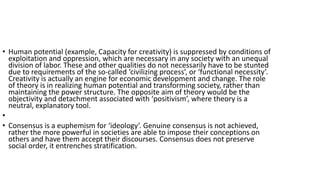
• Human potential (example, Capacity for creativity) is suppressed by conditions of
exploitation and oppression, which are necessary in any society with an unequal
division of labor. These and other qualities do not necessarily have to be stunted
due to requirements of the so-called ‘civilizing process’, or ‘functional necessity’.
Creativity is actually an engine for economic development and change. The role
of theory is in realizing human potential and transforming society, rather than
maintaining the power structure. The opposite aim of theory would be the
objectivity and detachment associated with ‘positivism’, where theory is a
neutral, explanatory tool.
•
• Consensus is a euphemism for ‘ideology’. Genuine consensus is not achieved,
rather the more powerful in societies are able to impose their conceptions on
others and have them accept their discourses. Consensus does not preserve
social order, it entrenches stratification.
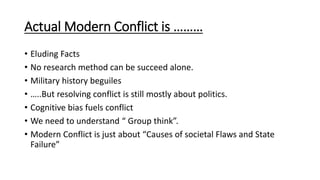
Actual Modern Conflict is ………
• Eluding Facts
• No research method can be succeed alone.
• Military history beguiles
• …..But resolving conflict is still mostly about politics.
• Cognitive bias fuels conflict
• We need to understand “ Group think”.
• Modern Conflict is just about “Causes of societal Flaws and State
Failure”
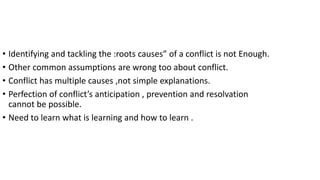
• Identifying and tackling the :roots causes” of a conflict is not Enough.
• Other common assumptions are wrong too about conflict.
• Conflict has multiple causes ,not simple explanations.
• Perfection of conflict’s anticipation , prevention and resolvation
cannot be possible.
• Need to learn what is learning and how to learn .
Thanks

Modern conflict

  • 1.
    SUMBUL FATIMA B.Ed (HONS.) M.AHISTORY MODERN CONFLICT
  • 2.
    Conflict • Conflict refersto some form of friction, or discord arising within a group when the beliefs or actions of one or more members of the group are either resisted by or unacceptable to one or more members of another group. Conflict can arise between members of the same group, known as intragroup conflict, or it can occur between members of two or more groups, and involve violence, interpersonal discord conflict. Conflict in groups often follows a specific course. Routine group interaction is first disrupted by an initial conflict, often caused by differences of opinion, disagreements between members, or scarcity of resources. At this point, the group is no longer united, and may split into coalitions. This period of conflict escalation in some cases gives way to a conflict resolution stage, after which the group can eventually return to routine group interaction
  • 3.
    Modern Conflict • Inthe case of earlier, topographic theory the systems or structures are called unconscious, preconscious and conscious. Modern conflict. Modern conflict theory is an extension and modification of the later ,so called structural theory. • he body of psychoanalytic theory about the mind and its functioning has the sobriquet modern conflict theory for two reasons. First, they indicate its relation to Freud's so-called structural theory and his so-called topographic theory, both of which attribute psycho-neurotic symptom formation to conflict among or between mental systems or structures. In the case of the earlier, topographic theory the systems or structures are called Unconscious, Preconscious, and Conscious. They are abbreviated as Ucs., Pcs., and Cs.
  • 4.
    • In thecase of the later, structural theory, they are called id, ego, and superego. The later theory was an extension and modification of the earlier one. Modern conflict theory is an extension and modification of the later, so-called structural theory. Second, these words distinguish it from the many other psychoanalytic theories of psychopathology, such as Klein Ian theory, Bionian theory, relational theory, subjectivist theory, and so on.
  • 5.
    Conflict Theories • Theseare sociology and social psychology that emphasize a materialist interpretation of History ,Dialectical Method of analysis , A Critical stance toward existing social arrangements, and political program or revolution or at least reform. Conflict theories draw attention to power differentials such as class conflict and generally contrast historically dominant ideologies. It is therefore a Marco-level analysis of society.
  • 6.
    Conflict Theories • Conflicttheories is most commonly associated with Marxism, but as a reaction to functionalism and the positivist method may also be associated with a number of other perspectives, including: • Critical Theory • Feminist Theory • Postmodern Theory • Post structural Theory • Postcolonial Theory • Queen Theory
  • 7.
    • World SystemTheory • Race-Conflict Approach Karl Marx is the father of Social Conflict Theory. C. Wright Mills has been called the founder of Modern Conflict Theory.
  • 8.
    Conflict Theory • Thehistory of conflict theory can be traced back to thinkers such as Machiavelli or Thomas Hobbes, both of whom viewed humanity cynically. In its current form, conflict theory attempts to refute the functionalist approach, which considers that societies and organizations function so that each individual and group plays a specific role, like organs in the body. There are radical basic assumptions (society is eternally in conflict, which might explain social change), or moderate ones (custom and conflict are always mixed). The moderate version allows for functionalism to operate as an equally acceptable theory since it would accept that even negative social institutions play a part in society's self-perpetuation.
  • 9.
    In understanding conflicttheory, competition between social classes plays a key part. The following are four primary assumptions of modern conflict theory: 1.Competition: Competition over scarce resources (money, leisure, sexual partners, and so on) is at the heart of all social relationships. Competition rather than consensus is characteristic of human relationships. 2.Structural inequality: Inequalities in power and reward are built into all social structures. Individuals and groups that benefit from any particular structure strive to see it maintained. 3.Revolution: Change occurs as a result of conflict between social class's competing interests rather than through adaptation. It is often abrupt and revolutionary rather than evolutionary. 4.War: Even war is a unifier of the societies involved, as well as war may set an end to whole societies. Conflict theory was elaborated in the United Kingdom by Max Gluckman and John Rex, in the United States by Lewis A. Coser, and Randall Collins, and in Germany by Ralf Dahrendorf, all of them being less or more influenced by Karl Marx, Ludwig Gumplovicz, Vilfredo Pareto, Georg Simmel, and other founding fathers of European sociology.
  • 10.
    Conflict theory appliedto society • Conflict theory offers a useful lens with which to analyze society. One might use this theory to explain the enmity between rich and poor within any society. This enmity could be expressed emotionally, verbally, or physically. Applying the theory to notable class conflicts is possible. Events such as the "Battle in Seattle" over global trade or the French Revolution serve as two examples. • Conflict theory can also be used to explain non-economic conflicts within a society. One might look at the divide between Protestants and Catholics as a battle over spiritual resources. On a less macro level, the competition between students in a classroom serves as a useful example as well. In such ways, conflict theory is usefully ambiguous in its application to innumerable phenomena.
  • 11.
    Classic theories • KarlMarx and Fried rich Engels, the Communist Manifesto, 1848 • “The history of all hitherto existing society is the history of class struggles. Freeman and slave, patrician and plebeian, lord and serf, guild-master and journeyman, in a word, oppressor and oppressed, stood in constant opposition to one another, carried on an interrupted, now hidden, now open fight, a fight that each time ended, either in a revolutionary re- constitution of society at large, or in the common ruin of the contending classes.” • -Ward’s Dynamic Sociology, 1883 was an extended thesis on how to reduce conflict and competition in society and thus optimize human progress. At the most basic level Ward saw human nature itself to be deeply conflicted between self-aggrandizement and altruism, between emotion and intellect, and between male and female
  • 12.
    • These conflictswould then be reflected in society and Ward assumed there had been a ‘perpetual and vigorous struggle’ among various ‘social forces’ that shaped civilization. Ward was optimistic and believed that it was possible to build on and reform present social structures with the help of sociological analysis. • -Gumplowicz, in Grundiss der Sociologies' (Outlines of Sociology, 1884), describes how civilization has been shaped by conflict between cultures and ethnic groups. Gumplowicz theorized that large complex societies evolved from the war and the conquest. Another organizes states around the domination of one group: masters and slaves. Eventually a complex caste system develops.
  • 13.
    Modern Approaches • InC. Wright Mills’ view, social structures are created through conflict between people with differing interests and resources. Individuals and resources, in turn, are influenced by these structures and by the ‘unequal distribution of power and resources in the society’. • -Gene Sharp’s key theme is that power is not monolithic; that is, it does not derive from some intrinsic quality of those who are in power. For Sharp, political power, the power of any state-regardless of its particular structural organization-ultimately derives from the subjects of the state. His fundamental belief is that any power structure relies upon the subjects’ obedience to the orders of the ruler(s). If subjects do not obey, leaders have no power.
  • 14.
    • Sharp’s scholarshiphas influenced resistance organizations around the world. Most recently the protest movement that toppled President Mubarak of Egypt drew extensively on his ideas. As well as the youth movement in Tunisia and the earlier ones in Eastern European ‘Color revolutions’ had been inspired by Sharp’s work. • -Alan Sears’ book ‘A Good Book, in theory’, 2008 articulates the conflict theory as follows: • Societies are defined by inequality that produces conflict, rather than which produces order and consensus. This conflict based on inequality can only be overcome through fundamental transformation of the existing relations in the society, and is productive of new social relations. The disadvantaged have structured interests that run counter to the status quo, which, once they are assumed, will lead to social change. Thus, they are viewed as agents of change rather than objects on should feel sympathy for.
  • 15.
    • Human potential(example, Capacity for creativity) is suppressed by conditions of exploitation and oppression, which are necessary in any society with an unequal division of labor. These and other qualities do not necessarily have to be stunted due to requirements of the so-called ‘civilizing process’, or ‘functional necessity’. Creativity is actually an engine for economic development and change. The role of theory is in realizing human potential and transforming society, rather than maintaining the power structure. The opposite aim of theory would be the objectivity and detachment associated with ‘positivism’, where theory is a neutral, explanatory tool. • • Consensus is a euphemism for ‘ideology’. Genuine consensus is not achieved, rather the more powerful in societies are able to impose their conceptions on others and have them accept their discourses. Consensus does not preserve social order, it entrenches stratification.
  • 16.
    Actual Modern Conflictis ……… • Eluding Facts • No research method can be succeed alone. • Military history beguiles • …..But resolving conflict is still mostly about politics. • Cognitive bias fuels conflict • We need to understand “ Group think”. • Modern Conflict is just about “Causes of societal Flaws and State Failure”
  • 17.
    • Identifying andtackling the :roots causes” of a conflict is not Enough. • Other common assumptions are wrong too about conflict. • Conflict has multiple causes ,not simple explanations. • Perfection of conflict’s anticipation , prevention and resolvation cannot be possible. • Need to learn what is learning and how to learn .
  • 18.