BIOGRAPHY Auguste Comte (1798-1857)was born in Montpellier, France.He was a philosopher and one of the founders of Sociology and Positivism. Comte was the first person to introduce the term “Altruism”. He had written two books namely, “The course of Positive Philosophy” and “A System of Positive Polity”
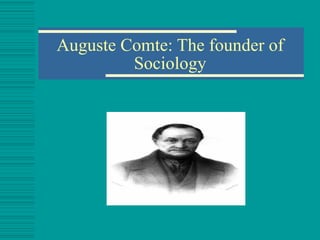
Auguste Comte: The founder of Sociology
Epistemology of his Theory Comte was very much concerned about , how society establish social order and how it is changed. In this regard, he argued that ,society undergoes three phases in its quest for the truth according to the  Laws of Three Stages.  These are   Theological ,  Metaphysical and  Positive Phases .
The Theological Phase The theological phase of man was based on whole-hearted belief in all things with reference to  God . God, Comte says, had reigned supreme over human existence pre- Enlightenment . Humanity's place in society was governed by its association with the divine presences and with the church. The theological phase deals with humankind's accepting the doctrines of the church (or place of worship) rather than relying on its rational powers to explore basic questions about existence. It dealt with the  restrictions put in place by the religious organization at the time and the total acceptance of any “fact” adduced for society to believe.
The Metaphysical Phase Comte describes the metaphysical phase of humanity as the time since the  Enlightenment , a time steeped in logical rationalism, to the time right after the  French Revolution . This second phase states that the universal rights of humanity are most important. The central idea is that humanity is invested with certain rights that must be respected. In this phase, democracies and dictators rose and fell in attempts to maintain the innate rights of humanity.
The Positive Phase The final stage of the trilogy of Comte’s universal law is the scientific, or positive stage. The central idea of this phase is that individual rights are more important than the rule of any one person. Comte stated the idea that humanity is able to govern itself is what makes this stage innately different from the rest. There is no higher power governing the masses and the intrigue of any one person than the idea that one can achieve anything based on one's individual free will and authority. The third principle is most important in the positive stage
Altruism(Ethics) Altruism  is an  ethical doctrine  that holds that individuals have a  moral   obligation  to help, serve, or benefit others, if necessary at the sacrifice of self interest.  Auguste Comte 's version of altruism calls for living for the sake of others. One who holds to either of these ethics is known as an "altruist."
Sociology France was Passing through social crisis during the time of Comte so in order to find a way out of this social impasse, he thought  a new science of society is needed which he termed as “Sociology ”
A Snapshot of His Theory - All human thinking, both for individual persons and for historical cultures, follows the law of the three stages: first seeking explanation in animistic purposes (the theological stage), then in abstract entities (the metaphysical stage), and finally in lawful observable correlations among variables (the positive stage).
THANK YOU

Auguste Comte

  • 1.
    BIOGRAPHY Auguste Comte(1798-1857)was born in Montpellier, France.He was a philosopher and one of the founders of Sociology and Positivism. Comte was the first person to introduce the term “Altruism”. He had written two books namely, “The course of Positive Philosophy” and “A System of Positive Polity”
  • 2.
    Auguste Comte: Thefounder of Sociology
  • 3.
    Epistemology of hisTheory Comte was very much concerned about , how society establish social order and how it is changed. In this regard, he argued that ,society undergoes three phases in its quest for the truth according to the Laws of Three Stages. These are Theological , Metaphysical and Positive Phases .
  • 4.
    The Theological PhaseThe theological phase of man was based on whole-hearted belief in all things with reference to God . God, Comte says, had reigned supreme over human existence pre- Enlightenment . Humanity's place in society was governed by its association with the divine presences and with the church. The theological phase deals with humankind's accepting the doctrines of the church (or place of worship) rather than relying on its rational powers to explore basic questions about existence. It dealt with the restrictions put in place by the religious organization at the time and the total acceptance of any “fact” adduced for society to believe.
  • 5.
    The Metaphysical PhaseComte describes the metaphysical phase of humanity as the time since the Enlightenment , a time steeped in logical rationalism, to the time right after the French Revolution . This second phase states that the universal rights of humanity are most important. The central idea is that humanity is invested with certain rights that must be respected. In this phase, democracies and dictators rose and fell in attempts to maintain the innate rights of humanity.
  • 6.
    The Positive PhaseThe final stage of the trilogy of Comte’s universal law is the scientific, or positive stage. The central idea of this phase is that individual rights are more important than the rule of any one person. Comte stated the idea that humanity is able to govern itself is what makes this stage innately different from the rest. There is no higher power governing the masses and the intrigue of any one person than the idea that one can achieve anything based on one's individual free will and authority. The third principle is most important in the positive stage
  • 7.
    Altruism(Ethics) Altruism is an ethical doctrine that holds that individuals have a moral obligation to help, serve, or benefit others, if necessary at the sacrifice of self interest. Auguste Comte 's version of altruism calls for living for the sake of others. One who holds to either of these ethics is known as an "altruist."
  • 8.
    Sociology France wasPassing through social crisis during the time of Comte so in order to find a way out of this social impasse, he thought a new science of society is needed which he termed as “Sociology ”
  • 9.
    A Snapshot ofHis Theory - All human thinking, both for individual persons and for historical cultures, follows the law of the three stages: first seeking explanation in animistic purposes (the theological stage), then in abstract entities (the metaphysical stage), and finally in lawful observable correlations among variables (the positive stage).
  • 10.