Metanoia, Inc.
                           Critical Systems Thinking™


Modern Carrier Strategies for
    Traffic Engineering
                      Dr. Vishal Sharma
                      Principal Consultant
                      Metanoia, Inc.
                      Voice: +1 408 394 6321
                      Email: v.sharma@ieee.org
                      Web: http://www.metanoia-
 © Copyright 2002
All Rights Reserved   inc.com
Metanoia, Inc.
                                                                  Critical Systems Thinking™


Basic Service Provider Goals
The two fundamental tasks before any service provider:
 Deploy a physical topology that meets customers’ needs


 Map customer traffic flows on to the physical topology


 Earlier (1990s) the mapping task was uncontrolled!
          By-product of shortest-path IGP routing
          Often handled by over-provisioning


©Copyright 2002,
All Rights Reserved            Modern Carrier Strategies for TE                        2
Metanoia, Inc.
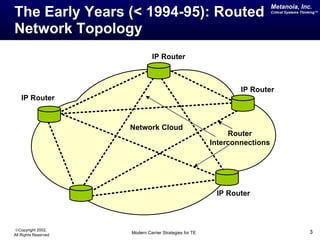
The Early Years (< 1994-95): Routed                                         Critical Systems Thinking™


Network Topology
                                IP Router


                                                                 IP Router
    IP Router


                      Network Cloud
                                                              Router
                                                         Interconnections


                                                          IP Router


©Copyright 2002,
All Rights Reserved   Modern Carrier Strategies for TE                                           3
Metanoia, Inc.
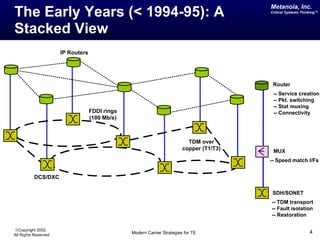
The Early Years (< 1994-95): A                                                            Critical Systems Thinking™


Stacked View
                      IP Routers


                                                                                           Router
                                                                                           -- Service creation
                                                                                           -- Pkt. switching
                                                                                           -- Stat muxing
                                   FDDI rings                                              -- Connectivity
                                   (100 Mb/s)


                                                                           TDM over
                                                                         copper (T1/T3)    MUX
                                                                                          -- Speed match I/Fs


          DCS/DXC

                                                                                           SDH/SONET
                                                                                          -- TDM transport
                                                                                          -- Fault isolation
                                                                                          -- Restoration

©Copyright 2002,
All Rights Reserved                             Modern Carrier Strategies for TE                               4
Metanoia, Inc.
TE in Carrier Networks: Traditional                                Critical Systems Thinking™


Routed Core (pre 1994-95)

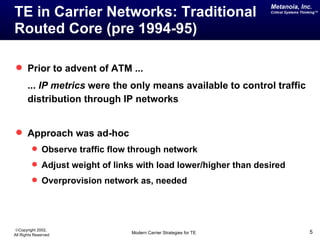
 Prior to advent of ATM ...
       ... IP metrics were the only means available to control traffic
       distribution through IP networks


 Approach was ad-hoc
          Observe traffic flow through network
          Adjust weight of links with load lower/higher than desired
          Overprovision network as, needed


©Copyright 2002,
All Rights Reserved             Modern Carrier Strategies for TE                        5
Metanoia, Inc.
                                                                                     Critical Systems Thinking™


Two Paths to TE in IP Networks
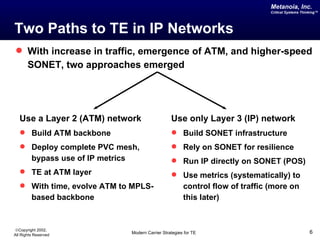
 With increase in traffic, emergence of ATM, and higher-speed
       SONET, two approaches emerged


   Use a Layer 2 (ATM) network                         Use only Layer 3 (IP) network
    Build ATM backbone                                 Build SONET infrastructure
    Deploy complete PVC mesh,                          Rely on SONET for resilience
         bypass use of IP metrics                       Run IP directly on SONET (POS)
    TE at ATM layer                                    Use metrics (systematically) to
    With time, evolve ATM to MPLS-                          control flow of traffic (more on
         based backbone                                      this later)


©Copyright 2002,
All Rights Reserved                 Modern Carrier Strategies for TE                                      6
Metanoia, Inc.
                                                                   Critical Systems Thinking™


Genesis of the ATM-Core
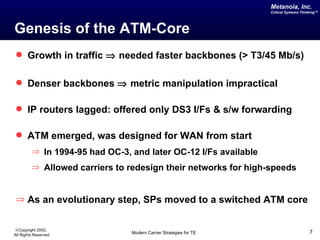
 Growth in traffic ⇒ needed faster backbones (> T3/45 Mb/s)


 Denser backbones ⇒ metric manipulation impractical

 IP routers lagged: offered only DS3 I/Fs & s/w forwarding

 ATM emerged, was designed for WAN from start
         ⇒ In 1994-95 had OC-3, and later OC-12 I/Fs available
         ⇒ Allowed carriers to redesign their networks for high-speeds


⇒ As an evolutionary step, SPs moved to a switched ATM core


©Copyright 2002,
All Rights Reserved             Modern Carrier Strategies for TE                        7
Metanoia, Inc.
                                                          Critical Systems Thinking™


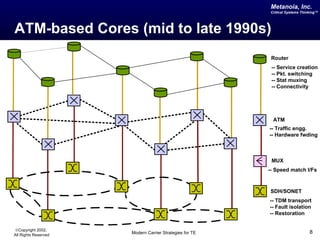
ATM-based Cores (mid to late 1990s)
                                                          Router
                                                          -- Service creation
                                                          -- Pkt. switching
                                                          -- Stat muxing
                                                          -- Connectivity


                                                           ATM
                                                         -- Traffic engg.
                                                         -- Hardware fwding


                                                          MUX
                                                         -- Speed match I/Fs


                                                          SDH/SONET
                                                         -- TDM transport
                                                         -- Fault isolation
                                                         -- Restoration


©Copyright 2002,
All Rights Reserved   Modern Carrier Strategies for TE                         8
Metanoia, Inc.
                                                                                                 Critical Systems Thinking™


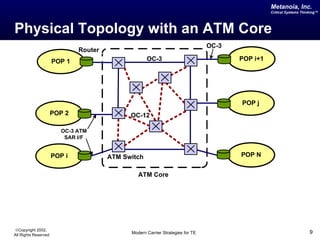
Physical Topology with an ATM Core
                                                                                OC-3
                              Router
                      POP 1                         OC-3                               POP i+1


                                                                                       POP j
                      POP 2                  OC-12

                         OC-3 ATM
                          SAR I/F


                      POP i            ATM Switch                                      POP N


                                                ATM Core


©Copyright 2002,
All Rights Reserved                          Modern Carrier Strategies for TE                                         9
Metanoia, Inc.
                                                                                                              Critical Systems Thinking™


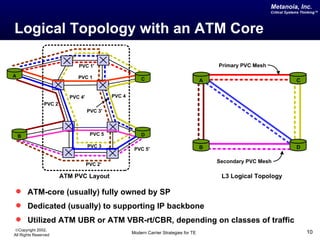
Logical Topology with an ATM Core

                             PVC 1'                                                        Primary PVC Mesh
A                            PVC 1                      C                              A                                    C


                          PVC 4'            PVC 4
                PVC 2
                                   PVC 3'


    B                               PVC 5               D

                                   PVC 3                                               B                                    D
                                                     PVC 5'

                                                                                           Secondary PVC Mesh
                                   PVC 2'

                        ATM PVC Layout                                                      L3 Logical Topology

 ATM-core (usually) fully owned by SP
 Dedicated (usually) to supporting IP backbone
 Utilized ATM UBR or ATM VBR-rt/CBR, depending on classes of traffic
©Copyright 2002,
All Rights Reserved                                 Modern Carrier Strategies for TE                                             10
Metanoia, Inc.
Genesis of the IP-over-SONET/SDH                                   Critical Systems Thinking™


Approach
 Desire to minimize # of network layers
        Easier management
        Simpler operation
        Potentially scalable


 Belief that high-speed SONET/SDH I/Fs would become
     available with advances in components (vindicated with time)


 Dictated partly by how (in time) a carrier’s network evolved


©Copyright 2002,
All Rights Reserved             Modern Carrier Strategies for TE                      11
Metanoia, Inc.
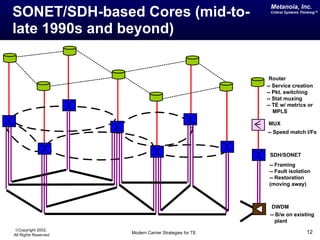
SONET/SDH-based Cores (mid-to-                            Critical Systems Thinking™


late 1990s and beyond)


                                                          Router
                                                         -- Service creation
                                                         -- Pkt. switching
                                                         -- Stat muxing
                                                         -- TE w/ metrics or
                                                            MPLS

                                                         MUX
                                                         -- Speed match I/Fs


                                                          SDH/SONET
                                                          -- Framing
                                                          -- Fault isolation
                                                          -- Restoration
                                                          (moving away)


                                                           DWDM
                                                          -- B/w on existing
                                                             plant
©Copyright 2002,
All Rights Reserved   Modern Carrier Strategies for TE                       12
Metanoia, Inc.
                                                                                                     Critical Systems Thinking™


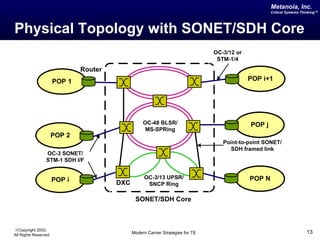
Physical Topology with SONET/SDH Core
                                                                                OC-3/12 or
                                                                                 STM-1/4
                              Router
                      POP 1                                                                  POP i+1


                                                  OC-48 BLSR/                                POP j
                                                   MS-SPRing
                      POP 2
                                                                                   Point-to-point SONET/
                                                                                      SDH framed link
                 OC-3 SONET/
                 STM-1 SDH I/F


                      POP i                        OC-3/13 UPSR/                             POP N
                                       DXC          SNCP Ring

                                              SONET/SDH Core


©Copyright 2002,
All Rights Reserved                          Modern Carrier Strategies for TE                                           13
Metanoia, Inc.
                                                                                                               Critical Systems Thinking™


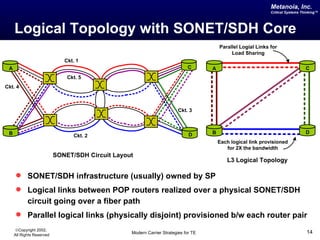
     Logical Topology with SONET/SDH Core
                                                                                         Parallel Logial Links for
                                                                                              Load Sharing
                              Ckt. 1
 A                                                                           C       A                                            C
                               Ckt. 5
Ckt. 4


                                                                         Ckt. 3


 B                                                                            D      B                                            D
                                 Ckt. 2
                                                                                         Each logical link provisioned
                                                                                            for 2X the bandwidth
                           SONET/SDH Circuit Layout
                                                                                            L3 Logical Topology

      SONET/SDH infrastructure (usually) owned by SP
      Logical links between POP routers realized over a physical SONET/SDH
            circuit going over a fiber path
      Parallel logical links (physically disjoint) provisioned b/w each router pair
     ©Copyright 2002,
     All Rights Reserved                          Modern Carrier Strategies for TE                                                14
Metanoia, Inc.
                                                                                          Critical Systems Thinking™


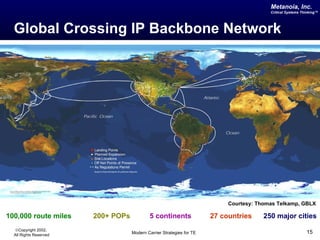
  Global Crossing IP Backbone Network


                                                                            Courtesy: Thomas Telkamp, GBLX

100,000 route miles     200+ POPs           5 continents               27 countries     250 major cities
  ©Copyright 2002,
  All Rights Reserved               Modern Carrier Strategies for TE                                         15
Metanoia, Inc.
                                                                      Critical Systems Thinking™


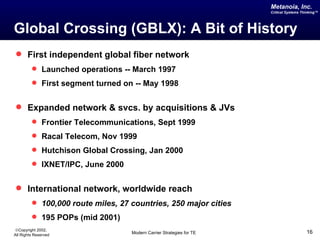
Global Crossing (GBLX): A Bit of History
 First independent global fiber network
          Launched operations -- March 1997
          First segment turned on -- May 1998


 Expanded network & svcs. by acquisitions & JVs
          Frontier Telecommunications, Sept 1999
          Racal Telecom, Nov 1999
          Hutchison Global Crossing, Jan 2000
          IXNET/IPC, June 2000


 International network, worldwide reach
          100,000 route miles, 27 countries, 250 major cities
          195 POPs (mid 2001)
©Copyright 2002,
All Rights Reserved                Modern Carrier Strategies for TE                      16
Metanoia, Inc.
                                                                                            Critical Systems Thinking™


Global Crossing IP Network
 OC-48c/STM-16c (2.5Gbps) IP backbone
          Selected 10Gbps links operational (e.g. Atlantic)
                                                           Edge Equipment


                                                                      Cisco 7500/7200 ESR, OSR
                                                                          Juniper M10/20/40


                               Core Equipment

                            Cisco GSR 12000/12400
                                 [12.0(17) SI]
 Services offered
          Internet access & Transit services
          IP VPNs -- Layer 3 and Layer 2
          MPLS and DiffServ deployed globally

©Copyright 2002,
All Rights Reserved                Modern Carrier Strategies for TE                                            17
Metanoia, Inc.
Global Crossing:                                                       Critical Systems Thinking™


Network Design Philosophy
 Ensure there are no bottlenecks in normal state


 On handling congestion
          Prevent via MPLS-TE
          Manage via Diffserv


 Over-provisioning
          Well traffic engineered network can handle all traffic
          Can withstand failure of even the most critical link(s)


 Avoid excessive complexity & features
          Makes the network unreliable/unstable


©Copyright 2002,
All Rights Reserved                 Modern Carrier Strategies for TE                      18
Metanoia, Inc.
                                                                                                            Critical Systems Thinking™


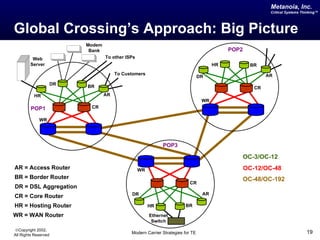
Global Crossing’s Approach: Big Picture
                           Modem
                            Bank                                                            POP2
         Web                       To other ISPs
        Server                                                                         HR            BR
                                        To Customers                                                       AR
                                                                                 DR
                      DR
                           BR                                                                         CR
          HR                       AR
                                                                                  WR
         POP1               CR

             WR


                                                             POP3

                                                                                                   OC-3/OC-12
AR = Access Router                                 WR                                              OC-12/OC-48
BR = Border Router                                                                                 OC-48/OC-192
                                                                          CR
DR = DSL Aggregation
                                              DR                                  AR
CR = Core Router
HR = Hosting Router                                     HR              BR

WR = WAN Router                                         Ethernet
                                                         Switch
©Copyright 2002,
All Rights Reserved                           Modern Carrier Strategies for TE                                                 19
Metanoia, Inc.
TE in the US IP Network:                                                   Critical Systems Thinking™


Deployment Strategy
 Decision to adopt MPLS for traffic engineering & VPNs
          Y2000: 50+ POPs, 300 routers; Y2002: 200+ POPs


 Initially, hierarchical MPLS system  2 levels of LSPs


 Later, a flat MPLS LSP full mesh only between core routers


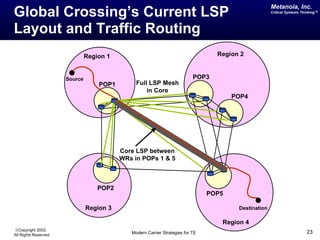
 Started w/ 9 regions -- 10-50 LSRs/region ⇒ 100-2500 LSPs/region
          Within regions: Routers fully-meshed
          Across regions: Core routers fully-meshed


 Intra-region traffic ~Mb/s to Gb/s, Inter-region traffic ~ Gb/s
                                                                    Source [Xiao00]
©Copyright 2002,
All Rights Reserved              Modern Carrier Strategies for TE                             20
Metanoia, Inc.
                                                                                        Critical Systems Thinking™


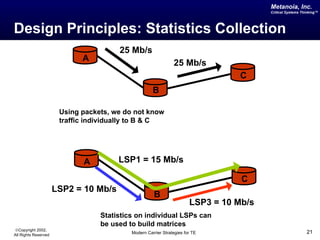
Design Principles: Statistics Collection
                                       25 Mb/s
                             A
                                                               25 Mb/s
                                                                                 C
                                                     B

                       Using packets, we do not know
                       traffic individually to B & C


                             A         LSP1 = 15 Mb/s

                                                                                  C
                      LSP2 = 10 Mb/s
                                                      B
                                                                       LSP3 = 10 Mb/s
                                  Statistics on individual LSPs can
                                  be used to build matrices
©Copyright 2002,
All Rights Reserved                        Modern Carrier Strategies for TE                                21
Metanoia, Inc.
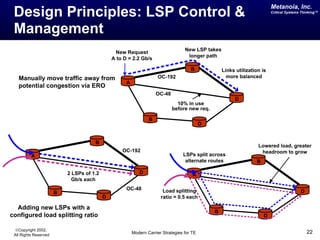
 Design Principles: LSP Control &                                                                                          Critical Systems Thinking™


 Management
                                                                                   New LSP takes
                                                New Request
                                                                                    longer path
                                               A to D = 2.2 Gb/s

                                                                                      B             Links utilization is
   Manually move traffic away from                                   OC-192                           more balanced
                                                     A
   potential congestion via ERO
                                                                     OC-48
                                                                                                          D
                                                                               10% in use
                                                                             before new req.

                                                                 B
                                                                                            D


                                      B
                                                                                                                    Lowered load, greater
                                                   OC-192                                                            headroom to grow
          A                                                                       LSPs split across
                                                                                   alternate routes                B

                           2 LSPs of 1.2                    D                          A
                             Gb/s each
                                                     OC-48              Load splitting
                       B                                                                                                                   D
                                           D                           ratio = 0.5 each

  Adding new LSPs with a
                                                                                                B
configured load splitting ratio                                                                                        D

 ©Copyright 2002,
 All Rights Reserved                                     Modern Carrier Strategies for TE                                                      22
Metanoia, Inc.
Global Crossing’s Current LSP                                                                         Critical Systems Thinking™


Layout and Traffic Routing
                               Region 1                                           Region 2


                      Source                                               POP3
                                   POP1        Full LSP Mesh
                                                   in Core
                                                                                       POP4


                                          Core LSP between
                                          WRs in POPs 1 & 5


                                   POP2
                                                                                POP5

                               Region 3                                                 Destination

                                                                                   Region 4
©Copyright 2002,
All Rights Reserved                          Modern Carrier Strategies for TE                                            23
Metanoia, Inc.
                                                                          Critical Systems Thinking™


Sprint (FON): A Bit of History
 A century of evolution ...
         1899: Brown Telephone Co., Abilene, KS
         1976: United Telephone, Kansas City, MS, 3.5M customers
         1984: Began building first, all-digital, US-wide, fiber-optic network
         1986: United + GTE merge LD subsidiaries  US Sprint
         1992: United buys GTE’s stake, renaming co. to Sprint Corp.
         2002: ~$23B revenue, 23M customers, 70 countries, 80,000 employees

 110,000+ route miles in the long distance (LD) network
          34,000+ in US, 78,000+ in rest of the world

 Transport infrastructure common to voice, ATM, & IP network
          Provides considerable leverage, as we’ll see later

©Copyright 2002,
All Rights Reserved                 Modern Carrier Strategies for TE                         24
Metanoia, Inc.
                                                                                                                   Critical Systems Thinking™


   Sprint (FON): IP Network Timeline

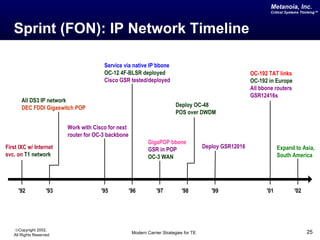
                                        Service via native IP bbone
                                        OC-12 4F-BLSR deployed                                             OC-192 TAT links
                                        Cisco GSR tested/deployed                                          OC-192 in Europe
                                                                                                           All bbone routers
                                                                                                           GSR12416s
       All DS3 IP network
       DEC FDDI Gigaswitch POP                                             Deploy OC-48
                                                                           POS over DWDM

                          Work with Cisco for next
                          router for OC-3 backbone
                                                              GigaPOP bbone
First IXC w/ Internet                                         GSR in POP                 Deploy GSR12016               Expand to Asia,
svc. on T1 network                                            OC-3 WAN                                                 South America


     '92            '93                '95           '96          '97         '98           '99                  '01            '02


   ©Copyright 2002,
   All Rights Reserved                                Modern Carrier Strategies for TE                                                25
Metanoia, Inc.
                                                                                                     Critical Systems Thinking™


SprintLinkTM IP Backbone Network


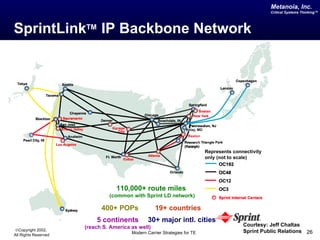
                                                                           Represents connectivity
                                                                           only (not to scale)


                                  110,000+ route miles
                               (common with Sprint LD network)

                            400+ POPs              19+ countries
                          5 continents          30+ major intl. cities
                      (reach S. America as well)                                          Courtesy: Jeff Chaltas
©Copyright 2002,                                                                          Sprint Public Relations 26
All Rights Reserved                     Modern Carrier Strategies for TE
Metanoia, Inc.
                                                                      Critical Systems Thinking™


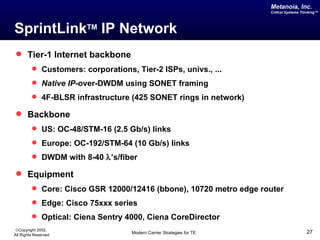
SprintLinkTM IP Network
 Tier-1 Internet backbone
          Customers: corporations, Tier-2 ISPs, univs., ...
          Native IP-over-DWDM using SONET framing
          4F-BLSR infrastructure (425 SONET rings in network)

 Backbone
          US: OC-48/STM-16 (2.5 Gb/s) links
          Europe: OC-192/STM-64 (10 Gb/s) links
          DWDM with 8-40 λ’s/fiber

 Equipment
          Core: Cisco GSR 12000/12416 (bbone), 10720 metro edge router
          Edge: Cisco 75xxx series
          Optical: Ciena Sentry 4000, Ciena CoreDirector
©Copyright 2002,
All Rights Reserved                Modern Carrier Strategies for TE                      27
Metanoia, Inc.
                                                                             Critical Systems Thinking™


SprintLinkTM IP Design Philosophy
 Large networks exhibit arch., design & engg. (ADE) non-linearities not
       seen at smaller scales
         ⇒ Even small things can & do cause huge effects (amplification)
         ⇒ More simultaneous events mean greater likelihood of interaction (coupling)


∴ Simplicity Principle: simple n/wks are easier to operate & scale
         ⇒ Complexity prohibits efficient scaling, driving up CAPEX and OPEX!


 Confine intelligence at edges


 No state in the network core/backbone


 Fastest forwarding of packets in core
         ⇒ Ensure packets encounter minimal queueing
©Copyright 2002,
All Rights Reserved                  Modern Carrier Strategies for TE                           28
Metanoia, Inc.
                                                                                                Critical Systems Thinking™


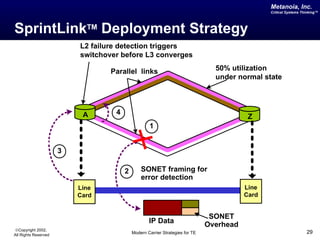
SprintLinkTM Deployment Strategy
                          L2 failure detection triggers
                          switchover before L3 converges

                                  Parallel links                                50% utilization
                                                                                under normal state


                           A       4
                                                                                          Z
                                                   1


                      3

                                       2       SONET framing for
                                               error detection
                          Line                                                           Line
                          Card                                                           Card


                                                                               SONET
                                                   IP Data
                                                                              Overhead
©Copyright 2002,
All Rights Reserved                        Modern Carrier Strategies for TE                                        29
Metanoia, Inc.
                                                                  Critical Systems Thinking™


SprintLinkTM Design Principles
 Great value on traffic measurement & monitoring


 Use it for
          Design, operations, management
          Dimensioning, provisioning
          SLAs, pricing
          Minimizing the extent of complex TE & QoS in the core


©Copyright 2002,
All Rights Reserved            Modern Carrier Strategies for TE                      30
Metanoia, Inc.
                                                                                                          Critical Systems Thinking™


Sprint’s Approach to Monitoring


                                                                                              Backbone
                                                                                                Links


                                                                                              Backbone
                                                                                                          Peering Links
                                                                                               Router
                                                                                   Probe


                                                                                  Access       Access         Access
                                                                                  Router       Router         Router


                Analysis platform located at
                Sprint ATL, Burlingame, CA                                        Customers   Customers    Customers


                                                                                              Adapted from [Diot99]
©Copyright 2002,
All Rights Reserved                            Modern Carrier Strategies for TE                                              31
Metanoia, Inc.
                                                                              Critical Systems Thinking™


Sprint Approach to TE
Aim: Thoroughly understand backbone traffic dynamics


Answer questions such as:
 Composition of traffic? Origin of traffic?


 Between any pair of POPs
          What is the traffic demand?
                   Volume of traffic?

                   Traffic patterns? (In time? In space?)

          How is this demand routed?


 How does one design traffic matrics optimally?

©Copyright 2002,
All Rights Reserved                        Modern Carrier Strategies for TE                      32
Metanoia, Inc.
                                                                                                                  Critical Systems Thinking™


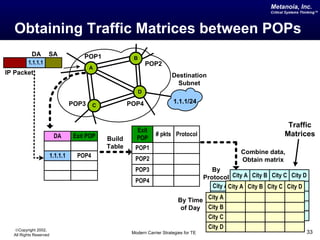
   Obtaining Traffic Matrices between POPs
           DA       SA                 POP1              B
         1.1.1.1                                                 POP2
                                         A
IP Packet                                                                   Destination
                                                                              Subnet
                                                             D

                                  POP3                 POP4                 1.1.1/24
                                           C


                                                                                                                          Traffic
                                                          Exit
                         DA        Exit POP               POP
                                                                   # pkts Protocol                                       Matrices
                                               Build
                                               Table     POP1
                                                                                                        Combine data,
                        1.1.1.1     POP4                 POP2                                           Obtain matrix
                                                         POP3                                 By
                                                                                           Protocol City A City B City C City D
                                                         POP4
                                                                                              City ACity A City B City C City D

                                                                               By Time      City A B
                                                                                              City
                                                                                of Day City B C
                                                                                        City
                                                                                       City C D
                                                                                        City

  ©Copyright 2002,
                                                                                            City D
  All Rights Reserved                                   Modern Carrier Strategies for TE                                             33
Metanoia, Inc.
                                                                                                          Critical Systems Thinking™


A Peek at a Row of a Traffic Matrix
                      To Backbone
                                      Peer 2


  Peer 1


              ISP
                                          Web 2

                            Web 1


                      Sprint POP under study


                                                                               Distribution of aggregate access
                                                                               traffic across other POPs in the Sprint
                                                                               backbone


                                                                                            Adapted from [Bhattacharya02]
              Summary of Data Collected
©Copyright 2002,
All Rights Reserved                               Modern Carrier Strategies for TE                                           34
Metanoia, Inc.
                                                            Critical Systems Thinking™


Applications of Traffic Matrices
 Traffic engineering


 Verify BGP peering


 Intra-domain routing


 SLA drafting


 Customer reports


©Copyright 2002,
All Rights Reserved      Modern Carrier Strategies for TE                      35
Metanoia, Inc.
                                                                  Critical Systems Thinking™


Acknowledgements
   Thomas Telkamp, Global Crossing
   Robert J. Rockell, Jeff Chaltas, Ananth Nagarajan, Sprint
   Steve Gordon, Cable and Wireless
   Jennifer Rexford, Albert Greenberg, Carsten Lund, AT&T Research
   Wai-Sum Lai, AT&T
   Fang Wu, NTT America
   Arman Maghbouleh, Alan Gous, Cariden Technologies
   Yufei Wang, VPI Systems


©Copyright 2002,
All Rights Reserved            Modern Carrier Strategies for TE                      36

Modern Carrier Strategies for Traffic Engineering

  • 1.
    Metanoia, Inc. Critical Systems Thinking™ Modern Carrier Strategies for Traffic Engineering Dr. Vishal Sharma Principal Consultant Metanoia, Inc. Voice: +1 408 394 6321 Email: v.sharma@ieee.org Web: http://www.metanoia- © Copyright 2002 All Rights Reserved inc.com
  • 2.
    Metanoia, Inc. Critical Systems Thinking™ Basic Service Provider Goals The two fundamental tasks before any service provider:  Deploy a physical topology that meets customers’ needs  Map customer traffic flows on to the physical topology  Earlier (1990s) the mapping task was uncontrolled!  By-product of shortest-path IGP routing  Often handled by over-provisioning ©Copyright 2002, All Rights Reserved Modern Carrier Strategies for TE 2
  • 3.
    Metanoia, Inc. The EarlyYears (< 1994-95): Routed Critical Systems Thinking™ Network Topology IP Router IP Router IP Router Network Cloud Router Interconnections IP Router ©Copyright 2002, All Rights Reserved Modern Carrier Strategies for TE 3
  • 4.
    Metanoia, Inc. The EarlyYears (< 1994-95): A Critical Systems Thinking™ Stacked View IP Routers Router -- Service creation -- Pkt. switching -- Stat muxing FDDI rings -- Connectivity (100 Mb/s) TDM over copper (T1/T3) MUX -- Speed match I/Fs DCS/DXC SDH/SONET -- TDM transport -- Fault isolation -- Restoration ©Copyright 2002, All Rights Reserved Modern Carrier Strategies for TE 4
  • 5.
    Metanoia, Inc. TE inCarrier Networks: Traditional Critical Systems Thinking™ Routed Core (pre 1994-95)  Prior to advent of ATM ... ... IP metrics were the only means available to control traffic distribution through IP networks  Approach was ad-hoc  Observe traffic flow through network  Adjust weight of links with load lower/higher than desired  Overprovision network as, needed ©Copyright 2002, All Rights Reserved Modern Carrier Strategies for TE 5
  • 6.
    Metanoia, Inc. Critical Systems Thinking™ Two Paths to TE in IP Networks  With increase in traffic, emergence of ATM, and higher-speed SONET, two approaches emerged Use a Layer 2 (ATM) network Use only Layer 3 (IP) network  Build ATM backbone  Build SONET infrastructure  Deploy complete PVC mesh,  Rely on SONET for resilience bypass use of IP metrics  Run IP directly on SONET (POS)  TE at ATM layer  Use metrics (systematically) to  With time, evolve ATM to MPLS- control flow of traffic (more on based backbone this later) ©Copyright 2002, All Rights Reserved Modern Carrier Strategies for TE 6
  • 7.
    Metanoia, Inc. Critical Systems Thinking™ Genesis of the ATM-Core  Growth in traffic ⇒ needed faster backbones (> T3/45 Mb/s)  Denser backbones ⇒ metric manipulation impractical  IP routers lagged: offered only DS3 I/Fs & s/w forwarding  ATM emerged, was designed for WAN from start ⇒ In 1994-95 had OC-3, and later OC-12 I/Fs available ⇒ Allowed carriers to redesign their networks for high-speeds ⇒ As an evolutionary step, SPs moved to a switched ATM core ©Copyright 2002, All Rights Reserved Modern Carrier Strategies for TE 7
  • 8.
    Metanoia, Inc. Critical Systems Thinking™ ATM-based Cores (mid to late 1990s) Router -- Service creation -- Pkt. switching -- Stat muxing -- Connectivity ATM -- Traffic engg. -- Hardware fwding MUX -- Speed match I/Fs SDH/SONET -- TDM transport -- Fault isolation -- Restoration ©Copyright 2002, All Rights Reserved Modern Carrier Strategies for TE 8
  • 9.
    Metanoia, Inc. Critical Systems Thinking™ Physical Topology with an ATM Core OC-3 Router POP 1 OC-3 POP i+1 POP j POP 2 OC-12 OC-3 ATM SAR I/F POP i ATM Switch POP N ATM Core ©Copyright 2002, All Rights Reserved Modern Carrier Strategies for TE 9
  • 10.
    Metanoia, Inc. Critical Systems Thinking™ Logical Topology with an ATM Core PVC 1' Primary PVC Mesh A PVC 1 C A C PVC 4' PVC 4 PVC 2 PVC 3' B PVC 5 D PVC 3 B D PVC 5' Secondary PVC Mesh PVC 2' ATM PVC Layout L3 Logical Topology  ATM-core (usually) fully owned by SP  Dedicated (usually) to supporting IP backbone  Utilized ATM UBR or ATM VBR-rt/CBR, depending on classes of traffic ©Copyright 2002, All Rights Reserved Modern Carrier Strategies for TE 10
  • 11.
    Metanoia, Inc. Genesis ofthe IP-over-SONET/SDH Critical Systems Thinking™ Approach  Desire to minimize # of network layers  Easier management  Simpler operation  Potentially scalable  Belief that high-speed SONET/SDH I/Fs would become available with advances in components (vindicated with time)  Dictated partly by how (in time) a carrier’s network evolved ©Copyright 2002, All Rights Reserved Modern Carrier Strategies for TE 11
  • 12.
    Metanoia, Inc. SONET/SDH-based Cores(mid-to- Critical Systems Thinking™ late 1990s and beyond) Router -- Service creation -- Pkt. switching -- Stat muxing -- TE w/ metrics or MPLS MUX -- Speed match I/Fs SDH/SONET -- Framing -- Fault isolation -- Restoration (moving away) DWDM -- B/w on existing plant ©Copyright 2002, All Rights Reserved Modern Carrier Strategies for TE 12
  • 13.
    Metanoia, Inc. Critical Systems Thinking™ Physical Topology with SONET/SDH Core OC-3/12 or STM-1/4 Router POP 1 POP i+1 OC-48 BLSR/ POP j MS-SPRing POP 2 Point-to-point SONET/ SDH framed link OC-3 SONET/ STM-1 SDH I/F POP i OC-3/13 UPSR/ POP N DXC SNCP Ring SONET/SDH Core ©Copyright 2002, All Rights Reserved Modern Carrier Strategies for TE 13
  • 14.
    Metanoia, Inc. Critical Systems Thinking™ Logical Topology with SONET/SDH Core Parallel Logial Links for Load Sharing Ckt. 1 A C A C Ckt. 5 Ckt. 4 Ckt. 3 B D B D Ckt. 2 Each logical link provisioned for 2X the bandwidth SONET/SDH Circuit Layout L3 Logical Topology  SONET/SDH infrastructure (usually) owned by SP  Logical links between POP routers realized over a physical SONET/SDH circuit going over a fiber path  Parallel logical links (physically disjoint) provisioned b/w each router pair ©Copyright 2002, All Rights Reserved Modern Carrier Strategies for TE 14
  • 15.
    Metanoia, Inc. Critical Systems Thinking™ Global Crossing IP Backbone Network Courtesy: Thomas Telkamp, GBLX 100,000 route miles 200+ POPs 5 continents 27 countries 250 major cities ©Copyright 2002, All Rights Reserved Modern Carrier Strategies for TE 15
  • 16.
    Metanoia, Inc. Critical Systems Thinking™ Global Crossing (GBLX): A Bit of History  First independent global fiber network  Launched operations -- March 1997  First segment turned on -- May 1998  Expanded network & svcs. by acquisitions & JVs  Frontier Telecommunications, Sept 1999  Racal Telecom, Nov 1999  Hutchison Global Crossing, Jan 2000  IXNET/IPC, June 2000  International network, worldwide reach  100,000 route miles, 27 countries, 250 major cities  195 POPs (mid 2001) ©Copyright 2002, All Rights Reserved Modern Carrier Strategies for TE 16
  • 17.
    Metanoia, Inc. Critical Systems Thinking™ Global Crossing IP Network  OC-48c/STM-16c (2.5Gbps) IP backbone  Selected 10Gbps links operational (e.g. Atlantic) Edge Equipment Cisco 7500/7200 ESR, OSR Juniper M10/20/40 Core Equipment Cisco GSR 12000/12400 [12.0(17) SI]  Services offered  Internet access & Transit services  IP VPNs -- Layer 3 and Layer 2  MPLS and DiffServ deployed globally ©Copyright 2002, All Rights Reserved Modern Carrier Strategies for TE 17
  • 18.
    Metanoia, Inc. Global Crossing: Critical Systems Thinking™ Network Design Philosophy  Ensure there are no bottlenecks in normal state  On handling congestion  Prevent via MPLS-TE  Manage via Diffserv  Over-provisioning  Well traffic engineered network can handle all traffic  Can withstand failure of even the most critical link(s)  Avoid excessive complexity & features  Makes the network unreliable/unstable ©Copyright 2002, All Rights Reserved Modern Carrier Strategies for TE 18
  • 19.
    Metanoia, Inc. Critical Systems Thinking™ Global Crossing’s Approach: Big Picture Modem Bank POP2 Web To other ISPs Server HR BR To Customers AR DR DR BR CR HR AR WR POP1 CR WR POP3 OC-3/OC-12 AR = Access Router WR OC-12/OC-48 BR = Border Router OC-48/OC-192 CR DR = DSL Aggregation DR AR CR = Core Router HR = Hosting Router HR BR WR = WAN Router Ethernet Switch ©Copyright 2002, All Rights Reserved Modern Carrier Strategies for TE 19
  • 20.
    Metanoia, Inc. TE inthe US IP Network: Critical Systems Thinking™ Deployment Strategy  Decision to adopt MPLS for traffic engineering & VPNs  Y2000: 50+ POPs, 300 routers; Y2002: 200+ POPs  Initially, hierarchical MPLS system  2 levels of LSPs  Later, a flat MPLS LSP full mesh only between core routers  Started w/ 9 regions -- 10-50 LSRs/region ⇒ 100-2500 LSPs/region  Within regions: Routers fully-meshed  Across regions: Core routers fully-meshed  Intra-region traffic ~Mb/s to Gb/s, Inter-region traffic ~ Gb/s Source [Xiao00] ©Copyright 2002, All Rights Reserved Modern Carrier Strategies for TE 20
  • 21.
    Metanoia, Inc. Critical Systems Thinking™ Design Principles: Statistics Collection 25 Mb/s A 25 Mb/s C B Using packets, we do not know traffic individually to B & C A LSP1 = 15 Mb/s C LSP2 = 10 Mb/s B LSP3 = 10 Mb/s Statistics on individual LSPs can be used to build matrices ©Copyright 2002, All Rights Reserved Modern Carrier Strategies for TE 21
  • 22.
    Metanoia, Inc. DesignPrinciples: LSP Control & Critical Systems Thinking™ Management New LSP takes New Request longer path A to D = 2.2 Gb/s B Links utilization is Manually move traffic away from OC-192 more balanced A potential congestion via ERO OC-48 D 10% in use before new req. B D B Lowered load, greater OC-192 headroom to grow A LSPs split across alternate routes B 2 LSPs of 1.2 D A Gb/s each OC-48 Load splitting B D D ratio = 0.5 each Adding new LSPs with a B configured load splitting ratio D ©Copyright 2002, All Rights Reserved Modern Carrier Strategies for TE 22
  • 23.
    Metanoia, Inc. Global Crossing’sCurrent LSP Critical Systems Thinking™ Layout and Traffic Routing Region 1 Region 2 Source POP3 POP1 Full LSP Mesh in Core POP4 Core LSP between WRs in POPs 1 & 5 POP2 POP5 Region 3 Destination Region 4 ©Copyright 2002, All Rights Reserved Modern Carrier Strategies for TE 23
  • 24.
    Metanoia, Inc. Critical Systems Thinking™ Sprint (FON): A Bit of History  A century of evolution ... 1899: Brown Telephone Co., Abilene, KS 1976: United Telephone, Kansas City, MS, 3.5M customers 1984: Began building first, all-digital, US-wide, fiber-optic network 1986: United + GTE merge LD subsidiaries  US Sprint 1992: United buys GTE’s stake, renaming co. to Sprint Corp. 2002: ~$23B revenue, 23M customers, 70 countries, 80,000 employees  110,000+ route miles in the long distance (LD) network  34,000+ in US, 78,000+ in rest of the world  Transport infrastructure common to voice, ATM, & IP network  Provides considerable leverage, as we’ll see later ©Copyright 2002, All Rights Reserved Modern Carrier Strategies for TE 24
  • 25.
    Metanoia, Inc. Critical Systems Thinking™ Sprint (FON): IP Network Timeline Service via native IP bbone OC-12 4F-BLSR deployed OC-192 TAT links Cisco GSR tested/deployed OC-192 in Europe All bbone routers GSR12416s All DS3 IP network DEC FDDI Gigaswitch POP Deploy OC-48 POS over DWDM Work with Cisco for next router for OC-3 backbone GigaPOP bbone First IXC w/ Internet GSR in POP Deploy GSR12016 Expand to Asia, svc. on T1 network OC-3 WAN South America '92 '93 '95 '96 '97 '98 '99 '01 '02 ©Copyright 2002, All Rights Reserved Modern Carrier Strategies for TE 25
  • 26.
    Metanoia, Inc. Critical Systems Thinking™ SprintLinkTM IP Backbone Network Represents connectivity only (not to scale) 110,000+ route miles (common with Sprint LD network) 400+ POPs 19+ countries 5 continents 30+ major intl. cities (reach S. America as well) Courtesy: Jeff Chaltas ©Copyright 2002, Sprint Public Relations 26 All Rights Reserved Modern Carrier Strategies for TE
  • 27.
    Metanoia, Inc. Critical Systems Thinking™ SprintLinkTM IP Network  Tier-1 Internet backbone  Customers: corporations, Tier-2 ISPs, univs., ...  Native IP-over-DWDM using SONET framing  4F-BLSR infrastructure (425 SONET rings in network)  Backbone  US: OC-48/STM-16 (2.5 Gb/s) links  Europe: OC-192/STM-64 (10 Gb/s) links  DWDM with 8-40 λ’s/fiber  Equipment  Core: Cisco GSR 12000/12416 (bbone), 10720 metro edge router  Edge: Cisco 75xxx series  Optical: Ciena Sentry 4000, Ciena CoreDirector ©Copyright 2002, All Rights Reserved Modern Carrier Strategies for TE 27
  • 28.
    Metanoia, Inc. Critical Systems Thinking™ SprintLinkTM IP Design Philosophy  Large networks exhibit arch., design & engg. (ADE) non-linearities not seen at smaller scales ⇒ Even small things can & do cause huge effects (amplification) ⇒ More simultaneous events mean greater likelihood of interaction (coupling) ∴ Simplicity Principle: simple n/wks are easier to operate & scale ⇒ Complexity prohibits efficient scaling, driving up CAPEX and OPEX!  Confine intelligence at edges  No state in the network core/backbone  Fastest forwarding of packets in core ⇒ Ensure packets encounter minimal queueing ©Copyright 2002, All Rights Reserved Modern Carrier Strategies for TE 28
  • 29.
    Metanoia, Inc. Critical Systems Thinking™ SprintLinkTM Deployment Strategy L2 failure detection triggers switchover before L3 converges Parallel links 50% utilization under normal state A 4 Z 1 3 2 SONET framing for error detection Line Line Card Card SONET IP Data Overhead ©Copyright 2002, All Rights Reserved Modern Carrier Strategies for TE 29
  • 30.
    Metanoia, Inc. Critical Systems Thinking™ SprintLinkTM Design Principles  Great value on traffic measurement & monitoring  Use it for  Design, operations, management  Dimensioning, provisioning  SLAs, pricing  Minimizing the extent of complex TE & QoS in the core ©Copyright 2002, All Rights Reserved Modern Carrier Strategies for TE 30
  • 31.
    Metanoia, Inc. Critical Systems Thinking™ Sprint’s Approach to Monitoring Backbone Links Backbone Peering Links Router Probe Access Access Access Router Router Router Analysis platform located at Sprint ATL, Burlingame, CA Customers Customers Customers Adapted from [Diot99] ©Copyright 2002, All Rights Reserved Modern Carrier Strategies for TE 31
  • 32.
    Metanoia, Inc. Critical Systems Thinking™ Sprint Approach to TE Aim: Thoroughly understand backbone traffic dynamics Answer questions such as:  Composition of traffic? Origin of traffic?  Between any pair of POPs  What is the traffic demand?  Volume of traffic?  Traffic patterns? (In time? In space?)  How is this demand routed?  How does one design traffic matrics optimally? ©Copyright 2002, All Rights Reserved Modern Carrier Strategies for TE 32
  • 33.
    Metanoia, Inc. Critical Systems Thinking™ Obtaining Traffic Matrices between POPs DA SA POP1 B 1.1.1.1 POP2 A IP Packet Destination Subnet D POP3 POP4 1.1.1/24 C Traffic Exit DA Exit POP POP # pkts Protocol Matrices Build Table POP1 Combine data, 1.1.1.1 POP4 POP2 Obtain matrix POP3 By Protocol City A City B City C City D POP4 City ACity A City B City C City D By Time City A B City of Day City B C City City C D City ©Copyright 2002, City D All Rights Reserved Modern Carrier Strategies for TE 33
  • 34.
    Metanoia, Inc. Critical Systems Thinking™ A Peek at a Row of a Traffic Matrix To Backbone Peer 2 Peer 1 ISP Web 2 Web 1 Sprint POP under study Distribution of aggregate access traffic across other POPs in the Sprint backbone Adapted from [Bhattacharya02] Summary of Data Collected ©Copyright 2002, All Rights Reserved Modern Carrier Strategies for TE 34
  • 35.
    Metanoia, Inc. Critical Systems Thinking™ Applications of Traffic Matrices  Traffic engineering  Verify BGP peering  Intra-domain routing  SLA drafting  Customer reports ©Copyright 2002, All Rights Reserved Modern Carrier Strategies for TE 35
  • 36.
    Metanoia, Inc. Critical Systems Thinking™ Acknowledgements  Thomas Telkamp, Global Crossing  Robert J. Rockell, Jeff Chaltas, Ananth Nagarajan, Sprint  Steve Gordon, Cable and Wireless  Jennifer Rexford, Albert Greenberg, Carsten Lund, AT&T Research  Wai-Sum Lai, AT&T  Fang Wu, NTT America  Arman Maghbouleh, Alan Gous, Cariden Technologies  Yufei Wang, VPI Systems ©Copyright 2002, All Rights Reserved Modern Carrier Strategies for TE 36

Editor's Notes

  • #3 So, in this first lecture, I’ll begin by look at circuit and packet switching. Of course this will be very familiar to everyone here. My goal is simply to recap some salient points that we’d want to keep at the back of our minds during the course. I’ll then highlight some fundamental switching notions. These are important because we’ll see that a lot of the effort in the design of architectures and algorithms for switch/routers is directed at addressing these basic notions. Finally, I’ll look at the basic architectural components of a packet router and a circuit switch or TDM cross-connect
  • #4 So, in this first lecture, I’ll begin by look at circuit and packet switching. Of course this will be very familiar to everyone here. My goal is simply to recap some salient points that we’d want to keep at the back of our minds during the course. I’ll then highlight some fundamental switching notions. These are important because we’ll see that a lot of the effort in the design of architectures and algorithms for switch/routers is directed at addressing these basic notions. Finally, I’ll look at the basic architectural components of a packet router and a circuit switch or TDM cross-connect
  • #5 So, in this first lecture, I’ll begin by look at circuit and packet switching. Of course this will be very familiar to everyone here. My goal is simply to recap some salient points that we’d want to keep at the back of our minds during the course. I’ll then highlight some fundamental switching notions. These are important because we’ll see that a lot of the effort in the design of architectures and algorithms for switch/routers is directed at addressing these basic notions. Finally, I’ll look at the basic architectural components of a packet router and a circuit switch or TDM cross-connect
  • #6 So, in this first lecture, I’ll begin by look at circuit and packet switching. Of course this will be very familiar to everyone here. My goal is simply to recap some salient points that we’d want to keep at the back of our minds during the course. I’ll then highlight some fundamental switching notions. These are important because we’ll see that a lot of the effort in the design of architectures and algorithms for switch/routers is directed at addressing these basic notions. Finally, I’ll look at the basic architectural components of a packet router and a circuit switch or TDM cross-connect
  • #7 So, in this first lecture, I’ll begin by look at circuit and packet switching. Of course this will be very familiar to everyone here. My goal is simply to recap some salient points that we’d want to keep at the back of our minds during the course. I’ll then highlight some fundamental switching notions. These are important because we’ll see that a lot of the effort in the design of architectures and algorithms for switch/routers is directed at addressing these basic notions. Finally, I’ll look at the basic architectural components of a packet router and a circuit switch or TDM cross-connect
  • #8 So, in this first lecture, I’ll begin by look at circuit and packet switching. Of course this will be very familiar to everyone here. My goal is simply to recap some salient points that we’d want to keep at the back of our minds during the course. I’ll then highlight some fundamental switching notions. These are important because we’ll see that a lot of the effort in the design of architectures and algorithms for switch/routers is directed at addressing these basic notions. Finally, I’ll look at the basic architectural components of a packet router and a circuit switch or TDM cross-connect
  • #9 So, in this first lecture, I’ll begin by look at circuit and packet switching. Of course this will be very familiar to everyone here. My goal is simply to recap some salient points that we’d want to keep at the back of our minds during the course. I’ll then highlight some fundamental switching notions. These are important because we’ll see that a lot of the effort in the design of architectures and algorithms for switch/routers is directed at addressing these basic notions. Finally, I’ll look at the basic architectural components of a packet router and a circuit switch or TDM cross-connect
  • #10 So, in this first lecture, I’ll begin by look at circuit and packet switching. Of course this will be very familiar to everyone here. My goal is simply to recap some salient points that we’d want to keep at the back of our minds during the course. I’ll then highlight some fundamental switching notions. These are important because we’ll see that a lot of the effort in the design of architectures and algorithms for switch/routers is directed at addressing these basic notions. Finally, I’ll look at the basic architectural components of a packet router and a circuit switch or TDM cross-connect
  • #11 So, in this first lecture, I’ll begin by look at circuit and packet switching. Of course this will be very familiar to everyone here. My goal is simply to recap some salient points that we’d want to keep at the back of our minds during the course. I’ll then highlight some fundamental switching notions. These are important because we’ll see that a lot of the effort in the design of architectures and algorithms for switch/routers is directed at addressing these basic notions. Finally, I’ll look at the basic architectural components of a packet router and a circuit switch or TDM cross-connect
  • #12 So, in this first lecture, I’ll begin by look at circuit and packet switching. Of course this will be very familiar to everyone here. My goal is simply to recap some salient points that we’d want to keep at the back of our minds during the course. I’ll then highlight some fundamental switching notions. These are important because we’ll see that a lot of the effort in the design of architectures and algorithms for switch/routers is directed at addressing these basic notions. Finally, I’ll look at the basic architectural components of a packet router and a circuit switch or TDM cross-connect
  • #13 So, in this first lecture, I’ll begin by look at circuit and packet switching. Of course this will be very familiar to everyone here. My goal is simply to recap some salient points that we’d want to keep at the back of our minds during the course. I’ll then highlight some fundamental switching notions. These are important because we’ll see that a lot of the effort in the design of architectures and algorithms for switch/routers is directed at addressing these basic notions. Finally, I’ll look at the basic architectural components of a packet router and a circuit switch or TDM cross-connect
  • #14 So, in this first lecture, I’ll begin by look at circuit and packet switching. Of course this will be very familiar to everyone here. My goal is simply to recap some salient points that we’d want to keep at the back of our minds during the course. I’ll then highlight some fundamental switching notions. These are important because we’ll see that a lot of the effort in the design of architectures and algorithms for switch/routers is directed at addressing these basic notions. Finally, I’ll look at the basic architectural components of a packet router and a circuit switch or TDM cross-connect
  • #15 So, in this first lecture, I’ll begin by look at circuit and packet switching. Of course this will be very familiar to everyone here. My goal is simply to recap some salient points that we’d want to keep at the back of our minds during the course. I’ll then highlight some fundamental switching notions. These are important because we’ll see that a lot of the effort in the design of architectures and algorithms for switch/routers is directed at addressing these basic notions. Finally, I’ll look at the basic architectural components of a packet router and a circuit switch or TDM cross-connect
  • #32 Get up to 1TB of data per day per POP! Timestamp have 2us accuracy, header has 44 bytes.
  • #33 Where does traffic come from or which sources/links/customers contribute to traffic and how much? POPs: What is the variaton of traffic per time of day? What is the distribution of traffic across aggregate flows? That is, what information on routing and traffic flow between POPs. Obtain information for traffic in both time and space. Matrix design: Is there a better way to spread the traffic across the paths between POPs? At what granularity should this be done. We look at this in the techniques lecture.
  • #34 Transmit time through a router is critical, since it is Critical for delay-sensitive application Adds to e2e delay Is useful to control QoS
  • #35 Observations: This histogram shows that the most common assumption that traffic from a source is uniformly distributed to all destinations does not match Internet behavior at all! This is because: Some POPs sink larger traffic than others – based simply on geography, based on where international trunks terminate, etc. The traffic distribution between POPs exhibits a significant degree of variation – the vol. Of traffic that an egress POP receives depends on the number and type of customers attached to the egress POP. Likewise, the amount of traffic an ingress POP generates depends on the no. and type of customers, access links, their speeds etc.
  • #36 TE: If a new POP/link is added, can they predict where in the network they need to add new bandwidth? Conversely, where do they need an additional POP/link to tackle congestion or growing traffic demands? BGP peering: Are we carrying unwanted IP traffic? Are our peers’ announcements consistent with our BGP announcements? Intra-domain routing: verify load balancing? Design adaptive policies SLAs: Can use info. on how much traffic is exchanged between peers and how it varies to see what guarantees can be offered for delay, throughput, etc. Reports: Can use to generate reports for customers that verify that customer traffic is being correctly and consistently routed
  • #37 I’ll now highlight a few switching phenomena that one must contend with in both circuit and packet switching. The reason for considering them here is that all architectures are ultimately designed to overcome these phenomena. The first of these is output contention, which occurs when the sources transmit at rates whose aggregate exceeds the capacity of one or more outputs. Circuit and packet switches handle output contention differently. In circuit switching of course no new circuit can be setup on a link that is full. So the moment there is output contention, one must reject any new circuit. In packet switching, the contention handling differs depending on the nature of the contention. For example, short-term congestion can be tackled by buffering data and transmitting it a short while later when resources become available. Long-term or sustained congestion can be handled in one of three ways: dropping excess data (the question here is whom to drop), by applying admission control at the source (the question here is whom to throttle), or by using flow control and sending feedback to the source (the question here is whom to reduce and by how much). The sizing of the buffers at various points in a switch/router is critically related to the nature and type of contention the switch is designed to handle.