Merck KGaA
Darmstadt, Germany
Shawn R. Smith – Associate Director, Marketing, BioReliance® End-to-
End Solutions, Merck KGaA, Darmstadt, Germany
Jerome Pionchon – Engineering Expert, BioReliance® End-to-End
Solutions, Merck KGaA, Darmstadt, Germany
Dennis Powers – Director of Sales Engineering, G-CON Manufacturing
Single-Use Technologies in Configurable, Prefabricated
Cleanroom Platforms for MAb BioProcessing
Modern
BioManufacturing
2
The life science business of
Merck KGaA, Darmstadt, Germany
operates as MilliporeSigma
in the U.S. and Canada.
Agenda
 Biopharma 2018 – global and local challenges
 Solutions: process, equipment and facilities
 Flexible, Single-Use, Modular facilities
 PODification
 Integration
3
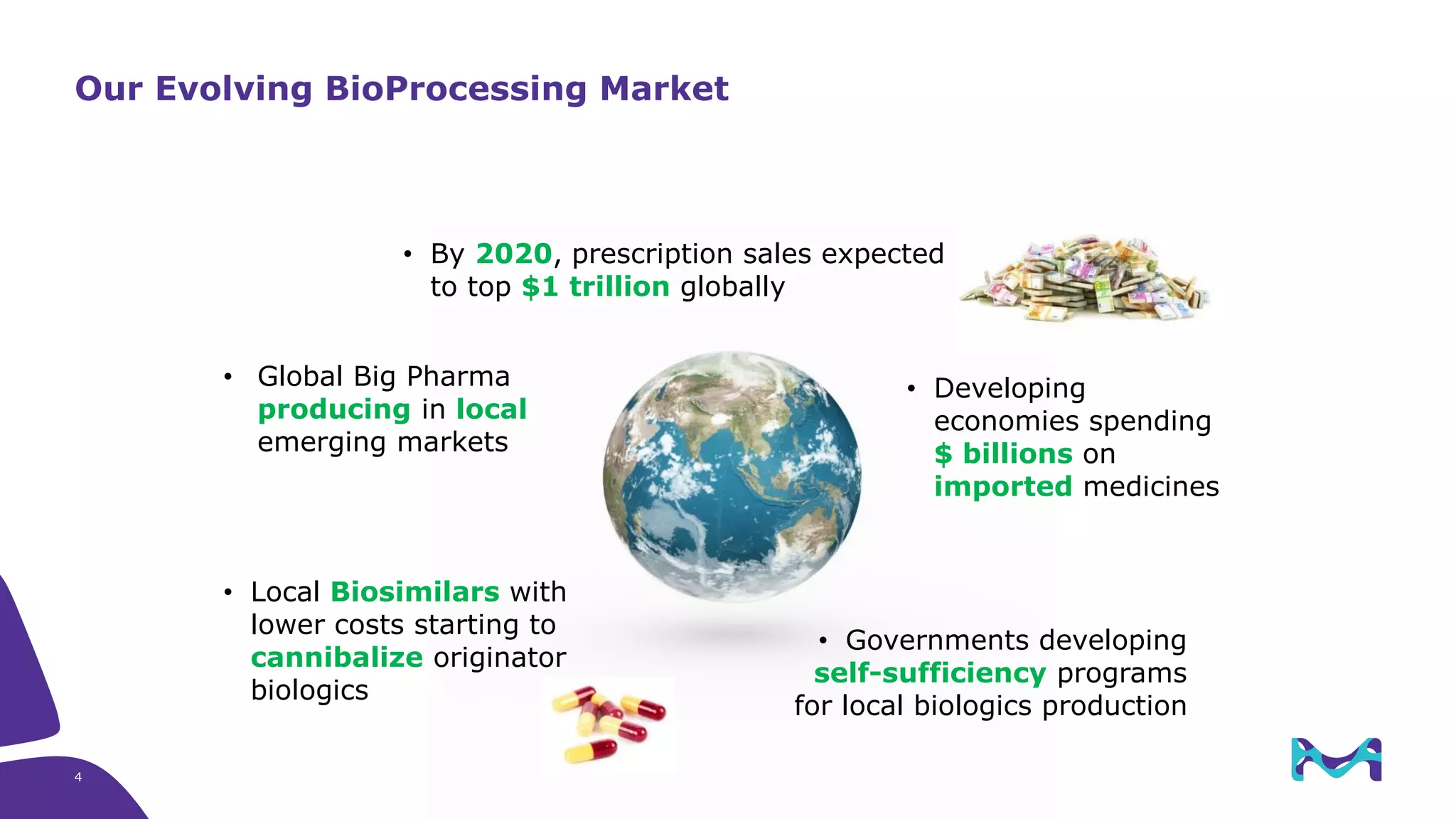
• Governments developing
self-sufficiency programs
for local biologics production
• Local Biosimilars with
lower costs starting to
cannibalize originator
biologics
• Global Big Pharma
producing in local
emerging markets
• Developing
economies spending
$ billions on
imported medicines
• By 2020, prescription sales expected
to top $1 trillion globally
Our Evolving BioProcessing Market
4
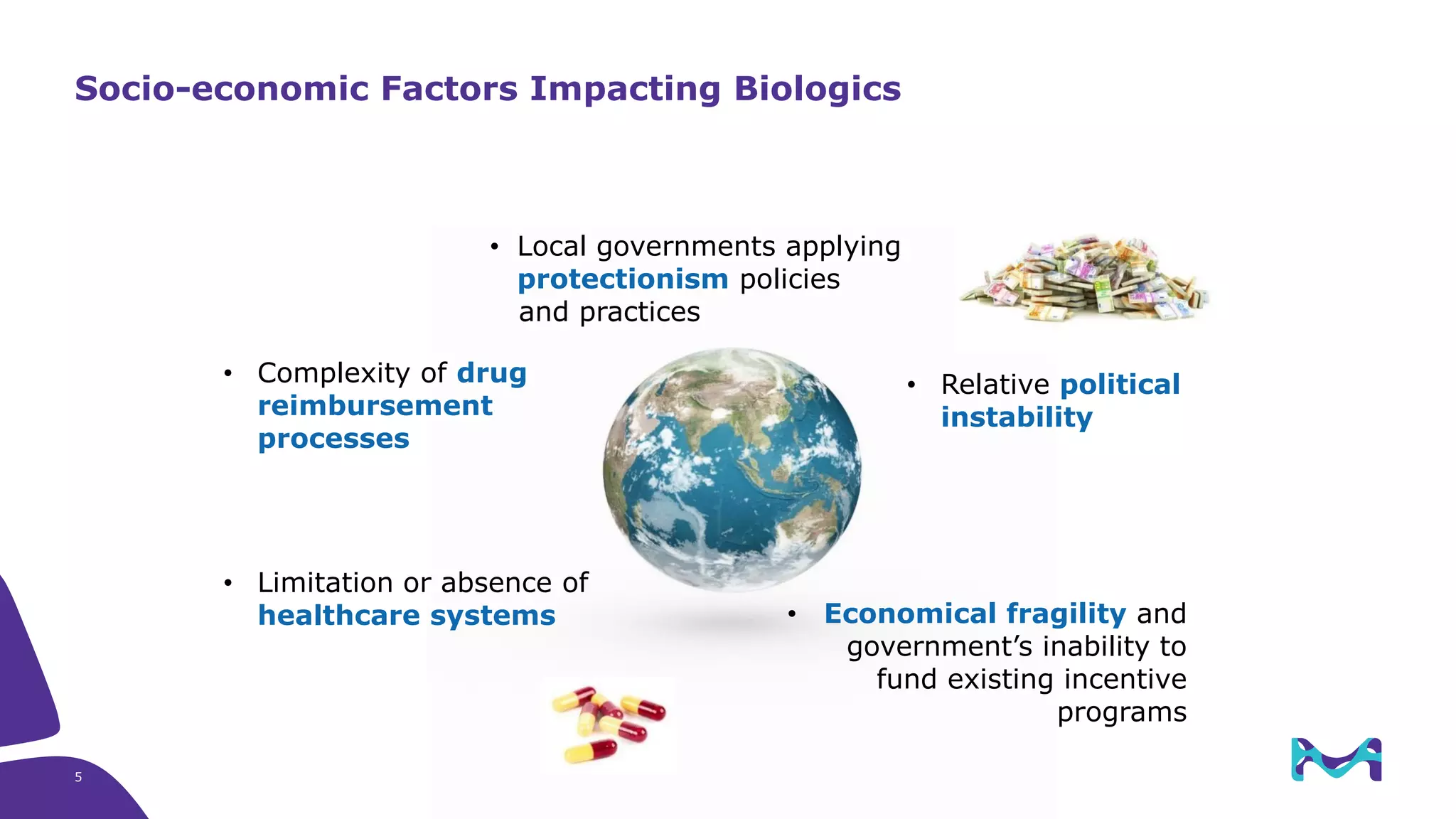
• Economical fragility and
government’s inability to
fund existing incentive
programs
• Limitation or absence of
healthcare systems
• Complexity of drug
reimbursement
processes
• Relative political
instability
• Local governments applying
protectionism policies
and practices
Socio-economic Factors Impacting Biologics
5
➢ Investing quickly to be the first to enter the market
➢ Lowering project financial risks
➢ Ensuring drug product COGS are competitive and affordable
➢ Smaller scale processes in multi-product facilities
➢ Higher process flexibility for better facility and capacity utilization
➢ Process and facility clonability / repurposability
The Impact on Biopharmaceutical Processes
Adapting and Responding to Challenges
6
A poll will now occur.
7
2
1
3
4
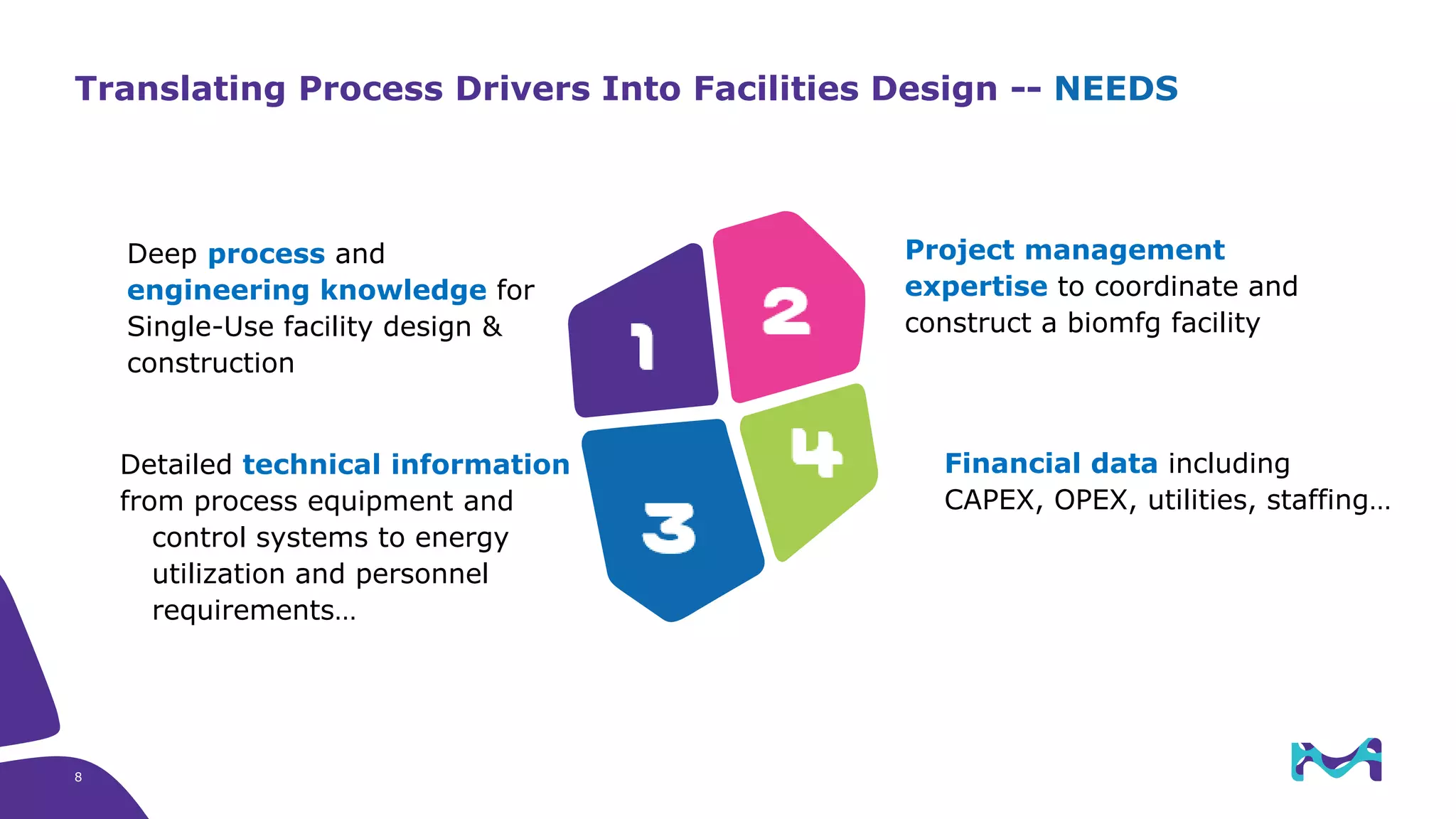
Deep process and
engineering knowledge for
Single-Use facility design &
construction
Project management
expertise to coordinate and
construct a biomfg facility
Detailed technical information
from process equipment and
control systems to energy
utilization and personnel
requirements…
Financial data including
CAPEX, OPEX, utilities, staffing…
Translating Process Drivers Into Facilities Design -- NEEDS
8
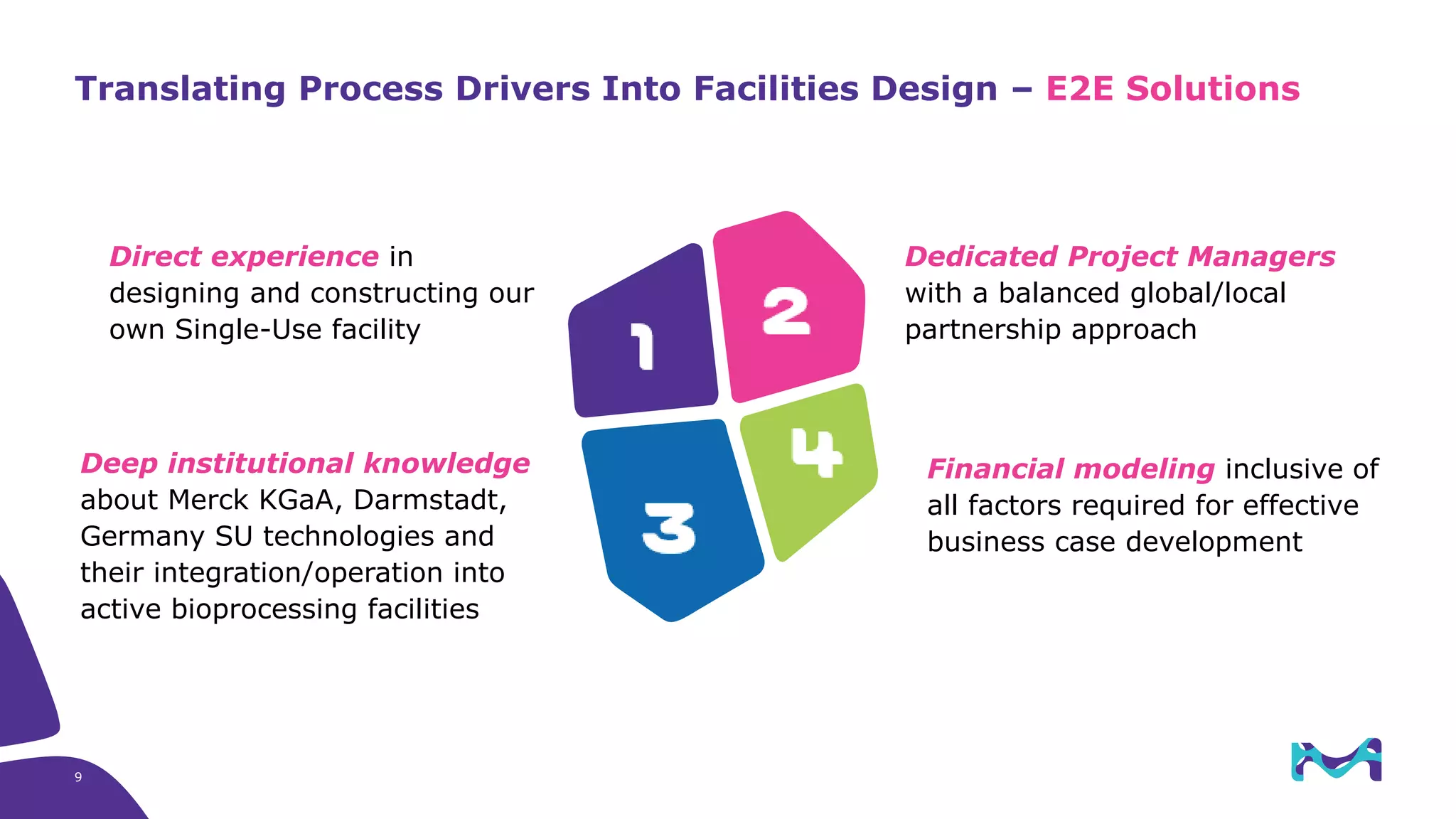
Direct experience in
designing and constructing our
own Single-Use facility
Dedicated Project Managers
with a balanced global/local
partnership approach
Deep institutional knowledge
about Merck KGaA, Darmstadt,
Germany SU technologies and
their integration/operation into
active bioprocessing facilities
Financial modeling inclusive of
all factors required for effective
business case development
Translating Process Drivers Into Facilities Design – E2E Solutions
2
1
3
4
9
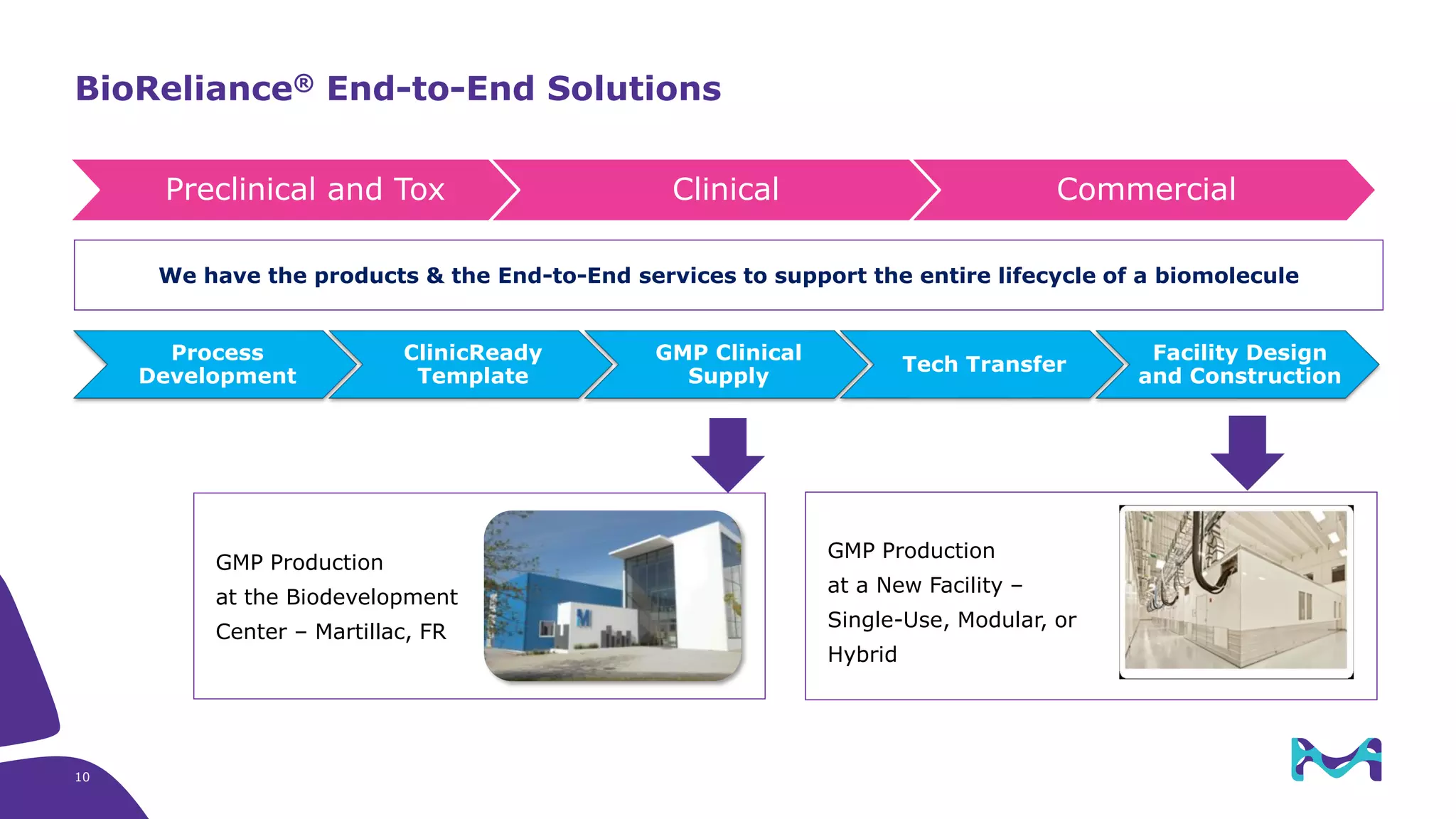
Process
Development
ClinicReady
Template
GMP Clinical
Supply
Tech Transfer
Facility Design
and Construction
Preclinical and Tox Clinical Commercial
We have the products & the End-to-End services to support the entire lifecycle of a biomolecule
GMP Production
at the Biodevelopment
Center – Martillac, FR
GMP Production
at a New Facility –
Single-Use, Modular, or
Hybrid
BioReliance® End-to-End Solutions
10
Merck KGaA
Darmstadt, Germany
ProcessEquipmentFacilities
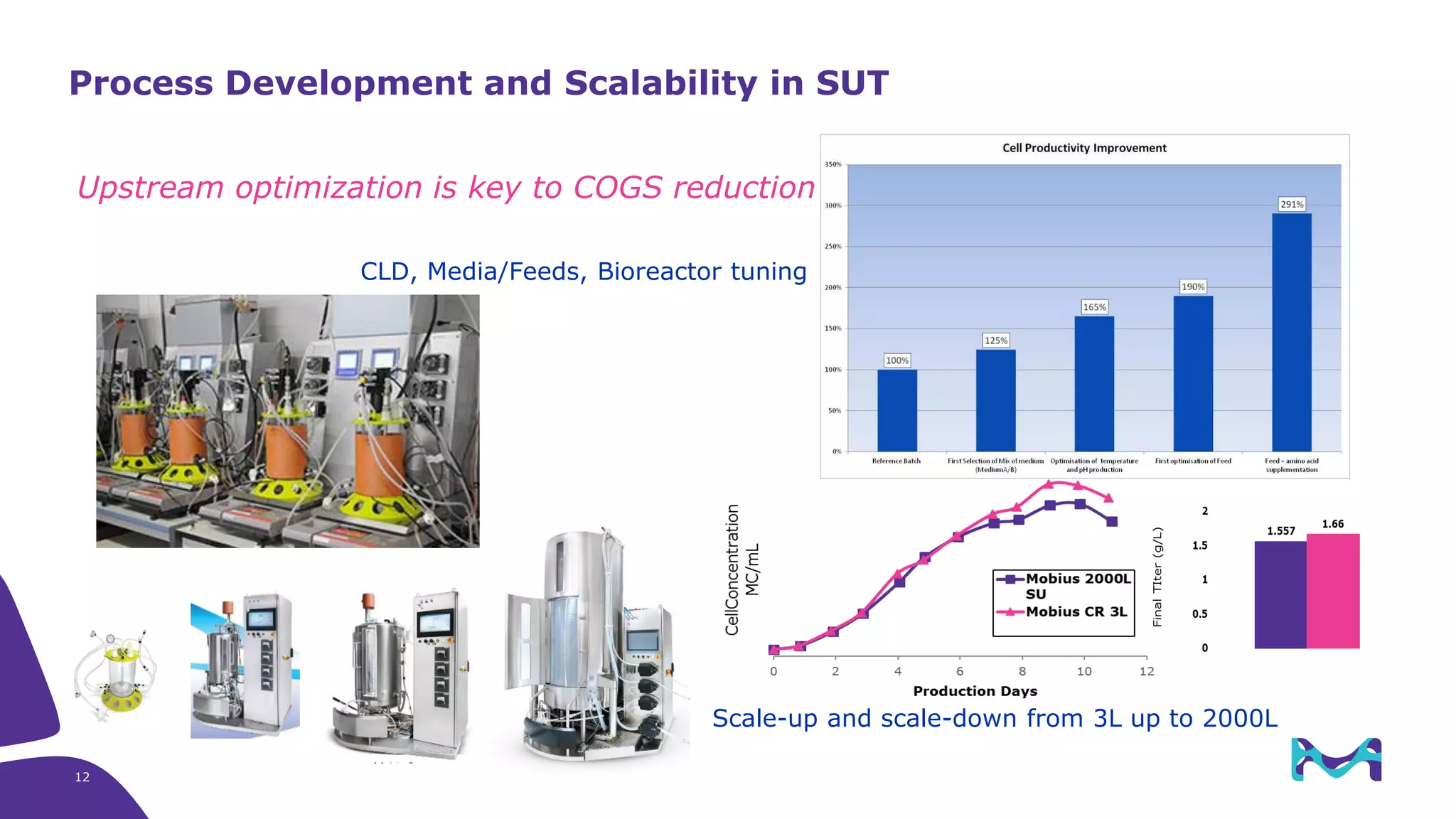
Upstream optimization is key to COGS reduction
Scale-up and scale-down from 3L up to 2000L
CLD, Media/Feeds, Bioreactor tuning
Process Development and Scalability in SUT
12
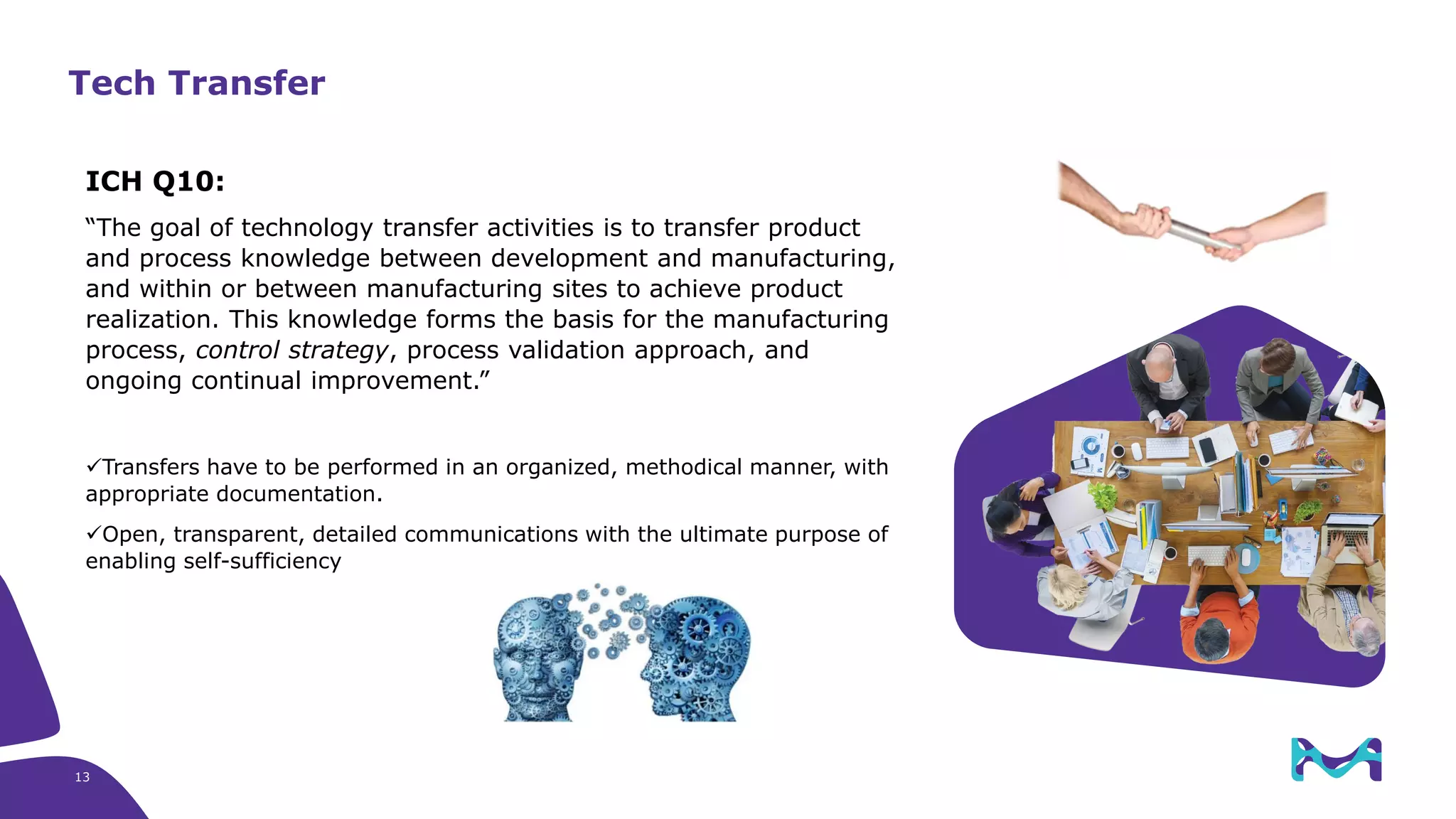
Tech Transfer
ICH Q10:
“The goal of technology transfer activities is to transfer product
and process knowledge between development and manufacturing,
and within or between manufacturing sites to achieve product
realization. This knowledge forms the basis for the manufacturing
process, control strategy, process validation approach, and
ongoing continual improvement.”
✓Transfers have to be performed in an organized, methodical manner, with
appropriate documentation.
✓Open, transparent, detailed communications with the ultimate purpose of
enabling self-sufficiency
13
14
Merck KGaA
Darmstadt, Germany
ProcessEquipmentFacilities
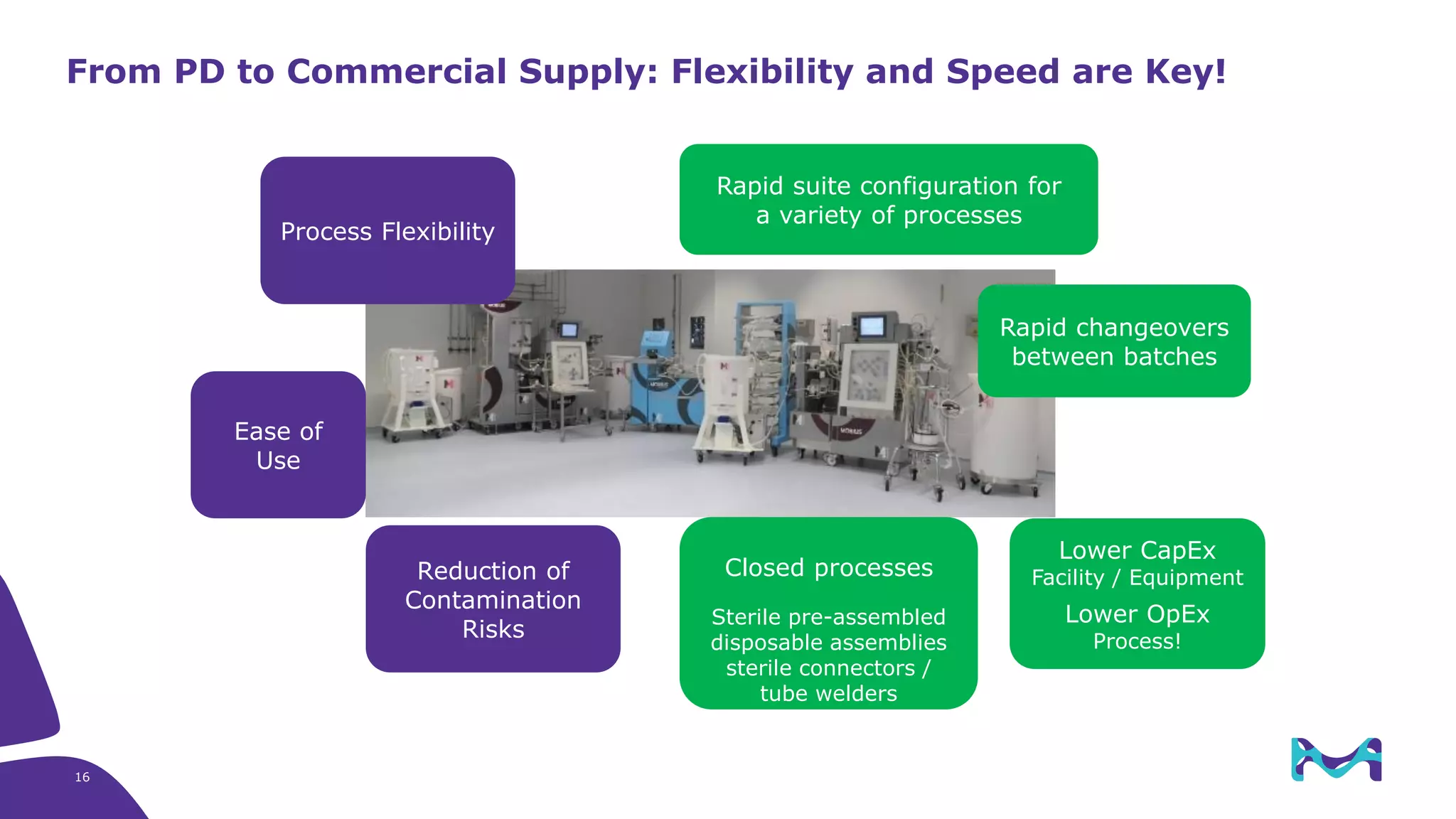
From PD to Commercial Supply: Flexibility and Speed are Key!
Rapid suite configuration for
a variety of processes
Rapid changeovers
between batches
Closed processes
Sterile pre-assembled
disposable assemblies
sterile connectors /
tube welders
Process Flexibility
Reduction of
Contamination
Risks
Ease of
Use
Lower CapEx
Facility / Equipment
Lower OpEx
Process!
16
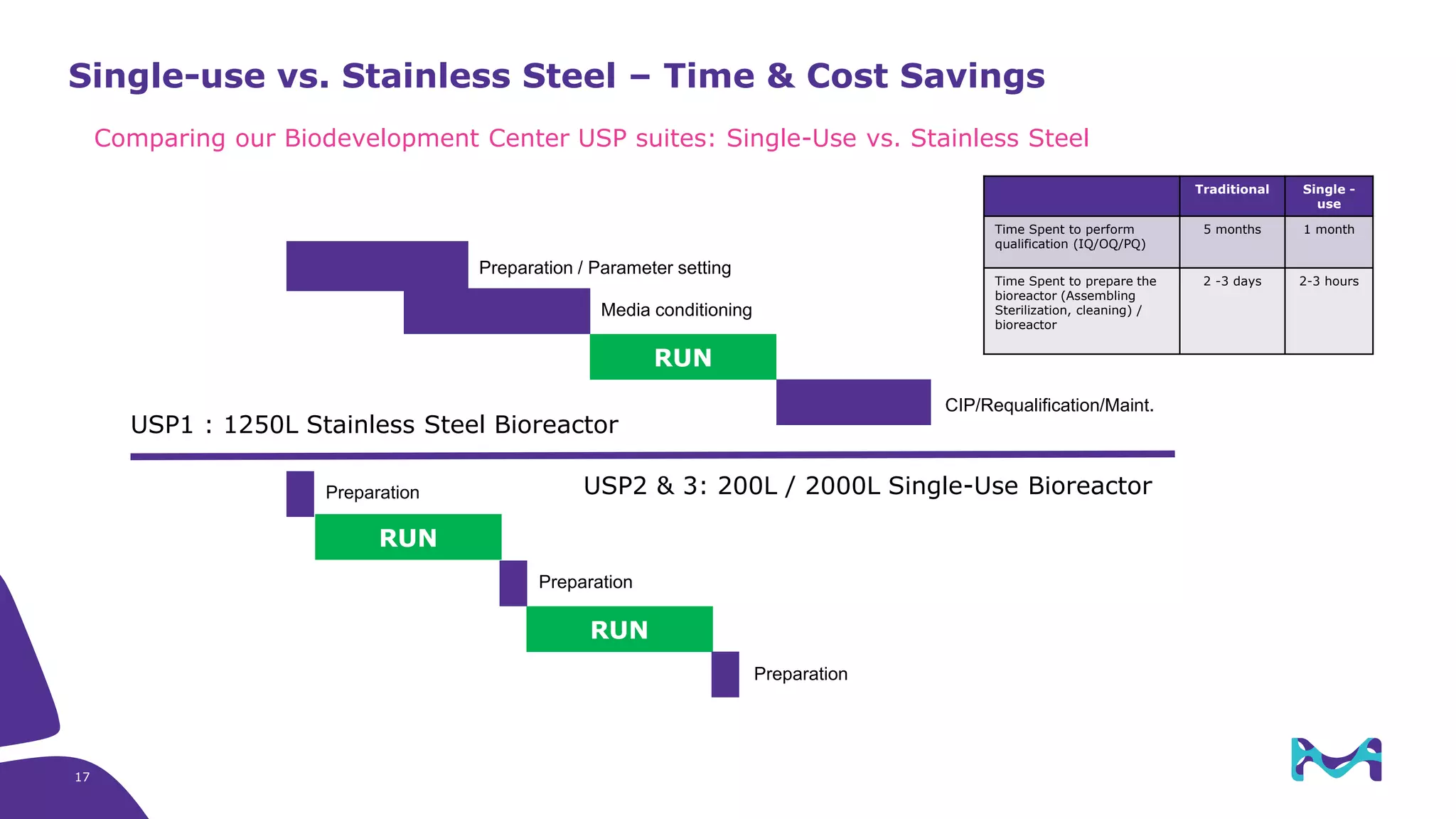
Single-use vs. Stainless Steel – Time & Cost Savings
Comparing our Biodevelopment Center USP suites: Single-Use vs. Stainless Steel
RUN
RUN
Preparation / Parameter setting
Media conditioning
CIP/Requalification/Maint.
Preparation
Preparation
USP1 : 1250L Stainless Steel Bioreactor
USP2 & 3: 200L / 2000L Single-Use Bioreactor
RUN
Traditional Single -
use
Time Spent to perform
qualification (IQ/OQ/PQ)
5 months 1 month
Time Spent to prepare the
bioreactor (Assembling
Sterilization, cleaning) /
bioreactor
2 -3 days 2-3 hours
Preparation
17
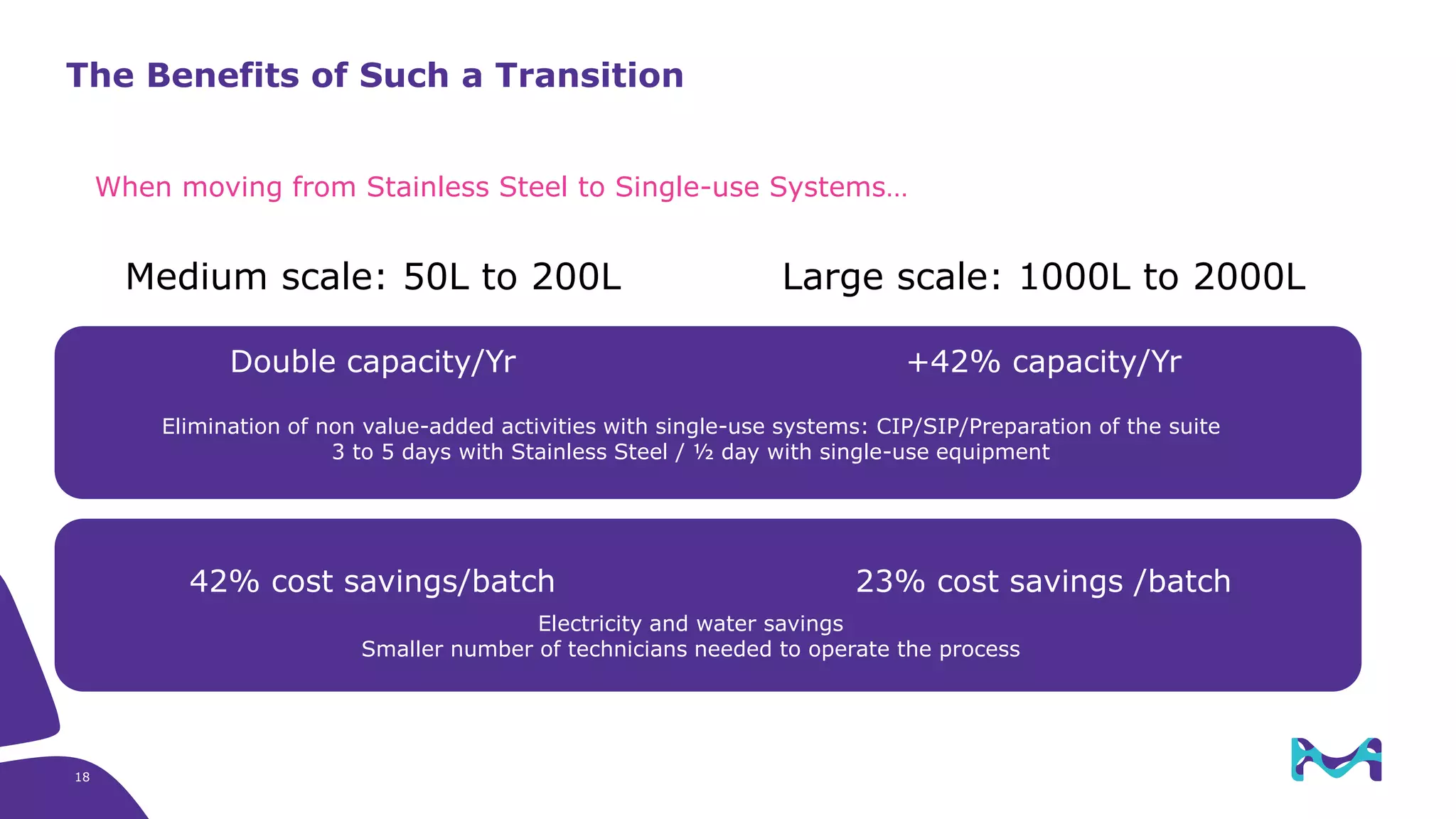
Large scale: 1000L to 2000L
+42% capacity/Yr
23% cost savings /batch
Medium scale: 50L to 200L
Double capacity/Yr
42% cost savings/batch
When moving from Stainless Steel to Single-use Systems…
Elimination of non value-added activities with single-use systems: CIP/SIP/Preparation of the suite
3 to 5 days with Stainless Steel / ½ day with single-use equipment
Electricity and water savings
Smaller number of technicians needed to operate the process
The Benefits of Such a Transition
18
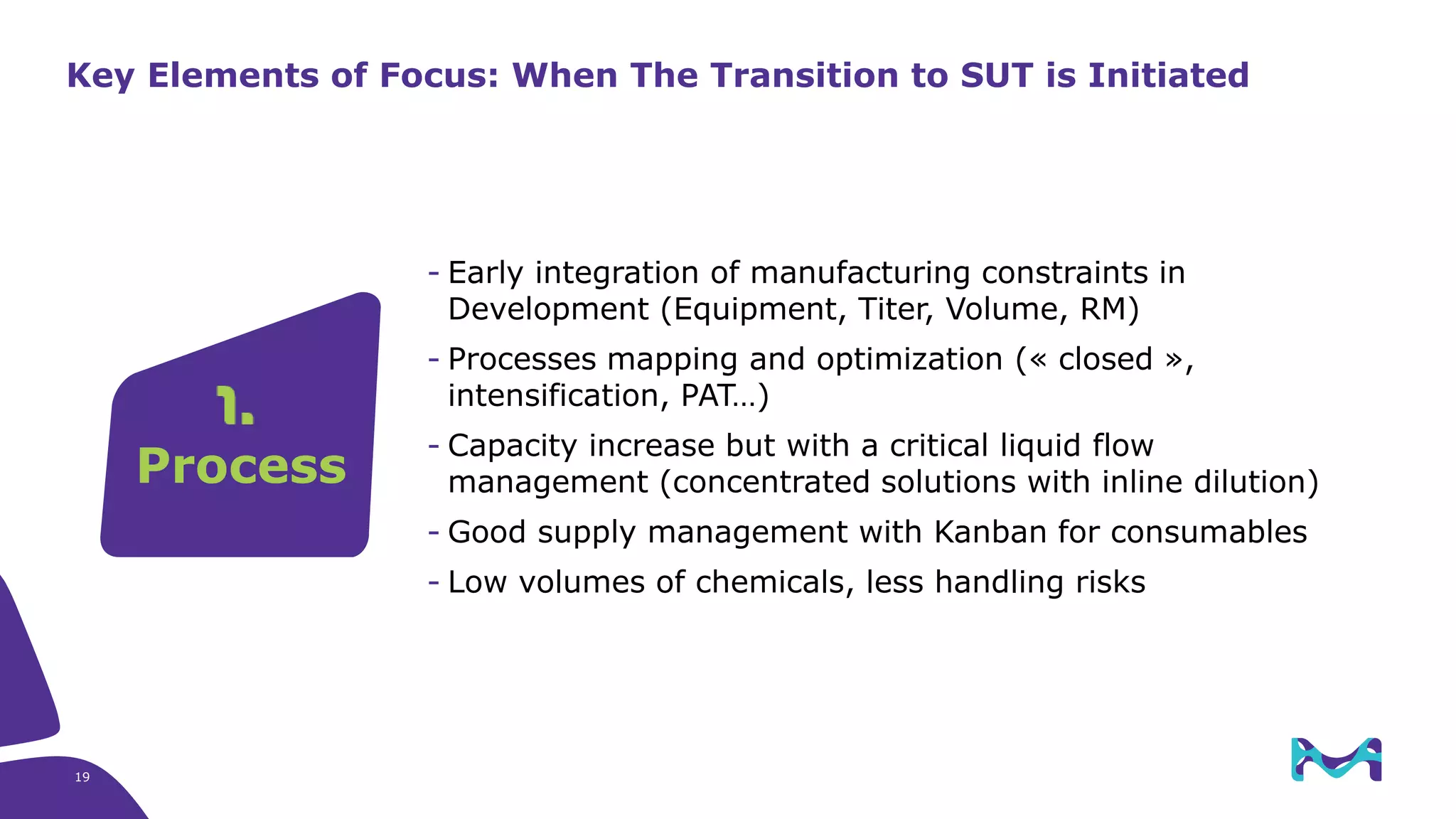
- Early integration of manufacturing constraints in
Development (Equipment, Titer, Volume, RM)
- Processes mapping and optimization (« closed »,
intensification, PAT…)
- Capacity increase but with a critical liquid flow
management (concentrated solutions with inline dilution)
- Good supply management with Kanban for consumables
- Low volumes of chemicals, less handling risks
1.
Process
Key Elements of Focus: When The Transition to SUT is Initiated
19
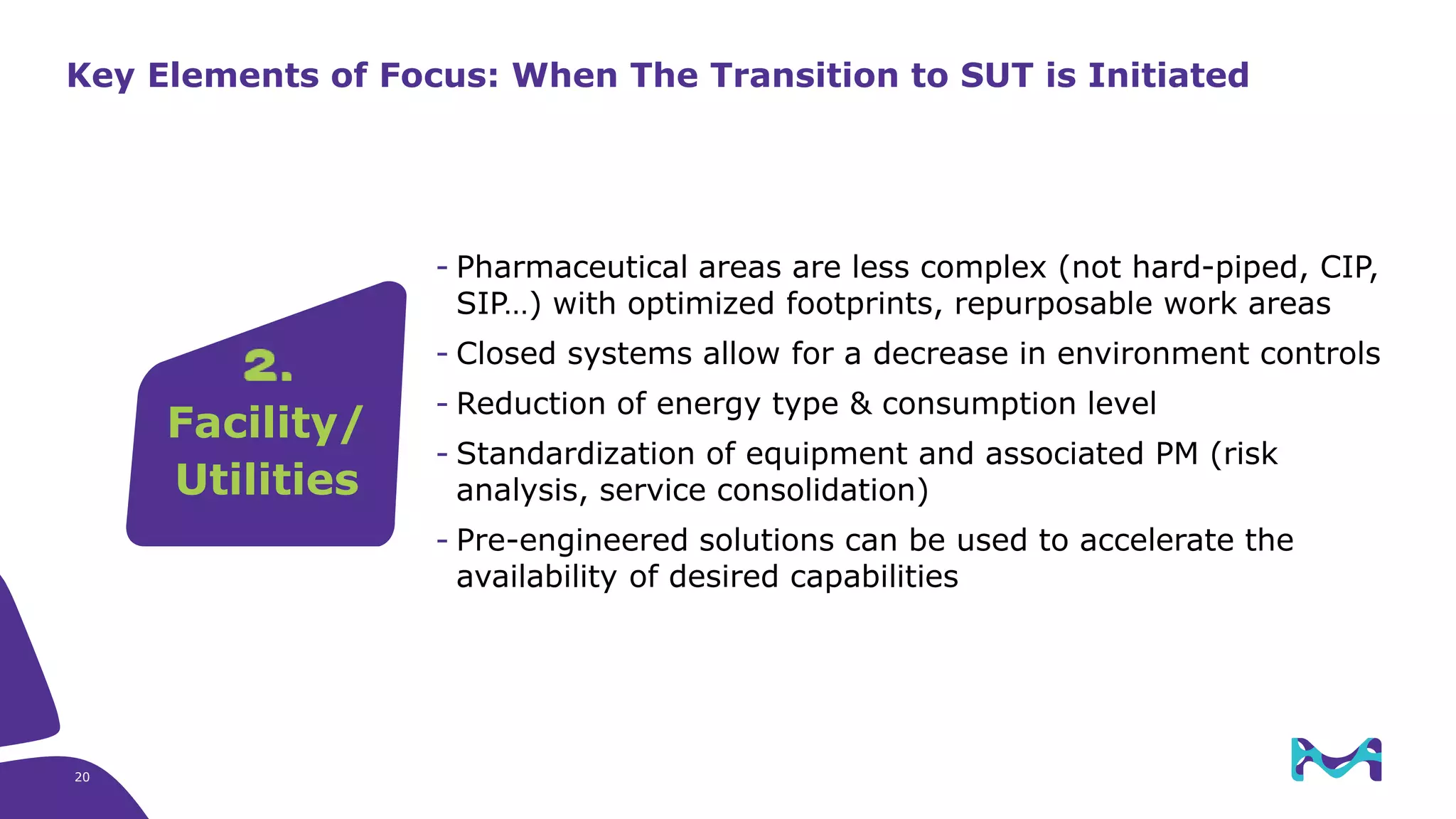
2.
Facility/
Utilities
- Pharmaceutical areas are less complex (not hard-piped, CIP,
SIP…) with optimized footprints, repurposable work areas
- Closed systems allow for a decrease in environment controls
- Reduction of energy type & consumption level
- Standardization of equipment and associated PM (risk
analysis, service consolidation)
- Pre-engineered solutions can be used to accelerate the
availability of desired capabilities
Key Elements of Focus: When The Transition to SUT is Initiated
20
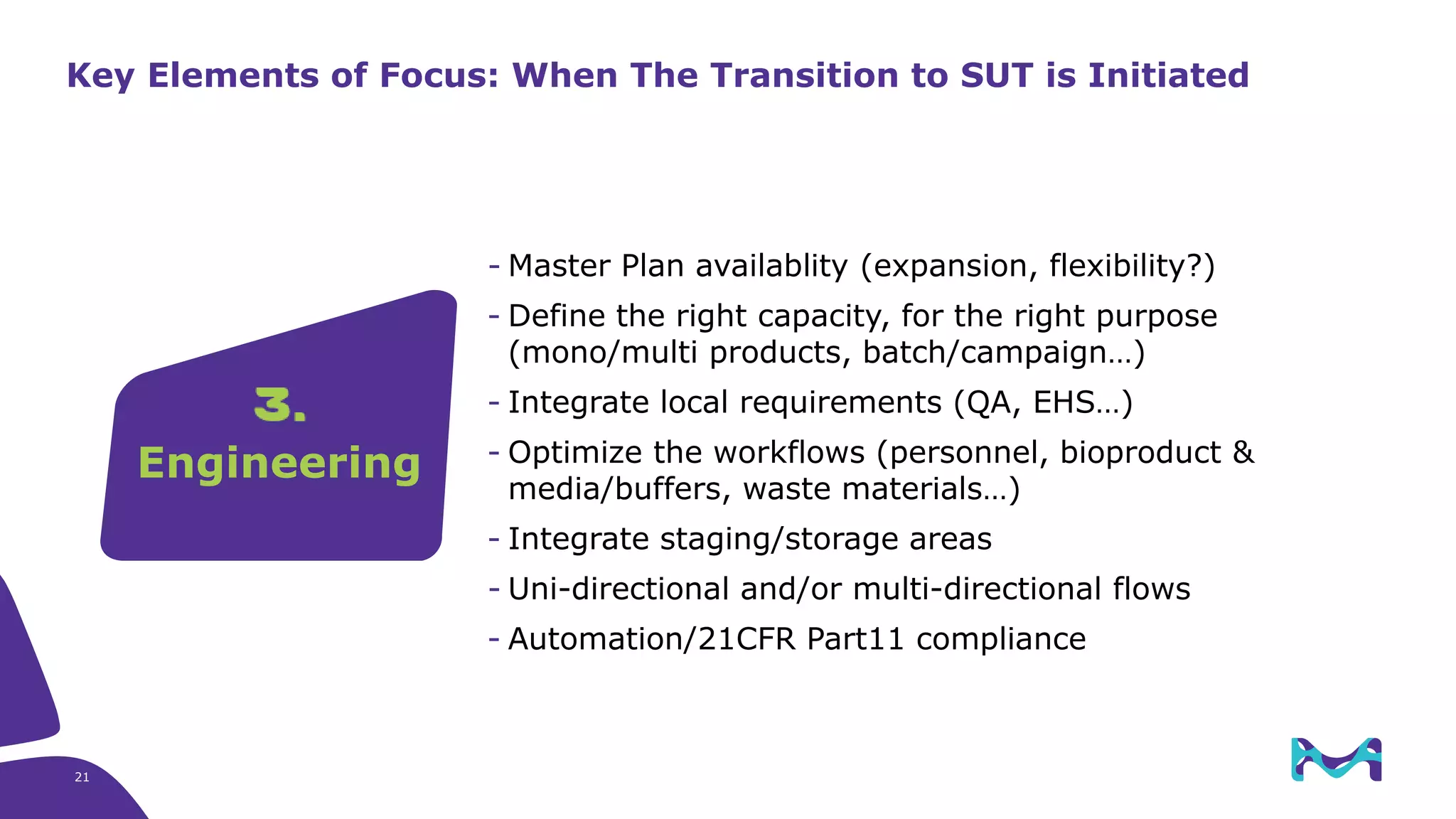
3.
Engineering
- Master Plan availablity (expansion, flexibility?)
- Define the right capacity, for the right purpose
(mono/multi products, batch/campaign…)
- Integrate local requirements (QA, EHS…)
- Optimize the workflows (personnel, bioproduct &
media/buffers, waste materials…)
- Integrate staging/storage areas
- Uni-directional and/or multi-directional flows
- Automation/21CFR Part11 compliance
Key Elements of Focus: When The Transition to SUT is Initiated
21
Merck KGaA
Darmstadt, Germany
ProcessEquipmentFacilities
Once the equipment has been selected, it is placed in the facility
1.To meet all Process, Quality and Regulatory requirements
2.For operator Ease of Use and Accessibility during any required maintenance
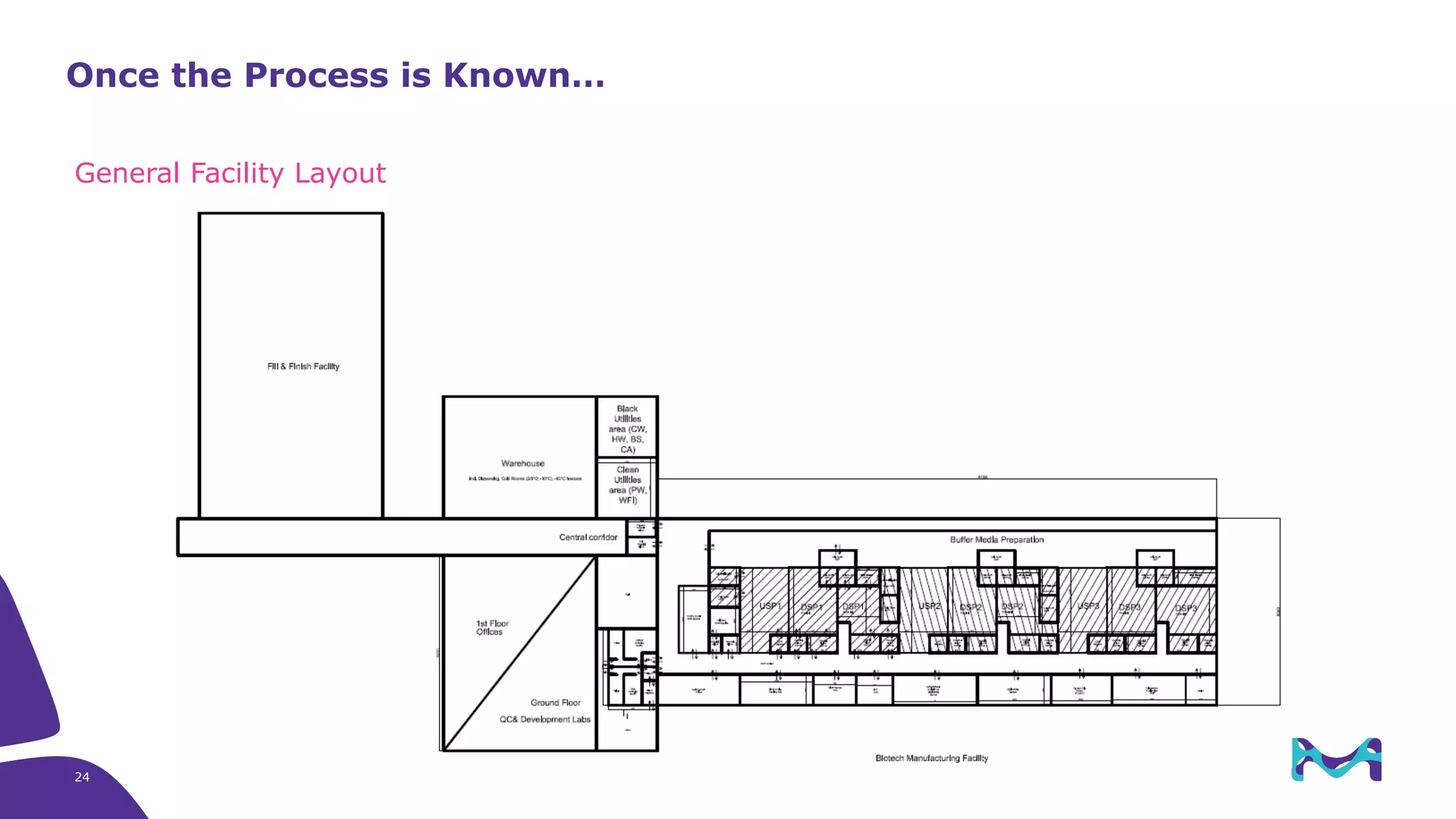
General Facility Layout
From the general facility layout, generate specific layouts
1. Room classification
2. Room pressurization
3. Personnel flow
4. Material flows including raw materials, waste, and final product
Once the Process is Known…
23
General Facility Layout
Once the Process is Known…
24
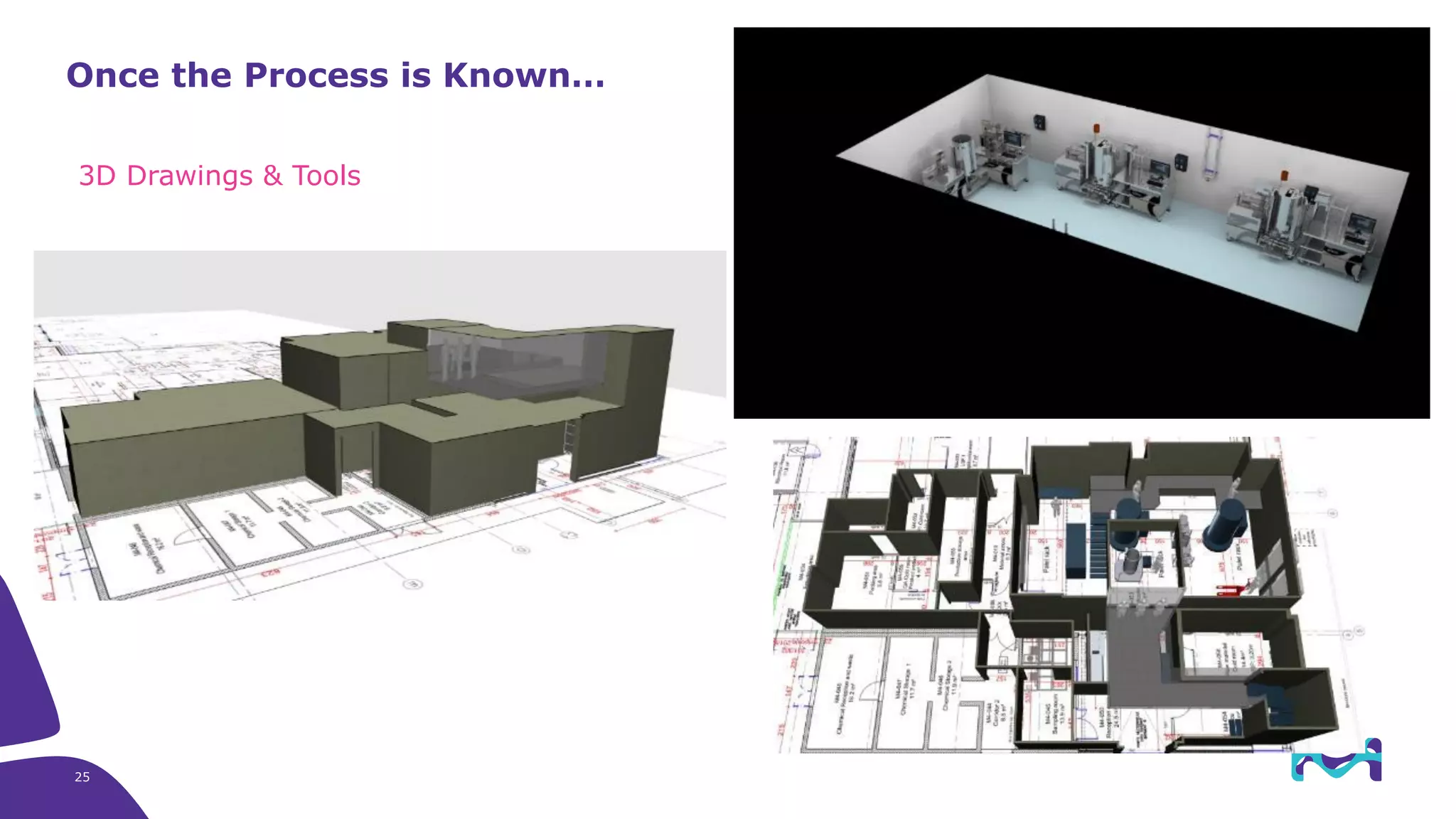
3D Drawings & Tools
Once the Process is Known…
25
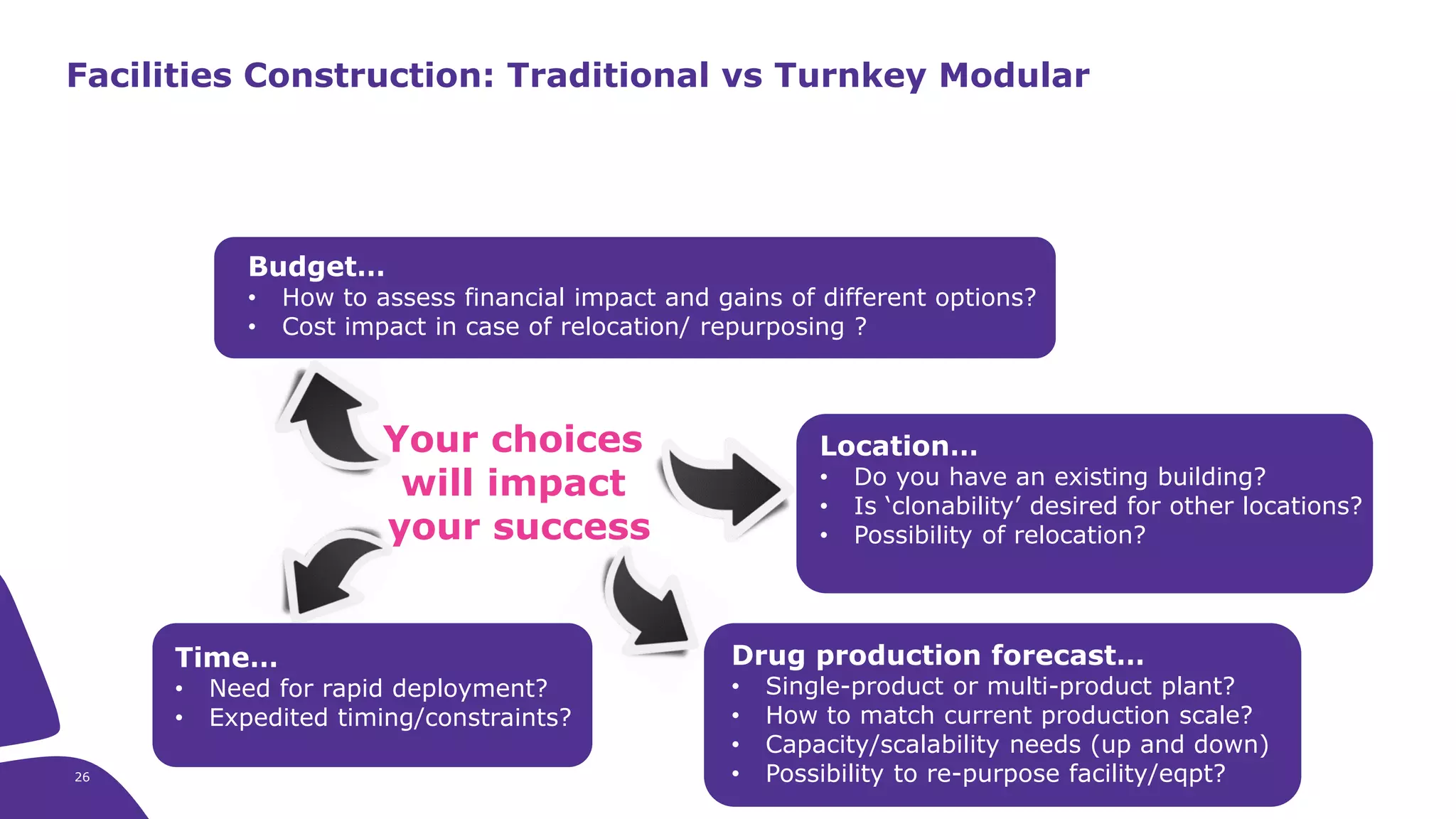
Your choices
will impact
your success
Location…
• Do you have an existing building?
• Is ‘clonability’ desired for other locations?
• Possibility of relocation?
Drug production forecast…
• Single-product or multi-product plant?
• How to match current production scale?
• Capacity/scalability needs (up and down)
• Possibility to re-purpose facility/eqpt?
Budget…
• How to assess financial impact and gains of different options?
• Cost impact in case of relocation/ repurposing ?
Time…
• Need for rapid deployment?
• Expedited timing/constraints?
Facilities Construction: Traditional vs Turnkey Modular
26
Merck KGaA
Darmstadt, Germany
Process  Equipment 
Turnkey Modular Facilities
Why Turnkey Modular?
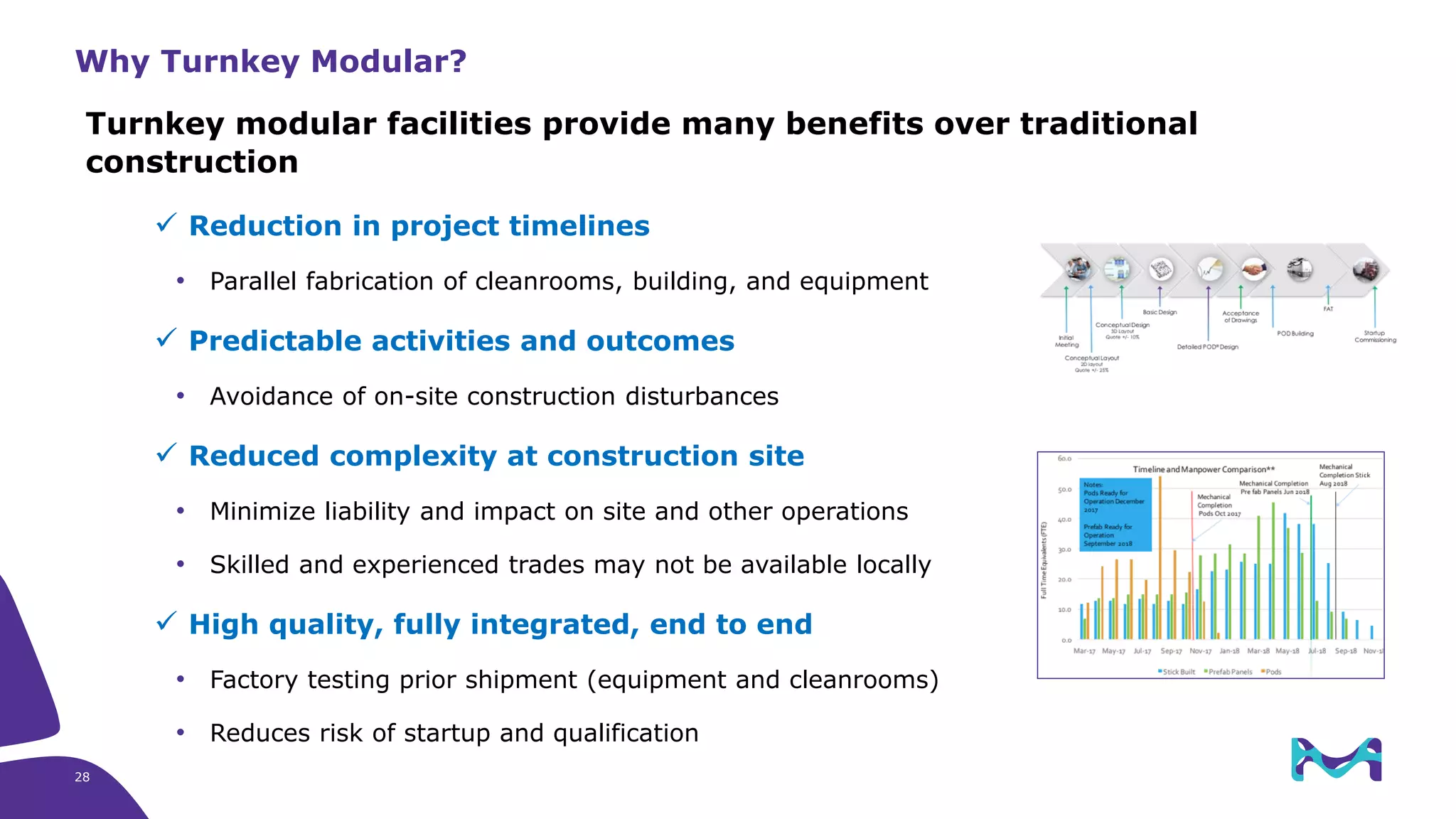
✓ Reduction in project timelines
• Parallel fabrication of cleanrooms, building, and equipment
✓ Predictable activities and outcomes
• Avoidance of on-site construction disturbances
✓ Reduced complexity at construction site
• Minimize liability and impact on site and other operations
• Skilled and experienced trades may not be available locally
✓ High quality, fully integrated, end to end
• Factory testing prior shipment (equipment and cleanrooms)
• Reduces risk of startup and qualification
Turnkey modular facilities provide many benefits over traditional
construction
28
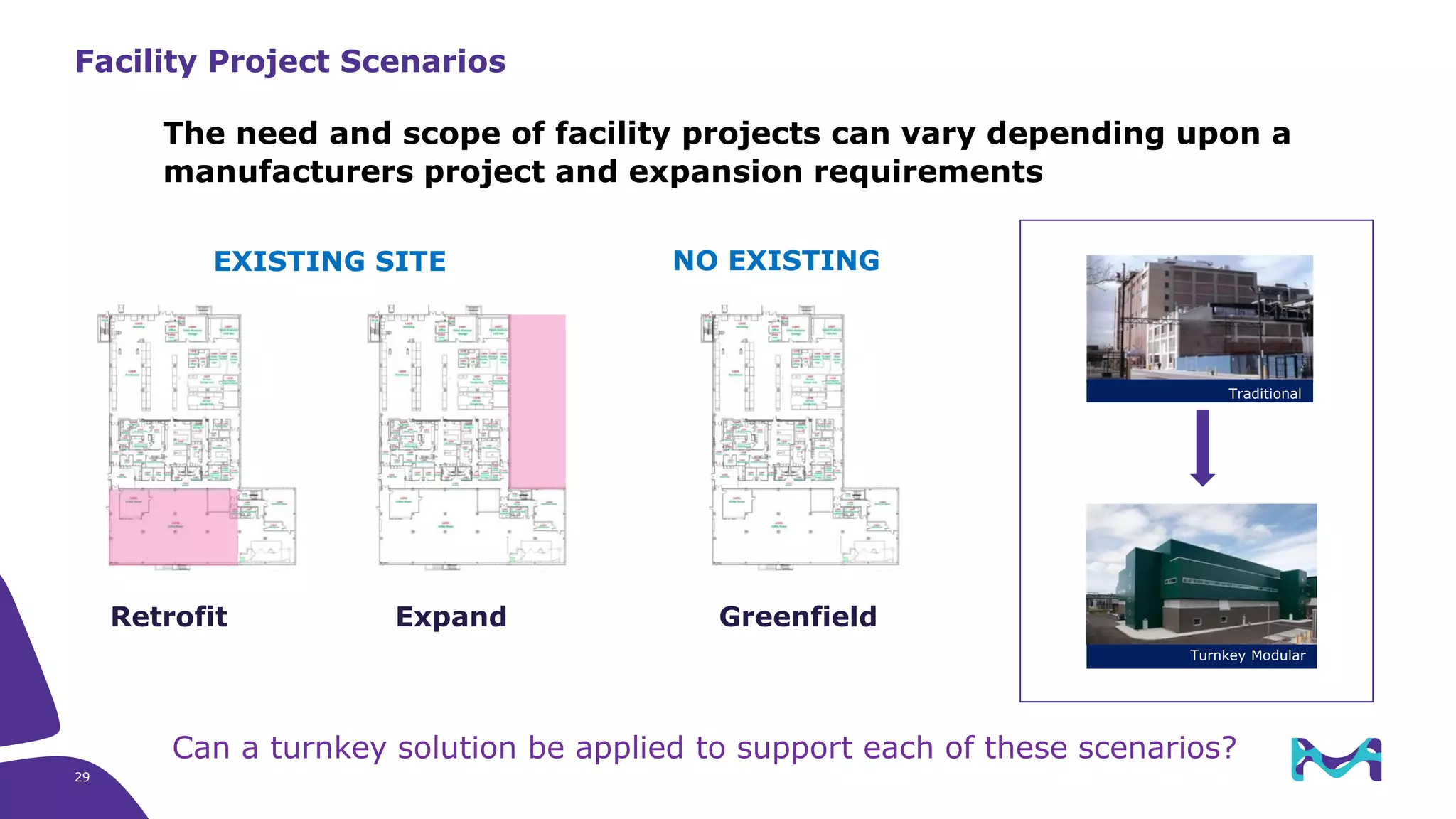
Facility Project Scenarios
The need and scope of facility projects can vary depending upon a
manufacturers project and expansion requirements
Retrofit
EXISTING SITE NO EXISTING
Expand Greenfield
Traditional
Turnkey Modular
Can a turnkey solution be applied to support each of these scenarios?
29
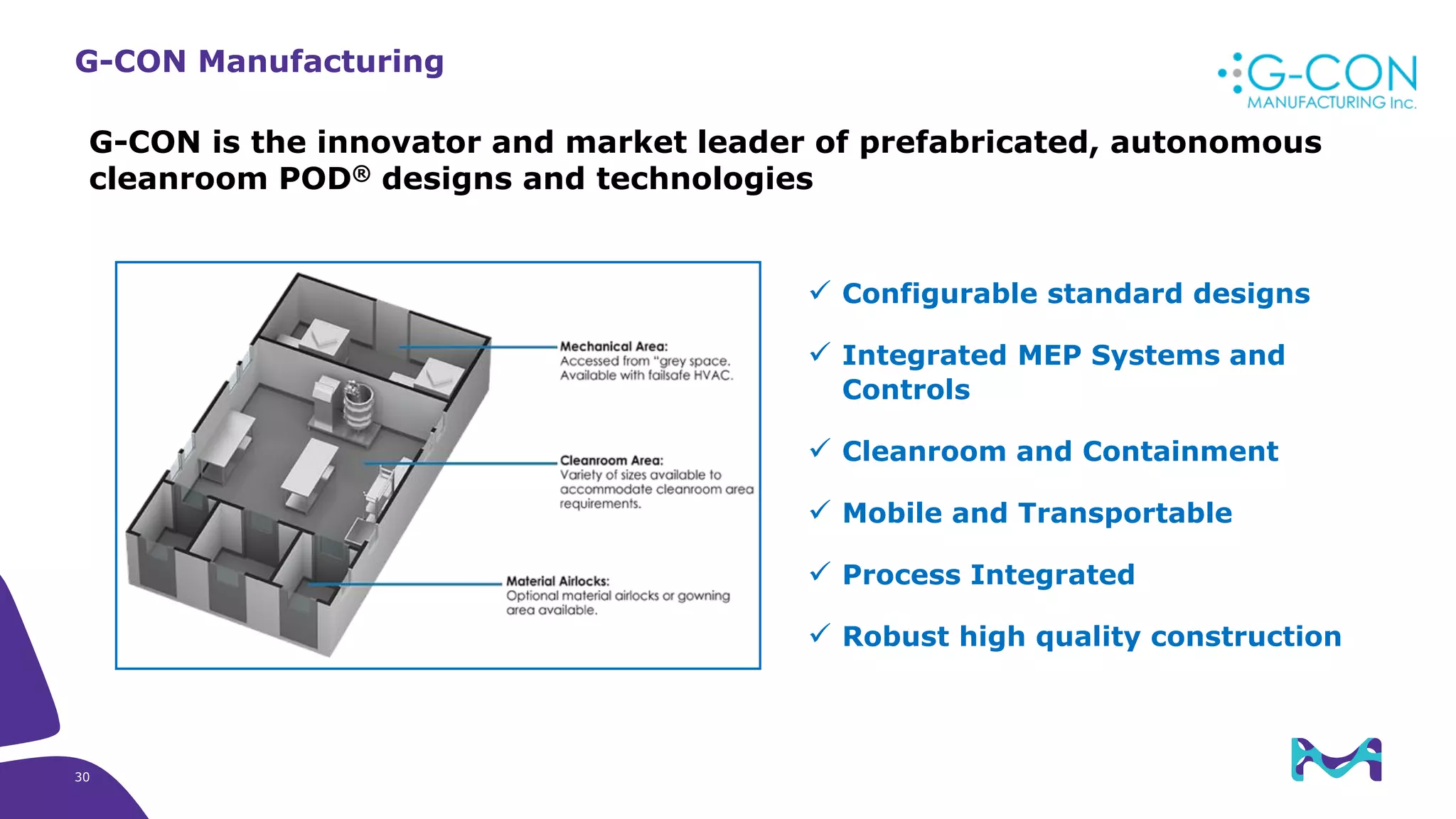
G-CON Manufacturing
G-CON is the innovator and market leader of prefabricated, autonomous
cleanroom POD® designs and technologies
✓ Configurable standard designs
✓ Integrated MEP Systems and
Controls
✓ Cleanroom and Containment
✓ Mobile and Transportable
✓ Process Integrated
✓ Robust high quality construction
30
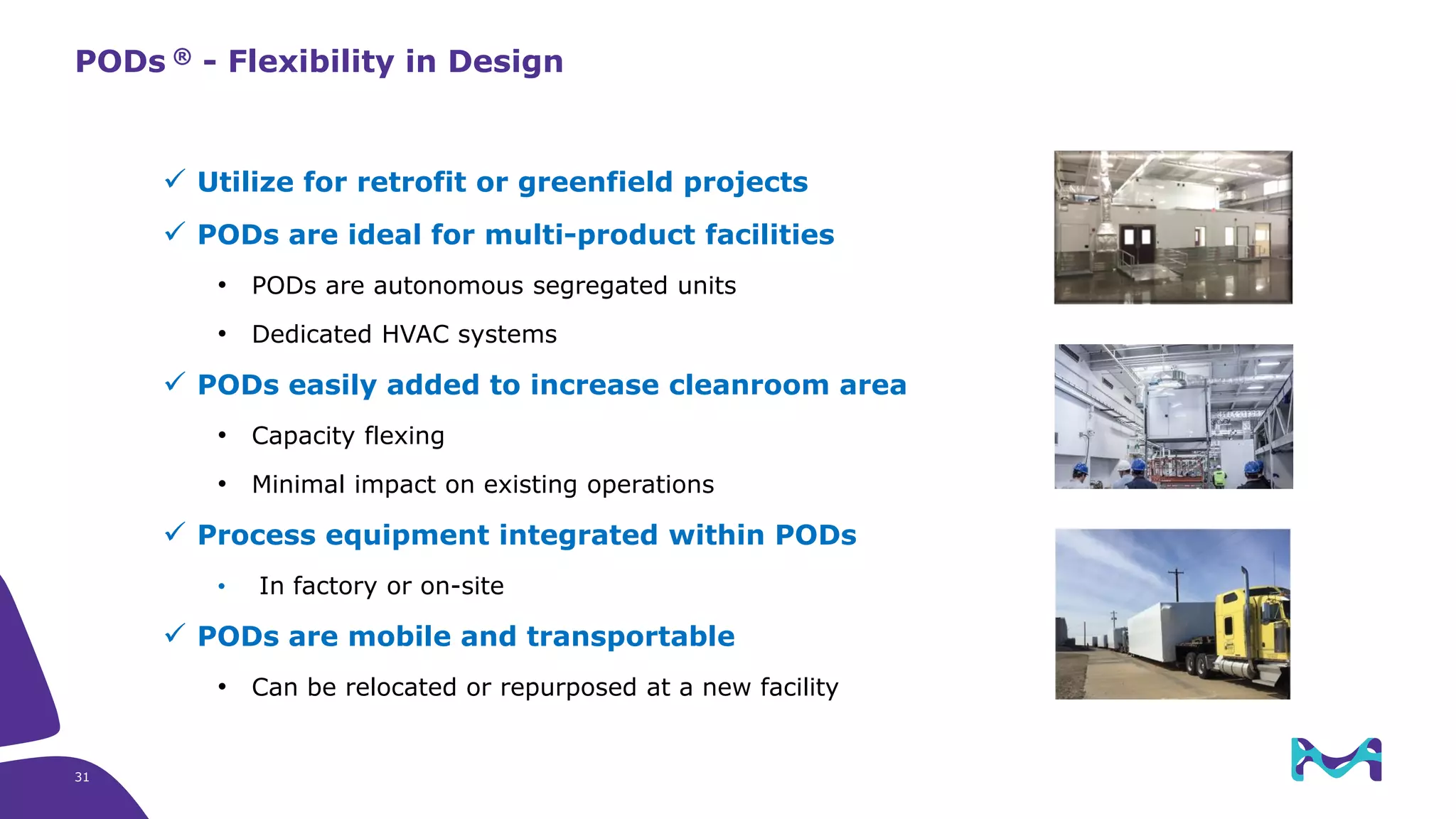
PODs ® - Flexibility in Design
✓ Utilize for retrofit or greenfield projects
✓ PODs are ideal for multi-product facilities
• PODs are autonomous segregated units
• Dedicated HVAC systems
✓ PODs easily added to increase cleanroom area
• Capacity flexing
• Minimal impact on existing operations
✓ Process equipment integrated within PODs
• In factory or on-site
✓ PODs are mobile and transportable
• Can be relocated or repurposed at a new facility
31
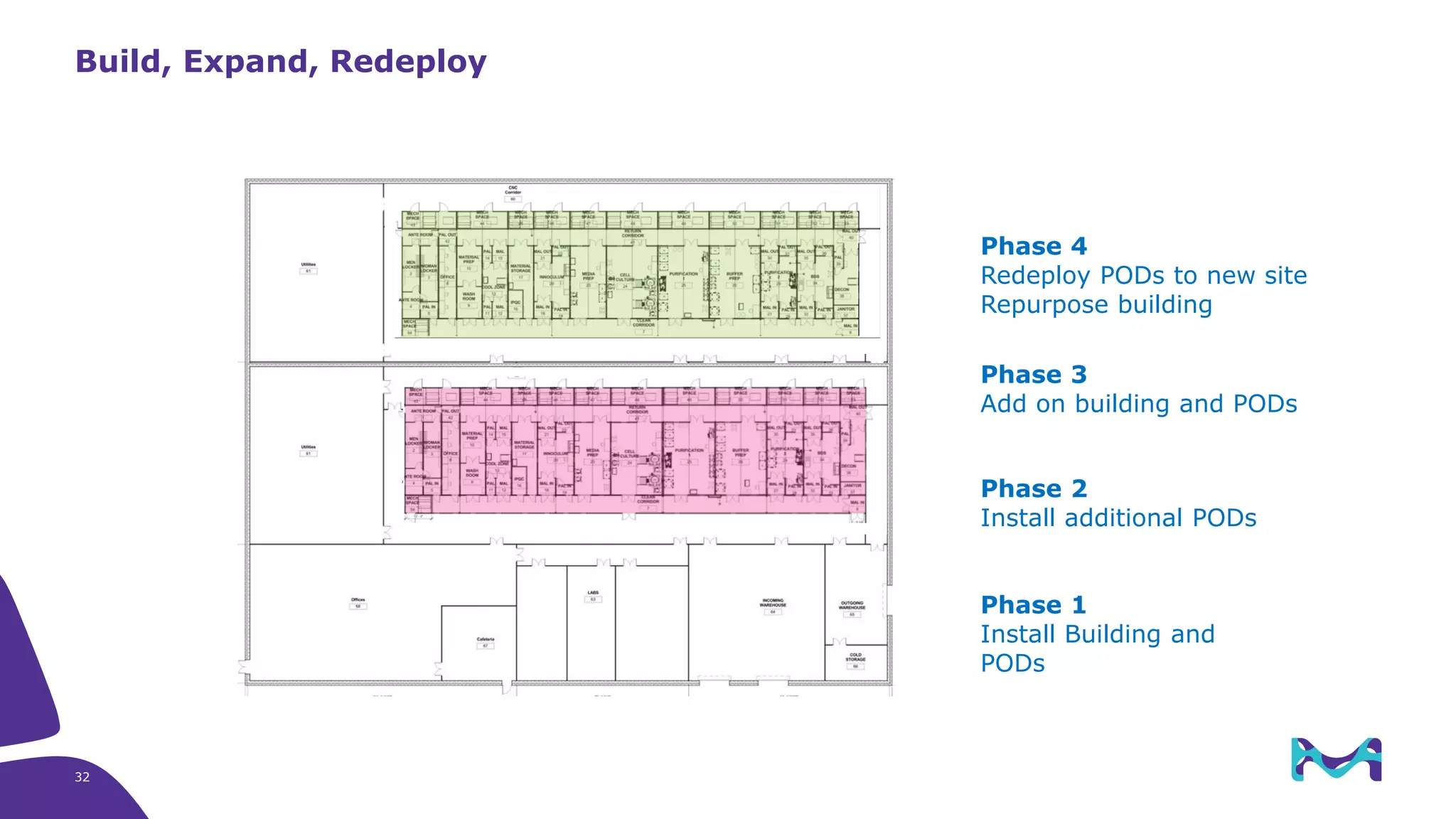
Build, Expand, Redeploy
Phase 1
Install Building and
PODs
Phase 2
Install additional PODs
Phase 3
Add on building and PODs
Phase 4
Redeploy PODs to new site
Repurpose building
32
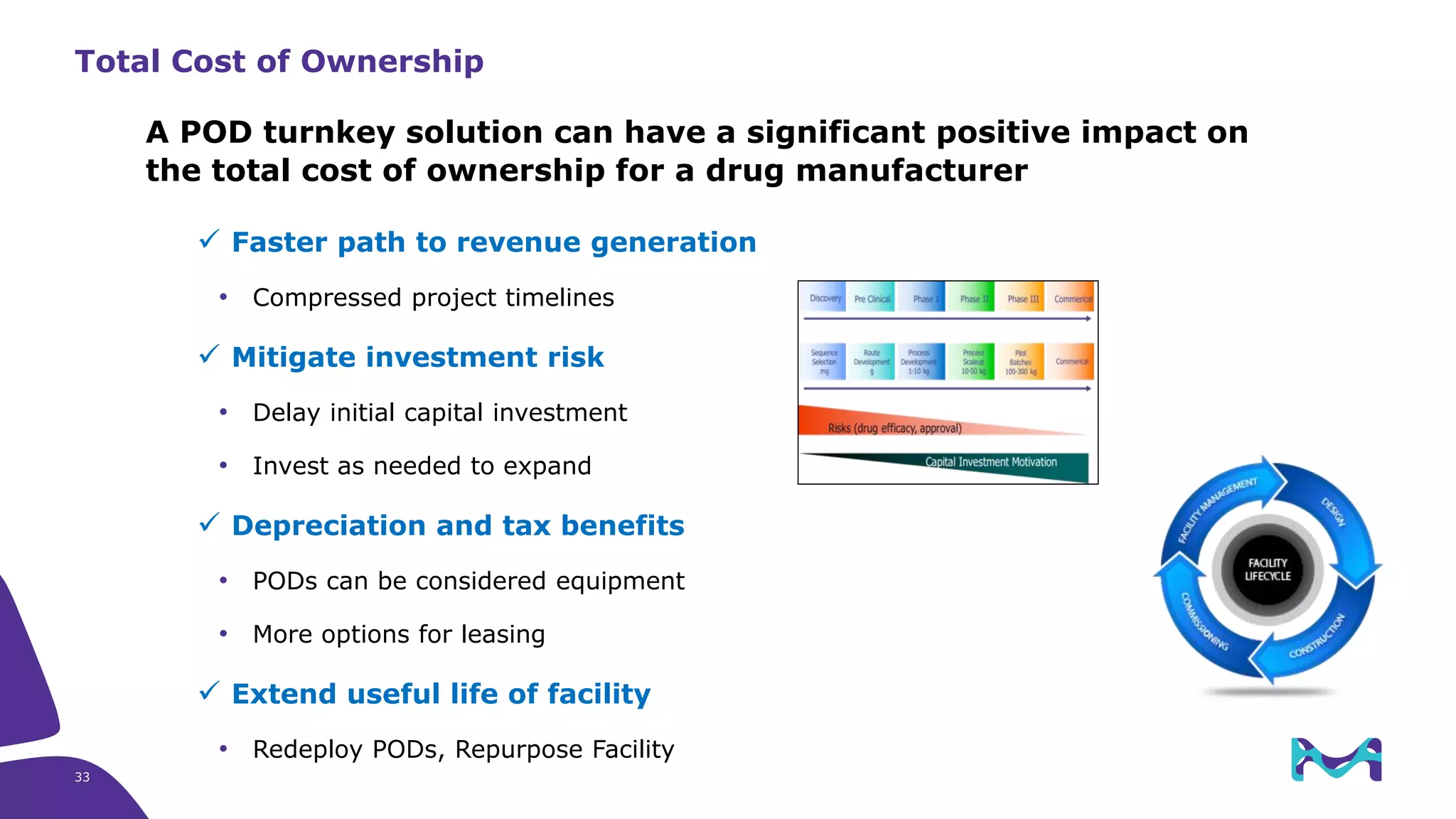
Total Cost of Ownership
✓ Faster path to revenue generation
• Compressed project timelines
✓ Mitigate investment risk
• Delay initial capital investment
• Invest as needed to expand
✓ Depreciation and tax benefits
• PODs can be considered equipment
• More options for leasing
✓ Extend useful life of facility
• Redeploy PODs, Repurpose Facility
A POD turnkey solution can have a significant positive impact on
the total cost of ownership for a drug manufacturer
33
Merck KGaA
Darmstadt, Germany
Bringing It All Together
Process
Development
ClinicReady
Template
GMP Clinical
Supply
Tech
Transfer
Facility Design
and Construction
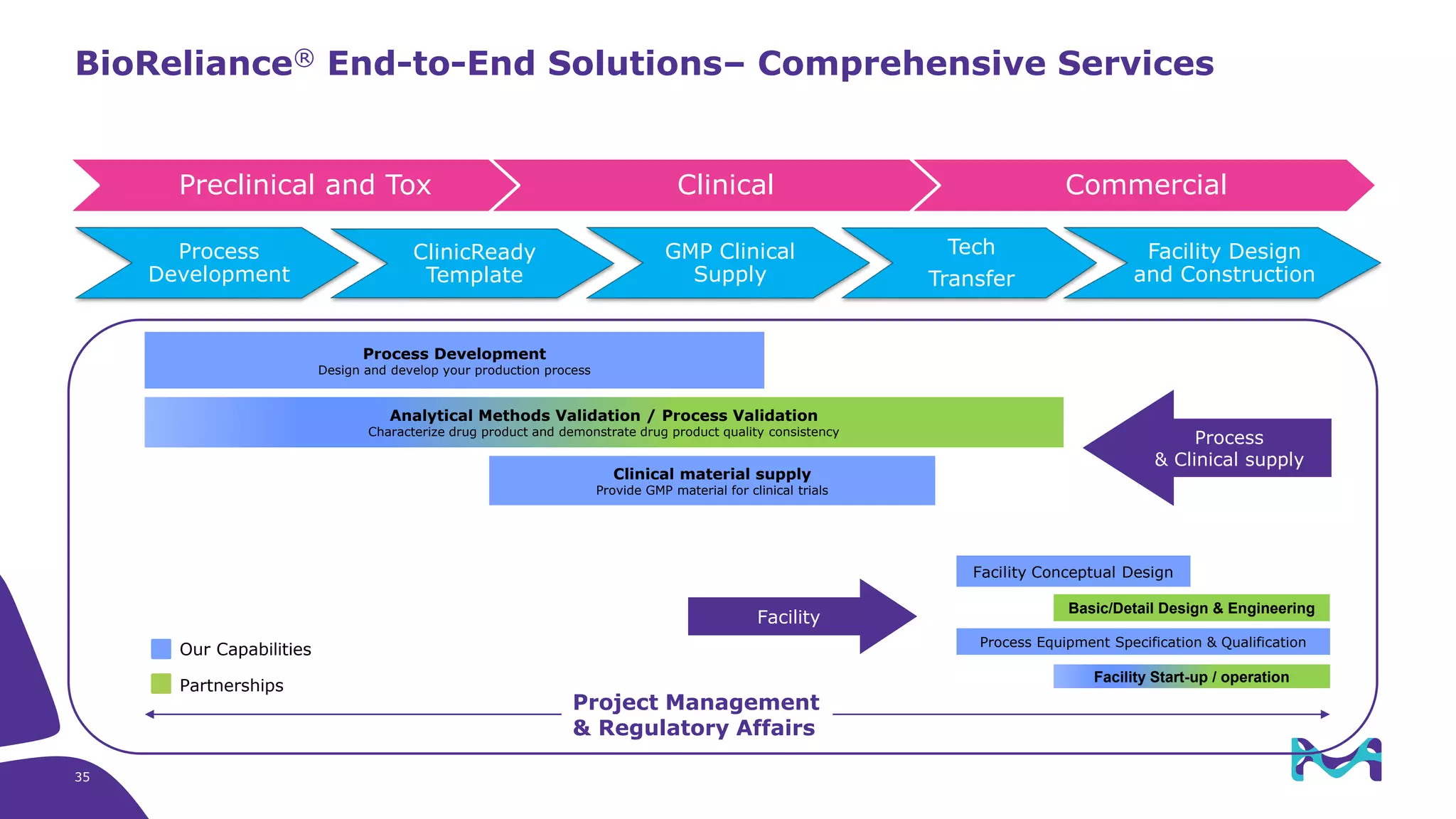
BioReliance® End-to-End Solutions– Comprehensive Services
Preclinical and Tox Clinical Commercial
Process Development
Design and develop your production process
Process Equipment Specification & Qualification
Facility Conceptual Design
Facility Start-up / operation
Analytical Methods Validation / Process Validation
Characterize drug product and demonstrate drug product quality consistency
Clinical material supply
Provide GMP material for clinical trials
Our Capabilities
Partnerships
Facility
Basic/Detail Design & Engineering
Project Management
& Regulatory Affairs
Process
& Clinical supply
35
Turnkey Modular
Solution
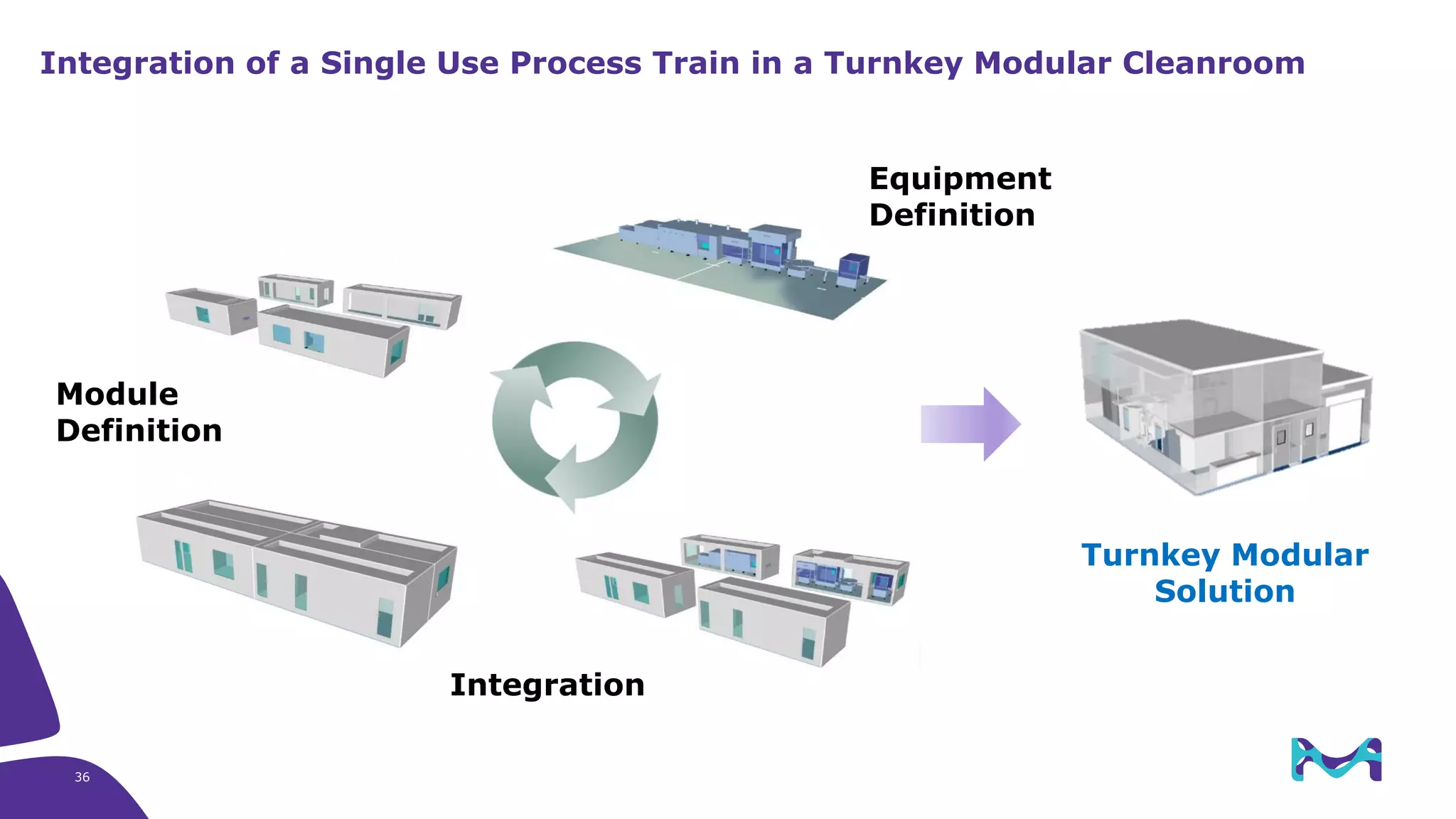
Integration of a Single Use Process Train in a Turnkey Modular Cleanroom
Module
Definition
Integration
Equipment
Definition
36
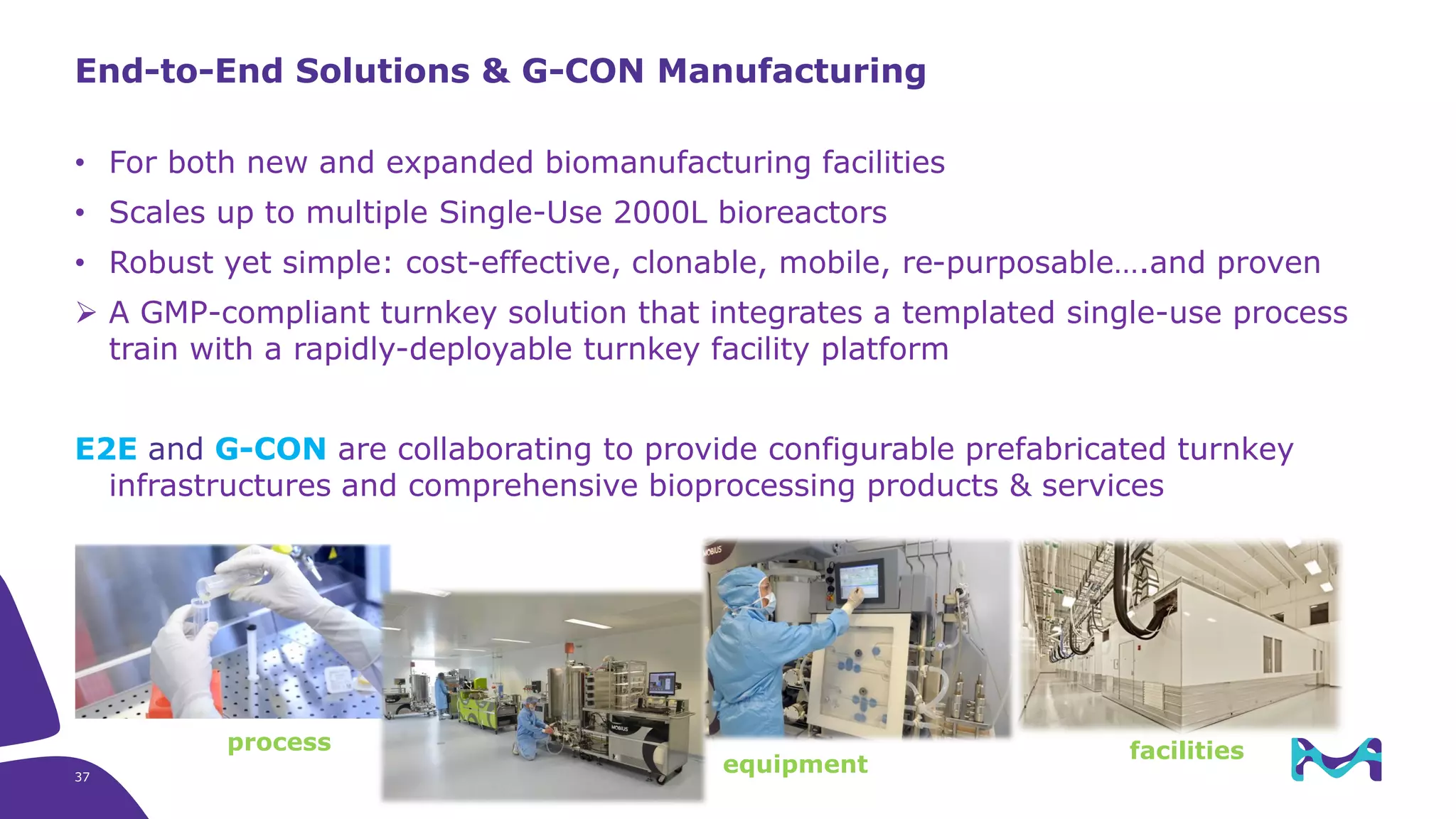
• For both new and expanded biomanufacturing facilities
• Scales up to multiple Single-Use 2000L bioreactors
• Robust yet simple: cost-effective, clonable, mobile, re-purposable….and proven
➢ A GMP-compliant turnkey solution that integrates a templated single-use process
train with a rapidly-deployable turnkey facility platform
E2E and G-CON are collaborating to provide configurable prefabricated turnkey
infrastructures and comprehensive bioprocessing products & services
End-to-End Solutions & G-CON Manufacturing
process
equipment
facilities
37
The vibrant M and BioReliance® are trademarks of Merck KGaA, Darmstadt, Germany or its affiliates. All other trademarks are the property of their respective
owners. Detailed information on trademarks is available via publicly accessible resources.
© 2017 Merck KGaA, Darmstadt, Germany and/or its affiliates. All Rights Reserved.

Modern BioManufacturing: Single-Use Technologies in Configurable, Prefabricated Cleanroom Platforms for MAb Bioprocessing

  • 1.
    Merck KGaA Darmstadt, Germany ShawnR. Smith – Associate Director, Marketing, BioReliance® End-to- End Solutions, Merck KGaA, Darmstadt, Germany Jerome Pionchon – Engineering Expert, BioReliance® End-to-End Solutions, Merck KGaA, Darmstadt, Germany Dennis Powers – Director of Sales Engineering, G-CON Manufacturing Single-Use Technologies in Configurable, Prefabricated Cleanroom Platforms for MAb BioProcessing Modern BioManufacturing
  • 2.
    2 The life sciencebusiness of Merck KGaA, Darmstadt, Germany operates as MilliporeSigma in the U.S. and Canada.
  • 3.
    Agenda  Biopharma 2018– global and local challenges  Solutions: process, equipment and facilities  Flexible, Single-Use, Modular facilities  PODification  Integration 3
  • 4.
    • Governments developing self-sufficiencyprograms for local biologics production • Local Biosimilars with lower costs starting to cannibalize originator biologics • Global Big Pharma producing in local emerging markets • Developing economies spending $ billions on imported medicines • By 2020, prescription sales expected to top $1 trillion globally Our Evolving BioProcessing Market 4
  • 5.
    • Economical fragilityand government’s inability to fund existing incentive programs • Limitation or absence of healthcare systems • Complexity of drug reimbursement processes • Relative political instability • Local governments applying protectionism policies and practices Socio-economic Factors Impacting Biologics 5
  • 6.
    ➢ Investing quicklyto be the first to enter the market ➢ Lowering project financial risks ➢ Ensuring drug product COGS are competitive and affordable ➢ Smaller scale processes in multi-product facilities ➢ Higher process flexibility for better facility and capacity utilization ➢ Process and facility clonability / repurposability The Impact on Biopharmaceutical Processes Adapting and Responding to Challenges 6
  • 7.
    A poll willnow occur. 7
  • 8.
    2 1 3 4 Deep process and engineeringknowledge for Single-Use facility design & construction Project management expertise to coordinate and construct a biomfg facility Detailed technical information from process equipment and control systems to energy utilization and personnel requirements… Financial data including CAPEX, OPEX, utilities, staffing… Translating Process Drivers Into Facilities Design -- NEEDS 8
  • 9.
    Direct experience in designingand constructing our own Single-Use facility Dedicated Project Managers with a balanced global/local partnership approach Deep institutional knowledge about Merck KGaA, Darmstadt, Germany SU technologies and their integration/operation into active bioprocessing facilities Financial modeling inclusive of all factors required for effective business case development Translating Process Drivers Into Facilities Design – E2E Solutions 2 1 3 4 9
  • 10.
    Process Development ClinicReady Template GMP Clinical Supply Tech Transfer FacilityDesign and Construction Preclinical and Tox Clinical Commercial We have the products & the End-to-End services to support the entire lifecycle of a biomolecule GMP Production at the Biodevelopment Center – Martillac, FR GMP Production at a New Facility – Single-Use, Modular, or Hybrid BioReliance® End-to-End Solutions 10
  • 11.
  • 12.
    Upstream optimization iskey to COGS reduction Scale-up and scale-down from 3L up to 2000L CLD, Media/Feeds, Bioreactor tuning Process Development and Scalability in SUT 12
  • 13.
    Tech Transfer ICH Q10: “Thegoal of technology transfer activities is to transfer product and process knowledge between development and manufacturing, and within or between manufacturing sites to achieve product realization. This knowledge forms the basis for the manufacturing process, control strategy, process validation approach, and ongoing continual improvement.” ✓Transfers have to be performed in an organized, methodical manner, with appropriate documentation. ✓Open, transparent, detailed communications with the ultimate purpose of enabling self-sufficiency 13
  • 14.
  • 15.
  • 16.
    From PD toCommercial Supply: Flexibility and Speed are Key! Rapid suite configuration for a variety of processes Rapid changeovers between batches Closed processes Sterile pre-assembled disposable assemblies sterile connectors / tube welders Process Flexibility Reduction of Contamination Risks Ease of Use Lower CapEx Facility / Equipment Lower OpEx Process! 16
  • 17.
    Single-use vs. StainlessSteel – Time & Cost Savings Comparing our Biodevelopment Center USP suites: Single-Use vs. Stainless Steel RUN RUN Preparation / Parameter setting Media conditioning CIP/Requalification/Maint. Preparation Preparation USP1 : 1250L Stainless Steel Bioreactor USP2 & 3: 200L / 2000L Single-Use Bioreactor RUN Traditional Single - use Time Spent to perform qualification (IQ/OQ/PQ) 5 months 1 month Time Spent to prepare the bioreactor (Assembling Sterilization, cleaning) / bioreactor 2 -3 days 2-3 hours Preparation 17
  • 18.
    Large scale: 1000Lto 2000L +42% capacity/Yr 23% cost savings /batch Medium scale: 50L to 200L Double capacity/Yr 42% cost savings/batch When moving from Stainless Steel to Single-use Systems… Elimination of non value-added activities with single-use systems: CIP/SIP/Preparation of the suite 3 to 5 days with Stainless Steel / ½ day with single-use equipment Electricity and water savings Smaller number of technicians needed to operate the process The Benefits of Such a Transition 18
  • 19.
    - Early integrationof manufacturing constraints in Development (Equipment, Titer, Volume, RM) - Processes mapping and optimization (« closed », intensification, PAT…) - Capacity increase but with a critical liquid flow management (concentrated solutions with inline dilution) - Good supply management with Kanban for consumables - Low volumes of chemicals, less handling risks 1. Process Key Elements of Focus: When The Transition to SUT is Initiated 19
  • 20.
    2. Facility/ Utilities - Pharmaceutical areasare less complex (not hard-piped, CIP, SIP…) with optimized footprints, repurposable work areas - Closed systems allow for a decrease in environment controls - Reduction of energy type & consumption level - Standardization of equipment and associated PM (risk analysis, service consolidation) - Pre-engineered solutions can be used to accelerate the availability of desired capabilities Key Elements of Focus: When The Transition to SUT is Initiated 20
  • 21.
    3. Engineering - Master Planavailablity (expansion, flexibility?) - Define the right capacity, for the right purpose (mono/multi products, batch/campaign…) - Integrate local requirements (QA, EHS…) - Optimize the workflows (personnel, bioproduct & media/buffers, waste materials…) - Integrate staging/storage areas - Uni-directional and/or multi-directional flows - Automation/21CFR Part11 compliance Key Elements of Focus: When The Transition to SUT is Initiated 21
  • 22.
  • 23.
    Once the equipmenthas been selected, it is placed in the facility 1.To meet all Process, Quality and Regulatory requirements 2.For operator Ease of Use and Accessibility during any required maintenance General Facility Layout From the general facility layout, generate specific layouts 1. Room classification 2. Room pressurization 3. Personnel flow 4. Material flows including raw materials, waste, and final product Once the Process is Known… 23
  • 24.
    General Facility Layout Oncethe Process is Known… 24
  • 25.
    3D Drawings &Tools Once the Process is Known… 25
  • 26.
    Your choices will impact yoursuccess Location… • Do you have an existing building? • Is ‘clonability’ desired for other locations? • Possibility of relocation? Drug production forecast… • Single-product or multi-product plant? • How to match current production scale? • Capacity/scalability needs (up and down) • Possibility to re-purpose facility/eqpt? Budget… • How to assess financial impact and gains of different options? • Cost impact in case of relocation/ repurposing ? Time… • Need for rapid deployment? • Expedited timing/constraints? Facilities Construction: Traditional vs Turnkey Modular 26
  • 27.
    Merck KGaA Darmstadt, Germany Process Equipment  Turnkey Modular Facilities
  • 28.
    Why Turnkey Modular? ✓Reduction in project timelines • Parallel fabrication of cleanrooms, building, and equipment ✓ Predictable activities and outcomes • Avoidance of on-site construction disturbances ✓ Reduced complexity at construction site • Minimize liability and impact on site and other operations • Skilled and experienced trades may not be available locally ✓ High quality, fully integrated, end to end • Factory testing prior shipment (equipment and cleanrooms) • Reduces risk of startup and qualification Turnkey modular facilities provide many benefits over traditional construction 28
  • 29.
    Facility Project Scenarios Theneed and scope of facility projects can vary depending upon a manufacturers project and expansion requirements Retrofit EXISTING SITE NO EXISTING Expand Greenfield Traditional Turnkey Modular Can a turnkey solution be applied to support each of these scenarios? 29
  • 30.
    G-CON Manufacturing G-CON isthe innovator and market leader of prefabricated, autonomous cleanroom POD® designs and technologies ✓ Configurable standard designs ✓ Integrated MEP Systems and Controls ✓ Cleanroom and Containment ✓ Mobile and Transportable ✓ Process Integrated ✓ Robust high quality construction 30
  • 31.
    PODs ® -Flexibility in Design ✓ Utilize for retrofit or greenfield projects ✓ PODs are ideal for multi-product facilities • PODs are autonomous segregated units • Dedicated HVAC systems ✓ PODs easily added to increase cleanroom area • Capacity flexing • Minimal impact on existing operations ✓ Process equipment integrated within PODs • In factory or on-site ✓ PODs are mobile and transportable • Can be relocated or repurposed at a new facility 31
  • 32.
    Build, Expand, Redeploy Phase1 Install Building and PODs Phase 2 Install additional PODs Phase 3 Add on building and PODs Phase 4 Redeploy PODs to new site Repurpose building 32
  • 33.
    Total Cost ofOwnership ✓ Faster path to revenue generation • Compressed project timelines ✓ Mitigate investment risk • Delay initial capital investment • Invest as needed to expand ✓ Depreciation and tax benefits • PODs can be considered equipment • More options for leasing ✓ Extend useful life of facility • Redeploy PODs, Repurpose Facility A POD turnkey solution can have a significant positive impact on the total cost of ownership for a drug manufacturer 33
  • 34.
  • 35.
    Process Development ClinicReady Template GMP Clinical Supply Tech Transfer Facility Design andConstruction BioReliance® End-to-End Solutions– Comprehensive Services Preclinical and Tox Clinical Commercial Process Development Design and develop your production process Process Equipment Specification & Qualification Facility Conceptual Design Facility Start-up / operation Analytical Methods Validation / Process Validation Characterize drug product and demonstrate drug product quality consistency Clinical material supply Provide GMP material for clinical trials Our Capabilities Partnerships Facility Basic/Detail Design & Engineering Project Management & Regulatory Affairs Process & Clinical supply 35
  • 36.
    Turnkey Modular Solution Integration ofa Single Use Process Train in a Turnkey Modular Cleanroom Module Definition Integration Equipment Definition 36
  • 37.
    • For bothnew and expanded biomanufacturing facilities • Scales up to multiple Single-Use 2000L bioreactors • Robust yet simple: cost-effective, clonable, mobile, re-purposable….and proven ➢ A GMP-compliant turnkey solution that integrates a templated single-use process train with a rapidly-deployable turnkey facility platform E2E and G-CON are collaborating to provide configurable prefabricated turnkey infrastructures and comprehensive bioprocessing products & services End-to-End Solutions & G-CON Manufacturing process equipment facilities 37
  • 38.
    The vibrant Mand BioReliance® are trademarks of Merck KGaA, Darmstadt, Germany or its affiliates. All other trademarks are the property of their respective owners. Detailed information on trademarks is available via publicly accessible resources. © 2017 Merck KGaA, Darmstadt, Germany and/or its affiliates. All Rights Reserved.