Merck KGaA
Darmstadt, Germany
Steven Strubbe, Technical Leader, BioReliance® End-to-End
Solutions
Guillaume Plane, Marketing and Development Manager,
BioReliance® End-to-End Solutions
Tips and Tricks from a Biodevelopment Center
Tech Transfer and
Scale-Up
Bioreactor Protection with the Viresolve® Barrier Filter | 16 August 2018
The life science business of
Merck KGaA, Darmstadt, Germany
operates as MilliporeSigma
in the U.S. and Canada.
2
3 Managing process scaling and tech transfer
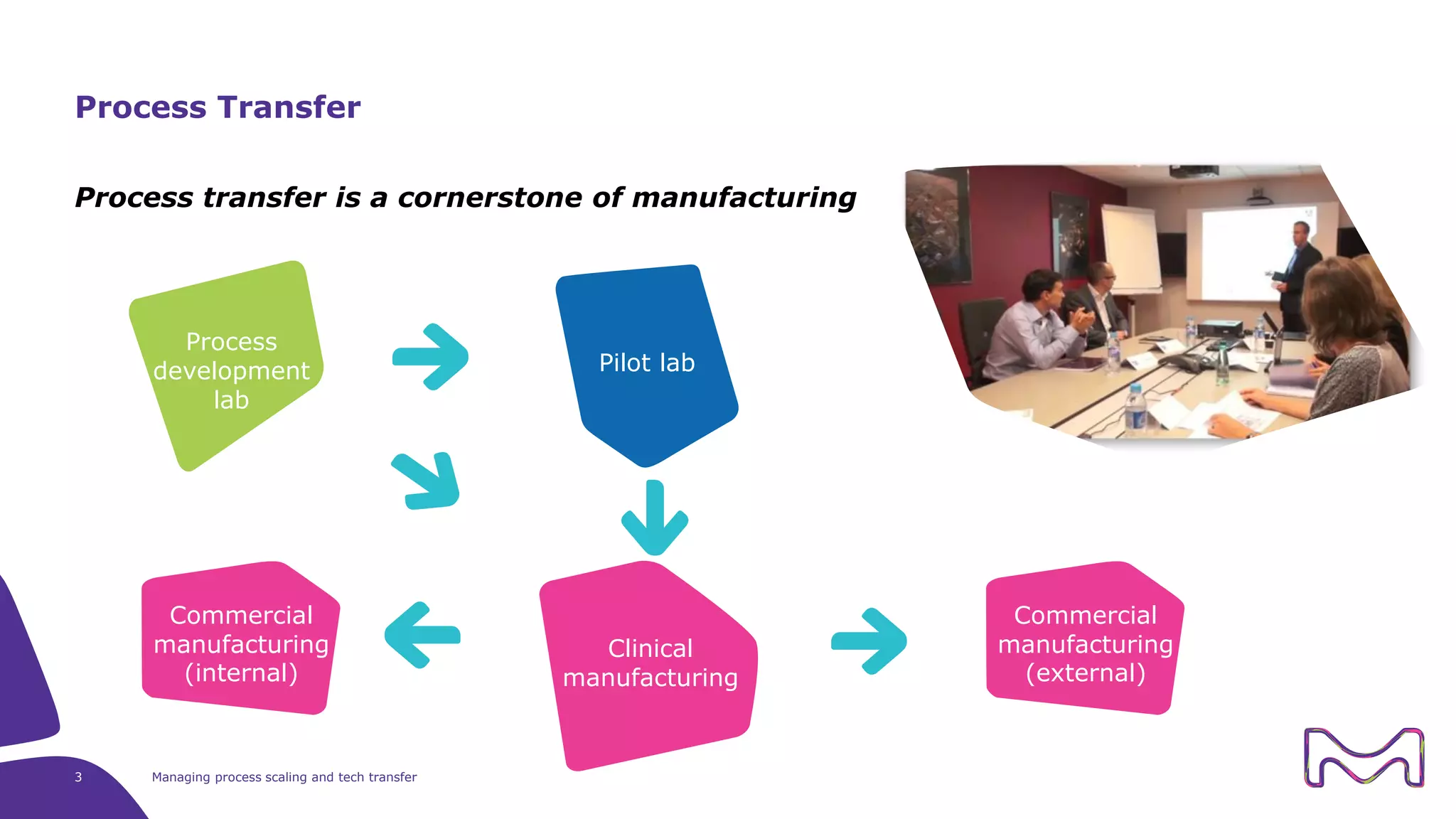
Process transfer is a cornerstone of manufacturing
Process Transfer
Process
development
lab
Pilot lab
Clinical
manufacturing
Commercial
manufacturing
(internal)
Commercial
manufacturing
(external)
4 Managing process scaling and tech transfer
Process transfer is regulatory defined
ICH Q10:
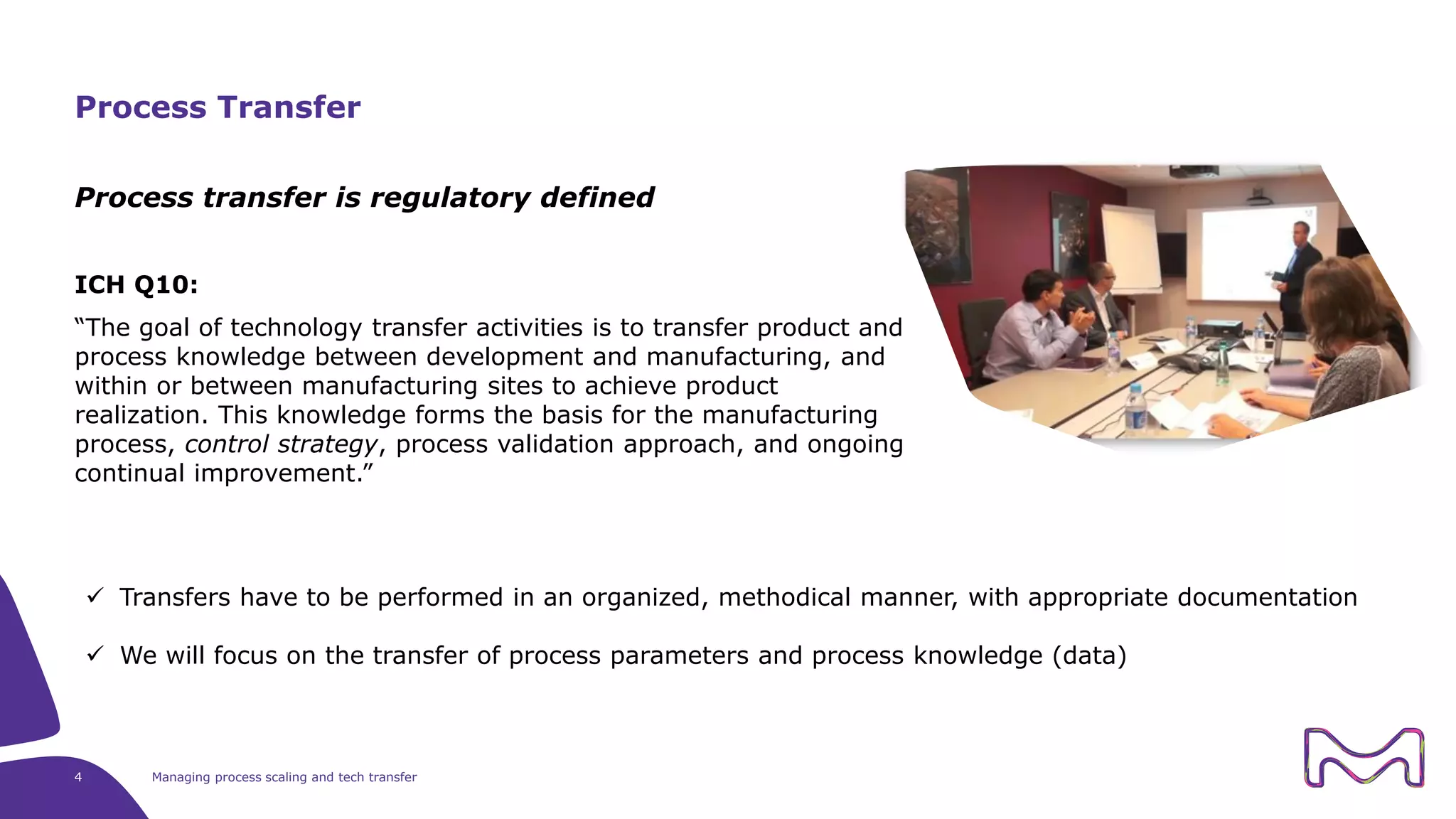
“The goal of technology transfer activities is to transfer product and
process knowledge between development and manufacturing, and
within or between manufacturing sites to achieve product
realization. This knowledge forms the basis for the manufacturing
process, control strategy, process validation approach, and ongoing
continual improvement.”
Process Transfer
 Transfers have to be performed in an organized, methodical manner, with appropriate documentation
 We will focus on the transfer of process parameters and process knowledge (data)
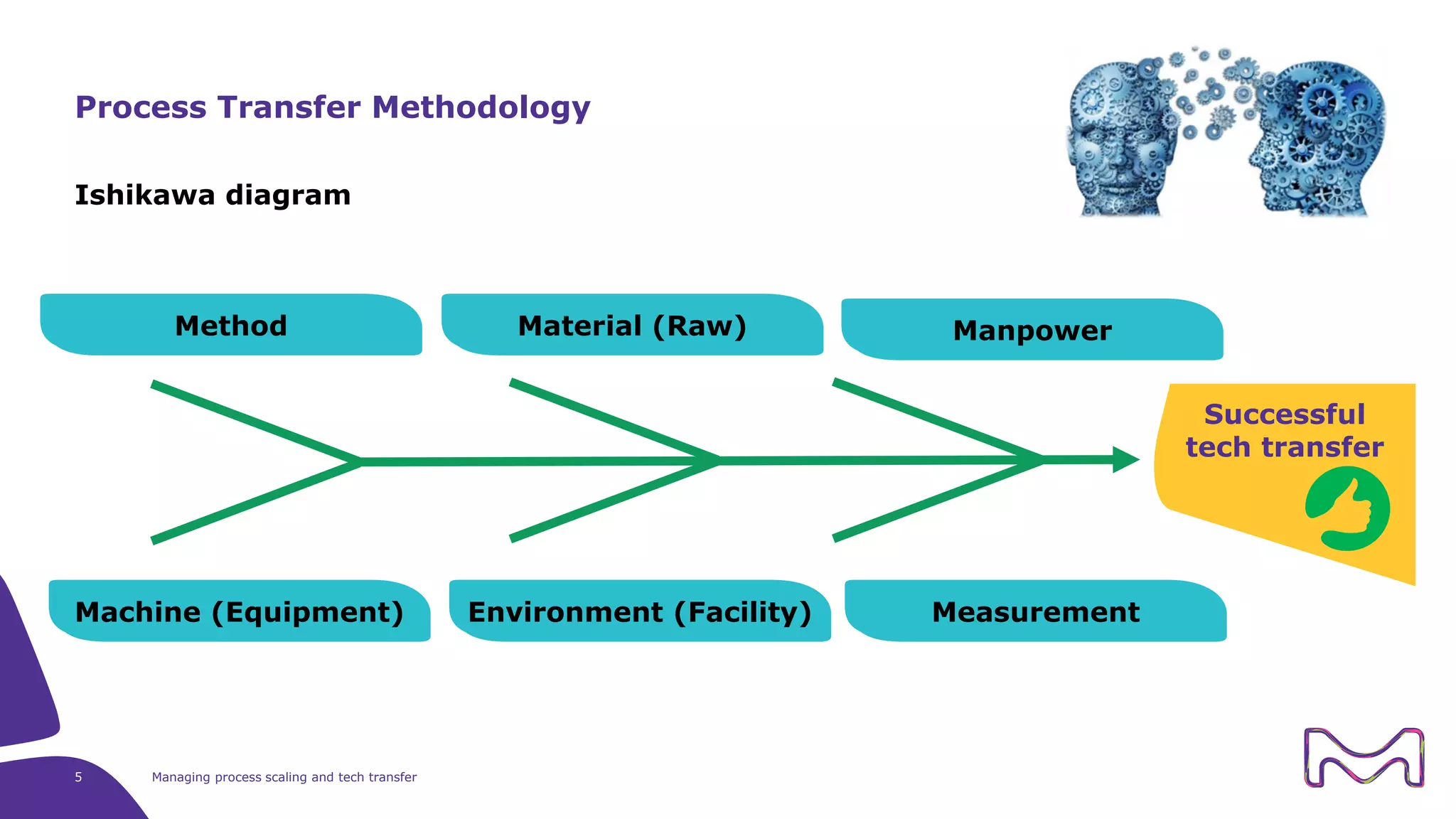
Ishikawa diagram
5 Managing process scaling and tech transfer
Process Transfer Methodology
Method Material (Raw) Manpower
Machine (Equipment) Environment (Facility) Measurement
Successful
tech transfer
Ishikawa diagram
6 Managing process scaling and tech transfer
Process Transfer Methodology
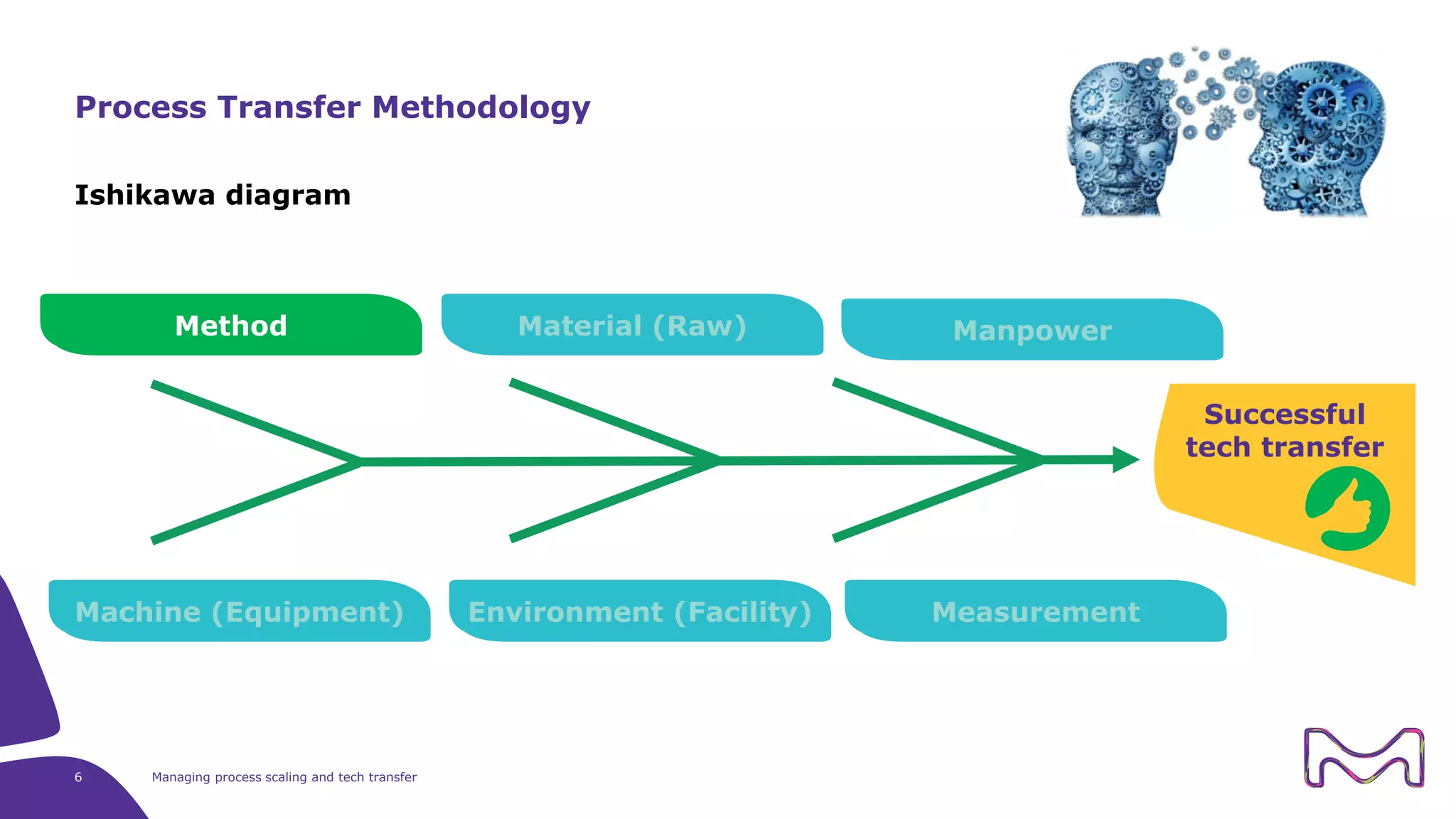
Method Material (Raw) Manpower
Machine (Equipment) Environment (Facility) Measurement
Successful
tech transfer
Ishikawa diagram
7 Managing process scaling and tech transfer
Process Transfer Methodology
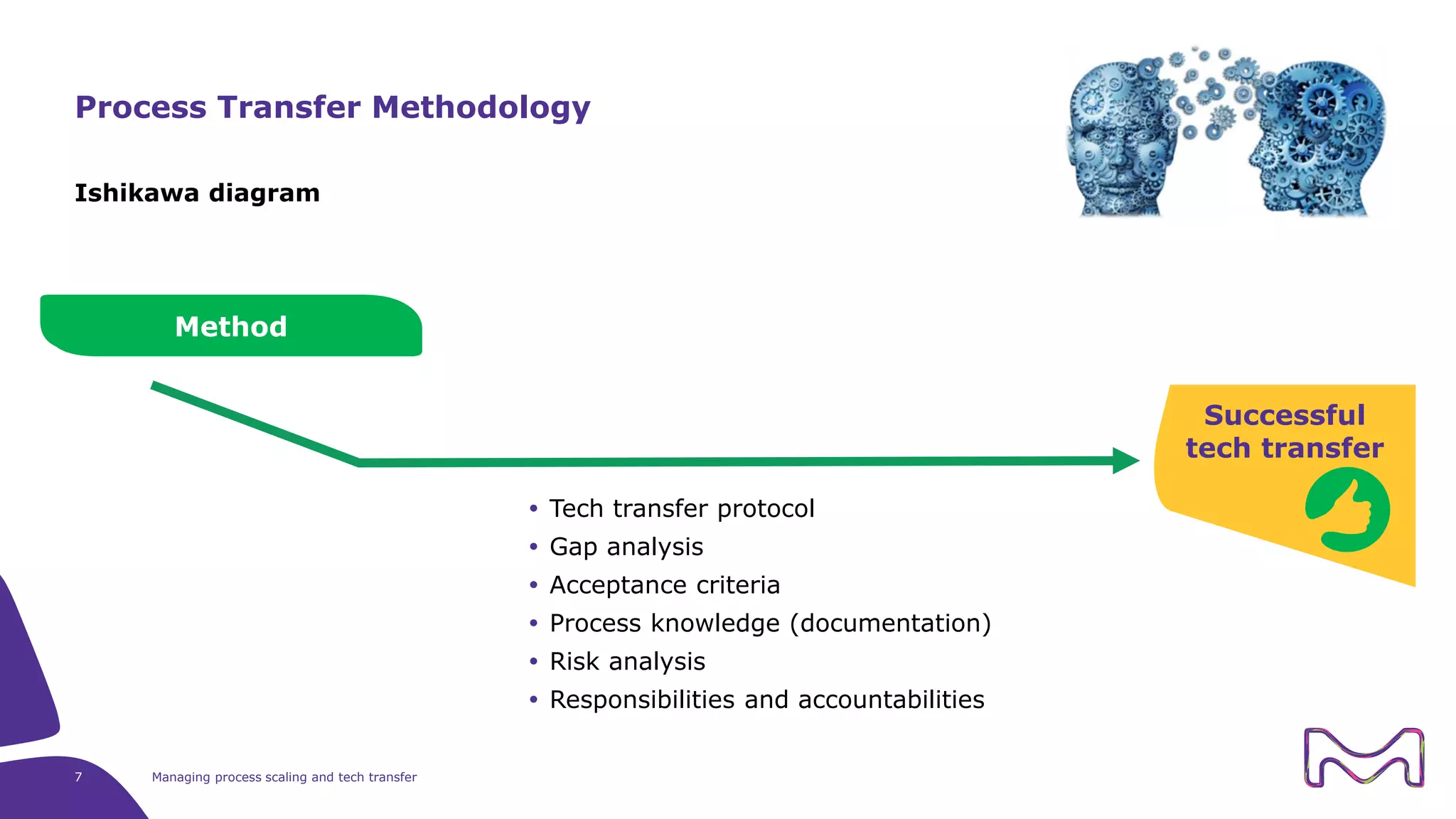
Method
Successful
tech transfer
 Tech transfer protocol
 Gap analysis
 Acceptance criteria
 Process knowledge (documentation)
 Risk analysis
 Responsibilities and accountabilities
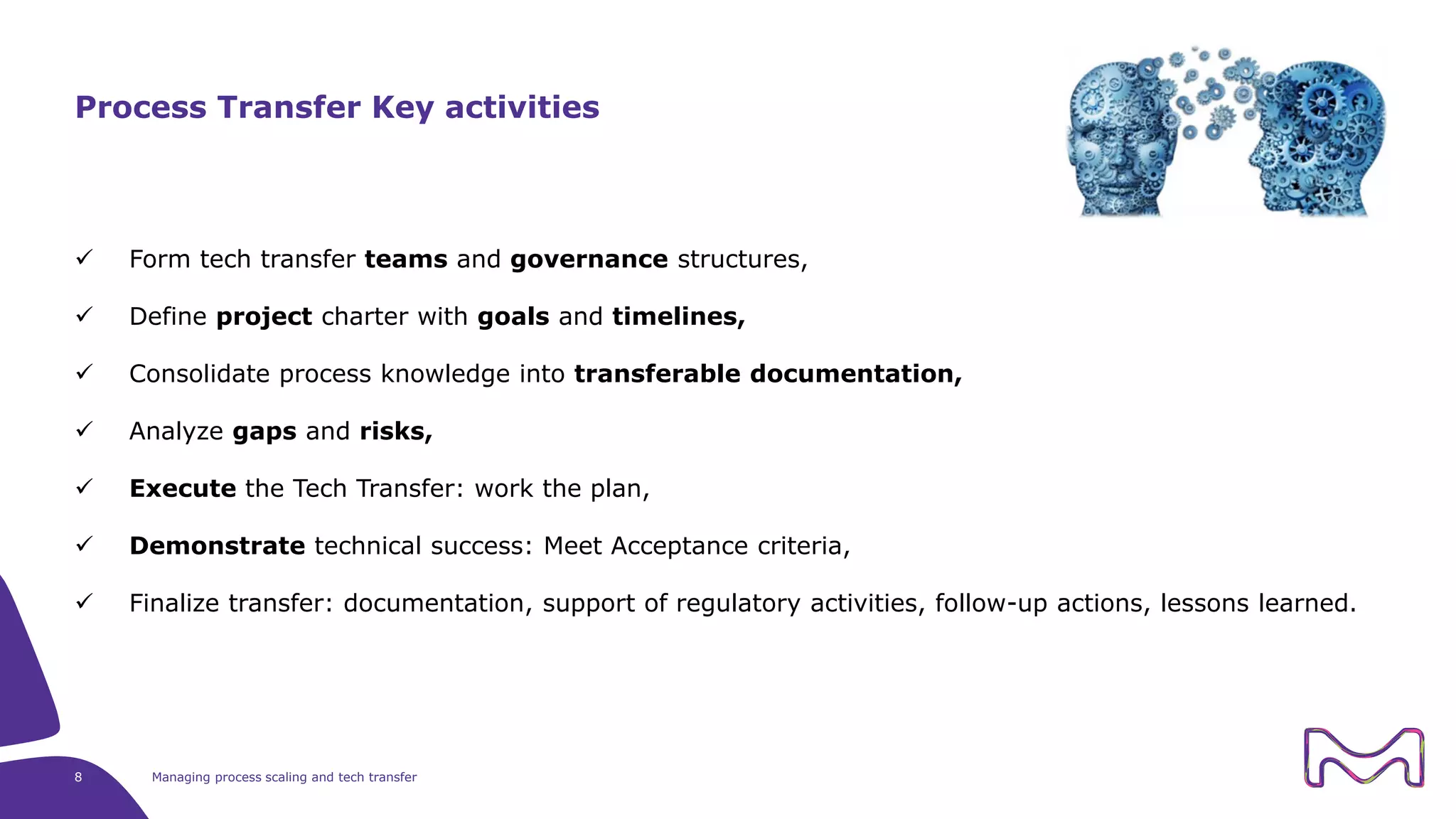
 Form tech transfer teams and governance structures,
 Define project charter with goals and timelines,
 Consolidate process knowledge into transferable documentation,
 Analyze gaps and risks,
 Execute the Tech Transfer: work the plan,
 Demonstrate technical success: Meet Acceptance criteria,
 Finalize transfer: documentation, support of regulatory activities, follow-up actions, lessons learned.
8 Managing process scaling and tech transfer
Process Transfer Key activities
9 Managing process scaling and tech transfer
Process Transfer Key activities
Project Charter
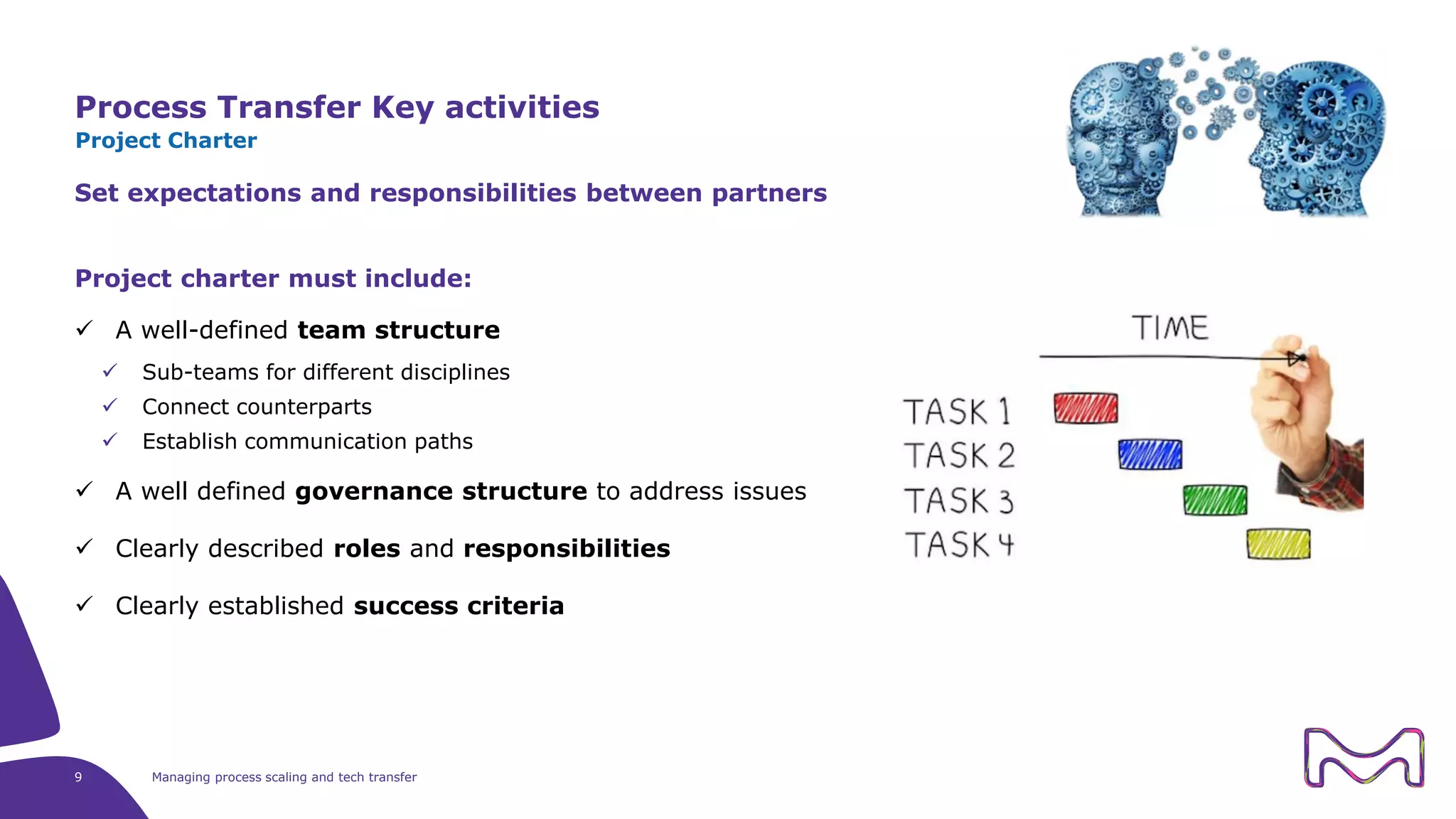
Set expectations and responsibilities between partners
Project charter must include:
 A well-defined team structure
 Sub-teams for different disciplines
 Connect counterparts
 Establish communication paths
 A well defined governance structure to address issues
 Clearly described roles and responsibilities
 Clearly established success criteria
10 Managing process scaling and tech transfer
Process Transfer Key activities
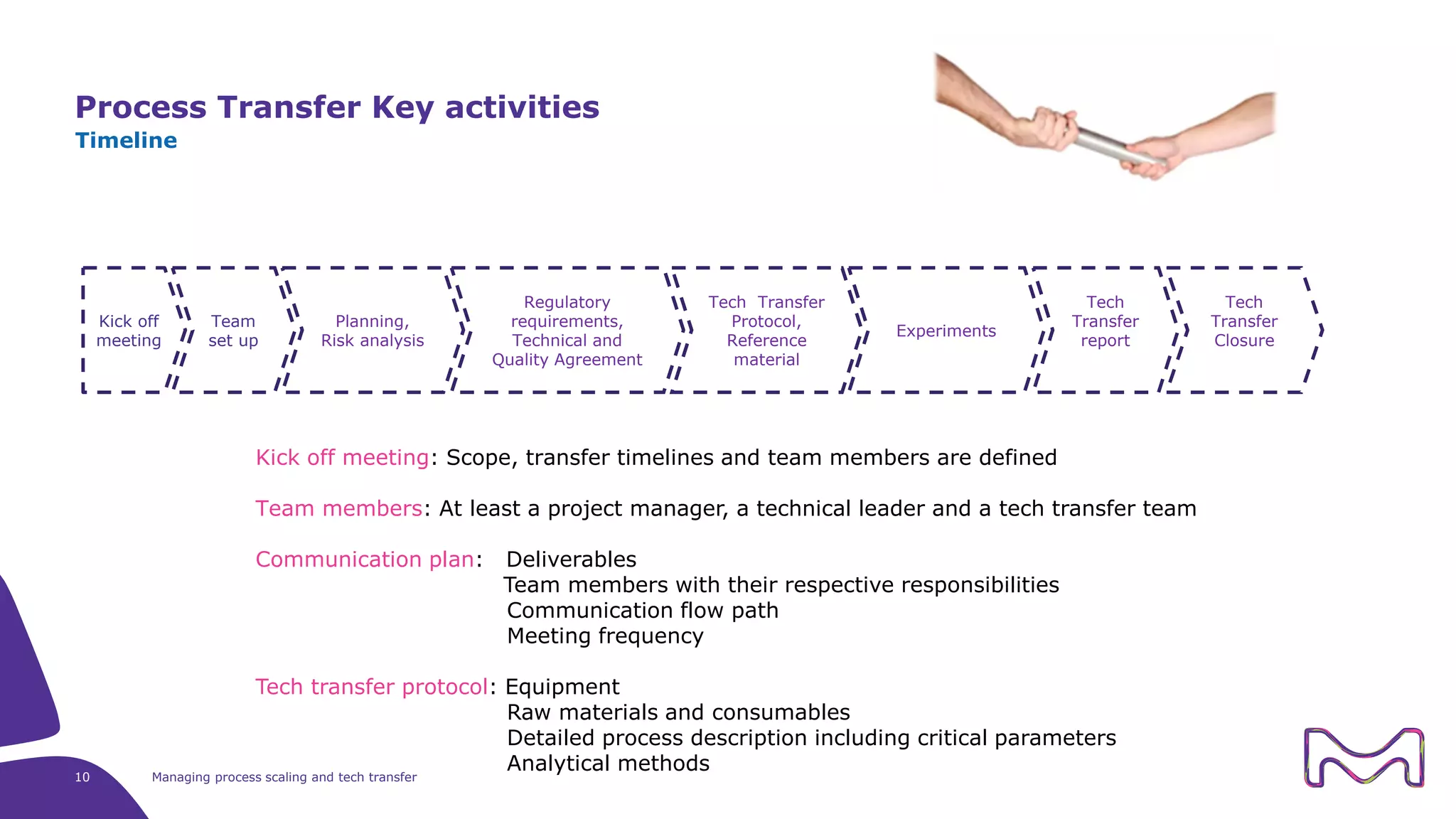
Timeline
Kick off
meeting
Team
set up
Regulatory
requirements,
Technical and
Quality Agreement
Planning,
Risk analysis
Kick off meeting: Scope, transfer timelines and team members are defined
Team members: At least a project manager, a technical leader and a tech transfer team
Communication plan: Deliverables
Team members with their respective responsibilities
Communication flow path
Meeting frequency
Tech transfer protocol: Equipment
Raw materials and consumables
Detailed process description including critical parameters
Analytical methods
Tech Transfer
Protocol,
Reference
material
Tech
Transfer
report
Tech
Transfer
Closure
Experiments
A Process Description document with an overview of each step and key process parameters is required
 Information should be described in a site and scale independent manner
 Site-specific details from previous process installations should also be gathered as examples
For example:
 Buffers may have been prepared in batch or via in-line dilution
 Bioreactors may have been operated with different sparger configurations
Process Transfer Key activities
11 Managing process scaling and tech transfer
Consolidated Process Knowledge
Use an electronic file sharing system
for document hosting – not email
Process Transfer Key activities
12 Managing process scaling and tech transfer
Gap analysis
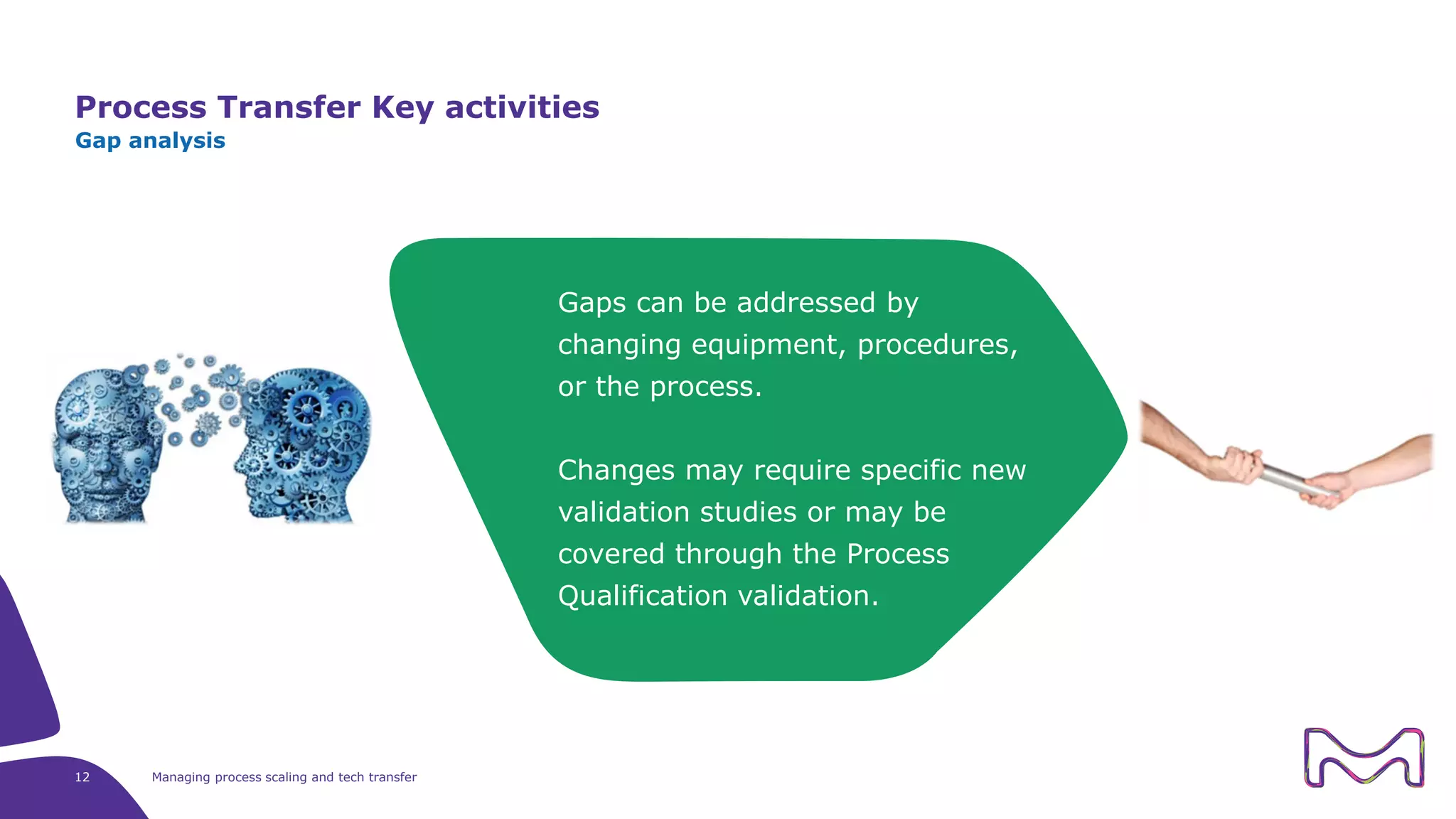
Gaps can be addressed by
changing equipment, procedures,
or the process.
Changes may require specific new
validation studies or may be
covered through the Process
Qualification validation.
Process Transfer Key activities
13 Managing process scaling and tech transfer
Quality Risk Management
Risks are inherent to
technology transfers
Identifying, assessing, and
mitigating - or - accepting
risks defines the project
work scope of a transfer
From ICH Q9, two primary principles
of quality risk management are:
 Evaluation of risk to quality should be based
on scientific knowledge and ultimately link to
protection of patients
 The level of effort, formality, and documentation of
The quality risk management process should be
commensurate with the level of risk
Process Transfer Key activities
14 Managing process scaling and tech transfer
Process “Q/q”ualification
It is a demonstration that the process is
performing correctly at the receiving unit.
It is important to have Pre-defined Success
Criteria: step yield, impurities, titer, etc.
Process Transfer Key activities
15 Managing process scaling and tech transfer
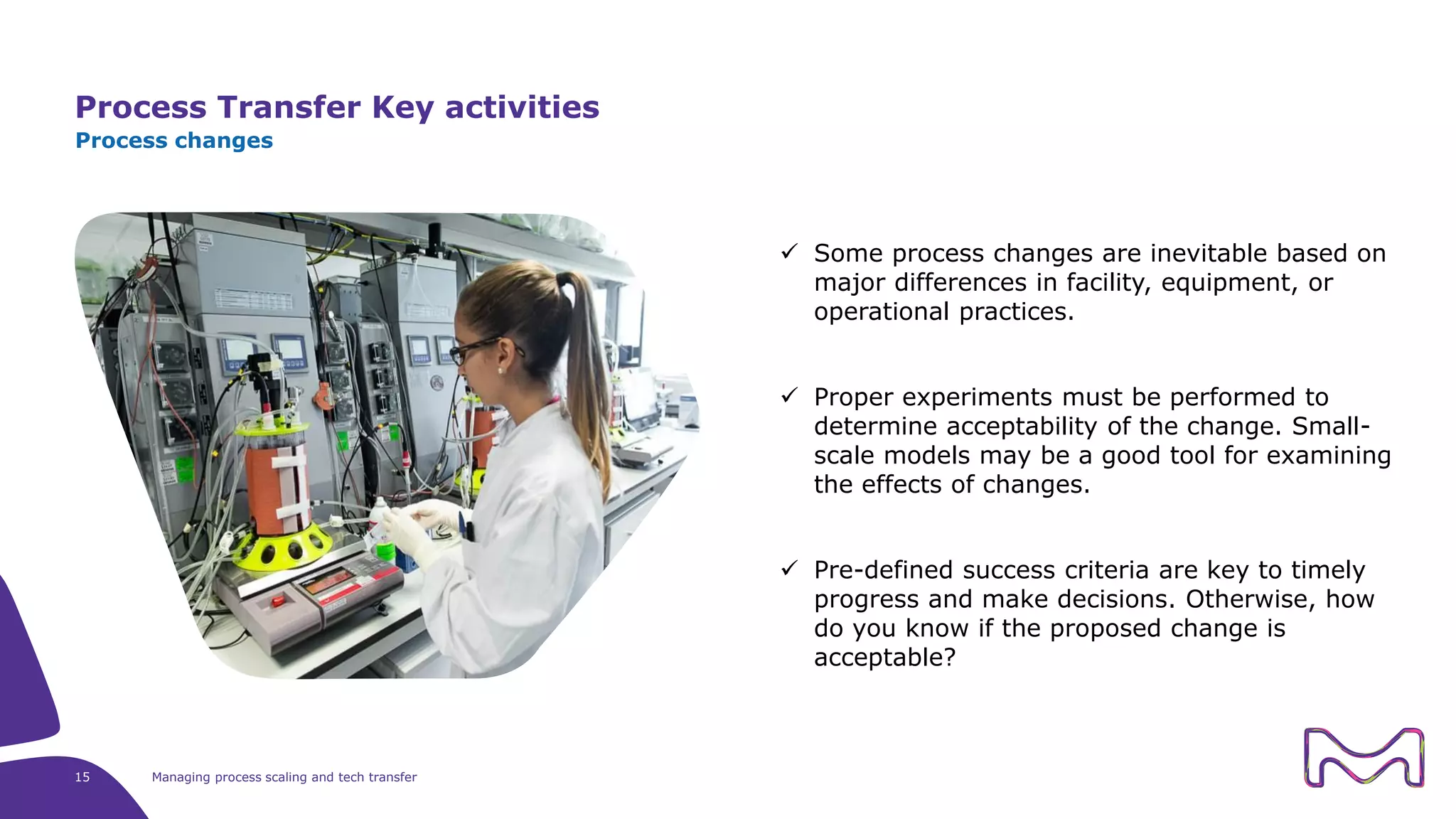
Process changes
 Some process changes are inevitable based on
major differences in facility, equipment, or
operational practices.
 Proper experiments must be performed to
determine acceptability of the change. Small-
scale models may be a good tool for examining
the effects of changes.
 Pre-defined success criteria are key to timely
progress and make decisions. Otherwise, how
do you know if the proposed change is
acceptable?
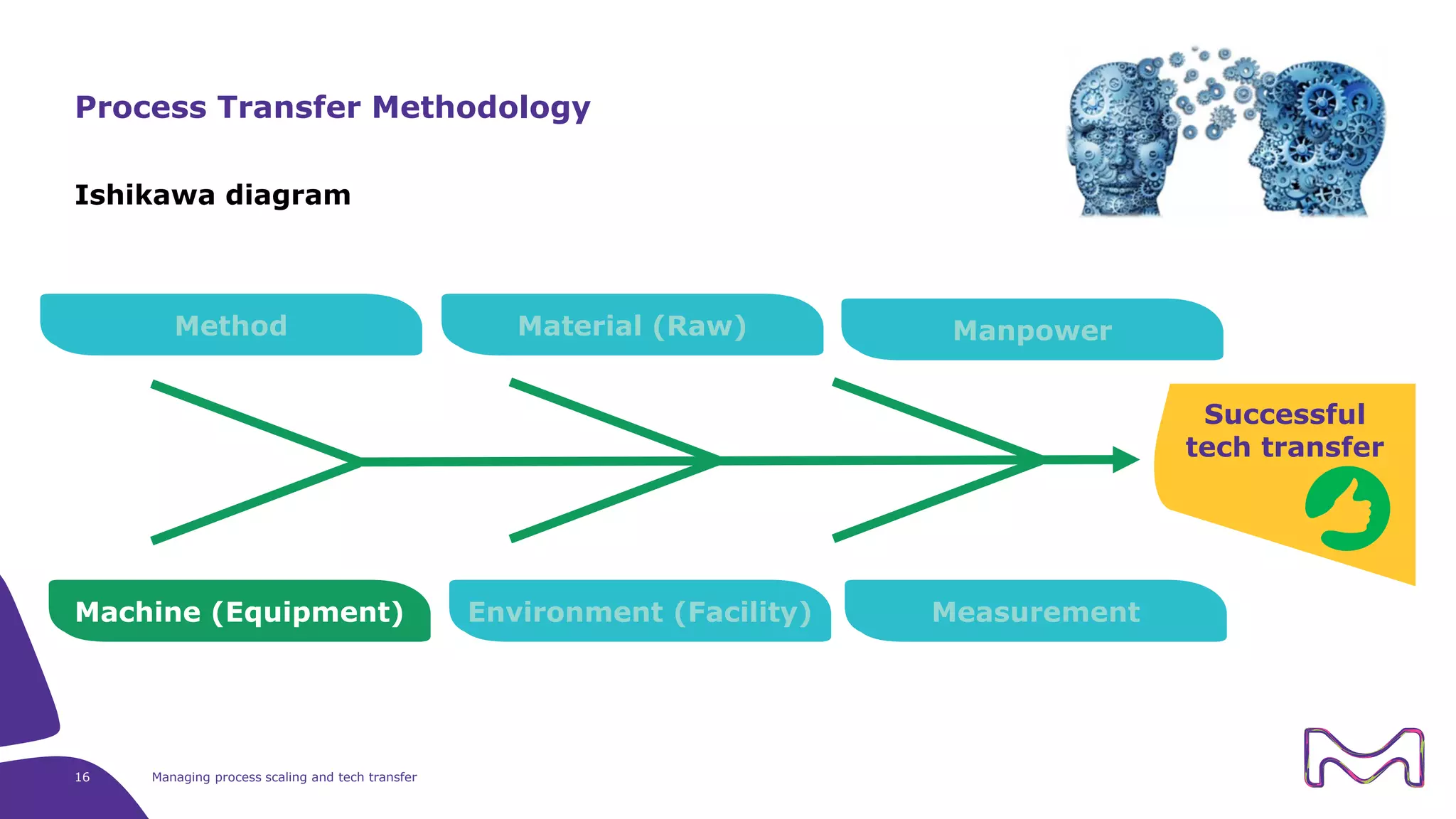
Ishikawa diagram
16 Managing process scaling and tech transfer
Process Transfer Methodology
Method Material (Raw) Manpower
Machine (Equipment) Environment (Facility) Measurement
Successful
tech transfer
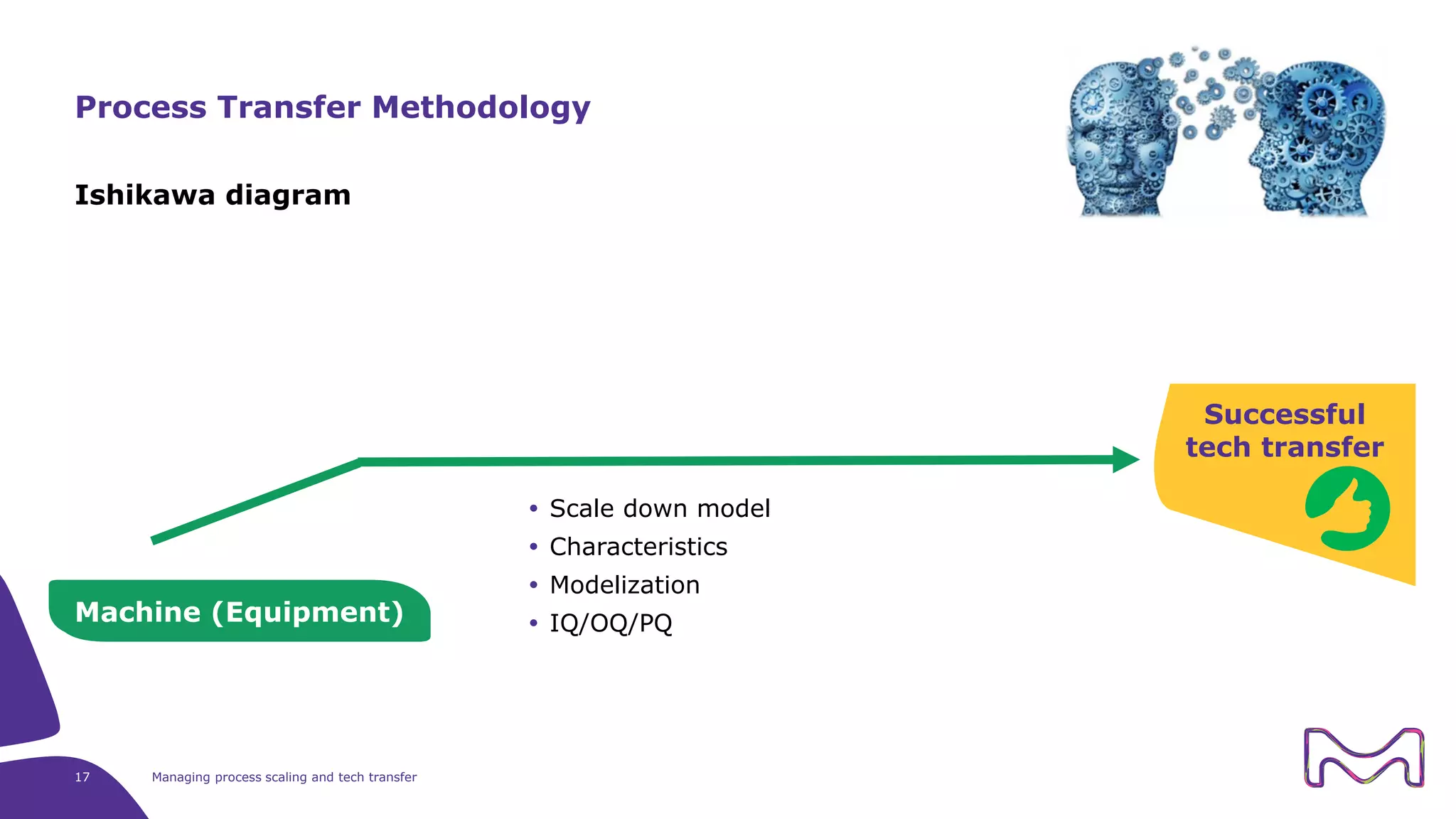
Ishikawa diagram
17 Managing process scaling and tech transfer
Process Transfer Methodology
Machine (Equipment)
Successful
tech transfer
 Scale down model
 Characteristics
 Modelization
 IQ/OQ/PQ
Systems characteristics have to be considered
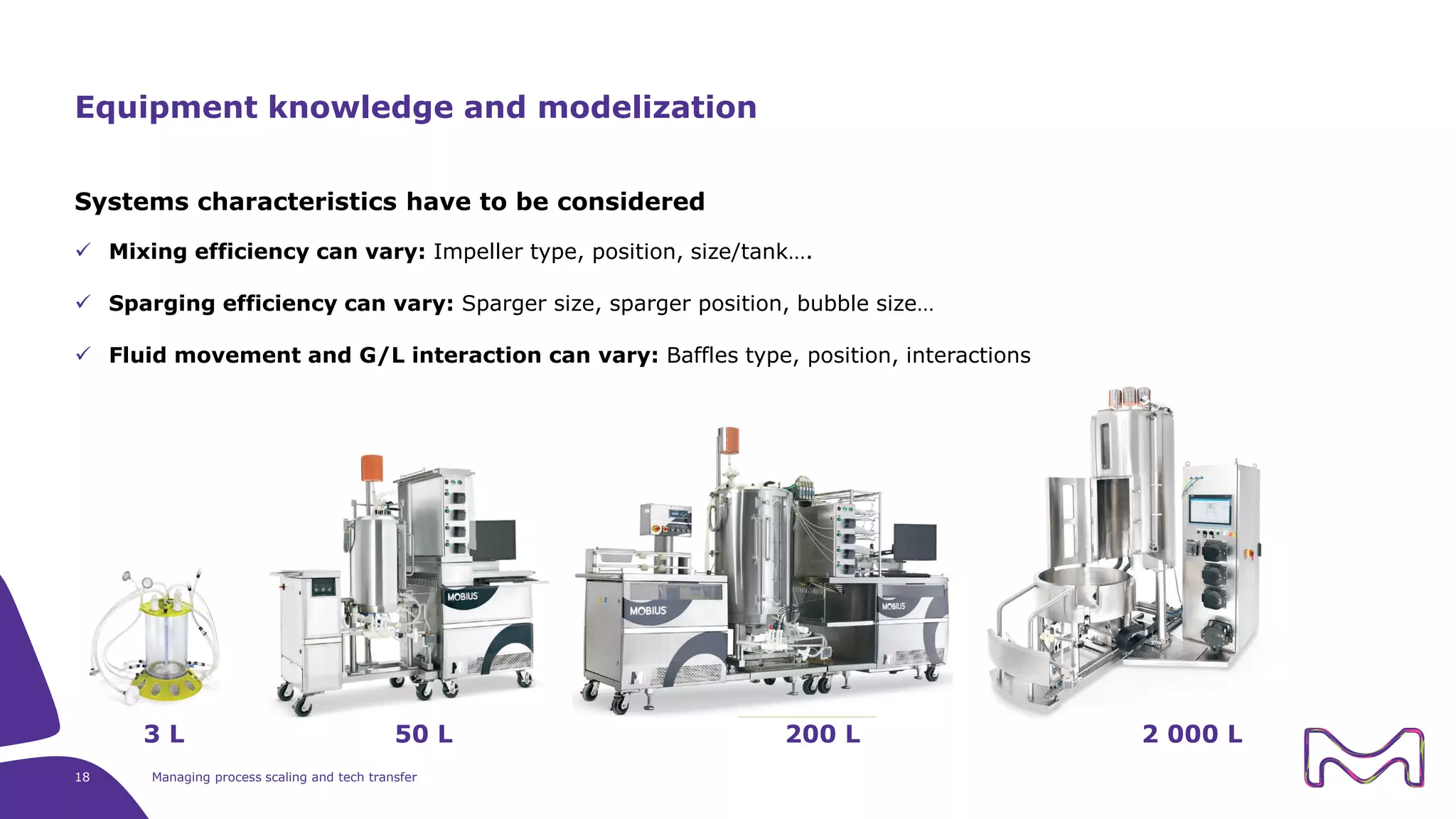
 Mixing efficiency can vary: Impeller type, position, size/tank….
 Sparging efficiency can vary: Sparger size, sparger position, bubble size…
 Fluid movement and G/L interaction can vary: Baffles type, position, interactions
18 Managing process scaling and tech transfer
Equipment knowledge and modelization
3 L 50 L 200 L 2 000 L
Systems characteristics have to be considered
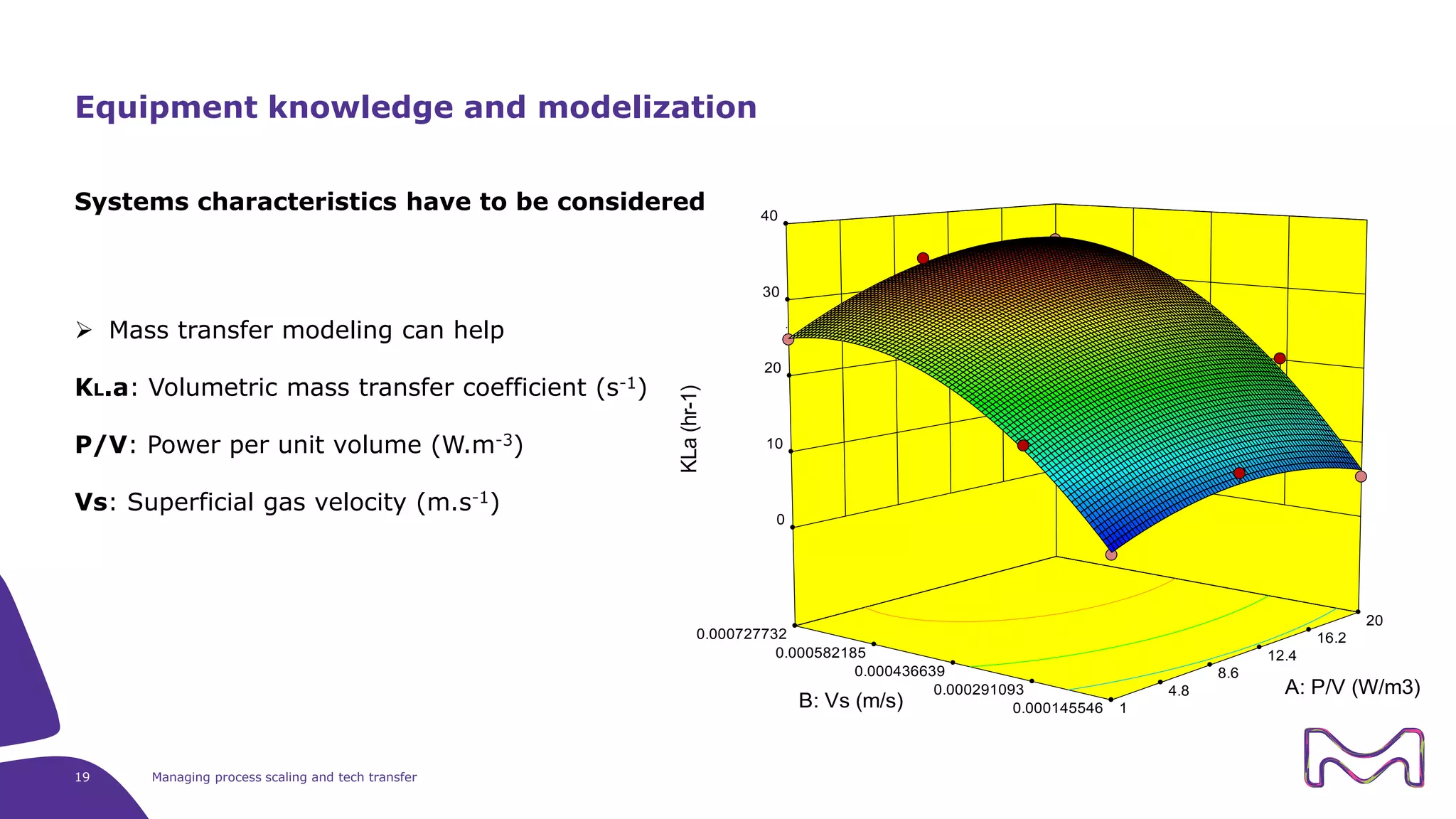
 Mass transfer modeling can help
KL.a: Volumetric mass transfer coefficient (s-1)
P/V: Power per unit volume (W.m-3)
Vs: Superficial gas velocity (m.s-1)
19 Managing process scaling and tech transfer
Equipment knowledge and modelization
Design-Expert® Software
Factor Coding: Actual
KLa (hr-1)
Design points above predicted value
Design points below predicted value
34.71
4.07
X1 = A: P/V
X2 = B: Vs
0.000145546
0.000291093
0.000436639
0.000582185
0.000727732
1
4.8
8.6
12.4
16.2
20
0
10
20
30
40
KLa(hr-1) A: P/V (W/m3)
B: Vs (m/s)
Systems characteristics have to be considered
20 Managing process scaling and tech transfer
Equipment knowledge and modelization
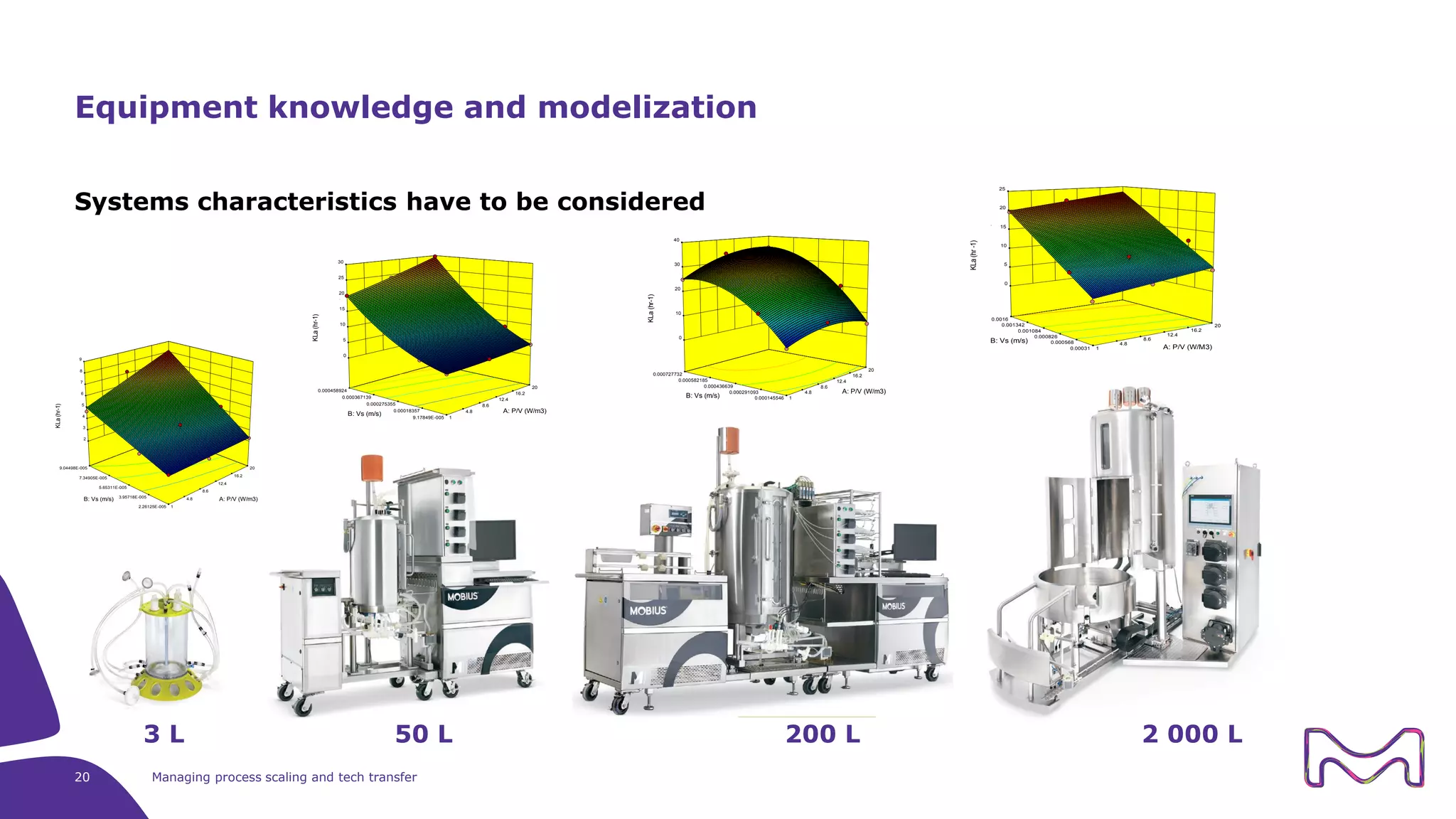
3 L 50 L 200 L 2 000 L
Design-Expert® Software
Factor Coding: Actual
KLa (hr -1)
Design points above predicted value
Design points below predicted value
22.17
1.88
X1 = A: P/V
X2 = B: Vs
0.00031
0.000568
0.000826
0.001084
0.001342
0.0016
1
4.8
8.6
12.4
16.2
20
0
5
10
15
20
25
KLa(hr-1)
A: P/V (W/M3)
B: Vs (m/s)
Design-Expert® Software
Factor Coding: Actual
KLa (hr-1)
Design points above predicted value
Design points below predicted value
34.71
4.07
X1 = A: P/V
X2 = B: Vs
0.000145546
0.000291093
0.000436639
0.000582185
0.000727732
1
4.8
8.6
12.4
16.2
20
0
10
20
30
40
KLa(hr-1)
A: P/V (W/m3)
B: Vs (m/s)
Design-Expert® Software
Factor Coding: Actual
KLa (hr-1)
Design points above predicted value
Design points below predicted value
29.63
1.91
X1 = A: P/V
X2 = B: Vs
9.17849E-005
0.00018357
0.000275355
0.000367139
0.000458924
1
4.8
8.6
12.4
16.2
20
0
5
10
15
20
25
30
KLa(hr-1)
A: P/V (W/m3)B: Vs (m/s)
-Expert® Software
Coding: Actual
-1)
gn points above predicted value
gn points below predicted value
P/V
Vs
2.26125E-005
3.95718E-005
5.65311E-005
7.34905E-005
9.04498E-005
1
4.8
8.6
12.4
16.2
20
2
3
4
5
6
7
8
9
KLa(hr-1)
A: P/V (W/m3)B: Vs (m/s)
Systems characteristics have to be considered
21 Managing process scaling and tech transfer
Equipment knowledge and modelization
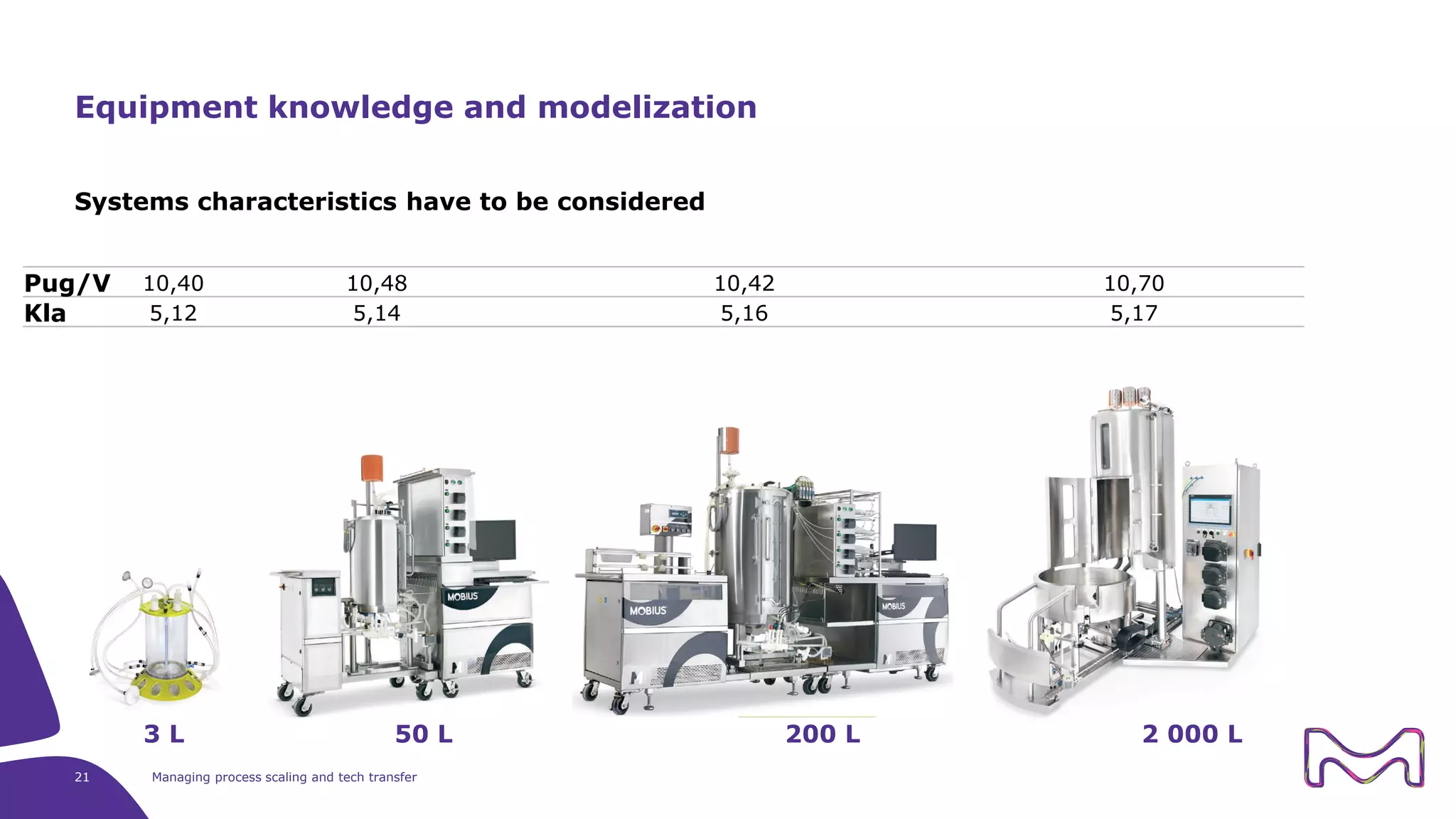
3 L 50 L 200 L 2 000 L
Pug/V 10,40 10,48 10,42 10,70
Kla 5,12 5,14 5,16 5,17
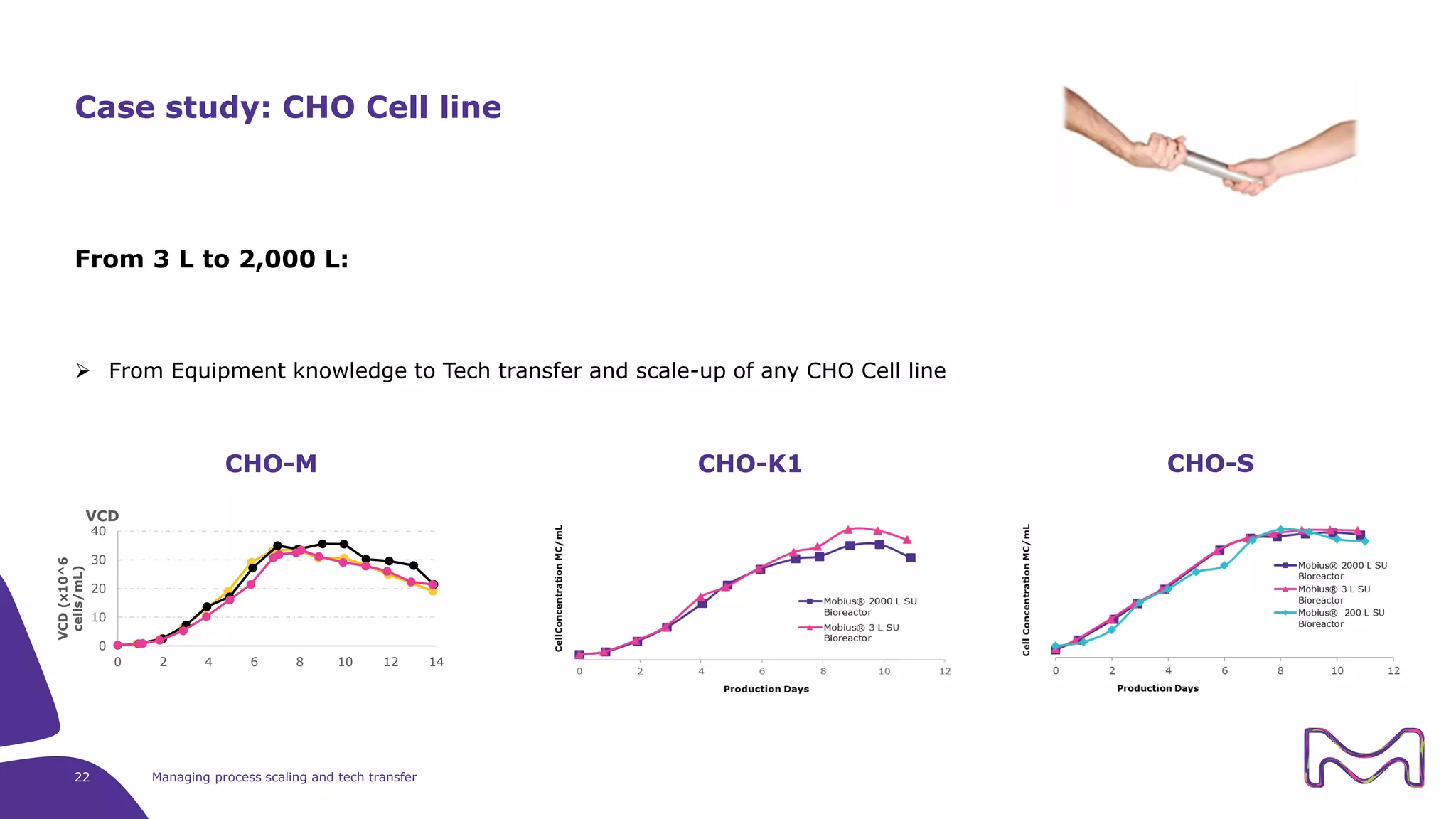
From 3 L to 2,000 L:
 From Equipment knowledge to Tech transfer and scale-up of any CHO Cell line
22 Managing process scaling and tech transfer
Case study: CHO Cell line
0
10
20
30
40
0 2 4 6 8 10 12 14
VCD(x10^6
cells/mL)
VCD
CHO-M CHO-K1 CHO-S
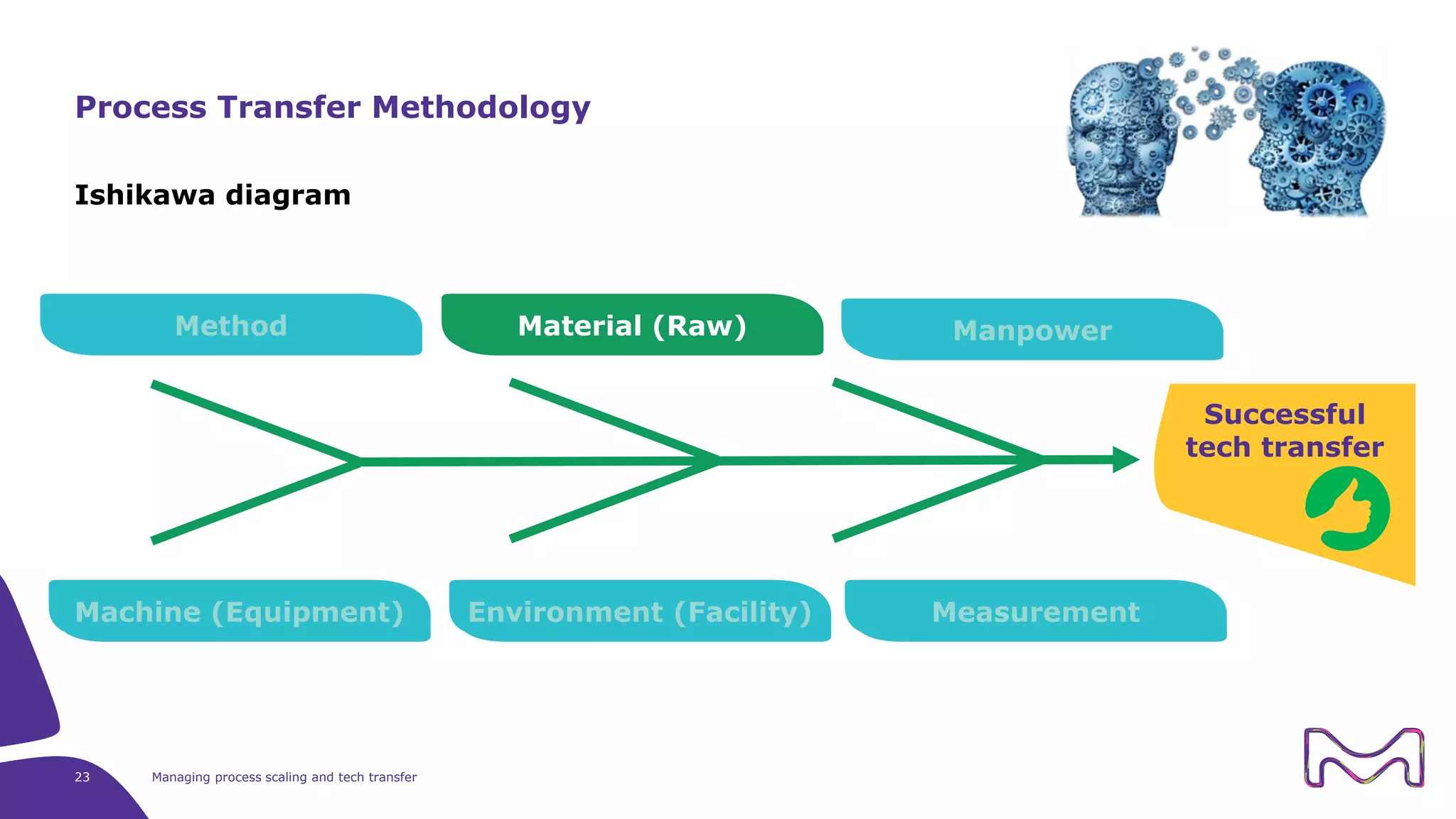
Ishikawa diagram
23 Managing process scaling and tech transfer
Process Transfer Methodology
Method Material (Raw) Manpower
Machine (Equipment) Environment (Facility) Measurement
Successful
tech transfer
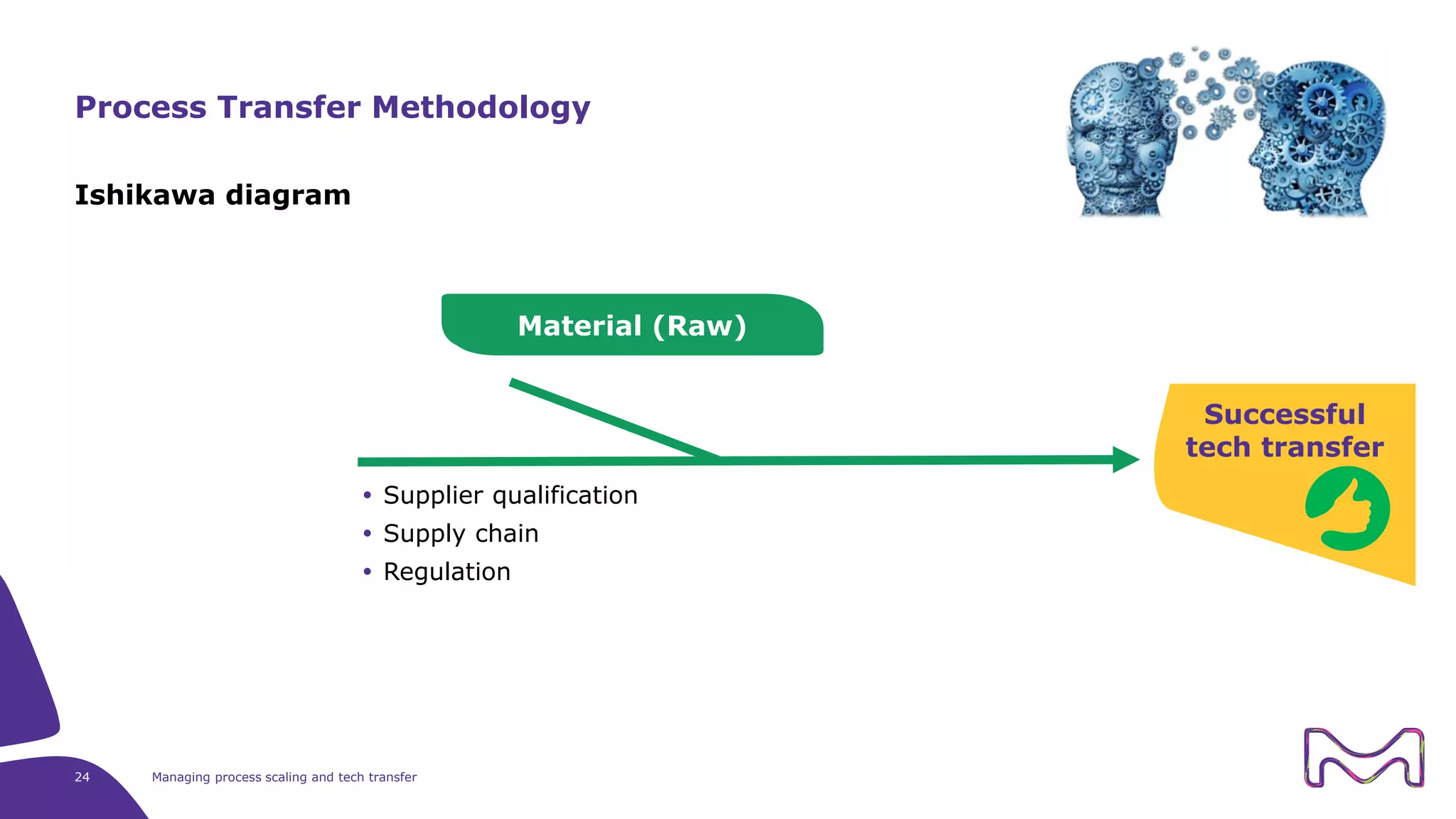
Ishikawa diagram
24 Managing process scaling and tech transfer
Process Transfer Methodology
Material (Raw)
Successful
tech transfer
 Supplier qualification
 Supply chain
 Regulation
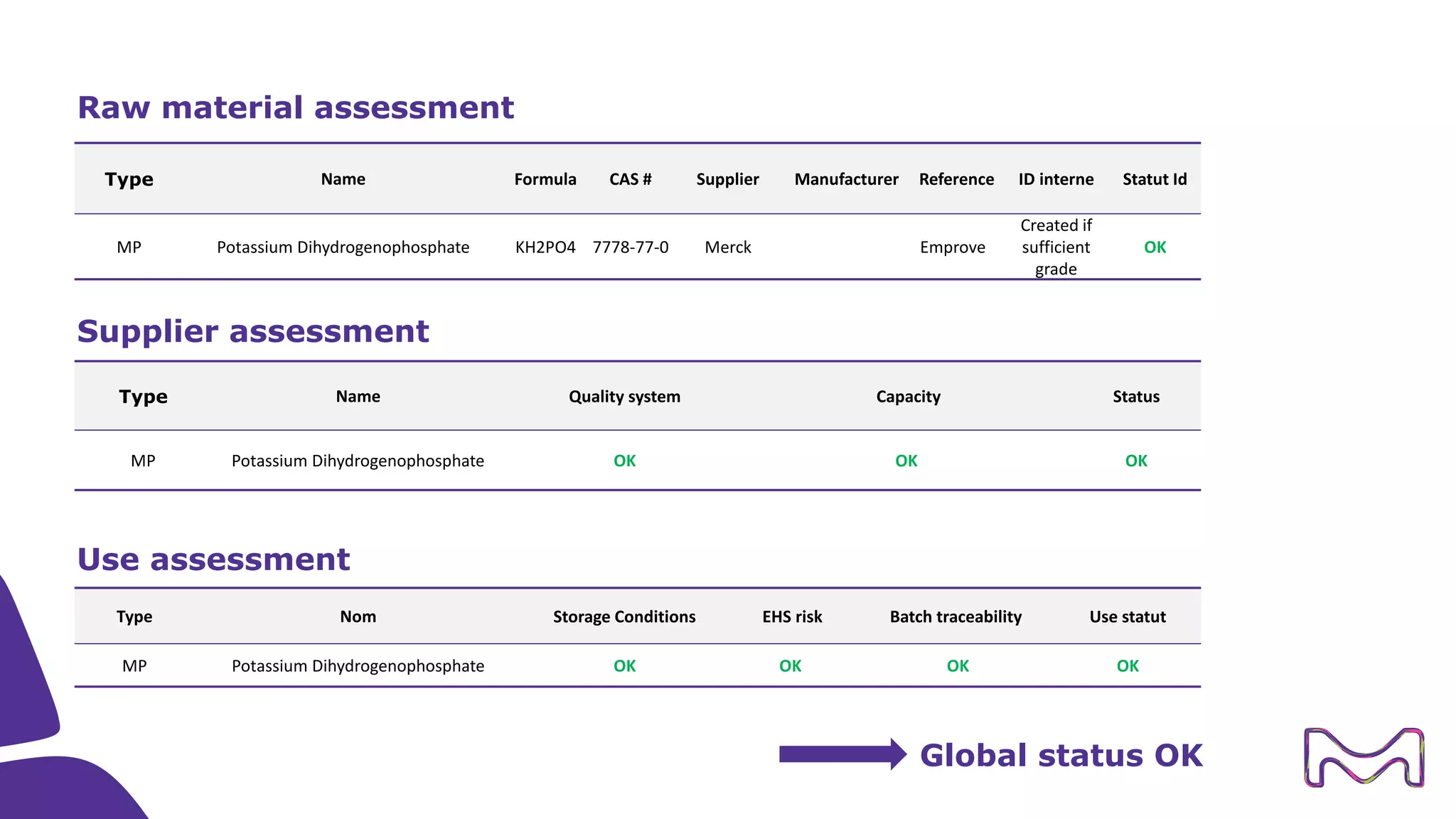
Raw material assessment
Type Name Formula CAS # Supplier Manufacturer Reference ID interne Statut Id
MP Potassium Dihydrogenophosphate KH2PO4 7778-77-0 Merck Emprove
Created if
sufficient
grade
OK
Type Name Quality system Capacity Status
MP Potassium Dihydrogenophosphate OK OK OK
Supplier assessment
Global status OK
Type Nom Storage Conditions EHS risk Batch traceability Use statut
MP Potassium Dihydrogenophosphate OK OK OK OK
Use assessment
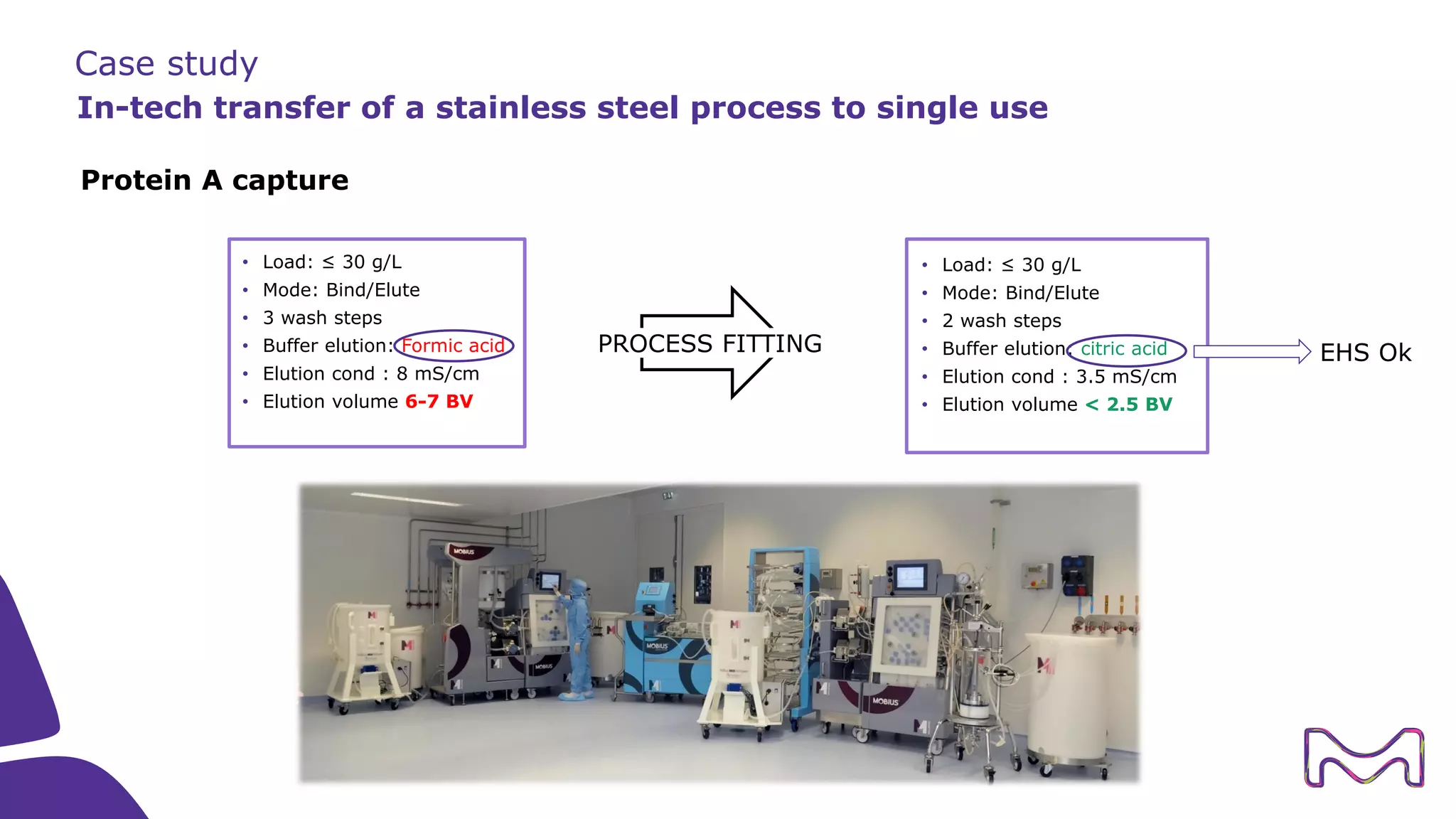
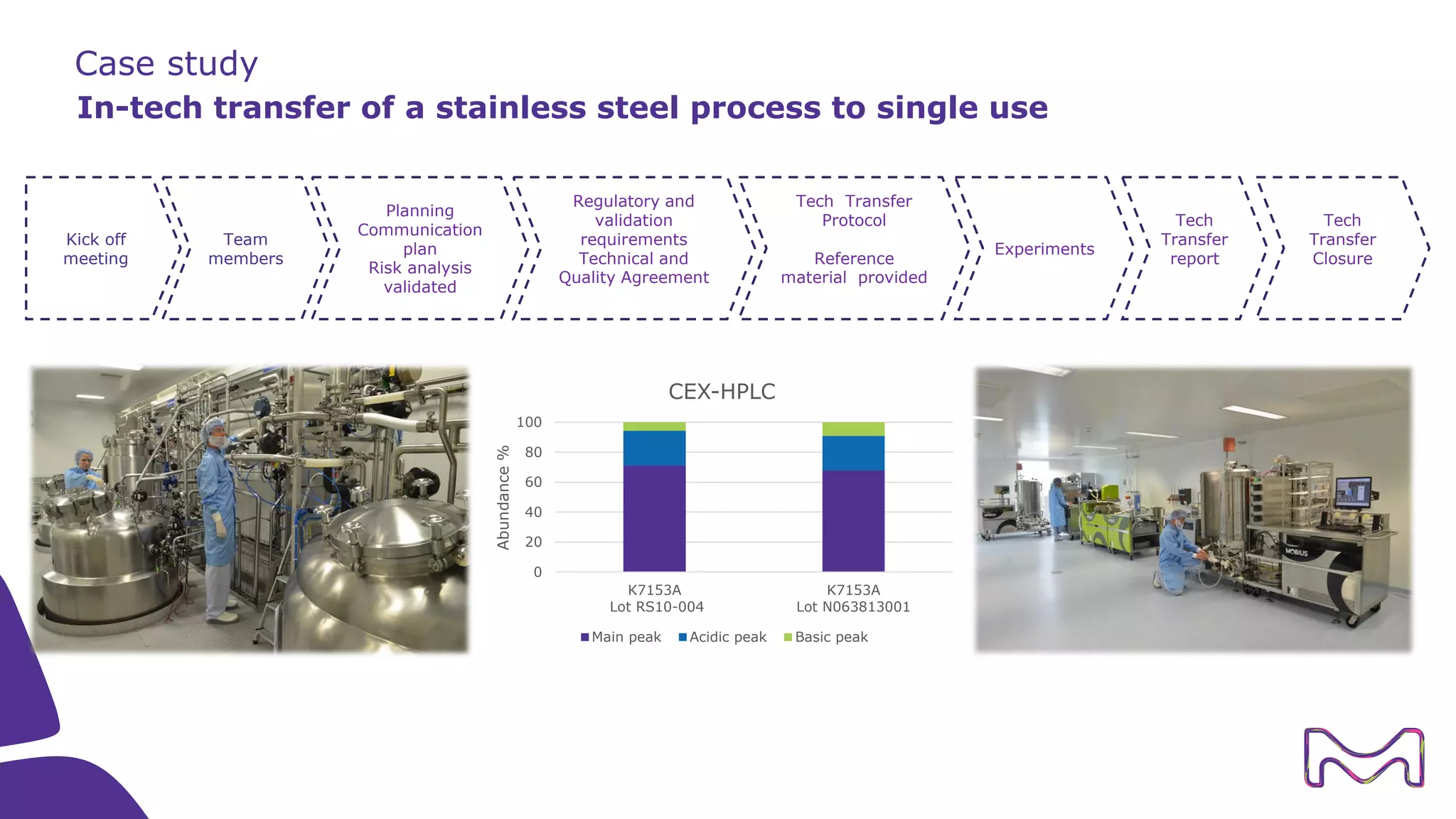
Case study
In-tech transfer of a stainless steel process to single use
PROCESS FITTING
• Load: ≤ 30 g/L
• Mode: Bind/Elute
• 3 wash steps
• Buffer elution: Formic acid
• Elution cond : 8 mS/cm
• Elution volume 6-7 BV
• Load: ≤ 30 g/L
• Mode: Bind/Elute
• 2 wash steps
• Buffer elution: citric acid
• Elution cond : 3.5 mS/cm
• Elution volume < 2.5 BV
Protein A capture
EHS Ok
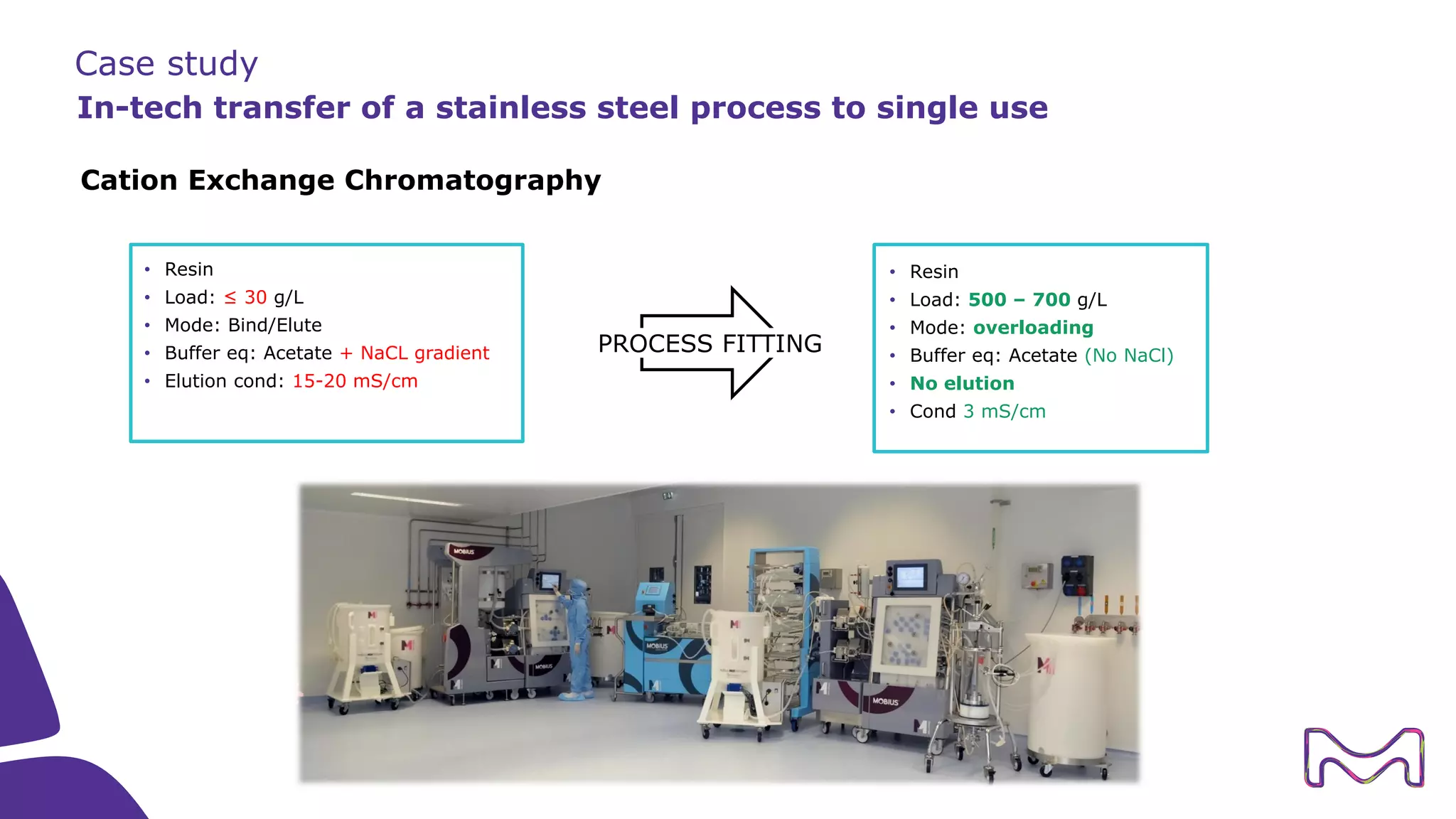
Case study
In-tech transfer of a stainless steel process to single use
PROCESS FITTING
Cation Exchange Chromatography
• Resin
• Load: ≤ 30 g/L
• Mode: Bind/Elute
• Buffer eq: Acetate + NaCL gradient
• Elution cond: 15-20 mS/cm
• Resin
• Load: 500 – 700 g/L
• Mode: overloading
• Buffer eq: Acetate (No NaCl)
• No elution
• Cond 3 mS/cm
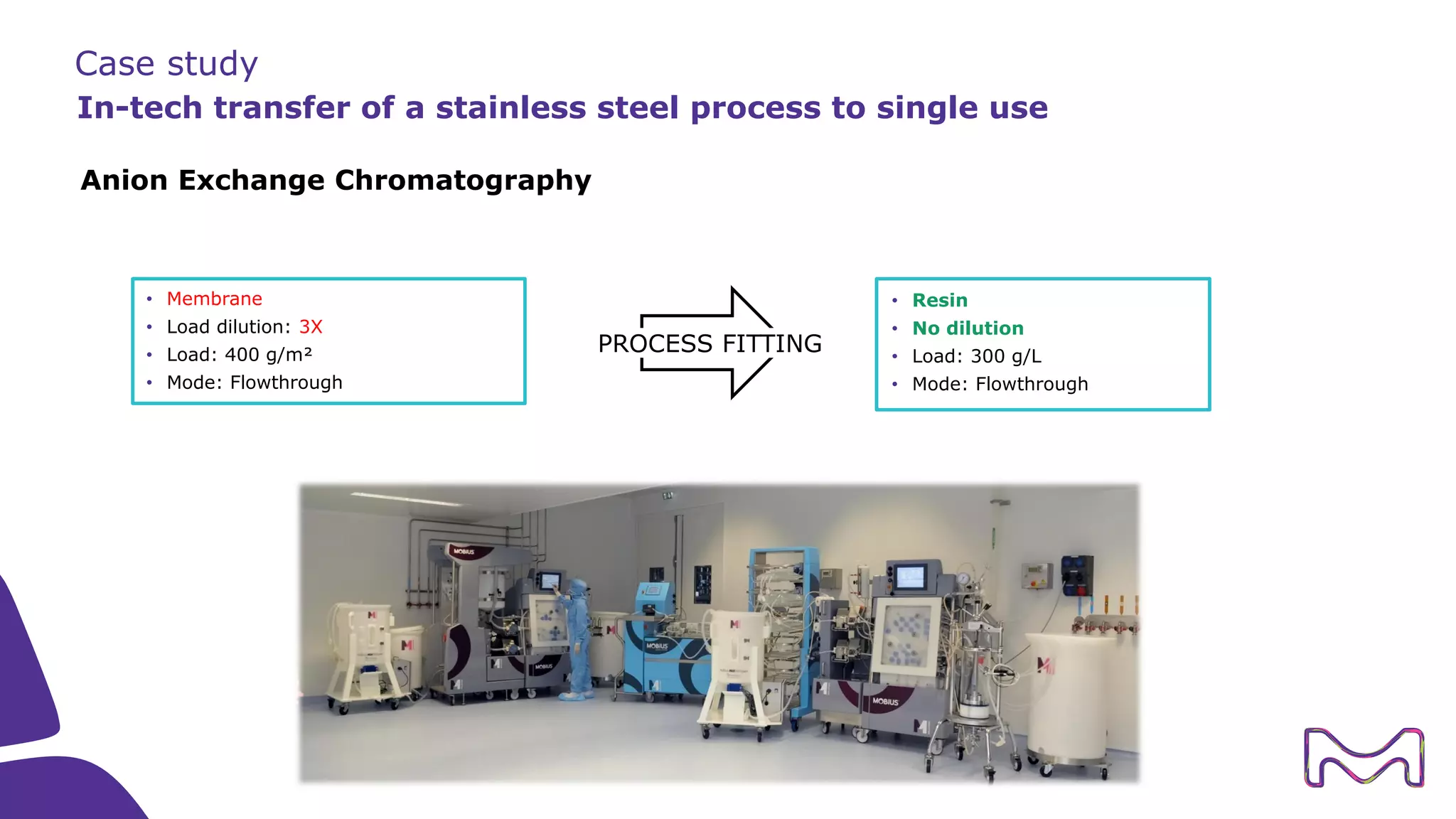
Case study
In-tech transfer of a stainless steel process to single use
PROCESS FITTING
Anion Exchange Chromatography
• Membrane
• Load dilution: 3X
• Load: 400 g/m²
• Mode: Flowthrough
• Resin
• No dilution
• Load: 300 g/L
• Mode: Flowthrough
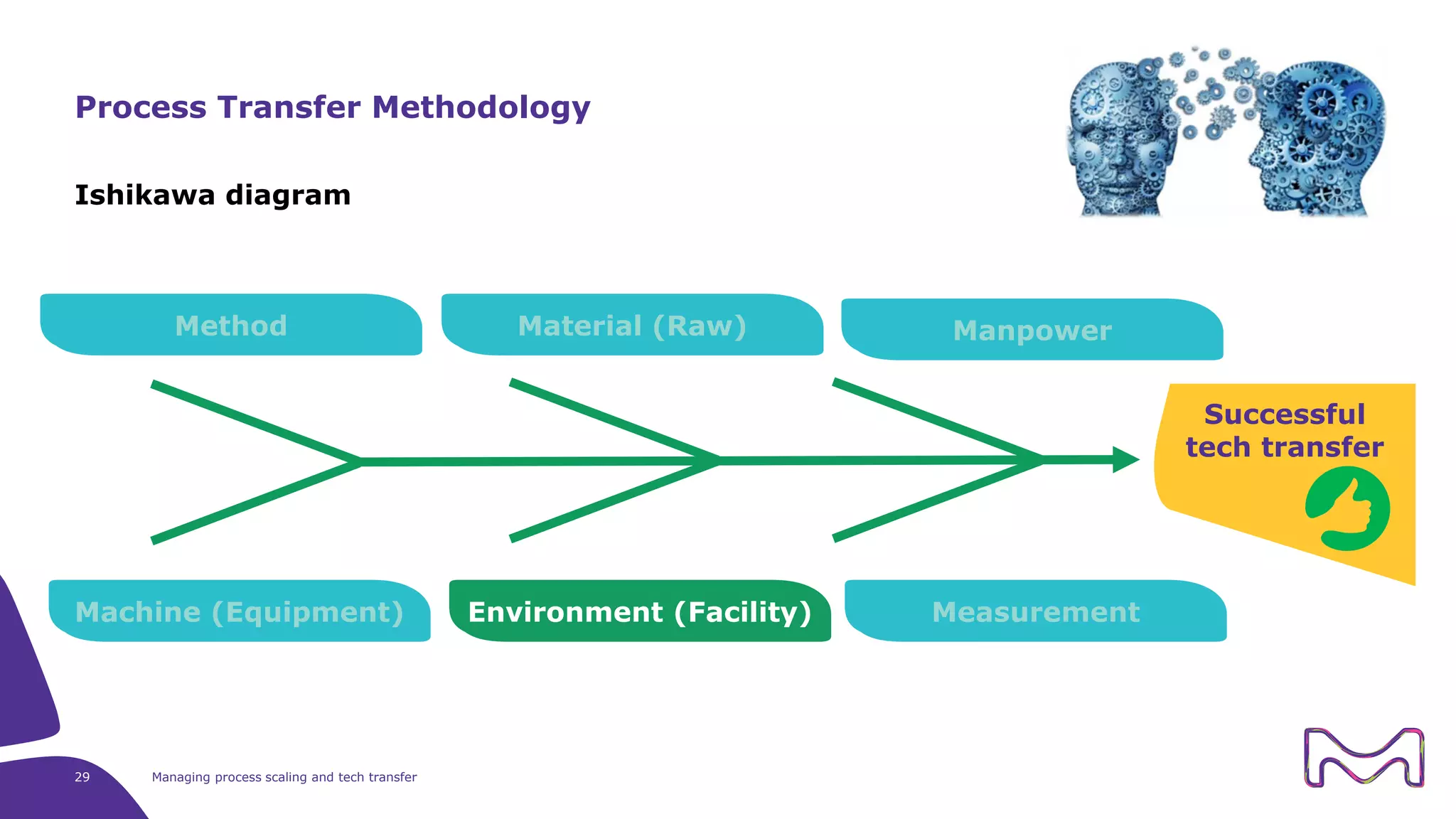
Ishikawa diagram
29 Managing process scaling and tech transfer
Process Transfer Methodology
Method Material (Raw) Manpower
Machine (Equipment) Environment (Facility) Measurement
Successful
tech transfer
Ishikawa diagram
30 Managing process scaling and tech transfer
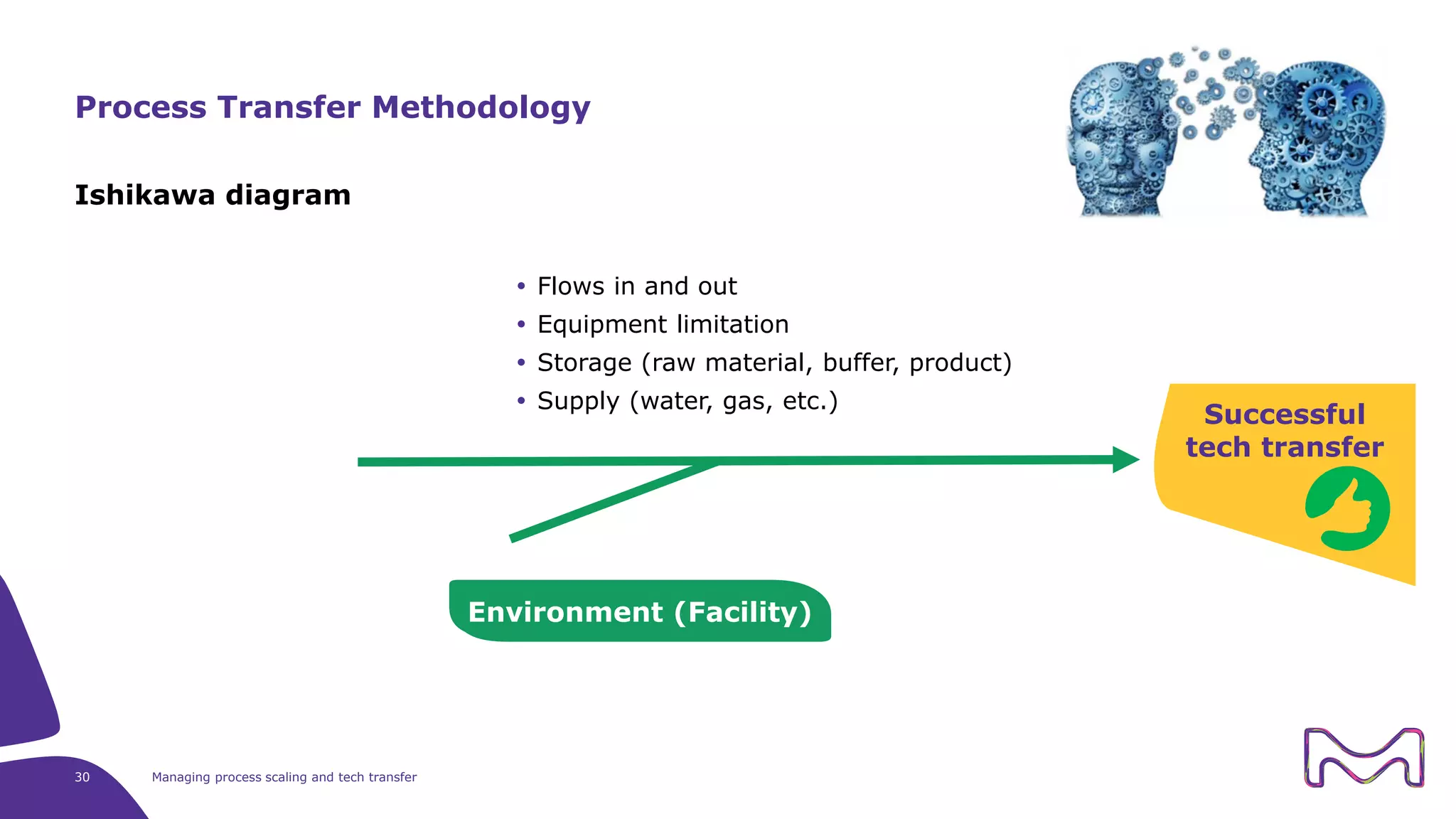
Process Transfer Methodology
Environment (Facility)
Successful
tech transfer
 Flows in and out
 Equipment limitation
 Storage (raw material, buffer, product)
 Supply (water, gas, etc.)
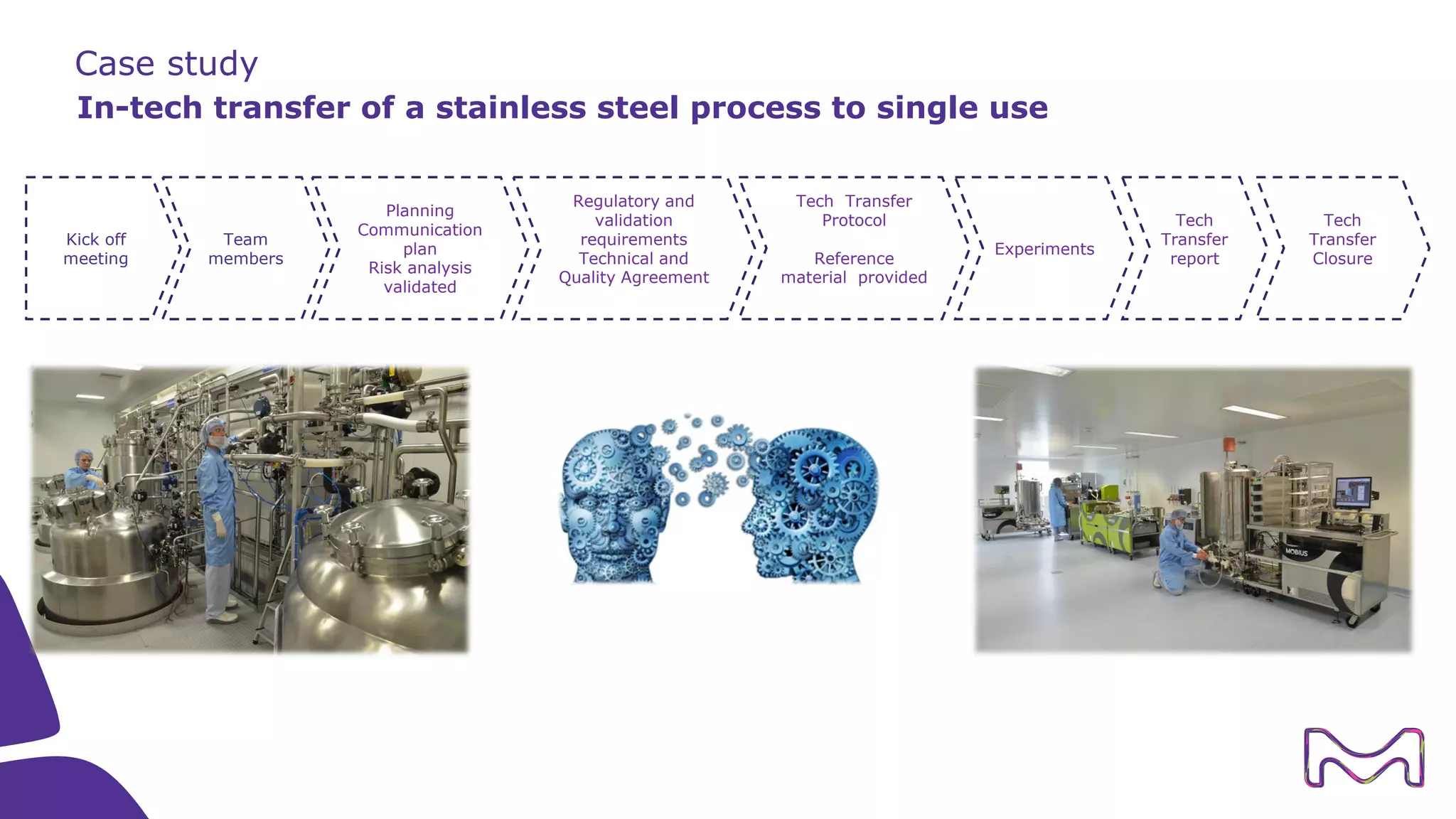
Case study
In-tech transfer of a stainless steel process to single use
Kick off
meeting
Team
members
Regulatory and
validation
requirements
Technical and
Quality Agreement
Planning
Communication
plan
Risk analysis
validated
Tech Transfer
Protocol
Reference
material provided
Tech
Transfer
report
Tech
Transfer
Closure
Experiments
Case study
In-tech transfer of a stainless steel process to single use
Kick off
meeting
Team
members
Regulatory and
validation
requirements
Technical and
Quality Agreement
Planning
Communication
plan
Risk analysis
validated
Tech Transfer
Protocol
Reference
material provided
Tech
Transfer
report
Tech
Transfer
Closure
Experiments
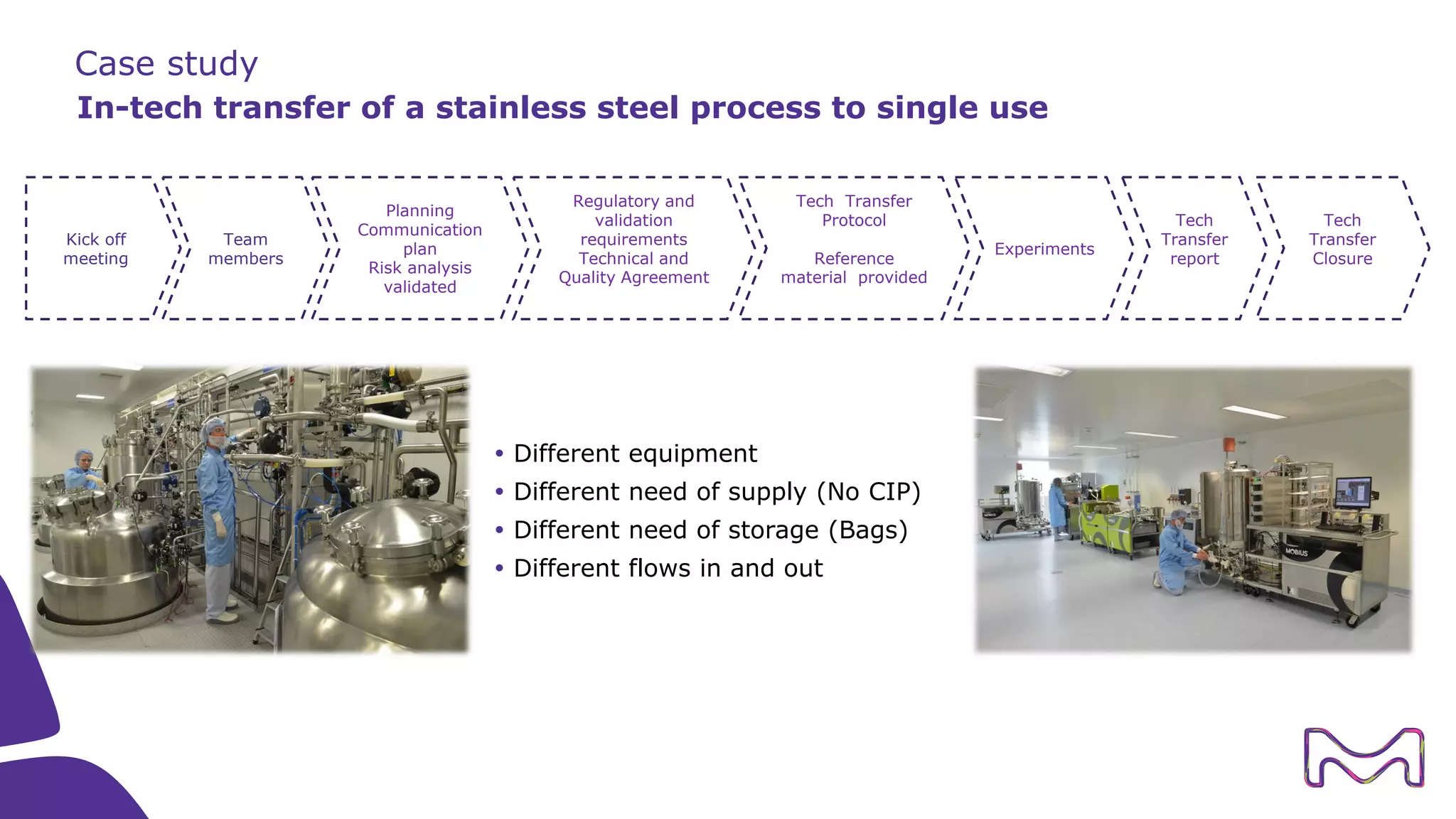
 Different equipment
 Different need of supply (No CIP)
 Different need of storage (Bags)
 Different flows in and out
Case study
In-tech transfer of a stainless steel process to single use
Kick off
meeting
Team
members
Regulatory and
validation
requirements
Technical and
Quality Agreement
Planning
Communication
plan
Risk analysis
validated
Tech Transfer
Protocol
Reference
material provided
Tech
Transfer
report
Tech
Transfer
Closure
Experiments
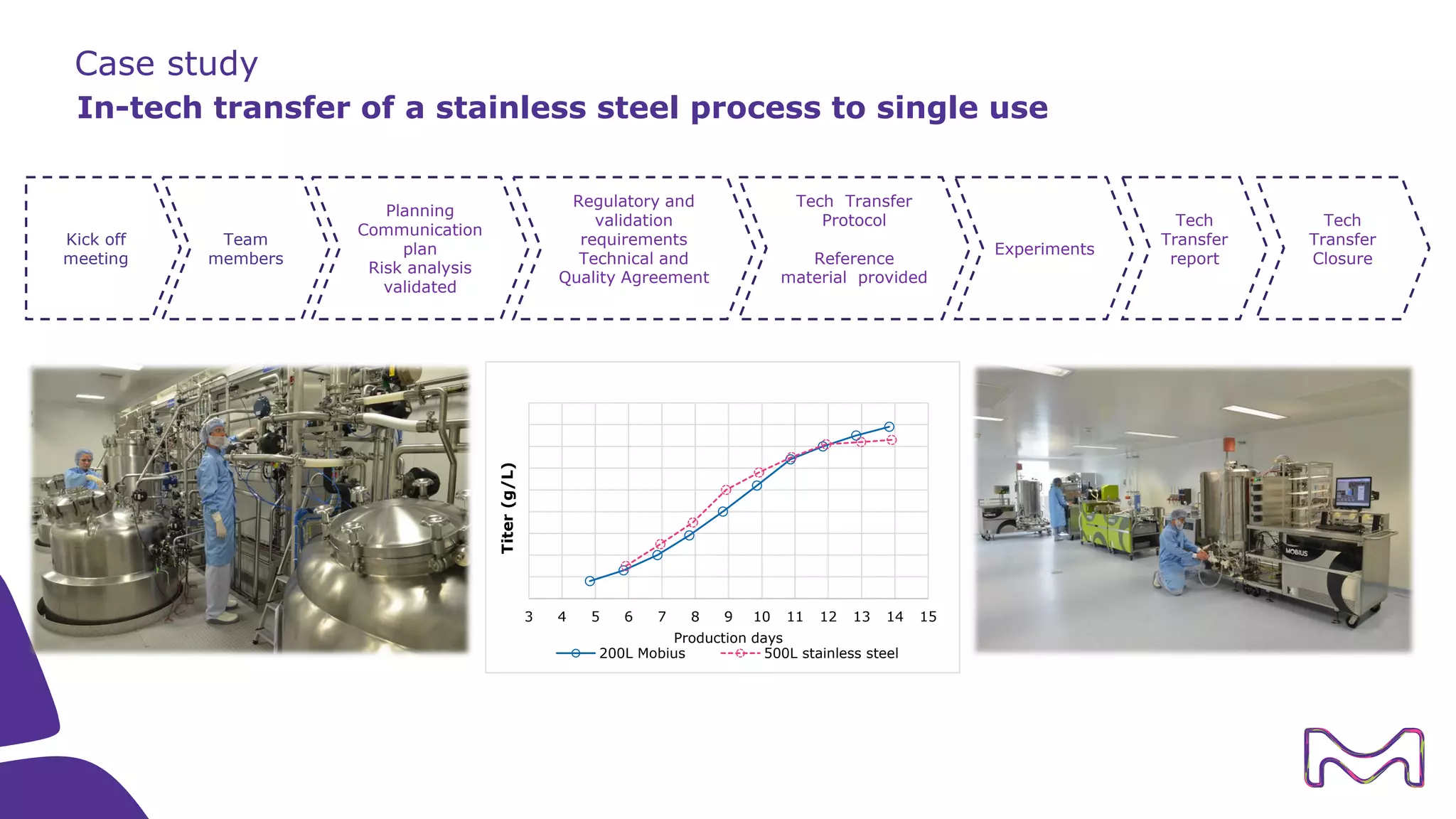
3 4 5 6 7 8 9 10 11 12 13 14 15
Titer(g/L)
Production days
200L Mobius 500L stainless steel
Case study
In-tech transfer of a stainless steel process to single use
Kick off
meeting
Team
members
Regulatory and
validation
requirements
Technical and
Quality Agreement
Planning
Communication
plan
Risk analysis
validated
Tech Transfer
Protocol
Reference
material provided
Tech
Transfer
report
Tech
Transfer
Closure
Experiments
0
20
40
60
80
100
K7153A
Lot RS10-004
K7153A
Lot N063813001
Abundance%
CEX-HPLC
Main peak Acidic peak Basic peak
Case study
In-tech transfer of a stainless steel process to single use
Kick off
meeting
Team
members
Regulatory and
validation
requirements
Technical and
Quality Agreement
Planning
Communication
plan
Risk analysis
validated
Tech Transfer
Protocol
Reference
material provided
Tech
Transfer
report
Tech
Transfer
Closure
Experiments
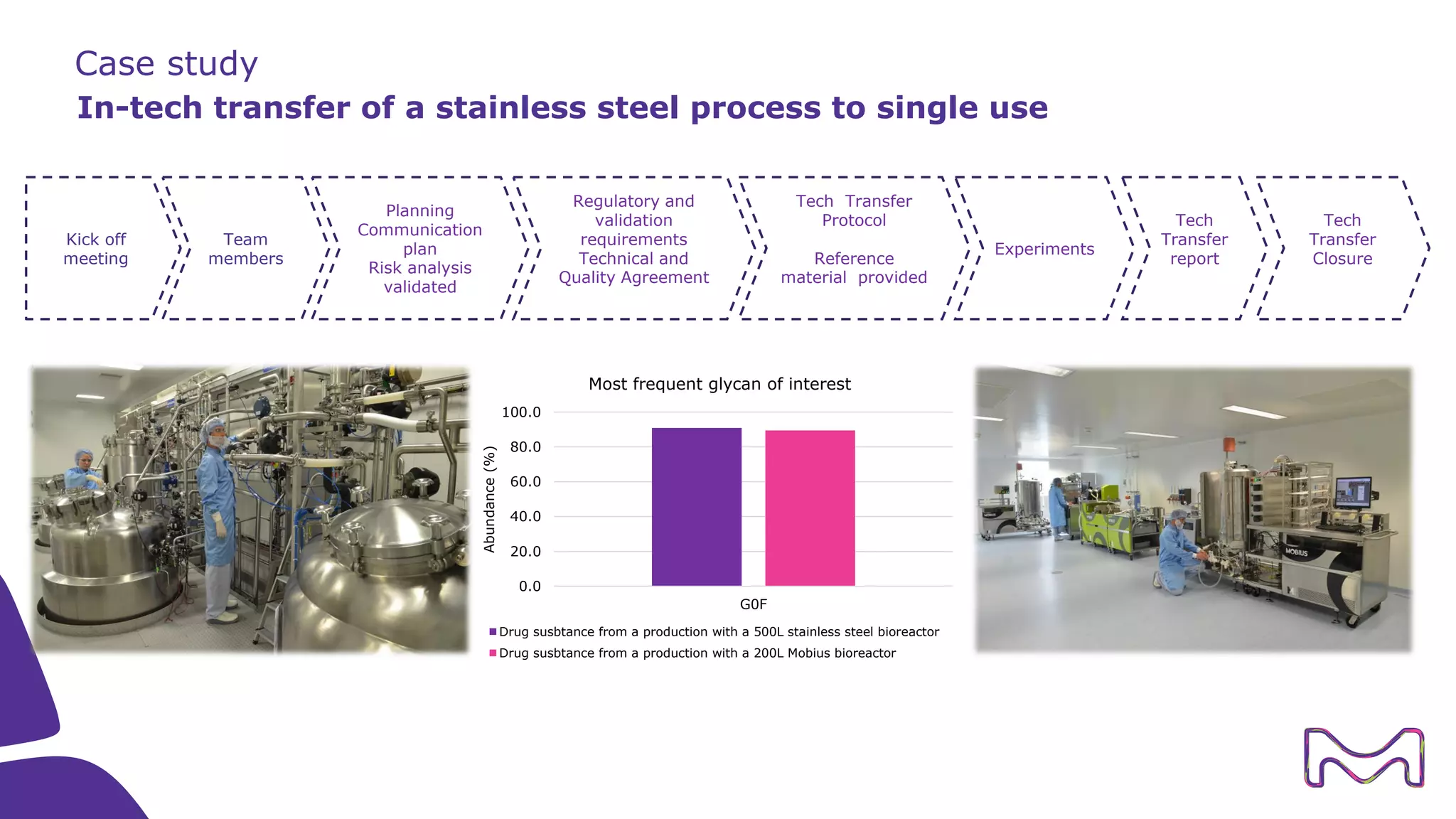
0.0
20.0
40.0
60.0
80.0
100.0
G0F
Abundance(%)
Most frequent glycan of interest
Drug susbtance from a production with a 500L stainless steel bioreactor
Drug susbtance from a production with a 200L Mobius bioreactor
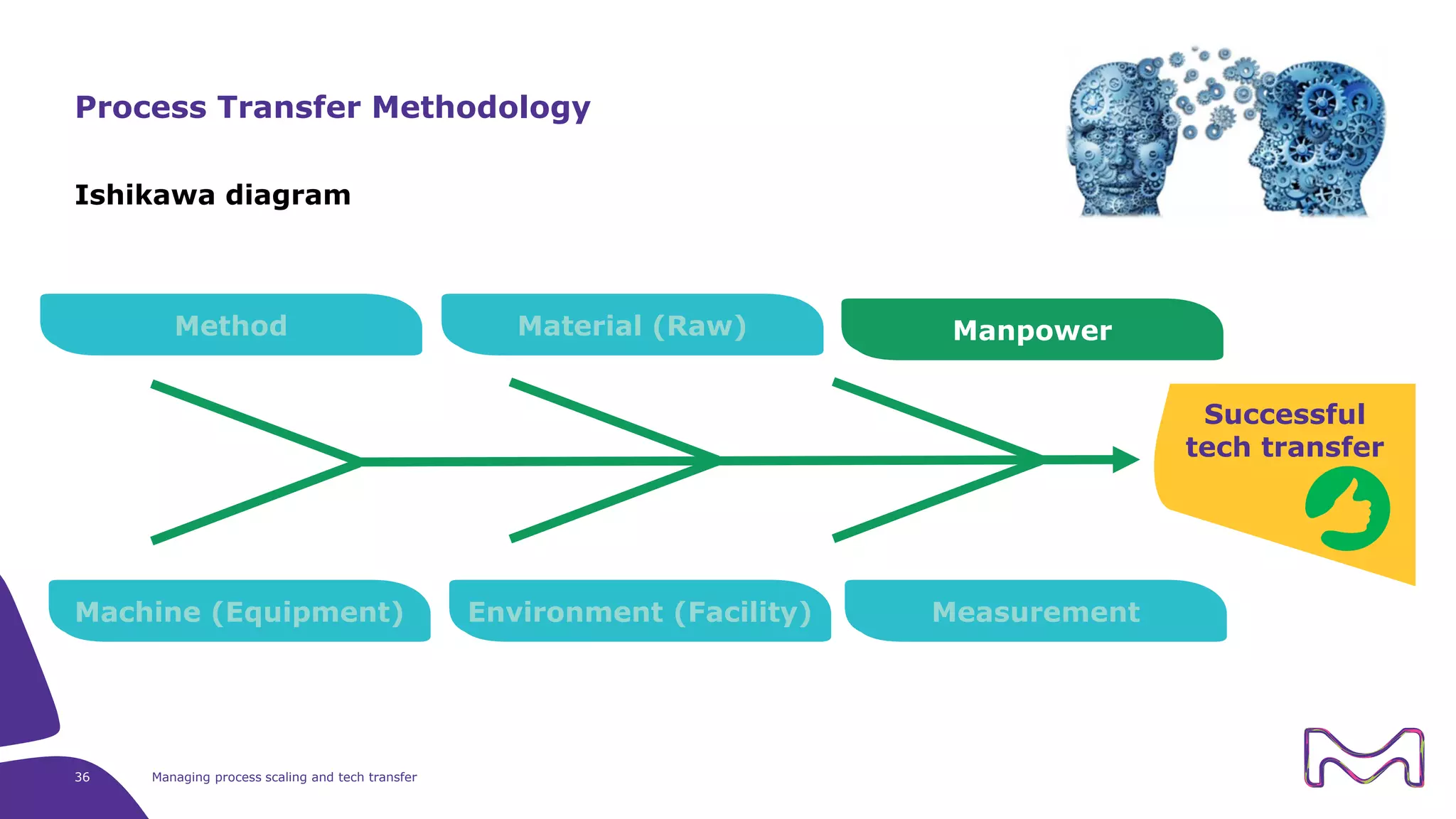
Ishikawa diagram
36 Managing process scaling and tech transfer
Process Transfer Methodology
Method Material (Raw) Manpower
Machine (Equipment) Environment (Facility) Measurement
Successful
tech transfer
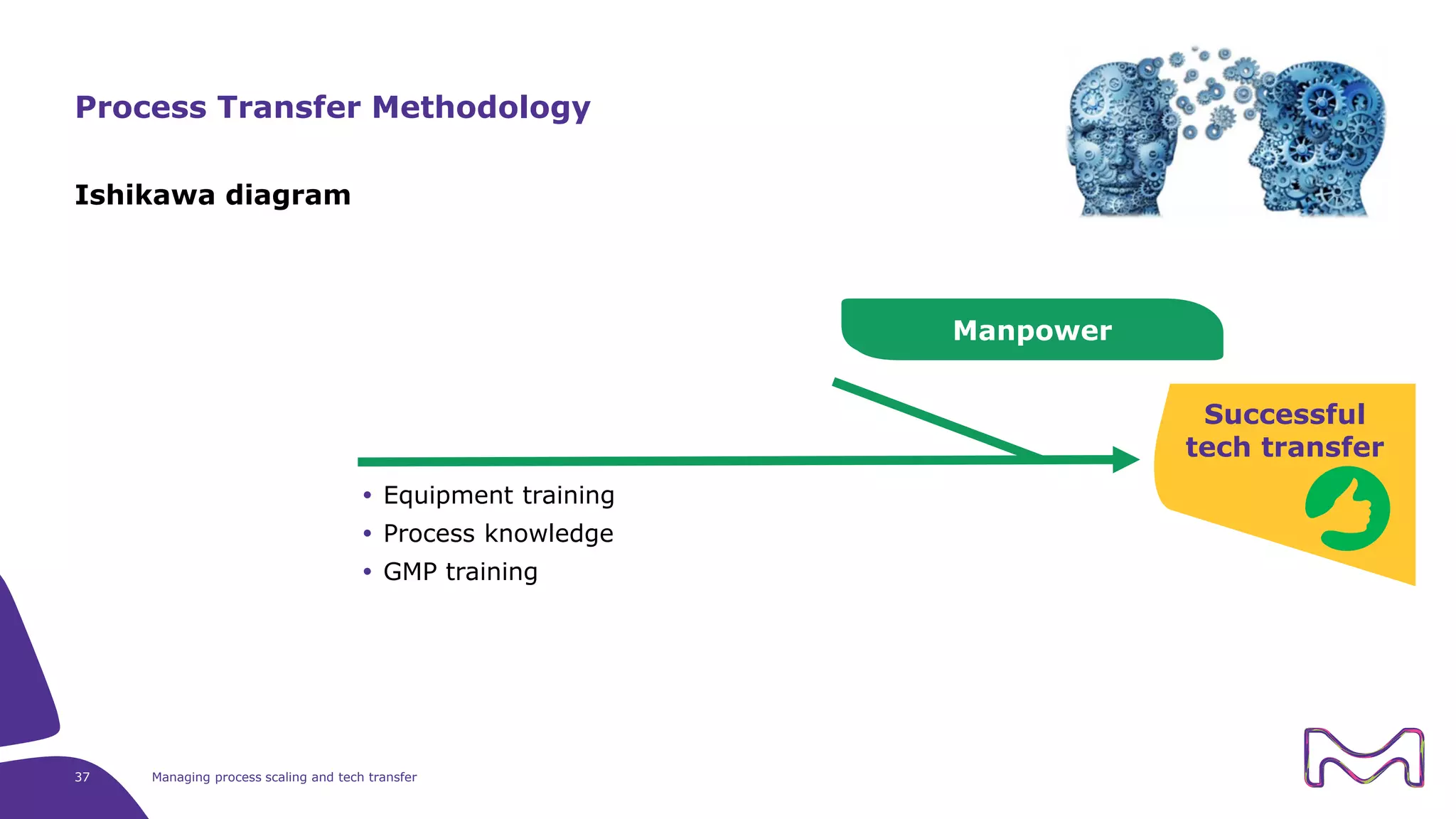
Ishikawa diagram
37 Managing process scaling and tech transfer
Process Transfer Methodology
Manpower
Successful
tech transfer
 Equipment training
 Process knowledge
 GMP training
38 Managing process scaling and tech transfer
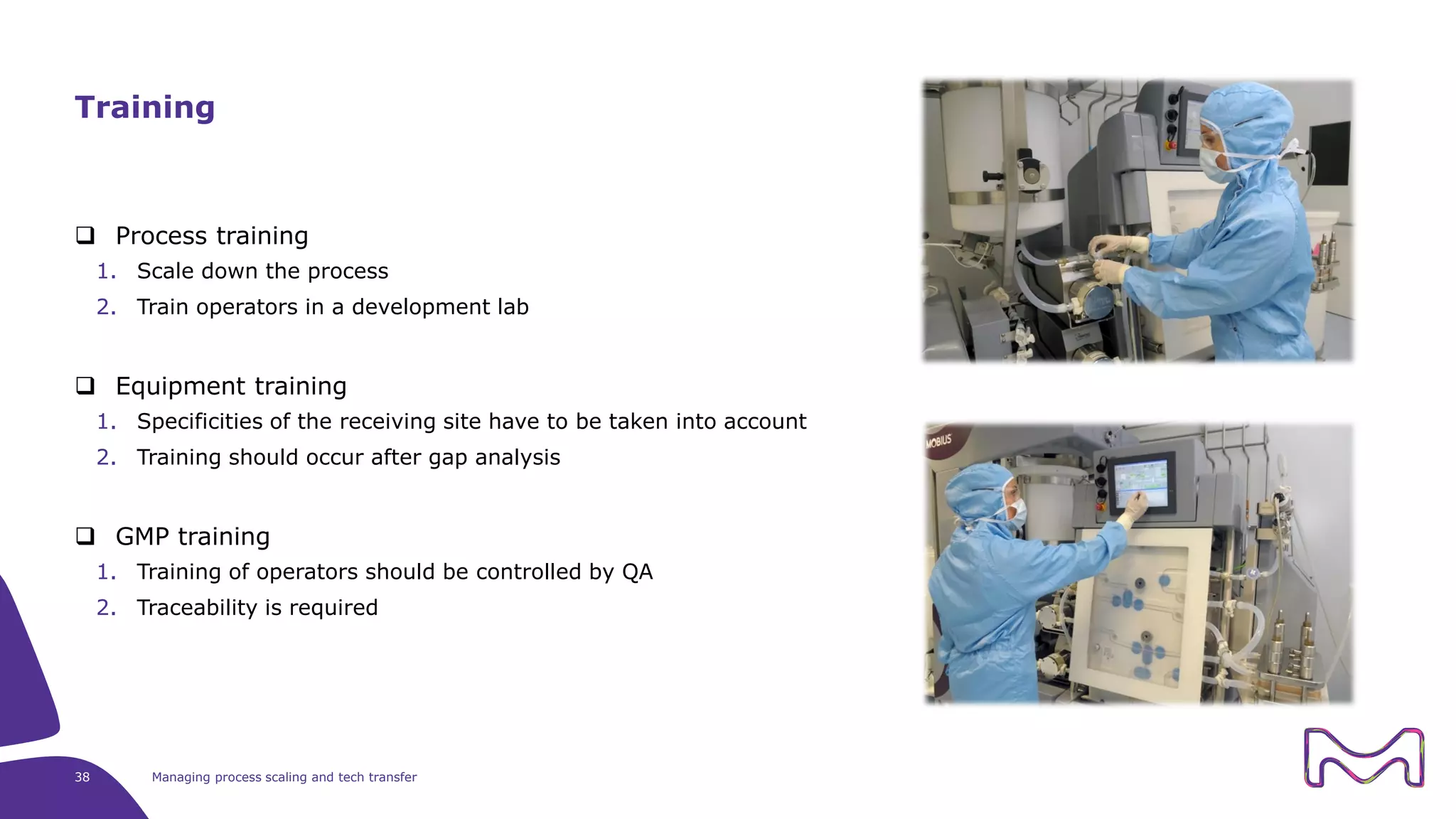
Training
 Process training
1. Scale down the process
2. Train operators in a development lab
 Equipment training
1. Specificities of the receiving site have to be taken into account
2. Training should occur after gap analysis
 GMP training
1. Training of operators should be controlled by QA
2. Traceability is required
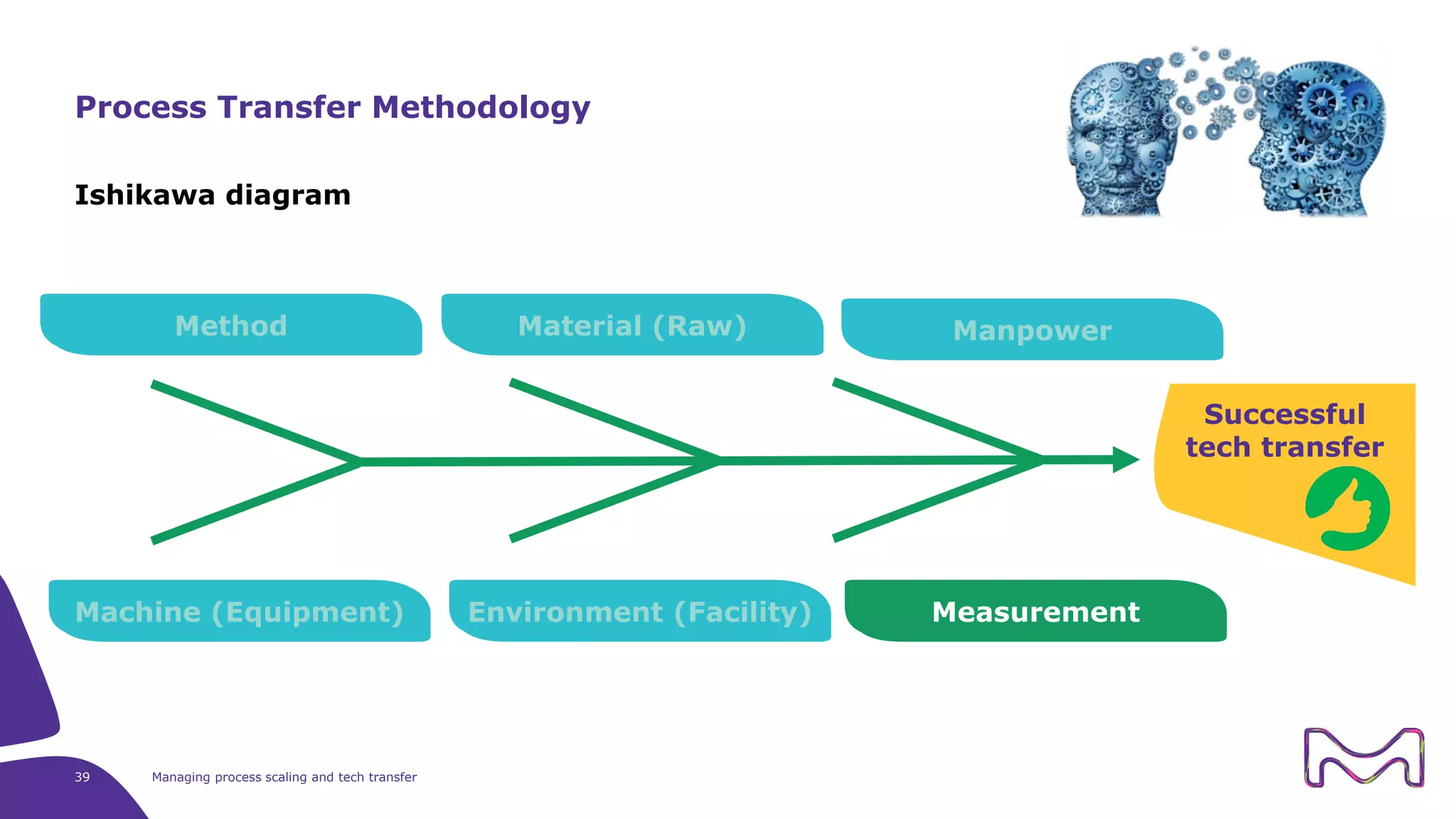
Ishikawa diagram
39 Managing process scaling and tech transfer
Process Transfer Methodology
Method Material (Raw) Manpower
Machine (Equipment) Environment (Facility) Measurement
Successful
tech transfer
Ishikawa diagram
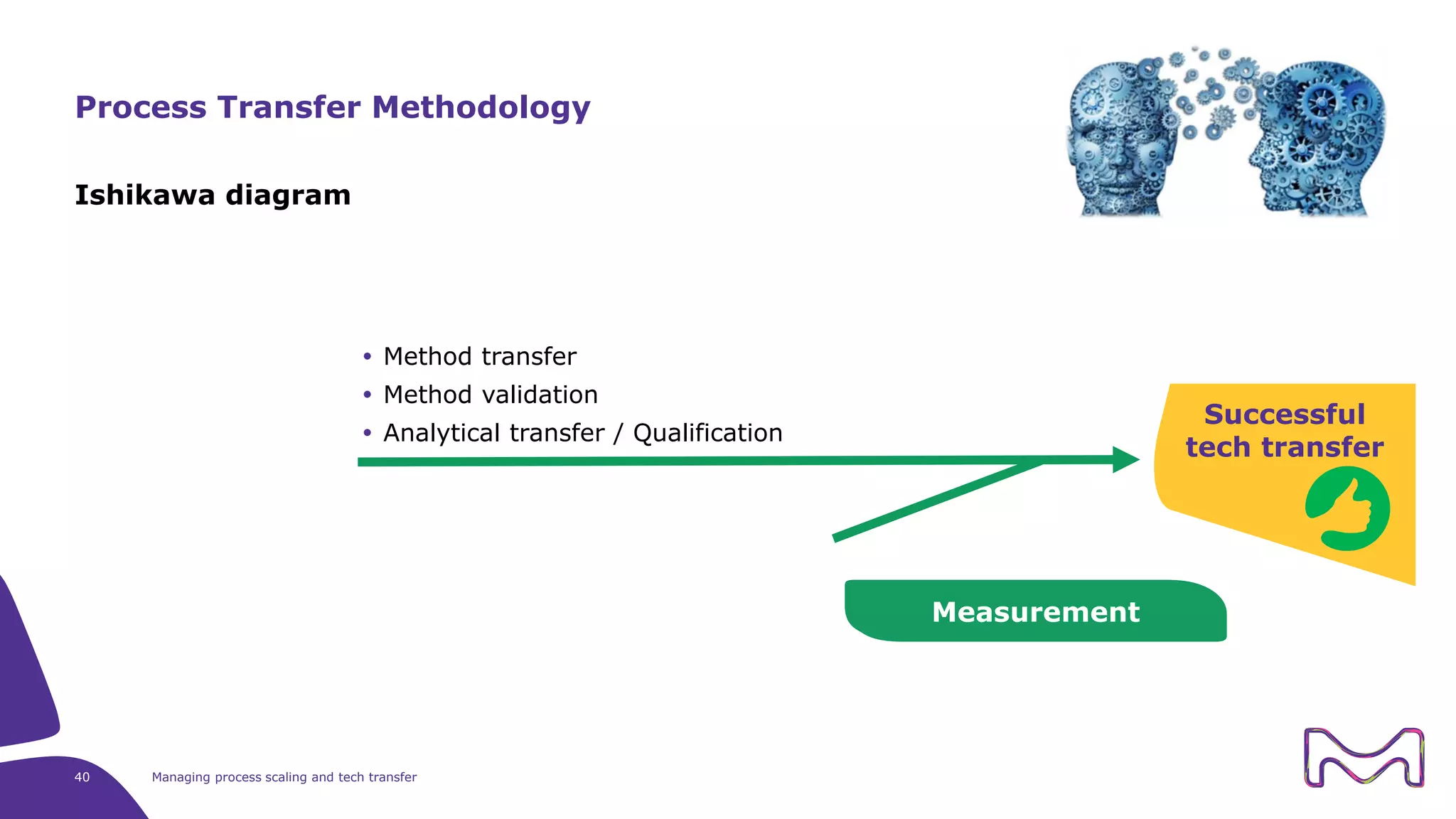
40 Managing process scaling and tech transfer
Process Transfer Methodology
Measurement
Successful
tech transfer
 Method transfer
 Method validation
 Analytical transfer / Qualification
41 Managing process scaling and tech transfer
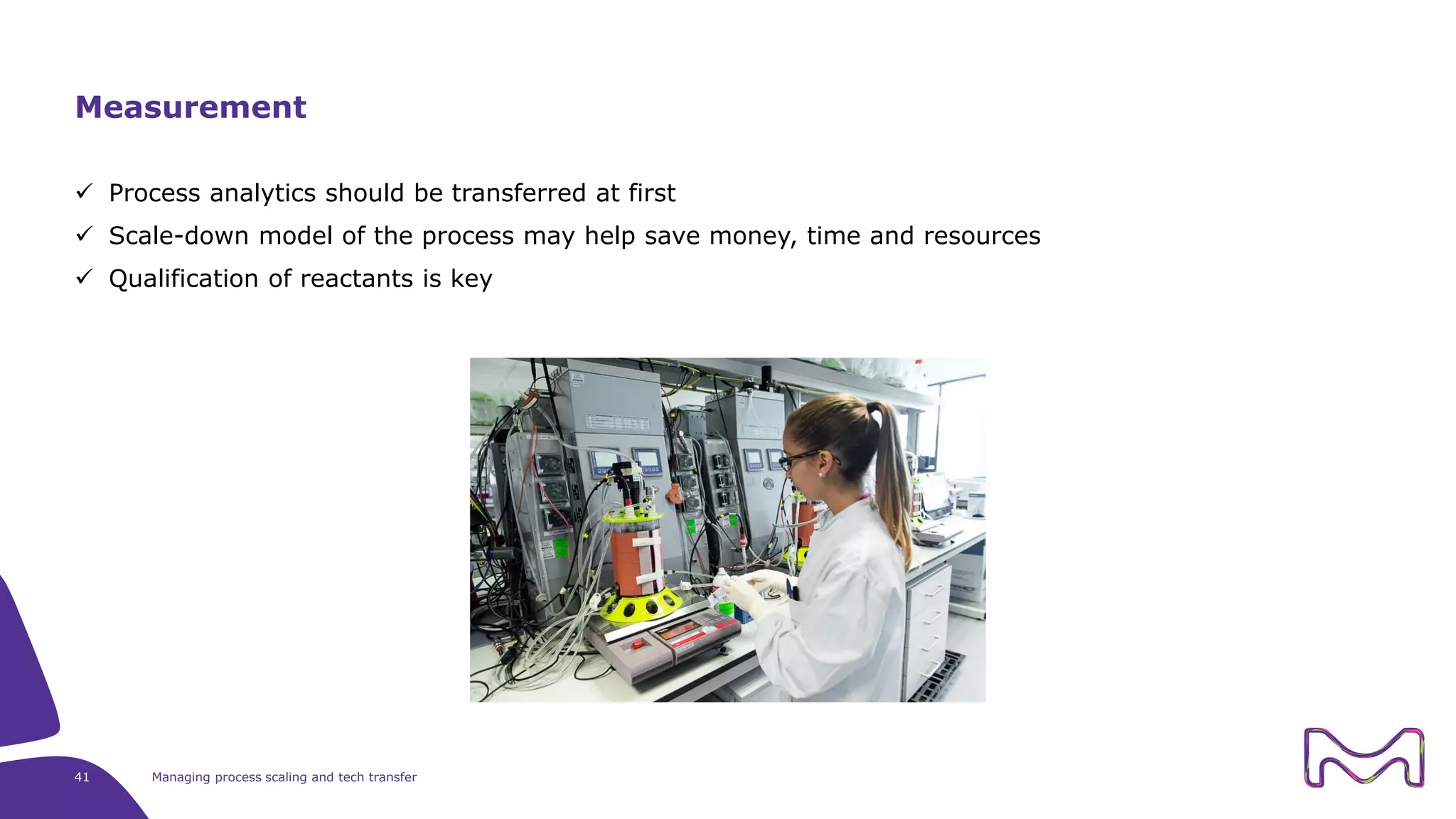
Measurement
 Process analytics should be transferred at first
 Scale-down model of the process may help save money, time and resources
 Qualification of reactants is key
42 Managing process scaling and tech transfer
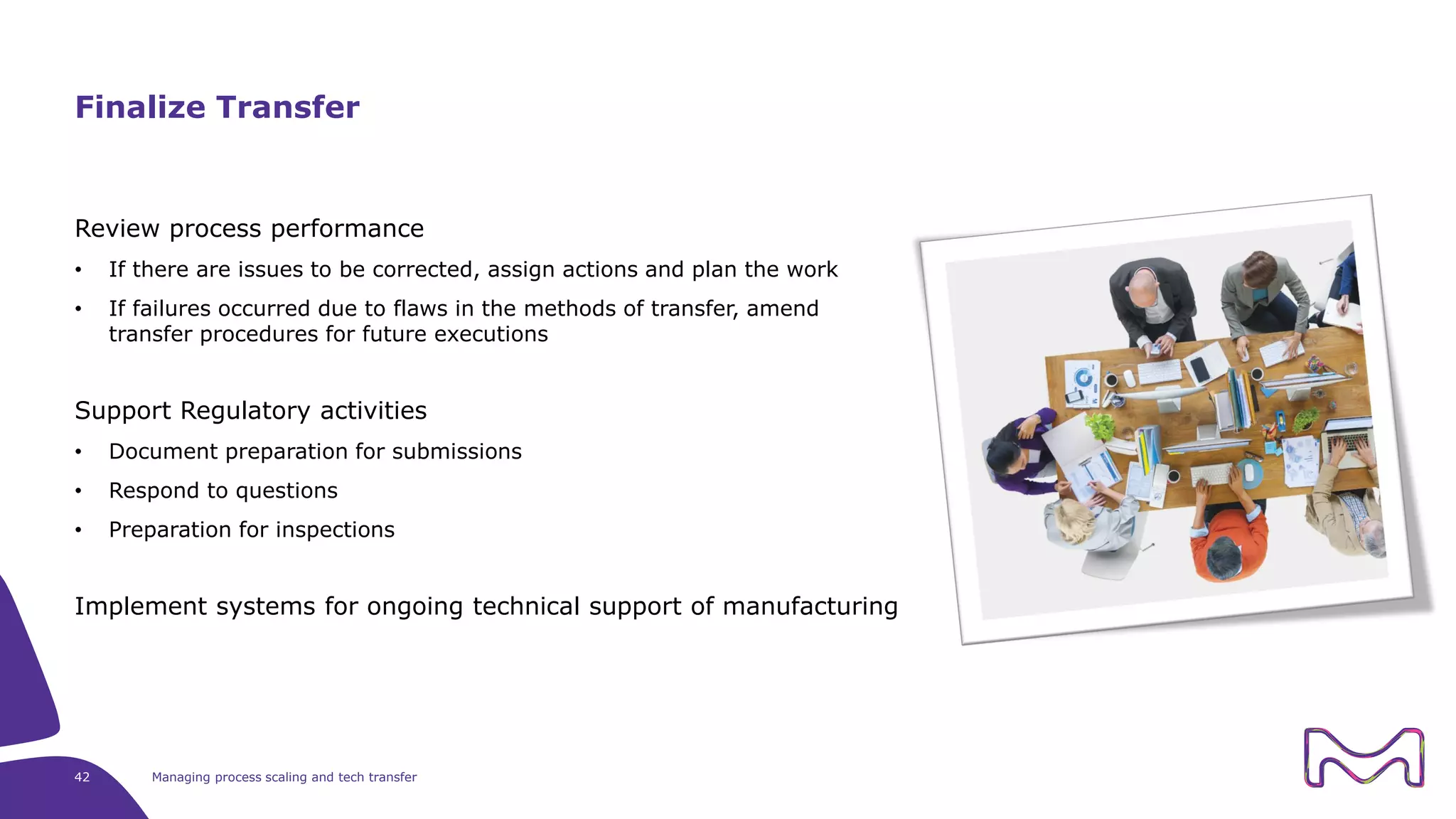
Review process performance
• If there are issues to be corrected, assign actions and plan the work
• If failures occurred due to flaws in the methods of transfer, amend
transfer procedures for future executions
Support Regulatory activities
• Document preparation for submissions
• Respond to questions
• Preparation for inspections
Implement systems for ongoing technical support of manufacturing
Finalize Transfer
The vibrant M and BioReliance are trademarks of Merck KGaA, Darmstadt, Germany or its affiliates. All other trademarks are the property of their respective
owners. Detailed information on trademarks is available via publicly accessible resources.
© 2018 Merck KGaA, Darmstadt, Germany and/or its affiliates. All Rights Reserved.

Tech transfer and Scale-up - Tips and tricks from a Biodevelopment center

  • 1.
    Merck KGaA Darmstadt, Germany StevenStrubbe, Technical Leader, BioReliance® End-to-End Solutions Guillaume Plane, Marketing and Development Manager, BioReliance® End-to-End Solutions Tips and Tricks from a Biodevelopment Center Tech Transfer and Scale-Up
  • 2.
    Bioreactor Protection withthe Viresolve® Barrier Filter | 16 August 2018 The life science business of Merck KGaA, Darmstadt, Germany operates as MilliporeSigma in the U.S. and Canada. 2
  • 3.
    3 Managing processscaling and tech transfer Process transfer is a cornerstone of manufacturing Process Transfer Process development lab Pilot lab Clinical manufacturing Commercial manufacturing (internal) Commercial manufacturing (external)
  • 4.
    4 Managing processscaling and tech transfer Process transfer is regulatory defined ICH Q10: “The goal of technology transfer activities is to transfer product and process knowledge between development and manufacturing, and within or between manufacturing sites to achieve product realization. This knowledge forms the basis for the manufacturing process, control strategy, process validation approach, and ongoing continual improvement.” Process Transfer  Transfers have to be performed in an organized, methodical manner, with appropriate documentation  We will focus on the transfer of process parameters and process knowledge (data)
  • 5.
    Ishikawa diagram 5 Managingprocess scaling and tech transfer Process Transfer Methodology Method Material (Raw) Manpower Machine (Equipment) Environment (Facility) Measurement Successful tech transfer
  • 6.
    Ishikawa diagram 6 Managingprocess scaling and tech transfer Process Transfer Methodology Method Material (Raw) Manpower Machine (Equipment) Environment (Facility) Measurement Successful tech transfer
  • 7.
    Ishikawa diagram 7 Managingprocess scaling and tech transfer Process Transfer Methodology Method Successful tech transfer  Tech transfer protocol  Gap analysis  Acceptance criteria  Process knowledge (documentation)  Risk analysis  Responsibilities and accountabilities
  • 8.
     Form techtransfer teams and governance structures,  Define project charter with goals and timelines,  Consolidate process knowledge into transferable documentation,  Analyze gaps and risks,  Execute the Tech Transfer: work the plan,  Demonstrate technical success: Meet Acceptance criteria,  Finalize transfer: documentation, support of regulatory activities, follow-up actions, lessons learned. 8 Managing process scaling and tech transfer Process Transfer Key activities
  • 9.
    9 Managing processscaling and tech transfer Process Transfer Key activities Project Charter Set expectations and responsibilities between partners Project charter must include:  A well-defined team structure  Sub-teams for different disciplines  Connect counterparts  Establish communication paths  A well defined governance structure to address issues  Clearly described roles and responsibilities  Clearly established success criteria
  • 10.
    10 Managing processscaling and tech transfer Process Transfer Key activities Timeline Kick off meeting Team set up Regulatory requirements, Technical and Quality Agreement Planning, Risk analysis Kick off meeting: Scope, transfer timelines and team members are defined Team members: At least a project manager, a technical leader and a tech transfer team Communication plan: Deliverables Team members with their respective responsibilities Communication flow path Meeting frequency Tech transfer protocol: Equipment Raw materials and consumables Detailed process description including critical parameters Analytical methods Tech Transfer Protocol, Reference material Tech Transfer report Tech Transfer Closure Experiments
  • 11.
    A Process Descriptiondocument with an overview of each step and key process parameters is required  Information should be described in a site and scale independent manner  Site-specific details from previous process installations should also be gathered as examples For example:  Buffers may have been prepared in batch or via in-line dilution  Bioreactors may have been operated with different sparger configurations Process Transfer Key activities 11 Managing process scaling and tech transfer Consolidated Process Knowledge Use an electronic file sharing system for document hosting – not email
  • 12.
    Process Transfer Keyactivities 12 Managing process scaling and tech transfer Gap analysis Gaps can be addressed by changing equipment, procedures, or the process. Changes may require specific new validation studies or may be covered through the Process Qualification validation.
  • 13.
    Process Transfer Keyactivities 13 Managing process scaling and tech transfer Quality Risk Management Risks are inherent to technology transfers Identifying, assessing, and mitigating - or - accepting risks defines the project work scope of a transfer From ICH Q9, two primary principles of quality risk management are:  Evaluation of risk to quality should be based on scientific knowledge and ultimately link to protection of patients  The level of effort, formality, and documentation of The quality risk management process should be commensurate with the level of risk
  • 14.
    Process Transfer Keyactivities 14 Managing process scaling and tech transfer Process “Q/q”ualification It is a demonstration that the process is performing correctly at the receiving unit. It is important to have Pre-defined Success Criteria: step yield, impurities, titer, etc.
  • 15.
    Process Transfer Keyactivities 15 Managing process scaling and tech transfer Process changes  Some process changes are inevitable based on major differences in facility, equipment, or operational practices.  Proper experiments must be performed to determine acceptability of the change. Small- scale models may be a good tool for examining the effects of changes.  Pre-defined success criteria are key to timely progress and make decisions. Otherwise, how do you know if the proposed change is acceptable?
  • 16.
    Ishikawa diagram 16 Managingprocess scaling and tech transfer Process Transfer Methodology Method Material (Raw) Manpower Machine (Equipment) Environment (Facility) Measurement Successful tech transfer
  • 17.
    Ishikawa diagram 17 Managingprocess scaling and tech transfer Process Transfer Methodology Machine (Equipment) Successful tech transfer  Scale down model  Characteristics  Modelization  IQ/OQ/PQ
  • 18.
    Systems characteristics haveto be considered  Mixing efficiency can vary: Impeller type, position, size/tank….  Sparging efficiency can vary: Sparger size, sparger position, bubble size…  Fluid movement and G/L interaction can vary: Baffles type, position, interactions 18 Managing process scaling and tech transfer Equipment knowledge and modelization 3 L 50 L 200 L 2 000 L
  • 19.
    Systems characteristics haveto be considered  Mass transfer modeling can help KL.a: Volumetric mass transfer coefficient (s-1) P/V: Power per unit volume (W.m-3) Vs: Superficial gas velocity (m.s-1) 19 Managing process scaling and tech transfer Equipment knowledge and modelization Design-Expert® Software Factor Coding: Actual KLa (hr-1) Design points above predicted value Design points below predicted value 34.71 4.07 X1 = A: P/V X2 = B: Vs 0.000145546 0.000291093 0.000436639 0.000582185 0.000727732 1 4.8 8.6 12.4 16.2 20 0 10 20 30 40 KLa(hr-1) A: P/V (W/m3) B: Vs (m/s)
  • 20.
    Systems characteristics haveto be considered 20 Managing process scaling and tech transfer Equipment knowledge and modelization 3 L 50 L 200 L 2 000 L Design-Expert® Software Factor Coding: Actual KLa (hr -1) Design points above predicted value Design points below predicted value 22.17 1.88 X1 = A: P/V X2 = B: Vs 0.00031 0.000568 0.000826 0.001084 0.001342 0.0016 1 4.8 8.6 12.4 16.2 20 0 5 10 15 20 25 KLa(hr-1) A: P/V (W/M3) B: Vs (m/s) Design-Expert® Software Factor Coding: Actual KLa (hr-1) Design points above predicted value Design points below predicted value 34.71 4.07 X1 = A: P/V X2 = B: Vs 0.000145546 0.000291093 0.000436639 0.000582185 0.000727732 1 4.8 8.6 12.4 16.2 20 0 10 20 30 40 KLa(hr-1) A: P/V (W/m3) B: Vs (m/s) Design-Expert® Software Factor Coding: Actual KLa (hr-1) Design points above predicted value Design points below predicted value 29.63 1.91 X1 = A: P/V X2 = B: Vs 9.17849E-005 0.00018357 0.000275355 0.000367139 0.000458924 1 4.8 8.6 12.4 16.2 20 0 5 10 15 20 25 30 KLa(hr-1) A: P/V (W/m3)B: Vs (m/s) -Expert® Software Coding: Actual -1) gn points above predicted value gn points below predicted value P/V Vs 2.26125E-005 3.95718E-005 5.65311E-005 7.34905E-005 9.04498E-005 1 4.8 8.6 12.4 16.2 20 2 3 4 5 6 7 8 9 KLa(hr-1) A: P/V (W/m3)B: Vs (m/s)
  • 21.
    Systems characteristics haveto be considered 21 Managing process scaling and tech transfer Equipment knowledge and modelization 3 L 50 L 200 L 2 000 L Pug/V 10,40 10,48 10,42 10,70 Kla 5,12 5,14 5,16 5,17
  • 22.
    From 3 Lto 2,000 L:  From Equipment knowledge to Tech transfer and scale-up of any CHO Cell line 22 Managing process scaling and tech transfer Case study: CHO Cell line 0 10 20 30 40 0 2 4 6 8 10 12 14 VCD(x10^6 cells/mL) VCD CHO-M CHO-K1 CHO-S
  • 23.
    Ishikawa diagram 23 Managingprocess scaling and tech transfer Process Transfer Methodology Method Material (Raw) Manpower Machine (Equipment) Environment (Facility) Measurement Successful tech transfer
  • 24.
    Ishikawa diagram 24 Managingprocess scaling and tech transfer Process Transfer Methodology Material (Raw) Successful tech transfer  Supplier qualification  Supply chain  Regulation
  • 25.
    Raw material assessment TypeName Formula CAS # Supplier Manufacturer Reference ID interne Statut Id MP Potassium Dihydrogenophosphate KH2PO4 7778-77-0 Merck Emprove Created if sufficient grade OK Type Name Quality system Capacity Status MP Potassium Dihydrogenophosphate OK OK OK Supplier assessment Global status OK Type Nom Storage Conditions EHS risk Batch traceability Use statut MP Potassium Dihydrogenophosphate OK OK OK OK Use assessment
  • 26.
    Case study In-tech transferof a stainless steel process to single use PROCESS FITTING • Load: ≤ 30 g/L • Mode: Bind/Elute • 3 wash steps • Buffer elution: Formic acid • Elution cond : 8 mS/cm • Elution volume 6-7 BV • Load: ≤ 30 g/L • Mode: Bind/Elute • 2 wash steps • Buffer elution: citric acid • Elution cond : 3.5 mS/cm • Elution volume < 2.5 BV Protein A capture EHS Ok
  • 27.
    Case study In-tech transferof a stainless steel process to single use PROCESS FITTING Cation Exchange Chromatography • Resin • Load: ≤ 30 g/L • Mode: Bind/Elute • Buffer eq: Acetate + NaCL gradient • Elution cond: 15-20 mS/cm • Resin • Load: 500 – 700 g/L • Mode: overloading • Buffer eq: Acetate (No NaCl) • No elution • Cond 3 mS/cm
  • 28.
    Case study In-tech transferof a stainless steel process to single use PROCESS FITTING Anion Exchange Chromatography • Membrane • Load dilution: 3X • Load: 400 g/m² • Mode: Flowthrough • Resin • No dilution • Load: 300 g/L • Mode: Flowthrough
  • 29.
    Ishikawa diagram 29 Managingprocess scaling and tech transfer Process Transfer Methodology Method Material (Raw) Manpower Machine (Equipment) Environment (Facility) Measurement Successful tech transfer
  • 30.
    Ishikawa diagram 30 Managingprocess scaling and tech transfer Process Transfer Methodology Environment (Facility) Successful tech transfer  Flows in and out  Equipment limitation  Storage (raw material, buffer, product)  Supply (water, gas, etc.)
  • 31.
    Case study In-tech transferof a stainless steel process to single use Kick off meeting Team members Regulatory and validation requirements Technical and Quality Agreement Planning Communication plan Risk analysis validated Tech Transfer Protocol Reference material provided Tech Transfer report Tech Transfer Closure Experiments
  • 32.
    Case study In-tech transferof a stainless steel process to single use Kick off meeting Team members Regulatory and validation requirements Technical and Quality Agreement Planning Communication plan Risk analysis validated Tech Transfer Protocol Reference material provided Tech Transfer report Tech Transfer Closure Experiments  Different equipment  Different need of supply (No CIP)  Different need of storage (Bags)  Different flows in and out
  • 33.
    Case study In-tech transferof a stainless steel process to single use Kick off meeting Team members Regulatory and validation requirements Technical and Quality Agreement Planning Communication plan Risk analysis validated Tech Transfer Protocol Reference material provided Tech Transfer report Tech Transfer Closure Experiments 3 4 5 6 7 8 9 10 11 12 13 14 15 Titer(g/L) Production days 200L Mobius 500L stainless steel
  • 34.
    Case study In-tech transferof a stainless steel process to single use Kick off meeting Team members Regulatory and validation requirements Technical and Quality Agreement Planning Communication plan Risk analysis validated Tech Transfer Protocol Reference material provided Tech Transfer report Tech Transfer Closure Experiments 0 20 40 60 80 100 K7153A Lot RS10-004 K7153A Lot N063813001 Abundance% CEX-HPLC Main peak Acidic peak Basic peak
  • 35.
    Case study In-tech transferof a stainless steel process to single use Kick off meeting Team members Regulatory and validation requirements Technical and Quality Agreement Planning Communication plan Risk analysis validated Tech Transfer Protocol Reference material provided Tech Transfer report Tech Transfer Closure Experiments 0.0 20.0 40.0 60.0 80.0 100.0 G0F Abundance(%) Most frequent glycan of interest Drug susbtance from a production with a 500L stainless steel bioreactor Drug susbtance from a production with a 200L Mobius bioreactor
  • 36.
    Ishikawa diagram 36 Managingprocess scaling and tech transfer Process Transfer Methodology Method Material (Raw) Manpower Machine (Equipment) Environment (Facility) Measurement Successful tech transfer
  • 37.
    Ishikawa diagram 37 Managingprocess scaling and tech transfer Process Transfer Methodology Manpower Successful tech transfer  Equipment training  Process knowledge  GMP training
  • 38.
    38 Managing processscaling and tech transfer Training  Process training 1. Scale down the process 2. Train operators in a development lab  Equipment training 1. Specificities of the receiving site have to be taken into account 2. Training should occur after gap analysis  GMP training 1. Training of operators should be controlled by QA 2. Traceability is required
  • 39.
    Ishikawa diagram 39 Managingprocess scaling and tech transfer Process Transfer Methodology Method Material (Raw) Manpower Machine (Equipment) Environment (Facility) Measurement Successful tech transfer
  • 40.
    Ishikawa diagram 40 Managingprocess scaling and tech transfer Process Transfer Methodology Measurement Successful tech transfer  Method transfer  Method validation  Analytical transfer / Qualification
  • 41.
    41 Managing processscaling and tech transfer Measurement  Process analytics should be transferred at first  Scale-down model of the process may help save money, time and resources  Qualification of reactants is key
  • 42.
    42 Managing processscaling and tech transfer Review process performance • If there are issues to be corrected, assign actions and plan the work • If failures occurred due to flaws in the methods of transfer, amend transfer procedures for future executions Support Regulatory activities • Document preparation for submissions • Respond to questions • Preparation for inspections Implement systems for ongoing technical support of manufacturing Finalize Transfer
  • 43.
    The vibrant Mand BioReliance are trademarks of Merck KGaA, Darmstadt, Germany or its affiliates. All other trademarks are the property of their respective owners. Detailed information on trademarks is available via publicly accessible resources. © 2018 Merck KGaA, Darmstadt, Germany and/or its affiliates. All Rights Reserved.