Concurrent
Engineering –
Breaking down
the silos
Gilad Langer and EJ Alston
Agenda
Introduction
• What is Concurrent or Integrated Engineering?
• What are the benefits
Engineering in Pharma – the traditional approach
• Examples
Concurrent Engineering Best Practice
• Examples
Concurrent Engineering In Practice
• Examples
• Advantages
• Value
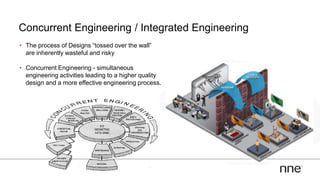
Concurrent Engineering / Integrated Engineering
• The process of Designs “tossed over the wall”
are inherently wasteful and risky
• Concurrent Engineering - simultaneous
engineering activities leading to a higher quality
design and a more effective engineering process.
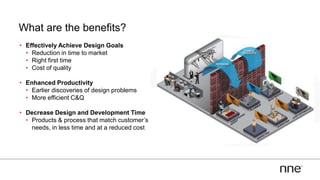
What are the benefits?
• Effectively Achieve Design Goals
• Reduction in time to market
• Right first time
• Cost of quality
• Enhanced Productivity
• Earlier discoveries of design problems
• More efficient C&Q
• Decrease Design and Development Time
• Products & process that match customer’s
needs, in less time and at a reduced cost
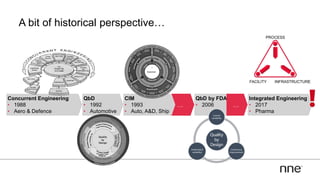
A bit of historical perspective…
Concurrent Engineering
• 1988
• Aero & Defence
…
QbD by FDA
• 2006
QbD
• 1992
• Automotive
CIM
• 1993
• Auto, A&D, Ship
…
Integrated Engineering
• 2017
• Pharma
THE TRADITIONAL APPROACH
6
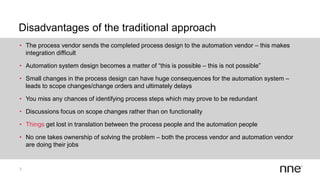
Disadvantages of the traditional approach
7
• The process vendor sends the completed process design to the automation vendor – this makes
integration difficult
• Automation system design becomes a matter of “this is possible – this is not possible”
• Small changes in the process design can have huge consequences for the automation system –
leads to scope changes/change orders and ultimately delays
• You miss any chances of identifying process steps which may prove to be redundant
• Discussions focus on scope changes rather than on functionality
• Things get lost in translation between the process people and the automation people
• No one takes ownership of solving the problem – both the process vendor and automation vendor
are doing their jobs
Example Brownfield Fill Finish Facility
• $120 mill. Fill Finish Facility under a consent decree with GMP fill and finish suites and packaging
• Equipment and facility designed by one company with installation, electrical, and automation
managed by other companies.
• Design delivered on time but automation programing 3 months delayed
• Document review cycles executed 6 times due to changes
• Executed multiple change orders increase project cost
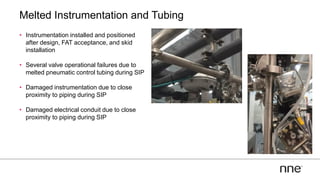
Melted Instrumentation and Tubing
• Instrumentation installed and positioned
after design, FAT acceptance, and skid
installation
• Several valve operational failures due to
melted pneumatic control tubing during SIP
• Damaged instrumentation due to close
proximity to piping during SIP
• Damaged electrical conduit due to close
proximity to piping during SIP
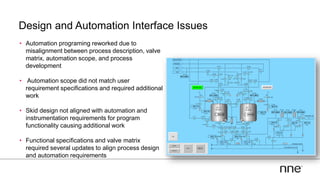
Design and Automation Interface Issues
• Automation programing reworked due to
misalignment between process description, valve
matrix, automation scope, and process
development
• Automation scope did not match user
requirement specifications and required additional
work
• Skid design not aligned with automation and
instrumentation requirements for program
functionality causing additional work
• Functional specifications and valve matrix
required several updates to align process design
and automation requirements
Example: Greenfield Fill Finish Facility
• $500 mill. Fill Finish Facility with GMP fill and finish suites, utility plant, central warehouse
• Different companies for Process Design, Architect, Automation Design & Integration, and G.C.
• 1+ year delay
• Design review cycle from 2 to 5+ (still not enough)
• 30% new scope in automation due to “unfinished” process and HVAC design
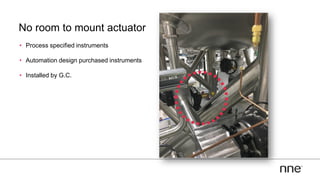
No room to mount actuator
• Process specified instruments
• Automation design purchased instruments
• Installed by G.C.
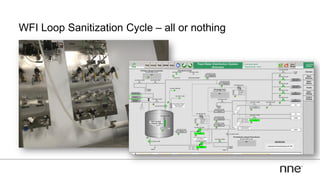
WFI Loop Sanitization Cycle – all or nothing
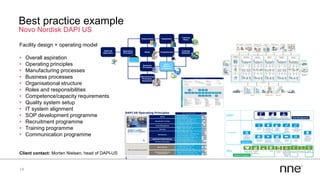
Best practice example
Novo Nordisk DAPI US
14
Facility design + operating model
• Overall aspiration
• Operating principles
• Manufacturing processes
• Business processes
• Organisational structure
• Roles and responsibilities
• Competence/capacity requirements
• Quality system setup
• IT system alignment
• SOP development programme
• Recruitment programme
• Training programme
• Communication programme
Client contact: Morten Nielsen, head of DAPI-US
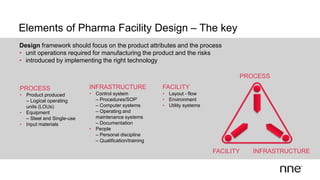
Elements of Pharma Facility Design – The key
Design framework should focus on the product attributes and the process
• unit operations required for manufacturing the product and the risks
• introduced by implementing the right technology
PROCESS
• Product produced
– Logical operating
units (LOUs)
• Equipment
– Steel and Single-use
• Input materials
INFRASTRUCTURE
• Control system
– Procedures/SOP’
– Computer systems
– Operating and
maintenance systems
– Documentation
• People
– Personal discipline
– Qualification/training
FACILITY
• Layout - flow
• Environment
• Utility systems
PROCESS
INFRASTRUCTUREFACILITY
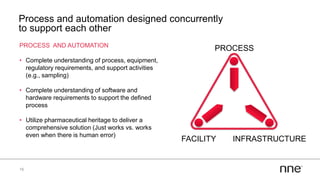
Process and automation designed concurrently
to support each other
16
PROCESS AND AUTOMATION
• Complete understanding of process, equipment,
regulatory requirements, and support activities
(e.g., sampling)
• Complete understanding of software and
hardware requirements to support the defined
process
• Utilize pharmaceutical heritage to deliver a
comprehensive solution (Just works vs. works
even when there is human error)
PROCESS
INFRASTRUCTUREFACILITY
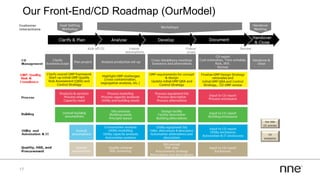
Our Front-End/CD Roadmap (OurModel)
17
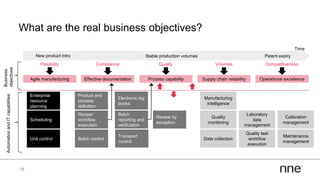
What are the real business objectives?
18
Agile manufacturing Effective documentation Process capability Supply chain reliability Operational excellence
Flexibility Compliance Quality Volumes Competitiveness
New product intro Stable production volumes Patent expiry
Time
Recipe/
workflow
execution
Batch
reporting and
verification
AutomationandITcapabilities
Business
objectives
Enterprise
resource
planning
Scheduling
Unit control
Product and
process
definition
Electronic log
books
Batch control
Transport
control
Review by
exception
Manufacturing
intelligence
Quality
monitoring
Data collection
Laboratory
data
management
Quality test
workflow
execution
Calibration
management
Maintenance
management
19
Advantages
20
• Ensures risk free design and implementation of automation and IT
• Leads to better and more robust design – the system is more effective and meets design objectives
• Facilitates a leaner process as it enables parallel design of process and automation system, which
optimises the project and the time schedule
• Enables optimisation of the process during the design phase
• Allows for automation input to process design, which creates room for optimisation and control
strategy – “have you thought about …”
• Allows for process input to automation design (what can we do to achieve seamless manufacturing?)
• Supports flexibility, agility and GMP readiness – all documentation is more homogenous – test
documentation for process and automation is the same
• Facilitates concurrent engineering – flexible manufacturing systems (FMS)
Value to the customer
21
• Transform automation solution from “just automating the process” to a complete system solution that
enables flexibility, agility and is “future proof”
• Design driven by business objectives
• Eliminate isolated and subjective technology decision
• Clear cost/benefit for solution elements
• Roadmap for solution elements not in initial scope
• Enable “informed” decisions during design and implementation phases using enterprise architecture
• Organisational alignment around common architecture
• Enterprise system touchpoints and integration
• Third party automation solution and equipment suppliers
Thank you
For further information please contact
EJ Alston
Director, Engineering
edal@nne.com
919-338-3160
Gilad Langer
Director, Automation & MIS
gidl@nne.com
415-405-6743

Concurrent Engineering – Breaking down the silos

  • 1.
    Concurrent Engineering – Breaking down thesilos Gilad Langer and EJ Alston
  • 2.
    Agenda Introduction • What isConcurrent or Integrated Engineering? • What are the benefits Engineering in Pharma – the traditional approach • Examples Concurrent Engineering Best Practice • Examples Concurrent Engineering In Practice • Examples • Advantages • Value
  • 3.
    Concurrent Engineering /Integrated Engineering • The process of Designs “tossed over the wall” are inherently wasteful and risky • Concurrent Engineering - simultaneous engineering activities leading to a higher quality design and a more effective engineering process.
  • 4.
    What are thebenefits? • Effectively Achieve Design Goals • Reduction in time to market • Right first time • Cost of quality • Enhanced Productivity • Earlier discoveries of design problems • More efficient C&Q • Decrease Design and Development Time • Products & process that match customer’s needs, in less time and at a reduced cost
  • 5.
    A bit ofhistorical perspective… Concurrent Engineering • 1988 • Aero & Defence … QbD by FDA • 2006 QbD • 1992 • Automotive CIM • 1993 • Auto, A&D, Ship … Integrated Engineering • 2017 • Pharma
  • 6.
  • 7.
    Disadvantages of thetraditional approach 7 • The process vendor sends the completed process design to the automation vendor – this makes integration difficult • Automation system design becomes a matter of “this is possible – this is not possible” • Small changes in the process design can have huge consequences for the automation system – leads to scope changes/change orders and ultimately delays • You miss any chances of identifying process steps which may prove to be redundant • Discussions focus on scope changes rather than on functionality • Things get lost in translation between the process people and the automation people • No one takes ownership of solving the problem – both the process vendor and automation vendor are doing their jobs
  • 8.
    Example Brownfield FillFinish Facility • $120 mill. Fill Finish Facility under a consent decree with GMP fill and finish suites and packaging • Equipment and facility designed by one company with installation, electrical, and automation managed by other companies. • Design delivered on time but automation programing 3 months delayed • Document review cycles executed 6 times due to changes • Executed multiple change orders increase project cost
  • 9.
    Melted Instrumentation andTubing • Instrumentation installed and positioned after design, FAT acceptance, and skid installation • Several valve operational failures due to melted pneumatic control tubing during SIP • Damaged instrumentation due to close proximity to piping during SIP • Damaged electrical conduit due to close proximity to piping during SIP
  • 10.
    Design and AutomationInterface Issues • Automation programing reworked due to misalignment between process description, valve matrix, automation scope, and process development • Automation scope did not match user requirement specifications and required additional work • Skid design not aligned with automation and instrumentation requirements for program functionality causing additional work • Functional specifications and valve matrix required several updates to align process design and automation requirements
  • 11.
    Example: Greenfield FillFinish Facility • $500 mill. Fill Finish Facility with GMP fill and finish suites, utility plant, central warehouse • Different companies for Process Design, Architect, Automation Design & Integration, and G.C. • 1+ year delay • Design review cycle from 2 to 5+ (still not enough) • 30% new scope in automation due to “unfinished” process and HVAC design
  • 12.
    No room tomount actuator • Process specified instruments • Automation design purchased instruments • Installed by G.C.
  • 13.
    WFI Loop SanitizationCycle – all or nothing
  • 14.
    Best practice example NovoNordisk DAPI US 14 Facility design + operating model • Overall aspiration • Operating principles • Manufacturing processes • Business processes • Organisational structure • Roles and responsibilities • Competence/capacity requirements • Quality system setup • IT system alignment • SOP development programme • Recruitment programme • Training programme • Communication programme Client contact: Morten Nielsen, head of DAPI-US
  • 15.
    Elements of PharmaFacility Design – The key Design framework should focus on the product attributes and the process • unit operations required for manufacturing the product and the risks • introduced by implementing the right technology PROCESS • Product produced – Logical operating units (LOUs) • Equipment – Steel and Single-use • Input materials INFRASTRUCTURE • Control system – Procedures/SOP’ – Computer systems – Operating and maintenance systems – Documentation • People – Personal discipline – Qualification/training FACILITY • Layout - flow • Environment • Utility systems PROCESS INFRASTRUCTUREFACILITY
  • 16.
    Process and automationdesigned concurrently to support each other 16 PROCESS AND AUTOMATION • Complete understanding of process, equipment, regulatory requirements, and support activities (e.g., sampling) • Complete understanding of software and hardware requirements to support the defined process • Utilize pharmaceutical heritage to deliver a comprehensive solution (Just works vs. works even when there is human error) PROCESS INFRASTRUCTUREFACILITY
  • 17.
  • 18.
    What are thereal business objectives? 18 Agile manufacturing Effective documentation Process capability Supply chain reliability Operational excellence Flexibility Compliance Quality Volumes Competitiveness New product intro Stable production volumes Patent expiry Time Recipe/ workflow execution Batch reporting and verification AutomationandITcapabilities Business objectives Enterprise resource planning Scheduling Unit control Product and process definition Electronic log books Batch control Transport control Review by exception Manufacturing intelligence Quality monitoring Data collection Laboratory data management Quality test workflow execution Calibration management Maintenance management
  • 19.
  • 20.
    Advantages 20 • Ensures riskfree design and implementation of automation and IT • Leads to better and more robust design – the system is more effective and meets design objectives • Facilitates a leaner process as it enables parallel design of process and automation system, which optimises the project and the time schedule • Enables optimisation of the process during the design phase • Allows for automation input to process design, which creates room for optimisation and control strategy – “have you thought about …” • Allows for process input to automation design (what can we do to achieve seamless manufacturing?) • Supports flexibility, agility and GMP readiness – all documentation is more homogenous – test documentation for process and automation is the same • Facilitates concurrent engineering – flexible manufacturing systems (FMS)
  • 21.
    Value to thecustomer 21 • Transform automation solution from “just automating the process” to a complete system solution that enables flexibility, agility and is “future proof” • Design driven by business objectives • Eliminate isolated and subjective technology decision • Clear cost/benefit for solution elements • Roadmap for solution elements not in initial scope • Enable “informed” decisions during design and implementation phases using enterprise architecture • Organisational alignment around common architecture • Enterprise system touchpoints and integration • Third party automation solution and equipment suppliers
  • 22.
    Thank you For furtherinformation please contact EJ Alston Director, Engineering edal@nne.com 919-338-3160 Gilad Langer Director, Automation & MIS gidl@nne.com 415-405-6743