Internet Banking
What is Internet banking?
● A system allowing individuals to perform banking
activities at home, via the internet.
● The automated delivery of new and traditional banking
products and services directly to customers through
electronic, interactive communication channels.
● Some online banks are traditional banks which also
offer online banking, while others are online only and
have no physical presence.
Development of E-banking
● The concept of Internet banking has been simultaneously
evolving with the development of the world wide web.
● Programmers working on banking data bases came up with
ideas for online banking transactions, some time during the
1980's.
● The online shopping promoted the use of credit cards
through Internet.
● The first online banking service in United States was
introduced, in October 1994.
The service was developed by Stanford Federal
Credit Union, which is a financial institution.
In May 1995 : Wells Fargo - the first bank in the
world to offer customer access to their accounts
over the internet(allows customer to see their
accounts online)
The online banking services are becoming more
and more prevalent due to the well developed
systems
© 2004 H. Weihrich Chap. 6. Decision Making
Development of E-banking
in India
● ICICI was the first bank to initiate the Internet
banking revolution in India as early as 1997
under the brand name 'Infinity‘.
● ICICI Bank kicked off online banking way
back in 1996 . But even for the Internet as a
whole, 1996 to 1998 marked the adoption
phase, while usage increased only in 1999-
due to lower ISP online charges, increased
PC penetration and a tech-friendly
atmosphere
RBI & E-Banking
● The Reserve Bank of India constituted a
working group on Internet Banking.
● The group divided the internet banking
products in India into 3 types based on the
levels of access granted.
● They are:- i) Information Only System: ii)
Electronic Information Transfer System: iii)
Fully Electronic Transactional System:
Information Only System
● General purpose information like
interest rates, branch location, bank
products and their features, loan and
deposit calculations are provided in the
banks website.
● There exist facilities for downloading
various types of application forms.
● The communication is normally done
through e-mail.
Uses
● There is no interaction
between the customer and
bank's application system.
● No identification of the
customer is done. In this
system, there is no possibility
of any unauthorized person
getting into production systems
of the bank through internet.
Electronic Information
Transfer System
'
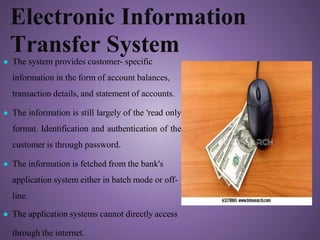
● The system provides customer- specific
information in the form of account balances,
transaction details, and statement of accounts.
● The information is still largely of the 'read only
format. Identification and authentication of the
customer is through password.
● The information is fetched from the bank's
application system either in batch mode or off-
line.
● The application systems cannot directly access
through the internet.
Fully Electronic Transactional
System
● This system allows bi-directional capabilities.
● Transactions can be submitted by the customer for online
update.
● This system requires high degree of security and control. In
this environment, web server and application systems are
linked over secure infrastructure.
● It comprises technology covering computerization,
networking and security, inter-bank payment gateway and legal
infrastructure .
Automated Teller Machine
(ATM)
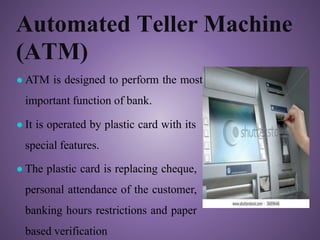
● ATM is designed to perform the most
important function of bank.
● It is operated by plastic card with its
special features.
● The plastic card is replacing cheque,
personal attendance of the customer,
banking hours restrictions and paper
based verification
Different services provided
under e-banking
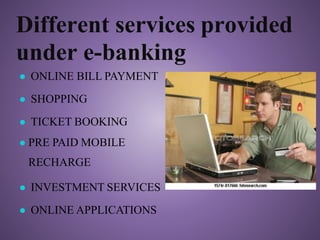
● ONLINE BILL PAYMENT
● SHOPPING
● TICKET BOOKING
● PRE PAID MOBILE
RECHARGE
● INVESTMENT SERVICES
● ONLINE APPLICATIONS
Service Provided By SBI
● Self-account funds transfer across India.
● Third party transfers in the same branch
● New account opening
● New Cheque-book request
● Railway tickets booking
● Utility bill payments
● LIC and other insurance premium payments
● Credit card dues payments
● Deposit your taxes
● Donations to Red Cross and such other organisations
State Bank Of India
Service Provided By ICICI
● BILL PAYMENT
● FUND TRANSFER
● ACCOUNT INFORMATION
● SMART MONEY ORDER SERVICE REQUEST
● CONVERT TO EMI A/C TO CARD TRANSFER
● PREPAID MOBILE RECHARGE
● ACCOUNT TRANSFER
Advantages of E-banking
● Benefits for Banks
●Benefits for Small to Medium
Businesses
● Benefits for Customers
●Larger customer coverage
Reducing the costs of operations
●Promoting their services and
products internationally
●Increasing the customer
satisfaction and providing a
personalized relationship with
customers
BBenefits for Banks
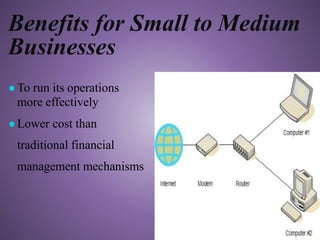
Benefits for Small to Medium
Businesses
●To run its operations
more effectively
●Lower cost than
traditional financial
management mechanisms
Benefits for Customers
● Convenience 24 hours a day, seven days a week
● Cost Reducing transfer fees
● Speed Faster circulation of assets
● Competitiveness - Fostering competition in financial
market
● Communicate easily
● Abolishing the uses of paper
Disadvantages OF E-banking
● A need for customer skill to deal with computers and
browsers.
● Many people who are not comfortable with computers and
the Internet, often find it difficult to use internet banking
● For beginners, internet banking is really time consuming
● In many instances, a simple mistake, like clicking a wrong
button, may create a big problem.
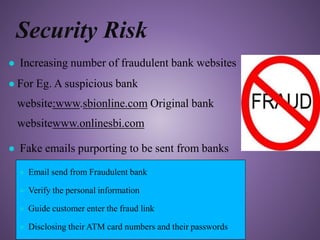
Security Risk
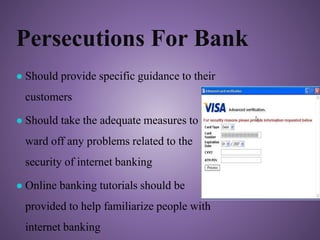
● Increasing number of fraudulent bank websites
● For Eg. A suspicious bank
website:www.sbionline.com Original bank
websitewww.onlinesbi.com
● Fake emails purporting to be sent from banks
● Email send from Fraudulent bank
● Verify the personal information
● Guide customer enter the fraud link
● Disclosing their ATM card numbers and their passwords
Persecutions For Bank
● Should provide specific guidance to their
customers
● Should take the adequate measures to
ward off any problems related to the
security of internet banking
● Online banking tutorials should be
provided to help familiarize people with
internet banking
Persecutions For Customers
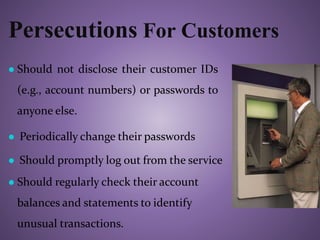
● Should not disclose their customer IDs
(e.g., account numbers) or passwords to
anyone else.
● Periodically change their passwords
● Should promptly log out from the service
● Should regularly check their account
balances and statements to identify
unusual transactions.
NAME: HARSH AWANA
ROLL: NO. 21BPB041
E-COMMERCE ASSIGNMENT

E-COMMERCE.pptx

  • 1.
  • 2.
    What is Internetbanking? ● A system allowing individuals to perform banking activities at home, via the internet. ● The automated delivery of new and traditional banking products and services directly to customers through electronic, interactive communication channels. ● Some online banks are traditional banks which also offer online banking, while others are online only and have no physical presence.
  • 3.
    Development of E-banking ●The concept of Internet banking has been simultaneously evolving with the development of the world wide web. ● Programmers working on banking data bases came up with ideas for online banking transactions, some time during the 1980's. ● The online shopping promoted the use of credit cards through Internet. ● The first online banking service in United States was introduced, in October 1994.
  • 4.
    The service wasdeveloped by Stanford Federal Credit Union, which is a financial institution. In May 1995 : Wells Fargo - the first bank in the world to offer customer access to their accounts over the internet(allows customer to see their accounts online) The online banking services are becoming more and more prevalent due to the well developed systems © 2004 H. Weihrich Chap. 6. Decision Making Development of E-banking
  • 5.
    Development of E-banking inIndia ● ICICI was the first bank to initiate the Internet banking revolution in India as early as 1997 under the brand name 'Infinity‘. ● ICICI Bank kicked off online banking way back in 1996 . But even for the Internet as a whole, 1996 to 1998 marked the adoption phase, while usage increased only in 1999- due to lower ISP online charges, increased PC penetration and a tech-friendly atmosphere
  • 6.
    RBI & E-Banking ●The Reserve Bank of India constituted a working group on Internet Banking. ● The group divided the internet banking products in India into 3 types based on the levels of access granted. ● They are:- i) Information Only System: ii) Electronic Information Transfer System: iii) Fully Electronic Transactional System:
  • 7.
    Information Only System ●General purpose information like interest rates, branch location, bank products and their features, loan and deposit calculations are provided in the banks website. ● There exist facilities for downloading various types of application forms. ● The communication is normally done through e-mail.
  • 8.
    Uses ● There isno interaction between the customer and bank's application system. ● No identification of the customer is done. In this system, there is no possibility of any unauthorized person getting into production systems of the bank through internet.
  • 9.
    Electronic Information Transfer System ' ●The system provides customer- specific information in the form of account balances, transaction details, and statement of accounts. ● The information is still largely of the 'read only format. Identification and authentication of the customer is through password. ● The information is fetched from the bank's application system either in batch mode or off- line. ● The application systems cannot directly access through the internet.
  • 10.
    Fully Electronic Transactional System ●This system allows bi-directional capabilities. ● Transactions can be submitted by the customer for online update. ● This system requires high degree of security and control. In this environment, web server and application systems are linked over secure infrastructure. ● It comprises technology covering computerization, networking and security, inter-bank payment gateway and legal infrastructure .
  • 11.
    Automated Teller Machine (ATM) ●ATM is designed to perform the most important function of bank. ● It is operated by plastic card with its special features. ● The plastic card is replacing cheque, personal attendance of the customer, banking hours restrictions and paper based verification
  • 12.
    Different services provided undere-banking ● ONLINE BILL PAYMENT ● SHOPPING ● TICKET BOOKING ● PRE PAID MOBILE RECHARGE ● INVESTMENT SERVICES ● ONLINE APPLICATIONS
  • 13.
    Service Provided BySBI ● Self-account funds transfer across India. ● Third party transfers in the same branch ● New account opening ● New Cheque-book request ● Railway tickets booking ● Utility bill payments ● LIC and other insurance premium payments ● Credit card dues payments ● Deposit your taxes ● Donations to Red Cross and such other organisations State Bank Of India
  • 14.
    Service Provided ByICICI ● BILL PAYMENT ● FUND TRANSFER ● ACCOUNT INFORMATION ● SMART MONEY ORDER SERVICE REQUEST ● CONVERT TO EMI A/C TO CARD TRANSFER ● PREPAID MOBILE RECHARGE ● ACCOUNT TRANSFER
  • 15.
    Advantages of E-banking ●Benefits for Banks ●Benefits for Small to Medium Businesses ● Benefits for Customers
  • 16.
    ●Larger customer coverage Reducingthe costs of operations ●Promoting their services and products internationally ●Increasing the customer satisfaction and providing a personalized relationship with customers BBenefits for Banks
  • 17.
    Benefits for Smallto Medium Businesses ●To run its operations more effectively ●Lower cost than traditional financial management mechanisms
  • 18.
    Benefits for Customers ●Convenience 24 hours a day, seven days a week ● Cost Reducing transfer fees ● Speed Faster circulation of assets ● Competitiveness - Fostering competition in financial market ● Communicate easily ● Abolishing the uses of paper
  • 19.
    Disadvantages OF E-banking ●A need for customer skill to deal with computers and browsers. ● Many people who are not comfortable with computers and the Internet, often find it difficult to use internet banking ● For beginners, internet banking is really time consuming ● In many instances, a simple mistake, like clicking a wrong button, may create a big problem.
  • 20.
    Security Risk ● Increasingnumber of fraudulent bank websites ● For Eg. A suspicious bank website:www.sbionline.com Original bank websitewww.onlinesbi.com ● Fake emails purporting to be sent from banks ● Email send from Fraudulent bank ● Verify the personal information ● Guide customer enter the fraud link ● Disclosing their ATM card numbers and their passwords
  • 21.
    Persecutions For Bank ●Should provide specific guidance to their customers ● Should take the adequate measures to ward off any problems related to the security of internet banking ● Online banking tutorials should be provided to help familiarize people with internet banking
  • 22.
    Persecutions For Customers ●Should not disclose their customer IDs (e.g., account numbers) or passwords to anyone else. ● Periodically change their passwords ● Should promptly log out from the service ● Should regularly check their account balances and statements to identify unusual transactions.
  • 23.
    NAME: HARSH AWANA ROLL:NO. 21BPB041 E-COMMERCE ASSIGNMENT