AGROFORESTRY
Definitions and Classification of Agroforestry Systems
Agroforestry is the intentional planting or retention of trees on fields through spatial or
temporal arrangements.
Also a dynamic and ecologically -based natural resource management system
A.F is sometimes described as a "new term for an old practice"
“The word ‘agroforestry’ has its roots in the concepts of ‘agrisilviculture’ and ‘Agrosilviculture’
(King 1968).
According to Ludgreen & Raintree (1982) agroforestry is ‘a collective name for land-use
systems, practices or technologies, where the woody perennials are deliberately integrated
with agricultural crops and/or animals in the same land management unit.
It’s important to increase, diversify, and sustain production for increased social, economic, and
environmental benefits.
What is Agroforestry?
Should also not be confused !
With farm forestry, which refers to tree planting on
farmers’ fields, mostly for the purpose of establishing
woodlots.
But, Agroforestry, which put the interactive association
between woody perennials and crops or animals for
diversification and sustainability of production and profits.
Together with forest management, several viable
alternatives to unsustainable management of natural
resources that has been proposed for tropical forest
ecosystems.
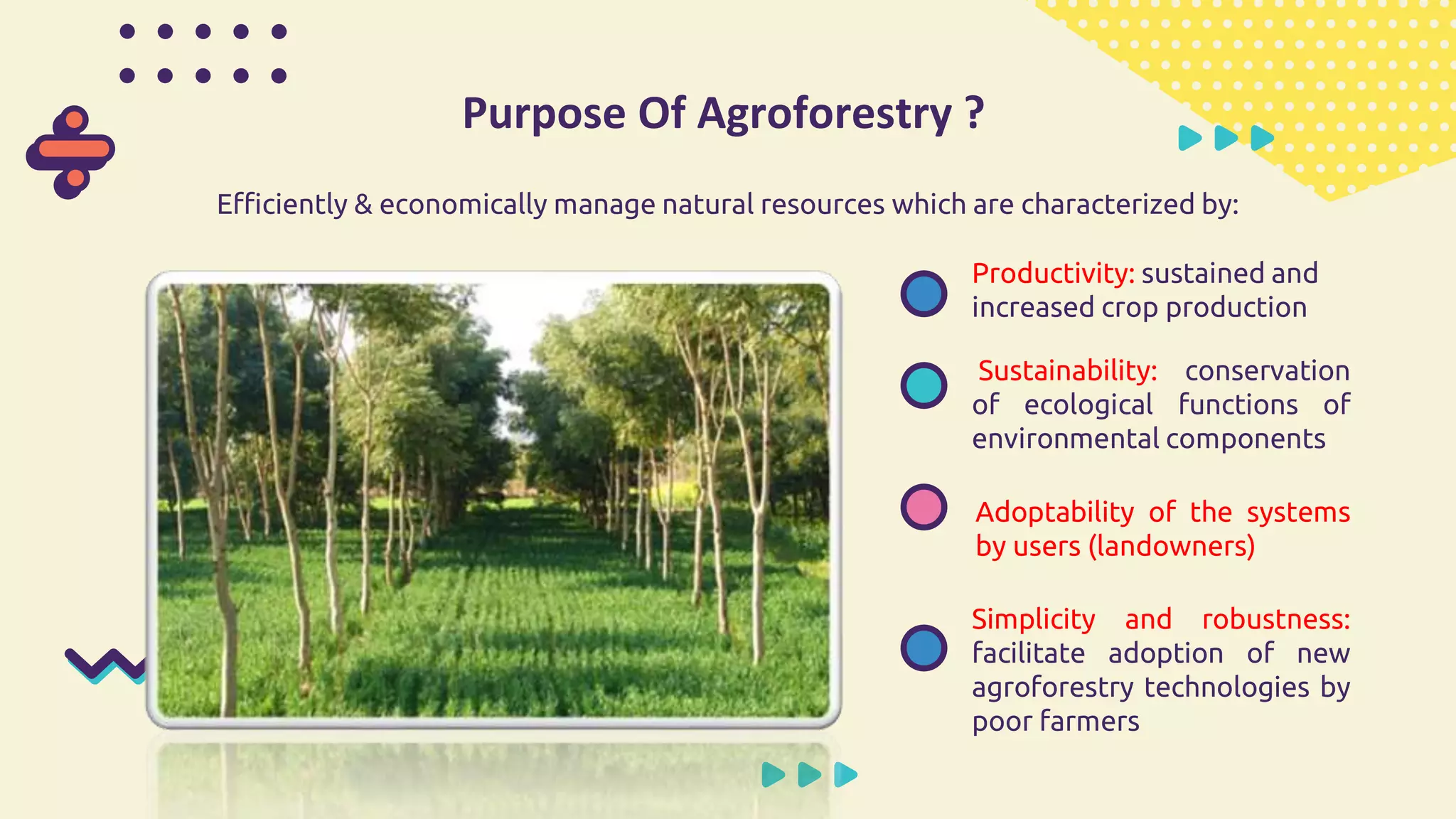
Purpose Of Agroforestry ?
Productivity: sustained and
increased crop production
Efficiently & economically manage natural resources which are characterized by:
Sustainability: conservation
of ecological functions of
environmental components
Adoptability of the systems
by users (landowners)
Simplicity and robustness:
facilitate adoption of new
agroforestry technologies by
poor farmers
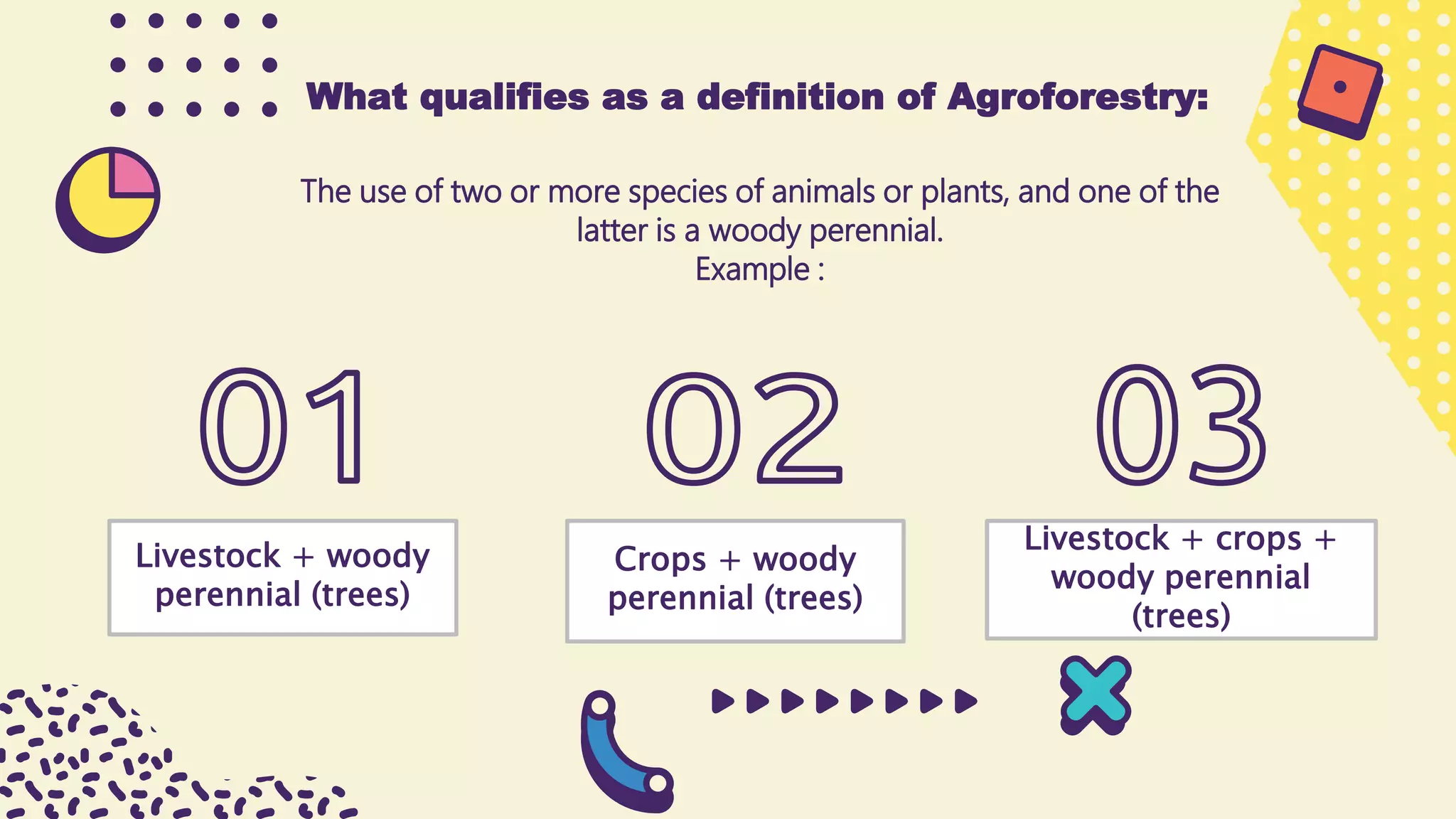
Livestock + woody
perennial (trees)
Crops + woody
perennial (trees)
Livestock + crops +
woody perennial
(trees)
What qualifies as a definition of Agroforestry:
The use of two or more species of animals or plants, and one of the
latter is a woody perennial.
Example :
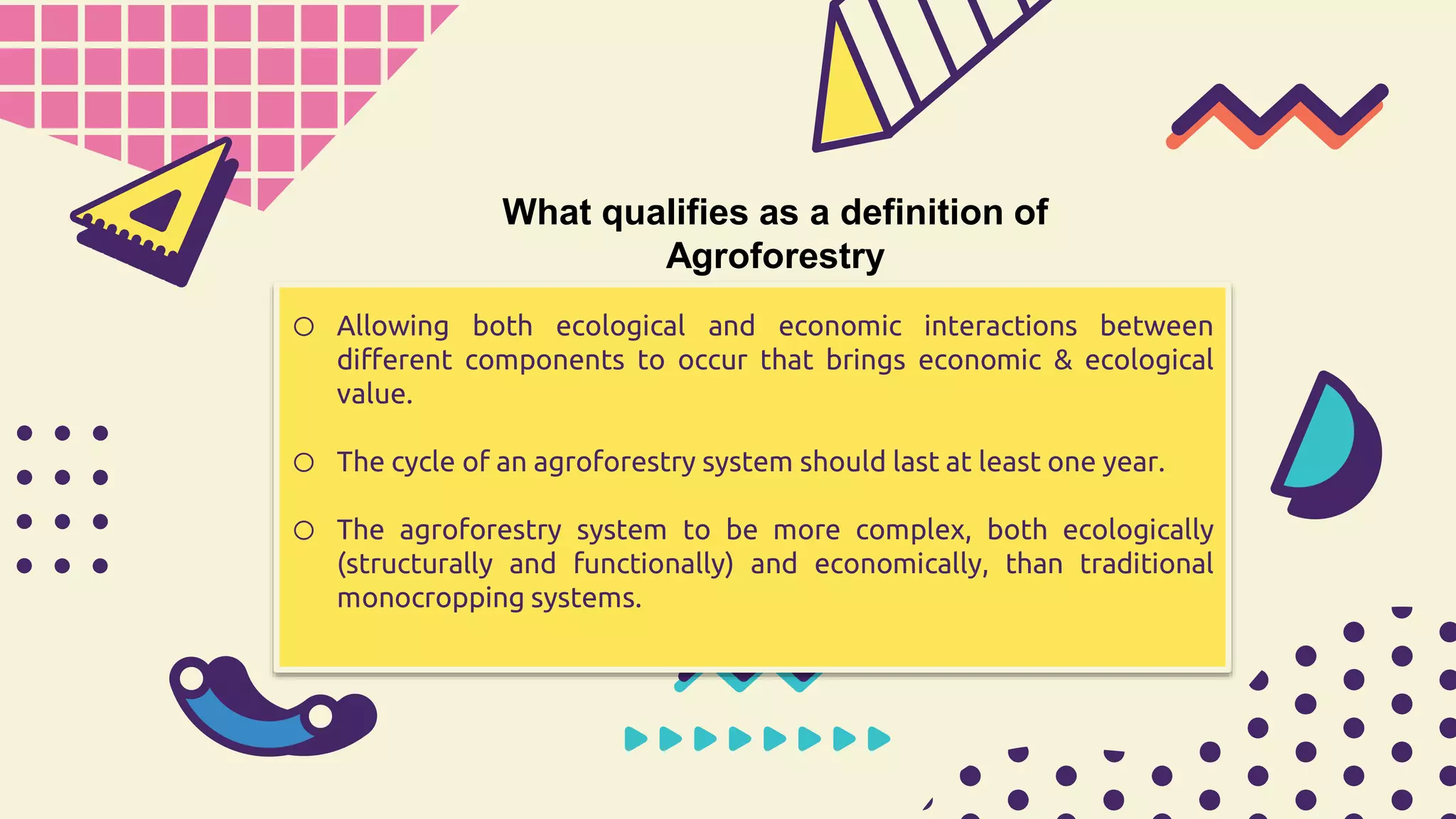
o Allowing both ecological and economic interactions between
different components to occur that brings economic & ecological
value.
o The cycle of an agroforestry system should last at least one year.
o The agroforestry system to be more complex, both ecologically
(structurally and functionally) and economically, than traditional
monocropping systems.
What qualifies as a definition of
Agroforestry
Basic Concepts in Agroforestry
A.F is based on the concept of associating trees with crops on the same
piece of land simultaneously or sequentially.
Classification Of Agroforestry Systems
 The structural composition and arrangement of the different components.
 The temporal sequence of introducing of different components into the
system.
 The function of woody perennials , either as windbreaks, a source of shade,
or for soil conservation
 The level of input in terms of the management, or the scale of management
for commercial purposes
 The environmental conditions and ecological suitability, based on the
assumption that certain types of systems are more appropriate in certain
areas than others for various environmental reasons
According to Nair (1993), the criteria for the classifications are :
1. Classification Based On Vegetation
Structure
 Trees/shrubs
(present in all
agroforestry
systems)
 Herbaceous
crops/fodder
plants
 Animals
 A standard/conventional Agroforestry system consist of
many elements/components are as follows:
Classification Based On Vegetation Structure
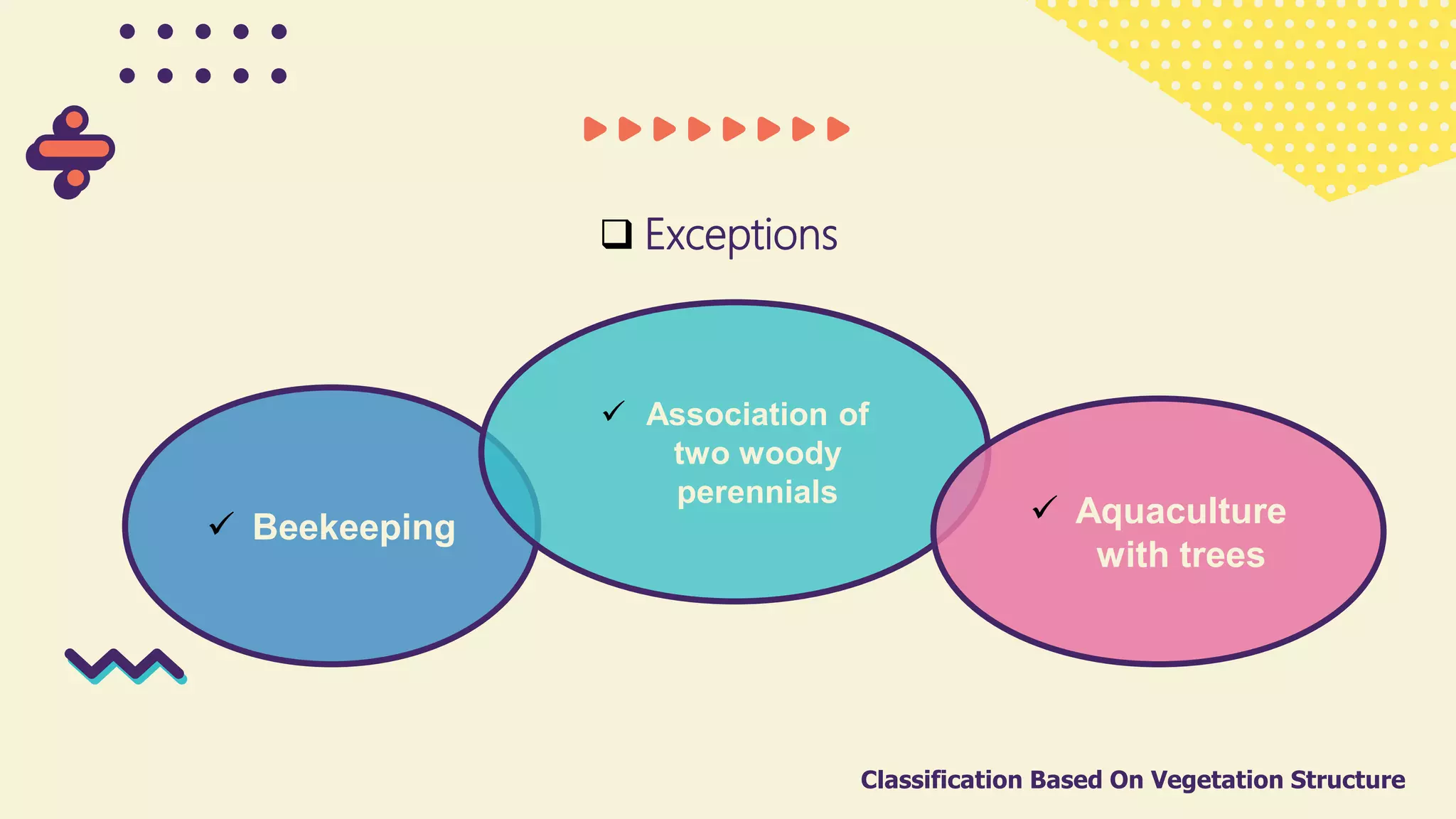
 Beekeeping
 Association of
two woody
perennials
 Aquaculture
with trees
 Exceptions
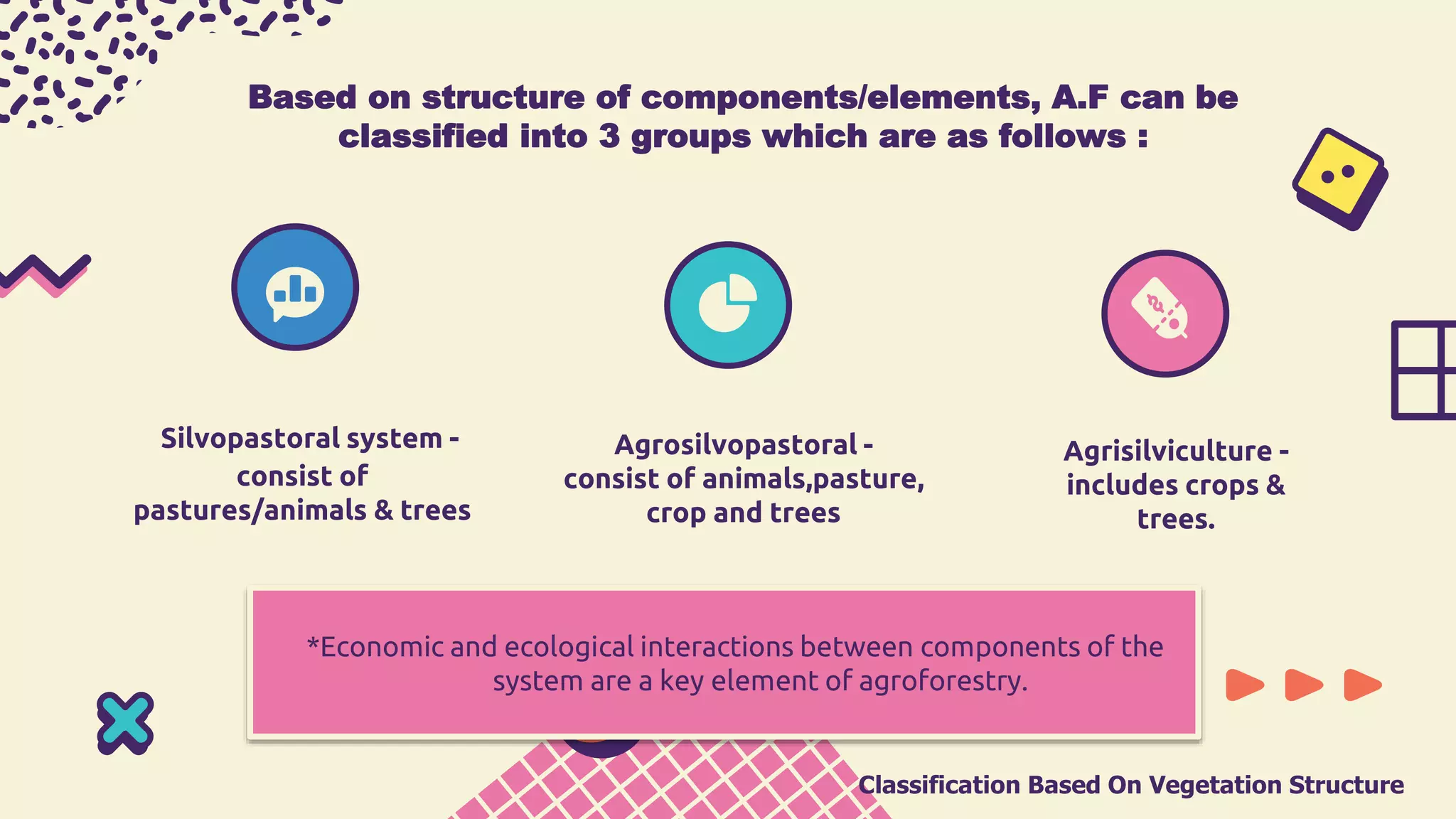
Based on structure of components/elements, A.F can be
classified into 3 groups which are as follows :
Agrosilvopastoral -
consist of animals,pasture,
crop and trees
Agrisilviculture -
includes crops &
trees.
Silvopastoral system -
consist of
pastures/animals & trees
*Economic and ecological interactions between components of the
system are a key element of agroforestry.
Classification Based On Vegetation Structure
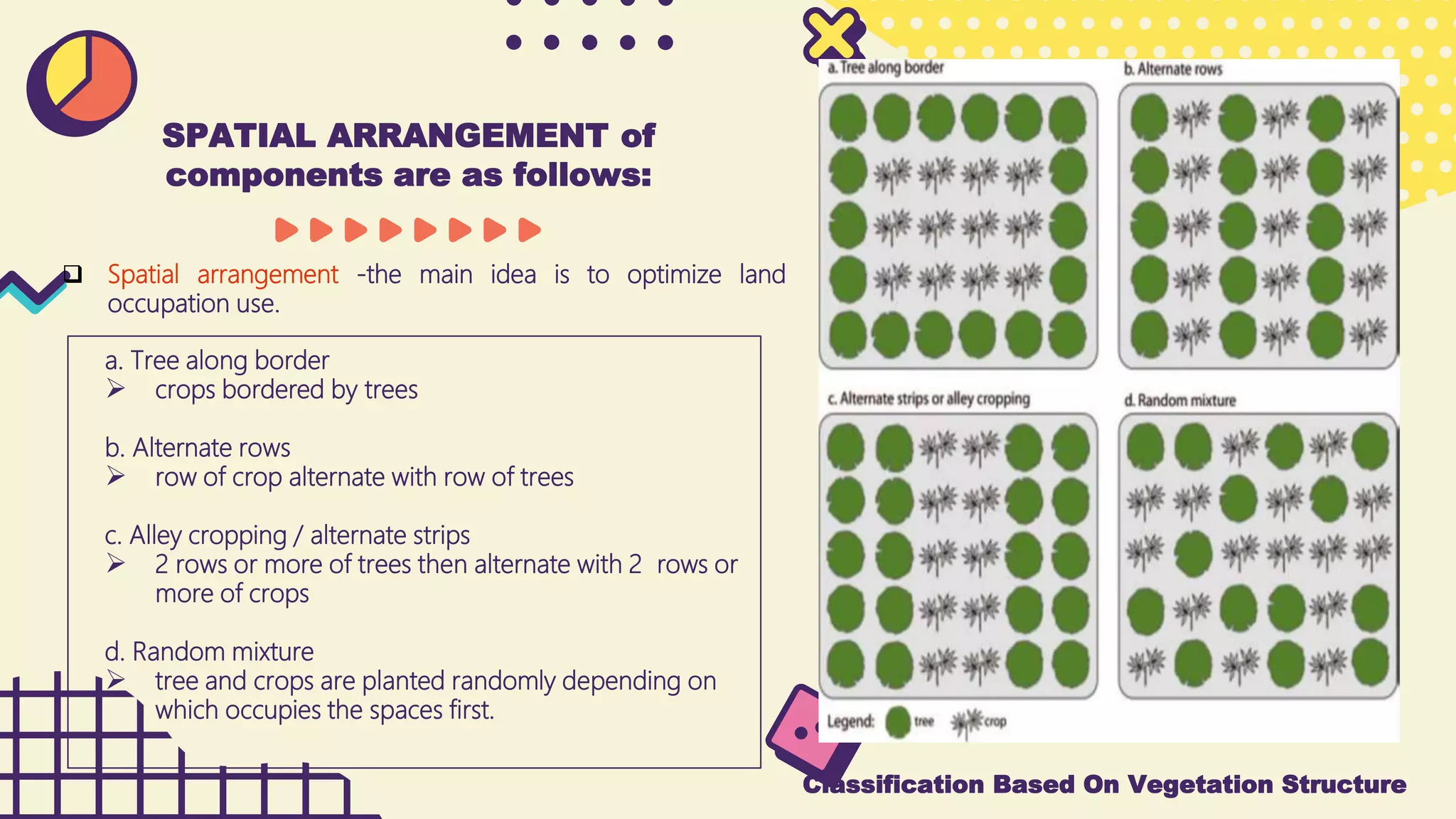
SPATIAL ARRANGEMENT of
components are as follows:
a. Tree along border
 crops bordered by trees
b. Alternate rows
 row of crop alternate with row of trees
c. Alley cropping / alternate strips
 2 rows or more of trees then alternate with 2 rows or
more of crops
d. Random mixture
 tree and crops are planted randomly depending on
which occupies the spaces first.
Classification Based On Vegetation Structure
 Spatial arrangement -the main idea is to optimize land
occupation use.
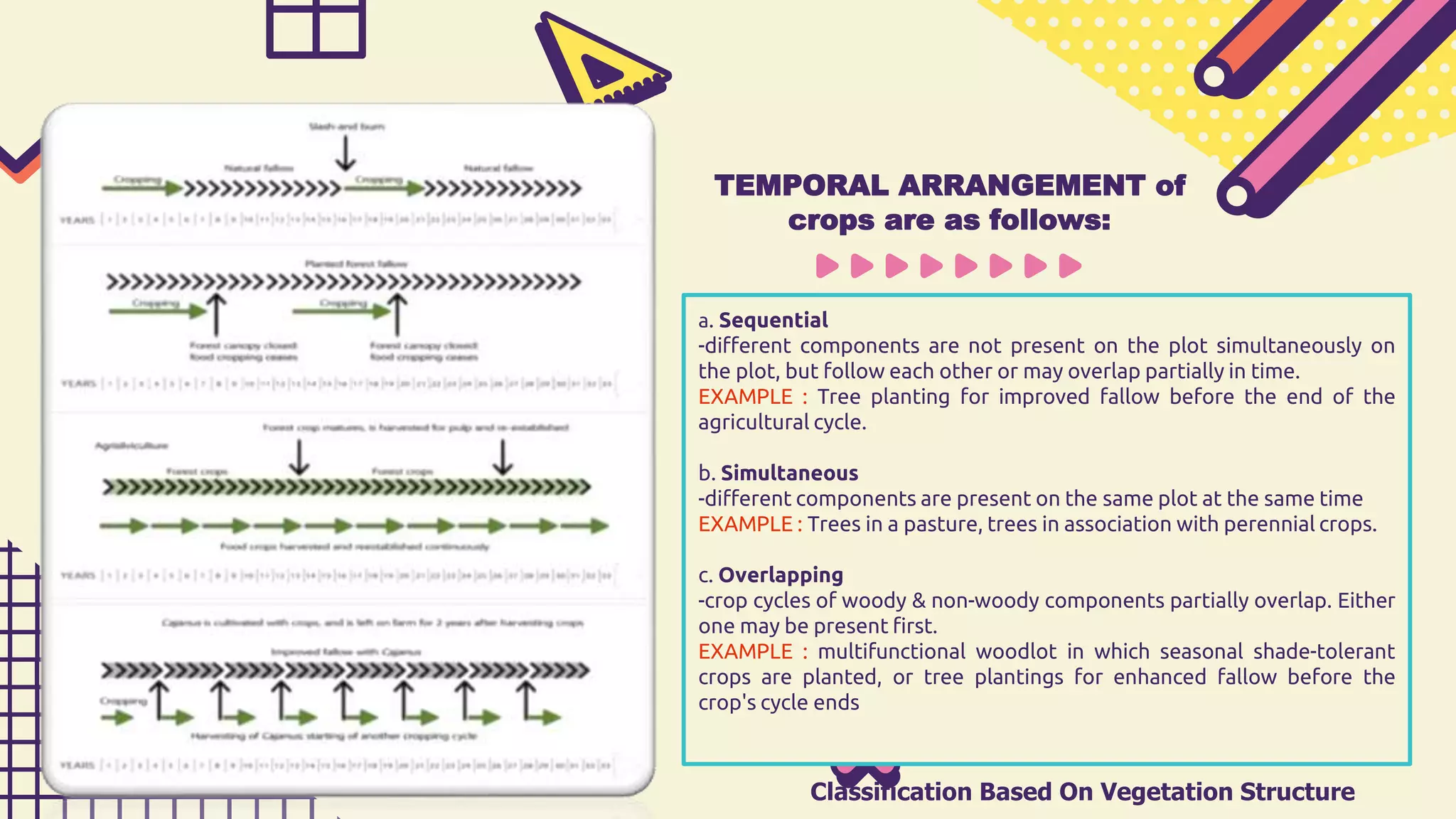
a. Sequential
-different components are not present on the plot simultaneously on
the plot, but follow each other or may overlap partially in time.
EXAMPLE : Tree planting for improved fallow before the end of the
agricultural cycle.
b. Simultaneous
-different components are present on the same plot at the same time
EXAMPLE : Trees in a pasture, trees in association with perennial crops.
c. Overlapping
-crop cycles of woody & non-woody components partially overlap. Either
one may be present first.
EXAMPLE : multifunctional woodlot in which seasonal shade-tolerant
crops are planted, or tree plantings for enhanced fallow before the
crop's cycle ends
TEMPORAL ARRANGEMENT of
crops are as follows:
Classification Based On Vegetation Structure
2. Classification Based on
Function
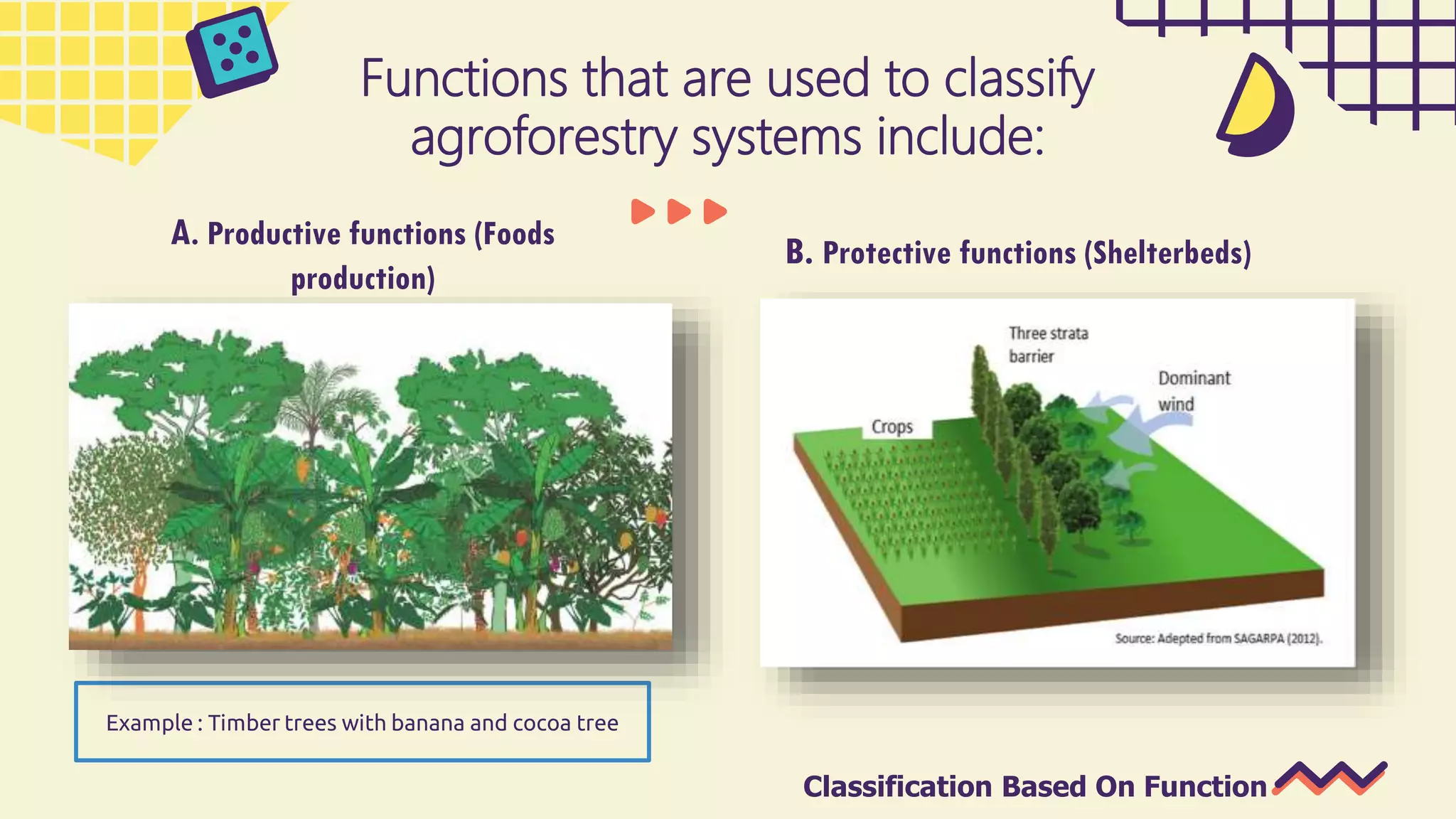
Functions that are used to classify
agroforestry systems include:
A. Productive functions (Foods
production)
Example : Timber trees with banana and cocoa tree
Classification Based On Function
B. Protective functions (Shelterbeds)
i. Timber
ii. Food
iii. Stimulants
iv. Aromas
v. Fats
vi. Medicinal products
Classification Based On Function
Trees& woody perennialscontributionin
agroforestryare:
vii. Fodder
viii. Weed control
ix. Nitrogen Fixation
x. Mulch
xi. Shade
xii. Carbon sequestration
xiii. Erosion control.
Introductionof animalsalsoprovidesbenefitssuchas:
Weed control (Grazing)
Food products (Meat, milk, fur, dung, eggs for bioenergy production)
3. Classification Based on
Socio-economic Activities
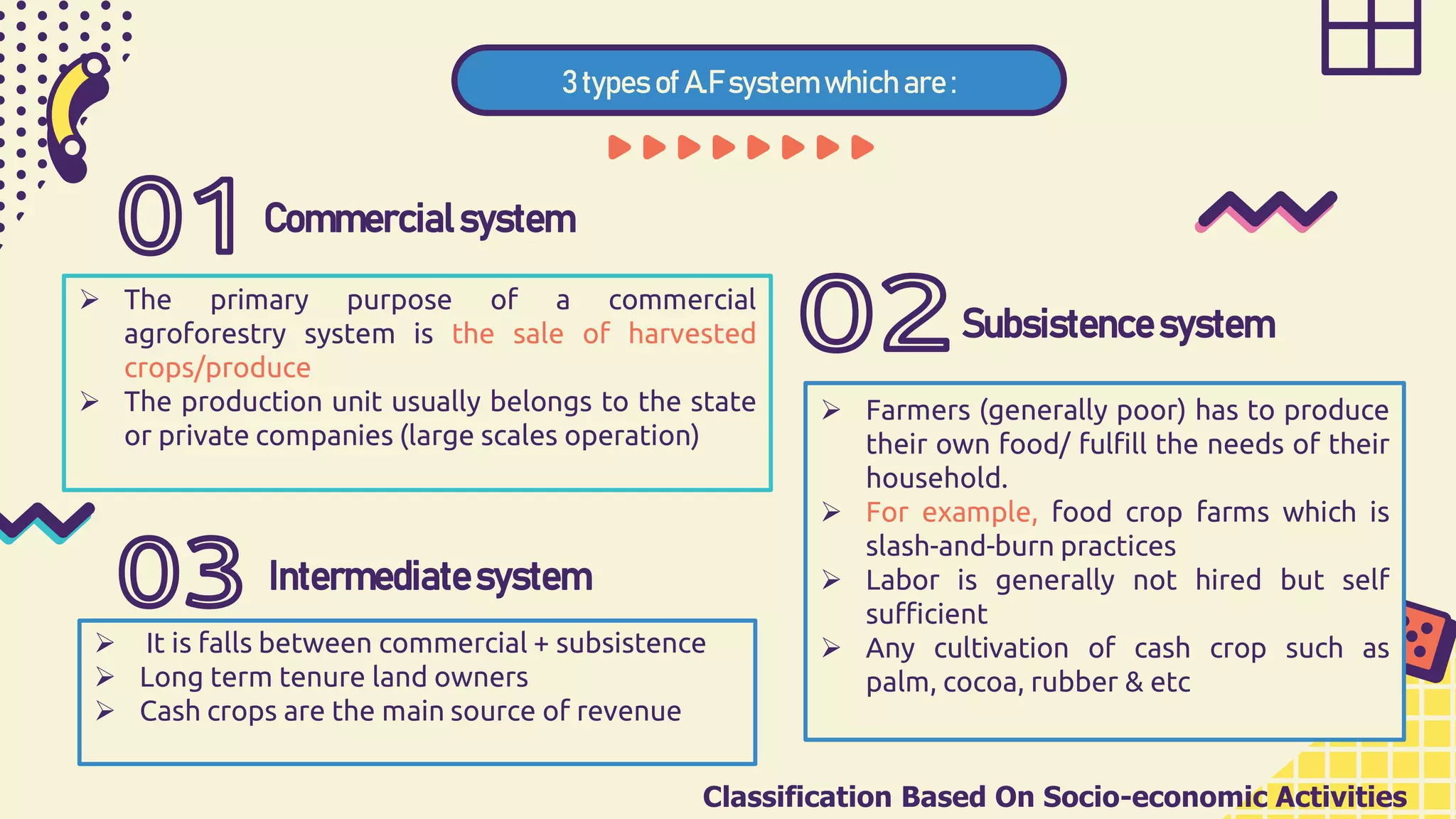
3 types of A.F system which are :
 The primary purpose of a commercial
agroforestry system is the sale of harvested
crops/produce
 The production unit usually belongs to the state
or private companies (large scales operation)
Commercialsystem
 Farmers (generally poor) has to produce
their own food/ fulfill the needs of their
household.
 For example, food crop farms which is
slash-and-burn practices
 Labor is generally not hired but self
sufficient
 Any cultivation of cash crop such as
palm, cocoa, rubber & etc
Subsistencesystem
 It is falls between commercial + subsistence
 Long term tenure land owners
 Cash crops are the main source of revenue
Intermediatesystem
Classification Based On Socio-economic Activities
4. Classification Based on
Ecological
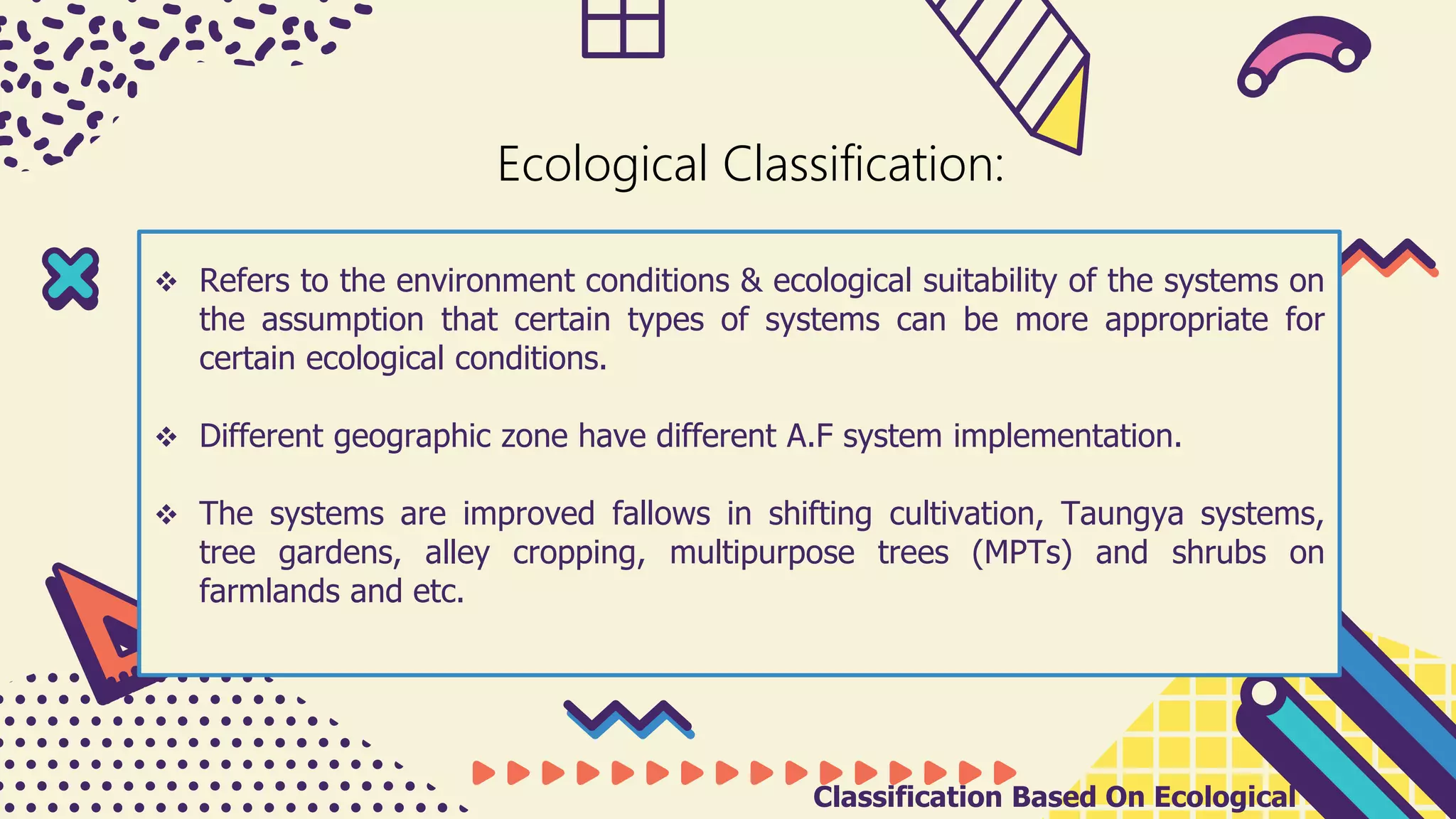
 Refers to the environment conditions & ecological suitability of the systems on
the assumption that certain types of systems can be more appropriate for
certain ecological conditions.
 Different geographic zone have different A.F system implementation.
 The systems are improved fallows in shifting cultivation, Taungya systems,
tree gardens, alley cropping, multipurpose trees (MPTs) and shrubs on
farmlands and etc.
Ecological Classification:
Classification Based On Ecological
A Framework for
Agroforestry Classification
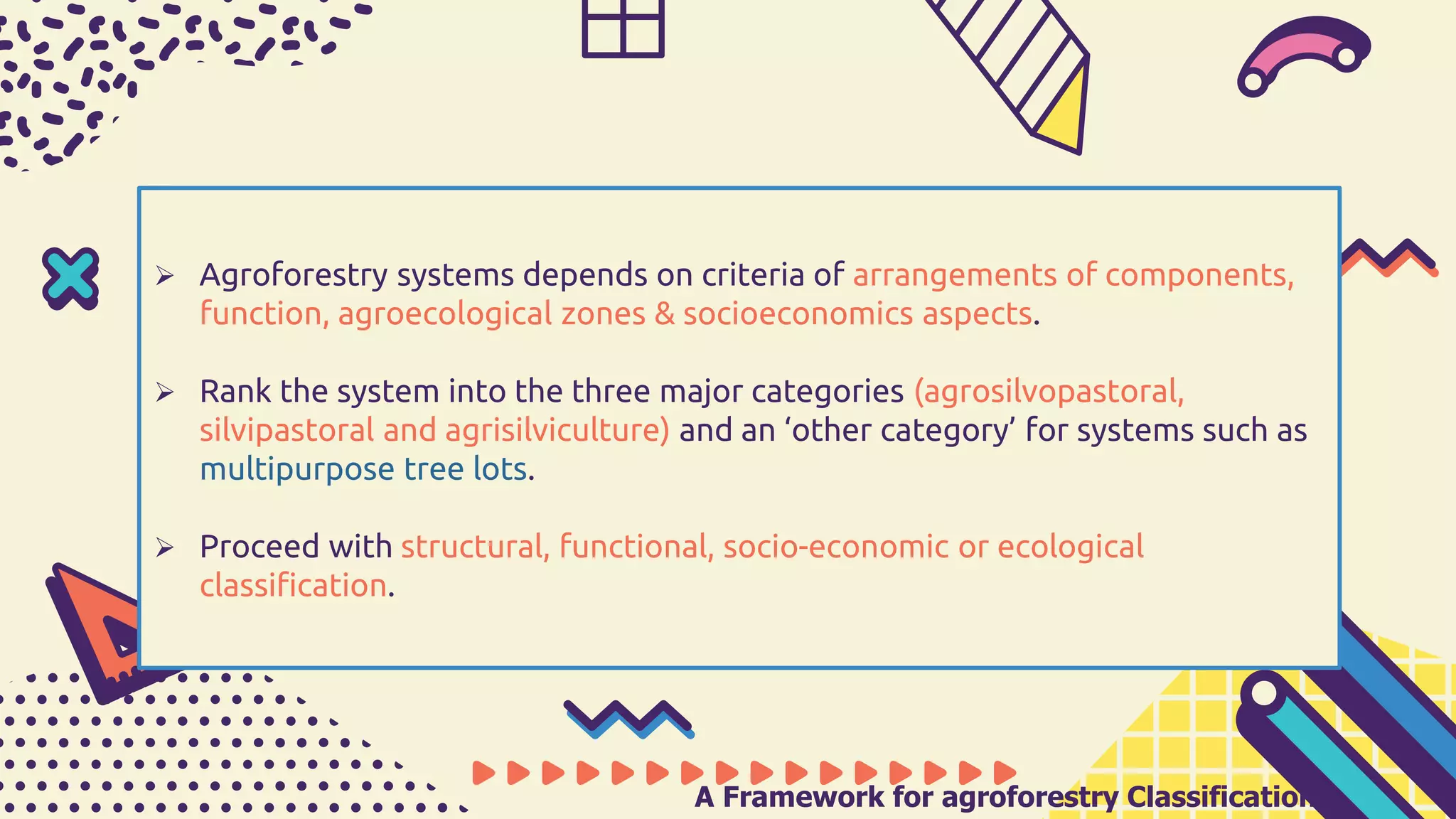
 Agroforestry systems depends on criteria of arrangements of components,
function, agroecological zones & socioeconomics aspects.
 Rank the system into the three major categories (agrosilvopastoral,
silvipastoral and agrisilviculture) and an ‘other category’ for systems such as
multipurpose tree lots.
 Proceed with structural, functional, socio-economic or ecological
classification.
A Framework for agroforestry Classification
CREDITS: This presentation template was created
by Slidesgo, including icons by Flaticon, and
infographics & images by Freepik
THANK YOU !

Definitions and Classification of Agroforestry Systems.pptx

  • 1.
  • 2.
    Agroforestry is theintentional planting or retention of trees on fields through spatial or temporal arrangements. Also a dynamic and ecologically -based natural resource management system A.F is sometimes described as a "new term for an old practice" “The word ‘agroforestry’ has its roots in the concepts of ‘agrisilviculture’ and ‘Agrosilviculture’ (King 1968). According to Ludgreen & Raintree (1982) agroforestry is ‘a collective name for land-use systems, practices or technologies, where the woody perennials are deliberately integrated with agricultural crops and/or animals in the same land management unit. It’s important to increase, diversify, and sustain production for increased social, economic, and environmental benefits. What is Agroforestry?
  • 3.
    Should also notbe confused ! With farm forestry, which refers to tree planting on farmers’ fields, mostly for the purpose of establishing woodlots. But, Agroforestry, which put the interactive association between woody perennials and crops or animals for diversification and sustainability of production and profits. Together with forest management, several viable alternatives to unsustainable management of natural resources that has been proposed for tropical forest ecosystems.
  • 4.
    Purpose Of Agroforestry? Productivity: sustained and increased crop production Efficiently & economically manage natural resources which are characterized by: Sustainability: conservation of ecological functions of environmental components Adoptability of the systems by users (landowners) Simplicity and robustness: facilitate adoption of new agroforestry technologies by poor farmers
  • 5.
    Livestock + woody perennial(trees) Crops + woody perennial (trees) Livestock + crops + woody perennial (trees) What qualifies as a definition of Agroforestry: The use of two or more species of animals or plants, and one of the latter is a woody perennial. Example :
  • 6.
    o Allowing bothecological and economic interactions between different components to occur that brings economic & ecological value. o The cycle of an agroforestry system should last at least one year. o The agroforestry system to be more complex, both ecologically (structurally and functionally) and economically, than traditional monocropping systems. What qualifies as a definition of Agroforestry
  • 7.
    Basic Concepts inAgroforestry A.F is based on the concept of associating trees with crops on the same piece of land simultaneously or sequentially.
  • 8.
    Classification Of AgroforestrySystems  The structural composition and arrangement of the different components.  The temporal sequence of introducing of different components into the system.  The function of woody perennials , either as windbreaks, a source of shade, or for soil conservation  The level of input in terms of the management, or the scale of management for commercial purposes  The environmental conditions and ecological suitability, based on the assumption that certain types of systems are more appropriate in certain areas than others for various environmental reasons According to Nair (1993), the criteria for the classifications are :
  • 9.
    1. Classification BasedOn Vegetation Structure  Trees/shrubs (present in all agroforestry systems)  Herbaceous crops/fodder plants  Animals  A standard/conventional Agroforestry system consist of many elements/components are as follows:
  • 10.
    Classification Based OnVegetation Structure  Beekeeping  Association of two woody perennials  Aquaculture with trees  Exceptions
  • 11.
    Based on structureof components/elements, A.F can be classified into 3 groups which are as follows : Agrosilvopastoral - consist of animals,pasture, crop and trees Agrisilviculture - includes crops & trees. Silvopastoral system - consist of pastures/animals & trees *Economic and ecological interactions between components of the system are a key element of agroforestry. Classification Based On Vegetation Structure
  • 12.
    SPATIAL ARRANGEMENT of componentsare as follows: a. Tree along border  crops bordered by trees b. Alternate rows  row of crop alternate with row of trees c. Alley cropping / alternate strips  2 rows or more of trees then alternate with 2 rows or more of crops d. Random mixture  tree and crops are planted randomly depending on which occupies the spaces first. Classification Based On Vegetation Structure  Spatial arrangement -the main idea is to optimize land occupation use.
  • 13.
    a. Sequential -different componentsare not present on the plot simultaneously on the plot, but follow each other or may overlap partially in time. EXAMPLE : Tree planting for improved fallow before the end of the agricultural cycle. b. Simultaneous -different components are present on the same plot at the same time EXAMPLE : Trees in a pasture, trees in association with perennial crops. c. Overlapping -crop cycles of woody & non-woody components partially overlap. Either one may be present first. EXAMPLE : multifunctional woodlot in which seasonal shade-tolerant crops are planted, or tree plantings for enhanced fallow before the crop's cycle ends TEMPORAL ARRANGEMENT of crops are as follows: Classification Based On Vegetation Structure
  • 14.
  • 15.
    Functions that areused to classify agroforestry systems include: A. Productive functions (Foods production) Example : Timber trees with banana and cocoa tree Classification Based On Function B. Protective functions (Shelterbeds)
  • 16.
    i. Timber ii. Food iii.Stimulants iv. Aromas v. Fats vi. Medicinal products Classification Based On Function Trees& woody perennialscontributionin agroforestryare: vii. Fodder viii. Weed control ix. Nitrogen Fixation x. Mulch xi. Shade xii. Carbon sequestration xiii. Erosion control. Introductionof animalsalsoprovidesbenefitssuchas: Weed control (Grazing) Food products (Meat, milk, fur, dung, eggs for bioenergy production)
  • 17.
    3. Classification Basedon Socio-economic Activities
  • 18.
    3 types ofA.F system which are :  The primary purpose of a commercial agroforestry system is the sale of harvested crops/produce  The production unit usually belongs to the state or private companies (large scales operation) Commercialsystem  Farmers (generally poor) has to produce their own food/ fulfill the needs of their household.  For example, food crop farms which is slash-and-burn practices  Labor is generally not hired but self sufficient  Any cultivation of cash crop such as palm, cocoa, rubber & etc Subsistencesystem  It is falls between commercial + subsistence  Long term tenure land owners  Cash crops are the main source of revenue Intermediatesystem Classification Based On Socio-economic Activities
  • 19.
  • 20.
     Refers tothe environment conditions & ecological suitability of the systems on the assumption that certain types of systems can be more appropriate for certain ecological conditions.  Different geographic zone have different A.F system implementation.  The systems are improved fallows in shifting cultivation, Taungya systems, tree gardens, alley cropping, multipurpose trees (MPTs) and shrubs on farmlands and etc. Ecological Classification: Classification Based On Ecological
  • 21.
  • 22.
     Agroforestry systemsdepends on criteria of arrangements of components, function, agroecological zones & socioeconomics aspects.  Rank the system into the three major categories (agrosilvopastoral, silvipastoral and agrisilviculture) and an ‘other category’ for systems such as multipurpose tree lots.  Proceed with structural, functional, socio-economic or ecological classification. A Framework for agroforestry Classification
  • 23.
    CREDITS: This presentationtemplate was created by Slidesgo, including icons by Flaticon, and infographics & images by Freepik THANK YOU !