Models and Theories of
Mental Health and
Addictive Disorders
Instructor: Dr. Dawn-Elise Snipes PhD, LPC-MHSP, LMHC
Executive Director: AllCEUs Counseling CEUs and Specialty Certificates
Podcast Host: Counselor Toolbox, Happiness Isn’t Brain Surgery
AllCEUs Unlimited CEUs $59 | Addiction Counselor Certificate Training $149 | Specialty Certificates $89 1
Objectives
 Explore why the mental health counselor needs to
understand addictive behaviors
 Learn the scientific and theoretical basis of
models of addiction and mental distress from
multiple disciplines
 Develop criteria for assessing models and theories
 Explore the appropriate application of models
 Learn how to access addiction and mental health
related literature from multiple disciplines
AllCEUs Unlimited CEUs $59 | Addiction Counselor Certificate Training $149 | Specialty Certificates $89 2
Why is this important to the Counselor
 Prevalence (proportion of cases in the population)
and incidence (number of new cases) of addiction is
increasing
 New understanding/awareness of behavioral addictions
 Improved knowledge of clinicians across disciplines to
diagnose
 Enables the clinician to provide more ethical and
comprehensive treatment to the client by
understanding
 The influence of drugs and certain behaviors on brain
chemistry which could
 Lead to the development of problems
 Negatively impact MH treatment progress
AllCEUs Unlimited CEUs $59 | Addiction Counselor Certificate Training $149 | Specialty Certificates $89 3
Why is this important to the Counselor
 Less than 30% of people who try to stop an
addiction succeed for more than 30 days
 Patients often interpret a systemic failure as a
personal failure
 They take get discouraged and feel helpless, hopeless
and like it is their fault that treatment failed
(compounding depression), instead of considering that
individualized treatment is part science and part art.
AllCEUs Unlimited CEUs $59 | Addiction Counselor Certificate Training $149 | Specialty Certificates $89 4
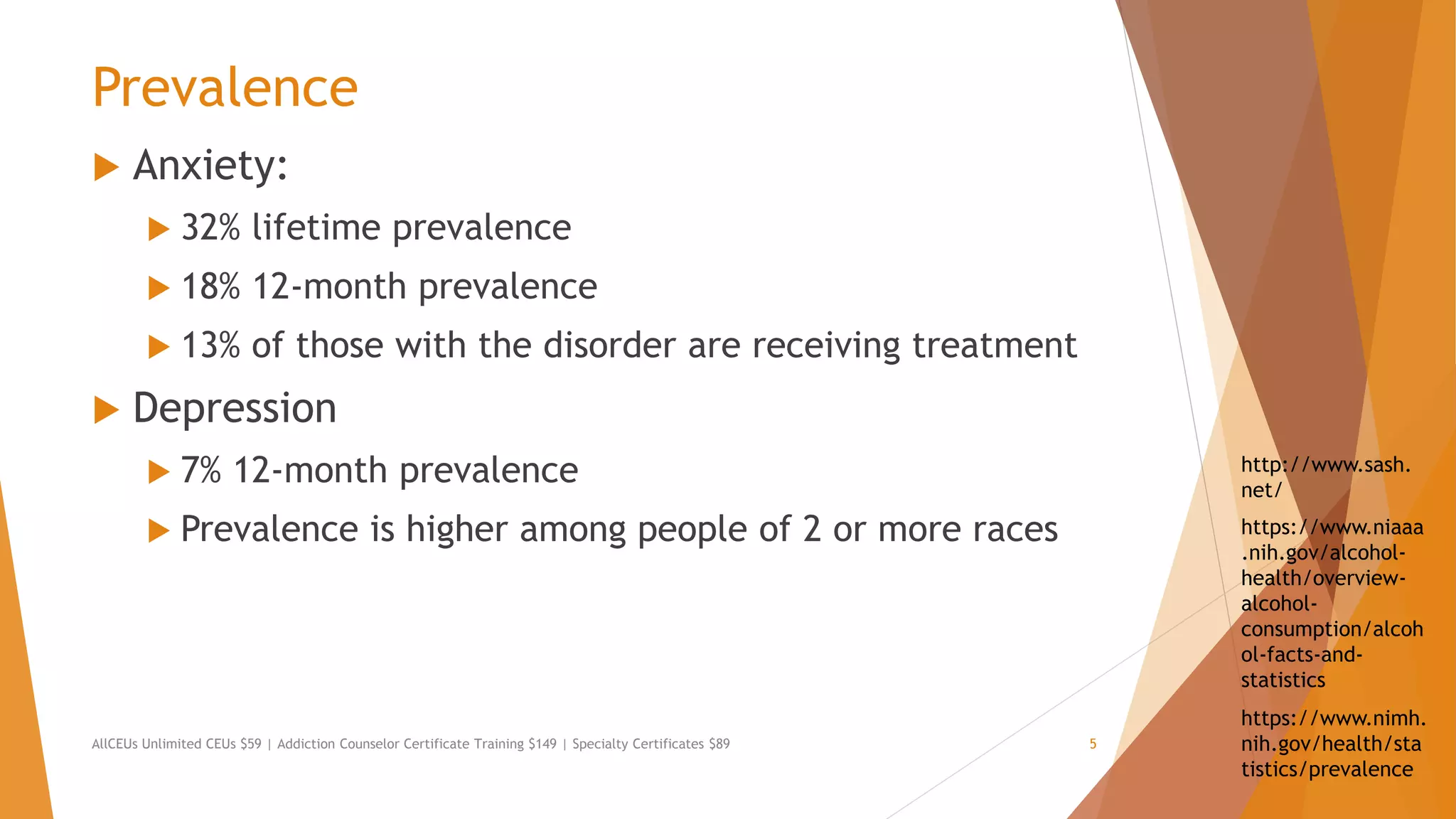
Prevalence
 Anxiety:
 32% lifetime prevalence
 18% 12-month prevalence
 13% of those with the disorder are receiving treatment
 Depression
 7% 12-month prevalence
 Prevalence is higher among people of 2 or more races
AllCEUs Unlimited CEUs $59 | Addiction Counselor Certificate Training $149 | Specialty Certificates $89 5
https://www.nimh.
nih.gov/health/sta
tistics/prevalence
https://www.niaaa
.nih.gov/alcohol-
health/overview-
alcohol-
consumption/alcoh
ol-facts-and-
statistics
http://www.sash.
net/
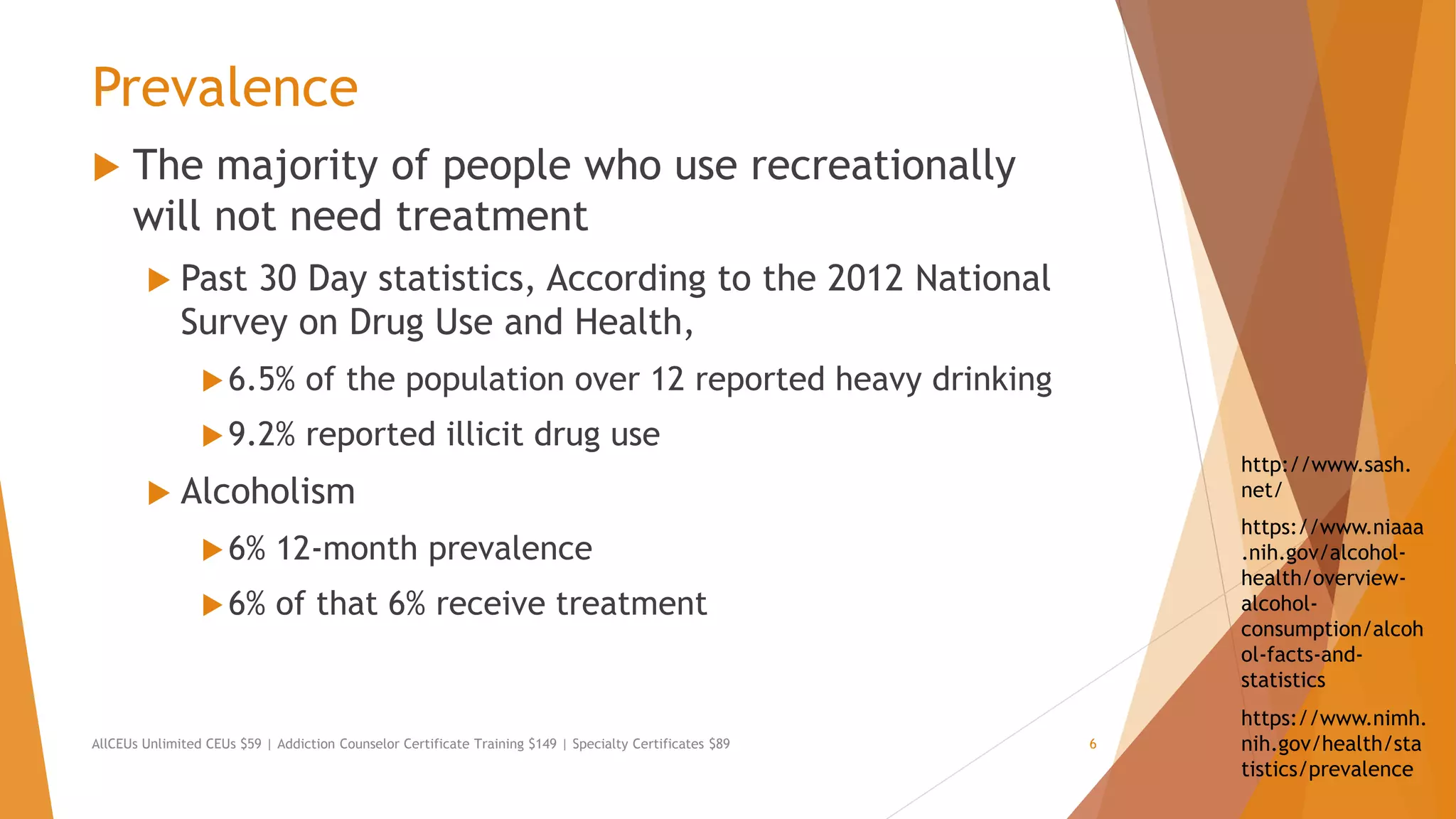
Prevalence
 The majority of people who use recreationally
will not need treatment
 Past 30 Day statistics, According to the 2012 National
Survey on Drug Use and Health,
6.5% of the population over 12 reported heavy drinking
9.2% reported illicit drug use
 Alcoholism
6% 12-month prevalence
6% of that 6% receive treatment
AllCEUs Unlimited CEUs $59 | Addiction Counselor Certificate Training $149 | Specialty Certificates $89 6
https://www.nimh.
nih.gov/health/sta
tistics/prevalence
https://www.niaaa
.nih.gov/alcohol-
health/overview-
alcohol-
consumption/alcoh
ol-facts-and-
statistics
http://www.sash.
net/
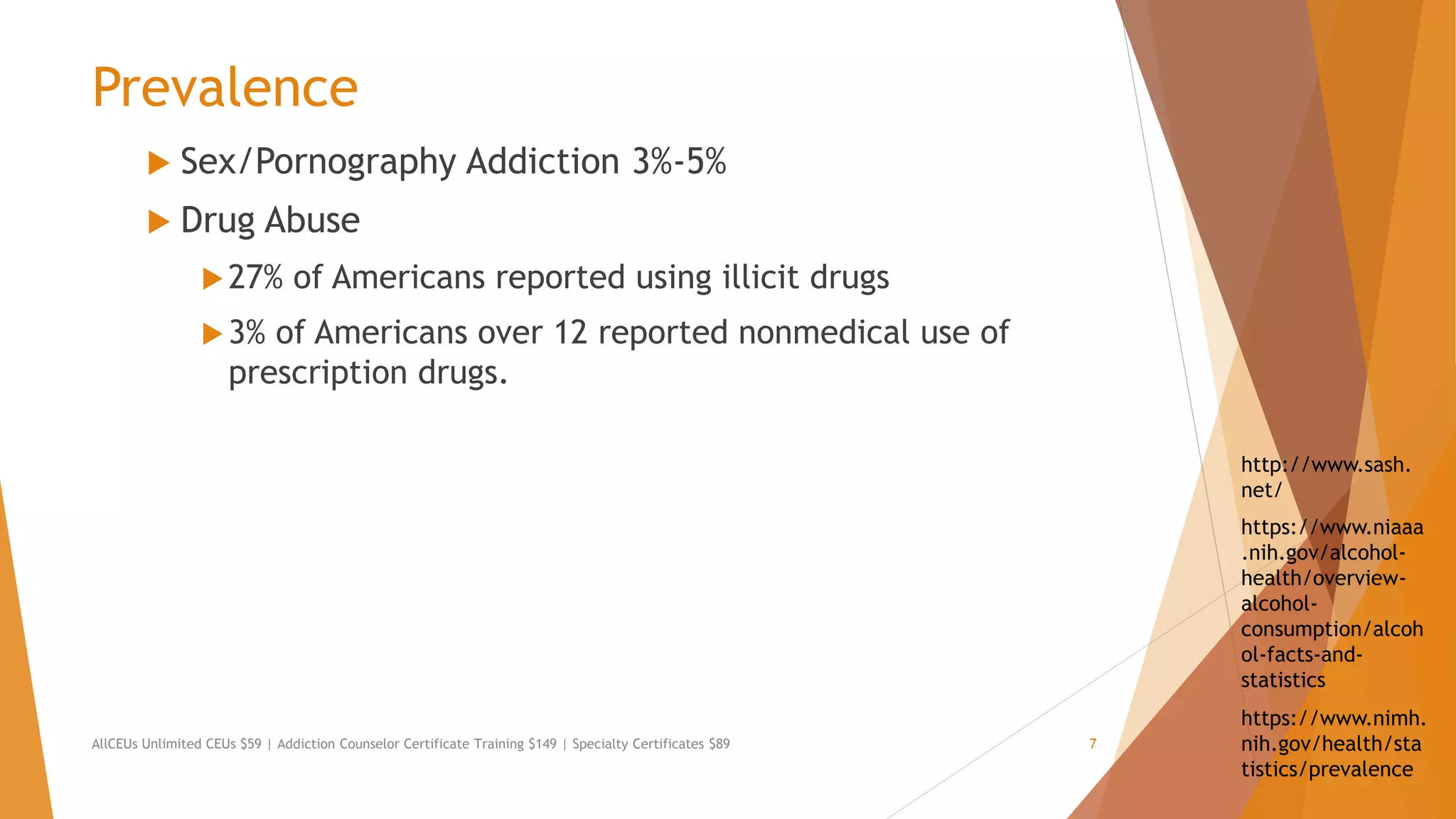
Prevalence
 Sex/Pornography Addiction 3%-5%
 Drug Abuse
27% of Americans reported using illicit drugs
3% of Americans over 12 reported nonmedical use of
prescription drugs.
AllCEUs Unlimited CEUs $59 | Addiction Counselor Certificate Training $149 | Specialty Certificates $89 7
https://www.nimh.
nih.gov/health/sta
tistics/prevalence
https://www.niaaa
.nih.gov/alcohol-
health/overview-
alcohol-
consumption/alcoh
ol-facts-and-
statistics
http://www.sash.
net/
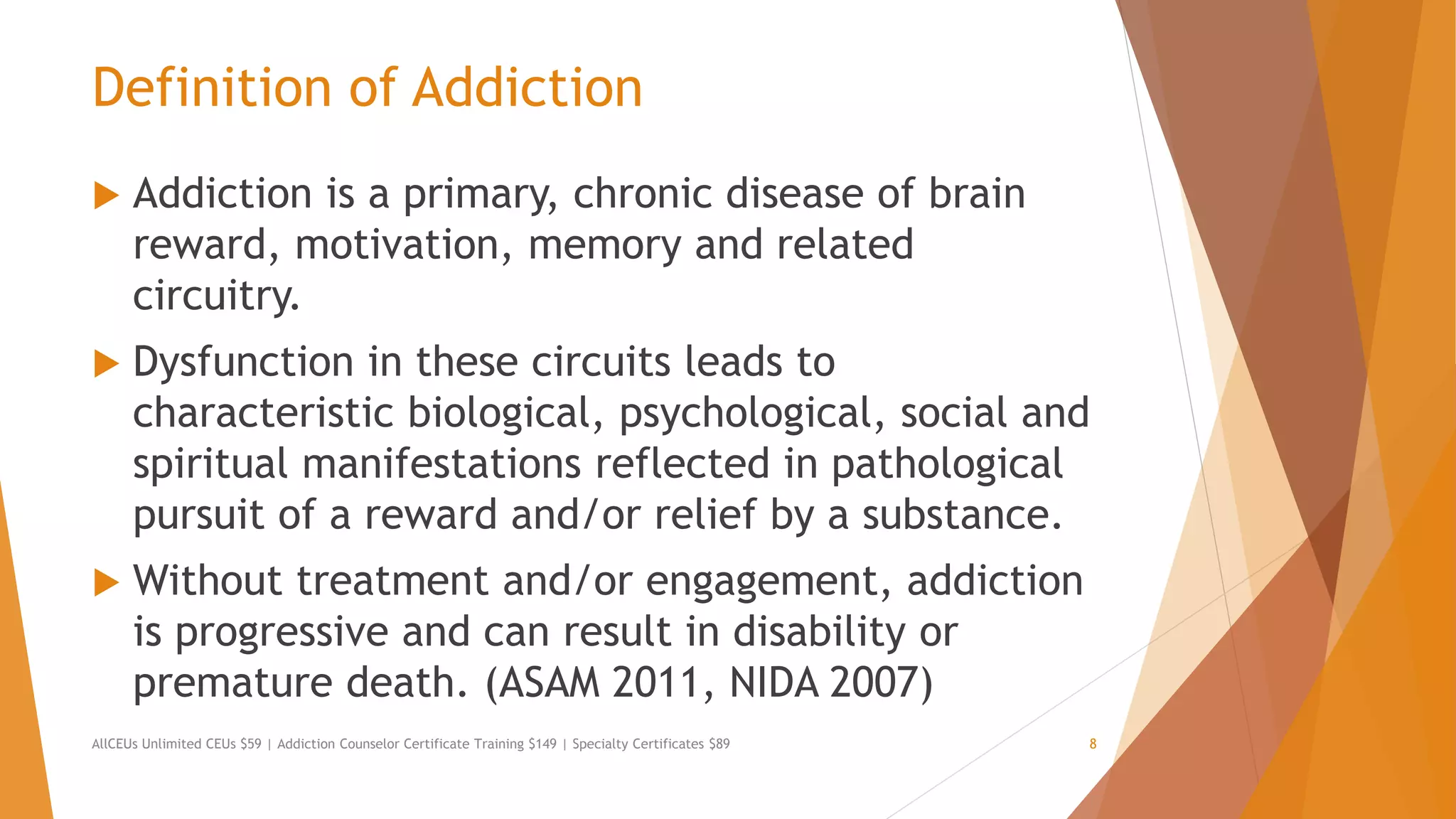
Definition of Addiction
 Addiction is a primary, chronic disease of brain
reward, motivation, memory and related
circuitry.
 Dysfunction in these circuits leads to
characteristic biological, psychological, social and
spiritual manifestations reflected in pathological
pursuit of a reward and/or relief by a substance.
 Without treatment and/or engagement, addiction
is progressive and can result in disability or
premature death. (ASAM 2011, NIDA 2007)
AllCEUs Unlimited CEUs $59 | Addiction Counselor Certificate Training $149 | Specialty Certificates $89 8
Addiction—A description, not a Diagnosis
 Addiction is a description, not a diagnostic term.
 Addiction erodes a person’s self-control and
ability to make sound decisions
 The DSM V has 2 diagnostic categories
 Substance abuse
 Substance dependence (The medical definition of
addiction)
Dependence is always characterized by dependence and
withdrawal
AllCEUs Unlimited CEUs $59 | Addiction Counselor Certificate Training $149 | Specialty Certificates $89 9
Addiction Description
 Cravings and compulsive behavior are caused in
large part as a consequence of substance use or
addictive behaviors on the brain causing
 Emotional
 Cognitive
 Physical
 Behavioral changes
AllCEUs Unlimited CEUs $59 | Addiction Counselor Certificate Training $149 | Specialty Certificates $89 10
Characteristics of Chronic Disease
 Disrupts normal functioning
 Have serious, harmful consequences
 Are preventable and treatable
 Can last a lifetime
 May be fatal if untreated
AllCEUs Unlimited CEUs $59 | Addiction Counselor Certificate Training $149 | Specialty Certificates $89 11
Criteria for Assessing Models and Theories
 Does it explain the development of the condition in
some people and not others (Predictive validity and
reliability)?
 Does it clearly define benchmarks for recovery?
 Can this explanation be applied across people and
situations (Generalizability)?
 Can it be used to develop effective prevention and
intervention strategies?
 Does it explain the use of seemingly destructive
behaviors
 Are there other unaccounted for factors which may
influence development or recovery?
AllCEUs Unlimited CEUs $59 | Addiction Counselor Certificate Training $149 | Specialty Certificates $89 12
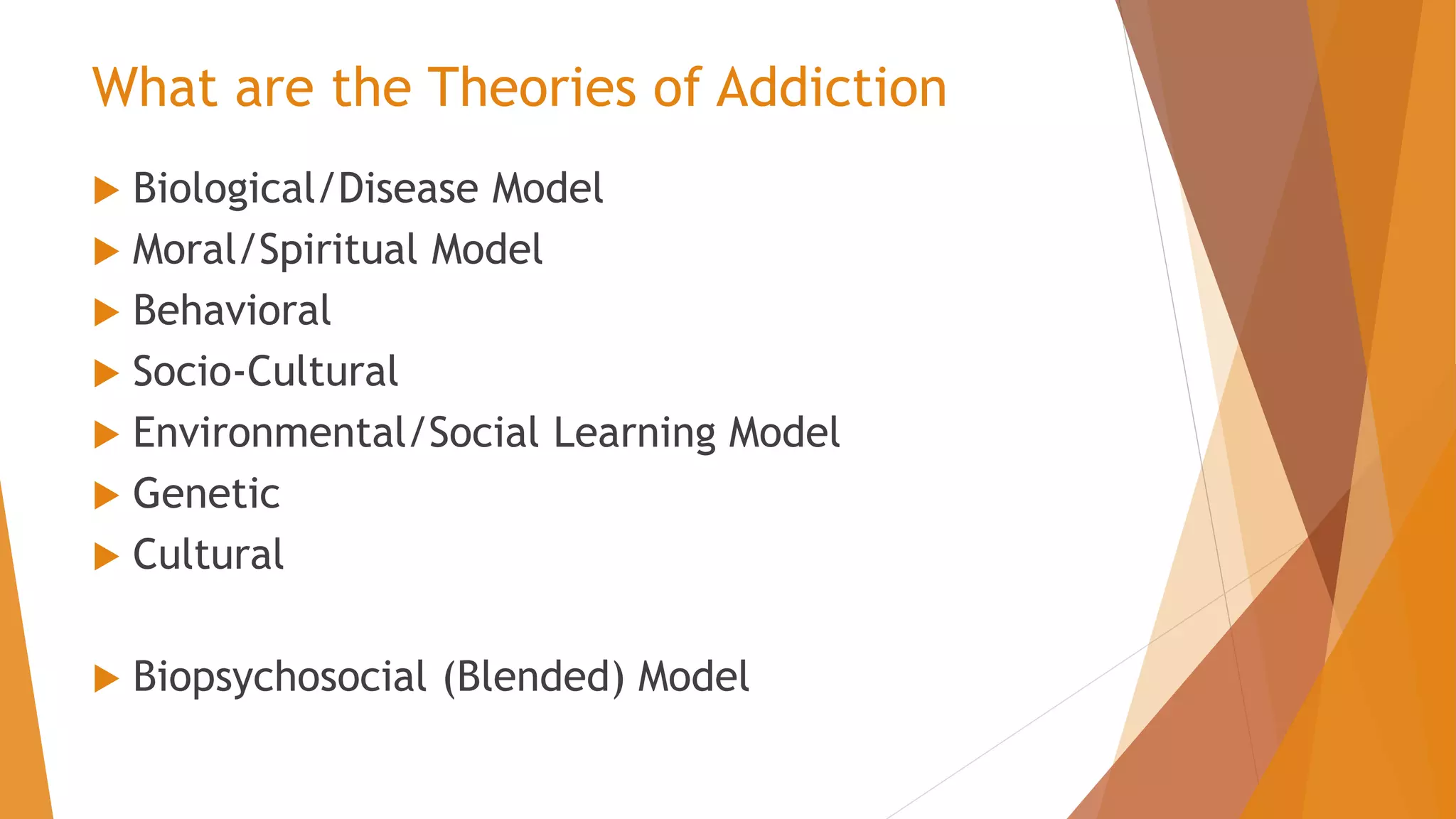
 Biological/Disease Model
 Moral/Spiritual Model
 Behavioral
 Socio-Cultural
 Environmental/Social Learning Model
 Genetic
 Cultural
 Biopsychosocial (Blended) Model
What are the Theories of Addiction
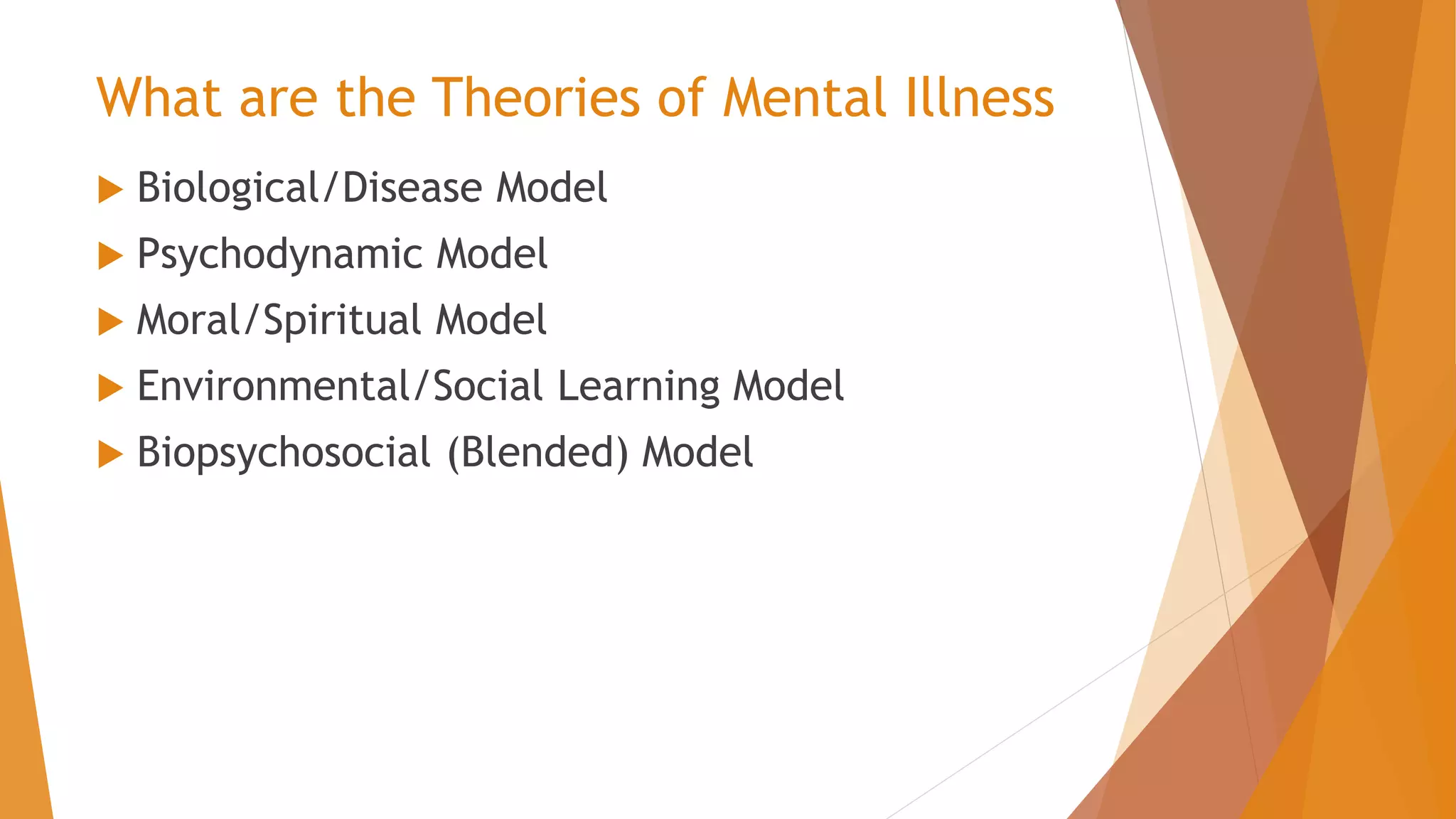
 Biological/Disease Model
 Psychodynamic Model
 Moral/Spiritual Model
 Environmental/Social Learning Model
 Biopsychosocial (Blended) Model
What are the Theories of Mental Illness
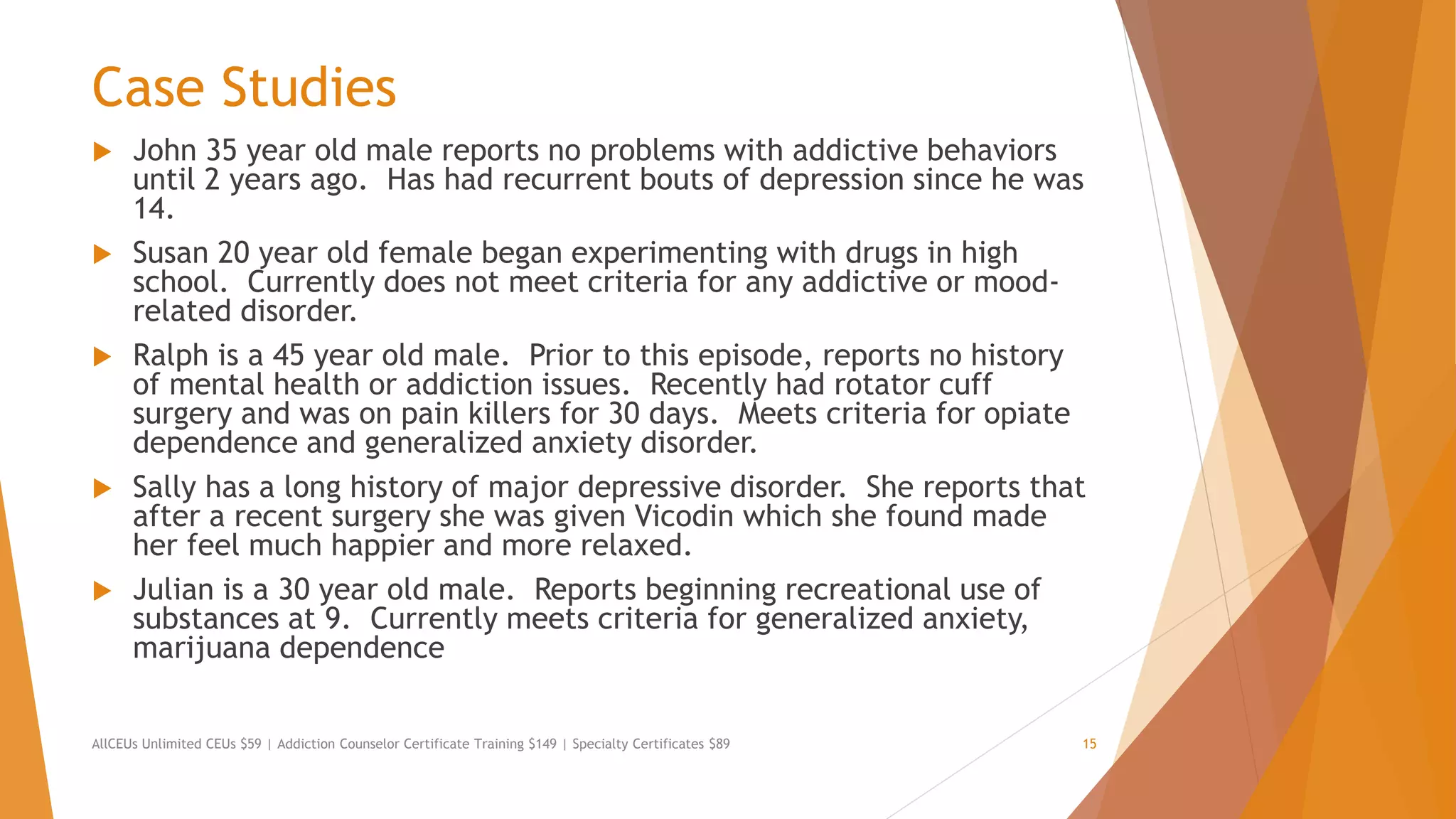
Case Studies
 John 35 year old male reports no problems with addictive behaviors
until 2 years ago. Has had recurrent bouts of depression since he was
14.
 Susan 20 year old female began experimenting with drugs in high
school. Currently does not meet criteria for any addictive or mood-
related disorder.
 Ralph is a 45 year old male. Prior to this episode, reports no history
of mental health or addiction issues. Recently had rotator cuff
surgery and was on pain killers for 30 days. Meets criteria for opiate
dependence and generalized anxiety disorder.
 Sally has a long history of major depressive disorder. She reports that
after a recent surgery she was given Vicodin which she found made
her feel much happier and more relaxed.
 Julian is a 30 year old male. Reports beginning recreational use of
substances at 9. Currently meets criteria for generalized anxiety,
marijuana dependence
AllCEUs Unlimited CEUs $59 | Addiction Counselor Certificate Training $149 | Specialty Certificates $89 15
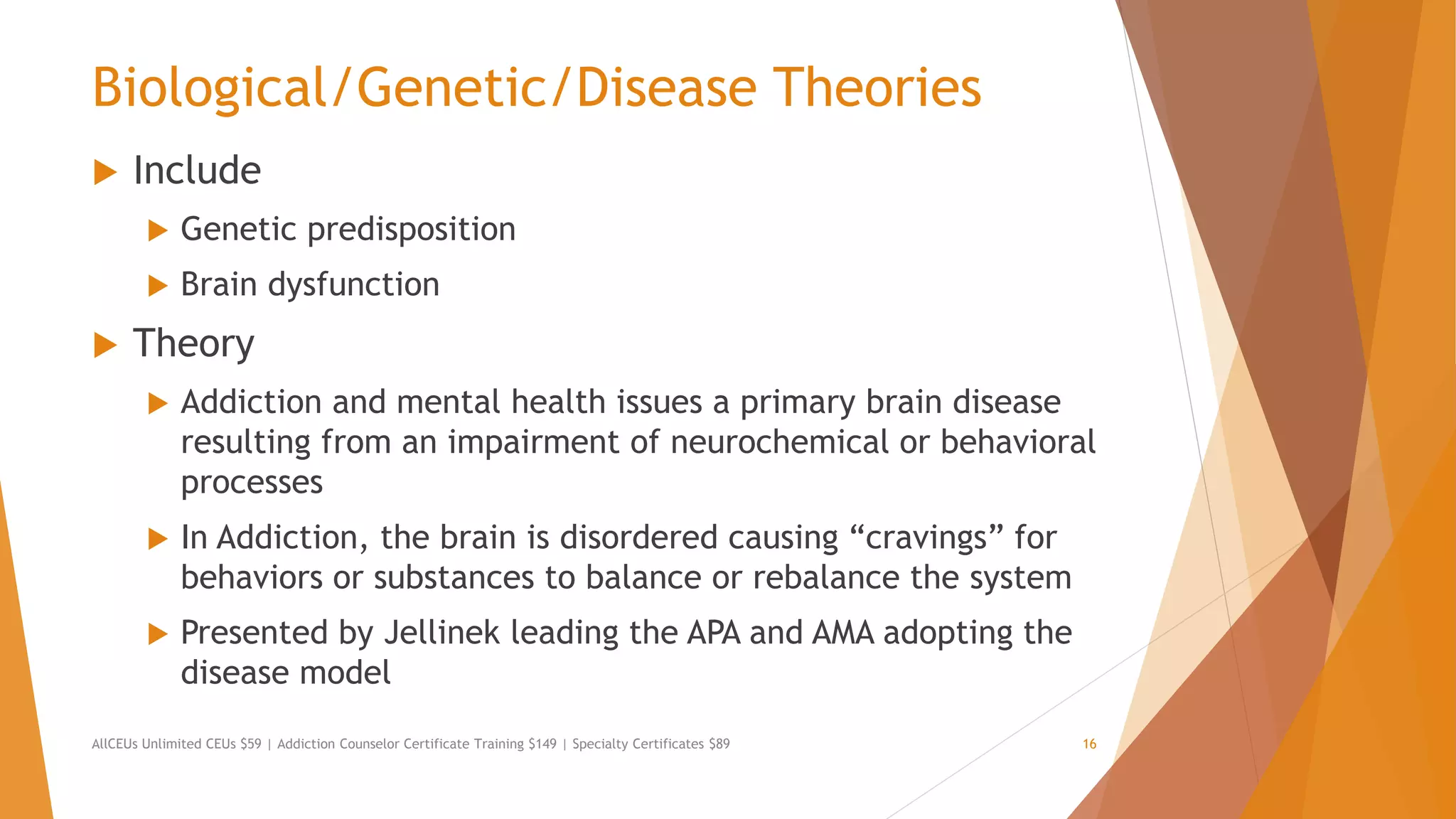
Biological/Genetic/Disease Theories
 Include
 Genetic predisposition
 Brain dysfunction
 Theory
 Addiction and mental health issues a primary brain disease
resulting from an impairment of neurochemical or behavioral
processes
 In Addiction, the brain is disordered causing “cravings” for
behaviors or substances to balance or rebalance the system
 Presented by Jellinek leading the APA and AMA adopting the
disease model
AllCEUs Unlimited CEUs $59 | Addiction Counselor Certificate Training $149 | Specialty Certificates $89 16
Biological/Genetic/Disease Theories
 Evidence
 The midbrain dopamine pathway in motivation and
reward processes
 The prefrontal cortex is implicated in regulation of
behavior
There are differences between people with addictions
and non-people with addictions in activity in that
structure.
 Intergenerational, twin and adoption studies have
shown some correlation with trends in type and
frequency
Question: What else might cause mental health or
addictive issues intergenerationally besides genes?
AllCEUs Unlimited CEUs $59 | Addiction Counselor Certificate Training $149 | Specialty Certificates $89
17
 Adoption studies have shown that children from
addicted parents are more likely to develop
addictions, even if adopted.
 Twin studies have shown that in identical twins, if
one develops an addiction, there is a greater
concordance toward addiction than fraternal
http://pubs.niaaa.nih.gov/publications/aa18.htm
Biological/Genetic/Disease Theories
 Addiction is a disease with symptoms and is
incurable, progressive and, if left untreated,
fatal.
 Strengths
 As a disease it provides hope of being treatable
 Removes societal stigma
 Relieves feelings of guilt and shame
AllCEUs Unlimited CEUs $59 | Addiction Counselor Certificate Training $149 | Specialty Certificates $89 19
Biological/Genetic/Disease Theories
 Limitations
 Removes much of the responsibility from the individual
 May provide “excuses” for relapse or avoid treatment
 Assumes recovery upon achievement of abstinence
 Fails to account for
 Social/environmental influences
 Higher-order cognitive processes
 Most of the research for this theory has been done in non-
human species.
 No consistently useful interventions have emerged from
this theory, with the exception of certain nicotine
replacement drugs
AllCEUs Unlimited CEUs $59 | Addiction Counselor Certificate Training $149 | Specialty Certificates $89
20
Biological/Genetic/Disease Theories
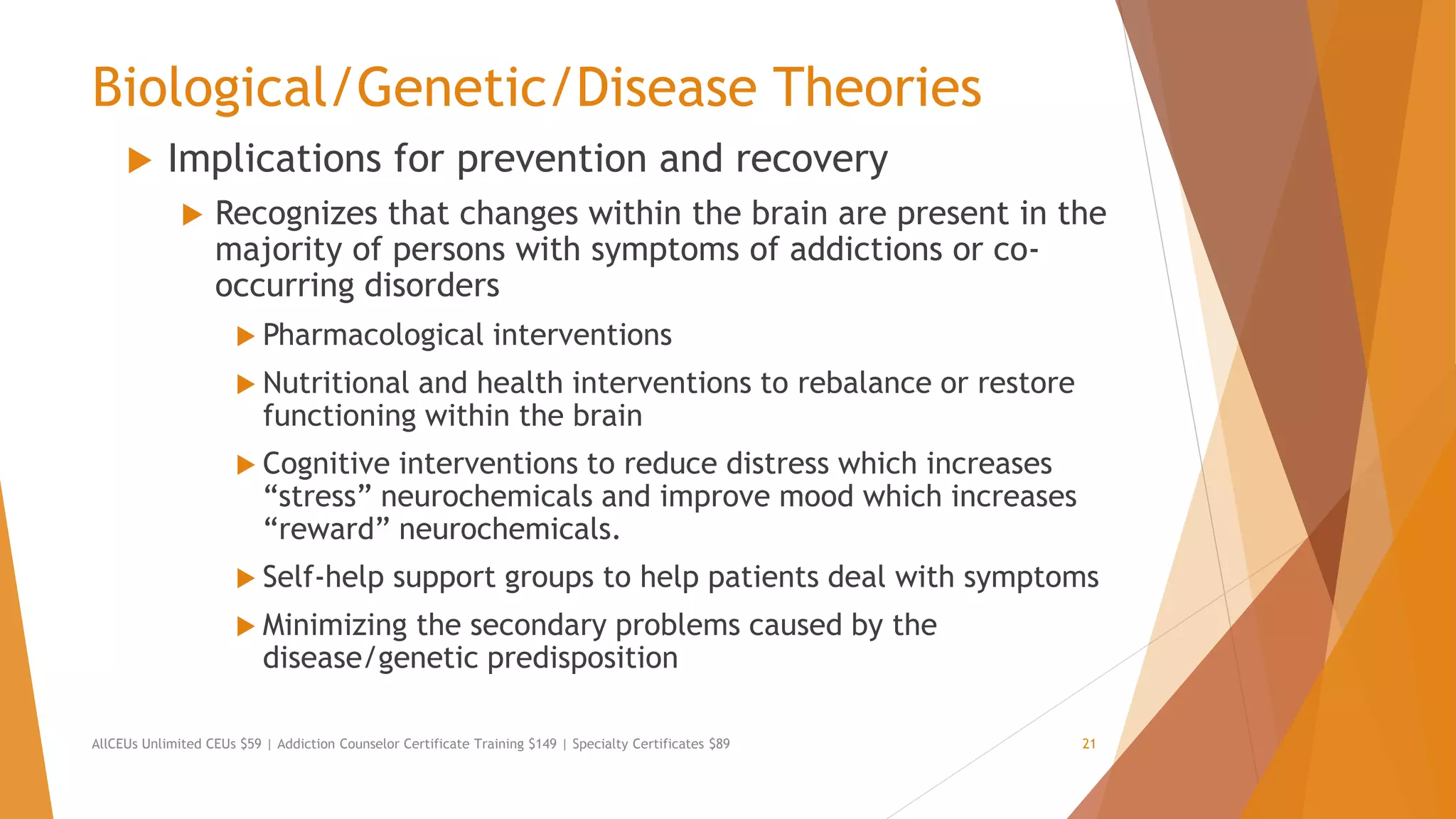
 Implications for prevention and recovery
 Recognizes that changes within the brain are present in the
majority of persons with symptoms of addictions or co-
occurring disorders
 Pharmacological interventions
 Nutritional and health interventions to rebalance or restore
functioning within the brain
 Cognitive interventions to reduce distress which increases
“stress” neurochemicals and improve mood which increases
“reward” neurochemicals.
 Self-help support groups to help patients deal with symptoms
 Minimizing the secondary problems caused by the
disease/genetic predisposition
AllCEUs Unlimited CEUs $59 | Addiction Counselor Certificate Training $149 | Specialty Certificates $89 21
Biological/Genetic/Disease Theories
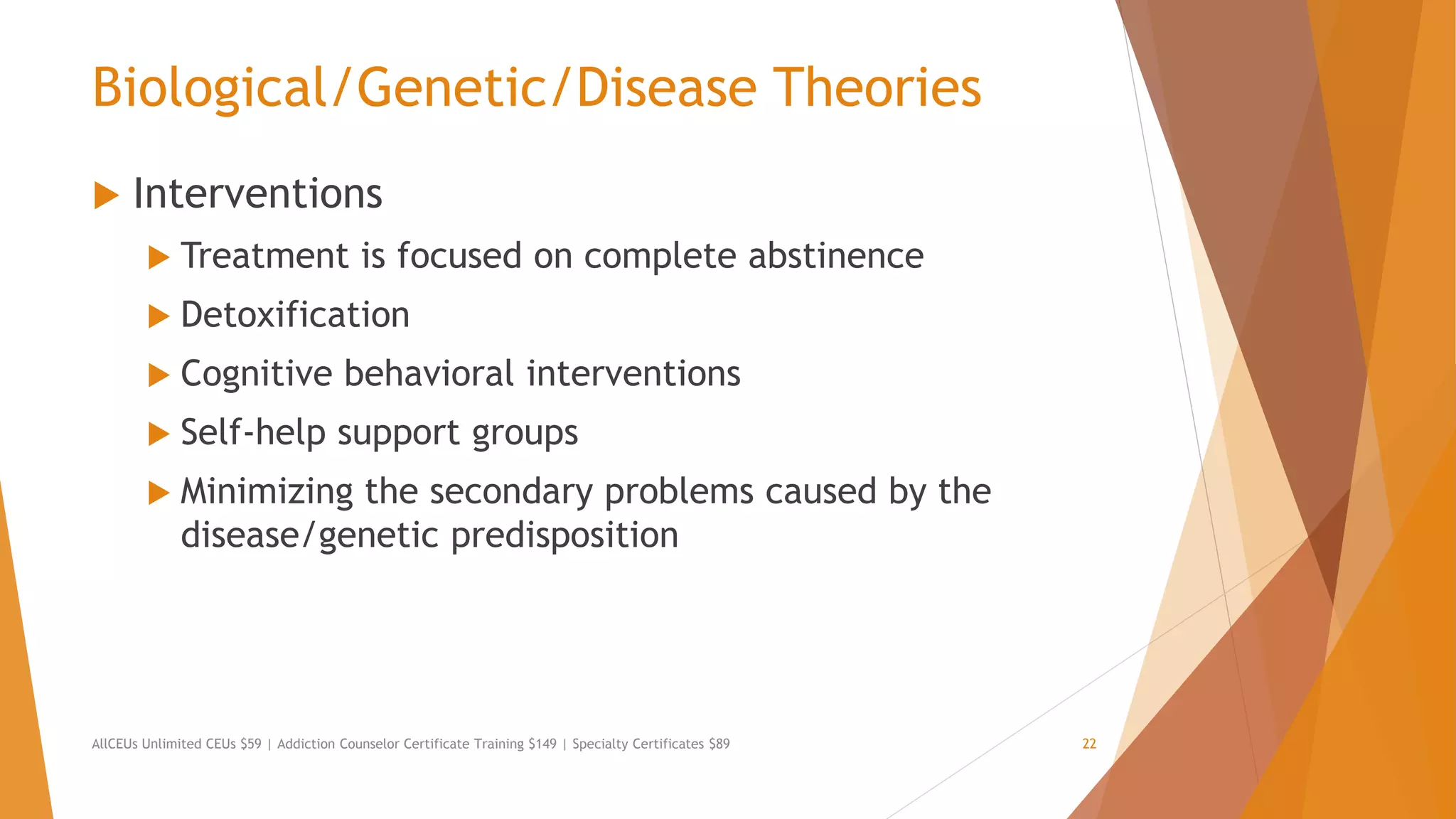
 Interventions
 Treatment is focused on complete abstinence
 Detoxification
 Cognitive behavioral interventions
 Self-help support groups
 Minimizing the secondary problems caused by the
disease/genetic predisposition
AllCEUs Unlimited CEUs $59 | Addiction Counselor Certificate Training $149 | Specialty Certificates $89 22
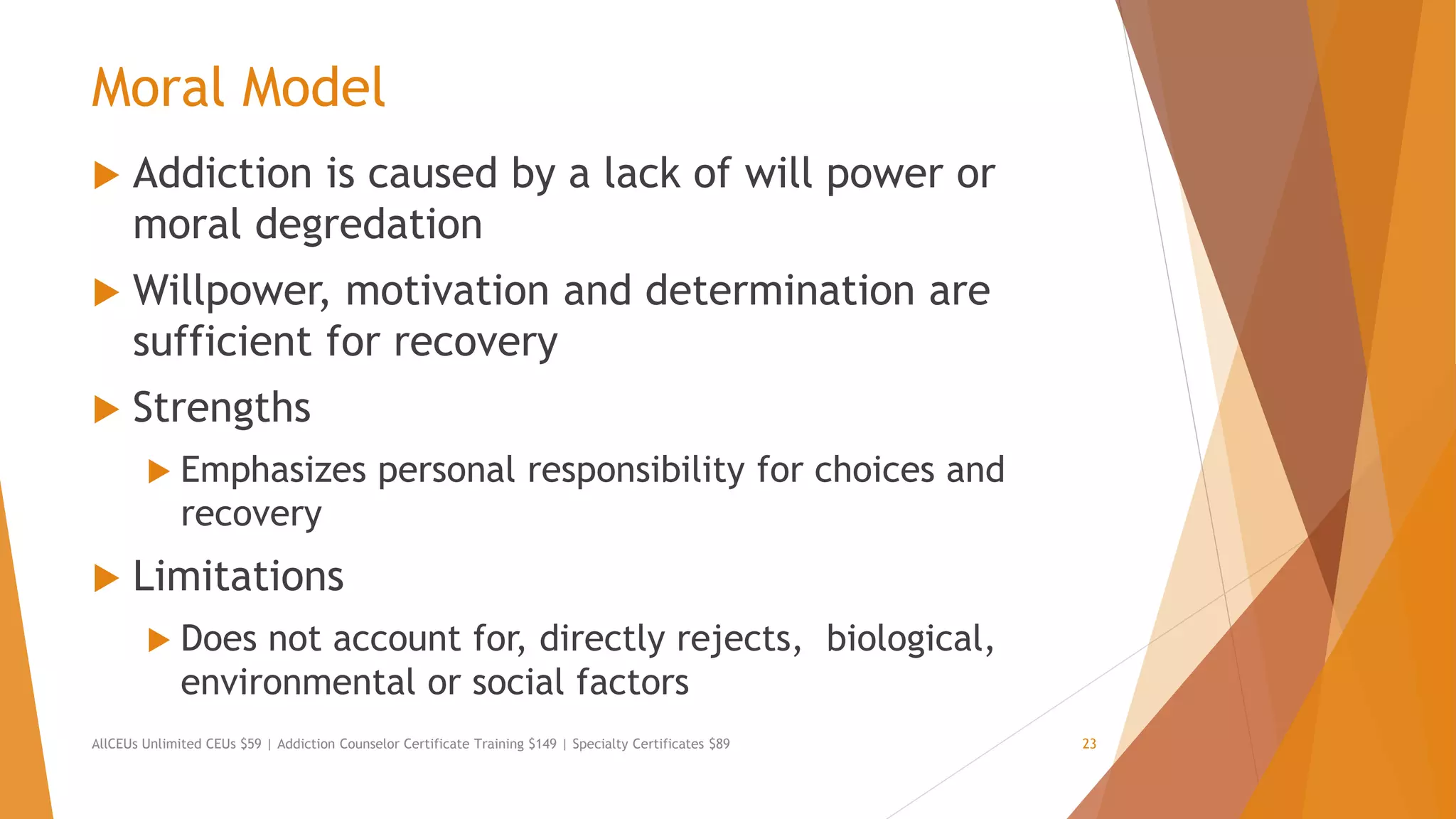
Moral Model
 Addiction is caused by a lack of will power or
moral degredation
 Willpower, motivation and determination are
sufficient for recovery
 Strengths
 Emphasizes personal responsibility for choices and
recovery
 Limitations
 Does not account for, directly rejects, biological,
environmental or social factors
AllCEUs Unlimited CEUs $59 | Addiction Counselor Certificate Training $149 | Specialty Certificates $89 23
Moral Model
 Treatment Implications
 Values clarification
 Cognitive therapy
AllCEUs Unlimited CEUs $59 | Addiction Counselor Certificate Training $149 | Specialty Certificates $89 24
Behavioral Theory
 Theory
 Addictions are learned
Through direct experience
Social learning
 Influenced by
Biology
Cognitions
Past learning
Situational antecedents
Reinforcement contingencies
AllCEUs Unlimited CEUs $59 | Addiction Counselor Certificate Training $149 | Specialty Certificates $89 25
Behavioral Theory
 Strengths
 Behaviors are easily observed
 Increases awareness of “triggers” or antecedents for
behaviors
 Treatment goals are easily defined for changing the behavior
by modifying the triggers and consequences of behavior.
 Limitations
 May not encourage the involvement of the family and larger
social system
 Pressures (reinforcement contingencies) implemented by the
family to maintain current behaviors are not directly
addressed
AllCEUs Unlimited CEUs $59 | Addiction Counselor Certificate Training $149 | Specialty Certificates $89 26
Behavioral Theory
 Treatment and Prevention Implications
 Rewards encouraged are nondestructive, but often fail
to have the reinforcement strength of the addictive
behavior.
 Enhance triggers for alternate behaviors
 Identify and reduce reinforcing properties of undesired
behaviors
AllCEUs Unlimited CEUs $59 | Addiction Counselor Certificate Training $149 | Specialty Certificates $89 27
Socio-Cultural Theories
 Theory
 Environmental and social pressures contribute to the
development including unemployment, single
parenting, poverty and the attitudes of family, peers
and society.
 Strengths
 Views issues within the context of the larger
environment
 Acknowledges the impact of social pressures in the
development of mental health and addictive issues
AllCEUs Unlimited CEUs $59 | Addiction Counselor Certificate Training $149 | Specialty Certificates $89 28
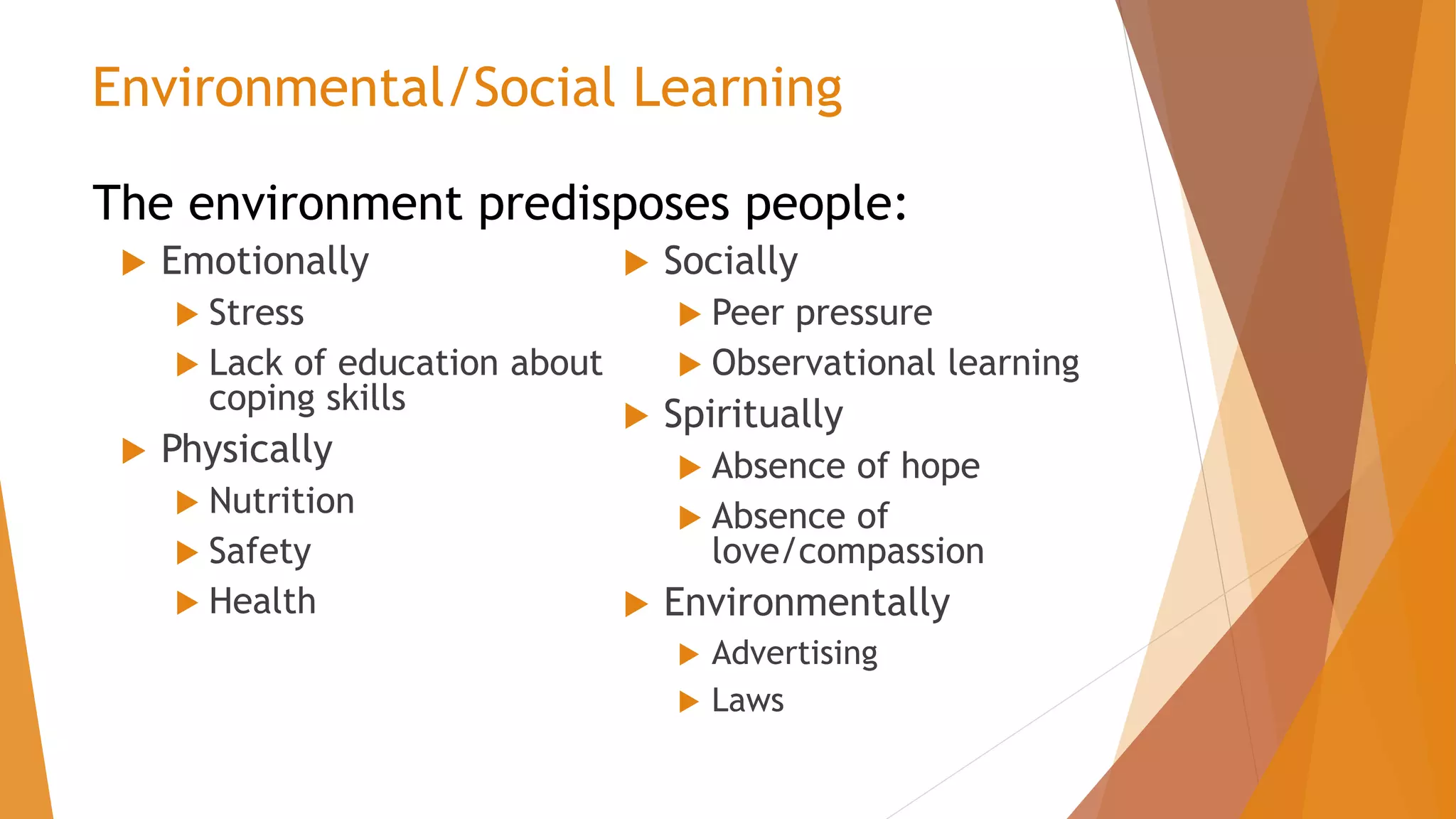
 Emotionally
 Stress
 Lack of education about
coping skills
 Physically
 Nutrition
 Safety
 Health
 Socially
 Peer pressure
 Observational learning
 Spiritually
 Absence of hope
 Absence of
love/compassion
 Environmentally
 Advertising
 Laws
Environmental/Social Learning
The environment predisposes people:
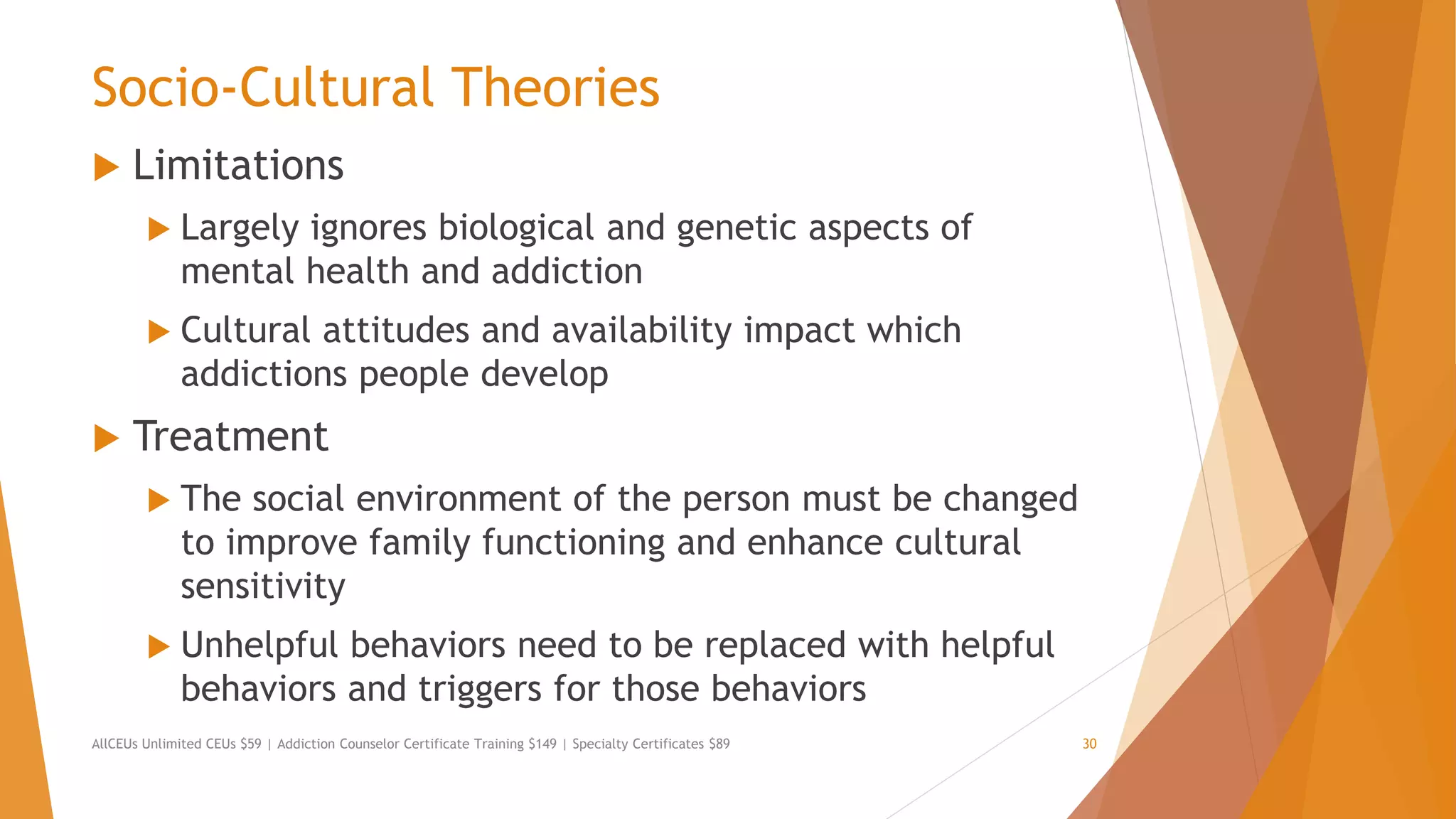
Socio-Cultural Theories
 Limitations
 Largely ignores biological and genetic aspects of
mental health and addiction
 Cultural attitudes and availability impact which
addictions people develop
 Treatment
 The social environment of the person must be changed
to improve family functioning and enhance cultural
sensitivity
 Unhelpful behaviors need to be replaced with helpful
behaviors and triggers for those behaviors
AllCEUs Unlimited CEUs $59 | Addiction Counselor Certificate Training $149 | Specialty Certificates $89 30
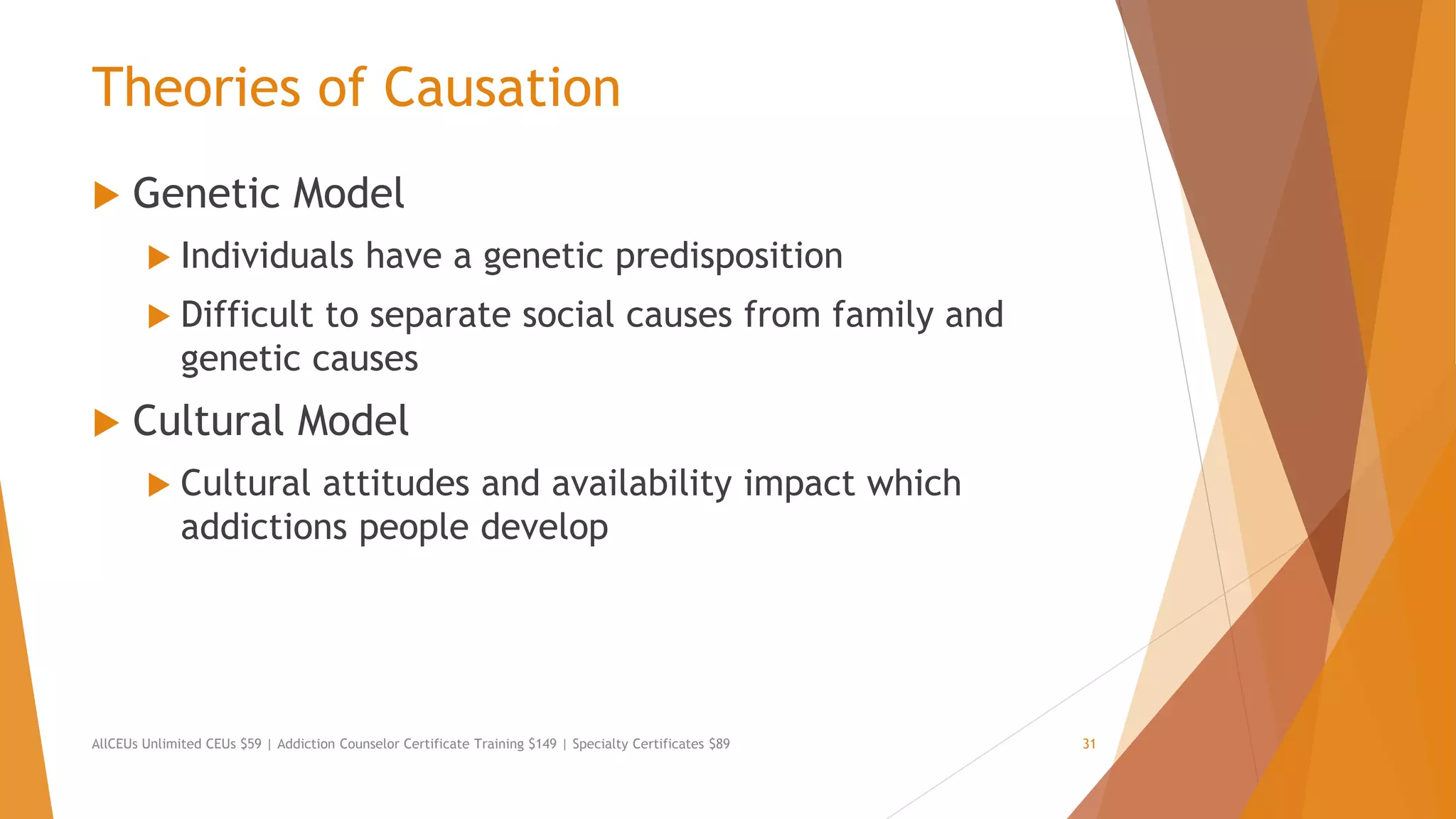
Theories of Causation
 Genetic Model
 Individuals have a genetic predisposition
 Difficult to separate social causes from family and
genetic causes
 Cultural Model
 Cultural attitudes and availability impact which
addictions people develop
AllCEUs Unlimited CEUs $59 | Addiction Counselor Certificate Training $149 | Specialty Certificates $89 31
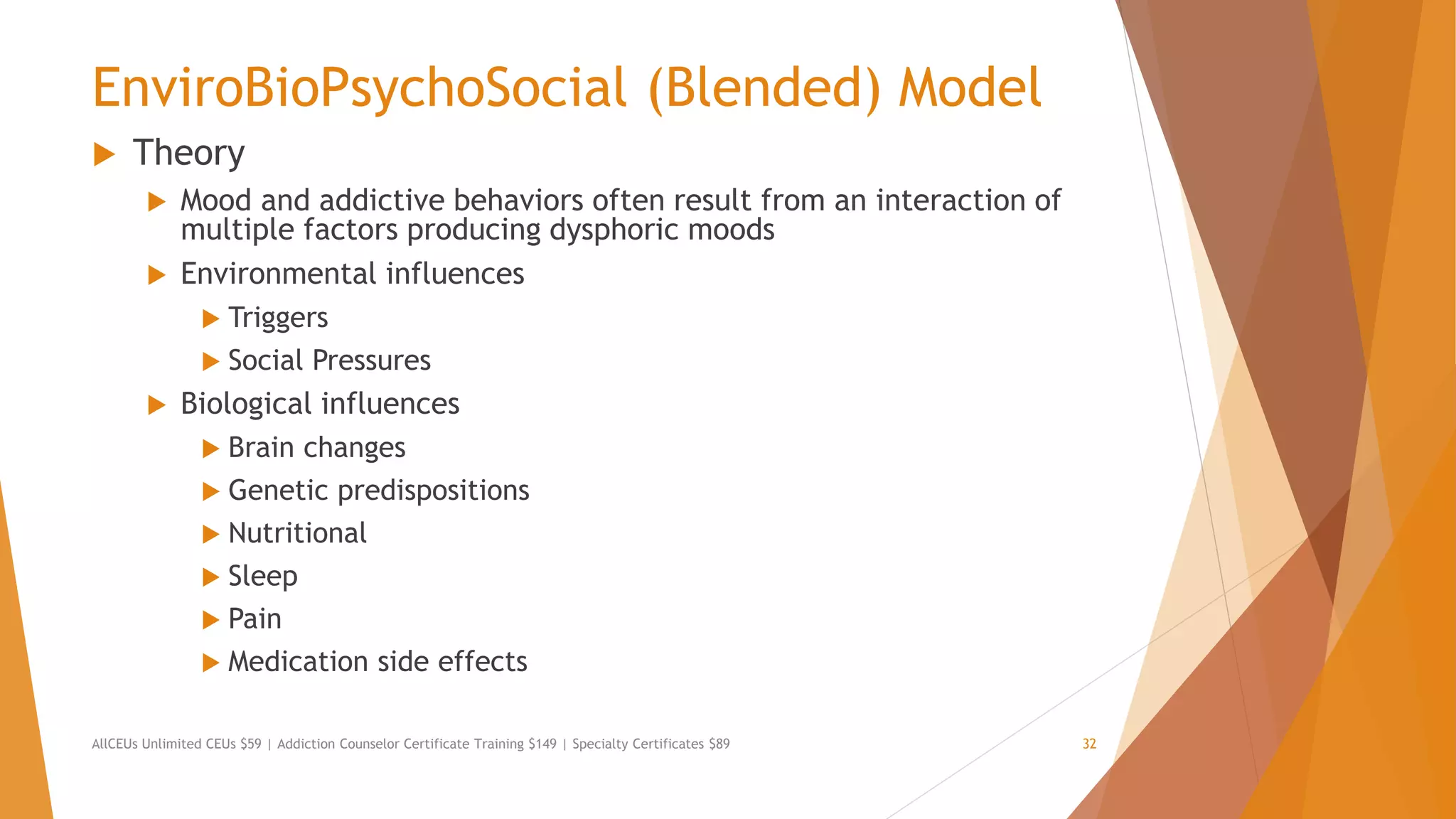
EnviroBioPsychoSocial (Blended) Model
 Theory
 Mood and addictive behaviors often result from an interaction of
multiple factors producing dysphoric moods
 Environmental influences
 Triggers
 Social Pressures
 Biological influences
 Brain changes
 Genetic predispositions
 Nutritional
 Sleep
 Pain
 Medication side effects
AllCEUs Unlimited CEUs $59 | Addiction Counselor Certificate Training $149 | Specialty Certificates $89 32
EnviroBioPsychoSocial Model
 Theory
 Psychological influences
 Addictive behavior produces positive feeling states and/or
numbing in response to dysphoric states.
 Lack of effective coping skills
 Motivation for escape/homeostasis
 Social
 Social learning/modeling from peers, family, culture attitudes
and behaviors
 Environmental Influences
 Availability
 Triggers
AllCEUs Unlimited CEUs $59 | Addiction Counselor Certificate Training $149 | Specialty Certificates $89 33
Theories of Causation
 Blended Model
 Addiction develops in each individual as a result of a
unique set of factors
AllCEUs Unlimited CEUs $59 | Addiction Counselor Certificate Training $149 | Specialty Certificates $89 34
Excellent Resources for FREE Literature
 National Institute of Health’s National Library of
Medicine (ncbi…gov)
 Open Access Journals (doaj.org)
 British Medical Journal (bmj.com)
 NIMH Publications (nimh.nih.gov)
 NIDA Publications (drugabuse.gov)
 SAMHSA (samhsa.gov)
AllCEUs Unlimited CEUs $59 | Addiction Counselor Certificate Training $149 | Specialty Certificates $89 35
Also see
 Addiction Counselor Certification Session 1 (2
videos) PPT “Session 1”
 Models of Addiction: Moral and Medical (Youtube)
 Models of Addiction and Co-Occurring Disorders
(Youtube)
 SocioEcological Theories of Addiction (Youtube)
 Models and Theories of Co-Occurring Disorders
Behavioral, Developmental, Learning (Vimeo)
AllCEUs Unlimited CEUs $59 | Addiction Counselor Certificate Training $149 | Specialty Certificates $89 36

Addiction Counselor Certification Training Series: Models and theories of mental disorders overview live certification track

  • 1.
    Models and Theoriesof Mental Health and Addictive Disorders Instructor: Dr. Dawn-Elise Snipes PhD, LPC-MHSP, LMHC Executive Director: AllCEUs Counseling CEUs and Specialty Certificates Podcast Host: Counselor Toolbox, Happiness Isn’t Brain Surgery AllCEUs Unlimited CEUs $59 | Addiction Counselor Certificate Training $149 | Specialty Certificates $89 1
  • 2.
    Objectives  Explore whythe mental health counselor needs to understand addictive behaviors  Learn the scientific and theoretical basis of models of addiction and mental distress from multiple disciplines  Develop criteria for assessing models and theories  Explore the appropriate application of models  Learn how to access addiction and mental health related literature from multiple disciplines AllCEUs Unlimited CEUs $59 | Addiction Counselor Certificate Training $149 | Specialty Certificates $89 2
  • 3.
    Why is thisimportant to the Counselor  Prevalence (proportion of cases in the population) and incidence (number of new cases) of addiction is increasing  New understanding/awareness of behavioral addictions  Improved knowledge of clinicians across disciplines to diagnose  Enables the clinician to provide more ethical and comprehensive treatment to the client by understanding  The influence of drugs and certain behaviors on brain chemistry which could  Lead to the development of problems  Negatively impact MH treatment progress AllCEUs Unlimited CEUs $59 | Addiction Counselor Certificate Training $149 | Specialty Certificates $89 3
  • 4.
    Why is thisimportant to the Counselor  Less than 30% of people who try to stop an addiction succeed for more than 30 days  Patients often interpret a systemic failure as a personal failure  They take get discouraged and feel helpless, hopeless and like it is their fault that treatment failed (compounding depression), instead of considering that individualized treatment is part science and part art. AllCEUs Unlimited CEUs $59 | Addiction Counselor Certificate Training $149 | Specialty Certificates $89 4
  • 5.
    Prevalence  Anxiety:  32%lifetime prevalence  18% 12-month prevalence  13% of those with the disorder are receiving treatment  Depression  7% 12-month prevalence  Prevalence is higher among people of 2 or more races AllCEUs Unlimited CEUs $59 | Addiction Counselor Certificate Training $149 | Specialty Certificates $89 5 https://www.nimh. nih.gov/health/sta tistics/prevalence https://www.niaaa .nih.gov/alcohol- health/overview- alcohol- consumption/alcoh ol-facts-and- statistics http://www.sash. net/
  • 6.
    Prevalence  The majorityof people who use recreationally will not need treatment  Past 30 Day statistics, According to the 2012 National Survey on Drug Use and Health, 6.5% of the population over 12 reported heavy drinking 9.2% reported illicit drug use  Alcoholism 6% 12-month prevalence 6% of that 6% receive treatment AllCEUs Unlimited CEUs $59 | Addiction Counselor Certificate Training $149 | Specialty Certificates $89 6 https://www.nimh. nih.gov/health/sta tistics/prevalence https://www.niaaa .nih.gov/alcohol- health/overview- alcohol- consumption/alcoh ol-facts-and- statistics http://www.sash. net/
  • 7.
    Prevalence  Sex/Pornography Addiction3%-5%  Drug Abuse 27% of Americans reported using illicit drugs 3% of Americans over 12 reported nonmedical use of prescription drugs. AllCEUs Unlimited CEUs $59 | Addiction Counselor Certificate Training $149 | Specialty Certificates $89 7 https://www.nimh. nih.gov/health/sta tistics/prevalence https://www.niaaa .nih.gov/alcohol- health/overview- alcohol- consumption/alcoh ol-facts-and- statistics http://www.sash. net/
  • 8.
    Definition of Addiction Addiction is a primary, chronic disease of brain reward, motivation, memory and related circuitry.  Dysfunction in these circuits leads to characteristic biological, psychological, social and spiritual manifestations reflected in pathological pursuit of a reward and/or relief by a substance.  Without treatment and/or engagement, addiction is progressive and can result in disability or premature death. (ASAM 2011, NIDA 2007) AllCEUs Unlimited CEUs $59 | Addiction Counselor Certificate Training $149 | Specialty Certificates $89 8
  • 9.
    Addiction—A description, nota Diagnosis  Addiction is a description, not a diagnostic term.  Addiction erodes a person’s self-control and ability to make sound decisions  The DSM V has 2 diagnostic categories  Substance abuse  Substance dependence (The medical definition of addiction) Dependence is always characterized by dependence and withdrawal AllCEUs Unlimited CEUs $59 | Addiction Counselor Certificate Training $149 | Specialty Certificates $89 9
  • 10.
    Addiction Description  Cravingsand compulsive behavior are caused in large part as a consequence of substance use or addictive behaviors on the brain causing  Emotional  Cognitive  Physical  Behavioral changes AllCEUs Unlimited CEUs $59 | Addiction Counselor Certificate Training $149 | Specialty Certificates $89 10
  • 11.
    Characteristics of ChronicDisease  Disrupts normal functioning  Have serious, harmful consequences  Are preventable and treatable  Can last a lifetime  May be fatal if untreated AllCEUs Unlimited CEUs $59 | Addiction Counselor Certificate Training $149 | Specialty Certificates $89 11
  • 12.
    Criteria for AssessingModels and Theories  Does it explain the development of the condition in some people and not others (Predictive validity and reliability)?  Does it clearly define benchmarks for recovery?  Can this explanation be applied across people and situations (Generalizability)?  Can it be used to develop effective prevention and intervention strategies?  Does it explain the use of seemingly destructive behaviors  Are there other unaccounted for factors which may influence development or recovery? AllCEUs Unlimited CEUs $59 | Addiction Counselor Certificate Training $149 | Specialty Certificates $89 12
  • 13.
     Biological/Disease Model Moral/Spiritual Model  Behavioral  Socio-Cultural  Environmental/Social Learning Model  Genetic  Cultural  Biopsychosocial (Blended) Model What are the Theories of Addiction
  • 14.
     Biological/Disease Model Psychodynamic Model  Moral/Spiritual Model  Environmental/Social Learning Model  Biopsychosocial (Blended) Model What are the Theories of Mental Illness
  • 15.
    Case Studies  John35 year old male reports no problems with addictive behaviors until 2 years ago. Has had recurrent bouts of depression since he was 14.  Susan 20 year old female began experimenting with drugs in high school. Currently does not meet criteria for any addictive or mood- related disorder.  Ralph is a 45 year old male. Prior to this episode, reports no history of mental health or addiction issues. Recently had rotator cuff surgery and was on pain killers for 30 days. Meets criteria for opiate dependence and generalized anxiety disorder.  Sally has a long history of major depressive disorder. She reports that after a recent surgery she was given Vicodin which she found made her feel much happier and more relaxed.  Julian is a 30 year old male. Reports beginning recreational use of substances at 9. Currently meets criteria for generalized anxiety, marijuana dependence AllCEUs Unlimited CEUs $59 | Addiction Counselor Certificate Training $149 | Specialty Certificates $89 15
  • 16.
    Biological/Genetic/Disease Theories  Include Genetic predisposition  Brain dysfunction  Theory  Addiction and mental health issues a primary brain disease resulting from an impairment of neurochemical or behavioral processes  In Addiction, the brain is disordered causing “cravings” for behaviors or substances to balance or rebalance the system  Presented by Jellinek leading the APA and AMA adopting the disease model AllCEUs Unlimited CEUs $59 | Addiction Counselor Certificate Training $149 | Specialty Certificates $89 16
  • 17.
    Biological/Genetic/Disease Theories  Evidence The midbrain dopamine pathway in motivation and reward processes  The prefrontal cortex is implicated in regulation of behavior There are differences between people with addictions and non-people with addictions in activity in that structure.  Intergenerational, twin and adoption studies have shown some correlation with trends in type and frequency Question: What else might cause mental health or addictive issues intergenerationally besides genes? AllCEUs Unlimited CEUs $59 | Addiction Counselor Certificate Training $149 | Specialty Certificates $89 17
  • 18.
     Adoption studieshave shown that children from addicted parents are more likely to develop addictions, even if adopted.  Twin studies have shown that in identical twins, if one develops an addiction, there is a greater concordance toward addiction than fraternal http://pubs.niaaa.nih.gov/publications/aa18.htm Biological/Genetic/Disease Theories
  • 19.
    Biological/Genetic/Disease Theories  Addictionis a disease with symptoms and is incurable, progressive and, if left untreated, fatal.  Strengths  As a disease it provides hope of being treatable  Removes societal stigma  Relieves feelings of guilt and shame AllCEUs Unlimited CEUs $59 | Addiction Counselor Certificate Training $149 | Specialty Certificates $89 19
  • 20.
    Biological/Genetic/Disease Theories  Limitations Removes much of the responsibility from the individual  May provide “excuses” for relapse or avoid treatment  Assumes recovery upon achievement of abstinence  Fails to account for  Social/environmental influences  Higher-order cognitive processes  Most of the research for this theory has been done in non- human species.  No consistently useful interventions have emerged from this theory, with the exception of certain nicotine replacement drugs AllCEUs Unlimited CEUs $59 | Addiction Counselor Certificate Training $149 | Specialty Certificates $89 20
  • 21.
    Biological/Genetic/Disease Theories  Implicationsfor prevention and recovery  Recognizes that changes within the brain are present in the majority of persons with symptoms of addictions or co- occurring disorders  Pharmacological interventions  Nutritional and health interventions to rebalance or restore functioning within the brain  Cognitive interventions to reduce distress which increases “stress” neurochemicals and improve mood which increases “reward” neurochemicals.  Self-help support groups to help patients deal with symptoms  Minimizing the secondary problems caused by the disease/genetic predisposition AllCEUs Unlimited CEUs $59 | Addiction Counselor Certificate Training $149 | Specialty Certificates $89 21
  • 22.
    Biological/Genetic/Disease Theories  Interventions Treatment is focused on complete abstinence  Detoxification  Cognitive behavioral interventions  Self-help support groups  Minimizing the secondary problems caused by the disease/genetic predisposition AllCEUs Unlimited CEUs $59 | Addiction Counselor Certificate Training $149 | Specialty Certificates $89 22
  • 23.
    Moral Model  Addictionis caused by a lack of will power or moral degredation  Willpower, motivation and determination are sufficient for recovery  Strengths  Emphasizes personal responsibility for choices and recovery  Limitations  Does not account for, directly rejects, biological, environmental or social factors AllCEUs Unlimited CEUs $59 | Addiction Counselor Certificate Training $149 | Specialty Certificates $89 23
  • 24.
    Moral Model  TreatmentImplications  Values clarification  Cognitive therapy AllCEUs Unlimited CEUs $59 | Addiction Counselor Certificate Training $149 | Specialty Certificates $89 24
  • 25.
    Behavioral Theory  Theory Addictions are learned Through direct experience Social learning  Influenced by Biology Cognitions Past learning Situational antecedents Reinforcement contingencies AllCEUs Unlimited CEUs $59 | Addiction Counselor Certificate Training $149 | Specialty Certificates $89 25
  • 26.
    Behavioral Theory  Strengths Behaviors are easily observed  Increases awareness of “triggers” or antecedents for behaviors  Treatment goals are easily defined for changing the behavior by modifying the triggers and consequences of behavior.  Limitations  May not encourage the involvement of the family and larger social system  Pressures (reinforcement contingencies) implemented by the family to maintain current behaviors are not directly addressed AllCEUs Unlimited CEUs $59 | Addiction Counselor Certificate Training $149 | Specialty Certificates $89 26
  • 27.
    Behavioral Theory  Treatmentand Prevention Implications  Rewards encouraged are nondestructive, but often fail to have the reinforcement strength of the addictive behavior.  Enhance triggers for alternate behaviors  Identify and reduce reinforcing properties of undesired behaviors AllCEUs Unlimited CEUs $59 | Addiction Counselor Certificate Training $149 | Specialty Certificates $89 27
  • 28.
    Socio-Cultural Theories  Theory Environmental and social pressures contribute to the development including unemployment, single parenting, poverty and the attitudes of family, peers and society.  Strengths  Views issues within the context of the larger environment  Acknowledges the impact of social pressures in the development of mental health and addictive issues AllCEUs Unlimited CEUs $59 | Addiction Counselor Certificate Training $149 | Specialty Certificates $89 28
  • 29.
     Emotionally  Stress Lack of education about coping skills  Physically  Nutrition  Safety  Health  Socially  Peer pressure  Observational learning  Spiritually  Absence of hope  Absence of love/compassion  Environmentally  Advertising  Laws Environmental/Social Learning The environment predisposes people:
  • 30.
    Socio-Cultural Theories  Limitations Largely ignores biological and genetic aspects of mental health and addiction  Cultural attitudes and availability impact which addictions people develop  Treatment  The social environment of the person must be changed to improve family functioning and enhance cultural sensitivity  Unhelpful behaviors need to be replaced with helpful behaviors and triggers for those behaviors AllCEUs Unlimited CEUs $59 | Addiction Counselor Certificate Training $149 | Specialty Certificates $89 30
  • 31.
    Theories of Causation Genetic Model  Individuals have a genetic predisposition  Difficult to separate social causes from family and genetic causes  Cultural Model  Cultural attitudes and availability impact which addictions people develop AllCEUs Unlimited CEUs $59 | Addiction Counselor Certificate Training $149 | Specialty Certificates $89 31
  • 32.
    EnviroBioPsychoSocial (Blended) Model Theory  Mood and addictive behaviors often result from an interaction of multiple factors producing dysphoric moods  Environmental influences  Triggers  Social Pressures  Biological influences  Brain changes  Genetic predispositions  Nutritional  Sleep  Pain  Medication side effects AllCEUs Unlimited CEUs $59 | Addiction Counselor Certificate Training $149 | Specialty Certificates $89 32
  • 33.
    EnviroBioPsychoSocial Model  Theory Psychological influences  Addictive behavior produces positive feeling states and/or numbing in response to dysphoric states.  Lack of effective coping skills  Motivation for escape/homeostasis  Social  Social learning/modeling from peers, family, culture attitudes and behaviors  Environmental Influences  Availability  Triggers AllCEUs Unlimited CEUs $59 | Addiction Counselor Certificate Training $149 | Specialty Certificates $89 33
  • 34.
    Theories of Causation Blended Model  Addiction develops in each individual as a result of a unique set of factors AllCEUs Unlimited CEUs $59 | Addiction Counselor Certificate Training $149 | Specialty Certificates $89 34
  • 35.
    Excellent Resources forFREE Literature  National Institute of Health’s National Library of Medicine (ncbi…gov)  Open Access Journals (doaj.org)  British Medical Journal (bmj.com)  NIMH Publications (nimh.nih.gov)  NIDA Publications (drugabuse.gov)  SAMHSA (samhsa.gov) AllCEUs Unlimited CEUs $59 | Addiction Counselor Certificate Training $149 | Specialty Certificates $89 35
  • 36.
    Also see  AddictionCounselor Certification Session 1 (2 videos) PPT “Session 1”  Models of Addiction: Moral and Medical (Youtube)  Models of Addiction and Co-Occurring Disorders (Youtube)  SocioEcological Theories of Addiction (Youtube)  Models and Theories of Co-Occurring Disorders Behavioral, Developmental, Learning (Vimeo) AllCEUs Unlimited CEUs $59 | Addiction Counselor Certificate Training $149 | Specialty Certificates $89 36