
BipolarChildren in the School
Setting
A Primerof Diagnosis and
Treatment Options forSpecial
Education Professionals
Gabriel Kaplan, M.D.
Bennett Silver, M.D.
Nadezhda Sexton, Ph.D.
NEWJERSEY
CHILDREN'S SYSTEMOF
CARE
Nadezhda Sexton, Ph.D.
The History of mental health services
forNJyouth
 Get in line
 Open a case
 Confined care rules
 Systemic fragmentation
 Silencing of families and youth
Systemreform resulted in:
 Dramatic increase in community based services
(need-driven, strength-based)
 Separation of child welfare and mental health
systems (individualized)
 Reduction in use of residential, detention, and
hospital stays (least restrictive)
 Maximized funding for effective interventions
(outcomes-driven)
 Empowerment and direct support of family
members; elevation of youth as consumers
(youth and family guided)
 Care Management Organizations (CMO) are county-
based, non-profit organizations that are responsible
for face-to-face care management and
comprehensive service planning for youth and their
families with intense complex needs.
 Family Support Organizations (FSOs) are non-profit
organizations run by families of children in that
county with emotional and behavioral challenges..
 Mobile Response & Stabilization Services (MRSS)
are provided to youth who exhibit emotional or
behavioral challenges that may jeopardize their
current living arrangements. They provide face-to-
face crisis response within 1 hour of notification.
 Youth Case Management (YCM) offers face-to-face
services for moderate-risk youth.
System of care agencies
About Us
Our Director's Message
A brighter, healthier future awaits those who care
In the late 90's, a dedicated group of parents approached the State of New Jersey with a plan to reform children's
mental health. These parents recognized that the system in place at that time was not meeting the needs of children
with complex emotional, mental health or behavioral challenges.
Under the direction of Governor Christie Whitman, New Jersey launched the Children's System of Care Initiative.
The vision was to create a system of care that focused on family strengths and community resources. Families and
youth work in partnership with public and private organizations to design mental health services and supports that are
effective, that build on the strengths of individuals, and that address each person's cultural and linguistic needs.
A system of care helps children, youth and families function better at home, in school, in the community and
throughout life. System of care is not a program — it is a philosophy of how care should be delivered. System of Care
is an approach to services that recognizes the importance of family, school and community, and seeks to promote the
full potential of every child and youth by addressing their physical, emotional, intellectual, cultural and social needs.
Madeline Lozowski
Executive Director
Family Support Organization
CSA Contract Service
Administrator
Checkit out:
 Toll-Free Access Line
1-877-652-7624
(Multi-lingual Language Line
available)
24 hours-a-day, 7 days a week
www.state.nj.us/dcf/behavioral
OVERVIEW OF BIPOLAR
DISORDER IN CHILDREN
AND ADOLESCENTS
Gabriel Kaplan, M.D.
Child’s Ordeal Shows
Risks of Psychosis Drugs forYoung
(9/1/10)
 At 18 months, Kyle started taking a daily
antipsychotic drug on the orders of a pediatrician
trying to quell the boy’s severe temper tantrums
 Thus began a troubled toddler’s journey from one
doctor to another, from one diagnosis to another,
involving even more drugs. Autism, bipolar
disorder, hyperactivity, insomnia, oppositional
defiant disorder
 The boy’s daily pill regimen multiplied: the
antipsychotic Risperdal, the antidepressant
Prozac, two sleeping medicines and one for
attention-deficit disorder. All by the time he was 3.
He gained Lb 49
Potentially Powerful Side
Effects (Published by NYT 9/1/10)
Kyle at 3 years old, he started taking
antipsychotics at 18 months due to severe
tantrums
Kyle at 6 years old, takes medication for
ADHD, doing well
Accurate Diagnosis a Must(Published by NYT 9/1/10)
 “It’s a controversial diagnosis, I agree with that,” said Dr.
Concepcion. “But if you will commit yourself in giving these
children these medicines, you have to have a diagnosis that
supports your treatment plan. You can’t just give a
nondiagnosis and give them the atypical antipsychotic.”
 Dr. Charles H. Zeanah, a Tulane medical professor, who
disagreed with both the diagnosis and the treatment. “I have
never seen a preschool child with bipolar disorder in 30 years
as a child psychiatrist specializing in early childhood mental
health,”
 Kyle’s new doctors point to his remarkable progress — and a
more common diagnosis for children of attention-deficit
hyperactivity disorder — as proof that he should have never
been prescribed such powerful drugs in the first place.
DSM-IV Mood Disorders
 Unipolar Disorders
 Major Depression
 Dysthymic Disorder
 Bipolar Disorders
 Bipolar I
 Bipolar II
 Cyclothymic Disorder
DSM-IV BipolarDisorders
 Bipolar I
 One or more Manic episodes (or Mixed
Mania/Depression) usually accompanied by
episodes of Depression (but may not)
 Bipolar II
 Major Depressive episodes with Hypomania
 Cyclothymic Disorder
 Less than full episodes of Mania and Depression
BipolarStats
 1% of population will develop
 One parent with Bipolar
 15-30% risk to offspring
 Both parents
 50-75% risk
 Risk in siblings: 20%
 Risk in identical twin: 70%
 60% of adults report onset before age of 20
BipolarEpidemic ?
 40-fold increase in outpatient diagnosis
1994-2003
 Moreno C, Laje G, Blanco C et al. National trends in the outpatient diagnosis and treatment
of bipolar disorder in youth. Arch Ge n Psychiatry. 2007;64:1032–1039
 6-fold increase in hospital diagnosis 1996-
2004
 Blader JC, Carlson G. Increased rates of bipolar disorder diagnoses among US child,
adolescent, and adult inpatients, 1996–2004. Bio lPsychiatry. 2007;62:107–114.
Increase in Outpatient
Diagnosis
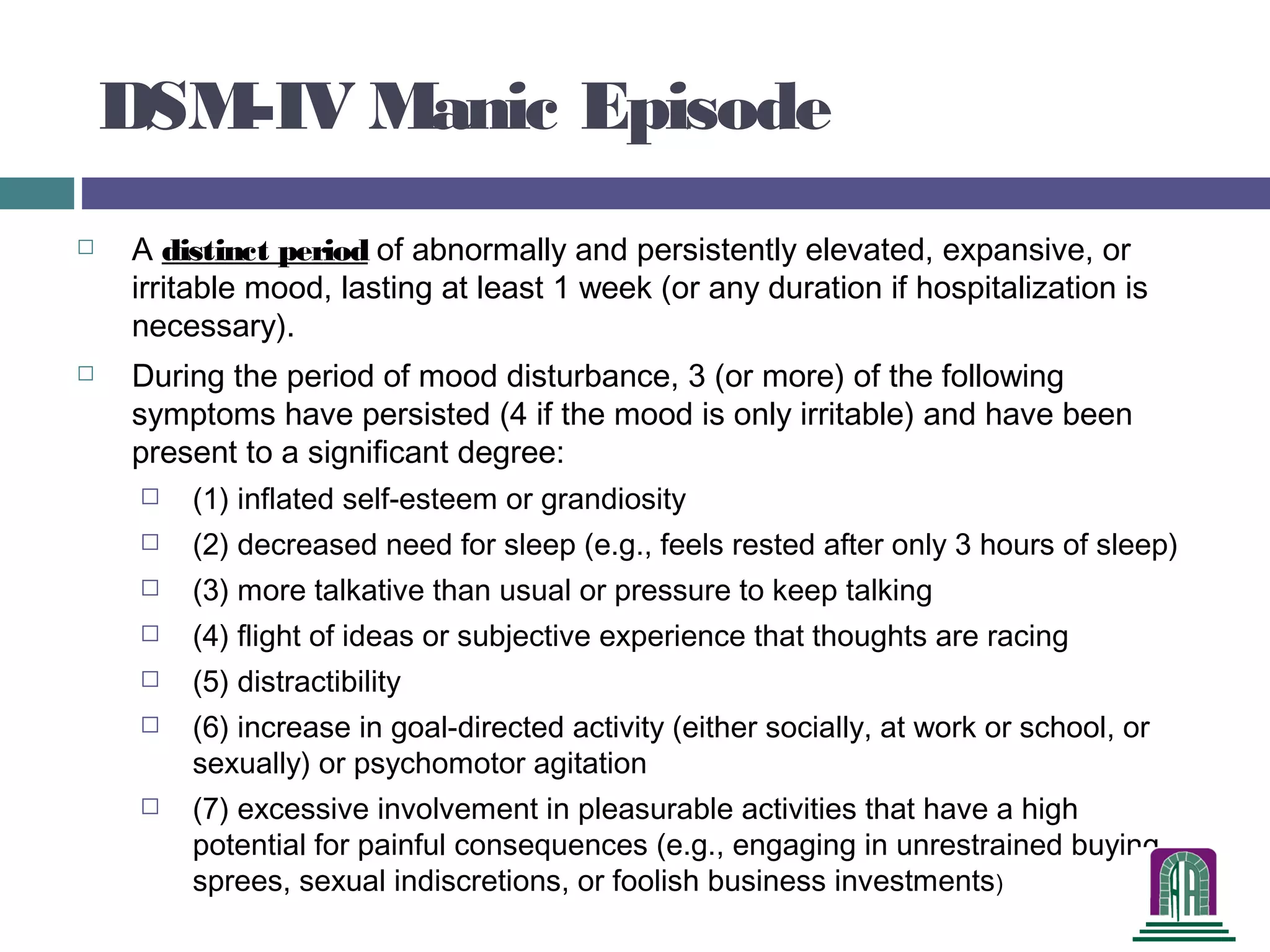
DSM-IV Manic Episode
 A distinct period of abnormally and persistently elevated, expansive, or
irritable mood, lasting at least 1 week (or any duration if hospitalization is
necessary). 
 During the period of mood disturbance, 3 (or more) of the following
symptoms have persisted (4 if the mood is only irritable) and have been
present to a significant degree: 
 (1) inflated self-esteem or grandiosity
 (2) decreased need for sleep (e.g., feels rested after only 3 hours of sleep)
 (3) more talkative than usual or pressure to keep talking 
 (4) flight of ideas or subjective experience that thoughts are racing
 (5) distractibility
 (6) increase in goal-directed activity (either socially, at work or school, or
sexually) or psychomotor agitation
 (7) excessive involvement in pleasurable activities that have a high
potential for painful consequences (e.g., engaging in unrestrained buying
sprees, sexual indiscretions, or foolish business investments)
Are DSMIV Criteria Applicable to
Pediatric BP?
 Criteria were established from adult research at a time
when PBP was not fully accepted
 Main problem is criterion A “Distinct Period”, often not
present in children
 In youth, BP shows mainly as
 ongoing mood lability and increased energy,
 Irritability/aggression,
 reckless behavior,
 short lived mood shifts
However, DSMis
Recommended
 The “presence” of mood episode –mania-
must be determined (elevated, expansive, or
irritable)
 Although its “precise” onset may not be
ascertained, in order to meet Bipolar criteria, a
mood episode MUST be distinguished from
persistent other kinds of presentations, i.e.
either normal personality style or pathological
(ADHD)
 “B” (developmentally reviewed) symptoms
must be present during the mood episode and
be of an impairing nature
Frequency of Pediatric Bipolar
Symptoms
Kowatch RA et al. Review and meta-analysis of the phenomenology and clinical characteristics of mania in
children and adolescents. Bipolar Disord 2005;7:483–496.
Normal ora Symptom?
 Children might present with seemingly manic
symptoms for a variety of reasons
 Clinicians use the FIND (Frequency, Intensity,
Number, and Duration) strategy to make this
determination.
A real FIND
 Frequency
 Symptoms occur most days in a week
 Intensity
 Symptoms are severe enough to cause extreme
disturbance in one domain or moderate disturbance in
two or more domains
 Number
 Symptoms occur three or four times a day
 Duration
 Symptoms occur 4 or more hours a day, total, not
necessarily contiguous
FINDQualifies Symptoms
 A child who becomes silly and giggly to a noticeable and
bothersome degree for 30 minutes twice per week in school
and home
 Frequency (twice per week),
 Intensity (mild interference in two domains),
 Number (one episode per day),
 Duration (30 minutes)
 Does not qualify for a BPD
 A child described as ‘‘too cheerful’’
 F: during school days and every day after school
 I: to the point that relations with teachers, parents, siblings, and
peers are disrupted
 N: several times per day
 D: ‘‘high’’ times last several hours
 Has crossed the FIND threshold
Euphoric/Expansive Mood
 NORMAL
 Dec 25th
 Very happy, giggling
 Got latest Wii model
 MANIA
 Dec 25th
 Laughing
hysterically in
Church
 Says people dress
funny
 Parental disapproval
does not stop laugh
Irritable Mood
 NORMAL
 After a long car trip
in the summer
 Hot and hungry
 MANIA
 Asked to tie shoes
 Two hour tantrum
Grandiosity
 NORMAL
 I am Superman
 Pretend play, stops
when its time for
supper
 MANIA
 I am Superman
 Attempts to jump out
the window to prove
can fly
Decreased Need forSleep
 NORMAL
 Anxious about test
tomorrow
 Up till 1 AM, stays in
bed
 Difficult to get up in
the morning and
tired all day
 MANIA
 No identifiable
stressor
 Up till 1 am running
around throughout
house
 Sleeps only 4 hours
and full of energy
next morning
Pressured Speech
 NORMAL
 Running back home
to tell mom got lead
part in school play
 MANIA
 No identifiable
reason for broken up
fast speech that
lasts for hours
Young Mania Rating Scale
Functional Impairment
 aggressive behavior,
 attention problems
 anxious and depressed symptoms
 delinquent behavior,
 social problems
 withdrawal,
 poor social skills, no friends, and teased by other
children.
 Substance abuse 39% which when present greatly
worsens severity and prognosis
Sala R et al Phenomenology, longitudinal course, and outcome of
children and adolescents with bipolar spectrum disorders. Child Adolesc
Psychiatr Clin N Am. 2009 Apr;18(2):273-89
Suicidal Ideas and Psychosis
 NORMAL
 Not present
 MANIA
 May be present
Suicide Attempts Various
Conditions 0-18 years
 Mania
 44%
 Major Depression
 18%
 No Disorder
 1%
Lewinsohn, PM.; Seeley, JR.; Klein, DN. Bipolar disorder in adolescents:
epidemiology and suicidal behavior. In: Geller, B.; DelBello, MP., editors.
Bipolar Disorder in Childhood and Early Adolescence. New York: Guilford;
2003. p. 7-24.
DIFFERENTIAL
DIAGNOSIS:
IS IT BIPOLARORADHD?
Gabriel Kaplan, M.D.
ADHDCriteria
ADHDBipolarOverlap
Distractibility
Manic Specific Symptoms
Geller et al, Journal of Child and Adolescent
Psychopharmacology 2002; 12:11–25
 Elated Mood
 Grandiosity
 Flight of Ideas
 Racing thoughts
 Decreased need for sleep
 Hypersexuality
Common Diagnostic Dilemma
 A child with impairing distractibility
and aggression
 Is it mild Bipolar?
 Is it severe ADHD?
 Are both conditions present? (Co-
morbidity)
ADHDvs Bipolar
 ADHD
 Child has always been distractible
 Family history of ADHD
 Bipolar
 Distractibility only occurs in the context of a
change of mood that is different from the patient’s
usual mood.
 Hypersexual, grandiose, elated, suicidal
 Co-Moribidity
 Distractibility persists when mood episode remits
TREATMENT OF
MANIA IN BIPOLAR
DISORDER
Bennett Silver, M.D.
What Are Mood Stabilizers?
 Medications with both antimanic and
antidepressant actions
 Medications that decrease vulnerability to
subsequent episodes of mania or depression
and do not exacerbate the current episode or
maintenance phase of treatment.
Mood Stabilizers Used forBipolar
Disorder
 LITHIUM:
 Lithium Carbonate
(Eskalith,Lithobid)
 ANTICONVULSANTS:
 Valproic Acid (Depakote)
 Carbamazepine (Tegretol)
 Lamotrigine (Lamictal)
 ATYPICAL
ANTIPSYCHOTICS:
 Risperidone (Risperdal)
 Quetiapine (Seroquel)
 Aripiprazole (Abilify)
 Olanzapine (Zyprexa)
 Ziprasidone (Geodon)
 Asenapine (Saphris)
 Paliperidone (Invega)
 Clozapine (Clozaril)
How Do Mood Stabilizer
Medications Work?
 Nobody really knows for sure but our understanding is
growing rapidly
 Effect “first messenger” brain neurotransmitters that act
at the synapse between nerve cells, such as dopamine,
serotonin, norepinephrine, glutamate, and GABA
 Effect “second messenger” systems within the nerve cell
such as cAMP (cyclic AMP) and BDNF (Brain-Derived
Neurotrophic Factor) which can turn on genes within the
nerve cell promoting nerve growth (neurogenesis) or
nerve atrophy
Lithium
 Oldest mood stabilizer
 Improves depression and mania
 Helps prevent future episodes
 Narrow dosage range (blood levels
required)
 Very dangerous in overdose
 Side – effects
 drowsiness, weakness, nausea
 fatigue, hand tremor, increased thirst
 increased urination, thyroid underactivity,

Anticonvulsants
 Improve depression and mania
 Lamictal especially good for depressive
episodes
 Help prevent future episodes
 Narrow dosage range (blood levels required)
 Work better than Lithium for rapid cyclers and
mixed states
 Side effects:
 Nausea, headache, double vision, sedation,
 liver enzyme elevation,weight gain,
 hormone changes in women (Depakote, e.g.,
polycystic ovary syndrome, absence of
Atypical Antipsychotics
 Improve depression and mania
 Help prevent future episodes
 Control delusions & hallucinations (psychosis)
 No blood levels required
 Side – effects: sedation; metabolic syndrome (some) -
weight gain,elevated blood sugar, blood pressure,
diabetes, elevated cholesterol; neuromuscular -
restlessness, muscle spasms (dystonia), involuntary
movements (tardive dyskinesia) - rarely
 Monitor: weight, blood pressure, blood sugar, cholesterol
Commonly Used Antipsychotic Medications (Second-
Generation antipsychotics, “Atypicals”)
*All of theatypical antipsychotics areserotoninanddopamine
antagonists
*In2009, Seroquel andAbilifywerenumbers 5and6 respectively
amongst thetoptendrugs intheU.S. basedonsales (over$4billion
each)
 Abilify –weight neutral, less sedating
 Risperdal – Moderate weight gain, increases prolactin
 Seroquel – Moderate weight gain, sedating, may have antidepressant properties
 Zyprexa – Very effective, but significant weight gain, metabolic effects (blood
sugar, cholesterol)
 Geodon – Weight neutral, less sedating
 Saphris – Recently released, sublingual pill
 Invega – Recently released
 Clozaril – Most effective, weight gain, metabolic effects, risk for severe white
blood cell suppression requires regular blood tests. Used when other medications
fail.
Treatment Considerations
 Choice of medication depends on an
individual’s Bipolar symptoms and pattern of
illness (psychosis, rapid cycling, etc.)
 Side-effect profile may affect choice of
medication
 Psychotherapy along with medication improves
outcome
Principles of Medication
Treatment
 Bipolar Disorder is a chronic, recurring
illness and requires chronic, long-term
maintenance medication
 Treatment targets acute episodes and
prevention of episodes with maintenance
medication
 Sometimes a single medication is
inadequate and a combination of
medications is required
 In fact, research indicates that there is a
large group of Bipolar patients who require
very complex psychopharmacologic
regimens in order to achieve and sustain a
good to excellent response *
 Periodic monitoring of blood levels
confirms adequate dosing and compliance
 Periodic monitoring for metabolic effects
(weight, blood sugar, cholesterol), thyroid,
kidney & liver function
*Post, R , Altshuler, L, et al. Complexity of pharmacologic treatment required for sustained improvement
in outpatients with bipolar disorder. J. Clin Psychiatry. 2010:71(9):1176-1186.
Principles of Medication
Treatment
Accurate Diagnosis and Early
Intervention
 Bipolar Disorder is often difficult to diagnose
in adolescence, because of the nature of
adolescent moodiness, and similarities with
other conditions such as ADHD,
Schizophrenia, and Addiction to drugs and
alcohol
 Bipolar Disorder can have a spectrum of
severity and milder forms are often missed or
misdiagnosed (eg., subthreshold or
subsyndromal mania)
 Misdiagnosis leads to delayed or incorrect
treatment
Early Aggressive Intervention
Improves Long Term Outcome
 Research shows that very often there are long
lags from the onset of Bipolar illness to first
treatment *
 This delay is longest in those with the earliest
onset in childhood and adolescence *
 Early onset Bipolar Disorder and delay to first
treatment are independent risk factors for
poor outcome in adulthood **
*Leverich GS, Post RM, Keck PE Jr, et al. The poor prognosis of childhood-onset bipolar
disorder. JPe diatr. 2007;150(5):485-490.
**Post R, Leverich G, Kupka R, et al. Early onset bipolar disorder and treatment delay are
risk factors for poor outcome in adulthood. JClin Psychiatry. 2010; 71(7):864-872.
Diagnostic Ambiguity and Co-
Occurring Disorders
 Correct diagnosis guides treatment and prevents a child from being
placed on medications that can worsen the course of the disorder
 Rarely does bipolar disorder in children occur as a pure entity
 It is often accompanied by symptoms that suggest other psychiatric
disorders, such as ADHD, Depression, Anxiety Disorders, Addiction
 For example, 61% of individuals with Bipolar Disorder also have a
substance abuse disorder – a higher co-occurrence than with any other
psychiatric disorder *
 1/3 of children who first present with depression will eventually go on to
manifest a Bipolar Disorder (risk of misdiagnosis as unipolar
depression) **
 As a result, a child with Bipolar Disorder may be prescribed
antidepressants such as Prozac or Zoloft to treat depressive or anxiety
symptoms, or stimulants such as Ritalin or Adderall to treat ADHD
* NIMH
** American Academy of Child and Adolescent Psychiatry
Diagnostic Complexity and Choosing the
Right Medication
 Treating a Bipolar child suffering from depression,
anxiety or ADHD with an antidepressant or a
stimulant alone can cause negative reactions such
as rapid cycling, manic, violent, aggressive, or
agitated behavior
 Often such patients seem to do well at first, but after
weeks or months of treatment their behavior
deteriorates
 Proper diagnosis prevents the child from being
placed on medications that may worsen the course
of the disorder
 Therefore, in a Bipolar child with such co-occurring
conditions it is prudent to stabilize the patient first on
a mood stabilizer(s) alone, prior to initiating other
When Medication Does Not Yield the
Expected Improvement
 Is patient taking the medication as instructed?
 Re-assess the accuracy of the diagnosis
 Look for and treat co-occurring conditions such
as: substance abuse, anxiety disorders,
ADHD, personality disorders, etc.
 Maximize use of non-pharmacologic treatment
modalities such as cognitive, behavioral
therapies
The Problem of Non-Compliance (Non-
Adherence) with Medication Treatment
 Non-compliance is the most common
reason for failure of medication,
relapse and re-admission to the
hospital
 Rates of poor compliance may reach
64% for Bipolar Disorders *
* J Clin Psychiatry, 2000 Aug, 61 (8): 549-55
Why Don’t Patients Take Their
Medication?
 Failure to understand the diagnosis, the chronic
nature of Bipolar illness, the prophylactic function
of medication & its positive effect on long term
outcome
 A desire to recapture the elevated mood, energy
and lack of inhibition associated with hypomanic
and manic states
 Side-effects, especially weight gain and sedation
 Underestimating the long-term consequences of
Bipolar Disorder on school, social and
occupational functioning
 Stigma associated with psychiatric illness &
medication
 Poor relationship between psychiatrist and patient
Countering Non-Compliance
 Psycho-education regarding medication and
Bipolar Disorder
 Create a treatment partnership between
physician, patient and parent(s)
 Listen and be flexible & responsive to patient
complaints about side-effects
 Group interaction with peers who are at
different stages of their treatment experience
Traditional Treatment Model
Therapeutic School: Integrated Treatment
Model forBipolarDisorder

Bipolar disorder in the school setting naa conference

  • 1.
    BipolarChildren in theSchool Setting A Primerof Diagnosis and Treatment Options forSpecial Education Professionals Gabriel Kaplan, M.D. Bennett Silver, M.D. Nadezhda Sexton, Ph.D.
  • 2.
  • 3.
    The History ofmental health services forNJyouth  Get in line  Open a case  Confined care rules  Systemic fragmentation  Silencing of families and youth
  • 4.
    Systemreform resulted in: Dramatic increase in community based services (need-driven, strength-based)  Separation of child welfare and mental health systems (individualized)  Reduction in use of residential, detention, and hospital stays (least restrictive)  Maximized funding for effective interventions (outcomes-driven)  Empowerment and direct support of family members; elevation of youth as consumers (youth and family guided)
  • 5.
     Care ManagementOrganizations (CMO) are county- based, non-profit organizations that are responsible for face-to-face care management and comprehensive service planning for youth and their families with intense complex needs.  Family Support Organizations (FSOs) are non-profit organizations run by families of children in that county with emotional and behavioral challenges..  Mobile Response & Stabilization Services (MRSS) are provided to youth who exhibit emotional or behavioral challenges that may jeopardize their current living arrangements. They provide face-to- face crisis response within 1 hour of notification.  Youth Case Management (YCM) offers face-to-face services for moderate-risk youth. System of care agencies
  • 6.
    About Us Our Director'sMessage A brighter, healthier future awaits those who care In the late 90's, a dedicated group of parents approached the State of New Jersey with a plan to reform children's mental health. These parents recognized that the system in place at that time was not meeting the needs of children with complex emotional, mental health or behavioral challenges. Under the direction of Governor Christie Whitman, New Jersey launched the Children's System of Care Initiative. The vision was to create a system of care that focused on family strengths and community resources. Families and youth work in partnership with public and private organizations to design mental health services and supports that are effective, that build on the strengths of individuals, and that address each person's cultural and linguistic needs. A system of care helps children, youth and families function better at home, in school, in the community and throughout life. System of care is not a program — it is a philosophy of how care should be delivered. System of Care is an approach to services that recognizes the importance of family, school and community, and seeks to promote the full potential of every child and youth by addressing their physical, emotional, intellectual, cultural and social needs. Madeline Lozowski Executive Director Family Support Organization
  • 7.
  • 8.
    Checkit out:  Toll-FreeAccess Line 1-877-652-7624 (Multi-lingual Language Line available) 24 hours-a-day, 7 days a week www.state.nj.us/dcf/behavioral
  • 9.
    OVERVIEW OF BIPOLAR DISORDERIN CHILDREN AND ADOLESCENTS Gabriel Kaplan, M.D.
  • 10.
    Child’s Ordeal Shows Risksof Psychosis Drugs forYoung (9/1/10)  At 18 months, Kyle started taking a daily antipsychotic drug on the orders of a pediatrician trying to quell the boy’s severe temper tantrums  Thus began a troubled toddler’s journey from one doctor to another, from one diagnosis to another, involving even more drugs. Autism, bipolar disorder, hyperactivity, insomnia, oppositional defiant disorder  The boy’s daily pill regimen multiplied: the antipsychotic Risperdal, the antidepressant Prozac, two sleeping medicines and one for attention-deficit disorder. All by the time he was 3. He gained Lb 49
  • 11.
    Potentially Powerful Side Effects(Published by NYT 9/1/10) Kyle at 3 years old, he started taking antipsychotics at 18 months due to severe tantrums Kyle at 6 years old, takes medication for ADHD, doing well
  • 12.
    Accurate Diagnosis aMust(Published by NYT 9/1/10)  “It’s a controversial diagnosis, I agree with that,” said Dr. Concepcion. “But if you will commit yourself in giving these children these medicines, you have to have a diagnosis that supports your treatment plan. You can’t just give a nondiagnosis and give them the atypical antipsychotic.”  Dr. Charles H. Zeanah, a Tulane medical professor, who disagreed with both the diagnosis and the treatment. “I have never seen a preschool child with bipolar disorder in 30 years as a child psychiatrist specializing in early childhood mental health,”  Kyle’s new doctors point to his remarkable progress — and a more common diagnosis for children of attention-deficit hyperactivity disorder — as proof that he should have never been prescribed such powerful drugs in the first place.
  • 13.
    DSM-IV Mood Disorders Unipolar Disorders  Major Depression  Dysthymic Disorder  Bipolar Disorders  Bipolar I  Bipolar II  Cyclothymic Disorder
  • 14.
    DSM-IV BipolarDisorders  BipolarI  One or more Manic episodes (or Mixed Mania/Depression) usually accompanied by episodes of Depression (but may not)  Bipolar II  Major Depressive episodes with Hypomania  Cyclothymic Disorder  Less than full episodes of Mania and Depression
  • 15.
    BipolarStats  1% ofpopulation will develop  One parent with Bipolar  15-30% risk to offspring  Both parents  50-75% risk  Risk in siblings: 20%  Risk in identical twin: 70%  60% of adults report onset before age of 20
  • 16.
    BipolarEpidemic ?  40-foldincrease in outpatient diagnosis 1994-2003  Moreno C, Laje G, Blanco C et al. National trends in the outpatient diagnosis and treatment of bipolar disorder in youth. Arch Ge n Psychiatry. 2007;64:1032–1039  6-fold increase in hospital diagnosis 1996- 2004  Blader JC, Carlson G. Increased rates of bipolar disorder diagnoses among US child, adolescent, and adult inpatients, 1996–2004. Bio lPsychiatry. 2007;62:107–114.
  • 17.
  • 18.
    DSM-IV Manic Episode A distinct period of abnormally and persistently elevated, expansive, or irritable mood, lasting at least 1 week (or any duration if hospitalization is necessary).   During the period of mood disturbance, 3 (or more) of the following symptoms have persisted (4 if the mood is only irritable) and have been present to a significant degree:   (1) inflated self-esteem or grandiosity  (2) decreased need for sleep (e.g., feels rested after only 3 hours of sleep)  (3) more talkative than usual or pressure to keep talking   (4) flight of ideas or subjective experience that thoughts are racing  (5) distractibility  (6) increase in goal-directed activity (either socially, at work or school, or sexually) or psychomotor agitation  (7) excessive involvement in pleasurable activities that have a high potential for painful consequences (e.g., engaging in unrestrained buying sprees, sexual indiscretions, or foolish business investments)
  • 19.
    Are DSMIV CriteriaApplicable to Pediatric BP?  Criteria were established from adult research at a time when PBP was not fully accepted  Main problem is criterion A “Distinct Period”, often not present in children  In youth, BP shows mainly as  ongoing mood lability and increased energy,  Irritability/aggression,  reckless behavior,  short lived mood shifts
  • 20.
    However, DSMis Recommended  The“presence” of mood episode –mania- must be determined (elevated, expansive, or irritable)  Although its “precise” onset may not be ascertained, in order to meet Bipolar criteria, a mood episode MUST be distinguished from persistent other kinds of presentations, i.e. either normal personality style or pathological (ADHD)  “B” (developmentally reviewed) symptoms must be present during the mood episode and be of an impairing nature
  • 21.
    Frequency of PediatricBipolar Symptoms Kowatch RA et al. Review and meta-analysis of the phenomenology and clinical characteristics of mania in children and adolescents. Bipolar Disord 2005;7:483–496.
  • 22.
    Normal ora Symptom? Children might present with seemingly manic symptoms for a variety of reasons  Clinicians use the FIND (Frequency, Intensity, Number, and Duration) strategy to make this determination.
  • 23.
    A real FIND Frequency  Symptoms occur most days in a week  Intensity  Symptoms are severe enough to cause extreme disturbance in one domain or moderate disturbance in two or more domains  Number  Symptoms occur three or four times a day  Duration  Symptoms occur 4 or more hours a day, total, not necessarily contiguous
  • 24.
    FINDQualifies Symptoms  Achild who becomes silly and giggly to a noticeable and bothersome degree for 30 minutes twice per week in school and home  Frequency (twice per week),  Intensity (mild interference in two domains),  Number (one episode per day),  Duration (30 minutes)  Does not qualify for a BPD  A child described as ‘‘too cheerful’’  F: during school days and every day after school  I: to the point that relations with teachers, parents, siblings, and peers are disrupted  N: several times per day  D: ‘‘high’’ times last several hours  Has crossed the FIND threshold
  • 25.
    Euphoric/Expansive Mood  NORMAL Dec 25th  Very happy, giggling  Got latest Wii model  MANIA  Dec 25th  Laughing hysterically in Church  Says people dress funny  Parental disapproval does not stop laugh
  • 26.
    Irritable Mood  NORMAL After a long car trip in the summer  Hot and hungry  MANIA  Asked to tie shoes  Two hour tantrum
  • 27.
    Grandiosity  NORMAL  Iam Superman  Pretend play, stops when its time for supper  MANIA  I am Superman  Attempts to jump out the window to prove can fly
  • 28.
    Decreased Need forSleep NORMAL  Anxious about test tomorrow  Up till 1 AM, stays in bed  Difficult to get up in the morning and tired all day  MANIA  No identifiable stressor  Up till 1 am running around throughout house  Sleeps only 4 hours and full of energy next morning
  • 29.
    Pressured Speech  NORMAL Running back home to tell mom got lead part in school play  MANIA  No identifiable reason for broken up fast speech that lasts for hours
  • 30.
  • 31.
  • 32.
    Functional Impairment  aggressivebehavior,  attention problems  anxious and depressed symptoms  delinquent behavior,  social problems  withdrawal,  poor social skills, no friends, and teased by other children.  Substance abuse 39% which when present greatly worsens severity and prognosis Sala R et al Phenomenology, longitudinal course, and outcome of children and adolescents with bipolar spectrum disorders. Child Adolesc Psychiatr Clin N Am. 2009 Apr;18(2):273-89
  • 33.
    Suicidal Ideas andPsychosis  NORMAL  Not present  MANIA  May be present
  • 34.
    Suicide Attempts Various Conditions0-18 years  Mania  44%  Major Depression  18%  No Disorder  1% Lewinsohn, PM.; Seeley, JR.; Klein, DN. Bipolar disorder in adolescents: epidemiology and suicidal behavior. In: Geller, B.; DelBello, MP., editors. Bipolar Disorder in Childhood and Early Adolescence. New York: Guilford; 2003. p. 7-24.
  • 35.
  • 36.
  • 37.
  • 38.
    Manic Specific Symptoms Gelleret al, Journal of Child and Adolescent Psychopharmacology 2002; 12:11–25  Elated Mood  Grandiosity  Flight of Ideas  Racing thoughts  Decreased need for sleep  Hypersexuality
  • 39.
    Common Diagnostic Dilemma A child with impairing distractibility and aggression  Is it mild Bipolar?  Is it severe ADHD?  Are both conditions present? (Co- morbidity)
  • 40.
    ADHDvs Bipolar  ADHD Child has always been distractible  Family history of ADHD  Bipolar  Distractibility only occurs in the context of a change of mood that is different from the patient’s usual mood.  Hypersexual, grandiose, elated, suicidal  Co-Moribidity  Distractibility persists when mood episode remits
  • 41.
    TREATMENT OF MANIA INBIPOLAR DISORDER Bennett Silver, M.D.
  • 42.
    What Are MoodStabilizers?  Medications with both antimanic and antidepressant actions  Medications that decrease vulnerability to subsequent episodes of mania or depression and do not exacerbate the current episode or maintenance phase of treatment.
  • 43.
    Mood Stabilizers UsedforBipolar Disorder  LITHIUM:  Lithium Carbonate (Eskalith,Lithobid)  ANTICONVULSANTS:  Valproic Acid (Depakote)  Carbamazepine (Tegretol)  Lamotrigine (Lamictal)  ATYPICAL ANTIPSYCHOTICS:  Risperidone (Risperdal)  Quetiapine (Seroquel)  Aripiprazole (Abilify)  Olanzapine (Zyprexa)  Ziprasidone (Geodon)  Asenapine (Saphris)  Paliperidone (Invega)  Clozapine (Clozaril)
  • 44.
    How Do MoodStabilizer Medications Work?  Nobody really knows for sure but our understanding is growing rapidly  Effect “first messenger” brain neurotransmitters that act at the synapse between nerve cells, such as dopamine, serotonin, norepinephrine, glutamate, and GABA  Effect “second messenger” systems within the nerve cell such as cAMP (cyclic AMP) and BDNF (Brain-Derived Neurotrophic Factor) which can turn on genes within the nerve cell promoting nerve growth (neurogenesis) or nerve atrophy
  • 45.
    Lithium  Oldest moodstabilizer  Improves depression and mania  Helps prevent future episodes  Narrow dosage range (blood levels required)  Very dangerous in overdose  Side – effects  drowsiness, weakness, nausea  fatigue, hand tremor, increased thirst  increased urination, thyroid underactivity, 
  • 46.
    Anticonvulsants  Improve depressionand mania  Lamictal especially good for depressive episodes  Help prevent future episodes  Narrow dosage range (blood levels required)  Work better than Lithium for rapid cyclers and mixed states  Side effects:  Nausea, headache, double vision, sedation,  liver enzyme elevation,weight gain,  hormone changes in women (Depakote, e.g., polycystic ovary syndrome, absence of
  • 47.
    Atypical Antipsychotics  Improvedepression and mania  Help prevent future episodes  Control delusions & hallucinations (psychosis)  No blood levels required  Side – effects: sedation; metabolic syndrome (some) - weight gain,elevated blood sugar, blood pressure, diabetes, elevated cholesterol; neuromuscular - restlessness, muscle spasms (dystonia), involuntary movements (tardive dyskinesia) - rarely  Monitor: weight, blood pressure, blood sugar, cholesterol
  • 48.
    Commonly Used AntipsychoticMedications (Second- Generation antipsychotics, “Atypicals”) *All of theatypical antipsychotics areserotoninanddopamine antagonists *In2009, Seroquel andAbilifywerenumbers 5and6 respectively amongst thetoptendrugs intheU.S. basedonsales (over$4billion each)  Abilify –weight neutral, less sedating  Risperdal – Moderate weight gain, increases prolactin  Seroquel – Moderate weight gain, sedating, may have antidepressant properties  Zyprexa – Very effective, but significant weight gain, metabolic effects (blood sugar, cholesterol)  Geodon – Weight neutral, less sedating  Saphris – Recently released, sublingual pill  Invega – Recently released  Clozaril – Most effective, weight gain, metabolic effects, risk for severe white blood cell suppression requires regular blood tests. Used when other medications fail.
  • 49.
    Treatment Considerations  Choiceof medication depends on an individual’s Bipolar symptoms and pattern of illness (psychosis, rapid cycling, etc.)  Side-effect profile may affect choice of medication  Psychotherapy along with medication improves outcome
  • 50.
    Principles of Medication Treatment Bipolar Disorder is a chronic, recurring illness and requires chronic, long-term maintenance medication  Treatment targets acute episodes and prevention of episodes with maintenance medication  Sometimes a single medication is inadequate and a combination of medications is required
  • 51.
     In fact,research indicates that there is a large group of Bipolar patients who require very complex psychopharmacologic regimens in order to achieve and sustain a good to excellent response *  Periodic monitoring of blood levels confirms adequate dosing and compliance  Periodic monitoring for metabolic effects (weight, blood sugar, cholesterol), thyroid, kidney & liver function *Post, R , Altshuler, L, et al. Complexity of pharmacologic treatment required for sustained improvement in outpatients with bipolar disorder. J. Clin Psychiatry. 2010:71(9):1176-1186. Principles of Medication Treatment
  • 52.
    Accurate Diagnosis andEarly Intervention  Bipolar Disorder is often difficult to diagnose in adolescence, because of the nature of adolescent moodiness, and similarities with other conditions such as ADHD, Schizophrenia, and Addiction to drugs and alcohol  Bipolar Disorder can have a spectrum of severity and milder forms are often missed or misdiagnosed (eg., subthreshold or subsyndromal mania)  Misdiagnosis leads to delayed or incorrect treatment
  • 53.
    Early Aggressive Intervention ImprovesLong Term Outcome  Research shows that very often there are long lags from the onset of Bipolar illness to first treatment *  This delay is longest in those with the earliest onset in childhood and adolescence *  Early onset Bipolar Disorder and delay to first treatment are independent risk factors for poor outcome in adulthood ** *Leverich GS, Post RM, Keck PE Jr, et al. The poor prognosis of childhood-onset bipolar disorder. JPe diatr. 2007;150(5):485-490. **Post R, Leverich G, Kupka R, et al. Early onset bipolar disorder and treatment delay are risk factors for poor outcome in adulthood. JClin Psychiatry. 2010; 71(7):864-872.
  • 54.
    Diagnostic Ambiguity andCo- Occurring Disorders  Correct diagnosis guides treatment and prevents a child from being placed on medications that can worsen the course of the disorder  Rarely does bipolar disorder in children occur as a pure entity  It is often accompanied by symptoms that suggest other psychiatric disorders, such as ADHD, Depression, Anxiety Disorders, Addiction  For example, 61% of individuals with Bipolar Disorder also have a substance abuse disorder – a higher co-occurrence than with any other psychiatric disorder *  1/3 of children who first present with depression will eventually go on to manifest a Bipolar Disorder (risk of misdiagnosis as unipolar depression) **  As a result, a child with Bipolar Disorder may be prescribed antidepressants such as Prozac or Zoloft to treat depressive or anxiety symptoms, or stimulants such as Ritalin or Adderall to treat ADHD * NIMH ** American Academy of Child and Adolescent Psychiatry
  • 55.
    Diagnostic Complexity andChoosing the Right Medication  Treating a Bipolar child suffering from depression, anxiety or ADHD with an antidepressant or a stimulant alone can cause negative reactions such as rapid cycling, manic, violent, aggressive, or agitated behavior  Often such patients seem to do well at first, but after weeks or months of treatment their behavior deteriorates  Proper diagnosis prevents the child from being placed on medications that may worsen the course of the disorder  Therefore, in a Bipolar child with such co-occurring conditions it is prudent to stabilize the patient first on a mood stabilizer(s) alone, prior to initiating other
  • 56.
    When Medication DoesNot Yield the Expected Improvement  Is patient taking the medication as instructed?  Re-assess the accuracy of the diagnosis  Look for and treat co-occurring conditions such as: substance abuse, anxiety disorders, ADHD, personality disorders, etc.  Maximize use of non-pharmacologic treatment modalities such as cognitive, behavioral therapies
  • 57.
    The Problem ofNon-Compliance (Non- Adherence) with Medication Treatment  Non-compliance is the most common reason for failure of medication, relapse and re-admission to the hospital  Rates of poor compliance may reach 64% for Bipolar Disorders * * J Clin Psychiatry, 2000 Aug, 61 (8): 549-55
  • 58.
    Why Don’t PatientsTake Their Medication?  Failure to understand the diagnosis, the chronic nature of Bipolar illness, the prophylactic function of medication & its positive effect on long term outcome  A desire to recapture the elevated mood, energy and lack of inhibition associated with hypomanic and manic states  Side-effects, especially weight gain and sedation  Underestimating the long-term consequences of Bipolar Disorder on school, social and occupational functioning  Stigma associated with psychiatric illness & medication  Poor relationship between psychiatrist and patient
  • 59.
    Countering Non-Compliance  Psycho-educationregarding medication and Bipolar Disorder  Create a treatment partnership between physician, patient and parent(s)  Listen and be flexible & responsive to patient complaints about side-effects  Group interaction with peers who are at different stages of their treatment experience
  • 60.
  • 61.
    Therapeutic School: IntegratedTreatment Model forBipolarDisorder