Integrating Treatment for Co-Occurring Disorders Brought to you by:
Presented By
TODAY’S PRESENTERS Cynthia Moreno Tuohy Executive Director NAADAC, The Association for  Addiction Professionals Misti Storie Education and Training Consultant NAADAC, The Association for  Addiction Professionals
TODAY’S PRESENTERS Tim Sheehan, Ph.D. Director of Institutional Effectiveness Hazelden Graduate School of Addiction Studies Mary Woods,  RNC, LADC, MSHS Chief Executive Officer Westbridge Community Services
WEB CONFERENCE OBJECTIVES Discuss the prevalence of co-occurring disorders  in substance abuse treatment programs
WEB CONFERENCE OBJECTIVES Discuss the prevalence of co-occurring disorders  in substance abuse treatment programs Contrast co-occurring treatment with traditional  addiction treatment
WEB CONFERENCE OBJECTIVES Discuss the prevalence of co-occurring disorders  in substance abuse treatment programs Contrast co-occurring treatment with traditional  addiction treatment Give a rationale for integrated treatment
WEB CONFERENCE OBJECTIVES Discuss the prevalence of co-occurring disorders  in substance abuse treatment programs Contrast co-occurring treatment with traditional  addiction treatment Give a rationale for integrated treatment List instruments helpful for screening
WEB CONFERENCE OBJECTIVES Discuss the prevalence of co-occurring disorders  in substance abuse treatment programs Contrast co-occurring treatment with traditional  addiction treatment Give a rationale for integrated treatment List instruments helpful for screening  Describe evidence-based therapies helpful in treating  co-occurring disorders
WEB CONFERENCE OBJECTIVES Discuss the prevalence of co-occurring disorders  in substance abuse treatment programs Contrast co-occurring treatment with traditional  addiction treatment Give a rationale for integrated treatment List instruments helpful for screening  Describe evidence-based therapies helpful in treating  co-occurring disorders Access new training programs available through  NAADAC and Hazelden
Part One: Introduction to Co-occurring Disorders
SCOPE OF PRACTICE An Addiction Professional’s scope of practice varies with education, training and state requirements.  With over 300 people on line today, each practitioner should keep his or her scope of practice in mind as we conduct this presentation.
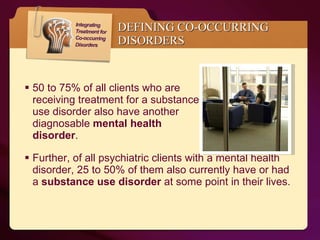
DEFINING CO-OCCURRING  DISORDERS 50 to 75% of all clients who are  receiving treatment for a substance  use disorder also have another  diagnosable  mental health  disorder .   Further, of all psychiatric clients with a mental health disorder, 25 to 50% of them also currently have or had a  substance use disorder  at some point in their lives.
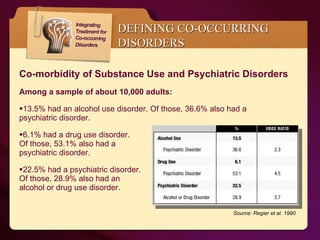
Co-morbidity of Substance Use and Psychiatric Disorders Among a sample of about 10,000 adults: 13.5% had an alcohol use disorder. Of those, 36.6% also had a  psychiatric disorder. 6.1% had a drug use disorder.  Of those, 53.1% also had a  psychiatric disorder. 22.5% had a psychiatric disorder.  Of those, 28.9% also had an  alcohol or drug use disorder. DEFINING CO-OCCURRING DISORDERS Source: Regier et al. 1990
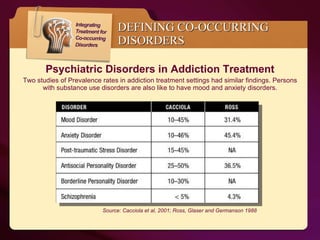
Psychiatric Disorders in Addiction Treatment Two studies of Prevalence rates in addiction treatment settings had similar findings. Persons with substance use disorders are also like to have mood and anxiety disorders. DEFINING CO-OCCURRING DISORDERS Source: Cacciola et al, 2001; Ross, Glaser and Germanson 1988
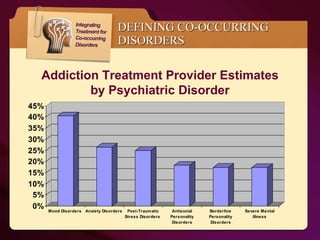
DEFINING CO-OCCURRING DISORDERS Addiction Treatment Provider Estimates  by Psychiatric Disorder
Mental health disorder (MHD) :  significant and chronic disturbances with “feelings, thinking, functioning and/or relationships that are not due to drug or alcohol use and are not the result of a medical illness” 22 DEFINING CO-OCCURRING DISORDERS Bipolar disorder Major depressive disorder Schizophrenia Obsessive-compulsive disorder Social phobia Borderline personality disorder Posttraumatic stress disorder
Substance use disorder (SUD) :  a behavioral pattern of continual psychoactive substance use that can be diagnosed as either substance abuse or substance dependence  DEFINING CO-OCCURRING DISORDERS
Co-occurring disorders (COD) :  the simultaneous existence of “one or more disorders relating to the use of alcohol and/or other drugs of abuse as well as one or more mental [health] disorders.” 18 DEFINING CO-OCCURRING DISORDERS
SEVERITY OF CO-OCCURRING DISORDERS Co-occurring mental health disorders are often placed on a continuum of severity.  Non-severe:  early in the continuum and can include mood disorders, anxiety disorders, adjustment disorders and personality disorders.  Severe:  include schizophrenia, bipolar disorder, schizoaffective disorder and major depressive disorder.
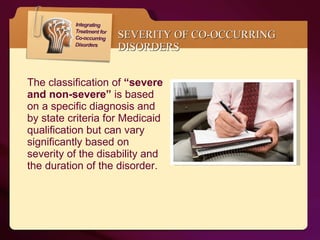
SEVERITY OF CO-OCCURRING DISORDERS The classification of  “severe and non-severe”  is based on a specific diagnosis and by state criteria for Medicaid qualification but can vary significantly based on severity of the disability and the duration of the disorder.
QUADRANTS OF CARE
Part Two: What is Co-occurring Treatment and How  is It Different from Traditional Addiction Treatment?
MODELS OF TREATMENT Clients with co-occurring  disorders have historically  received substance abuse  treatment services in isolation  from mental health treatment  services.  As more research on co-occurring disorders began to be conducted, the many limitations this approach places on the client and his or her success in treatment began to surface.
MODELS OF TREATMENT A twenty-eight year-old-woman named Anita entered an addiction treatment center where she was assessed as having alcohol dependence. Six months earlier, Anita had been diagnosed with major depressive disorder and was prescribed medication by her family doctor.  At the treatment facility, it was recommended that Anita be re-assessed and treated, if necessary, at a mental health clinic, located nearby in town.  What model of treatment does this scenario represent?  single model of treatment sequential model of treatment parallel model of treatment integrated model of treatment
Single model of care  - It was believed that once the “primary disorder" was treated effectively, the client’s substance use problem would resolve itself because drugs and/or alcohol were no longer needed to cope.  Sequential model of treatment  - acknowledges the presence of co-occurring disorders but treats them one at a time.  Parallel model of treatment  - mental health disorders are treated at the same time as co-occurring substance use disorders, only by separate treatment professionals and often at separate treatment facilities. MODELS OF TREATMENT
INTEGRATED MODEL OF TREATMENT Integrated model of treatment an approach to treating co-occurring disorders that utilizes one competent treatment team at the same facility to recognize and address all mental health and substance use disorders at the same time.
INTEGRATED MODEL OF TREATMENT The integrated model of treatment can best be defined by following seven components: Integration
INTEGRATED MODEL OF TREATMENT The integrated model of treatment can best be defined by following seven components: Integration Comprehensiveness
INTEGRATED MODEL OF TREATMENT The integrated model of treatment can best be defined by following seven components: Integration Comprehensiveness Assertiveness
INTEGRATED MODEL OF TREATMENT The integrated model of treatment can best be defined by following seven components: Integration Comprehensiveness Assertiveness Reduction of negative consequences
INTEGRATED MODEL OF TREATMENT The integrated model of treatment can best be defined by following seven components: Integration Comprehensiveness Assertiveness Reduction of negative consequences  Long-term perspective
INTEGRATED MODEL OF TREATMENT The integrated model of treatment can best be defined by following seven components: Integration Comprehensiveness Assertiveness Reduction of negative consequences  Long-term perspective  Motivation-based treatment
INTEGRATED MODEL OF TREATMENT The integrated model of treatment can best be defined by following seven components: Integration Comprehensiveness Assertiveness Reduction of negative consequences  Long-term perspective  Motivation-based treatment  Multiple psychotherapeutic modalities
BENEFITS OF AN INTEGRATED MODEL OF CARE Benefits of an Integrated  Model of Care  Reduced need for coordination
BENEFITS OF AN INTEGRATED MODEL OF CARE Benefits of an Integrated  Model of Care  Reduced need for coordination  Reduced frustration for clients
BENEFITS OF AN INTEGRATED MODEL OF CARE Benefits of an Integrated  Model of Care  Reduced need for coordination  Reduced frustration for clients Shared decision-making responsibilities
BENEFITS OF AN INTEGRATED MODEL OF CARE Benefits of an Integrated  Model of Care  Reduced need for coordination  Reduced frustration for clients Shared decision-making responsibilities Families and significant others are included
BENEFITS OF AN INTEGRATED MODEL OF CARE Benefits of an Integrated  Model of Care  Reduced need for coordination  Reduced frustration for clients Shared decision-making responsibilities Families and significant others are included Transparent practices help everyone involved share responsibility
BENEFITS OF AN INTEGRATED MODEL OF CARE Benefits of an Integrated  Model of Care  Reduced need for coordination  Reduced frustration for clients Shared decision-making responsibilities Families and significant others are included Transparent practices help everyone involved share responsibility Clients are empowered to treat their own illness and manage their own recovery
BENEFITS OF AN INTEGRATED MODEL OF CARE Benefits of an Integrated  Model of Care  Reduced need for coordination  Reduced frustration for clients Shared decision-making responsibilities Families and significant others are included Transparent practices help everyone involved share responsibility Clients are empowered to treat their own illness and manage their own recovery The client and his/her family has more choice in treatment, more ability for self-management, and a higher satisfaction with care
One disorder does not necessarily present as “primary.” There isn’t necessarily a causal relationship between co-occurring disorders. These are co-occurring brain diseases that need to be treated simultaneously . CO-OCCURRING DISORDERS INTERACTIONS An integrated model of care assumes that:
SCREENING AND ASSESSMENT Screening :  The first phase of evaluation where the potential client is interviewed to determine if he or she is appropriate for that specific treatment facility and to determine the possible presence or absence of a substance use or mental health problem.
SCREENING AND ASSESSMENT Assessment:  The second phase of evaluation where a systematic interview is necessary to verify the potential presence of a mental health or substance use disorder detected during the screening process.
SCREENING AND ASSESSMENT Intoxication Withdrawal Substance-induced disorders Motivational factors Feelings, symptoms, and disorders Complexities of Screening and Assessment
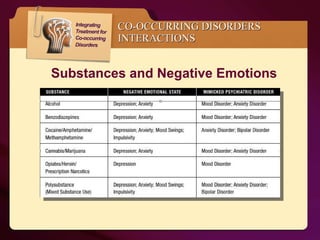
CO-OCCURRING DISORDERS INTERACTIONS Substances and Negative Emotions
SCREENING AND ASSESSMENT The choice of screening measures depends on: The skill of the screening professional The cost of the screening materials  How simple the scale is to interpret and use across disciplines Psychometric qualities The relevance of screening to prevalent disorders Movement from very sensitive (generic) measures to more specific measures
Integrated Assessment  Process – 12 Steps Engage the Client SCREENING AND ASSESSMENT
Integrated Assessment  Process – 12 Steps Engage the Client Identify and Contact Collaterals SCREENING AND ASSESSMENT
Integrated Assessment  Process – 12 Steps Engage the Client Identify and Contact Collaterals Screen for and Detect Co-occurring Disorders SCREENING AND ASSESSMENT
Integrated Assessment  Process – 12 Steps Engage the Client Identify and Contact Collaterals Screen for and Detect Co-occurring Disorders Determine Quadrant and Locus of Responsibility SCREENING AND ASSESSMENT
Integrated Assessment  Process – 12 Steps Engage the Client Identify and Contact Collaterals Screen for and Detect Co-occurring Disorders Determine Quadrant and Locus of Responsibility Determine Level of Care SCREENING AND ASSESSMENT
Integrated Assessment  Process – 12 Steps Engage the Client Identify and Contact Collaterals Screen for and Detect Co-occurring Disorders Determine Quadrant and Locus of Responsibility Determine Level of Care Determine Diagnosis SCREENING AND ASSESSMENT
Integrated Assessment  Process – 12 Steps Determine Disability and  Functional Impairment  SCREENING AND ASSESSMENT
Integrated Assessment  Process – 12 Steps Determine Disability and  Functional Impairment  Identify Strengths and Supports SCREENING AND ASSESSMENT
Integrated Assessment  Process – 12 Steps Determine Disability and  Functional Impairment  Identify Strengths and Supports Identify Cultural and Linguistic Needs and Supports SCREENING AND ASSESSMENT
Integrated Assessment  Process – 12 Steps Determine Disability and  Functional Impairment  Identify Strengths and Supports Identify Cultural and Linguistic Needs and Supports Identify Problem Domains SCREENING AND ASSESSMENT
Integrated Assessment  Process – 12 Steps Determine Disability and  Functional Impairment  Identify Strengths and Supports Identify Cultural and Linguistic Needs and Supports Identify Problem Domains Determine Stage of Change SCREENING AND ASSESSMENT
Integrated Assessment  Process – 12 Steps Determine Disability and  Functional Impairment  Identify Strengths and Supports Identify Cultural and Linguistic Needs and Supports Identify Problem Domains Determine Stage of Change Plan Treatment SCREENING AND ASSESSMENT
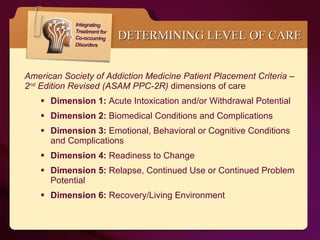
American Society of Addiction Medicine Patient Placement Criteria – 2 nd  Edition Revised (ASAM PPC-2R)  dimensions of care Dimension 1:  Acute Intoxication and/or Withdrawal Potential Dimension 2:  Biomedical Conditions and Complications Dimension 3:  Emotional, Behavioral or Cognitive Conditions and Complications Dimension 4:  Readiness to Change Dimension 5:  Relapse, Continued Use or Continued Problem Potential Dimension 6:  Recovery/Living Environment DETERMINING LEVEL OF CARE
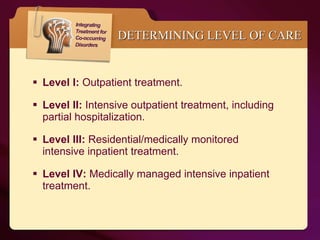
Level I:  Outpatient treatment.  Level II:  Intensive outpatient treatment, including partial hospitalization. Level III:  Residential/medically monitored intensive inpatient treatment. Level IV:  Medically managed intensive inpatient treatment. DETERMINING LEVEL OF CARE
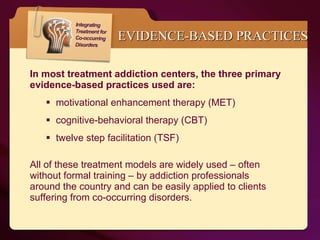
EVIDENCE-BASED PRACTICES In most treatment addiction centers, the three primary evidence-based practices used are: motivational enhancement therapy (MET) cognitive-behavioral therapy (CBT)  twelve step facilitation (TSF) All of these treatment models are widely used – often without formal training – by addiction professionals around the country and can be easily applied to clients suffering from co-occurring disorders.
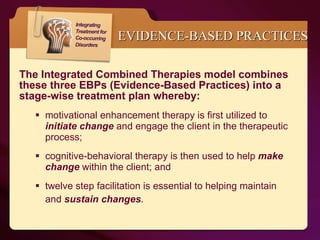
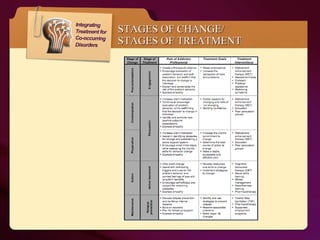
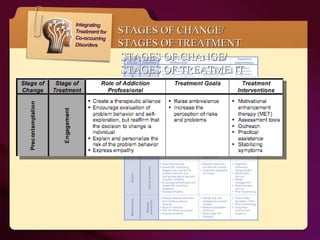
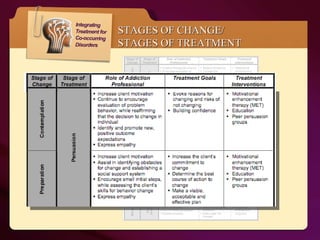
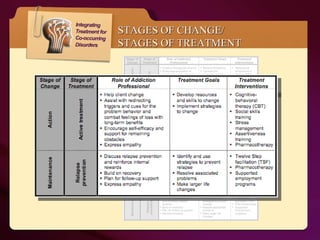
EVIDENCE-BASED PRACTICES The Integrated Combined Therapies model combines these three EBPs (Evidence-Based Practices) into a stage-wise treatment plan whereby: motivational enhancement therapy is first utilized to  initiate change   and engage the client in the therapeutic process;  cognitive-behavioral therapy is then used to help  make change   within the client; and  twelve step facilitation is essential to helping maintain and  sustain changes .
STAGES OF CHANGE/ STAGES OF TREATMENT
STAGES OF CHANGE/ STAGES OF TREATMENT STAGES OF CHANGE/ STAGES OF TREATMENT
STAGES OF CHANGE/ STAGES OF TREATMENT
OTHER CONSIDERATIONS Managing Medications Involving the Family Encouraging Participation in  Peer-Support Recovery Programs
Collaboration with the prescriber Even though the prescriber is ultimately responsible for ensuring safety and effectiveness of pharmacotherapies, addiction professionals can also help in this effort.  Since addiction professionals tend to see the client more often, they are well-positioned to: recognize danger signs (including recent psychoactive substance use)  recognize abnormal side effects monitor and support medication compliance
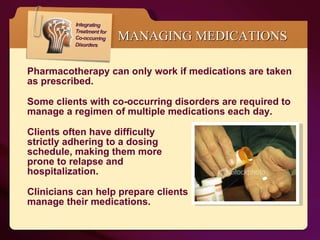
MANAGING MEDICATIONS Pharmacotherapy can only work if medications are taken as prescribed.  Some clients with co-occurring disorders are required to manage a regimen of multiple medications each day. Clients often have difficulty  strictly adhering to a dosing  schedule, making them more  prone to relapse and  hospitalization.  Clinicians can help prepare clients  to manage their medications.
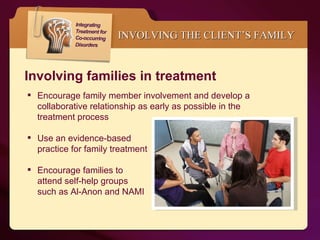
INVOLVING THE CLIENT’S FAMILY It is a myth that people with co-occurring disorders are disconnected from their families.  Research has shown that outcomes for substance use and mental health disorders are improved, including fewer relapses, when families are actively engaged in the treatment process. Unfortunately, family members of a client who has co-occurring disorders often experience considerable stress, heartbreak, and confusion. Involving families in treatment
INVOLVING THE CLIENT’S FAMILY   Involving families in treatment Encourage family member involvement and develop a collaborative relationship as early as possible in the treatment process  Use an evidence-based  practice for family treatment  Encourage families to  attend self-help groups  such as Al-Anon and NAMI
Double Trouble in Recovery Mental Illness Anonymous Dual Disorders Anonymous Dual Recovery Anonymous Dual Diagnosis Anonymous DUAL-RECOVERY MUTUAL SELF-HELP   Specific dual-recovery groups can provide essential peer support:
GUIDING PRINCIPLES OF RECOVERY There are many pathways to recovery. Recovery is self-directed and empowering, involving personal recognition of the need for change and transformation. Recovery exists on a continuum of improved health and wellness. Recovery involves addressing discrimination and transcending shame and stigma.  Recovery is supported by peers and allies, and involves joining and rebuilding a life in the community. Recovery is a reality. (from CSAT ’ s Regional Recovery Meetings, May 2008)
Part Three Resources and Training Opportunities
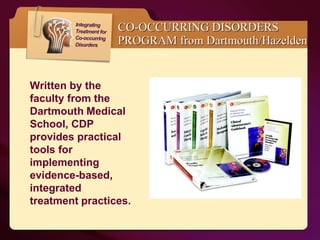
CO-OCCURRING DISORDERS PROGRAM from Dartmouth/Hazelden Written by the faculty from the Dartmouth   Medical School, CDP provides practical tools for implementing evidence-based, integrated treatment   practices.
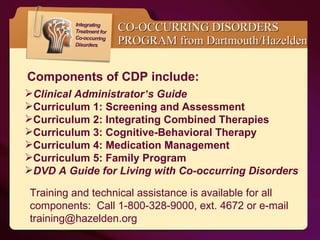
CO-OCCURRING DISORDERS PROGRAM from Dartmouth/Hazelden Clinical Administrator ’ s Guide     Curriculum 1: Screening and Assessment           Curriculum 2: Integrating Combined Therapies     Curriculum 3: Cognitive-Behavioral Therapy         Curriculum 4: Medication Management         Curriculum 5: Family Program           DVD A Guide for Living with Co-occurring Disorders Components of CDP include: Training and technical assistance is available for all components:  Call 1-800-328-9000, ext. 4672 or e-mail training@hazelden.org
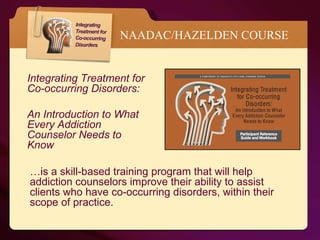
NAADAC/HAZELDEN COURSE Integrating Treatment for Co-occurring Disorders:  An Introduction to What Every Addiction Counselor Needs to Know … is a skill-based training program that will help addiction counselors improve their ability to assist clients who have co-occurring disorders, within their scope of practice.
NAADAC/HAZELDEN COURSE Through case studies, video presentations, interactive exercises and extensive written resources, participants learn: the many myths related to mental illness treatment barriers to assessing and treating co-occurring disorders relevant research and prevalence data commonly encountered mental disorders applicable screening and assessment instruments issues surrounding medication management coordinating with other mental health professionals the integrated model of mental health and addiction treatment services
NAADAC is now conducting the Lifelong Learning Program:  Integrating Treatment for  Co-occurring Disorders:  An Introduction to What Every  Addiction Counselor Needs  To Know   Check the NAADAC website for trainings coming to your area at www.naadac.org NAADAC/HAZELDEN COURSE Interested in hosting a training?  Contact: Diana Kamp dkamp@naadac.org  Cynthia  Moreno Tuohy moreno@naadac.org
Now available as a distance learning program! Integrating Treatment for Co-Occurring  Co-occurring Disorders:  An Introduction to What Every Addiction Counselor Needs to Know. Learn at your own pace through presentations, videos, case studies, and interactive exercises. Available 24/7. $180.00 18 CEs from NAADAC; 6 CEs from APA NAADAC/HAZELDEN COURSE
LEADERSHIP IN  CO-OCCURRING DISORDERS Announcing the Focus on Integrated Recovery! A collaboration between: Dartmouth Psychiatric Research Center Hazelden  NAADAC, the Association for Addiction Professionals NAATP, the National Association of Addiction Treatment Providers The National Council for Community Behavioral Healthcare  SAMHSA, the Substance Abuse and Mental Health Services Administration, and  WestBridge Community Services Active discussions with other leaders
FOCUS ON INTEGRATED RECOVERY Co-Occurring Leadership  What you can expect from Focus on Integrated Recovery  Practical, evidence-based resources to aid in the integration of the substance use and mental health disorders professions Centralized source for consistent messaging about co-occurring disorders  Ongoing mechanism to capture the learning and experiences from partners and constituents across the behavioral health spectrum Opportunities for in-person and distance education on co-occurring disorders Support for the September 2011 Recovery Month Collaboration on new initiatives: evidence-based scopes of practice, outcome measurement, workforce development
FOCUS ON INTEGRATED RECOVERY Co-Occurring Leadership  Where to find the Focus on Integrated Recovery  Communications begin during September, 2011 Recovery Month  National Public Relations efforts E-mail campaigns Focus on Integrated Recovery Website Links on the partners’ websites Recovery Month materials Let us know what you think and how we can help! contact Jon Hartman - jhartman@hazelden.org
August 18, 2011  -  Strategies for Successful Test Taking   September 15, 2011  -  Your Voice Counts: Advocacy and the NAADAC Political Action Committee October 13, 2011  -  Conflict Resolution for Clients and Professionals   November 17, 2011  -  What's Next in Your Career? Recap and Highlights from the NAADAC Workforce Conference   December 15, 2011  -  Clinical Supervision: Keys to Success Register at: www.naadac.org/education or www.myaccucare.com/webinars UPCOMING WEBINARS 2011
Alcohol SBIRT: Integrating Evidence-based Practice Into Your Practice  Medication Assisted Recovery: What Every Addiction Professional Needs to Know Build Your Business With the Department of Transportation Substance Abuse Professional (SAP) Qualification  Working with NAADAC to Express Your Professional Identity  Screening, Brief Intervention and Referral to Treatment (SBIRT) Medicaid Expansion 2014 and Preparing to Bill for Medicaid  Understanding NAADAC’s Code of Ethics Staying Informed: Trends of the Addiction Profession Archived webinars located at: www.naadac.org/education or www.myaccucare.com/webinars ARCHIVED WEBINARS
Time for discussion! www.naadac.org www.bhevolution.org www.hazelden.org www.westbridge.org
Providing solutions to improve the quality of life for communities by helping addictions professionals excel in their field through the use of information technology. Visit us today!   Call: (800) 324-7966 Click: www.MyAccuCare.com Clinical Administrative Outcome   Reporting Billing
The education delivered in this webinar is FREE to all professionals.  2 CEs are FREE to NAADAC members and AccuCare subscribers who attend this webinar.  Non-members of NAADAC or non-subscribers of AccuCare receive 2 CEs for $25.  If you wish to receive CE credit, you  MUST  download, complete and submit the “CE Quiz” that is located at: www.myaccucare.com/webinars www.naadac.org/education A CE certificate will be emailed to you within 30 days. Successfully passing the “CE Quiz” is the ONLY way to receive a CE certificate.  OBTAINING CE CREDIT
Thank you for participating! www.naadac.org www.bhevolution.org www.hazelden.org www.westbridge.org www.myaccucare.com Misti - misti@naadac.org Emily - ehaverty@orionhealthcare.com

Integrated Treatment for Co-occurring disorders

  • 1.
    Integrating Treatment forCo-Occurring Disorders Brought to you by:
  • 2.
  • 3.
    TODAY’S PRESENTERS CynthiaMoreno Tuohy Executive Director NAADAC, The Association for Addiction Professionals Misti Storie Education and Training Consultant NAADAC, The Association for Addiction Professionals
  • 4.
    TODAY’S PRESENTERS TimSheehan, Ph.D. Director of Institutional Effectiveness Hazelden Graduate School of Addiction Studies Mary Woods, RNC, LADC, MSHS Chief Executive Officer Westbridge Community Services
  • 5.
    WEB CONFERENCE OBJECTIVESDiscuss the prevalence of co-occurring disorders in substance abuse treatment programs
  • 6.
    WEB CONFERENCE OBJECTIVESDiscuss the prevalence of co-occurring disorders in substance abuse treatment programs Contrast co-occurring treatment with traditional addiction treatment
  • 7.
    WEB CONFERENCE OBJECTIVESDiscuss the prevalence of co-occurring disorders in substance abuse treatment programs Contrast co-occurring treatment with traditional addiction treatment Give a rationale for integrated treatment
  • 8.
    WEB CONFERENCE OBJECTIVESDiscuss the prevalence of co-occurring disorders in substance abuse treatment programs Contrast co-occurring treatment with traditional addiction treatment Give a rationale for integrated treatment List instruments helpful for screening
  • 9.
    WEB CONFERENCE OBJECTIVESDiscuss the prevalence of co-occurring disorders in substance abuse treatment programs Contrast co-occurring treatment with traditional addiction treatment Give a rationale for integrated treatment List instruments helpful for screening Describe evidence-based therapies helpful in treating co-occurring disorders
  • 10.
    WEB CONFERENCE OBJECTIVESDiscuss the prevalence of co-occurring disorders in substance abuse treatment programs Contrast co-occurring treatment with traditional addiction treatment Give a rationale for integrated treatment List instruments helpful for screening Describe evidence-based therapies helpful in treating co-occurring disorders Access new training programs available through NAADAC and Hazelden
  • 11.
    Part One: Introductionto Co-occurring Disorders
  • 12.
    SCOPE OF PRACTICEAn Addiction Professional’s scope of practice varies with education, training and state requirements. With over 300 people on line today, each practitioner should keep his or her scope of practice in mind as we conduct this presentation.
  • 13.
    DEFINING CO-OCCURRING DISORDERS 50 to 75% of all clients who are receiving treatment for a substance use disorder also have another diagnosable mental health disorder . Further, of all psychiatric clients with a mental health disorder, 25 to 50% of them also currently have or had a substance use disorder at some point in their lives.
  • 14.
    Co-morbidity of SubstanceUse and Psychiatric Disorders Among a sample of about 10,000 adults: 13.5% had an alcohol use disorder. Of those, 36.6% also had a psychiatric disorder. 6.1% had a drug use disorder. Of those, 53.1% also had a psychiatric disorder. 22.5% had a psychiatric disorder. Of those, 28.9% also had an alcohol or drug use disorder. DEFINING CO-OCCURRING DISORDERS Source: Regier et al. 1990
  • 15.
    Psychiatric Disorders inAddiction Treatment Two studies of Prevalence rates in addiction treatment settings had similar findings. Persons with substance use disorders are also like to have mood and anxiety disorders. DEFINING CO-OCCURRING DISORDERS Source: Cacciola et al, 2001; Ross, Glaser and Germanson 1988
  • 16.
    DEFINING CO-OCCURRING DISORDERSAddiction Treatment Provider Estimates by Psychiatric Disorder
  • 17.
    Mental health disorder(MHD) : significant and chronic disturbances with “feelings, thinking, functioning and/or relationships that are not due to drug or alcohol use and are not the result of a medical illness” 22 DEFINING CO-OCCURRING DISORDERS Bipolar disorder Major depressive disorder Schizophrenia Obsessive-compulsive disorder Social phobia Borderline personality disorder Posttraumatic stress disorder
  • 18.
    Substance use disorder(SUD) : a behavioral pattern of continual psychoactive substance use that can be diagnosed as either substance abuse or substance dependence DEFINING CO-OCCURRING DISORDERS
  • 19.
    Co-occurring disorders (COD): the simultaneous existence of “one or more disorders relating to the use of alcohol and/or other drugs of abuse as well as one or more mental [health] disorders.” 18 DEFINING CO-OCCURRING DISORDERS
  • 20.
    SEVERITY OF CO-OCCURRINGDISORDERS Co-occurring mental health disorders are often placed on a continuum of severity. Non-severe: early in the continuum and can include mood disorders, anxiety disorders, adjustment disorders and personality disorders. Severe: include schizophrenia, bipolar disorder, schizoaffective disorder and major depressive disorder.
  • 21.
    SEVERITY OF CO-OCCURRINGDISORDERS The classification of “severe and non-severe” is based on a specific diagnosis and by state criteria for Medicaid qualification but can vary significantly based on severity of the disability and the duration of the disorder.
  • 22.
  • 23.
    Part Two: Whatis Co-occurring Treatment and How is It Different from Traditional Addiction Treatment?
  • 24.
    MODELS OF TREATMENTClients with co-occurring disorders have historically received substance abuse treatment services in isolation from mental health treatment services. As more research on co-occurring disorders began to be conducted, the many limitations this approach places on the client and his or her success in treatment began to surface.
  • 25.
    MODELS OF TREATMENTA twenty-eight year-old-woman named Anita entered an addiction treatment center where she was assessed as having alcohol dependence. Six months earlier, Anita had been diagnosed with major depressive disorder and was prescribed medication by her family doctor. At the treatment facility, it was recommended that Anita be re-assessed and treated, if necessary, at a mental health clinic, located nearby in town. What model of treatment does this scenario represent? single model of treatment sequential model of treatment parallel model of treatment integrated model of treatment
  • 26.
    Single model ofcare - It was believed that once the “primary disorder" was treated effectively, the client’s substance use problem would resolve itself because drugs and/or alcohol were no longer needed to cope. Sequential model of treatment - acknowledges the presence of co-occurring disorders but treats them one at a time. Parallel model of treatment - mental health disorders are treated at the same time as co-occurring substance use disorders, only by separate treatment professionals and often at separate treatment facilities. MODELS OF TREATMENT
  • 27.
    INTEGRATED MODEL OFTREATMENT Integrated model of treatment an approach to treating co-occurring disorders that utilizes one competent treatment team at the same facility to recognize and address all mental health and substance use disorders at the same time.
  • 28.
    INTEGRATED MODEL OFTREATMENT The integrated model of treatment can best be defined by following seven components: Integration
  • 29.
    INTEGRATED MODEL OFTREATMENT The integrated model of treatment can best be defined by following seven components: Integration Comprehensiveness
  • 30.
    INTEGRATED MODEL OFTREATMENT The integrated model of treatment can best be defined by following seven components: Integration Comprehensiveness Assertiveness
  • 31.
    INTEGRATED MODEL OFTREATMENT The integrated model of treatment can best be defined by following seven components: Integration Comprehensiveness Assertiveness Reduction of negative consequences
  • 32.
    INTEGRATED MODEL OFTREATMENT The integrated model of treatment can best be defined by following seven components: Integration Comprehensiveness Assertiveness Reduction of negative consequences Long-term perspective
  • 33.
    INTEGRATED MODEL OFTREATMENT The integrated model of treatment can best be defined by following seven components: Integration Comprehensiveness Assertiveness Reduction of negative consequences Long-term perspective Motivation-based treatment
  • 34.
    INTEGRATED MODEL OFTREATMENT The integrated model of treatment can best be defined by following seven components: Integration Comprehensiveness Assertiveness Reduction of negative consequences Long-term perspective Motivation-based treatment Multiple psychotherapeutic modalities
  • 35.
    BENEFITS OF ANINTEGRATED MODEL OF CARE Benefits of an Integrated Model of Care Reduced need for coordination
  • 36.
    BENEFITS OF ANINTEGRATED MODEL OF CARE Benefits of an Integrated Model of Care Reduced need for coordination Reduced frustration for clients
  • 37.
    BENEFITS OF ANINTEGRATED MODEL OF CARE Benefits of an Integrated Model of Care Reduced need for coordination Reduced frustration for clients Shared decision-making responsibilities
  • 38.
    BENEFITS OF ANINTEGRATED MODEL OF CARE Benefits of an Integrated Model of Care Reduced need for coordination Reduced frustration for clients Shared decision-making responsibilities Families and significant others are included
  • 39.
    BENEFITS OF ANINTEGRATED MODEL OF CARE Benefits of an Integrated Model of Care Reduced need for coordination Reduced frustration for clients Shared decision-making responsibilities Families and significant others are included Transparent practices help everyone involved share responsibility
  • 40.
    BENEFITS OF ANINTEGRATED MODEL OF CARE Benefits of an Integrated Model of Care Reduced need for coordination Reduced frustration for clients Shared decision-making responsibilities Families and significant others are included Transparent practices help everyone involved share responsibility Clients are empowered to treat their own illness and manage their own recovery
  • 41.
    BENEFITS OF ANINTEGRATED MODEL OF CARE Benefits of an Integrated Model of Care Reduced need for coordination Reduced frustration for clients Shared decision-making responsibilities Families and significant others are included Transparent practices help everyone involved share responsibility Clients are empowered to treat their own illness and manage their own recovery The client and his/her family has more choice in treatment, more ability for self-management, and a higher satisfaction with care
  • 42.
    One disorder doesnot necessarily present as “primary.” There isn’t necessarily a causal relationship between co-occurring disorders. These are co-occurring brain diseases that need to be treated simultaneously . CO-OCCURRING DISORDERS INTERACTIONS An integrated model of care assumes that:
  • 43.
    SCREENING AND ASSESSMENTScreening : The first phase of evaluation where the potential client is interviewed to determine if he or she is appropriate for that specific treatment facility and to determine the possible presence or absence of a substance use or mental health problem.
  • 44.
    SCREENING AND ASSESSMENTAssessment: The second phase of evaluation where a systematic interview is necessary to verify the potential presence of a mental health or substance use disorder detected during the screening process.
  • 45.
    SCREENING AND ASSESSMENTIntoxication Withdrawal Substance-induced disorders Motivational factors Feelings, symptoms, and disorders Complexities of Screening and Assessment
  • 46.
    CO-OCCURRING DISORDERS INTERACTIONSSubstances and Negative Emotions
  • 47.
    SCREENING AND ASSESSMENTThe choice of screening measures depends on: The skill of the screening professional The cost of the screening materials How simple the scale is to interpret and use across disciplines Psychometric qualities The relevance of screening to prevalent disorders Movement from very sensitive (generic) measures to more specific measures
  • 48.
    Integrated Assessment Process – 12 Steps Engage the Client SCREENING AND ASSESSMENT
  • 49.
    Integrated Assessment Process – 12 Steps Engage the Client Identify and Contact Collaterals SCREENING AND ASSESSMENT
  • 50.
    Integrated Assessment Process – 12 Steps Engage the Client Identify and Contact Collaterals Screen for and Detect Co-occurring Disorders SCREENING AND ASSESSMENT
  • 51.
    Integrated Assessment Process – 12 Steps Engage the Client Identify and Contact Collaterals Screen for and Detect Co-occurring Disorders Determine Quadrant and Locus of Responsibility SCREENING AND ASSESSMENT
  • 52.
    Integrated Assessment Process – 12 Steps Engage the Client Identify and Contact Collaterals Screen for and Detect Co-occurring Disorders Determine Quadrant and Locus of Responsibility Determine Level of Care SCREENING AND ASSESSMENT
  • 53.
    Integrated Assessment Process – 12 Steps Engage the Client Identify and Contact Collaterals Screen for and Detect Co-occurring Disorders Determine Quadrant and Locus of Responsibility Determine Level of Care Determine Diagnosis SCREENING AND ASSESSMENT
  • 54.
    Integrated Assessment Process – 12 Steps Determine Disability and Functional Impairment SCREENING AND ASSESSMENT
  • 55.
    Integrated Assessment Process – 12 Steps Determine Disability and Functional Impairment Identify Strengths and Supports SCREENING AND ASSESSMENT
  • 56.
    Integrated Assessment Process – 12 Steps Determine Disability and Functional Impairment Identify Strengths and Supports Identify Cultural and Linguistic Needs and Supports SCREENING AND ASSESSMENT
  • 57.
    Integrated Assessment Process – 12 Steps Determine Disability and Functional Impairment Identify Strengths and Supports Identify Cultural and Linguistic Needs and Supports Identify Problem Domains SCREENING AND ASSESSMENT
  • 58.
    Integrated Assessment Process – 12 Steps Determine Disability and Functional Impairment Identify Strengths and Supports Identify Cultural and Linguistic Needs and Supports Identify Problem Domains Determine Stage of Change SCREENING AND ASSESSMENT
  • 59.
    Integrated Assessment Process – 12 Steps Determine Disability and Functional Impairment Identify Strengths and Supports Identify Cultural and Linguistic Needs and Supports Identify Problem Domains Determine Stage of Change Plan Treatment SCREENING AND ASSESSMENT
  • 60.
    American Society ofAddiction Medicine Patient Placement Criteria – 2 nd Edition Revised (ASAM PPC-2R) dimensions of care Dimension 1: Acute Intoxication and/or Withdrawal Potential Dimension 2: Biomedical Conditions and Complications Dimension 3: Emotional, Behavioral or Cognitive Conditions and Complications Dimension 4: Readiness to Change Dimension 5: Relapse, Continued Use or Continued Problem Potential Dimension 6: Recovery/Living Environment DETERMINING LEVEL OF CARE
  • 61.
    Level I: Outpatient treatment. Level II: Intensive outpatient treatment, including partial hospitalization. Level III: Residential/medically monitored intensive inpatient treatment. Level IV: Medically managed intensive inpatient treatment. DETERMINING LEVEL OF CARE
  • 62.
    EVIDENCE-BASED PRACTICES Inmost treatment addiction centers, the three primary evidence-based practices used are: motivational enhancement therapy (MET) cognitive-behavioral therapy (CBT) twelve step facilitation (TSF) All of these treatment models are widely used – often without formal training – by addiction professionals around the country and can be easily applied to clients suffering from co-occurring disorders.
  • 63.
    EVIDENCE-BASED PRACTICES TheIntegrated Combined Therapies model combines these three EBPs (Evidence-Based Practices) into a stage-wise treatment plan whereby: motivational enhancement therapy is first utilized to initiate change and engage the client in the therapeutic process; cognitive-behavioral therapy is then used to help make change within the client; and twelve step facilitation is essential to helping maintain and sustain changes .
  • 64.
    STAGES OF CHANGE/STAGES OF TREATMENT
  • 65.
    STAGES OF CHANGE/STAGES OF TREATMENT STAGES OF CHANGE/ STAGES OF TREATMENT
  • 66.
    STAGES OF CHANGE/STAGES OF TREATMENT
  • 67.
    STAGES OF CHANGE/STAGES OF TREATMENT
  • 68.
    OTHER CONSIDERATIONS ManagingMedications Involving the Family Encouraging Participation in Peer-Support Recovery Programs
  • 69.
    Collaboration with theprescriber Even though the prescriber is ultimately responsible for ensuring safety and effectiveness of pharmacotherapies, addiction professionals can also help in this effort. Since addiction professionals tend to see the client more often, they are well-positioned to: recognize danger signs (including recent psychoactive substance use) recognize abnormal side effects monitor and support medication compliance
  • 70.
    MANAGING MEDICATIONS Pharmacotherapycan only work if medications are taken as prescribed. Some clients with co-occurring disorders are required to manage a regimen of multiple medications each day. Clients often have difficulty strictly adhering to a dosing schedule, making them more prone to relapse and hospitalization. Clinicians can help prepare clients to manage their medications.
  • 71.
    INVOLVING THE CLIENT’SFAMILY It is a myth that people with co-occurring disorders are disconnected from their families. Research has shown that outcomes for substance use and mental health disorders are improved, including fewer relapses, when families are actively engaged in the treatment process. Unfortunately, family members of a client who has co-occurring disorders often experience considerable stress, heartbreak, and confusion. Involving families in treatment
  • 72.
    INVOLVING THE CLIENT’SFAMILY Involving families in treatment Encourage family member involvement and develop a collaborative relationship as early as possible in the treatment process Use an evidence-based practice for family treatment Encourage families to attend self-help groups such as Al-Anon and NAMI
  • 73.
    Double Trouble inRecovery Mental Illness Anonymous Dual Disorders Anonymous Dual Recovery Anonymous Dual Diagnosis Anonymous DUAL-RECOVERY MUTUAL SELF-HELP Specific dual-recovery groups can provide essential peer support:
  • 74.
    GUIDING PRINCIPLES OFRECOVERY There are many pathways to recovery. Recovery is self-directed and empowering, involving personal recognition of the need for change and transformation. Recovery exists on a continuum of improved health and wellness. Recovery involves addressing discrimination and transcending shame and stigma. Recovery is supported by peers and allies, and involves joining and rebuilding a life in the community. Recovery is a reality. (from CSAT ’ s Regional Recovery Meetings, May 2008)
  • 75.
    Part Three Resourcesand Training Opportunities
  • 76.
    CO-OCCURRING DISORDERS PROGRAMfrom Dartmouth/Hazelden Written by the faculty from the Dartmouth   Medical School, CDP provides practical tools for implementing evidence-based, integrated treatment   practices.
  • 77.
    CO-OCCURRING DISORDERS PROGRAMfrom Dartmouth/Hazelden Clinical Administrator ’ s Guide     Curriculum 1: Screening and Assessment         Curriculum 2: Integrating Combined Therapies     Curriculum 3: Cognitive-Behavioral Therapy       Curriculum 4: Medication Management       Curriculum 5: Family Program         DVD A Guide for Living with Co-occurring Disorders Components of CDP include: Training and technical assistance is available for all components: Call 1-800-328-9000, ext. 4672 or e-mail training@hazelden.org
  • 78.
    NAADAC/HAZELDEN COURSE IntegratingTreatment for Co-occurring Disorders: An Introduction to What Every Addiction Counselor Needs to Know … is a skill-based training program that will help addiction counselors improve their ability to assist clients who have co-occurring disorders, within their scope of practice.
  • 79.
    NAADAC/HAZELDEN COURSE Throughcase studies, video presentations, interactive exercises and extensive written resources, participants learn: the many myths related to mental illness treatment barriers to assessing and treating co-occurring disorders relevant research and prevalence data commonly encountered mental disorders applicable screening and assessment instruments issues surrounding medication management coordinating with other mental health professionals the integrated model of mental health and addiction treatment services
  • 80.
    NAADAC is nowconducting the Lifelong Learning Program: Integrating Treatment for Co-occurring Disorders: An Introduction to What Every Addiction Counselor Needs To Know Check the NAADAC website for trainings coming to your area at www.naadac.org NAADAC/HAZELDEN COURSE Interested in hosting a training? Contact: Diana Kamp dkamp@naadac.org Cynthia Moreno Tuohy moreno@naadac.org
  • 81.
    Now available asa distance learning program! Integrating Treatment for Co-Occurring Co-occurring Disorders: An Introduction to What Every Addiction Counselor Needs to Know. Learn at your own pace through presentations, videos, case studies, and interactive exercises. Available 24/7. $180.00 18 CEs from NAADAC; 6 CEs from APA NAADAC/HAZELDEN COURSE
  • 82.
    LEADERSHIP IN CO-OCCURRING DISORDERS Announcing the Focus on Integrated Recovery! A collaboration between: Dartmouth Psychiatric Research Center Hazelden NAADAC, the Association for Addiction Professionals NAATP, the National Association of Addiction Treatment Providers The National Council for Community Behavioral Healthcare SAMHSA, the Substance Abuse and Mental Health Services Administration, and WestBridge Community Services Active discussions with other leaders
  • 83.
    FOCUS ON INTEGRATEDRECOVERY Co-Occurring Leadership What you can expect from Focus on Integrated Recovery Practical, evidence-based resources to aid in the integration of the substance use and mental health disorders professions Centralized source for consistent messaging about co-occurring disorders Ongoing mechanism to capture the learning and experiences from partners and constituents across the behavioral health spectrum Opportunities for in-person and distance education on co-occurring disorders Support for the September 2011 Recovery Month Collaboration on new initiatives: evidence-based scopes of practice, outcome measurement, workforce development
  • 84.
    FOCUS ON INTEGRATEDRECOVERY Co-Occurring Leadership Where to find the Focus on Integrated Recovery Communications begin during September, 2011 Recovery Month National Public Relations efforts E-mail campaigns Focus on Integrated Recovery Website Links on the partners’ websites Recovery Month materials Let us know what you think and how we can help! contact Jon Hartman - jhartman@hazelden.org
  • 85.
    August 18, 2011 - Strategies for Successful Test Taking September 15, 2011 - Your Voice Counts: Advocacy and the NAADAC Political Action Committee October 13, 2011 - Conflict Resolution for Clients and Professionals November 17, 2011 - What's Next in Your Career? Recap and Highlights from the NAADAC Workforce Conference December 15, 2011 - Clinical Supervision: Keys to Success Register at: www.naadac.org/education or www.myaccucare.com/webinars UPCOMING WEBINARS 2011
  • 86.
    Alcohol SBIRT: IntegratingEvidence-based Practice Into Your Practice Medication Assisted Recovery: What Every Addiction Professional Needs to Know Build Your Business With the Department of Transportation Substance Abuse Professional (SAP) Qualification Working with NAADAC to Express Your Professional Identity Screening, Brief Intervention and Referral to Treatment (SBIRT) Medicaid Expansion 2014 and Preparing to Bill for Medicaid Understanding NAADAC’s Code of Ethics Staying Informed: Trends of the Addiction Profession Archived webinars located at: www.naadac.org/education or www.myaccucare.com/webinars ARCHIVED WEBINARS
  • 87.
    Time for discussion!www.naadac.org www.bhevolution.org www.hazelden.org www.westbridge.org
  • 88.
    Providing solutions toimprove the quality of life for communities by helping addictions professionals excel in their field through the use of information technology. Visit us today! Call: (800) 324-7966 Click: www.MyAccuCare.com Clinical Administrative Outcome Reporting Billing
  • 89.
    The education deliveredin this webinar is FREE to all professionals. 2 CEs are FREE to NAADAC members and AccuCare subscribers who attend this webinar. Non-members of NAADAC or non-subscribers of AccuCare receive 2 CEs for $25. If you wish to receive CE credit, you MUST download, complete and submit the “CE Quiz” that is located at: www.myaccucare.com/webinars www.naadac.org/education A CE certificate will be emailed to you within 30 days. Successfully passing the “CE Quiz” is the ONLY way to receive a CE certificate. OBTAINING CE CREDIT
  • 90.
    Thank you forparticipating! www.naadac.org www.bhevolution.org www.hazelden.org www.westbridge.org www.myaccucare.com Misti - misti@naadac.org Emily - ehaverty@orionhealthcare.com

Editor's Notes

  • #4 New Horizons: Integrating Motivational Styles, Strategies and Skills with Pharmacotherapy
  • #5 New Horizons: Integrating Motivational Styles, Strategies and Skills with Pharmacotherapy
  • #6 New Horizons: Integrating Motivational Styles, Strategies and Skills with Pharmacotherapy
  • #7 New Horizons: Integrating Motivational Styles, Strategies and Skills with Pharmacotherapy
  • #8 New Horizons: Integrating Motivational Styles, Strategies and Skills with Pharmacotherapy
  • #9 New Horizons: Integrating Motivational Styles, Strategies and Skills with Pharmacotherapy
  • #10 New Horizons: Integrating Motivational Styles, Strategies and Skills with Pharmacotherapy
  • #11 New Horizons: Integrating Motivational Styles, Strategies and Skills with Pharmacotherapy
  • #86 And if I may, NAADAC has several webinars scheduled for 2011. You can see the list of topics here. They range from co-occurring disorders to becoming an SAP, to clinical supervision. Each of these webinars is free to participants and will offer 2 continuing education credits. More information about these and so much more on our website, www.naadac.org/education.
  • #87 And if I may, NAADAC has several webinars scheduled for 2011. You can see the list of topics here. They range from co-occurring disorders to becoming an SAP, to clinical supervision. Each of these webinars is free to participants and will offer 2 continuing education credits. More information about these and so much more on our website, www.naadac.org/education.
  • #88 New Horizons: Integrating Motivational Styles, Strategies and Skills with Pharmacotherapy TIME: 4:45pm - 5:00pm - You have 15 minutes to have the participants complete all the required surveys and evaluations.
  • #91 New Horizons: Integrating Motivational Styles, Strategies and Skills with Pharmacotherapy TIME: 4:45pm - 5:00pm - You have 15 minutes to have the participants complete all the required surveys and evaluations.