The Psychological Dimensions of the Drug Problem & Treatment and Rehabilitation of Drug Dependents Rey M. Mollenido, MD
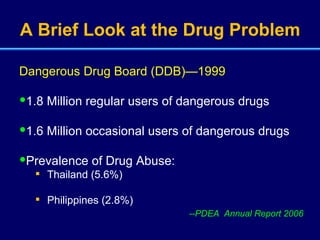
A Brief Look at the Drug Problem Dangerous Drug Board (DDB)—1999  1.8 Million regular users of dangerous drugs 1.6 Million occasional users of dangerous drugs Prevalence of Drug Abuse: Thailand (5.6%) Philippines (2.8%)    --PDEA  Annual Report 2006
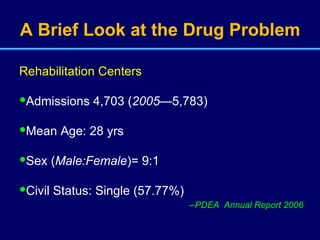
A Brief Look at the Drug Problem Rehabilitation Centers Admissions 4,703 ( 2005 —5,783)  Mean Age: 28 yrs  Sex ( Male:Female )= 9:1 Civil Status: Single (57.77%)   --PDEA  Annual Report 2006
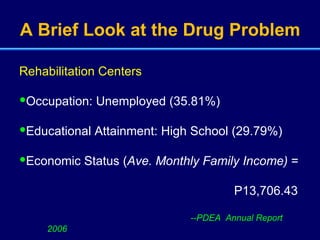
A Brief Look at the Drug Problem Rehabilitation Centers Occupation: Unemployed (35.81%) Educational Attainment: High School (29.79%) Economic Status ( Ave. Monthly Family Income)  =  P13,706.43 --PDEA  Annual Report 2006
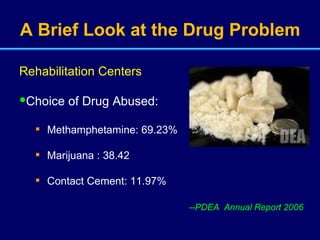
A Brief Look at the Drug Problem Rehabilitation Centers Choice of Drug Abused:  Methamphetamine: 69.23%  Marijuana : 38.42 Contact Cement: 11.97%   --PDEA  Annual Report 2006
A Brief Look at the Drug Problem Rehabilitation Centers Admissions 4,278  Mean Age: 20-29 yrs  Sex ( Male:Female )=  9:1 Civil Status: Single (57.77%)   --PDEA  Annual Report 2007
Why Examine the Psychological Dimension of the Drug Problem? More people trying More people trying again and again The abuser doesn’t get totally cured Must cover the BIO-PSYCHO-SOCIAL aspect of each person
The Treatment Process Discontinuation of substance use Detoxification Rehabilitation Treatment of co-morbid conditions Environmental manipulation  Family therapy Behavioral modification
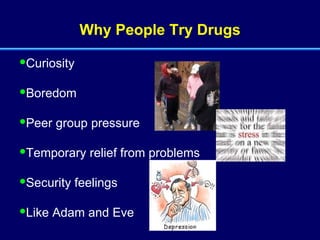
Why People Try Drugs Curiosity Boredom Peer group pressure Temporary relief from problems Security feelings Like Adam and Eve
Etiology: Psychological Theories Addictive Personality need to feel self-worth need to have control over the environment need to feel intimate contact need to accomplish something need to eliminate pain or negative feelings
Etiology: Psychological Theories Behavioral Theories conduct problems of childhood relationship between conduct problems, hyperactivity, impulsivity, and future substance abuse
Psychodynamics Freudian infantile desires  regressive pleasurable adaptation  Neo-Freudian adaptive effort to survive Progressive responses to psychological suffering and deficient self-regulation
Behavioral Models Drug self-administration model Skinner Operant reinforcement Pleasure with drug Conditioned place-preference model Kumar from Pavlov Place conducive to addiction
Why People Continue to Use Drugs Age of anxiety Age of Depression Personal inadequacies, failures and conflicts cause tension Predisposing personality, emotional and behavioral disturbances.
Why People Continue to Use Drugs Primer    Receptor sites Cravings Compelling urge Urgent and overpowering desire Irresistible impulse WHO : desire to experience the effect(s) of a previously experienced psychoactive substance
Why People Continue to Use Drugs Factors Peer Pressure Coping Mechanism to Stress Anxiety Disorders Depression Feel Good
Drug use starts early and peaks in the teen years Evidence from surveys First Drug Use (number of initiates) Infant Teen Adult Older Adult Child
Drug use starts early and peaks in the teen years One of the serious concerns regarding today’s youth About 25% of adolescents 12-17 years of age have illicit drug use
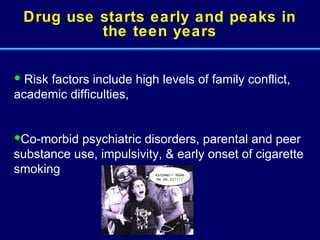
Drug use starts early and peaks in the teen years Risk factors include high levels of family conflict, academic difficulties,  Co-morbid psychiatric disorders, parental and peer substance use, impulsivity, & early onset of cigarette smoking
Drug use starts early and peaks in the teen years
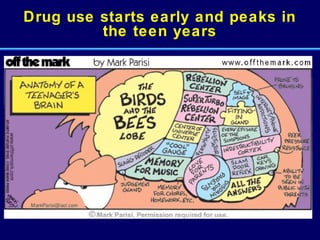
Drug use starts early and peaks in the teen years Lack of connectedness to parents and family Poor training in delaying gratification Much due to ignorance “ Adult-sized CHILD”
Drug use starts early and peaks in the teen years Lack of ability to plan for future Pubertal intensities  Physical challenges – “new found power” Lack emotional stability – identity struggles Need for belonging (gang formations)  Insecurities Independence struggles
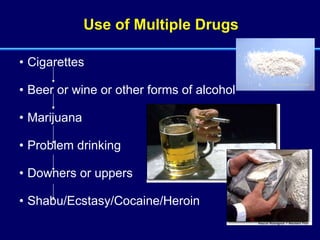
Use of Multiple Drugs Cigarettes Beer or wine or other forms of alcohol Marijuana Problem drinking Downers or uppers  Shabu/Ecstasy/Cocaine/Heroin
Presence of Co-morbid Disorders Attention Deficit Hyperactivity Disorder Conduct Disorder Affective/Mood Disorders Tends not to resolve after a few weeks of abstinence Adults = depressive disorders usually resolve Anxiety Disorders
The good news is… Drug Abuse is a preventable  behavior and  Drug Addiction is a  treatable  disease
Treatment Goals Abstinence Physical, psychiatric and psychosocial well-being of the patient
Matching Patients to  Individual Needs No single treatment is appropriate for all individuals Effective treatment attends to multiple needs of the individual, not just his/her  drug use Treatment must address medical, psychological, social, vocational, and  legal problems www.drugabuse.gov
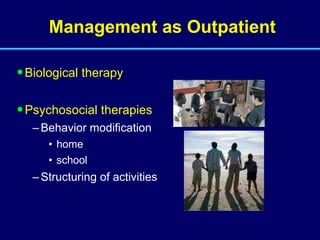
Management  As Outpatient As Rehabilitation Patient In-housed Slightly different setting & approach Treated as Out-patient after
Management as Outpatient Biological therapy Psychosocial therapies Behavior modification home school Structuring of activities
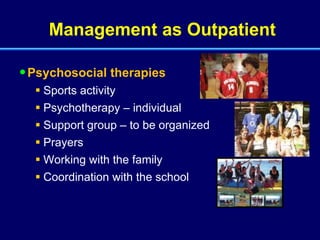
Management as Outpatient Psychosocial therapies Sports activity Psychotherapy – individual Support group – to be organized Prayers Working with the family Coordination with the school
Outpatient Treatment:  Key Elements Explicit structure and expectations Positive and collaborative relationship with the client Teaching information and cognitive-behavioral concepts Positively reinforcing desired behavioral change
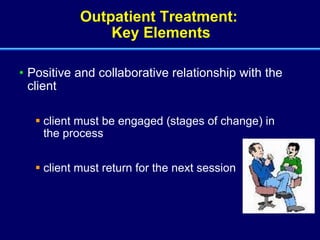
Outpatient Treatment:  Key Elements Positive and collaborative relationship with the client client must be engaged (stages of change) in the process client must return for the next session
Outpatient Treatment:  Key Elements (cont’d) Corrective  feedback using a motivational interaction style Educating family members on the expected course of recovery Periodic urine testing Introducing/encouraging self-help participation
Outpatient Treatment:  Key Elements (cont’d) Periodic urine testing not presented as a monitoring measure a way to help discontinue drug use a useful therapeutic opportunity for insight into client’s behavior
Treatment Considerations Cognitive behavioral approach current treatment of choice focuses on “unlearning” maladaptive behavior and on learning more adaptive responses most closely linked with existing scientific knowledge
Cognitive Behavioral Outpatient Therapy Focus on abstinence Focus on behavior  vs  feelings Focus is behavior  vs  reason behind it Transference is encouraged and utilized Goal is stability  vs  emotional catharsis
Self-Help and Drug Addiction Treatment Complements and extends treatment efforts Most commonly used models include 12-Step (AA, NA) and Smart Recovery Most treatment programs encourage self-help participation during/after treatment www.drugabuse.gov
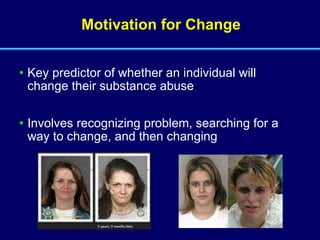
Motivation for Change Key predictor of whether an individual will change their substance abuse Involves recognizing problem, searching for a way to change, and then changing
Motivation for Change Motivational interviewing  seeks to elicit self-motivational statement from patients,  supports behavioral change, and  creates a discrepancy between the patient’s goals and continued alcohol and other drug use.
Guidelines for Therapeutic Relationship Encourage honest expression of feelings Listen and express caring Hold individual responsible for behavior Provide consequences for negative behavior and talk about specific, objectionable actions Do not compromise own values, monitor reaction Communicate to team
Assessing an Adolescent Trust in necessary for a therapeutic alliance. Effective ways to prevent a trusting relationship from developing: To test without the young person’s knowledge To test in spite of the adolescent’s objections To test on parents’ demand
Rehabilitation Not prison, nor punishment Therapeutic environment More protective for the client May be a form of group therapy Not merely a place, but a process as well
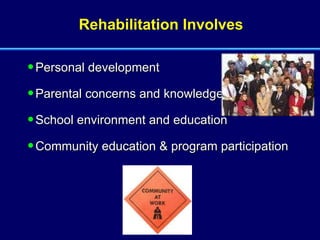
Rehabilitation Involves Personal development Parental concerns and knowledge School environment and education Community education & program participation
Rehabilitation Involves Program in a workplace Mass media education & program involvement Law enforcement Legislation
Duration of Treatment Depends on patient problems/needs Less than 90 days is of limited/no effectiveness for residential/outpatient setting A minimum of 12 months is required for methadone maintenance Longer treatment is often indicated www.drugabuse.gov
Treatment Outcome Measures Substance Use Medical and Physical Health Psychosocial Functioning Employment stability Criminal Justice Involvement Relapse Prevention
Treatment Centers in Iloilo WVMC-Substance Abuse Treatment & Rehabilitation Center WVSUMC for detoxification New Life Therapeutic Center DelaLlana Detention Center Dalayunan Home for Boys
Prevention Strategies Always the best approach A group effort
STRATEGIES FOR DRUG ABUSE PREVENTION IN THE WORKPLACE Company Policies and Procedures on alcoholism and drug abuse. Example: - Tardiness and absenteeism  guidelines;  - Establishing an alcohol /drug-free workplace
STRATEGIES FOR DRUG ABUSE PREVENTION IN THE WORKPLACE Information on harmful effects of drugs and alcohol utilizing the following media: -  Posters, Comics, Seminars, Newsletter, Leaflets, Paging System, Stage  Presentation, Skits, Exhibitions and Film Showing Example:
STRATEGIES FOR DRUG ABUSE PREVENTION IN THE WORKPLACE Education Example: Employee Education Program Training of Staff/Supervisors for EAP Training on Parenting
STRATEGIES FOR DRUG ABUSE PREVENTION IN THE WORKPLACE Positive alternatives - opportunities for wholesome recreation and self-expression. -  Sports, Cultural Activities and Livelihood Activities Example:
ineffective parenting chaotic home environment lack of mutual attachments/nurturing inappropriate behavior in the classroom failure in school performance Prevention Programs Should . . . . Reduce Risk Factors www.drugabuse.gov
poor social coping skills affiliations with deviant peers perceptions of approval of drug-using behaviors in the school, peer, and community environments Prevention Programs Should . . . . Reduce Risk Factors www.drugabuse.gov
Prevention Programs Should . . . . strong family bonds parental monitoring parental involvement success in school performance prosocial institutions (e.g. such as family, school, and religious organizations) conventional norms about drug use www.drugabuse.gov Enhance Protective Factors
Resist drugs Strengthen personal commitments against drug use Increase social competency Reinforce attitudes against drug use Prevention Programs Should . . . . www.drugabuse.gov Include Interactive Skills-Based Training
Involve Communities and Schools Media campaigns and policy changes Strengthen norms against drug use Address specific nature of local drug problem www.drugabuse.gov Prevention Programs Should . . . .
Provides greater impact than parent-only or child-only programs Include at each stage of development Involve effective parenting skills Prevention Programs Should be. . . . www.drugabuse.gov Family-Focused
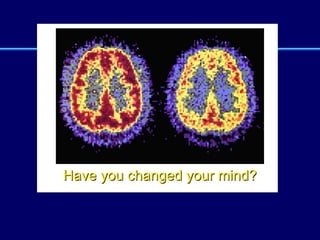
Have you changed your mind?
 

Psychological dimensions

  • 1.
    The Psychological Dimensionsof the Drug Problem & Treatment and Rehabilitation of Drug Dependents Rey M. Mollenido, MD
  • 2.
    A Brief Lookat the Drug Problem Dangerous Drug Board (DDB)—1999 1.8 Million regular users of dangerous drugs 1.6 Million occasional users of dangerous drugs Prevalence of Drug Abuse: Thailand (5.6%) Philippines (2.8%) --PDEA Annual Report 2006
  • 3.
    A Brief Lookat the Drug Problem Rehabilitation Centers Admissions 4,703 ( 2005 —5,783) Mean Age: 28 yrs Sex ( Male:Female )= 9:1 Civil Status: Single (57.77%) --PDEA Annual Report 2006
  • 4.
    A Brief Lookat the Drug Problem Rehabilitation Centers Occupation: Unemployed (35.81%) Educational Attainment: High School (29.79%) Economic Status ( Ave. Monthly Family Income) = P13,706.43 --PDEA Annual Report 2006
  • 5.
    A Brief Lookat the Drug Problem Rehabilitation Centers Choice of Drug Abused: Methamphetamine: 69.23% Marijuana : 38.42 Contact Cement: 11.97% --PDEA Annual Report 2006
  • 6.
    A Brief Lookat the Drug Problem Rehabilitation Centers Admissions 4,278 Mean Age: 20-29 yrs Sex ( Male:Female )= 9:1 Civil Status: Single (57.77%) --PDEA Annual Report 2007
  • 7.
    Why Examine thePsychological Dimension of the Drug Problem? More people trying More people trying again and again The abuser doesn’t get totally cured Must cover the BIO-PSYCHO-SOCIAL aspect of each person
  • 8.
    The Treatment ProcessDiscontinuation of substance use Detoxification Rehabilitation Treatment of co-morbid conditions Environmental manipulation Family therapy Behavioral modification
  • 9.
    The Treatment ProcessDiscontinuation of substance use Detoxification Rehabilitation Treatment of co-morbid conditions Environmental manipulation Family therapy Behavioral modification
  • 10.
    The Treatment ProcessDiscontinuation of substance use Detoxification Rehabilitation Treatment of co-morbid conditions Environmental manipulation Family therapy Behavioral modification
  • 11.
    The Treatment ProcessDiscontinuation of substance use Detoxification Rehabilitation Treatment of co-morbid conditions Environmental manipulation Family therapy Behavioral modification
  • 12.
    The Treatment ProcessDiscontinuation of substance use Detoxification Rehabilitation Treatment of co-morbid conditions Environmental manipulation Family therapy Behavioral modification
  • 13.
    The Treatment ProcessDiscontinuation of substance use Detoxification Rehabilitation Treatment of co-morbid conditions Environmental manipulation Family therapy Behavioral modification
  • 14.
    The Treatment ProcessDiscontinuation of substance use Detoxification Rehabilitation Treatment of co-morbid conditions Environmental manipulation Family therapy Behavioral modification
  • 15.
    The Treatment ProcessDiscontinuation of substance use Detoxification Rehabilitation Treatment of co-morbid conditions Environmental manipulation Family therapy Behavioral modification
  • 16.
    Why People TryDrugs Curiosity Boredom Peer group pressure Temporary relief from problems Security feelings Like Adam and Eve
  • 17.
    Etiology: Psychological TheoriesAddictive Personality need to feel self-worth need to have control over the environment need to feel intimate contact need to accomplish something need to eliminate pain or negative feelings
  • 18.
    Etiology: Psychological TheoriesBehavioral Theories conduct problems of childhood relationship between conduct problems, hyperactivity, impulsivity, and future substance abuse
  • 19.
    Psychodynamics Freudian infantiledesires regressive pleasurable adaptation Neo-Freudian adaptive effort to survive Progressive responses to psychological suffering and deficient self-regulation
  • 20.
    Behavioral Models Drugself-administration model Skinner Operant reinforcement Pleasure with drug Conditioned place-preference model Kumar from Pavlov Place conducive to addiction
  • 21.
    Why People Continueto Use Drugs Age of anxiety Age of Depression Personal inadequacies, failures and conflicts cause tension Predisposing personality, emotional and behavioral disturbances.
  • 22.
    Why People Continueto Use Drugs Primer  Receptor sites Cravings Compelling urge Urgent and overpowering desire Irresistible impulse WHO : desire to experience the effect(s) of a previously experienced psychoactive substance
  • 23.
    Why People Continueto Use Drugs Factors Peer Pressure Coping Mechanism to Stress Anxiety Disorders Depression Feel Good
  • 24.
    Drug use startsearly and peaks in the teen years Evidence from surveys First Drug Use (number of initiates) Infant Teen Adult Older Adult Child
  • 25.
    Drug use startsearly and peaks in the teen years One of the serious concerns regarding today’s youth About 25% of adolescents 12-17 years of age have illicit drug use
  • 26.
    Drug use startsearly and peaks in the teen years Risk factors include high levels of family conflict, academic difficulties, Co-morbid psychiatric disorders, parental and peer substance use, impulsivity, & early onset of cigarette smoking
  • 27.
    Drug use startsearly and peaks in the teen years
  • 28.
    Drug use startsearly and peaks in the teen years Lack of connectedness to parents and family Poor training in delaying gratification Much due to ignorance “ Adult-sized CHILD”
  • 29.
    Drug use startsearly and peaks in the teen years Lack of ability to plan for future Pubertal intensities Physical challenges – “new found power” Lack emotional stability – identity struggles Need for belonging (gang formations) Insecurities Independence struggles
  • 30.
    Use of MultipleDrugs Cigarettes Beer or wine or other forms of alcohol Marijuana Problem drinking Downers or uppers Shabu/Ecstasy/Cocaine/Heroin
  • 31.
    Presence of Co-morbidDisorders Attention Deficit Hyperactivity Disorder Conduct Disorder Affective/Mood Disorders Tends not to resolve after a few weeks of abstinence Adults = depressive disorders usually resolve Anxiety Disorders
  • 32.
    The good newsis… Drug Abuse is a preventable behavior and Drug Addiction is a treatable disease
  • 33.
    Treatment Goals AbstinencePhysical, psychiatric and psychosocial well-being of the patient
  • 34.
    Matching Patients to Individual Needs No single treatment is appropriate for all individuals Effective treatment attends to multiple needs of the individual, not just his/her drug use Treatment must address medical, psychological, social, vocational, and legal problems www.drugabuse.gov
  • 35.
    Management AsOutpatient As Rehabilitation Patient In-housed Slightly different setting & approach Treated as Out-patient after
  • 36.
    Management as OutpatientBiological therapy Psychosocial therapies Behavior modification home school Structuring of activities
  • 37.
    Management as OutpatientPsychosocial therapies Sports activity Psychotherapy – individual Support group – to be organized Prayers Working with the family Coordination with the school
  • 38.
    Outpatient Treatment: Key Elements Explicit structure and expectations Positive and collaborative relationship with the client Teaching information and cognitive-behavioral concepts Positively reinforcing desired behavioral change
  • 39.
    Outpatient Treatment: Key Elements Positive and collaborative relationship with the client client must be engaged (stages of change) in the process client must return for the next session
  • 40.
    Outpatient Treatment: Key Elements (cont’d) Corrective feedback using a motivational interaction style Educating family members on the expected course of recovery Periodic urine testing Introducing/encouraging self-help participation
  • 41.
    Outpatient Treatment: Key Elements (cont’d) Periodic urine testing not presented as a monitoring measure a way to help discontinue drug use a useful therapeutic opportunity for insight into client’s behavior
  • 42.
    Treatment Considerations Cognitivebehavioral approach current treatment of choice focuses on “unlearning” maladaptive behavior and on learning more adaptive responses most closely linked with existing scientific knowledge
  • 43.
    Cognitive Behavioral OutpatientTherapy Focus on abstinence Focus on behavior vs feelings Focus is behavior vs reason behind it Transference is encouraged and utilized Goal is stability vs emotional catharsis
  • 44.
    Self-Help and DrugAddiction Treatment Complements and extends treatment efforts Most commonly used models include 12-Step (AA, NA) and Smart Recovery Most treatment programs encourage self-help participation during/after treatment www.drugabuse.gov
  • 45.
    Motivation for ChangeKey predictor of whether an individual will change their substance abuse Involves recognizing problem, searching for a way to change, and then changing
  • 46.
    Motivation for ChangeMotivational interviewing seeks to elicit self-motivational statement from patients, supports behavioral change, and creates a discrepancy between the patient’s goals and continued alcohol and other drug use.
  • 47.
    Guidelines for TherapeuticRelationship Encourage honest expression of feelings Listen and express caring Hold individual responsible for behavior Provide consequences for negative behavior and talk about specific, objectionable actions Do not compromise own values, monitor reaction Communicate to team
  • 48.
    Assessing an AdolescentTrust in necessary for a therapeutic alliance. Effective ways to prevent a trusting relationship from developing: To test without the young person’s knowledge To test in spite of the adolescent’s objections To test on parents’ demand
  • 49.
    Rehabilitation Not prison,nor punishment Therapeutic environment More protective for the client May be a form of group therapy Not merely a place, but a process as well
  • 50.
    Rehabilitation Involves Personaldevelopment Parental concerns and knowledge School environment and education Community education & program participation
  • 51.
    Rehabilitation Involves Programin a workplace Mass media education & program involvement Law enforcement Legislation
  • 52.
    Duration of TreatmentDepends on patient problems/needs Less than 90 days is of limited/no effectiveness for residential/outpatient setting A minimum of 12 months is required for methadone maintenance Longer treatment is often indicated www.drugabuse.gov
  • 53.
    Treatment Outcome MeasuresSubstance Use Medical and Physical Health Psychosocial Functioning Employment stability Criminal Justice Involvement Relapse Prevention
  • 54.
    Treatment Centers inIloilo WVMC-Substance Abuse Treatment & Rehabilitation Center WVSUMC for detoxification New Life Therapeutic Center DelaLlana Detention Center Dalayunan Home for Boys
  • 55.
    Prevention Strategies Alwaysthe best approach A group effort
  • 56.
    STRATEGIES FOR DRUGABUSE PREVENTION IN THE WORKPLACE Company Policies and Procedures on alcoholism and drug abuse. Example: - Tardiness and absenteeism guidelines; - Establishing an alcohol /drug-free workplace
  • 57.
    STRATEGIES FOR DRUGABUSE PREVENTION IN THE WORKPLACE Information on harmful effects of drugs and alcohol utilizing the following media: - Posters, Comics, Seminars, Newsletter, Leaflets, Paging System, Stage Presentation, Skits, Exhibitions and Film Showing Example:
  • 58.
    STRATEGIES FOR DRUGABUSE PREVENTION IN THE WORKPLACE Education Example: Employee Education Program Training of Staff/Supervisors for EAP Training on Parenting
  • 59.
    STRATEGIES FOR DRUGABUSE PREVENTION IN THE WORKPLACE Positive alternatives - opportunities for wholesome recreation and self-expression. - Sports, Cultural Activities and Livelihood Activities Example:
  • 60.
    ineffective parenting chaotichome environment lack of mutual attachments/nurturing inappropriate behavior in the classroom failure in school performance Prevention Programs Should . . . . Reduce Risk Factors www.drugabuse.gov
  • 61.
    poor social copingskills affiliations with deviant peers perceptions of approval of drug-using behaviors in the school, peer, and community environments Prevention Programs Should . . . . Reduce Risk Factors www.drugabuse.gov
  • 62.
    Prevention Programs Should. . . . strong family bonds parental monitoring parental involvement success in school performance prosocial institutions (e.g. such as family, school, and religious organizations) conventional norms about drug use www.drugabuse.gov Enhance Protective Factors
  • 63.
    Resist drugs Strengthenpersonal commitments against drug use Increase social competency Reinforce attitudes against drug use Prevention Programs Should . . . . www.drugabuse.gov Include Interactive Skills-Based Training
  • 64.
    Involve Communities andSchools Media campaigns and policy changes Strengthen norms against drug use Address specific nature of local drug problem www.drugabuse.gov Prevention Programs Should . . . .
  • 65.
    Provides greater impactthan parent-only or child-only programs Include at each stage of development Involve effective parenting skills Prevention Programs Should be. . . . www.drugabuse.gov Family-Focused
  • 66.
    Have you changedyour mind?
  • 67.

Editor's Notes

  • #18 11
  • #19 11
  • #26 EPS that resulted from a hypodopaminergic state limited the usefulness of conventional antipyschotics. Aripiprazole, through its activation of the dopamine receptor, produces significantly less EPS than the prototype conventional agent haloperidol. Data were pooled from five 4- to 6-week double-blind multicenter studies that included patients randomized to receive aripiprazole (n=932), placebo (n=416), or haloperidol (n=201). Spontaneous reports of EPS-related adverse events (dystonic, parkinsonian, akathisia, dyskinetic, and residual) were measured on the Simpson-Angus Scale (SAS), Abnormal Involuntary Movement Scale (AIMS), and the Barnes Akathisia Rating Scale. No significant difference was seen between the placebo and aripiprazole groups (19.4% vs 21.1%); however, the incidence of EPS was significantly higher with haloperidol compared with aripiprazole (43.5 % vs 21.1%; P <.001). Reference Marder S, McQuade E, Stock E, et al. Aripiprazole in the treatment of schizophrenia: safety and tolerability in short-term, placebo-controlled trials. Schizophr Res . 2003;61:123-136.
  • #27 EPS that resulted from a hypodopaminergic state limited the usefulness of conventional antipyschotics. Aripiprazole, through its activation of the dopamine receptor, produces significantly less EPS than the prototype conventional agent haloperidol. Data were pooled from five 4- to 6-week double-blind multicenter studies that included patients randomized to receive aripiprazole (n=932), placebo (n=416), or haloperidol (n=201). Spontaneous reports of EPS-related adverse events (dystonic, parkinsonian, akathisia, dyskinetic, and residual) were measured on the Simpson-Angus Scale (SAS), Abnormal Involuntary Movement Scale (AIMS), and the Barnes Akathisia Rating Scale. No significant difference was seen between the placebo and aripiprazole groups (19.4% vs 21.1%); however, the incidence of EPS was significantly higher with haloperidol compared with aripiprazole (43.5 % vs 21.1%; P <.001). Reference Marder S, McQuade E, Stock E, et al. Aripiprazole in the treatment of schizophrenia: safety and tolerability in short-term, placebo-controlled trials. Schizophr Res . 2003;61:123-136.
  • #28 EPS that resulted from a hypodopaminergic state limited the usefulness of conventional antipyschotics. Aripiprazole, through its activation of the dopamine receptor, produces significantly less EPS than the prototype conventional agent haloperidol. Data were pooled from five 4- to 6-week double-blind multicenter studies that included patients randomized to receive aripiprazole (n=932), placebo (n=416), or haloperidol (n=201). Spontaneous reports of EPS-related adverse events (dystonic, parkinsonian, akathisia, dyskinetic, and residual) were measured on the Simpson-Angus Scale (SAS), Abnormal Involuntary Movement Scale (AIMS), and the Barnes Akathisia Rating Scale. No significant difference was seen between the placebo and aripiprazole groups (19.4% vs 21.1%); however, the incidence of EPS was significantly higher with haloperidol compared with aripiprazole (43.5 % vs 21.1%; P <.001). Reference Marder S, McQuade E, Stock E, et al. Aripiprazole in the treatment of schizophrenia: safety and tolerability in short-term, placebo-controlled trials. Schizophr Res . 2003;61:123-136.
  • #33 Slide 11: A message to remember.     We discussed many important points today. Two points, in particular. I hope you remember. One is that drug abuse and addiction affect every segment of society. That’s all of us. Everyone. Not one person is immune from the disease of addiction.   These slides today demonstrate that there are observable changes in brain function that take place when drugs are used. We saw that the brains of addicts are different from the brains of people who are not addicted. And it is difficult, in some cases impossible, to return the brain to normal. Scientists, like those who work at the National Institute on Drug Abuse, are working to develop treatments to help people who are addicted to drugs. But treatment, like addiction, is a complex issue.   Courtesy of Partnership for a Drug Free America.
  • #35 Matching Patients to Individual Needs No single treatment is appropriate for all individuals. Matching treatment setting, interventions, and services to each individual’s particular problems and needs is critical to his or her ultimate success in returning to productive functioning in the family, workplace, and society. Effective treatment attends to multiple needs of the individual, not just his or her drug use. To be effective, treatment must address the individual’s drug use and any associated medical, psychological, social, vocational, and legal problems.  
  • #45 Self-Help and Drug Addiction Treatment Self-help groups can complement and extend the effects of professional drug addiction treatment. The most prominent self-help groups are those affiliated with Alcoholics Anonymous (AA), Narcotics Anonymous (NA), and Cocaine Anonymous (CA), all of which are based on the 12-step model and Smart Recovery. Most drug addiction treatment programs encourage patients to participate in a self-help group during and after formal treatment.
  • #48 32
  • #53 Duration of Treatment Individuals progress through drug addiction treatment at various speeds, so there is no predetermined length of treatment. However, research has shown unequivocally that good outcomes are contingent on adequate lengths of treatment. Generally, for residential or outpatient treatment, participation for less than 90 days is of limited or no effectiveness, and treatments lasting significantly longer often are indicated. For methadone maintenance, 12 months of treatment is the minimum, and some opiate-addicted individuals will continue to benefit from methadone maintenance treatment over a period of years.
  • #61 Risk Factors Prevention research reveals there are many risk factors for drug abuse, each representing a challenge to the psychological and social development of the individual and each having a different impact depending on the phase of a young person’s development. For this reason, those factors that affect early development in the family are probably the most crucial such as: -ineffective parenting, especially with children with difficult temperaments and conduct disorders; -chaotic home environments, particularly in which parents abuse substances or suffer from mental illnesses and; -lack of mutual attachments and nurturing. Other risk factors relate to children interacting with other socialization agents outside of the family, specifically the school, peers, and the community. Some of these factors include: -inappropriate behavior in the classroom -failure in school performance -poor social coping skills -affiliations with deviant peers -perceptions of approval of drug-using behaviors in the school, peer, and community environments
  • #62 Risk Factors Prevention research reveals there are many risk factors for drug abuse, each representing a challenge to the psychological and social development of the individual and each having a different impact depending on the phase of a young person’s development. For this reason, those factors that affect early development in the family are probably the most crucial such as: -ineffective parenting, especially with children with difficult temperaments and conduct disorders; -chaotic home environments, particularly in which parents abuse substances or suffer from mental illnesses and; -lack of mutual attachments and nurturing. Other risk factors relate to children interacting with other socialization agents outside of the family, specifically the school, peers, and the community. Some of these factors include: -inappropriate behavior in the classroom -failure in school performance -poor social coping skills -affiliations with deviant peers -perceptions of approval of drug-using behaviors in the school, peer, and community environments
  • #63 Protective Factors Certain protective factors also have been identified. These factors are not always the opposite of risk factors. Their impact also varies along the developmental process. The most salient protective factors include: -strong family bonds -parental monitoring -parental involvement -success in school performance -prosocial institutions (e.g. such as family, school, and religious organizations) -conventional norms about drug use
  • #64 Skills-Based Training Prevention program should include skills training to help children and adolescents resist drugs, strengthen personal commitments against drug use, increase social competency (e.g., communications, peer relationships, self efficacy, and assertiveness), and reinforce attitudes against drug use. Programs should use interactive methods (e.g., group discussion) rather than didactic teaching methods alone. In addition, most effective programs are long-term and use “booster sessions” to reinforce content.
  • #65 Community and School Involvement Community programs that include media campaigns and policy changes, such as new regulations that restrict access to alcohol, tobacco, or other drugs, are more effective when they are accompanied by school or family interventions. Community programs need to strengthen norms against drug use in all drug abuse prevention settings, including the family and the school. In addition, prevention programming should be adapted to address the specific nature of the drug abuse problem in the local community.
  • #66 Family-Focused Prevention Family focused prevention efforts have a greater impact than strategies that focus on parents only or children only. It is important to access families of children at each stage of the child’s development and to train parents in effective parenting skills help reduce conduct problems and improve parent-child relationships.
  • #67 Slide 14: Have you changed your mind? Here is our last slide. As we look at side-by-side PET scans of a person who has never used cocaine compared with a cocaine addict, can you tell which brain is more active and healthy? Take a guess. Yes, the brain on the left with an abundance of red is the healthy, active brain. With a little bit of knowledge about what drug addiction actually is, anyone —not just neuroscientists and neurobiologists—can see the changes in brain activity caused by drug abuse and addiction. The PET scans we’ve looked at today prove that. We’ve seen the scientific facts. We’ve learned that addiction is a brain disease. And we’ve also learned that scientists are making great strides in developing treatments for addiction. There will be no magic charm to make addiction go away. But educated and informed with the scientific facts about what drugs can do to the brain, we are each in a better position to decide whether or not to take drugs in the first place. Given the facts, have you changed your mind? Photo courtesy of NIDA. If You Change Your Mind. Student magazine. NIH Publication No. 93-3474, 1993.
  • #68 Slide 14: Have you changed your mind? Here is our last slide. As we look at side-by-side PET scans of a person who has never used cocaine compared with a cocaine addict, can you tell which brain is more active and healthy? Take a guess. Yes, the brain on the left with an abundance of red is the healthy, active brain. With a little bit of knowledge about what drug addiction actually is, anyone —not just neuroscientists and neurobiologists—can see the changes in brain activity caused by drug abuse and addiction. The PET scans we’ve looked at today prove that. We’ve seen the scientific facts. We’ve learned that addiction is a brain disease. And we’ve also learned that scientists are making great strides in developing treatments for addiction. There will be no magic charm to make addiction go away. But educated and informed with the scientific facts about what drugs can do to the brain, we are each in a better position to decide whether or not to take drugs in the first place. Given the facts, have you changed your mind? Photo courtesy of NIDA. If You Change Your Mind. Student magazine. NIH Publication No. 93-3474, 1993.