





Meaningful Use: The Fine Print
Institute for Behavioral Health Informatics
November 11th 2010
The Statements
Become Meaningful Use Certified
Fulfill 15 Core and 5 Menu Requirements
Receive $67,300 per provider
Start Receiving Incentives in 2011
1) Results may vary
2) Not available in all states
3) See CMS for Details
Background
• Health IT has tremendous potential to
transform how health care is delivered
• Health Information Technology for
Economic & Clinical Health Act (HITECH)
attempts to realize that potential
• $34 billion in financial incentives to
Medicare & Medicaid providers for the
adoption and meaningful use of Health IT
Critical Goals
• Increase care coordination and foster better
doctor-patient communication
• Reduce medical errors and improve patient
safety
• Support delivery of evidence based care
• Provide patients with their own, portable
health information
• Improve quality of care, while fostering more
cost effective delivery
Meaningful Use
Multi-year multi-stage incentive program to
help expand Health IT infrastructure, spur
the adoption of Certified EHR Technology
and utilize it to reach a series of specified
objectives
Medicare Incentives
• Hospitals
– Medicare Hospitals and MA-affiliated hospitals
– Critical Access Hospitals (CAH)
• Eligible Professionals (EP)
– Non hospital-based MD, DO, DDS, DDM,
Podiatrists, Optometrists, Chiropractors
– Must see 50% of patients at a facility that has
certified EHR technology
Who is eligible
• Hospital-based providers – 90% or more
of their covered professional services in
either an inpatient (POS 21) or emergency
room (POS 23) of a hospital
• An EP can only assign their
reimbursement to a single taxpayer
identification number
A Few Key Points
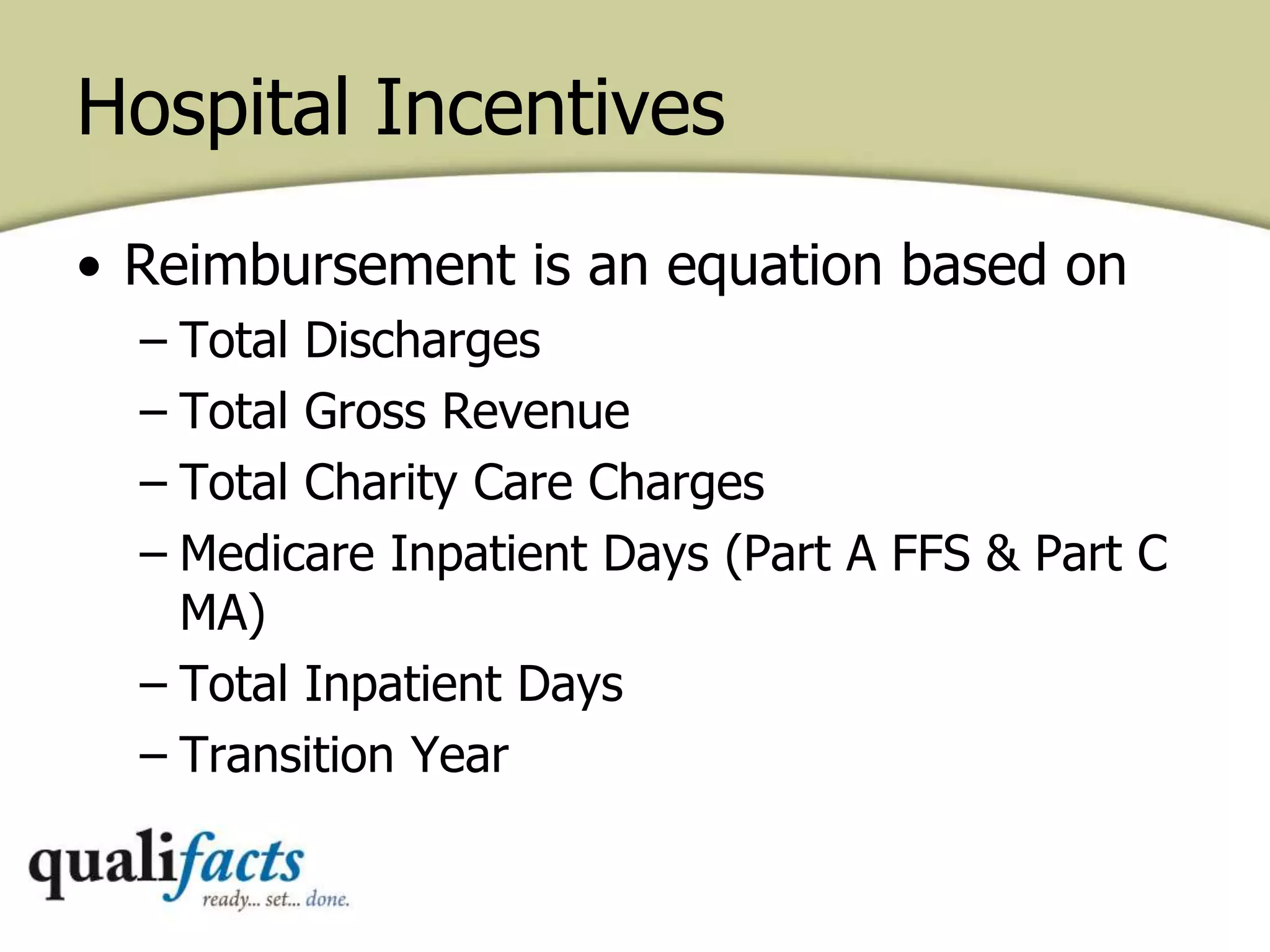
Hospital Incentives
• Reimbursement is an equation based on
– Total Discharges
– Total Gross Revenue
– Total Charity Care Charges
– Medicare Inpatient Days (Part A FFS & Part C
MA)
– Total Inpatient Days
– Transition Year
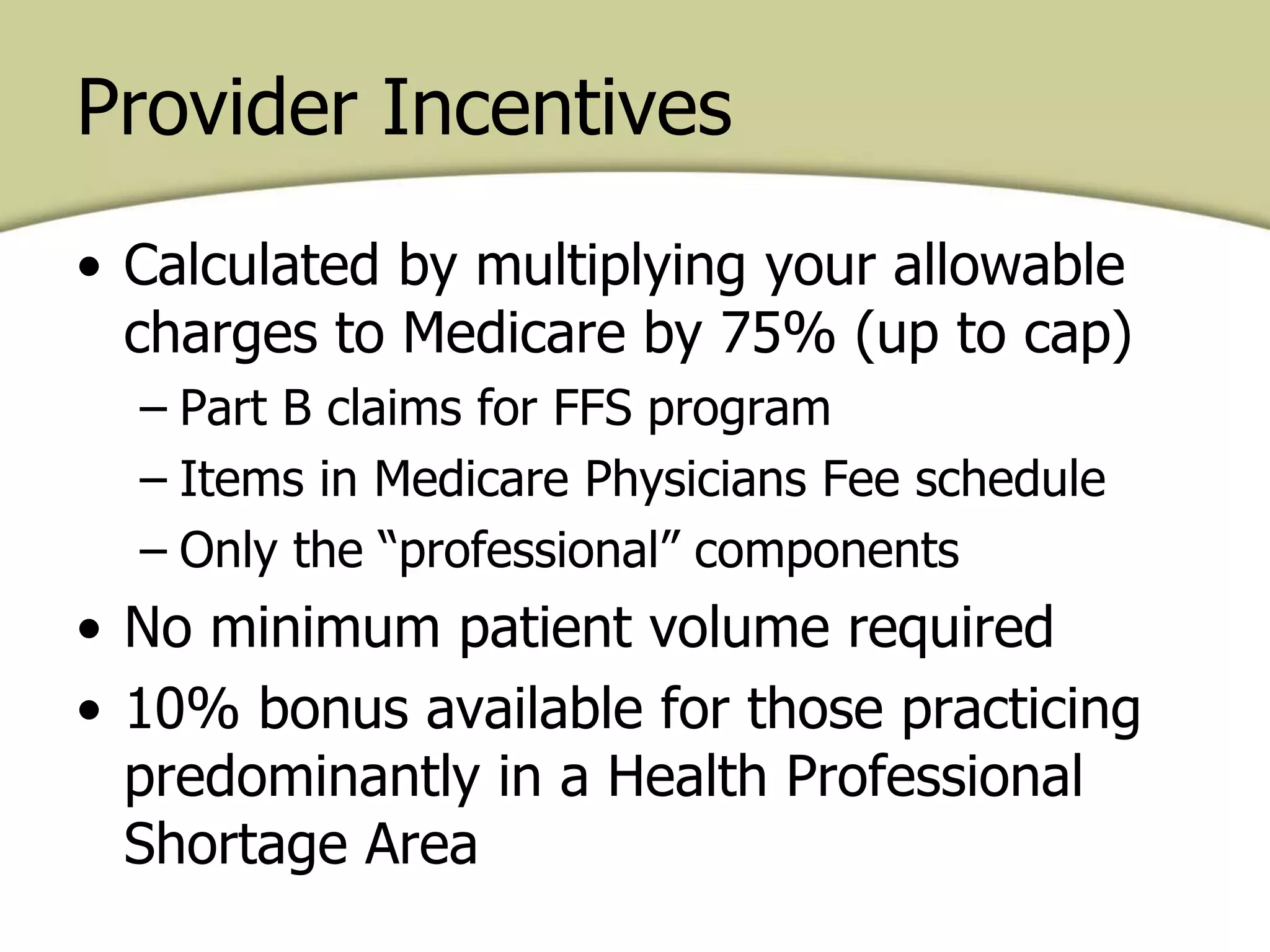
Provider Incentives
• Calculated by multiplying your allowable
charges to Medicare by 75% (up to cap)
– Part B claims for FFS program
– Items in Medicare Physicians Fee schedule
– Only the “professional” components
• No minimum patient volume required
• 10% bonus available for those practicing
predominantly in a Health Professional
Shortage Area
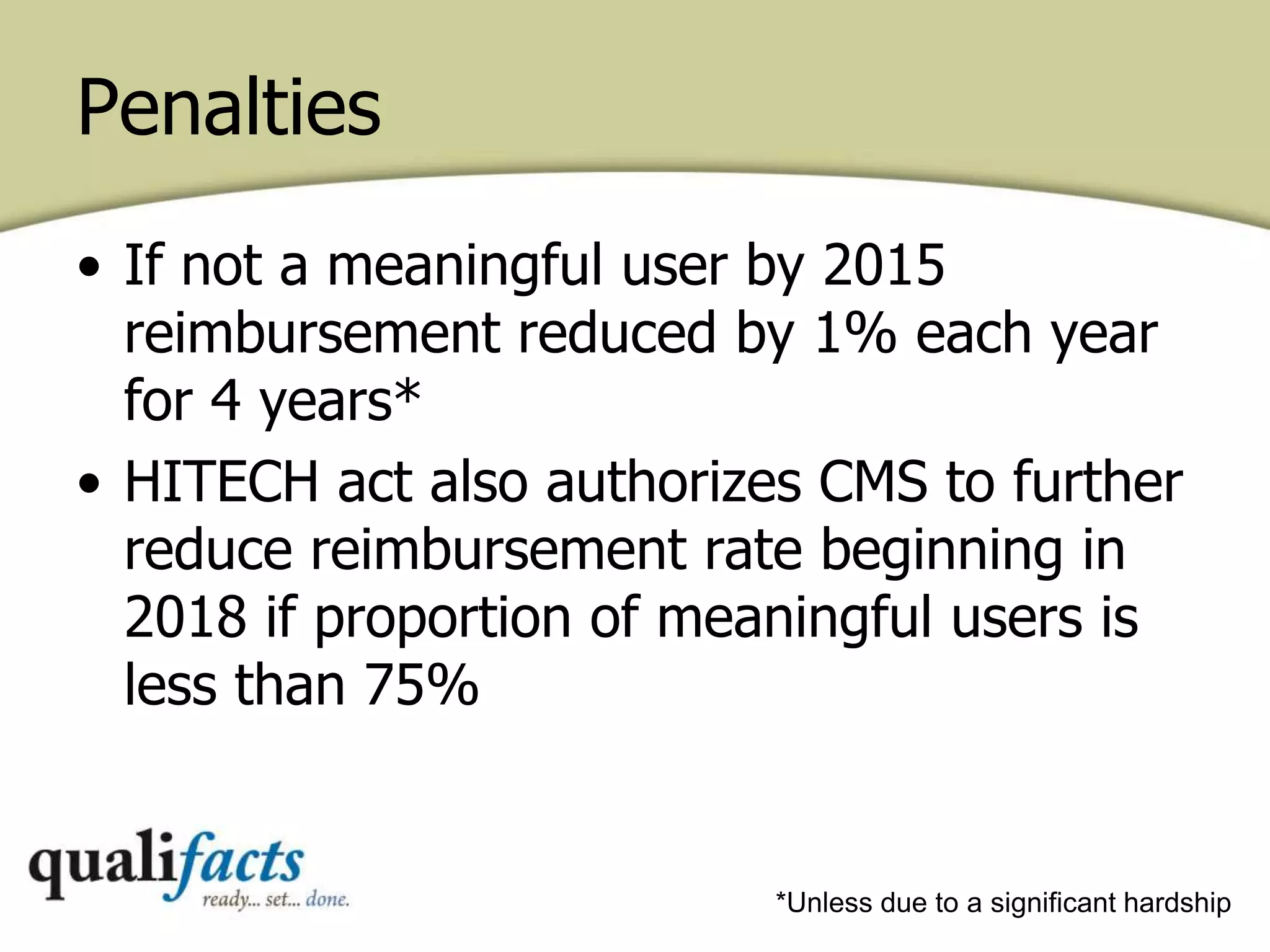
Penalties
• If not a meaningful user by 2015
reimbursement reduced by 1% each year
for 4 years*
• HITECH act also authorizes CMS to further
reduce reimbursement rate beginning in
2018 if proportion of meaningful users is
less than 75%
*Unless due to a significant hardship
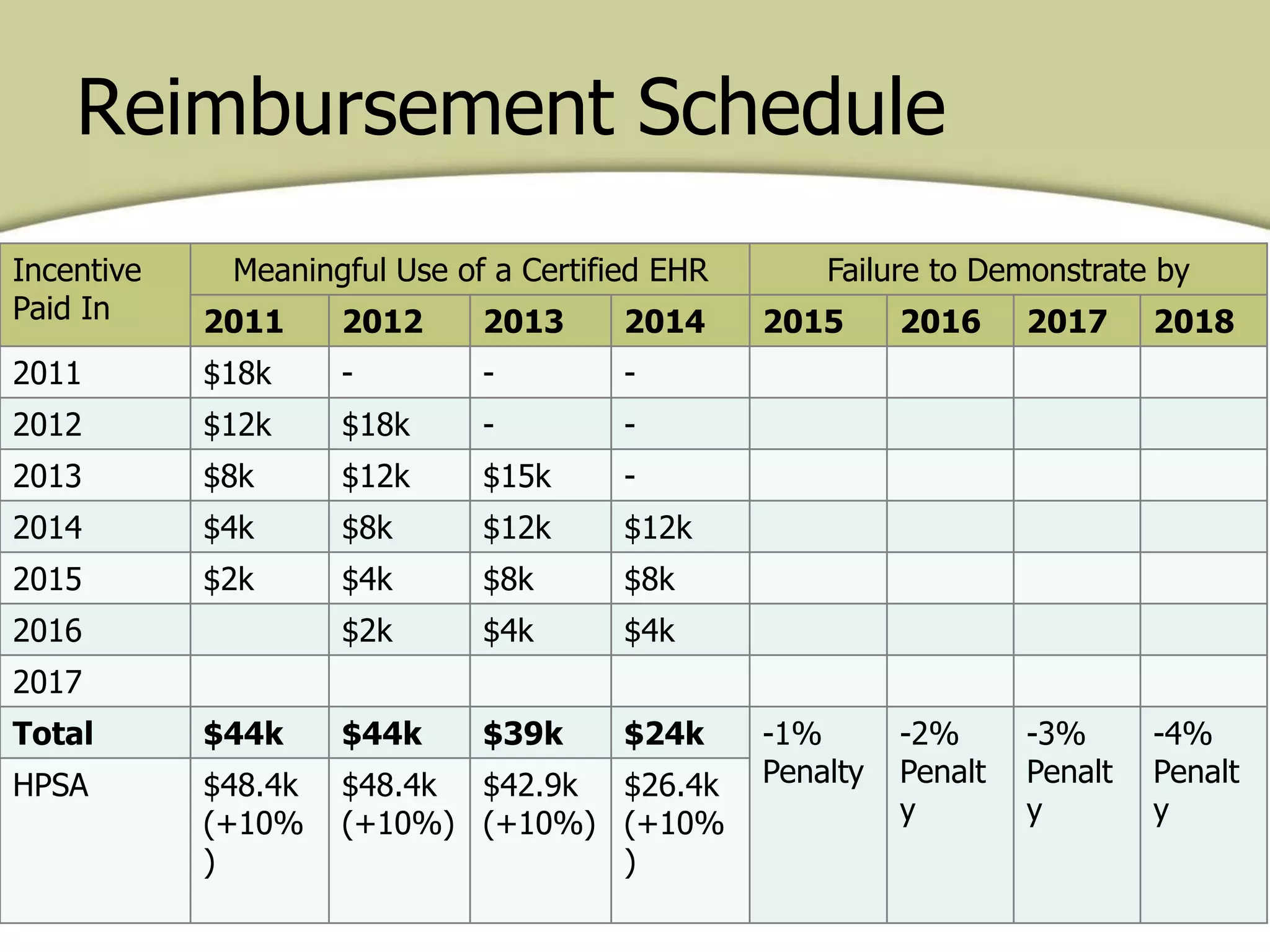
Reimbursement Schedule
Incentive
Paid In
Meaningful Use of a Certified EHR Failure to Demonstrate by
2011 2012 2013 2014 2015 2016 2017 2018
2011 $18k - - -
2012 $12k $18k - -
2013 $8k $12k $15k -
2014 $4k $8k $12k $12k
2015 $2k $4k $8k $8k
2016 $2k $4k $4k
2017
Total $44k $44k $39k $24k -1%
Penalty
-2%
Penalt
y
-3%
Penalt
y
-4%
Penalt
y
HPSA $48.4k
(+10%
)
$48.4k
(+10%)
$42.9k
(+10%)
$26.4k
(+10%
)
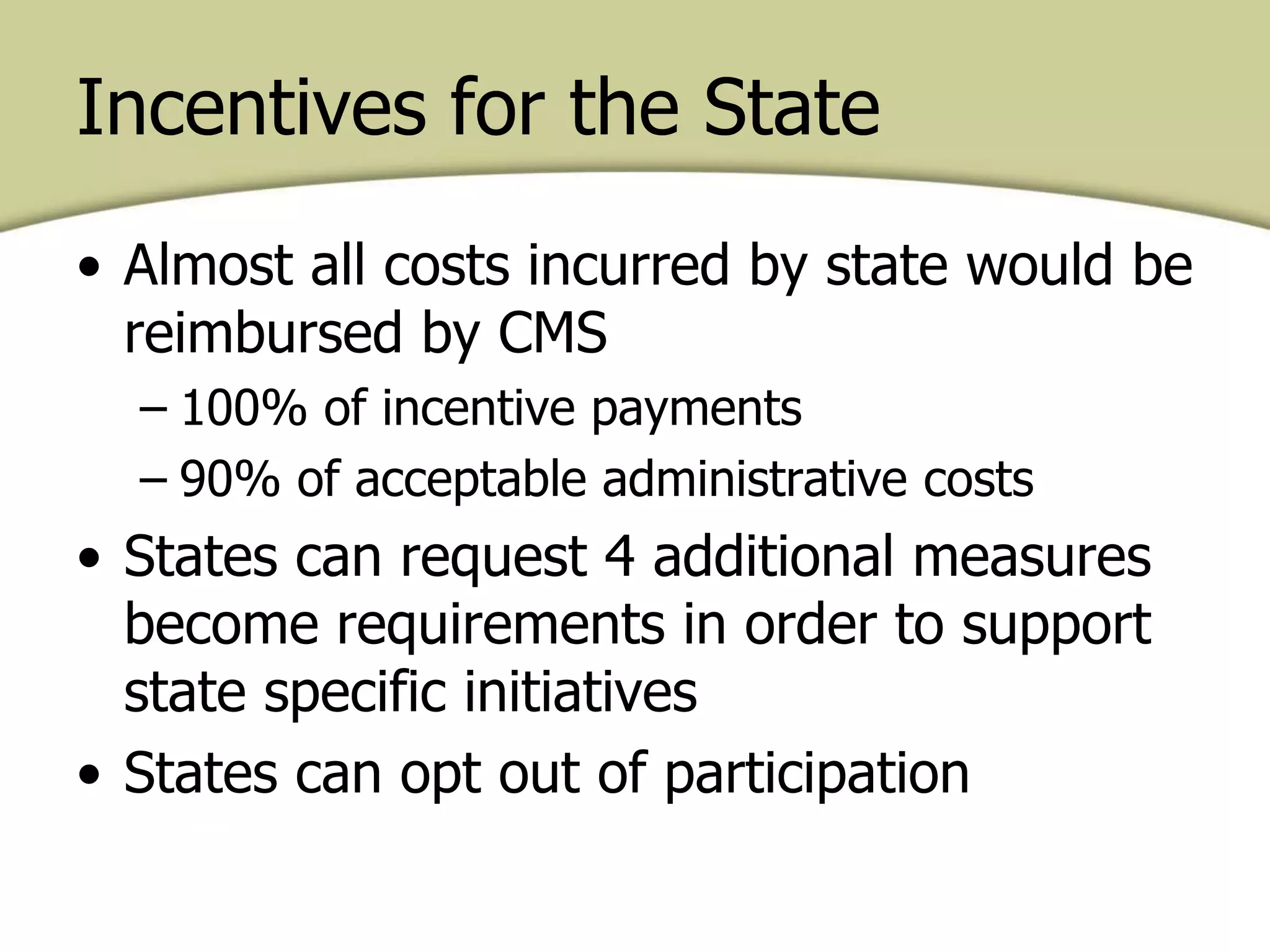
Medicaid Incentives
• Almost all costs incurred by state would be
reimbursed by CMS
– 100% of incentive payments
– 90% of acceptable administrative costs
• States can request 4 additional measures
become requirements in order to support
state specific initiatives
• States can opt out of participation
Incentives for the State
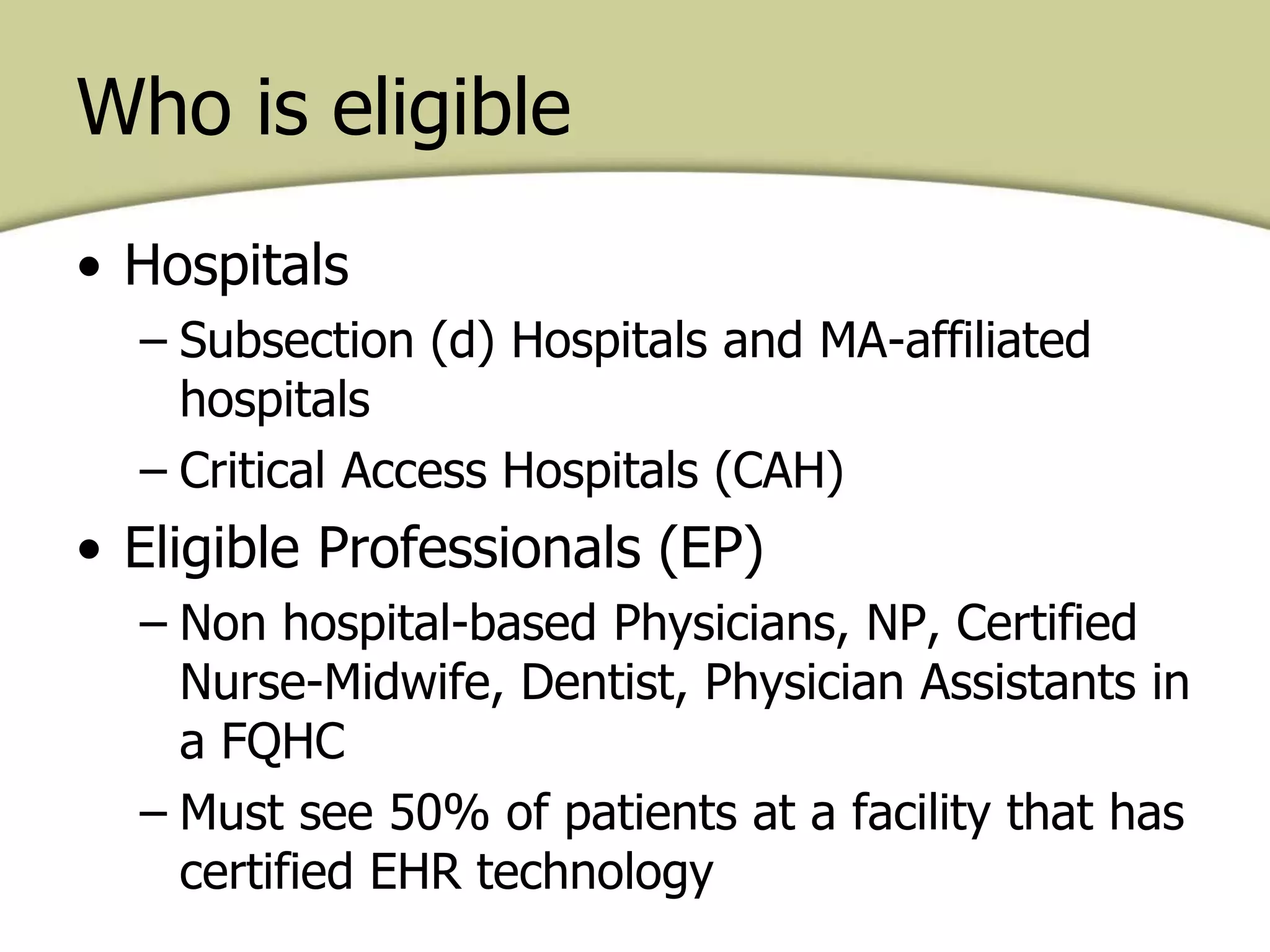
• Hospitals
– Subsection (d) Hospitals and MA-affiliated
hospitals
– Critical Access Hospitals (CAH)
• Eligible Professionals (EP)
– Non hospital-based Physicians, NP, Certified
Nurse-Midwife, Dentist, Physician Assistants in
a FQHC
– Must see 50% of patients at a facility that has
certified EHR technology
Who is eligible
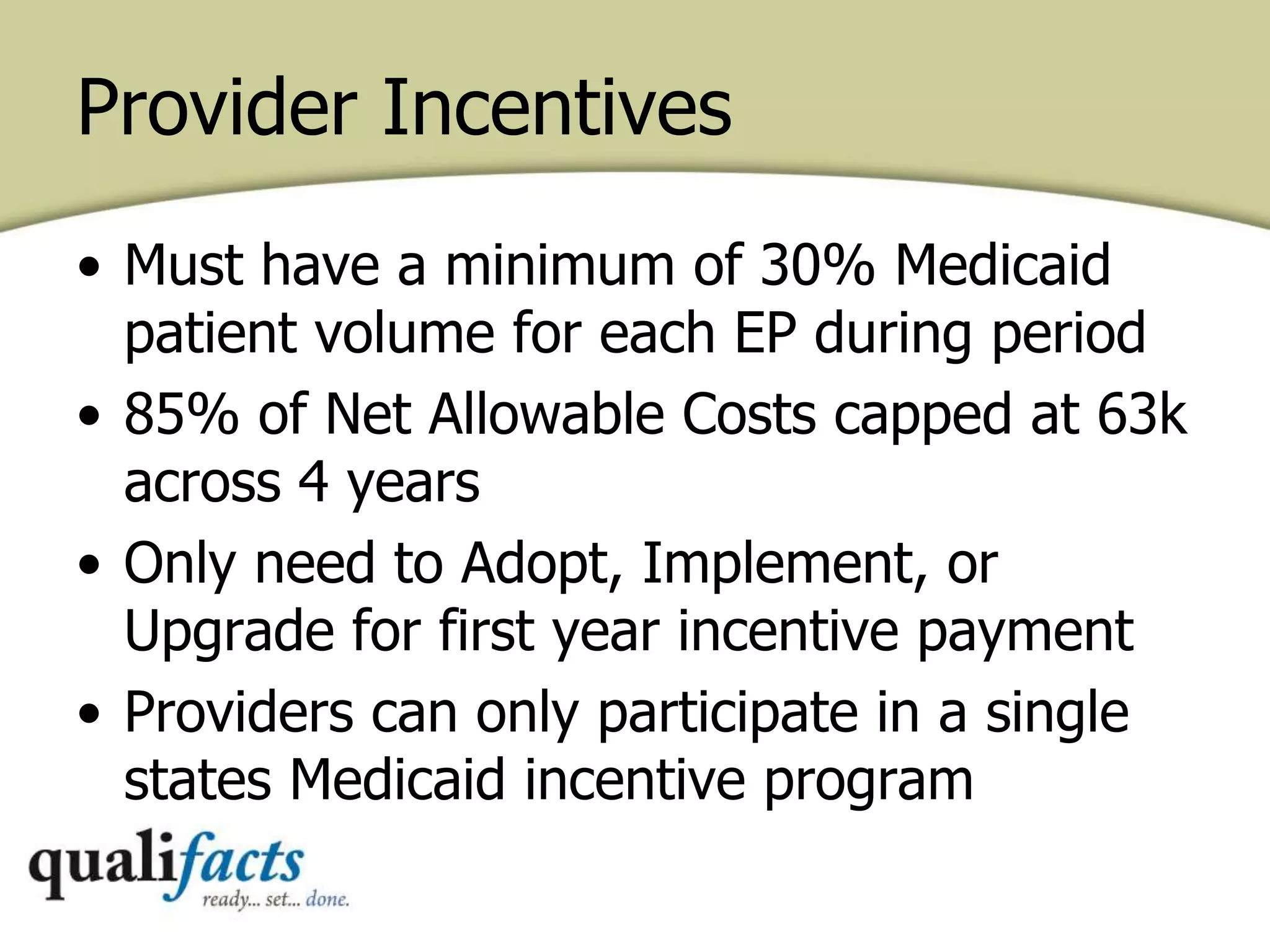
Provider Incentives
• Must have a minimum of 30% Medicaid
patient volume for each EP during period
• 85% of Net Allowable Costs capped at 63k
across 4 years
• Only need to Adopt, Implement, or
Upgrade for first year incentive payment
• Providers can only participate in a single
states Medicaid incentive program
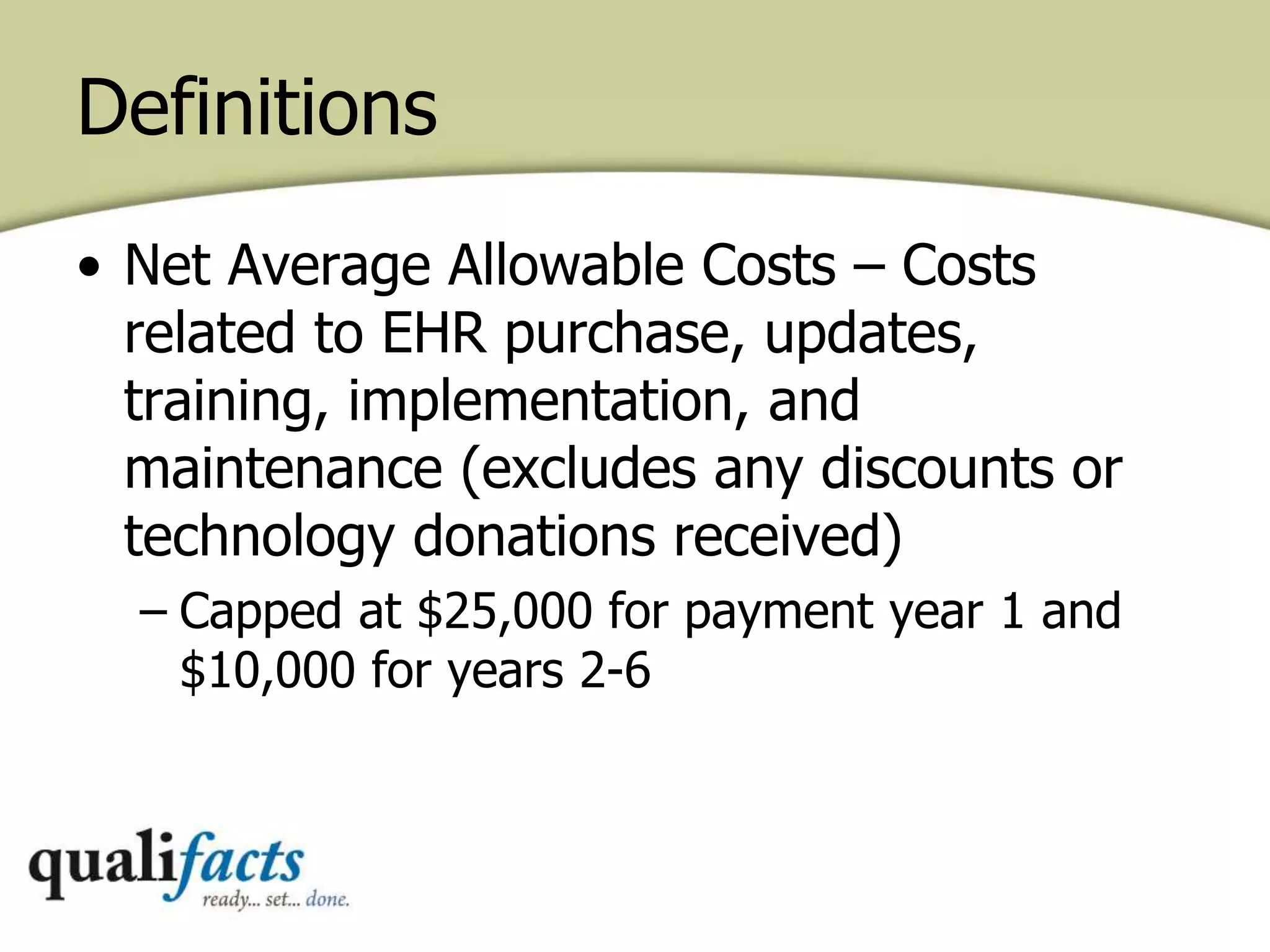
• Net Average Allowable Costs – Costs
related to EHR purchase, updates,
training, implementation, and
maintenance (excludes any discounts or
technology donations received)
– Capped at $25,000 for payment year 1 and
$10,000 for years 2-6
Definitions
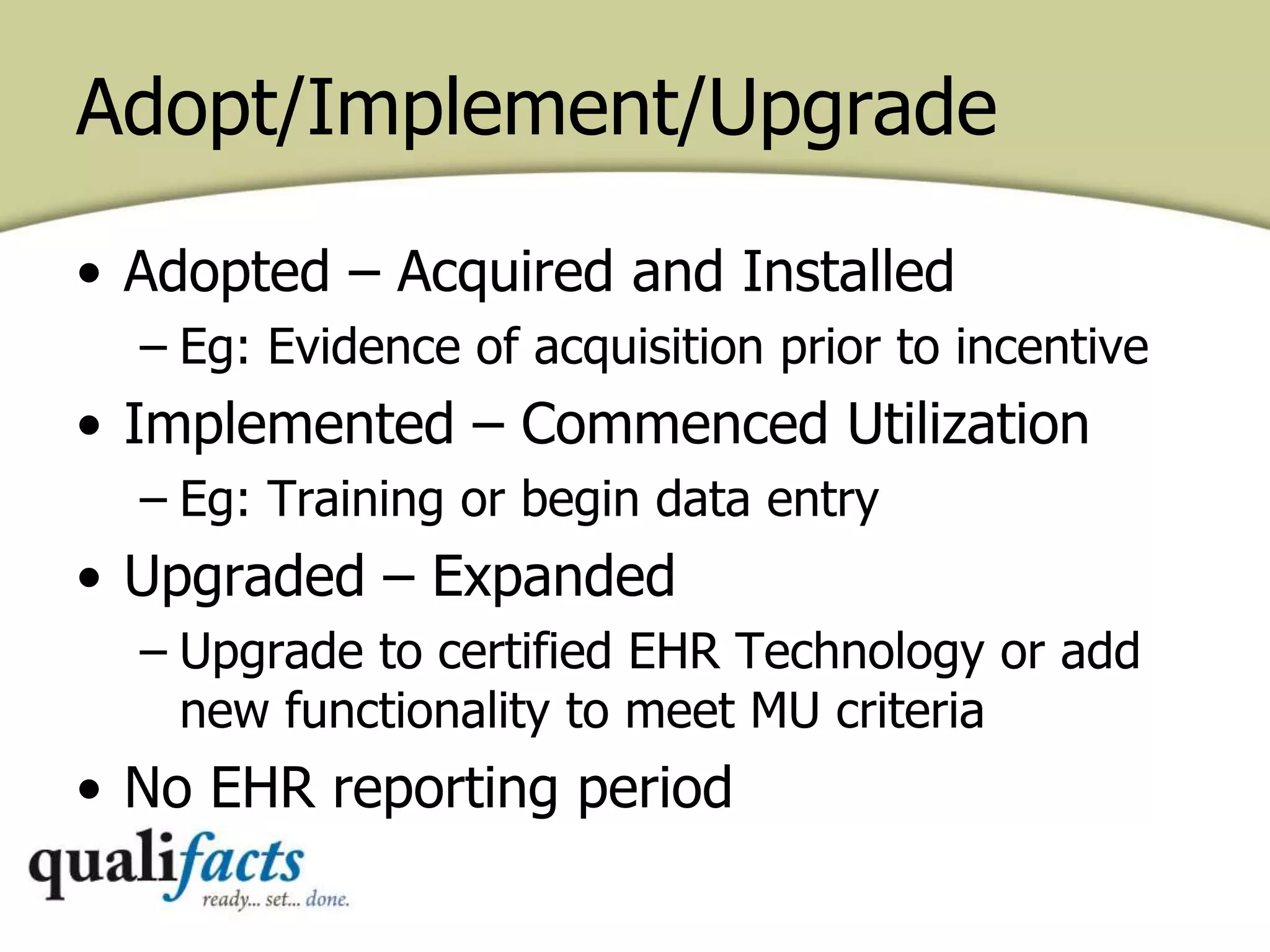
Adopt/Implement/Upgrade
• Adopted – Acquired and Installed
– Eg: Evidence of acquisition prior to incentive
• Implemented – Commenced Utilization
– Eg: Training or begin data entry
• Upgraded – Expanded
– Upgrade to certified EHR Technology or add
new functionality to meet MU criteria
• No EHR reporting period
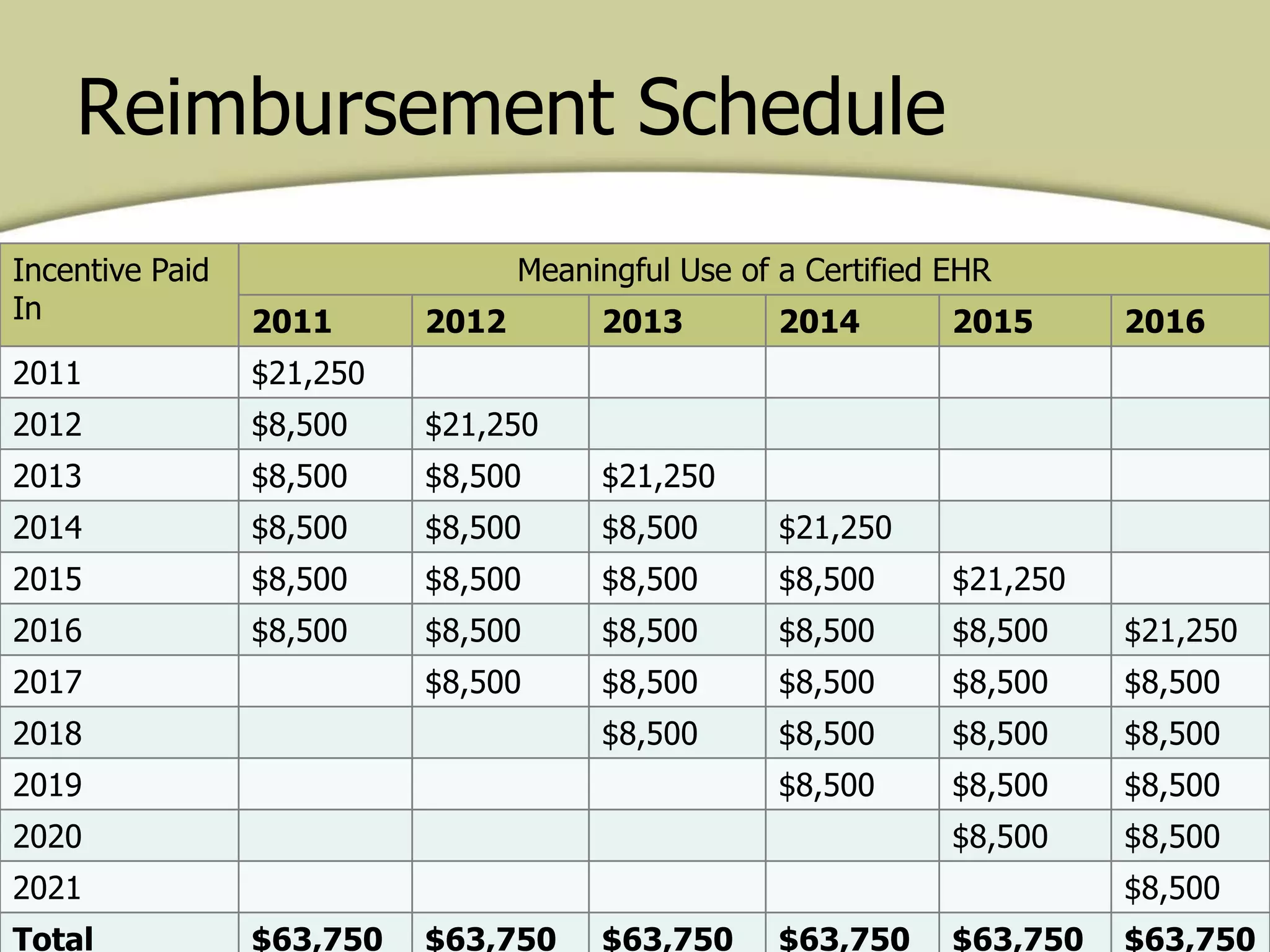
Reimbursement Schedule
Incentive Paid
In
Meaningful Use of a Certified EHR
2011 2012 2013 2014 2015 2016
2011 $21,250
2012 $8,500 $21,250
2013 $8,500 $8,500 $21,250
2014 $8,500 $8,500 $8,500 $21,250
2015 $8,500 $8,500 $8,500 $8,500 $21,250
2016 $8,500 $8,500 $8,500 $8,500 $8,500 $21,250
2017 $8,500 $8,500 $8,500 $8,500 $8,500
2018 $8,500 $8,500 $8,500 $8,500
2019 $8,500 $8,500 $8,500
2020 $8,500 $8,500
2021 $8,500
Total $63,750 $63,750 $63,750 $63,750 $63,750 $63,750
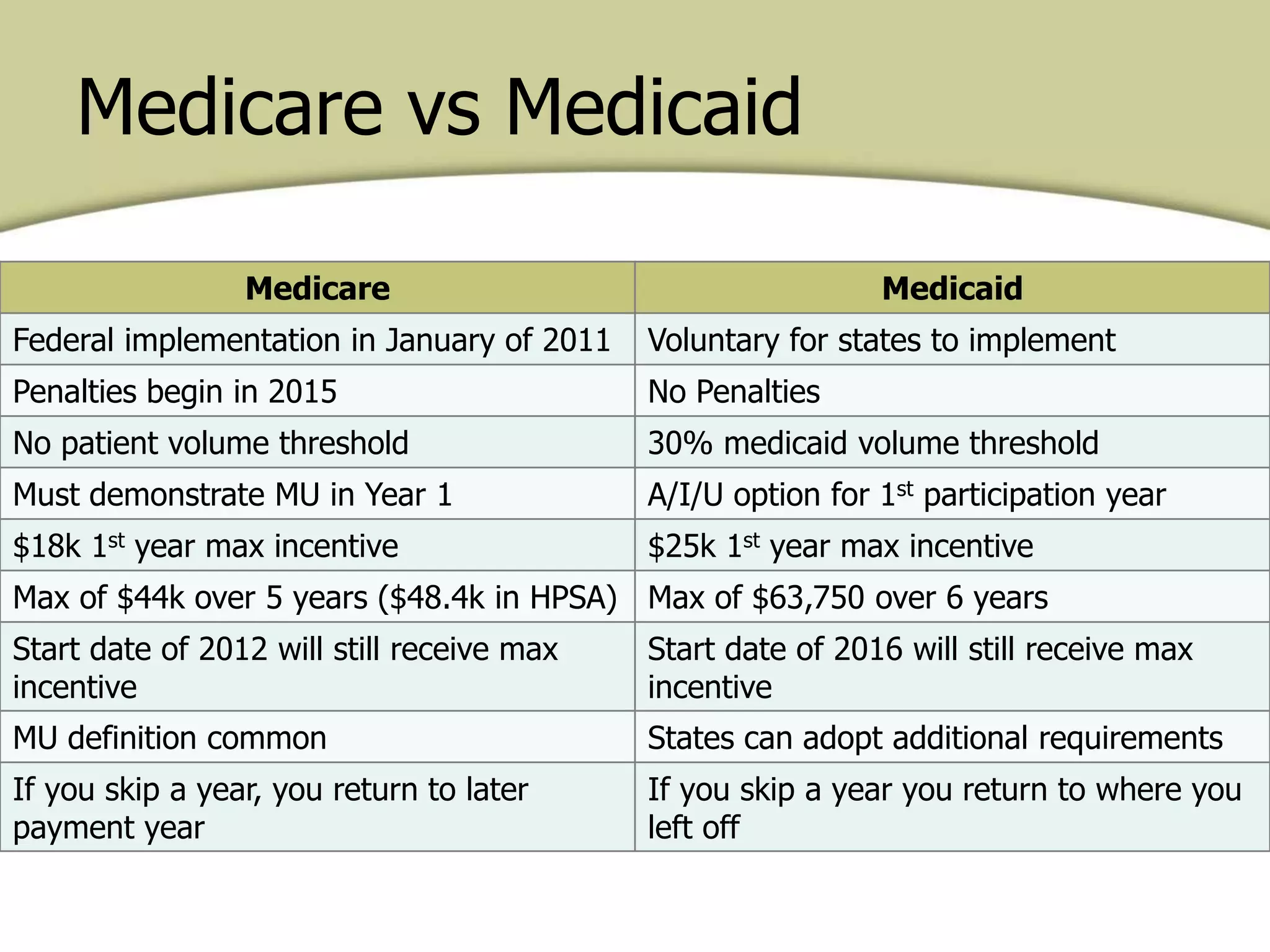
Medicare vs Medicaid
Medicare Medicaid
Federal implementation in January of 2011 Voluntary for states to implement
Penalties begin in 2015 No Penalties
No patient volume threshold 30% medicaid volume threshold
Must demonstrate MU in Year 1 A/I/U option for 1st participation year
$18k 1st year max incentive $25k 1st year max incentive
Max of $44k over 5 years ($48.4k in HPSA) Max of $63,750 over 6 years
Start date of 2012 will still receive max
incentive
Start date of 2016 will still receive max
incentive
MU definition common States can adopt additional requirements
If you skip a year, you return to later
payment year
If you skip a year you return to where you
left off
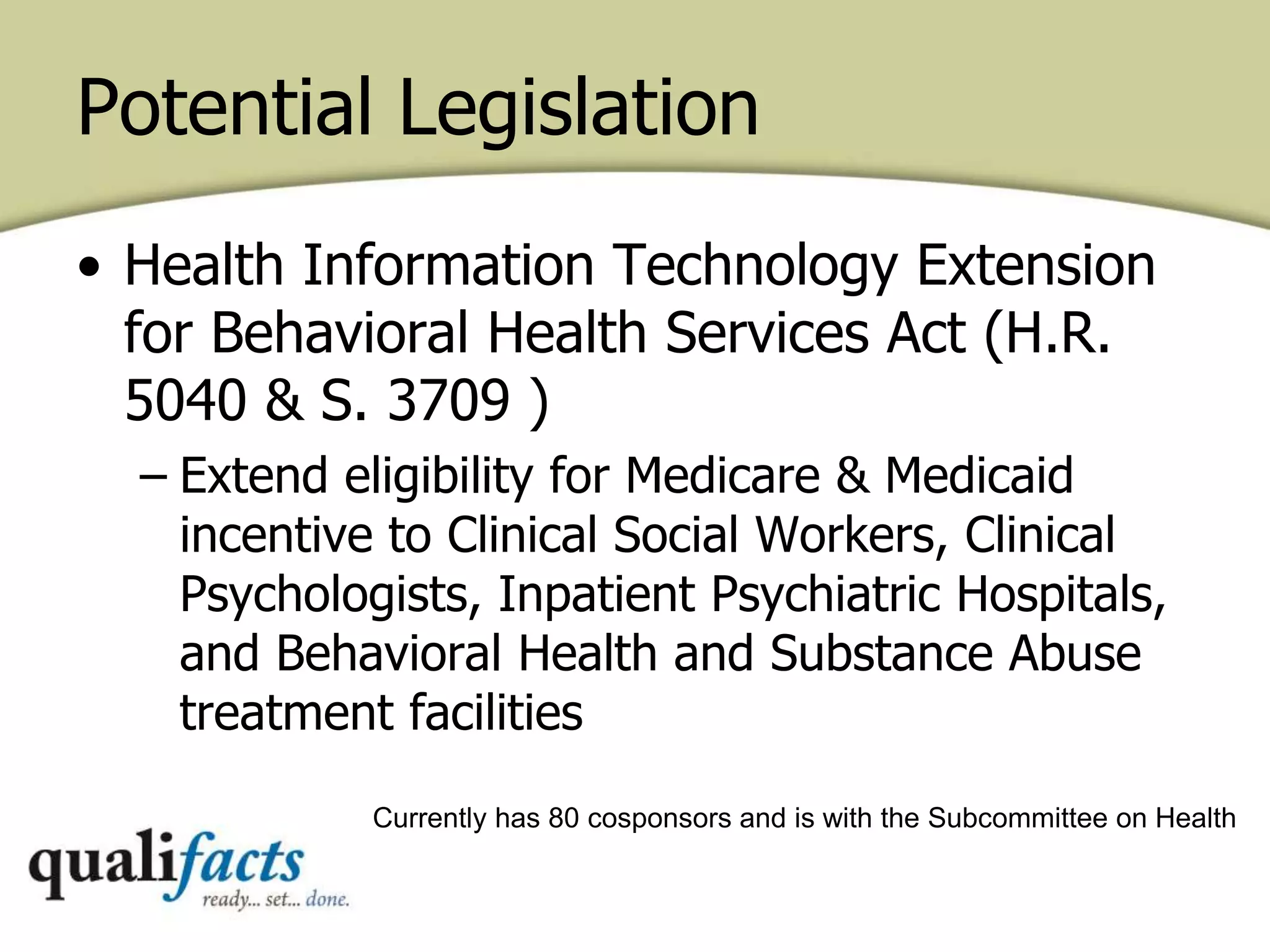
Potential Legislation
• Health Information Technology Extension
for Behavioral Health Services Act (H.R.
5040 & S. 3709 )
– Extend eligibility for Medicare & Medicaid
incentive to Clinical Social Workers, Clinical
Psychologists, Inpatient Psychiatric Hospitals,
and Behavioral Health and Substance Abuse
treatment facilities
Currently has 80 cosponsors and is with the Subcommittee on Health
How to Become a Meaningful User
• Use of Certified EHR Technology
• Meet Staged IT Functionality Measures
• Meet Staged Clinical Quality Measures
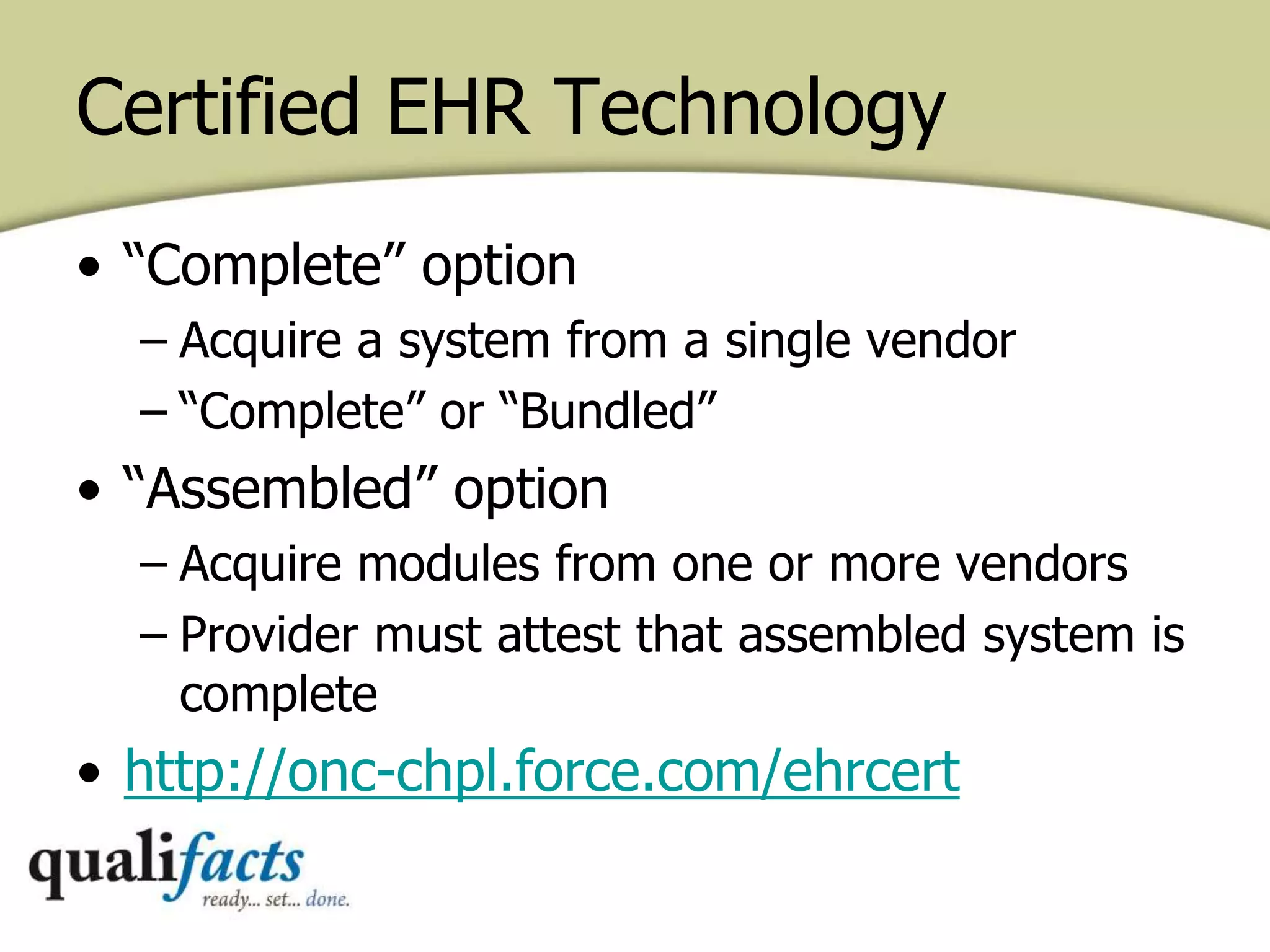
Certified EHR Technology
• “Complete” option
– Acquire a system from a single vendor
– “Complete” or “Bundled”
• “Assembled” option
– Acquire modules from one or more vendors
– Provider must attest that assembled system is
complete
• http://onc-chpl.force.com/ehrcert
How to Become a Meaningful User
Use of Certified EHR Technology
• Meet Staged IT Functionality Measures
• Meet Staged Clinical Quality Measures
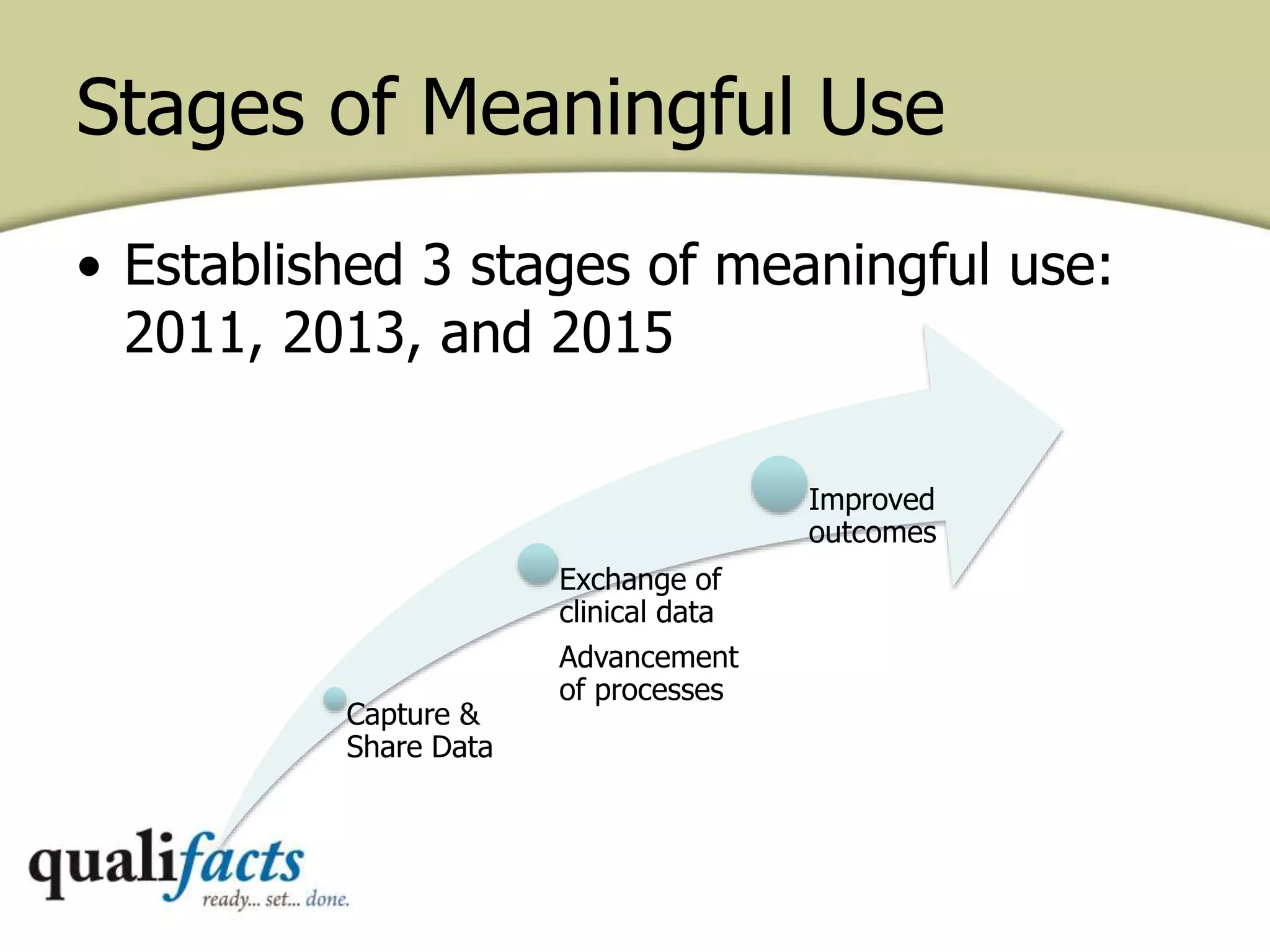
Stages of Meaningful Use
• Established 3 stages of meaningful use:
2011, 2013, and 2015
Capture &
Share Data
Exchange of
clinical data
Advancement
of processes
Improved
outcomes
Stage 1: Overview
• Capture health information in a coded and
structured format
• Track key clinical conditions and
communicate for coordination purposes
• Implement Clinical Decision Support tools
• Report clinical quality measures & public
health information
Stage 1: Reporting & Payment
• Reporting period is a 90 day consecutive
period
– Subsequent years will be full payment year
• Reporting through attestation
• Payment received once CMS has been
shown attainment and reached either
yearly maximum or end of calendar year
IT Functionality Measures
• Purpose: Show how well the provider/hospital
is using their Certified EHR Technology
• Core Measures
– Must attain or qualify for exception on all
measures
• Menu Items
– Must attain or qualify for exception on 5
measures
– Must choose one public health measure
Core Functionality Measures
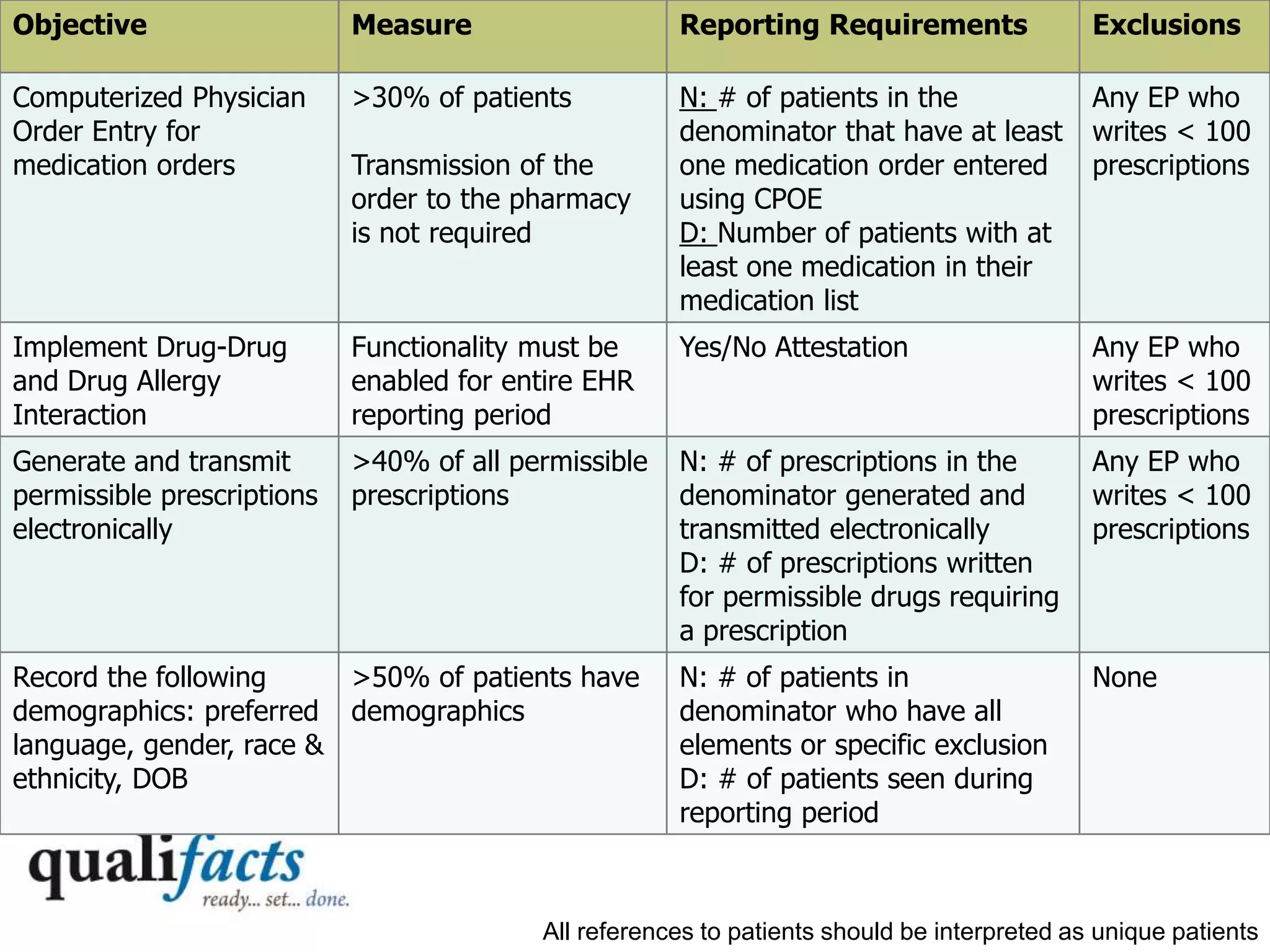
IT Measures: Stage 1 (Core)
Objective Measure Reporting Requirements Exclusions
Computerized Physician
Order Entry for
medication orders
>30% of patients
Transmission of the
order to the pharmacy
is not required
N: # of patients in the
denominator that have at least
one medication order entered
using CPOE
D: Number of patients with at
least one medication in their
medication list
Any EP who
writes < 100
prescriptions
Implement Drug-Drug
and Drug Allergy
Interaction
Functionality must be
enabled for entire EHR
reporting period
Yes/No Attestation Any EP who
writes < 100
prescriptions
Generate and transmit
permissible prescriptions
electronically
>40% of all permissible
prescriptions
N: # of prescriptions in the
denominator generated and
transmitted electronically
D: # of prescriptions written
for permissible drugs requiring
a prescription
Any EP who
writes < 100
prescriptions
Record the following
demographics: preferred
language, gender, race &
ethnicity, DOB
>50% of patients have
demographics
N: # of patients in
denominator who have all
elements or specific exclusion
D: # of patients seen during
reporting period
None
All references to patients should be interpreted as unique patients
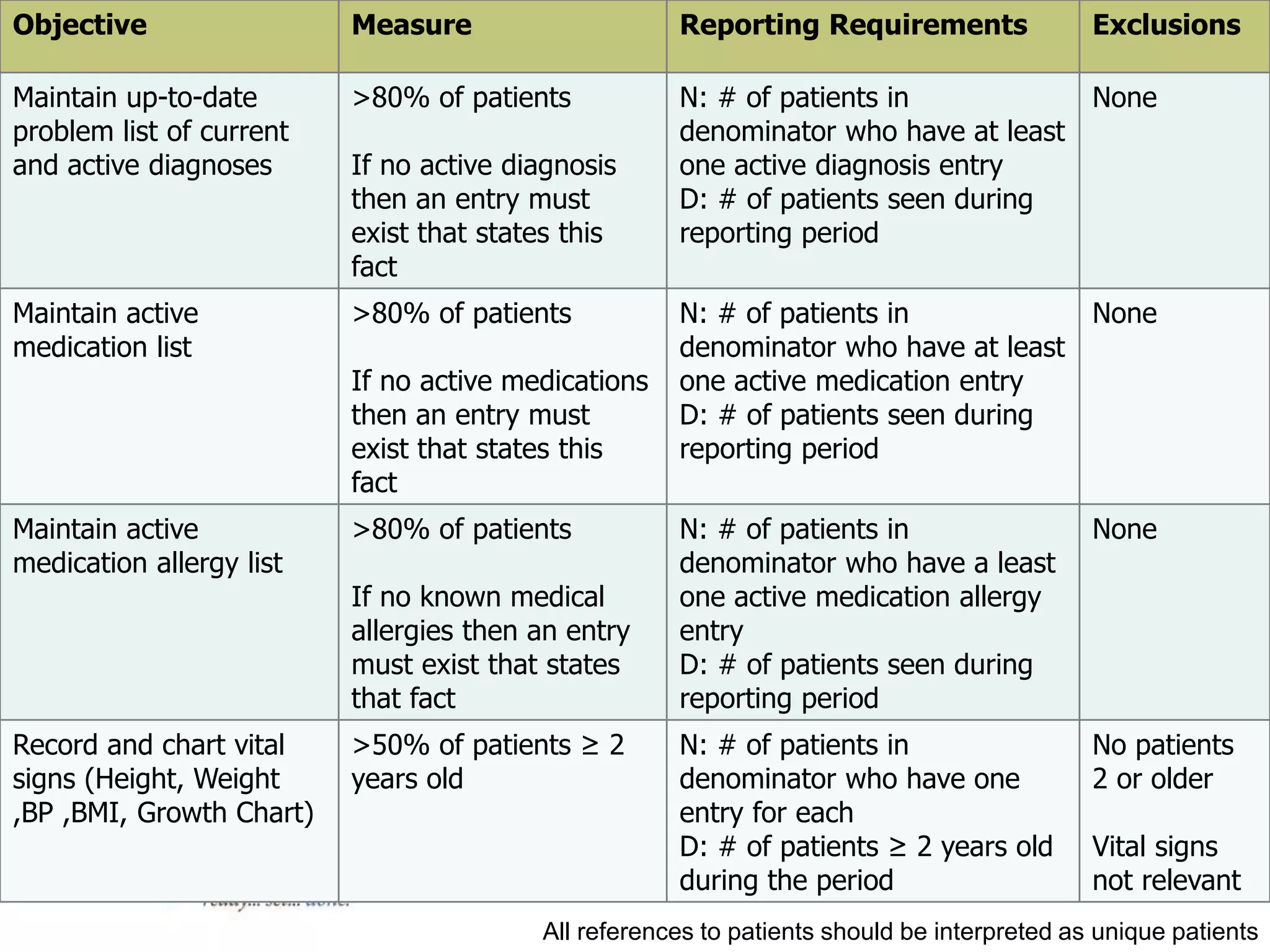
IT Measures: Stage 1 (Core)
Objective Measure Reporting Requirements Exclusions
Maintain up-to-date
problem list of current
and active diagnoses
>80% of patients
If no active diagnosis
then an entry must
exist that states this
fact
N: # of patients in
denominator who have at least
one active diagnosis entry
D: # of patients seen during
reporting period
None
Maintain active
medication list
>80% of patients
If no active medications
then an entry must
exist that states this
fact
N: # of patients in
denominator who have at least
one active medication entry
D: # of patients seen during
reporting period
None
Maintain active
medication allergy list
>80% of patients
If no known medical
allergies then an entry
must exist that states
that fact
N: # of patients in
denominator who have a least
one active medication allergy
entry
D: # of patients seen during
reporting period
None
Record and chart vital
signs (Height, Weight
,BP ,BMI, Growth Chart)
>50% of patients ≥ 2
years old
N: # of patients in
denominator who have one
entry for each
D: # of patients ≥ 2 years old
during the period
No patients
2 or older
Vital signs
not relevant
All references to patients should be interpreted as unique patients
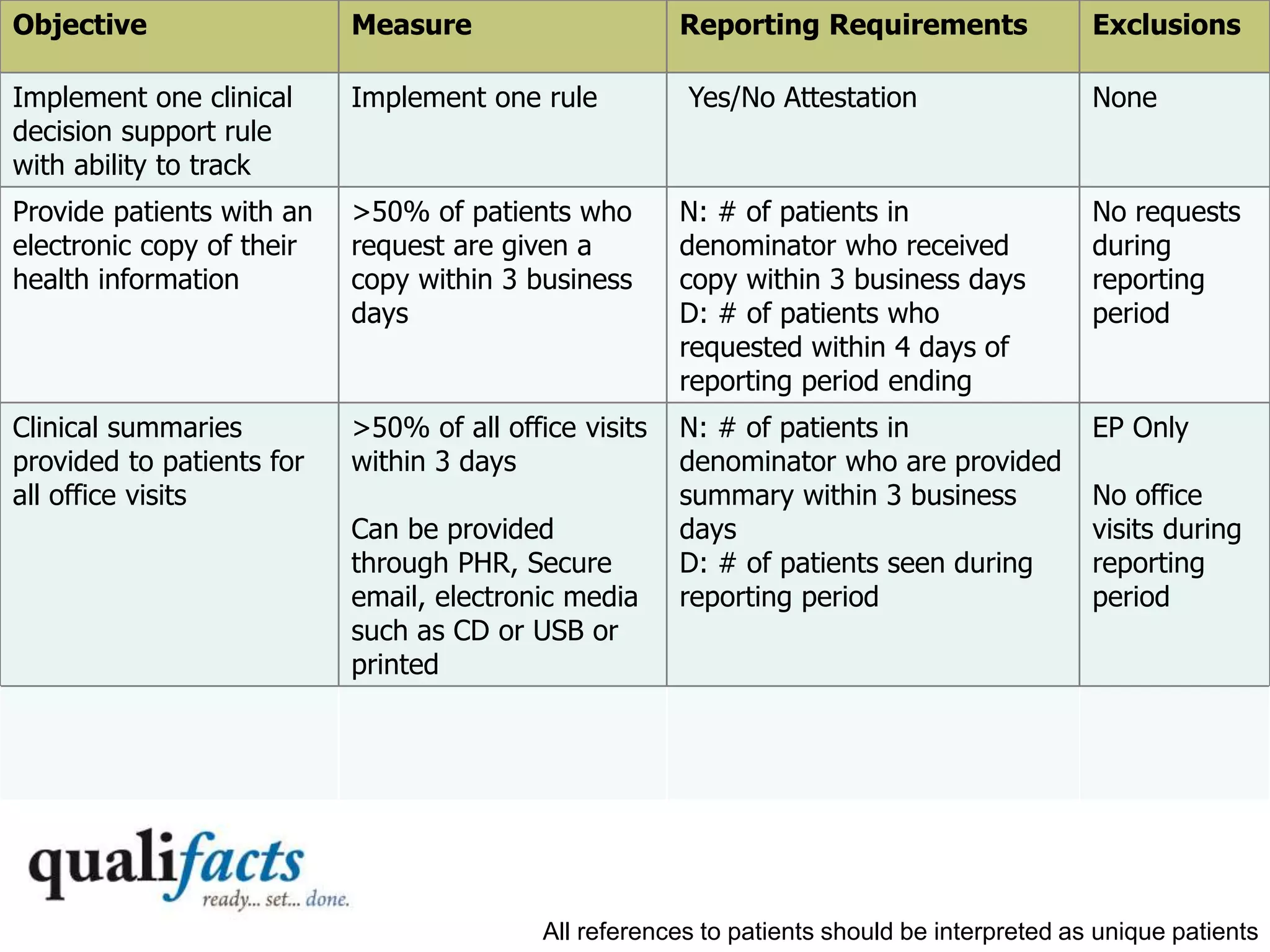
IT Measures: Stage 1 (Core)
Objective Measure Reporting Requirements Exclusions
Implement one clinical
decision support rule
with ability to track
Implement one rule Yes/No Attestation None
Provide patients with an
electronic copy of their
health information
>50% of patients who
request are given a
copy within 3 business
days
N: # of patients in
denominator who received
copy within 3 business days
D: # of patients who
requested within 4 days of
reporting period ending
No requests
during
reporting
period
Clinical summaries
provided to patients for
all office visits
>50% of all office visits
within 3 days
Can be provided
through PHR, Secure
email, electronic media
such as CD or USB or
printed
N: # of patients in
denominator who are provided
summary within 3 business
days
D: # of patients seen during
reporting period
EP Only
No office
visits during
reporting
period
All references to patients should be interpreted as unique patients
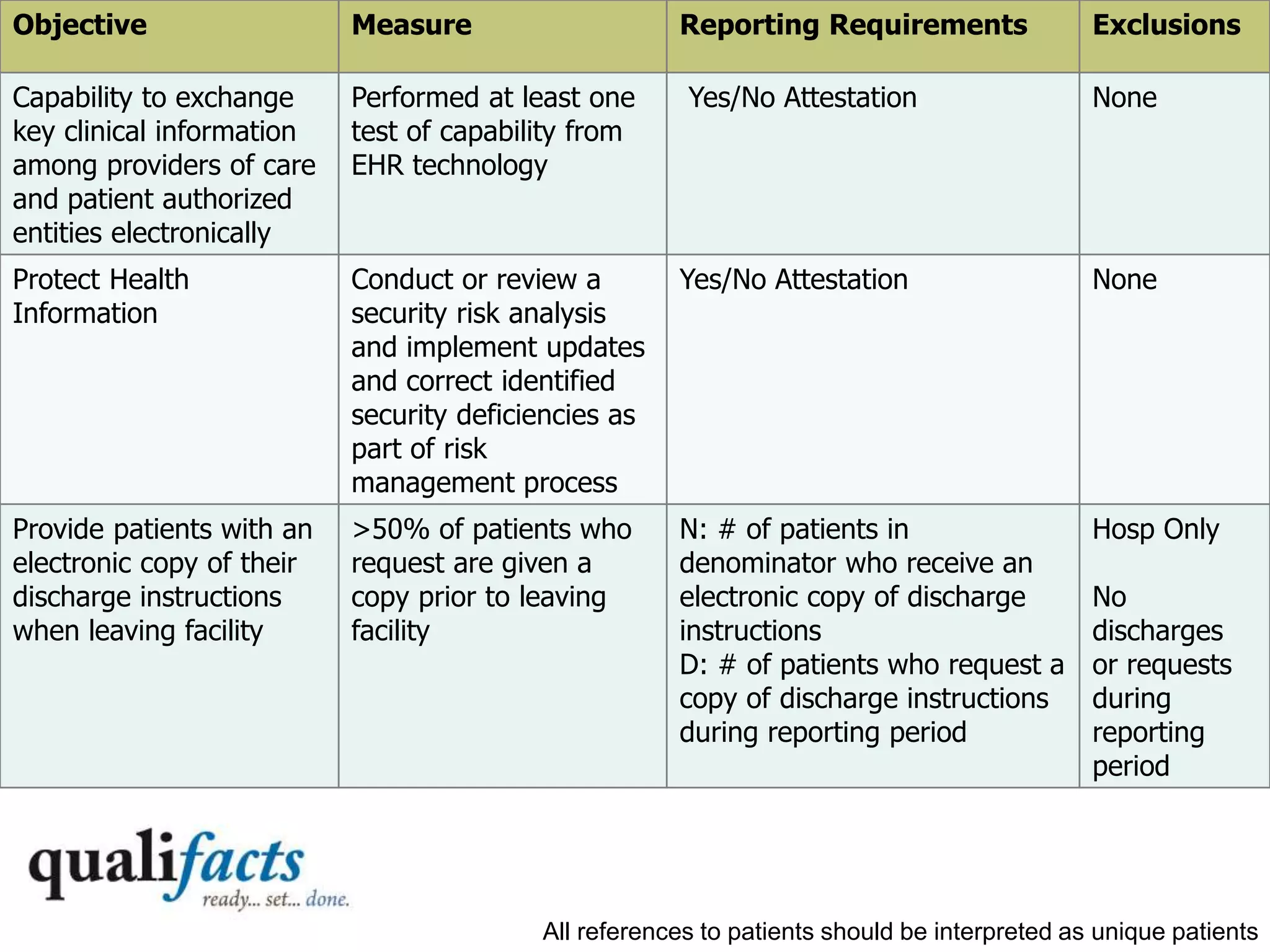
IT Measures: Stage 1 (Core)
Objective Measure Reporting Requirements Exclusions
Capability to exchange
key clinical information
among providers of care
and patient authorized
entities electronically
Performed at least one
test of capability from
EHR technology
Yes/No Attestation None
Protect Health
Information
Conduct or review a
security risk analysis
and implement updates
and correct identified
security deficiencies as
part of risk
management process
Yes/No Attestation None
Provide patients with an
electronic copy of their
discharge instructions
when leaving facility
>50% of patients who
request are given a
copy prior to leaving
facility
N: # of patients in
denominator who receive an
electronic copy of discharge
instructions
D: # of patients who request a
copy of discharge instructions
during reporting period
Hosp Only
No
discharges
or requests
during
reporting
period
All references to patients should be interpreted as unique patients
Menu Functionality Measures
IT Measures: Stage 1 (Core)
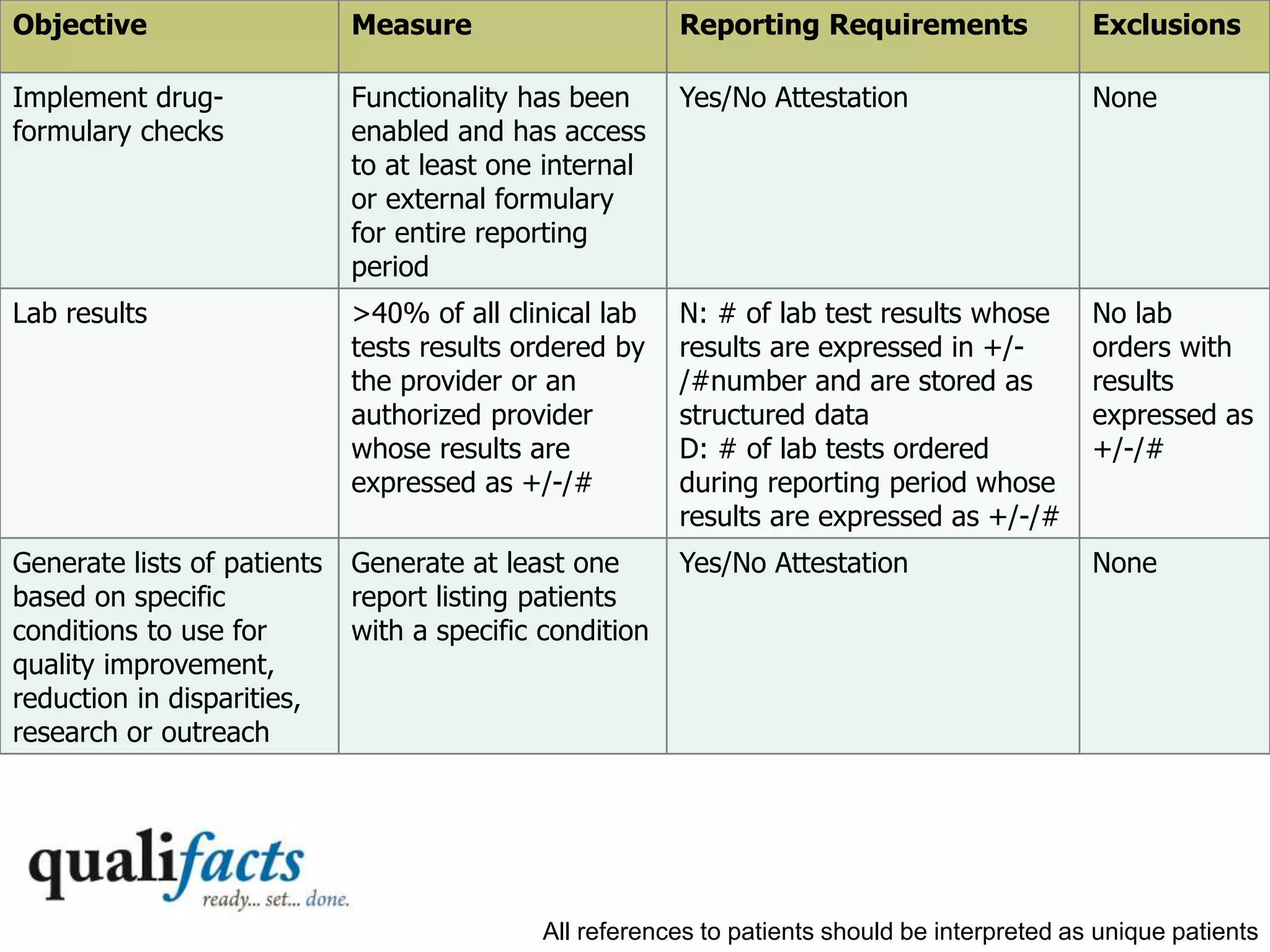
Objective Measure Reporting Requirements Exclusions
Implement drug-
formulary checks
Functionality has been
enabled and has access
to at least one internal
or external formulary
for entire reporting
period
Yes/No Attestation None
Lab results >40% of all clinical lab
tests results ordered by
the provider or an
authorized provider
whose results are
expressed as +/-/#
N: # of lab test results whose
results are expressed in +/-
/#number and are stored as
structured data
D: # of lab tests ordered
during reporting period whose
results are expressed as +/-/#
No lab
orders with
results
expressed as
+/-/#
Generate lists of patients
based on specific
conditions to use for
quality improvement,
reduction in disparities,
research or outreach
Generate at least one
report listing patients
with a specific condition
Yes/No Attestation None
All references to patients should be interpreted as unique patients
IT Measures: Stage 1 (Core)
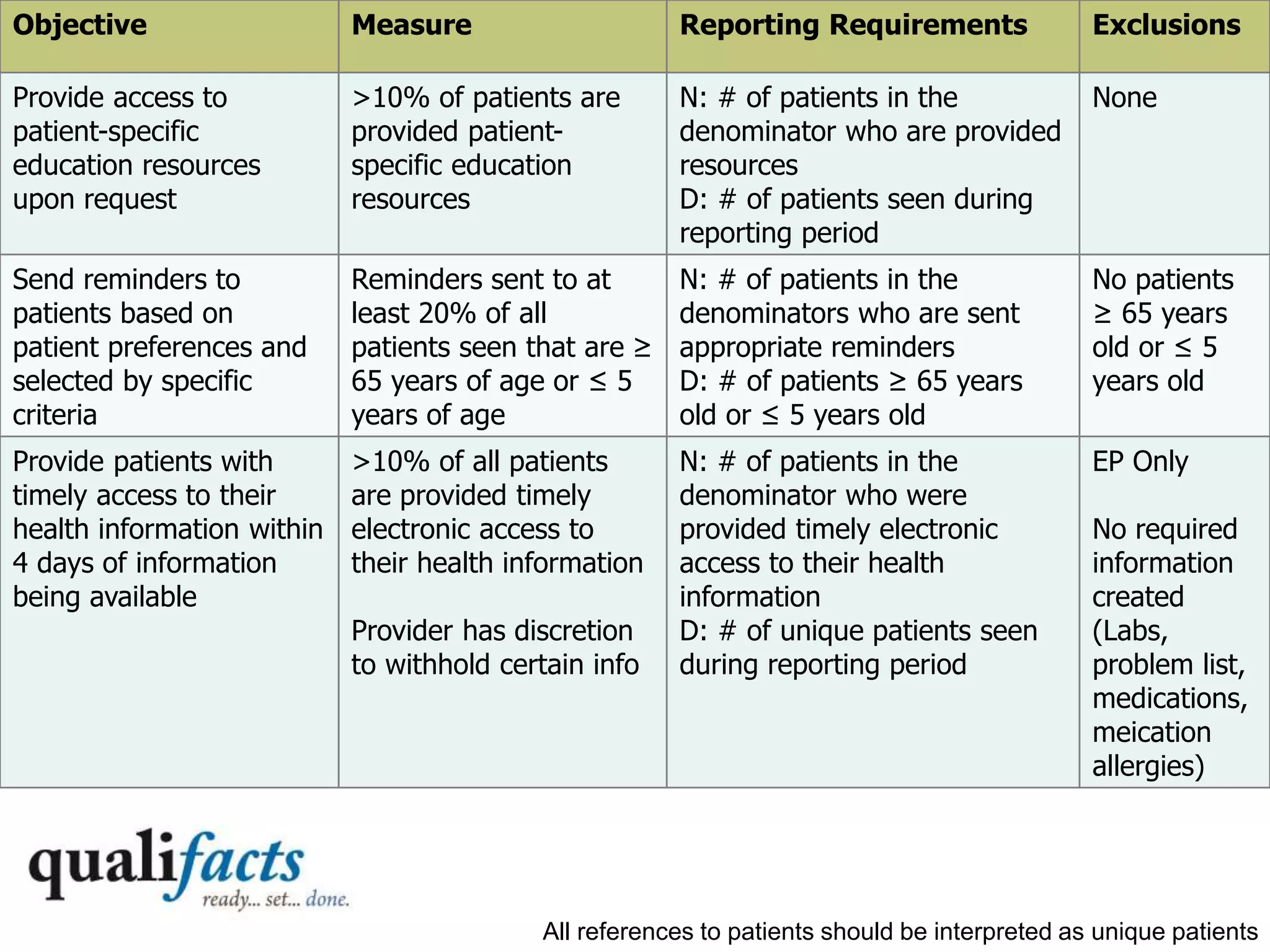
Objective Measure Reporting Requirements Exclusions
Provide access to
patient-specific
education resources
upon request
>10% of patients are
provided patient-
specific education
resources
N: # of patients in the
denominator who are provided
resources
D: # of patients seen during
reporting period
None
Send reminders to
patients based on
patient preferences and
selected by specific
criteria
Reminders sent to at
least 20% of all
patients seen that are ≥
65 years of age or ≤ 5
years of age
N: # of patients in the
denominators who are sent
appropriate reminders
D: # of patients ≥ 65 years
old or ≤ 5 years old
No patients
≥ 65 years
old or ≤ 5
years old
Provide patients with
timely access to their
health information within
4 days of information
being available
>10% of all patients
are provided timely
electronic access to
their health information
Provider has discretion
to withhold certain info
N: # of patients in the
denominator who were
provided timely electronic
access to their health
information
D: # of unique patients seen
during reporting period
EP Only
No required
information
created
(Labs,
problem list,
medications,
meication
allergies)
All references to patients should be interpreted as unique patients
IT Measures: Stage 1 (Core)
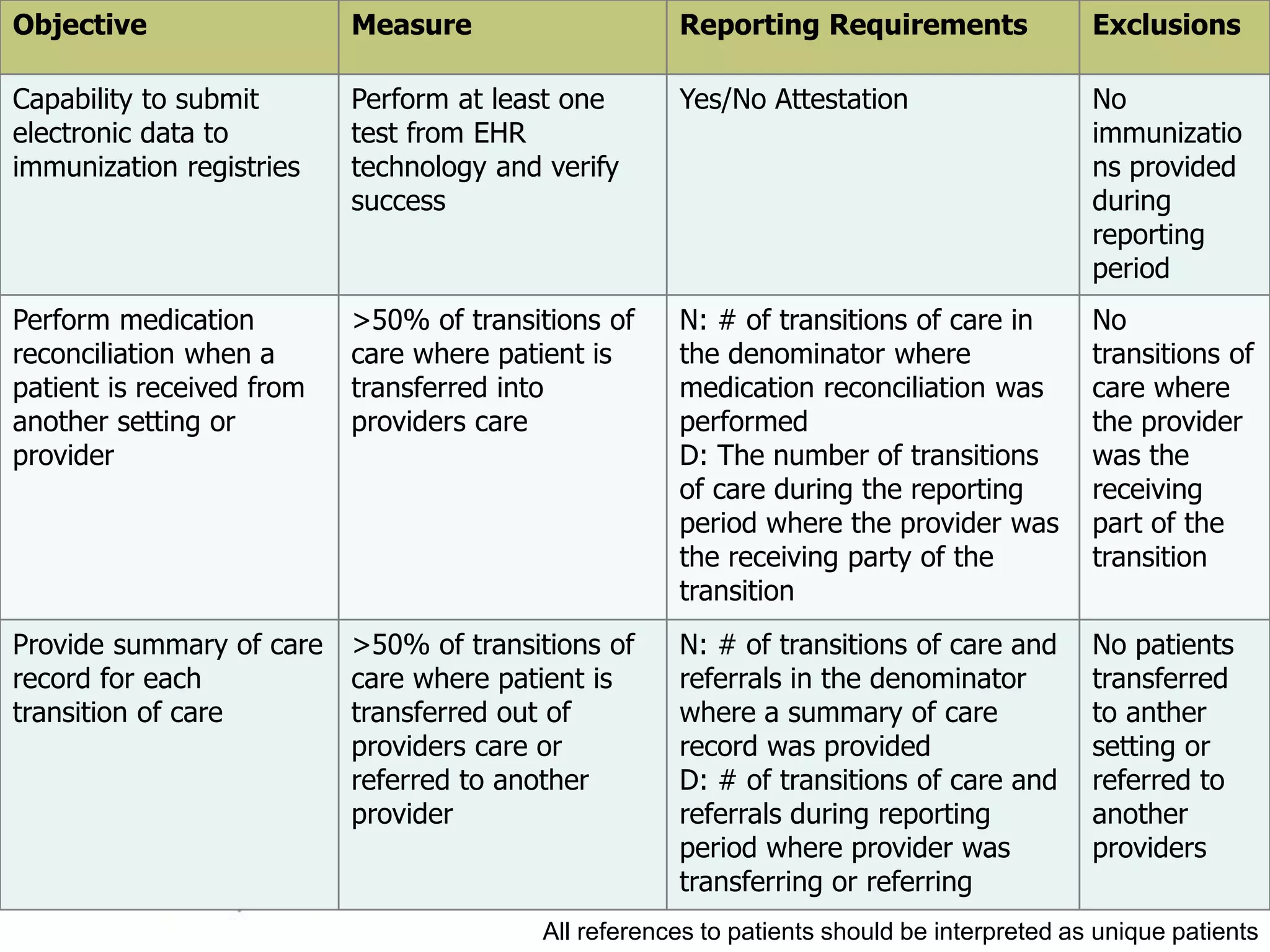
Objective Measure Reporting Requirements Exclusions
Capability to submit
electronic data to
immunization registries
Perform at least one
test from EHR
technology and verify
success
Yes/No Attestation No
immunizatio
ns provided
during
reporting
period
Perform medication
reconciliation when a
patient is received from
another setting or
provider
>50% of transitions of
care where patient is
transferred into
providers care
N: # of transitions of care in
the denominator where
medication reconciliation was
performed
D: The number of transitions
of care during the reporting
period where the provider was
the receiving party of the
transition
No
transitions of
care where
the provider
was the
receiving
part of the
transition
Provide summary of care
record for each
transition of care
>50% of transitions of
care where patient is
transferred out of
providers care or
referred to another
provider
N: # of transitions of care and
referrals in the denominator
where a summary of care
record was provided
D: # of transitions of care and
referrals during reporting
period where provider was
transferring or referring
No patients
transferred
to anther
setting or
referred to
another
providers
All references to patients should be interpreted as unique patients
IT Measures: Stage 1 (Core)
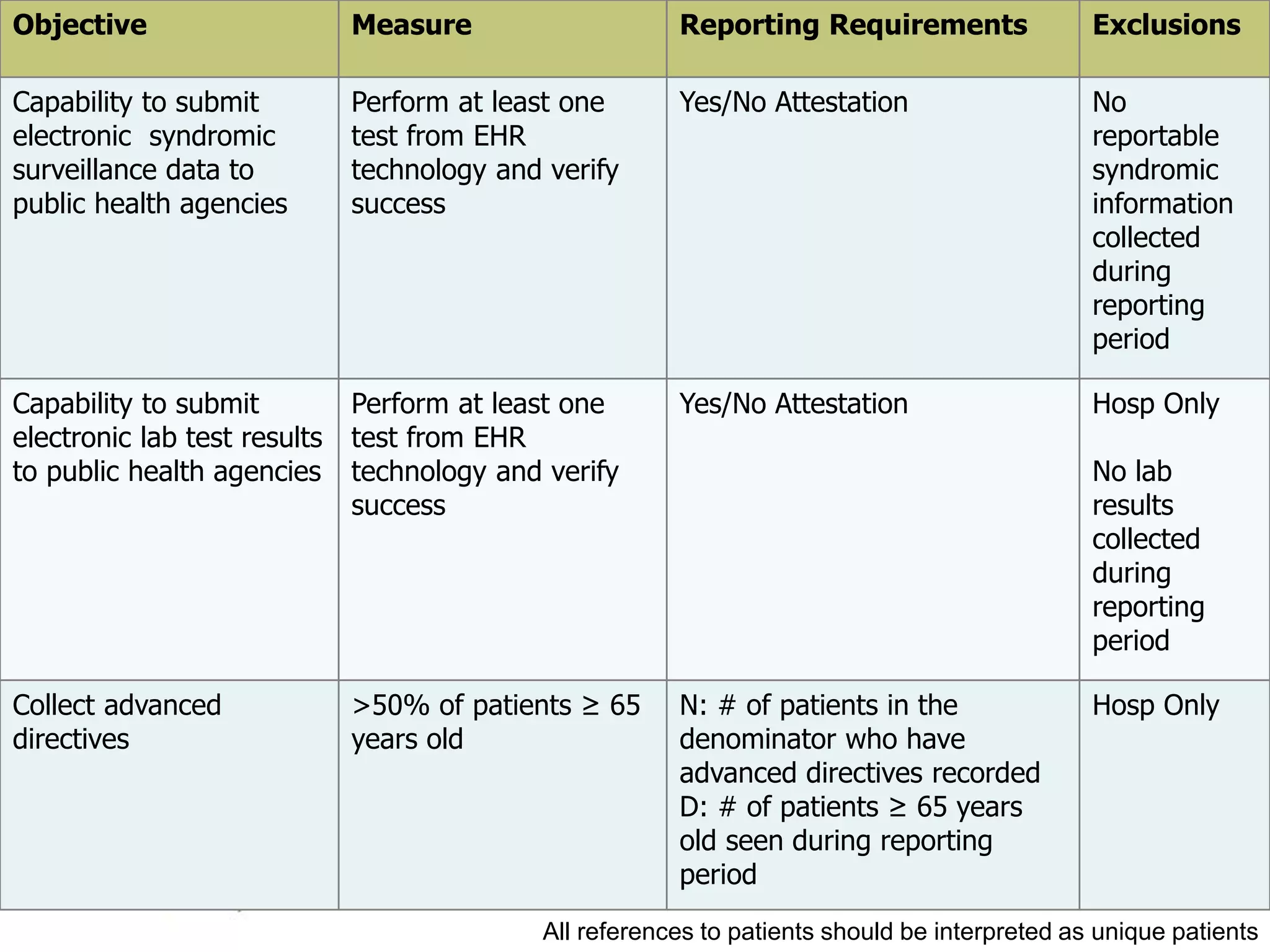
Objective Measure Reporting Requirements Exclusions
Capability to submit
electronic syndromic
surveillance data to
public health agencies
Perform at least one
test from EHR
technology and verify
success
Yes/No Attestation No
reportable
syndromic
information
collected
during
reporting
period
Capability to submit
electronic lab test results
to public health agencies
Perform at least one
test from EHR
technology and verify
success
Yes/No Attestation Hosp Only
No lab
results
collected
during
reporting
period
Collect advanced
directives
>50% of patients ≥ 65
years old
N: # of patients in the
denominator who have
advanced directives recorded
D: # of patients ≥ 65 years
old seen during reporting
period
Hosp Only
All references to patients should be interpreted as unique patients
How to Become a Meaningful User
Use of Certified EHR Technology
Meet Staged IT Functionality Measures
• Meet Staged Clinical Quality Measures
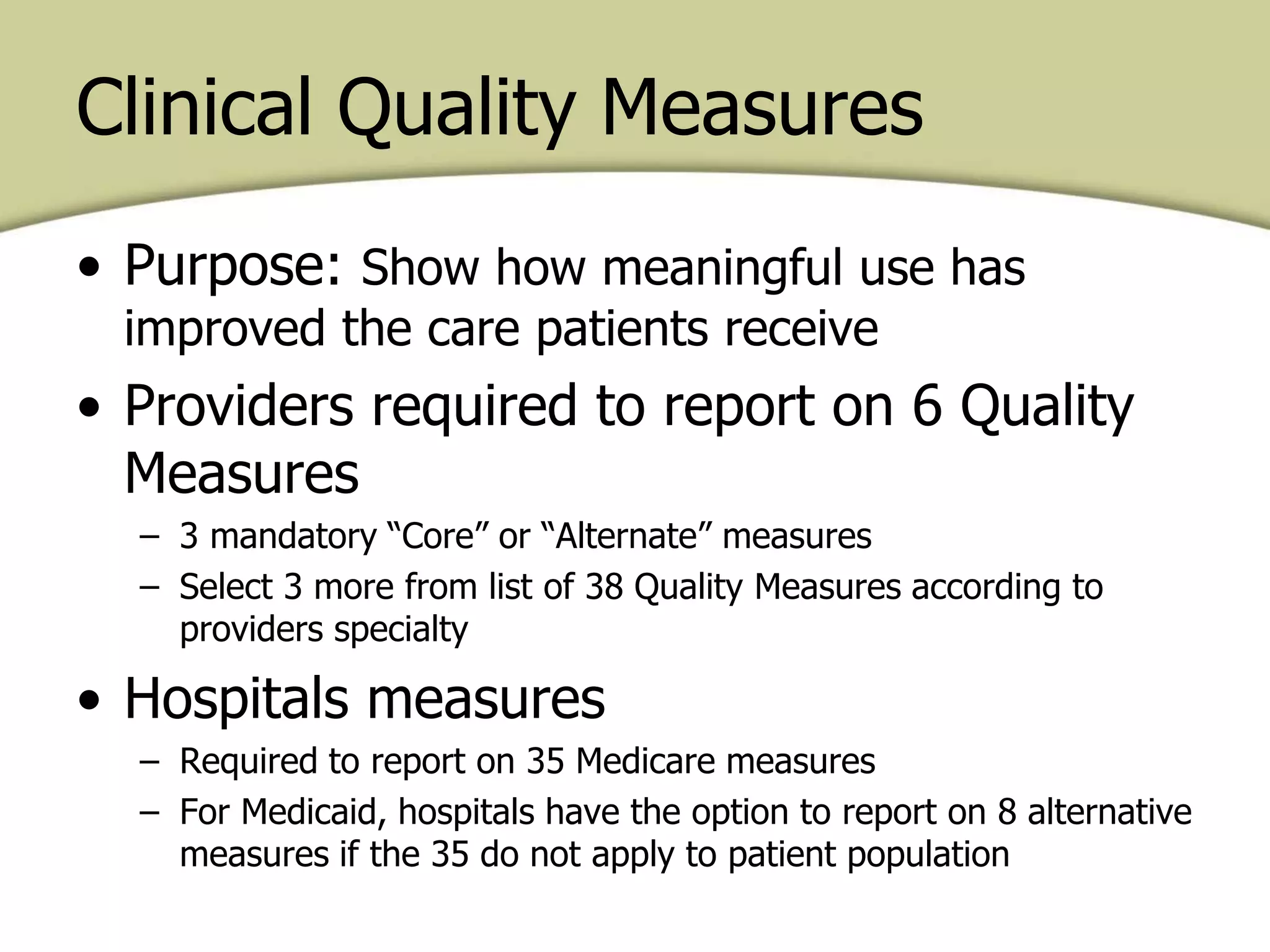
Clinical Quality Measures
• Purpose: Show how meaningful use has
improved the care patients receive
• Providers required to report on 6 Quality
Measures
– 3 mandatory “Core” or “Alternate” measures
– Select 3 more from list of 38 Quality Measures according to
providers specialty
• Hospitals measures
– Required to report on 35 Medicare measures
– For Medicaid, hospitals have the option to report on 8 alternative
measures if the 35 do not apply to patient population
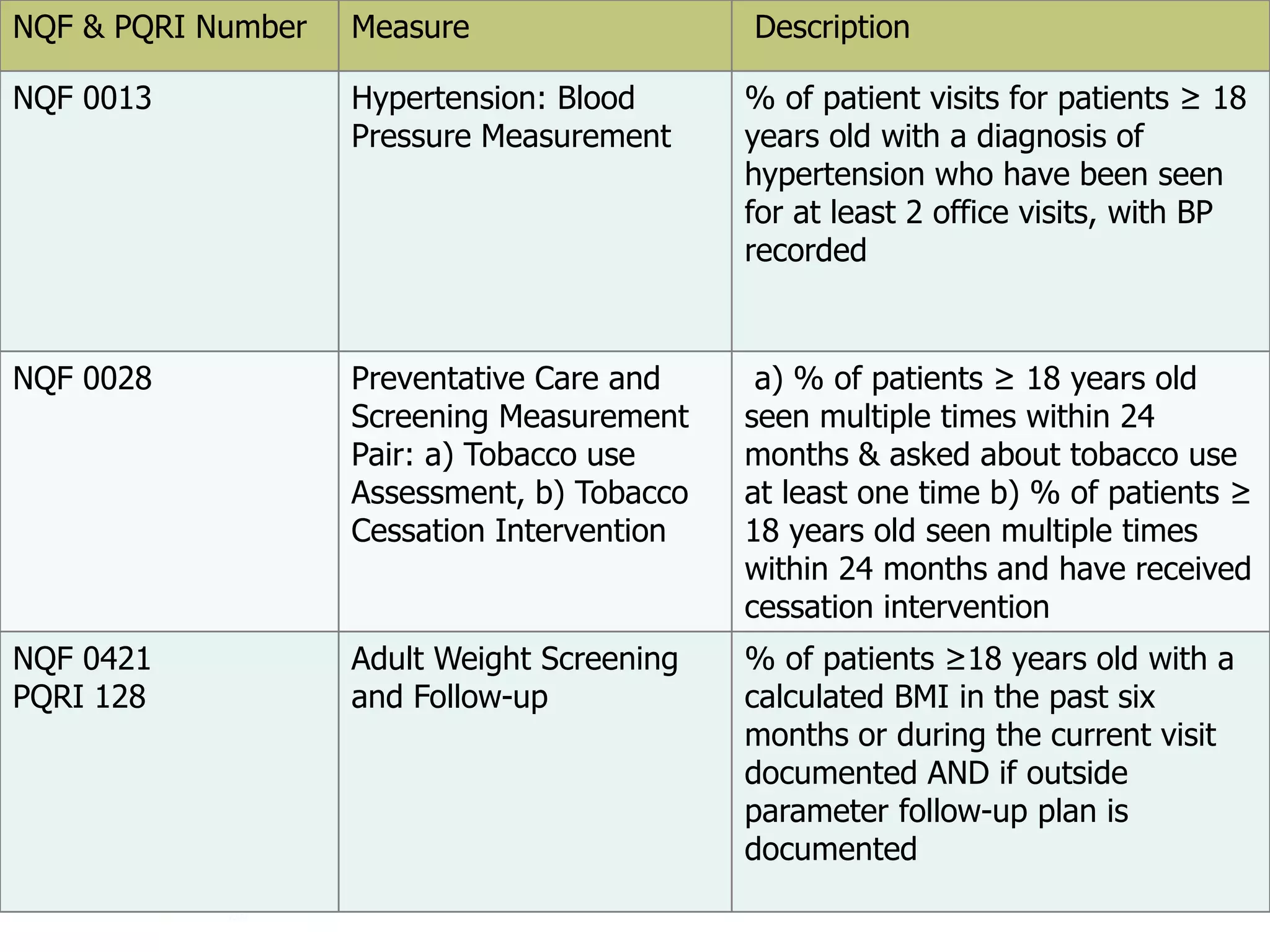
Core Clinical Quality Measures
NQF & PQRI Number Measure Description
NQF 0013 Hypertension: Blood
Pressure Measurement
% of patient visits for patients ≥ 18
years old with a diagnosis of
hypertension who have been seen
for at least 2 office visits, with BP
recorded
NQF 0028 Preventative Care and
Screening Measurement
Pair: a) Tobacco use
Assessment, b) Tobacco
Cessation Intervention
a) % of patients ≥ 18 years old
seen multiple times within 24
months & asked about tobacco use
at least one time b) % of patients ≥
18 years old seen multiple times
within 24 months and have received
cessation intervention
NQF 0421
PQRI 128
Adult Weight Screening
and Follow-up
% of patients ≥18 years old with a
calculated BMI in the past six
months or during the current visit
documented AND if outside
parameter follow-up plan is
documented
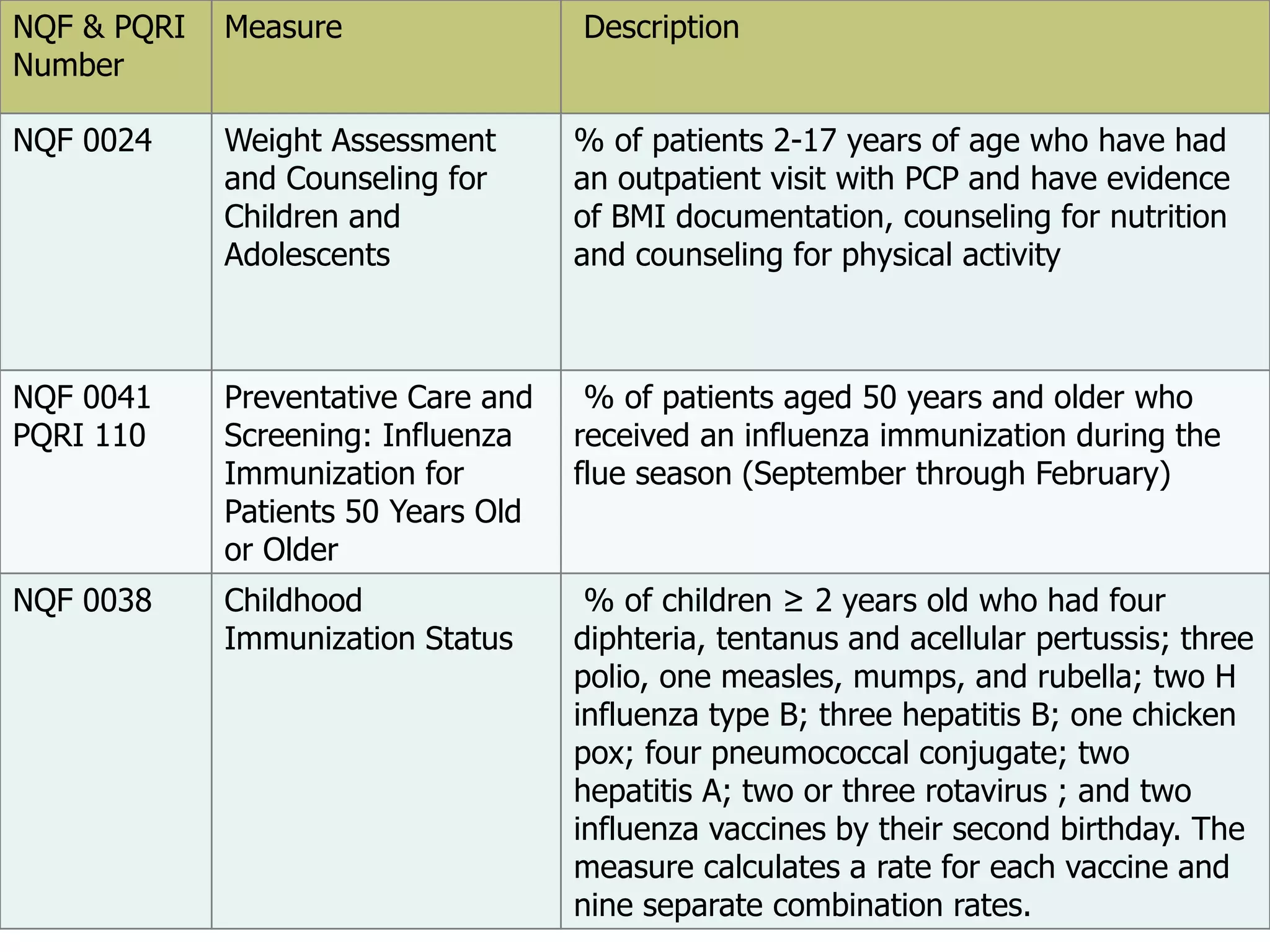
Alternate Clinical Quality
Measures
Alternate Quality Measures
NQF & PQRI
Number
Measure Description
NQF 0024 Weight Assessment
and Counseling for
Children and
Adolescents
% of patients 2-17 years of age who have had
an outpatient visit with PCP and have evidence
of BMI documentation, counseling for nutrition
and counseling for physical activity
NQF 0041
PQRI 110
Preventative Care and
Screening: Influenza
Immunization for
Patients 50 Years Old
or Older
% of patients aged 50 years and older who
received an influenza immunization during the
flue season (September through February)
NQF 0038 Childhood
Immunization Status
% of children ≥ 2 years old who had four
diphteria, tentanus and acellular pertussis; three
polio, one measles, mumps, and rubella; two H
influenza type B; three hepatitis B; one chicken
pox; four pneumococcal conjugate; two
hepatitis A; two or three rotavirus ; and two
influenza vaccines by their second birthday. The
measure calculates a rate for each vaccine and
nine separate combination rates.
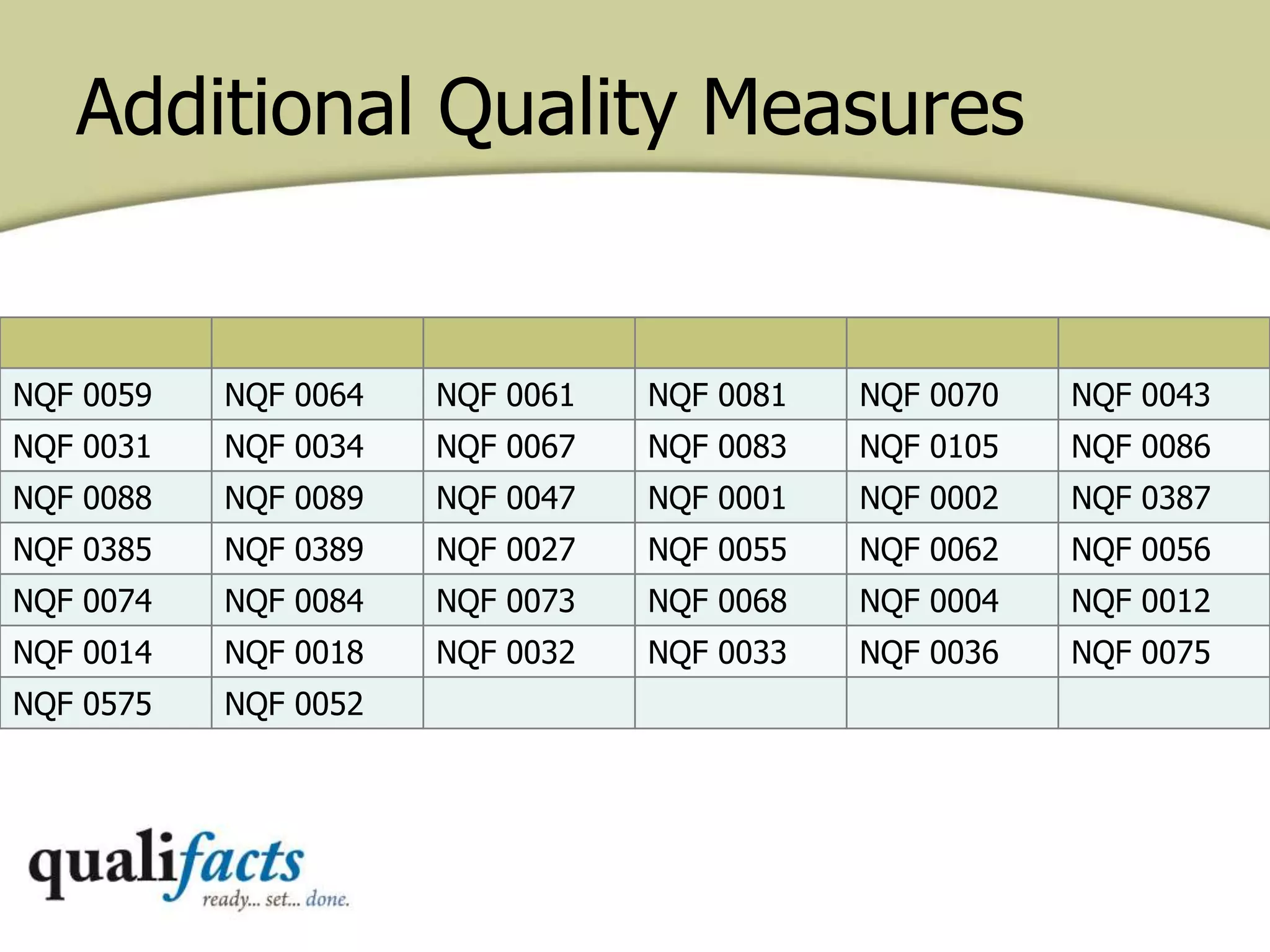
Additional Quality Measures
NQF 0059 NQF 0064 NQF 0061 NQF 0081 NQF 0070 NQF 0043
NQF 0031 NQF 0034 NQF 0067 NQF 0083 NQF 0105 NQF 0086
NQF 0088 NQF 0089 NQF 0047 NQF 0001 NQF 0002 NQF 0387
NQF 0385 NQF 0389 NQF 0027 NQF 0055 NQF 0062 NQF 0056
NQF 0074 NQF 0084 NQF 0073 NQF 0068 NQF 0004 NQF 0012
NQF 0014 NQF 0018 NQF 0032 NQF 0033 NQF 0036 NQF 0075
NQF 0575 NQF 0052
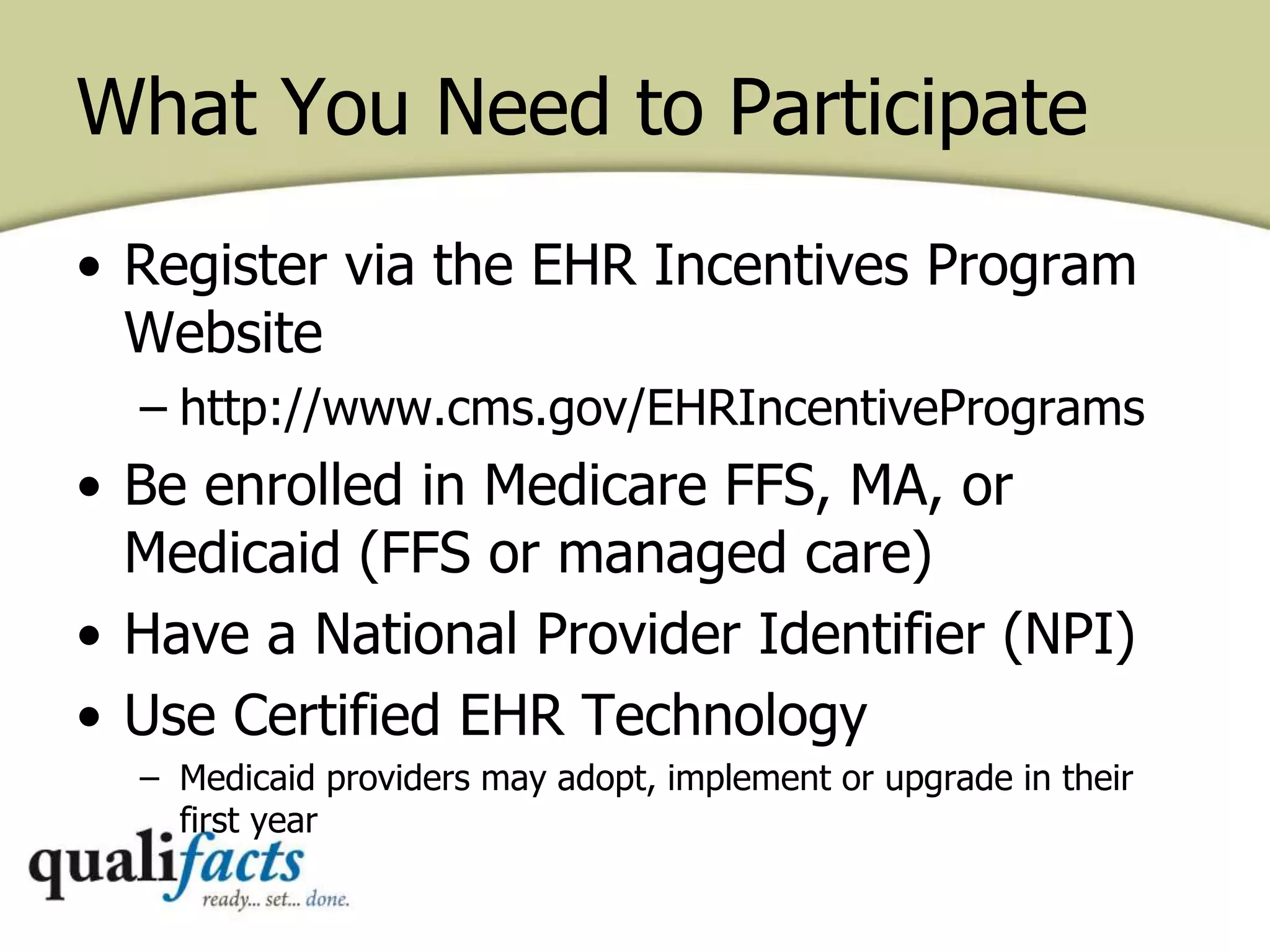
What You Need to Participate
• Register via the EHR Incentives Program
Website
– http://www.cms.gov/EHRIncentivePrograms
• Be enrolled in Medicare FFS, MA, or
Medicaid (FFS or managed care)
• Have a National Provider Identifier (NPI)
• Use Certified EHR Technology
– Medicaid providers may adopt, implement or upgrade in their
first year
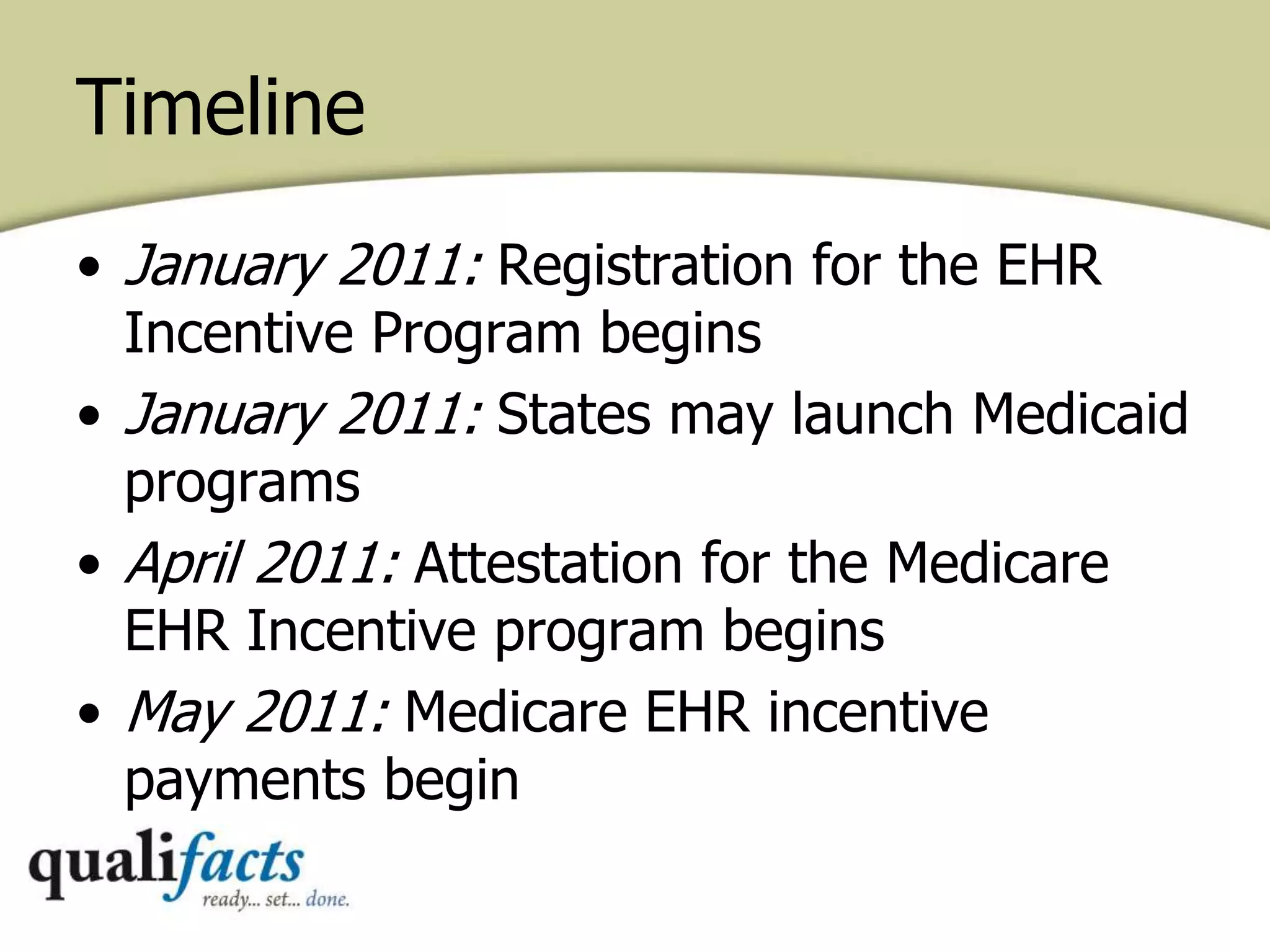
Timeline
• January 2011: Registration for the EHR
Incentive Program begins
• January 2011: States may launch Medicaid
programs
• April 2011: Attestation for the Medicare
EHR Incentive program begins
• May 2011: Medicare EHR incentive
payments begin
Action Plan Straw Man
Questions

Meaningful Use: The Fine Print

  • 1.
    Meaningful Use: TheFine Print Institute for Behavioral Health Informatics November 11th 2010
  • 2.
    The Statements Become MeaningfulUse Certified Fulfill 15 Core and 5 Menu Requirements Receive $67,300 per provider Start Receiving Incentives in 2011 1) Results may vary 2) Not available in all states 3) See CMS for Details
  • 3.
    Background • Health IThas tremendous potential to transform how health care is delivered • Health Information Technology for Economic & Clinical Health Act (HITECH) attempts to realize that potential • $34 billion in financial incentives to Medicare & Medicaid providers for the adoption and meaningful use of Health IT
  • 4.
    Critical Goals • Increasecare coordination and foster better doctor-patient communication • Reduce medical errors and improve patient safety • Support delivery of evidence based care • Provide patients with their own, portable health information • Improve quality of care, while fostering more cost effective delivery
  • 5.
    Meaningful Use Multi-year multi-stageincentive program to help expand Health IT infrastructure, spur the adoption of Certified EHR Technology and utilize it to reach a series of specified objectives
  • 6.
  • 7.
    • Hospitals – MedicareHospitals and MA-affiliated hospitals – Critical Access Hospitals (CAH) • Eligible Professionals (EP) – Non hospital-based MD, DO, DDS, DDM, Podiatrists, Optometrists, Chiropractors – Must see 50% of patients at a facility that has certified EHR technology Who is eligible
  • 8.
    • Hospital-based providers– 90% or more of their covered professional services in either an inpatient (POS 21) or emergency room (POS 23) of a hospital • An EP can only assign their reimbursement to a single taxpayer identification number A Few Key Points
  • 9.
    Hospital Incentives • Reimbursementis an equation based on – Total Discharges – Total Gross Revenue – Total Charity Care Charges – Medicare Inpatient Days (Part A FFS & Part C MA) – Total Inpatient Days – Transition Year
  • 10.
    Provider Incentives • Calculatedby multiplying your allowable charges to Medicare by 75% (up to cap) – Part B claims for FFS program – Items in Medicare Physicians Fee schedule – Only the “professional” components • No minimum patient volume required • 10% bonus available for those practicing predominantly in a Health Professional Shortage Area
  • 11.
    Penalties • If nota meaningful user by 2015 reimbursement reduced by 1% each year for 4 years* • HITECH act also authorizes CMS to further reduce reimbursement rate beginning in 2018 if proportion of meaningful users is less than 75% *Unless due to a significant hardship
  • 12.
    Reimbursement Schedule Incentive Paid In MeaningfulUse of a Certified EHR Failure to Demonstrate by 2011 2012 2013 2014 2015 2016 2017 2018 2011 $18k - - - 2012 $12k $18k - - 2013 $8k $12k $15k - 2014 $4k $8k $12k $12k 2015 $2k $4k $8k $8k 2016 $2k $4k $4k 2017 Total $44k $44k $39k $24k -1% Penalty -2% Penalt y -3% Penalt y -4% Penalt y HPSA $48.4k (+10% ) $48.4k (+10%) $42.9k (+10%) $26.4k (+10% )
  • 13.
  • 14.
    • Almost allcosts incurred by state would be reimbursed by CMS – 100% of incentive payments – 90% of acceptable administrative costs • States can request 4 additional measures become requirements in order to support state specific initiatives • States can opt out of participation Incentives for the State
  • 15.
    • Hospitals – Subsection(d) Hospitals and MA-affiliated hospitals – Critical Access Hospitals (CAH) • Eligible Professionals (EP) – Non hospital-based Physicians, NP, Certified Nurse-Midwife, Dentist, Physician Assistants in a FQHC – Must see 50% of patients at a facility that has certified EHR technology Who is eligible
  • 16.
    Provider Incentives • Musthave a minimum of 30% Medicaid patient volume for each EP during period • 85% of Net Allowable Costs capped at 63k across 4 years • Only need to Adopt, Implement, or Upgrade for first year incentive payment • Providers can only participate in a single states Medicaid incentive program
  • 17.
    • Net AverageAllowable Costs – Costs related to EHR purchase, updates, training, implementation, and maintenance (excludes any discounts or technology donations received) – Capped at $25,000 for payment year 1 and $10,000 for years 2-6 Definitions
  • 18.
    Adopt/Implement/Upgrade • Adopted –Acquired and Installed – Eg: Evidence of acquisition prior to incentive • Implemented – Commenced Utilization – Eg: Training or begin data entry • Upgraded – Expanded – Upgrade to certified EHR Technology or add new functionality to meet MU criteria • No EHR reporting period
  • 19.
    Reimbursement Schedule Incentive Paid In MeaningfulUse of a Certified EHR 2011 2012 2013 2014 2015 2016 2011 $21,250 2012 $8,500 $21,250 2013 $8,500 $8,500 $21,250 2014 $8,500 $8,500 $8,500 $21,250 2015 $8,500 $8,500 $8,500 $8,500 $21,250 2016 $8,500 $8,500 $8,500 $8,500 $8,500 $21,250 2017 $8,500 $8,500 $8,500 $8,500 $8,500 2018 $8,500 $8,500 $8,500 $8,500 2019 $8,500 $8,500 $8,500 2020 $8,500 $8,500 2021 $8,500 Total $63,750 $63,750 $63,750 $63,750 $63,750 $63,750
  • 20.
    Medicare vs Medicaid MedicareMedicaid Federal implementation in January of 2011 Voluntary for states to implement Penalties begin in 2015 No Penalties No patient volume threshold 30% medicaid volume threshold Must demonstrate MU in Year 1 A/I/U option for 1st participation year $18k 1st year max incentive $25k 1st year max incentive Max of $44k over 5 years ($48.4k in HPSA) Max of $63,750 over 6 years Start date of 2012 will still receive max incentive Start date of 2016 will still receive max incentive MU definition common States can adopt additional requirements If you skip a year, you return to later payment year If you skip a year you return to where you left off
  • 21.
    Potential Legislation • HealthInformation Technology Extension for Behavioral Health Services Act (H.R. 5040 & S. 3709 ) – Extend eligibility for Medicare & Medicaid incentive to Clinical Social Workers, Clinical Psychologists, Inpatient Psychiatric Hospitals, and Behavioral Health and Substance Abuse treatment facilities Currently has 80 cosponsors and is with the Subcommittee on Health
  • 22.
    How to Becomea Meaningful User • Use of Certified EHR Technology • Meet Staged IT Functionality Measures • Meet Staged Clinical Quality Measures
  • 23.
    Certified EHR Technology •“Complete” option – Acquire a system from a single vendor – “Complete” or “Bundled” • “Assembled” option – Acquire modules from one or more vendors – Provider must attest that assembled system is complete • http://onc-chpl.force.com/ehrcert
  • 24.
    How to Becomea Meaningful User Use of Certified EHR Technology • Meet Staged IT Functionality Measures • Meet Staged Clinical Quality Measures
  • 25.
    Stages of MeaningfulUse • Established 3 stages of meaningful use: 2011, 2013, and 2015 Capture & Share Data Exchange of clinical data Advancement of processes Improved outcomes
  • 26.
    Stage 1: Overview •Capture health information in a coded and structured format • Track key clinical conditions and communicate for coordination purposes • Implement Clinical Decision Support tools • Report clinical quality measures & public health information
  • 27.
    Stage 1: Reporting& Payment • Reporting period is a 90 day consecutive period – Subsequent years will be full payment year • Reporting through attestation • Payment received once CMS has been shown attainment and reached either yearly maximum or end of calendar year
  • 28.
    IT Functionality Measures •Purpose: Show how well the provider/hospital is using their Certified EHR Technology • Core Measures – Must attain or qualify for exception on all measures • Menu Items – Must attain or qualify for exception on 5 measures – Must choose one public health measure
  • 29.
  • 30.
    IT Measures: Stage1 (Core) Objective Measure Reporting Requirements Exclusions Computerized Physician Order Entry for medication orders >30% of patients Transmission of the order to the pharmacy is not required N: # of patients in the denominator that have at least one medication order entered using CPOE D: Number of patients with at least one medication in their medication list Any EP who writes < 100 prescriptions Implement Drug-Drug and Drug Allergy Interaction Functionality must be enabled for entire EHR reporting period Yes/No Attestation Any EP who writes < 100 prescriptions Generate and transmit permissible prescriptions electronically >40% of all permissible prescriptions N: # of prescriptions in the denominator generated and transmitted electronically D: # of prescriptions written for permissible drugs requiring a prescription Any EP who writes < 100 prescriptions Record the following demographics: preferred language, gender, race & ethnicity, DOB >50% of patients have demographics N: # of patients in denominator who have all elements or specific exclusion D: # of patients seen during reporting period None All references to patients should be interpreted as unique patients
  • 31.
    IT Measures: Stage1 (Core) Objective Measure Reporting Requirements Exclusions Maintain up-to-date problem list of current and active diagnoses >80% of patients If no active diagnosis then an entry must exist that states this fact N: # of patients in denominator who have at least one active diagnosis entry D: # of patients seen during reporting period None Maintain active medication list >80% of patients If no active medications then an entry must exist that states this fact N: # of patients in denominator who have at least one active medication entry D: # of patients seen during reporting period None Maintain active medication allergy list >80% of patients If no known medical allergies then an entry must exist that states that fact N: # of patients in denominator who have a least one active medication allergy entry D: # of patients seen during reporting period None Record and chart vital signs (Height, Weight ,BP ,BMI, Growth Chart) >50% of patients ≥ 2 years old N: # of patients in denominator who have one entry for each D: # of patients ≥ 2 years old during the period No patients 2 or older Vital signs not relevant All references to patients should be interpreted as unique patients
  • 32.
    IT Measures: Stage1 (Core) Objective Measure Reporting Requirements Exclusions Implement one clinical decision support rule with ability to track Implement one rule Yes/No Attestation None Provide patients with an electronic copy of their health information >50% of patients who request are given a copy within 3 business days N: # of patients in denominator who received copy within 3 business days D: # of patients who requested within 4 days of reporting period ending No requests during reporting period Clinical summaries provided to patients for all office visits >50% of all office visits within 3 days Can be provided through PHR, Secure email, electronic media such as CD or USB or printed N: # of patients in denominator who are provided summary within 3 business days D: # of patients seen during reporting period EP Only No office visits during reporting period All references to patients should be interpreted as unique patients
  • 33.
    IT Measures: Stage1 (Core) Objective Measure Reporting Requirements Exclusions Capability to exchange key clinical information among providers of care and patient authorized entities electronically Performed at least one test of capability from EHR technology Yes/No Attestation None Protect Health Information Conduct or review a security risk analysis and implement updates and correct identified security deficiencies as part of risk management process Yes/No Attestation None Provide patients with an electronic copy of their discharge instructions when leaving facility >50% of patients who request are given a copy prior to leaving facility N: # of patients in denominator who receive an electronic copy of discharge instructions D: # of patients who request a copy of discharge instructions during reporting period Hosp Only No discharges or requests during reporting period All references to patients should be interpreted as unique patients
  • 34.
  • 35.
    IT Measures: Stage1 (Core) Objective Measure Reporting Requirements Exclusions Implement drug- formulary checks Functionality has been enabled and has access to at least one internal or external formulary for entire reporting period Yes/No Attestation None Lab results >40% of all clinical lab tests results ordered by the provider or an authorized provider whose results are expressed as +/-/# N: # of lab test results whose results are expressed in +/- /#number and are stored as structured data D: # of lab tests ordered during reporting period whose results are expressed as +/-/# No lab orders with results expressed as +/-/# Generate lists of patients based on specific conditions to use for quality improvement, reduction in disparities, research or outreach Generate at least one report listing patients with a specific condition Yes/No Attestation None All references to patients should be interpreted as unique patients
  • 36.
    IT Measures: Stage1 (Core) Objective Measure Reporting Requirements Exclusions Provide access to patient-specific education resources upon request >10% of patients are provided patient- specific education resources N: # of patients in the denominator who are provided resources D: # of patients seen during reporting period None Send reminders to patients based on patient preferences and selected by specific criteria Reminders sent to at least 20% of all patients seen that are ≥ 65 years of age or ≤ 5 years of age N: # of patients in the denominators who are sent appropriate reminders D: # of patients ≥ 65 years old or ≤ 5 years old No patients ≥ 65 years old or ≤ 5 years old Provide patients with timely access to their health information within 4 days of information being available >10% of all patients are provided timely electronic access to their health information Provider has discretion to withhold certain info N: # of patients in the denominator who were provided timely electronic access to their health information D: # of unique patients seen during reporting period EP Only No required information created (Labs, problem list, medications, meication allergies) All references to patients should be interpreted as unique patients
  • 37.
    IT Measures: Stage1 (Core) Objective Measure Reporting Requirements Exclusions Capability to submit electronic data to immunization registries Perform at least one test from EHR technology and verify success Yes/No Attestation No immunizatio ns provided during reporting period Perform medication reconciliation when a patient is received from another setting or provider >50% of transitions of care where patient is transferred into providers care N: # of transitions of care in the denominator where medication reconciliation was performed D: The number of transitions of care during the reporting period where the provider was the receiving party of the transition No transitions of care where the provider was the receiving part of the transition Provide summary of care record for each transition of care >50% of transitions of care where patient is transferred out of providers care or referred to another provider N: # of transitions of care and referrals in the denominator where a summary of care record was provided D: # of transitions of care and referrals during reporting period where provider was transferring or referring No patients transferred to anther setting or referred to another providers All references to patients should be interpreted as unique patients
  • 38.
    IT Measures: Stage1 (Core) Objective Measure Reporting Requirements Exclusions Capability to submit electronic syndromic surveillance data to public health agencies Perform at least one test from EHR technology and verify success Yes/No Attestation No reportable syndromic information collected during reporting period Capability to submit electronic lab test results to public health agencies Perform at least one test from EHR technology and verify success Yes/No Attestation Hosp Only No lab results collected during reporting period Collect advanced directives >50% of patients ≥ 65 years old N: # of patients in the denominator who have advanced directives recorded D: # of patients ≥ 65 years old seen during reporting period Hosp Only All references to patients should be interpreted as unique patients
  • 39.
    How to Becomea Meaningful User Use of Certified EHR Technology Meet Staged IT Functionality Measures • Meet Staged Clinical Quality Measures
  • 40.
    Clinical Quality Measures •Purpose: Show how meaningful use has improved the care patients receive • Providers required to report on 6 Quality Measures – 3 mandatory “Core” or “Alternate” measures – Select 3 more from list of 38 Quality Measures according to providers specialty • Hospitals measures – Required to report on 35 Medicare measures – For Medicaid, hospitals have the option to report on 8 alternative measures if the 35 do not apply to patient population
  • 41.
  • 42.
    Core Clinical QualityMeasures NQF & PQRI Number Measure Description NQF 0013 Hypertension: Blood Pressure Measurement % of patient visits for patients ≥ 18 years old with a diagnosis of hypertension who have been seen for at least 2 office visits, with BP recorded NQF 0028 Preventative Care and Screening Measurement Pair: a) Tobacco use Assessment, b) Tobacco Cessation Intervention a) % of patients ≥ 18 years old seen multiple times within 24 months & asked about tobacco use at least one time b) % of patients ≥ 18 years old seen multiple times within 24 months and have received cessation intervention NQF 0421 PQRI 128 Adult Weight Screening and Follow-up % of patients ≥18 years old with a calculated BMI in the past six months or during the current visit documented AND if outside parameter follow-up plan is documented
  • 43.
  • 44.
    Alternate Quality Measures NQF& PQRI Number Measure Description NQF 0024 Weight Assessment and Counseling for Children and Adolescents % of patients 2-17 years of age who have had an outpatient visit with PCP and have evidence of BMI documentation, counseling for nutrition and counseling for physical activity NQF 0041 PQRI 110 Preventative Care and Screening: Influenza Immunization for Patients 50 Years Old or Older % of patients aged 50 years and older who received an influenza immunization during the flue season (September through February) NQF 0038 Childhood Immunization Status % of children ≥ 2 years old who had four diphteria, tentanus and acellular pertussis; three polio, one measles, mumps, and rubella; two H influenza type B; three hepatitis B; one chicken pox; four pneumococcal conjugate; two hepatitis A; two or three rotavirus ; and two influenza vaccines by their second birthday. The measure calculates a rate for each vaccine and nine separate combination rates.
  • 45.
    Additional Quality Measures NQF0059 NQF 0064 NQF 0061 NQF 0081 NQF 0070 NQF 0043 NQF 0031 NQF 0034 NQF 0067 NQF 0083 NQF 0105 NQF 0086 NQF 0088 NQF 0089 NQF 0047 NQF 0001 NQF 0002 NQF 0387 NQF 0385 NQF 0389 NQF 0027 NQF 0055 NQF 0062 NQF 0056 NQF 0074 NQF 0084 NQF 0073 NQF 0068 NQF 0004 NQF 0012 NQF 0014 NQF 0018 NQF 0032 NQF 0033 NQF 0036 NQF 0075 NQF 0575 NQF 0052
  • 46.
    What You Needto Participate • Register via the EHR Incentives Program Website – http://www.cms.gov/EHRIncentivePrograms • Be enrolled in Medicare FFS, MA, or Medicaid (FFS or managed care) • Have a National Provider Identifier (NPI) • Use Certified EHR Technology – Medicaid providers may adopt, implement or upgrade in their first year
  • 47.
    Timeline • January 2011:Registration for the EHR Incentive Program begins • January 2011: States may launch Medicaid programs • April 2011: Attestation for the Medicare EHR Incentive program begins • May 2011: Medicare EHR incentive payments begin
  • 48.
  • 49.

Editor's Notes

  • #7 Considered the minimal standard for MU attainment
  • #13 Must begin by 2014
  • #14 States not States have the ability to add 4 more core measures
  • #16 Definition of Hospital-based: 90% or more of their covered professional services in either an inpatient (POS 21) or emergency root (POS 23) of a hospital
  • #17 Incentive payments are flat fees intended to cover the “net average allowable cost of purchasing and implementing and maintaining an EHR Can accept $29k in first year and $10k in subsequent years from outside funding such as federal grants without effecting reimbursement
  • #30 In the event that you attest that one of the Exclusion criteria applies to you, it decreases the number of metrics an EP needs to submit against
  • #35 EP’s must select 5 (including one from Public Health) Any measure that is not applicable can count towards your 5 items
  • #38 Medication reconciliation is described as the process of identifying the most accurate list of all medications that the patient is taking, including name, dosage, frequency and route, by comparing the medical record to an external list of medications obtained from a patient, hospital or other provider. Transition of care is clarified as the movement of a patient from one setting of care (hospital, ambulatory primary care practice, ambulatory, specialty care practice, long-term care, home health, rehabilitation facility) to another. We also clarify that the receiving eligible hospital or EP would conduct the medication reconciliation.
  • #39 Medication reconciliation is described as the process of identifying the most accurate list of all medications that the patient is taking, including name, dosage, frequency and route, by comparing the medical record to an external list of medications obtained from a patient, hospital or other provider. Transition of care is clarified as the movement of a patient from one setting of care (hospital, ambulatory primary care practice, ambulatory, specialty care practice, long-term care, home health, rehabilitation facility) to another. We also clarify that the receiving eligible hospital or EP would conduct the medication reconciliation.
  • #42 EP’s must select 5 (including one from Public Health) Any measure that is not applicable can count towards your 5 items
  • #44 EP’s must select 5 (including one from Public Health) Any measure that is not applicable can count towards your 5 items
  • #49 EP’s must select 5 (including one from Public Health) Any measure that is not applicable can count towards your 5 items
  • #50 EP’s must select 5 (including one from Public Health) Any measure that is not applicable can count towards your 5 items