Download to read offline
![International Research Journal of Engineering and Technology (IRJET) e-ISSN: 2395-0056
Volume: 04 Issue: 10 | Oct -2017 www.irjet.net p-ISSN: 2395-0072
© 2017, IRJET | Impact Factor value: 6.171 | ISO 9001:2008 Certified Journal | Page 1305
2. METHODOLOGY
The current study focuses on the production of interlocking
bricks without using any mortar for the construction of
walls, what accuracy for the evenness and parallelism of the
uppermost and bottom brick surfaces is necessitated to
make sure wall alignment is slender and not beyond the
limits as prescribed by [1]BS code8000-3:2001whichstates
that the erectness diversion in each 5m lengthiness wall
should not exceed ±5mm, and verticality lean up to 3m wall
height is within ±10mm[2].Here in this study, we have
designed a mold in order to make customized interlocking
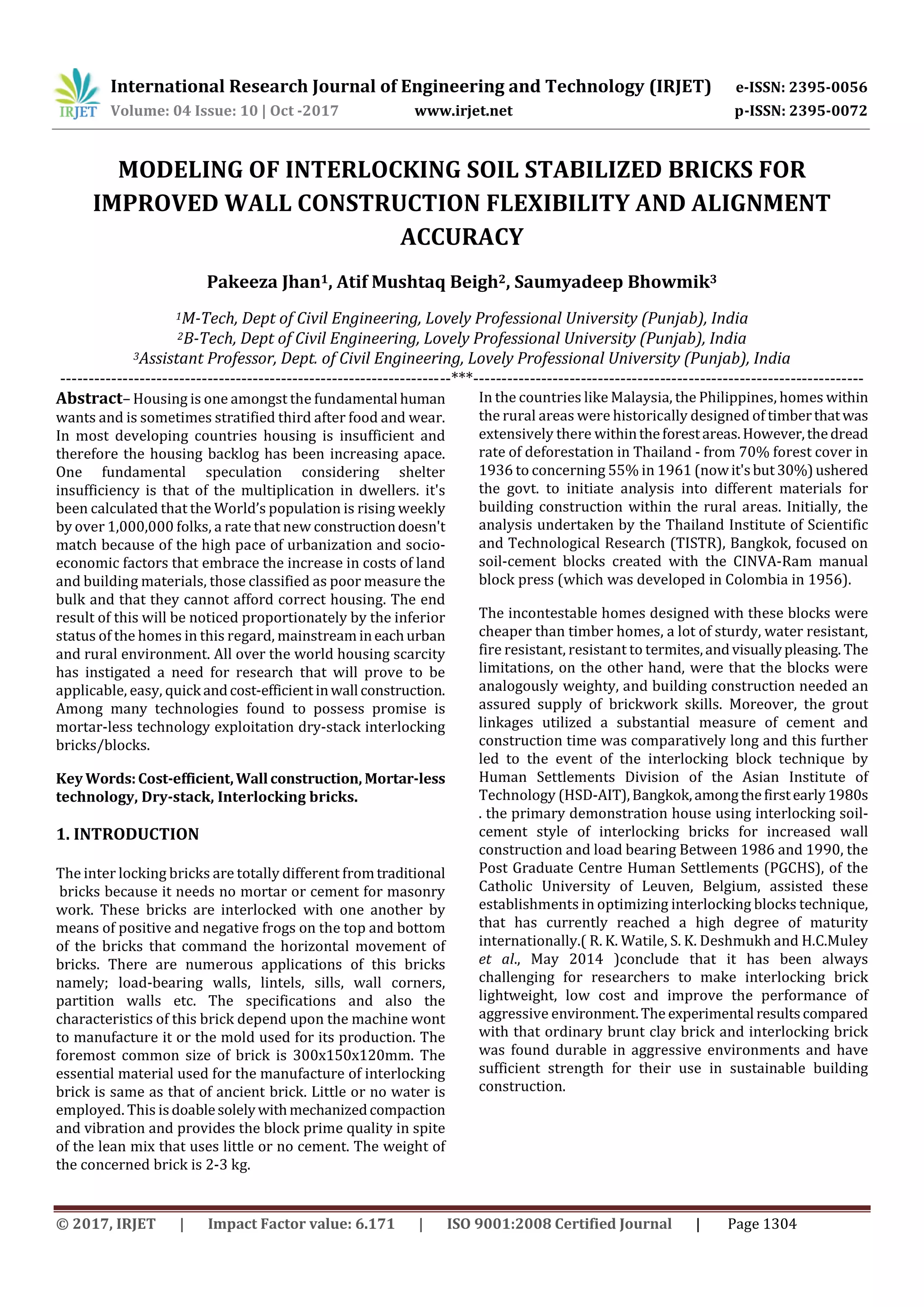
bricks(figure 1).From the figure we can see two up heaved
holes that can be called positive or negative frogs as per
convention.
Fig -1: The Mould For Brick Making With A Brick Adjacent
To It
2.1 STUDY AREA
Interlocking bricks is the most straightforward approach of
implementing in IBS (industrialized building system) and
can easily penetrate in the construction merchandise.
Interlocking bricks engages load bearing wall by integrating
the columns and beams as an elemental part of the wall for
each and every type of houses (up to 5-storey in high). The
budget that can be safeguarded on a wall construction can
vary between 10% to 30% as compared to traditional brick
with additional unsubstantial foundation cost as per IBS
Roadmap 2011-2015. Interlocking bricks give 3 timesfaster
in regard to that of the wall construction, columns & beams
in comparison to conventional ways and means. More rapid
construction gives a key benefit to commercial clients andin
addition keeping up government’spolicytoconstruct10,000
affordable housings in 2012.[3]
2.2 BRICK PRODUCTION STEPS
Step 1: Excavation
Excavation involves un-soiling and digging. Unsoiling is the
process of stripping off top surfaceabout200mmindepthas
top surface is full of impurities and must be rejected.Digging
involves excavating clay and then spreading in heaps of
about 600-1200 mm.
Step 2: Cleaning And Sieving:-
Obtained clay is cleaned of stones, pebbles, vegetablematter
and other impurities by passing it through a conventional
sieve. If impurities are in excess clay needs tobewashedand
screened.
Step 3: Pulverizing
Pulverizing is a process of grinding of clay to convert lumps
of clay into powdered form. Pulverized clay is subjected to
weathering process. Weathering involves exposure to
atmospheric conditions for softening purpose as shown in
figure 2.
Step 4: Mixing And Pugging
Clay is made loose and any ingredientto beaddedarespread
out at the top followed by turning up and down vertically.
Pugging is the process of tempering the clay to make it
plastic of uniform consistency for bricks. Clay was added
with sufficient amount of water and was thoroughly mixed
with the shovel.
Step 5: Moulding Of Bricks
Moulding involved was hand molding. Here we leveled the
ground surface and sprinkled fine sand over the ground.
Mould was dunked inside water, next placed on the ground
to occupy the prepared clay. Over and aboveclayisdetached
by wooden or metal strike, soon after the skeleton of the
mold is held up and raw brick is departed on the ground
Step 6: Drying Of Bricks
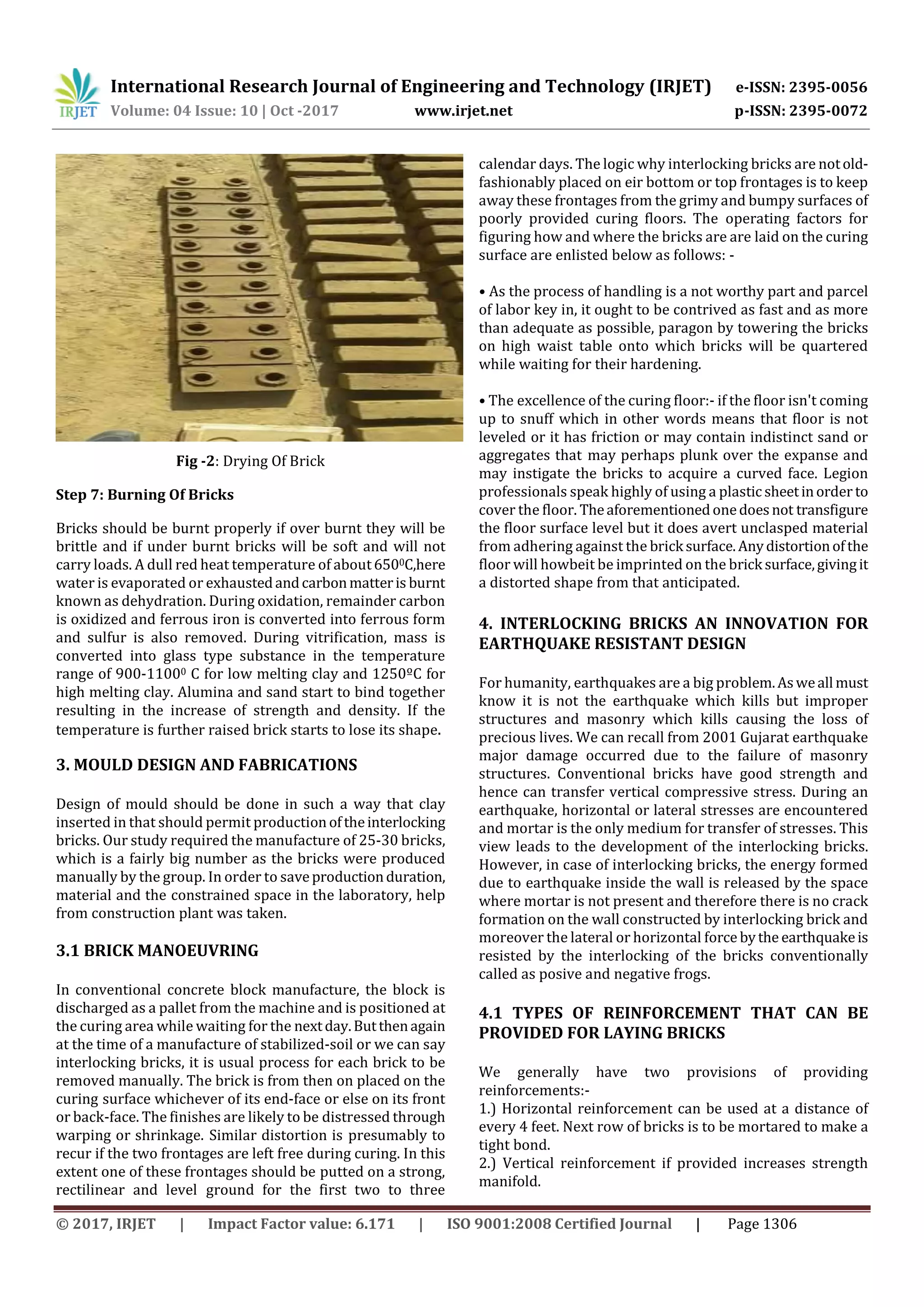
Bricks are laid longitudinally, allowed todrytill theybecome
hard(moisture content of 2%).Sufficient gap is provided for
air circulation as shown in figure 2](https://image.slidesharecdn.com/irjet-v4i10237-171129094329/75/Modeling-of-Interlocking-Soil-Stabilized-Bricks-for-Improved-Wall-Construction-Flexibility-and-Alignment-Accuracy-2-2048.jpg)
![International Research Journal of Engineering and Technology (IRJET) e-ISSN: 2395-0056
Volume: 04 Issue: 10 | Oct -2017 www.irjet.net p-ISSN: 2395-0072
© 2017, IRJET | Impact Factor value: 6.171 | ISO 9001:2008 Certified Journal | Page 1307
5. COMPRESSIVE STRENGTH TEST AS PER IS: 3495-
(PART -I )-1992[4] RESULTS
In this test, the load is enforced axially at a equivalent rate of
14 N/mm2 per minute unless failure results from UTM
(universal testing machine). Themaximal loadatbreakdown
is jotted down. machine.
CALCULATION:-
Compressive strength (N/mm2) = Maximum load at the
breakdown (in N)/ Avg. related to bed faces (in mm2).
Compressive strength table readings is shown as
S.NO ACTUAL
SIZE OF
BRICK
(mm2)
COMPRESSIVE
LOAD (N)
COMPRESSIVE
STRENGTH(N/mm2)
1. 22.05 x
10.5
27000 11.1
2. 22.06 x
10.6
26500 11.3
3. 22.05 x
10.5
27000 11.6
4. 22.06 x
10.5
25000 10.79
5. 22.05 x
10.6
26000 11.21
Average compressive strength =
= 11.1+11.3+11.6+10.79+11.21 N/mm2
5
=11.33 N/mm2
6. ADVANTAGES OF INTERLOCKING BRICKS
• Cement consumption in interlocking bricks will be
less than the brickwork with cement mortar for
conventional bricks.
• Work can be completed faster than that of
traditional estimated time.
• The houses constructed with mud made
interlocking bricks the electricity consumption will
be less, because of the cool atmosphere inside in
summers and hot during winters.
• Using interlocking bricks means we are using the
Eco-friendly construction as there is less cement
and hence no emission of carbon dioxide gas.
• No cracks even after the earthquakes.
• Economical or in other words cost saving in terms
of cement, sand, and water.
6.1 DISADVANTAGES OF INTERLOCKING BRICKS
• The space between the interlocks of these bricks is
enough for insects and ants to set up their homes.
• If rainwater flows through these bricks, the colour
of the brick changes very fast.
• Forecasting the prospects forISSB(Interlockingsoil
stabilized bricks) in progressing countries is
challenging because of current building standards,
code of practice and rules and consequently create
negative temperament towards new technologies.
7. CONCLUSIONS
Based on above study, following inferences are drawn:
• Interlocking bricks is also not about sizing and
dimension.
• The interlocking bricks are the new andimprovised
version of bricks as the new innovations keep on
evolving every now and then.
• It is an opportunity fortheindustrytoacknowledge
the new innovative product which has enhanced
advantages over conventional bricks.
• The Interlocking bricks ideology is one of the
simplified, discretionary and most flexible systems
that can be used in the construction industry.
• The above study advocates that established on its
characterization, benefits and innovative capability
of interlocking bricks, it should be given
concentration by CIDB ( Construction Industry
Development Board) to be counted in as one of IBS
(industrializedbuildingsystem) merchandiseunder
the innovative or hybridise cluster.
8. FUTURE SCOPE
The future scope for interlocking bricks is enlisted below:
The interlocking can be used in partition walls.
They can be used at places where we need less self-
weight of structures as no mortar is used.
They can be used for earthquake resistant buildings
as we know strain energy due to the earthquake is
generally released from mortar resulting in the
development of cracks in it, but interlocking bricks
have no mortar so stain energy is released without
causing cracks in the structure.
Vertical reinforcement can also be provided which
is not possible in conventional bricks in order to
increase the strength of the structure.](https://image.slidesharecdn.com/irjet-v4i10237-171129094329/75/Modeling-of-Interlocking-Soil-Stabilized-Bricks-for-Improved-Wall-Construction-Flexibility-and-Alignment-Accuracy-4-2048.jpg)
![International Research Journal of Engineering and Technology (IRJET) e-ISSN: 2395-0056
Volume: 04 Issue: 10 | Oct -2017 www.irjet.net p-ISSN: 2395-0072
© 2017, IRJET | Impact Factor value: 6.171 | ISO 9001:2008 Certified Journal | Page 1308
ACKNOWLEDGEMENT
we would like to express our deep sense of gratitude
towards our guide Mr. Sauymadeep Bhowmik for his
consistent guidance, encouragement, suggestions, valuable
criticism and kind support. We also owesincerethankstoall
the lecturers of “School Of Civil Engineering” fortheiradvice
and counseling. We are very much thankful to the higher
authorities of Lovely Professional University for permitting
us to make this research and do the experimentation and
analysis plus making us work with their highly experienced
and skilled guide.
REFERENCES
[1] Wrap.warwick.ac.uk.
[2] Guidelines for the design of wall as per BS code 8000-
3:2001.
[3] Ibsresearch.blogspot.my
[4] Test for Compressive strength, New Delhi: Bureau of
Indian Standards, IS: 3495(Part-I)-1992.
BIOGRAPHIES
Pakeeza Jhan is the M-Tech student of
Lovely Professional UniversityPunjab
under the domain of Construction
Project Management and has done B-
tech from the same university.
Atif Mushtaq Beigh has done
B-Tech from Lovely Professional
University, Punjab.
Saumyadeep Bhowmik is an assistant
professor in Civil engineering
department of Lovely Professional
University, Punjab under the domain
of Hydrology and has done B-tech
from the same university and M-tech
from National Institute OfTechnology,
Agartala.](https://image.slidesharecdn.com/irjet-v4i10237-171129094329/75/Modeling-of-Interlocking-Soil-Stabilized-Bricks-for-Improved-Wall-Construction-Flexibility-and-Alignment-Accuracy-5-2048.jpg)

This document summarizes research on modeling interlocking soil-stabilized bricks to improve wall construction flexibility and alignment accuracy. Key points: - Interlocking bricks do not require mortar, instead connecting through positive and negative "frogs" on each brick. This allows faster, more flexible construction compared to traditional bricks. - Researchers designed a mold to produce customized interlocking bricks meeting accuracy standards for wall alignment. Compressive strength testing of sample bricks produced an average strength of 11.33 N/mm2. - Interlocking bricks have advantages over traditional bricks like lower cement use, faster construction, earthquake resistance from mortar-less connections, and cost savings. Disadvantages include potential insect/ant access


