
TADIPATRI ENGINEERING COLLEGE
(Affiliated to jawaharlal nehru technology university of anantapur, recognized by AICTE, New Delhi)
TADIPATRI
BY: K. HYDER ALI

 What is GFRG panel
 Why GFRG panels
 Properties of GFRG panel
 Manufacturing of GFRG panel
 Placing of panels
 Advantages
 Disadvantages
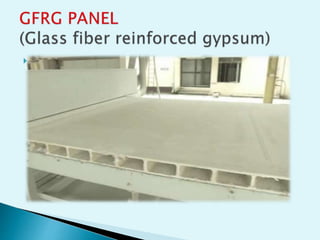
GFRG panels are the composite material of gypsum
and glass fiber having an composition of
GYPSUM(CALCIUM SULPHATE) = 89-94 %
GLASS FIBRES = 4-6 %
PORTLAND CEMENT = 1-2 %
SAND OR SILICIOUS MATERIALS = 1- 5%
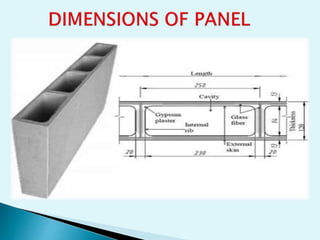
GFRG panels are the hollow boards which is been
used for the various component of building
Dimension: 12m x 3m x 124mm
Also known as Rapidwall
 We need a very fast construction technology which can
increase our development rate
 Our India is still a developing country fighting with a huge
shortage of housing every year.
 Conventional methods of construction lead to formation of
huge amount of CO2 (about 40% is developed due to
construction industry) increasing chances of global
warming.
 Fertilizer industries are facing problems regarding disposal
of industrial waste gypsum (2000 tonnes per day)
 We are not having enough water for ourselves, then why
allow buildings to drink it?
 Compressive strength of panel with concrete infill
180 kg/cm2
 Flexural strength of panel with concrete infill
20.80kg/cm2
 Tensile strength 28.8kN/m
 Water absorption <2%
 Fire resistance
 Free from corrosion
 Rot and termite proof
 Light in weight
 Earthquake resistant

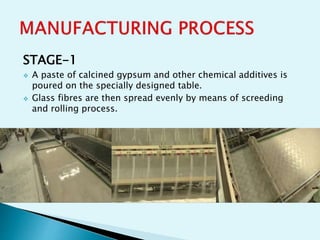
STAGE-1
 A paste of calcined gypsum and other chemical additives is
poured on the specially designed table.
 Glass fibres are then spread evenly by means of screeding
and rolling process.
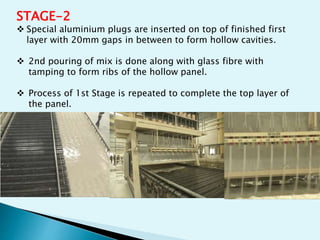
STAGE-2
 Special aluminium plugs are inserted on top of finished first
layer with 20mm gaps in between to form hollow cavities.
 2nd pouring of mix is done along with glass fibre with
tamping to form ribs of the hollow panel.
 Process of 1st Stage is repeated to complete the top layer of
the panel.
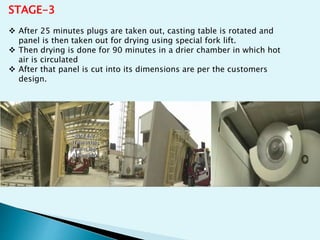
STAGE-3
 After 25 minutes plugs are taken out, casting table is rotated and
panel is then taken out for drying using special fork lift.
 Then drying is done for 90 minutes in a drier chamber in which hot
air is circulated
 After that panel is cut into its dimensions are per the customers
design.
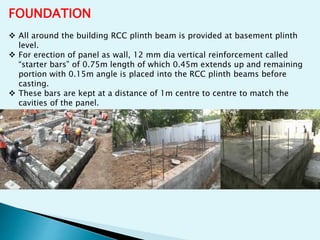
FOUNDATION
 All around the building RCC plinth beam is provided at basement plinth
level.
 For erection of panel as wall, 12 mm dia vertical reinforcement called
“starter bars” of 0.75m length of which 0.45m extends up and remaining
portion with 0.15m angle is placed into the RCC plinth beams before
casting.
 These bars are kept at a distance of 1m centre to centre to match the
cavities of the panel.
SUPERSTRUCTURE
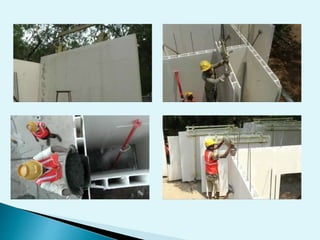
Pre-cut panels are brought to the construction site.
Panels are kept over the starter bars on the plinth beam
using cranes.
Grooves are cut into the panels at every joints to
facilitate integral bonding.
Verticality of panels are checked and then cavities
having reinforcements are filled with concrete.
It is mandatory to reinforce and fill all the joints with
concrete.
Other cavities can be filled with any inert materials (e.g.
quarry dust mixed with 5% cement and water)
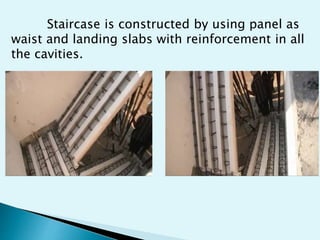
Staircase is constructed by using panel as
waist and landing slabs with reinforcement in all
the cavities.
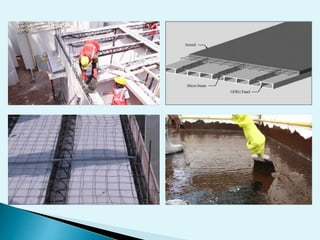
ROOF SLAB
Formworks are erected.
Tie beams are constructed all along the walls to
provide bond between roof slab and walls.
Panels are then placed in position.
Every third cavity is then cut open from the top and
reinforcement cages are inserted for concrete micro
beams.
Electrical conduits are then placed in position.
Welded wire mesh is then kept all over the panel.
Then concreting is done with thickness 50mm.
Subsequently waterproofing of roof is done.
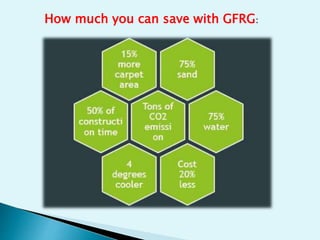
How much you can save with GFRG:
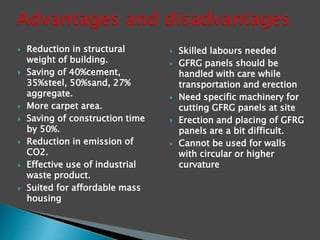
 Reduction in structural
weight of building.
 Saving of 40%cement,
35%steel, 50%sand, 27%
aggregate.
 More carpet area.
 Saving of construction time
by 50%.
 Reduction in emission of
CO2.
 Effective use of industrial
waste product.
 Suited for affordable mass
housing
 Skilled labours needed
 GFRG panels should be
handled with care while
transportation and erection
 Need specific machinery for
cutting GFRG panels at site
 Erection and placing of GFRG
panels are a bit difficult.
 Cannot be used for walls
with circular or higher
curvature
 Providing affordable housing is a challenge for developing
like India.
 India have an shortage of nearly 17.6 million houses.
 There is also a challenge of disposal of industrial waste like
gypsum.
 India having an nearly 2000 tones/day of gypsum waste
generations.
 The work carried in concluded that there is saving in cost of
construction up to 20-30%
 GFRG panel housing provide an adequate solutions to the
above problems
Thanq…
foryourco operation

GFRG PANELS

  • 1.
    TADIPATRI ENGINEERING COLLEGE (Affiliatedto jawaharlal nehru technology university of anantapur, recognized by AICTE, New Delhi) TADIPATRI BY: K. HYDER ALI
  • 2.
  • 3.
     What isGFRG panel  Why GFRG panels  Properties of GFRG panel  Manufacturing of GFRG panel  Placing of panels  Advantages  Disadvantages
  • 4.
    GFRG panels arethe composite material of gypsum and glass fiber having an composition of GYPSUM(CALCIUM SULPHATE) = 89-94 % GLASS FIBRES = 4-6 % PORTLAND CEMENT = 1-2 % SAND OR SILICIOUS MATERIALS = 1- 5% GFRG panels are the hollow boards which is been used for the various component of building Dimension: 12m x 3m x 124mm Also known as Rapidwall
  • 5.
     We needa very fast construction technology which can increase our development rate  Our India is still a developing country fighting with a huge shortage of housing every year.  Conventional methods of construction lead to formation of huge amount of CO2 (about 40% is developed due to construction industry) increasing chances of global warming.  Fertilizer industries are facing problems regarding disposal of industrial waste gypsum (2000 tonnes per day)  We are not having enough water for ourselves, then why allow buildings to drink it?
  • 6.
     Compressive strengthof panel with concrete infill 180 kg/cm2  Flexural strength of panel with concrete infill 20.80kg/cm2  Tensile strength 28.8kN/m  Water absorption <2%  Fire resistance  Free from corrosion  Rot and termite proof  Light in weight  Earthquake resistant
  • 7.
  • 8.
    STAGE-1  A pasteof calcined gypsum and other chemical additives is poured on the specially designed table.  Glass fibres are then spread evenly by means of screeding and rolling process.
  • 9.
    STAGE-2  Special aluminiumplugs are inserted on top of finished first layer with 20mm gaps in between to form hollow cavities.  2nd pouring of mix is done along with glass fibre with tamping to form ribs of the hollow panel.  Process of 1st Stage is repeated to complete the top layer of the panel.
  • 10.
    STAGE-3  After 25minutes plugs are taken out, casting table is rotated and panel is then taken out for drying using special fork lift.  Then drying is done for 90 minutes in a drier chamber in which hot air is circulated  After that panel is cut into its dimensions are per the customers design.
  • 11.
    FOUNDATION  All aroundthe building RCC plinth beam is provided at basement plinth level.  For erection of panel as wall, 12 mm dia vertical reinforcement called “starter bars” of 0.75m length of which 0.45m extends up and remaining portion with 0.15m angle is placed into the RCC plinth beams before casting.  These bars are kept at a distance of 1m centre to centre to match the cavities of the panel.
  • 12.
    SUPERSTRUCTURE Pre-cut panels arebrought to the construction site. Panels are kept over the starter bars on the plinth beam using cranes. Grooves are cut into the panels at every joints to facilitate integral bonding. Verticality of panels are checked and then cavities having reinforcements are filled with concrete. It is mandatory to reinforce and fill all the joints with concrete. Other cavities can be filled with any inert materials (e.g. quarry dust mixed with 5% cement and water)
  • 14.
    Staircase is constructedby using panel as waist and landing slabs with reinforcement in all the cavities.
  • 15.
    ROOF SLAB Formworks areerected. Tie beams are constructed all along the walls to provide bond between roof slab and walls. Panels are then placed in position. Every third cavity is then cut open from the top and reinforcement cages are inserted for concrete micro beams. Electrical conduits are then placed in position. Welded wire mesh is then kept all over the panel. Then concreting is done with thickness 50mm. Subsequently waterproofing of roof is done.
  • 17.
    How much youcan save with GFRG:
  • 18.
     Reduction instructural weight of building.  Saving of 40%cement, 35%steel, 50%sand, 27% aggregate.  More carpet area.  Saving of construction time by 50%.  Reduction in emission of CO2.  Effective use of industrial waste product.  Suited for affordable mass housing  Skilled labours needed  GFRG panels should be handled with care while transportation and erection  Need specific machinery for cutting GFRG panels at site  Erection and placing of GFRG panels are a bit difficult.  Cannot be used for walls with circular or higher curvature
  • 20.
     Providing affordablehousing is a challenge for developing like India.  India have an shortage of nearly 17.6 million houses.  There is also a challenge of disposal of industrial waste like gypsum.  India having an nearly 2000 tones/day of gypsum waste generations.  The work carried in concluded that there is saving in cost of construction up to 20-30%  GFRG panel housing provide an adequate solutions to the above problems
  • 21.