MODEL BIAS IN AI
17 Aug 2017
Jason Tamara Widjaja
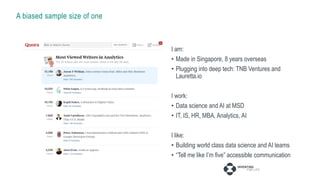
A biased sample size of one
I am:
• Made in Singapore, 8 years overseas
• Plugging into deep tech: TNB Ventures and
Lauretta.io
I work:
• Data science and AI at MSD
• IT, IS, HR, MBA, Analytics, AI
I like:
• Building world class data science and AI teams
• “Tell me like I’m five” accessible communication
Agenda
3
1 Introduction: What Is AI in MSD?
2 The Problem: Model Bias in Practice
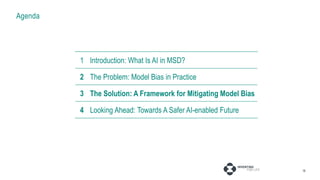
3 The Solution: A Framework for Mitigating Model Bias
4 Looking Ahead: Towards A Safer AI-enabled Future
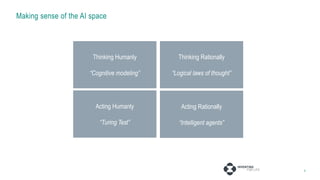
Acting Humanly
“Turing Test”
Making sense of the AI space
4
Thinking Humanly
“Cognitive modeling”
Thinking Rationally
“Logical laws of thought”
Acting Rationally
“Intelligent agents”
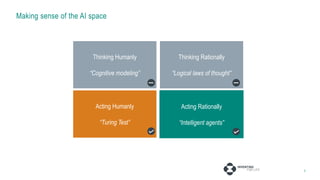
Acting Humanly
“Turing Test”
Making sense of the AI space
5
Thinking Humanly
“Cognitive modeling”
Thinking Rationally
“Logical laws of thought”
Acting Rationally
“Intelligent agents”
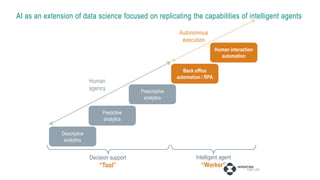
Descriptive
analytics
Predictive
analytics
Prescriptive
analytics
AI as an extension of data science focused on replicating the capabilities of intelligent agents
Human
agency
Decision support
“Tool”
Back office
automation / RPA
Human interaction
automation
Intelligent agent
“Worker”
Autonomous
execution
Agenda
7
1 Introduction: AI in MSD
2 The Problem: Model Bias in Practice
3 Fixing Projects: Pressure Points
4 Fixing Systems: Broader Considerations
1 Introduction: What Is AI in MSD?
2 The Problem: Model Bias in Practice
3 The Solution: A Framework for Mitigating Model Bias
4 Looking Ahead: Towards A Safer AI-enabled Future
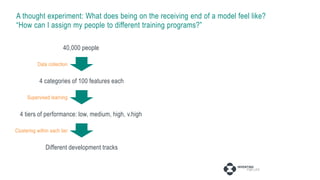
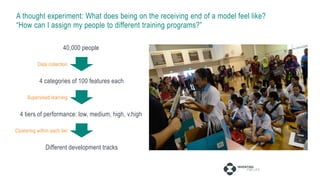
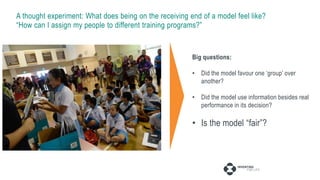
A thought experiment: What does being on the receiving end of a model feel like?
“How can I assign my people to different training programs?”
40,000 people
4 categories of 100 features each
4 tiers of performance: low, medium, high, v.high
Different development tracks
Data collection
Supervised learning
Clustering within each tier
A thought experiment: What does being on the receiving end of a model feel like?
“How can I assign my people to different training programs?”
40,000 people
4 categories of 100 features each
Different development tracks
Data collection
Supervised learning
Clustering within each tier
4 tiers of performance: low, medium, high, v.high
A thought experiment: What does being on the receiving end of a model feel like?
“How can I assign my people to different training programs?”
40,000 people
4 categories of 100 features each
4 tiers: low, medium, high, talent
Different development tracks
Data collection
Supervised learning
Clustering within each tier
Big questions:
• Did the model favour one ‘group’ over
another?
• Did the model use information besides real
performance in its decision?
• Is the model “fair”?
11
Now what if the model was fully automated?
No appeals. No explanations. No human intervention.
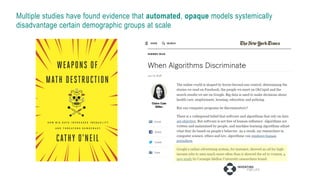
Multiple studies have found evidence that automated, opaque models systemically
disadvantage certain demographic groups at scale
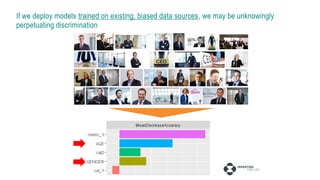
Google’s search results for ‘CEO’ – 14 August 2017
If we deploy models trained on existing, biased data sources, we may be unknowingly
perpetuating discrimination
15
Models do not automatically remove bias - used carelessly they may
systematize it
Agenda
16
1 Introduction: AI in MSD
2 The Problem: Model Bias in Practice
3 Fixing Projects: Pressure Points
4 Fixing Systems: Broader Considerations
1 Introduction: What Is AI in MSD?
2 The Problem: Model Bias in Practice
3 The Solution: A Framework for Mitigating Model Bias
4 Looking Ahead: Towards A Safer AI-enabled Future
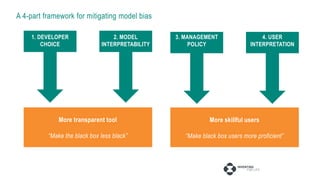
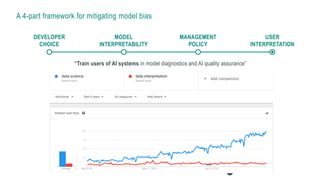
A 4-part framework for mitigating model bias
2. MODEL
INTERPRETABILITY
1. DEVELOPER
CHOICE
3. MANAGEMENT
POLICY
4. USER
INTERPRETATION
More transparent tool
“Make the black box less black”
More skillful users
“Make black box users more proficient”
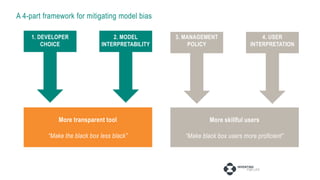
A 4-part framework for mitigating model bias
2. MODEL
INTERPRETABILITY
1. DEVELOPER
CHOICE
3. MANAGEMENT
POLICY
4. USER
INTERPRETATION
More transparent tool
“Make the black box less black”
More skillful users
“Make black box users more proficient”
A 4-part framework for mitigating model bias
MODEL
INTERPRETABILITY
DEVELOPER
CHOICE
MANAGEMENT
POLICY
USER
INTERPRETATION
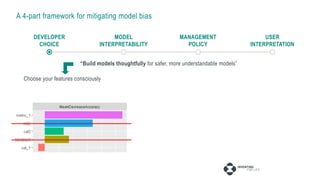
“Build models thoughtfully for safer, more understandable models”
Choose your features consciously
A 4-part framework for mitigating model bias
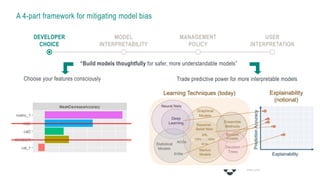
Choose your features consciously Trade predictive power for more interpretable models
“Build models thoughtfully for safer, more understandable models”
MODEL
INTERPRETABILITY
DEVELOPER
CHOICE
MANAGEMENT
POLICY
USER
INTERPRETATION
A 4-part framework for mitigating model bias
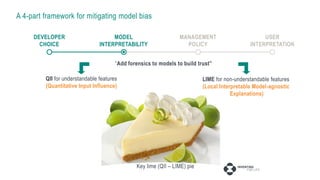
“Add forensics to models to build trust”
QII for understandable features
(Quantitative Input Influence)
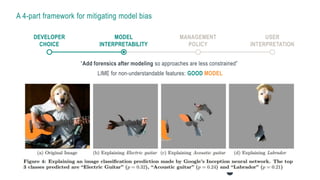
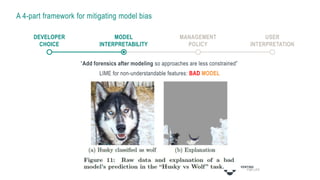
LIME for non-understandable features
(Local Interpretable Model-agnostic
Explanations)
MODEL
INTERPRETABILITY
DEVELOPER
CHOICE
MANAGEMENT
POLICY
USER
INTERPRETATION
Key lime (QII – LIME) pie
A 4-part framework for mitigating model bias
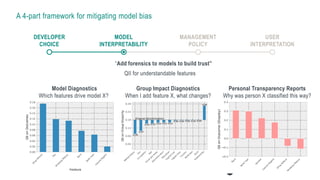
QII for understandable features
MODEL
INTERPRETABILITY
DEVELOPER
CHOICE
MANAGEMENT
POLICY
USER
INTERPRETATION
Personal Transparency Reports
Why was person X classified this way?
Group Impact Diagnostics
When I add feature X, what changes?
Model Diagnostics
Which features drive model X?
“Add forensics to models to build trust”
A 4-part framework for mitigating model bias
LIME for non-understandable features: GOOD MODEL
“Add forensics after modeling so approaches are less constrained”
MODEL
INTERPRETABILITY
DEVELOPER
CHOICE
MANAGEMENT
POLICY
USER
INTERPRETATION
A 4-part framework for mitigating model bias
LIME for non-understandable features: BAD MODEL
“Add forensics after modeling so approaches are less constrained”
MODEL
INTERPRETABILITY
DEVELOPER
CHOICE
MANAGEMENT
POLICY
USER
INTERPRETATION
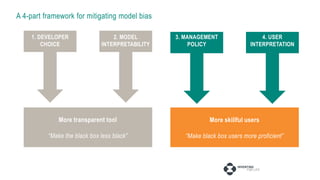
A 4-part framework for mitigating model bias
2. MODEL
INTERPRETABILITY
1. DEVELOPER
CHOICE
3. MANAGEMENT
POLICY
4. USER
INTERPRETATION
More transparent tool
“Make the black box less black”
More skillful users
“Make black box users more proficient”
A 4-part framework for mitigating model bias
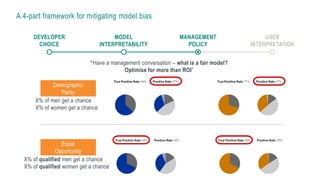
“Have a management conversation – what is a fair model?
Optimise for more than ROI”
Demographic
Parity
X% of men get a chance
X% of women get a chance
Equal
Opportunity
X% of qualified men get a chance
X% of qualified women get a chance
MODEL
INTERPRETABILITY
DEVELOPER
CHOICE
MANAGEMENT
POLICY
USER
INTERPRETATION
A 4-part framework for mitigating model bias
“Train users of AI systems in model diagnostics and AI quality assurance”
MODEL
INTERPRETABILITY
DEVELOPER
CHOICE
MANAGEMENT
POLICY
USER
INTERPRETATION
Agenda
28
1 Introduction: AI in MSD
2 The Problem: Model Bias in Practice
3 Fixing Projects: Pressure Points
4 Fixing Systems: Broader Considerations
1 Introduction: What Is AI in MSD?
2 The Problem: Model Bias in Practice
3 The Solution: A Framework for Mitigating Model Bias
4 Looking Ahead: Towards A Safer AI-enabled Future
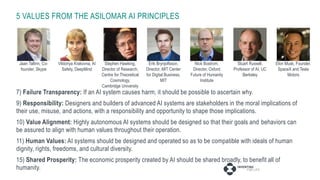
5 VALUES FROM THE ASILOMAR AI PRINCIPLES
7) Failure Transparency: If an AI system causes harm, it should be possible to ascertain why.
9) Responsibility: Designers and builders of advanced AI systems are stakeholders in the moral implications of
their use, misuse, and actions, with a responsibility and opportunity to shape those implications.
10) Value Alignment: Highly autonomous AI systems should be designed so that their goals and behaviors can
be assured to align with human values throughout their operation.
11) Human Values: AI systems should be designed and operated so as to be compatible with ideals of human
dignity, rights, freedoms, and cultural diversity.
15) Shared Prosperity: The economic prosperity created by AI should be shared broadly, to benefit all of
humanity.
Jaan Tallinn, Co-
founder, Skype
Viktoriya Krakovna, AI
Safety, DeepMind
Nick Bostrom,
Director, Oxford
Future of Humanity
Institute
Erik Brynjolfsson,
Director, MIT Center
for Digital Business,
MIT
Stephen Hawking,
Director of Research,
Centre for Theoretical
Cosmology,
Cambridge University
Stuart Russell,
Professor of AI, UC
Berkeley
Elon Musk, Founder,
SpaceX and Tesla
Motors
Appendix and references
1. Ribeiro, M. T., Singh, S., & Guestrin, C. (2016, August). Why should I trust you?: Explaining the predictions of
any classifier. In Proceedings of the 22nd ACM SIGKDD International Conference on Knowledge Discovery
and Data Mining (pp. 1135-1144). ACM.
2. Datta, A., Sen, S., & Zick, Y. (2017). Algorithmic transparency via quantitative input influence. In Transparent
Data Mining for Big and Small Data (pp. 71-94). Springer International Publishing.
3. Hardt, M., Price, E., & Srebro, N. (2016). Equality of opportunity in supervised learning. In Advances in
Neural Information Processing Systems (pp. 3315-3323).
4. Gunning, D. (2017). Explainable artificial intelligence (xai). Defense Advanced Research Projects Agency
(DARPA), nd Web.
5. AI Principles. (n.d.). Retrieved August 10, 2017, from https://futureoflife.org/ai-principles/
30
31
Our tools need to be sharper, but they also need to be safer
Industry 4.0 needs to grow up alongside ethics 4.0

Model bias in AI

  • 1.
    MODEL BIAS INAI 17 Aug 2017 Jason Tamara Widjaja
  • 2.
    A biased samplesize of one I am: • Made in Singapore, 8 years overseas • Plugging into deep tech: TNB Ventures and Lauretta.io I work: • Data science and AI at MSD • IT, IS, HR, MBA, Analytics, AI I like: • Building world class data science and AI teams • “Tell me like I’m five” accessible communication
  • 3.
    Agenda 3 1 Introduction: WhatIs AI in MSD? 2 The Problem: Model Bias in Practice 3 The Solution: A Framework for Mitigating Model Bias 4 Looking Ahead: Towards A Safer AI-enabled Future
  • 4.
    Acting Humanly “Turing Test” Makingsense of the AI space 4 Thinking Humanly “Cognitive modeling” Thinking Rationally “Logical laws of thought” Acting Rationally “Intelligent agents”
  • 5.
    Acting Humanly “Turing Test” Makingsense of the AI space 5 Thinking Humanly “Cognitive modeling” Thinking Rationally “Logical laws of thought” Acting Rationally “Intelligent agents”
  • 6.
    Descriptive analytics Predictive analytics Prescriptive analytics AI as anextension of data science focused on replicating the capabilities of intelligent agents Human agency Decision support “Tool” Back office automation / RPA Human interaction automation Intelligent agent “Worker” Autonomous execution
  • 7.
    Agenda 7 1 Introduction: AIin MSD 2 The Problem: Model Bias in Practice 3 Fixing Projects: Pressure Points 4 Fixing Systems: Broader Considerations 1 Introduction: What Is AI in MSD? 2 The Problem: Model Bias in Practice 3 The Solution: A Framework for Mitigating Model Bias 4 Looking Ahead: Towards A Safer AI-enabled Future
  • 8.
    A thought experiment:What does being on the receiving end of a model feel like? “How can I assign my people to different training programs?” 40,000 people 4 categories of 100 features each 4 tiers of performance: low, medium, high, v.high Different development tracks Data collection Supervised learning Clustering within each tier
  • 9.
    A thought experiment:What does being on the receiving end of a model feel like? “How can I assign my people to different training programs?” 40,000 people 4 categories of 100 features each Different development tracks Data collection Supervised learning Clustering within each tier 4 tiers of performance: low, medium, high, v.high
  • 10.
    A thought experiment:What does being on the receiving end of a model feel like? “How can I assign my people to different training programs?” 40,000 people 4 categories of 100 features each 4 tiers: low, medium, high, talent Different development tracks Data collection Supervised learning Clustering within each tier Big questions: • Did the model favour one ‘group’ over another? • Did the model use information besides real performance in its decision? • Is the model “fair”?
  • 11.
    11 Now what ifthe model was fully automated? No appeals. No explanations. No human intervention.
  • 12.
    Multiple studies havefound evidence that automated, opaque models systemically disadvantage certain demographic groups at scale
  • 13.
    Google’s search resultsfor ‘CEO’ – 14 August 2017
  • 14.
    If we deploymodels trained on existing, biased data sources, we may be unknowingly perpetuating discrimination
  • 15.
    15 Models do notautomatically remove bias - used carelessly they may systematize it
  • 16.
    Agenda 16 1 Introduction: AIin MSD 2 The Problem: Model Bias in Practice 3 Fixing Projects: Pressure Points 4 Fixing Systems: Broader Considerations 1 Introduction: What Is AI in MSD? 2 The Problem: Model Bias in Practice 3 The Solution: A Framework for Mitigating Model Bias 4 Looking Ahead: Towards A Safer AI-enabled Future
  • 17.
    A 4-part frameworkfor mitigating model bias 2. MODEL INTERPRETABILITY 1. DEVELOPER CHOICE 3. MANAGEMENT POLICY 4. USER INTERPRETATION More transparent tool “Make the black box less black” More skillful users “Make black box users more proficient”
  • 18.
    A 4-part frameworkfor mitigating model bias 2. MODEL INTERPRETABILITY 1. DEVELOPER CHOICE 3. MANAGEMENT POLICY 4. USER INTERPRETATION More transparent tool “Make the black box less black” More skillful users “Make black box users more proficient”
  • 19.
    A 4-part frameworkfor mitigating model bias MODEL INTERPRETABILITY DEVELOPER CHOICE MANAGEMENT POLICY USER INTERPRETATION “Build models thoughtfully for safer, more understandable models” Choose your features consciously
  • 20.
    A 4-part frameworkfor mitigating model bias Choose your features consciously Trade predictive power for more interpretable models “Build models thoughtfully for safer, more understandable models” MODEL INTERPRETABILITY DEVELOPER CHOICE MANAGEMENT POLICY USER INTERPRETATION
  • 21.
    A 4-part frameworkfor mitigating model bias “Add forensics to models to build trust” QII for understandable features (Quantitative Input Influence) LIME for non-understandable features (Local Interpretable Model-agnostic Explanations) MODEL INTERPRETABILITY DEVELOPER CHOICE MANAGEMENT POLICY USER INTERPRETATION Key lime (QII – LIME) pie
  • 22.
    A 4-part frameworkfor mitigating model bias QII for understandable features MODEL INTERPRETABILITY DEVELOPER CHOICE MANAGEMENT POLICY USER INTERPRETATION Personal Transparency Reports Why was person X classified this way? Group Impact Diagnostics When I add feature X, what changes? Model Diagnostics Which features drive model X? “Add forensics to models to build trust”
  • 23.
    A 4-part frameworkfor mitigating model bias LIME for non-understandable features: GOOD MODEL “Add forensics after modeling so approaches are less constrained” MODEL INTERPRETABILITY DEVELOPER CHOICE MANAGEMENT POLICY USER INTERPRETATION
  • 24.
    A 4-part frameworkfor mitigating model bias LIME for non-understandable features: BAD MODEL “Add forensics after modeling so approaches are less constrained” MODEL INTERPRETABILITY DEVELOPER CHOICE MANAGEMENT POLICY USER INTERPRETATION
  • 25.
    A 4-part frameworkfor mitigating model bias 2. MODEL INTERPRETABILITY 1. DEVELOPER CHOICE 3. MANAGEMENT POLICY 4. USER INTERPRETATION More transparent tool “Make the black box less black” More skillful users “Make black box users more proficient”
  • 26.
    A 4-part frameworkfor mitigating model bias “Have a management conversation – what is a fair model? Optimise for more than ROI” Demographic Parity X% of men get a chance X% of women get a chance Equal Opportunity X% of qualified men get a chance X% of qualified women get a chance MODEL INTERPRETABILITY DEVELOPER CHOICE MANAGEMENT POLICY USER INTERPRETATION
  • 27.
    A 4-part frameworkfor mitigating model bias “Train users of AI systems in model diagnostics and AI quality assurance” MODEL INTERPRETABILITY DEVELOPER CHOICE MANAGEMENT POLICY USER INTERPRETATION
  • 28.
    Agenda 28 1 Introduction: AIin MSD 2 The Problem: Model Bias in Practice 3 Fixing Projects: Pressure Points 4 Fixing Systems: Broader Considerations 1 Introduction: What Is AI in MSD? 2 The Problem: Model Bias in Practice 3 The Solution: A Framework for Mitigating Model Bias 4 Looking Ahead: Towards A Safer AI-enabled Future
  • 29.
    5 VALUES FROMTHE ASILOMAR AI PRINCIPLES 7) Failure Transparency: If an AI system causes harm, it should be possible to ascertain why. 9) Responsibility: Designers and builders of advanced AI systems are stakeholders in the moral implications of their use, misuse, and actions, with a responsibility and opportunity to shape those implications. 10) Value Alignment: Highly autonomous AI systems should be designed so that their goals and behaviors can be assured to align with human values throughout their operation. 11) Human Values: AI systems should be designed and operated so as to be compatible with ideals of human dignity, rights, freedoms, and cultural diversity. 15) Shared Prosperity: The economic prosperity created by AI should be shared broadly, to benefit all of humanity. Jaan Tallinn, Co- founder, Skype Viktoriya Krakovna, AI Safety, DeepMind Nick Bostrom, Director, Oxford Future of Humanity Institute Erik Brynjolfsson, Director, MIT Center for Digital Business, MIT Stephen Hawking, Director of Research, Centre for Theoretical Cosmology, Cambridge University Stuart Russell, Professor of AI, UC Berkeley Elon Musk, Founder, SpaceX and Tesla Motors
  • 30.
    Appendix and references 1.Ribeiro, M. T., Singh, S., & Guestrin, C. (2016, August). Why should I trust you?: Explaining the predictions of any classifier. In Proceedings of the 22nd ACM SIGKDD International Conference on Knowledge Discovery and Data Mining (pp. 1135-1144). ACM. 2. Datta, A., Sen, S., & Zick, Y. (2017). Algorithmic transparency via quantitative input influence. In Transparent Data Mining for Big and Small Data (pp. 71-94). Springer International Publishing. 3. Hardt, M., Price, E., & Srebro, N. (2016). Equality of opportunity in supervised learning. In Advances in Neural Information Processing Systems (pp. 3315-3323). 4. Gunning, D. (2017). Explainable artificial intelligence (xai). Defense Advanced Research Projects Agency (DARPA), nd Web. 5. AI Principles. (n.d.). Retrieved August 10, 2017, from https://futureoflife.org/ai-principles/ 30
  • 31.
    31 Our tools needto be sharper, but they also need to be safer Industry 4.0 needs to grow up alongside ethics 4.0