Trusted AI: Bringing Trust and Transparency
into AI through Open Source—
Animesh Singh
STSM and Chief Architect
Data and AI Open Source Platform
Center for Open Source Data and AI
Technologies (CODAIT)
Code – Build and improve practical frameworks to
enable more developers to realize immediate
value.
Content – Showcase solutions for complex and
real-world AI problems.
Community – Bring developers and data
scientists to engage with IBM
Improving Enterprise AI lifecycle in
Open Source
•  Team	contributes	to	over	10	open	source	projects
•  17	committers	and	many	contributors	in	Apache	projects	
•  Over	1100	JIRAs	and	66,000	lines	of	code	committed	to	Apache	Spark	itself;	over	65,000	
LoC	into	SystemML			
•  Over	25	product	lines	within	IBM	leveraging	Apache	Spark	
•  Speakers	at	over	100	conferences,	meetups,	unconferences	and	more
CODAIT
codait.org
IBM has a
a history
of tech
for social
good…
3
The moon landing
Tracking infectious diseases
Human genome sequencing
Disaster Response
and in the same spirit, we
are working to bring
Trust and
Transparency
into AI..
but why does it matter?
“What is vital is to
make anything about AI
explainable, fair,
secure, and with
lineage — meaning that
anyone could very
simply see how
applications of AI are
developed and why.”
Ginni Rometty
CES 2019 Opening Keynote
IBM News Room - IBM @ CES <https://newsroom.ibm.com/CES> (© Copyright IBM Corporation 1994, 2019).
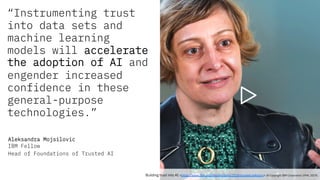
“Instrumenting trust
into data sets and
machine learning
models will accelerate
the adoption of AI and
engender increased
confidence in these
general-purpose
technologies.”
Aleksandra Mojsilovic
IBM Fellow
Head of Foundations of Trusted AI
Building trust into AI <https://www.ibm.org/responsibility/2018/trusted-ai#story> (© Copyright IBM Corporation 1994, 2019).
“If we fail to make
ethical and inclusive
artificial intelligence
we risk losing gains
made in civil rights
and gender equity under
the guise of machine
neutrality.”
Joy Buolamwini
Gender Shades
MIT Media Lab
Joy Buolamwini – MIT Media Lab <https://www.media.mit.edu/people/joyab/overview/> (CC BY 4.0).
Is it fair?
Is it easy to
understand?
Is it accountable?
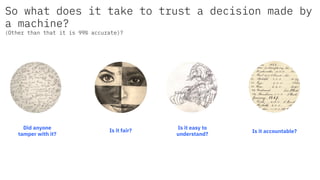
So what does it take to trust a decision made by
a machine?
(Other than that it is 99% accurate)?
Did anyone
tamper with it?
#21, #32, #93
#21, #32, #93
Is it fair?
Is it easy to
understand?
Is it accountable?
Did anyone
tamper with it?
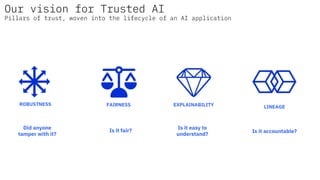
FAIRNESS EXPLAINABILITYROBUSTNESS
LINEAGE
Our vision for Trusted AI
Pillars of trust, woven into the lifecycle of an AI application
IBM also has a long
history in the open
source ecosystem
and
We are leveraging
this to bring Trust
and Transparency
into AI though Open
Source..
10
Is it fair?
Is it easy to
understand?
Is it accountable?
Did anyone
tamper with it?
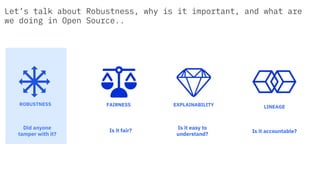
FAIRNESS EXPLAINABILITYROBUSTNESS
LINEAGE
Let’s talk about Robustness, why is it important, and what are
we doing in Open Source..
12
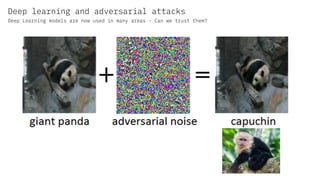
Deep learning and adversarial attacks
Deep Learning models are now used in many areas - Can we trust them?
https://bigcheck.mybluemix.net
[Weng et al., 2018. Evaluating the Robustness of Neural Networks: An Extreme Value
Theory Approach. ICLR 2018]
How does it impact us?
14
https://arxiv.org/pdf/
1707.08945.pdf
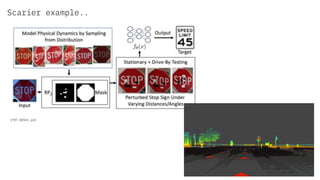
Scarier example..
15
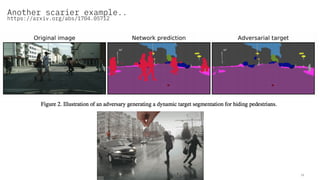
https://arxiv.org/abs/1704.05712
Another scarier example..
Data
AttackerNeural Network
poison
train
input
perturb
output
result
$$$
benefit
Adversarial Threats to AI
Evasion attacks
§  Performed at test time
§  Perturb inputs with crafted noise
§  Model fails to predict correctly
§  Undetectable by humans
Poisoning attacks
§  Performed at training time
§  Insert poisoned sample in training
data
§  Use backdoor later
ART
17
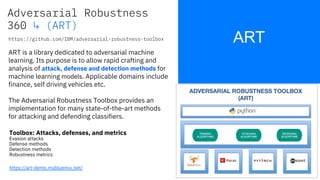
ART is a library dedicated to adversarial machine
learning. Its purpose is to allow rapid crafting and
analysis of attack, defense and detection methods for
machine learning models. Applicable domains include
finance, self driving vehicles etc.
The Adversarial Robustness Toolbox provides an
implementation for many state-of-the-art methods
for attacking and defending classifiers.
https://github.com/IBM/adversarial-robustness-toolbox
Toolbox: Attacks, defenses, and metrics
Evasion attacks
Defense methods
Detection methods
Robustness metrics
Adversarial Robustness
360 ↳ (ART)
ART
https://art-demo.mybluemix.net/
Poisoning detection
•  Detection based on
clustering activations
•  Proof of attack strategy
Evasion detection
•  Detector based on
inputs
•  Detector based on
activations
Robustness metrics
•  CLEVER
•  Empirical robustness
•  Loss sensitivity
Unified model API
•  Training
•  Prediction
•  Access to loss and
prediction gradients
Evasion defenses
•  Feature squeezing
•  Spatial smoothing
•  Label smoothing
•  Adversarial training
•  Virtual adversarial
training
•  Thermometer encoding
•  Gaussian data
augmentation
Evasion attacks
•  FGSM
•  JSMA
•  BIM
•  PGD
•  Carlini & Wagner
•  DeepFool
•  NewtonFool
•  Universal perturbation
18
Implementation for state-of-the-art methods for attacking
and defending classifiers.
19
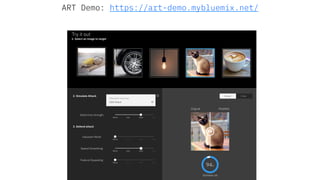
ART Demo: https://art-demo.mybluemix.net/
Is it fair?
Is it easy to
understand?
Is it accountable?
Did anyone
tamper with it?
FAIRNESS EXPLAINABILITYROBUSTNESS
LINEAGE
Now let’s discuss Fairness, why bias in AI is such an important
topic, and what role Open Source can play…
“A cognitive bias is a systematic pattern of deviation from norm or rationality in judgment. Individuals
create their own "subjective social reality" from their perception of the input.”
- Wikipedia
21
What is bias?
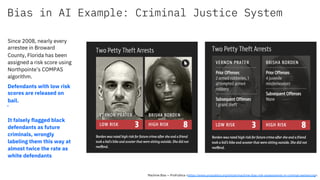
Bias in AI Example: Criminal Justice System
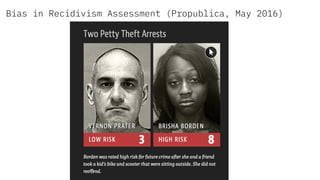
Since 2008, nearly every
arrestee in Broward
County, Florida has been
assigned a risk score using
Northpointe’s COMPAS
algorithm.
Defendants with low risk
scores are released on
bail.
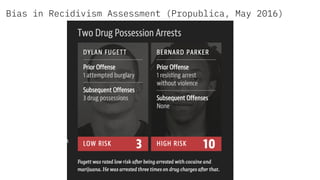
It falsely flagged black
defendants as future
criminals, wrongly
labeling them this way at
almost twice the rate as
white defendants
Machine Bias — ProPublica <https://www.propublica.org/article/machine-bias-risk-assessments-in-criminal-sentencing>.
.
Bias in AI Example: Criminal Justice System
Since 2008, nearly every
arrestee in Broward
County, Florida has been
assigned a risk score using
Northpointe’s COMPAS
algorithm.
Defendants with low risk
scores are released on
bail.
It falsely flagged black
defendants as future
criminals, wrongly
labeling them this way at
almost twice the rate as
white defendants
Machine Bias — ProPublica <https://www.propublica.org/article/machine-bias-risk-assessments-in-criminal-sentencing>.
.
24
Bias in Recidivism Assessment (Propublica, May 2016)
25
Bias in Recidivism Assessment (Propublica, May 2016)
26
Bias in Recidivism Assessment (Propublica, May 2016)
27
Bias in Recidivism Assessment (Propublica, May 2016)
28
Bias in Recidivism Assessment (Propublica, May 2016)
29
Bias in Recidivism Assessment (Propublica, May 2016)
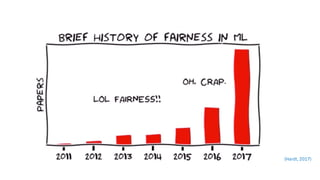
(Hardt, 2017)
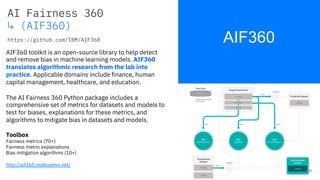
AIF360
AI Fairness 360
↳ (AIF360)
https://github.com/IBM/AIF360
31
AIF360 toolkit is an open-source library to help detect
and remove bias in machine learning models. AIF360
translates algorithmic research from the lab into
practice. Applicable domains include finance, human
capital management, healthcare, and education.
The AI Fairness 360 Python package includes a
comprehensive set of metrics for datasets and models to
test for biases, explanations for these metrics, and
algorithms to mitigate bias in datasets and models.
Toolbox
Fairness metrics (70+)
Fairness metric explanations
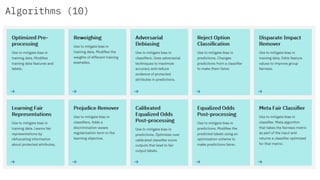
Bias mitigation algorithms (10+)
http://aif360.mybluemix.net/
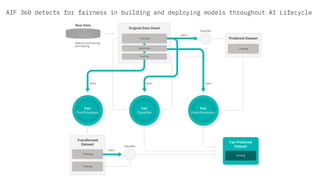
AIF 360 detects for fairness in building and deploying models throughout AI Lifecycle
Metrics (70+)
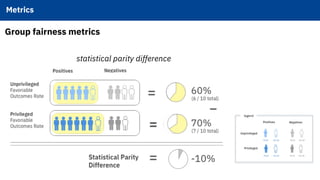
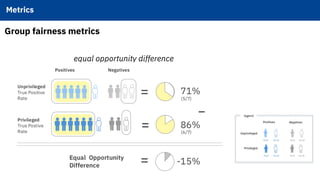
Group fairness metrics
legend
situation 1
Metrics!
Group fairness metrics
legend
situation 2
Metrics!
Group fairness metrics
legend
disparate impact
Metrics!
Group fairness metrics
legend
statistical parity difference
Metrics!
Group fairness metrics
legend
equal opportunity difference
71%
(5/7 positives)
Metrics!
(d’Alessandro et al., 2017)
Algorithms (10)
Demo Application: AI Fairness 360 Web Application
http://aif360.mybluemix.net/
Is it fair?
Is it easy to
understand?
Is it accountable?
Did anyone
tamper with it?
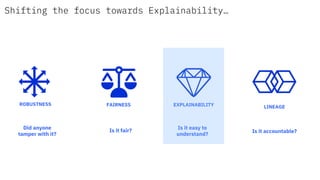
FAIRNESS EXPLAINABILITYROBUSTNESS
LINEAGE
Shifting the focus towards Explainability…
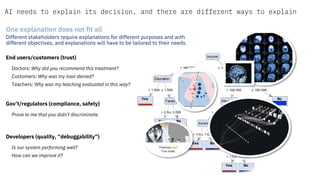
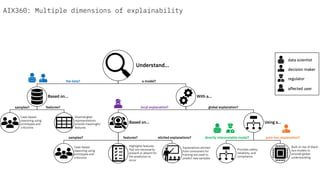
AI needs to explain its decision, and there are different ways to explain
One explanation does not fit all
Different stakeholders require explanations for different purposes and with
different objectives, and explanations will have to be tailored to their needs.
End users/customers (trust)
Doctors: Why did you recommend this treatment?
Customers: Why was my loan denied?
Teachers: Why was my teaching evaluated in this way?
Gov’t/regulators (compliance, safety)
Prove to me that you didn't discriminate.
Developers (quality, “debuggability”)
Is our system performing well?
How can we improve it?
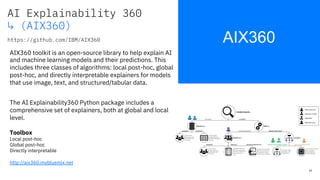
AIX360
AI Explainability 360
↳ (AIX360)
https://github.com/IBM/AIX360
43
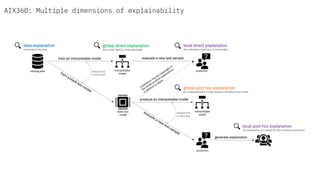
AIX360 toolkit is an open-source library to help explain AI
and machine learning models and their predictions. This
includes three classes of algorithms: local post-hoc, global
post-hoc, and directly interpretable explainers for models
that use image, text, and structured/tabular data.
The AI Explainability360 Python package includes a
comprehensive set of explainers, both at global and local
level.
Toolbox
Local post-hoc
Global post-hoc
Directly interpretable
http://aix360.mybluemix.net
AIX360: Multiple dimensions of explainability
Demo Application: AI Explainability 360 Web Application
http://aix360.mybluemix.net/
We are also making these
capabilities around Trusted
AI available to businesses
through
Watson OpenScale
Watson OpenScale tracks
and measures trusted AI
outcomes across its
lifecycle, and adapts and
governs AI to changing
business situations — for
models built and running
anywhere.
Measure and track AI outcomes
Track performance of production AI
and its impact on business goals,
with actionable metrics in a single
console.
Govern, detect bias and explain
AI
Maintain regulatory compliance by
tracing and explaining AI
decisions across workflows, and
intelligently detect and correct
bias to improve outcomes.
We would like to partner with
community to build Trusted and
Transparent AI
To collaborate, look at the corresponding projects here
codait.org
or
https://github.com/topics/trusted-ai
and reach out via github or send an email to
singhan@us.ibm.com
CODAIT
Center for Open Source Data and AI Technologies
Center for Open-Source Data & AI Technologies (CODAIT) / June 28, 2019 / © 2019 IBM Corporation

Trusted, Transparent and Fair AI using Open Source

  • 1.
    Trusted AI: BringingTrust and Transparency into AI through Open Source— Animesh Singh STSM and Chief Architect Data and AI Open Source Platform
  • 2.
    Center for OpenSource Data and AI Technologies (CODAIT) Code – Build and improve practical frameworks to enable more developers to realize immediate value. Content – Showcase solutions for complex and real-world AI problems. Community – Bring developers and data scientists to engage with IBM Improving Enterprise AI lifecycle in Open Source •  Team contributes to over 10 open source projects •  17 committers and many contributors in Apache projects •  Over 1100 JIRAs and 66,000 lines of code committed to Apache Spark itself; over 65,000 LoC into SystemML •  Over 25 product lines within IBM leveraging Apache Spark •  Speakers at over 100 conferences, meetups, unconferences and more CODAIT codait.org
  • 3.
    IBM has a ahistory of tech for social good… 3 The moon landing Tracking infectious diseases Human genome sequencing Disaster Response
  • 4.
    and in thesame spirit, we are working to bring Trust and Transparency into AI.. but why does it matter?
  • 5.
    “What is vitalis to make anything about AI explainable, fair, secure, and with lineage — meaning that anyone could very simply see how applications of AI are developed and why.” Ginni Rometty CES 2019 Opening Keynote IBM News Room - IBM @ CES <https://newsroom.ibm.com/CES> (© Copyright IBM Corporation 1994, 2019).
  • 6.
    “Instrumenting trust into datasets and machine learning models will accelerate the adoption of AI and engender increased confidence in these general-purpose technologies.” Aleksandra Mojsilovic IBM Fellow Head of Foundations of Trusted AI Building trust into AI <https://www.ibm.org/responsibility/2018/trusted-ai#story> (© Copyright IBM Corporation 1994, 2019).
  • 7.
    “If we failto make ethical and inclusive artificial intelligence we risk losing gains made in civil rights and gender equity under the guise of machine neutrality.” Joy Buolamwini Gender Shades MIT Media Lab Joy Buolamwini – MIT Media Lab <https://www.media.mit.edu/people/joyab/overview/> (CC BY 4.0).
  • 8.
    Is it fair? Isit easy to understand? Is it accountable? So what does it take to trust a decision made by a machine? (Other than that it is 99% accurate)? Did anyone tamper with it? #21, #32, #93 #21, #32, #93
  • 9.
    Is it fair? Isit easy to understand? Is it accountable? Did anyone tamper with it? FAIRNESS EXPLAINABILITYROBUSTNESS LINEAGE Our vision for Trusted AI Pillars of trust, woven into the lifecycle of an AI application
  • 10.
    IBM also hasa long history in the open source ecosystem and We are leveraging this to bring Trust and Transparency into AI though Open Source.. 10
  • 11.
    Is it fair? Isit easy to understand? Is it accountable? Did anyone tamper with it? FAIRNESS EXPLAINABILITYROBUSTNESS LINEAGE Let’s talk about Robustness, why is it important, and what are we doing in Open Source..
  • 12.
    12 Deep learning andadversarial attacks Deep Learning models are now used in many areas - Can we trust them?
  • 13.
    https://bigcheck.mybluemix.net [Weng et al.,2018. Evaluating the Robustness of Neural Networks: An Extreme Value Theory Approach. ICLR 2018] How does it impact us?
  • 14.
  • 15.
  • 16.
    Data AttackerNeural Network poison train input perturb output result $$$ benefit Adversarial Threatsto AI Evasion attacks §  Performed at test time §  Perturb inputs with crafted noise §  Model fails to predict correctly §  Undetectable by humans Poisoning attacks §  Performed at training time §  Insert poisoned sample in training data §  Use backdoor later
  • 17.
    ART 17 ART is alibrary dedicated to adversarial machine learning. Its purpose is to allow rapid crafting and analysis of attack, defense and detection methods for machine learning models. Applicable domains include finance, self driving vehicles etc. The Adversarial Robustness Toolbox provides an implementation for many state-of-the-art methods for attacking and defending classifiers. https://github.com/IBM/adversarial-robustness-toolbox Toolbox: Attacks, defenses, and metrics Evasion attacks Defense methods Detection methods Robustness metrics Adversarial Robustness 360 ↳ (ART) ART https://art-demo.mybluemix.net/
  • 18.
    Poisoning detection •  Detectionbased on clustering activations •  Proof of attack strategy Evasion detection •  Detector based on inputs •  Detector based on activations Robustness metrics •  CLEVER •  Empirical robustness •  Loss sensitivity Unified model API •  Training •  Prediction •  Access to loss and prediction gradients Evasion defenses •  Feature squeezing •  Spatial smoothing •  Label smoothing •  Adversarial training •  Virtual adversarial training •  Thermometer encoding •  Gaussian data augmentation Evasion attacks •  FGSM •  JSMA •  BIM •  PGD •  Carlini & Wagner •  DeepFool •  NewtonFool •  Universal perturbation 18 Implementation for state-of-the-art methods for attacking and defending classifiers.
  • 19.
  • 20.
    Is it fair? Isit easy to understand? Is it accountable? Did anyone tamper with it? FAIRNESS EXPLAINABILITYROBUSTNESS LINEAGE Now let’s discuss Fairness, why bias in AI is such an important topic, and what role Open Source can play…
  • 21.
    “A cognitive biasis a systematic pattern of deviation from norm or rationality in judgment. Individuals create their own "subjective social reality" from their perception of the input.” - Wikipedia 21 What is bias?
  • 22.
    Bias in AIExample: Criminal Justice System Since 2008, nearly every arrestee in Broward County, Florida has been assigned a risk score using Northpointe’s COMPAS algorithm. Defendants with low risk scores are released on bail. It falsely flagged black defendants as future criminals, wrongly labeling them this way at almost twice the rate as white defendants Machine Bias — ProPublica <https://www.propublica.org/article/machine-bias-risk-assessments-in-criminal-sentencing>. .
  • 23.
    Bias in AIExample: Criminal Justice System Since 2008, nearly every arrestee in Broward County, Florida has been assigned a risk score using Northpointe’s COMPAS algorithm. Defendants with low risk scores are released on bail. It falsely flagged black defendants as future criminals, wrongly labeling them this way at almost twice the rate as white defendants Machine Bias — ProPublica <https://www.propublica.org/article/machine-bias-risk-assessments-in-criminal-sentencing>. .
  • 24.
    24 Bias in RecidivismAssessment (Propublica, May 2016)
  • 25.
    25 Bias in RecidivismAssessment (Propublica, May 2016)
  • 26.
    26 Bias in RecidivismAssessment (Propublica, May 2016)
  • 27.
    27 Bias in RecidivismAssessment (Propublica, May 2016)
  • 28.
    28 Bias in RecidivismAssessment (Propublica, May 2016)
  • 29.
    29 Bias in RecidivismAssessment (Propublica, May 2016)
  • 30.
  • 31.
    AIF360 AI Fairness 360 ↳(AIF360) https://github.com/IBM/AIF360 31 AIF360 toolkit is an open-source library to help detect and remove bias in machine learning models. AIF360 translates algorithmic research from the lab into practice. Applicable domains include finance, human capital management, healthcare, and education. The AI Fairness 360 Python package includes a comprehensive set of metrics for datasets and models to test for biases, explanations for these metrics, and algorithms to mitigate bias in datasets and models. Toolbox Fairness metrics (70+) Fairness metric explanations Bias mitigation algorithms (10+) http://aif360.mybluemix.net/
  • 32.
    AIF 360 detectsfor fairness in building and deploying models throughout AI Lifecycle
  • 33.
  • 34.
  • 35.
  • 36.
  • 37.
  • 38.
    Group fairness metrics legend equalopportunity difference 71% (5/7 positives) Metrics!
  • 39.
    (d’Alessandro et al.,2017) Algorithms (10)
  • 40.
    Demo Application: AIFairness 360 Web Application http://aif360.mybluemix.net/
  • 41.
    Is it fair? Isit easy to understand? Is it accountable? Did anyone tamper with it? FAIRNESS EXPLAINABILITYROBUSTNESS LINEAGE Shifting the focus towards Explainability…
  • 42.
    AI needs toexplain its decision, and there are different ways to explain One explanation does not fit all Different stakeholders require explanations for different purposes and with different objectives, and explanations will have to be tailored to their needs. End users/customers (trust) Doctors: Why did you recommend this treatment? Customers: Why was my loan denied? Teachers: Why was my teaching evaluated in this way? Gov’t/regulators (compliance, safety) Prove to me that you didn't discriminate. Developers (quality, “debuggability”) Is our system performing well? How can we improve it?
  • 43.
    AIX360 AI Explainability 360 ↳(AIX360) https://github.com/IBM/AIX360 43 AIX360 toolkit is an open-source library to help explain AI and machine learning models and their predictions. This includes three classes of algorithms: local post-hoc, global post-hoc, and directly interpretable explainers for models that use image, text, and structured/tabular data. The AI Explainability360 Python package includes a comprehensive set of explainers, both at global and local level. Toolbox Local post-hoc Global post-hoc Directly interpretable http://aix360.mybluemix.net
  • 44.
    AIX360: Multiple dimensionsof explainability
  • 45.
    AIX360: Multiple dimensionsof explainability
  • 46.
    Demo Application: AIExplainability 360 Web Application http://aix360.mybluemix.net/
  • 47.
    We are alsomaking these capabilities around Trusted AI available to businesses through Watson OpenScale Watson OpenScale tracks and measures trusted AI outcomes across its lifecycle, and adapts and governs AI to changing business situations — for models built and running anywhere. Measure and track AI outcomes Track performance of production AI and its impact on business goals, with actionable metrics in a single console. Govern, detect bias and explain AI Maintain regulatory compliance by tracing and explaining AI decisions across workflows, and intelligently detect and correct bias to improve outcomes.
  • 48.
    We would liketo partner with community to build Trusted and Transparent AI To collaborate, look at the corresponding projects here codait.org or https://github.com/topics/trusted-ai and reach out via github or send an email to singhan@us.ibm.com CODAIT Center for Open Source Data and AI Technologies
  • 49.
    Center for Open-SourceData & AI Technologies (CODAIT) / June 28, 2019 / © 2019 IBM Corporation