I. DEFINITION
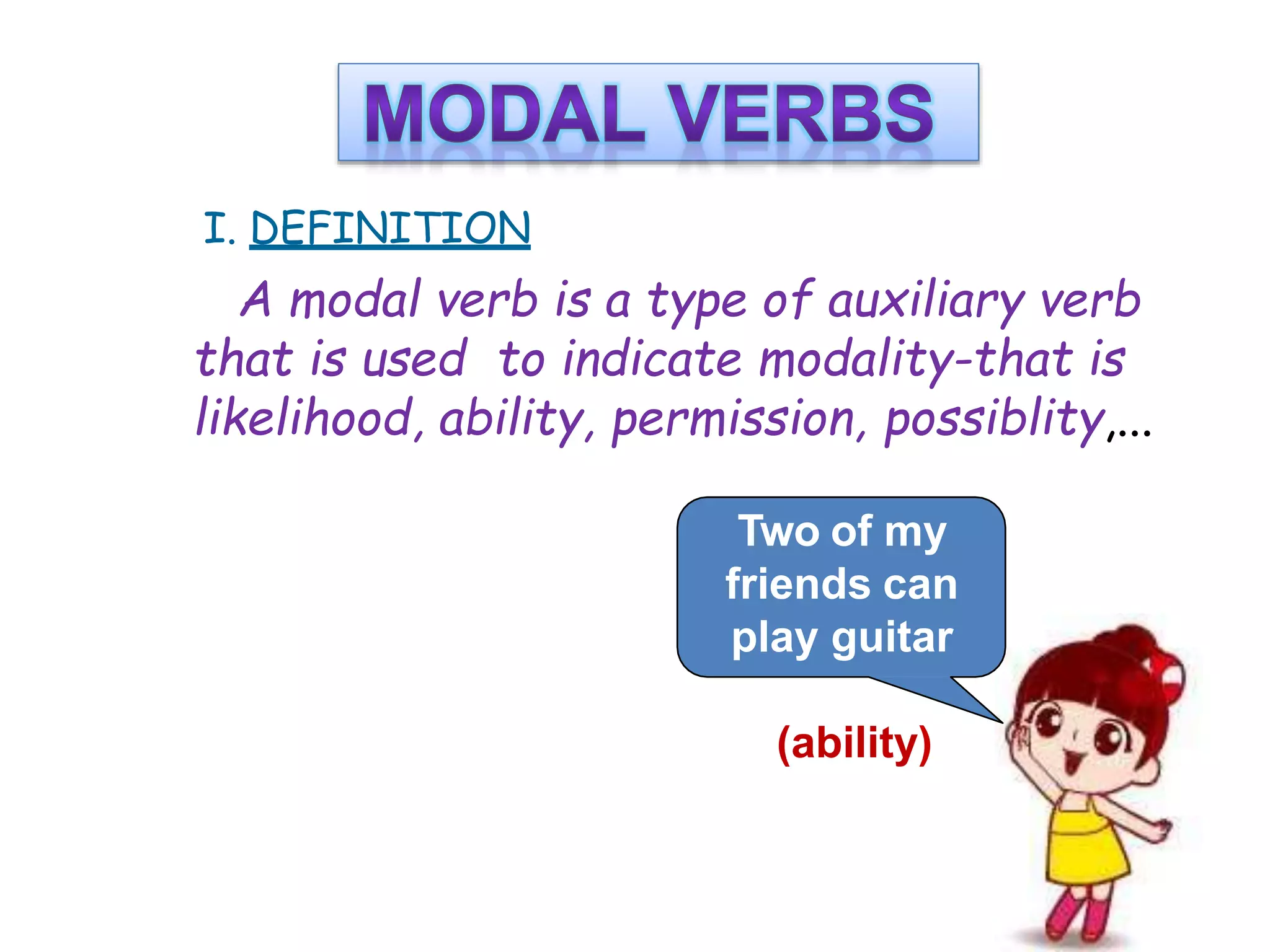
A modal verb is a type of auxiliary verb
that is used to indicate modality-that is
likelihood, ability, permission, possiblity,...
Two of my
friends can
play guitar
(ability)
MODAL VERBS
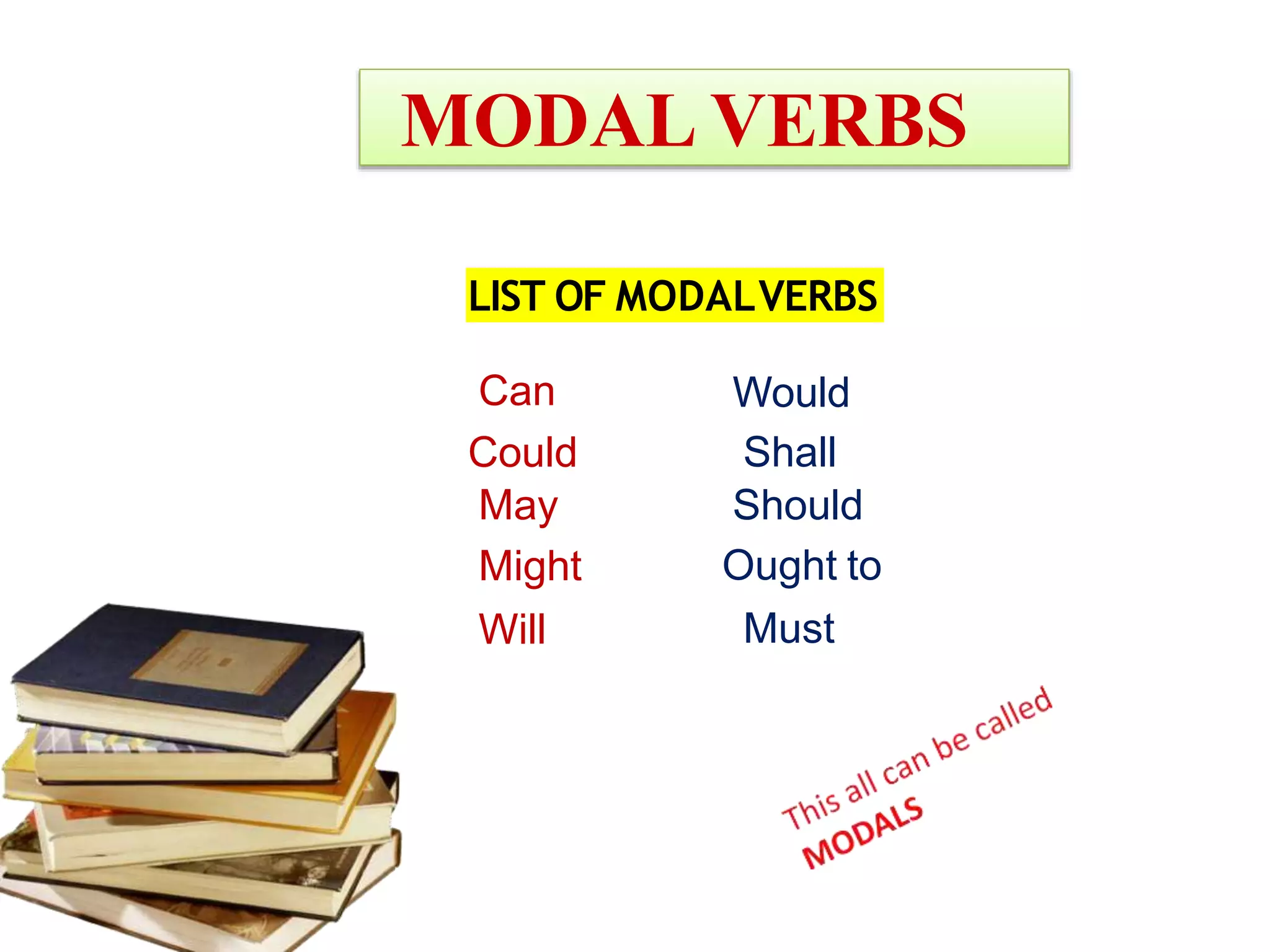
LIST OF MODALVERBS
Can
Could
May
Might
Will
Would
Shall
Should
Ought to
Must
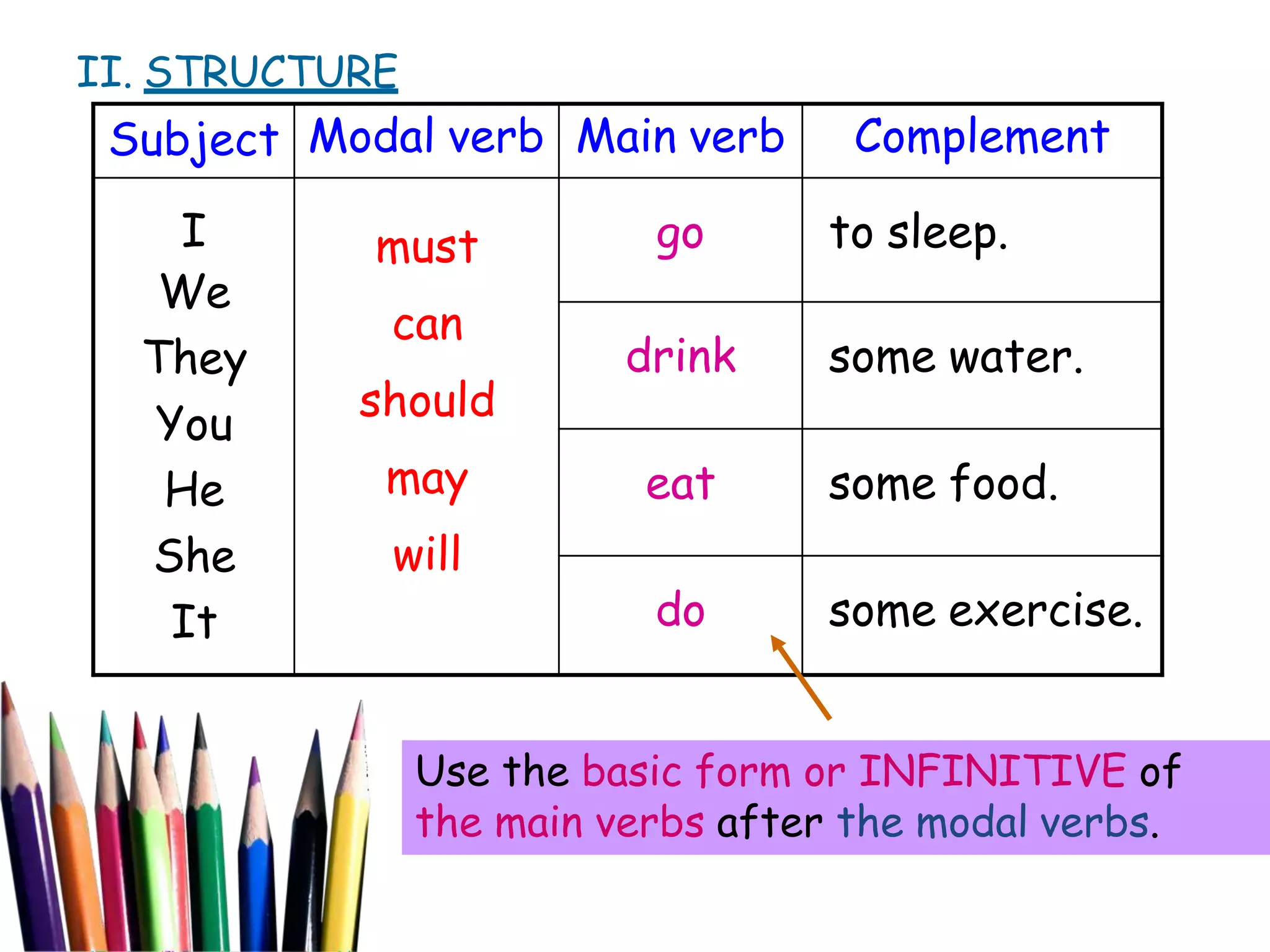
Subject Modal verb Main verb Complement
I
We
They
You
He
She
It
must
can
should
may
will
go to sleep.
drink some water.
eat some food.
do some exercise.
Use the basic form or INFINITIVE of
the main verbs after the modal verbs.
II. STRUCTURE
MODAL VERBS
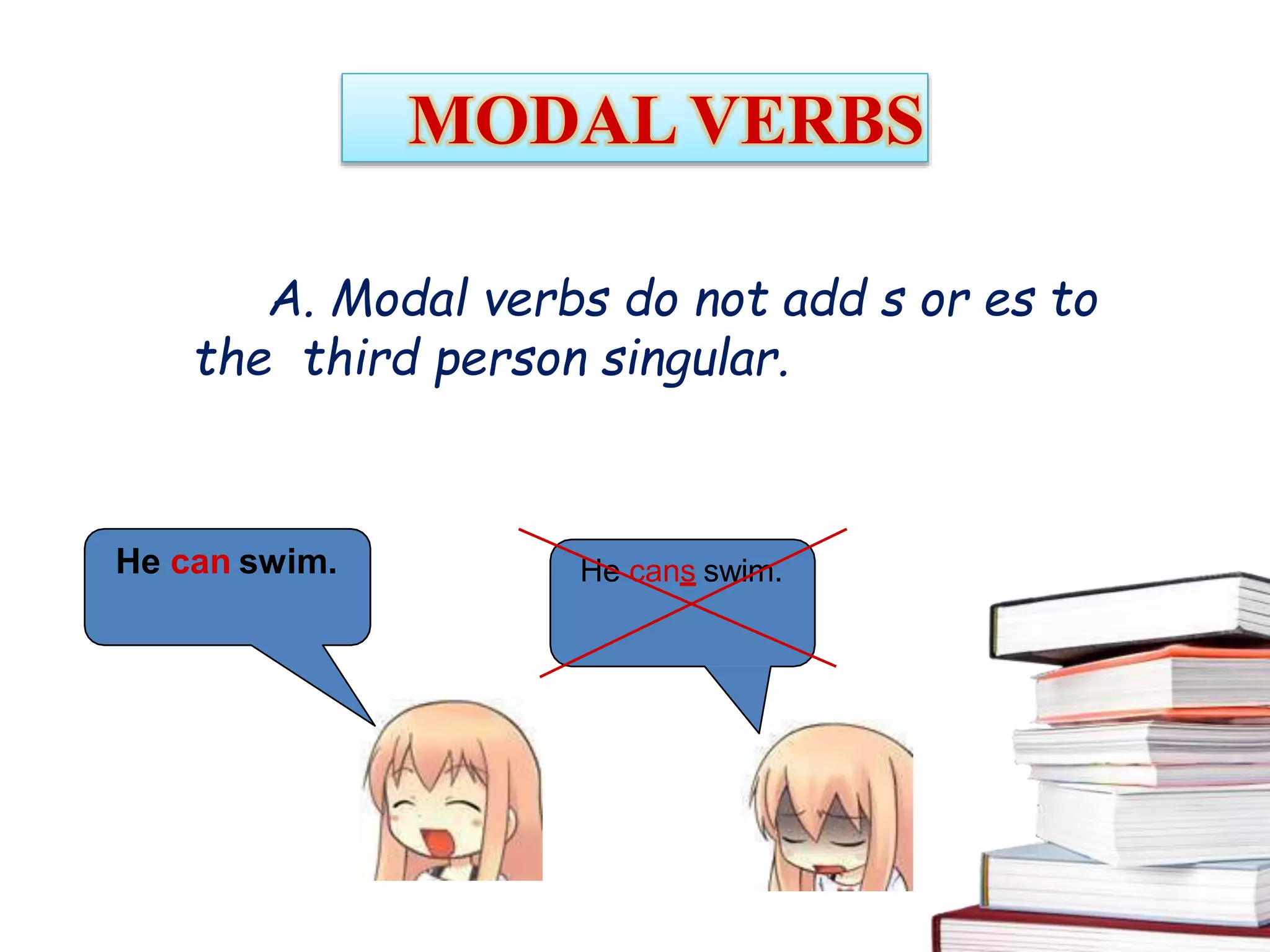
A. Modal verbs do not add s or es to
the third person singular.
He can swim. He cans swim.
MODAL VERBS
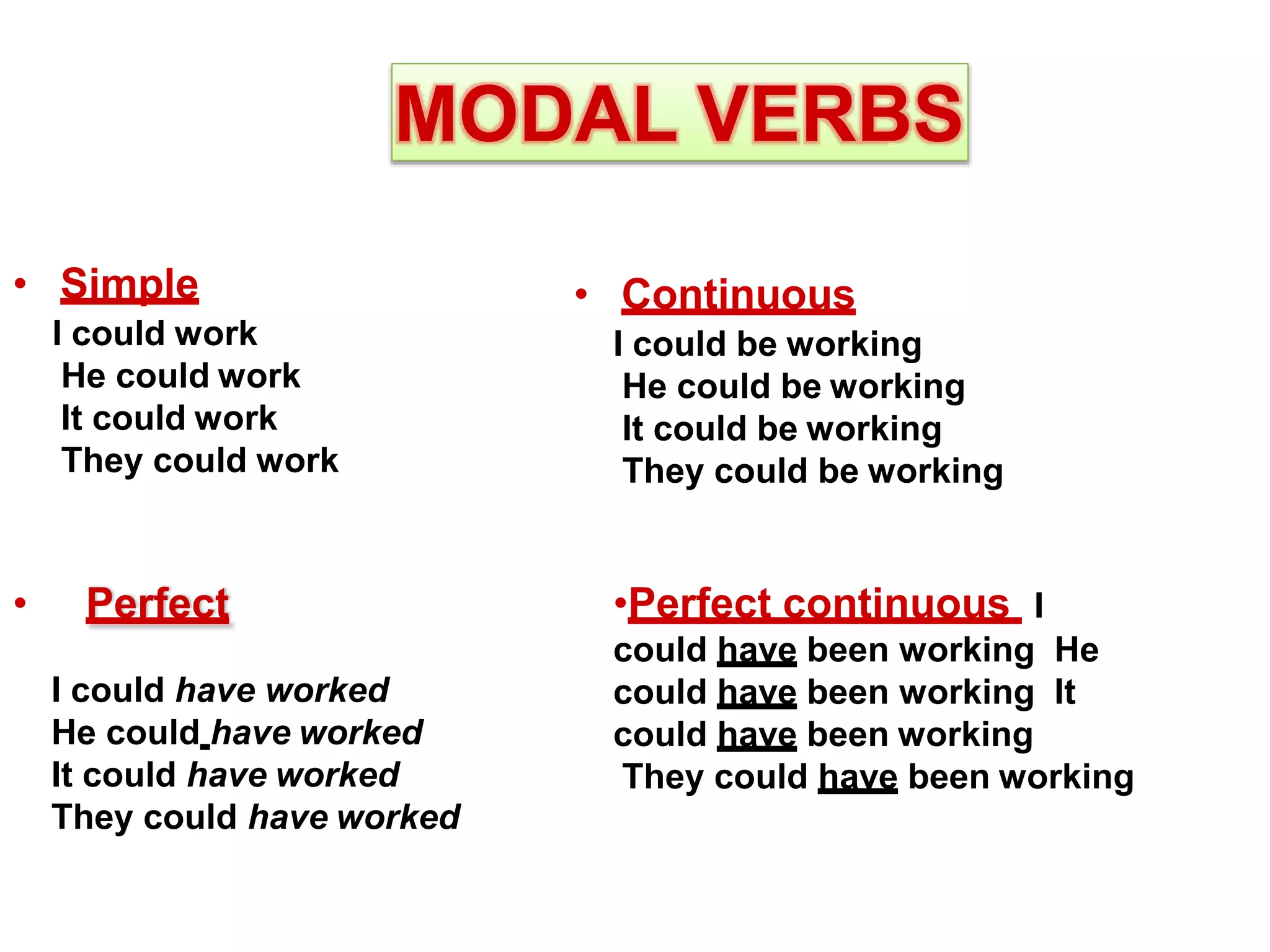
• Simple
I could work
He could work
It could work
They could work
• Perfect
I could have worked
He could have worked
It could have worked
They could have worked
• Continuous
I could be working
He could be working
It could be working
They could be working
•Perfect continuous I
could have been working He
could have been working It
could have been working
They could have been working
MODAL VERBS
B. Modal verbs don’t need auxiliaries to form
negative and question.
Exp : She should stay.
She doesn’t should stay. → She shouldn’t stay.
Why does she stay? → Why should shestay?
c. Modal verbs don’t have infinitives or –ing
forms
Exp: canning to might
MODAL VERBS
HOW TO USE
CAN
Use Example
Ability / Possibility
Impossibility
Asking for permission
Wecan’t fix it.
Can I bring
here?
 They can control their own
work.



R
equest Can you help
me?
MODAL VERBS
COULD
Use Example
Could I borrow your
dictionary?
R
equest
Permission 
Could you say it again more
slowly?
Possibility
Future
Ability
 I think we could have another tea.
 I wish Cndrll could meet me next week.
 He gave up his old job so he could work
for us.

MODAL VERBS
MAY
Use Example
 May I have another cup of
coffee?
 I may finish my homework
permission
possibility
MODAL VERBS
MIGHT
Use Example
Possibility  We'd better phone tomorrow, theymight be
eating their dinner now.
.
MODAL VERBS
Use Example
Sayingwhat’s right or correct
 She ought to finish by next
week.
MODAL VERBS
SHALL
Use
Suggestion Shall we say 2.30
then?
Example
 Shall I help you with your
luggage?
Shall I do that or will you?
Permission
Offer

MODAL VERBS
III. USAGE
SHOULD
Use Example
Sayingwhat’s right or correct

Possibility

We should solve this
problem. Fees should
decrease next year.
MODAL VERBS
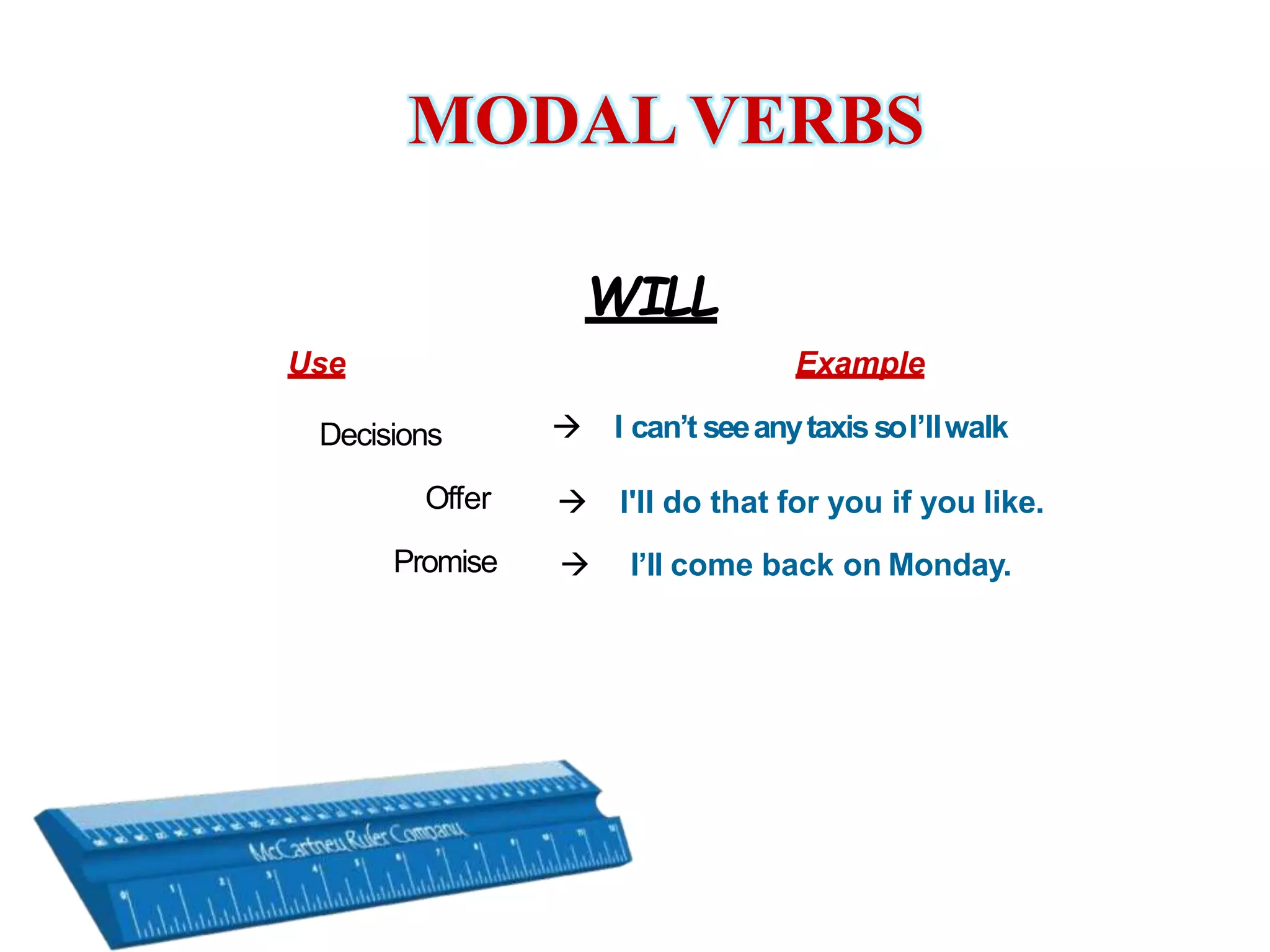
WILL
Use Example
Decisions  I can’t seeanytaxissoI’llwalk
 I'll do that for you if you like.
 I’ll come back on Monday.
Offer
Promise
MODAL VERBS
III. USAGE
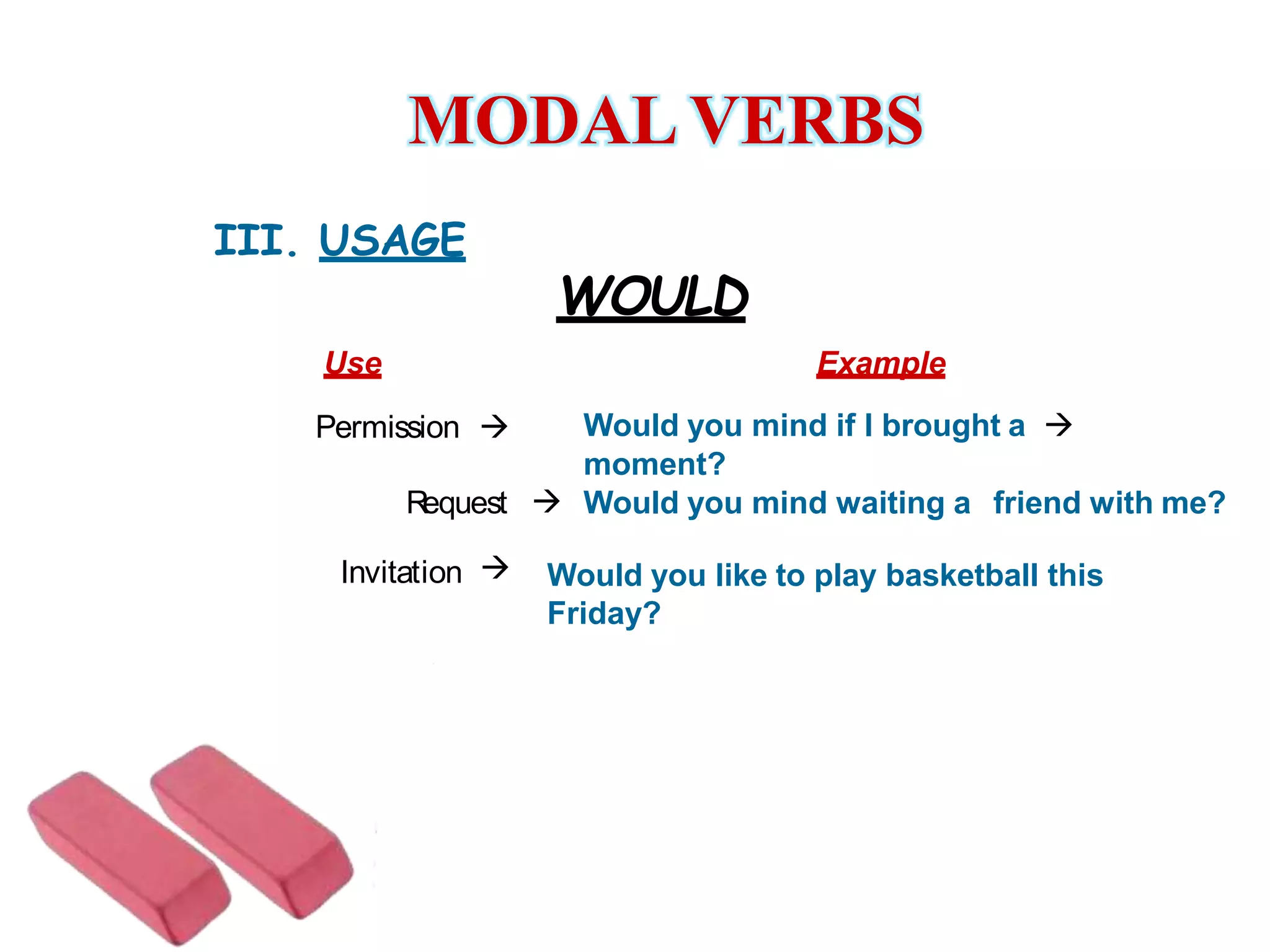
WOULD
Use Example
Permission  Would you mind if I brought a 
moment?
Would you mind waiting a friend with me?

Invitation Would you like to play basketball this
Friday?
R
equest 
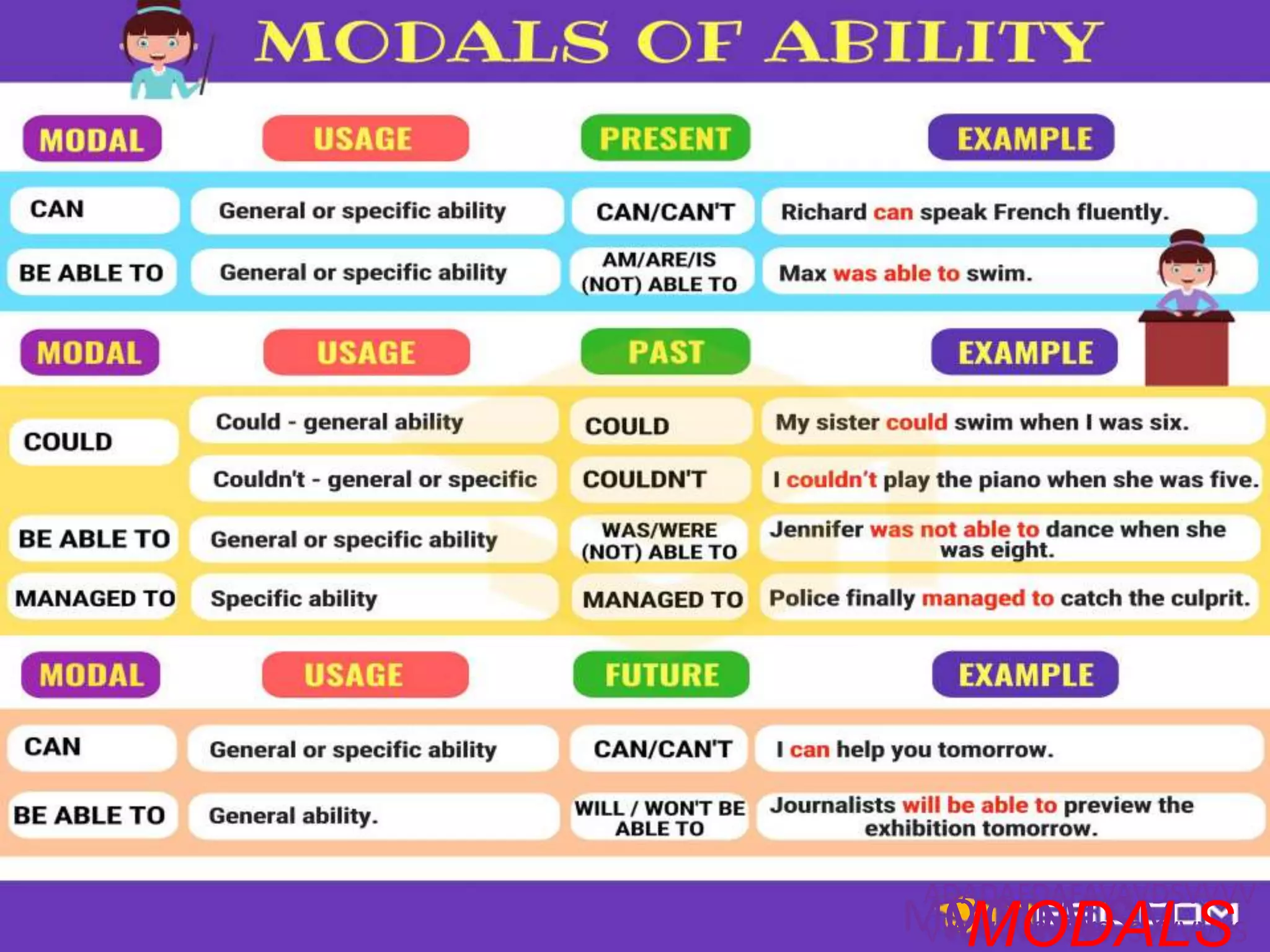
MODALS
ADADAFDAFAVAVDSVVVV
VVVVVVSVSVSVSVVVVVS
MODAN.COM
MODALS
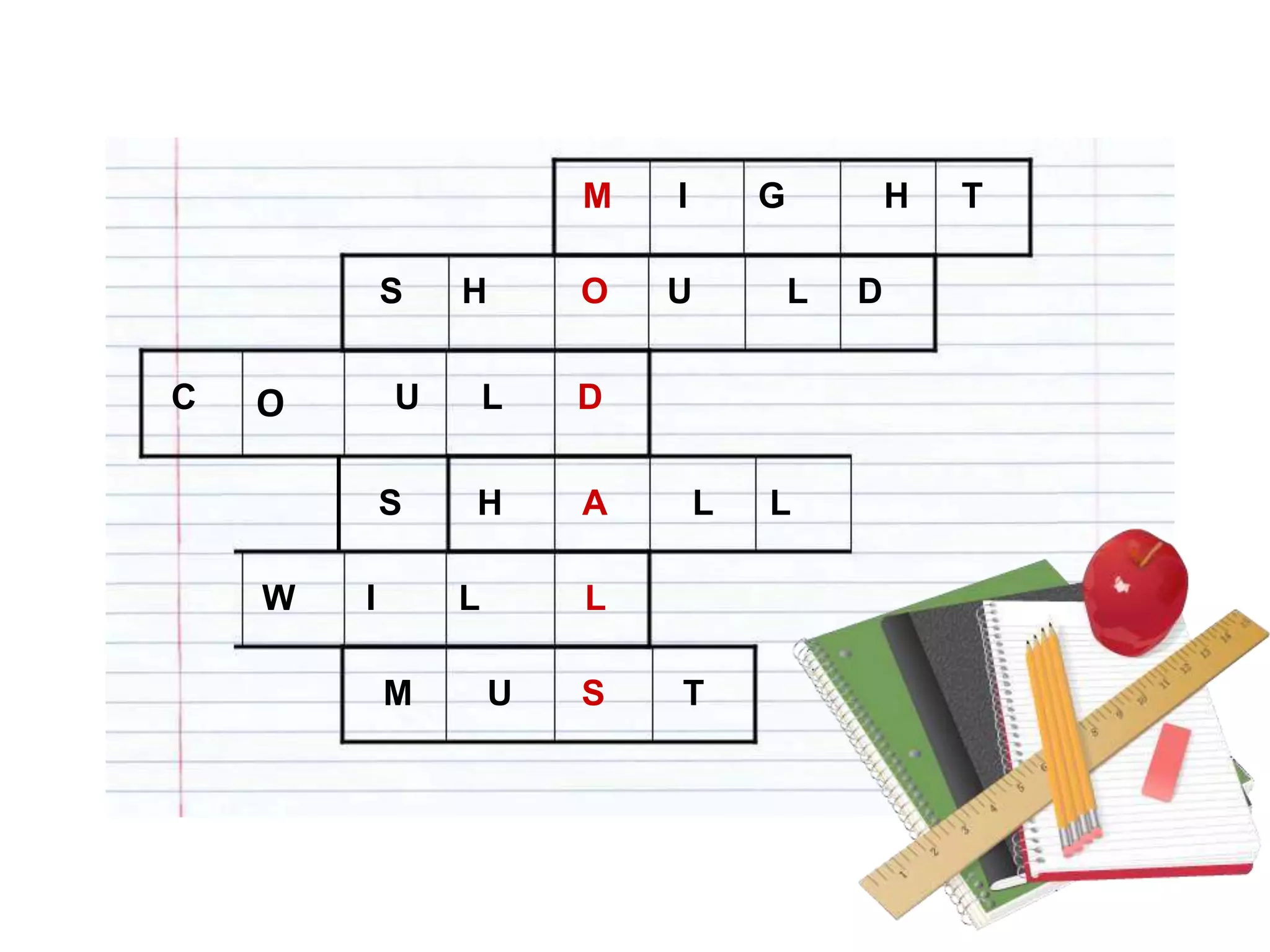
M I G H T
S H O U L D
C U L D
S H A L L
W I L L
M U S T
O
THE END
Thanks for yourattention

Modals ppt -- Sachin Gothwal (GRACIOUS SKILLS )

  • 4.
    I. DEFINITION A modalverb is a type of auxiliary verb that is used to indicate modality-that is likelihood, ability, permission, possiblity,... Two of my friends can play guitar (ability)
  • 5.
    MODAL VERBS LIST OFMODALVERBS Can Could May Might Will Would Shall Should Ought to Must
  • 6.
    Subject Modal verbMain verb Complement I We They You He She It must can should may will go to sleep. drink some water. eat some food. do some exercise. Use the basic form or INFINITIVE of the main verbs after the modal verbs. II. STRUCTURE
  • 7.
    MODAL VERBS A. Modalverbs do not add s or es to the third person singular. He can swim. He cans swim.
  • 8.
    MODAL VERBS • Simple Icould work He could work It could work They could work • Perfect I could have worked He could have worked It could have worked They could have worked • Continuous I could be working He could be working It could be working They could be working •Perfect continuous I could have been working He could have been working It could have been working They could have been working
  • 9.
    MODAL VERBS B. Modalverbs don’t need auxiliaries to form negative and question. Exp : She should stay. She doesn’t should stay. → She shouldn’t stay. Why does she stay? → Why should shestay? c. Modal verbs don’t have infinitives or –ing forms Exp: canning to might
  • 10.
    MODAL VERBS HOW TOUSE CAN Use Example Ability / Possibility Impossibility Asking for permission Wecan’t fix it. Can I bring here?  They can control their own work.    R equest Can you help me?
  • 11.
    MODAL VERBS COULD Use Example CouldI borrow your dictionary? R equest Permission  Could you say it again more slowly? Possibility Future Ability  I think we could have another tea.  I wish Cndrll could meet me next week.  He gave up his old job so he could work for us. 
  • 12.
    MODAL VERBS MAY Use Example May I have another cup of coffee?  I may finish my homework permission possibility
  • 13.
    MODAL VERBS MIGHT Use Example Possibility We'd better phone tomorrow, theymight be eating their dinner now. .
  • 14.
    MODAL VERBS Use Example Sayingwhat’sright or correct  She ought to finish by next week.
  • 15.
    MODAL VERBS SHALL Use Suggestion Shallwe say 2.30 then? Example  Shall I help you with your luggage? Shall I do that or will you? Permission Offer 
  • 16.
    MODAL VERBS III. USAGE SHOULD UseExample Sayingwhat’s right or correct  Possibility  We should solve this problem. Fees should decrease next year.
  • 17.
    MODAL VERBS WILL Use Example Decisions I can’t seeanytaxissoI’llwalk  I'll do that for you if you like.  I’ll come back on Monday. Offer Promise
  • 18.
    MODAL VERBS III. USAGE WOULD UseExample Permission  Would you mind if I brought a  moment? Would you mind waiting a friend with me?  Invitation Would you like to play basketball this Friday? R equest 
  • 19.
  • 20.
    M I GH T S H O U L D C U L D S H A L L W I L L M U S T O
  • 21.
    THE END Thanks foryourattention