By Khatuna Bedenashvili
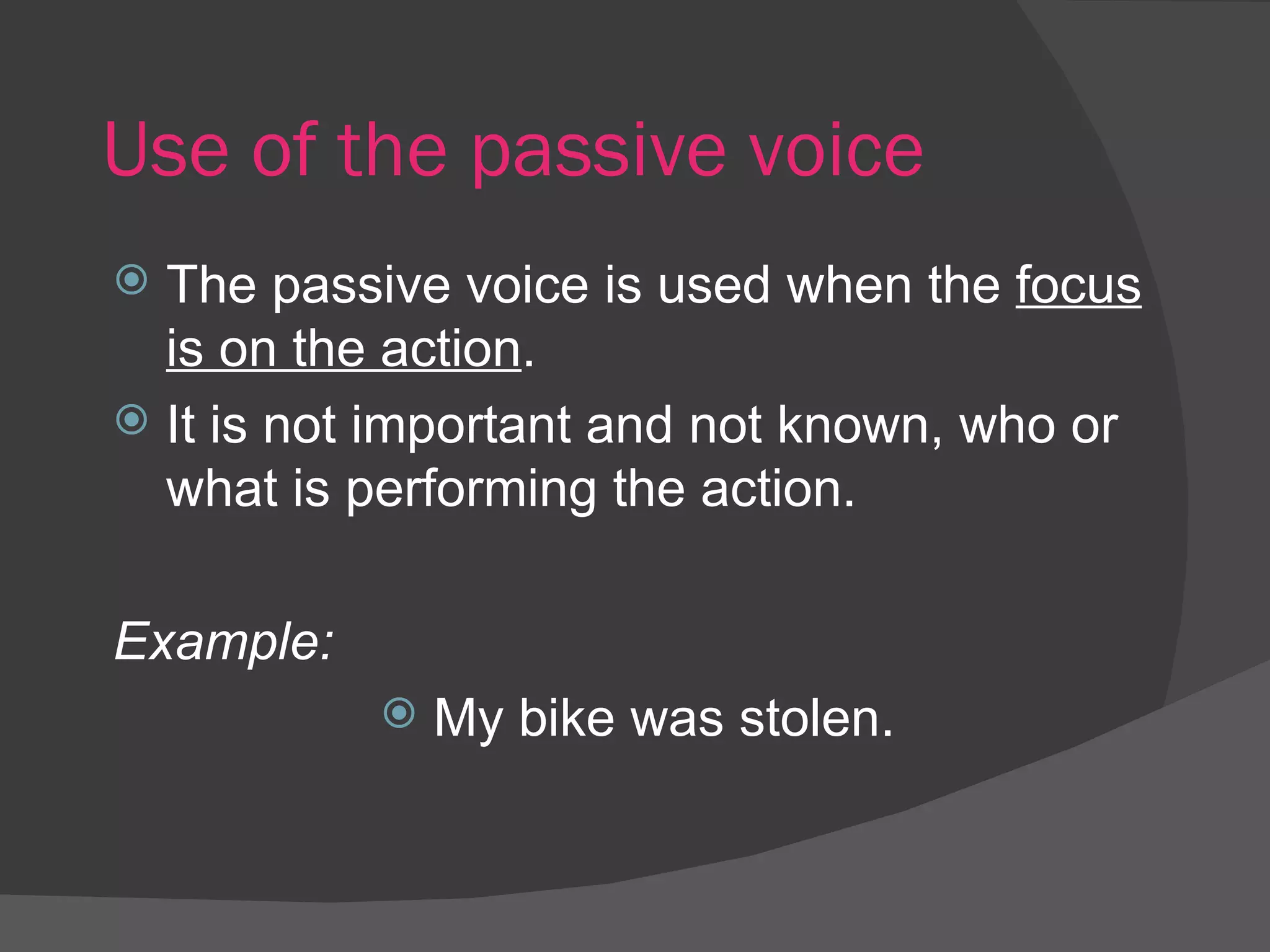
Use of the passive voice The passive voice is used when the  focus is on the action .  It is not important and not known, who or what is performing the action. Example: My bike was stolen.
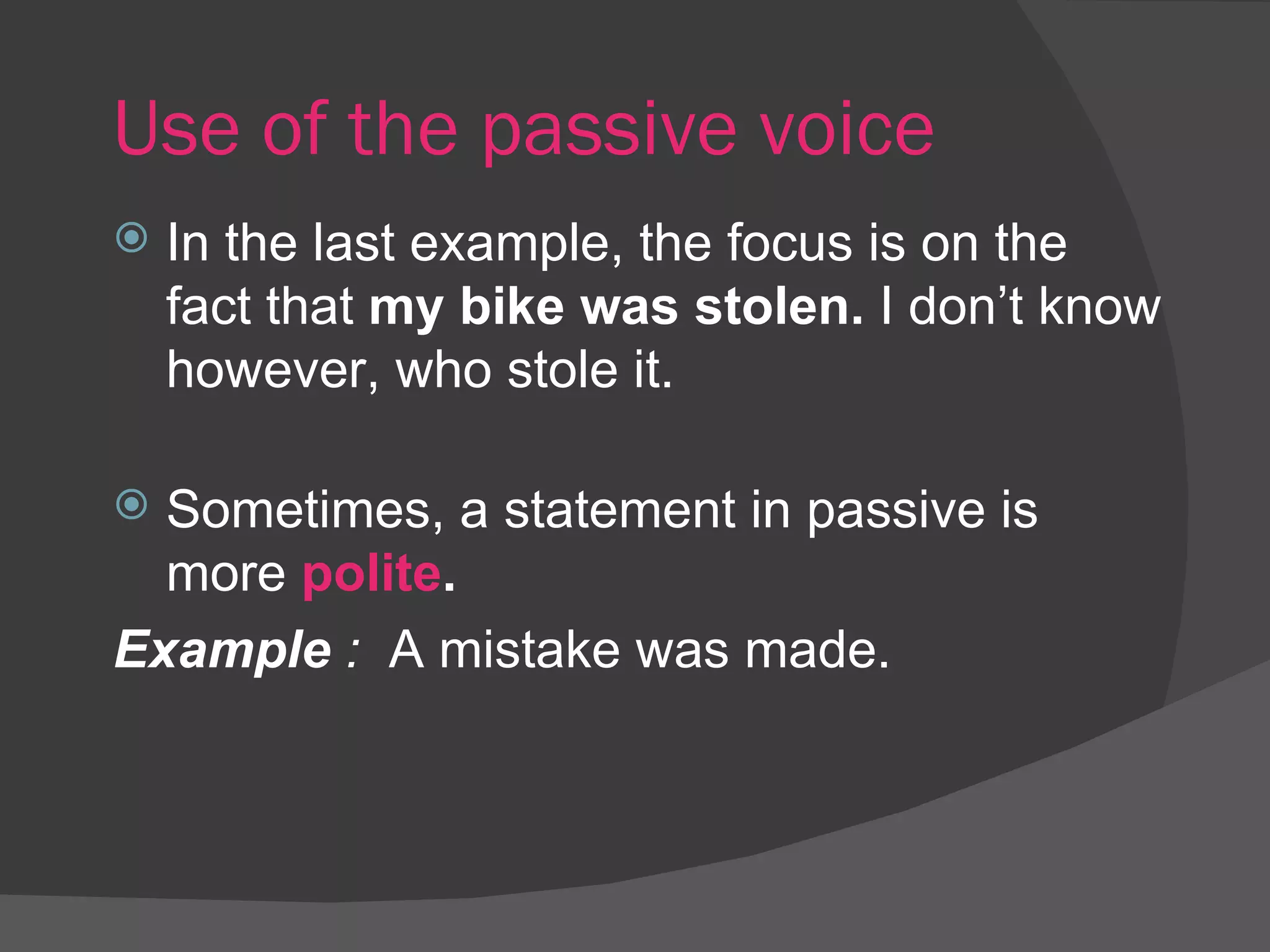
Use of the passive voice In the last example, the focus is on the fact that  my bike was stolen.  I don’t know however, who stole it. Sometimes, a statement in passive is more  polite . Example  :  A mistake was made.
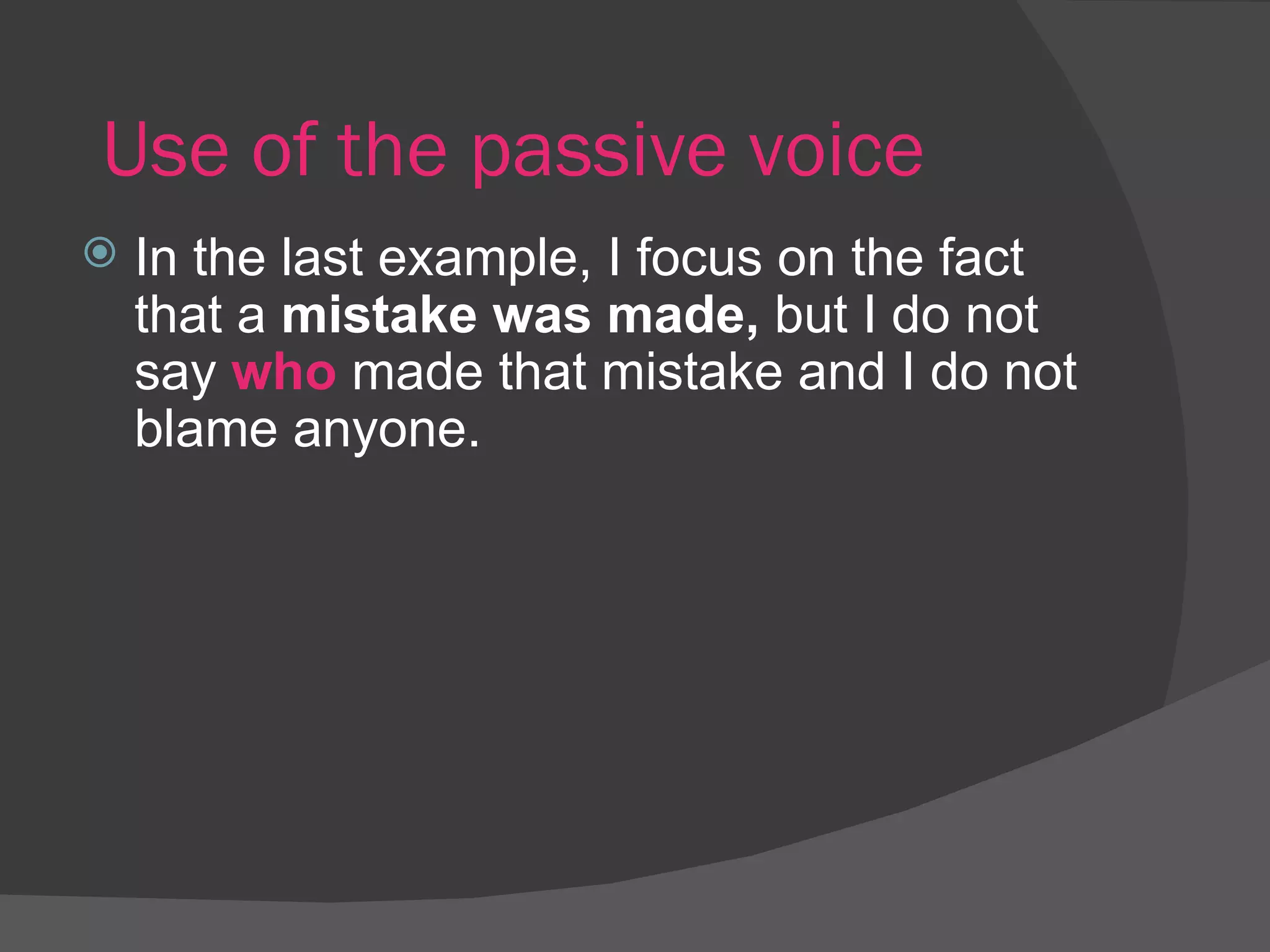
Use of the passive voice In the last example, I focus on the fact that a  mistake was made,  but I do not say  who   made that mistake and I do not blame anyone.
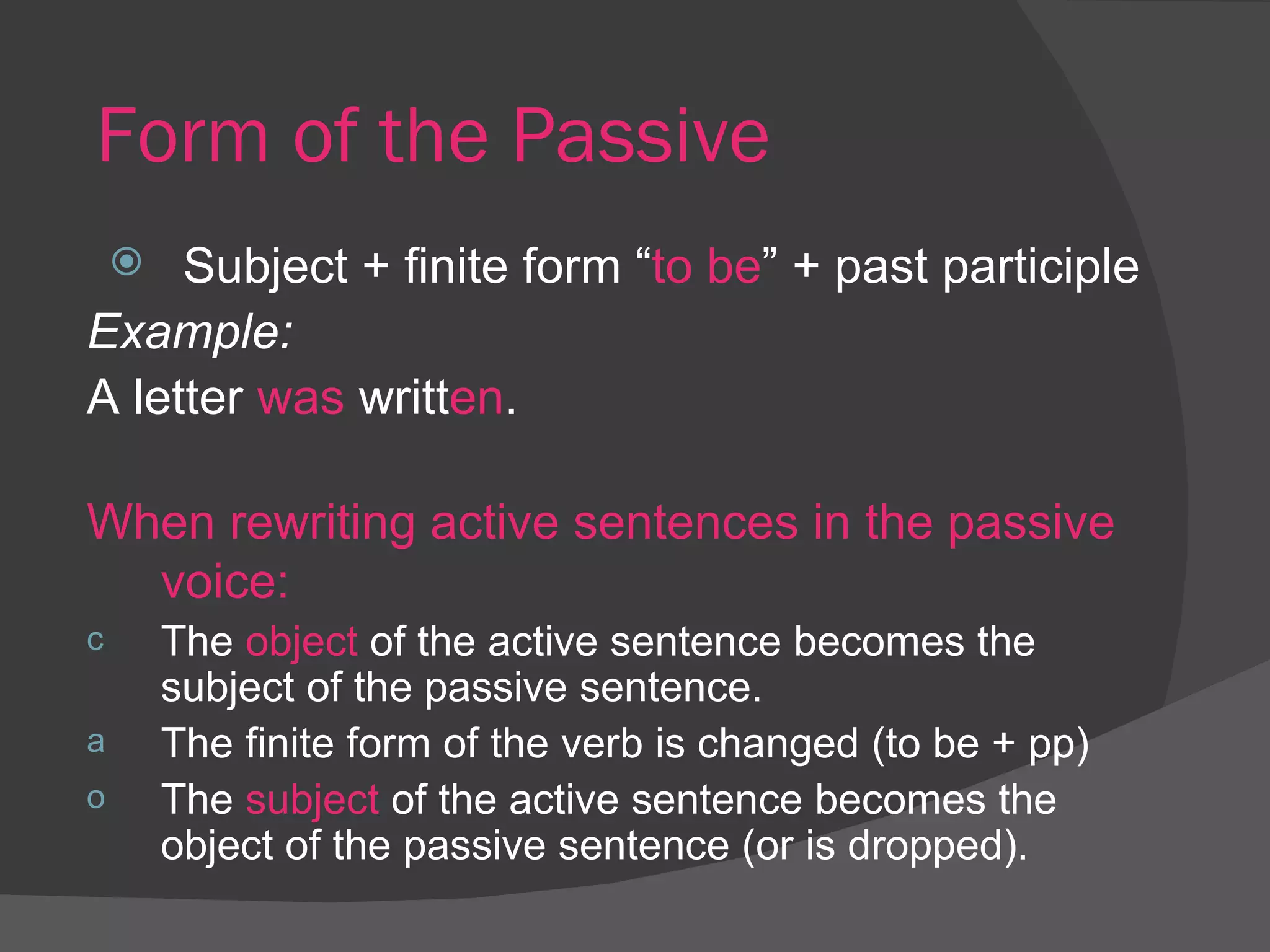
Form of the Passive Subject + finite form “ to be ” + past participle Example:   A letter  was  writt en .  When rewriting active sentences in the passive voice: The  object  of the active sentence becomes the subject of the passive sentence. The finite form of the verb is changed (to be + pp) The  subject  of the active sentence becomes the object of the passive sentence (or is dropped).
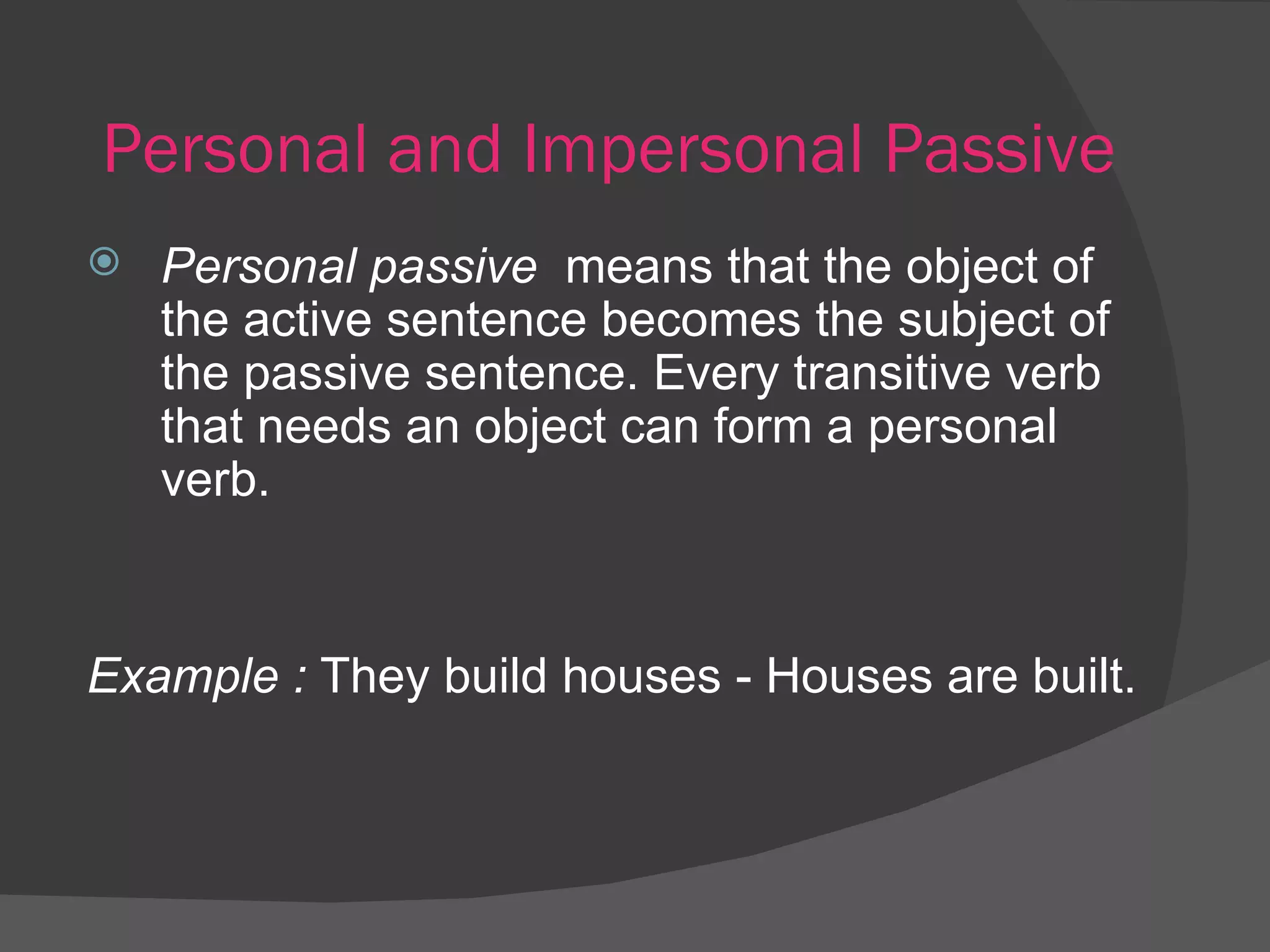
Personal and Impersonal Passive Personal passive  means that the object of the active sentence becomes the subject of the passive sentence. Every transitive verb that needs an object can form a personal verb. Example :  They build houses - Houses are built.
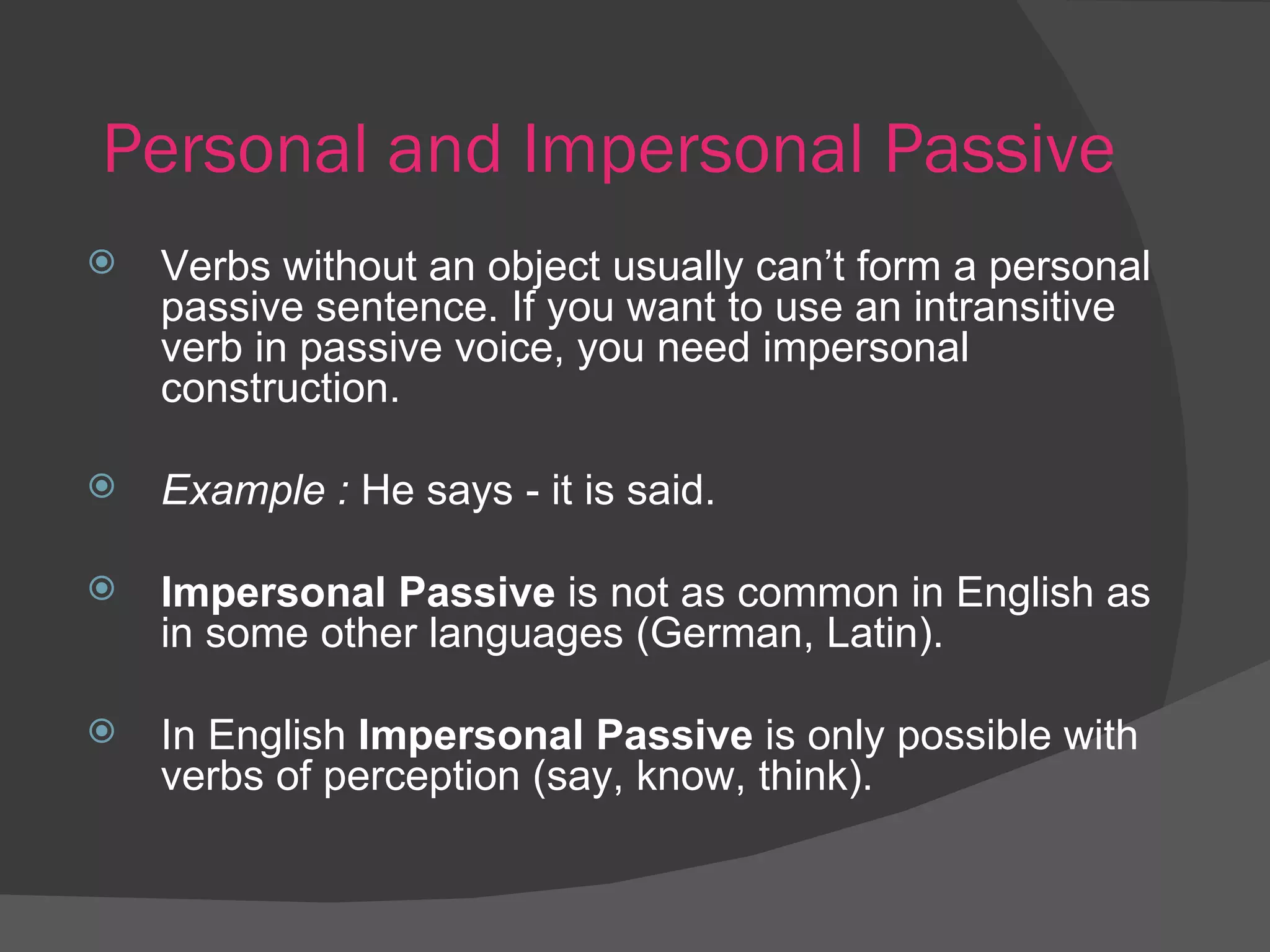
Personal and Impersonal Passive Verbs without an object   usually can’t form a personal passive sentence. If you want to use an intransitive verb in passive voice, you need impersonal construction. Example :  He says - it is said. Impersonal Passive  is not as common in English as in some other languages (German, Latin).  In English  Impersonal Passive  is only possible with verbs of perception (say, know, think).
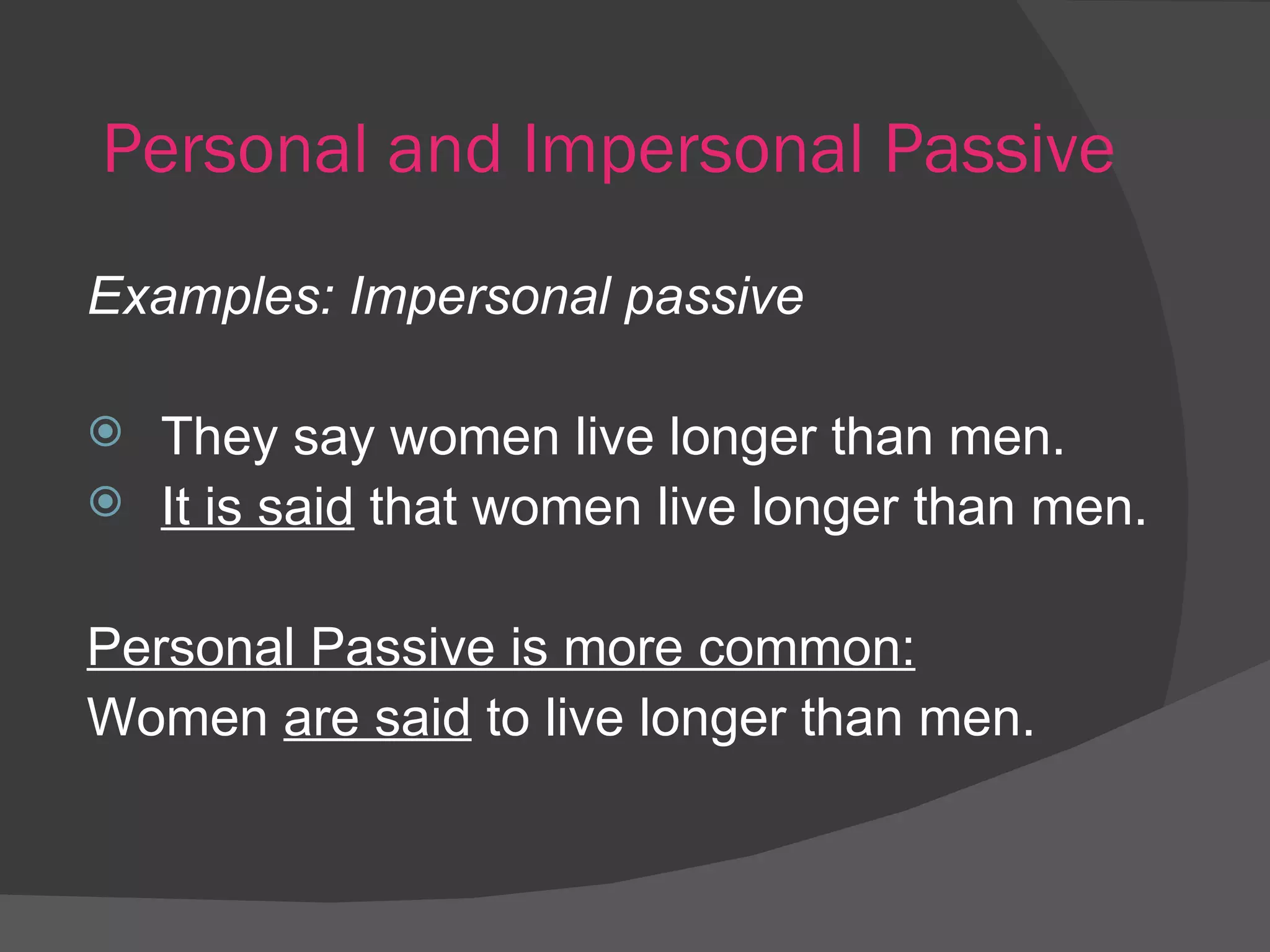
Personal and Impersonal Passive Examples: Impersonal passive They say women live longer than men. It is said  that women live longer than men. Personal Passive is more common: Women  are said  to live longer than men.
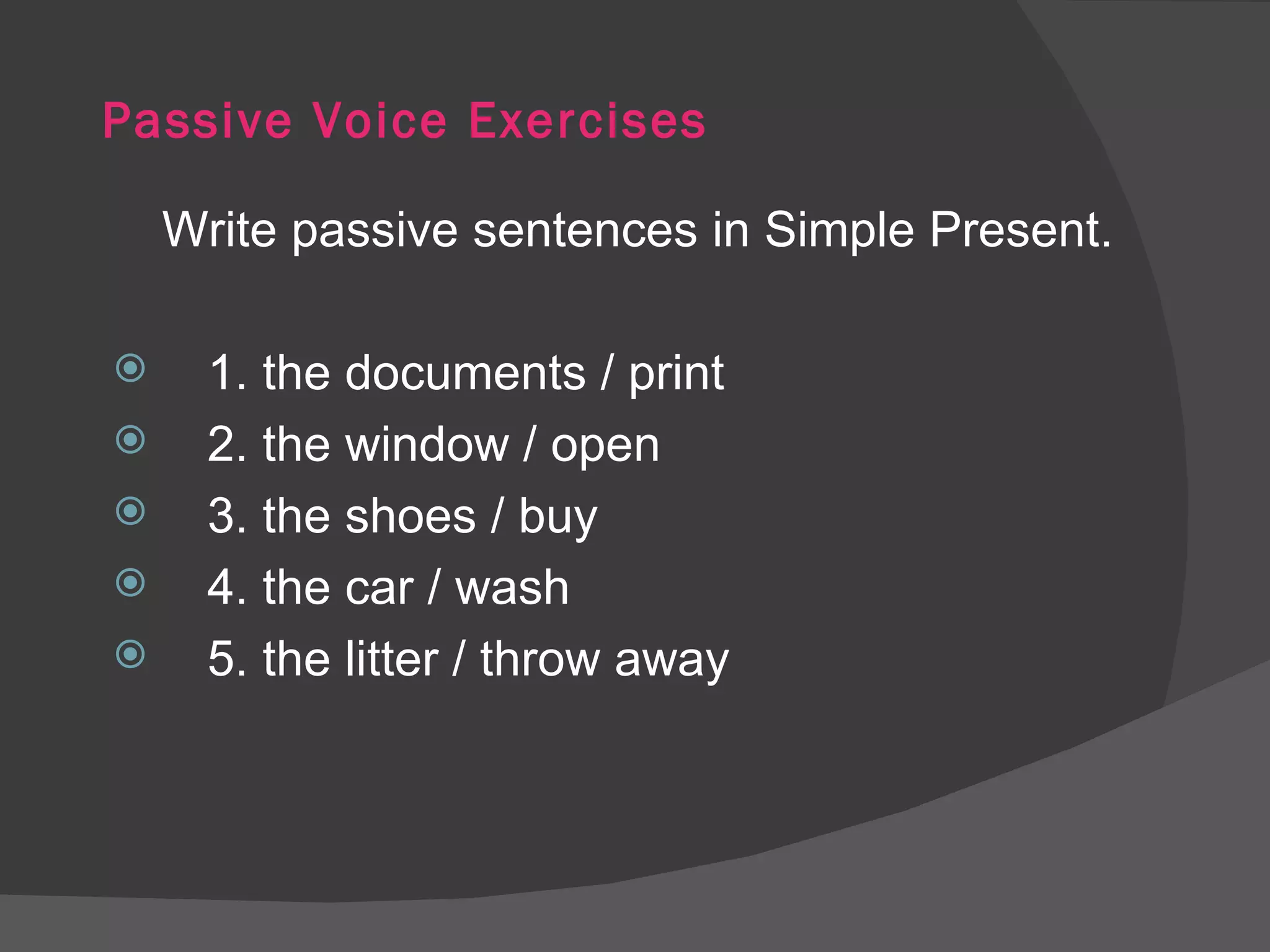
Passive Voice Exercises Write passive sentences in Simple Present. 1. the documents / print 2. the window / open 3. the shoes / buy 4. the car / wash 5. the litter / throw away
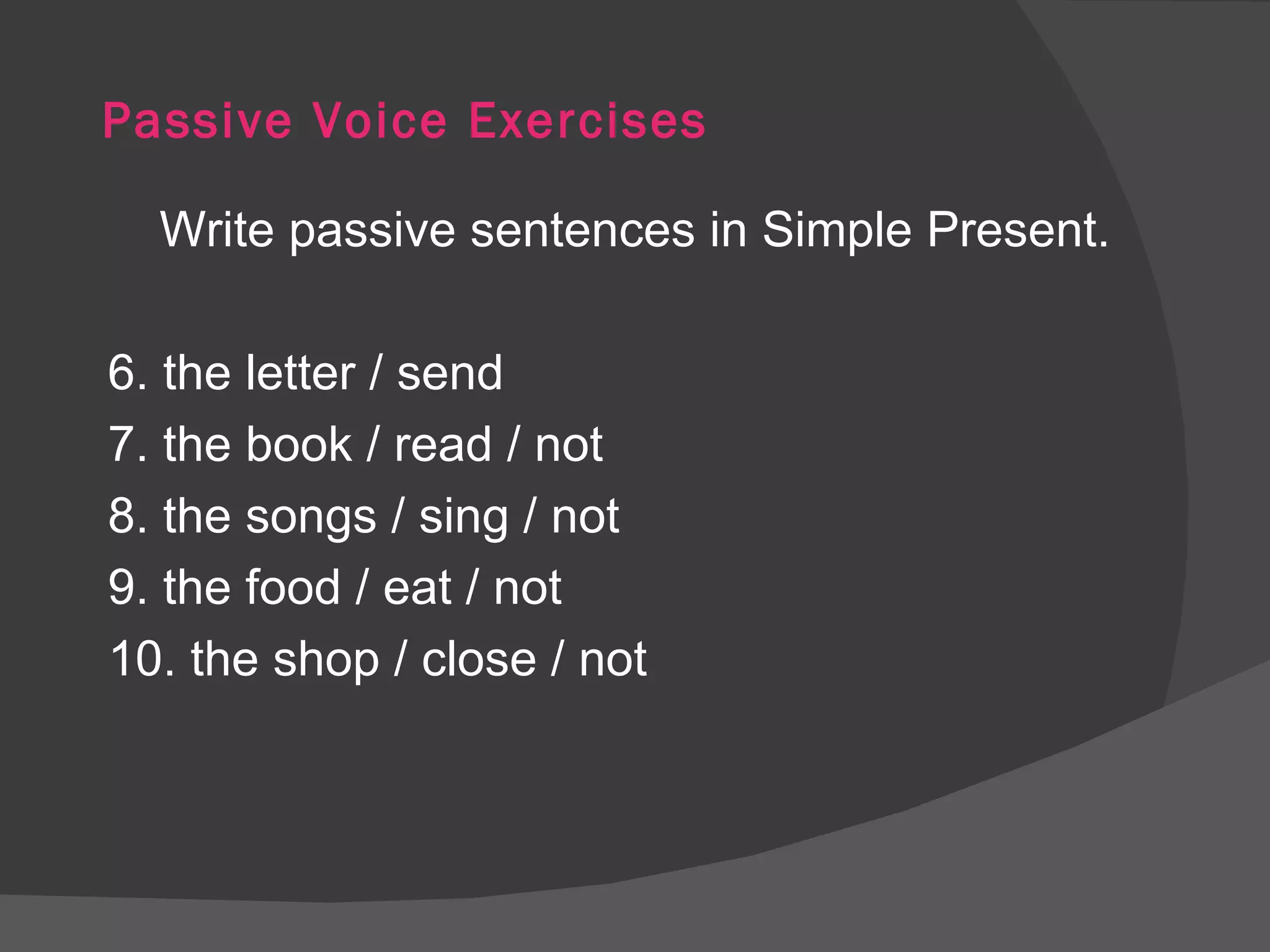
Passive Voice Exercises Write passive sentences in Simple Present. 6. the letter / send 7. the book / read / not 8. the songs / sing / not 9. the food / eat / not 10. the shop / close / not
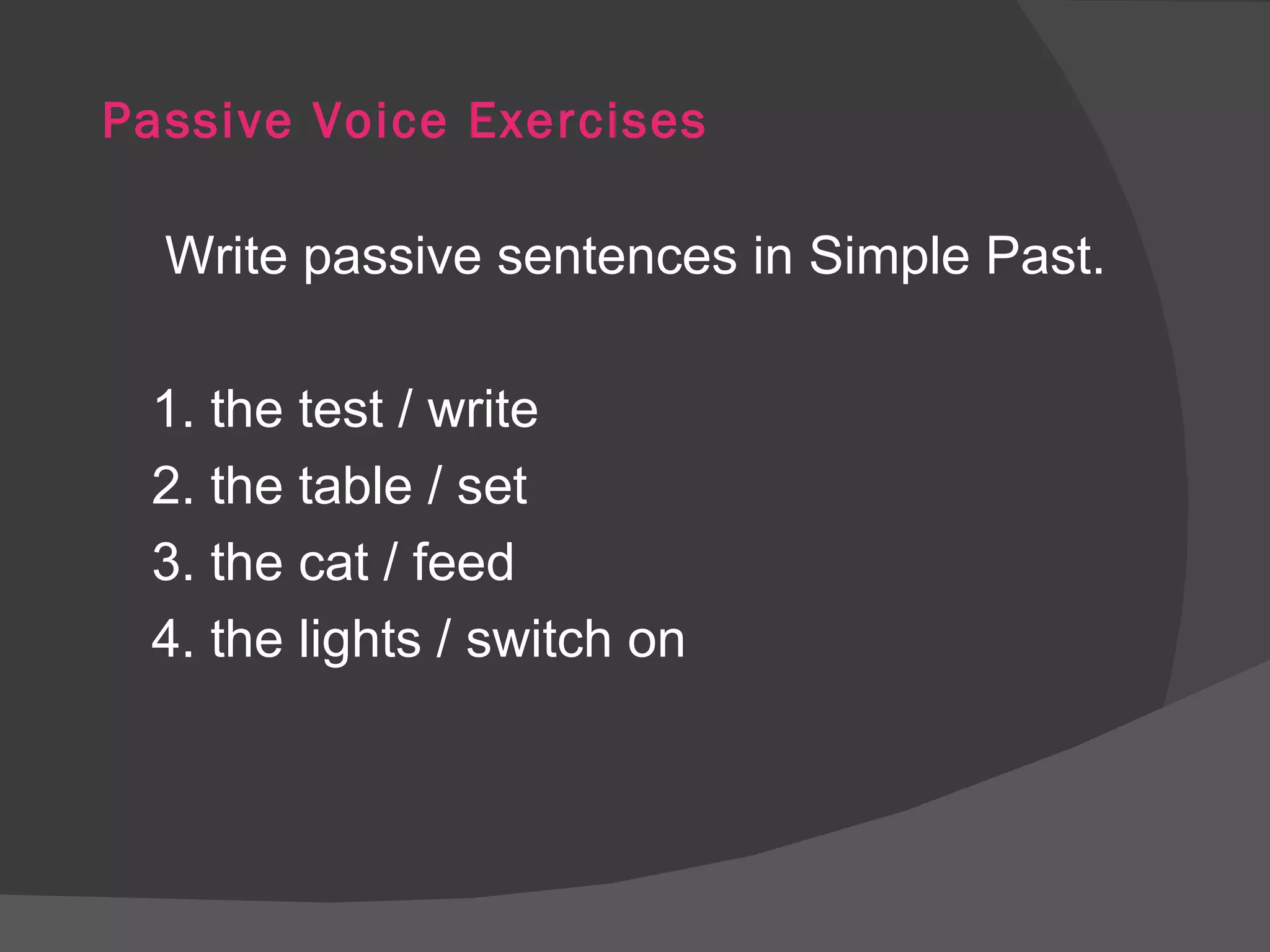
Passive Voice Exercises Write passive sentences in Simple Past. 1. the test / write 2. the table / set 3. the cat / feed 4. the lights / switch on
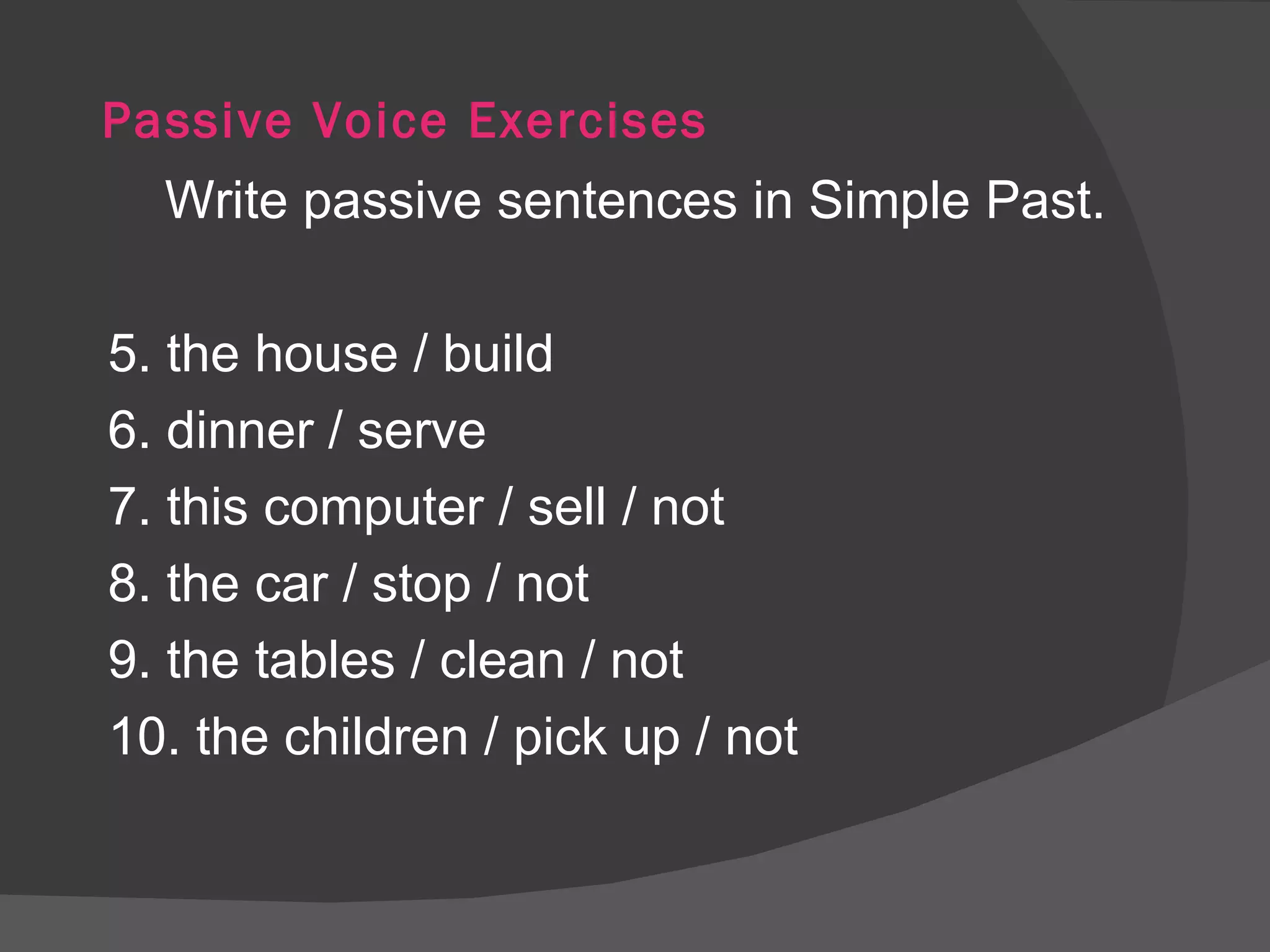
Passive Voice Exercises Write passive sentences in Simple Past. 5. the house / build 6. dinner / serve 7. this computer / sell / not 8. the car / stop / not 9. the tables / clean / not 10. the children / pick up / not
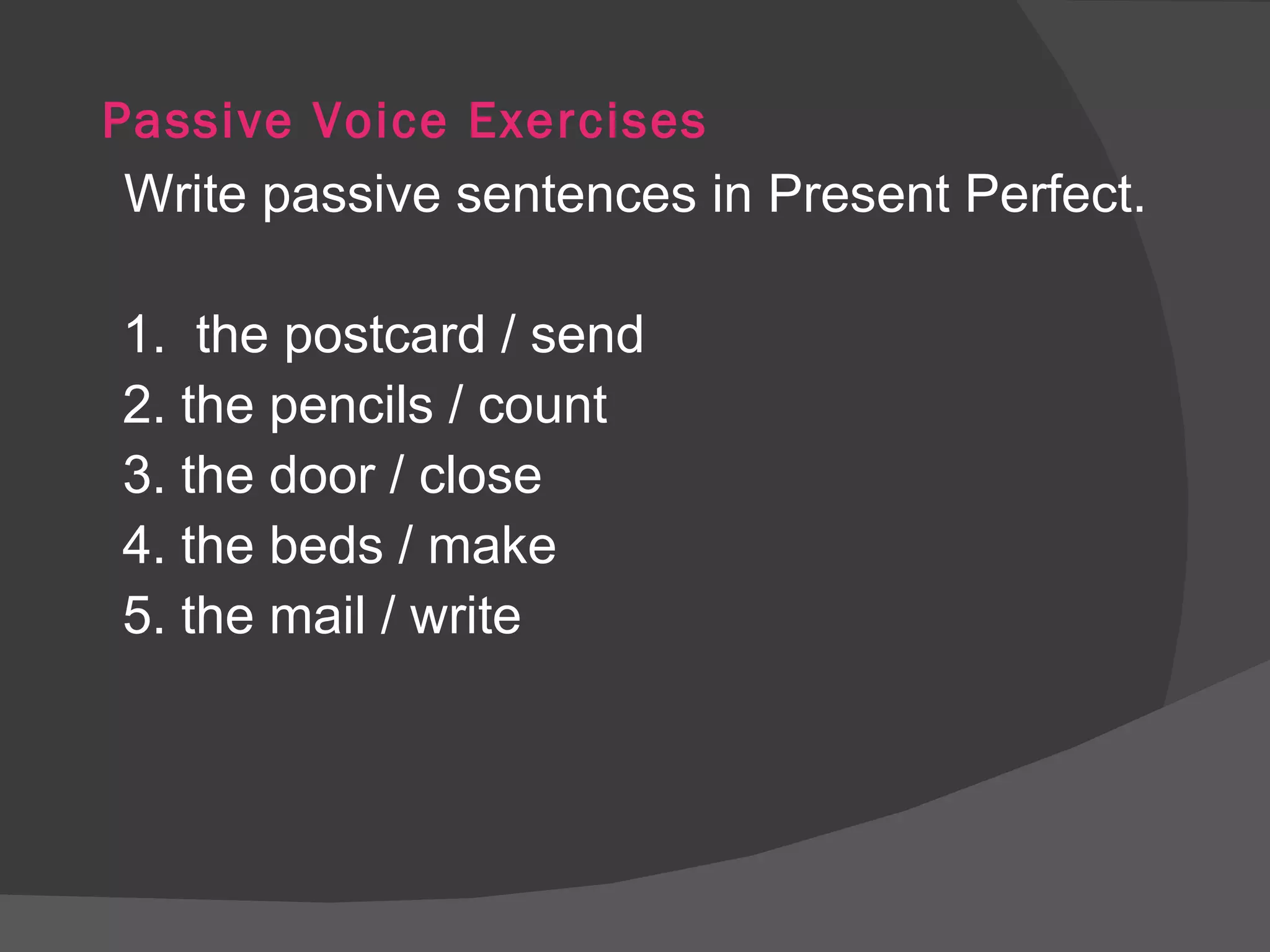
Passive Voice Exercises Write passive sentences in Present Perfect. 1.  the postcard / send 2. the pencils / count 3. the door / close 4. the beds / make 5. the mail / write
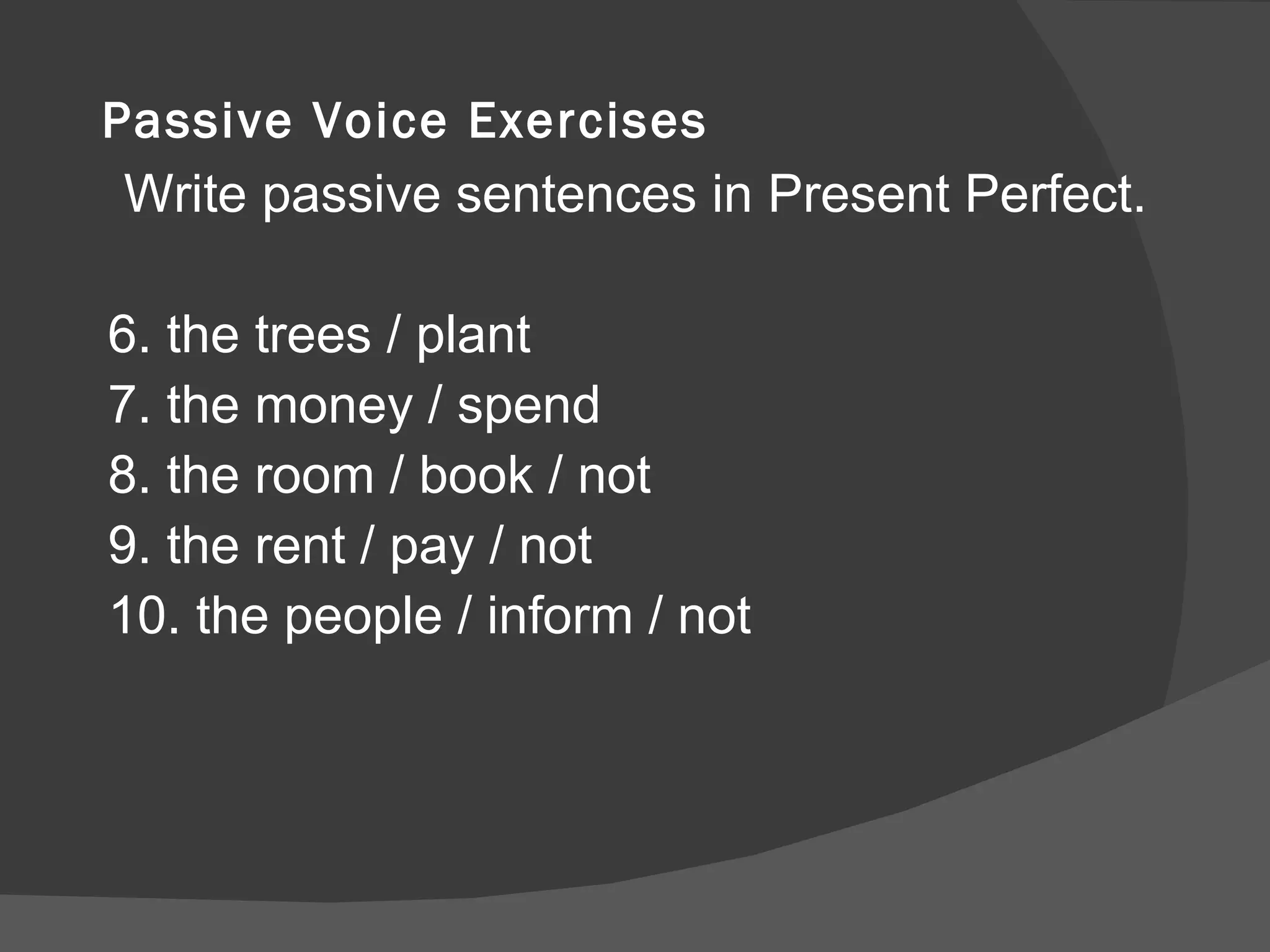
Passive Voice Exercises Write passive sentences in Present Perfect. 6. the trees / plant 7. the money / spend 8. the room / book / not 9. the rent / pay / not 10. the people / inform / not
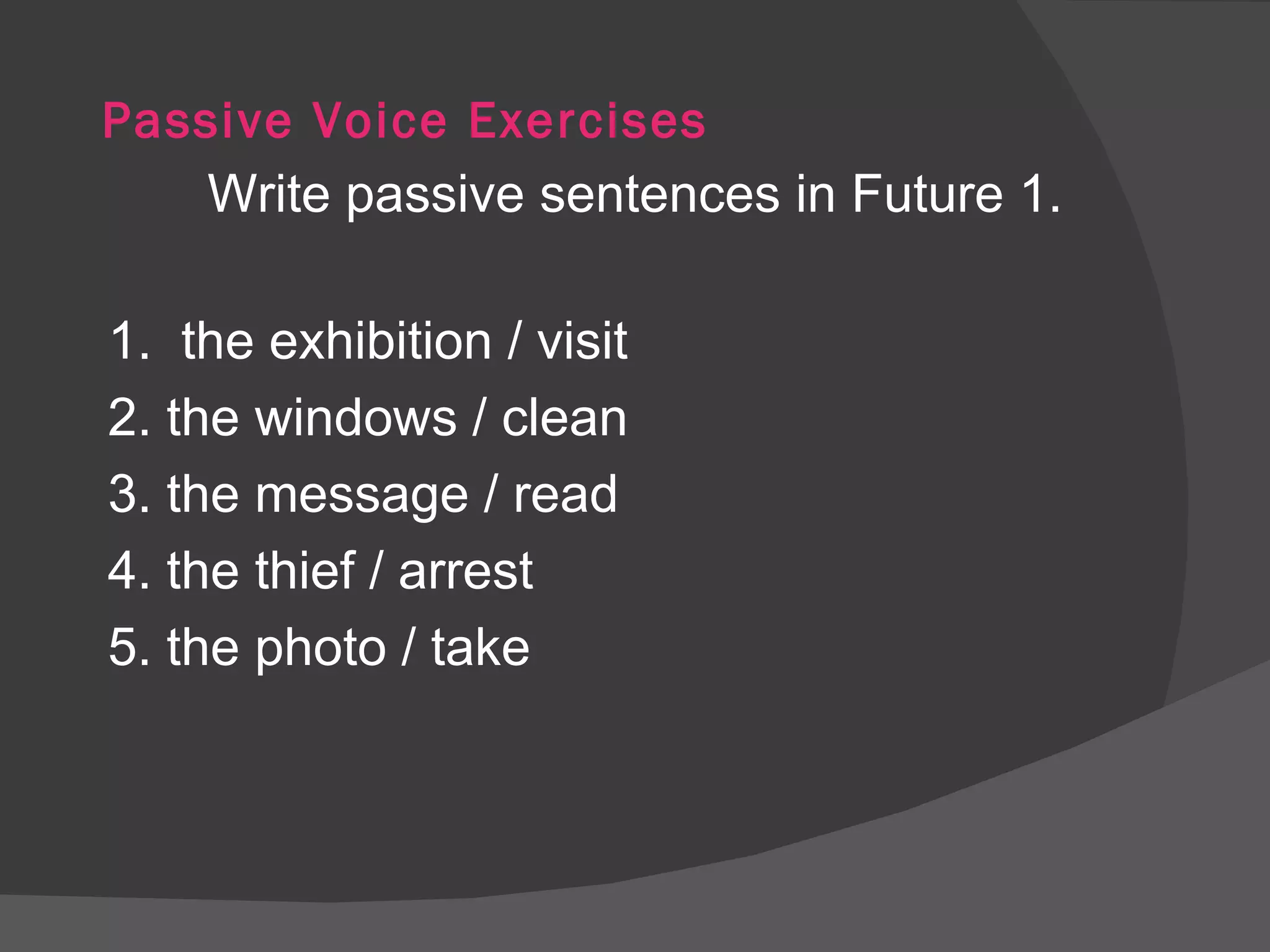
Passive Voice Exercises Write passive sentences in Future 1. 1.  the exhibition / visit 2. the windows / clean 3. the message / read 4. the thief / arrest 5. the photo / take
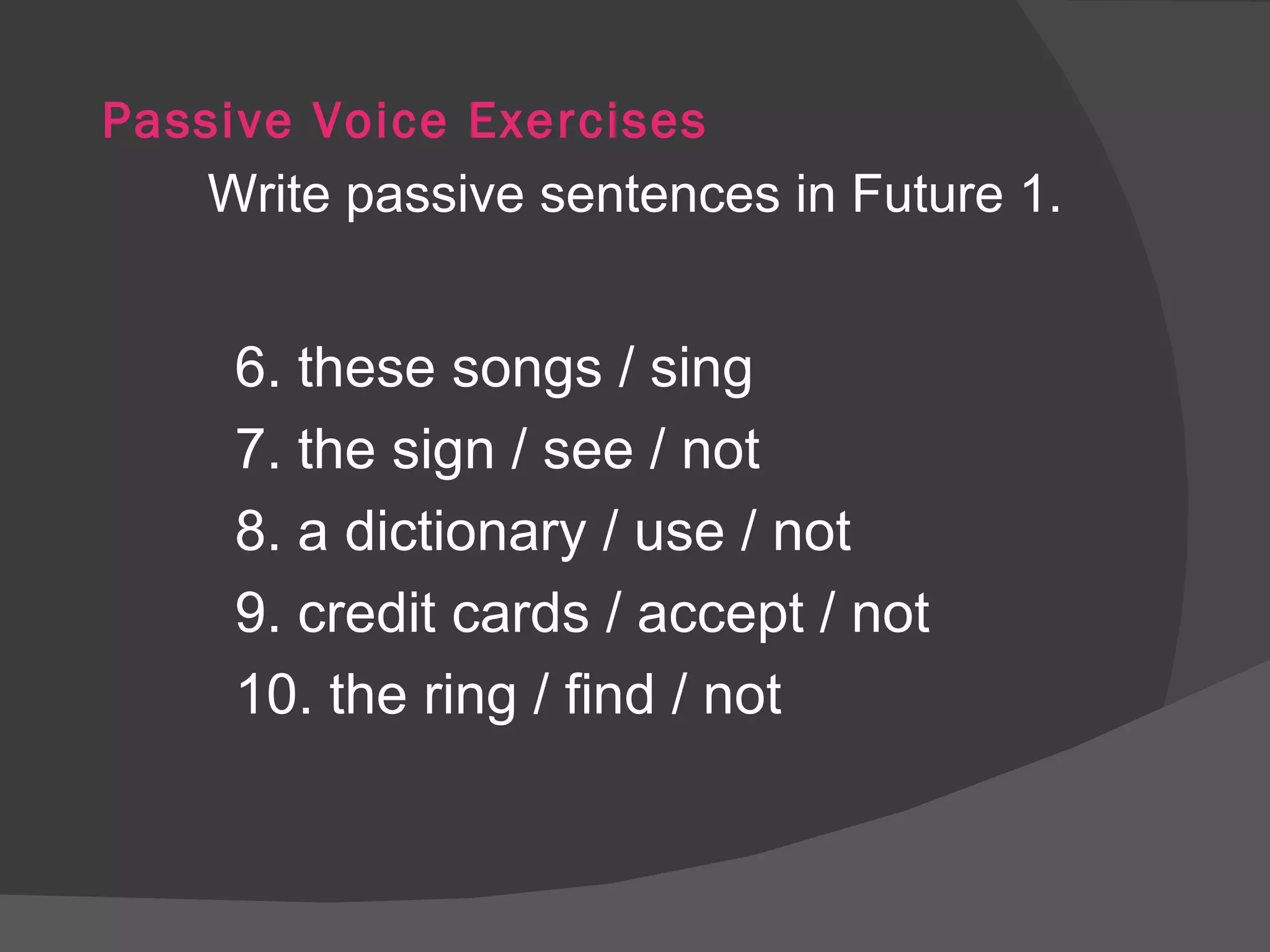
Passive Voice Exercises Write passive sentences in Future 1. 6. these songs / sing 7. the sign / see / not 8. a dictionary / use / not 9. credit cards / accept / not 10. the ring / find / not

Thepassivevoice 090803015459 Phpapp01

  • 1.
  • 2.
    Use of thepassive voice The passive voice is used when the focus is on the action . It is not important and not known, who or what is performing the action. Example: My bike was stolen.
  • 3.
    Use of thepassive voice In the last example, the focus is on the fact that my bike was stolen. I don’t know however, who stole it. Sometimes, a statement in passive is more polite . Example : A mistake was made.
  • 4.
    Use of thepassive voice In the last example, I focus on the fact that a mistake was made, but I do not say who made that mistake and I do not blame anyone.
  • 5.
    Form of thePassive Subject + finite form “ to be ” + past participle Example: A letter was writt en . When rewriting active sentences in the passive voice: The object of the active sentence becomes the subject of the passive sentence. The finite form of the verb is changed (to be + pp) The subject of the active sentence becomes the object of the passive sentence (or is dropped).
  • 6.
    Personal and ImpersonalPassive Personal passive means that the object of the active sentence becomes the subject of the passive sentence. Every transitive verb that needs an object can form a personal verb. Example : They build houses - Houses are built.
  • 7.
    Personal and ImpersonalPassive Verbs without an object usually can’t form a personal passive sentence. If you want to use an intransitive verb in passive voice, you need impersonal construction. Example : He says - it is said. Impersonal Passive is not as common in English as in some other languages (German, Latin). In English Impersonal Passive is only possible with verbs of perception (say, know, think).
  • 8.
    Personal and ImpersonalPassive Examples: Impersonal passive They say women live longer than men. It is said that women live longer than men. Personal Passive is more common: Women are said to live longer than men.
  • 9.
    Passive Voice ExercisesWrite passive sentences in Simple Present. 1. the documents / print 2. the window / open 3. the shoes / buy 4. the car / wash 5. the litter / throw away
  • 10.
    Passive Voice ExercisesWrite passive sentences in Simple Present. 6. the letter / send 7. the book / read / not 8. the songs / sing / not 9. the food / eat / not 10. the shop / close / not
  • 11.
    Passive Voice ExercisesWrite passive sentences in Simple Past. 1. the test / write 2. the table / set 3. the cat / feed 4. the lights / switch on
  • 12.
    Passive Voice ExercisesWrite passive sentences in Simple Past. 5. the house / build 6. dinner / serve 7. this computer / sell / not 8. the car / stop / not 9. the tables / clean / not 10. the children / pick up / not
  • 13.
    Passive Voice ExercisesWrite passive sentences in Present Perfect. 1. the postcard / send 2. the pencils / count 3. the door / close 4. the beds / make 5. the mail / write
  • 14.
    Passive Voice ExercisesWrite passive sentences in Present Perfect. 6. the trees / plant 7. the money / spend 8. the room / book / not 9. the rent / pay / not 10. the people / inform / not
  • 15.
    Passive Voice ExercisesWrite passive sentences in Future 1. 1. the exhibition / visit 2. the windows / clean 3. the message / read 4. the thief / arrest 5. the photo / take
  • 16.
    Passive Voice ExercisesWrite passive sentences in Future 1. 6. these songs / sing 7. the sign / see / not 8. a dictionary / use / not 9. credit cards / accept / not 10. the ring / find / not