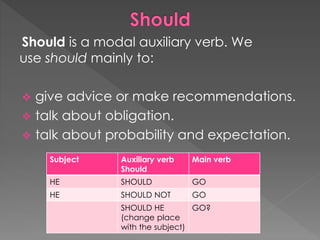
Should is a modal auxiliary verb. We 
use should mainly to: 
 give advice or make recommendations. 
 talk about obligation. 
 talk about probability and expectation. 
Subject Auxiliary verb 
Should 
Main verb 
HE SHOULD GO 
HE SHOULD NOT GO 
SHOULD HE 
(change place 
with the subject) 
GO?
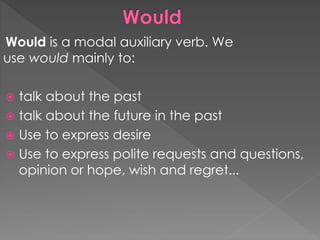
Would is a modal auxiliary verb. We 
use would mainly to: 
 talk about the past 
 talk about the future in the past 
 Use to express desire 
 Use to express polite requests and questions, 
opinion or hope, wish and regret...
SUBJECT AUXILIARY VERB 
WOULD 
MAIN VERB 
SHE WOULD LIKE TEA. 
SHE WOULD NOT LIKE WHISKY. 
WOULD SHE LIKE COFFFE?
Can is a modal auxiliary verb. We 
use can mainly to: 
 Express a general ability. 
 Express an opportunity. 
 Express an informal request.
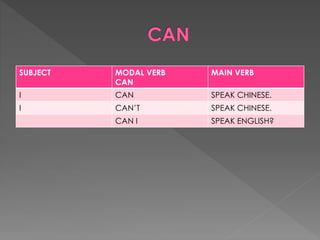
SUBJECT MODAL VERB 
CAN 
MAIN VERB 
I CAN SPEAK CHINESE. 
I CAN’T SPEAK CHINESE. 
CAN I SPEAK ENGLISH?

Modal verbs

  • 2.
    Should is amodal auxiliary verb. We use should mainly to:  give advice or make recommendations.  talk about obligation.  talk about probability and expectation. Subject Auxiliary verb Should Main verb HE SHOULD GO HE SHOULD NOT GO SHOULD HE (change place with the subject) GO?
  • 3.
    Would is amodal auxiliary verb. We use would mainly to:  talk about the past  talk about the future in the past  Use to express desire  Use to express polite requests and questions, opinion or hope, wish and regret...
  • 4.
    SUBJECT AUXILIARY VERB WOULD MAIN VERB SHE WOULD LIKE TEA. SHE WOULD NOT LIKE WHISKY. WOULD SHE LIKE COFFFE?
  • 5.
    Can is amodal auxiliary verb. We use can mainly to:  Express a general ability.  Express an opportunity.  Express an informal request.
  • 6.
    SUBJECT MODAL VERB CAN MAIN VERB I CAN SPEAK CHINESE. I CAN’T SPEAK CHINESE. CAN I SPEAK ENGLISH?