Management of Change Process to Improve
Reliability, Reduce Maintenance Cost and
Better Risk Management
Serge Mathieu & Michel Cote
Agenda
Part 1:
• What is the Definition of a Change or Modification ?
• Why do Modifications ?• Why do Modifications ?
• Why is Management of Change so Important ?
• Consequences from Modifications ?
Part 2:
• Case Study in a Zinc Processing Plant
Definition of a Change
Source: The Collins dictionary
1. Change: to make or become different; alter.
2. Change: to replace with or exchange for another: to transform or
convert.
Definition of Modification
1. Modification: adjustment, alteration, change, mutation.
Source: The Collins THESAURUS
Why Do Modifications ?
• To reduce risk for safety or to comply with laws and
regulations.
• To reduce risk for the environment or to comply with laws
and regulations.and regulations.
• To increase equipment output and efficiency.
• To maintain operations with an equipment that has obsolete
components.
• To generate savings by reducing maintenance or operating
cost.
Consequences from Modifications
On SafetyOn Safety
• Standard operating procedures not updated.
• Possibility of by-passing a safety interlock.
• Lock-out, tag-out procedures not updated.• Lock-out, tag-out procedures not updated.
• Training documents not updated.
• Non-compliant installations resulting from a change
(lifting devices, pressure vessels, protective devices, etc.)
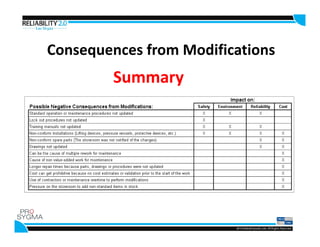
Consequences from Modifications
SummarySummary
Conclusion
A Management of Change Process will:
• Generate savings right out of the maintenance budget.
• Minimize impacts and risks for safety, environment and• Minimize impacts and risks for safety, environment and
equipment Reliability.
• Promote the modifications that have potential to support the
mill’s objectives: Safety & environmental compliance and
making profits!
Questions ?
Michel Cote: mcote@prosygma.ca
Serge Mathieu: smahieu@prosygma.ca
www.prosygma.ca
22

Management of Change

  • 1.
    Management of ChangeProcess to Improve Reliability, Reduce Maintenance Cost and Better Risk Management Serge Mathieu & Michel Cote
  • 2.
    Agenda Part 1: • Whatis the Definition of a Change or Modification ? • Why do Modifications ?• Why do Modifications ? • Why is Management of Change so Important ? • Consequences from Modifications ? Part 2: • Case Study in a Zinc Processing Plant
  • 3.
    Definition of aChange Source: The Collins dictionary 1. Change: to make or become different; alter. 2. Change: to replace with or exchange for another: to transform or convert. Definition of Modification 1. Modification: adjustment, alteration, change, mutation. Source: The Collins THESAURUS
  • 4.
    Why Do Modifications? • To reduce risk for safety or to comply with laws and regulations. • To reduce risk for the environment or to comply with laws and regulations.and regulations. • To increase equipment output and efficiency. • To maintain operations with an equipment that has obsolete components. • To generate savings by reducing maintenance or operating cost.
  • 5.
    Consequences from Modifications OnSafetyOn Safety • Standard operating procedures not updated. • Possibility of by-passing a safety interlock. • Lock-out, tag-out procedures not updated.• Lock-out, tag-out procedures not updated. • Training documents not updated. • Non-compliant installations resulting from a change (lifting devices, pressure vessels, protective devices, etc.)
  • 6.
  • 7.
    Conclusion A Management ofChange Process will: • Generate savings right out of the maintenance budget. • Minimize impacts and risks for safety, environment and• Minimize impacts and risks for safety, environment and equipment Reliability. • Promote the modifications that have potential to support the mill’s objectives: Safety & environmental compliance and making profits!
  • 8.
    Questions ? Michel Cote:mcote@prosygma.ca Serge Mathieu: smahieu@prosygma.ca www.prosygma.ca 22