Mobile Operating Systems:
        Android
         Nicos Demetriou

    SONAR – Fall Semester 2012
Outline
• Historical Development
• Mobile OS in market
• Android OS
  –   Introduction
  –   Architecture
  –   Application Development
  –   Filesystem
  –   Boot process
• Hardware
• Focus on

                                2
Historical Development
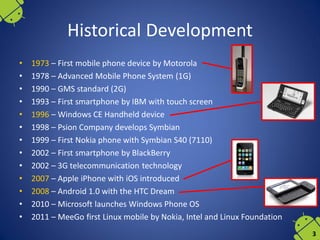
•   1973 – First mobile phone device by Motorola
•   1978 – Advanced Mobile Phone System (1G)
•   1990 – GMS standard (2G)
•   1993 – First smartphone by IBM with touch screen
•   1996 – Windows CE Handheld device
•   1998 – Psion Company develops Symbian
•   1999 – First Nokia phone with Symbian S40 (7110)
•   2002 – First smartphone by BlackBerry
•   2002 – 3G telecommunication technology
•   2007 – Apple iPhone with iOS introduced
•   2008 – Android 1.0 with the HTC Dream
•   2010 – Microsoft launches Windows Phone OS
•   2011 – MeeGo first Linux mobile by Nokia, Intel and Linux Foundation
                                                                           3
Mobile OS in the market
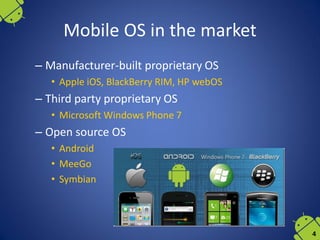
– Manufacturer-built proprietary OS
   • Apple iOS, BlackBerry RIM, HP webOS
– Third party proprietary OS
   • Microsoft Windows Phone 7
– Open source OS
   • Android
   • MeeGo
   • Symbian


                                           4
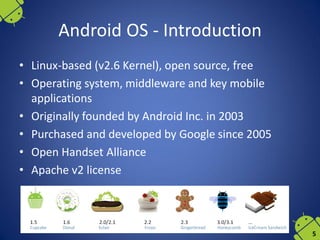
Android OS - Introduction
• Linux-based (v2.6 Kernel), open source, free
• Operating system, middleware and key mobile
  applications
• Originally founded by Android Inc. in 2003
• Purchased and developed by Google since 2005
• Open Handset Alliance
• Apache v2 license


                                                 5
Open Handset Alliance


                        6
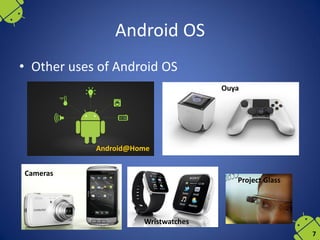
Android OS
• Other uses of Android OS
                                     Ouya


            Android@Home


Cameras
                                        Project Glass


                      Wristwatches
                                                        7
8
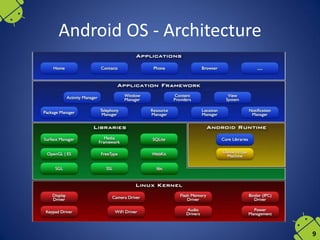
Android OS - Architecture


                            9
Android OS - Architecture
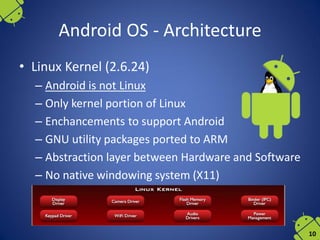
• Linux Kernel (2.6.24)
  – Android is not Linux
  – Only kernel portion of Linux
  – Enchancements to support Android
  – GNU utility packages ported to ARM
  – Abstraction layer between Hardware and Software
  – No native windowing system (X11)


                                                      10
Android OS - Architecture
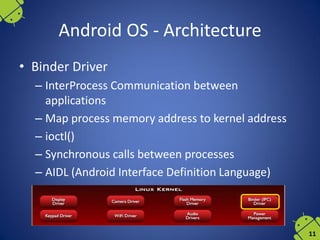
• Binder Driver
  – InterProcess Communication between
    applications
  – Map process memory address to kernel address
  – ioctl()
  – Synchronous calls between processes
  – AIDL (Android Interface Definition Language)


                                                   11
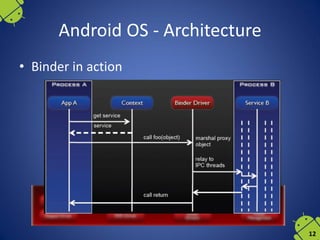
Android OS - Architecture
• Binder in action


                                  12
Android OS - Architecture
• Power Management
  – Battery power Limited capacity
  – Built on top of Linux PM
  – Wake locks – keep power on
    •   PARTIAL_WAKE_LOCK (CPU on, screen/keyboard off)
    •   SCREEN_DIM_WAKE_LOCK (CPU on, screen dim, keyboard off)
    •   SCREEN_BRIGHT_WAKE_LOCK (CPU on, screen bright, kb off)
    •   FULL_WAKE_LOCK (CPU on, screen on, keyboard bright)


                                                                  13
Android OS - Architecture
• Power Management in action


                                  14
Android OS - Architecture
• Other kernel features
  – Android shared memory (ashmem)
  – Process memory allocator (pmem)
  – System logging facility (logger)
  – Alarm timers
  – Paranoid network security
  – RAM_CONSOLE (save kernel messages to RAM)


                                                15
Android OS - Architecture
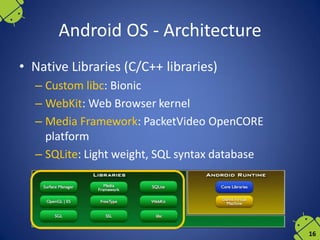
• Native Libraries (C/C++ libraries)
  – Custom libc: Bionic
  – WebKit: Web Browser kernel
  – Media Framework: PacketVideo OpenCORE
    platform
  – SQLite: Light weight, SQL syntax database


                                                16
Android OS - Architecture
• Android Runtime
  – Core Libraries: Core APIs for Java
     • Data structures, Utilities, File/Network access, graphics
  – Dalvik Virtual Machine


                                                                   17
Android OS - Architecture
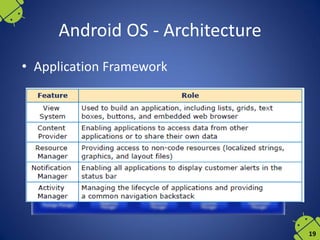
• Application Framework
  – Core platform services
     • Activity/Package/Window/Resource Manager
  – Hardware Services
     • Access to lower-level API through location Manager
     • Telephony/Bluetooth/WiFi/USB/Sensor Service


                                                            18
Android OS - Architecture
• Application Framework


                                 19
Android OS - Architecture
• Applications
  – Built-in Core Applications
     • Email client, SMS, Calendar, Maps, Contacts, Browser…
  – User implemented Applications
     • Written in Java
     • Every application has its own process
     • Can be killed to reclaim resources


                                                               20
Android OS - Architecture


                            21
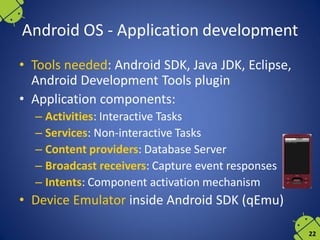
Android OS - Application development
• Tools needed: Android SDK, Java JDK, Eclipse,
  Android Development Tools plugin
• Application components:
  – Activities: Interactive Tasks
  – Services: Non-interactive Tasks
  – Content providers: Database Server
  – Broadcast receivers: Capture event responses
  – Intents: Component activation mechanism
• Device Emulator inside Android SDK (qEmu)

                                                   22
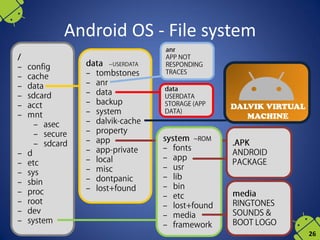
Android OS - File system
• Supports Linux filesystems:
  – ext2, ext3, ext4
• YAFFS (Yet Another Flash File System)
  – NAND chips with 512 byte pages


                                          25
Android OS - File system
‒
‒         ‒
‒         ‒
‒         ‒
          ‒
‒                           DALVIK VIRTUAL
          ‒
‒                              MACHINE
    ‒     ‒
    ‒     ‒
    ‒     ‒
          ‒         ‒
‒
          ‒         ‒
‒
          ‒         ‒
‒
          ‒         ‒
‒
          ‒         ‒
‒
                    ‒
‒
                    ‒
‒
                    ‒
‒
                    ‒
                                             26
Android OS - Boot process
                      ROM  Boot code
                      Boot media available
                      Boot loader  RAM


                                          27
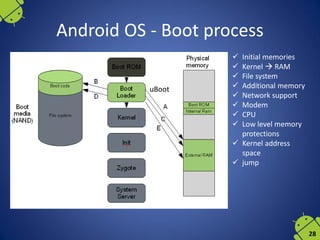
Android OS - Boot process
                      Initial memories
                      Kernel  RAM
                      File system
           uBoot      Additional memory
                      Network support
                      Modem
                      CPU
                      Low level memory
                       protections
                      Kernel address
                       space
                      jump


                                           28
Android OS - Boot process
                        Interrupt controllers
                        Memory protections
                        Caches and scheduling
                        Virtual memory
                        User space processes
                        init


                                           29
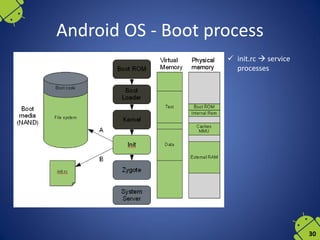
Android OS - Boot process
                     init.rc  service
                      processes


                                          30
Android OS - Boot process
                            Zygote  VM
                            Socket for input
                            Zygote.fork()  VM for
                             child process


/system/bin/app_process


                                                      31
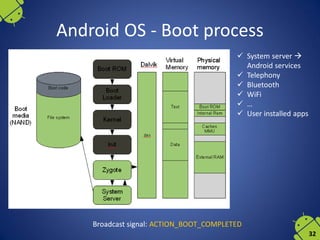
Android OS - Boot process
                                          System server 
                                           Android services
                                          Telephony
                                          Bluetooth
                                          WiFi
                                          …
                                          User installed apps


    Broadcast signal: ACTION_BOOT_COMPLETED
                                                                 32
Android OS - Boot process


                            33
Android Hardware
• Device Requirements
      Feature                   Minimum Requirement
  Chipset         ARM-based
  Memory          128 MB RAM; 256 MB Flash External
  Storage         Mini or Micro SD
  Primary Display QVGA TFT LCD or larger, 16-bit color or better
  Navigation Keys 5-way navigation with 5 application keys, power,
                  camera and volume controls
  Camera          2MP CMOS
  USB             Standard mini-B USB interface
  Bluetooth       1.2 or 2.0


                                                                     34
Android Hardware – System on Chip
                     Phone Manufacturers / System on Chip Provider
Motorola             Texas Instruments OMAP / NVIDIA Tegra 2 (newer dual core phones)
Samsung              Samsung Hummingbird / Exynos
HTC                  Qualcomm Snapdragon
LG                   Qualcomm Snapdragon / Texas Instruments OMAP 4 (newer dual core phones)
Dell                 Qualcomm Snapdragon
Sony Ericcsson       Qualcomm Snapdragon


                                   HTC Nexus One
                 Chipset                       CPU                      GPU
       Snapdragon Gen1             1 GHz ARM Cortex-A8             Adreno 200


                 *Android Hardware Comparison Chart

                                                                                               35
Android Hardware - Chipsets
                   ARM CPU Specifications
            CPU                             Feaures
                     1.2 DMIPS per MHz (Dhrystone MIPS)
                     Frequency of 528-600 MHz
ARM11
                     8-stage pipeline
                      90nm process technology
                     2 DMIPS per MHz (Dhrystone MIPS)
                     Frequency from 600 MHz to 1 GHz
ARM Cortex-A8        In-order execution pipeline
                     13-stage pipeline
                     65/45nm process technology
                     2.5 DMIPS per MHz (Dhrystone MIPS)
                     Frequency up to 2 GHz
                     Out-of-order execution pipeline
                     NEON SIMD instruction set extension (OMAP 4)
ARM Cortex-A9
                     High performance VFPv3 Floating Point Unit (Tegra 2)
                     9-stage pipeline
                     Support for up to 4 cores                                   AMD Adreno
                     40nm process technology
                                                      GPU                                  Feaures
                                                 Adreno 200       17M triangles/sec
                                                                  41M triangles/sec
                                                 Adreno 205       245M pixels/sec
                                                                  720p video recording and playback up to 30 frames/second
                                                                  88M triangles/sec
                                                 Adreno 220        532M pixels/sec
                                                                   1080p video recording and playback up to 30 frames/second
                                                                                                                               36
Android Hardware – Nexus One


                               37
Android Hardware – Nexus One


                               38
Android Hardware – Nexus One


                               39
Android Hardware – Nexus One


                               40
Focus on
• Testing applications on:
  – SDK Emulator
  – Real device
  – Virtual Machine running Android
• Share experience
• Compare metrics:
  – CPU usage
  – Memory
• Using low level commands (adb)
                                      41
References
•   Software
    – http://en.wikipedia.org/wiki/Android_(operating_system)
    – http://www.mobisoftinfotech.com/blog/tag/layers-of-android/
    – http://www.androidenea.com/2009/06/android-boot-process-from-power-
      on.html
    – http://www.android-app-market.com/android-application-components.html
    – http://www.android-app-market.com/android-development-environment-
      setup.html
    – https://sites.google.com/site/io/anatomy--physiology-of-an-android

•   Hardware
    – http://www.isuppli.com/Teardowns/News/Pages/Google-Nexus-One-Carries-
      $17415-Materials-Cost-iSuppli-Teardown-Reveals.aspx
    – http://androidnexus.com/guides/the-ultimate-android-cpu-gpu-comparison-
      guide


                                                                                42
Try this on your Android Phone!
          *#*#4636#*#*


                                  43
Mobile Operating Systems:
        Android
         Nicos Demetriou

    SONAR – Fall Semester 2012

Mobile operating systems

  • 1.
    Mobile Operating Systems: Android Nicos Demetriou SONAR – Fall Semester 2012
  • 2.
    Outline • Historical Development •Mobile OS in market • Android OS – Introduction – Architecture – Application Development – Filesystem – Boot process • Hardware • Focus on 2
  • 3.
    Historical Development • 1973 – First mobile phone device by Motorola • 1978 – Advanced Mobile Phone System (1G) • 1990 – GMS standard (2G) • 1993 – First smartphone by IBM with touch screen • 1996 – Windows CE Handheld device • 1998 – Psion Company develops Symbian • 1999 – First Nokia phone with Symbian S40 (7110) • 2002 – First smartphone by BlackBerry • 2002 – 3G telecommunication technology • 2007 – Apple iPhone with iOS introduced • 2008 – Android 1.0 with the HTC Dream • 2010 – Microsoft launches Windows Phone OS • 2011 – MeeGo first Linux mobile by Nokia, Intel and Linux Foundation 3
  • 4.
    Mobile OS inthe market – Manufacturer-built proprietary OS • Apple iOS, BlackBerry RIM, HP webOS – Third party proprietary OS • Microsoft Windows Phone 7 – Open source OS • Android • MeeGo • Symbian 4
  • 5.
    Android OS -Introduction • Linux-based (v2.6 Kernel), open source, free • Operating system, middleware and key mobile applications • Originally founded by Android Inc. in 2003 • Purchased and developed by Google since 2005 • Open Handset Alliance • Apache v2 license 5
  • 6.
  • 7.
    Android OS • Otheruses of Android OS Ouya Android@Home Cameras Project Glass Wristwatches 7
  • 8.
  • 9.
    Android OS -Architecture 9
  • 10.
    Android OS -Architecture • Linux Kernel (2.6.24) – Android is not Linux – Only kernel portion of Linux – Enchancements to support Android – GNU utility packages ported to ARM – Abstraction layer between Hardware and Software – No native windowing system (X11) 10
  • 11.
    Android OS -Architecture • Binder Driver – InterProcess Communication between applications – Map process memory address to kernel address – ioctl() – Synchronous calls between processes – AIDL (Android Interface Definition Language) 11
  • 12.
    Android OS -Architecture • Binder in action 12
  • 13.
    Android OS -Architecture • Power Management – Battery power Limited capacity – Built on top of Linux PM – Wake locks – keep power on • PARTIAL_WAKE_LOCK (CPU on, screen/keyboard off) • SCREEN_DIM_WAKE_LOCK (CPU on, screen dim, keyboard off) • SCREEN_BRIGHT_WAKE_LOCK (CPU on, screen bright, kb off) • FULL_WAKE_LOCK (CPU on, screen on, keyboard bright) 13
  • 14.
    Android OS -Architecture • Power Management in action 14
  • 15.
    Android OS -Architecture • Other kernel features – Android shared memory (ashmem) – Process memory allocator (pmem) – System logging facility (logger) – Alarm timers – Paranoid network security – RAM_CONSOLE (save kernel messages to RAM) 15
  • 16.
    Android OS -Architecture • Native Libraries (C/C++ libraries) – Custom libc: Bionic – WebKit: Web Browser kernel – Media Framework: PacketVideo OpenCORE platform – SQLite: Light weight, SQL syntax database 16
  • 17.
    Android OS -Architecture • Android Runtime – Core Libraries: Core APIs for Java • Data structures, Utilities, File/Network access, graphics – Dalvik Virtual Machine 17
  • 18.
    Android OS -Architecture • Application Framework – Core platform services • Activity/Package/Window/Resource Manager – Hardware Services • Access to lower-level API through location Manager • Telephony/Bluetooth/WiFi/USB/Sensor Service 18
  • 19.
    Android OS -Architecture • Application Framework 19
  • 20.
    Android OS -Architecture • Applications – Built-in Core Applications • Email client, SMS, Calendar, Maps, Contacts, Browser… – User implemented Applications • Written in Java • Every application has its own process • Can be killed to reclaim resources 20
  • 21.
    Android OS -Architecture 21
  • 22.
    Android OS -Application development • Tools needed: Android SDK, Java JDK, Eclipse, Android Development Tools plugin • Application components: – Activities: Interactive Tasks – Services: Non-interactive Tasks – Content providers: Database Server – Broadcast receivers: Capture event responses – Intents: Component activation mechanism • Device Emulator inside Android SDK (qEmu) 22
  • 23.
    Android OS -File system • Supports Linux filesystems: – ext2, ext3, ext4 • YAFFS (Yet Another Flash File System) – NAND chips with 512 byte pages 25
  • 24.
    Android OS -File system ‒ ‒ ‒ ‒ ‒ ‒ ‒ ‒ ‒ DALVIK VIRTUAL ‒ ‒ MACHINE ‒ ‒ ‒ ‒ ‒ ‒ ‒ ‒ ‒ ‒ ‒ ‒ ‒ ‒ ‒ ‒ ‒ ‒ ‒ ‒ ‒ ‒ ‒ ‒ ‒ ‒ ‒ ‒ 26
  • 25.
    Android OS -Boot process  ROM  Boot code  Boot media available  Boot loader  RAM 27
  • 26.
    Android OS -Boot process  Initial memories  Kernel  RAM  File system uBoot  Additional memory  Network support  Modem  CPU  Low level memory protections  Kernel address space  jump 28
  • 27.
    Android OS -Boot process  Interrupt controllers  Memory protections  Caches and scheduling  Virtual memory  User space processes  init 29
  • 28.
    Android OS -Boot process  init.rc  service processes 30
  • 29.
    Android OS -Boot process  Zygote  VM  Socket for input  Zygote.fork()  VM for child process /system/bin/app_process 31
  • 30.
    Android OS -Boot process  System server  Android services  Telephony  Bluetooth  WiFi  …  User installed apps Broadcast signal: ACTION_BOOT_COMPLETED 32
  • 31.
    Android OS -Boot process 33
  • 32.
    Android Hardware • DeviceRequirements Feature Minimum Requirement Chipset ARM-based Memory 128 MB RAM; 256 MB Flash External Storage Mini or Micro SD Primary Display QVGA TFT LCD or larger, 16-bit color or better Navigation Keys 5-way navigation with 5 application keys, power, camera and volume controls Camera 2MP CMOS USB Standard mini-B USB interface Bluetooth 1.2 or 2.0 34
  • 33.
    Android Hardware –System on Chip Phone Manufacturers / System on Chip Provider Motorola Texas Instruments OMAP / NVIDIA Tegra 2 (newer dual core phones) Samsung Samsung Hummingbird / Exynos HTC Qualcomm Snapdragon LG Qualcomm Snapdragon / Texas Instruments OMAP 4 (newer dual core phones) Dell Qualcomm Snapdragon Sony Ericcsson Qualcomm Snapdragon HTC Nexus One Chipset CPU GPU Snapdragon Gen1 1 GHz ARM Cortex-A8 Adreno 200 *Android Hardware Comparison Chart 35
  • 34.
    Android Hardware -Chipsets ARM CPU Specifications CPU Feaures 1.2 DMIPS per MHz (Dhrystone MIPS) Frequency of 528-600 MHz ARM11 8-stage pipeline 90nm process technology 2 DMIPS per MHz (Dhrystone MIPS) Frequency from 600 MHz to 1 GHz ARM Cortex-A8 In-order execution pipeline 13-stage pipeline 65/45nm process technology 2.5 DMIPS per MHz (Dhrystone MIPS) Frequency up to 2 GHz Out-of-order execution pipeline NEON SIMD instruction set extension (OMAP 4) ARM Cortex-A9 High performance VFPv3 Floating Point Unit (Tegra 2) 9-stage pipeline Support for up to 4 cores AMD Adreno 40nm process technology GPU Feaures Adreno 200 17M triangles/sec 41M triangles/sec Adreno 205 245M pixels/sec 720p video recording and playback up to 30 frames/second 88M triangles/sec Adreno 220 532M pixels/sec 1080p video recording and playback up to 30 frames/second 36
  • 35.
  • 36.
  • 37.
  • 38.
  • 39.
    Focus on • Testingapplications on: – SDK Emulator – Real device – Virtual Machine running Android • Share experience • Compare metrics: – CPU usage – Memory • Using low level commands (adb) 41
  • 40.
    References • Software – http://en.wikipedia.org/wiki/Android_(operating_system) – http://www.mobisoftinfotech.com/blog/tag/layers-of-android/ – http://www.androidenea.com/2009/06/android-boot-process-from-power- on.html – http://www.android-app-market.com/android-application-components.html – http://www.android-app-market.com/android-development-environment- setup.html – https://sites.google.com/site/io/anatomy--physiology-of-an-android • Hardware – http://www.isuppli.com/Teardowns/News/Pages/Google-Nexus-One-Carries- $17415-Materials-Cost-iSuppli-Teardown-Reveals.aspx – http://androidnexus.com/guides/the-ultimate-android-cpu-gpu-comparison- guide 42
  • 41.
    Try this onyour Android Phone! *#*#4636#*#* 43
  • 42.
    Mobile Operating Systems: Android Nicos Demetriou SONAR – Fall Semester 2012