MobilE platform warFree Software Conference, 2010Gábor Török
ContentIntroductionAbout mobile marketMobile platformsFrom developers’ perspectiveLevels of openness
HistoryMilestones: mobile calls, PDA functionality, data transmission, convergenceSome important boosting factorsNetwork enhancements across generations from 1G to 4GTechnical innovations, miniaturization of handheld devicesImproving & opening operating systems from the beginning of 2000 (Symbian) until today (Android)Spread of mobile phones, increase in ratio of smart/regular phones
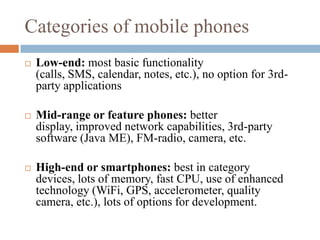
Categories of mobile phonesLow-end: most basic functionality (calls, SMS, calendar, notes, etc.), no option for 3rd-party applicationsMid-range or feature phones: better display, improved network capabilities, 3rd-party software (Java ME), FM-radio, camera, etc.High-end or smartphones: best in category devices, lots of memory, fast CPU, use of enhanced technology (WiFi, GPS, accelerometer, quality camera, etc.), lots of options for development.
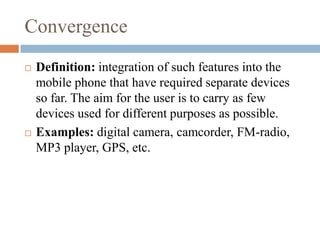
ConvergenceDefinition: integration of such features into the mobile phone that have required separate devices so far. The aim for the user is to carry as few devices used for different purposes as possible.Examples: digital camera, camcorder, FM-radio, MP3 player, GPS, etc.
ContentIntroductionAbout mobile marketMobile platformsFrom developers’ perspectiveLevels of openness
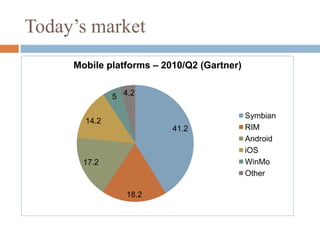
Today’s market
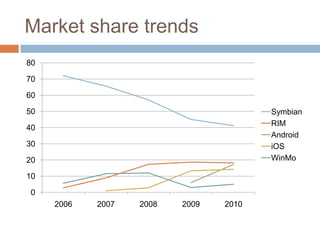
Market share trends
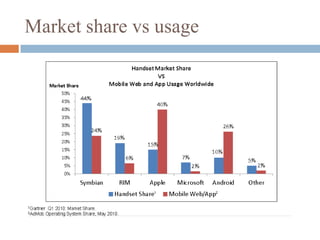
Market share vs usage
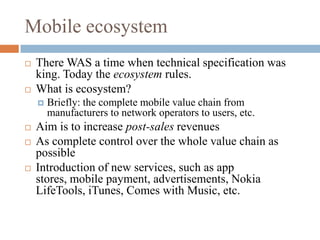
Mobile ecosystemThere WAS a time when technical specification was king. Today the ecosystem rules.What is ecosystem?Briefly: the complete mobile value chain from manufacturers to network operators to users, etc.Aim is to increase post-sales revenuesAs complete control over the whole value chain as possibleIntroduction of new services, such as app stores, mobile payment, advertisements, Nokia LifeTools, iTunes, Comes with Music, etc.
ContentIntroductionAbout mobile marketMobile platformsFrom developers’ perspectiveLevels of openness
SymbianMost widely used mobile OS: 40+%10+ years old, optimized for mobile from the beginningOpen source, Eclipse licenseNative language is C++, but there are many other options for development(Still) Closely related to Nokia
BlackBerryMarket share is below 20%, most popular in North-AmericaOn the market since 2002Enterprise phone with very efficient network managementLatest operating system is BlackBerry OS 6.0, but QNX is expected to replace itDevelopment mainly in Java ME environment, but web widgets are also supported
iOSNearly 17% market shareMaster of user experience (simple, multi-touch)iPhone introduced in 2007More than 250k mobile applications in App StoreNative SDK, web applicationsTightly controlled ecosystem
Windows Mobile/Windows Phone 7Market share around 5%, significant fall since 2008Meant to give the same experience as on desktop WindowsUsed rather as an enterprise phone than multimediaLots of choices for development (WinMo 6.5)Windows Phone 7 will soon replace Windows Mobile 6.5, from when on only Silverlight-based development will be possible.
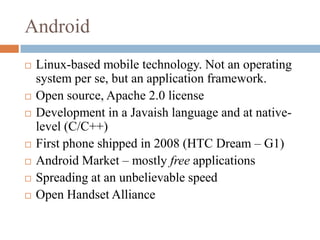
AndroidLinux-based mobile technology. Not an operating system per se, but an application framework.Open source, Apache 2.0 licenseDevelopment in a Javaish language and at native-level (C/C++)First phone shipped in 2008 (HTC Dream – G1)Android Market – mostly free applicationsSpreading at an unbelievable speedOpen Handset Alliance
ContentIntroductionAbout mobile marketMobile platformsFrom developers’ perspectiveLevels of openness
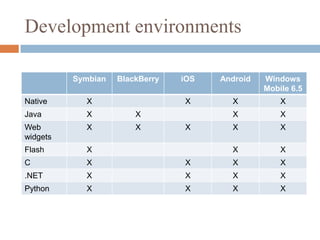
Development environments
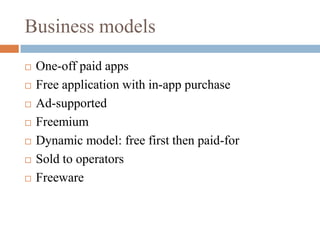
Business modelsOne-off paid appsFree application with in-app purchaseAd-supportedFreemiumDynamic model: free first then paid-forSold to operatorsFreeware
Which platform to choose?Important areas to consider:Purpose of the applicationWho is it targeted for?Geographical locationCounting with platform limitationsMobile is different from desktopDevices with limited capabilitiesLess reliable network, communicationDifferent user experience
ContentIntroductionAbout mobile marketMobile platformsFrom developers’ perspectiveLevels of openness
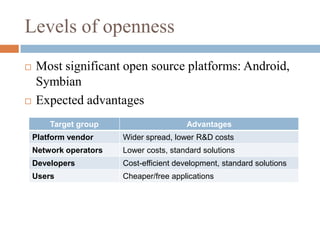
Levels of opennessMost significant open source platforms: Android, SymbianExpected advantages
About meGábor Török10 years experience in mobileFive time Forum Nokia Championgabor[dot]i[dot]torok[at]gmail[dot]comhttp://mobile-thoughts.blogspot.com/http://hu.linkedin.com/in/gabortorok
Questions

Mobile platform war

  • 1.
    MobilE platform warFreeSoftware Conference, 2010Gábor Török
  • 2.
    ContentIntroductionAbout mobile marketMobileplatformsFrom developers’ perspectiveLevels of openness
  • 3.
    HistoryMilestones: mobile calls,PDA functionality, data transmission, convergenceSome important boosting factorsNetwork enhancements across generations from 1G to 4GTechnical innovations, miniaturization of handheld devicesImproving & opening operating systems from the beginning of 2000 (Symbian) until today (Android)Spread of mobile phones, increase in ratio of smart/regular phones
  • 4.
    Categories of mobilephonesLow-end: most basic functionality (calls, SMS, calendar, notes, etc.), no option for 3rd-party applicationsMid-range or feature phones: better display, improved network capabilities, 3rd-party software (Java ME), FM-radio, camera, etc.High-end or smartphones: best in category devices, lots of memory, fast CPU, use of enhanced technology (WiFi, GPS, accelerometer, quality camera, etc.), lots of options for development.
  • 5.
    ConvergenceDefinition: integration ofsuch features into the mobile phone that have required separate devices so far. The aim for the user is to carry as few devices used for different purposes as possible.Examples: digital camera, camcorder, FM-radio, MP3 player, GPS, etc.
  • 6.
    ContentIntroductionAbout mobile marketMobileplatformsFrom developers’ perspectiveLevels of openness
  • 7.
  • 8.
  • 9.
  • 10.
    Mobile ecosystemThere WASa time when technical specification was king. Today the ecosystem rules.What is ecosystem?Briefly: the complete mobile value chain from manufacturers to network operators to users, etc.Aim is to increase post-sales revenuesAs complete control over the whole value chain as possibleIntroduction of new services, such as app stores, mobile payment, advertisements, Nokia LifeTools, iTunes, Comes with Music, etc.
  • 11.
    ContentIntroductionAbout mobile marketMobileplatformsFrom developers’ perspectiveLevels of openness
  • 12.
    SymbianMost widely usedmobile OS: 40+%10+ years old, optimized for mobile from the beginningOpen source, Eclipse licenseNative language is C++, but there are many other options for development(Still) Closely related to Nokia
  • 13.
    BlackBerryMarket share isbelow 20%, most popular in North-AmericaOn the market since 2002Enterprise phone with very efficient network managementLatest operating system is BlackBerry OS 6.0, but QNX is expected to replace itDevelopment mainly in Java ME environment, but web widgets are also supported
  • 14.
    iOSNearly 17% marketshareMaster of user experience (simple, multi-touch)iPhone introduced in 2007More than 250k mobile applications in App StoreNative SDK, web applicationsTightly controlled ecosystem
  • 15.
    Windows Mobile/Windows Phone7Market share around 5%, significant fall since 2008Meant to give the same experience as on desktop WindowsUsed rather as an enterprise phone than multimediaLots of choices for development (WinMo 6.5)Windows Phone 7 will soon replace Windows Mobile 6.5, from when on only Silverlight-based development will be possible.
  • 16.
    AndroidLinux-based mobile technology.Not an operating system per se, but an application framework.Open source, Apache 2.0 licenseDevelopment in a Javaish language and at native-level (C/C++)First phone shipped in 2008 (HTC Dream – G1)Android Market – mostly free applicationsSpreading at an unbelievable speedOpen Handset Alliance
  • 17.
    ContentIntroductionAbout mobile marketMobileplatformsFrom developers’ perspectiveLevels of openness
  • 18.
  • 19.
    Business modelsOne-off paidappsFree application with in-app purchaseAd-supportedFreemiumDynamic model: free first then paid-forSold to operatorsFreeware
  • 20.
    Which platform tochoose?Important areas to consider:Purpose of the applicationWho is it targeted for?Geographical locationCounting with platform limitationsMobile is different from desktopDevices with limited capabilitiesLess reliable network, communicationDifferent user experience
  • 21.
    ContentIntroductionAbout mobile marketMobileplatformsFrom developers’ perspectiveLevels of openness
  • 22.
    Levels of opennessMostsignificant open source platforms: Android, SymbianExpected advantages
  • 23.
    About meGábor Török10years experience in mobileFive time Forum Nokia Championgabor[dot]i[dot]torok[at]gmail[dot]comhttp://mobile-thoughts.blogspot.com/http://hu.linkedin.com/in/gabortorok
  • 24.

Editor's Notes

  • #4 Hálózat: 1G (1979 – NTT), 2G (1991 – Radiolinja), 2.5G (2001 – Európa és USA ), 2.75G (2003 – AT&T), 3G (2001 – NTT), 3.5G (2008), 4G (2009 – TeliaSonera)1G– analogue2G – digitally encrypted, SMS, 14.4kbit/s2.5G – GPRS: 56-115kbit/s, HSCSD, MMS2.75G – EDGE: use of new codec  enhanced data rate, 236.8kbit/s3G – simultaneous use of speech and data, W-CDMA, from several hundreds of kbits to few megabit per sec, mobile TV, video call3.5G – HSPA, several (tens of) Mbit/s4G – LTE, a few hundreds of Mbit/sEricsson szerint 2010-ben átléptük az 5 milliárdos mobile subscriber határt.Okostelefonok egyre elterjedtebbek, százalékos arányuk rohamosan emelkedik.Szoftver: 2000-ig saját OS nyitottság nélkül, majd Symbian (2000 – Ericsson R380), Windows CE Pocket PC (2001), Palm OS Treo (2002), RIM/BlackBerry (2002), Apple (2007 – iPhone), Android (2008 – HTC Dream)
  • #5 Feature phones: http://www.zdnetasia.com/entry-level-phones-not-for-all-makers-62056596.htmSmartphones: http://en.wikipedia.org/wiki/SmartphoneInternet tablet – N800, N900, etc.: PDA és UMPC között, 3rd-party apps, 3G/WiFiTablet computer – iPad: okostelefonok és laptopok között, A4-es méret, mobil internetre (web) kihegyezve, 3rd-party apps, 3G/WiFiNetbook: kis laptop a web-based internet használatra kihegyezve.
  • #7 IntroductionAbout mobile marketMobile platformsFrom developers’ perspectiveLevels of openness
  • #8 http://www.gartner.com/it/page.jsp?id=1421013
  • #9 Gartner2010/Q2:http://www.gartner.com/it/page.jsp?id=14210132009/02: http://www.gartner.com/it/page.jsp?id=11268122008/Q2 (2007/Q2 is):http://www.gartner.com/it/page.jsp?id=7541122006: http://www.roughlydrafted.com/RD/RDM.Tech.Q1.07/BEC05CE1-D5EB-4E48-B46C-7385D5AADCFE.html
  • #12 IntroductionAbout mobile marketMobile platformsFrom developers’ perspectiveLevels of openness
  • #13 Elterjedés: USA-ban nemEPOC: Psion, voltaképpen több, mint 20 éves már => meg is látszik rajta néhol, h korosMás nyelvek: JME, web development, Flash, Python, C, .NET/Silverlight, ...Piaci részesedésMúltFejlesztési opciók: nyelvek, tesztelés (RDA)App store
  • #14 http://www.rethink-wireless.com/2010/09/30/rim-replace-blackberry-os-qnx-platform.htmhttp://www.unwiredview.com/2010/09/28/rim-qnx-will-eventually-replace-blackberry-osQNX = RTOS with such big names as customers as BMW, Porsche, GE, Caterpillar(http://www.unwiredview.com/2010/08/19/rims-blackpad-wont-run-blackberry-os)
  • #17 Google: interest in showing adsOHA: TI, Intel, HTC, Google, SamsungOpen source: Apache license => proprietary extensions w/o submitting changes backDalvikSQLite, WebKit, OpenGL ESAndroid Market: only a few countries are allowed to sell appsOracle sued Google for Android patent infringementsEasy to steal applications (apps re-packaged and sold on other markets), no right protection => LVL (License Verification Library) has been introducedUI fragmentation – Google is trying to do something against it in 3.0Funny to observe that Android is one of the most open Oses and now trying to make such counter-actions (DRM, UI) that will make it similarly not-so-open as SymbianThe Apache license allows manufacturers and mobile operators to innovate using the platform without the requirement to contribute those innovations back to the open source community. Because these innovations and differentiated features can be kept proprietary, manufacturers and mobile operators are protected from the "viral infection" problem often associated with other licenses.
  • #19 Natív, JME, widgets (webkit, PhoneGap, fragmentation [BONDI]), flash, python, C language, .NET/SilverlightApple web widgets are called as web appsASE (Android Scripting Environment) supports script languages such as Python.NET fejlesztés iPhone-ra (MonoTouch), Android-ra (MonoDroid)
  • #20 $1 business model
  • #21 http://www.scribd.com/doc/38328618/Market-Comparison-Nokia-Ovi-Store-Google-Android-Marketplace-Apple-App-Storehttp://blog.distimo.com/2010_02_our-presentation-from-mobile-world-congres-2010-mobile-application-stores-state-of-play/http://assets.appcelerator.com.s3.amazonaws.com/docs/Appcelerator-IDC-Q4-Mobile-Developer-Report.pdfhttp://gigaom.com/2010/09/29/what-platforms-will-have-mobile-app-devs-in-12-mos/JelenLassú átfutási idő – Apple, NokiaNincs QA – Google (előny-hátrány)Can’t really access prospective customers on app storesTöbb bevételt reméltek a Nokiasok, kevesebbet az iPhone-osokMost paid-for apps in Ovi, most free apps on Android Market (users are less willing to pay)JövőAndroid sokkal több eszközön fog futni (tablets, Google/Apple TV, car)  ígéretesebbiOS rentábilisabb rövid távonFragmentation remains a key concern for AndroidFocus: iOS, Android, web, Windows Phone 7
  • #23 Google’s „Less than free” model