Mobile learning : Myth busters
Alex Mackman
Technical Director, Agylia
www.agylia.com
Agenda
• Research project background
• Common like and dislikes
• Ideal scenarios for mobile learning technology
• Microlearning
• How to ensure continued engagement
• Summary
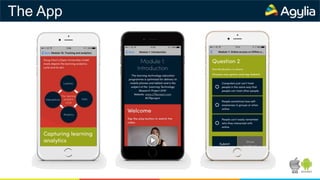
The App
Analytics
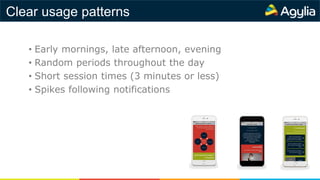
Clear usage patterns
• Early mornings, late afternoon, evening
• Random periods throughout the day
• Short session times (3 minutes or less)
• Spikes following notifications
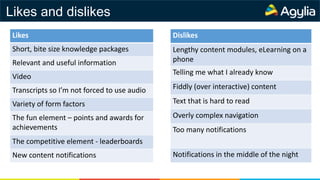
Likes
Short, bite size knowledge packages
Relevant and useful information
Video
Transcripts so I’m not forced to use audio
Variety of form factors
The fun element – points and awards for
achievements
The competitive element - leaderboards
New content notifications
Likes and dislikes
Dislikes
Lengthy content modules, eLearning on a
phone
Telling me what I already know
Fiddly (over interactive) content
Text that is hard to read
Overly complex navigation
Too many notifications
Notifications in the middle of the night
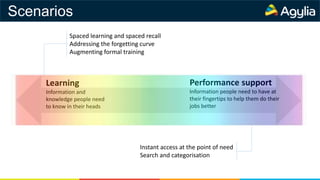
Learning
Information and
knowledge people need
to know in their heads
Performance support
Information people need to have at
their fingertips to help them do their
jobs better
Scenarios
Spaced learning and spaced recall
Addressing the forgetting curve
Augmenting formal training
Instant access at the point of need
Search and categorisation
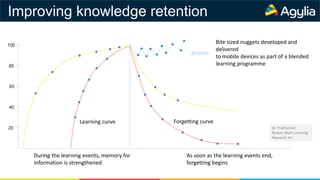
Improving knowledge retention
During the learning events, memory for
information is strengthened
As soon as the learning events end,
forgetting begins
Forgetting curve
W. Thalheimer,
Boston Work Learning
Research Inc
20
40
60
80
100
Learning curve
Bite sized nuggets developed and
delivered
to mobile devices as part of a blended
learning programme
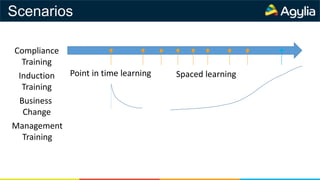
Scenarios
Compliance
Training
Point in time learning Spaced learningInduction
Training
Business
Change
Management
Training
• More than bite-size content served from
an LMS
• It sees content delivered in short bursts,
typically 1-5 minutes in duration
• Uses spaced learning and spaced retrieval
techniques to help embed knowledge in
long term memory
• It adapts continuously to an individual's
training needs based on their current
level of knowledge in a given domain
• Well suited to both long term knowledge
retention AND performance improvement
Microlearning
Benefits to the organisation
Can improve workforce performance
Cheaper to build
Easier to update
Shorter development cycles
Wider application
Meets millennial expectations
What are the benefits?
Benefits to the individual
More appealing than click-through eLearning
Can increase voluntary participation in
learning
Accessible anywhere – on all device types
Requires less time away from work
Available at the time of need (JIT)
Personalised for maximum benefit
How can we help ensure
continued engagement?
Make it relevant
• Build personalised, adaptive learning programmes
• Give people what they need to know
• Avoid unnecessary information
• Avoid telling people what they already know
• Move beyond the classic one size fits all style of training
• Becomes possible with focussed, granular content
• Requires a dynamic delivery platform
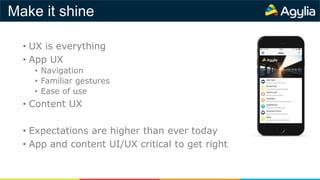
Make it shine
• UX is everything
• App UX
• Navigation
• Familiar gestures
• Ease of use
• Content UX
• Expectations are higher than ever today
• App and content UI/UX critical to get right
Make it fun
• Three types of gamification:
1. Simulation (e.g. pilot training simulators)
2. Game-based learning (i.e. video-type game)
3. Game mechanics (points, awards, levelling up, leaderboards)
• Microlearning lends itself to gamification techniques
• Reward people for proving their expertise
• Challenge and motivate people to move up leader boards
• Be seen as champions or experts in particular areas
Make it collaborative
• Enable connections:
• Do you have a question about the latest micro-asset?
• Something you don't understand?
• Who else has completed it recently?
• Who can I ask?
• Have you just reached an expert level having completed a
microlearning programme with flying colours?
• Then why not become a champion, be ready to help others
undergoing the same training programme to master the same skills
- and perhaps get rewarded for doing so
• Did you find the latest content useful?
• Like it
• Share / recommend it
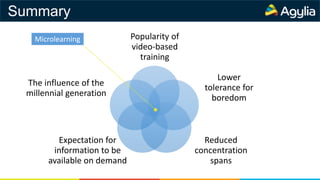
Popularity of
video-based
training
Lower
tolerance for
boredom
Reduced
concentration
spans
Expectation for
information to be
available on demand
The influence of the
millennial generation
Summary
Microlearning

Mobile learning myth busters

  • 2.
    Mobile learning :Myth busters Alex Mackman Technical Director, Agylia www.agylia.com
  • 3.
    Agenda • Research projectbackground • Common like and dislikes • Ideal scenarios for mobile learning technology • Microlearning • How to ensure continued engagement • Summary
  • 5.
  • 6.
  • 7.
    Clear usage patterns •Early mornings, late afternoon, evening • Random periods throughout the day • Short session times (3 minutes or less) • Spikes following notifications
  • 8.
    Likes Short, bite sizeknowledge packages Relevant and useful information Video Transcripts so I’m not forced to use audio Variety of form factors The fun element – points and awards for achievements The competitive element - leaderboards New content notifications Likes and dislikes Dislikes Lengthy content modules, eLearning on a phone Telling me what I already know Fiddly (over interactive) content Text that is hard to read Overly complex navigation Too many notifications Notifications in the middle of the night
  • 9.
    Learning Information and knowledge peopleneed to know in their heads Performance support Information people need to have at their fingertips to help them do their jobs better Scenarios Spaced learning and spaced recall Addressing the forgetting curve Augmenting formal training Instant access at the point of need Search and categorisation
  • 10.
    Improving knowledge retention Duringthe learning events, memory for information is strengthened As soon as the learning events end, forgetting begins Forgetting curve W. Thalheimer, Boston Work Learning Research Inc 20 40 60 80 100 Learning curve Bite sized nuggets developed and delivered to mobile devices as part of a blended learning programme
  • 11.
    Scenarios Compliance Training Point in timelearning Spaced learningInduction Training Business Change Management Training
  • 12.
    • More thanbite-size content served from an LMS • It sees content delivered in short bursts, typically 1-5 minutes in duration • Uses spaced learning and spaced retrieval techniques to help embed knowledge in long term memory • It adapts continuously to an individual's training needs based on their current level of knowledge in a given domain • Well suited to both long term knowledge retention AND performance improvement Microlearning
  • 13.
    Benefits to theorganisation Can improve workforce performance Cheaper to build Easier to update Shorter development cycles Wider application Meets millennial expectations What are the benefits? Benefits to the individual More appealing than click-through eLearning Can increase voluntary participation in learning Accessible anywhere – on all device types Requires less time away from work Available at the time of need (JIT) Personalised for maximum benefit
  • 14.
    How can wehelp ensure continued engagement?
  • 15.
    Make it relevant •Build personalised, adaptive learning programmes • Give people what they need to know • Avoid unnecessary information • Avoid telling people what they already know • Move beyond the classic one size fits all style of training • Becomes possible with focussed, granular content • Requires a dynamic delivery platform
  • 16.
    Make it shine •UX is everything • App UX • Navigation • Familiar gestures • Ease of use • Content UX • Expectations are higher than ever today • App and content UI/UX critical to get right
  • 17.
    Make it fun •Three types of gamification: 1. Simulation (e.g. pilot training simulators) 2. Game-based learning (i.e. video-type game) 3. Game mechanics (points, awards, levelling up, leaderboards) • Microlearning lends itself to gamification techniques • Reward people for proving their expertise • Challenge and motivate people to move up leader boards • Be seen as champions or experts in particular areas
  • 18.
    Make it collaborative •Enable connections: • Do you have a question about the latest micro-asset? • Something you don't understand? • Who else has completed it recently? • Who can I ask? • Have you just reached an expert level having completed a microlearning programme with flying colours? • Then why not become a champion, be ready to help others undergoing the same training programme to master the same skills - and perhaps get rewarded for doing so • Did you find the latest content useful? • Like it • Share / recommend it
  • 19.
    Popularity of video-based training Lower tolerance for boredom Reduced concentration spans Expectationfor information to be available on demand The influence of the millennial generation Summary Microlearning