NOTES
NOTES: 
Mobile AR, OOH and the Mirror World. 
I’m going to take these three things: 
Mobile Augmented Reality 
Out of Home Media Strategy 
Mirror World or 3D Mapping of the Real World 
...and bring them all together in a way that hopefully makes sense.
NOTES: 
And since we’re in the business track...
NOTES: 
I’m going to start off by 
talking about the management structure of Advertising Agencies: 
There it is — five holding companies.
NOTES: 
Each of these holding companies is structured in a similar way...
NOTES: 
They acquire ad-agencies to get control of their media dollars. 
Spin those off from each agency and roll them up into a giant media management arm 
that controls the media spending across all their agencies. 
Think bulk purchasing power and the leverage to push around the television networks.
NOTES: 
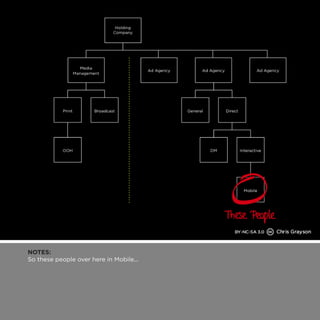
Mobile is developed as a sub-category of digital, 
within the Direct Marketing silo of the agency side.
NOTES: 
And then there are these people that actually have decades of experience in geo-targeted 
and location based media strategy... way over here. And never the twain shall meet. 
The reason the industry is structured this way is principally to the advantage of 
broadcast tv advertising. And as everyone in advertising knows... 
What’s good for broadcast is good for everyone! (sarcasm)
NOTES: 
So these people over here in Mobile...
NOTES: 
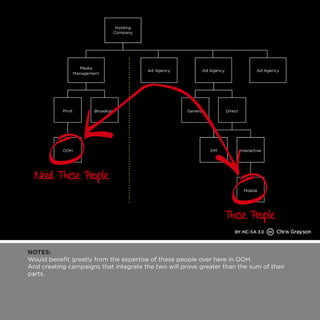
Would benefit greatly from the expertise of these people over here in OOH. 
And creating campaigns that integrate the two will prove greater than the sum of their 
parts.
NOTES: 
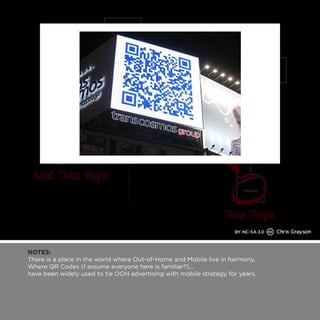
There is a place in the world where Out-of-Home and Mobile live in harmony. 
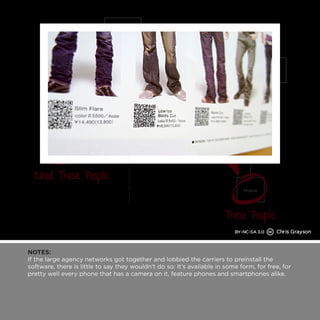
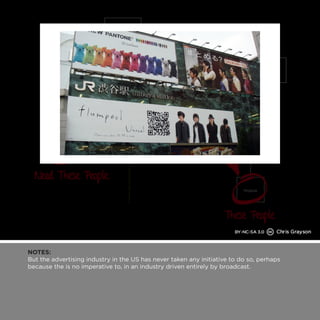
Where QR Codes (I assume everyone here is familiar?)... 
have been widely used to tie OOH advertising with mobile strategy for years.
NOTES: 
Why does this work in Japan, but not the US? 
There is a lot of speculation on the subject.
NOTES: 
Two most common conclusions: 
Blame it on the psyche of American phone users: It must be a cultural thing. 
Or Blame the Carriers for not pre-installing the software...
NOTES: 
I’m more incline to blame the structure of the advertising industry...
NOTES: 
If the large agency networks got together and lobbied the carriers to preinstall the 
software, there is little to say they wouldn’t do so: It’s available in some form, for free, for 
pretty well every phone that has a camera on it, feature phones and smartphones alike.
NOTES: 
But the advertising industry in the US has never taken any initiative to do so, perhaps 
because the is no imperative to, in an industry driven entirely by broadcast.
NOTES: 
So we have OOH... “Out of Home” advertising...
NOTES: 
And it’s cousin, Digital Out Of Home. 
Not only Out of Home, but Digital at that. 
These are people with a foot in both worlds, 
who will be most receptive to this convergence. 
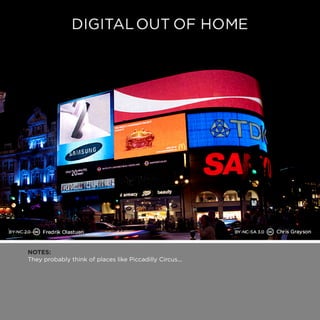
When most people think of DOOH...
NOTES: 
They probably think of places like Piccadilly Circus...
NOTES: 
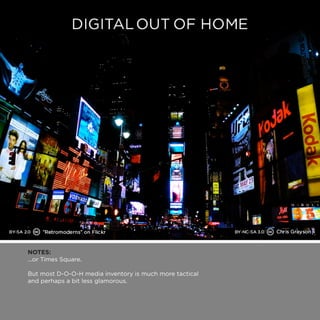
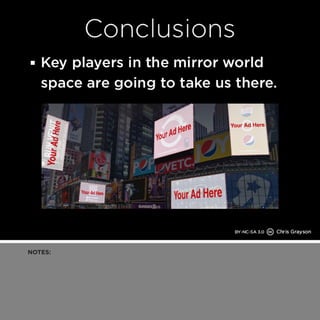
...or Times Square. 
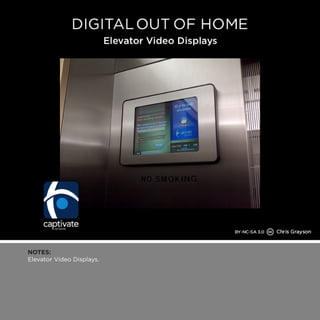
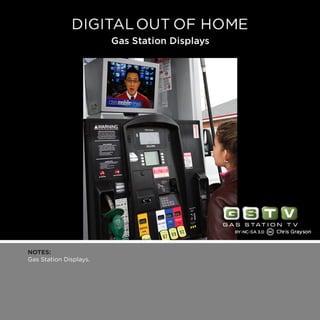
But most D-O-O-H media inventory is much more tactical 
and perhaps a bit less glamorous.
NOTES: 
Elevator Video Displays.
NOTES: 
Gas Station Displays.
NOTES: 
Checkout-Line Displays.
NOTES: 
ATM Displays. 
All place-based and context driven media... much like mobile.
NOTES: 
Now let’s have a look at that other component. 
Mirror Worlds.
NOTES: 
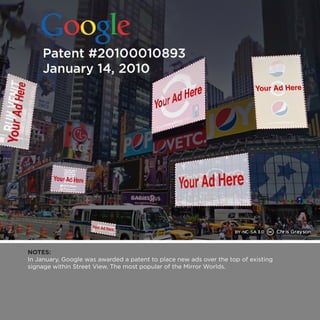
In January, Google was awarded a patent to place new ads over the top of existing 
signage within Street View. The most popular of the Mirror Worlds.
NOTES: 
Answer: 
Content for local or map-based search and mobile pull from the same databases. 
Mapping and wayfinding apps are among ther most popular mobile apps, 
this is especially true of AR. 
Lets have a look at some of the popular mobile AR apps to date.
NOTES: 
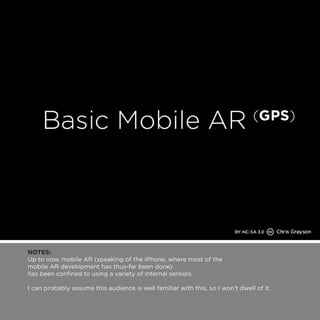
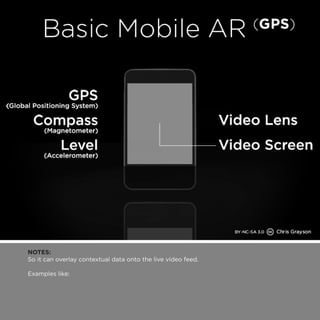
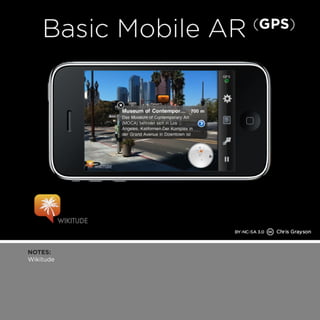
Up to now, mobile AR (speaking of the iPhone, where most of the 
mobile AR development has thus-far been done) 
has been confined to using a variety of internal sensors. 
I can probably assume this audience is well familiar with this, so I won’t dwell of it.
NOTES: 
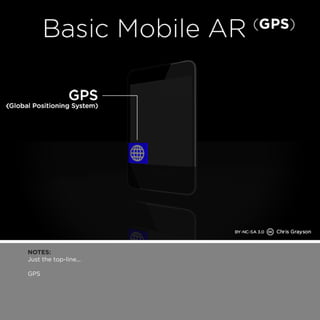
Just the top-line... 
GPS
NOTES: 
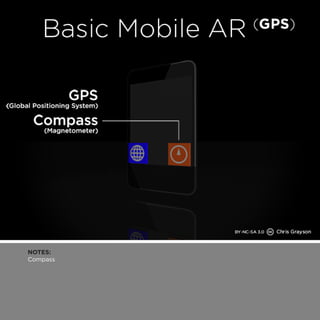
Compass
NOTES: 
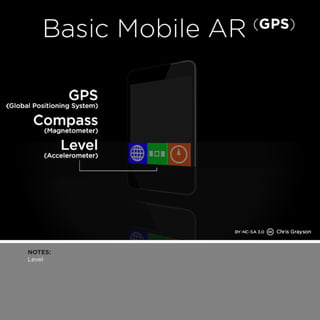
Level
NOTES: 
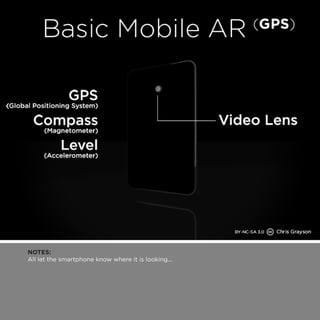
All let the smartphone know where it is looking...
NOTES: 
So it can overlay contextual data onto the live video feed. 
Examples like:
NOTES: 
The Layar Mobile AR Borwser.
NOTES: 
Wikitude
NOTES: 
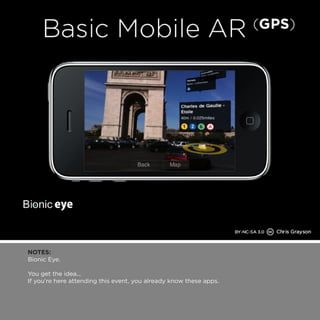
Bionic Eye. 
You get the idea... 
If you’re here attending this event, you already know these apps.
NOTES: 
But because they have no real understanding of their surroundings, 
they’re very limited in what they can do.
NOTES:
NOTES: 
With computer vision, the phone can do more than just overlay information onto the 
live video feed, it can analyze it in real time, and have a true geometric understanding of 
what is around it.
NOTES: 
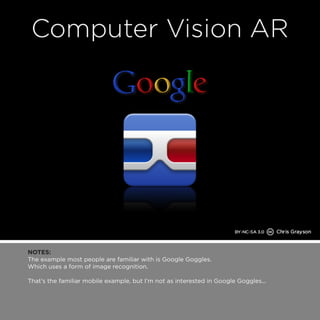
The example most people are familiar with is Google Goggles. 
Which uses a form of image recognition. 
That’s the familiar mobile example, but I’m not as interested in Google Goggles...
NOTES: 
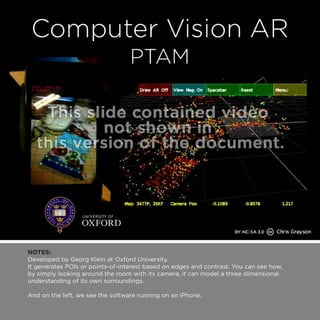
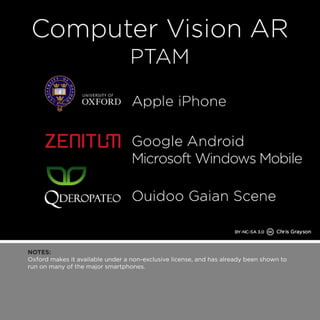
...I’m more interested in a technology called PTAM.
NOTES: 
Parallel Tracking And Mapping.
NOTES: 
Developed by Georg Klein at Oxford University. 
It generates POIs or points-of-interest based on edges and contrast. You can see how, 
by simply looking around the room with its camera, it can model a three dimensional 
understanding of its own surroundings. 
And on the left, we see the software running on an iPhone.
NOTES: 
Oxford makes it available under a non-exclusive license, and has already been shown to 
run on many of the major smartphones.
NOTES: 
When you combine Computer Vision AR with Mirror Worlds 
things start to get interesting.
NOTES: 
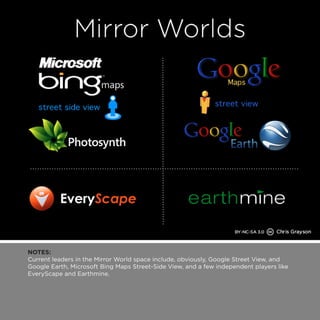
Current leaders in the Mirror World space include, obviously, Google Street View, and 
Google Earth, Microsoft Bing Maps Street-Side View, and a few independent players like 
EveryScape and Earthmine.
NOTES: 
This shows a Mirror World Point Cloud Model created at the University of Washington 
(Research lead by Noah Snavely and financed principally by Microsoft). This research 
was the foundation for what ultimately became Photosynth.
NOTES: 
With a Mirror World of major urban areas...
NOTES: 
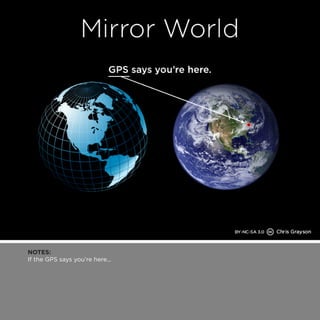
GPS can place your position in the real world, and consequently in the Mirror World...
NOTES: 
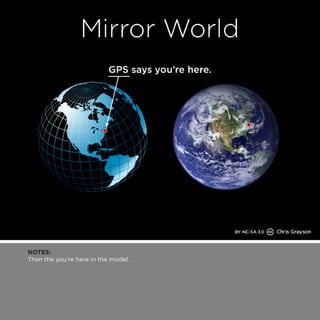
If the GPS says you’re here...
NOTES: 
Then the you’re here in the model.
NOTES: 
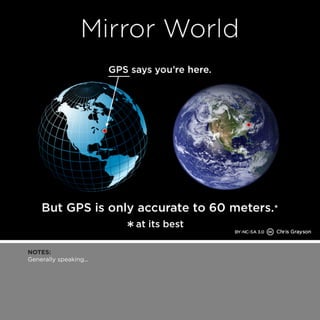
Generally speaking...
NOTES:
NOTES: 
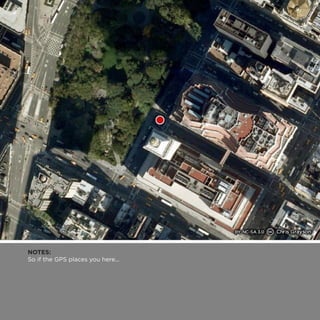
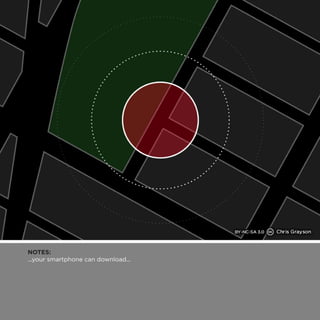
So if the GPS places you here...
NOTES: 
...your smartphone can download...
NOTES: 
...download a model of your general area...
NOTES: 
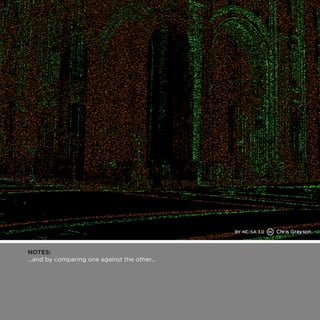
...while the camera, using PTAM or similar software generates a real time model of your 
actual suroundings, based on its actual view...
NOTES: 
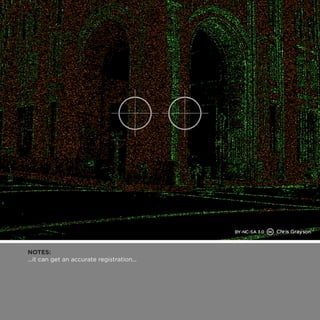
...and by comparing one against the other...
NOTES: 
...it can get an accurate registration...
NOTES: 
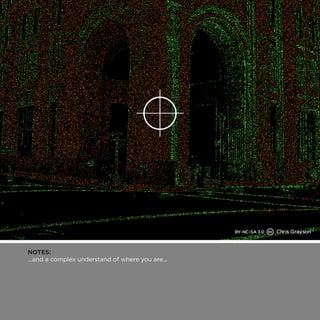
...and a complex understand of where you are...
NOTES:
NOTES:
NOTES: 
Which will allow for the accurate registration of virtual content into the real world, instead 
of the loose approximation of the apps we have now. And in the case of Apple, iPhone 
SDK4 allows analysis of the live video feed, making computer vision technically possible 
on iPhones within the month, so we can expect to see apps coming out later this year. 
The convergence of OOH and Mobile already exists, but computer vision mobile AR will 
accelerate this, as the illustration makes obvious.
NOTES: 
So let’s look at some numbers.
NOTES: 
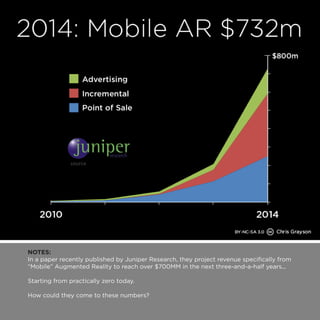
In a paper recently published by Juniper Research, they project revenue specifically from 
“Mobile” Augmented Reality to reach over $700MM in the next three-and-a-half years... 
Starting from practically zero today. 
How could they come to these numbers?
NOTES: 
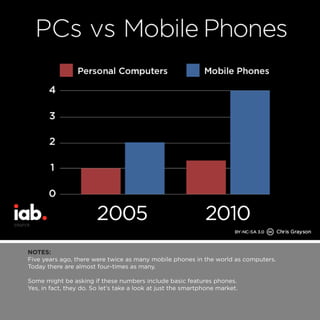
Five years ago, there were twice as many mobile phones in the world as computers. 
Today there are almost four-times as many. 

Some might be asking if these numbers include basic features phones. 
Yes, in fact, they do. So let’s take a look at just the smartphone market.
NOTES: 
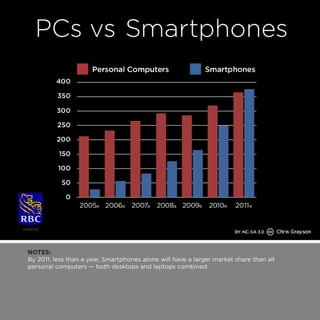
By 2011, less than a year, Smartphones alone will have a larger market share than all 
personal computers — both desktops and laptops combined.
NOTES: 
I had a difficult time finding good examples (any examples) of convergence between 
OOH and the Mobile AR space. I managed to find one, and an interesting example of 
non-AR mobile-plus-DOOH that went beyond QRCodes and Couponing. But first, I’m 
going to show an unexpected DOOH and AR convergence...
NOTES: 
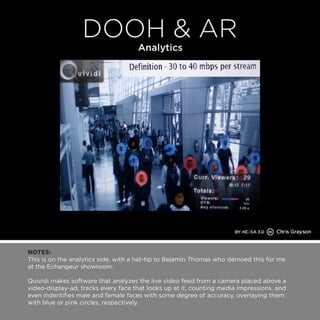
This is on the analytics side, with a hat-tip to Bejamin Thomas who demoed this for me 
at the Echangeur showroom. 
Quividi makes software that analyzes the live video feed from a camera placed above a 
video-display-ad, tracks every face that looks up at it, counting media impressions, and 
even indentifies male and female faces with some degree of accuracy, overlaying them 
with blue or pink circles, respectively.
NOTES: 
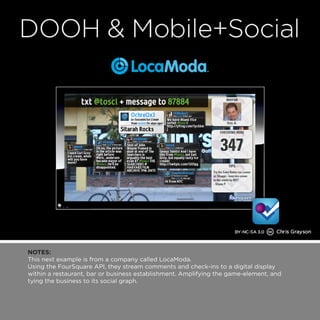
This next example is from a company called LocaModa. 
Using the FourSquare API, they stream comments and check-ins to a digital display 
within a restaurant, bar or business establishment. Amplifying the game-element, and 
tying the business to its social graph.
NOTES: 
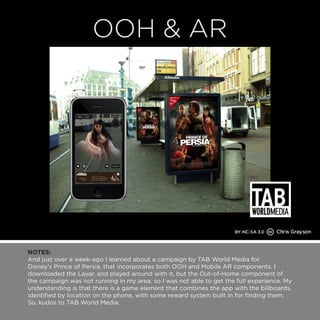
And just over a week-ago I learned about a campaign by TAB World Media for 
Disney’s Prince of Persia, that incorporates both OOH and Mobile AR components. I 
downloaded the Layar, and played around with it, but the Out-of-Home component of 
the campaign was not running in my area, so I was not able to get the full experience. My 
understanding is that there is a game element that combines the app with the billboards, 
identified by location on the phone, with some reward system built in for finding them. 
So, kudos to TAB World Media.
NOTES:
NOTES:
NOTES:
NOTES:
NOTES:
NOTES: 
And I’ll close with one more related food-for-thought...
NOTES: 
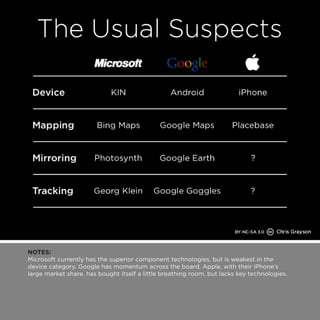
Microsoft currently has the superior component technologies, but is weakest in the 
device category. Google has momentum across the board. Apple, with their iPhone’s 
large market share, has bought itself a little breathing room, but lacks key technologies.
You are free to use assets from this presentation under the terms of the 
Creative Commons license: 
Attribution: Chris Grayson must be credited. 
Noncommercial: Don’t use it in an advertisement. 
Share Alike: Anything you make that incorporates any of these assets must also be 
available for others to use under Creative Commons license. 
Some content, such as company logos (including the GigantiCo logo) are NOT available with the 
Creative Commons license and are the property of their respective owners.

Mobile AR, OOH and the Mirror World

  • 1.
  • 2.
    NOTES: Mobile AR,OOH and the Mirror World. I’m going to take these three things: Mobile Augmented Reality Out of Home Media Strategy Mirror World or 3D Mapping of the Real World ...and bring them all together in a way that hopefully makes sense.
  • 3.
    NOTES: And sincewe’re in the business track...
  • 4.
    NOTES: I’m goingto start off by talking about the management structure of Advertising Agencies: There it is — five holding companies.
  • 5.
    NOTES: Each ofthese holding companies is structured in a similar way...
  • 6.
    NOTES: They acquiread-agencies to get control of their media dollars. Spin those off from each agency and roll them up into a giant media management arm that controls the media spending across all their agencies. Think bulk purchasing power and the leverage to push around the television networks.
  • 7.
    NOTES: Mobile isdeveloped as a sub-category of digital, within the Direct Marketing silo of the agency side.
  • 8.
    NOTES: And thenthere are these people that actually have decades of experience in geo-targeted and location based media strategy... way over here. And never the twain shall meet. The reason the industry is structured this way is principally to the advantage of broadcast tv advertising. And as everyone in advertising knows... What’s good for broadcast is good for everyone! (sarcasm)
  • 9.
    NOTES: So thesepeople over here in Mobile...
  • 10.
    NOTES: Would benefitgreatly from the expertise of these people over here in OOH. And creating campaigns that integrate the two will prove greater than the sum of their parts.
  • 11.
    NOTES: There isa place in the world where Out-of-Home and Mobile live in harmony. Where QR Codes (I assume everyone here is familiar?)... have been widely used to tie OOH advertising with mobile strategy for years.
  • 12.
    NOTES: Why doesthis work in Japan, but not the US? There is a lot of speculation on the subject.
  • 13.
    NOTES: Two mostcommon conclusions: Blame it on the psyche of American phone users: It must be a cultural thing. Or Blame the Carriers for not pre-installing the software...
  • 14.
    NOTES: I’m moreincline to blame the structure of the advertising industry...
  • 15.
    NOTES: If thelarge agency networks got together and lobbied the carriers to preinstall the software, there is little to say they wouldn’t do so: It’s available in some form, for free, for pretty well every phone that has a camera on it, feature phones and smartphones alike.
  • 16.
    NOTES: But theadvertising industry in the US has never taken any initiative to do so, perhaps because the is no imperative to, in an industry driven entirely by broadcast.
  • 17.
    NOTES: So wehave OOH... “Out of Home” advertising...
  • 18.
    NOTES: And it’scousin, Digital Out Of Home. Not only Out of Home, but Digital at that. These are people with a foot in both worlds, who will be most receptive to this convergence. When most people think of DOOH...
  • 19.
    NOTES: They probablythink of places like Piccadilly Circus...
  • 20.
    NOTES: ...or TimesSquare. But most D-O-O-H media inventory is much more tactical and perhaps a bit less glamorous.
  • 21.
  • 22.
  • 23.
  • 24.
    NOTES: ATM Displays. All place-based and context driven media... much like mobile.
  • 25.
    NOTES: Now let’shave a look at that other component. Mirror Worlds.
  • 26.
    NOTES: In January,Google was awarded a patent to place new ads over the top of existing signage within Street View. The most popular of the Mirror Worlds.
  • 27.
    NOTES: Answer: Contentfor local or map-based search and mobile pull from the same databases. Mapping and wayfinding apps are among ther most popular mobile apps, this is especially true of AR. Lets have a look at some of the popular mobile AR apps to date.
  • 28.
    NOTES: Up tonow, mobile AR (speaking of the iPhone, where most of the mobile AR development has thus-far been done) has been confined to using a variety of internal sensors. I can probably assume this audience is well familiar with this, so I won’t dwell of it.
  • 29.
    NOTES: Just thetop-line... GPS
  • 30.
  • 31.
  • 32.
    NOTES: All letthe smartphone know where it is looking...
  • 33.
    NOTES: So itcan overlay contextual data onto the live video feed. Examples like:
  • 34.
    NOTES: The LayarMobile AR Borwser.
  • 35.
  • 36.
    NOTES: Bionic Eye. You get the idea... If you’re here attending this event, you already know these apps.
  • 37.
    NOTES: But becausethey have no real understanding of their surroundings, they’re very limited in what they can do.
  • 38.
  • 39.
    NOTES: With computervision, the phone can do more than just overlay information onto the live video feed, it can analyze it in real time, and have a true geometric understanding of what is around it.
  • 40.
    NOTES: The examplemost people are familiar with is Google Goggles. Which uses a form of image recognition. That’s the familiar mobile example, but I’m not as interested in Google Goggles...
  • 41.
    NOTES: ...I’m moreinterested in a technology called PTAM.
  • 42.
  • 43.
    NOTES: Developed byGeorg Klein at Oxford University. It generates POIs or points-of-interest based on edges and contrast. You can see how, by simply looking around the room with its camera, it can model a three dimensional understanding of its own surroundings. And on the left, we see the software running on an iPhone.
  • 44.
    NOTES: Oxford makesit available under a non-exclusive license, and has already been shown to run on many of the major smartphones.
  • 45.
    NOTES: When youcombine Computer Vision AR with Mirror Worlds things start to get interesting.
  • 46.
    NOTES: Current leadersin the Mirror World space include, obviously, Google Street View, and Google Earth, Microsoft Bing Maps Street-Side View, and a few independent players like EveryScape and Earthmine.
  • 47.
    NOTES: This showsa Mirror World Point Cloud Model created at the University of Washington (Research lead by Noah Snavely and financed principally by Microsoft). This research was the foundation for what ultimately became Photosynth.
  • 48.
    NOTES: With aMirror World of major urban areas...
  • 49.
    NOTES: GPS canplace your position in the real world, and consequently in the Mirror World...
  • 50.
    NOTES: If theGPS says you’re here...
  • 51.
    NOTES: Then theyou’re here in the model.
  • 52.
  • 53.
  • 54.
    NOTES: So ifthe GPS places you here...
  • 55.
  • 56.
    NOTES: ...download amodel of your general area...
  • 57.
    NOTES: ...while thecamera, using PTAM or similar software generates a real time model of your actual suroundings, based on its actual view...
  • 58.
    NOTES: ...and bycomparing one against the other...
  • 59.
    NOTES: ...it canget an accurate registration...
  • 60.
    NOTES: ...and acomplex understand of where you are...
  • 61.
  • 62.
  • 63.
    NOTES: Which willallow for the accurate registration of virtual content into the real world, instead of the loose approximation of the apps we have now. And in the case of Apple, iPhone SDK4 allows analysis of the live video feed, making computer vision technically possible on iPhones within the month, so we can expect to see apps coming out later this year. The convergence of OOH and Mobile already exists, but computer vision mobile AR will accelerate this, as the illustration makes obvious.
  • 64.
    NOTES: So let’slook at some numbers.
  • 65.
    NOTES: In apaper recently published by Juniper Research, they project revenue specifically from “Mobile” Augmented Reality to reach over $700MM in the next three-and-a-half years... Starting from practically zero today. How could they come to these numbers?
  • 66.
    NOTES: Five yearsago, there were twice as many mobile phones in the world as computers. Today there are almost four-times as many. Some might be asking if these numbers include basic features phones. Yes, in fact, they do. So let’s take a look at just the smartphone market.


  • 67.
    NOTES: By 2011,less than a year, Smartphones alone will have a larger market share than all personal computers — both desktops and laptops combined.
  • 68.
    NOTES: I hada difficult time finding good examples (any examples) of convergence between OOH and the Mobile AR space. I managed to find one, and an interesting example of non-AR mobile-plus-DOOH that went beyond QRCodes and Couponing. But first, I’m going to show an unexpected DOOH and AR convergence...
  • 69.
    NOTES: This ison the analytics side, with a hat-tip to Bejamin Thomas who demoed this for me at the Echangeur showroom. Quividi makes software that analyzes the live video feed from a camera placed above a video-display-ad, tracks every face that looks up at it, counting media impressions, and even indentifies male and female faces with some degree of accuracy, overlaying them with blue or pink circles, respectively.
  • 70.
    NOTES: This nextexample is from a company called LocaModa. Using the FourSquare API, they stream comments and check-ins to a digital display within a restaurant, bar or business establishment. Amplifying the game-element, and tying the business to its social graph.
  • 71.
    NOTES: And justover a week-ago I learned about a campaign by TAB World Media for Disney’s Prince of Persia, that incorporates both OOH and Mobile AR components. I downloaded the Layar, and played around with it, but the Out-of-Home component of the campaign was not running in my area, so I was not able to get the full experience. My understanding is that there is a game element that combines the app with the billboards, identified by location on the phone, with some reward system built in for finding them. So, kudos to TAB World Media.
  • 72.
  • 73.
  • 74.
  • 75.
  • 76.
  • 77.
    NOTES: And I’llclose with one more related food-for-thought...
  • 78.
    NOTES: Microsoft currentlyhas the superior component technologies, but is weakest in the device category. Google has momentum across the board. Apple, with their iPhone’s large market share, has bought itself a little breathing room, but lacks key technologies.
  • 79.
    You are freeto use assets from this presentation under the terms of the Creative Commons license: Attribution: Chris Grayson must be credited. Noncommercial: Don’t use it in an advertisement. Share Alike: Anything you make that incorporates any of these assets must also be available for others to use under Creative Commons license. Some content, such as company logos (including the GigantiCo logo) are NOT available with the Creative Commons license and are the property of their respective owners.