Mnemonics for Week 4


Rib costal groove: order of intercostal blood vessels and nerves
VAN (from superior to inferior)
Vein
Artery
Nerve

Diaphragm innervation
“C3, 4, 5 keep the diaphragm alive”
Diaphragm innervation is by cervical roots 3, 4, and 5 (phrenic nerve)

Lingula location:
LingULa Left Upper Lobe

Lung lobe numbers/Heart AV valves: right vs. left
Right side: Tricuspid heart valve and tri-lobed lung
Left side: Bicuspid heart valve and bi-lobed lung


Atrioventricular (AV) valves:
LAB RAT
Left Atrium: Bicuspid valve
Right Atrium: Tricuspid

Semilunar valve cusps: Aortic and pulmonary
Both of them have a right and left cusp, but one has an anterior cusp and one has a posterior
cusp
Pulmonary trunk is anterior to the Aorta It has the anterior cusp (right, left and anterior
cusps)
Aorta is posterior to the pulmonary trunk It has the posterior cusp (right, left and posterior
cusps)


Aortic Arch: major branch order
Know your ABC’S:
Aortic arch gives rise to:
Brachiocephalic trunk
Left Common Carotid artery
Left Subclavian artery
 Beware of the trick question of “What is the first branch of the aorta?” Technically, it’s
       the coronary arteries.
Coronary circulation: arteries and associated veins
Small Margin:
Small vein and Marginal artery
Middle schoolers show Public Display of Affection (PDA):
Middle Vein and Posterior Descending Artery
Great LAD:
Great vein and Left Anterior Descending artery
CC’s:
Coronary sinus and Left Circumflex artery


Main Bronchi: which one is more vertical?
“Inhale a bite, it goes down the right”
     Inhaled objects are more likely to lodge into the right main bronchus, since it is the one
       that is more vertical.


                                     Mnemonics for Week 5

This is actually a mnemonic from last week’s material. But this was in the textbook, First Aid for
USMLE 2007 under the respiratory section. So I thought it was worth mentioning:
Pulmonary artery location on each lung, in relation to the bronchi.
RALS
 Right lung the pulmonary artery will be Anterior to the main bronchi.
Left lung the pulmonary artery is located Superior to the main bronchi.
Remember the bronchi have cartilage so they should be easy to identify.


Diaphragm apertures: spinal levels
“I 8 10 Eggs At 12” (read this as “I ate ten eggs at twelve” if it doesn’t look right to you)
Interior Vena Cava T8
T10 Esophagus
Aorta  T12


Posterior mediastinum contents:
DATES
Descending aorta
Azygous and hemiazygous vein
Thoracic duct
Esophagus
Sympathetic trunk/ganglia
External carotid artery branches
“Some Angry Lady Figured Out PMS”
Superior thyroid artery
Ascending Pharyngeal artery
Lingual artery
Facial artery
Occipital artery
Posterior auricular artery
Maxillary artery
 Superficial Temporal artery
     Alternative: As Steve Lay Frozen Olive Palpated Some More


Tetralogy of Fallot- 4 findings
“PROVE”
Pulmonary trunk stenosis
Right ventricular hypertrophy
Overriding aorta
VSD


                                  Mnemonics for Week 6

Branches of the Facial Nerve (after stylomastoid foramen)
"Tell Ziggy Bob Marley Called"        Tell Zac Blunts May Confuse
· From superior to inferior:
Temporal branch
Zygomatic branch
Buccal branch
Mandibular branch
Cervical branch
· Alternatively: "To Zanzibar By Motor Car".
· Alternatively: “Ten Zebras Bit My Cheek”
· Alternatively: "Two Zulus Bit My Cat"
· Alternatively: "Two Zebras Bit My Coccyx"
· Alternatively: "Tall Zulus Bear Many Children"
· Alternatively: "Two Zombies Buggered My Cat"
The motor branches of the facial nerve go through the parotid gland


V3: Sensory Branches
BAIL
Buccal
Auriculotemporal
Inferior alveolar
Lingual


Face muscles: large muscle groups’ cranial innervation
Mandibular nerve (CN V3): Mastication.
Facial nerve (CN VII): Facial expression.

Foramen spinosum: location on base of skull
Foramen spinosum is adjacent to the spine of sphenoid.

Scalp nerve supply
GLASS:
Greater occipital/ Greater auricular
Lesser occipital
Auriculotemporal
Supratrochlear
Supraorbital


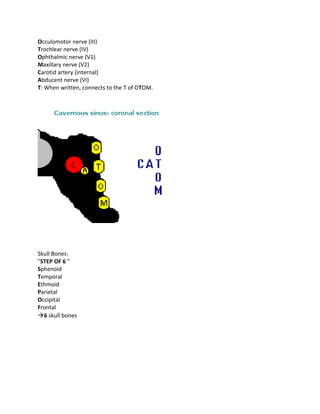
Cavernosum sinus contents
O TOM CAT:
O TOM are lateral wall components, in order from superior to inferior.
CA are the components within the sinus, from medial to lateral. CA ends at the level of T from O
TOM.
· See diagram.
Occulomotor nerve (III)
Trochlear nerve (IV)
Ophthalmic nerve (V1)
Maxillary nerve (V2)
Carotid artery (internal)
Abducent nerve (VI)
T: When written, connects to the T of OTOM.


Skull Bones:
"STEP OF 6 "
Sphenoid
Temporal
Ethmoid
Parietal
Occipital
Frontal
6 skull bones
Mnemonics for Week 7

Orbit: bones of medial wall:
My Little Eye Sits in the orbit
Maxilla (frontal process)
Lacrimal
Ethmoid
Sphenoid (body)

Extraocular muscles cranial nerve innervation:
LR6SO4 rest 3
Lateral Rectus is 6th
Superior Oblique is 4th
Rest are all 3rd cranial nerve (CN III: oculomotor)


Extraocular muscles: movements
Obliques cause Lateral rotation (abduction) of eyeball
Actions of the oblique muscles are opposite to their name
Actions of the recti muscles are rightly fitting their name

Relationship of lingual nerve and submandibular duct
The duck lies over the lake
Submandibular duct is passes on top of the lingual nerve
(The lingual nerve courses laterally, inferiorly then medial to the submandibular duct.)

Mnemonics unit 2

  • 1.
    Mnemonics for Week4 Rib costal groove: order of intercostal blood vessels and nerves VAN (from superior to inferior) Vein Artery Nerve Diaphragm innervation “C3, 4, 5 keep the diaphragm alive” Diaphragm innervation is by cervical roots 3, 4, and 5 (phrenic nerve) Lingula location: LingULa Left Upper Lobe Lung lobe numbers/Heart AV valves: right vs. left Right side: Tricuspid heart valve and tri-lobed lung Left side: Bicuspid heart valve and bi-lobed lung Atrioventricular (AV) valves: LAB RAT Left Atrium: Bicuspid valve Right Atrium: Tricuspid Semilunar valve cusps: Aortic and pulmonary Both of them have a right and left cusp, but one has an anterior cusp and one has a posterior cusp Pulmonary trunk is anterior to the Aorta It has the anterior cusp (right, left and anterior cusps) Aorta is posterior to the pulmonary trunk It has the posterior cusp (right, left and posterior cusps) Aortic Arch: major branch order Know your ABC’S: Aortic arch gives rise to: Brachiocephalic trunk Left Common Carotid artery Left Subclavian artery
  • 2.
     Beware ofthe trick question of “What is the first branch of the aorta?” Technically, it’s the coronary arteries. Coronary circulation: arteries and associated veins Small Margin: Small vein and Marginal artery Middle schoolers show Public Display of Affection (PDA): Middle Vein and Posterior Descending Artery Great LAD: Great vein and Left Anterior Descending artery CC’s: Coronary sinus and Left Circumflex artery Main Bronchi: which one is more vertical? “Inhale a bite, it goes down the right”  Inhaled objects are more likely to lodge into the right main bronchus, since it is the one that is more vertical. Mnemonics for Week 5 This is actually a mnemonic from last week’s material. But this was in the textbook, First Aid for USMLE 2007 under the respiratory section. So I thought it was worth mentioning: Pulmonary artery location on each lung, in relation to the bronchi. RALS Right lung the pulmonary artery will be Anterior to the main bronchi. Left lung the pulmonary artery is located Superior to the main bronchi. Remember the bronchi have cartilage so they should be easy to identify. Diaphragm apertures: spinal levels “I 8 10 Eggs At 12” (read this as “I ate ten eggs at twelve” if it doesn’t look right to you) Interior Vena Cava T8 T10 Esophagus Aorta  T12 Posterior mediastinum contents: DATES Descending aorta Azygous and hemiazygous vein Thoracic duct Esophagus Sympathetic trunk/ganglia
  • 3.
    External carotid arterybranches “Some Angry Lady Figured Out PMS” Superior thyroid artery Ascending Pharyngeal artery Lingual artery Facial artery Occipital artery Posterior auricular artery Maxillary artery Superficial Temporal artery  Alternative: As Steve Lay Frozen Olive Palpated Some More Tetralogy of Fallot- 4 findings “PROVE” Pulmonary trunk stenosis Right ventricular hypertrophy Overriding aorta VSD Mnemonics for Week 6 Branches of the Facial Nerve (after stylomastoid foramen) "Tell Ziggy Bob Marley Called" Tell Zac Blunts May Confuse · From superior to inferior: Temporal branch
  • 4.
    Zygomatic branch Buccal branch Mandibularbranch Cervical branch · Alternatively: "To Zanzibar By Motor Car". · Alternatively: “Ten Zebras Bit My Cheek” · Alternatively: "Two Zulus Bit My Cat" · Alternatively: "Two Zebras Bit My Coccyx" · Alternatively: "Tall Zulus Bear Many Children" · Alternatively: "Two Zombies Buggered My Cat" The motor branches of the facial nerve go through the parotid gland V3: Sensory Branches BAIL Buccal Auriculotemporal Inferior alveolar Lingual Face muscles: large muscle groups’ cranial innervation Mandibular nerve (CN V3): Mastication. Facial nerve (CN VII): Facial expression. Foramen spinosum: location on base of skull Foramen spinosum is adjacent to the spine of sphenoid. Scalp nerve supply GLASS: Greater occipital/ Greater auricular Lesser occipital Auriculotemporal Supratrochlear Supraorbital Cavernosum sinus contents O TOM CAT: O TOM are lateral wall components, in order from superior to inferior. CA are the components within the sinus, from medial to lateral. CA ends at the level of T from O TOM. · See diagram.
  • 5.
    Occulomotor nerve (III) Trochlearnerve (IV) Ophthalmic nerve (V1) Maxillary nerve (V2) Carotid artery (internal) Abducent nerve (VI) T: When written, connects to the T of OTOM. Skull Bones: "STEP OF 6 " Sphenoid Temporal Ethmoid Parietal Occipital Frontal 6 skull bones
  • 6.
    Mnemonics for Week7 Orbit: bones of medial wall: My Little Eye Sits in the orbit Maxilla (frontal process) Lacrimal Ethmoid Sphenoid (body) Extraocular muscles cranial nerve innervation: LR6SO4 rest 3 Lateral Rectus is 6th Superior Oblique is 4th Rest are all 3rd cranial nerve (CN III: oculomotor) Extraocular muscles: movements Obliques cause Lateral rotation (abduction) of eyeball Actions of the oblique muscles are opposite to their name Actions of the recti muscles are rightly fitting their name Relationship of lingual nerve and submandibular duct The duck lies over the lake Submandibular duct is passes on top of the lingual nerve (The lingual nerve courses laterally, inferiorly then medial to the submandibular duct.)