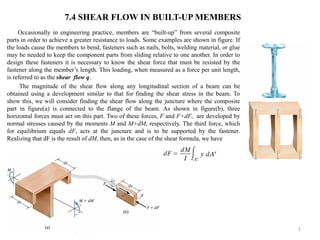
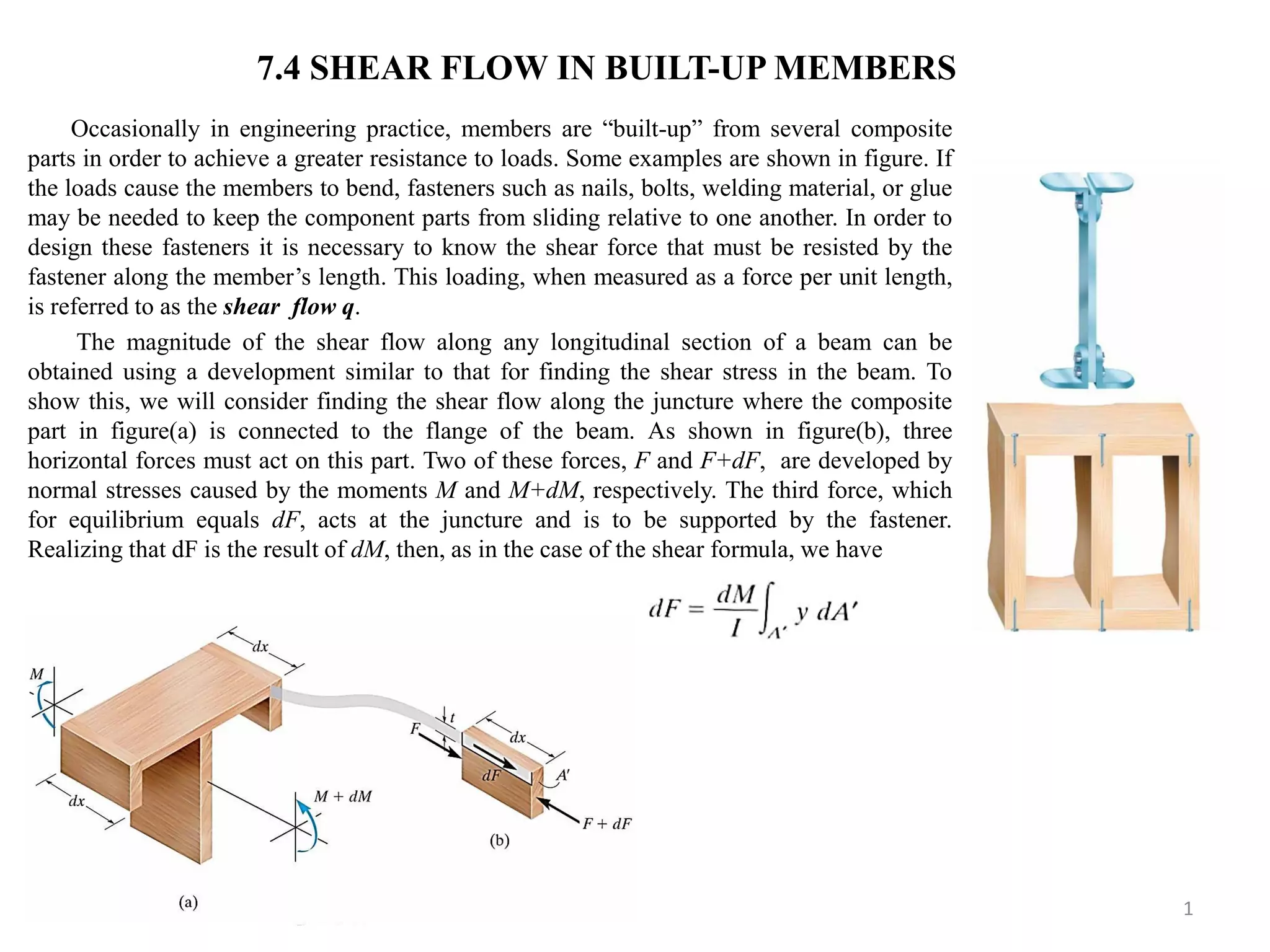
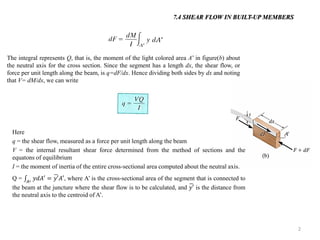
Occasionally in engineering practice, members are “built-up” from several composite parts in order to achieve a greater resistance to loads. Some examples are shown in figure. If the loads cause the members to bend, fasteners such as nails, bolts, welding material, or glue may be needed to keep the component parts from sliding relative to one another. In order to design these fasteners it is necessary to know the shear force that must be resisted by the fastener along the member’s length. This loading, when measured as a force per unit length, is referred to as the shear flow q. 
The magnitude of the shear flow along any longitudinal section of a beam can be obtained using a development similar to that for finding the shear stress in the beam. To show this, we will consider finding the shear flow along the juncture where the composite part in figure(a) is connected to the flange of the beam. As shown in figure(b), three horizontal forces must act on this part. Two of these forces, F and F+dF, are developed by normal stresses caused by the moments M and M+dM, respectively. The third force, which for equilibrium equals dF, acts at the juncture and is to be supported by the fastener. Realizing that dF is the result of dM, then, as in the case of the shear formula, we have 
1 
7.4 SHEAR FLOW IN BUILT-UP MEMBERS
2 
7.4 SHEAR FLOW IN BUILT-UP MEMBERS 
The integral represents Q, that is, the moment of the light colored area A’ in figure(b) about the neutral axis for the cross section. Since the segment has a length dx, the shear flow, or force per unit length along the beam, is q=dF/dx. Hence dividing both sides by dx and noting that V= dM/dx, we can write 
Here 
q = the shear flow, measured as a force per unit length along the beam 
V = the internal resultant shear force determined from the method of sections and the equatons of equilibrium 
I = the moment of inertia of the entire cross-sectional area computed about the neutral axis. 
Q = 푦푑퐴′퐴′=푦′ 퐴′, where A’ is the cross-sectional area of the segment that is connected to the beam at the juncture where the shear flow is to be calculated, and 푦′ is the distance from the neutral axis to the centroid of A’.
3 
7.4 SHEAR FLOW IN BUILT-UP MEMBERS 
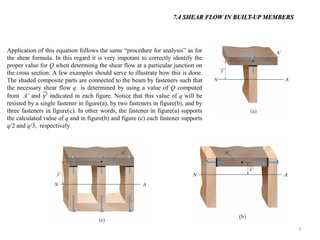
Application of this equation follows the same “procedure for analysis” as for the shear formula. In this regard it is very impotant to correctly identify the proper value for Q when determinig the shear flow at a particular junction on the cross section. A few examples should serve to illustrate how this is done. The shaded composite parts are connected to the beam by fasteners such that the necessary shear flow q is determined by using a value of Q computed from A’ and 푦′ indicated in each figure. Notice that this value of q will be resisted by a single fastener in figure(a), by two fasteners in figure(b), and by three fasteners in figure(c). In other words, the fastener in figure(a) supports the calculated value of q and in figure(b) and figure (c) each fastener supports q/2 and q/3, respectively.
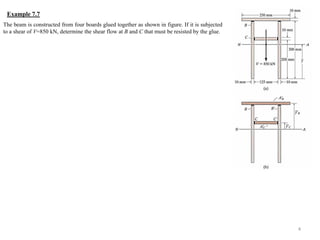
The beam is constructed from four boards glued together as shown in figure. If it is subjected to a shear of V=850 kN, determine the shear flow at B and C that must be resisted by the glue. 
4 
Example 7.7
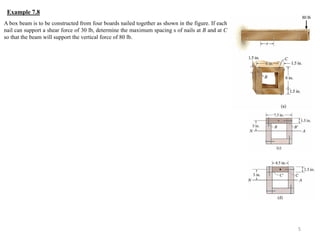
A box beam is to be constructed from four boards nailed together as shown in the figure. If each nail can support a shear force of 30 lb, determine the maximum spacing s of nails at B and at C so that the beam will support the vertical force of 80 lb. 
5 
Example 7.8
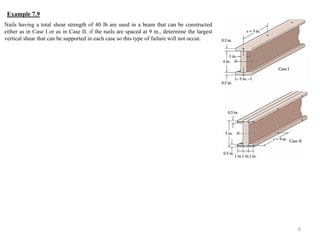
Nails having a total shear strength of 40 lb are used in a beam that can be constructed either as in Case I or as in Case II. ıf the nails are spaced at 9 in., determine the largest vertical shear that can be supported in each case so this type of failure will not occur. 
6 
Example 7.9

Mm210(7b)

  • 1.
    Occasionally in engineeringpractice, members are “built-up” from several composite parts in order to achieve a greater resistance to loads. Some examples are shown in figure. If the loads cause the members to bend, fasteners such as nails, bolts, welding material, or glue may be needed to keep the component parts from sliding relative to one another. In order to design these fasteners it is necessary to know the shear force that must be resisted by the fastener along the member’s length. This loading, when measured as a force per unit length, is referred to as the shear flow q. The magnitude of the shear flow along any longitudinal section of a beam can be obtained using a development similar to that for finding the shear stress in the beam. To show this, we will consider finding the shear flow along the juncture where the composite part in figure(a) is connected to the flange of the beam. As shown in figure(b), three horizontal forces must act on this part. Two of these forces, F and F+dF, are developed by normal stresses caused by the moments M and M+dM, respectively. The third force, which for equilibrium equals dF, acts at the juncture and is to be supported by the fastener. Realizing that dF is the result of dM, then, as in the case of the shear formula, we have 1 7.4 SHEAR FLOW IN BUILT-UP MEMBERS
  • 2.
    2 7.4 SHEARFLOW IN BUILT-UP MEMBERS The integral represents Q, that is, the moment of the light colored area A’ in figure(b) about the neutral axis for the cross section. Since the segment has a length dx, the shear flow, or force per unit length along the beam, is q=dF/dx. Hence dividing both sides by dx and noting that V= dM/dx, we can write Here q = the shear flow, measured as a force per unit length along the beam V = the internal resultant shear force determined from the method of sections and the equatons of equilibrium I = the moment of inertia of the entire cross-sectional area computed about the neutral axis. Q = 푦푑퐴′퐴′=푦′ 퐴′, where A’ is the cross-sectional area of the segment that is connected to the beam at the juncture where the shear flow is to be calculated, and 푦′ is the distance from the neutral axis to the centroid of A’.
  • 3.
    3 7.4 SHEARFLOW IN BUILT-UP MEMBERS Application of this equation follows the same “procedure for analysis” as for the shear formula. In this regard it is very impotant to correctly identify the proper value for Q when determinig the shear flow at a particular junction on the cross section. A few examples should serve to illustrate how this is done. The shaded composite parts are connected to the beam by fasteners such that the necessary shear flow q is determined by using a value of Q computed from A’ and 푦′ indicated in each figure. Notice that this value of q will be resisted by a single fastener in figure(a), by two fasteners in figure(b), and by three fasteners in figure(c). In other words, the fastener in figure(a) supports the calculated value of q and in figure(b) and figure (c) each fastener supports q/2 and q/3, respectively.
  • 4.
    The beam isconstructed from four boards glued together as shown in figure. If it is subjected to a shear of V=850 kN, determine the shear flow at B and C that must be resisted by the glue. 4 Example 7.7
  • 5.
    A box beamis to be constructed from four boards nailed together as shown in the figure. If each nail can support a shear force of 30 lb, determine the maximum spacing s of nails at B and at C so that the beam will support the vertical force of 80 lb. 5 Example 7.8
  • 6.
    Nails having atotal shear strength of 40 lb are used in a beam that can be constructed either as in Case I or as in Case II. ıf the nails are spaced at 9 in., determine the largest vertical shear that can be supported in each case so this type of failure will not occur. 6 Example 7.9