Managing
Marketing
Information to
Gain Customer
Insights
Part-1
 Marketing Information and Customer Insights
 Assessing Marketing Information Needs
 Developing Marketing Information
 Marketing Research
 Analyzing and Using Marketing Information
 Other Marketing Information Considerations
Topic Outline
 Fresh and deep insights into customers needs and wants
 Difficult to obtain
 Not obvious
 Customer’s unsure of their behavior
 Better information and more effective use of existing
information
Customer Insights are:
Marketing Information and
Customer Insights
 Companies are forming customer
insights teams
 Include all company
functional areas
 Collect information from a
wide variety of sources
 Use insights to create more
value for their customers
Customer Insights
Marketing Information and
Customer Insights
Marketing information system (MIS)
consists of people and procedures
for:
 Assessing the information needs
 Developing needed information
 Helping decision makers use the information for customer
Marketing Information Systems (MIS)
Marketing Information and
Customer Insights
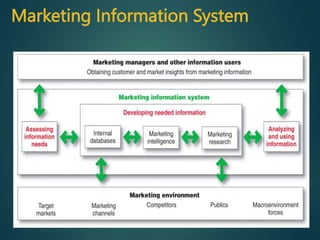
Marketing Information System
MIS provides information to the company’s marketing and other
managers and external partners such as suppliers, resellers, and
marketing service agencies
Assessing Marketing Information
Needs
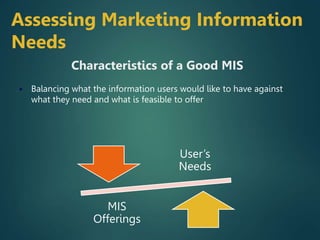
 Balancing what the information users would like to have against
what they need and what is feasible to offer
Characteristics of a Good MIS
Assessing Marketing Information
Needs
User’s
Needs
MIS
Offerings
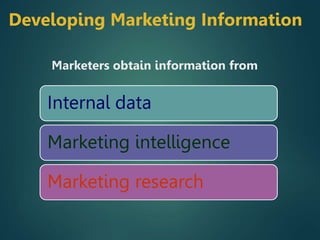
Internal data
Marketing intelligence
Marketing research
Marketers obtain information from
Developing Marketing Information
 Internal databases are electronic collections of consumer and
market information obtained from data sources within the
company network
Internal Data
Developing Marketing
Information
 Competitive Marketing Intelligence The systematic collection
and analysis
of publicly available information about consumers, competitors
and developments in the marketplace
Competitive Marketing Intelligence
Developing Marketing
Information
1- 12
Copyright © 2012 Pearson Education, Inc.
Publishing as Prentice Hall
What is Marketing Research?
Marketing research is the systematic design, collection, analysis, and
reporting of data and findings relevant to a specific marketing
situation facing the company.
1- 13
Copyright © 2012 Pearson Education, Inc.
Publishing as Prentice Hall
Types of Marketing Research Firms
 Syndicated service research firms
 Firms gather consumer & trade information, which they sell for a
fee e.g. ACNielsen, National Council For Applied Economic Research
(NCAER)
 Custom marketing research firms
 They design & carry out research studies for various clients based
on specific briefs.
 Specialty-line marketing research firms
 These firms provides specialized research services such as
developing a research brief, collecting field data, preparing data
analyses & reports for other firms.
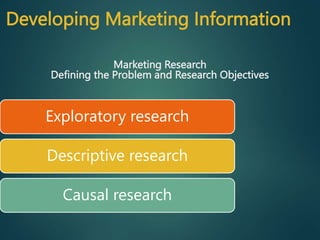
Developing Marketing Information
Marketing Research
Defining the Problem and Research Objectives
Exploratory research
Descriptive research
Causal research
1- 15
Copyright © 2012 Pearson Education, Inc.
Publishing as Prentice Hall
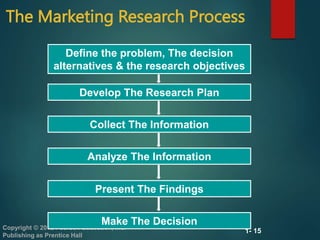
The Marketing Research Process
Develop The Research Plan
Define the problem, The decision
alternatives & the research objectives
Collect The Information
Make The Decision
Present The Findings
Analyze The Information
1- 16
Copyright © 2012 Pearson Education, Inc.
Publishing as Prentice Hall
Step 1: Define the Problem
 Define the problem
 Problem should not be too broad or too
narrow.
 Specify decision alternatives
 State research objectives
1- 17
Copyright © 2012 Pearson Education, Inc.
Publishing as Prentice Hall
Step 2: Develop the Research Plan
 Data sources
 Research approach
 Research instruments
 Sampling plan
 Contact methods
1- 18
Copyright © 2012 Pearson Education, Inc.
Publishing as Prentice Hall
Step 2: Develop the Research Plan
Secondary data consists of information that already exists somewhere,
having been collected for another purpose
Primary data consists of information gathered for the special research
plan
Data sources
Developing Marketing Information
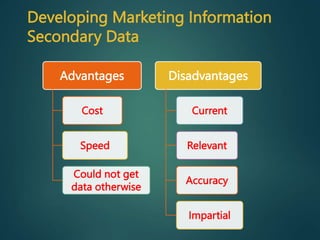
Secondary Data
Advantages
Cost
Speed
Could not get
data otherwise
Disadvantages
Current
Relevant
Accuracy
Impartial
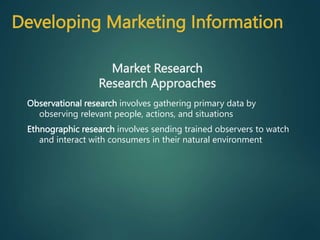
Observational research involves gathering primary data by
observing relevant people, actions, and situations
Ethnographic research involves sending trained observers to watch
and interact with consumers in their natural environment
Market Research
Research Approaches
Developing Marketing Information
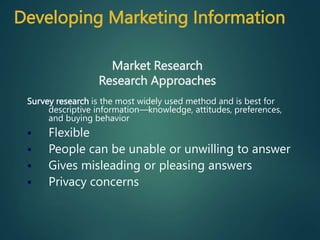
Survey research is the most widely used method and is best for
descriptive information—knowledge, attitudes, preferences,
and buying behavior
 Flexible
 People can be unable or unwilling to answer
 Gives misleading or pleasing answers
 Privacy concerns
Market Research
Research Approaches
Developing Marketing Information
Experimental research is best for gathering causal information—
cause-and-effect relationships
Market Research
Research Approaches
Developing Marketing Information
Sample is a segment of the population selected for marketing
research to represent the population as a whole
 Who is to be studied?
 How many people should be studied?
 How should the people be chosen?
Marketing Research
Sampling Plan
Developing Marketing Information
1- 24
Copyright © 2012 Pearson Education, Inc.
Publishing as Prentice Hall
Step 2: Develop the Research Plan…
 Research instruments
 Questionnaires
 Qualitative Measures
 Technological Devices
Developing Marketing Information
Marketing Research
Research Instruments
Questionnaires
• Most common
• Administered in person, by phone,
or online
• Flexible
• Research must be careful with
wording and ordering of questions
1- 26
Copyright © 2012 Pearson Education, Inc.
Publishing as Prentice Hall
Questionnaire Do’s and Don’ts
 Ensure questions are free of bias
 Make questions simple
 Make questions specific
 Avoid jargon
 Avoid sophisticated words
 Avoid ambiguous words
 Avoid negatives
 Avoid hypothetical's
 Avoid words that could be
misheard
 Use response bands
 Use mutually exclusive categories
 Allow for “other” in fixed response
questions
1- 27
Copyright © 2012 Pearson Education, Inc.
Publishing as Prentice Hall
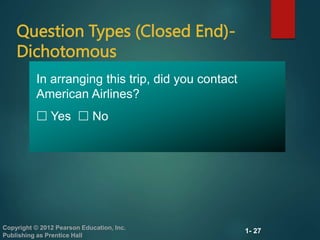
Question Types (Closed End)-
Dichotomous
In arranging this trip, did you contact
American Airlines?
 Yes  No
1- 28
Copyright © 2012 Pearson Education, Inc.
Publishing as Prentice Hall
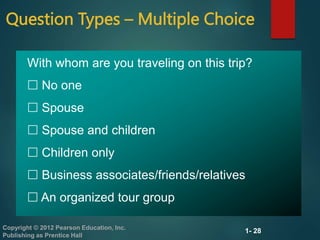
Question Types – Multiple Choice
With whom are you traveling on this trip?
 No one
 Spouse
 Spouse and children
 Children only
 Business associates/friends/relatives
 An organized tour group
1- 29
Copyright © 2012 Pearson Education, Inc.
Publishing as Prentice Hall
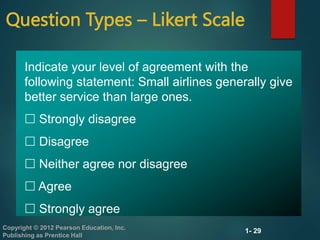
Question Types – Likert Scale
Indicate your level of agreement with the
following statement: Small airlines generally give
better service than large ones.
 Strongly disagree
 Disagree
 Neither agree nor disagree
 Agree
 Strongly agree
1- 30
Copyright © 2012 Pearson Education, Inc.
Publishing as Prentice Hall
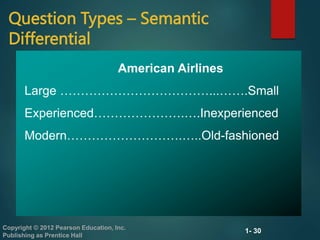
Question Types – Semantic
Differential
American Airlines
Large ………………………………...…….Small
Experienced………………….….Inexperienced
Modern……………………….…..Old-fashioned
1- 31
Copyright © 2012 Pearson Education, Inc.
Publishing as Prentice Hall
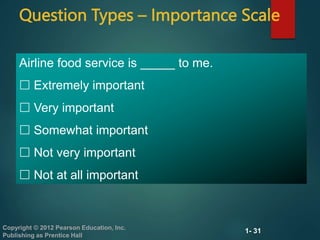
Question Types – Importance Scale
Airline food service is _____ to me.
 Extremely important
 Very important
 Somewhat important
 Not very important
 Not at all important
1- 32
Copyright © 2012 Pearson Education, Inc.
Publishing as Prentice Hall
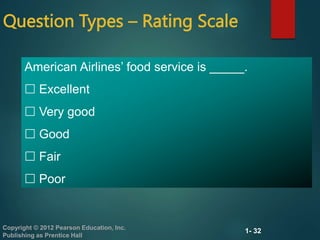
Question Types – Rating Scale
American Airlines’ food service is _____.
 Excellent
 Very good
 Good
 Fair
 Poor
1- 33
Copyright © 2012 Pearson Education, Inc.
Publishing as Prentice Hall
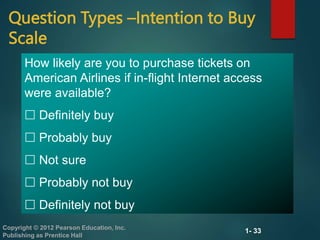
Question Types –Intention to Buy
Scale
How likely are you to purchase tickets on
American Airlines if in-flight Internet access
were available?
 Definitely buy
 Probably buy
 Not sure
 Probably not buy
 Definitely not buy
1- 34
Copyright © 2012 Pearson Education, Inc.
Publishing as Prentice Hall
Question Types (Open End)-
Completely Unstructured
What is your opinion of American Airlines?
1- 35
Copyright © 2012 Pearson Education, Inc.
Publishing as Prentice Hall
Question Types –Word Association
What is the first word that comes to your mind
when you hear the following?
Airline ________________________
American _____________________
Travel ________________________
1- 36
Copyright © 2012 Pearson Education, Inc.
Publishing as Prentice Hall
Question Types – Sentence
Completion
When I choose an airline, the most important
consideration in my decision is:
_____________________________________
_____________________________________
_____________________________________
_____________________________________
_____________________________________
_____________________________________
__________________.
1- 37
Copyright © 2012 Pearson Education, Inc.
Publishing as Prentice Hall
Question Types –Story Completion
“I flew American a few days ago. I noticed that
the exterior and interior of the plane had very
bright colors. This aroused in me the following
thoughts and feelings.” Now complete the story.
_______________________________________
_______________________________________
_______________________________________
_______________________________________
_______________________________________
_______________________________________
1- 38
Copyright © 2012 Pearson Education, Inc.
Publishing as Prentice Hall
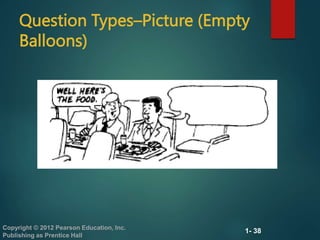
Question Types–Picture (Empty
Balloons)
Bibliography
 Principles of Marketing by Philip Kotler & Gary Armstrong
Fifteenth Edition, Published by Prentice Hall
 Marketing Management – A South Asian Perspective
by Philip Kotler, Kevin Lane Keller, Abraham Koshy &
Mithileshwar Jha, 13th Edition, Published by Pearson
Education, Inc.
 Principles and Practices of Marketing by Jobber, D. 4th
edition, McGraw Hill International.
 Principles of Advertising & IMC by Tom Duncan 2nd
Edition, Published by McGraw-Hill Irwin.

FOM-Lecture-6.pptx

  • 1.
  • 2.
     Marketing Informationand Customer Insights  Assessing Marketing Information Needs  Developing Marketing Information  Marketing Research  Analyzing and Using Marketing Information  Other Marketing Information Considerations Topic Outline
  • 3.
     Fresh anddeep insights into customers needs and wants  Difficult to obtain  Not obvious  Customer’s unsure of their behavior  Better information and more effective use of existing information Customer Insights are: Marketing Information and Customer Insights
  • 4.
     Companies areforming customer insights teams  Include all company functional areas  Collect information from a wide variety of sources  Use insights to create more value for their customers Customer Insights Marketing Information and Customer Insights
  • 5.
    Marketing information system(MIS) consists of people and procedures for:  Assessing the information needs  Developing needed information  Helping decision makers use the information for customer Marketing Information Systems (MIS) Marketing Information and Customer Insights
  • 6.
  • 7.
    MIS provides informationto the company’s marketing and other managers and external partners such as suppliers, resellers, and marketing service agencies Assessing Marketing Information Needs
  • 8.
     Balancing whatthe information users would like to have against what they need and what is feasible to offer Characteristics of a Good MIS Assessing Marketing Information Needs User’s Needs MIS Offerings
  • 9.
    Internal data Marketing intelligence Marketingresearch Marketers obtain information from Developing Marketing Information
  • 10.
     Internal databasesare electronic collections of consumer and market information obtained from data sources within the company network Internal Data Developing Marketing Information
  • 11.
     Competitive MarketingIntelligence The systematic collection and analysis of publicly available information about consumers, competitors and developments in the marketplace Competitive Marketing Intelligence Developing Marketing Information
  • 12.
    1- 12 Copyright ©2012 Pearson Education, Inc. Publishing as Prentice Hall What is Marketing Research? Marketing research is the systematic design, collection, analysis, and reporting of data and findings relevant to a specific marketing situation facing the company.
  • 13.
    1- 13 Copyright ©2012 Pearson Education, Inc. Publishing as Prentice Hall Types of Marketing Research Firms  Syndicated service research firms  Firms gather consumer & trade information, which they sell for a fee e.g. ACNielsen, National Council For Applied Economic Research (NCAER)  Custom marketing research firms  They design & carry out research studies for various clients based on specific briefs.  Specialty-line marketing research firms  These firms provides specialized research services such as developing a research brief, collecting field data, preparing data analyses & reports for other firms.
  • 14.
    Developing Marketing Information MarketingResearch Defining the Problem and Research Objectives Exploratory research Descriptive research Causal research
  • 15.
    1- 15 Copyright ©2012 Pearson Education, Inc. Publishing as Prentice Hall The Marketing Research Process Develop The Research Plan Define the problem, The decision alternatives & the research objectives Collect The Information Make The Decision Present The Findings Analyze The Information
  • 16.
    1- 16 Copyright ©2012 Pearson Education, Inc. Publishing as Prentice Hall Step 1: Define the Problem  Define the problem  Problem should not be too broad or too narrow.  Specify decision alternatives  State research objectives
  • 17.
    1- 17 Copyright ©2012 Pearson Education, Inc. Publishing as Prentice Hall Step 2: Develop the Research Plan  Data sources  Research approach  Research instruments  Sampling plan  Contact methods
  • 18.
    1- 18 Copyright ©2012 Pearson Education, Inc. Publishing as Prentice Hall Step 2: Develop the Research Plan Secondary data consists of information that already exists somewhere, having been collected for another purpose Primary data consists of information gathered for the special research plan Data sources
  • 19.
    Developing Marketing Information SecondaryData Advantages Cost Speed Could not get data otherwise Disadvantages Current Relevant Accuracy Impartial
  • 20.
    Observational research involvesgathering primary data by observing relevant people, actions, and situations Ethnographic research involves sending trained observers to watch and interact with consumers in their natural environment Market Research Research Approaches Developing Marketing Information
  • 21.
    Survey research isthe most widely used method and is best for descriptive information—knowledge, attitudes, preferences, and buying behavior  Flexible  People can be unable or unwilling to answer  Gives misleading or pleasing answers  Privacy concerns Market Research Research Approaches Developing Marketing Information
  • 22.
    Experimental research isbest for gathering causal information— cause-and-effect relationships Market Research Research Approaches Developing Marketing Information
  • 23.
    Sample is asegment of the population selected for marketing research to represent the population as a whole  Who is to be studied?  How many people should be studied?  How should the people be chosen? Marketing Research Sampling Plan Developing Marketing Information
  • 24.
    1- 24 Copyright ©2012 Pearson Education, Inc. Publishing as Prentice Hall Step 2: Develop the Research Plan…  Research instruments  Questionnaires  Qualitative Measures  Technological Devices
  • 25.
    Developing Marketing Information MarketingResearch Research Instruments Questionnaires • Most common • Administered in person, by phone, or online • Flexible • Research must be careful with wording and ordering of questions
  • 26.
    1- 26 Copyright ©2012 Pearson Education, Inc. Publishing as Prentice Hall Questionnaire Do’s and Don’ts  Ensure questions are free of bias  Make questions simple  Make questions specific  Avoid jargon  Avoid sophisticated words  Avoid ambiguous words  Avoid negatives  Avoid hypothetical's  Avoid words that could be misheard  Use response bands  Use mutually exclusive categories  Allow for “other” in fixed response questions
  • 27.
    1- 27 Copyright ©2012 Pearson Education, Inc. Publishing as Prentice Hall Question Types (Closed End)- Dichotomous In arranging this trip, did you contact American Airlines?  Yes  No
  • 28.
    1- 28 Copyright ©2012 Pearson Education, Inc. Publishing as Prentice Hall Question Types – Multiple Choice With whom are you traveling on this trip?  No one  Spouse  Spouse and children  Children only  Business associates/friends/relatives  An organized tour group
  • 29.
    1- 29 Copyright ©2012 Pearson Education, Inc. Publishing as Prentice Hall Question Types – Likert Scale Indicate your level of agreement with the following statement: Small airlines generally give better service than large ones.  Strongly disagree  Disagree  Neither agree nor disagree  Agree  Strongly agree
  • 30.
    1- 30 Copyright ©2012 Pearson Education, Inc. Publishing as Prentice Hall Question Types – Semantic Differential American Airlines Large ………………………………...…….Small Experienced………………….….Inexperienced Modern……………………….…..Old-fashioned
  • 31.
    1- 31 Copyright ©2012 Pearson Education, Inc. Publishing as Prentice Hall Question Types – Importance Scale Airline food service is _____ to me.  Extremely important  Very important  Somewhat important  Not very important  Not at all important
  • 32.
    1- 32 Copyright ©2012 Pearson Education, Inc. Publishing as Prentice Hall Question Types – Rating Scale American Airlines’ food service is _____.  Excellent  Very good  Good  Fair  Poor
  • 33.
    1- 33 Copyright ©2012 Pearson Education, Inc. Publishing as Prentice Hall Question Types –Intention to Buy Scale How likely are you to purchase tickets on American Airlines if in-flight Internet access were available?  Definitely buy  Probably buy  Not sure  Probably not buy  Definitely not buy
  • 34.
    1- 34 Copyright ©2012 Pearson Education, Inc. Publishing as Prentice Hall Question Types (Open End)- Completely Unstructured What is your opinion of American Airlines?
  • 35.
    1- 35 Copyright ©2012 Pearson Education, Inc. Publishing as Prentice Hall Question Types –Word Association What is the first word that comes to your mind when you hear the following? Airline ________________________ American _____________________ Travel ________________________
  • 36.
    1- 36 Copyright ©2012 Pearson Education, Inc. Publishing as Prentice Hall Question Types – Sentence Completion When I choose an airline, the most important consideration in my decision is: _____________________________________ _____________________________________ _____________________________________ _____________________________________ _____________________________________ _____________________________________ __________________.
  • 37.
    1- 37 Copyright ©2012 Pearson Education, Inc. Publishing as Prentice Hall Question Types –Story Completion “I flew American a few days ago. I noticed that the exterior and interior of the plane had very bright colors. This aroused in me the following thoughts and feelings.” Now complete the story. _______________________________________ _______________________________________ _______________________________________ _______________________________________ _______________________________________ _______________________________________
  • 38.
    1- 38 Copyright ©2012 Pearson Education, Inc. Publishing as Prentice Hall Question Types–Picture (Empty Balloons)
  • 39.
    Bibliography  Principles ofMarketing by Philip Kotler & Gary Armstrong Fifteenth Edition, Published by Prentice Hall  Marketing Management – A South Asian Perspective by Philip Kotler, Kevin Lane Keller, Abraham Koshy & Mithileshwar Jha, 13th Edition, Published by Pearson Education, Inc.  Principles and Practices of Marketing by Jobber, D. 4th edition, McGraw Hill International.  Principles of Advertising & IMC by Tom Duncan 2nd Edition, Published by McGraw-Hill Irwin.