1
3GPP TSG SA Chairman
Stephen Hayes
Stephen Hayes
3GPP presentation on
Services Evolution
Moscow, September 2008
2
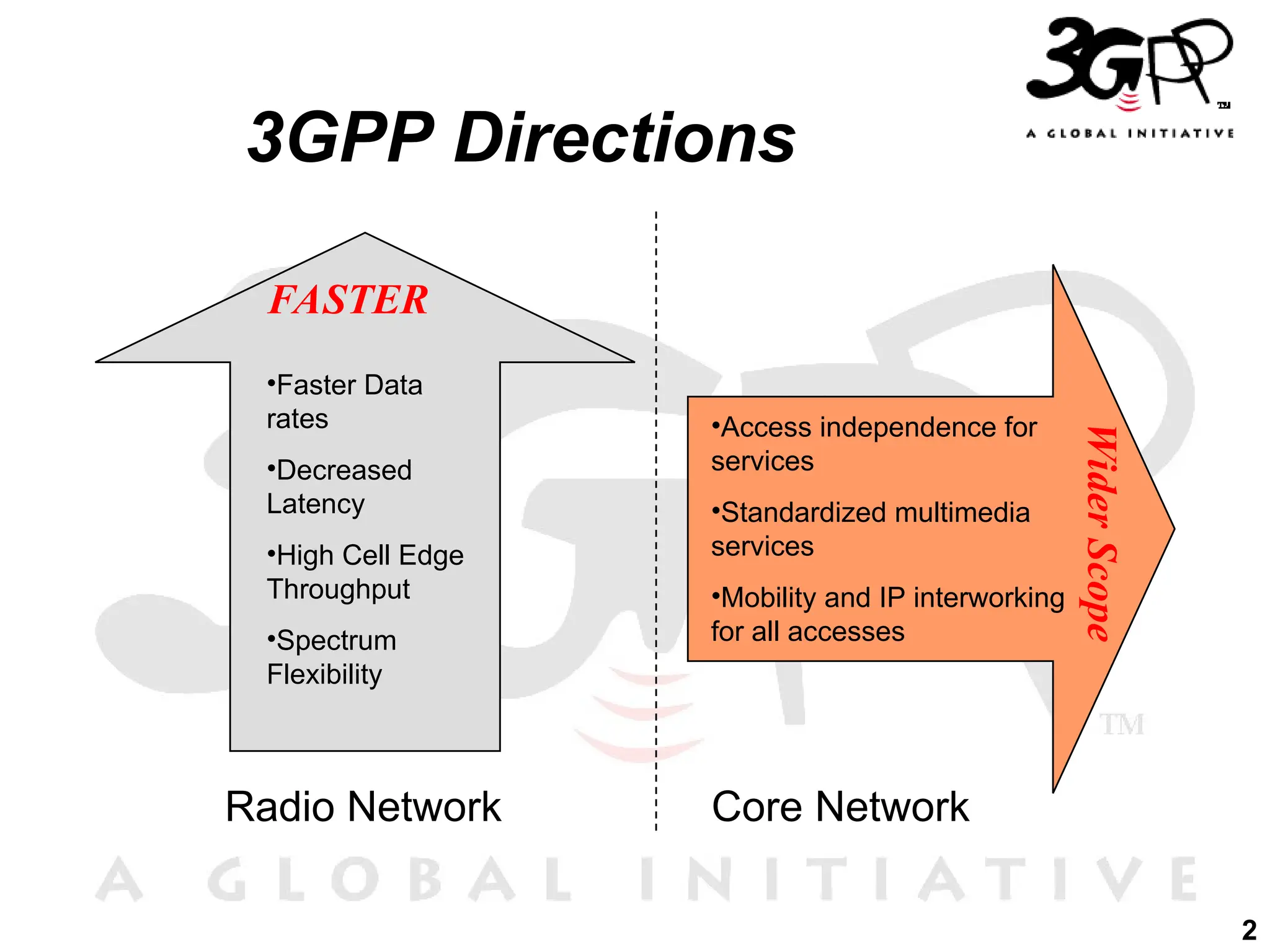
3GPP Directions
Radio Network Core Network
•Faster Data
rates
•Decreased
Latency
•High Cell Edge
Throughput
•Spectrum
Flexibility
•Access independence for
services
•Standardized multimedia
services
•Mobility and IP interworking
for all accesses
FASTER
Wider
Scope
3
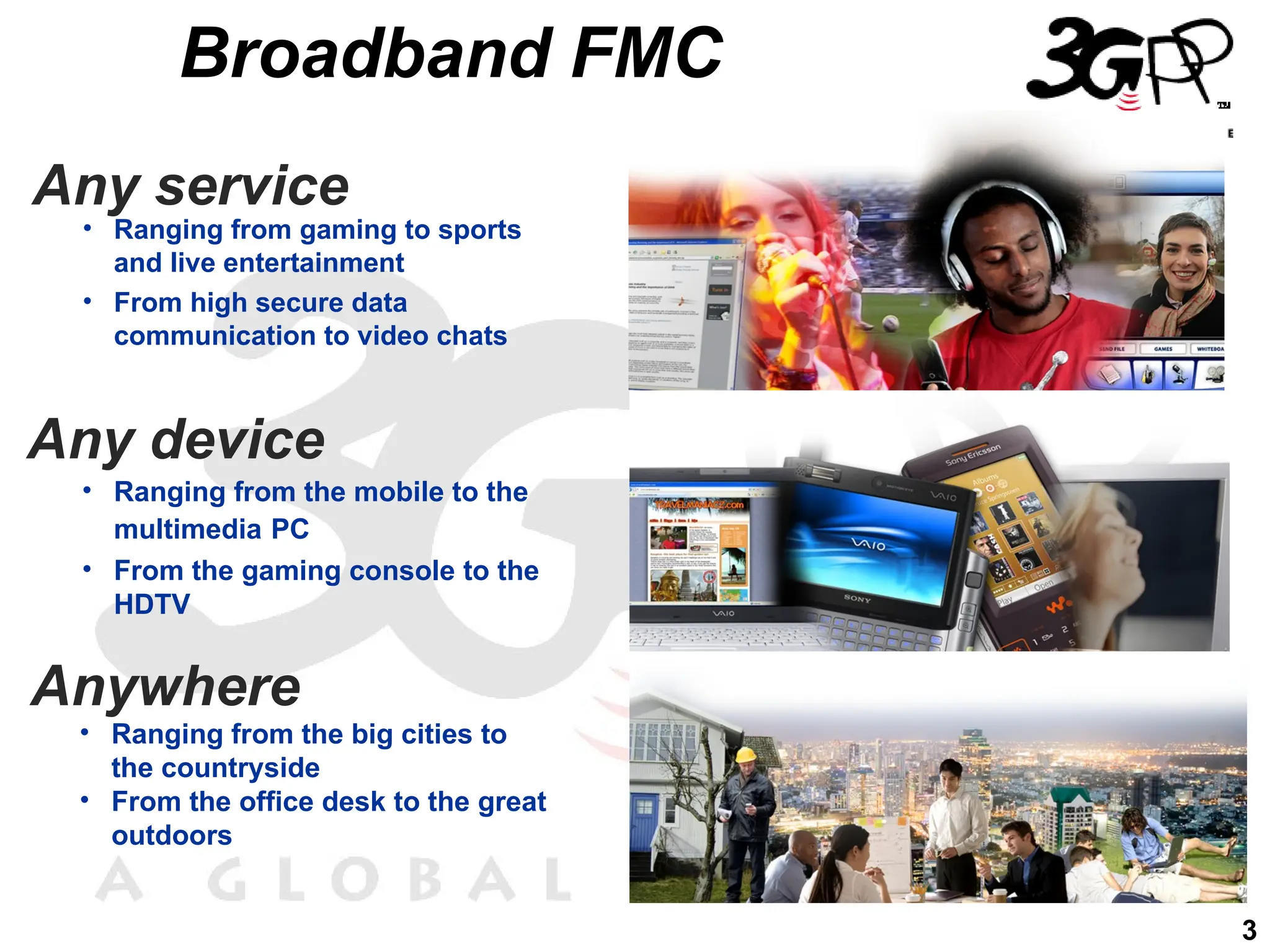
Broadband FMC
Any service
• Ranging from gaming to sports
and live entertainment
• From high secure data
communication to video chats
Anywhere
• Ranging from the big cities to
the countryside
• From the office desk to the great
outdoors
Any device
• Ranging from the mobile to the
multimedia PC
• From the gaming console to the
HDTV
4
Broadband Accesses
They come in many flavors
xDSL
Fiber (PON & P2P)
Fiber/VDSL2
Fixed Wireless
HSPA/LTE
Satellite/Terrestrial
Unlicensed
(WiFi, etc)
Others
Cable (DOCSIS2 3)
Fixed
access
Fixed/nomadic
wireless
Mobile
access
WCDMA/HSPA
LTE
CDMA2000
EVDO
GSM/EDGE
The borderline between fixed and mobile is getting less clear
Mobile WiMax
Others
5
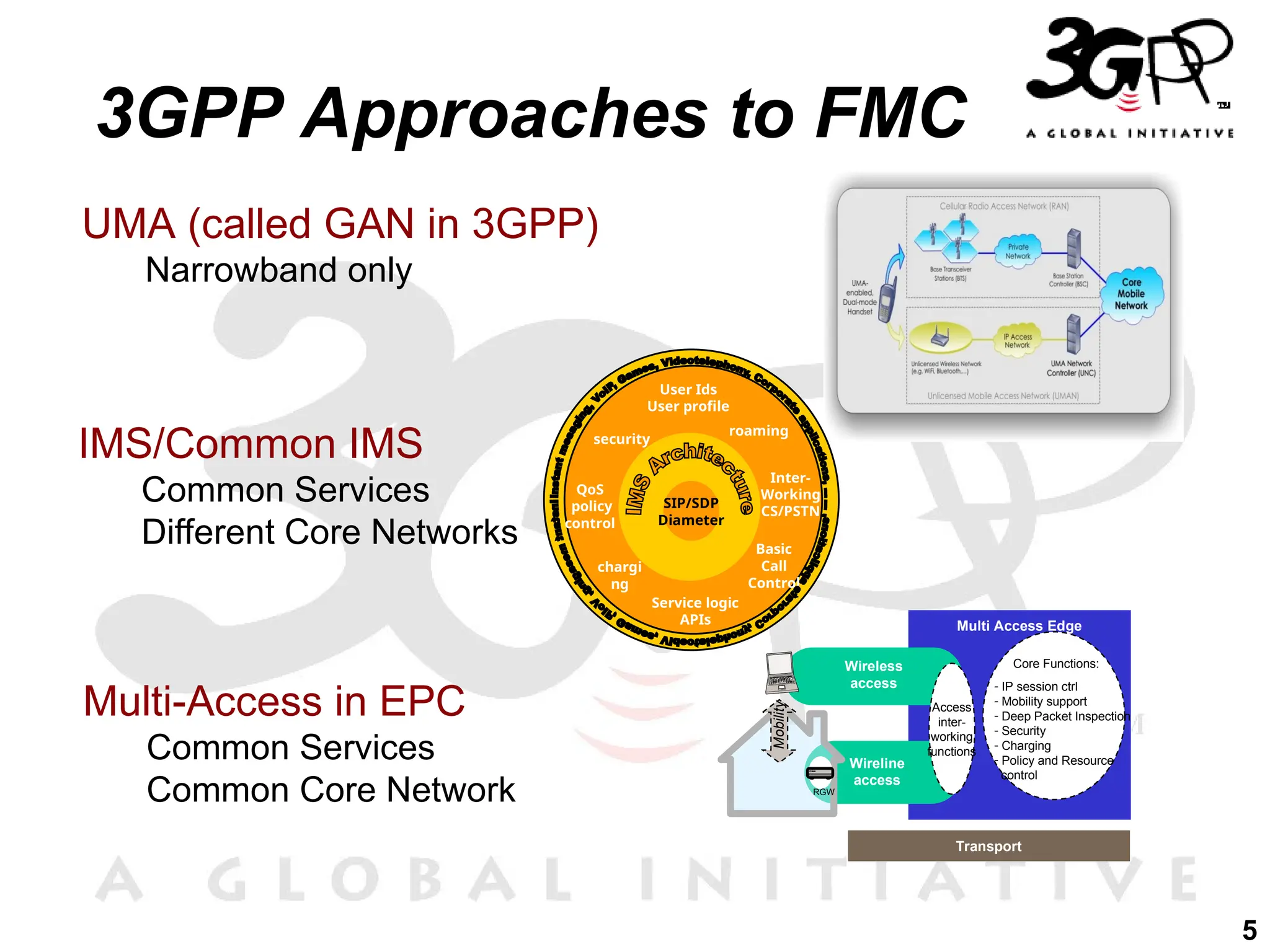
3GPP Approaches to FMC
User Ids
User profile
security
roaming
Inter-
Working
CS/PSTN
QoS
policy
control
Basic
Call
Control
Service logic
APIs
SIP/SDP
Diameter
chargi
ng
Multi Access Edge
Transport
Mobility
Core Functions:
- IP session ctrl
- Mobility support
- Deep Packet Inspection
- Security
- Charging
- Policy and Resource
control
Access
inter-
working
functions
RGW
Wireline
access
Wireless
access
IMS/Common IMS
Common Services
Different Core Networks
Multi-Access in EPC
Common Services
Common Core Network
UMA (called GAN in 3GPP)
Narrowband only
6
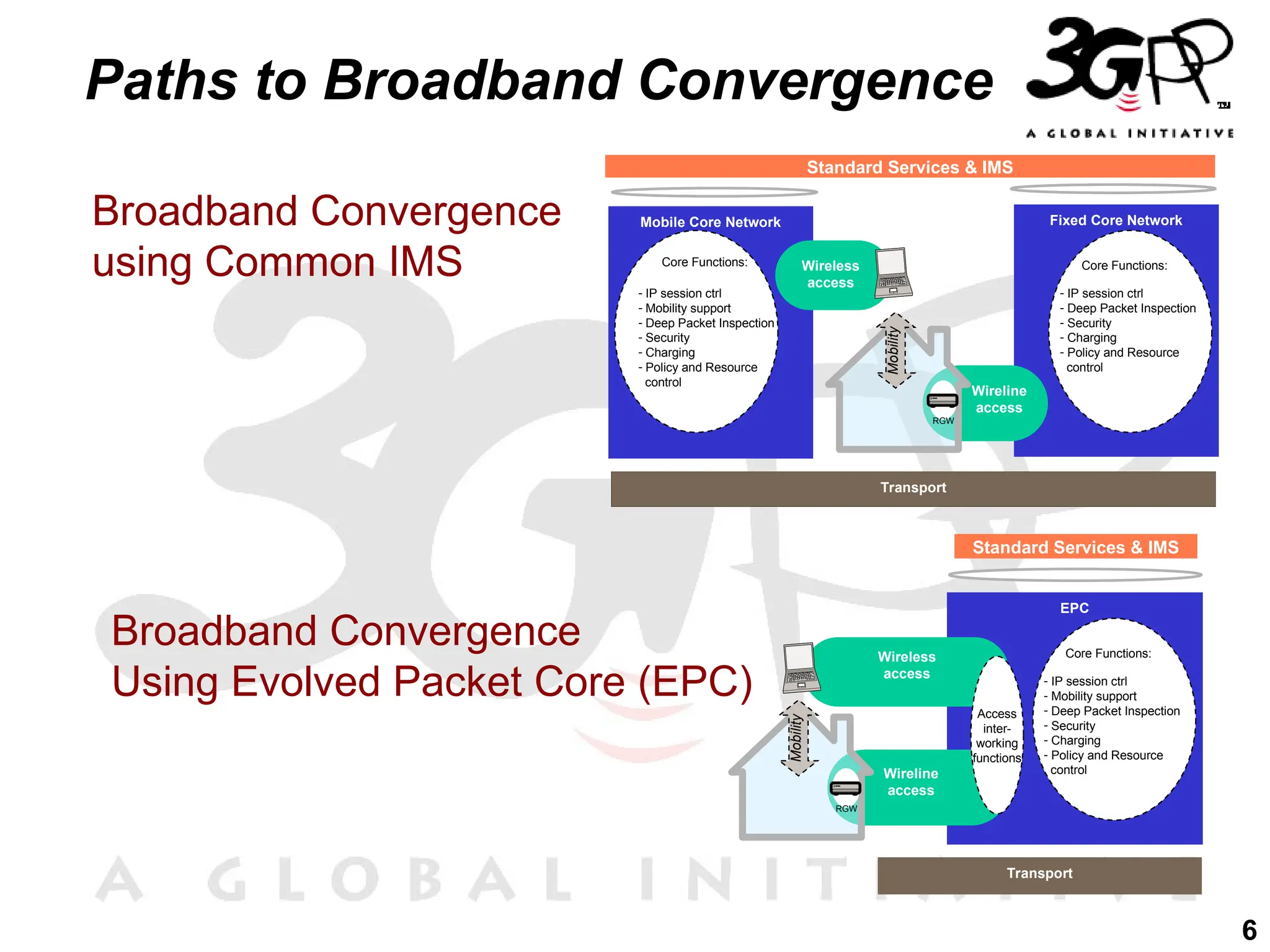
Paths to Broadband Convergence
Broadband Convergence
using Common IMS
Broadband Convergence
Using Evolved Packet Core (EPC)
EPC
Transport
Mobility
Core Functions:
- IP session ctrl
- Mobility support
- Deep Packet Inspection
- Security
- Charging
- Policy and Resource
control
Access
inter-
working
functions
RGW
Wireline
access
Wireless
access
Standard Services & IMS
Fixed Core Network
Transport
Mobility
Core Functions:
- IP session ctrl
- Deep Packet Inspection
- Security
- Charging
- Policy and Resource
control
RGW
Wireline
access
Wireless
access
Mobile Core Network
Core Functions:
- IP session ctrl
- Mobility support
- Deep Packet Inspection
- Security
- Charging
- Policy and Resource
control
Wireless
access
Standard Services & IMS
7
Paths to Broadband Convergence
Broadband Convergence
using Common IMS
Broadband Convergence
Using Evolved Packet Core (EPC)
EPC
Transport
Mobility
Core Functions:
- IP session ctrl
- Mobility support
- Deep Packet Inspection
- Security
- Charging
- Policy and Resource
control
Access
inter-
working
functions
RGW
Wireline
access
Wireless
access
Standard Services & IMS
Fixed Core Network
Transport
Mobility
Core Functions:
- IP session ctrl
- Deep Packet Inspection
- Security
- Charging
- Policy and Resource
control
RGW
Wireline
access
Wireless
access
Mobile Core Network
Core Functions:
- IP session ctrl
- Mobility support
- Deep Packet Inspection
- Security
- Charging
- Policy and Resource
control
Wireless
access
Standard Services & IMS
8
IMS/Common IMS
1999 2000 2001 2002 2003 2004 2005 2006 2007 2008 2009
UMTS (3G) HSPA DL HSPA UL LTE
• IMS developed as part of 3GPP Rel 5 as an application development environment
– Encourage new applications to use environment
– Greater operator policing than native SIP/SDP
– Home control allowing customization
• IMS retargeted in Rel 7 for telephony replacement
– Standardized multimedia suite developed
– Optimizations to improve performance
– Access independence
• Common IMS specified in Rel 8
– Integration of IMS variants and requirements from 3GPP2, TISPAN, and Cablelabs
IMS MMTel Common IMS
9
IMS/Common IMS
• IMS
– Session Control based on SIP/SDP
– Authentication/Authorization based on Diameter
– Extensions for Operator Needs
• Resource Control/QoS
• Charging
• Security and Identification
• Roaming
• Regulatory (emergency call, lawful intercept,etc.)
– Access Independent
– Standardized Multimedia Suite Defined in 3GPP
– Many operators have already deployed IMS for FMC
• Common IMS
– Extensions to IMS to meet requirements of different industry
segments
• Regulatory
• Legacy
• Different Business Models
10
Multimedia Telephony Service
• Multiple Simultaneous Media Streams
– Voice
– Text
– Video
– File Transfer
– Video/Photo/Audio Sharing
• Multimedia analogs of traditional PSTN supplementary services
– Originating Identification Presentation (OIP)
– Originating Identification Restriction (OIR)
– Terminating Identification Presentation (TIP)
– Terminating Identification Restriction (TIR)
– Malicious Communication IDentification (MCID)
– Anonymous Communication Rejection (ACR)
– Communication Diversion (CDIV)
– Communication Waiting (CW)
– Communication Hold (HOLD)
– Communication Barring (CB)
– Completion of Communications to Busy Subscriber (CCBS)
– Message Waiting Indication (MWI)
– Conference (CONF)
– Advice Of Charge (AOC)
– Explicit Communication Transfer (ECT)
– Reverse charging
– Closed User Group (CUG)
– Three-Party (3PTY)
11
But what if you need?
• Session Continuity
• Mobility for non IMS applications
• Common IP level services
– Filtering
– Deep Packet Inspection
– Firewall
• Common Management
12
Paths to Broadband Convergence
Broadband Convergence
using Common IMS
Broadband Convergence
Using Evolved Packet Core (EPC)
EPC
Transport
Mobility
Core Functions:
- IP session ctrl
- Mobility support
- Deep Packet Inspection
- Security
- Charging
- Policy and Resource
control
Access
inter-
working
functions
RGW
Wireline
access
Wireless
access
Standard Services & IMS
Fixed Core Network
Transport
Mobility
Core Functions:
- IP session ctrl
- Deep Packet Inspection
- Security
- Charging
- Policy and Resource
control
RGW
Wireline
access
Wireless
access
Mobile Core Network
Core Functions:
- IP session ctrl
- Mobility support
- Deep Packet Inspection
- Security
- Charging
- Policy and Resource
control
Wireless
access
Standard Services & IMS
13
Examples of non-IMS apps
• Multimedia Broadcast Messaging Service
(MBMS)
• High Quality Audio
• Packet Streaming
14
Evolved Packet Core (EPC)
• IP Based Core Network
• Flat structure
• IETF and GTP based mobility
• Supports both 3GPP and non-3GPP
Accesses
• Policy Control
• Optimized for packet based multimedia
15
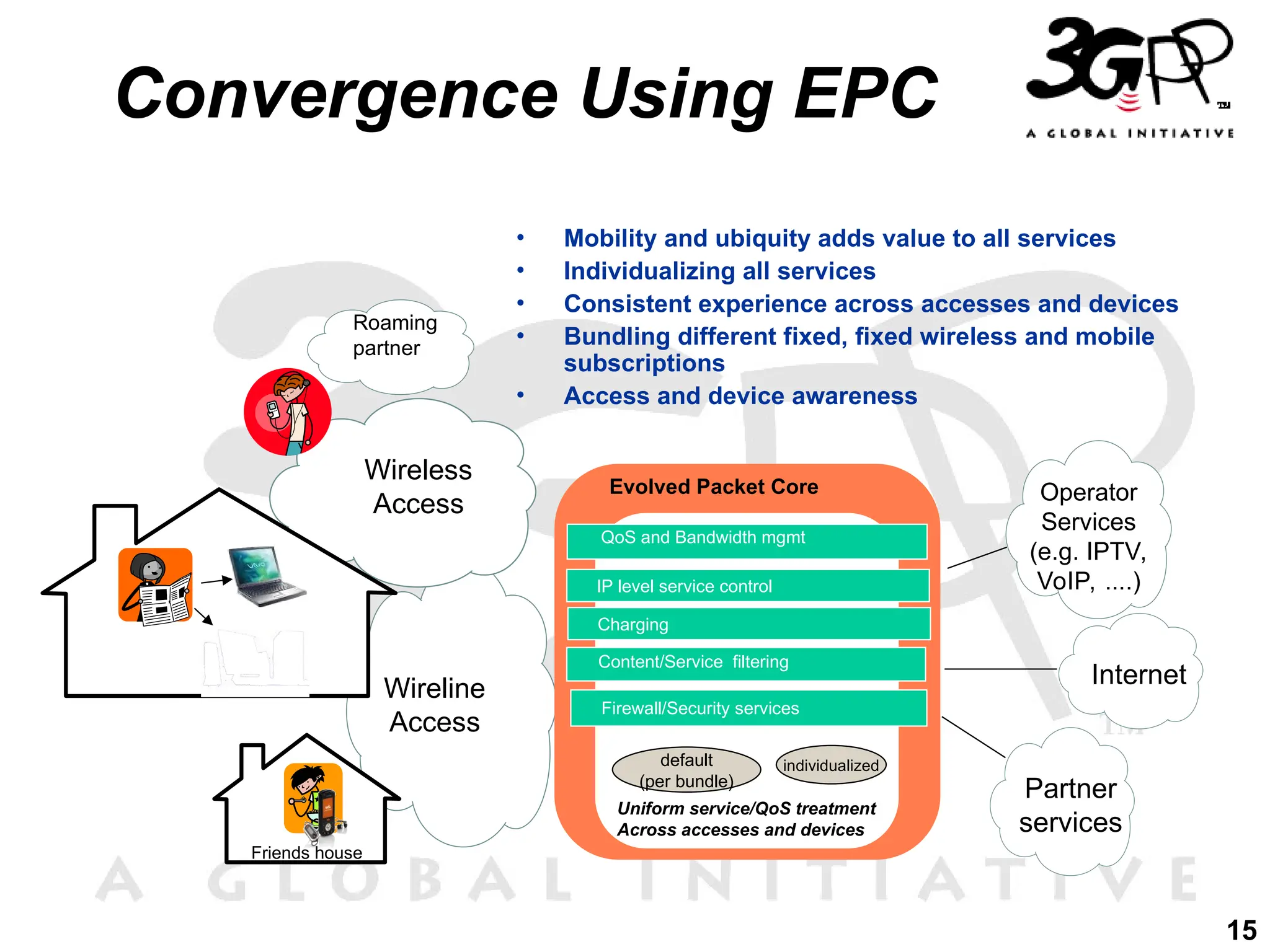
Convergence Using EPC
Evolved Packet Core
Wireline
Access
Wireless
Access
Partner
services
Firewall/Security services
Content/Service filtering
QoS and Bandwidth mgmt
IP level service control
Uniform service/QoS treatment
Across accesses and devices
Friends house
Roaming
partner
Operator
Services
(e.g. IPTV,
VoIP, ....)
• Mobility and ubiquity adds value to all services
• Individualizing all services
• Consistent experience across accesses and devices
• Bundling different fixed, fixed wireless and mobile
subscriptions
• Access and device awareness
default
(per bundle)
individualized
Internet
Charging
16
3GPP Evolved Packet Core (EPC)
Generic model for access interworking (simplified)
SGi
PCRF
Gx
HSS
Operator's IP
Services
(e.g. IMS, PSS
etc.)
SWx
-
S6b
Rx
PDN
Gateway
3GPP AAA
Server
PMIP
Non-3GPP IP
Access
Gxc
S5
S6a
3GPP
Access
Serving
Gateway
Mobility, connectivity,
IP address allocation
Policy and resource
control
Authentication,
Authorization
3GPP2 access
(part of 3GPP R8)
WiMAX access
(part of 3GPP R8)
WiFi access
(part of 3GPP R8)
xDSL access
Fiber access
Integration point
Overall capability:
- Multi-access mobility for roaming
- Advanced charging
17
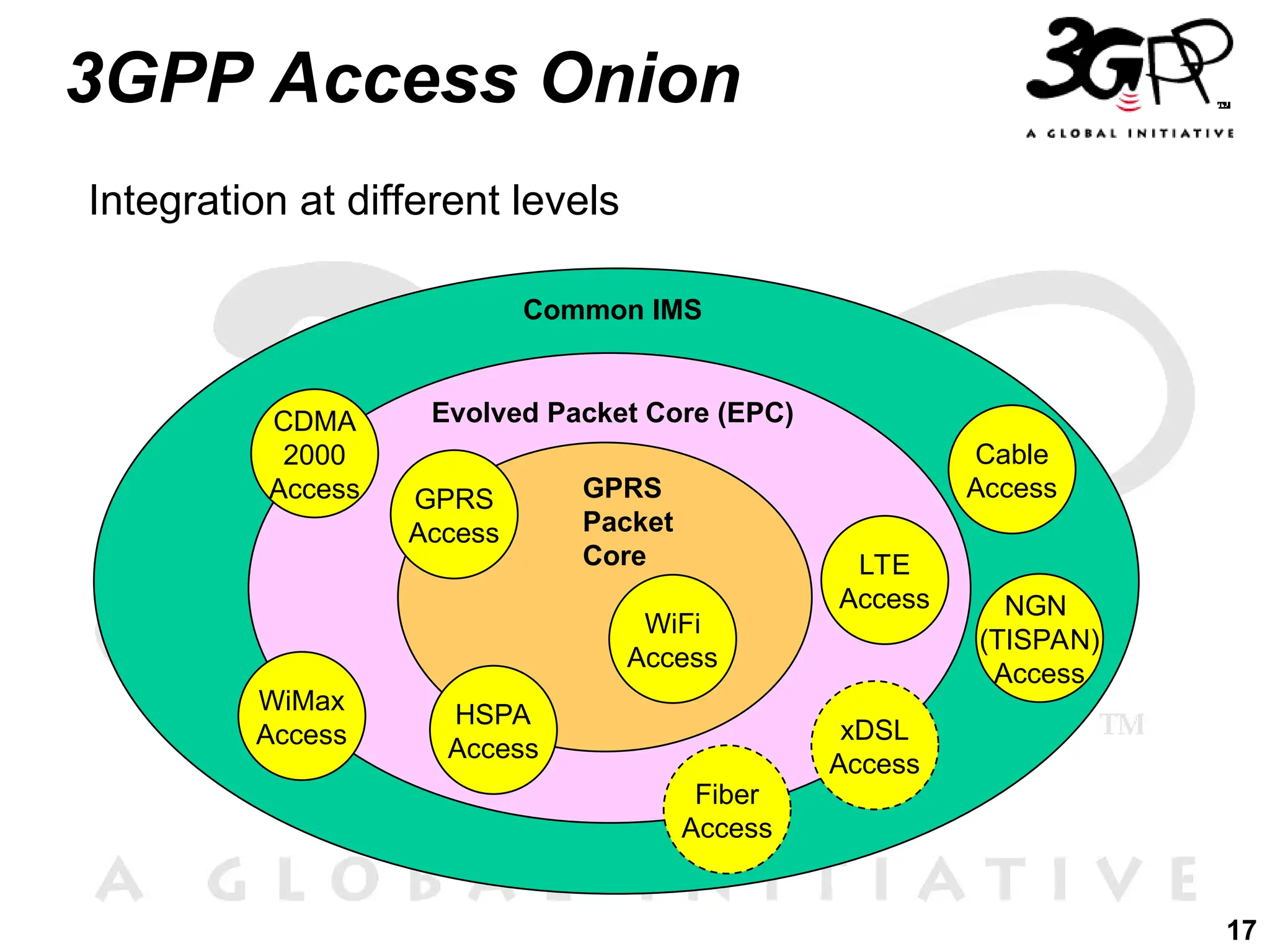
3GPP Access Onion
GPRS
Access
HSPA
Access
LTE
Access
CDMA
2000
Access
WiMax
Access
NGN
(TISPAN)
Access
WiFi
Access
Cable
Access
GPRS
Packet
Core
Evolved Packet Core (EPC)
Common IMS
xDSL
Access
Integration at different levels
Fiber
Access
18
Summary
• 3GPP is committed to Mobile Broadband
• 3GPP is committed to FMC
• Two complementary paths to broadband
FMC
– Common Service Platform (Common IMS)
– Multi-Access Packet Core (EPC)
19
Thanks for your
attention !
More information at
www.3gpp.org

3gpp_Service_evolution_3gpp_Service_evolution

  • 1.
    1 3GPP TSG SAChairman 3GPP TSG SA Chairman Stephen Hayes Stephen Hayes 3GPP presentation on Services Evolution Moscow, September 2008
  • 2.
    2 3GPP Directions Radio NetworkCore Network •Faster Data rates •Decreased Latency •High Cell Edge Throughput •Spectrum Flexibility •Access independence for services •Standardized multimedia services •Mobility and IP interworking for all accesses FASTER Wider Scope
  • 3.
    3 Broadband FMC Any service •Ranging from gaming to sports and live entertainment • From high secure data communication to video chats Anywhere • Ranging from the big cities to the countryside • From the office desk to the great outdoors Any device • Ranging from the mobile to the multimedia PC • From the gaming console to the HDTV
  • 4.
    4 Broadband Accesses They comein many flavors xDSL Fiber (PON & P2P) Fiber/VDSL2 Fixed Wireless HSPA/LTE Satellite/Terrestrial Unlicensed (WiFi, etc) Others Cable (DOCSIS2 3) Fixed access Fixed/nomadic wireless Mobile access WCDMA/HSPA LTE CDMA2000 EVDO GSM/EDGE The borderline between fixed and mobile is getting less clear Mobile WiMax Others
  • 5.
    5 3GPP Approaches toFMC User Ids User profile security roaming Inter- Working CS/PSTN QoS policy control Basic Call Control Service logic APIs SIP/SDP Diameter chargi ng Multi Access Edge Transport Mobility Core Functions: - IP session ctrl - Mobility support - Deep Packet Inspection - Security - Charging - Policy and Resource control Access inter- working functions RGW Wireline access Wireless access IMS/Common IMS Common Services Different Core Networks Multi-Access in EPC Common Services Common Core Network UMA (called GAN in 3GPP) Narrowband only
  • 6.
    6 Paths to BroadbandConvergence Broadband Convergence using Common IMS Broadband Convergence Using Evolved Packet Core (EPC) EPC Transport Mobility Core Functions: - IP session ctrl - Mobility support - Deep Packet Inspection - Security - Charging - Policy and Resource control Access inter- working functions RGW Wireline access Wireless access Standard Services & IMS Fixed Core Network Transport Mobility Core Functions: - IP session ctrl - Deep Packet Inspection - Security - Charging - Policy and Resource control RGW Wireline access Wireless access Mobile Core Network Core Functions: - IP session ctrl - Mobility support - Deep Packet Inspection - Security - Charging - Policy and Resource control Wireless access Standard Services & IMS
  • 7.
    7 Paths to BroadbandConvergence Broadband Convergence using Common IMS Broadband Convergence Using Evolved Packet Core (EPC) EPC Transport Mobility Core Functions: - IP session ctrl - Mobility support - Deep Packet Inspection - Security - Charging - Policy and Resource control Access inter- working functions RGW Wireline access Wireless access Standard Services & IMS Fixed Core Network Transport Mobility Core Functions: - IP session ctrl - Deep Packet Inspection - Security - Charging - Policy and Resource control RGW Wireline access Wireless access Mobile Core Network Core Functions: - IP session ctrl - Mobility support - Deep Packet Inspection - Security - Charging - Policy and Resource control Wireless access Standard Services & IMS
  • 8.
    8 IMS/Common IMS 1999 20002001 2002 2003 2004 2005 2006 2007 2008 2009 UMTS (3G) HSPA DL HSPA UL LTE • IMS developed as part of 3GPP Rel 5 as an application development environment – Encourage new applications to use environment – Greater operator policing than native SIP/SDP – Home control allowing customization • IMS retargeted in Rel 7 for telephony replacement – Standardized multimedia suite developed – Optimizations to improve performance – Access independence • Common IMS specified in Rel 8 – Integration of IMS variants and requirements from 3GPP2, TISPAN, and Cablelabs IMS MMTel Common IMS
  • 9.
    9 IMS/Common IMS • IMS –Session Control based on SIP/SDP – Authentication/Authorization based on Diameter – Extensions for Operator Needs • Resource Control/QoS • Charging • Security and Identification • Roaming • Regulatory (emergency call, lawful intercept,etc.) – Access Independent – Standardized Multimedia Suite Defined in 3GPP – Many operators have already deployed IMS for FMC • Common IMS – Extensions to IMS to meet requirements of different industry segments • Regulatory • Legacy • Different Business Models
  • 10.
    10 Multimedia Telephony Service •Multiple Simultaneous Media Streams – Voice – Text – Video – File Transfer – Video/Photo/Audio Sharing • Multimedia analogs of traditional PSTN supplementary services – Originating Identification Presentation (OIP) – Originating Identification Restriction (OIR) – Terminating Identification Presentation (TIP) – Terminating Identification Restriction (TIR) – Malicious Communication IDentification (MCID) – Anonymous Communication Rejection (ACR) – Communication Diversion (CDIV) – Communication Waiting (CW) – Communication Hold (HOLD) – Communication Barring (CB) – Completion of Communications to Busy Subscriber (CCBS) – Message Waiting Indication (MWI) – Conference (CONF) – Advice Of Charge (AOC) – Explicit Communication Transfer (ECT) – Reverse charging – Closed User Group (CUG) – Three-Party (3PTY)
  • 11.
    11 But what ifyou need? • Session Continuity • Mobility for non IMS applications • Common IP level services – Filtering – Deep Packet Inspection – Firewall • Common Management
  • 12.
    12 Paths to BroadbandConvergence Broadband Convergence using Common IMS Broadband Convergence Using Evolved Packet Core (EPC) EPC Transport Mobility Core Functions: - IP session ctrl - Mobility support - Deep Packet Inspection - Security - Charging - Policy and Resource control Access inter- working functions RGW Wireline access Wireless access Standard Services & IMS Fixed Core Network Transport Mobility Core Functions: - IP session ctrl - Deep Packet Inspection - Security - Charging - Policy and Resource control RGW Wireline access Wireless access Mobile Core Network Core Functions: - IP session ctrl - Mobility support - Deep Packet Inspection - Security - Charging - Policy and Resource control Wireless access Standard Services & IMS
  • 13.
    13 Examples of non-IMSapps • Multimedia Broadcast Messaging Service (MBMS) • High Quality Audio • Packet Streaming
  • 14.
    14 Evolved Packet Core(EPC) • IP Based Core Network • Flat structure • IETF and GTP based mobility • Supports both 3GPP and non-3GPP Accesses • Policy Control • Optimized for packet based multimedia
  • 15.
    15 Convergence Using EPC EvolvedPacket Core Wireline Access Wireless Access Partner services Firewall/Security services Content/Service filtering QoS and Bandwidth mgmt IP level service control Uniform service/QoS treatment Across accesses and devices Friends house Roaming partner Operator Services (e.g. IPTV, VoIP, ....) • Mobility and ubiquity adds value to all services • Individualizing all services • Consistent experience across accesses and devices • Bundling different fixed, fixed wireless and mobile subscriptions • Access and device awareness default (per bundle) individualized Internet Charging
  • 16.
    16 3GPP Evolved PacketCore (EPC) Generic model for access interworking (simplified) SGi PCRF Gx HSS Operator's IP Services (e.g. IMS, PSS etc.) SWx - S6b Rx PDN Gateway 3GPP AAA Server PMIP Non-3GPP IP Access Gxc S5 S6a 3GPP Access Serving Gateway Mobility, connectivity, IP address allocation Policy and resource control Authentication, Authorization 3GPP2 access (part of 3GPP R8) WiMAX access (part of 3GPP R8) WiFi access (part of 3GPP R8) xDSL access Fiber access Integration point Overall capability: - Multi-access mobility for roaming - Advanced charging
  • 17.
  • 18.
    18 Summary • 3GPP iscommitted to Mobile Broadband • 3GPP is committed to FMC • Two complementary paths to broadband FMC – Common Service Platform (Common IMS) – Multi-Access Packet Core (EPC)
  • 19.
    19 Thanks for your attention! More information at www.3gpp.org