Assessment = Improved Teaching and
Learning: Using Rubrics to Measure
Information Literacy Skills
Library Assessment Conference
2010
Kathy Crowe
Associate Dean for Public Services
University of North Carolina at
Greensboro (UNCG)
• Publicly supported
• University of North Carolina system
• High Research Activity
• Carnegie classification of community engaged
• Enrollment: 17,540 (16,090.25 FTE)
• Undergraduate: 14,315 (13,583.25 FTE)
• Graduate: 3,225 (2,507 FTE)
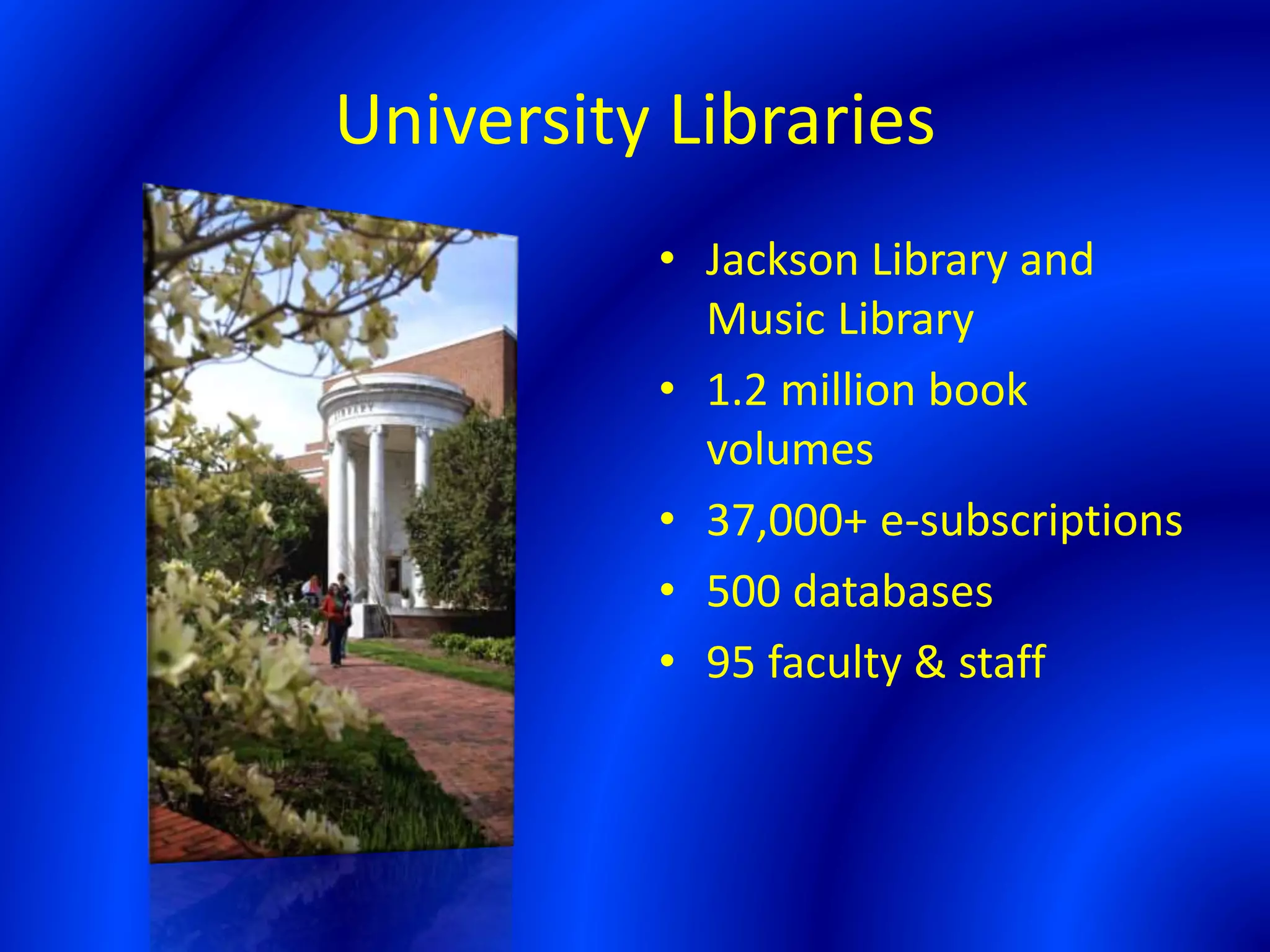
University Libraries
• Jackson Library and
Music Library
• 1.2 million book
volumes
• 37,000+ e-subscriptions
• 500 databases
• 95 faculty & staff
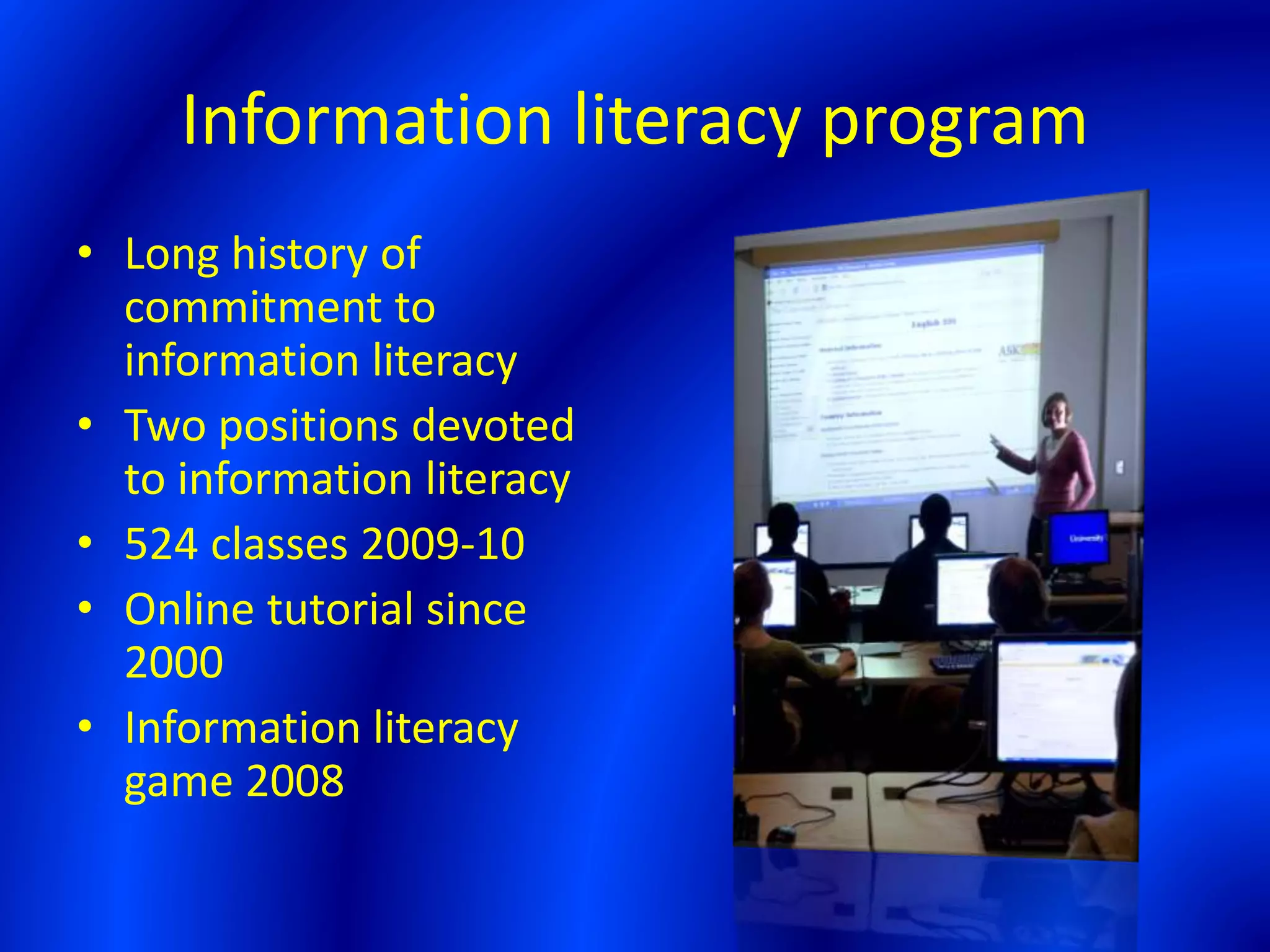
Information literacy program
• Long history of
commitment to
information literacy
• Two positions devoted
to information literacy
• 524 classes 2009-10
• Online tutorial since
2000
• Information literacy
game 2008
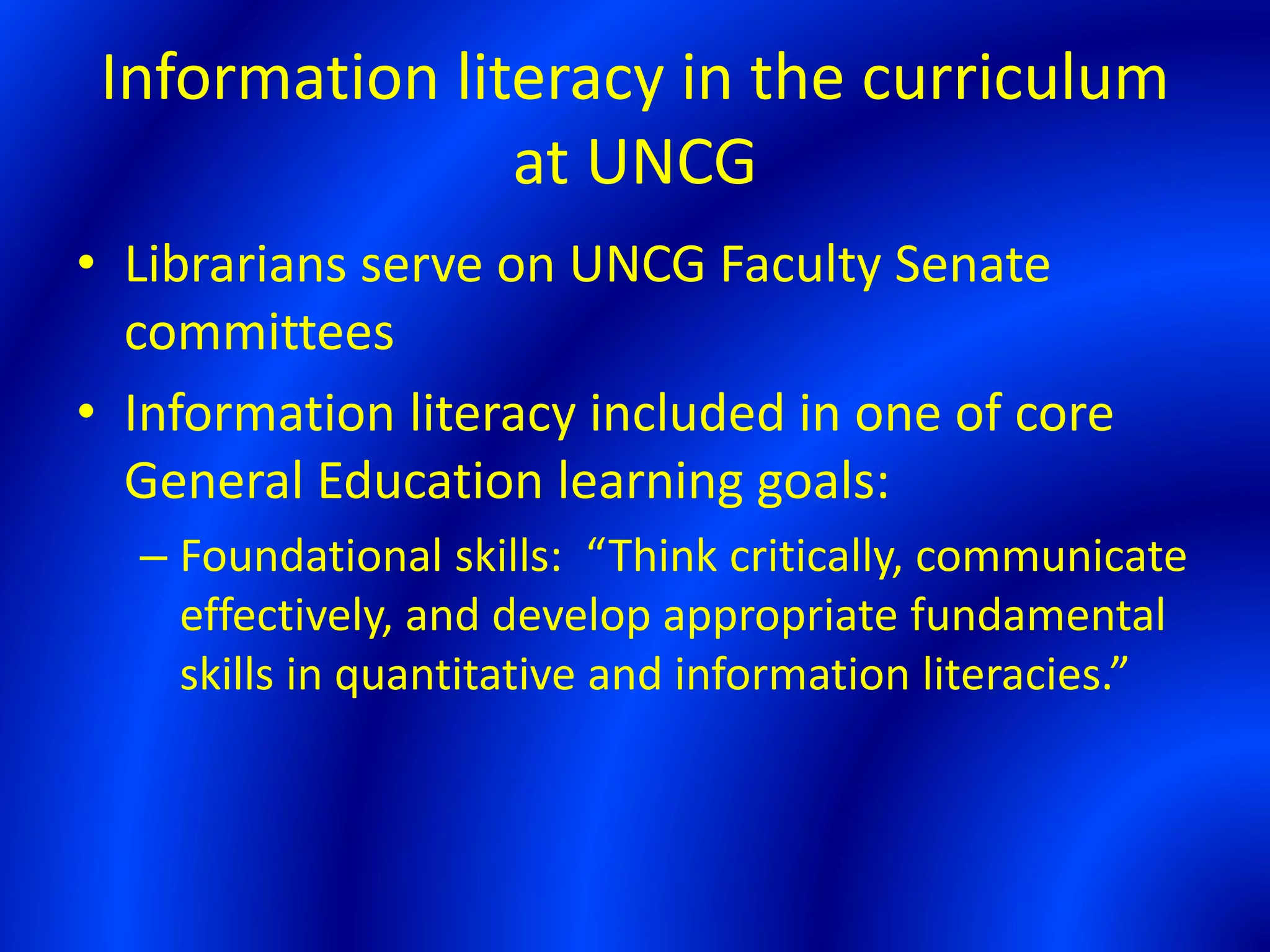
Information literacy in the curriculum
at UNCG
• Librarians serve on UNCG Faculty Senate
committees
• Information literacy included in one of core
General Education learning goals:
– Foundational skills: “Think critically, communicate
effectively, and develop appropriate fundamental
skills in quantitative and information literacies.”
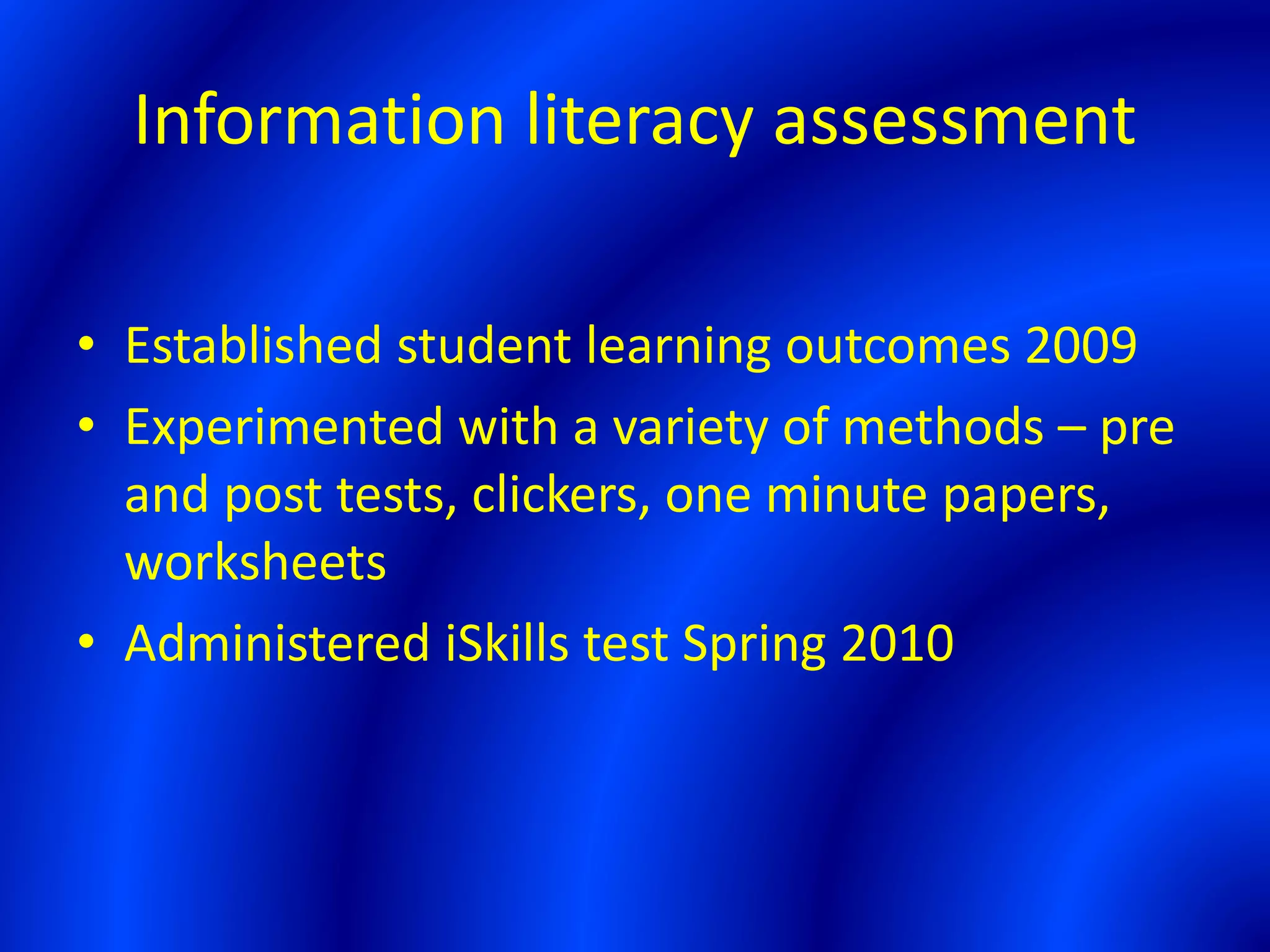
Information literacy assessment
• Established student learning outcomes 2009
• Experimented with a variety of methods – pre
and post tests, clickers, one minute papers,
worksheets
• Administered iSkills test Spring 2010
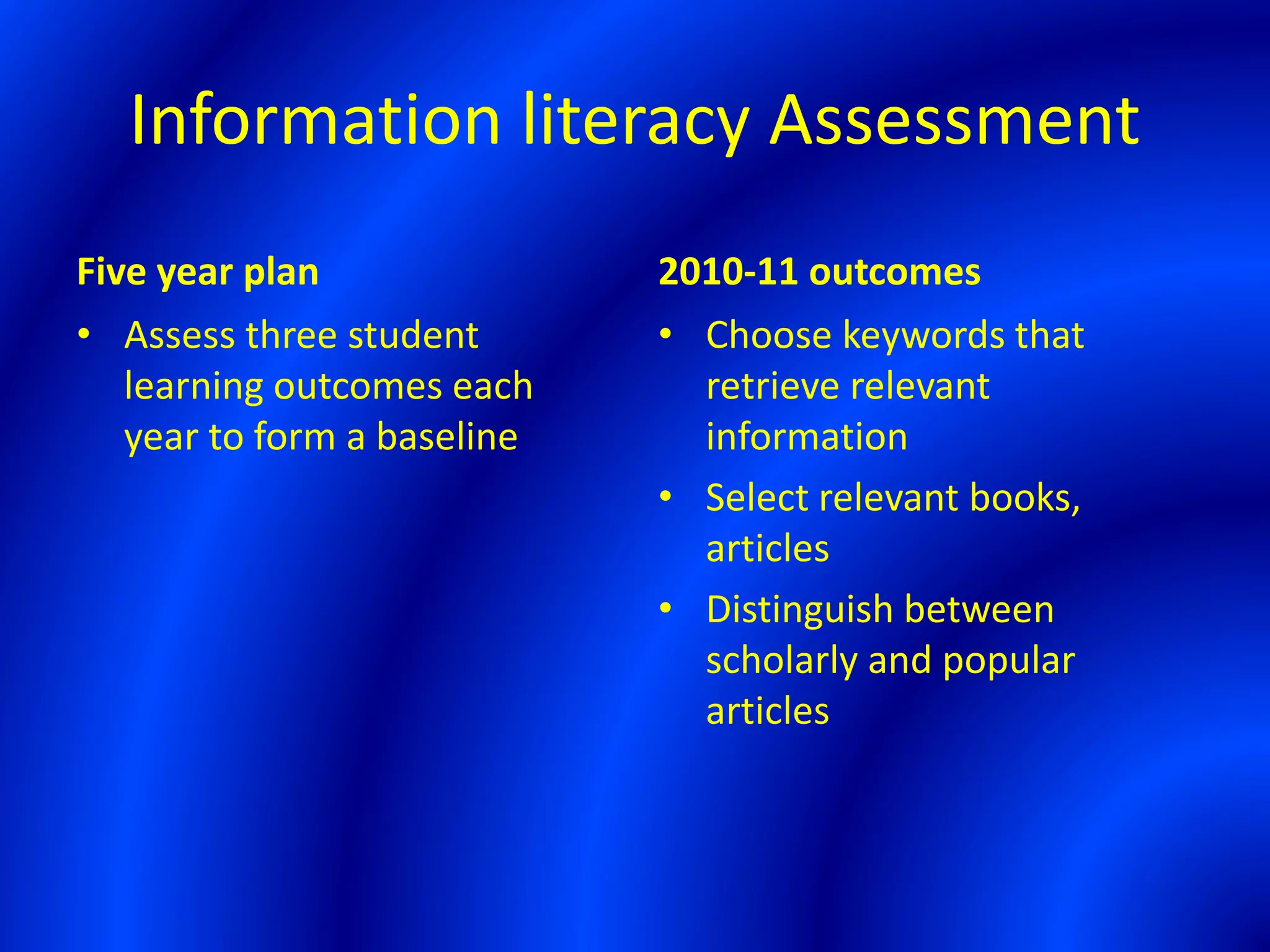
Information literacy Assessment
Five year plan
• Assess three student
learning outcomes each
year to form a baseline
• Choose keywords that
retrieve relevant
information
• Select relevant books,
articles
• Distinguish between
scholarly and popular
articles
2010-11 outcomes
Assessment study
• Communication Studies (CST 300)
• Three semester study
– Pilot Spring 2009
– Fall 2009 & Spring 2010
CST 300
• CST 300 (Communication Theory) required of
all CST majors
• Students required to write 8-10 pp paper
using primary research articles
• Long history of collaboration with the Library
– Students attend library instruction session
– Librarian prepares Lib Guide
– Student complete worksheet
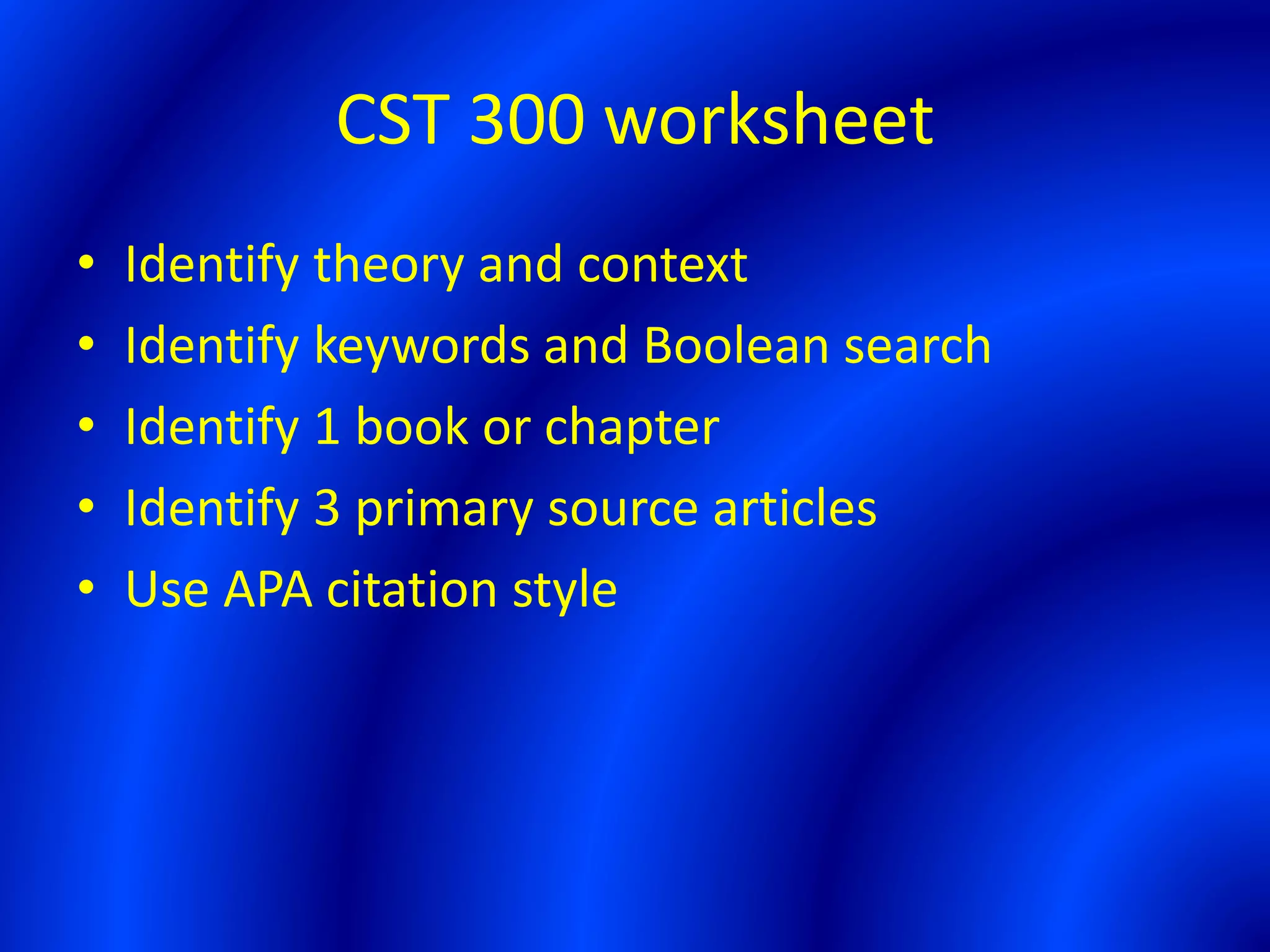
CST 300 worksheet
• Identify theory and context
• Identify keywords and Boolean search
• Identify 1 book or chapter
• Identify 3 primary source articles
• Use APA citation style
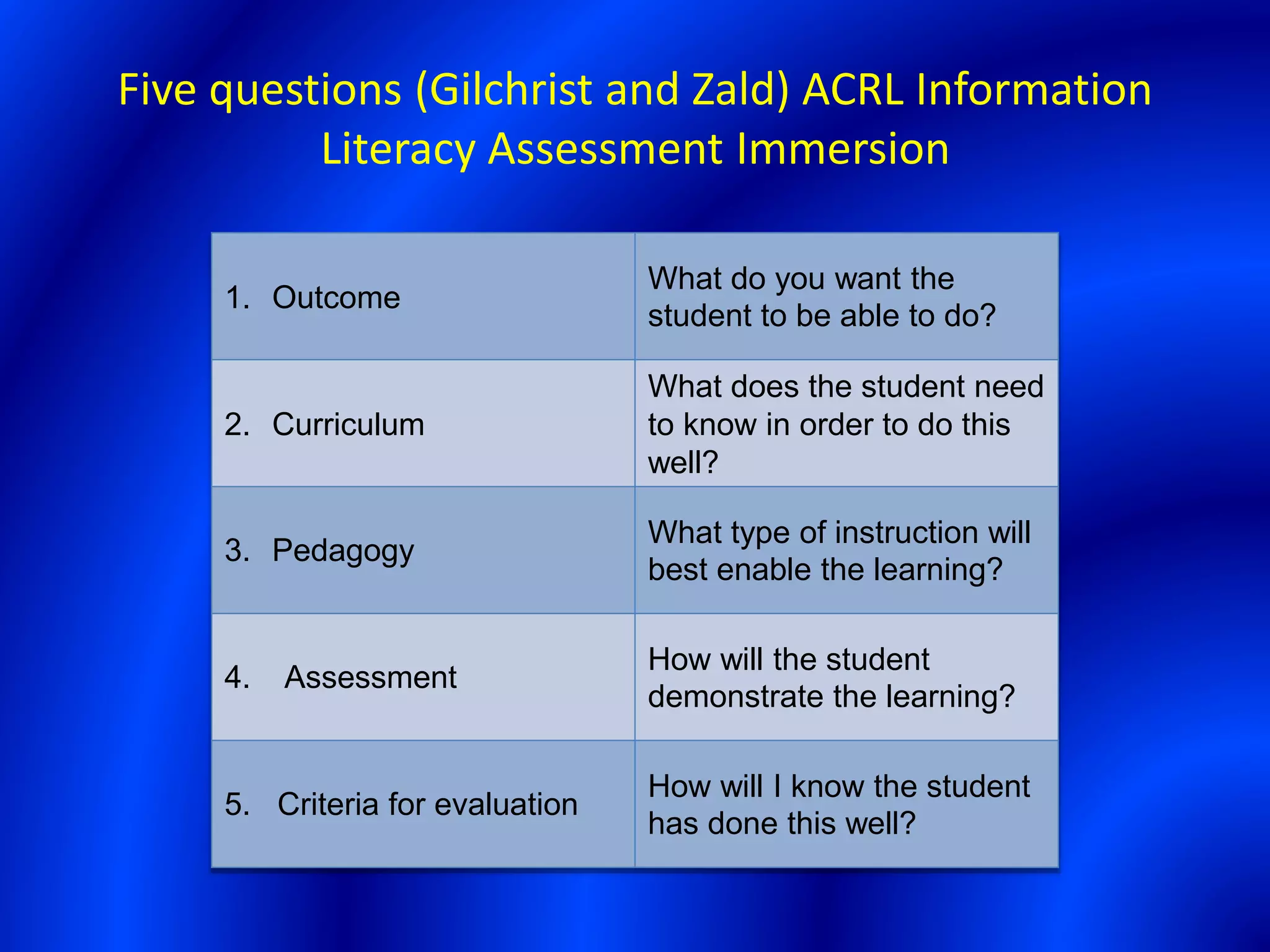
Five questions (Gilchrist and Zald) ACRL Information
Literacy Assessment Immersion
1. Outcome
What do you want the
student to be able to do?
2. Curriculum
What does the student need
to know in order to do this
well?
3. Pedagogy
What type of instruction will
best enable the learning?
4. Assessment
How will the student
demonstrate the learning?
5. Criteria for evaluation
How will I know the student
has done this well?
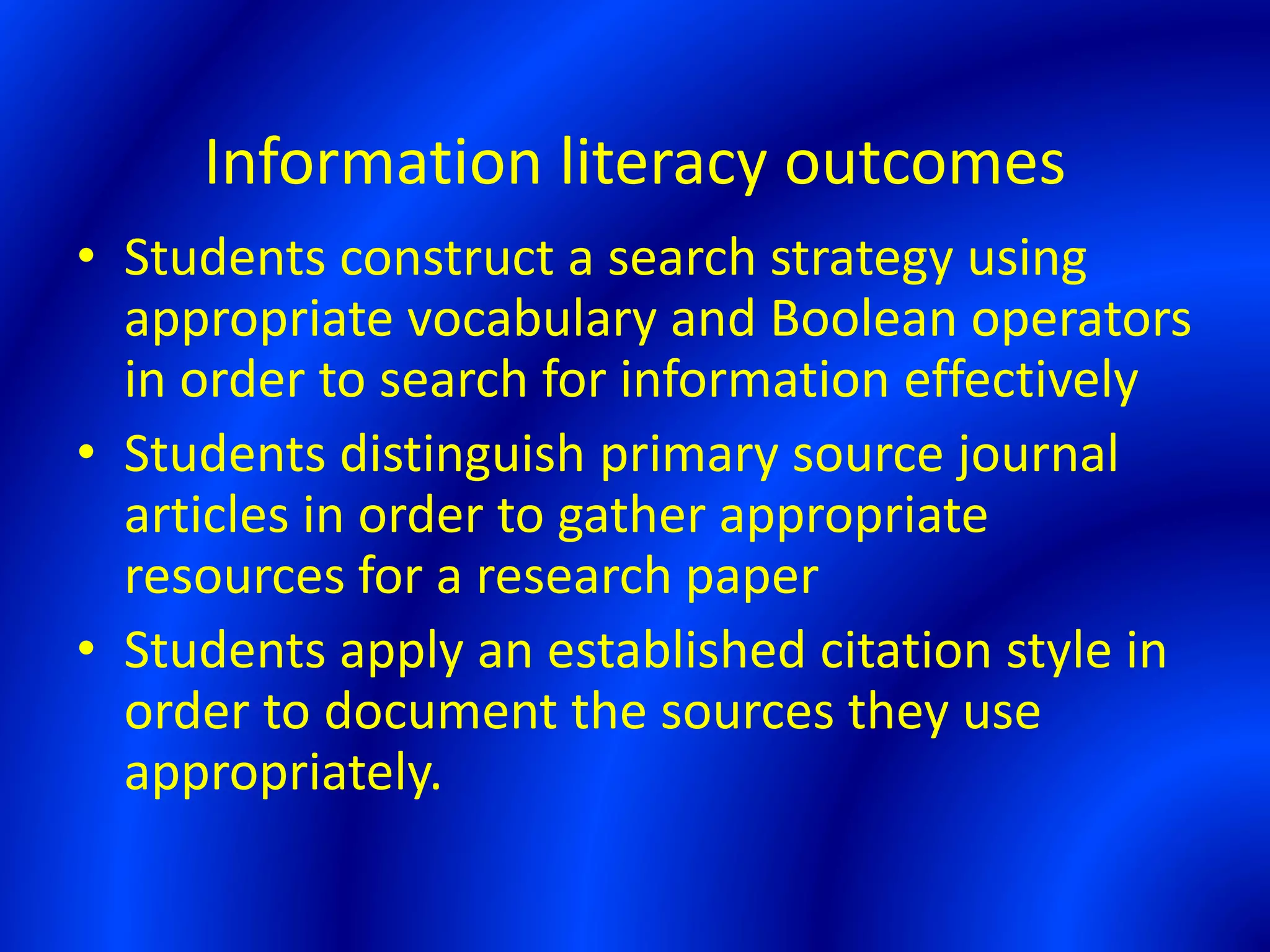
Information literacy outcomes
• Students construct a search strategy using
appropriate vocabulary and Boolean operators
in order to search for information effectively
• Students distinguish primary source journal
articles in order to gather appropriate
resources for a research paper
• Students apply an established citation style in
order to document the sources they use
appropriately.
Course outcome for information
literacy
• Apply a working knowledge of information
literacy as a tool for scholarship in
communication studies including APA style for
professional writing , library search techniques
and use of primary sources (journal articles
and other research publications)
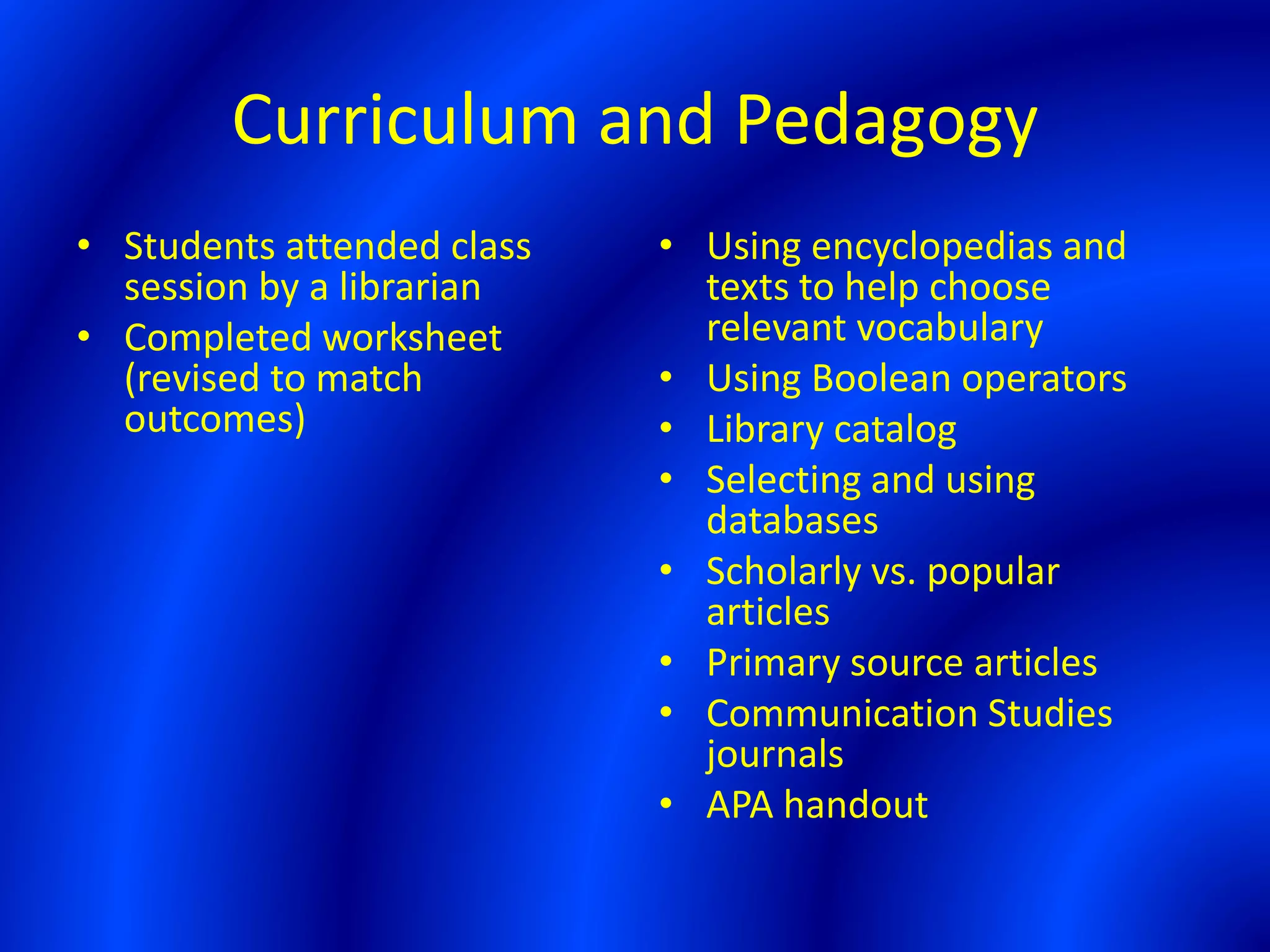
Curriculum and Pedagogy
• Students attended class
session by a librarian
• Completed worksheet
(revised to match
outcomes)
• Using encyclopedias and
texts to help choose
relevant vocabulary
• Using Boolean operators
• Library catalog
• Selecting and using
databases
• Scholarly vs. popular
articles
• Primary source articles
• Communication Studies
journals
• APA handout
Assessment
• Developed a rubric to
score library worksheet
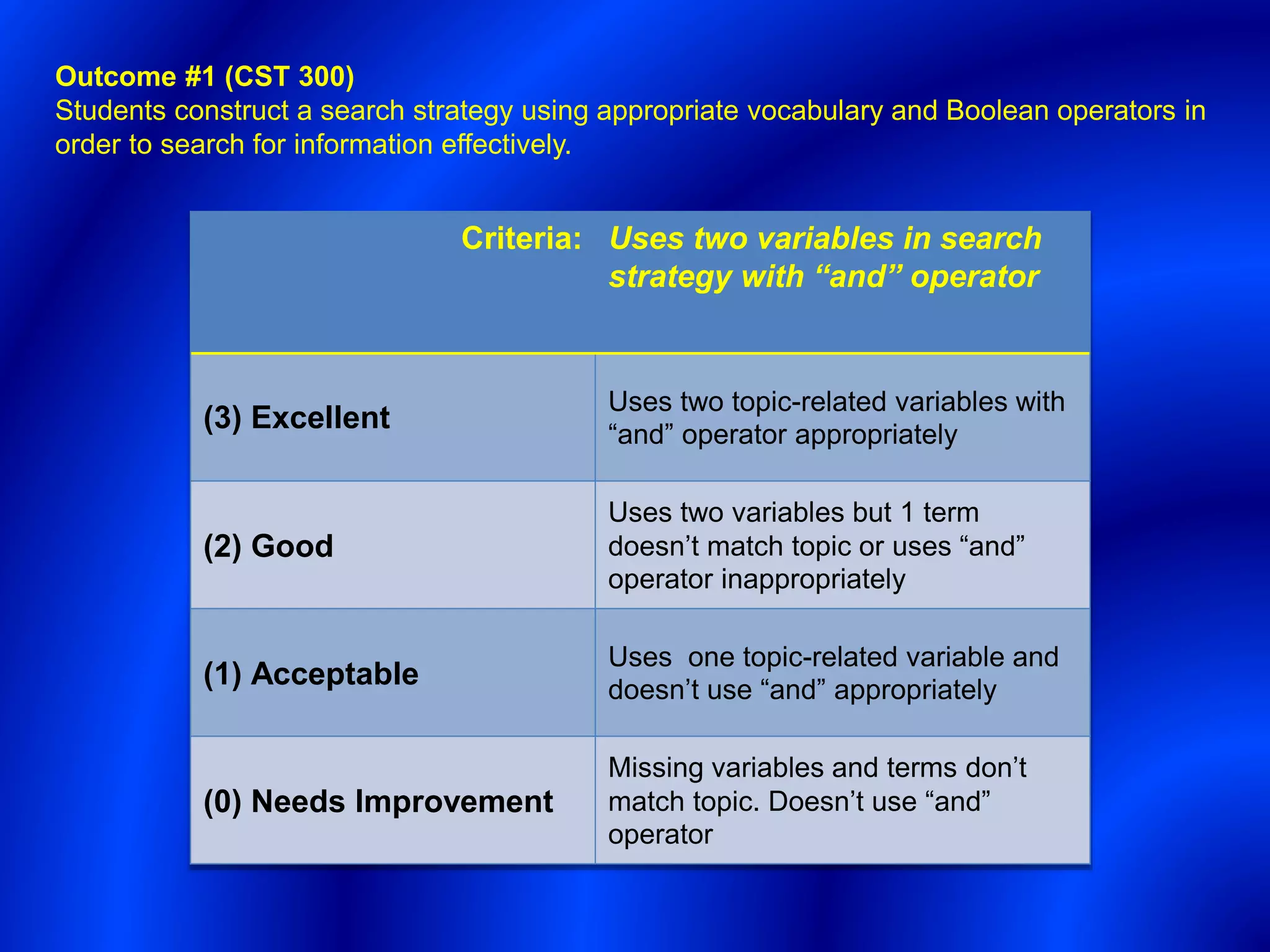
Outcome #1 (CST 300)
Students construct a search strategy using appropriate vocabulary and Boolean operators in
order to search for information effectively.
Criteria: Uses two variables in search
strategy with “and” operator
(3) Excellent
Uses two topic-related variables with
“and” operator appropriately
(2) Good
Uses two variables but 1 term
doesn’t match topic or uses “and”
operator inappropriately
(1) Acceptable
Uses one topic-related variable and
doesn’t use “and” appropriately
(0) Needs Improvement
Missing variables and terms don’t
match topic. Doesn’t use “and”
operator
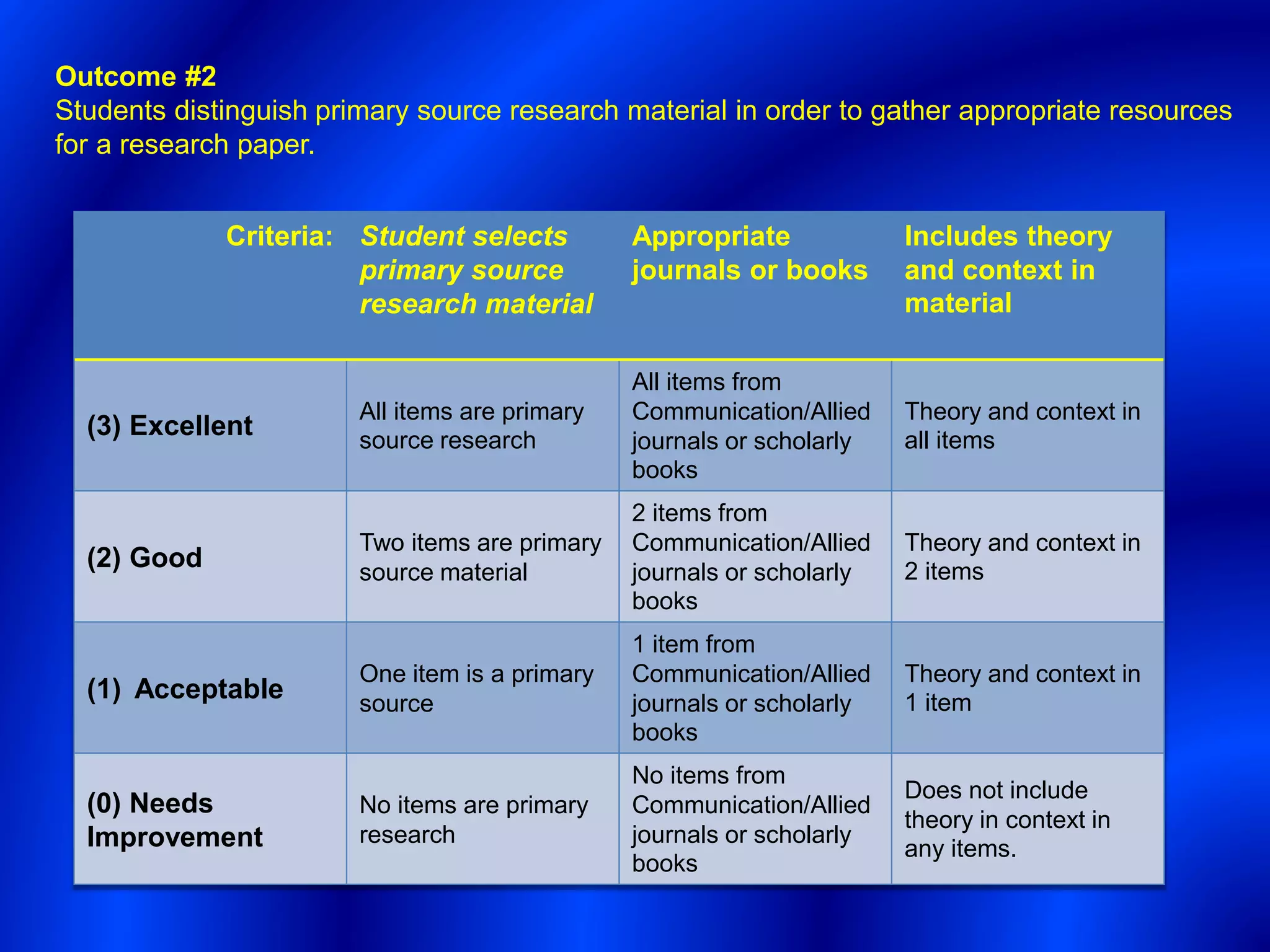
Outcome #2
Students distinguish primary source research material in order to gather appropriate resources
for a research paper.
Criteria: Student selects
primary source
research material
Appropriate
journals or books
Includes theory
and context in
material
(3) Excellent
All items are primary
source research
All items from
Communication/Allied
journals or scholarly
books
Theory and context in
all items
(2) Good
Two items are primary
source material
2 items from
Communication/Allied
journals or scholarly
books
Theory and context in
2 items
(1) Acceptable
One item is a primary
source
1 item from
Communication/Allied
journals or scholarly
books
Theory and context in
1 item
(0) Needs
Improvement
No items are primary
research
No items from
Communication/Allied
journals or scholarly
books
Does not include
theory in context in
any items.
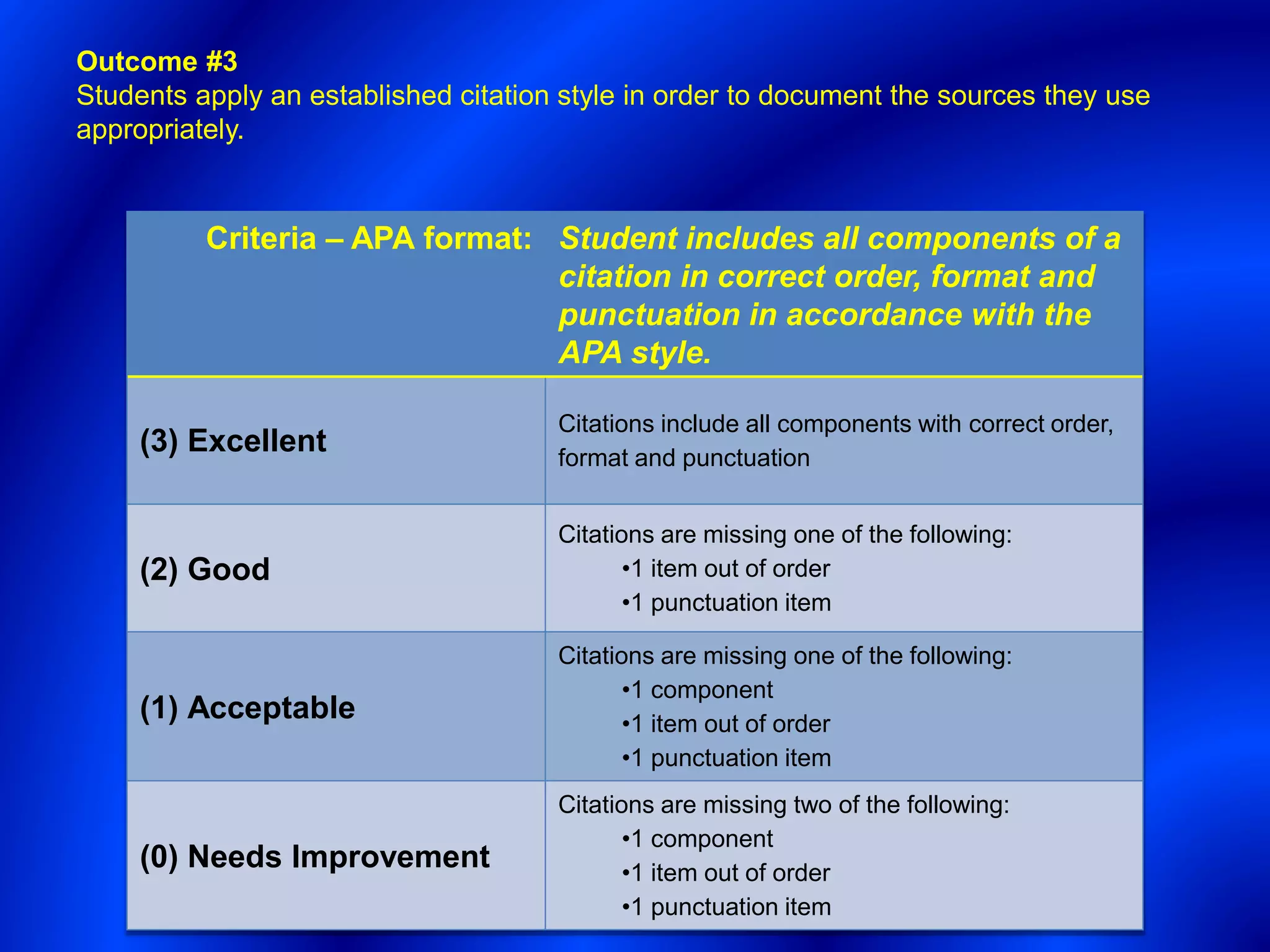
Outcome #3
Students apply an established citation style in order to document the sources they use
appropriately.
Criteria – APA format: Student includes all components of a
citation in correct order, format and
punctuation in accordance with the
APA style.
(3) Excellent
Citations include all components with correct order,
format and punctuation
(2) Good
Citations are missing one of the following:
•1 item out of order
•1 punctuation item
(1) Acceptable
Citations are missing one of the following:
•1 component
•1 item out of order
•1 punctuation item
(0) Needs Improvement
Citations are missing two of the following:
•1 component
•1 item out of order
•1 punctuation item
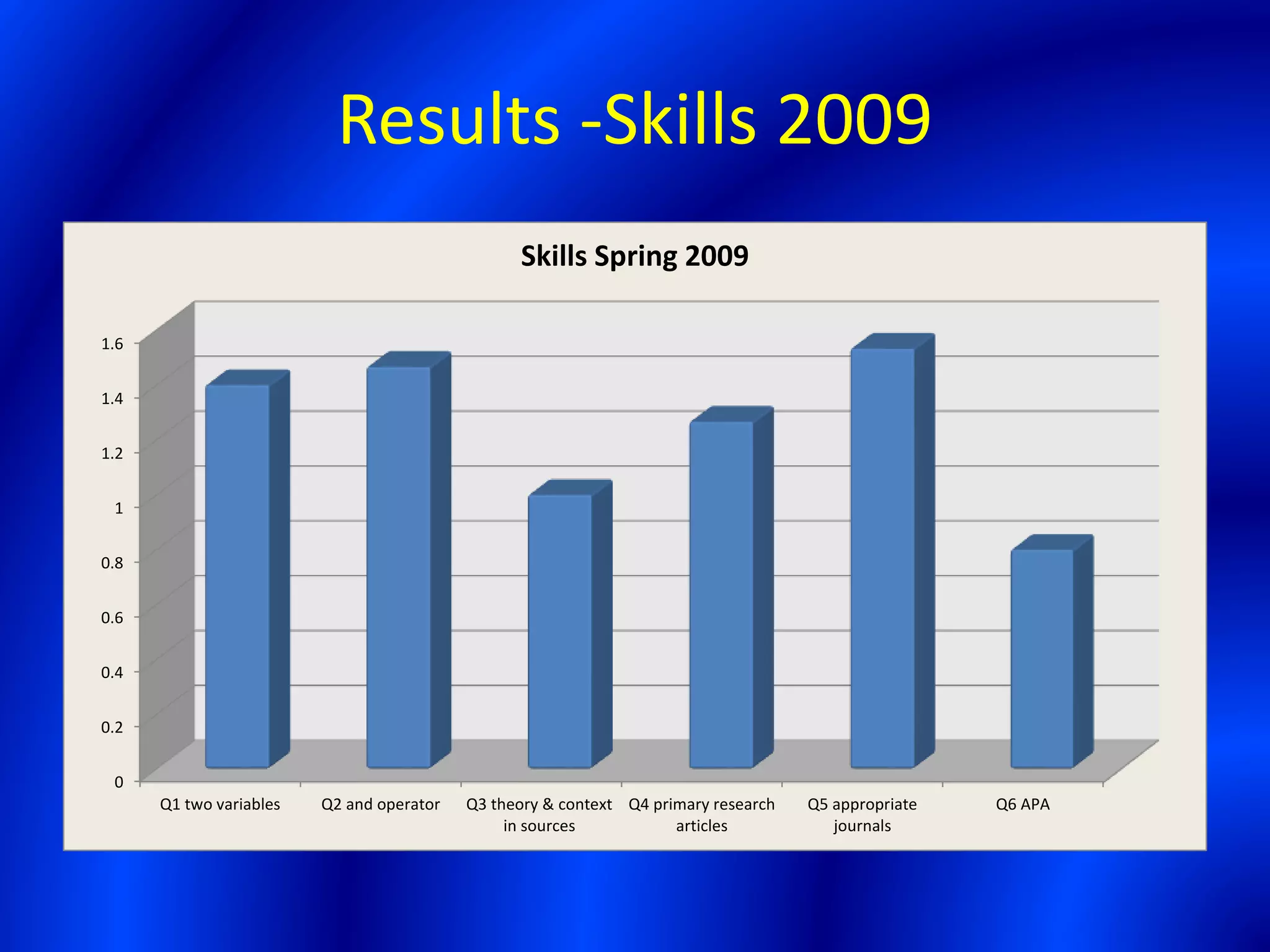
Results -Skills 2009
0
0.2
0.4
0.6
0.8
1
1.2
1.4
1.6
Q1 two variables Q2 and operator Q3 theory & context
in sources
Q4 primary research
articles
Q5 appropriate
journals
Q6 APA
Skills Spring 2009
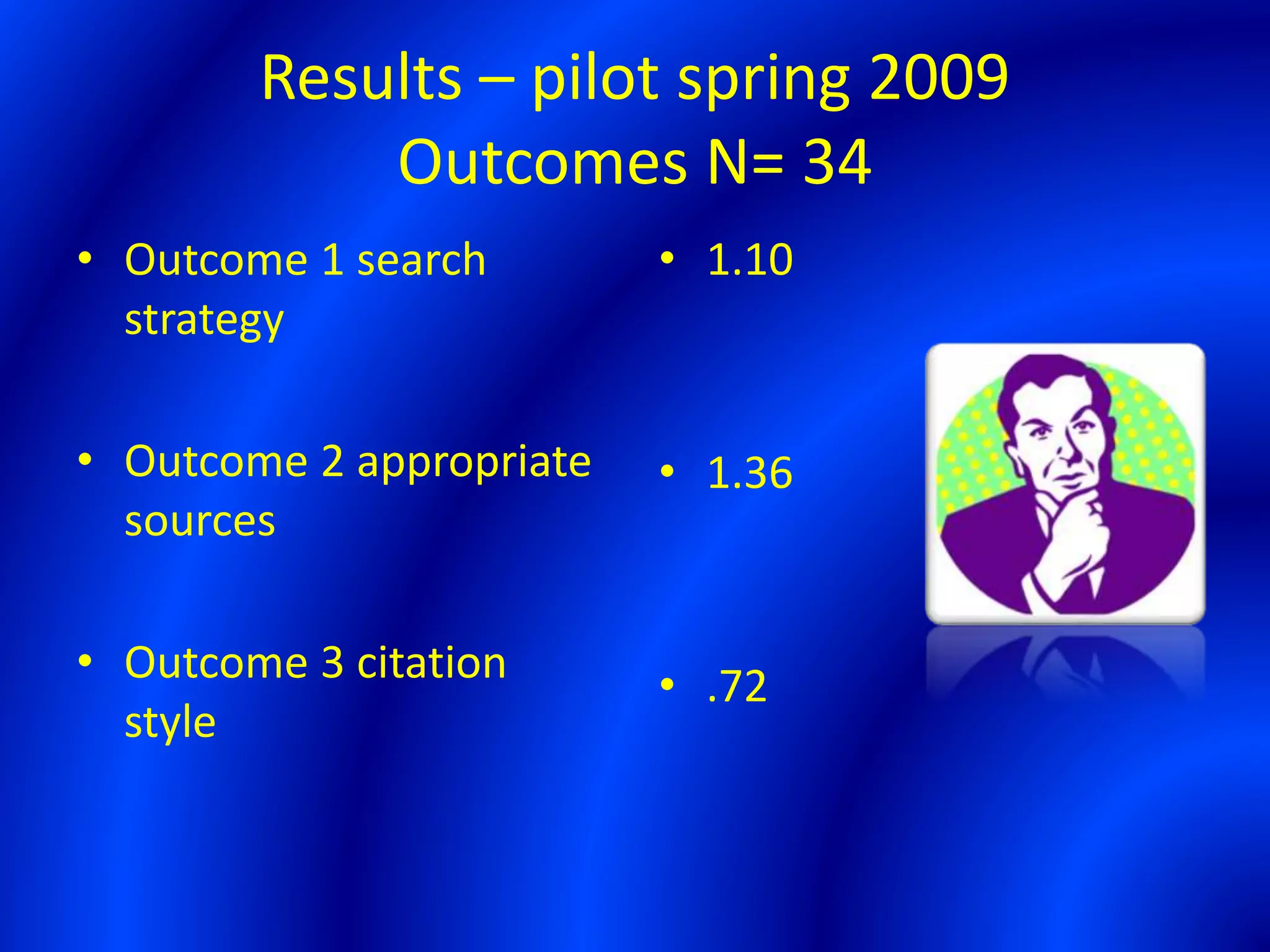
Results – pilot spring 2009
Outcomes N= 34
• Outcome 1 search
strategy
• Outcome 2 appropriate
sources
• Outcome 3 citation
style
• 1.10
• 1.36
• .72
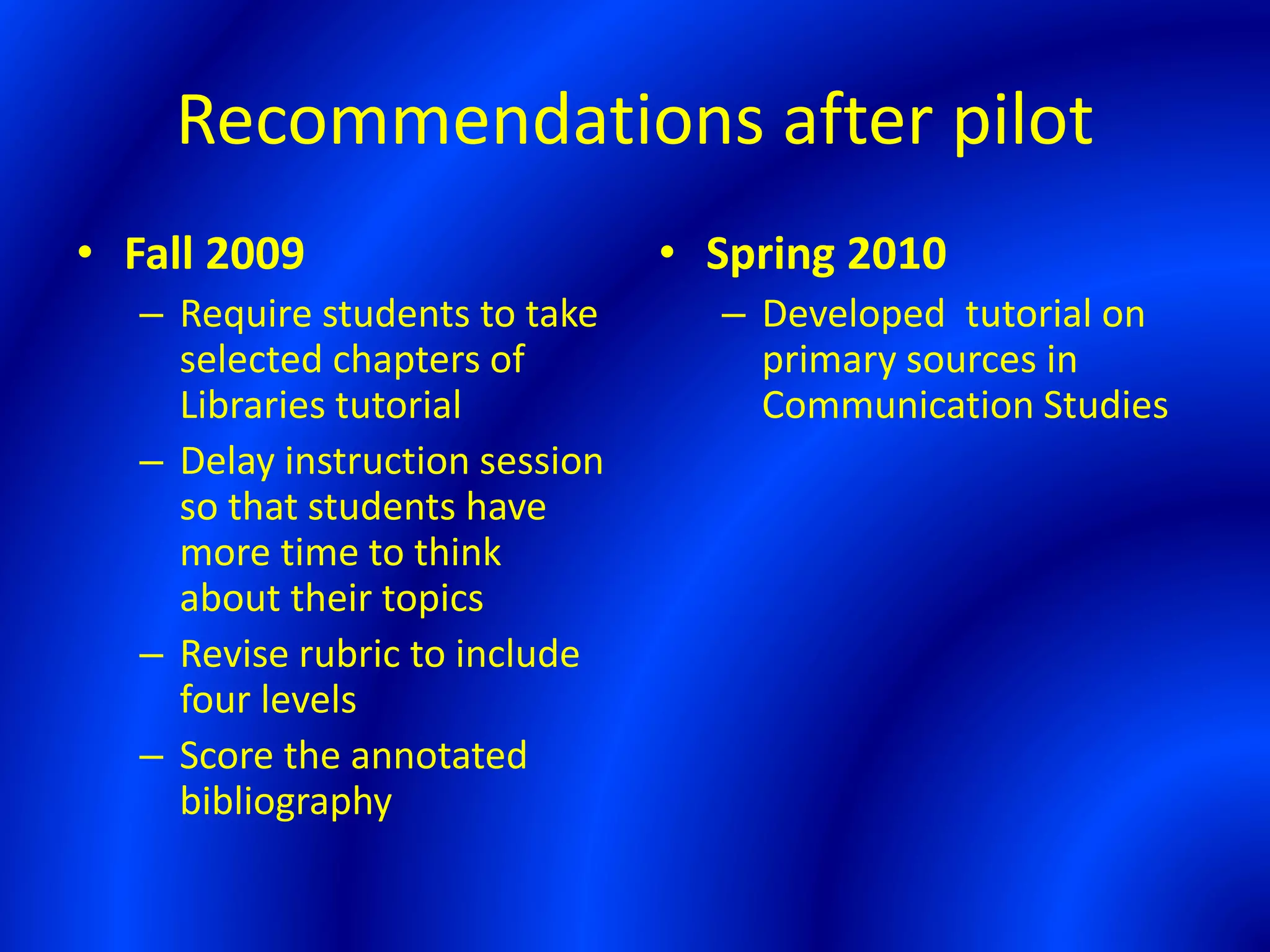
Recommendations after pilot
• Fall 2009
– Require students to take
selected chapters of
Libraries tutorial
– Delay instruction session
so that students have
more time to think
about their topics
– Revise rubric to include
four levels
– Score the annotated
bibliography
• Spring 2010
– Developed tutorial on
primary sources in
Communication Studies
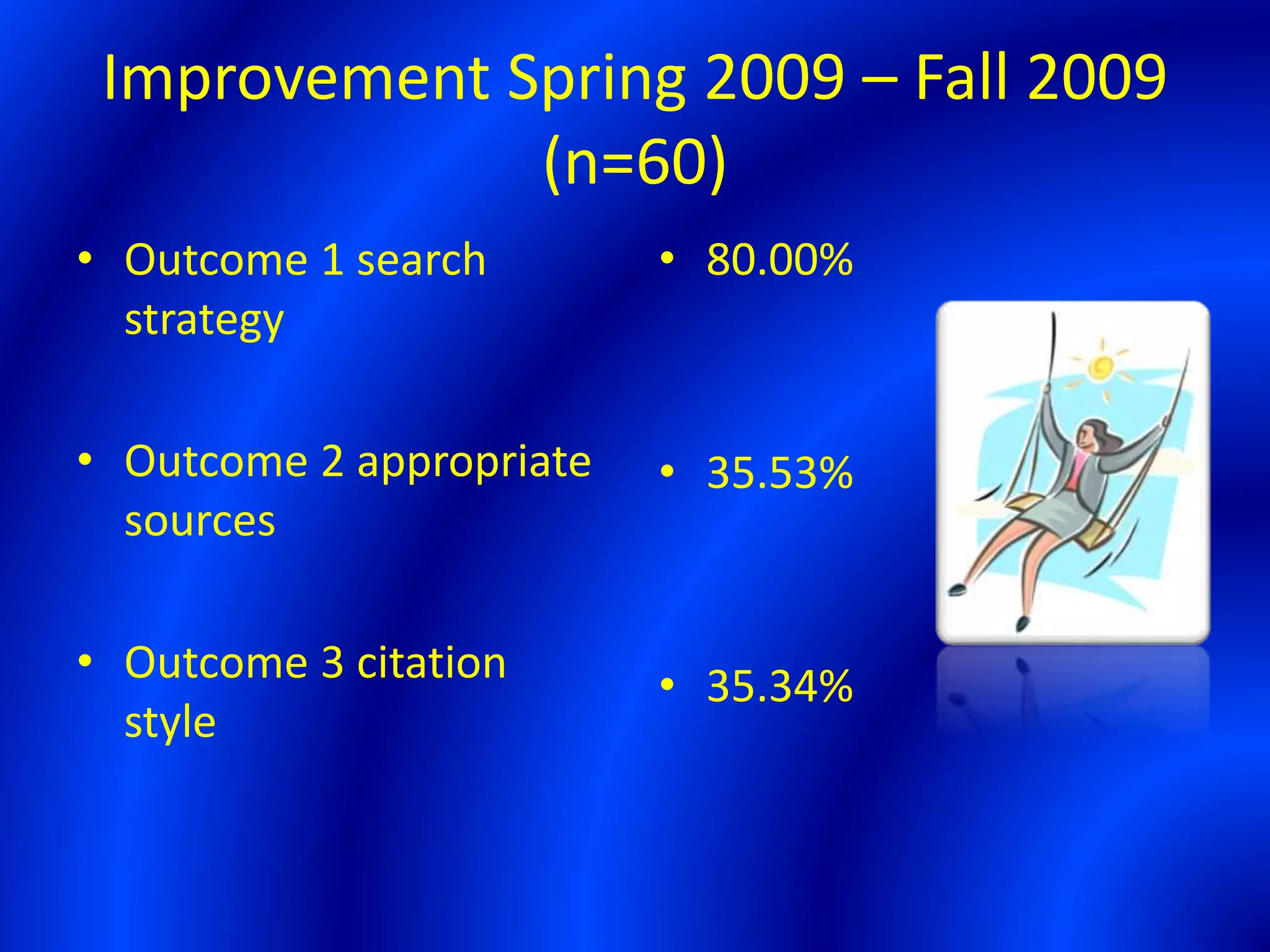
Improvement Spring 2009 – Fall 2009
(n=60)
• Outcome 1 search
strategy
• Outcome 2 appropriate
sources
• Outcome 3 citation
style
• 80.00%
• 35.53%
• 35.34%
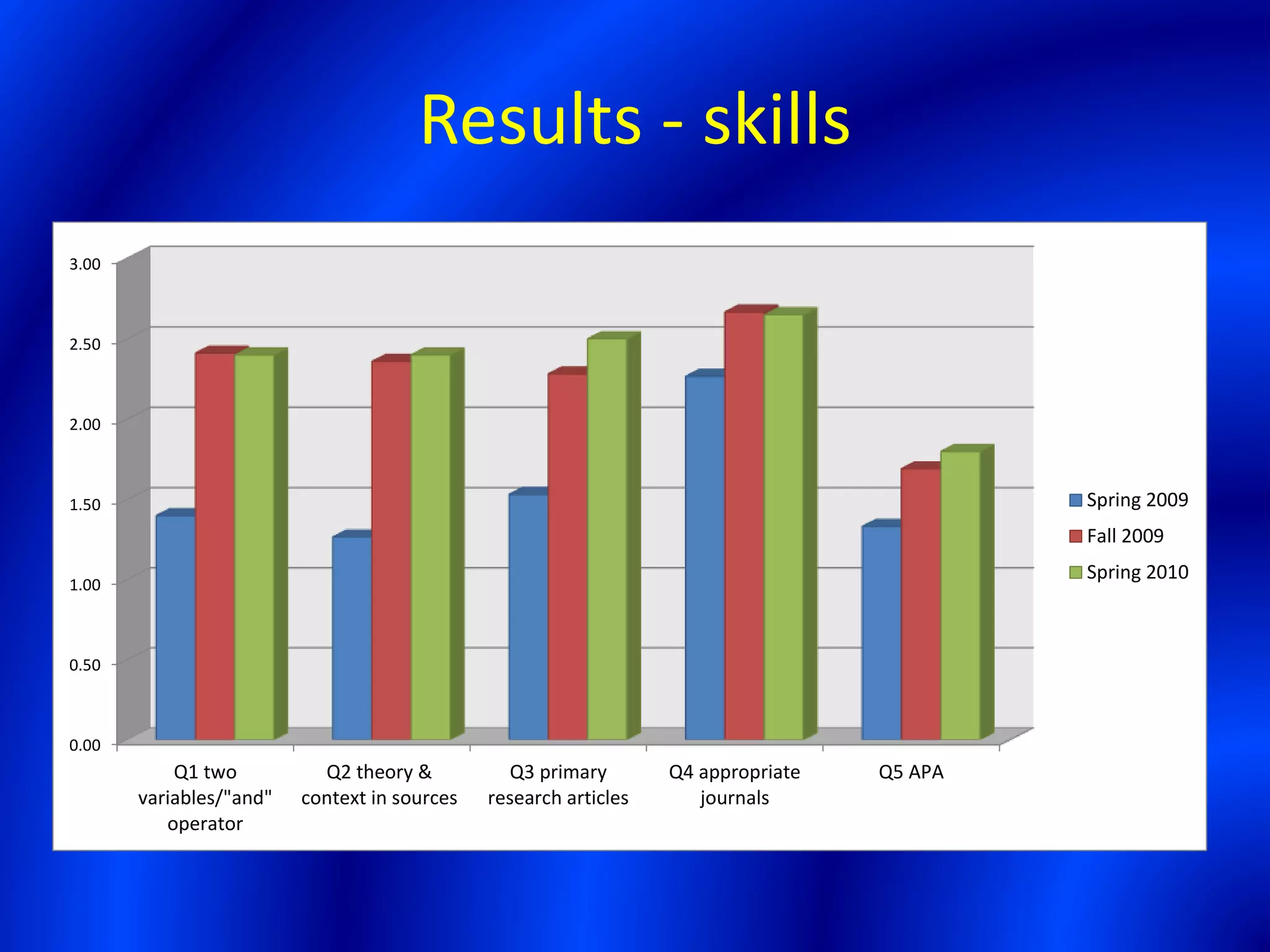
Results - skills
0.00
0.50
1.00
1.50
2.00
2.50
3.00
Q1 two
variables/"and"
operator
Q2 theory &
context in sources
Q3 primary
research articles
Q4 appropriate
journals
Q5 APA
Spring 2009
Fall 2009
Spring 2010
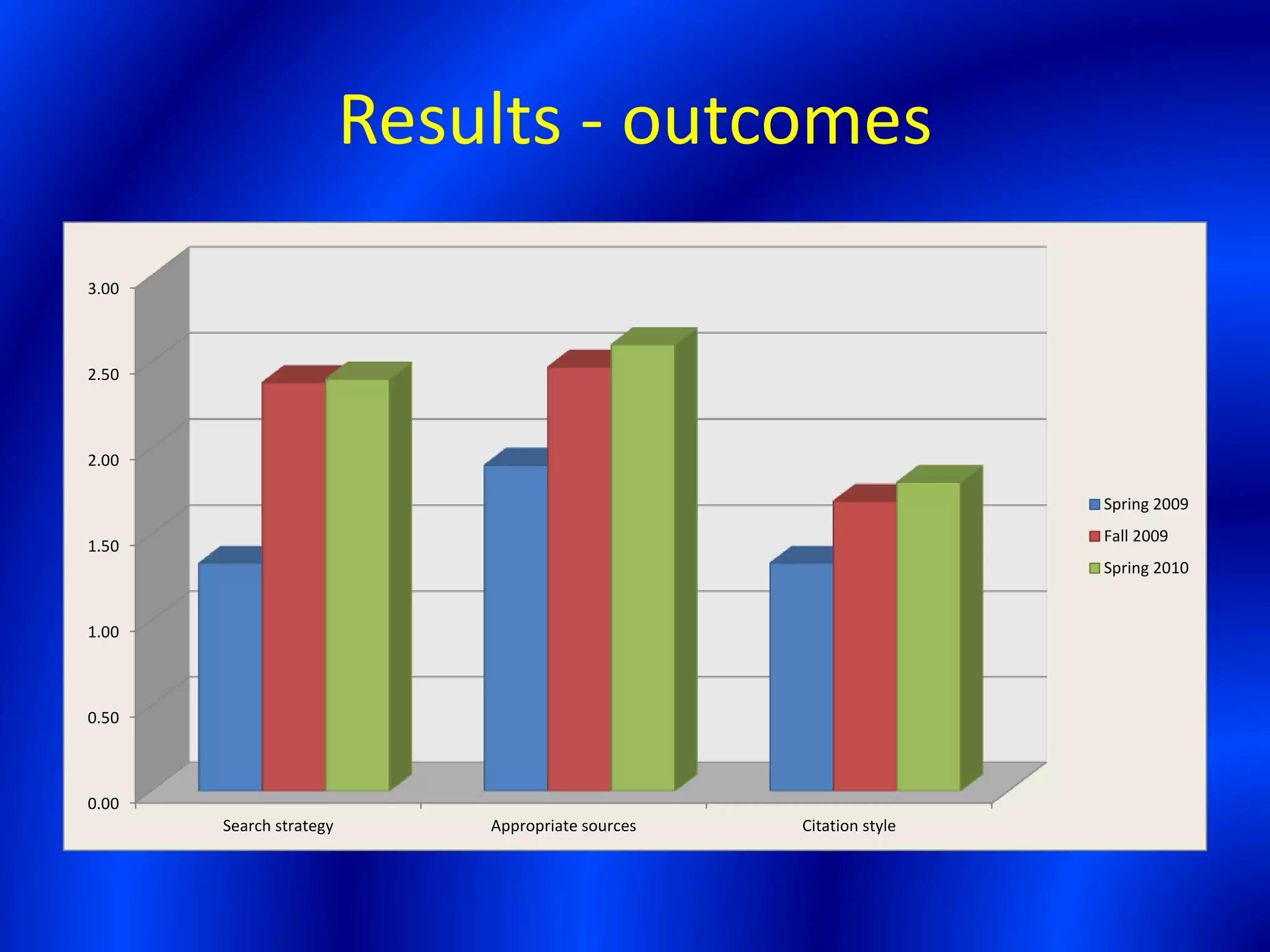
Results - outcomes
0.00
0.50
1.00
1.50
2.00
2.50
3.00
Search strategy Appropriate sources Citation style
Spring 2009
Fall 2009
Spring 2010
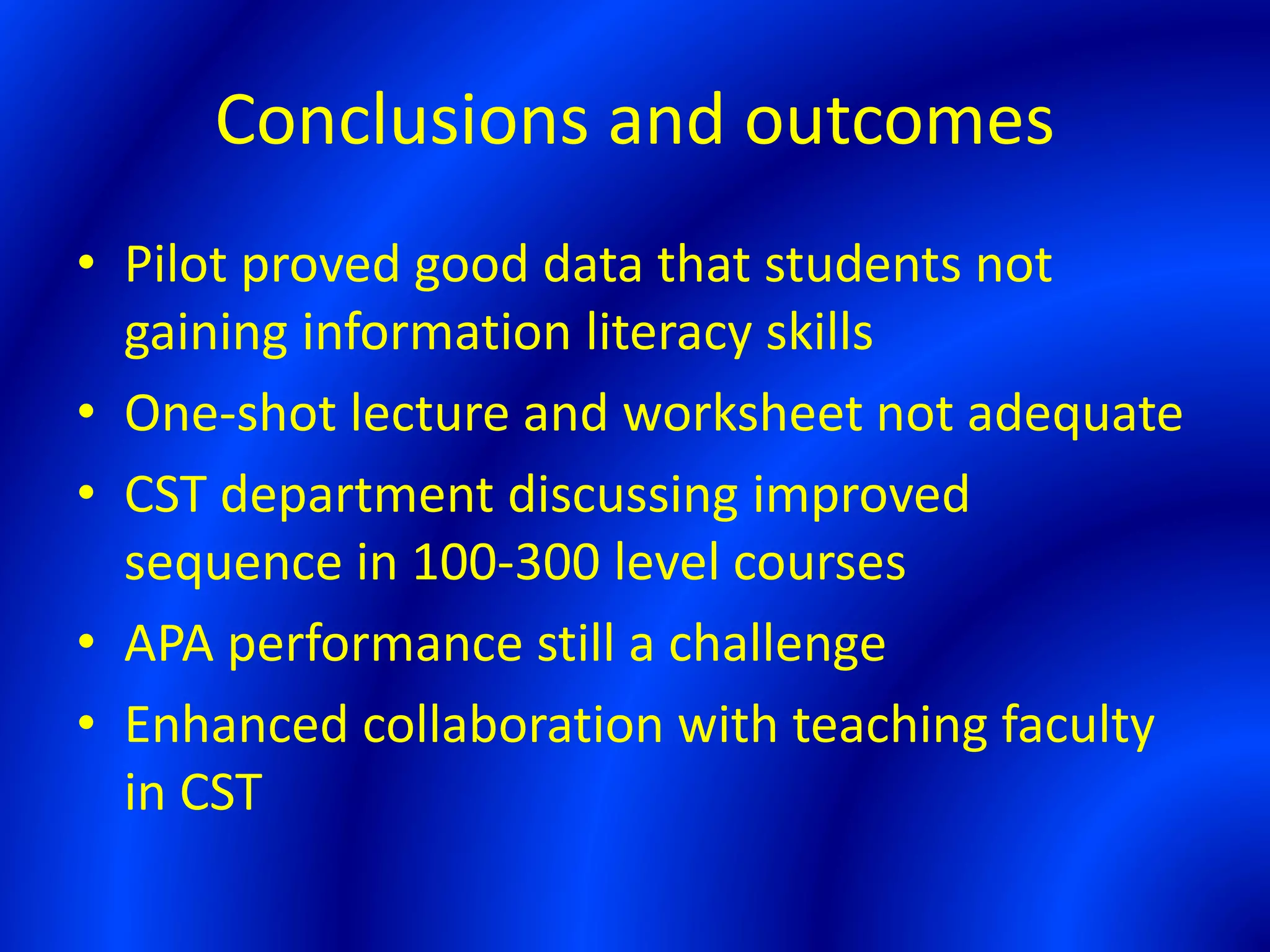
Conclusions and outcomes
• Pilot proved good data that students not
gaining information literacy skills
• One-shot lecture and worksheet not adequate
• CST department discussing improved
sequence in 100-300 level courses
• APA performance still a challenge
• Enhanced collaboration with teaching faculty
in CST
Challenges
• Devising rubric takes time
• Scoring worksheets takes time (about 7-10
minutes for each)
• Gaining evidence far outweighs challenges
Future plans
• Share rubric with students
• Use additional raters
• Expand use of rubrics among other instruction
librarians
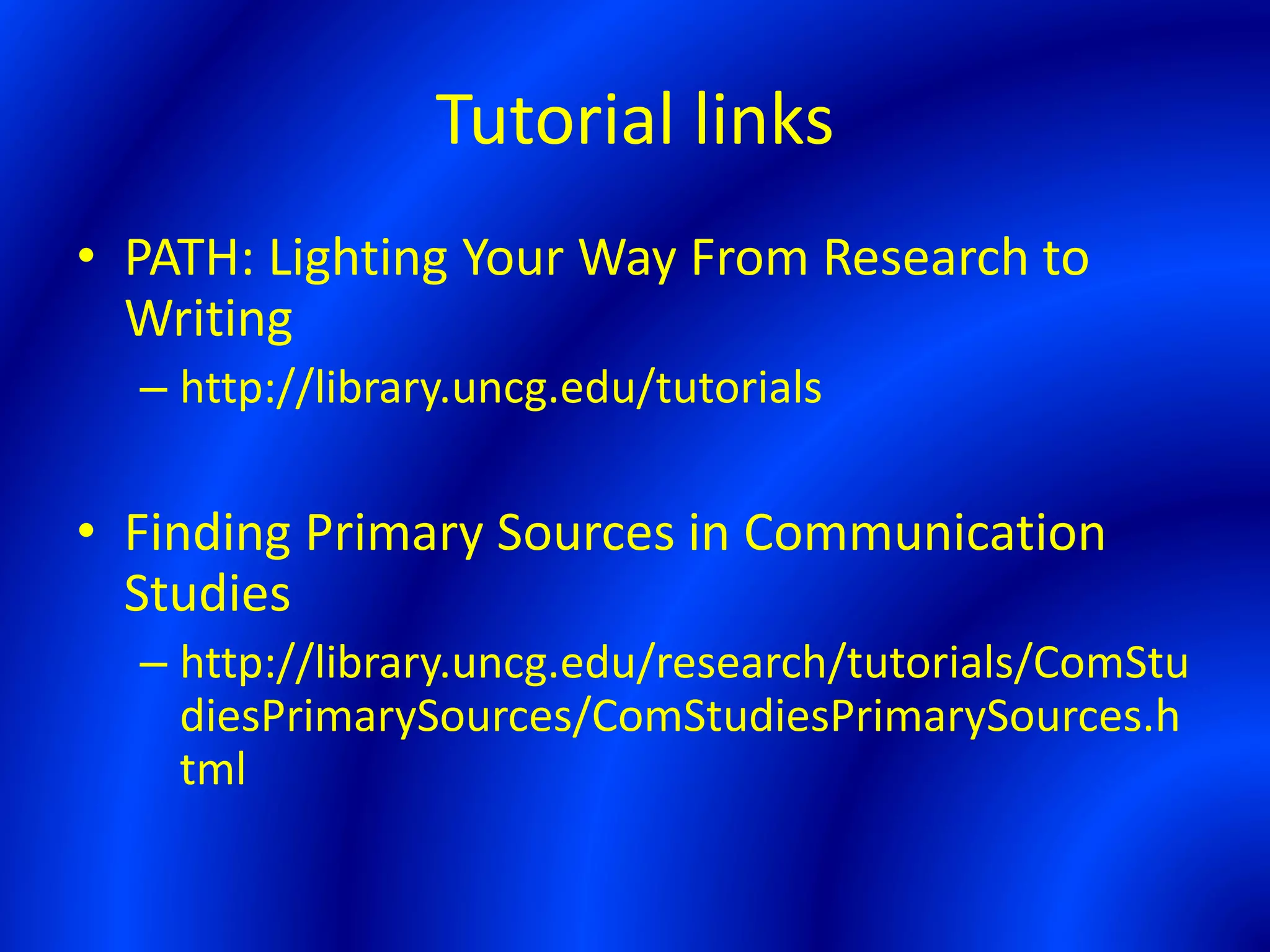
Tutorial links
• PATH: Lighting Your Way From Research to
Writing
– http://library.uncg.edu/tutorials
• Finding Primary Sources in Communication
Studies
– http://library.uncg.edu/research/tutorials/ComStu
diesPrimarySources/ComStudiesPrimarySources.h
tml
Questions and comments

Assessment = Improved Teaching and Learning: Using Rubrics to Measure Information Literacy Skills

  • 1.
    Assessment = ImprovedTeaching and Learning: Using Rubrics to Measure Information Literacy Skills Library Assessment Conference 2010 Kathy Crowe Associate Dean for Public Services
  • 2.
    University of NorthCarolina at Greensboro (UNCG) • Publicly supported • University of North Carolina system • High Research Activity • Carnegie classification of community engaged • Enrollment: 17,540 (16,090.25 FTE) • Undergraduate: 14,315 (13,583.25 FTE) • Graduate: 3,225 (2,507 FTE)
  • 3.
    University Libraries • JacksonLibrary and Music Library • 1.2 million book volumes • 37,000+ e-subscriptions • 500 databases • 95 faculty & staff
  • 4.
    Information literacy program •Long history of commitment to information literacy • Two positions devoted to information literacy • 524 classes 2009-10 • Online tutorial since 2000 • Information literacy game 2008
  • 5.
    Information literacy inthe curriculum at UNCG • Librarians serve on UNCG Faculty Senate committees • Information literacy included in one of core General Education learning goals: – Foundational skills: “Think critically, communicate effectively, and develop appropriate fundamental skills in quantitative and information literacies.”
  • 6.
    Information literacy assessment •Established student learning outcomes 2009 • Experimented with a variety of methods – pre and post tests, clickers, one minute papers, worksheets • Administered iSkills test Spring 2010
  • 7.
    Information literacy Assessment Fiveyear plan • Assess three student learning outcomes each year to form a baseline • Choose keywords that retrieve relevant information • Select relevant books, articles • Distinguish between scholarly and popular articles 2010-11 outcomes
  • 8.
    Assessment study • CommunicationStudies (CST 300) • Three semester study – Pilot Spring 2009 – Fall 2009 & Spring 2010
  • 9.
    CST 300 • CST300 (Communication Theory) required of all CST majors • Students required to write 8-10 pp paper using primary research articles • Long history of collaboration with the Library – Students attend library instruction session – Librarian prepares Lib Guide – Student complete worksheet
  • 10.
    CST 300 worksheet •Identify theory and context • Identify keywords and Boolean search • Identify 1 book or chapter • Identify 3 primary source articles • Use APA citation style
  • 11.
    Five questions (Gilchristand Zald) ACRL Information Literacy Assessment Immersion 1. Outcome What do you want the student to be able to do? 2. Curriculum What does the student need to know in order to do this well? 3. Pedagogy What type of instruction will best enable the learning? 4. Assessment How will the student demonstrate the learning? 5. Criteria for evaluation How will I know the student has done this well?
  • 12.
    Information literacy outcomes •Students construct a search strategy using appropriate vocabulary and Boolean operators in order to search for information effectively • Students distinguish primary source journal articles in order to gather appropriate resources for a research paper • Students apply an established citation style in order to document the sources they use appropriately.
  • 13.
    Course outcome forinformation literacy • Apply a working knowledge of information literacy as a tool for scholarship in communication studies including APA style for professional writing , library search techniques and use of primary sources (journal articles and other research publications)
  • 14.
    Curriculum and Pedagogy •Students attended class session by a librarian • Completed worksheet (revised to match outcomes) • Using encyclopedias and texts to help choose relevant vocabulary • Using Boolean operators • Library catalog • Selecting and using databases • Scholarly vs. popular articles • Primary source articles • Communication Studies journals • APA handout
  • 15.
    Assessment • Developed arubric to score library worksheet
  • 16.
    Outcome #1 (CST300) Students construct a search strategy using appropriate vocabulary and Boolean operators in order to search for information effectively. Criteria: Uses two variables in search strategy with “and” operator (3) Excellent Uses two topic-related variables with “and” operator appropriately (2) Good Uses two variables but 1 term doesn’t match topic or uses “and” operator inappropriately (1) Acceptable Uses one topic-related variable and doesn’t use “and” appropriately (0) Needs Improvement Missing variables and terms don’t match topic. Doesn’t use “and” operator
  • 17.
    Outcome #2 Students distinguishprimary source research material in order to gather appropriate resources for a research paper. Criteria: Student selects primary source research material Appropriate journals or books Includes theory and context in material (3) Excellent All items are primary source research All items from Communication/Allied journals or scholarly books Theory and context in all items (2) Good Two items are primary source material 2 items from Communication/Allied journals or scholarly books Theory and context in 2 items (1) Acceptable One item is a primary source 1 item from Communication/Allied journals or scholarly books Theory and context in 1 item (0) Needs Improvement No items are primary research No items from Communication/Allied journals or scholarly books Does not include theory in context in any items.
  • 18.
    Outcome #3 Students applyan established citation style in order to document the sources they use appropriately. Criteria – APA format: Student includes all components of a citation in correct order, format and punctuation in accordance with the APA style. (3) Excellent Citations include all components with correct order, format and punctuation (2) Good Citations are missing one of the following: •1 item out of order •1 punctuation item (1) Acceptable Citations are missing one of the following: •1 component •1 item out of order •1 punctuation item (0) Needs Improvement Citations are missing two of the following: •1 component •1 item out of order •1 punctuation item
  • 19.
    Results -Skills 2009 0 0.2 0.4 0.6 0.8 1 1.2 1.4 1.6 Q1two variables Q2 and operator Q3 theory & context in sources Q4 primary research articles Q5 appropriate journals Q6 APA Skills Spring 2009
  • 20.
    Results – pilotspring 2009 Outcomes N= 34 • Outcome 1 search strategy • Outcome 2 appropriate sources • Outcome 3 citation style • 1.10 • 1.36 • .72
  • 21.
    Recommendations after pilot •Fall 2009 – Require students to take selected chapters of Libraries tutorial – Delay instruction session so that students have more time to think about their topics – Revise rubric to include four levels – Score the annotated bibliography • Spring 2010 – Developed tutorial on primary sources in Communication Studies
  • 22.
    Improvement Spring 2009– Fall 2009 (n=60) • Outcome 1 search strategy • Outcome 2 appropriate sources • Outcome 3 citation style • 80.00% • 35.53% • 35.34%
  • 23.
    Results - skills 0.00 0.50 1.00 1.50 2.00 2.50 3.00 Q1two variables/"and" operator Q2 theory & context in sources Q3 primary research articles Q4 appropriate journals Q5 APA Spring 2009 Fall 2009 Spring 2010
  • 24.
    Results - outcomes 0.00 0.50 1.00 1.50 2.00 2.50 3.00 Searchstrategy Appropriate sources Citation style Spring 2009 Fall 2009 Spring 2010
  • 25.
    Conclusions and outcomes •Pilot proved good data that students not gaining information literacy skills • One-shot lecture and worksheet not adequate • CST department discussing improved sequence in 100-300 level courses • APA performance still a challenge • Enhanced collaboration with teaching faculty in CST
  • 26.
    Challenges • Devising rubrictakes time • Scoring worksheets takes time (about 7-10 minutes for each) • Gaining evidence far outweighs challenges
  • 27.
    Future plans • Sharerubric with students • Use additional raters • Expand use of rubrics among other instruction librarians
  • 28.
    Tutorial links • PATH:Lighting Your Way From Research to Writing – http://library.uncg.edu/tutorials • Finding Primary Sources in Communication Studies – http://library.uncg.edu/research/tutorials/ComStu diesPrimarySources/ComStudiesPrimarySources.h tml
  • 29.