Cell cycle and mitosis of human cells. How cell gets ready itself for division?
The phases of the cycle. The phases of mitotic division. What is the Go?
Prophase, metaphase, prometaphase, anaphase, telophase, cytokinesis.
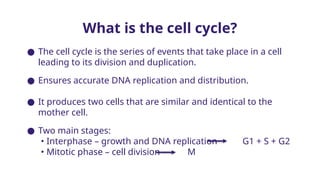
What is thecell cycle?
● The cell cycle is the series of events that take place in a cell
leading to its division and duplication.
● Ensures accurate DNA replication and distribution.
● It produces two cells that are similar and identical to the
mother cell.
● Two main stages:
• Interphase – growth and DNA replication G1 + S + G2
• Mitotic phase – cell division M
Cell Cycle stages
Itincludes Interphase and Mitosis and
the stages is:
● G₁ phase: Cell grows and prepares
proteins for DNA synthesis.
● S phase: DNA is replicated.
● G₂ phase: Cell prepares for mitosis.
● M phase: Mitosis and cytokinesis occur.
🌀The cycle then repeats as the cell divides
into two daughter cells.
7.
Go?!
In many tissuesterminally differentiated cells exit the cell
cycle and do not reinitiate DNA synthesis or cell division (Go).
Cells remain metabolically active and viable, some cells enter
G0 temporarily and then reenter cell cycle when the body
need.
(e.g. liver cells)
Overview of Mitosis
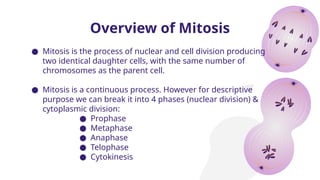
●Mitosis is the process of nuclear and cell division producing
two identical daughter cells, with the same number of
chromosomes as the parent cell.
● Mitosis is a continuous process. However for descriptive
purpose we can break it into 4 phases (nuclear division) &
cytoplasmic division:
● Prophase
● Metaphase
● Anaphase
● Telophase
● Cytokinesis
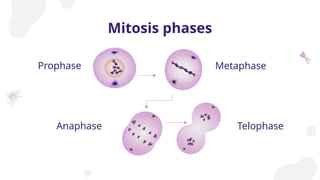
Mitosis Phases
● Prophase:Chromosomes condense; spindle forms.
● Metaphase: Chromosomes line up in the middle and
spindle fibers hold the chromosomes by the Kinetochore
● Anaphase: Sister chromatids separate to opposite poles.
● Telophase: Nuclear membranes reform; chromosomes de-
condense.
● Cytokinesis: Cytoplasm divides, forming two new cells.
12.
Importance of theM phase
Phase Description
Prophase Chromatin condenses into visible chromosomes, the nuclear envelope breaks
down, and the mitotic spindle forms
Prometaphase The chromosomes attach to the spindle fibers and begin to move towards the
center of the cell
Metaphase The chromosomes align at the equator of the cell, forming the metaphase plate
Anaphase The sister chromatids separate and move towards opposite poles of the cell
Telophase The chromosomes reach the poles of the cell, the nuclear envelope reforms, and
the chromosomes begin to decondense
Cytokinesis The cytoplasm divides, resulting in two daughter cells with identical genetic
material
Summary
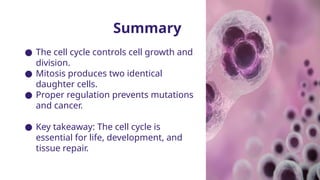
● The cellcycle controls cell growth and
division.
● Mitosis produces two identical
daughter cells.
● Proper regulation prevents mutations
and cancer.
● Key takeaway: The cell cycle is
essential for life, development, and
tissue repair.