Plant Mitochondrial
Omics
ANANDA LEKSHMI L
2020608005
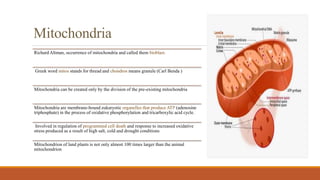
Mitochondria
Richard Altman, occurrence of mitochondria and called them bioblast.
Greek word mitos stands for thread and chondros means granule (Carl Benda )
Mitochondria can be created only by the division of the pre-existing mitochondria
Mitochondria are membrane-bound eukaryotic organelles that produce ATP (adenosine
triphosphate) in the process of oxidative phosphorylation and tricarboxylic acid cycle.
Involved in regulation of programmed cell death and response to increased oxidative
stress produced as a result of high salt, cold and drought conditions
Mitochondrion of land plants is not only almost 100 times larger than the animal
mitochondrion
Mitochondrial DNA
Circular (linear in some fungi and protozoa)
Double stranded
Supercoiled
No histones
Multiple copies located in nucleoids
Contain DNA which codes for mitochondrial proteins, ribosomes, etc.
Divide by a process similar to binary fission when cell divides
Intramolecular recombination leading to the
formation of smaller mtDNA molecules
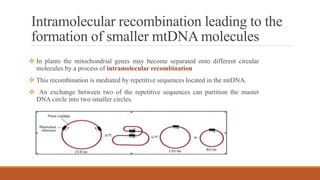
 In plants the mitochondrial genes may become separated onto different circular
molecules by a process of intramolecular recombination
 This recombination is mediated by repetitive sequences located in the mtDNA.
 An exchange between two of the repetitive sequences can partition the master
DNA circle into two smaller circles.
Maize Mitochondrial Genome
Transcriptional Regulation and Transcriptome
Only one type of RNA
polymerase, i.e. nuclear-
encoded RNA polymerase is
responsible for transcription of
plant chondrion.
NEP, a single protein 110-kDa
enzyme is encoded by nuclear
RpoT (RNA polymerase of the
T-phage type) genes and does
not require nuclear-encoded
sigma-like factors for promoter
specificity and identification
They are highly conserved
(Hess and Borner 1999 ;
McAllister 1993 )
NEP recognizes consensus
sequences localized in close
proximity of translation
initiation sites
Transcription in plant
mitochondria is loosely
regulated and has minimal role
in tissue-specific and
developmental stage-specific
regulation of steady-state level
of RNA
Post-transcriptional regulation
is proposed to play an important
role to maintain different tissue-
specific steady-state levels of
mtRNA
Post-Transcriptional Regulation
Regulate gene expression
which are involved in
oxidative phosphorelation
Mito- omics (mitochondrial
genetic system ) are regulated
in complex manner
Co -Transcriptionally or
post- transcriptionallly
processed, spliced and edited
prior to translation
Presence of similar gene
content and high conservation
of gene and intron sequnce
RNA Splicing and Translational Machinery
 Contain higher-order conserved
structures required splicing​
 Act as ribozyme, i.e. self-splice
 Act as retro-elements​
 Group I introns encode homing
DNA endonuclease​
 Group II introns encode
reverse transcriptase
 Own translation machinery composed
of ribosomes - mitoribosomes
 Proteins ( nuclear and mitochondrial
genomes) and ribosomal RNA (rRNA
transcribed from mitochondrion)
 Two subunits, (80 protiens)
 large subunit (LSU) - 42
 small subunit (SSU) - 24
Mitochondrial Proteomics
Diversity of mitochondrial functions - mitochondrial proteome may contain thousands
of proteins
 Identification and functional attribution to each protein of mitochondrial proteome is
of prime importance
Although mitochondria have their own genome, only a few proteins are encoded by it
Majority of proteins are encoded by nucleus and then transported into mitochondria by
complex protein import machinery
Proteins are imported into mitochondria through multi-subunit protein complexes
called as translocases
 Proteins are translated into the cytosol - recognized by the protein import complex
and transported into mitochondria
This specific recognition of proteins depends on the presence of N-terminal targeting
sequence termed as presequence
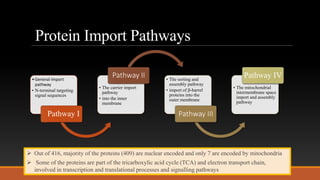
Protein Import Pathways
•General import
pathway
• N-terminal targeting
signal sequences
Pathway I
• The carrier import
pathway
• into the inner
membrane
Pathway II • The sorting and
assembly pathway
• import of β-barrel
proteins into the
outer membrane
Pathway III
• The mitochondrial
intermembrane space
import and assembly
pathway
Pathway IV
 Out of 416, majority of the proteins (409) are nuclear encoded and only 7 are encoded by mitochondria
 Some of the proteins are part of the tricarboxylic acid cycle (TCA) and electron transport chain,
involved in transcription and translational processes and signalling pathways
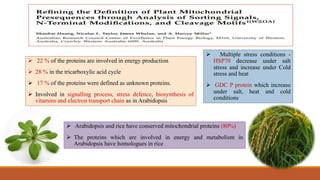
Study on arabidopsis
 22 % of the proteins are involved in energy production
 28 % in the tricarboxylic acid cycle
 17 % of the proteins were defined as unknown proteins.
 Involved in signalling process, stress defence, biosynthesis of
vitamins and electron transport chain as in Arabidopsis
 Arabidopsis and rice have conserved mitochondrial proteins (80%)
 The proteins which are involved in energy and metabolism in
Arabidopsis have homologues in rice
 Multiple stress conditions -
HSP70 decrease under salt
stress and increase under Cold
stress and heat
 GDC P protein which increase
under salt, heat and cold
conditions
Mitochondrial Energy Metabolomics
The eukaryotic cell came into existence as a result of an endosymbiotic association of unique energy-producing bacteria and a proto- eukaryotic
cell
Host cell provided physical space and materials to the bacterium, which supplied energy to the host
During the evolution of this symbiotic relationship, the bacterium transferred many of its genes
The mitochondrial genome controls many essential functions to meet energy requirement of cells
The most important among these functions are
(1) OXPHOS (oxidative phosphorylation)
(2) Production of most of the cell’s ROS
(3) Regulation of apoptosis
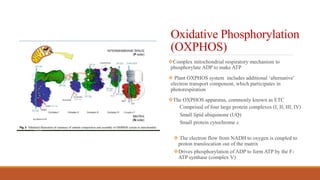
Oxidative Phosphorylation
(OXPHOS)
Complex mitochondrial respiratory mechanism to
phosphorylate ADP to make ATP
 Plant OXPHOS system includes additional ‘alternative’
electron transport component, which participates in
photorespiration
The OXPHOS apparatus, commonly known as ETC
 Comprised of four large protein complexes (I, II, III, IV)
 Small lipid ubiquinone (UQ)
 Small protein cytochrome c
 The electron flow from NADH to oxygen is coupled to
proton translocation out of the matrix
Drives phosphorylation of ADP to form ATP by the F-
ATP synthase (complex V)
Crosstalk Between Organelles: Anterograde and
Retrograde
Anterograde regulatory
mechanism :
Coordinates gene expression in
chloroplasts and mitochondria
and is responsive to endogenous
and environmental signals
perceived by the nucleus.
Retrograde signalling :
Regulates the expression
of nuclear organelle genes
in response to the metabolic and
developmental state of the
organelle
Crosstalk
Between
Chloroplast
and
Mitochondria
Metabolically interdependent -
 photosynthesis provides substrates for mitochondrial
respiration
chloroplast depends on a range of compounds synthesized
by mitochondria
Mitochondrial respiration protects photosynthesis against
photo-inhibition by dissipating redox equivalents exported from
the chloroplasts
Specifi c mitochondrial proteins glycine decarboxylase (gdc)
have effects on chloroplast
 lowered glycine decarboxylase activity and are impaired in
photorespiration
leading to an over-reduction and over energization of the
chloroplast
Autophagy
Autophagy is a regulatory mechanism just before commitment stage for PCD
In absence of autophagy plants experience an accelerated senescence and appear more sensitive to chronic oxidative stress
Autophagy deficient plants undergo premature senescence - inability to clean up toxic cellular components, such as damaged
mitochondria
The role autophagy in plant defence responses against invading pathogens reported that autophagy-deficient plants underwent
an uncontrolled hypersensitive response (HR) after infection with avirulent pathogen
The lesion that normally remains localized to the point of infection instead spread throughout the leaf and killed it
Autophagy is considered as pro-survival mechanism against acute stress and oxidative stress
Direct application of H2O2 can induce autophagic cell death in plants - as mitochondria are one of the main locations in plant
cells for the production of ROS - directly initiate autophagic cell death
Applications of Plant Mito-Omics
The mitochondrial uniqueness in various mechanisms and essentiality for
cellular survival keep them in the centre of cellular metabolism alike in plant
and animal world
The mitochondrial complexes are the central hub for oxygen utilization in cell,
and during the process, oxygen free radicals are generated, which is the leading
cause of cellular damage.
mitochondria have strong antioxidant machinery to get rid of oxygen free
radicals and help to prolong the life of cell as a unit and organism as whole
system
It has been clearly shown that the mitochondria are instrumental in redox and
ROS signalling under abiotic and biotic stresses in plant
The mechanism to modulate the mito-omics to enhance stress tolerance and/or
resistance still has to be established
REFERENCE
◦ Refining the Definition of Plant Mitochondrial Presequences through Analysis
of Sorting Signals, N-Terminal Modifications, and Cleavage Motifs -Shaobai
Huang, Nicolas L. Taylor, James Whelan, and A. Harvey Millar
◦ Plant Mitochondrial Omics: State-of- the-Art Knowledge Mustafa Malik
Ghulam , Sumaira Kousar , and Harsh Vardhan
◦ Plant Mitochondria- DAVID C. LOGAN School of Biology University of St
Andrews St Andrews Scotland UK
THANK YOU FOR LISTENING...

Mitochondrial omics

  • 1.
  • 2.
    Mitochondria Richard Altman, occurrenceof mitochondria and called them bioblast. Greek word mitos stands for thread and chondros means granule (Carl Benda ) Mitochondria can be created only by the division of the pre-existing mitochondria Mitochondria are membrane-bound eukaryotic organelles that produce ATP (adenosine triphosphate) in the process of oxidative phosphorylation and tricarboxylic acid cycle. Involved in regulation of programmed cell death and response to increased oxidative stress produced as a result of high salt, cold and drought conditions Mitochondrion of land plants is not only almost 100 times larger than the animal mitochondrion
  • 3.
    Mitochondrial DNA Circular (linearin some fungi and protozoa) Double stranded Supercoiled No histones Multiple copies located in nucleoids Contain DNA which codes for mitochondrial proteins, ribosomes, etc. Divide by a process similar to binary fission when cell divides
  • 4.
    Intramolecular recombination leadingto the formation of smaller mtDNA molecules  In plants the mitochondrial genes may become separated onto different circular molecules by a process of intramolecular recombination  This recombination is mediated by repetitive sequences located in the mtDNA.  An exchange between two of the repetitive sequences can partition the master DNA circle into two smaller circles.
  • 5.
  • 6.
    Transcriptional Regulation andTranscriptome Only one type of RNA polymerase, i.e. nuclear- encoded RNA polymerase is responsible for transcription of plant chondrion. NEP, a single protein 110-kDa enzyme is encoded by nuclear RpoT (RNA polymerase of the T-phage type) genes and does not require nuclear-encoded sigma-like factors for promoter specificity and identification They are highly conserved (Hess and Borner 1999 ; McAllister 1993 ) NEP recognizes consensus sequences localized in close proximity of translation initiation sites Transcription in plant mitochondria is loosely regulated and has minimal role in tissue-specific and developmental stage-specific regulation of steady-state level of RNA Post-transcriptional regulation is proposed to play an important role to maintain different tissue- specific steady-state levels of mtRNA
  • 7.
    Post-Transcriptional Regulation Regulate geneexpression which are involved in oxidative phosphorelation Mito- omics (mitochondrial genetic system ) are regulated in complex manner Co -Transcriptionally or post- transcriptionallly processed, spliced and edited prior to translation Presence of similar gene content and high conservation of gene and intron sequnce
  • 8.
    RNA Splicing andTranslational Machinery  Contain higher-order conserved structures required splicing​  Act as ribozyme, i.e. self-splice  Act as retro-elements​  Group I introns encode homing DNA endonuclease​  Group II introns encode reverse transcriptase  Own translation machinery composed of ribosomes - mitoribosomes  Proteins ( nuclear and mitochondrial genomes) and ribosomal RNA (rRNA transcribed from mitochondrion)  Two subunits, (80 protiens)  large subunit (LSU) - 42  small subunit (SSU) - 24
  • 9.
    Mitochondrial Proteomics Diversity ofmitochondrial functions - mitochondrial proteome may contain thousands of proteins  Identification and functional attribution to each protein of mitochondrial proteome is of prime importance Although mitochondria have their own genome, only a few proteins are encoded by it Majority of proteins are encoded by nucleus and then transported into mitochondria by complex protein import machinery Proteins are imported into mitochondria through multi-subunit protein complexes called as translocases  Proteins are translated into the cytosol - recognized by the protein import complex and transported into mitochondria This specific recognition of proteins depends on the presence of N-terminal targeting sequence termed as presequence
  • 10.
    Protein Import Pathways •Generalimport pathway • N-terminal targeting signal sequences Pathway I • The carrier import pathway • into the inner membrane Pathway II • The sorting and assembly pathway • import of β-barrel proteins into the outer membrane Pathway III • The mitochondrial intermembrane space import and assembly pathway Pathway IV  Out of 416, majority of the proteins (409) are nuclear encoded and only 7 are encoded by mitochondria  Some of the proteins are part of the tricarboxylic acid cycle (TCA) and electron transport chain, involved in transcription and translational processes and signalling pathways
  • 11.
    Study on arabidopsis 22 % of the proteins are involved in energy production  28 % in the tricarboxylic acid cycle  17 % of the proteins were defined as unknown proteins.  Involved in signalling process, stress defence, biosynthesis of vitamins and electron transport chain as in Arabidopsis  Arabidopsis and rice have conserved mitochondrial proteins (80%)  The proteins which are involved in energy and metabolism in Arabidopsis have homologues in rice  Multiple stress conditions - HSP70 decrease under salt stress and increase under Cold stress and heat  GDC P protein which increase under salt, heat and cold conditions
  • 12.
    Mitochondrial Energy Metabolomics Theeukaryotic cell came into existence as a result of an endosymbiotic association of unique energy-producing bacteria and a proto- eukaryotic cell Host cell provided physical space and materials to the bacterium, which supplied energy to the host During the evolution of this symbiotic relationship, the bacterium transferred many of its genes The mitochondrial genome controls many essential functions to meet energy requirement of cells The most important among these functions are (1) OXPHOS (oxidative phosphorylation) (2) Production of most of the cell’s ROS (3) Regulation of apoptosis
  • 13.
    Oxidative Phosphorylation (OXPHOS) Complex mitochondrialrespiratory mechanism to phosphorylate ADP to make ATP  Plant OXPHOS system includes additional ‘alternative’ electron transport component, which participates in photorespiration The OXPHOS apparatus, commonly known as ETC  Comprised of four large protein complexes (I, II, III, IV)  Small lipid ubiquinone (UQ)  Small protein cytochrome c  The electron flow from NADH to oxygen is coupled to proton translocation out of the matrix Drives phosphorylation of ADP to form ATP by the F- ATP synthase (complex V)
  • 14.
    Crosstalk Between Organelles:Anterograde and Retrograde Anterograde regulatory mechanism : Coordinates gene expression in chloroplasts and mitochondria and is responsive to endogenous and environmental signals perceived by the nucleus. Retrograde signalling : Regulates the expression of nuclear organelle genes in response to the metabolic and developmental state of the organelle
  • 15.
    Crosstalk Between Chloroplast and Mitochondria Metabolically interdependent - photosynthesis provides substrates for mitochondrial respiration chloroplast depends on a range of compounds synthesized by mitochondria Mitochondrial respiration protects photosynthesis against photo-inhibition by dissipating redox equivalents exported from the chloroplasts Specifi c mitochondrial proteins glycine decarboxylase (gdc) have effects on chloroplast  lowered glycine decarboxylase activity and are impaired in photorespiration leading to an over-reduction and over energization of the chloroplast
  • 16.
    Autophagy Autophagy is aregulatory mechanism just before commitment stage for PCD In absence of autophagy plants experience an accelerated senescence and appear more sensitive to chronic oxidative stress Autophagy deficient plants undergo premature senescence - inability to clean up toxic cellular components, such as damaged mitochondria The role autophagy in plant defence responses against invading pathogens reported that autophagy-deficient plants underwent an uncontrolled hypersensitive response (HR) after infection with avirulent pathogen The lesion that normally remains localized to the point of infection instead spread throughout the leaf and killed it Autophagy is considered as pro-survival mechanism against acute stress and oxidative stress Direct application of H2O2 can induce autophagic cell death in plants - as mitochondria are one of the main locations in plant cells for the production of ROS - directly initiate autophagic cell death
  • 17.
    Applications of PlantMito-Omics The mitochondrial uniqueness in various mechanisms and essentiality for cellular survival keep them in the centre of cellular metabolism alike in plant and animal world The mitochondrial complexes are the central hub for oxygen utilization in cell, and during the process, oxygen free radicals are generated, which is the leading cause of cellular damage. mitochondria have strong antioxidant machinery to get rid of oxygen free radicals and help to prolong the life of cell as a unit and organism as whole system It has been clearly shown that the mitochondria are instrumental in redox and ROS signalling under abiotic and biotic stresses in plant The mechanism to modulate the mito-omics to enhance stress tolerance and/or resistance still has to be established
  • 18.
    REFERENCE ◦ Refining theDefinition of Plant Mitochondrial Presequences through Analysis of Sorting Signals, N-Terminal Modifications, and Cleavage Motifs -Shaobai Huang, Nicolas L. Taylor, James Whelan, and A. Harvey Millar ◦ Plant Mitochondrial Omics: State-of- the-Art Knowledge Mustafa Malik Ghulam , Sumaira Kousar , and Harsh Vardhan ◦ Plant Mitochondria- DAVID C. LOGAN School of Biology University of St Andrews St Andrews Scotland UK
  • 19.
    THANK YOU FORLISTENING...