

SUBODH KHANAL
• Asst. Professor
• Paklihawa Campus
• Email: Subodh.agroecology@gmail.com,
subodh@iaas.edu.np
Phone: 9851138999
• Text book of crop physiology (please follow it)
Introduction
derived from Latin word “physis” meaning
nature and “logos” meaning science.
• Study of plant way of life.
• Study of plant functions and response of crop
to different environment
• Julius von Sachs (October 2, 1832 - May 29,
1897) is considered as the father of Plant
Physiology
• Aristotle: plant nutrition controlled by a soul, absorb readymade
food
• Jan van Helmont: Willow tree experiment (200 pounds soil)
• Joseph Priestley, Jan Ingenhousz and Jean Senebier : plant leaves
in light take up carbon dioxide and emit equivalent amounts of
oxygen.
• Nicholas de Saussure noted that water was involved in the process
• J. R. Mayer observed that the process converted light energy into
the chemical energy of organic carbon.
• In 1727 Stephen Hales, (Vegetable Staticks): transpiration, growth,
and gas exchanges of plants.
• 1895 by Henry Dixen and John Joly.
• In 1926, E. Munch proposed a similar mechanism for translocation
• In 1952, phytochrome was discovered and found to be the pigment
at the center of photoperiodism.
•Cell discovered by Robert Hooke (1665)
•The nucleus was first described by Franz Bauer in
1804
•more detail in 1831 by Scottish botanist Robert
Brown in a talk at the Linnaean Society of London.
•Dujardin in 1835 discovered the protoplasm and
named as “sarcode”.
•Johannes E. Purkinje in 1839 first introduced the
term 'Protoplasm'.
What will you be studying?
• Physical aspects: biophysical phenomenon, soil water
relation, absorption and translocation of water,
transpiration, ascent of sap, guttation e.t.c.
• Metabolic aspects: photosynthesis, respiration,
translocation of photosynthates
• Growth and development aspects: seed dormancy,
vernalization, photoperiodism, seed germination, growth
and development, growth hormones, flowering,
senescence.
Importance/practical application
• Seed manipulation with:
 Genetic potential
 Productivity
 Resistance
 Dormancy
• Fertility : inoculation of BMO
• soil-water-plant relationship will enhance the bumper yield of crops.
• High dry matter production
• Photosynthesis
• Herbicide resistance : round up ready crops
• Nutriophysiology
• Daylength manipulation
• Postharvest loss
• Phytohormones
• Stress physiology
• Fortification
December 12 2017
PHYSIOLOGY
THE CELL
Subodh Khanal
Asst. Professor
Paklihawa Campus
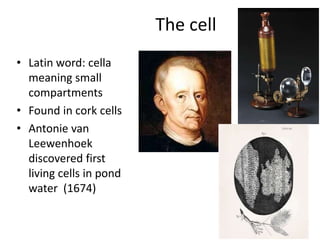
The cell
• Latin word: cella
meaning small
compartments
• Found in cork cells
• Antonie van
Leewenhoek
discovered first
living cells in pond
water (1674)
Types of cell
• Prokaryotes(primitive nucleus)
• Eukaryotes (well defined nucleus)
• See difference between prokaryotes and
eukaryotes
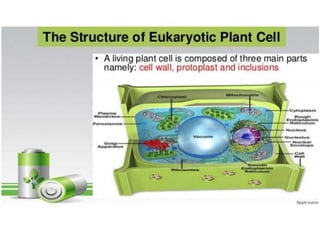
• Plant cell and animal cell
1. Cell wall
• Outermost part
• Nonliving
• Main chemical compound: cellulose
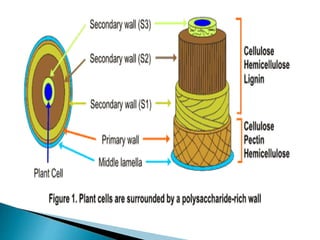
• Primary, secondary and middle lamella
• Structural figure(TS and LS) see book
FUNCTIONS OF CELL WALL
• structural support
• Form and shape
2. Protoplasm
• Mass of proteins, lipids, nucleic acid and
water within a cell; except cell wall.
• Living portion of protoplasm organized into
specific bodies with specific functions is cell
organelles.
Friday, February 20, 2015
Cell Organelles
A membrane-bound compartment or structure in
a cell that performs a special function.
Membrane bound organelles are found only in
eukaryotic cells.
Friday, February 20, 2015
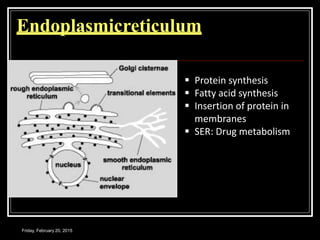
Endoplasmicreticulum
 Protein synthesis
 Fatty acid synthesis
 Insertion of protein in
membranes
 SER: Drug metabolism
Friday, February 20, 2015
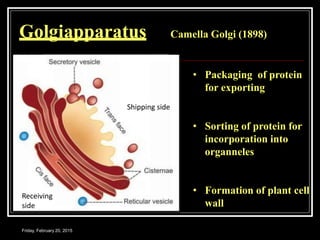
Golgiapparatus Camella Golgi (1898)
• Packaging of protein
for exporting
• Sorting of protein for
incorporation into
organneles
• Formation of plant cell
wall
Receiving
side
Shipping side
Friday, February 20, 2015
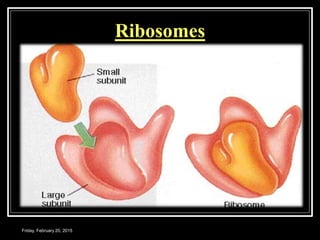
Ribosomes
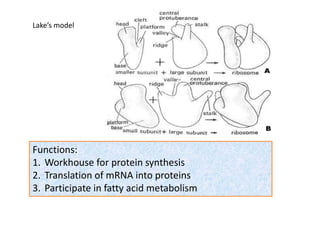
Lake’s model
Functions:
1. Workhouse for protein synthesis
2. Translation of mRNA into proteins
3. Participate in fatty acid metabolism
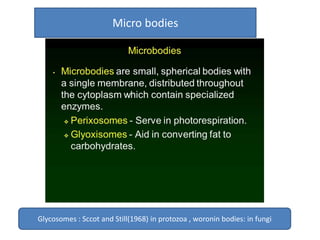
Micro bodies
Glycosomes : Sccot and Still(1968) in protozoa , woronin bodies: in fungi
Peroxisomes
• Peroxisome, membrane-
bound organelle occurring in the cytoplasm of
eukaryotic cells.
• They also contribute to the biosynthesis of
membrane lipids known as plasmalogens.
• Break down hydrogen peroxides
• Oxidase create H202, break H202 by catalase,
peroxidase
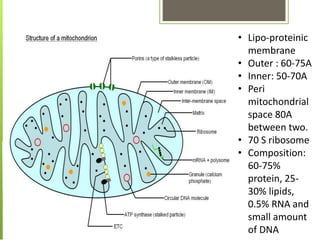
• Lipo-proteinic
membrane
• Outer : 60-75A
• Inner: 50-70A
• Peri
mitochondrial
space 80A
between two.
• 70 S ribosome
• Composition:
60-75%
protein, 25-
30% lipids,
0.5% RNA and
small amount
of DNA
Functions
• Energy production site
• they use complex molecule and oxygen to
produce high energy molecule (ATP)
• Called as power house of cell
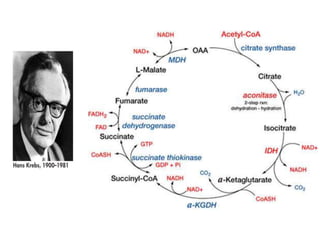
• Kreb cycle
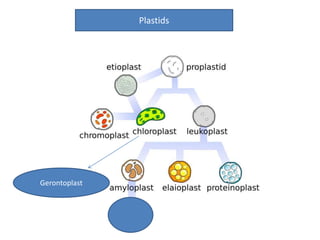
Plastids
Gerontoplast
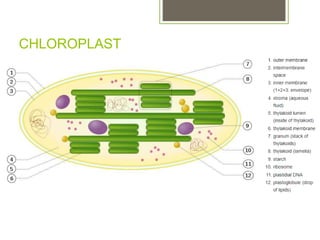
CHLOROPLAST
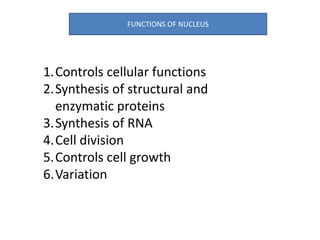
FUNCTIONS OF NUCLEUS
1.Controls cellular functions
2.Synthesis of structural and
enzymatic proteins
3.Synthesis of RNA
4.Cell division
5.Controls cell growth
6.Variation
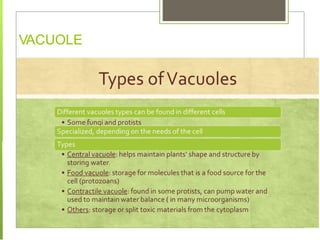
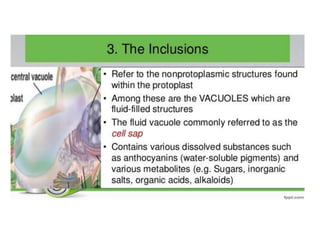
VACUOLE
THANK YOU
Energy flow in a biological system
diffusion, osmosis and water potential
WUE and crop water needs
water absorption
ascent of sap
nutrient uptake
nutriophysiology
Subodh Khanal
Asst. Professor
Paklihawa campus
Energy:
1. Kinetic Energy
2. Potential Energy
Energy is the capacity to do work
•The search of energy is main theme of life. Sun is the ultimate
source of energy.
•WE MAKE MONEY BY HARVESTING SUNLIGHT!!!
•In a cell energy is present as:
 Potential energy(bonds)
 Thermal energy (ATP)
 Electrical energy ( charged particles) K+ Na +
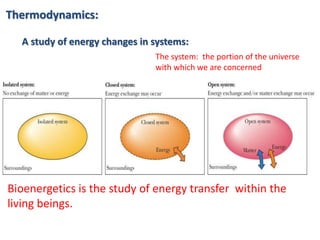
Thermodynamics:
A study of energy changes in systems:
The system: the portion of the universe
with which we are concerned
Bioenergetics is the study of energy transfer within the
living beings.
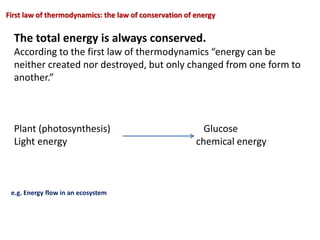
First law of thermodynamics: the law of conservation of energy
The total energy is always conserved.
According to the first law of thermodynamics “energy can be
neither created nor destroyed, but only changed from one form to
another.”
Plant (photosynthesis) Glucose
Light energy chemical energy
e.g. Energy flow in an ecosystem
Second law of thermodynamics: no any system is
100% efficient.
The total entropy is always increases.
System tends to proceed from ordered states to
disordered states
WHY??????
• Cellular respiration
• Indigestion
• Unavailable (color or fixed)
Third law of thermodynamics:
Entropy of any crystalline substance must approach zero
as temperature approaches 0° K
For biological systems entropy changes are more useful than
absolute entropies
Living system are never at equilibrium with the sorrounding
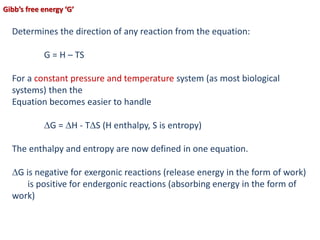
Gibb’s free energy ‘G’
Determines the direction of any reaction from the equation:
G = H – TS
For a constant pressure and temperature system (as most biological
systems) then the
Equation becomes easier to handle
G = H - TS (H enthalpy, S is entropy)
The enthalpy and entropy are now defined in one equation.
G is negative for exergonic reactions (release energy in the form of work)
is positive for endergonic reactions (absorbing energy in the form of
work)
Practical 1: Calculation in bioenergetics
See questions and solutions from the provided handout.
Maintain it in your practical copy.
CROP
WATER
RELATION
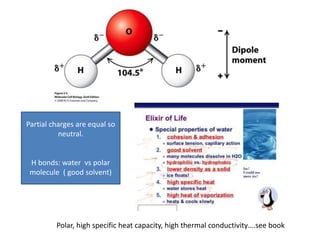
Polar, high specific heat capacity, high thermal conductivity….see book
Partial charges are equal so
neutral.
H bonds: water vs polar
molecule ( good solvent)
Functions
• Major component of cell
• Uptake and transport of materials
• Medium for biochemical reactions.
• Reactant in biochemical reaction (photosynthesis)
• Structural support via turgor pressure
• Transfer of plant gametes
• Offspring dispersal (coconut)
• plant movement (touch me not)
• Cell elongation
• Thermal buffer
• Evolution
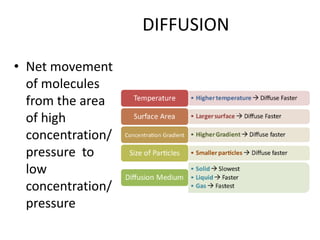
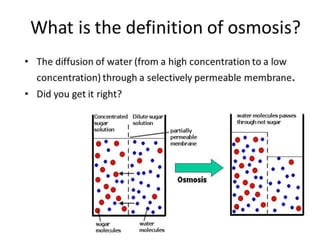
DIFFUSION
• Net movement
of molecules
from the area
of high
concentration/
pressure to
low
concentration/
pressure
IMPORTANCE in plants
1.Gaseous exchange
2.Passive salt absorption
3.Removal of excess water by
transpiration
4.Translocation of organic residues
5.Pollination? ???
Significance of Osmosis in Plants:
(1)Water absorption by roots.
(2) cell to cell movement.
(3)Opening and closing of stomata
(4)shape or form of their organs is
maintained.
(5)The resistance of plants to drought and
frost increases with increase in osmotic
pressure of their cells.
(6)Turgidity of the cells of the young seedlings
allows them to come out of the soil.
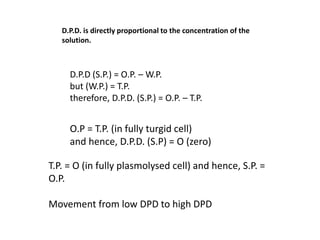
D.P.D. is directly proportional to the concentration of the
solution.
D.P.D (S.P.) = O.P. – W.P.
but (W.P.) = T.P.
therefore, D.P.D. (S.P.) = O.P. – T.P.
O.P = T.P. (in fully turgid cell)
and hence, D.P.D. (S.P) = O (zero)
T.P. = O (in fully plasmolysed cell) and hence, S.P. =
O.P.
Movement from low DPD to high DPD
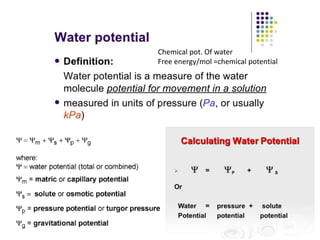
Chemical pot. Of water
Free energy/mol =chemical potential
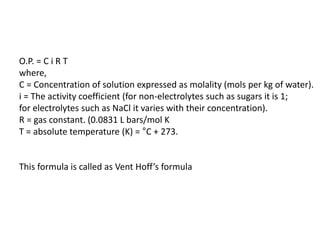
O.P. = C i R T
where,
C = Concentration of solution expressed as molality (mols per kg of water).
i = The activity coefficient (for non-electrolytes such as sugars it is 1;
for electrolytes such as NaCl it varies with their concentration).
R = gas constant. (0.0831 L bars/mol K
T = absolute temperature (K) = °C + 273.
This formula is called as Vent Hoff’s formula
Note: see numericals present in book. Maintain
it in practical also as practical 2 (see page 62-64)
.
55
Problem #1
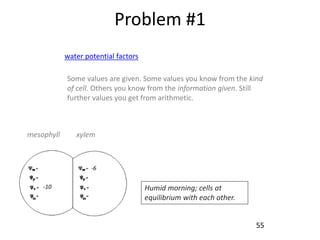
Here you have two cells. Your job is to fill in the missing values for the
water potential factors.
Some values are given. Some values you know from the kind
of cell. Others you know from the information given. Still
further values you get from arithmetic.
Humid morning; cells at
equilibrium with each other.
mesophyll xylem
-10
-6
Hints
• Cells are at equilibrium
• Matric potential of wet substance is 0
• The right cell is a xylem vessel element,
and it is filled with xylem sap, almost pure
water. This tells you its solute potential.
• Normal cells have water potentials that
are between about -1 and -15 bars.
Problem #2
• In the same cells above what happens if
transpiration starts to rise?
• If transpiration is taking place, there must be
water flow from the xylem to the mesophyll cell.
This means the mesophyll cell has a lower water
potential than the xylem.
• Typically the differences are just a couple of bars
for nearby cells.
• So water potential of mesophyll is -8
On average, for each 100 litres of water used by a plant, each
process uses:
• Photosynthesis 0.1 litres
• Growth (new leaves, roots etc) 1.9 litres
• Transpiration 98 litres
Mechanism of absorption and
translocation of water
Category of water found in soil
• Gravitational water: comes under the
influence of gravity
• Capillary water: water remained in soil as film
coating after gravitational water has drained
away. Retained by surface tension.
• Hygroscopic or imbibed water: held by
adhesion
• Runaway water: flows on the surface
• Chemically bound water: chemically combined
with Fe, Al
Mechanism of water absorption
1.Active : in roots : when
transpiration is low
2.Passive : in leaves
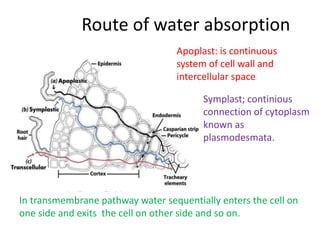
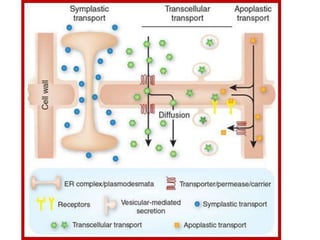
Route of water absorption
Apoplast: is continuous
system of cell wall and
intercellular space
Symplast; continious
connection of cytoplasm
known as
plasmodesmata.
In transmembrane pathway water sequentially enters the cell on
one side and exits the cell on other side and so on.
Active water absorption
• root cells play active role in the absorption of
water (4%)
• metabolic energy released through respiration
is consumed
• Slowly transpiring plants
• Can be osmotic or non osmotic (against the
gradient, related to respiration, auxin content,
respiratory inhibitors )
Passive absorption
 According to osmotic gradient
 Does not require energy
 Does not require oxygen
 Root pressure not created
Factors affecting
• Root system: number of root hairs and depth
• Concentration of soil solution; solute=high
OP ( soil OP>sap, osmotic absorption )
• Availability of soil water
• Aeration
• minerals : poor in alkaline and saline soils
• Transpiration
• Temperature (increases upto 30 degree, 0 at 0
)
• Metabolism
 The upward movement of water from the root to
the
top of the plant is called as ascent of sap.
 The water uptake takes place through the roots
and the leaves transpire most of this water.
Theories of
ascent of sap
Vital
theorie
s
Physical
theories
Root
pressur
e
theory
Godlewski
theory
Vital force
theory
Imbibitions
theory
Capillary
force
theory
Cohesion
theory
Root pressure theory
• Root pressure is developed when absorption>
transpiration so water is pushed in trachids
• Hydrostatic pressure is responsible
Criticism:
• Only 2 atm but 20 atm is required to raise
• Absent in conifers
• Absent in rapidly transpiring plants
• Water raises even in absence of roots
Godlewski theory
• Pumping action of xylem parenchyma is
responsible.
• Due to change in OP
Pulsation theory by JC Bose
• Inner layer of cortex
• Pulsation like heart
• Responsible for upward movement
• Strasburger proved these theories wrong
• Ascent of sap even if destroyed by picric
acid
Physical theories
• atmospheric pressure theory: Boehm. < 34 ft.
only
• Capillary force theory: Boehm: only true to
small distance
• Imbibition theory: Unger: may be upto 1000
atm but water ascends through lumen not
through walls.
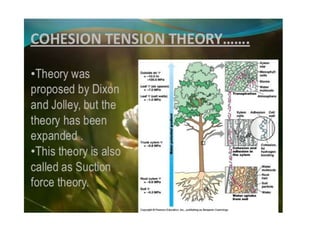
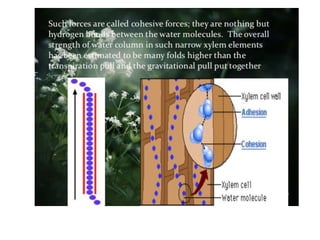
• Cohesion tension theory: transpiration pull
theory: Dixon and Jolly theory
Objection
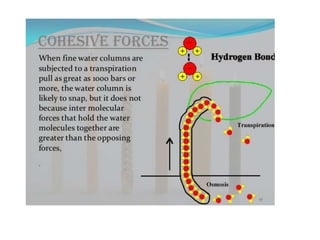
• Transpiration is not solely responsible for
continious water column.
• Air vessels in trachids and vessels break
column
• High wind velocity, high temperature
break column
Evidences
• Osmotic potential reached upto 200 atm
• Purely physical
• Absorption depends on transpiration
• Tensile strength of xylem sap 25-300 atm
sufficient to maintain continuous water
column
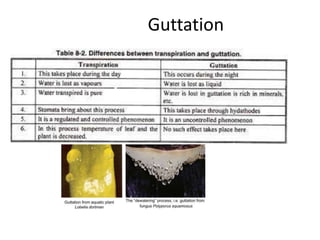
Guttation
3
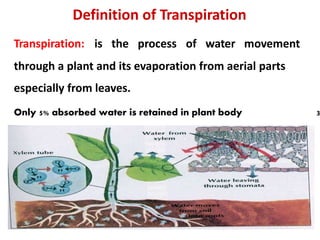
Definition of Transpiration
Transpiration: is the process of water movement
through a plant and its evaporation from aerial parts
especially from leaves.
Only 5% absorbed water is retained in plant body
Distribution and Types
of Stomata:
• Apple or mulberry (hypostomatic) type:
• Potato type: more on lower: potato,
tomato, Brassica, pea, beans
• Oat (amphistomatic) type: equal
• Water lily/ Nymphea (epistomatic) type:
above
• Potamogeton (astomatic) type: vestigeal
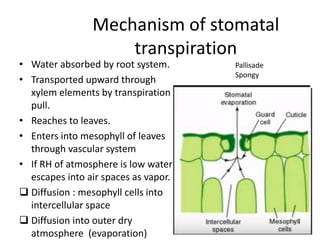
Mechanism of stomatal
transpiration
• Water absorbed by root system.
• Transported upward through
xylem elements by transpiration
pull.
• Reaches to leaves.
• Enters into mesophyll of leaves
through vascular system
• If RH of atmosphere is low water
escapes into air spaces as vapor.
 Diffusion : mesophyll cells into
intercellular space
 Diffusion into outer dry
atmosphere (evaporation)
Pallisade
Spongy
• Mesophyll becomes turgid
• TP increases, DPD decreases so water diffuses
into intercellular space
• Intercellular space becomes saturated with water
• Vapor pressure >water vapor of atomosphere
• DPD of intercellular space <DPD of vapor
pressure of atmosphere
• Water escapes into the atmosphere in the form
of vapor.
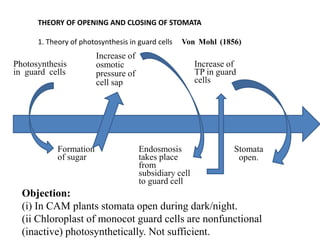
Increase of
osmotic
pressure of
cell sap
Photosynthesis
in guard cells
Increase of
TP in guard
cells
Formation
of sugar
Endosmosis
takes place
from
subsidiary cell
to guard cell
Stomata
open.
Objection:
(i) In CAM plants stomata open during dark/night.
(ii Chloroplast of monocot guard cells are nonfunctional
(inactive) photosynthetically. Not sufficient.
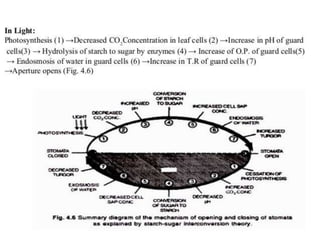
THEORY OF OPENING AND CLOSING OF STOMATA
1. Theory of photosynthesis in guard cells Von Mohl (1856)
Starch sugar conversion theory
• Lloyd: day>> guard cells contain
sugar>>stomata open, starch at night
• Sayre and Searly: day>> neutral or alkaline
ph >>stomata open, acidic>> closes
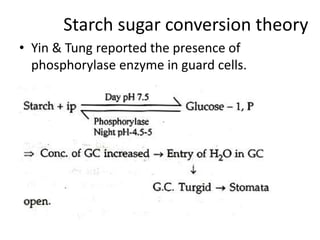
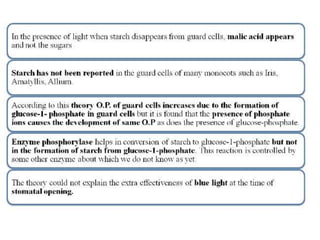
Starch sugar conversion theory
• Yin & Tung reported the presence of
phosphorylase enzyme in guard cells.
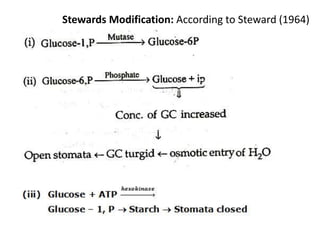
Stewards Modification: According to Steward (1964)
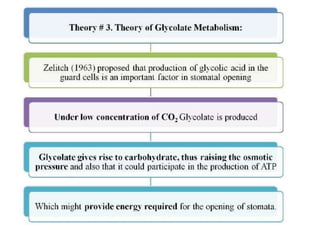
Theory # 3. Theory of Glycolate Metabolism:
Under low concentration of C02 Glycolate is produced
Glycolate gives rise to carbohydrate, thus raising the osmotic
pressure and also that it could participate in the production
of ATP
Which might provide energy required for the opening of stomata,
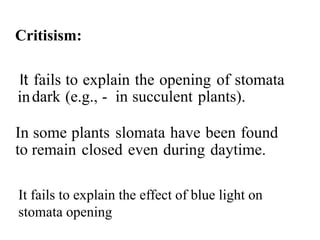
Critisism:
fails to explain the opening of stomataIt
indark (e.g., - in succulent plants).
In
to
some plants slomata have been found
remain closed even during daytime.
It fails to explain the effect of blue light on
stomata opening
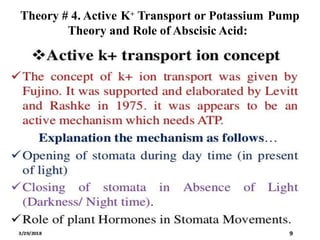
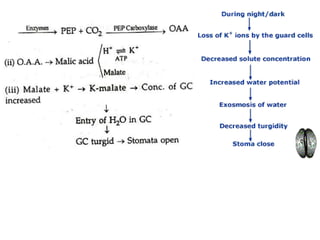
Theory # 4. Active K+ Transport or Potassium Pump
Theory and Role of Abscisic Acid:
The concept of K+
ion transport was given by Fujino. It was
supported and elaborated
be an active mechanism
by Levitt & Rashke in 1975 It appears to
which needs ATP. It is based on recent
observations and (explains the mechanism as follows.
Factors causing opening and
closing of stomata
• Light: stomata opens at day mostly, CAM
opposite. Red and blue but Blue light more
effective. Stimulates light receptor
zeazanthin.
• temperature: within 20-30 degrees,
increase in temperature facilitates opening
of stomata
• C02: inversely proportional (acidifies)
• Water: directly proportional
Water Use Efficiency
• Water Use (technical) Efficiency: The mass of
agricultural produce per unit of water
consumed
• Water Use (economic) Efficiency: The value of
product(s) produced per unit of water volume
consumed
• Water Use (hydraulic) Efficiency: The portion of
water actually used by irrigated agriculture of
the volume of water withdrawn
Factors affecting WUE
1. Climatic factors (Rh, sunlight, temperature)
2. Agronomic practices and crop management
(early sown vs late sown, depth)
3. Antitranspirants
4. Mulching
5. Shelter belts
6. Weed
7. Fertilizers
Crop water need
• The crop water need (ET crop) is defined as the
depth (or amount) of water needed to meet the
water loss through evapotranspiration.
• In other words, it is the amount of water needed by
the various crops to grow optimally.
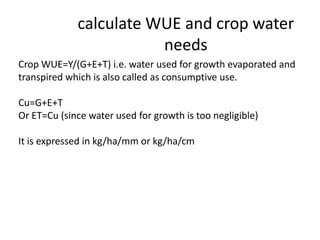
calculate WUE and crop water
needs
Crop WUE=Y/(G+E+T) i.e. water used for growth evaporated and
transpired which is also called as consumptive use.
Cu=G+E+T
Or ET=Cu (since water used for growth is too negligible)
It is expressed in kg/ha/mm or kg/ha/cm
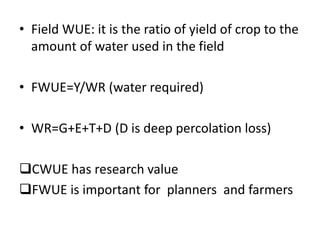
• Field WUE: it is the ratio of yield of crop to the
amount of water used in the field
• FWUE=Y/WR (water required)
• WR=G+E+T+D (D is deep percolation loss)
CWUE has research value
FWUE is important for planners and farmers
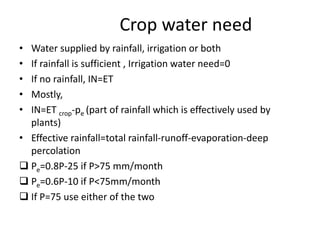
Crop water need
• Water supplied by rainfall, irrigation or both
• If rainfall is sufficient , Irrigation water need=0
• If no rainfall, IN=ET
• Mostly,
• IN=ET crop-pe (part of rainfall which is effectively used by
plants)
• Effective rainfall=total rainfall-runoff-evaporation-deep
percolation
 Pe=0.8P-25 if P>75 mm/month
 Pe=0.6P-10 if P<75mm/month
 If P=75 use either of the two
MINERAL SALT ABSORPTION
• Active
• Passive
1. Mass flow theory
• Ions absorbed under mass flow of water
due to transpiration
• Increase in transpiration pull increases the
ion uptake
• absence of metabolic energy
• Fails to explain against osmotic gradient
Outer and apparent free space
theory
• Ions move in and out of the cells until
equilibrium is achieved.
• The part of plant cells which allows
diffusion is called outer space.
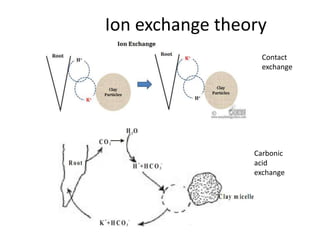
Ion exchange theory
Contact
exchange
Carbonic
acid
exchange
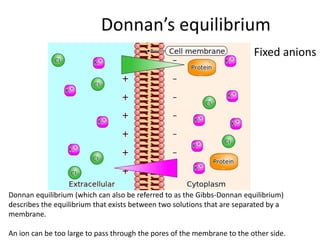
Donnan’s equilibrium
Fixed anions
Donnan equilibrium (which can also be referred to as the Gibbs-Donnan equilibrium)
describes the equilibrium that exists between two solutions that are separated by a
membrane.
An ion can be too large to pass through the pores of the membrane to the other side.
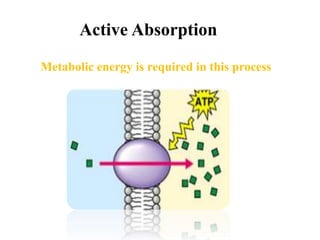
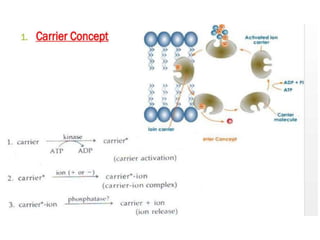
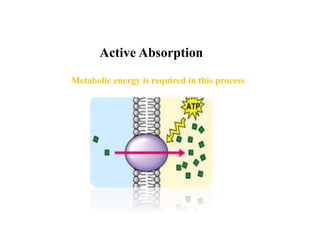
Active Absorption
Metabolic energy is required in this process
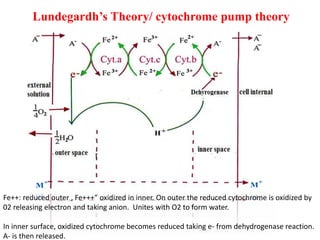
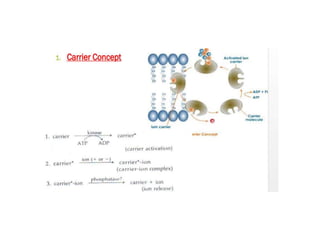
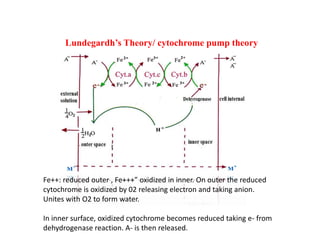
Lundegardh’s Theory/ cytochrome pump theory
Fe++: reduced outer , Fe+++” oxidized in inner. On outer the reduced cytochrome is oxidized by
02 releasing electron and taking anion. Unites with O2 to form water.
In inner surface, oxidized cytochrome becomes reduced taking e- from dehydrogenase reaction.
A- is then released.
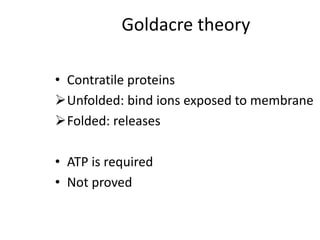
Goldacre theory
• Contratile proteins
Unfolded: bind ions exposed to membrane
Folded: releases
• ATP is required
• Not proved
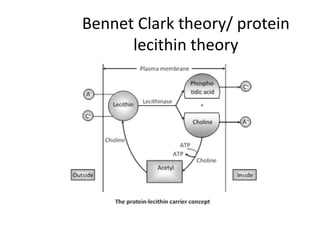
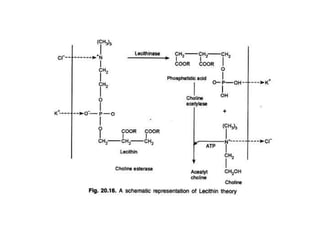
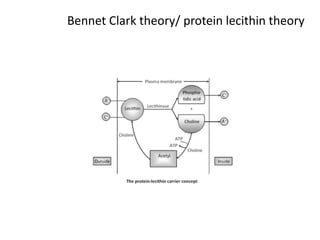
Bennet Clark theory/ protein
lecithin theory
Factors affecting:
• Temperature: +ve upto certain level, KE during diffusion
• Ph: decrease in ph increases anions and reverse for
cations, if crossed the physiological range damage plant
tissue
• Light: indirect by transpiration and photosynthesis
• Oxygen: active absorption is affected in absence
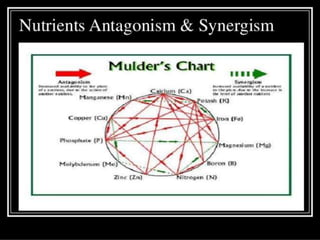
• Interaction: antagonism e.g. calcium vs K/Na, P vs Zn,
synergistic: Zn and Cu, Zn and Fe
• Growth: active growth favors
• Age: mature have high surface area but suberization also
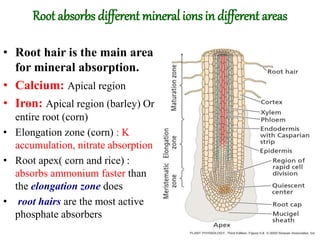
Root absorbs different mineral ions in different areas
• Root hair is the main area
for mineral absorption.
• Calcium: Apical region
• Iron: Apical region (barley) Or
entire root (corn)
• Elongation zone (corn) : K
accumulation, nitrate absorption
• Root apex( corn and rice) :
absorbs ammonium faster than
the elongation zone does
• root hairs are the most active
phosphate absorbers
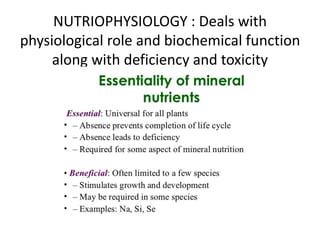
NUTRIOPHYSIOLOGY : Deals with
physiological role and biochemical function
along with deficiency and toxicity
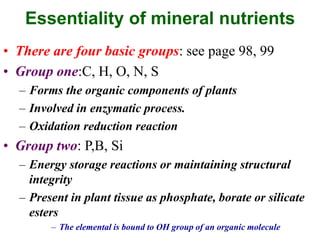
Essentiality of mineral nutrients
• There are four basic groups: see page 98, 99
• Group one:C, H, O, N, S
– Forms the organic components of plants
– Involved in enzymatic process.
– Oxidation reduction reaction
• Group two: P,B, Si
– Energy storage reactions or maintaining structural
integrity
– Present in plant tissue as phosphate, borate or silicate
esters
– The elemental is bound to OH group of an organic molecule
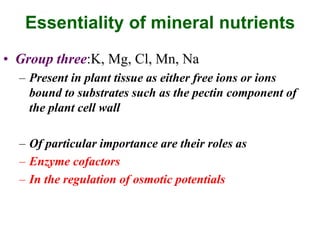
Essentiality of mineral nutrients
• Group three:K, Mg, Cl, Mn, Na
– Present in plant tissue as either free ions or ions
bound to substrates such as the pectin component of
the plant cell wall
– Of particular importance are their roles as
– Enzyme cofactors
– In the regulation of osmotic potentials
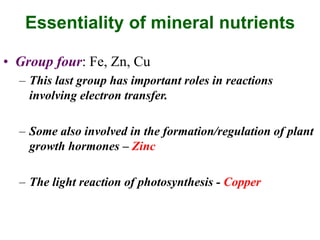
Essentiality of mineral nutrients
• Group four: Fe, Zn, Cu
– This last group has important roles in reactions
involving electron transfer.
– Some also involved in the formation/regulation of plant
growth hormones – Zinc
– The light reaction of photosynthesis - Copper
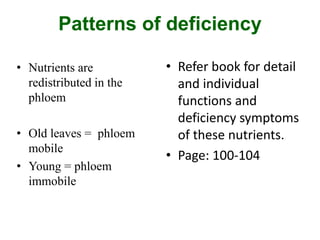
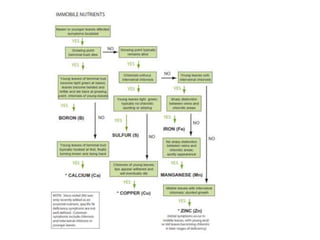
Patterns of deficiency
• Nutrients are
redistributed in the
phloem
• Old leaves = phloem
mobile
• Young = phloem
immobile
• Refer book for detail
and individual
functions and
deficiency symptoms
of these nutrients.
• Page: 100-104
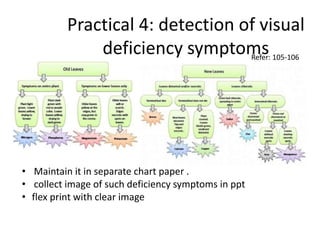
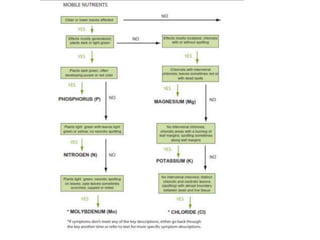
Practical 4: detection of visual
deficiency symptomsRefer: 105-106
• Maintain it in separate chart paper .
• collect image of such deficiency symptoms in ppt
• flex print with clear image
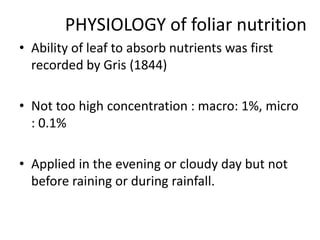
PHYSIOLOGY of foliar nutrition
• Ability of leaf to absorb nutrients was first
recorded by Gris (1844)
• Not too high concentration : macro: 1%, micro
: 0.1%
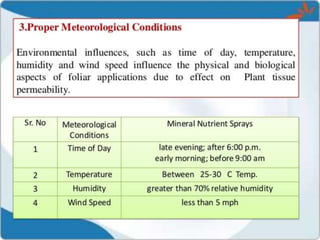
• Applied in the evening or cloudy day but not
before raining or during rainfall.
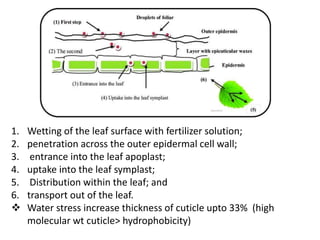
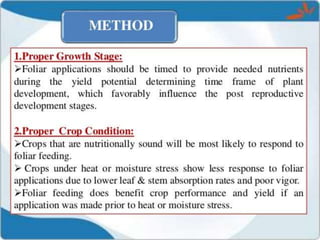
1. Wetting of the leaf surface with fertilizer solution;
2. penetration across the outer epidermal cell wall;
3. entrance into the leaf apoplast;
4. uptake into the leaf symplast;
5. Distribution within the leaf; and
6. transport out of the leaf.
 Water stress increase thickness of cuticle upto 33% (high
molecular wt cuticle> hydrophobicity)
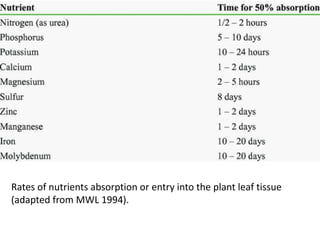
Rates of nutrients absorption or entry into the plant leaf tissue
(adapted from MWL 1994).
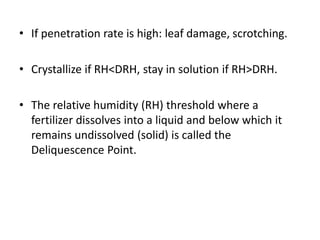
• If penetration rate is high: leaf damage, scrotching.
• Crystallize if RH<DRH, stay in solution if RH>DRH.
• The relative humidity (RH) threshold where a
fertilizer dissolves into a liquid and below which it
remains undissolved (solid) is called the
Deliquescence Point.
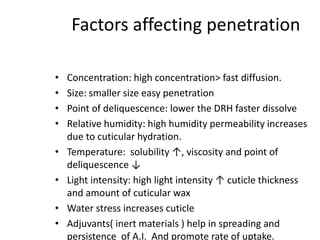
Factors affecting penetration
• Concentration: high concentration> fast diffusion.
• Size: smaller size easy penetration
• Point of deliquescence: lower the DRH faster dissolve
• Relative humidity: high humidity permeability increases
due to cuticular hydration.
• Temperature: solubility ↑, viscosity and point of
deliquescence ↓
• Light intensity: high light intensity ↑ cuticle thickness
and amount of cuticular wax
• Water stress increases cuticle
• Adjuvants( inert materials ) help in spreading and
persistence of A.I. And promote rate of uptake.
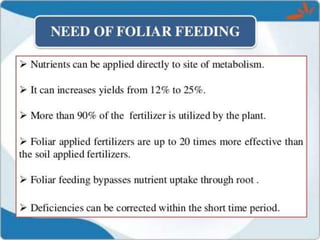
Practical application when:
• Low nutrient availability in soil
• Dry top soil
• Decrease in root activity during
reproductive stage
• Increase in protein content of cereals
grains
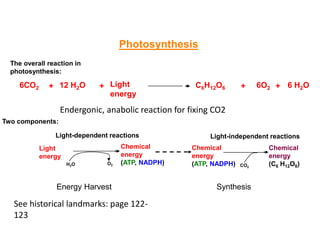
12 H2O
The overall reaction in
photosynthesis:
6CO2 + ++ Light
energy
C6H12O6 6O2 6 H2O+
Photosynthesis
Two components:
Light
energy
H2O O2
Light-dependent reactions
Chemical
energy
(ATP, NADPH)
Chemical
energy
(ATP, NADPH) CO2
Light-independent reactions
Chemical
energy
(C6 H12O6)
Energy Harvest Synthesis
See historical landmarks: page 122-
123
Endergonic, anabolic reaction for fixing CO2
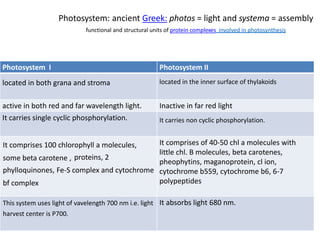
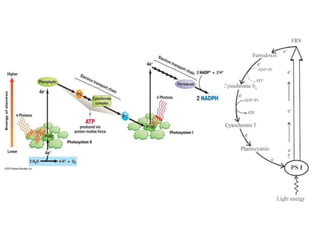
Photosystem I Photosystem II
located in both grana and stroma located in the inner surface of thylakoids
active in both red and far wavelength light. Inactive in far red light
It carries single cyclic phosphorylation. It carries non cyclic phosphorylation.
It comprises 100 chlorophyll a molecules,
some beta carotene , proteins, 2
phylloquinones, Fe-S complex and cytochrome
bf complex
It comprises of 40-50 chl a molecules with
little chl. B molecules, beta carotenes,
pheophytins, maganoprotein, cl ion,
cytochrome b559, cytochrome b6, 6-7
polypeptides
This system uses light of vavelength 700 nm i.e. light
harvest center is P700.
It absorbs light 680 nm.
Photosystem: ancient Greek: photos = light and systema = assembly
functional and structural units of protein complexes involved in photosynthesis
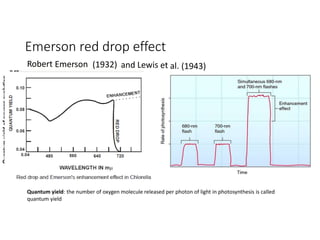
Emerson red drop effect
•
Robert Emerson (1932) and Lewis et al. (1943)
Quantum yield: the number of oxygen molecule released per photon of light in photosynthesis is called
quantum yield
• Chlorophyll a is the main pigment
• Cholorophyll is made of porphyrin ring and a hydrophobic tail
• Other pigments are called accessory pigments
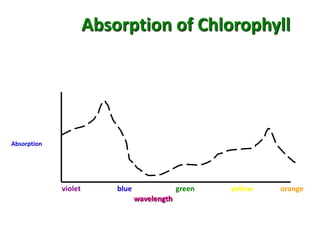
Absorption of Chlorophyll
wavelength
Absorption
violet blue green yellow orange
Mechanism of photosynthesis
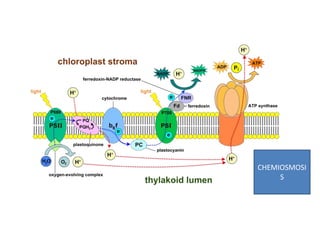
photosynthesis consists two successive series of reactions:
• Light or Hill reaction
• Dark reaction or Blackmann’s reaction.
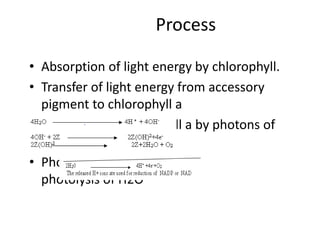
• Absorption of light energy by chlorophyll.
• Transfer of light energy from accessory
pigment to chlorophyll a
• Activation of chlorophyll a by photons of
light
• Photo
photolysis of H2O
Process
CHEMIOSMOSI
S
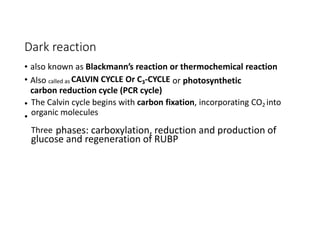
Dark reaction
•
•
also known as Blackmann’s reaction or thermochemical reaction
Also called as CALVIN CYCLE Or C3-CYCLE or photosynthetic
carbon reduction cycle (PCR cycle)
•
•
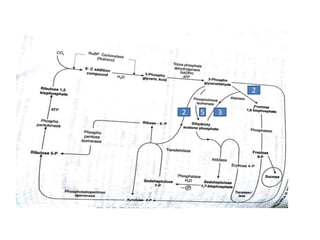
The Calvin cycle begins with carbon fixation, incorporating CO2 into
organic molecules
Three phases: carboxylation, reduction and production of
glucose and regeneration of RUBP
2 5 3
2
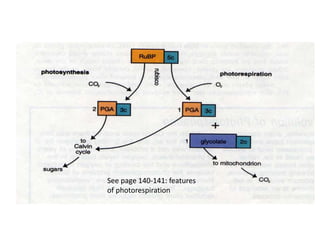
See page 140-141: features
of photorespiration
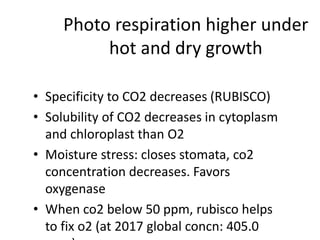
• Specificity to CO2 decreases (RUBISCO)
• Solubility of CO2 decreases in cytoplasm
and chloroplast than O2
• Moisture stress: closes stomata, co2
concentration decreases. Favors
oxygenase
• When co2 below 50 ppm, rubisco helps
to fix o2 (at 2017 global concn: 405.0
Photo respiration higher under
hot and dry growth
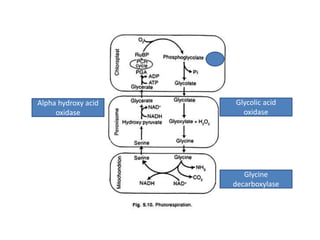
Glycolic acid
oxidase
Glycine
decarboxylase
Alpha hydroxy acid
oxidase
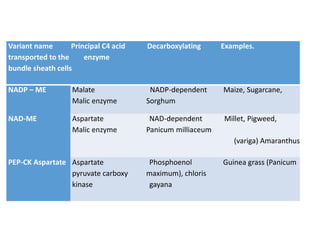
Variant name Principal C4 acid Decarboxylating Examples.
transported to the enzyme
bundle sheath cells
NADP – ME
NAD-ME
PEP-CK Aspartate
Malate NADP-dependent Maize, Sugarcane,
Malic enzyme Sorghum
Aspartate NAD-dependent Millet, Pigweed,
Malic enzyme Panicum milliaceum
(variga) Amaranthus
Aspartate Phosphoenol Guinea grass (Panicum
pyruvate carboxy maximum), chloris
kinase gayana
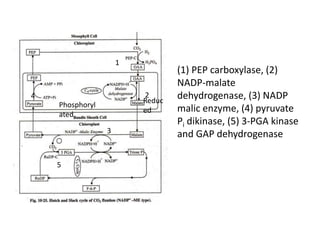
Reduc
ed
Phosphoryl
ated
1
2
3
4
5
(1) PEP carboxylase, (2)
NADP-malate
dehydrogenase, (3) NADP
malic enzyme, (4) pyruvate
Pi dikinase, (5) 3-PGA kinase
and GAP dehydrogenase
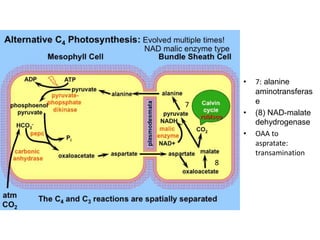
• 7: alanine
aminotransferas
e
• (8) NAD-malate
dehydrogenase
• OAA to
aspratate:
transamination
7
8
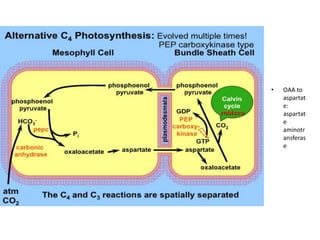
• OAA to
aspartat
e:
aspartat
e
aminotr
ansferas
e
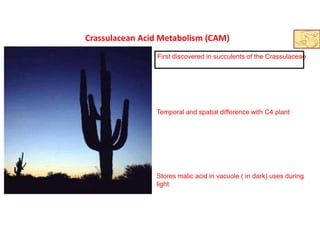
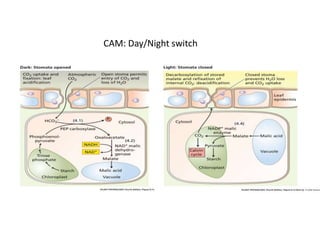
Crassulacean Acid Metabolism (CAM)
Temporal and spatial difference with C4 plant
Stores malic acid in vacuole ( in dark) uses during
light
First discovered in succulents of the Crassulaceae
CAM: Day/Night switch
Factors affecting
• A. External factors
photosynthesis
a. Light
Intensity
Quality: Blue and red light, green
Duration : avge 10-12 hrs
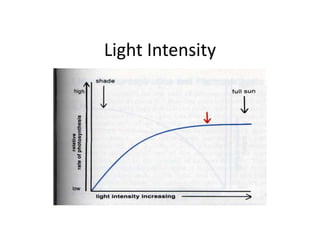
Light Intensity
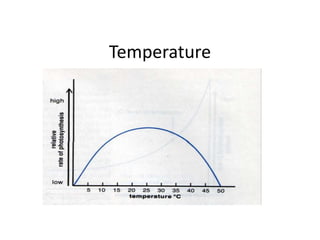
Temperature
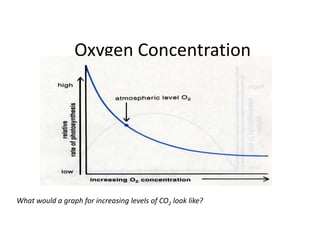
Oxygen Concentration
What would a graph for increasing levels of CO2 look like?
Internal factors
1. Protoplasmic factors: it takes some time to initiate the process in
seedlings even if the chlorophyll has appeared.
2.
3.
4.
Chlorophyll content: normal and variegated leaves
Accumulation of products
Structure of leaves
Active Absorption
Metabolic energy is required in this process
Lundegardh’s Theory/ cytochrome pump theory
Fe++: reduced outer , Fe+++” oxidized in inner. On outer the reduced
cytochrome is oxidized by 02 releasing electron and taking anion.
Unites with O2 to form water.
In inner surface, oxidized cytochrome becomes reduced taking e- from
dehydrogenase reaction. A- is then released.
Goldacre theory
• Contratile proteins
Unfolded: bind ions exposed to membrane
Folded: releases
• ATP is required
• Not proved
Bennet Clark theory/ protein lecithin theory
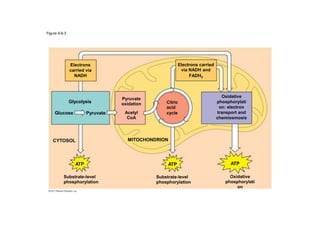
Respiration
• Cellular respiration is the process by which
cells transfer chemical energy from sugar
molecules to ATP molecules.
• As this happens cells release CO2 and use
up O2
• Respiration can be AEROBIC or ANAEROBIC
Figure 9.6-3
Electrons carried
via NADH and
FADH2
Electrons
carried via
NADH
Oxidative
phosphorylati
on: electron
transport and
chemiosmosis
Pyruvate
oxidation
Acetyl
CoA
Glycolysis Citric
acid
cycleGlucose Pyruvate
MITOCHONDRIONCYTOSOL
ATPATP ATP
Oxidative
phosphorylati
on
Substrate-level
phosphorylation
Substrate-level
phosphorylation
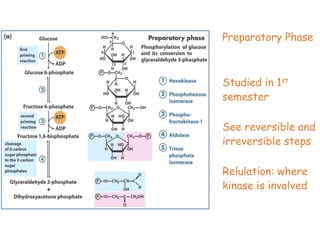
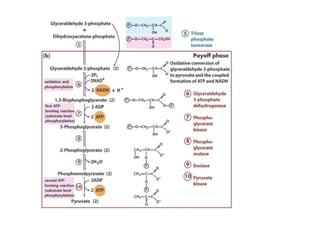
Preparatory Phase
Studied in 1st
semester
See reversible and
irreversible steps
Relulation: where
kinase is involved
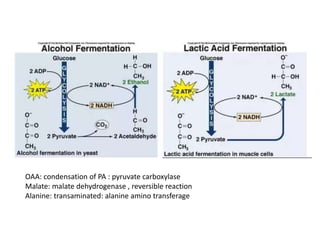
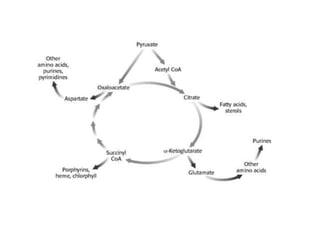
OAA: condensation of PA : pyruvate carboxylase
Malate: malate dehydrogenase , reversible reaction
Alanine: transaminated: alanine amino transferage
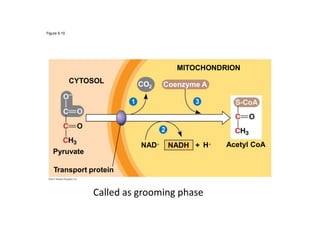
Figure 9.10
MITOCHONDRION
CYTOSOL CO Coenzyme A2
31
2
Acetyl CoAHNAD NADH +
Pyruvate
Transport protein
Called as grooming phase
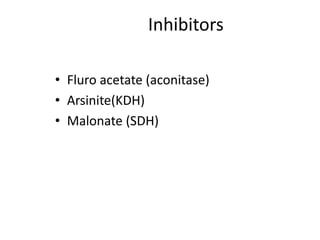
Inhibitors
• Fluro acetate (aconitase)
• Arsinite(KDH)
• Malonate (SDH)
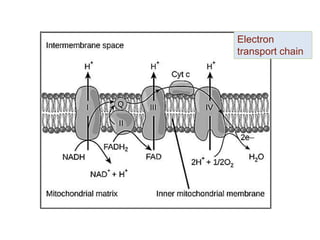
Electron
transport chain
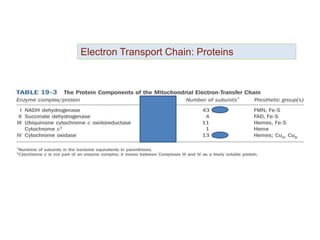
Electron Transport Chain: Proteins
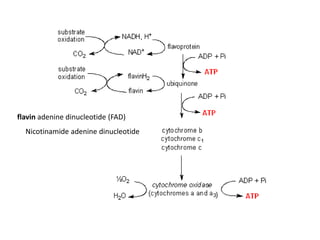
flavin adenine dinucleotide (FAD)
Nicotinamide adenine dinucleotide
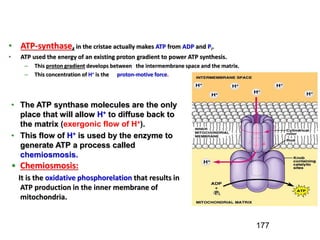
177
• Chemiosmosis:
It is the oxidative phosphorelation that results in
ATP production in the inner membrane of
mitochondria.
• The ATP synthase molecules are the only
place that will allow H+ to diffuse back to
the matrix (exergonic flow of H+).
• This flow of H+ is used by the enzyme to
generate ATP a process called
chemiosmosis.
• ATP-synthase, in the cristae actually makes ATP from ADP and Pi.
• ATP used the energy of an existing proton gradient to power ATP synthesis.
– This proton gradient develops between the intermembrane space and the matrix.
– This concentration of H+ is the proton-motive force.
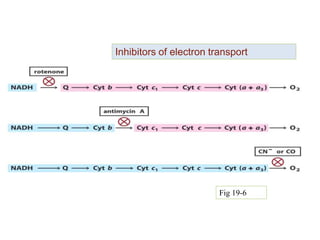
Inhibitors of electron transport
Fig 19-6
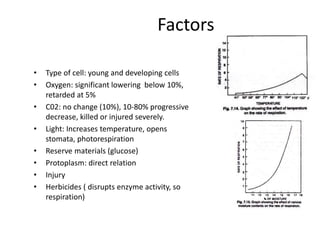
• Type of cell: young and developing cells
• Oxygen: significant lowering below 10%,
retarded at 5%
• C02: no change (10%), 10-80% progressive
decrease, killed or injured severely.
• Light: Increases temperature, opens
stomata, photorespiration
• Reserve materials (glucose)
• Protoplasm: direct relation
• Injury
• Herbicides ( disrupts enzyme activity, so
respiration)
Factors
TRANSLOCATION OF PHOTOSYNTHATES
A highly specialized process for redistributing
•Photosynthesis products synthesized in leaves
•Movement of sugar from source to sink
•Through sieve tube element
• Food and minerals move through tubes
formed by chains of cells, sieve-tube
members.
– sieve plates
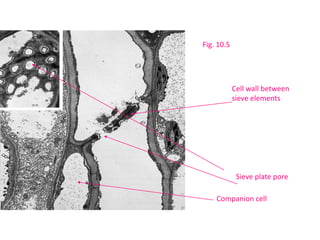
– companion cell
Phloem
Sieve plate pore
Cell wall between
sieve elements
Companion cell
Fig. 10.5
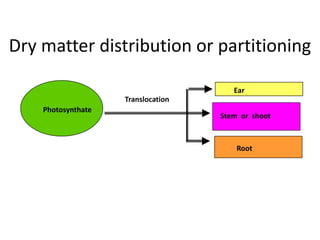
Dry matter distribution or partitioning
Photosynthate
Translocation
Ear
Stem or shoot
Root
Direction of movement
• Downward: from leaves to stem/roots
• Upward: germination, from underground
stem, formation of new buds,
development of fruits
• Lateral: by medullary cells
• Food, some metabolites, hormones and
mineral nutrients
• Movement happens to move in
• Proximity
• Development
• Modification of source sink relationship
Factors affecting source sink
pathway
Exactly what is
intransported
phloem?
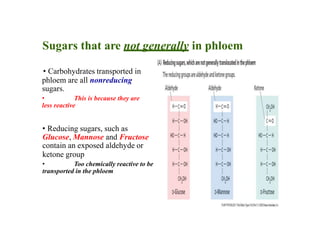
Sugars that are not generally in phloem
• Carbohydrates transported in
phloem are all nonreducing
sugars.
• This is because they are
less reactive
• Reducing sugars, such as
Glucose, Mannose and Fructose
contain an exposed aldehyde or
ketone group
• Too chemically reactive to be
transported in the phloem
Phloem transport
Velocities ≈ 1 m hour-1 , much faster than
diffusion
• What is the mechanism of phloem transport?
• What causes flow?,
• What’s the source of energy?
Mechanism of transport
1. Diffusion hypothesis
• high to low
2. Protoplasmic streaming theory
According to Devries and Curtis soluble food materials in sieve tubes move
from one end to another end due to cytoplasmic streaming.
Objections:
• rate of protoplasmic streaming is much slower than the rate of
translocation.
• Protoplasmic streaming has not been observed in matured sieve plate of
most plant.
3. Protein - Lecithin Theory:
 Discussed earlier
4. Munch mass flow hypothesis
• Munch’s “Mass Flow” Hypothesis- Munch (1930) proposed that
soluble food material in the phloem shows mass flow.
the
•
•
Objection:
Unidirectional
Mass flow is purely physical process but phloem transport is active
process and requires energy.•
The Pressure-Flow Model
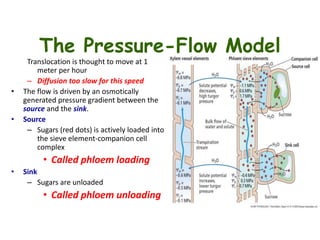
Translocation is thought to move at 1
meter per hour
– Diffusion too slow for this speed
• The flow is driven by an osmotically
generated pressure gradient between the
source and the sink.
• Source
– Sugars (red dots) is actively loaded into
the sieve element-companion cell
complex
• Called phloem loading
• Sink
– Sugars are unloaded
• Called phloem unloading
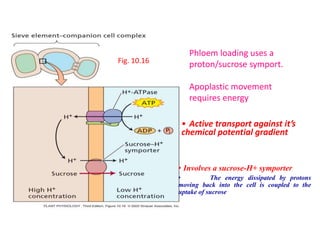
Fig. 10.16
Phloem loading uses a
proton/sucrose symport.
Apoplastic movement
requires energy
• Active transport against it’s
chemical potential gradient
• Involves a sucrose-H+ symporter
• The energy dissipated by protons
moving back into the cell is coupled to the
uptake of sucrose
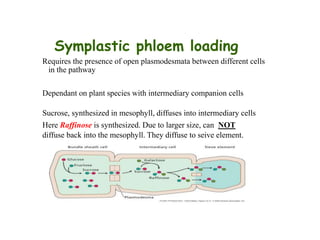
Symplastic phloem loading
Requires the presence of open plasmodesmata between different cells
in the pathway
Dependant on plant species with intermediary companion cells
Sucrose, synthesized in mesophyll, diffuses into intermediary cells
Here Raffinose is synthesized. Due to larger size, can NOT
diffuse back into the mesophyll. They diffuse to seive element.
Phloem unloading
• Also can occur by symplastic or apoplatic pathways
• Symplastic:
• Appears to be a completely symplastic pathway in young dicot
leaves
• Again, moves through open plasmodesmata
Apoplastic
One step, transport from the sieve element- companion cell complex to
successive sink cells, occurs in the apoplast.
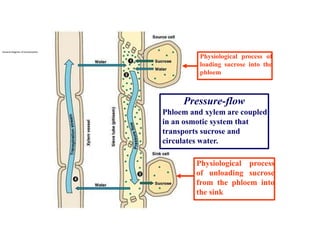
General diagram of translocation
Physiological process
of unloading sucrose
from the phloem into
the sink
Pressure-flow
Phloem and xylem are coupled
in an osmotic system that
transports sucrose and
circulates water.
Physiological process of
loading sucrose into the
phloem
Background
• First step of sexual reproduction
• Important and dramatic event in ontogeny
(development of an individual).
• Transformation of vegetative apex into
reproductive structure.
• Immense importance for perpetuation
(continue) and origin of variability to next
generation.
Physiology of flowering
1. Events in bud leading to flowering
• Induction:
Flowering stimulus is generated
Influenced by water stress, photoperiod or
chilling temperature
• Evocation
After receiving stimulus, shoot apex
committed to form floral bud primordia
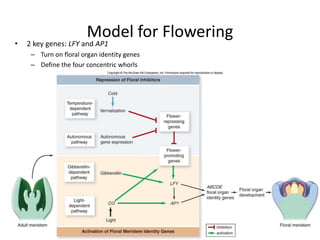
Model for Flowering
• 2 key genes: LFY and AP1
– Turn on floral organ identity genes
– Define the four concentric whorls
• Sepal, petal, stamen, and carpel
201
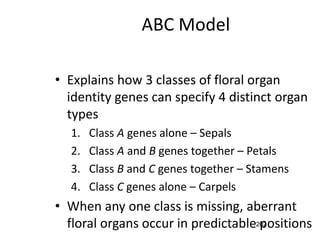
ABC Model
• Explains how 3 classes of floral organ
identity genes can specify 4 distinct organ
types
1. Class A genes alone – Sepals
2. Class A and B genes together – Petals
3. Class B and C genes together – Stamens
4. Class C genes alone – Carpels
• When any one class is missing, aberrant
floral organs occur in predictable positions202
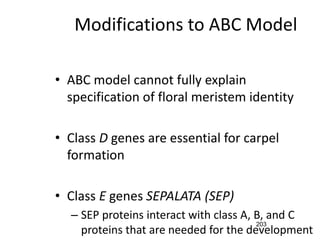
Modifications to ABC Model
• ABC model cannot fully explain
specification of floral meristem identity
• Class D genes are essential for carpel
formation
• Class E genes SEPALATA (SEP)
– SEP proteins interact with class A, B, and C
proteins that are needed for the development
203
204
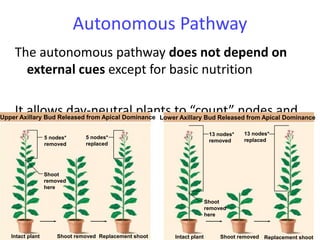
Autonomous Pathway
The autonomous pathway does not depend on
external cues except for basic nutrition
It allows day-neutral plants to “count” nodes and
“remember” node location
Upper Axillary Bud Released from Apical Dominance Lower Axillary Bud Released from Apical Dominance
Intact plant Shoot removed Replacement shoot
Shoot
removed
here
5 nodes*
removed
5 nodes*
replaced
Intact plant Shoot removed Replacement shoot
Shoot
removed
here
13 nodes*
removed
13 nodes*
replaced
What is photoperiodism
• The physiological response to light period
• Photoperiodism is the response by an
organism to synchronise its body with
changes in day length
• Measured in terms of critical day length
1. Short day plant (SDP) eg. chrysanthemums
2. Long day plant (LDP) eg. Chinese cabbage, beet etc.
3. Day neutral plant (DNP): if other conditions are satisfied. eg. tomato,
cucumber, egg plant and bean
4. Long short day plants: long at vegetative: Bryophyllum, night jasmine
5. Short long day plants: short at vegetative:
Plant types responsive to photoperiodism
Photoperiodic induction
• Plants may require one or more inductive cycles for flowering.
• An appropriate photoperiod in 24 hours cycle constitutes one inductive
cycle.
• If a plant which has received sufficient inductive cycles is subsequently
placed under unfavorable photoperiods, it will still flower.
• Flowering will also occur if a plant receives inductive cycles after
intervals of unfavorable photoperiods (i.e., discontinuous inductive
cycles.)
• This persistence of photoperiodic after effect is called photoperiodic
induction.
• Xanthium (a short day plant) requires only one inductive cycle and normally
flowers after about 64-days.
• It can be made to flower even after 13 days if it has received 4-8 inductive
cycles. In such cases the number of flowers is also increased.
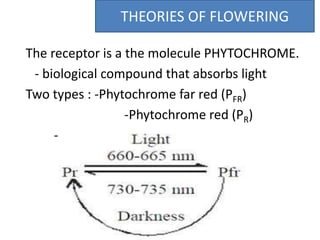
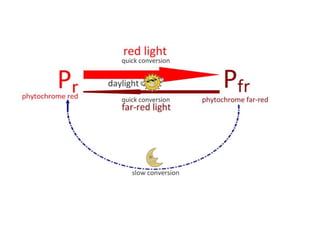
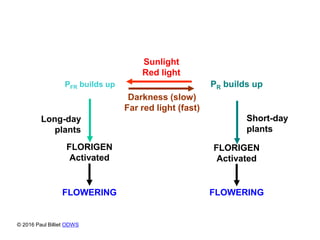
The receptor is a the molecule PHYTOCHROME.
- biological compound that absorbs light
Two types : -Phytochrome far red (PFR)
-Phytochrome red (PR)
- interconvertible
PhotochromeTHEORIES OF FLOWERING
Sunlight
Red light
Darkness (slow)
Far red light (fast)
PFR builds up
Long-day
plants
FLOWERING
FLORIGEN
Activated
PR builds up
Short-day
plants
FLORIGEN
Activated
FLOWERING
© 2016 Paul Billiet ODWS
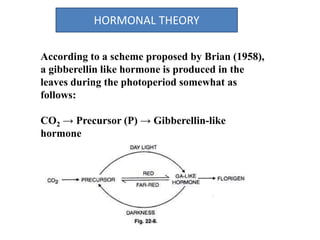
HORMONAL THEORY
According to a scheme proposed by Brian (1958),
a gibberellin like hormone is produced in the
leaves during the photoperiod somewhat as
follows:
CO2 → Precursor (P) → Gibberellin-like
hormone
CHAILAKHYAN HYPOTHESIS
He gave the concept of ‘florigen’ as a bicomponent
complementary flowering hormone complex.
According to him, gibberellins are essential for
flowering for long day species and anthesins
for flowering of short day plants.
THEORY OF ENDOGENOUS RHYTHM
Bunning 1958: 2 halves
a. Photophilus phase: anabolic
b. Scotophilus phase: dark, sensitive: Catabolic and
dehydration
Light during scotophilus phase inhibit flowering in SDP
FLORAL INHIBITOR THEORY:
• The inhibitor concept is based on an early
observation reported by Lang in 1952 that LDP
Hyoscyamus and SDP Chenopodium can be
induced to flower by removal of some leaves.
• Since the inhibitory substances are thought to
be generated in leaves, it is likely that the
leaves inhibit floral induction.
C/N RELATIONSHIP THEORY:
• High C:N ratio: flowering
• Low C:N ratio: vegetative growth
• Pruning, girdling effects the C:N ratio
TRACE ELEMENT NUTRITION
THEORY:
Copper and Iron
• Iron is also involved in photoperiodic
induction. Hillman pointed out that flowering
in Lemna is inhibited by reducing the iron
supply.
WATER STRESS THEORY:
• Brenchart demonstrated that a period of
water shortage is absolutely required for
flower initiation
• Positive: Chenopodium polyspermism
• Negative: Xanthium
Importance
• Annuals can be growth twice /thrice in a year
• Prevention of winter dormancy and autumn leaf
fall
• increased stolen formation in strawberry (long
days)
• Increased yield
• Plants such as leafy vegetables, radish remain
vegetative unless sufficient photoperiod is not
given.
Vernalization
Promoting flowering with cold
Also called as yarovization.
•Jarovoe in Russian – from jar meaning fire or
the god of spring.)
Vernalization
• For vernalization the seeds are allowed to germinate for some time and
then are given cold treatment 0 C to 5 C.
• The period of cold treatment varies from few days to many weeks.
• After the cold treatment the seedlings are allowed to dry for sometime
and then sown.
• Vernalization prepares the plant for flowering.
• The cold stimulus usually perceived by the apical meistems but in some
species all dividing cells of roots and leaves may be the potential sites of
vernalization eg.Leennario biennis.
• The vernalization is an aerobic process and requires metabolic energy.
• In the absence of oxygen cold treatment becomes completely inefficient.
• Sufficient amount of water is also essential.
• Vernalization of dry seeds is not possible.
Mechanism of vernalization
1. Concept of Gregory
• Gregory and coworker were working on cereals.
• They believed that vernalization process consists
of several partial reactions.
• Cells within the shoot apex receives low
temperature stimulus.
• It starts metabolic processes.
• These processes pynthosize the flower stimulus.
• The flower stimulus is then transformed into
localized areas within the shoot apex.
• Thus flowering start in it.
2. Phasic development theory
• Proposed by Lysenko in 1934.
• According to this theory there is a series of phases in the
development of a plant.
• Each phase is stimulated by an environmental factor such
as temperature,light,etc.
• Commencement of one phase will take place only after
the completion of the proceeding phase.
• There are two phases
1.Thermophase
2.Photophase
(a) Thermophase:
• The early phase of life which requires definite
temperature for development is called thermophase.
• It is applied to development of seeds and seedlings.
• Each seed requires definite temperature
• . This requirement, varies for different species. For
example, biennial winter wheat need low temperature.
But the seeds of annual spring varieties require higher
temperature.
• Thermophase must be completed before the
photophase.
• Thus chilled or vernalized seeds complete the
thermaphase.
b) Photophase:
• The late phase of life in which plant
require definite light requirement for
flowering is called photophase.
• If the chilled seeds are sown, they grow
and enter into photophase.
• This phase require definite light and dark
period (photoperiodism) for flowering.
Hormonal theories
• Melcher (1939)
• He proposed that chilling treatment induces the formation of a new
floral hormone called vernalin.
• This hormone is transmitted to other parts of the plant.
• He graphted a vernalized plant with an unvernalized plant.
• The unvernalized plant also initiates flowering.
• The hormone,vernalin diffuses from the vernalized plant to
the unvernalized plant and induces flowering.
Devernalization
• The reversion of vernalization by high temperature treatment is called
devernalization.
• Devernalization is effected by treating the vernalized seeds or buds with
high temperature.
• Lang et al (1957) demonstrated that application of gibberlins can replace
the cold treatment for vernalization in certain biennial plants.
Practical applications
• Due to vernalization the vegetative period of the plant is cut short resulting in
an early flowering.
• Vernalization increases the resistance of plants to fungal diseases.
• It increases the cold resistance of plants.
• In the biennials,vernalization induces early flowering and early fruit setting.
• Flowering can be induced by graphting and this feature is used in horticulture.
• It also helps in crop improvement.
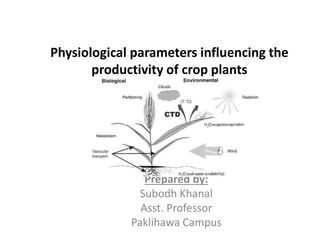
Physiological parameters influencing the
productivity of crop plants
Prepared by:
Subodh Khanal
Asst. Professor
Paklihawa Campus
The crop productivity is determined by many
methods
• Growth characters
• Nutrient content
• Developmental characters.
Growth analysis
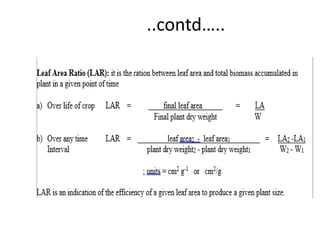
 Leaf Area Index (LAI)
Leaf Area Index (LAI) was defined by Watson
(1947) as the total one‐sided area of leaf tissue
per unit ground surface area.
• LAI = leaf area / ground area
….contd…………….
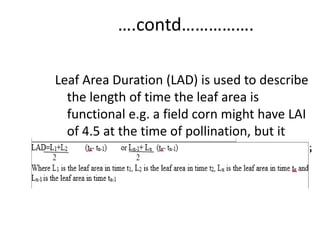
Leaf Area Duration (LAD) is used to describe
the length of time the leaf area is
functional e.g. a field corn might have LAI
of 4.5 at the time of pollination, but it
could be useful also to know how long this
LAI is maintained.
….contd……..
Optimum vs Critical Leaf Area
• Optimum Leaf Area is the leaf area at
which the rate of dry matter production is
max at a particular LAI and less at LAI
below or above.
• Critical Leaf Area is when the rate of dry
matter production is constant after the
maximum rate was reached. It is the LAI
..contd…..
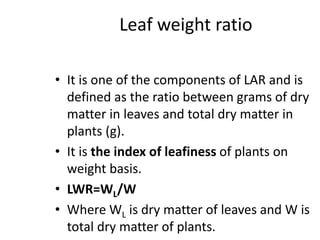
Leaf weight ratio
• It is one of the components of LAR and is
defined as the ratio between grams of dry
matter in leaves and total dry matter in
plants (g).
• It is the index of leafiness of plants on
weight basis.
• LWR=WL/W
• Where WL is dry matter of leaves and W is
total dry matter of plants.
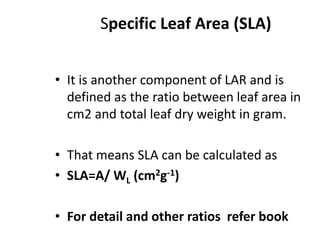
Specific Leaf Area (SLA)
• It is another component of LAR and is
defined as the ratio between leaf area in
cm2 and total leaf dry weight in gram.
• That means SLA can be calculated as
• SLA=A/ WL (cm2g-1)
• For detail and other ratios refer book
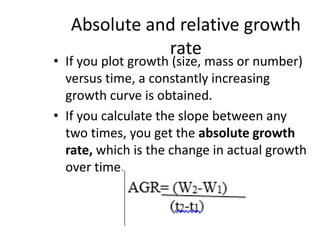
Absolute and relative growth
rate
• If you plot growth (size, mass or number)
versus time, a constantly increasing
growth curve is obtained.
• If you calculate the slope between any
two times, you get the absolute growth
rate, which is the change in actual growth
over time.
Contd….
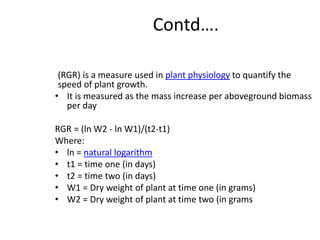
(RGR) is a measure used in plant physiology to quantify the
speed of plant growth.
• It is measured as the mass increase per aboveground biomass
per day
RGR = (ln W2 - ln W1)/(t2-t1)
Where:
• ln = natural logarithm
• t1 = time one (in days)
• t2 = time two (in days)
• W1 = Dry weight of plant at time one (in grams)
• W2 = Dry weight of plant at time two (in grams
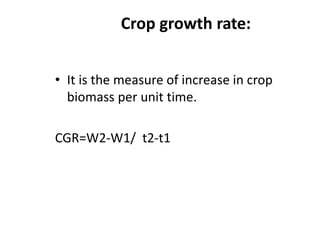
Crop growth rate:
• It is the measure of increase in crop
biomass per unit time.
CGR=W2-W1/ t2-t1
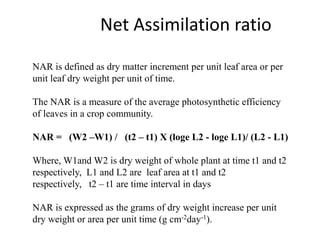
Net Assimilation ratio
NAR is defined as dry matter increment per unit leaf area or per
unit leaf dry weight per unit of time.
The NAR is a measure of the average photosynthetic efficiency
of leaves in a crop community.
NAR = (W2 –W1) / (t2 – t1) X (loge L2 - loge L1)/ (L2 - L1)
Where, W1and W2 is dry weight of whole plant at time t1 and t2
respectively, L1 and L2 are leaf area at t1 and t2
respectively, t2 – t1 are time interval in days
NAR is expressed as the grams of dry weight increase per unit
dry weight or area per unit time (g cm-2day-1).
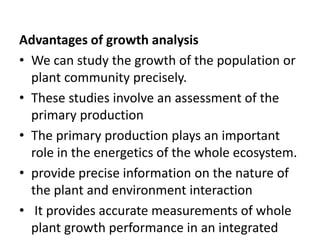
Advantages of growth analysis
• We can study the growth of the population or
plant community precisely.
• These studies involve an assessment of the
primary production
• The primary production plays an important
role in the energetics of the whole ecosystem.
• provide precise information on the nature of
the plant and environment interaction
• It provides accurate measurements of whole
plant growth performance in an integrated
Drawbacks of Growth Analysis
• In classical growth analysis sampling for
primary values consist of harvesting
(destructively) representative sets of
plants or plots
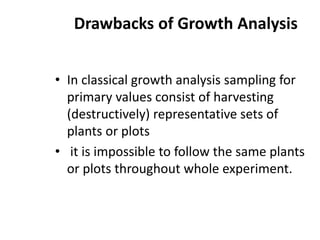
• it is impossible to follow the same plants
or plots throughout whole experiment.
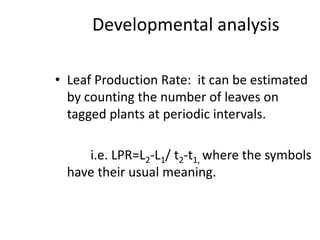
Developmental analysis
• Leaf Production Rate: it can be estimated
by counting the number of leaves on
tagged plants at periodic intervals.
i.e. LPR=L2-L1/ t2-t1, where the symbols
have their usual meaning.
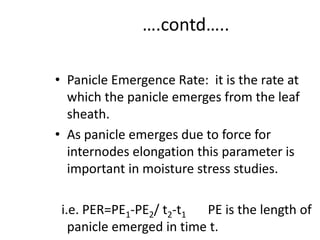
….contd…..
• Panicle Emergence Rate: it is the rate at
which the panicle emerges from the leaf
sheath.
• As panicle emerges due to force for
internodes elongation this parameter is
important in moisture stress studies.
i.e. PER=PE1-PE2/ t2-t1 PE is the length of
panicle emerged in time t.
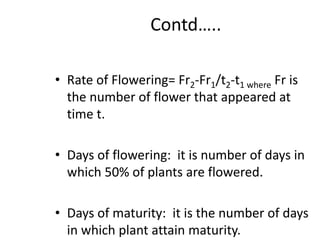
Contd…..
• Rate of Flowering= Fr2-Fr1/t2-t1 where Fr is
the number of flower that appeared at
time t.
• Days of flowering: it is number of days in
which 50% of plants are flowered.
• Days of maturity: it is the number of days
in which plant attain maturity.
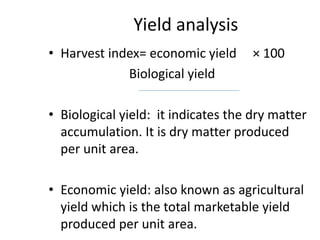
Yield analysis
• Harvest index= economic yield × 100
Biological yield
• Biological yield: it indicates the dry matter
accumulation. It is dry matter produced
per unit area.
• Economic yield: also known as agricultural
yield which is the total marketable yield
produced per unit area.
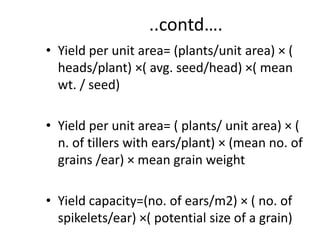
..contd….
• Yield per unit area= (plants/unit area) × (
heads/plant) ×( avg. seed/head) ×( mean
wt. / seed)
• Yield per unit area= ( plants/ unit area) × (
n. of tillers with ears/plant) × (mean no. of
grains /ear) × mean grain weight
• Yield capacity=(no. of ears/m2) × ( no. of
spikelets/ear) ×( potential size of a grain)
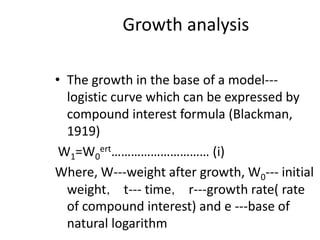
Growth analysis
• The growth in the base of a model---
logistic curve which can be expressed by
compound interest formula (Blackman,
1919)
W1=W0
ert………………………… (i)
Where, W---weight after growth, W0--- initial
weight, t--- time, r---growth rate( rate
of compound interest) and e ---base of
natural logarithm
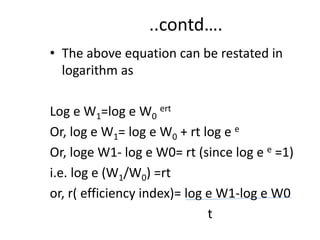
..contd….
• The above equation can be restated in
logarithm as
Log e W1=log e W0
ert
Or, log e W1= log e W0 + rt log e e
Or, loge W1- log e W0= rt (since log e e =1)
i.e. log e (W1/W0) =rt
or, r( efficiency index)= log e W1-log e W0
t
Cereals
• Tillers:
poor tillers determine the low yield
 maximum and effective tillers influence
the productivity of crop plants.
Maximum number of tillers /sq. m is
correlated with the number of ear
formation phase.
• Stem:
stout, erect, plant height, number of plant
population and plant
Sink and source is one of the vital
physiological parameters
• Canopy structures;
shape, size, length and arrangement of
leaves
The rate of crop photosynthesis depends
on LAI, LAE, LAD, photosynthesis rate/unit
leaf area, LAR and ULR.
• Grain yield:
reflects the proportion of assimilates
distribution between economic and total
biomass.
The length and number of spikelets, the
weight of grains, the number of grains,
cobs, pods, fruits e.t.c.
Y=Nr. Ng. Wg
• Dry matter production: profuse growth of
roots absorbs high amount nutrients from
soil and help in assimilation.
Pulse and oil seeds crop
• Vegetative period
• Root to shoot ratio
• Grain size and test weight
• Plant population
• No. of pods or fruits/plant
• Grain and straw ratio
• Plant habit and growing season
•
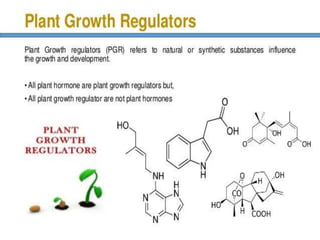
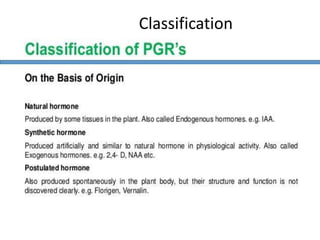
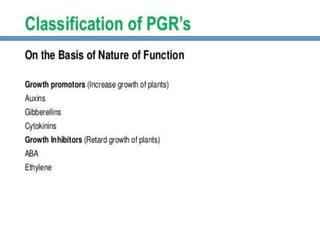
Classification
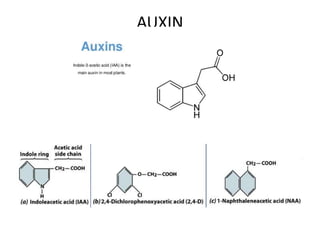
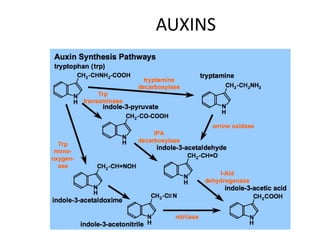
AUXIN
AUXINS
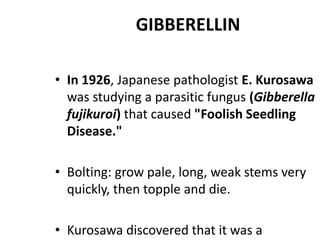
GIBBERELLIN
• In 1926, Japanese pathologist E. Kurosawa
was studying a parasitic fungus (Gibberella
fujikuroi) that caused "Foolish Seedling
Disease."
• Bolting: grow pale, long, weak stems very
quickly, then topple and die.
• Kurosawa discovered that it was a
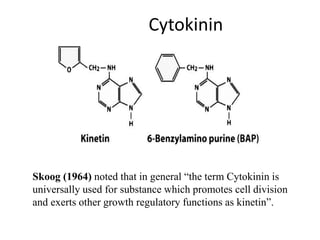
Cytokinin
Skoog (1964) noted that in general “the term Cytokinin is
universally used for substance which promotes cell division
and exerts other growth regulatory functions as kinetin”.
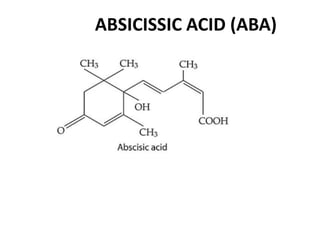
ABSICISSIC ACID (ABA)
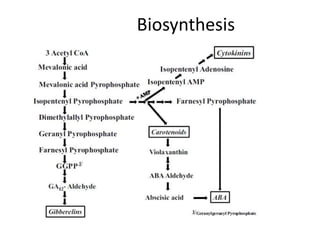
Biosynthesis
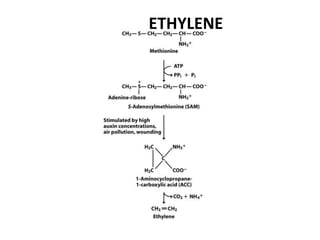
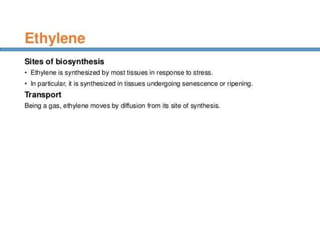
ETHYLENE
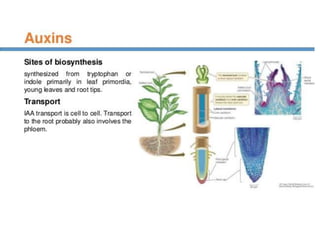
Mode of action of auxin
1. Enlargement
• Application of IAA in the cell.
• Binding: A possible auxin-binding receptor protein has
been identified in plants which are called as auxin-
binding protein 1 (ABP1).
• Enhance proton pump (H+) from cytosol to cell wall.
The extrusion of protons is facilitated by H+-ATPases
located in plasma-membrane.
• Decreasing the pH of cell wall , activation of enzyme
and loosening of wall pressure
• Entry of water and cell enlargement
Physiological role
• Cell elongation and division
• The main causes of cell elongation-
– By increasing the osmotic content, permeability
of cell to water, wall synthesis.
– By reducing wall pressure.
– By inducing the synthesis of RNA & protein which
in turn lead to an increase in cell wall plasticity &
extension.
• Auxin also induces / promotes cell division
within the cambial region.
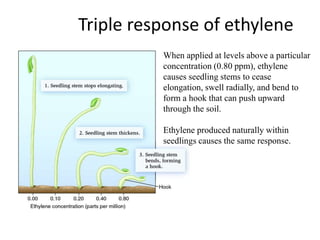
Triple response of ethylene
When applied at levels above a particular
concentration (0.80 ppm), ethylene
causes seedling stems to cease
elongation, swell radially, and bend to
form a hook that can push upward
through the soil.
Ethylene produced naturally within
seedlings causes the same response.
Mechanism of action
• Increase permeability increases RNA and
protein synthesis
• Accelarates the secretion of enzymes:
polygalaturunase, cellulase and
phospholipase------ softening and
degradation of cell wall
• Alpha amylase: hydrolysis of starch into
sugar
• High permeability: more repsiration:
ROLE OF ETHYLENE
• Fruit Ripening -- Ethylene stimulates all
these factors of fruit ripening:
– Breakdown of chlorophyll and synthesis of
other pigments.
– Fruit softening by cellulase and pectinase cell
wall breakdown.
– Formation of volatile compounds -
attractants.
– Conversion of starches and acids to sugars.
• You have studied physiological role and
practical actions in 1st semester (
Introductory Horticulture)
• So won’t be dealing those.
• Study on your own.
Other PGRs
– Florigen:
– Anthesins:
– Vernalin:
– Morphactins: synthetic, flowering stimulation, sequence of flowering, position and
number of flowers, formation of flowers, inflorescence, parthenocarpy, etc.
– Brassinosteroids, recognized as a sixth class of plant hormones, which stimulate cell
elongation and division, gravitropism, resistance to stress, and xylem differentiation.
They inhibit root growth and leaf abscission.
– Salicylic acid —These are involved in a complex cascade of chemical events that,
stimulated by herbivory, can help the plant mount a chemical defense against its
predators.
– Jasmonates —. They are believed to also have a role in seed germination, and affect the
storage of protein in seeds, and seem to affect root growth.
– Plant peptide hormones —growth and development, including defense mechanisms,
the control of cell division and expansion, and pollen self-incompatibility.
– Polyamines —These small, basic molecules are ubiquitous in living organisms, and are
involved in mitosis and meiosis control via regulation of apoptosis (programmed cell
death).
– Systemin: Systemin is transported from the site of herbivore damage to other tissues
where it induces gene transcription of defense factors, including jasmonate.
Thank you very much for your cooperation
and best of luck to you all…..
With
regards and lots of love
From Subodh Khanal
Subodh.agroecology@gmail.com
9851138999

Class note of Introductory crop physiology

  • 1.
    SUBODH KHANAL • Asst.Professor • Paklihawa Campus • Email: Subodh.agroecology@gmail.com, subodh@iaas.edu.np Phone: 9851138999 • Text book of crop physiology (please follow it)
  • 2.
    Introduction derived from Latinword “physis” meaning nature and “logos” meaning science. • Study of plant way of life. • Study of plant functions and response of crop to different environment • Julius von Sachs (October 2, 1832 - May 29, 1897) is considered as the father of Plant Physiology
  • 3.
    • Aristotle: plantnutrition controlled by a soul, absorb readymade food • Jan van Helmont: Willow tree experiment (200 pounds soil) • Joseph Priestley, Jan Ingenhousz and Jean Senebier : plant leaves in light take up carbon dioxide and emit equivalent amounts of oxygen. • Nicholas de Saussure noted that water was involved in the process • J. R. Mayer observed that the process converted light energy into the chemical energy of organic carbon. • In 1727 Stephen Hales, (Vegetable Staticks): transpiration, growth, and gas exchanges of plants. • 1895 by Henry Dixen and John Joly. • In 1926, E. Munch proposed a similar mechanism for translocation • In 1952, phytochrome was discovered and found to be the pigment at the center of photoperiodism.
  • 4.
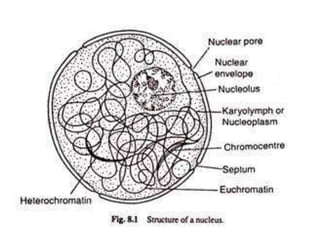
    •Cell discovered byRobert Hooke (1665) •The nucleus was first described by Franz Bauer in 1804 •more detail in 1831 by Scottish botanist Robert Brown in a talk at the Linnaean Society of London. •Dujardin in 1835 discovered the protoplasm and named as “sarcode”. •Johannes E. Purkinje in 1839 first introduced the term 'Protoplasm'.
  • 5.
    What will yoube studying? • Physical aspects: biophysical phenomenon, soil water relation, absorption and translocation of water, transpiration, ascent of sap, guttation e.t.c. • Metabolic aspects: photosynthesis, respiration, translocation of photosynthates • Growth and development aspects: seed dormancy, vernalization, photoperiodism, seed germination, growth and development, growth hormones, flowering, senescence.
  • 6.
    Importance/practical application • Seedmanipulation with:  Genetic potential  Productivity  Resistance  Dormancy • Fertility : inoculation of BMO • soil-water-plant relationship will enhance the bumper yield of crops. • High dry matter production • Photosynthesis • Herbicide resistance : round up ready crops • Nutriophysiology • Daylength manipulation • Postharvest loss • Phytohormones • Stress physiology • Fortification
  • 7.
    December 12 2017 PHYSIOLOGY THECELL Subodh Khanal Asst. Professor Paklihawa Campus
  • 8.
    The cell • Latinword: cella meaning small compartments • Found in cork cells • Antonie van Leewenhoek discovered first living cells in pond water (1674)
  • 9.
    Types of cell •Prokaryotes(primitive nucleus) • Eukaryotes (well defined nucleus) • See difference between prokaryotes and eukaryotes • Plant cell and animal cell
  • 11.
    1. Cell wall •Outermost part • Nonliving • Main chemical compound: cellulose • Primary, secondary and middle lamella • Structural figure(TS and LS) see book
  • 13.
    FUNCTIONS OF CELLWALL • structural support • Form and shape
  • 14.
    2. Protoplasm • Massof proteins, lipids, nucleic acid and water within a cell; except cell wall. • Living portion of protoplasm organized into specific bodies with specific functions is cell organelles.
  • 17.
    Friday, February 20,2015 Cell Organelles A membrane-bound compartment or structure in a cell that performs a special function. Membrane bound organelles are found only in eukaryotic cells.
  • 18.
    Friday, February 20,2015 Endoplasmicreticulum  Protein synthesis  Fatty acid synthesis  Insertion of protein in membranes  SER: Drug metabolism
  • 19.
    Friday, February 20,2015 Golgiapparatus Camella Golgi (1898) • Packaging of protein for exporting • Sorting of protein for incorporation into organneles • Formation of plant cell wall Receiving side Shipping side
  • 20.
    Friday, February 20,2015 Ribosomes
  • 21.
    Lake’s model Functions: 1. Workhousefor protein synthesis 2. Translation of mRNA into proteins 3. Participate in fatty acid metabolism
  • 22.
    Micro bodies Glycosomes :Sccot and Still(1968) in protozoa , woronin bodies: in fungi
  • 23.
    Peroxisomes • Peroxisome, membrane- boundorganelle occurring in the cytoplasm of eukaryotic cells. • They also contribute to the biosynthesis of membrane lipids known as plasmalogens. • Break down hydrogen peroxides • Oxidase create H202, break H202 by catalase, peroxidase
  • 25.
    • Lipo-proteinic membrane • Outer: 60-75A • Inner: 50-70A • Peri mitochondrial space 80A between two. • 70 S ribosome • Composition: 60-75% protein, 25- 30% lipids, 0.5% RNA and small amount of DNA
  • 26.
    Functions • Energy productionsite • they use complex molecule and oxygen to produce high energy molecule (ATP) • Called as power house of cell • Kreb cycle
  • 27.
  • 28.
  • 30.
    FUNCTIONS OF NUCLEUS 1.Controlscellular functions 2.Synthesis of structural and enzymatic proteins 3.Synthesis of RNA 4.Cell division 5.Controls cell growth 6.Variation
  • 31.
  • 33.
  • 34.
    Energy flow ina biological system diffusion, osmosis and water potential WUE and crop water needs water absorption ascent of sap nutrient uptake nutriophysiology Subodh Khanal Asst. Professor Paklihawa campus
  • 35.
    Energy: 1. Kinetic Energy 2.Potential Energy Energy is the capacity to do work •The search of energy is main theme of life. Sun is the ultimate source of energy. •WE MAKE MONEY BY HARVESTING SUNLIGHT!!! •In a cell energy is present as:  Potential energy(bonds)  Thermal energy (ATP)  Electrical energy ( charged particles) K+ Na +
  • 36.
    Thermodynamics: A study ofenergy changes in systems: The system: the portion of the universe with which we are concerned Bioenergetics is the study of energy transfer within the living beings.
  • 37.
    First law ofthermodynamics: the law of conservation of energy The total energy is always conserved. According to the first law of thermodynamics “energy can be neither created nor destroyed, but only changed from one form to another.” Plant (photosynthesis) Glucose Light energy chemical energy e.g. Energy flow in an ecosystem
  • 38.
    Second law ofthermodynamics: no any system is 100% efficient. The total entropy is always increases. System tends to proceed from ordered states to disordered states WHY?????? • Cellular respiration • Indigestion • Unavailable (color or fixed)
  • 39.
    Third law ofthermodynamics: Entropy of any crystalline substance must approach zero as temperature approaches 0° K For biological systems entropy changes are more useful than absolute entropies Living system are never at equilibrium with the sorrounding
  • 40.
    Gibb’s free energy‘G’ Determines the direction of any reaction from the equation: G = H – TS For a constant pressure and temperature system (as most biological systems) then the Equation becomes easier to handle G = H - TS (H enthalpy, S is entropy) The enthalpy and entropy are now defined in one equation. G is negative for exergonic reactions (release energy in the form of work) is positive for endergonic reactions (absorbing energy in the form of work)
  • 41.
    Practical 1: Calculationin bioenergetics See questions and solutions from the provided handout. Maintain it in your practical copy.
  • 42.
  • 43.
    Polar, high specificheat capacity, high thermal conductivity….see book Partial charges are equal so neutral. H bonds: water vs polar molecule ( good solvent)
  • 44.
    Functions • Major componentof cell • Uptake and transport of materials • Medium for biochemical reactions. • Reactant in biochemical reaction (photosynthesis) • Structural support via turgor pressure • Transfer of plant gametes • Offspring dispersal (coconut) • plant movement (touch me not) • Cell elongation • Thermal buffer • Evolution
  • 45.
    DIFFUSION • Net movement ofmolecules from the area of high concentration/ pressure to low concentration/ pressure
  • 46.
    IMPORTANCE in plants 1.Gaseousexchange 2.Passive salt absorption 3.Removal of excess water by transpiration 4.Translocation of organic residues 5.Pollination? ???
  • 48.
    Significance of Osmosisin Plants: (1)Water absorption by roots. (2) cell to cell movement. (3)Opening and closing of stomata (4)shape or form of their organs is maintained. (5)The resistance of plants to drought and frost increases with increase in osmotic pressure of their cells. (6)Turgidity of the cells of the young seedlings allows them to come out of the soil.
  • 49.
    D.P.D. is directlyproportional to the concentration of the solution. D.P.D (S.P.) = O.P. – W.P. but (W.P.) = T.P. therefore, D.P.D. (S.P.) = O.P. – T.P. O.P = T.P. (in fully turgid cell) and hence, D.P.D. (S.P) = O (zero) T.P. = O (in fully plasmolysed cell) and hence, S.P. = O.P. Movement from low DPD to high DPD
  • 51.
    Chemical pot. Ofwater Free energy/mol =chemical potential
  • 52.
    O.P. = Ci R T where, C = Concentration of solution expressed as molality (mols per kg of water). i = The activity coefficient (for non-electrolytes such as sugars it is 1; for electrolytes such as NaCl it varies with their concentration). R = gas constant. (0.0831 L bars/mol K T = absolute temperature (K) = °C + 273. This formula is called as Vent Hoff’s formula
  • 54.
    Note: see numericalspresent in book. Maintain it in practical also as practical 2 (see page 62-64) .
  • 55.
    55 Problem #1 Here youhave two cells. Your job is to fill in the missing values for the water potential factors. Some values are given. Some values you know from the kind of cell. Others you know from the information given. Still further values you get from arithmetic. Humid morning; cells at equilibrium with each other. mesophyll xylem -10 -6
  • 56.
    Hints • Cells areat equilibrium • Matric potential of wet substance is 0 • The right cell is a xylem vessel element, and it is filled with xylem sap, almost pure water. This tells you its solute potential. • Normal cells have water potentials that are between about -1 and -15 bars.
  • 57.
    Problem #2 • Inthe same cells above what happens if transpiration starts to rise? • If transpiration is taking place, there must be water flow from the xylem to the mesophyll cell. This means the mesophyll cell has a lower water potential than the xylem. • Typically the differences are just a couple of bars for nearby cells. • So water potential of mesophyll is -8
  • 58.
    On average, foreach 100 litres of water used by a plant, each process uses: • Photosynthesis 0.1 litres • Growth (new leaves, roots etc) 1.9 litres • Transpiration 98 litres Mechanism of absorption and translocation of water
  • 59.
    Category of waterfound in soil • Gravitational water: comes under the influence of gravity • Capillary water: water remained in soil as film coating after gravitational water has drained away. Retained by surface tension. • Hygroscopic or imbibed water: held by adhesion • Runaway water: flows on the surface • Chemically bound water: chemically combined with Fe, Al
  • 60.
    Mechanism of waterabsorption 1.Active : in roots : when transpiration is low 2.Passive : in leaves
  • 61.
    Route of waterabsorption Apoplast: is continuous system of cell wall and intercellular space Symplast; continious connection of cytoplasm known as plasmodesmata. In transmembrane pathway water sequentially enters the cell on one side and exits the cell on other side and so on.
  • 63.
    Active water absorption •root cells play active role in the absorption of water (4%) • metabolic energy released through respiration is consumed • Slowly transpiring plants • Can be osmotic or non osmotic (against the gradient, related to respiration, auxin content, respiratory inhibitors )
  • 64.
    Passive absorption  Accordingto osmotic gradient  Does not require energy  Does not require oxygen  Root pressure not created
  • 65.
    Factors affecting • Rootsystem: number of root hairs and depth • Concentration of soil solution; solute=high OP ( soil OP>sap, osmotic absorption ) • Availability of soil water • Aeration • minerals : poor in alkaline and saline soils • Transpiration • Temperature (increases upto 30 degree, 0 at 0 ) • Metabolism
  • 66.
     The upwardmovement of water from the root to the top of the plant is called as ascent of sap.  The water uptake takes place through the roots and the leaves transpire most of this water.
  • 67.
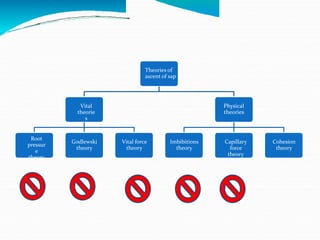
    Theories of ascent ofsap Vital theorie s Physical theories Root pressur e theory Godlewski theory Vital force theory Imbibitions theory Capillary force theory Cohesion theory
  • 68.
    Root pressure theory •Root pressure is developed when absorption> transpiration so water is pushed in trachids • Hydrostatic pressure is responsible Criticism: • Only 2 atm but 20 atm is required to raise • Absent in conifers • Absent in rapidly transpiring plants • Water raises even in absence of roots
  • 69.
    Godlewski theory • Pumpingaction of xylem parenchyma is responsible. • Due to change in OP
  • 70.
    Pulsation theory byJC Bose • Inner layer of cortex • Pulsation like heart • Responsible for upward movement • Strasburger proved these theories wrong • Ascent of sap even if destroyed by picric acid
  • 71.
    Physical theories • atmosphericpressure theory: Boehm. < 34 ft. only • Capillary force theory: Boehm: only true to small distance • Imbibition theory: Unger: may be upto 1000 atm but water ascends through lumen not through walls. • Cohesion tension theory: transpiration pull theory: Dixon and Jolly theory
  • 75.
    Objection • Transpiration isnot solely responsible for continious water column. • Air vessels in trachids and vessels break column • High wind velocity, high temperature break column
  • 76.
    Evidences • Osmotic potentialreached upto 200 atm • Purely physical • Absorption depends on transpiration • Tensile strength of xylem sap 25-300 atm sufficient to maintain continuous water column
  • 77.
  • 78.
    3 Definition of Transpiration Transpiration:is the process of water movement through a plant and its evaporation from aerial parts especially from leaves. Only 5% absorbed water is retained in plant body
  • 81.
    Distribution and Types ofStomata: • Apple or mulberry (hypostomatic) type: • Potato type: more on lower: potato, tomato, Brassica, pea, beans • Oat (amphistomatic) type: equal • Water lily/ Nymphea (epistomatic) type: above • Potamogeton (astomatic) type: vestigeal
  • 82.
    Mechanism of stomatal transpiration •Water absorbed by root system. • Transported upward through xylem elements by transpiration pull. • Reaches to leaves. • Enters into mesophyll of leaves through vascular system • If RH of atmosphere is low water escapes into air spaces as vapor.  Diffusion : mesophyll cells into intercellular space  Diffusion into outer dry atmosphere (evaporation) Pallisade Spongy
  • 83.
    • Mesophyll becomesturgid • TP increases, DPD decreases so water diffuses into intercellular space • Intercellular space becomes saturated with water • Vapor pressure >water vapor of atomosphere • DPD of intercellular space <DPD of vapor pressure of atmosphere • Water escapes into the atmosphere in the form of vapor.
  • 84.
    Increase of osmotic pressure of cellsap Photosynthesis in guard cells Increase of TP in guard cells Formation of sugar Endosmosis takes place from subsidiary cell to guard cell Stomata open. Objection: (i) In CAM plants stomata open during dark/night. (ii Chloroplast of monocot guard cells are nonfunctional (inactive) photosynthetically. Not sufficient. THEORY OF OPENING AND CLOSING OF STOMATA 1. Theory of photosynthesis in guard cells Von Mohl (1856)
  • 85.
    Starch sugar conversiontheory • Lloyd: day>> guard cells contain sugar>>stomata open, starch at night • Sayre and Searly: day>> neutral or alkaline ph >>stomata open, acidic>> closes
  • 86.
    Starch sugar conversiontheory • Yin & Tung reported the presence of phosphorylase enzyme in guard cells.
  • 87.
  • 90.
    Theory # 3.Theory of Glycolate Metabolism: Under low concentration of C02 Glycolate is produced Glycolate gives rise to carbohydrate, thus raising the osmotic pressure and also that it could participate in the production of ATP Which might provide energy required for the opening of stomata,
  • 91.
    Critisism: fails to explainthe opening of stomataIt indark (e.g., - in succulent plants). In to some plants slomata have been found remain closed even during daytime. It fails to explain the effect of blue light on stomata opening
  • 92.
    Theory # 4.Active K+ Transport or Potassium Pump Theory and Role of Abscisic Acid: The concept of K+ ion transport was given by Fujino. It was supported and elaborated be an active mechanism by Levitt & Rashke in 1975 It appears to which needs ATP. It is based on recent observations and (explains the mechanism as follows.
  • 94.
    Factors causing openingand closing of stomata • Light: stomata opens at day mostly, CAM opposite. Red and blue but Blue light more effective. Stimulates light receptor zeazanthin. • temperature: within 20-30 degrees, increase in temperature facilitates opening of stomata • C02: inversely proportional (acidifies) • Water: directly proportional
  • 95.
    Water Use Efficiency •Water Use (technical) Efficiency: The mass of agricultural produce per unit of water consumed • Water Use (economic) Efficiency: The value of product(s) produced per unit of water volume consumed • Water Use (hydraulic) Efficiency: The portion of water actually used by irrigated agriculture of the volume of water withdrawn
  • 96.
    Factors affecting WUE 1.Climatic factors (Rh, sunlight, temperature) 2. Agronomic practices and crop management (early sown vs late sown, depth) 3. Antitranspirants 4. Mulching 5. Shelter belts 6. Weed 7. Fertilizers
  • 97.
    Crop water need •The crop water need (ET crop) is defined as the depth (or amount) of water needed to meet the water loss through evapotranspiration. • In other words, it is the amount of water needed by the various crops to grow optimally.
  • 98.
    calculate WUE andcrop water needs Crop WUE=Y/(G+E+T) i.e. water used for growth evaporated and transpired which is also called as consumptive use. Cu=G+E+T Or ET=Cu (since water used for growth is too negligible) It is expressed in kg/ha/mm or kg/ha/cm
  • 99.
    • Field WUE:it is the ratio of yield of crop to the amount of water used in the field • FWUE=Y/WR (water required) • WR=G+E+T+D (D is deep percolation loss) CWUE has research value FWUE is important for planners and farmers
  • 100.
    Crop water need •Water supplied by rainfall, irrigation or both • If rainfall is sufficient , Irrigation water need=0 • If no rainfall, IN=ET • Mostly, • IN=ET crop-pe (part of rainfall which is effectively used by plants) • Effective rainfall=total rainfall-runoff-evaporation-deep percolation  Pe=0.8P-25 if P>75 mm/month  Pe=0.6P-10 if P<75mm/month  If P=75 use either of the two
  • 101.
    MINERAL SALT ABSORPTION •Active • Passive
  • 102.
    1. Mass flowtheory • Ions absorbed under mass flow of water due to transpiration • Increase in transpiration pull increases the ion uptake • absence of metabolic energy • Fails to explain against osmotic gradient
  • 103.
    Outer and apparentfree space theory • Ions move in and out of the cells until equilibrium is achieved. • The part of plant cells which allows diffusion is called outer space.
  • 104.
  • 105.
    Donnan’s equilibrium Fixed anions Donnanequilibrium (which can also be referred to as the Gibbs-Donnan equilibrium) describes the equilibrium that exists between two solutions that are separated by a membrane. An ion can be too large to pass through the pores of the membrane to the other side.
  • 106.
    Active Absorption Metabolic energyis required in this process
  • 108.
    Lundegardh’s Theory/ cytochromepump theory Fe++: reduced outer , Fe+++” oxidized in inner. On outer the reduced cytochrome is oxidized by 02 releasing electron and taking anion. Unites with O2 to form water. In inner surface, oxidized cytochrome becomes reduced taking e- from dehydrogenase reaction. A- is then released.
  • 109.
    Goldacre theory • Contratileproteins Unfolded: bind ions exposed to membrane Folded: releases • ATP is required • Not proved
  • 110.
    Bennet Clark theory/protein lecithin theory
  • 112.
    Factors affecting: • Temperature:+ve upto certain level, KE during diffusion • Ph: decrease in ph increases anions and reverse for cations, if crossed the physiological range damage plant tissue • Light: indirect by transpiration and photosynthesis • Oxygen: active absorption is affected in absence • Interaction: antagonism e.g. calcium vs K/Na, P vs Zn, synergistic: Zn and Cu, Zn and Fe • Growth: active growth favors • Age: mature have high surface area but suberization also
  • 113.
    Root absorbs differentmineral ions in different areas • Root hair is the main area for mineral absorption. • Calcium: Apical region • Iron: Apical region (barley) Or entire root (corn) • Elongation zone (corn) : K accumulation, nitrate absorption • Root apex( corn and rice) : absorbs ammonium faster than the elongation zone does • root hairs are the most active phosphate absorbers
  • 114.
    NUTRIOPHYSIOLOGY : Dealswith physiological role and biochemical function along with deficiency and toxicity
  • 115.
    Essentiality of mineralnutrients • There are four basic groups: see page 98, 99 • Group one:C, H, O, N, S – Forms the organic components of plants – Involved in enzymatic process. – Oxidation reduction reaction • Group two: P,B, Si – Energy storage reactions or maintaining structural integrity – Present in plant tissue as phosphate, borate or silicate esters – The elemental is bound to OH group of an organic molecule
  • 116.
    Essentiality of mineralnutrients • Group three:K, Mg, Cl, Mn, Na – Present in plant tissue as either free ions or ions bound to substrates such as the pectin component of the plant cell wall – Of particular importance are their roles as – Enzyme cofactors – In the regulation of osmotic potentials
  • 117.
    Essentiality of mineralnutrients • Group four: Fe, Zn, Cu – This last group has important roles in reactions involving electron transfer. – Some also involved in the formation/regulation of plant growth hormones – Zinc – The light reaction of photosynthesis - Copper
  • 118.
    Patterns of deficiency •Nutrients are redistributed in the phloem • Old leaves = phloem mobile • Young = phloem immobile • Refer book for detail and individual functions and deficiency symptoms of these nutrients. • Page: 100-104
  • 120.
    Practical 4: detectionof visual deficiency symptomsRefer: 105-106 • Maintain it in separate chart paper . • collect image of such deficiency symptoms in ppt • flex print with clear image
  • 125.
    PHYSIOLOGY of foliarnutrition • Ability of leaf to absorb nutrients was first recorded by Gris (1844) • Not too high concentration : macro: 1%, micro : 0.1% • Applied in the evening or cloudy day but not before raining or during rainfall.
  • 128.
    1. Wetting ofthe leaf surface with fertilizer solution; 2. penetration across the outer epidermal cell wall; 3. entrance into the leaf apoplast; 4. uptake into the leaf symplast; 5. Distribution within the leaf; and 6. transport out of the leaf.  Water stress increase thickness of cuticle upto 33% (high molecular wt cuticle> hydrophobicity)
  • 129.
    Rates of nutrientsabsorption or entry into the plant leaf tissue (adapted from MWL 1994).
  • 132.
    • If penetrationrate is high: leaf damage, scrotching. • Crystallize if RH<DRH, stay in solution if RH>DRH. • The relative humidity (RH) threshold where a fertilizer dissolves into a liquid and below which it remains undissolved (solid) is called the Deliquescence Point.
  • 133.
    Factors affecting penetration •Concentration: high concentration> fast diffusion. • Size: smaller size easy penetration • Point of deliquescence: lower the DRH faster dissolve • Relative humidity: high humidity permeability increases due to cuticular hydration. • Temperature: solubility ↑, viscosity and point of deliquescence ↓ • Light intensity: high light intensity ↑ cuticle thickness and amount of cuticular wax • Water stress increases cuticle • Adjuvants( inert materials ) help in spreading and persistence of A.I. And promote rate of uptake.
  • 134.
    Practical application when: •Low nutrient availability in soil • Dry top soil • Decrease in root activity during reproductive stage • Increase in protein content of cereals grains
  • 135.
    12 H2O The overallreaction in photosynthesis: 6CO2 + ++ Light energy C6H12O6 6O2 6 H2O+ Photosynthesis Two components: Light energy H2O O2 Light-dependent reactions Chemical energy (ATP, NADPH) Chemical energy (ATP, NADPH) CO2 Light-independent reactions Chemical energy (C6 H12O6) Energy Harvest Synthesis See historical landmarks: page 122- 123 Endergonic, anabolic reaction for fixing CO2
  • 136.
    Photosystem I PhotosystemII located in both grana and stroma located in the inner surface of thylakoids active in both red and far wavelength light. Inactive in far red light It carries single cyclic phosphorylation. It carries non cyclic phosphorylation. It comprises 100 chlorophyll a molecules, some beta carotene , proteins, 2 phylloquinones, Fe-S complex and cytochrome bf complex It comprises of 40-50 chl a molecules with little chl. B molecules, beta carotenes, pheophytins, maganoprotein, cl ion, cytochrome b559, cytochrome b6, 6-7 polypeptides This system uses light of vavelength 700 nm i.e. light harvest center is P700. It absorbs light 680 nm. Photosystem: ancient Greek: photos = light and systema = assembly functional and structural units of protein complexes involved in photosynthesis
  • 137.
    Emerson red dropeffect • Robert Emerson (1932) and Lewis et al. (1943) Quantum yield: the number of oxygen molecule released per photon of light in photosynthesis is called quantum yield
  • 138.
    • Chlorophyll ais the main pigment • Cholorophyll is made of porphyrin ring and a hydrophobic tail • Other pigments are called accessory pigments
  • 139.
  • 140.
    Mechanism of photosynthesis photosynthesisconsists two successive series of reactions: • Light or Hill reaction • Dark reaction or Blackmann’s reaction.
  • 141.
    • Absorption oflight energy by chlorophyll. • Transfer of light energy from accessory pigment to chlorophyll a • Activation of chlorophyll a by photons of light • Photo photolysis of H2O Process
  • 143.
  • 144.
    Dark reaction • • also knownas Blackmann’s reaction or thermochemical reaction Also called as CALVIN CYCLE Or C3-CYCLE or photosynthetic carbon reduction cycle (PCR cycle) • • The Calvin cycle begins with carbon fixation, incorporating CO2 into organic molecules Three phases: carboxylation, reduction and production of glucose and regeneration of RUBP
  • 145.
  • 146.
    See page 140-141:features of photorespiration
  • 147.
    • Specificity toCO2 decreases (RUBISCO) • Solubility of CO2 decreases in cytoplasm and chloroplast than O2 • Moisture stress: closes stomata, co2 concentration decreases. Favors oxygenase • When co2 below 50 ppm, rubisco helps to fix o2 (at 2017 global concn: 405.0 Photo respiration higher under hot and dry growth
  • 148.
  • 149.
    Variant name PrincipalC4 acid Decarboxylating Examples. transported to the enzyme bundle sheath cells NADP – ME NAD-ME PEP-CK Aspartate Malate NADP-dependent Maize, Sugarcane, Malic enzyme Sorghum Aspartate NAD-dependent Millet, Pigweed, Malic enzyme Panicum milliaceum (variga) Amaranthus Aspartate Phosphoenol Guinea grass (Panicum pyruvate carboxy maximum), chloris kinase gayana
  • 150.
    Reduc ed Phosphoryl ated 1 2 3 4 5 (1) PEP carboxylase,(2) NADP-malate dehydrogenase, (3) NADP malic enzyme, (4) pyruvate Pi dikinase, (5) 3-PGA kinase and GAP dehydrogenase
  • 151.
    • 7: alanine aminotransferas e •(8) NAD-malate dehydrogenase • OAA to aspratate: transamination 7 8
  • 152.
  • 153.
    Crassulacean Acid Metabolism(CAM) Temporal and spatial difference with C4 plant Stores malic acid in vacuole ( in dark) uses during light First discovered in succulents of the Crassulaceae
  • 154.
  • 155.
    Factors affecting • A.External factors photosynthesis a. Light Intensity Quality: Blue and red light, green Duration : avge 10-12 hrs
  • 156.
  • 157.
  • 158.
    Oxygen Concentration What woulda graph for increasing levels of CO2 look like?
  • 159.
    Internal factors 1. Protoplasmicfactors: it takes some time to initiate the process in seedlings even if the chlorophyll has appeared. 2. 3. 4. Chlorophyll content: normal and variegated leaves Accumulation of products Structure of leaves
  • 160.
    Active Absorption Metabolic energyis required in this process
  • 162.
    Lundegardh’s Theory/ cytochromepump theory Fe++: reduced outer , Fe+++” oxidized in inner. On outer the reduced cytochrome is oxidized by 02 releasing electron and taking anion. Unites with O2 to form water. In inner surface, oxidized cytochrome becomes reduced taking e- from dehydrogenase reaction. A- is then released.
  • 163.
    Goldacre theory • Contratileproteins Unfolded: bind ions exposed to membrane Folded: releases • ATP is required • Not proved
  • 164.
    Bennet Clark theory/protein lecithin theory
  • 165.
    Respiration • Cellular respirationis the process by which cells transfer chemical energy from sugar molecules to ATP molecules. • As this happens cells release CO2 and use up O2 • Respiration can be AEROBIC or ANAEROBIC
  • 166.
    Figure 9.6-3 Electrons carried viaNADH and FADH2 Electrons carried via NADH Oxidative phosphorylati on: electron transport and chemiosmosis Pyruvate oxidation Acetyl CoA Glycolysis Citric acid cycleGlucose Pyruvate MITOCHONDRIONCYTOSOL ATPATP ATP Oxidative phosphorylati on Substrate-level phosphorylation Substrate-level phosphorylation
  • 167.
    Preparatory Phase Studied in1st semester See reversible and irreversible steps Relulation: where kinase is involved
  • 169.
    OAA: condensation ofPA : pyruvate carboxylase Malate: malate dehydrogenase , reversible reaction Alanine: transaminated: alanine amino transferage
  • 170.
    Figure 9.10 MITOCHONDRION CYTOSOL COCoenzyme A2 31 2 Acetyl CoAHNAD NADH + Pyruvate Transport protein Called as grooming phase
  • 173.
    Inhibitors • Fluro acetate(aconitase) • Arsinite(KDH) • Malonate (SDH)
  • 174.
  • 175.
  • 176.
    flavin adenine dinucleotide(FAD) Nicotinamide adenine dinucleotide
  • 177.
    177 • Chemiosmosis: It isthe oxidative phosphorelation that results in ATP production in the inner membrane of mitochondria. • The ATP synthase molecules are the only place that will allow H+ to diffuse back to the matrix (exergonic flow of H+). • This flow of H+ is used by the enzyme to generate ATP a process called chemiosmosis. • ATP-synthase, in the cristae actually makes ATP from ADP and Pi. • ATP used the energy of an existing proton gradient to power ATP synthesis. – This proton gradient develops between the intermembrane space and the matrix. – This concentration of H+ is the proton-motive force.
  • 178.
    Inhibitors of electrontransport Fig 19-6
  • 179.
    • Type ofcell: young and developing cells • Oxygen: significant lowering below 10%, retarded at 5% • C02: no change (10%), 10-80% progressive decrease, killed or injured severely. • Light: Increases temperature, opens stomata, photorespiration • Reserve materials (glucose) • Protoplasm: direct relation • Injury • Herbicides ( disrupts enzyme activity, so respiration) Factors
  • 180.
    TRANSLOCATION OF PHOTOSYNTHATES Ahighly specialized process for redistributing •Photosynthesis products synthesized in leaves •Movement of sugar from source to sink •Through sieve tube element
  • 181.
    • Food andminerals move through tubes formed by chains of cells, sieve-tube members. – sieve plates – companion cell Phloem
  • 182.
    Sieve plate pore Cellwall between sieve elements Companion cell Fig. 10.5
  • 183.
    Dry matter distributionor partitioning Photosynthate Translocation Ear Stem or shoot Root
  • 184.
    Direction of movement •Downward: from leaves to stem/roots • Upward: germination, from underground stem, formation of new buds, development of fruits • Lateral: by medullary cells • Food, some metabolites, hormones and mineral nutrients • Movement happens to move in
  • 185.
    • Proximity • Development •Modification of source sink relationship Factors affecting source sink pathway
  • 186.
  • 187.
    Sugars that arenot generally in phloem • Carbohydrates transported in phloem are all nonreducing sugars. • This is because they are less reactive • Reducing sugars, such as Glucose, Mannose and Fructose contain an exposed aldehyde or ketone group • Too chemically reactive to be transported in the phloem
  • 188.
    Phloem transport Velocities ≈1 m hour-1 , much faster than diffusion • What is the mechanism of phloem transport? • What causes flow?, • What’s the source of energy?
  • 189.
    Mechanism of transport 1.Diffusion hypothesis • high to low 2. Protoplasmic streaming theory According to Devries and Curtis soluble food materials in sieve tubes move from one end to another end due to cytoplasmic streaming. Objections: • rate of protoplasmic streaming is much slower than the rate of translocation. • Protoplasmic streaming has not been observed in matured sieve plate of most plant.
  • 190.
    3. Protein -Lecithin Theory:  Discussed earlier
  • 191.
    4. Munch massflow hypothesis • Munch’s “Mass Flow” Hypothesis- Munch (1930) proposed that soluble food material in the phloem shows mass flow. the • • Objection: Unidirectional Mass flow is purely physical process but phloem transport is active process and requires energy.•
  • 192.
    The Pressure-Flow Model Translocationis thought to move at 1 meter per hour – Diffusion too slow for this speed • The flow is driven by an osmotically generated pressure gradient between the source and the sink. • Source – Sugars (red dots) is actively loaded into the sieve element-companion cell complex • Called phloem loading • Sink – Sugars are unloaded • Called phloem unloading
  • 193.
    Fig. 10.16 Phloem loadinguses a proton/sucrose symport. Apoplastic movement requires energy • Active transport against it’s chemical potential gradient • Involves a sucrose-H+ symporter • The energy dissipated by protons moving back into the cell is coupled to the uptake of sucrose
  • 194.
    Symplastic phloem loading Requiresthe presence of open plasmodesmata between different cells in the pathway Dependant on plant species with intermediary companion cells Sucrose, synthesized in mesophyll, diffuses into intermediary cells Here Raffinose is synthesized. Due to larger size, can NOT diffuse back into the mesophyll. They diffuse to seive element.
  • 195.
    Phloem unloading • Alsocan occur by symplastic or apoplatic pathways • Symplastic: • Appears to be a completely symplastic pathway in young dicot leaves • Again, moves through open plasmodesmata Apoplastic One step, transport from the sieve element- companion cell complex to successive sink cells, occurs in the apoplast.
  • 196.
    General diagram oftranslocation Physiological process of unloading sucrose from the phloem into the sink Pressure-flow Phloem and xylem are coupled in an osmotic system that transports sucrose and circulates water. Physiological process of loading sucrose into the phloem
  • 198.
    Background • First stepof sexual reproduction • Important and dramatic event in ontogeny (development of an individual). • Transformation of vegetative apex into reproductive structure. • Immense importance for perpetuation (continue) and origin of variability to next generation.
  • 199.
    Physiology of flowering 1.Events in bud leading to flowering • Induction: Flowering stimulus is generated Influenced by water stress, photoperiod or chilling temperature • Evocation After receiving stimulus, shoot apex committed to form floral bud primordia
  • 201.
    Model for Flowering •2 key genes: LFY and AP1 – Turn on floral organ identity genes – Define the four concentric whorls • Sepal, petal, stamen, and carpel 201
  • 202.
    ABC Model • Explainshow 3 classes of floral organ identity genes can specify 4 distinct organ types 1. Class A genes alone – Sepals 2. Class A and B genes together – Petals 3. Class B and C genes together – Stamens 4. Class C genes alone – Carpels • When any one class is missing, aberrant floral organs occur in predictable positions202
  • 203.
    Modifications to ABCModel • ABC model cannot fully explain specification of floral meristem identity • Class D genes are essential for carpel formation • Class E genes SEPALATA (SEP) – SEP proteins interact with class A, B, and C proteins that are needed for the development 203
  • 204.
    204 Autonomous Pathway The autonomouspathway does not depend on external cues except for basic nutrition It allows day-neutral plants to “count” nodes and “remember” node location Upper Axillary Bud Released from Apical Dominance Lower Axillary Bud Released from Apical Dominance Intact plant Shoot removed Replacement shoot Shoot removed here 5 nodes* removed 5 nodes* replaced Intact plant Shoot removed Replacement shoot Shoot removed here 13 nodes* removed 13 nodes* replaced
  • 205.
    What is photoperiodism •The physiological response to light period • Photoperiodism is the response by an organism to synchronise its body with changes in day length • Measured in terms of critical day length
  • 206.
    1. Short dayplant (SDP) eg. chrysanthemums 2. Long day plant (LDP) eg. Chinese cabbage, beet etc. 3. Day neutral plant (DNP): if other conditions are satisfied. eg. tomato, cucumber, egg plant and bean 4. Long short day plants: long at vegetative: Bryophyllum, night jasmine 5. Short long day plants: short at vegetative: Plant types responsive to photoperiodism
  • 207.
    Photoperiodic induction • Plantsmay require one or more inductive cycles for flowering. • An appropriate photoperiod in 24 hours cycle constitutes one inductive cycle. • If a plant which has received sufficient inductive cycles is subsequently placed under unfavorable photoperiods, it will still flower. • Flowering will also occur if a plant receives inductive cycles after intervals of unfavorable photoperiods (i.e., discontinuous inductive cycles.) • This persistence of photoperiodic after effect is called photoperiodic induction. • Xanthium (a short day plant) requires only one inductive cycle and normally flowers after about 64-days. • It can be made to flower even after 13 days if it has received 4-8 inductive cycles. In such cases the number of flowers is also increased.
  • 208.
    The receptor isa the molecule PHYTOCHROME. - biological compound that absorbs light Two types : -Phytochrome far red (PFR) -Phytochrome red (PR) - interconvertible PhotochromeTHEORIES OF FLOWERING
  • 210.
    Sunlight Red light Darkness (slow) Farred light (fast) PFR builds up Long-day plants FLOWERING FLORIGEN Activated PR builds up Short-day plants FLORIGEN Activated FLOWERING © 2016 Paul Billiet ODWS
  • 211.
    HORMONAL THEORY According toa scheme proposed by Brian (1958), a gibberellin like hormone is produced in the leaves during the photoperiod somewhat as follows: CO2 → Precursor (P) → Gibberellin-like hormone
  • 212.
    CHAILAKHYAN HYPOTHESIS He gavethe concept of ‘florigen’ as a bicomponent complementary flowering hormone complex. According to him, gibberellins are essential for flowering for long day species and anthesins for flowering of short day plants.
  • 213.
    THEORY OF ENDOGENOUSRHYTHM Bunning 1958: 2 halves a. Photophilus phase: anabolic b. Scotophilus phase: dark, sensitive: Catabolic and dehydration Light during scotophilus phase inhibit flowering in SDP
  • 214.
    FLORAL INHIBITOR THEORY: •The inhibitor concept is based on an early observation reported by Lang in 1952 that LDP Hyoscyamus and SDP Chenopodium can be induced to flower by removal of some leaves. • Since the inhibitory substances are thought to be generated in leaves, it is likely that the leaves inhibit floral induction.
  • 215.
    C/N RELATIONSHIP THEORY: •High C:N ratio: flowering • Low C:N ratio: vegetative growth • Pruning, girdling effects the C:N ratio
  • 216.
    TRACE ELEMENT NUTRITION THEORY: Copperand Iron • Iron is also involved in photoperiodic induction. Hillman pointed out that flowering in Lemna is inhibited by reducing the iron supply.
  • 217.
    WATER STRESS THEORY: •Brenchart demonstrated that a period of water shortage is absolutely required for flower initiation • Positive: Chenopodium polyspermism • Negative: Xanthium
  • 218.
    Importance • Annuals canbe growth twice /thrice in a year • Prevention of winter dormancy and autumn leaf fall • increased stolen formation in strawberry (long days) • Increased yield • Plants such as leafy vegetables, radish remain vegetative unless sufficient photoperiod is not given.
  • 219.
    Vernalization Promoting flowering withcold Also called as yarovization. •Jarovoe in Russian – from jar meaning fire or the god of spring.)
  • 220.
    Vernalization • For vernalizationthe seeds are allowed to germinate for some time and then are given cold treatment 0 C to 5 C. • The period of cold treatment varies from few days to many weeks. • After the cold treatment the seedlings are allowed to dry for sometime and then sown. • Vernalization prepares the plant for flowering. • The cold stimulus usually perceived by the apical meistems but in some species all dividing cells of roots and leaves may be the potential sites of vernalization eg.Leennario biennis.
  • 221.
    • The vernalizationis an aerobic process and requires metabolic energy. • In the absence of oxygen cold treatment becomes completely inefficient. • Sufficient amount of water is also essential. • Vernalization of dry seeds is not possible.
  • 222.
    Mechanism of vernalization 1.Concept of Gregory • Gregory and coworker were working on cereals. • They believed that vernalization process consists of several partial reactions. • Cells within the shoot apex receives low temperature stimulus. • It starts metabolic processes. • These processes pynthosize the flower stimulus. • The flower stimulus is then transformed into localized areas within the shoot apex. • Thus flowering start in it.
  • 223.
    2. Phasic developmenttheory • Proposed by Lysenko in 1934. • According to this theory there is a series of phases in the development of a plant. • Each phase is stimulated by an environmental factor such as temperature,light,etc. • Commencement of one phase will take place only after the completion of the proceeding phase. • There are two phases 1.Thermophase 2.Photophase
  • 224.
    (a) Thermophase: • Theearly phase of life which requires definite temperature for development is called thermophase. • It is applied to development of seeds and seedlings. • Each seed requires definite temperature • . This requirement, varies for different species. For example, biennial winter wheat need low temperature. But the seeds of annual spring varieties require higher temperature. • Thermophase must be completed before the photophase. • Thus chilled or vernalized seeds complete the thermaphase.
  • 225.
    b) Photophase: • Thelate phase of life in which plant require definite light requirement for flowering is called photophase. • If the chilled seeds are sown, they grow and enter into photophase. • This phase require definite light and dark period (photoperiodism) for flowering.
  • 226.
    Hormonal theories • Melcher(1939) • He proposed that chilling treatment induces the formation of a new floral hormone called vernalin. • This hormone is transmitted to other parts of the plant. • He graphted a vernalized plant with an unvernalized plant. • The unvernalized plant also initiates flowering. • The hormone,vernalin diffuses from the vernalized plant to the unvernalized plant and induces flowering.
  • 227.
    Devernalization • The reversionof vernalization by high temperature treatment is called devernalization. • Devernalization is effected by treating the vernalized seeds or buds with high temperature. • Lang et al (1957) demonstrated that application of gibberlins can replace the cold treatment for vernalization in certain biennial plants.
  • 228.
    Practical applications • Dueto vernalization the vegetative period of the plant is cut short resulting in an early flowering. • Vernalization increases the resistance of plants to fungal diseases. • It increases the cold resistance of plants. • In the biennials,vernalization induces early flowering and early fruit setting. • Flowering can be induced by graphting and this feature is used in horticulture. • It also helps in crop improvement.
  • 229.
    Physiological parameters influencingthe productivity of crop plants Prepared by: Subodh Khanal Asst. Professor Paklihawa Campus
  • 230.
    The crop productivityis determined by many methods • Growth characters • Nutrient content • Developmental characters.
  • 231.
    Growth analysis  LeafArea Index (LAI) Leaf Area Index (LAI) was defined by Watson (1947) as the total one‐sided area of leaf tissue per unit ground surface area. • LAI = leaf area / ground area
  • 232.
    ….contd……………. Leaf Area Duration(LAD) is used to describe the length of time the leaf area is functional e.g. a field corn might have LAI of 4.5 at the time of pollination, but it could be useful also to know how long this LAI is maintained.
  • 233.
    ….contd…….. Optimum vs CriticalLeaf Area • Optimum Leaf Area is the leaf area at which the rate of dry matter production is max at a particular LAI and less at LAI below or above. • Critical Leaf Area is when the rate of dry matter production is constant after the maximum rate was reached. It is the LAI
  • 234.
  • 235.
    Leaf weight ratio •It is one of the components of LAR and is defined as the ratio between grams of dry matter in leaves and total dry matter in plants (g). • It is the index of leafiness of plants on weight basis. • LWR=WL/W • Where WL is dry matter of leaves and W is total dry matter of plants.
  • 236.
    Specific Leaf Area(SLA) • It is another component of LAR and is defined as the ratio between leaf area in cm2 and total leaf dry weight in gram. • That means SLA can be calculated as • SLA=A/ WL (cm2g-1) • For detail and other ratios refer book
  • 237.
    Absolute and relativegrowth rate • If you plot growth (size, mass or number) versus time, a constantly increasing growth curve is obtained. • If you calculate the slope between any two times, you get the absolute growth rate, which is the change in actual growth over time.
  • 238.
    Contd…. (RGR) is ameasure used in plant physiology to quantify the speed of plant growth. • It is measured as the mass increase per aboveground biomass per day RGR = (ln W2 - ln W1)/(t2-t1) Where: • ln = natural logarithm • t1 = time one (in days) • t2 = time two (in days) • W1 = Dry weight of plant at time one (in grams) • W2 = Dry weight of plant at time two (in grams
  • 239.
    Crop growth rate: •It is the measure of increase in crop biomass per unit time. CGR=W2-W1/ t2-t1
  • 240.
    Net Assimilation ratio NARis defined as dry matter increment per unit leaf area or per unit leaf dry weight per unit of time. The NAR is a measure of the average photosynthetic efficiency of leaves in a crop community. NAR = (W2 –W1) / (t2 – t1) X (loge L2 - loge L1)/ (L2 - L1) Where, W1and W2 is dry weight of whole plant at time t1 and t2 respectively, L1 and L2 are leaf area at t1 and t2 respectively, t2 – t1 are time interval in days NAR is expressed as the grams of dry weight increase per unit dry weight or area per unit time (g cm-2day-1).
  • 241.
    Advantages of growthanalysis • We can study the growth of the population or plant community precisely. • These studies involve an assessment of the primary production • The primary production plays an important role in the energetics of the whole ecosystem. • provide precise information on the nature of the plant and environment interaction • It provides accurate measurements of whole plant growth performance in an integrated
  • 242.
    Drawbacks of GrowthAnalysis • In classical growth analysis sampling for primary values consist of harvesting (destructively) representative sets of plants or plots • it is impossible to follow the same plants or plots throughout whole experiment.
  • 243.
    Developmental analysis • LeafProduction Rate: it can be estimated by counting the number of leaves on tagged plants at periodic intervals. i.e. LPR=L2-L1/ t2-t1, where the symbols have their usual meaning.
  • 244.
    ….contd….. • Panicle EmergenceRate: it is the rate at which the panicle emerges from the leaf sheath. • As panicle emerges due to force for internodes elongation this parameter is important in moisture stress studies. i.e. PER=PE1-PE2/ t2-t1 PE is the length of panicle emerged in time t.
  • 245.
    Contd….. • Rate ofFlowering= Fr2-Fr1/t2-t1 where Fr is the number of flower that appeared at time t. • Days of flowering: it is number of days in which 50% of plants are flowered. • Days of maturity: it is the number of days in which plant attain maturity.
  • 246.
    Yield analysis • Harvestindex= economic yield × 100 Biological yield • Biological yield: it indicates the dry matter accumulation. It is dry matter produced per unit area. • Economic yield: also known as agricultural yield which is the total marketable yield produced per unit area.
  • 247.
    ..contd…. • Yield perunit area= (plants/unit area) × ( heads/plant) ×( avg. seed/head) ×( mean wt. / seed) • Yield per unit area= ( plants/ unit area) × ( n. of tillers with ears/plant) × (mean no. of grains /ear) × mean grain weight • Yield capacity=(no. of ears/m2) × ( no. of spikelets/ear) ×( potential size of a grain)
  • 248.
    Growth analysis • Thegrowth in the base of a model--- logistic curve which can be expressed by compound interest formula (Blackman, 1919) W1=W0 ert………………………… (i) Where, W---weight after growth, W0--- initial weight, t--- time, r---growth rate( rate of compound interest) and e ---base of natural logarithm
  • 249.
    ..contd…. • The aboveequation can be restated in logarithm as Log e W1=log e W0 ert Or, log e W1= log e W0 + rt log e e Or, loge W1- log e W0= rt (since log e e =1) i.e. log e (W1/W0) =rt or, r( efficiency index)= log e W1-log e W0 t
  • 250.
    Cereals • Tillers: poor tillersdetermine the low yield  maximum and effective tillers influence the productivity of crop plants. Maximum number of tillers /sq. m is correlated with the number of ear formation phase.
  • 251.
    • Stem: stout, erect,plant height, number of plant population and plant Sink and source is one of the vital physiological parameters • Canopy structures; shape, size, length and arrangement of leaves The rate of crop photosynthesis depends on LAI, LAE, LAD, photosynthesis rate/unit leaf area, LAR and ULR.
  • 252.
    • Grain yield: reflectsthe proportion of assimilates distribution between economic and total biomass. The length and number of spikelets, the weight of grains, the number of grains, cobs, pods, fruits e.t.c. Y=Nr. Ng. Wg • Dry matter production: profuse growth of roots absorbs high amount nutrients from soil and help in assimilation.
  • 253.
    Pulse and oilseeds crop • Vegetative period • Root to shoot ratio • Grain size and test weight • Plant population • No. of pods or fruits/plant • Grain and straw ratio • Plant habit and growing season •
  • 255.
  • 257.
  • 259.
  • 260.
    GIBBERELLIN • In 1926,Japanese pathologist E. Kurosawa was studying a parasitic fungus (Gibberella fujikuroi) that caused "Foolish Seedling Disease." • Bolting: grow pale, long, weak stems very quickly, then topple and die. • Kurosawa discovered that it was a
  • 262.
    Cytokinin Skoog (1964) notedthat in general “the term Cytokinin is universally used for substance which promotes cell division and exerts other growth regulatory functions as kinetin”.
  • 264.
  • 266.
  • 267.
  • 269.
    Mode of actionof auxin 1. Enlargement • Application of IAA in the cell. • Binding: A possible auxin-binding receptor protein has been identified in plants which are called as auxin- binding protein 1 (ABP1). • Enhance proton pump (H+) from cytosol to cell wall. The extrusion of protons is facilitated by H+-ATPases located in plasma-membrane. • Decreasing the pH of cell wall , activation of enzyme and loosening of wall pressure • Entry of water and cell enlargement
  • 270.
    Physiological role • Cellelongation and division • The main causes of cell elongation- – By increasing the osmotic content, permeability of cell to water, wall synthesis. – By reducing wall pressure. – By inducing the synthesis of RNA & protein which in turn lead to an increase in cell wall plasticity & extension. • Auxin also induces / promotes cell division within the cambial region.
  • 271.
    Triple response ofethylene When applied at levels above a particular concentration (0.80 ppm), ethylene causes seedling stems to cease elongation, swell radially, and bend to form a hook that can push upward through the soil. Ethylene produced naturally within seedlings causes the same response.
  • 272.
    Mechanism of action •Increase permeability increases RNA and protein synthesis • Accelarates the secretion of enzymes: polygalaturunase, cellulase and phospholipase------ softening and degradation of cell wall • Alpha amylase: hydrolysis of starch into sugar • High permeability: more repsiration:
  • 273.
    ROLE OF ETHYLENE •Fruit Ripening -- Ethylene stimulates all these factors of fruit ripening: – Breakdown of chlorophyll and synthesis of other pigments. – Fruit softening by cellulase and pectinase cell wall breakdown. – Formation of volatile compounds - attractants. – Conversion of starches and acids to sugars.
  • 274.
    • You havestudied physiological role and practical actions in 1st semester ( Introductory Horticulture) • So won’t be dealing those. • Study on your own.
  • 275.
    Other PGRs – Florigen: –Anthesins: – Vernalin: – Morphactins: synthetic, flowering stimulation, sequence of flowering, position and number of flowers, formation of flowers, inflorescence, parthenocarpy, etc. – Brassinosteroids, recognized as a sixth class of plant hormones, which stimulate cell elongation and division, gravitropism, resistance to stress, and xylem differentiation. They inhibit root growth and leaf abscission. – Salicylic acid —These are involved in a complex cascade of chemical events that, stimulated by herbivory, can help the plant mount a chemical defense against its predators. – Jasmonates —. They are believed to also have a role in seed germination, and affect the storage of protein in seeds, and seem to affect root growth. – Plant peptide hormones —growth and development, including defense mechanisms, the control of cell division and expansion, and pollen self-incompatibility. – Polyamines —These small, basic molecules are ubiquitous in living organisms, and are involved in mitosis and meiosis control via regulation of apoptosis (programmed cell death). – Systemin: Systemin is transported from the site of herbivore damage to other tissues where it induces gene transcription of defense factors, including jasmonate.
  • 276.
    Thank you verymuch for your cooperation and best of luck to you all….. With regards and lots of love From Subodh Khanal Subodh.agroecology@gmail.com 9851138999