Biotechnology and Recombinant DNA
Technique
Ahmed Mushtaq
Roll No 20012514-001
Biotechnology
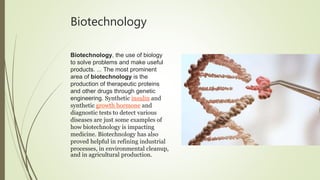
Biotechnology, the use of biology
to solve problems and make useful
products. ... The most prominent
area of biotechnology is the
production of therapeutic proteins
and other drugs through genetic
engineering. Synthetic insulin and
synthetic growth hormone and
diagnostic tests to detect various
diseases are just some examples of
how biotechnology is impacting
medicine. Biotechnology has also
proved helpful in refining industrial
processes, in environmental cleanup,
and in agricultural production.
Recombinant DNA technology
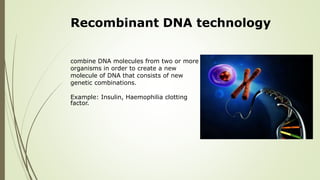
combine DNA molecules from two or more
organisms in order to create a new
molecule of DNA that consists of new
genetic combinations.
Example: Insulin, Haemophilia clotting
factor.
Steps in DNA Recombination
Isolation of the Gene of
Interest (DNA Sequence
Cut off
Insertion in vector
Transformation
Expression
Isolation of the Gene of Interest (DNA Sequence)
Researchers may be interested in reproducing insulin for patients
with Diabetes mellitus.
Researchers have to identify the gen responsible for the production
of insulin in human beings and isolate it in its pure form. In order to
isolate the desired genes or a given sequence of the DNA molecule,
it's first important to obtain DNA of the organism and purify the DNA
from some of the other macromolecules like lipids and proteins,
etc.
Essentially, this means that it's necessary to break the cell open in
order to obtain the DNA. Depending on the type of cell, different
enzymes can be used
Isolation of the Gene of Interest
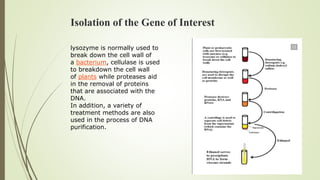
lysozyme is normally used to
break down the cell wall of
a bacterium, cellulase is used
to breakdown the cell wall
of plants while proteases aid
in the removal of proteins
that are associated with the
DNA.
In addition, a variety of
treatment methods are also
used in the process of DNA
purification.
Isolation of the Gene of Interest
eukaryotic cells, denaturing detergents are used to lyse the cells in order to
free the cell contents.
Detergents like sodium dodecyl sulfate and ethyl trimethyl ammonium
bromide which are surface acting agents disrupt the cell membrane allowing
cell components (organelles, etc) to be released.
Once the cell membrane is destroyed (releasing contents of the cell), they
are treated with the enzyme protease which acts on and destroys proteins,
RNA and RNAs. Proteases have been shown to degrade enzymes and
nucleases. This is particularly important as it aids in the purification of the
DNA. The DNA is associated with these macromolecules under normal
conditions.
Once macromolecules (proteins etc) are destroyed using various enzymes, a
centrifuge is used to pellet cell debris so that they settle at the bottom of the
tube while the supernatant (containing the DNA) can be extracted. Lastly,
DNA is recovered through precipitation by using ethanol.
2: RNAse is also used during DNA purification to degrade RNA.
Cut Off
(Restriction Enzymes)
Once DNA is purified; restriction enzymes are used to isolate
the gene of interest
Restriction endonucleases present in bateria.
400 Types
20 Functional
A restriction enzyme is a type of enzyme that identifies a
given sequence and cuts the DNA strand only at that
particular site (the site with a specific nucleotide sequence).
Then, the enzymes act like molecular scissors given that they
are able to effectively cut the DNA at specific locations to
isolate the desired gene (DNA sequences e.g. INS gene).
Why present in bacteria
R.E present in bacteria and act as self defence mechanism.
When phage virus attack on virus and try to control over
bacteria Then these enzymes try to cut Virus DNA to make virus
ineffective and lysogenic or lytic cycle .
Restriction enzymes
As already mentioned, restriction enzymes
serve to cleave DNA at given sites having
identified specific sequences of the DNA.
One of the most common restriction
enzymes is EcoRI.
There is bacteria named Ecoli present in
our intestine that make Vitamin K the
further help in Blood clotting
letter "E" represents the genus
(Escherichia), the letters "co" represents
the species (coli) while the last letter and
number "RI" represent the strain. One of
the other common enzymes is PstI which
originates from the bacterium Providencia
stuartii
Restriction enzymes
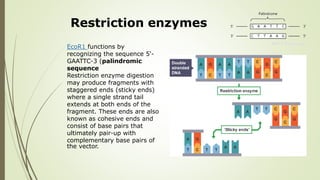
EcoR1 functions by
recognizing the sequence 5'-
GAATTC-3 (palindromic
sequence
Restriction enzyme digestion
may produce fragments with
staggered ends (sticky ends)
where a single strand tail
extends at both ends of the
fragment. These ends are also
known as cohesive ends and
consist of base pairs that
ultimately pair-up with
complementary base pairs of
the vector.
Insertion of the Isolated Gene into a
Vector
a vector is a carrier that can carry the
gene of interest into a given cell where
it is replicated as the cell divides.
It's worth noting that the gene of
interest isolated from the DNA molecule
cannot be directly introduced into a cell.
This is because it may be perceived as a
foreign material and destroyed
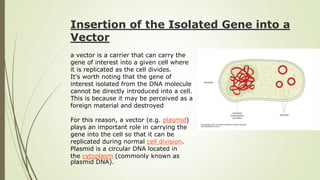
For this reason, a vector (e.g. plasmid)
plays an important role in carrying the
gene into the cell so that it can be
replicated during normal cell division.
Plasmid is a circular DNA located in
the cytoplasm (commonly known as
plasmid DNA).
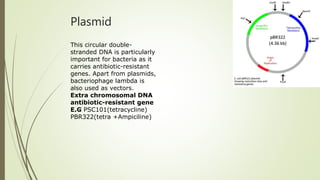
Plasmid
This circular double-
stranded DNA is particularly
important for bacteria as it
carries antibiotic-resistant
genes. Apart from plasmids,
bacteriophage lambda is
also used as vectors.
Extra chromosomal DNA
antibiotic-resistant gene
E.G PSC101(tetracycline)
PBR322(tetra +Ampiciline)
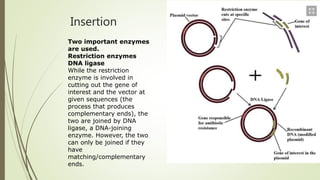
Insertion
Two important enzymes
are used.
Restriction enzymes
DNA ligase
While the restriction
enzyme is involved in
cutting out the gene of
interest and the vector at
given sequences (the
process that produces
complementary ends), the
two are joined by DNA
ligase, a DNA-joining
enzyme. However, the two
can only be joined if they
have
matching/complementary
ends.
Transformation - Introduction of the
Modified Vector into a host
Transformation is the fourth
step of recombinant DNA
technology and involves the
introduction of the recombinant
DNA (modified plasmid) into
the host cell (e.g. bacterium).
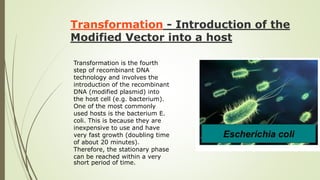
One of the most commonly
used hosts is the bacterium E.
coli. This is because they are
inexpensive to use and have
very fast growth (doubling time
of about 20 minutes).
Therefore, the stationary phase
can be reached within a very
short period of time.
Transformation
· Microinjection - This method involves the use of a glass needle
(microcapillary pipette) to directly introduce the new DNA material into
the cell. Here, a micromanipulator (for precision) is used to direct the
movement of the needle.
· Electroporation - In this method, an electrical field is applied in
order to increase permeability of the cell membrane. This makes it
easier for the modified plasmid to be inserted into the cell.
· Calcium Chloride mediated transfer
CaCl2 solution increase the permeability and make membrane porus
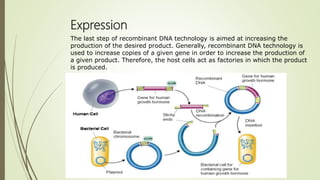
Expression
The last step of recombinant DNA technology is aimed at increasing the
production of the desired product. Generally, recombinant DNA technology is
used to increase copies of a given gene in order to increase the production of
a given product. Therefore, the host cells act as factories in which the product
is produced.
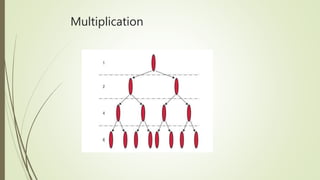
Multiplication
Application of Biotechnology
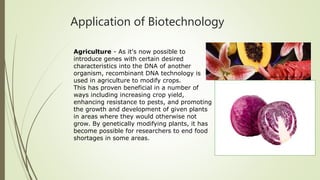
Agriculture - As it's now possible to
introduce genes with certain desired
characteristics into the DNA of another
organism, recombinant DNA technology is
used in agriculture to modify crops.
This has proven beneficial in a number of
ways including increasing crop yield,
enhancing resistance to pests, and promoting
the growth and development of given plants
in areas where they would otherwise not
grow. By genetically modifying plants, it has
become possible for researchers to end food
shortages in some areas.
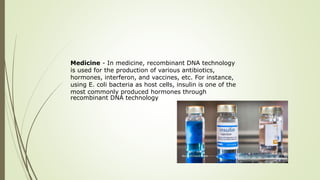
Medicine - In medicine, recombinant DNA technology
is used for the production of various antibiotics,
hormones, interferon, and vaccines, etc. For instance,
using E. coli bacteria as host cells, insulin is one of the
most commonly produced hormones through
recombinant DNA technology
Industry
In various industries, recombinant DNA technology is used for
the purposes of producing different types of chemicals. Organic
acids like citric acid are produced by microorganisms, therefore,
researchers have isolated genes involved in the production of
these substances for large scale production.
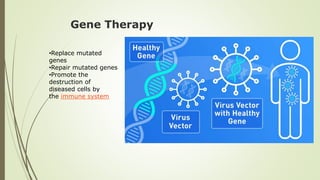
Gene Therapy
•Replace mutated
genes
•Repair mutated genes
•Promote the
destruction of
diseased cells by
the immune system
THANK YOU

Biotechnology and recombinant dna technique(UOG)

  • 1.
    Biotechnology and RecombinantDNA Technique Ahmed Mushtaq Roll No 20012514-001
  • 2.
    Biotechnology Biotechnology, the useof biology to solve problems and make useful products. ... The most prominent area of biotechnology is the production of therapeutic proteins and other drugs through genetic engineering. Synthetic insulin and synthetic growth hormone and diagnostic tests to detect various diseases are just some examples of how biotechnology is impacting medicine. Biotechnology has also proved helpful in refining industrial processes, in environmental cleanup, and in agricultural production.
  • 3.
    Recombinant DNA technology combineDNA molecules from two or more organisms in order to create a new molecule of DNA that consists of new genetic combinations. Example: Insulin, Haemophilia clotting factor.
  • 4.
    Steps in DNARecombination Isolation of the Gene of Interest (DNA Sequence Cut off Insertion in vector Transformation Expression
  • 5.
    Isolation of theGene of Interest (DNA Sequence) Researchers may be interested in reproducing insulin for patients with Diabetes mellitus. Researchers have to identify the gen responsible for the production of insulin in human beings and isolate it in its pure form. In order to isolate the desired genes or a given sequence of the DNA molecule, it's first important to obtain DNA of the organism and purify the DNA from some of the other macromolecules like lipids and proteins, etc. Essentially, this means that it's necessary to break the cell open in order to obtain the DNA. Depending on the type of cell, different enzymes can be used
  • 6.
    Isolation of theGene of Interest lysozyme is normally used to break down the cell wall of a bacterium, cellulase is used to breakdown the cell wall of plants while proteases aid in the removal of proteins that are associated with the DNA. In addition, a variety of treatment methods are also used in the process of DNA purification.
  • 7.
    Isolation of theGene of Interest eukaryotic cells, denaturing detergents are used to lyse the cells in order to free the cell contents. Detergents like sodium dodecyl sulfate and ethyl trimethyl ammonium bromide which are surface acting agents disrupt the cell membrane allowing cell components (organelles, etc) to be released. Once the cell membrane is destroyed (releasing contents of the cell), they are treated with the enzyme protease which acts on and destroys proteins, RNA and RNAs. Proteases have been shown to degrade enzymes and nucleases. This is particularly important as it aids in the purification of the DNA. The DNA is associated with these macromolecules under normal conditions. Once macromolecules (proteins etc) are destroyed using various enzymes, a centrifuge is used to pellet cell debris so that they settle at the bottom of the tube while the supernatant (containing the DNA) can be extracted. Lastly, DNA is recovered through precipitation by using ethanol. 2: RNAse is also used during DNA purification to degrade RNA.
  • 8.
    Cut Off (Restriction Enzymes) OnceDNA is purified; restriction enzymes are used to isolate the gene of interest Restriction endonucleases present in bateria. 400 Types 20 Functional A restriction enzyme is a type of enzyme that identifies a given sequence and cuts the DNA strand only at that particular site (the site with a specific nucleotide sequence). Then, the enzymes act like molecular scissors given that they are able to effectively cut the DNA at specific locations to isolate the desired gene (DNA sequences e.g. INS gene).
  • 9.
    Why present inbacteria R.E present in bacteria and act as self defence mechanism. When phage virus attack on virus and try to control over bacteria Then these enzymes try to cut Virus DNA to make virus ineffective and lysogenic or lytic cycle .
  • 10.
    Restriction enzymes As alreadymentioned, restriction enzymes serve to cleave DNA at given sites having identified specific sequences of the DNA. One of the most common restriction enzymes is EcoRI. There is bacteria named Ecoli present in our intestine that make Vitamin K the further help in Blood clotting letter "E" represents the genus (Escherichia), the letters "co" represents the species (coli) while the last letter and number "RI" represent the strain. One of the other common enzymes is PstI which originates from the bacterium Providencia stuartii
  • 11.
    Restriction enzymes EcoR1 functionsby recognizing the sequence 5'- GAATTC-3 (palindromic sequence Restriction enzyme digestion may produce fragments with staggered ends (sticky ends) where a single strand tail extends at both ends of the fragment. These ends are also known as cohesive ends and consist of base pairs that ultimately pair-up with complementary base pairs of the vector.
  • 12.
    Insertion of theIsolated Gene into a Vector a vector is a carrier that can carry the gene of interest into a given cell where it is replicated as the cell divides. It's worth noting that the gene of interest isolated from the DNA molecule cannot be directly introduced into a cell. This is because it may be perceived as a foreign material and destroyed For this reason, a vector (e.g. plasmid) plays an important role in carrying the gene into the cell so that it can be replicated during normal cell division. Plasmid is a circular DNA located in the cytoplasm (commonly known as plasmid DNA).
  • 13.
    Plasmid This circular double- strandedDNA is particularly important for bacteria as it carries antibiotic-resistant genes. Apart from plasmids, bacteriophage lambda is also used as vectors. Extra chromosomal DNA antibiotic-resistant gene E.G PSC101(tetracycline) PBR322(tetra +Ampiciline)
  • 14.
    Insertion Two important enzymes areused. Restriction enzymes DNA ligase While the restriction enzyme is involved in cutting out the gene of interest and the vector at given sequences (the process that produces complementary ends), the two are joined by DNA ligase, a DNA-joining enzyme. However, the two can only be joined if they have matching/complementary ends.
  • 15.
    Transformation - Introductionof the Modified Vector into a host Transformation is the fourth step of recombinant DNA technology and involves the introduction of the recombinant DNA (modified plasmid) into the host cell (e.g. bacterium). One of the most commonly used hosts is the bacterium E. coli. This is because they are inexpensive to use and have very fast growth (doubling time of about 20 minutes). Therefore, the stationary phase can be reached within a very short period of time.
  • 16.
    Transformation · Microinjection -This method involves the use of a glass needle (microcapillary pipette) to directly introduce the new DNA material into the cell. Here, a micromanipulator (for precision) is used to direct the movement of the needle. · Electroporation - In this method, an electrical field is applied in order to increase permeability of the cell membrane. This makes it easier for the modified plasmid to be inserted into the cell. · Calcium Chloride mediated transfer CaCl2 solution increase the permeability and make membrane porus
  • 17.
    Expression The last stepof recombinant DNA technology is aimed at increasing the production of the desired product. Generally, recombinant DNA technology is used to increase copies of a given gene in order to increase the production of a given product. Therefore, the host cells act as factories in which the product is produced.
  • 18.
  • 19.
    Application of Biotechnology Agriculture- As it's now possible to introduce genes with certain desired characteristics into the DNA of another organism, recombinant DNA technology is used in agriculture to modify crops. This has proven beneficial in a number of ways including increasing crop yield, enhancing resistance to pests, and promoting the growth and development of given plants in areas where they would otherwise not grow. By genetically modifying plants, it has become possible for researchers to end food shortages in some areas.
  • 20.
    Medicine - Inmedicine, recombinant DNA technology is used for the production of various antibiotics, hormones, interferon, and vaccines, etc. For instance, using E. coli bacteria as host cells, insulin is one of the most commonly produced hormones through recombinant DNA technology
  • 21.
    Industry In various industries,recombinant DNA technology is used for the purposes of producing different types of chemicals. Organic acids like citric acid are produced by microorganisms, therefore, researchers have isolated genes involved in the production of these substances for large scale production.
  • 22.
    Gene Therapy •Replace mutated genes •Repairmutated genes •Promote the destruction of diseased cells by the immune system
  • 23.