What are
Pronouns?• are words that take the
place of nouns.
• substitute of a noun
 Antecedent is the word for
which the pronoun
stands.
What are Pronoun?
 A different pronoun is required
depending on two elements:
1. the noun being replaced; and
2. the function that noun has in the
sentence.
10/18/16
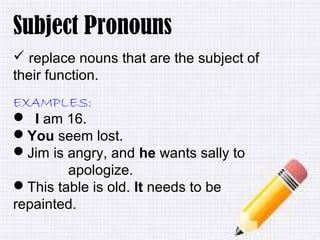
Subject Pronouns
 replace nouns that are the subject of
their function.
EXAMPLES:
 I am 16.
You seem lost.
Jim is angry, and he wants sally to
apologize.
This table is old. It needs to be
repainted.
10/18/16
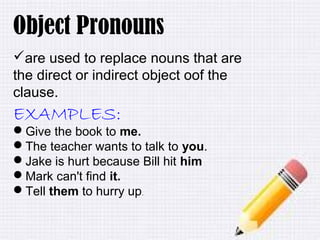
Object Pronouns
are used to replace nouns that are
the direct or indirect object oof the
clause.
EXAMPLES:
Give the book to me.
The teacher wants to talk to you.
Jake is hurt because Bill hit him
Mark can't find it.
Tell them to hurry up.
10/18/16
Different
Kinds of
Pronouns
Different Kinds of Pronouns
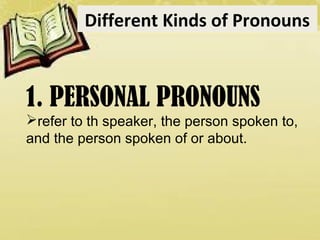
1. PERSONAL PRONOUNS
refer to th speaker, the person spoken to,
and the person spoken of or about.
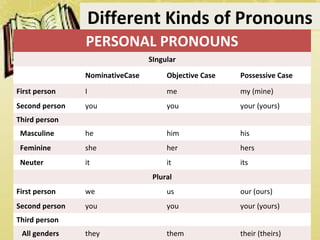
PERSONAL PRONOUNS
SIngular
NominativeCase Objective Case Possessive Case
First person I me my (mine)
Second person you you your (yours)
Third person
Masculine he him his
Feminine she her hers
Neuter it it its
Plural
First person we us our (ours)
Second person you you your (yours)
Third person
All genders they them their (theirs)
Different Kinds of Pronouns
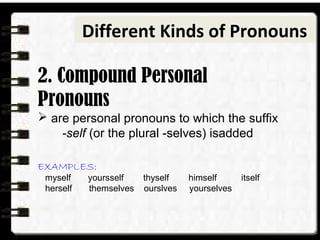
2. Compound Personal
Pronouns
 are personal pronouns to which the suffix
-self (or the plural -selves) isadded
EXAMPLES:
myself yoursself thyself himself itself
herself themselves ourslves yourselves
Different Kinds of Pronouns
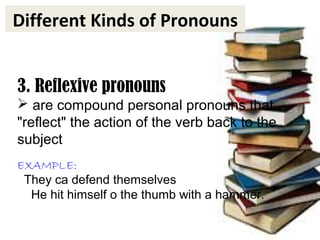
3. Reflexive pronouns
 are compound personal pronouns that
"reflect" the action of the verb back to the
subject
EXAMPLE:
They ca defend themselves
He hit himself o the thumb with a hammer.
Different Kinds of Pronouns
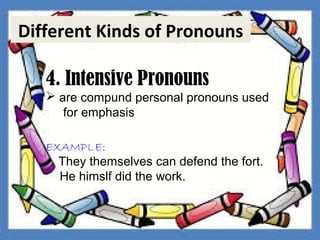
4. Intensive Pronouns
 are compund personal pronouns used
for emphasis
EXAMPLE:
They themselves can defend the fort.
He himslf did the work.
Different Kinds of Pronouns
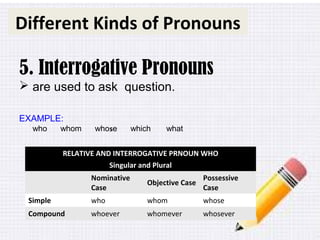
5. Interrogative Pronouns
 are used to ask question.
EXAMPLE:
who whom whose which what
RELATIVE AND INTERROGATIVE PRNOUN WHO
Singular and Plural
Nominative
Case
Objective Case
Possessive
Case
Simple who whom whose
Compound whoever whomever whosever
Different Kinds of Pronouns
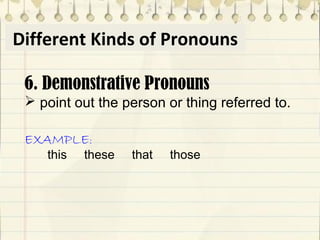
6. Demonstrative Pronouns
 point out the person or thing referred to.
EXAMPLE:
this these that those
Different Kinds of Pronouns
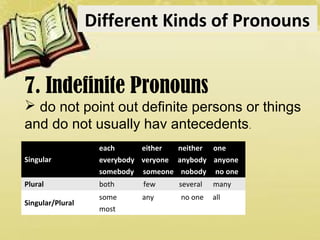
7. Indefinite Pronouns
 do not point out definite persons or things
and do not usually hav antecedents.
Singular
each either neither one
everybody veryone anybody anyone
somebody someone nobody no one
Plural both few several many
Singular/Plural
some any no one all
most
Different Kinds of Pronouns
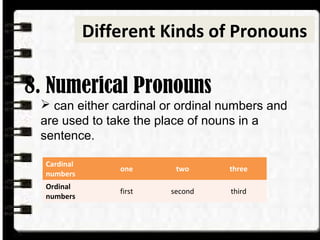
8. Numerical Pronouns
 can either cardinal or ordinal numbers and
are used to take the place of nouns in a
sentence.
Cardinal
numbers
one two three
Ordinal
numbers
first second third
Different Kinds of Pronouns
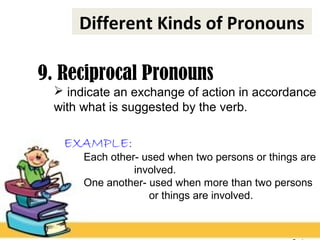
9. Reciprocal Pronouns
 indicate an exchange of action in accordance
with what is suggested by the verb.
EXAMPLE:
Each other- used when two persons or things are
involved.
One another- used when more than two persons
or things are involved.
Different Kinds of Pronouns
10. Relative Pronouns
 are used to introduce dependent
clauses.
EXAMPLE:
who whom whose
which that
Different Kinds of Pronouns
10/18/16
 References:
-Smart English Book by San Miguel,
et. al
-English Grammar Master
(application)

PRONOUNS

  • 2.
    What are Pronouns?• arewords that take the place of nouns. • substitute of a noun  Antecedent is the word for which the pronoun stands.
  • 3.
    What are Pronoun? A different pronoun is required depending on two elements: 1. the noun being replaced; and 2. the function that noun has in the sentence.
  • 4.
    10/18/16 Subject Pronouns  replacenouns that are the subject of their function. EXAMPLES:  I am 16. You seem lost. Jim is angry, and he wants sally to apologize. This table is old. It needs to be repainted.
  • 5.
    10/18/16 Object Pronouns are usedto replace nouns that are the direct or indirect object oof the clause. EXAMPLES: Give the book to me. The teacher wants to talk to you. Jake is hurt because Bill hit him Mark can't find it. Tell them to hurry up.
  • 6.
  • 7.
    Different Kinds ofPronouns 1. PERSONAL PRONOUNS refer to th speaker, the person spoken to, and the person spoken of or about.
  • 8.
    PERSONAL PRONOUNS SIngular NominativeCase ObjectiveCase Possessive Case First person I me my (mine) Second person you you your (yours) Third person Masculine he him his Feminine she her hers Neuter it it its Plural First person we us our (ours) Second person you you your (yours) Third person All genders they them their (theirs) Different Kinds of Pronouns
  • 9.
    2. Compound Personal Pronouns are personal pronouns to which the suffix -self (or the plural -selves) isadded EXAMPLES: myself yoursself thyself himself itself herself themselves ourslves yourselves Different Kinds of Pronouns
  • 10.
    Different Kinds ofPronouns 3. Reflexive pronouns  are compound personal pronouns that "reflect" the action of the verb back to the subject EXAMPLE: They ca defend themselves He hit himself o the thumb with a hammer. Different Kinds of Pronouns
  • 11.
    Different Kinds ofPronouns 4. Intensive Pronouns  are compund personal pronouns used for emphasis EXAMPLE: They themselves can defend the fort. He himslf did the work. Different Kinds of Pronouns
  • 12.
    Different Kinds ofPronouns 5. Interrogative Pronouns  are used to ask question. EXAMPLE: who whom whose which what RELATIVE AND INTERROGATIVE PRNOUN WHO Singular and Plural Nominative Case Objective Case Possessive Case Simple who whom whose Compound whoever whomever whosever Different Kinds of Pronouns
  • 13.
    Different Kinds ofPronouns 6. Demonstrative Pronouns  point out the person or thing referred to. EXAMPLE: this these that those Different Kinds of Pronouns
  • 14.
    7. Indefinite Pronouns do not point out definite persons or things and do not usually hav antecedents. Singular each either neither one everybody veryone anybody anyone somebody someone nobody no one Plural both few several many Singular/Plural some any no one all most Different Kinds of Pronouns
  • 15.
    Different Kinds ofPronouns 8. Numerical Pronouns  can either cardinal or ordinal numbers and are used to take the place of nouns in a sentence. Cardinal numbers one two three Ordinal numbers first second third Different Kinds of Pronouns
  • 16.
    Different Kinds ofPronouns 9. Reciprocal Pronouns  indicate an exchange of action in accordance with what is suggested by the verb. EXAMPLE: Each other- used when two persons or things are involved. One another- used when more than two persons or things are involved. Different Kinds of Pronouns
  • 17.
    Different Kinds ofPronouns 10. Relative Pronouns  are used to introduce dependent clauses. EXAMPLE: who whom whose which that Different Kinds of Pronouns
  • 18.
    10/18/16  References: -Smart EnglishBook by San Miguel, et. al -English Grammar Master (application)