A good and comprehensive discussion about adjectives. It
also includes the following lessons:
Lesson 1. Major Classifications of Adjectives
Lesson 2. Comparison of Adjectives
Lesson 3. Adjectives in a series
What are Adjectives?
 Are words used to describe or modify
nouns or other substantives.
 An adjective may either be a word, a
phrase or a clause
 It is a word that limits or describes a
noun or a pronoun.
Lesson 1
These are adjectives that describes the appearance,
the quality, the shape, the color, the behavior or any
of the outward aspects of things, places or people.
Examples:
Pretty lady (appearance)
Round box (shape)
Black snickers (color)
Loyal boyfriend (behavior)
Types of Descriptive
Adjectives
 Proper adjective- an adjective formed from a proper noun.
Example:
Philippine eagle
Chinese food
 Common adjective- an adjective that expresses the ordinary
qualities of a noun.
Example:
Beautiful scenery
Useful harbors
 Many participles may also be used as descriptive
adjectives.
Examples:
Broken heart
Shooting stars
Untamed horses
Praying mantis
Descriptive Adjectives According
to Functions
 Attributive Adjective- a word-modifier placed just
before the word it modifies, attributes a condition or a
quality of what is spoken of.
Example: Yayen is a potential teacher.
 Appositive Adjectives- are modifiers formed in pairs
which are placed immediately following the word they
modify in apposition. These are set off by commas.
Example: Andro, handsome and loyal, is Karen’s
boyfriend.
 Predicate Adjectives- are adjectives that describe the
subjects and are used as subject compliments. It may
be used after any of the following linking verbs: am,
is, are, was and were.
Example: Athena Andya is happy.
 Objective Compliment- used as an adjective. It modifies
the direct object of the verb.
Example: Excessive drinking made the patient
weak. (weak, the objective compliment modifies
patient)
 Adjectives that either points out or denotes the number of an
object. It may be the ordinal, the limitation in any way, as to
how much or how many of what is spoken of.
Example:
First daughter
Many problems
3 Classifications of Limiting
Adjectives
 Articles- the articles, the, a, and an indicate whether the noun
is used definitely or indefinitely.
Example: The church of St. John in Wales collapsed in
ruins a minute after it was finished.
 Numerical Adjectives- denote the exact number, rank or
position of a noun.
Example: My boyfriend won the first prize in
declamation.
 Pronomial Adjectives- are personal pronouns in their
possessive cases used as modifiers.
Example: My daughter graduated from Harvard with
honors.
Activity no. 1
Instruction: Arrange the jumbled letters to form an
adjective. Identify whether this adjectives are
descriptive or limiting. The noun it modifies will
serve as your clue.
1. SOURNEEG mother - ________________
2. JNATOR war -________________
3. NOKRAE ginseng - ________________
4. NGLODE teeth - ________________
5. TVAINGCPATI scenery - _________________
Activity no. 2
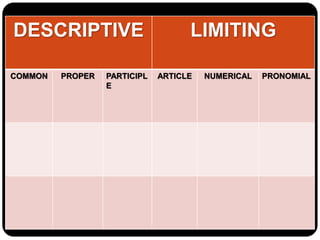
Instruction: Using the table below, identify adjectives according to its
classifications. Be sure to place them to their corresponding types. Do not
repeat adjectives that appears more than once.
The first human heart transplant operation was performed on
Louis Washkansky, aged 55, at the Groote Schuur Hospital, Cape Town,
South Africa in 1967. The lady donor was Denise Ann Darvall, 25 years of
age. After living for 18 days, Washkansky died.
The first transplantee to give birth was Betsy Snieth, 23, to a
baby girl, at Stanford University. The longest surviving heart transplantee
has been Emmanuel Vitria, French patient, who received a heart
transplant from Pierre Ponson, 20, on 1968. The youngest heart
transplantee was “Baby Moses” who underwent the critical operation in
1985.
Dr. Christiaan Barnard, heart transplant pioneer, completed the
first of his spectacular operations successfully in 1967.
DESCRIPTIVE LIMITING
COMMON PROPER PARTICIPL
E
ARTICLE NUMERICAL PRONOMIAL
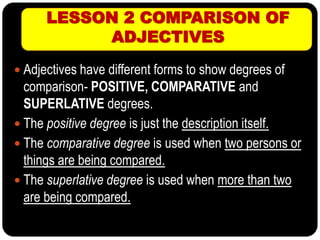
LESSON 2 COMPARISON OF
ADJECTIVES
 Adjectives have different forms to show degrees of
comparison- POSITIVE, COMPARATIVE and
SUPERLATIVE degrees.
 The positive degree is just the description itself.
 The comparative degree is used when two persons or
things are being compared.
 The superlative degree is used when more than two
are being compared.
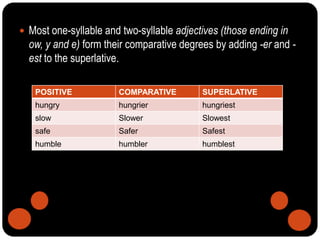
 Most one-syllable and two-syllable adjectives (those ending in
ow, y and e) form their comparative degrees by adding -er and -
est to the superlative.
POSITIVE COMPARATIVE SUPERLATIVE
hungry hungrier hungriest
slow Slower Slowest
safe Safer Safest
humble humbler humblest
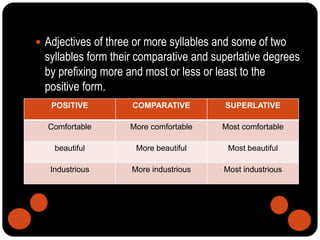
 Adjectives of three or more syllables and some of two
syllables form their comparative and superlative degrees
by prefixing more and most or less or least to the
positive form.
POSITIVE COMPARATIVE SUPERLATIVE
Comfortable More comfortable Most comfortable
beautiful More beautiful Most beautiful
Industrious More industrious Most industrious
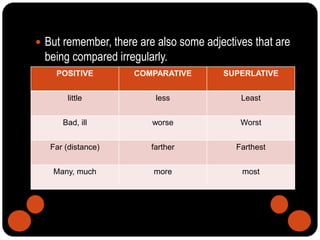
 But remember, there are also some adjectives that are
being compared irregularly.
POSITIVE COMPARATIVE SUPERLATIVE
little less Least
Bad, ill worse Worst
Far (distance) farther Farthest
Many, much more most
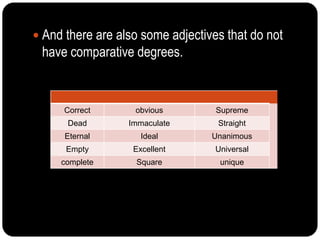
 And there are also some adjectives that do not
have comparative degrees.
Correct obvious Supreme
Dead Immaculate Straight
Eternal Ideal Unanimous
Empty Excellent Universal
complete Square unique
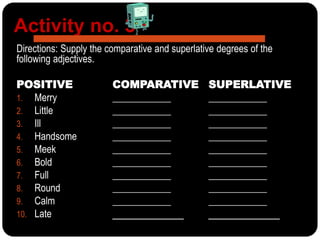
Activity no. 3
Directions: Supply the comparative and superlative degrees of the
following adjectives.
POSITIVE COMPARATIVE SUPERLATIVE
1. Merry ____________ ____________
2. Little ____________ ____________
3. Ill ____________ ____________
4. Handsome ____________ ____________
5. Meek ____________ ____________
6. Bold ____________ ____________
7. Full ____________ ____________
8. Round ____________ ____________
9. Calm ____________ ____________
10. Late ____________ ____________
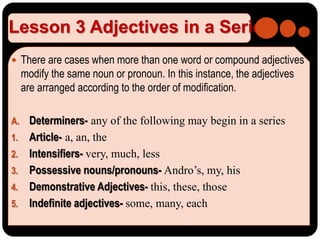
Lesson 3 Adjectives in a Series
 There are cases when more than one word or compound adjectives
modify the same noun or pronoun. In this instance, the adjectives
are arranged according to the order of modification.
A. Determiners- any of the following may begin in a series
1. Article- a, an, the
2. Intensifiers- very, much, less
3. Possessive nouns/pronouns- Andro’s, my, his
4. Demonstrative Adjectives- this, these, those
5. Indefinite adjectives- some, many, each
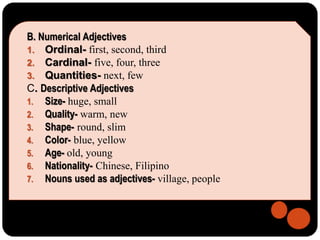
B. Numerical Adjectives
1. Ordinal- first, second, third
2. Cardinal- five, four, three
3. Quantities- next, few
C. Descriptive Adjectives
1. Size- huge, small
2. Quality- warm, new
3. Shape- round, slim
4. Color- blue, yellow
5. Age- old, young
6. Nationality- Chinese, Filipino
7. Nouns used as adjectives- village, people
References
Smart English
English for Specific
Purposes
ADJECTIVES

ADJECTIVES

  • 1.
    A good andcomprehensive discussion about adjectives. It also includes the following lessons: Lesson 1. Major Classifications of Adjectives Lesson 2. Comparison of Adjectives Lesson 3. Adjectives in a series
  • 2.
    What are Adjectives? Are words used to describe or modify nouns or other substantives.  An adjective may either be a word, a phrase or a clause  It is a word that limits or describes a noun or a pronoun.
  • 3.
  • 4.
    These are adjectivesthat describes the appearance, the quality, the shape, the color, the behavior or any of the outward aspects of things, places or people. Examples: Pretty lady (appearance) Round box (shape) Black snickers (color) Loyal boyfriend (behavior)
  • 5.
    Types of Descriptive Adjectives Proper adjective- an adjective formed from a proper noun. Example: Philippine eagle Chinese food  Common adjective- an adjective that expresses the ordinary qualities of a noun. Example: Beautiful scenery Useful harbors
  • 6.
     Many participlesmay also be used as descriptive adjectives. Examples: Broken heart Shooting stars Untamed horses Praying mantis
  • 7.
    Descriptive Adjectives According toFunctions  Attributive Adjective- a word-modifier placed just before the word it modifies, attributes a condition or a quality of what is spoken of. Example: Yayen is a potential teacher.  Appositive Adjectives- are modifiers formed in pairs which are placed immediately following the word they modify in apposition. These are set off by commas. Example: Andro, handsome and loyal, is Karen’s boyfriend.
  • 8.
     Predicate Adjectives-are adjectives that describe the subjects and are used as subject compliments. It may be used after any of the following linking verbs: am, is, are, was and were. Example: Athena Andya is happy.  Objective Compliment- used as an adjective. It modifies the direct object of the verb. Example: Excessive drinking made the patient weak. (weak, the objective compliment modifies patient)
  • 9.
     Adjectives thateither points out or denotes the number of an object. It may be the ordinal, the limitation in any way, as to how much or how many of what is spoken of. Example: First daughter Many problems
  • 10.
    3 Classifications ofLimiting Adjectives  Articles- the articles, the, a, and an indicate whether the noun is used definitely or indefinitely. Example: The church of St. John in Wales collapsed in ruins a minute after it was finished.  Numerical Adjectives- denote the exact number, rank or position of a noun. Example: My boyfriend won the first prize in declamation.  Pronomial Adjectives- are personal pronouns in their possessive cases used as modifiers. Example: My daughter graduated from Harvard with honors.
  • 11.
    Activity no. 1 Instruction:Arrange the jumbled letters to form an adjective. Identify whether this adjectives are descriptive or limiting. The noun it modifies will serve as your clue. 1. SOURNEEG mother - ________________ 2. JNATOR war -________________ 3. NOKRAE ginseng - ________________ 4. NGLODE teeth - ________________ 5. TVAINGCPATI scenery - _________________
  • 12.
    Activity no. 2 Instruction:Using the table below, identify adjectives according to its classifications. Be sure to place them to their corresponding types. Do not repeat adjectives that appears more than once. The first human heart transplant operation was performed on Louis Washkansky, aged 55, at the Groote Schuur Hospital, Cape Town, South Africa in 1967. The lady donor was Denise Ann Darvall, 25 years of age. After living for 18 days, Washkansky died. The first transplantee to give birth was Betsy Snieth, 23, to a baby girl, at Stanford University. The longest surviving heart transplantee has been Emmanuel Vitria, French patient, who received a heart transplant from Pierre Ponson, 20, on 1968. The youngest heart transplantee was “Baby Moses” who underwent the critical operation in 1985. Dr. Christiaan Barnard, heart transplant pioneer, completed the first of his spectacular operations successfully in 1967.
  • 13.
    DESCRIPTIVE LIMITING COMMON PROPERPARTICIPL E ARTICLE NUMERICAL PRONOMIAL
  • 14.
    LESSON 2 COMPARISONOF ADJECTIVES  Adjectives have different forms to show degrees of comparison- POSITIVE, COMPARATIVE and SUPERLATIVE degrees.  The positive degree is just the description itself.  The comparative degree is used when two persons or things are being compared.  The superlative degree is used when more than two are being compared.
  • 15.
     Most one-syllableand two-syllable adjectives (those ending in ow, y and e) form their comparative degrees by adding -er and - est to the superlative. POSITIVE COMPARATIVE SUPERLATIVE hungry hungrier hungriest slow Slower Slowest safe Safer Safest humble humbler humblest
  • 16.
     Adjectives ofthree or more syllables and some of two syllables form their comparative and superlative degrees by prefixing more and most or less or least to the positive form. POSITIVE COMPARATIVE SUPERLATIVE Comfortable More comfortable Most comfortable beautiful More beautiful Most beautiful Industrious More industrious Most industrious
  • 17.
     But remember,there are also some adjectives that are being compared irregularly. POSITIVE COMPARATIVE SUPERLATIVE little less Least Bad, ill worse Worst Far (distance) farther Farthest Many, much more most
  • 18.
     And thereare also some adjectives that do not have comparative degrees. Correct obvious Supreme Dead Immaculate Straight Eternal Ideal Unanimous Empty Excellent Universal complete Square unique
  • 19.
    Activity no. 3 Directions:Supply the comparative and superlative degrees of the following adjectives. POSITIVE COMPARATIVE SUPERLATIVE 1. Merry ____________ ____________ 2. Little ____________ ____________ 3. Ill ____________ ____________ 4. Handsome ____________ ____________ 5. Meek ____________ ____________ 6. Bold ____________ ____________ 7. Full ____________ ____________ 8. Round ____________ ____________ 9. Calm ____________ ____________ 10. Late ____________ ____________
  • 20.
    Lesson 3 Adjectivesin a Series  There are cases when more than one word or compound adjectives modify the same noun or pronoun. In this instance, the adjectives are arranged according to the order of modification. A. Determiners- any of the following may begin in a series 1. Article- a, an, the 2. Intensifiers- very, much, less 3. Possessive nouns/pronouns- Andro’s, my, his 4. Demonstrative Adjectives- this, these, those 5. Indefinite adjectives- some, many, each
  • 21.
    B. Numerical Adjectives 1.Ordinal- first, second, third 2. Cardinal- five, four, three 3. Quantities- next, few C. Descriptive Adjectives 1. Size- huge, small 2. Quality- warm, new 3. Shape- round, slim 4. Color- blue, yellow 5. Age- old, young 6. Nationality- Chinese, Filipino 7. Nouns used as adjectives- village, people
  • 22.