Pronouns
Pronouns
• are words that take the place of nouns.
• Antecedent – is the word for which the
pronouns stand.
Differentkindsof PRONOUNS
• Personal Pronouns – refer to the speaker, the
person spoken to, and the person spoken of or
about.
 I, you, he, she, it, we, they
 He is an outstanding doctor from Russia.
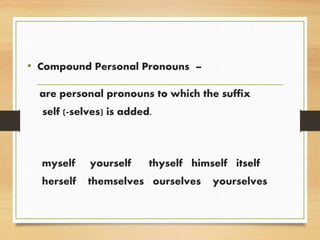
• Compound Personal Pronouns –
are personal pronouns to which the suffix
self (-selves) is added.
myself yourself thyself himself itself
herself themselves ourselves yourselves
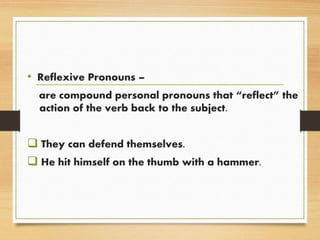
• Reflexive Pronouns –
are compound personal pronouns that “reflect” the
action of the verb back to the subject.
 They can defend themselves.
 He hit himself on the thumb with a hammer.
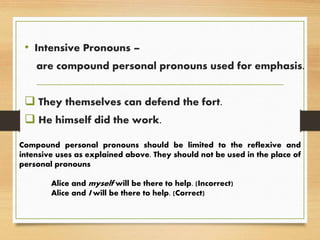
• Intensive Pronouns –
are compound personal pronouns used for emphasis.
 They themselves can defend the fort.
 He himself did the work.
Compound personal pronouns should be limited to the reflexive and
intensive uses as explained above. They should not be used in the place of
personal pronouns
Alice and myself will be there to help. (Incorrect)
Alice and I will be there to help. (Correct)
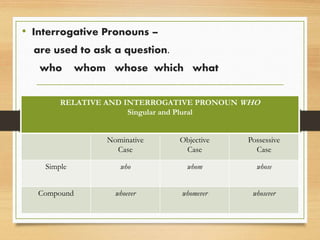
• Interrogative Pronouns –
are used to ask a question.
who whom whose which what
RELATIVE AND INTERROGATIVE PRONOUN WHO
Singular and Plural
Nominative
Case
Objective
Case
Possessive
Case
Simple who whom whose
Compound whoever whomever whosever
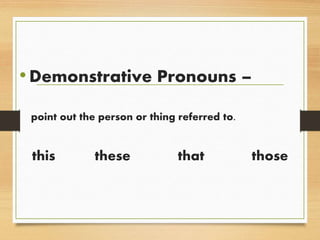
•Demonstrative Pronouns –
point out the person or thing referred to.
this these that those
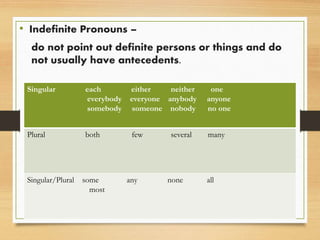
• Indefinite Pronouns –
do not point out definite persons or things and do
not usually have antecedents.
Singular each either neither one
everybody everyone anybody anyone
somebody someone nobody no one
Plural both few several many
Singular/Plural some any none all
most
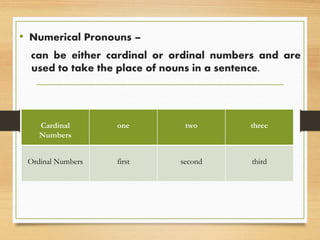
• Numerical Pronouns –
can be either cardinal or ordinal numbers and are
used to take the place of nouns in a sentence.
Cardinal
Numbers
one two three
Ordinal Numbers first second third
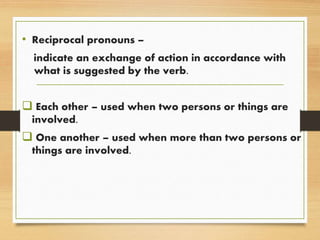
• Reciprocal pronouns –
indicate an exchange of action in accordance with
what is suggested by the verb.
 Each other – used when two persons or things are
involved.
 One another – used when more than two persons or
things are involved.
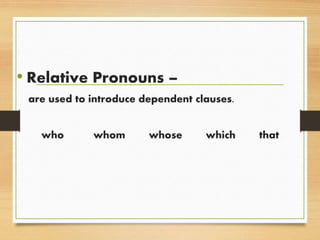
• Relative Pronouns –
are used to introduce dependent clauses.
who whom whose which that

Pronouns

  • 1.
  • 2.
    Pronouns • are wordsthat take the place of nouns. • Antecedent – is the word for which the pronouns stand.
  • 3.
  • 4.
    • Personal Pronouns– refer to the speaker, the person spoken to, and the person spoken of or about.  I, you, he, she, it, we, they  He is an outstanding doctor from Russia.
  • 5.
    • Compound PersonalPronouns – are personal pronouns to which the suffix self (-selves) is added. myself yourself thyself himself itself herself themselves ourselves yourselves
  • 6.
    • Reflexive Pronouns– are compound personal pronouns that “reflect” the action of the verb back to the subject.  They can defend themselves.  He hit himself on the thumb with a hammer.
  • 7.
    • Intensive Pronouns– are compound personal pronouns used for emphasis.  They themselves can defend the fort.  He himself did the work. Compound personal pronouns should be limited to the reflexive and intensive uses as explained above. They should not be used in the place of personal pronouns Alice and myself will be there to help. (Incorrect) Alice and I will be there to help. (Correct)
  • 8.
    • Interrogative Pronouns– are used to ask a question. who whom whose which what RELATIVE AND INTERROGATIVE PRONOUN WHO Singular and Plural Nominative Case Objective Case Possessive Case Simple who whom whose Compound whoever whomever whosever
  • 9.
    •Demonstrative Pronouns – pointout the person or thing referred to. this these that those
  • 10.
    • Indefinite Pronouns– do not point out definite persons or things and do not usually have antecedents. Singular each either neither one everybody everyone anybody anyone somebody someone nobody no one Plural both few several many Singular/Plural some any none all most
  • 11.
    • Numerical Pronouns– can be either cardinal or ordinal numbers and are used to take the place of nouns in a sentence. Cardinal Numbers one two three Ordinal Numbers first second third
  • 12.
    • Reciprocal pronouns– indicate an exchange of action in accordance with what is suggested by the verb.  Each other – used when two persons or things are involved.  One another – used when more than two persons or things are involved.
  • 13.
    • Relative Pronouns– are used to introduce dependent clauses. who whom whose which that