UNIT-2
Information
Information can be defined as meaningfully interpreted data. If we give you a number 1-212-290-4700, it
does not make any sense on its own. It is just a raw data. However if we say Tel: +1-212-290-4700, it
starts making sense. It becomes a telephone number. If I gather some more data and record it
meaningfully like −
Address: 350 Fifth Avenue, 34th floor New York, NY 10118-3299 USA Tel: +1-212-290-4700 Fax: +1-
212-736-1300
It becomes a very useful information - the address of New York office of Human Rights Watch, a non-
profit, non-governmental human rights organization.
So, from a system analyst's point of view, information is a sequence of symbols that can be construed to a
useful message.
An Information System is a system that gathers data and disseminates information with the sole purpose
of providing information to its users.
The main object of an information system is to provide information to its users. Information systems vary
according to the type of users who use the system.
A Management Information System is an information system that evaluates, analyzes, and processes an
organization's data to produce meaningful and useful information based on which the management can
take right decisions to ensure future growth of the organization.
Information Definition:-
According to Davis and Olson −
information is the message (utterance or expression) being conveyed. Therefore, in a general
sense, information is "Knowledge communicated or received, concerning a particular fact or
circumstance". Information cannot be predicted and resolves uncertainty.“
"Information is a data that has been processed into a form that is meaningful to recipient and is of
real or perceived value in the current or the prospective action or decision of recipient."
MIS
Information/Data CollectionTechniques
The most popular data collection techniques include:
 Surveys: A questionnaire is prepared to collect the data from the field.
 Secondary data sources or archival data: Data is collected through old records, magazines,
company website, etc.
 Objective measures or tests: An experimental test is conducted on the subject and the data is
collected.
 Interviews: Data is collected by the system analyst by following a rigid procedure and collecting
the answers to a set of pre-conceived questions through personal interviews.
•Increasing impact of information processing for organizational decision making.
•Dependency of services sector including banking, financial organization, health care, entertainment,
tourism and travel, education and numerous others on information.
•Changing employment scene world over, shifting base from manual agricultural to machine-based
manufacturing and other industry related jobs.
•Information revolution and the overall development scenario.
•Growth of IT industry and its strategic importance.
•Strong growth of information services fuelled by increasing competition and reduced product life
cycle.
•Need for sustainable development and quality life.
•Improvement in communication and transportation brought in by use of information processing.
•Need for sustainable development and quality life.
•Improvement in communication and transportation brought in by use of information processing.
•Use of information processing in reduction of energy consumption, reduction in pollution and a
better ecological balance in future.
•Use of information processing in land record managements, legal delivery system, educational
institutions, natural resource planning, customer relation management and so on.
 Reliability − It should be verifiable and dependable.
 Timely − It must be current and it must reach the users well in time, so that important
decisions can be made in time.
 Relevant − It should be current and valid information and it should reduce uncertainties.
 Accurate − It should be free of errors and mistakes, true, and not deceptive.
 Sufficient − It should be adequate in quantity, so that decisions can be made on its basis.
Unambiguous − It should be expressed in clear terms. In other words, in should be comprehensive.
Complete − It should meet all the needs in the current context.
Unbiased − It should be impartial, free from any bias. In other words, it should have integrity.
Explicit − It should not need any further explanation.
Comparable − It should be of uniform collection, analysis, content, and format.
Reproducible − It could be used by documented methods on the same data set to achieve a
consistent result.
The following list summarizes the five main uses of information by businesses and other organizations
−
Planning − At the planning stage, information is the most important ingredient in decision making.
Information at planning stage includes that of business resources, assets, liabilities, plants and
machineries, properties, suppliers, customers, competitors, market and market dynamics, fiscal policy
changes of the Government, emerging technologies, etc.
Recording − Business processing these days involves recording information about each transaction or
event. This information collected, stored and updated regularly at the operational level.
Controlling − A business need to set up an information filter, so that only filtered data is presented to
the middle and top management. This ensures efficiency at the operational level and effectiveness at the
tactical and strategic level.
Measuring − A business measures its performance metrics by collecting and analyzing sales data, cost
of manufacturing, and profit earned.
Decision-making − MIS is primarily concerned with managerial decision-making, theory of
organizational behavior, and underlying human behavior in organizational context. Decision-making
information includes the socio-economic impact of competition, globalization, democratization, and the
effects of all these factors on an organizational structure.
USES OF INFORMATION
MIS
Information can be classified in a number of ways and in this chapter, you will learn two of
the most important ways to classify information.
Action Versus No-action Information
The information which induces action is called an action information. The information which
communicates only the status of a situation is a no-action information. ‘No stock’ report call- ing a
purchase action is an action information but the stock ledger showing the store transac- tions and the
stock balances is a No-action information.
Recurring Versus Non-recurring Information
The information generated at regular intervals is a recurring information. The monthly sales reports, the
stock statements, the trial balance, etc. are recurring information. The financial analysis or the report on
the market research study is a non-recurring information.
Internal Versus External Information
The information generated through the internal sources of the organisation is termed as an internal
information, while the information generated through the Government reports, the industry surveys, etc.
is termed as an external information, as the sources of the data are outside the organisation.
The action information, the recurring information and the internal information are the prime areas for
computerisation and they contribute qualitatively to the MIS.
Based on Anthony's classification of Management, information used in business for decision-
making is generally categorized into three types:
 Strategic Information: Strategic information is concerned with long term policy decisions
that defines the objectives of a business and checks how well these objectives are met. For
example, acquiring a new plant, a new product, diversification of business etc., comes under
strategic information.
 Tactical Information: Tactical information is concerned with the information needed for
exercising control over business resources, like budgeting, quality control, service level,
inventory level, productivity level etc.
 Operational Information: Operational information is concerned with plant/business level
information and is used to ensure proper conduction of specific operational tasks as
planned/intended. Various operator specific, machine specific and shift specific jobs for quality
control checks comes under this category.
MIS
ClassificationbyApplication
In terms of applications, information can be categorized as:
 Planning Information: These are the information needed for establishing standard norms and
specifications in an organization. This information is used in strategic, tactical, and operation planning
of any activity. Examples of such information are time standards, design standards.
 Control Information: This information is needed for establishing control over all business activities
through feedback mechanism. This information is used for controlling attainment, nature and
utilization of important processes in a system. When such information reflects a deviation from the
established standards, the system should induce a decision or an action leading to control.
 Knowledge Information: Knowledge is defined as "information about information". Knowledge
information is acquired through experience and learning, and collected from archival data and
research studies.
 Organizational Information: Organizational information deals with an organization's environment,
culture in the light of its objectives. Karl Weick's Organizational Information Theory emphasizes that
an organization reduces its equivocality or uncertainty by collecting, managing and using these
information prudently. This information is used by everybody in the organization; examples of such
information are employee and payroll information.
 Functional/Operational Information: This is operation specific information. For
example, daily schedules in a manufacturing plant that refers to the detailed
assignment of jobs to machines or machines to operators. In a service oriented
business, it would be the duty roster of various personnel. This information is mostly
internal to the organization.
 Database Information: Database information construes large quantities of
information that has multiple usage and application. Such information is stored,
retrieved and managed to create databases. For example, material specification or
supplier information is stored for multiple users.
Levels Of Information
• Data can be define as the quantitative or
qualitative value of a variable (e.g. number,
images, words, figures, facts or ideas)
• It is a lowest unit of information from
which other measurements and analysis
can be done.
• Data is one of the most important and vital
aspect of any research study.
• Ac c ur ate and s ys tematic data c ollec tion is c r itic al to
c onduc ting s c ientific r es earc h.
• Data c ollec tion allows to c ollec t information about s tudy
objec ts /s ubjects/partic ipants.
• Inc ludes doc uments r eview, obs er vation, ques tioning,
meas ur ing, or a c ombination of differ ent methods .
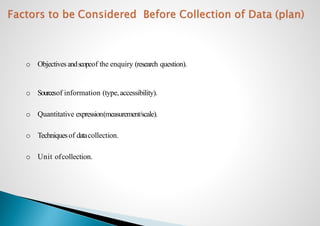
o Objectives andscopeof the enquiry (research question).
o Sourcesof information (type,accessibility).
o Quantitative expression(measurement/scale).
o Techniquesof datacollection.
o Unit ofcollection.
Identify typesof
data
Typesof
measurementsand
variables
Instruments
Scales
Methods
Written
permissions
Pilot
testing
Revise
1- Data
collection
forms
2-Operational
procedures
Research question
Research hypothesis
“Data about the data” (e.g., method of collection,
relationship of data to the events in the research
protocol, etc.)
- Temporal metadata require particular attention
-Understand the implications of atime (e.g., if a
blood specimen is drawn to measure adrug level, we
must know the time that the specimen was drawn
and the time the drug wasadministered
- Need to choosewhen to measure and how often
I- Quantitative data - measurements that can be manipulated
mathematically
• Precision - body temperature, serum chloride , absolute
eosinophil count.
II- Qualitative data - conceptual entities rather than numeric
values (subject gender and race, signs and symptoms,
diagnoses)
•May represent concepts that relate to quantitative data
[“blood pressure” is numeric, but the procedures themselves
are qualitative]
III. Ordinal data look like numbers (e.g., urine protein
measurements “0”, “1+”, “2+”, etc.)
IV.Signal data - quantitative in nature but are treated as
qualitative (e.g., electrocardiogram tracings)
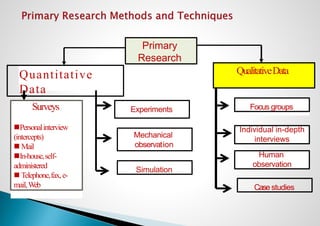
Surveys
Personalinterview
(intercepts)
 Mail
In-house,self-
administered
 Telephone,fax,e-
mail,W
eb
Quantitative
Data
Primary
Research
Experiments
Mechanical
observation
Simulation
QualitativeData
Casestudies
Human
observation
Individual in-depth
interviews
Focus groups
the data collection is a process of gathering information from all the relevant
sources to find a solution to the research problem. It helps to evaluate the
outcome of the problem. The data collection methods allow a person to conclude
an answer to the relevant question. Most of the organizations use data collection
methods to make assumptions about future probabilities and trends. Once the
data is collected, it is necessary to undergo the data organization process. The
main sources of the data collections methods are “Data”. A data can be classified
into two types, namely primary data and the secondary data. The primary
importance of data collection in any research or business process is that it helps
to determine many important things about the company, particularly the
performance. So, the data collection process plays an important role in all the
streams. Depends on the type of data, the data collection method is divided into
two categories namely,
Primary Data Collection methods
Secondary Data Collection methods
DATA/INFORMATION COLLECTION METHODS
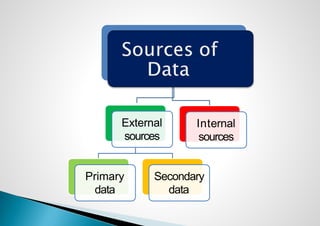
External
sources
Primary
data
Secondary
data
Internal
sources
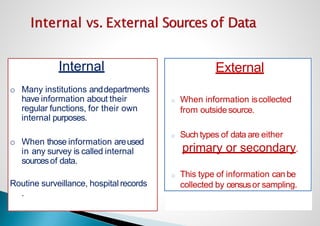
Internal
o Many institutions anddepartments
have information about their
regular functions, for their own
internal purposes.
o When those information areused
in any survey is called internal
sourcesof data.
Routine surveillance, hospital records
.
External
o When information iscollected
from outside source.
o Suchtypes of data are either
primary or secondary.
o This type of information can be
collected by censusor sampling.
Primary Data Collection Methods
Primary data or raw data is a type of information that is obtained directly from
the first-hand source through experiments, surveys, or observations. The
primary data collection method is further classified into two types. They are
Quantitative Data Collection Methods
Qualitative Data Collection Methods
Let us discuss the different methods performed to collect the data under these
two data collection methods.
Quantitative Data Collection Methods
It is based on mathematical calculations using various formats like close-ended
questions, correlation and regression methods, mean, median or mode
measures. This method is cheaper than qualitative data collection methods, and
it can be applied in a short duration of time.
Qualitative Data Collection Methods
It does not involve any mathematical calculations. This method is closely
associated with elements that are not quantifiable. This qualitative data
collection method includes interviews, questionnaires, observations, case
studies etc. There are several methods to collect this type of data. They are
Observation Method
Observation method is used when the study relates to behavioural
science. This method is planned systematically. It subjects many controls
and checks. The different types of observations are:
•Structured and unstructured observation
•Controlled and uncontrolled observation
•Participant, non-participant and disguised observation
Interview Method
The method of collecting data in terms of oral or verbal responses. It is
achieved in two ways, such as
•Personal Interview – In this method, a person known as an interviewer is
required to ask questions face to face to the other person. The personal
interview can be structured or unstructured, direct investigation, focused
conversation etc.
•Telephonic Interview – In this method, an interviewer obtains information
by contacting people on the telephone to ask the questions or views
orally.
Questionnaire Method
In this method, the set of questions are mailed to the respondent. They
should read, reply and subsequently return the questionnaire. The
questions are printed in the definite order on the form. A good survey
should have the following features:
Short and simple
Should follow a logical sequence
Provide adequate space for answers
Avoid technical terms
Should have good physical appearance such as colour, quality of the
paper to attract the attention of the respondent
Schedules
This method is similar to the questionnaire method with a slight
difference. The enumerations are specially appointed for the purpose
of filling the schedules. It explains the aims and objects of the
investigation and may remove misunderstandings if any have come up.
Enumerations should be trained to perform their job with hard work
and patience.
 Collected from first-hand experiences is known asprimary
data. More reliable, authentic and not been published
anywhere.
 Primary data hasnot been changed or altered by human
being, therefore its validity is greater than secondarydata.
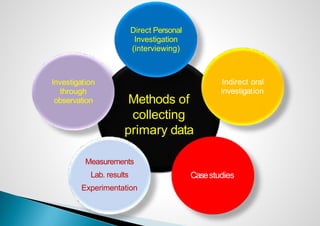
Methods of
collecting
primary data
Direct Personal
Investigation
(interviewing)
Indirect oral
investigation
Casestudies
Measurements
Lab. results
Experimentation
Investigation
through
observation
Merits
Targeted issues are
addressed
Data interpretation is better
High accuracy of data
Addressing specific
research issues
Greater control
Demerits
Cost
Time
More personnel / resources
Inaccurate feedback
Training, skill and
laborious.
Secondary Data Collection Methods
Secondary data is data collected by someone other than the actual user. It means that the
information is already available, and someone analyses it. The secondary data includes
magazines, newspapers, books, journals etc. It may be either published data or
unpublished data.
Published data are available in various resources including
•Government publications
•Public records
•Historical and statistical documents
•Business documents
•Technical and trade journals
Unpublished data includes
•Diaries
•Letters
•Unpublished biographies etc.
 Already been collected by others.
 Journals, periodicals, research publication ,official
record etc.
 May beavailable in the published or unpublished
form.
 Resorted to when primary data sources/methods are
infeasible -, inaccessible.
Published
International
Government
Corporation
Institutional
Unpublished
Merits
Quick andcheap
Wider geographical area
Leading to primary data
Demerits
Not fulfilling specific
research needs
Poor accuracy
Not up to date
Longer orientation period
Poor accessibility in some
cases
Primary data
 Real time
 Sureabout the sources
 Can answer research
question.
 Cost and time
 Can avoid bias
 More flexible
Secondary data
o Past data
o Not sure about sources
o Refining the research
problem
o Cheapand no time
o Biascan’t beruled out
o Lessflexible
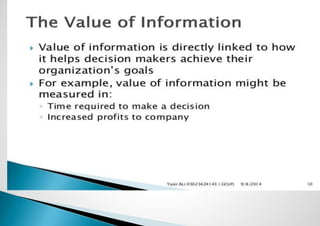
Value of information (VOI or VoI) is the amount a decision
maker would be willing to pay for information prior to
making a decision.
VoI is sometimes distinguished into value of perfect
information, also called value of clairvoyance (VoC), and value
of imperfect information. They are closely related to the
widely known expected value of perfect information (EVPI)
and expected value of sample information (EVSI).
Its value is related to the person who uses it, when he uses
it and for what he uses it.
Any assessment of the value of information is therefore
related to the value of the decision-making supported by
such information.
Value Of Information
For example consider two persons lost in the Sahara desert. One
person has an adequate supply of drinking water (more than he
could desire) and another has exhausted his supply. If one were to
approach these two individuals with information about a drinking
water well in the surrounding, such information will obviously
have greater value for the one who has exhausted his water
supply. For the one who is thirsty, this information is the most
valuable piece of information for him at that point of time as it
will determine if he will survive. If by chance the information
reaches this thirsty person late and he dies of thirst, then the value
of the same information becomes zero. So we can see that the
same information can have different value for different people at
different points in time. Hence, it will be fair to conclude that
value of information is relative. There is no absolute value of
information.
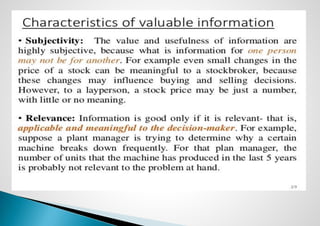
Key Factor Affecting Value of Information (CARE)
•Creditability. The source of information is a key factor in affecting the value of
information, logically an information from a credible source will hold more value,
compared to hearsay or myth passed around. ...
•Availability.
•Relativity.
•Efficiency.
By knowing the value of information and its foundation, information
can be improved and can provide better support in decision making. The
model is concise, clear and broadly applicable, though it should be
adapted to the organization to get the most out of it.
S.NO INFORMATION KNOWLEDGE
1 Information denotes the organized data about
someone or something obtained from various
sources such as newspaper, internet, television,
discussions, etc.
Knowledge refers to the
awareness or understanding
on the subject acquired
from education or
experience of a person.
2 Information is nothing but the refined form of
data, which is helpful to understand the meaning.
knowledge is the relevant
and objective information
that helps in drawing
conclusions.
3 Data compiled in the meaningful context provides
information.
when information is
combined with experience
and intuition, it results in
knowledge.
4 Information brings on comprehension of the facts
and figures.
knowledge which leads to
the understanding of the
subject.
S.NO INFORMATION KNOWLEDGE
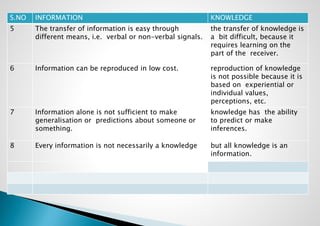
5 The transfer of information is easy through
different means, i.e. verbal or non-verbal signals.
the transfer of knowledge is
a bit difficult, because it
requires learning on the
part of the receiver.
6 Information can be reproduced in low cost. reproduction of knowledge
is not possible because it is
based on experiential or
individual values,
perceptions, etc.
7 Information alone is not sufficient to make
generalisation or predictions about someone or
something.
knowledge has the ability
to predict or make
inferences.
8 Every information is not necessarily a knowledge but all knowledge is an
information.
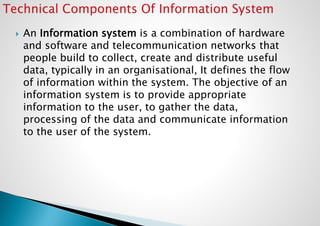
 An Information system is a combination of hardware
and software and telecommunication networks that
people build to collect, create and distribute useful
data, typically in an organisational, It defines the flow
of information within the system. The objective of an
information system is to provide appropriate
information to the user, to gather the data,
processing of the data and communicate information
to the user of the system.
Components of the information system are as follows:
1. Computer Hardware:
Physical equipment used for input, output and processing. What hardware to use it
depends upon the type and size of the organisation. It consists of input, an output
device, operating system, processor, and media devices. This also includes computer
peripheral devices.
2. Computer Software:
The programs/ application program used to control and coordinate the hardware
components. It is used for analysing and processing of the data. These programs include
a set of instruction used for processing information:
Software is further classified into 2 types:
System Software
Application Software
3. Databases:
Data are the raw facts and figures that are unorganised that are and later processed to
generate information. Softwares are used for organising and serving data to the user,
managing physical storage of media and virtual resources. As the hardware can’t work
without software the same as software needs data for processing. Data are managed
using Database management system.
Database software is used for efficient access for required data, and to manage
knowledge bases.
4. Network:
Networks resources refer to the telecommunication networks like the intranet,
extranet and the internet.
These resources facilitate the flow of information in the organisation.
Networks consists of both the physicals devises such as networks cards, routers,
hubs and cables and software such as operating systems, web servers, data servers
and application servers.
Telecommunications networks consist of computers, communications processors,
and other devices interconnected by communications media and controlled by
software.
Networks include communication media, and Network Support.
5. Human Resources:
It is associated with the manpower required to run and manage the system. People
are the end user of the information system, end-user use information produced for
their own purpose, the main purpose of the information system is to benefit the end
user. The end user can be accountants, engineers, salespersons, customers, clerks,
or managers etc. People are also responsible to develop and operate information
systems. They include systems analysts, computer operators, programmers, and
other clerical IS personnel, and managerial techniques.
DEFINITION OF INFORMATION SYSTEM – ” An information system is a set of interrelated
components that works together to collect, process, store and breakdown the
information to support decision making. ”
Following are the DIMENSIONS of information system:
1.ORGANIZATIONAL DIMENSION : Information system are part of organization.
Information system will have the standard operating procedure and culture of an
organization embedded within them. This involves:
a)Functional specialties b)Business processes c)Culture d)Political interest groups.
2.MANAGEMENT DIMENSION : Managers perceive business challenges in the
environment. Information systems supply tools and information needed by the
managers to allocate, coordinate and monitor their work, make decision, create new
products and services and make long range strategic decision.
3.TECHNOLOGY DIMENSION : Management uses technology to carry out their functions.
It consists of – computer hardware/software, data management technology,
networking/telecom technology. Its one of the many tools managers use to cope with
the change.
Information Systems are classified by organisational levels, mode of data,
processing, system objectives and type of support provided.
Following are the TYPE of information system:
1. Transaction Processing System (TPS):
Transaction Processing System are information system that processes data resulting
from the occurrences of business transactions
Their objectives are to provide transaction in order to update records and generate
reports i.e to perform store keeping function
The transaction is performed in two ways: Batching processing and Online
transaction processing.
Example: Bill system, payroll system, Stock control system.
2. Management Information System (MIS):
Management Information System is designed to take relatively raw data available
through a Transaction Processing System and convert them into a summarized and
aggregated form for the manager, usually in a report format. It reports tending to be
used by middle management and operational supervisors.
Many different types of report are produced in MIS. Some of the reports are a
summary report, on-demand report, ad-hoc reports and an exception report.
Example: Sales management systems, Human resource management system.
3. Decision Support System (DSS):
Decision Support System is an interactive information system that provides
information, models and data manipulation tools to help in making the
decision in a semi-structured and unstructured situation.
Decision Support System comprises tools and techniques to help in
gathering relevant information and analyze the options and alternatives, the
end user is more involved in creating DSS than an MIS.
Example: Financial planning systems, Bank loan management systems.
4. Experts System:
Experts systems include expertise in order to aid managers in diagnosing
problems or in problem-solving. These systems are based on the principles
of artificial intelligence research.
Experts Systems is a knowledge-based information system. It uses its
knowledge about a specify are to act as an expert consultant to users.
Knowledgebase and software modules are the components of an expert
system. These modules perform inference on the knowledge and offer
answers to a user’s question

Mis final unit 2 information

  • 1.
  • 3.
    Information can bedefined as meaningfully interpreted data. If we give you a number 1-212-290-4700, it does not make any sense on its own. It is just a raw data. However if we say Tel: +1-212-290-4700, it starts making sense. It becomes a telephone number. If I gather some more data and record it meaningfully like − Address: 350 Fifth Avenue, 34th floor New York, NY 10118-3299 USA Tel: +1-212-290-4700 Fax: +1- 212-736-1300 It becomes a very useful information - the address of New York office of Human Rights Watch, a non- profit, non-governmental human rights organization. So, from a system analyst's point of view, information is a sequence of symbols that can be construed to a useful message. An Information System is a system that gathers data and disseminates information with the sole purpose of providing information to its users. The main object of an information system is to provide information to its users. Information systems vary according to the type of users who use the system. A Management Information System is an information system that evaluates, analyzes, and processes an organization's data to produce meaningful and useful information based on which the management can take right decisions to ensure future growth of the organization.
  • 4.
    Information Definition:- According toDavis and Olson − information is the message (utterance or expression) being conveyed. Therefore, in a general sense, information is "Knowledge communicated or received, concerning a particular fact or circumstance". Information cannot be predicted and resolves uncertainty.“ "Information is a data that has been processed into a form that is meaningful to recipient and is of real or perceived value in the current or the prospective action or decision of recipient."
  • 5.
    MIS Information/Data CollectionTechniques The mostpopular data collection techniques include:  Surveys: A questionnaire is prepared to collect the data from the field.  Secondary data sources or archival data: Data is collected through old records, magazines, company website, etc.  Objective measures or tests: An experimental test is conducted on the subject and the data is collected.  Interviews: Data is collected by the system analyst by following a rigid procedure and collecting the answers to a set of pre-conceived questions through personal interviews.
  • 6.
    •Increasing impact ofinformation processing for organizational decision making. •Dependency of services sector including banking, financial organization, health care, entertainment, tourism and travel, education and numerous others on information. •Changing employment scene world over, shifting base from manual agricultural to machine-based manufacturing and other industry related jobs. •Information revolution and the overall development scenario. •Growth of IT industry and its strategic importance. •Strong growth of information services fuelled by increasing competition and reduced product life cycle. •Need for sustainable development and quality life. •Improvement in communication and transportation brought in by use of information processing.
  • 7.
    •Need for sustainabledevelopment and quality life. •Improvement in communication and transportation brought in by use of information processing. •Use of information processing in reduction of energy consumption, reduction in pollution and a better ecological balance in future. •Use of information processing in land record managements, legal delivery system, educational institutions, natural resource planning, customer relation management and so on.
  • 8.
     Reliability −It should be verifiable and dependable.  Timely − It must be current and it must reach the users well in time, so that important decisions can be made in time.  Relevant − It should be current and valid information and it should reduce uncertainties.  Accurate − It should be free of errors and mistakes, true, and not deceptive.  Sufficient − It should be adequate in quantity, so that decisions can be made on its basis.
  • 9.
    Unambiguous − Itshould be expressed in clear terms. In other words, in should be comprehensive. Complete − It should meet all the needs in the current context. Unbiased − It should be impartial, free from any bias. In other words, it should have integrity. Explicit − It should not need any further explanation. Comparable − It should be of uniform collection, analysis, content, and format. Reproducible − It could be used by documented methods on the same data set to achieve a consistent result.
  • 10.
    The following listsummarizes the five main uses of information by businesses and other organizations − Planning − At the planning stage, information is the most important ingredient in decision making. Information at planning stage includes that of business resources, assets, liabilities, plants and machineries, properties, suppliers, customers, competitors, market and market dynamics, fiscal policy changes of the Government, emerging technologies, etc. Recording − Business processing these days involves recording information about each transaction or event. This information collected, stored and updated regularly at the operational level. Controlling − A business need to set up an information filter, so that only filtered data is presented to the middle and top management. This ensures efficiency at the operational level and effectiveness at the tactical and strategic level. Measuring − A business measures its performance metrics by collecting and analyzing sales data, cost of manufacturing, and profit earned. Decision-making − MIS is primarily concerned with managerial decision-making, theory of organizational behavior, and underlying human behavior in organizational context. Decision-making information includes the socio-economic impact of competition, globalization, democratization, and the effects of all these factors on an organizational structure. USES OF INFORMATION
  • 12.
    MIS Information can beclassified in a number of ways and in this chapter, you will learn two of the most important ways to classify information.
  • 13.
    Action Versus No-actionInformation The information which induces action is called an action information. The information which communicates only the status of a situation is a no-action information. ‘No stock’ report call- ing a purchase action is an action information but the stock ledger showing the store transac- tions and the stock balances is a No-action information. Recurring Versus Non-recurring Information The information generated at regular intervals is a recurring information. The monthly sales reports, the stock statements, the trial balance, etc. are recurring information. The financial analysis or the report on the market research study is a non-recurring information. Internal Versus External Information The information generated through the internal sources of the organisation is termed as an internal information, while the information generated through the Government reports, the industry surveys, etc. is termed as an external information, as the sources of the data are outside the organisation. The action information, the recurring information and the internal information are the prime areas for computerisation and they contribute qualitatively to the MIS.
  • 14.
    Based on Anthony'sclassification of Management, information used in business for decision- making is generally categorized into three types:  Strategic Information: Strategic information is concerned with long term policy decisions that defines the objectives of a business and checks how well these objectives are met. For example, acquiring a new plant, a new product, diversification of business etc., comes under strategic information.  Tactical Information: Tactical information is concerned with the information needed for exercising control over business resources, like budgeting, quality control, service level, inventory level, productivity level etc.  Operational Information: Operational information is concerned with plant/business level information and is used to ensure proper conduction of specific operational tasks as planned/intended. Various operator specific, machine specific and shift specific jobs for quality control checks comes under this category.
  • 15.
    MIS ClassificationbyApplication In terms ofapplications, information can be categorized as:  Planning Information: These are the information needed for establishing standard norms and specifications in an organization. This information is used in strategic, tactical, and operation planning of any activity. Examples of such information are time standards, design standards.  Control Information: This information is needed for establishing control over all business activities through feedback mechanism. This information is used for controlling attainment, nature and utilization of important processes in a system. When such information reflects a deviation from the established standards, the system should induce a decision or an action leading to control.  Knowledge Information: Knowledge is defined as "information about information". Knowledge information is acquired through experience and learning, and collected from archival data and research studies.  Organizational Information: Organizational information deals with an organization's environment, culture in the light of its objectives. Karl Weick's Organizational Information Theory emphasizes that an organization reduces its equivocality or uncertainty by collecting, managing and using these information prudently. This information is used by everybody in the organization; examples of such information are employee and payroll information.
  • 16.
     Functional/Operational Information:This is operation specific information. For example, daily schedules in a manufacturing plant that refers to the detailed assignment of jobs to machines or machines to operators. In a service oriented business, it would be the duty roster of various personnel. This information is mostly internal to the organization.  Database Information: Database information construes large quantities of information that has multiple usage and application. Such information is stored, retrieved and managed to create databases. For example, material specification or supplier information is stored for multiple users.
  • 17.
  • 19.
    • Data canbe define as the quantitative or qualitative value of a variable (e.g. number, images, words, figures, facts or ideas) • It is a lowest unit of information from which other measurements and analysis can be done. • Data is one of the most important and vital aspect of any research study.
  • 20.
    • Ac cur ate and s ys tematic data c ollec tion is c r itic al to c onduc ting s c ientific r es earc h. • Data c ollec tion allows to c ollec t information about s tudy objec ts /s ubjects/partic ipants. • Inc ludes doc uments r eview, obs er vation, ques tioning, meas ur ing, or a c ombination of differ ent methods .
  • 21.
    o Objectives andscopeofthe enquiry (research question). o Sourcesof information (type,accessibility). o Quantitative expression(measurement/scale). o Techniquesof datacollection. o Unit ofcollection.
  • 23.
  • 24.
    “Data about thedata” (e.g., method of collection, relationship of data to the events in the research protocol, etc.) - Temporal metadata require particular attention -Understand the implications of atime (e.g., if a blood specimen is drawn to measure adrug level, we must know the time that the specimen was drawn and the time the drug wasadministered - Need to choosewhen to measure and how often
  • 25.
    I- Quantitative data- measurements that can be manipulated mathematically • Precision - body temperature, serum chloride , absolute eosinophil count. II- Qualitative data - conceptual entities rather than numeric values (subject gender and race, signs and symptoms, diagnoses) •May represent concepts that relate to quantitative data [“blood pressure” is numeric, but the procedures themselves are qualitative] III. Ordinal data look like numbers (e.g., urine protein measurements “0”, “1+”, “2+”, etc.) IV.Signal data - quantitative in nature but are treated as qualitative (e.g., electrocardiogram tracings)
  • 26.
  • 27.
    the data collectionis a process of gathering information from all the relevant sources to find a solution to the research problem. It helps to evaluate the outcome of the problem. The data collection methods allow a person to conclude an answer to the relevant question. Most of the organizations use data collection methods to make assumptions about future probabilities and trends. Once the data is collected, it is necessary to undergo the data organization process. The main sources of the data collections methods are “Data”. A data can be classified into two types, namely primary data and the secondary data. The primary importance of data collection in any research or business process is that it helps to determine many important things about the company, particularly the performance. So, the data collection process plays an important role in all the streams. Depends on the type of data, the data collection method is divided into two categories namely, Primary Data Collection methods Secondary Data Collection methods DATA/INFORMATION COLLECTION METHODS
  • 28.
  • 29.
    Internal o Many institutionsanddepartments have information about their regular functions, for their own internal purposes. o When those information areused in any survey is called internal sourcesof data. Routine surveillance, hospital records . External o When information iscollected from outside source. o Suchtypes of data are either primary or secondary. o This type of information can be collected by censusor sampling.
  • 30.
    Primary Data CollectionMethods Primary data or raw data is a type of information that is obtained directly from the first-hand source through experiments, surveys, or observations. The primary data collection method is further classified into two types. They are Quantitative Data Collection Methods Qualitative Data Collection Methods Let us discuss the different methods performed to collect the data under these two data collection methods. Quantitative Data Collection Methods It is based on mathematical calculations using various formats like close-ended questions, correlation and regression methods, mean, median or mode measures. This method is cheaper than qualitative data collection methods, and it can be applied in a short duration of time. Qualitative Data Collection Methods It does not involve any mathematical calculations. This method is closely associated with elements that are not quantifiable. This qualitative data collection method includes interviews, questionnaires, observations, case studies etc. There are several methods to collect this type of data. They are
  • 31.
    Observation Method Observation methodis used when the study relates to behavioural science. This method is planned systematically. It subjects many controls and checks. The different types of observations are: •Structured and unstructured observation •Controlled and uncontrolled observation •Participant, non-participant and disguised observation Interview Method The method of collecting data in terms of oral or verbal responses. It is achieved in two ways, such as •Personal Interview – In this method, a person known as an interviewer is required to ask questions face to face to the other person. The personal interview can be structured or unstructured, direct investigation, focused conversation etc. •Telephonic Interview – In this method, an interviewer obtains information by contacting people on the telephone to ask the questions or views orally.
  • 32.
    Questionnaire Method In thismethod, the set of questions are mailed to the respondent. They should read, reply and subsequently return the questionnaire. The questions are printed in the definite order on the form. A good survey should have the following features: Short and simple Should follow a logical sequence Provide adequate space for answers Avoid technical terms Should have good physical appearance such as colour, quality of the paper to attract the attention of the respondent Schedules This method is similar to the questionnaire method with a slight difference. The enumerations are specially appointed for the purpose of filling the schedules. It explains the aims and objects of the investigation and may remove misunderstandings if any have come up. Enumerations should be trained to perform their job with hard work and patience.
  • 33.
     Collected fromfirst-hand experiences is known asprimary data. More reliable, authentic and not been published anywhere.  Primary data hasnot been changed or altered by human being, therefore its validity is greater than secondarydata.
  • 34.
    Methods of collecting primary data DirectPersonal Investigation (interviewing) Indirect oral investigation Casestudies Measurements Lab. results Experimentation Investigation through observation
  • 35.
    Merits Targeted issues are addressed Datainterpretation is better High accuracy of data Addressing specific research issues Greater control Demerits Cost Time More personnel / resources Inaccurate feedback Training, skill and laborious.
  • 36.
    Secondary Data CollectionMethods Secondary data is data collected by someone other than the actual user. It means that the information is already available, and someone analyses it. The secondary data includes magazines, newspapers, books, journals etc. It may be either published data or unpublished data. Published data are available in various resources including •Government publications •Public records •Historical and statistical documents •Business documents •Technical and trade journals Unpublished data includes •Diaries •Letters •Unpublished biographies etc.
  • 37.
     Already beencollected by others.  Journals, periodicals, research publication ,official record etc.  May beavailable in the published or unpublished form.  Resorted to when primary data sources/methods are infeasible -, inaccessible.
  • 38.
  • 39.
    Merits Quick andcheap Wider geographicalarea Leading to primary data Demerits Not fulfilling specific research needs Poor accuracy Not up to date Longer orientation period Poor accessibility in some cases
  • 40.
    Primary data  Realtime  Sureabout the sources  Can answer research question.  Cost and time  Can avoid bias  More flexible Secondary data o Past data o Not sure about sources o Refining the research problem o Cheapand no time o Biascan’t beruled out o Lessflexible
  • 41.
    Value of information(VOI or VoI) is the amount a decision maker would be willing to pay for information prior to making a decision. VoI is sometimes distinguished into value of perfect information, also called value of clairvoyance (VoC), and value of imperfect information. They are closely related to the widely known expected value of perfect information (EVPI) and expected value of sample information (EVSI). Its value is related to the person who uses it, when he uses it and for what he uses it. Any assessment of the value of information is therefore related to the value of the decision-making supported by such information. Value Of Information
  • 42.
    For example considertwo persons lost in the Sahara desert. One person has an adequate supply of drinking water (more than he could desire) and another has exhausted his supply. If one were to approach these two individuals with information about a drinking water well in the surrounding, such information will obviously have greater value for the one who has exhausted his water supply. For the one who is thirsty, this information is the most valuable piece of information for him at that point of time as it will determine if he will survive. If by chance the information reaches this thirsty person late and he dies of thirst, then the value of the same information becomes zero. So we can see that the same information can have different value for different people at different points in time. Hence, it will be fair to conclude that value of information is relative. There is no absolute value of information.
  • 45.
    Key Factor AffectingValue of Information (CARE) •Creditability. The source of information is a key factor in affecting the value of information, logically an information from a credible source will hold more value, compared to hearsay or myth passed around. ... •Availability. •Relativity. •Efficiency. By knowing the value of information and its foundation, information can be improved and can provide better support in decision making. The model is concise, clear and broadly applicable, though it should be adapted to the organization to get the most out of it.
  • 46.
    S.NO INFORMATION KNOWLEDGE 1Information denotes the organized data about someone or something obtained from various sources such as newspaper, internet, television, discussions, etc. Knowledge refers to the awareness or understanding on the subject acquired from education or experience of a person. 2 Information is nothing but the refined form of data, which is helpful to understand the meaning. knowledge is the relevant and objective information that helps in drawing conclusions. 3 Data compiled in the meaningful context provides information. when information is combined with experience and intuition, it results in knowledge. 4 Information brings on comprehension of the facts and figures. knowledge which leads to the understanding of the subject.
  • 47.
    S.NO INFORMATION KNOWLEDGE 5The transfer of information is easy through different means, i.e. verbal or non-verbal signals. the transfer of knowledge is a bit difficult, because it requires learning on the part of the receiver. 6 Information can be reproduced in low cost. reproduction of knowledge is not possible because it is based on experiential or individual values, perceptions, etc. 7 Information alone is not sufficient to make generalisation or predictions about someone or something. knowledge has the ability to predict or make inferences. 8 Every information is not necessarily a knowledge but all knowledge is an information.
  • 49.
     An Informationsystem is a combination of hardware and software and telecommunication networks that people build to collect, create and distribute useful data, typically in an organisational, It defines the flow of information within the system. The objective of an information system is to provide appropriate information to the user, to gather the data, processing of the data and communicate information to the user of the system.
  • 51.
    Components of theinformation system are as follows: 1. Computer Hardware: Physical equipment used for input, output and processing. What hardware to use it depends upon the type and size of the organisation. It consists of input, an output device, operating system, processor, and media devices. This also includes computer peripheral devices. 2. Computer Software: The programs/ application program used to control and coordinate the hardware components. It is used for analysing and processing of the data. These programs include a set of instruction used for processing information: Software is further classified into 2 types: System Software Application Software 3. Databases: Data are the raw facts and figures that are unorganised that are and later processed to generate information. Softwares are used for organising and serving data to the user, managing physical storage of media and virtual resources. As the hardware can’t work without software the same as software needs data for processing. Data are managed using Database management system. Database software is used for efficient access for required data, and to manage knowledge bases.
  • 52.
    4. Network: Networks resourcesrefer to the telecommunication networks like the intranet, extranet and the internet. These resources facilitate the flow of information in the organisation. Networks consists of both the physicals devises such as networks cards, routers, hubs and cables and software such as operating systems, web servers, data servers and application servers. Telecommunications networks consist of computers, communications processors, and other devices interconnected by communications media and controlled by software. Networks include communication media, and Network Support. 5. Human Resources: It is associated with the manpower required to run and manage the system. People are the end user of the information system, end-user use information produced for their own purpose, the main purpose of the information system is to benefit the end user. The end user can be accountants, engineers, salespersons, customers, clerks, or managers etc. People are also responsible to develop and operate information systems. They include systems analysts, computer operators, programmers, and other clerical IS personnel, and managerial techniques.
  • 53.
    DEFINITION OF INFORMATIONSYSTEM – ” An information system is a set of interrelated components that works together to collect, process, store and breakdown the information to support decision making. ” Following are the DIMENSIONS of information system: 1.ORGANIZATIONAL DIMENSION : Information system are part of organization. Information system will have the standard operating procedure and culture of an organization embedded within them. This involves: a)Functional specialties b)Business processes c)Culture d)Political interest groups. 2.MANAGEMENT DIMENSION : Managers perceive business challenges in the environment. Information systems supply tools and information needed by the managers to allocate, coordinate and monitor their work, make decision, create new products and services and make long range strategic decision. 3.TECHNOLOGY DIMENSION : Management uses technology to carry out their functions. It consists of – computer hardware/software, data management technology, networking/telecom technology. Its one of the many tools managers use to cope with the change.
  • 54.
    Information Systems areclassified by organisational levels, mode of data, processing, system objectives and type of support provided. Following are the TYPE of information system: 1. Transaction Processing System (TPS): Transaction Processing System are information system that processes data resulting from the occurrences of business transactions Their objectives are to provide transaction in order to update records and generate reports i.e to perform store keeping function The transaction is performed in two ways: Batching processing and Online transaction processing. Example: Bill system, payroll system, Stock control system. 2. Management Information System (MIS): Management Information System is designed to take relatively raw data available through a Transaction Processing System and convert them into a summarized and aggregated form for the manager, usually in a report format. It reports tending to be used by middle management and operational supervisors. Many different types of report are produced in MIS. Some of the reports are a summary report, on-demand report, ad-hoc reports and an exception report. Example: Sales management systems, Human resource management system.
  • 55.
    3. Decision SupportSystem (DSS): Decision Support System is an interactive information system that provides information, models and data manipulation tools to help in making the decision in a semi-structured and unstructured situation. Decision Support System comprises tools and techniques to help in gathering relevant information and analyze the options and alternatives, the end user is more involved in creating DSS than an MIS. Example: Financial planning systems, Bank loan management systems. 4. Experts System: Experts systems include expertise in order to aid managers in diagnosing problems or in problem-solving. These systems are based on the principles of artificial intelligence research. Experts Systems is a knowledge-based information system. It uses its knowledge about a specify are to act as an expert consultant to users. Knowledgebase and software modules are the components of an expert system. These modules perform inference on the knowledge and offer answers to a user’s question