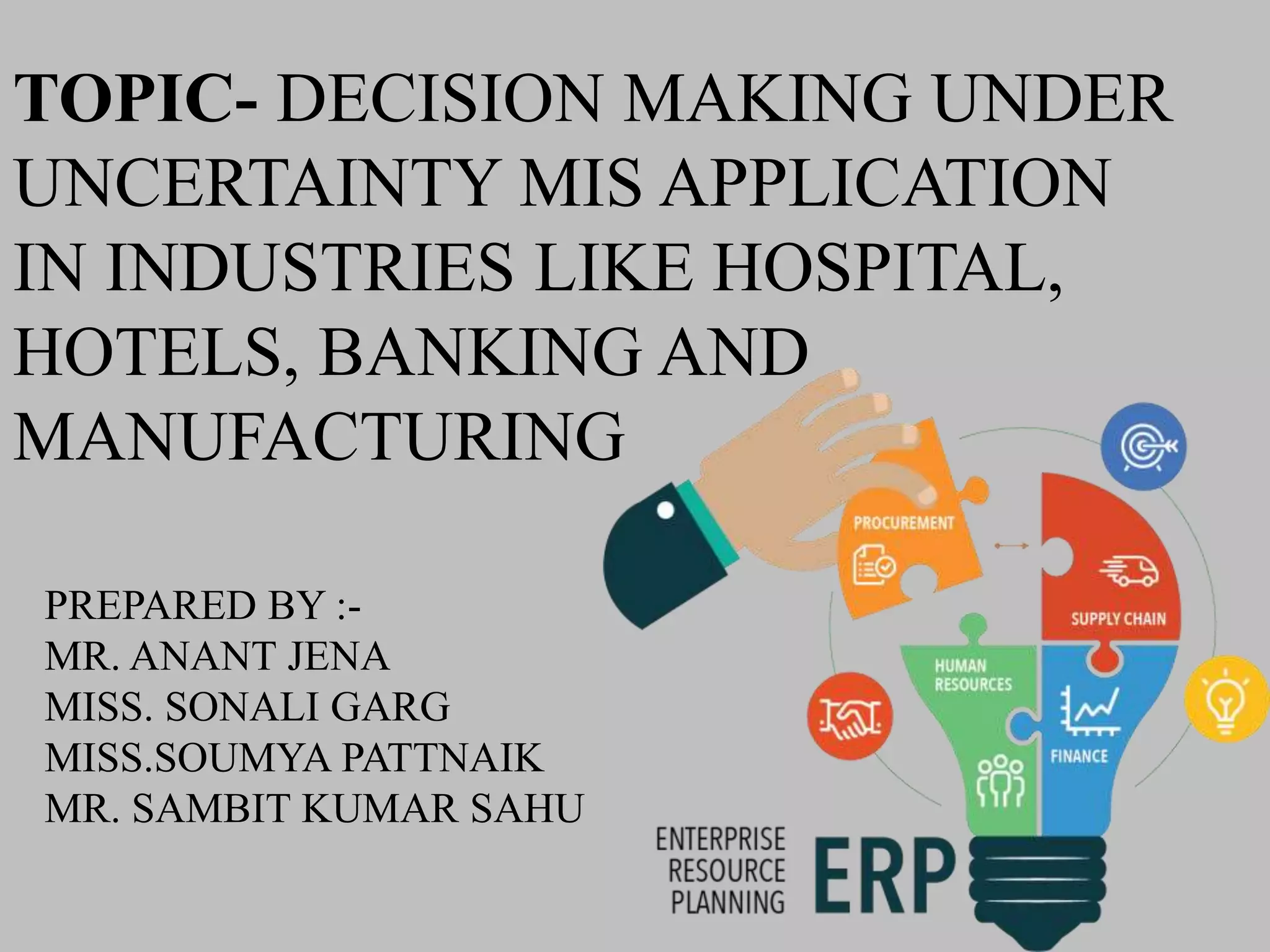
TOPIC- DECISION MAKING UNDER
UNCERTAINTY MIS APPLICATION
IN INDUSTRIES LIKE HOSPITAL,
HOTELS, BANKING AND
MANUFACTURING
PREPARED BY :-
MR. ANANT JENA
MISS. SONALI GARG
MISS.SOUMYA PATTNAIK
MR. SAMBIT KUMAR SAHU
Introduction to application of MIS
• Customer satisfaction is the main goal in service industry but
not in manufacturing industry.
• To maintain the position in the industry we should know the
service required.
• The service sectors are more susceptible to change as compared
to manufacturing sectors because to stay in the competition the
managers in a service sector give maximum efforts to provide
distinctive service.
• MIS gives the prime focus on the services that are needed to
the people.
• Due to MIS , management is able to provide services of the
highest level by understanding the needs that enhances the
communication , physical and human related process to
maintain this levels.
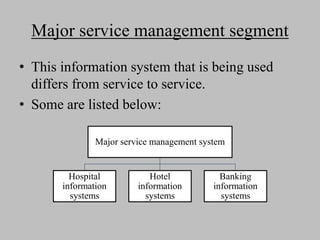
Major service management segment
• This information system that is being used
differs from service to service.
• Some are listed below:
Major service management system
Hospital
information
systems
Hotel
information
systems
Banking
information
systems
Hospital information systems
• Hospital management has to provide
distinctive services to a wide variety of
customers having different perceptions and
expectations regarding in the services.
• Customer mainly focuses on the end results of
the services and appraise the management on
the performance of service process.
• We can say this information system as “HIS”.
Contd.
• This HIS means it is a computerized system that
regulates all the medical and administrative
information processing activities in order to
achieve an efficient and effective work
performance by health professionals of a hospital.
• It is also known as INTEGRATED HOSPITAL
INFORMATION PROCESSING SYSTEM
“IHIS” because it integrates various components
like clinical information system (cis), financial
information system (fis) , laboratory system (Lis)
, nursing information system (nis) , pharmacy
information system (pis), etc.
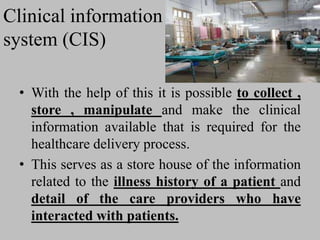
Clinical information
system (CIS)
• With the help of this it is possible to collect ,
store , manipulate and make the clinical
information available that is required for the
healthcare delivery process.
• This serves as a store house of the information
related to the illness history of a patient and
detail of the care providers who have
interacted with patients.
Financial information system (FIS)
• FIS manages the financial activities of the
hospital. Such as :-
i. Payroll : various kinds of payments and
deductions of the employees are managed using
the system.
Basically , these are of two types –
a) the recurring ones re generated in an
automated manner when the payroll is prepared.
b) the non recurring ones like overtime are
added to the payment ones they have been
approved.
contd.
ii. Patient accounting : this keeps the track of the financial
transaction that have been carried out when the patient
visited to the hospital. The various records that are kept
such as doctor’s operations , medications and procedures
and the fees collected from both the inpatient and
outpatient.
iii. Accounts payable : the payments and invoices generated
within the hospital are managed by using this module.
iv. Accounts receivable : the record related to the clients ,
payments and invoices are managed.
v. Fixed asset management : this provides supports for
retaining asset data and forecasting the depreciation.
Front-End and Back-End application of
“HIS”
• FRONT-END
1. Patient Database : this handles the queries regarding
patients who are currently being treated and those are
discharged. This queries are made by any patient, staffs or
doctors of the hospital.
2. Medical server database : it handles the information
regarding names, tekephone no. , address,holidays,
locations, work time of all hospital staffs including
doctors,technician and nurses. This also provides support
service centers during emergency .
3. resource planning and control : online queries regarding
the schedulingv, rescheduling and availability of facilities
and resources are answered by this module.
• BACK-END
1. Core applications :
 Manpower and personnel planning.
 Payroll and the employee related applications.
 Hospital billing and recovery.
 Financial accounting . Capital budgeting and expenses control.
 Resources utilization and analysis.
2. Critical control applications:
 Patients waiting times and service cycle.
 Stock outs of critical drugs and time needed to get the supply.
 Patients admitted , treated and cured during a time period.
 Understanding new trends in services and analysing what to be
done to satisfy the services.
 Analysis of the delays in terms of duration and causes.
 Reporting the causes and analyzing the number of patients which
have been sent to some other hospital due to lack of facilities.
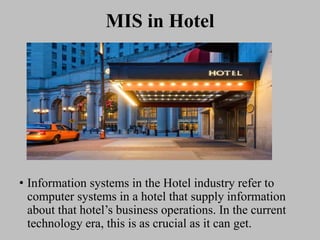
MIS in Hotel
• Information systems in the Hotel industry refer to
computer systems in a hotel that supply information
about that hotel’s business operations. In the current
technology era, this is as crucial as it can get.
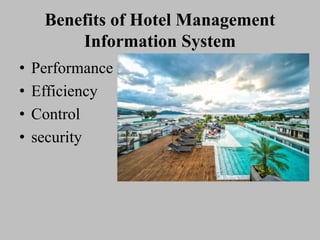
Benefits of Hotel Management
Information System
• Performance
• Efficiency
• Control
• security
Concept of Decision-Making
Decision-making is a cognitive process that results in the selection of a course
of action among several alternative scenarios.
Decision-making is a daily activity for any human being. There is no exception
about that. When it comes to business organizations, decision-making is a habit
and a process as well.
 In a decision-making process, we choose one course of action from a few
possible alternatives. In the process of decision-making, we may use many tools,
techniques, and perceptions.
In addition, we may make our own private decisions or may prefer a collective
decision.
Usually, decision-making is hard. Majority of corporate decisions involve
some level of dissatisfaction or conflict with another party.
Identification of the Purpose of the Decision-
In this step, the problem is thoroughly analyzed. There are a couple
of questions one should ask when it comes to identifying the
purpose of the decision.
What exactly is the problem?
Why the problem should be solved?
Who are the affected parties of the problem?
Does the problem have a deadline or a specific time-line?
Information Gathering-
A problem of an organization will have many stakeholders. In
addition, there can be dozens of factors involved and affected by the
problem.
In the process of solving the problem, you will have to gather as
much as information related to the factors and stakeholders involved
in the problem. For the process of information gathering, tools such
as 'Check Sheets' can be effectively used.
Principles for Judging the Alternatives-
In this step, the baseline criteria for judging the alternatives should be
set up. When it comes to defining the criteria, organizational goals as
well as the corporate culture should be taken into consideration.
As an example, profit is one of the main concerns in every decision
making process. Companies usually do not make decisions that reduce
profits, unless it is an exceptional case.
Brainstorm and Analyze the Choices-
For this step, brainstorming to list down all the ideas is the best
option. Before the idea generation step, it is vital to understand the
causes of the problem and prioritization of causes.
For this, you can make use of Cause-and-Effect diagrams and Pareto
Chart tool. Cause-and-Effect diagram helps you to identify all
possible causes of the problem and Pareto chart helps you to prioritize
and identify the causes with the highest effect.
Evaluation of Alternatives-
Use your judgment principles and decision-making criteria to
evaluate each alternative. In this step, experience and
effectiveness of the judgment principles come into play. You need
to compare each alternative for their positives and negatives.
Select the Best Alternative-
Once you go through from Step 1 to Step 5, this step is easy. In
addition, the selection of the best alternative is an informed
decision since you have already followed a methodology to
derive and select the best alternative.
Execute the decision-
Convert your decision into a plan or a sequence of activities.
Execute your plan by yourself or with the help of subordinates.
Evaluate the Results-
Evaluate the outcome of your decision. See whether there is
anything you should learn and then correct in future decision
making. This is one of the best practices that will improve your
decision-making skills
5 FACTORS OF DECISIONS
• If you’re motivated by desire, and would consider
yourself someone who sees the glass half full rather than
half empty, you’re a toward person. You need to be
motivated by goals and rewards. You find the silver
lining and make your choices based on the pursuit of
pleasure.
• If you answered fear, you’re an away person. You need
to be motivated by something negative, including the
consequences of not doing something. You find it makes
more sense to identify the potential risks and downsides
of a situation than to look at the positives.
Toward or Away
Internal or External
• If you’re someone who seeks out a point of
reference internally, then you simply think about
the issue and make a decision for yourself.
An internal person will rely on what’s important to
them and turns inward to make their choice.
• If you find yourself seeking out points of
reference externally, then you reach out to people
in your life for their feedback. As an external
person, you look to others and rely on testimonials
and statistics. You want validation from outside
sources, so you can make the most well-informed
choices possible.
Possibility or Necessity
• If you’re someone who sees the many possibilities of
a situation and is motivated by the growth you can
pursue there, you’re a possibilities person.
• Others are motivated by necessity. If you’re a
necessity person, you like your job because you
know how to do it well and you perform the tasks
required of you without thinking too much outside
the box. You like being shown what you need to do
and executing, whereas someone who identifies as
a possibilities person is motivated by seeing what
they could potentially achieve.
Matcher or Mismatcher
• As a matcher, you focus on finding sameness and
will be motivated by relating something new to
something you’re already familiar with. There are
two types of matchers: matchers who focus
on sameness and matchers who focus on sameness
with exception.
• Sameness matchers relate a new experience to
something positive in their past. Sameness with
exception matchers look at how an experience is
like something they’re familiar with, while still
finding a unique quality within the situation.
Generality or Specificity
• Some people are motivated by the big picture, while
others find more comfort in the details. If you’re
a generalist, you like to focus on the master plan and
are always thinking about your overall goal. As you
make decisions, you think about how it will affect
what you’re trying to achieve in the long run.
• If you’re a specific person, however, you’re
concerned with the details and will be doubtful if
only given a general sense of the situation. You
don’t regularly think about the future and are able to
hone in on the short term.
Role of Management in Decision Making
Information Access-Managers need rapid access to
information to make decisions about strategic, financial,
marketing and operational issues.
Companies collect vast amounts of information, including
customer records, sales data, market research, financial
records, manufacturing and inventory data, and human
resource records.
However, much of that information is held in separate
departmental databases, making it difficult for decision
makers to access data quickly.
A management information system simplifies and speeds
up information retrieval by storing data in a central
location that is accessible via a network. The result is
decisions that are quicker and more accurate.
Data Collection-Management information systems bring
together data from inside and outside the organization. By setting
up a network that links a central database to retail outlets,
distributors and members of a supply chain, companies can
collect sales and production data daily, or more frequently, and
make decisions based on the latest information.
Collaboration-In situations where decision-making involves
groups, as well as individuals, management information systems
make it easy for teams to make collaborative decisions. In a
project team, for example, management information systems
enable all members to access the same essential data, even if they
are working in different locations.
Interpretation
Management information systems help decision-makers understand
the implications of their decisions. The systems collate raw data
into reports in a format that enables decision-makers to quickly
identify patterns and trends that would not have been obvious in the
raw data. Decision-makers can also use management information
systems to understand the potential effect of change.
Presentation
The reporting tools within management information systems enable
decision-makers to tailor reports to the information needs of other
parties. If a decision requires approval by a senior executive, the
decision-maker can create a brief executive summary for review. If
managers want to share the detailed findings of a report with
colleagues, they can create full reports and provide different levels
of supplementary data.
Decision support system
 A system which supports the process of
decision-making is known as decision support
system (dss).
 This helps in supporting only and not
automating the process of decision making.
 DSS is a specific class of MIS system that
helps the managers at all stages of decision
making like problem identification , selection
of relevent dara, picking up the right approch
and examining alterntives.
Advantages of Decision Support
System
• Allows for faster decision-making
• Reduces the time taken to solve problems
• Has been seen to improve collaboration and
communication within groups
• Provides more evidence in support of a decision
• May increase decision-maker satisfaction
• Providing different perspectives to a situation
• Helps automate various business systems
Disadvantages of Decision Support
System
• Too much emphasis/control given to the machines.
• May reduce skill in staff because they become dependent on
the computers
• Reduction in efficiency because of information overload
• Shift of responsibility - easy to blame computer!
• Disgruntled employees who feel they are now only doing
clerical work
• False sense of being objective - humans still feed information
in and decide how exactly to process it.
conclusion
• Here we conclude that both MIS AND DSS are helpful
in different ways .
• A Management Information System (MIS) is an
information system that evaluates, analyzes, and
processes an organization’s data to produce meaningful
and useful information based on which the management
can take right decisions to ensure future growth of the
organization. A Decision Support System (DSS) is
an information system that supports business or
organizational decision-making activities.

application of MIS ppt

  • 1.
    TOPIC- DECISION MAKINGUNDER UNCERTAINTY MIS APPLICATION IN INDUSTRIES LIKE HOSPITAL, HOTELS, BANKING AND MANUFACTURING PREPARED BY :- MR. ANANT JENA MISS. SONALI GARG MISS.SOUMYA PATTNAIK MR. SAMBIT KUMAR SAHU
  • 2.
    Introduction to applicationof MIS • Customer satisfaction is the main goal in service industry but not in manufacturing industry. • To maintain the position in the industry we should know the service required. • The service sectors are more susceptible to change as compared to manufacturing sectors because to stay in the competition the managers in a service sector give maximum efforts to provide distinctive service. • MIS gives the prime focus on the services that are needed to the people. • Due to MIS , management is able to provide services of the highest level by understanding the needs that enhances the communication , physical and human related process to maintain this levels.
  • 3.
    Major service managementsegment • This information system that is being used differs from service to service. • Some are listed below: Major service management system Hospital information systems Hotel information systems Banking information systems
  • 4.
    Hospital information systems •Hospital management has to provide distinctive services to a wide variety of customers having different perceptions and expectations regarding in the services. • Customer mainly focuses on the end results of the services and appraise the management on the performance of service process. • We can say this information system as “HIS”.
  • 5.
    Contd. • This HISmeans it is a computerized system that regulates all the medical and administrative information processing activities in order to achieve an efficient and effective work performance by health professionals of a hospital. • It is also known as INTEGRATED HOSPITAL INFORMATION PROCESSING SYSTEM “IHIS” because it integrates various components like clinical information system (cis), financial information system (fis) , laboratory system (Lis) , nursing information system (nis) , pharmacy information system (pis), etc.
  • 6.
    Clinical information system (CIS) •With the help of this it is possible to collect , store , manipulate and make the clinical information available that is required for the healthcare delivery process. • This serves as a store house of the information related to the illness history of a patient and detail of the care providers who have interacted with patients.
  • 7.
    Financial information system(FIS) • FIS manages the financial activities of the hospital. Such as :- i. Payroll : various kinds of payments and deductions of the employees are managed using the system. Basically , these are of two types – a) the recurring ones re generated in an automated manner when the payroll is prepared. b) the non recurring ones like overtime are added to the payment ones they have been approved.
  • 8.
    contd. ii. Patient accounting: this keeps the track of the financial transaction that have been carried out when the patient visited to the hospital. The various records that are kept such as doctor’s operations , medications and procedures and the fees collected from both the inpatient and outpatient. iii. Accounts payable : the payments and invoices generated within the hospital are managed by using this module. iv. Accounts receivable : the record related to the clients , payments and invoices are managed. v. Fixed asset management : this provides supports for retaining asset data and forecasting the depreciation.
  • 9.
    Front-End and Back-Endapplication of “HIS” • FRONT-END 1. Patient Database : this handles the queries regarding patients who are currently being treated and those are discharged. This queries are made by any patient, staffs or doctors of the hospital. 2. Medical server database : it handles the information regarding names, tekephone no. , address,holidays, locations, work time of all hospital staffs including doctors,technician and nurses. This also provides support service centers during emergency . 3. resource planning and control : online queries regarding the schedulingv, rescheduling and availability of facilities and resources are answered by this module.
  • 10.
    • BACK-END 1. Coreapplications :  Manpower and personnel planning.  Payroll and the employee related applications.  Hospital billing and recovery.  Financial accounting . Capital budgeting and expenses control.  Resources utilization and analysis. 2. Critical control applications:  Patients waiting times and service cycle.  Stock outs of critical drugs and time needed to get the supply.  Patients admitted , treated and cured during a time period.  Understanding new trends in services and analysing what to be done to satisfy the services.  Analysis of the delays in terms of duration and causes.  Reporting the causes and analyzing the number of patients which have been sent to some other hospital due to lack of facilities.
  • 11.
    MIS in Hotel •Information systems in the Hotel industry refer to computer systems in a hotel that supply information about that hotel’s business operations. In the current technology era, this is as crucial as it can get.
  • 12.
    Benefits of HotelManagement Information System • Performance • Efficiency • Control • security
  • 13.
    Concept of Decision-Making Decision-makingis a cognitive process that results in the selection of a course of action among several alternative scenarios. Decision-making is a daily activity for any human being. There is no exception about that. When it comes to business organizations, decision-making is a habit and a process as well.  In a decision-making process, we choose one course of action from a few possible alternatives. In the process of decision-making, we may use many tools, techniques, and perceptions. In addition, we may make our own private decisions or may prefer a collective decision. Usually, decision-making is hard. Majority of corporate decisions involve some level of dissatisfaction or conflict with another party.
  • 14.
    Identification of thePurpose of the Decision- In this step, the problem is thoroughly analyzed. There are a couple of questions one should ask when it comes to identifying the purpose of the decision. What exactly is the problem? Why the problem should be solved? Who are the affected parties of the problem? Does the problem have a deadline or a specific time-line? Information Gathering- A problem of an organization will have many stakeholders. In addition, there can be dozens of factors involved and affected by the problem. In the process of solving the problem, you will have to gather as much as information related to the factors and stakeholders involved in the problem. For the process of information gathering, tools such as 'Check Sheets' can be effectively used.
  • 15.
    Principles for Judgingthe Alternatives- In this step, the baseline criteria for judging the alternatives should be set up. When it comes to defining the criteria, organizational goals as well as the corporate culture should be taken into consideration. As an example, profit is one of the main concerns in every decision making process. Companies usually do not make decisions that reduce profits, unless it is an exceptional case. Brainstorm and Analyze the Choices- For this step, brainstorming to list down all the ideas is the best option. Before the idea generation step, it is vital to understand the causes of the problem and prioritization of causes. For this, you can make use of Cause-and-Effect diagrams and Pareto Chart tool. Cause-and-Effect diagram helps you to identify all possible causes of the problem and Pareto chart helps you to prioritize and identify the causes with the highest effect.
  • 16.
    Evaluation of Alternatives- Useyour judgment principles and decision-making criteria to evaluate each alternative. In this step, experience and effectiveness of the judgment principles come into play. You need to compare each alternative for their positives and negatives. Select the Best Alternative- Once you go through from Step 1 to Step 5, this step is easy. In addition, the selection of the best alternative is an informed decision since you have already followed a methodology to derive and select the best alternative. Execute the decision- Convert your decision into a plan or a sequence of activities. Execute your plan by yourself or with the help of subordinates.
  • 17.
    Evaluate the Results- Evaluatethe outcome of your decision. See whether there is anything you should learn and then correct in future decision making. This is one of the best practices that will improve your decision-making skills
  • 18.
    5 FACTORS OFDECISIONS • If you’re motivated by desire, and would consider yourself someone who sees the glass half full rather than half empty, you’re a toward person. You need to be motivated by goals and rewards. You find the silver lining and make your choices based on the pursuit of pleasure. • If you answered fear, you’re an away person. You need to be motivated by something negative, including the consequences of not doing something. You find it makes more sense to identify the potential risks and downsides of a situation than to look at the positives. Toward or Away
  • 19.
    Internal or External •If you’re someone who seeks out a point of reference internally, then you simply think about the issue and make a decision for yourself. An internal person will rely on what’s important to them and turns inward to make their choice. • If you find yourself seeking out points of reference externally, then you reach out to people in your life for their feedback. As an external person, you look to others and rely on testimonials and statistics. You want validation from outside sources, so you can make the most well-informed choices possible.
  • 20.
    Possibility or Necessity •If you’re someone who sees the many possibilities of a situation and is motivated by the growth you can pursue there, you’re a possibilities person. • Others are motivated by necessity. If you’re a necessity person, you like your job because you know how to do it well and you perform the tasks required of you without thinking too much outside the box. You like being shown what you need to do and executing, whereas someone who identifies as a possibilities person is motivated by seeing what they could potentially achieve.
  • 21.
    Matcher or Mismatcher •As a matcher, you focus on finding sameness and will be motivated by relating something new to something you’re already familiar with. There are two types of matchers: matchers who focus on sameness and matchers who focus on sameness with exception. • Sameness matchers relate a new experience to something positive in their past. Sameness with exception matchers look at how an experience is like something they’re familiar with, while still finding a unique quality within the situation.
  • 22.
    Generality or Specificity •Some people are motivated by the big picture, while others find more comfort in the details. If you’re a generalist, you like to focus on the master plan and are always thinking about your overall goal. As you make decisions, you think about how it will affect what you’re trying to achieve in the long run. • If you’re a specific person, however, you’re concerned with the details and will be doubtful if only given a general sense of the situation. You don’t regularly think about the future and are able to hone in on the short term.
  • 23.
    Role of Managementin Decision Making Information Access-Managers need rapid access to information to make decisions about strategic, financial, marketing and operational issues. Companies collect vast amounts of information, including customer records, sales data, market research, financial records, manufacturing and inventory data, and human resource records. However, much of that information is held in separate departmental databases, making it difficult for decision makers to access data quickly. A management information system simplifies and speeds up information retrieval by storing data in a central location that is accessible via a network. The result is decisions that are quicker and more accurate.
  • 24.
    Data Collection-Management informationsystems bring together data from inside and outside the organization. By setting up a network that links a central database to retail outlets, distributors and members of a supply chain, companies can collect sales and production data daily, or more frequently, and make decisions based on the latest information. Collaboration-In situations where decision-making involves groups, as well as individuals, management information systems make it easy for teams to make collaborative decisions. In a project team, for example, management information systems enable all members to access the same essential data, even if they are working in different locations.
  • 25.
    Interpretation Management information systemshelp decision-makers understand the implications of their decisions. The systems collate raw data into reports in a format that enables decision-makers to quickly identify patterns and trends that would not have been obvious in the raw data. Decision-makers can also use management information systems to understand the potential effect of change. Presentation The reporting tools within management information systems enable decision-makers to tailor reports to the information needs of other parties. If a decision requires approval by a senior executive, the decision-maker can create a brief executive summary for review. If managers want to share the detailed findings of a report with colleagues, they can create full reports and provide different levels of supplementary data.
  • 26.
    Decision support system A system which supports the process of decision-making is known as decision support system (dss).  This helps in supporting only and not automating the process of decision making.  DSS is a specific class of MIS system that helps the managers at all stages of decision making like problem identification , selection of relevent dara, picking up the right approch and examining alterntives.
  • 27.
    Advantages of DecisionSupport System • Allows for faster decision-making • Reduces the time taken to solve problems • Has been seen to improve collaboration and communication within groups • Provides more evidence in support of a decision • May increase decision-maker satisfaction • Providing different perspectives to a situation • Helps automate various business systems
  • 28.
    Disadvantages of DecisionSupport System • Too much emphasis/control given to the machines. • May reduce skill in staff because they become dependent on the computers • Reduction in efficiency because of information overload • Shift of responsibility - easy to blame computer! • Disgruntled employees who feel they are now only doing clerical work • False sense of being objective - humans still feed information in and decide how exactly to process it.
  • 29.
    conclusion • Here weconclude that both MIS AND DSS are helpful in different ways . • A Management Information System (MIS) is an information system that evaluates, analyzes, and processes an organization’s data to produce meaningful and useful information based on which the management can take right decisions to ensure future growth of the organization. A Decision Support System (DSS) is an information system that supports business or organizational decision-making activities.