MIPS CPU Design using Verilog
Tsung-Chu Huang
Dept. of Electronics Eng., National Changhua University of Education, Taiwan
2023/1/5
2
Outline
 Introduction to MIPS32: ISA & SPIM
 Instruction Formats
 Addressing Modes
 Instruction Set Architecture and Assembly Language Compiled by SPIM
 Single-Stage MIPS Design
 Program Counter (PC)
 Instruction Memory (IM)
 Register Files (RF)
 Arithmetic Logic Unit (ALU)
 Data Memory (DM)
 5-Stage Pipeline MIPS Design
 Basic Pipeline Design by Spatial Gate-Level Design
 Explanation for Term Project
3
Introduction to MIPS
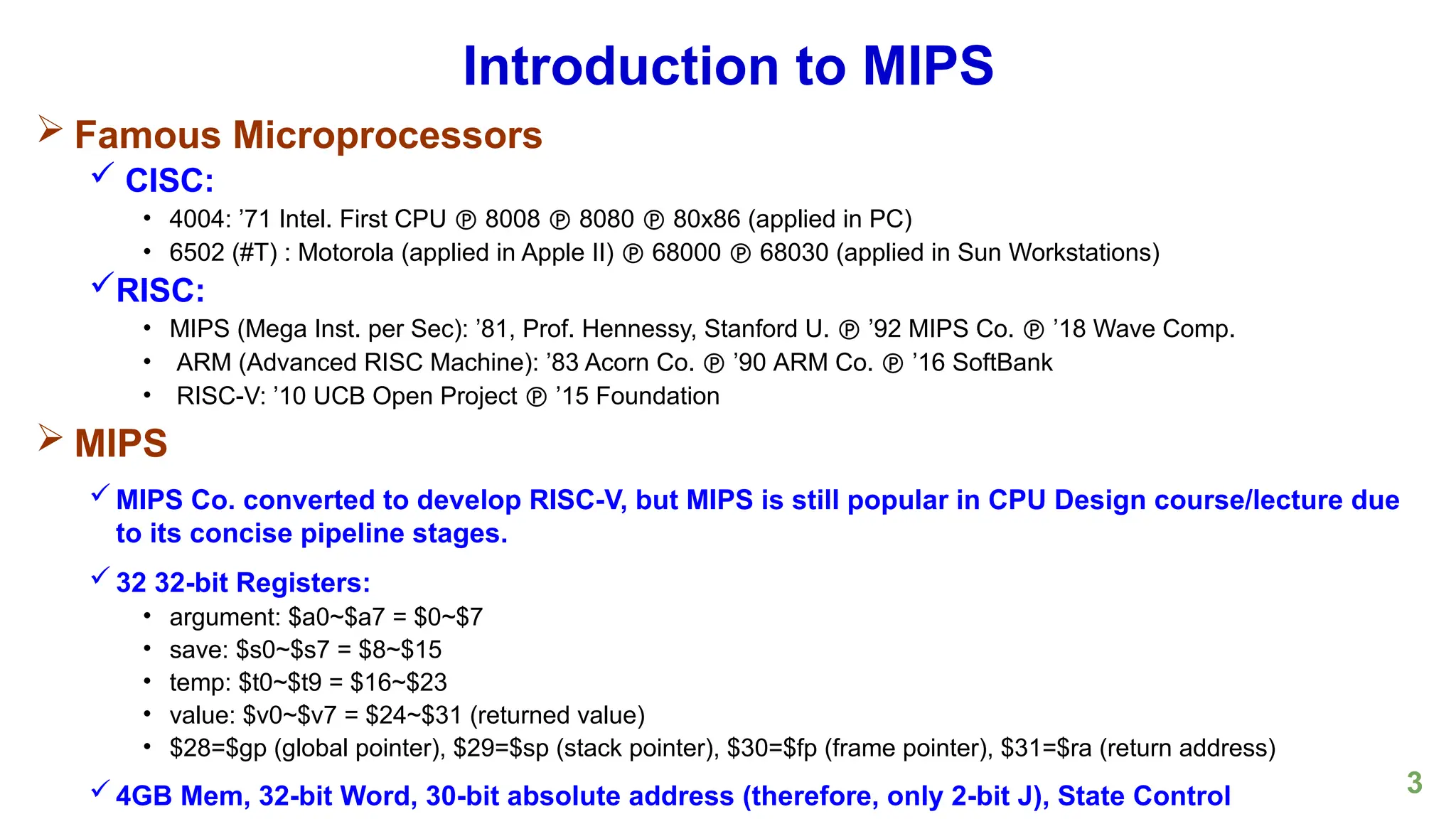
 Famous Microprocessors
 CISC:
• 4004: ’71 Intel. First CPU  8008  8080  80x86 (applied in PC)
• 6502 (#T) : Motorola (applied in Apple II)  68000  68030 (applied in Sun Workstations)
RISC:
• MIPS (Mega Inst. per Sec): ’81, Prof. Hennessy, Stanford U.  ’92 MIPS Co.  ’18 Wave Comp.
• ARM (Advanced RISC Machine): ’83 Acorn Co.  ’90 ARM Co.  ’16 SoftBank
• RISC-V: ’10 UCB Open Project  ’15 Foundation
 MIPS
MIPS Co. converted to develop RISC-V, but MIPS is still popular in CPU Design course/lecture due
to its concise pipeline stages.
32 32-bit Registers:
• argument: $a0~$a7 = $0~$7
• save: $s0~$s7 = $8~$15
• temp: $t0~$t9 = $16~$23
• value: $v0~$v7 = $24~$31 (returned value)
• $28=$gp (global pointer), $29=$sp (stack pointer), $30=$fp (frame pointer), $31=$ra (return address)
4GB Mem, 32-bit Word, 30-bit absolute address (therefore, only 2-bit J), State Control
4
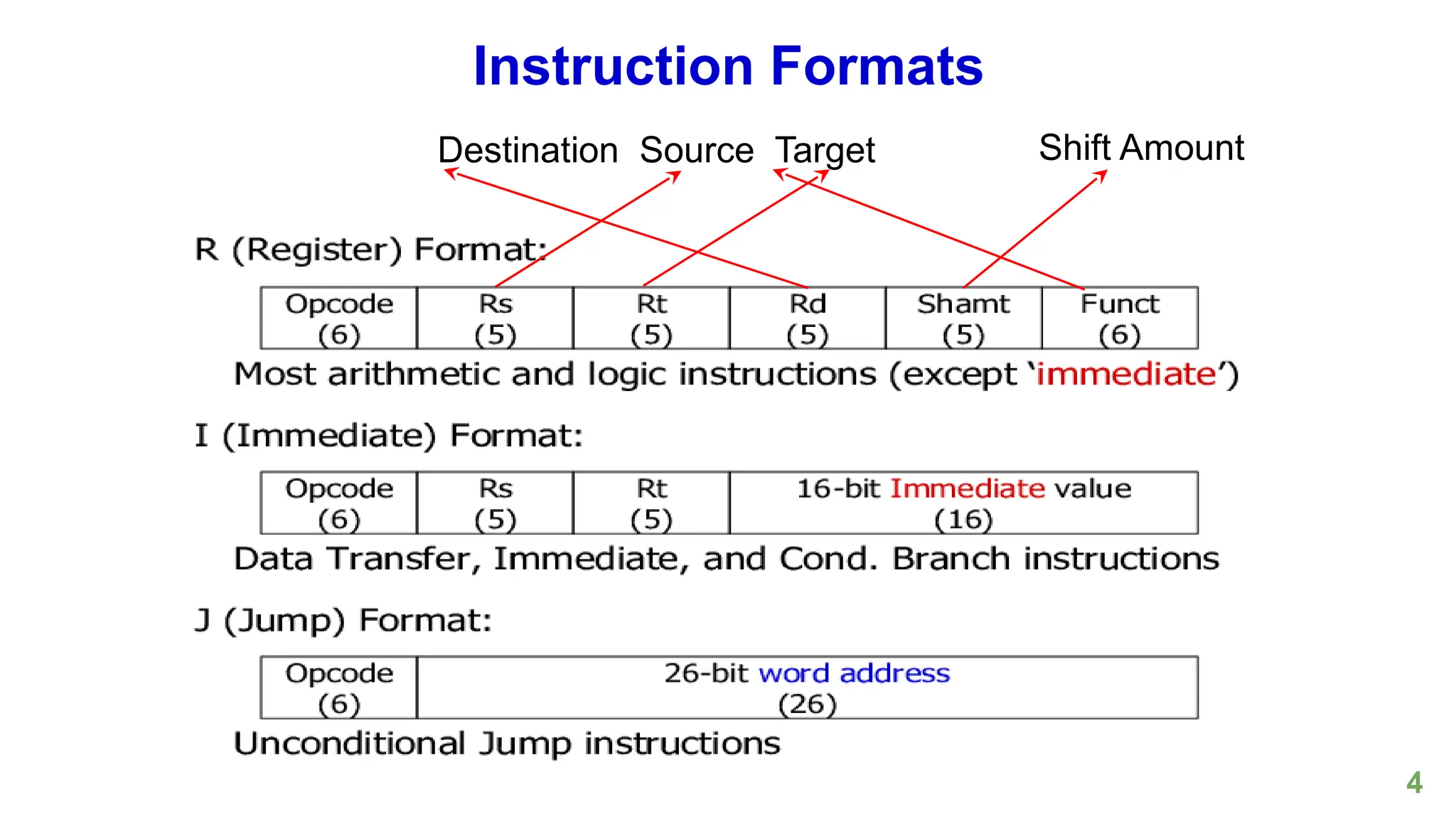
Instruction Formats
Destination Source Target Shift Amount
5
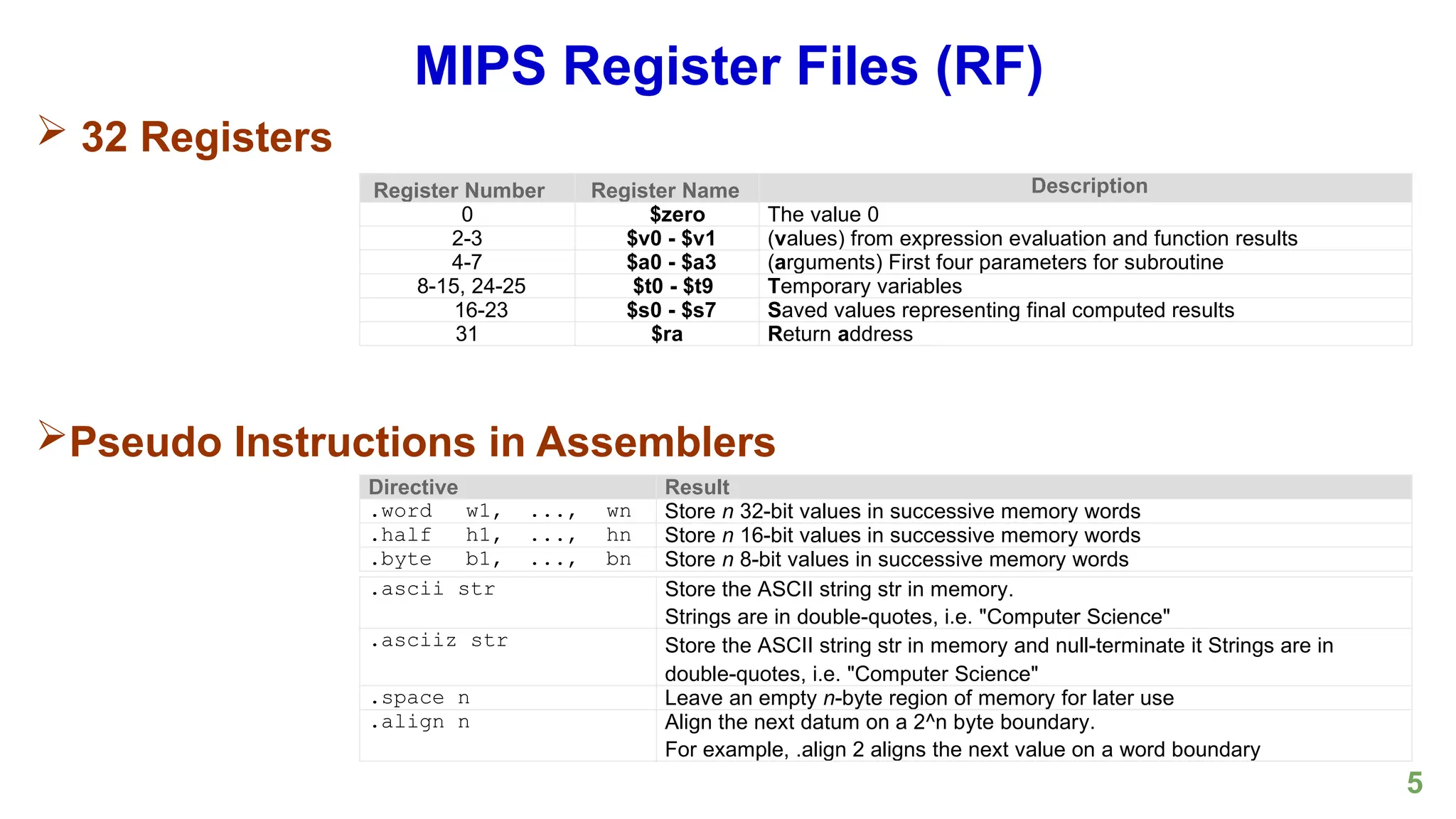
MIPS Register Files (RF)
 32 Registers
Pseudo Instructions in Assemblers
Register Number Register Name Description
0 $zero The value 0
2-3 $v0 - $v1 (values) from expression evaluation and function results
4-7 $a0 - $a3 (arguments) First four parameters for subroutine
8-15, 24-25 $t0 - $t9 Temporary variables
16-23 $s0 - $s7 Saved values representing final computed results
31 $ra Return address
Directive Result
.word w1, ..., wn Store n 32-bit values in successive memory words
.half h1, ..., hn Store n 16-bit values in successive memory words
.byte b1, ..., bn Store n 8-bit values in successive memory words
.ascii str Store the ASCII string str in memory.
Strings are in double-quotes, i.e. "Computer Science"
.asciiz str Store the ASCII string str in memory and null-terminate it Strings are in
double-quotes, i.e. "Computer Science"
.space n Leave an empty n-byte region of memory for later use
.align n Align the next datum on a 2^n byte boundary.
For example, .align 2 aligns the next value on a word boundary
6
MIPS Instruction Set
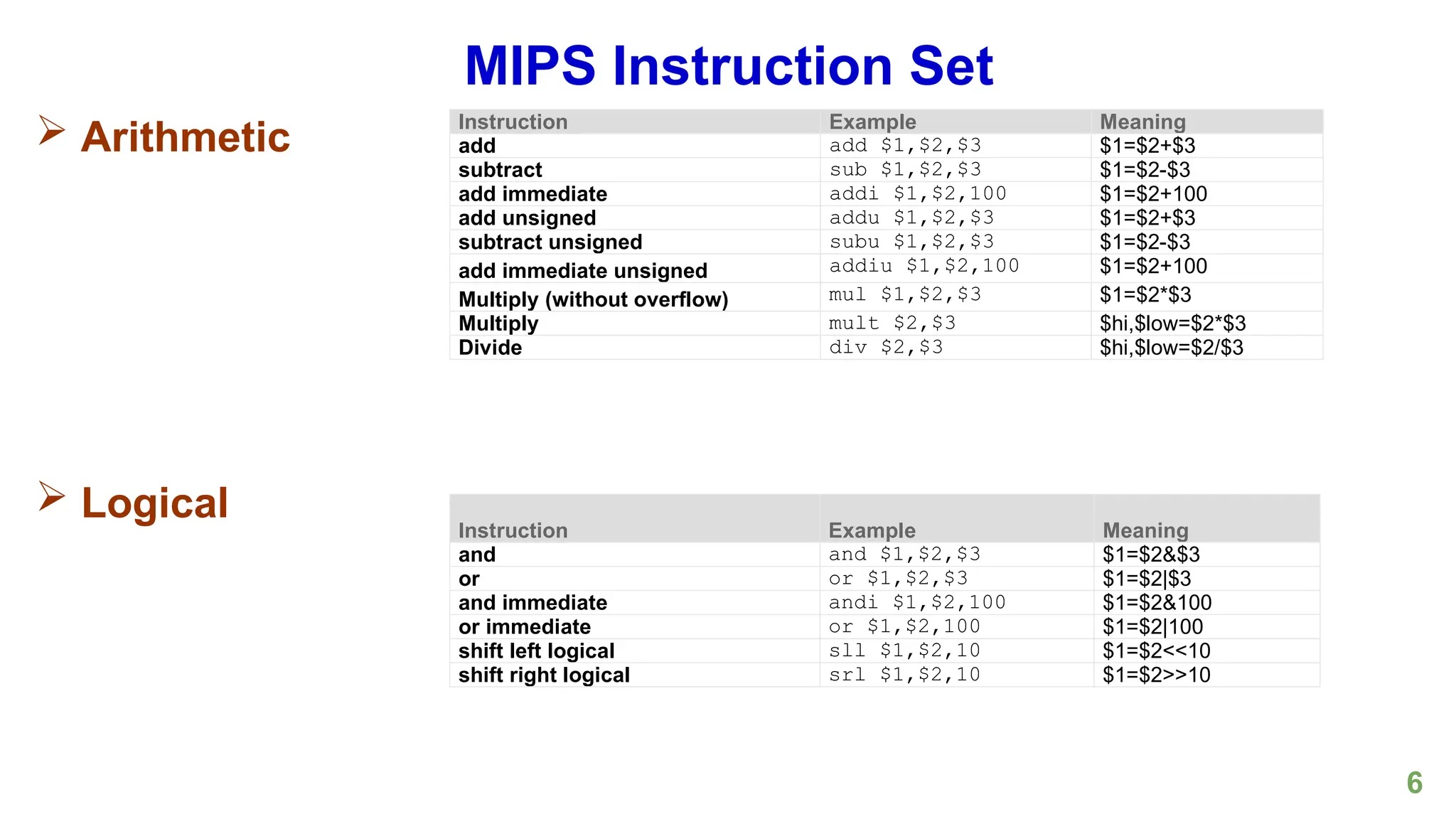
 Arithmetic
 Logical
Instruction Example Meaning
add add $1,$2,$3 $1=$2+$3
subtract sub $1,$2,$3 $1=$2-$3
add immediate addi $1,$2,100 $1=$2+100
add unsigned addu $1,$2,$3 $1=$2+$3
subtract unsigned subu $1,$2,$3 $1=$2-$3
add immediate unsigned addiu $1,$2,100 $1=$2+100
Multiply (without overflow) mul $1,$2,$3 $1=$2*$3
Multiply mult $2,$3 $hi,$low=$2*$3
Divide div $2,$3 $hi,$low=$2/$3
Instruction Example Meaning
and and $1,$2,$3 $1=$2&$3
or or $1,$2,$3 $1=$2|$3
and immediate andi $1,$2,100 $1=$2&100
or immediate or $1,$2,100 $1=$2|100
shift left logical sll $1,$2,10 $1=$2<<10
shift right logical srl $1,$2,10 $1=$2>>10
7
MIPS Instruction Set
 Data Transfer
 Conditional Branch
Instruction Example Meaning
load word lw
$1,100($2)
$1=Memory[$2+100]
store word sw $1,100($2) Memory[$2+100]=$1
load upper immediate lui $1,100 $1=100x2^16
load address la $1,label $1=Address of label
load immediate li $1,100 $1=100
move from hi mfhi $2 $2=hi
move from lo mflo $2 $2=lo
move move $1, $2 $1=$2
Instruction Example Meaning
branch on equal beq $1,$2,100 if($1==$2) go to PC+4+100
branch on not equal bne $1,$2,100 if($1!=$2) go to PC+4+100
branch on greater than bgt $1,$2,100 if($1>$2) go to PC+4+100
branch on greater than or equal bge $1,$2,100 if($1>=$2) go to PC+4+100
branch on less than blt $1,$2,100 if($1<$2) go to PC+4+100
branch on less than or equal ble $1,$2,100 if($1<=$2) go to PC+4+100
8
MIPS Instruction Set
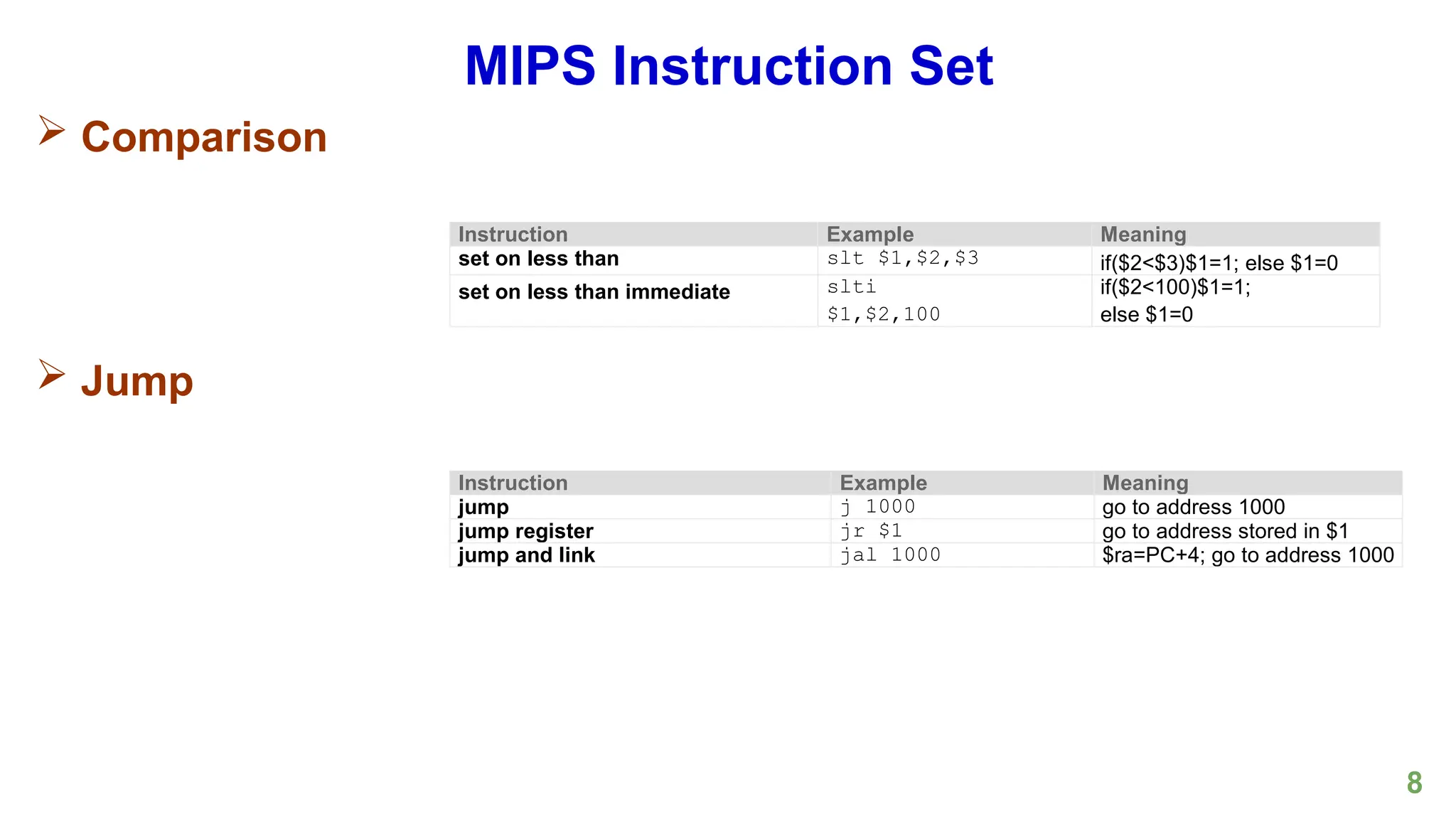
 Comparison
 Jump
Instruction Example Meaning
set on less than slt $1,$2,$3 if($2<$3)$1=1; else $1=0
set on less than immediate slti
$1,$2,100
if($2<100)$1=1;
else $1=0
Instruction Example Meaning
jump j 1000 go to address 1000
jump register jr $1 go to address stored in $1
jump and link jal 1000 $ra=PC+4; go to address 1000
9
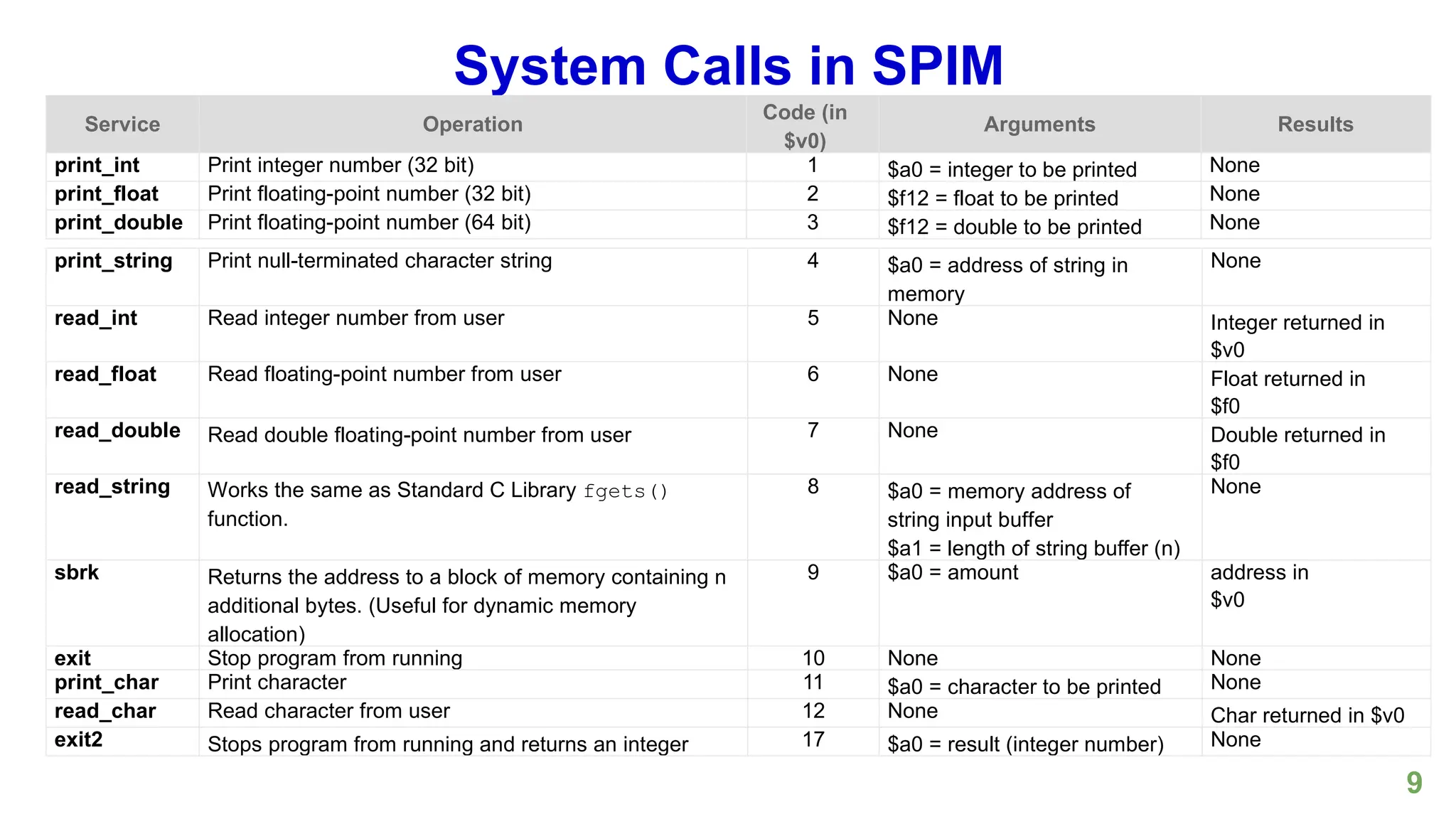
System Calls in SPIM
Service Operation
Code (in
$v0)
Arguments Results
print_int Print integer number (32 bit) 1 $a0 = integer to be printed None
print_float Print floating-point number (32 bit) 2 $f12 = float to be printed None
print_double Print floating-point number (64 bit) 3 $f12 = double to be printed None
print_string Print null-terminated character string 4 $a0 = address of string in
memory
None
read_int Read integer number from user 5 None Integer returned in
$v0
read_float Read floating-point number from user 6 None Float returned in
$f0
read_double Read double floating-point number from user 7 None Double returned in
$f0
read_string Works the same as Standard C Library fgets()
function.
8 $a0 = memory address of
string input buffer
$a1 = length of string buffer (n)
None
sbrk Returns the address to a block of memory containing n
additional bytes. (Useful for dynamic memory
allocation)
9 $a0 = amount address in
$v0
exit Stop program from running 10 None None
print_char Print character 11 $a0 = character to be printed None
read_char Read character from user 12 None Char returned in $v0
exit2 Stops program from running and returns an integer 17 $a0 = result (integer number) None
10
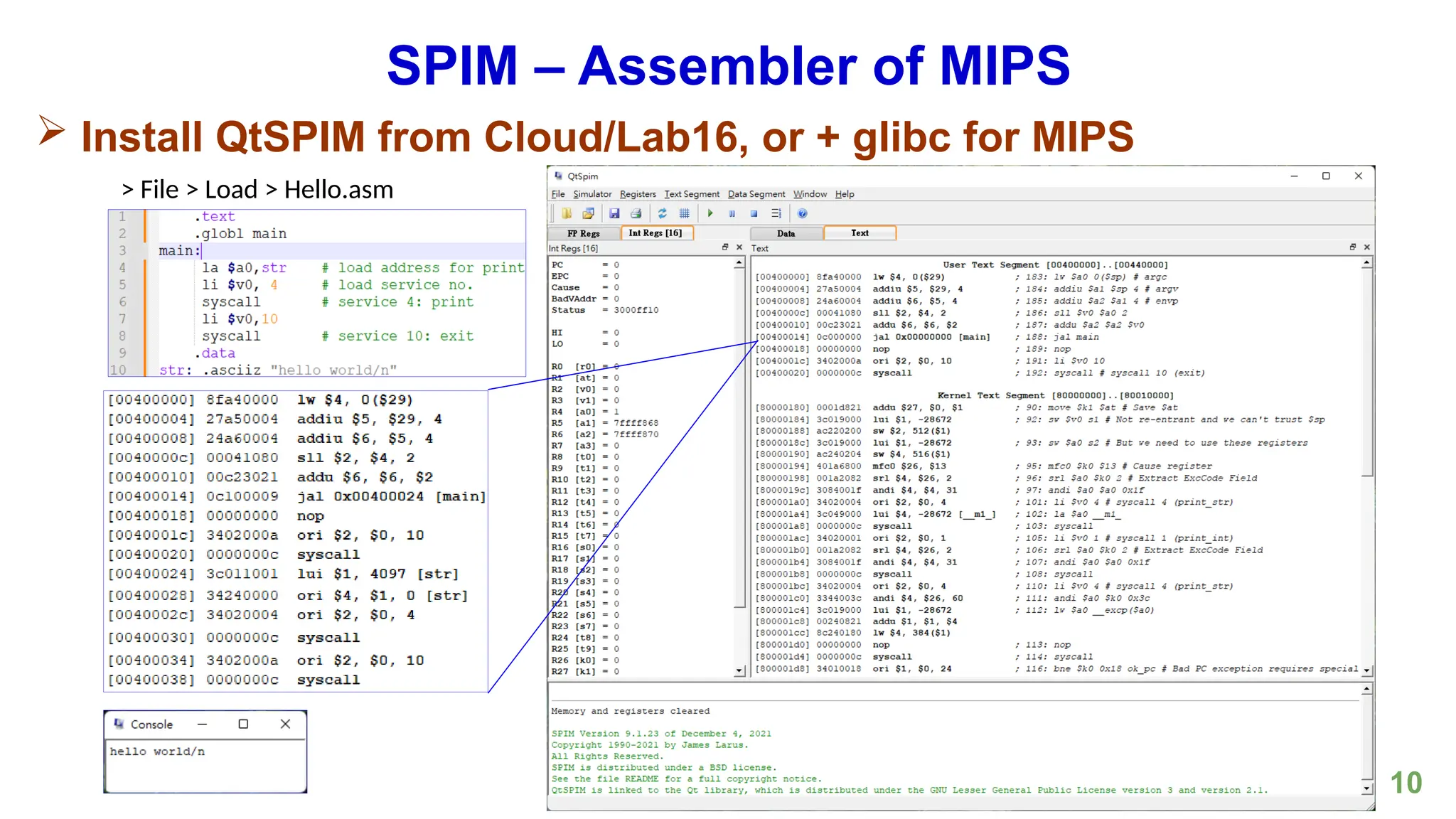
SPIM – Assembler of MIPS
 Install QtSPIM from Cloud/Lab16, or + glibc for MIPS
> File > Load > Hello.asm
11
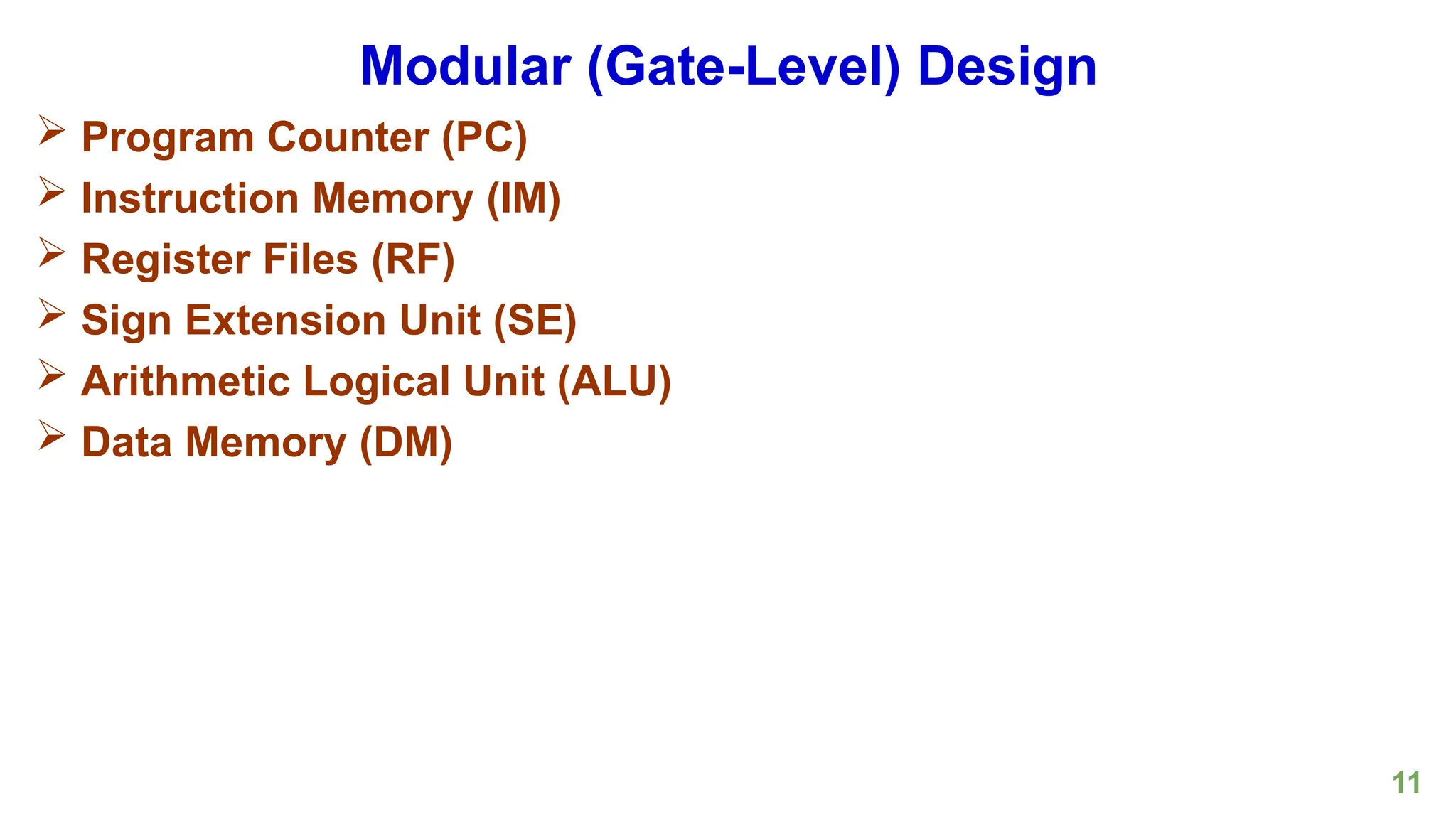
Modular (Gate-Level) Design
 Program Counter (PC)
 Instruction Memory (IM)
 Register Files (RF)
 Sign Extension Unit (SE)
 Arithmetic Logical Unit (ALU)
 Data Memory (DM)
12
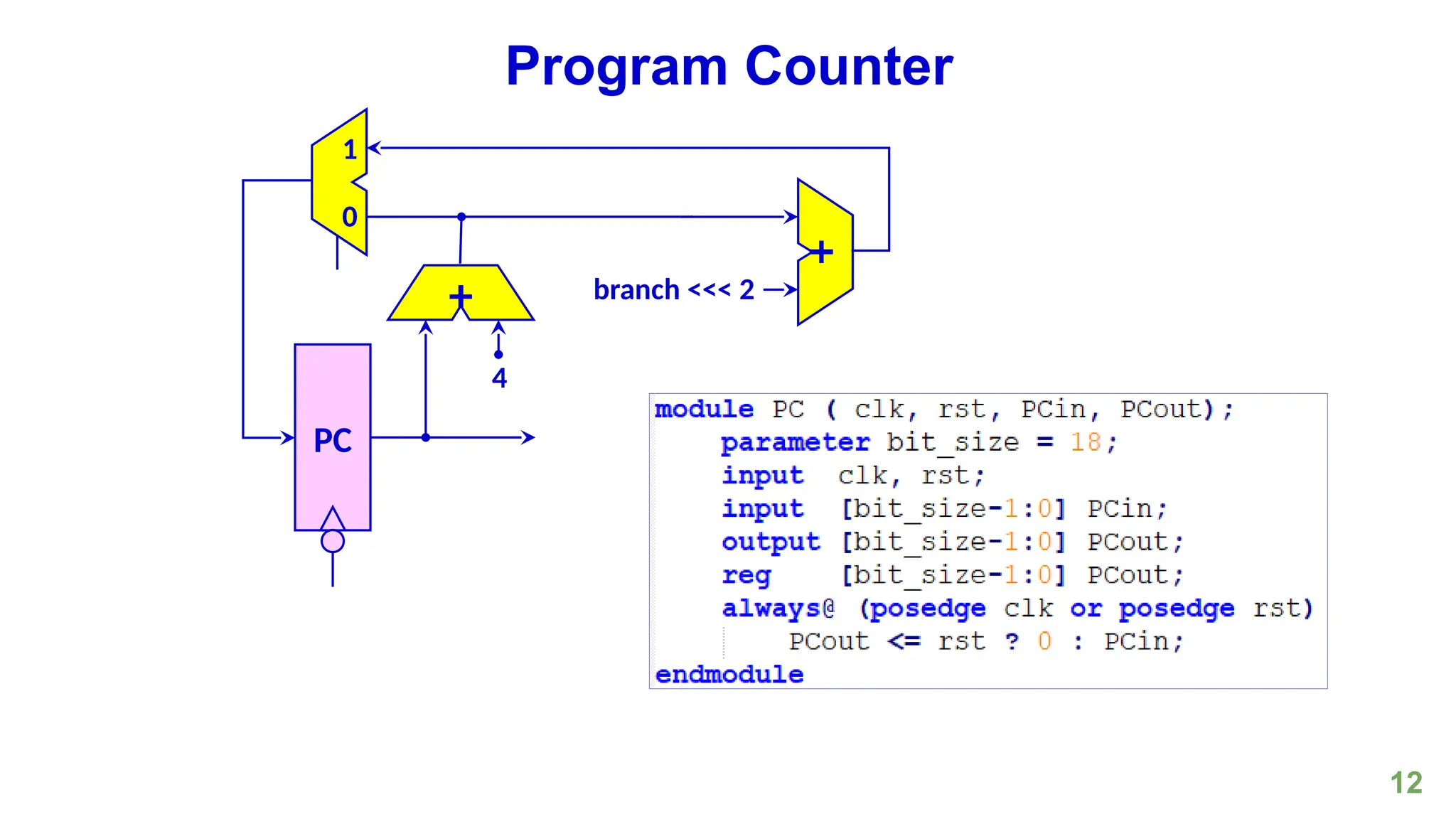
Program Counter
+
PC
4
+
branch <<< 2
0
1
13
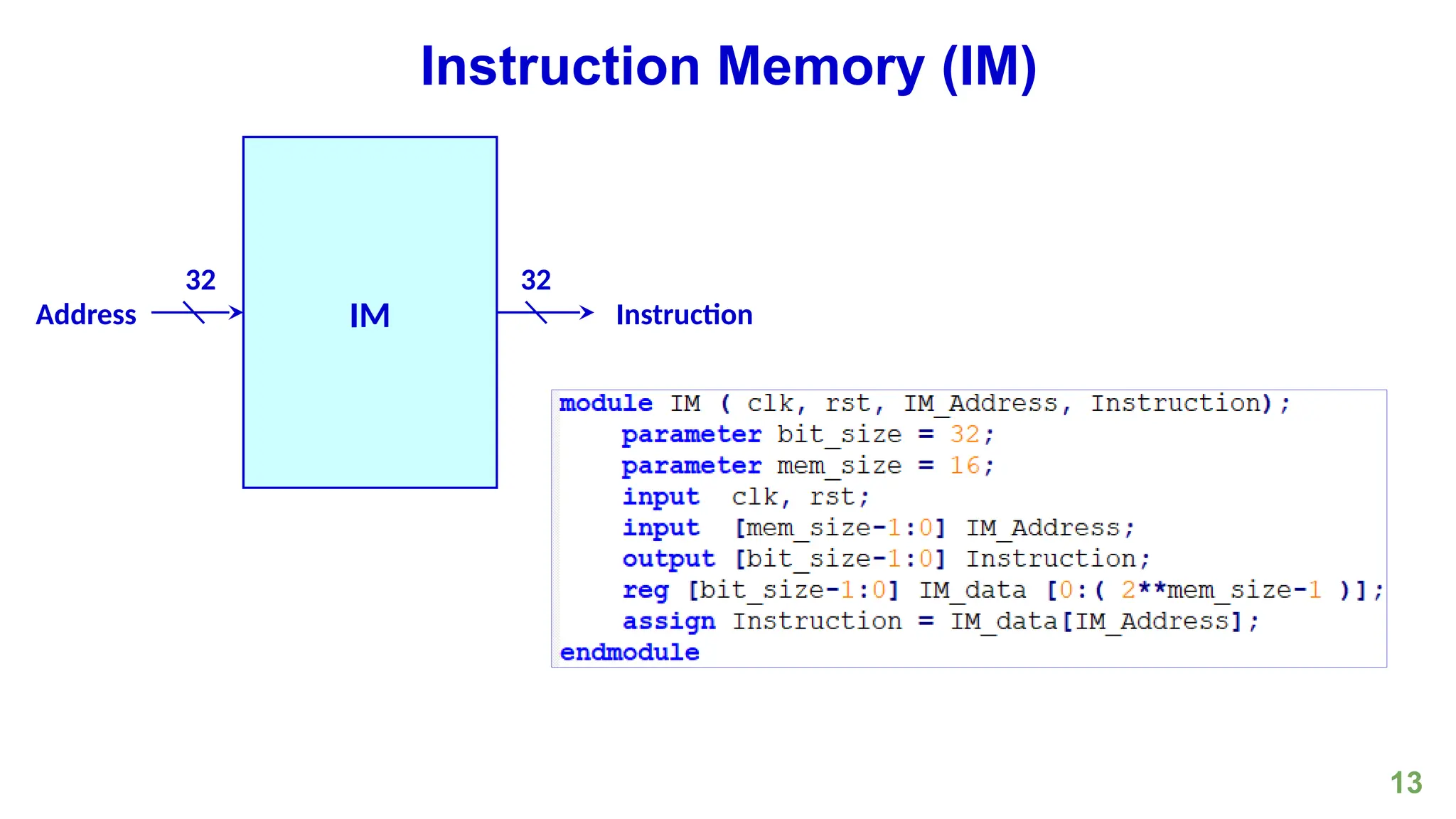
Instruction Memory (IM)
IM
Address Instruction
32
32
14
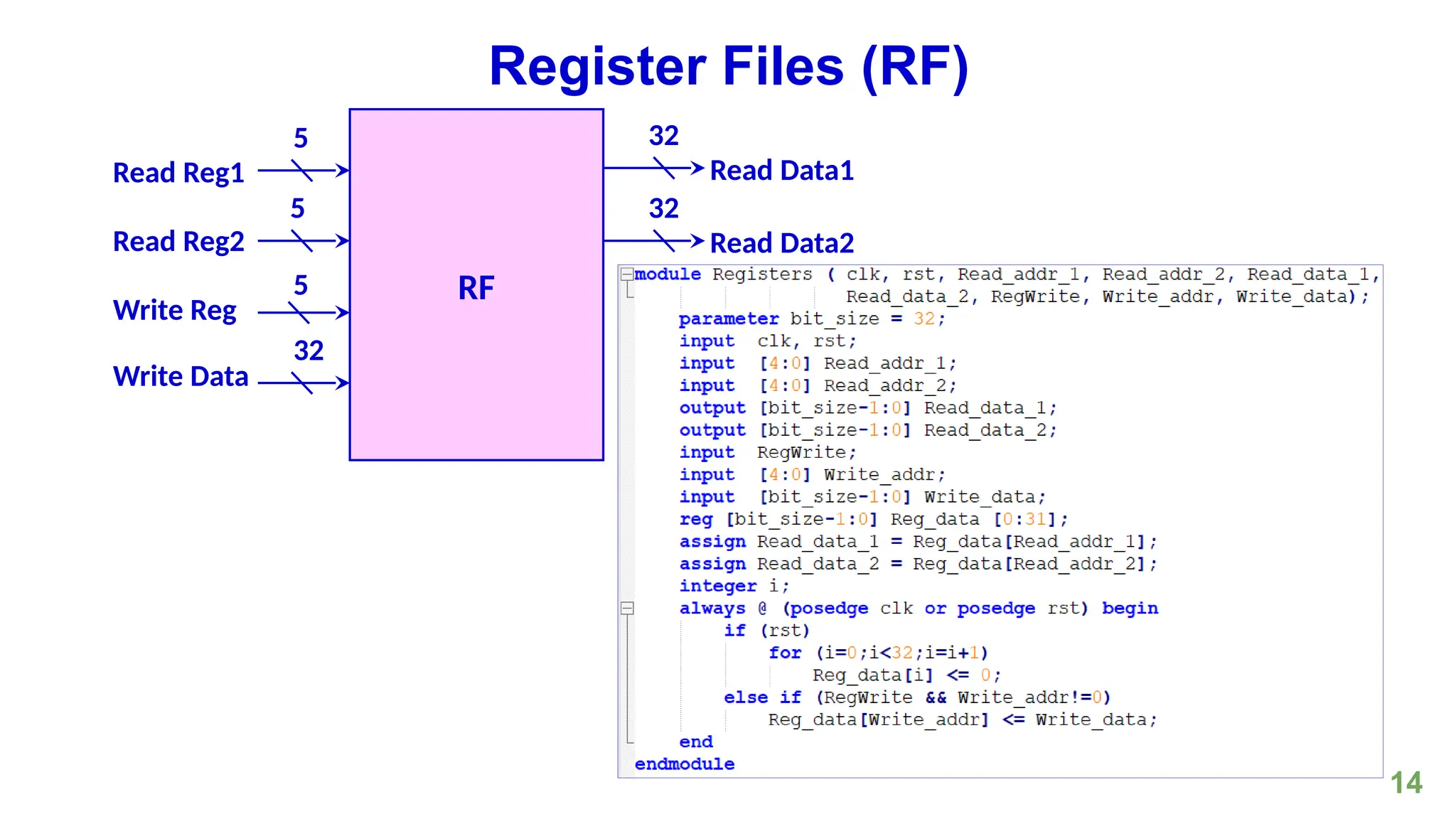
Register Files (RF)
RF
Read Data2
32
Read Reg1
5
5
32
Read Data1
32
Read Reg2
Write Reg
Write Data
5
15
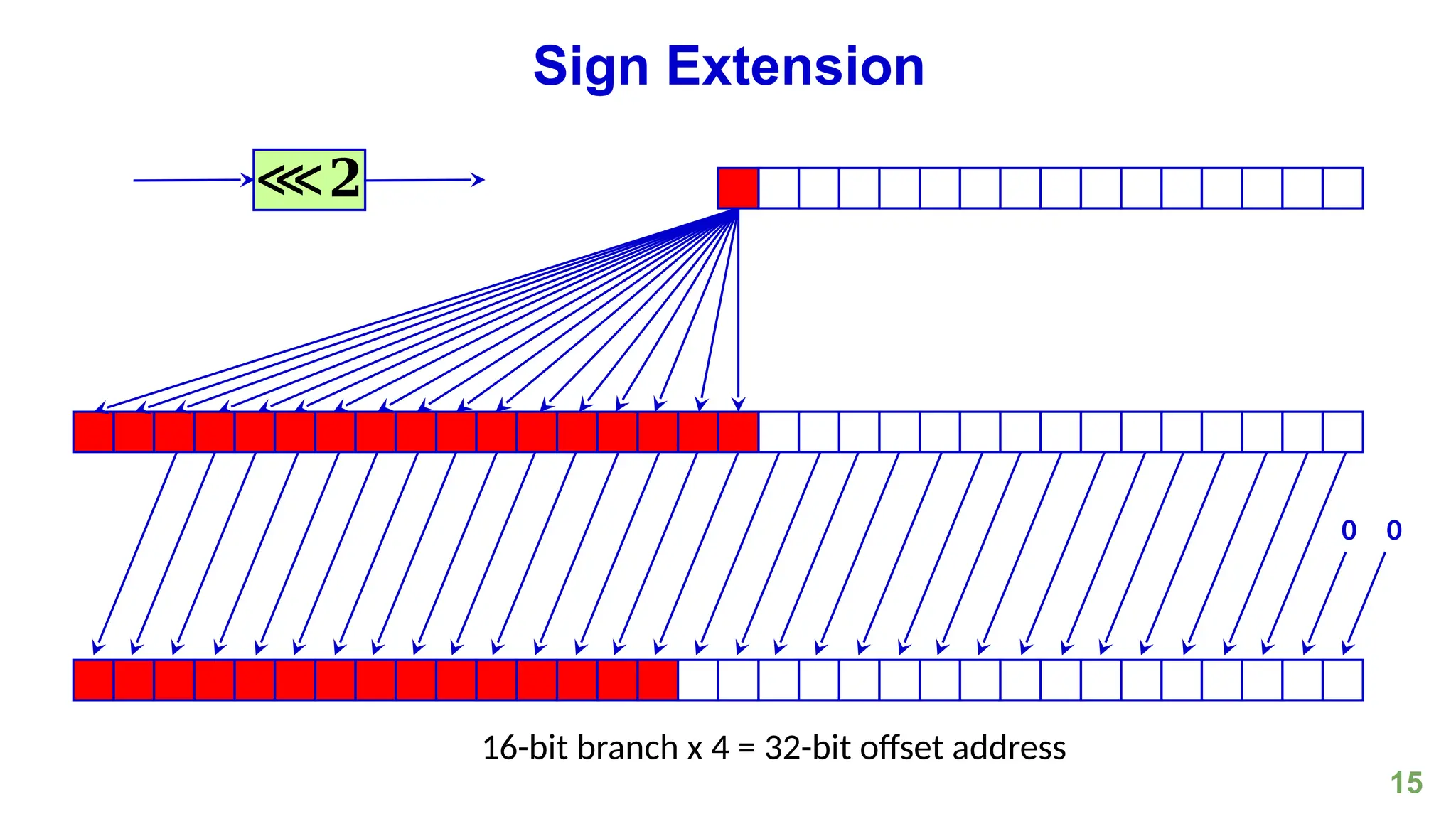
Sign Extension
0 0
16-bit branch x 4 = 32-bit offset address
⋘𝟐
16
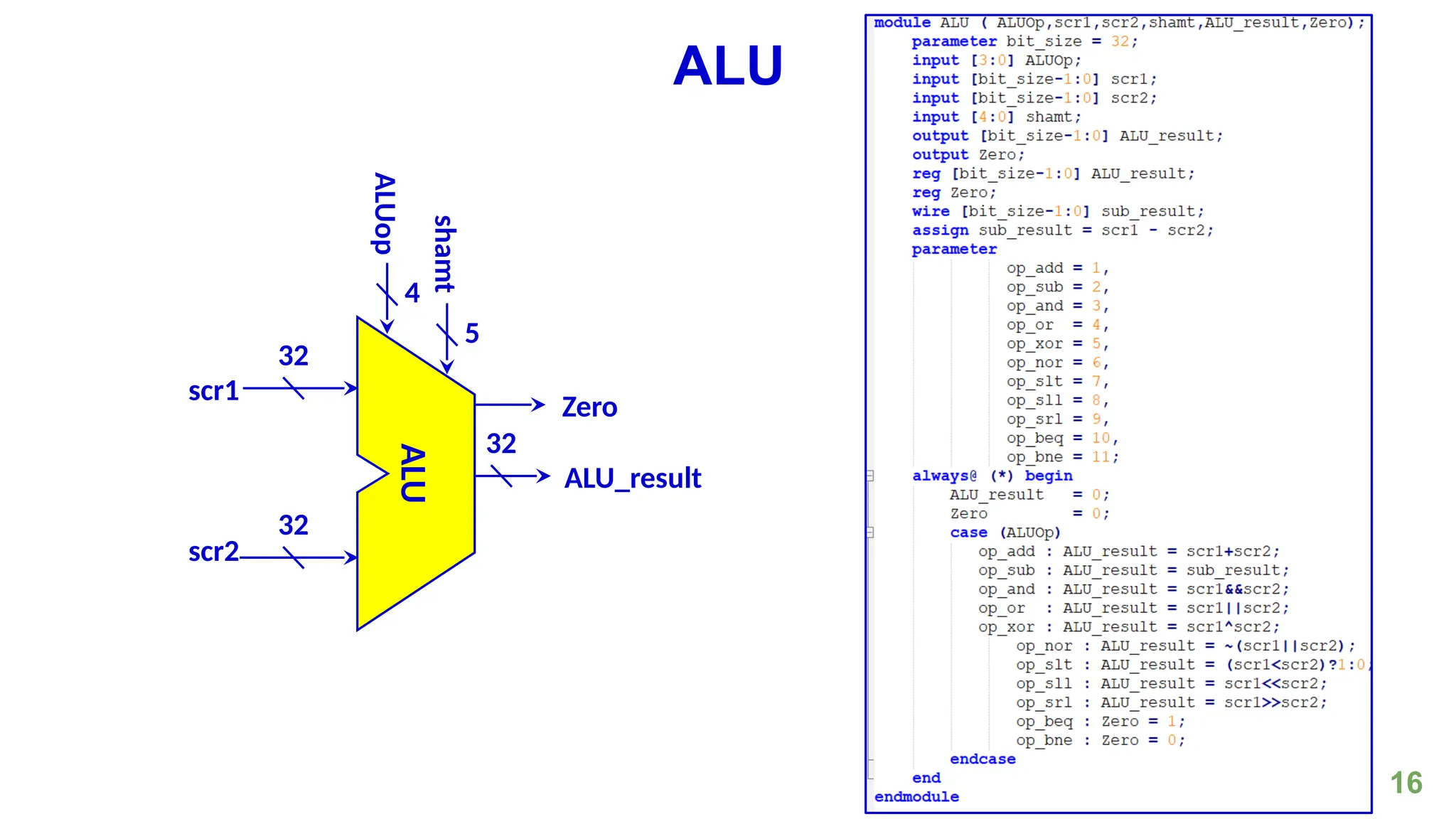
ALU
ALU
ALU_result
32
Zero
scr1
32
scr2
32
4
ALUop
5
shamt
17
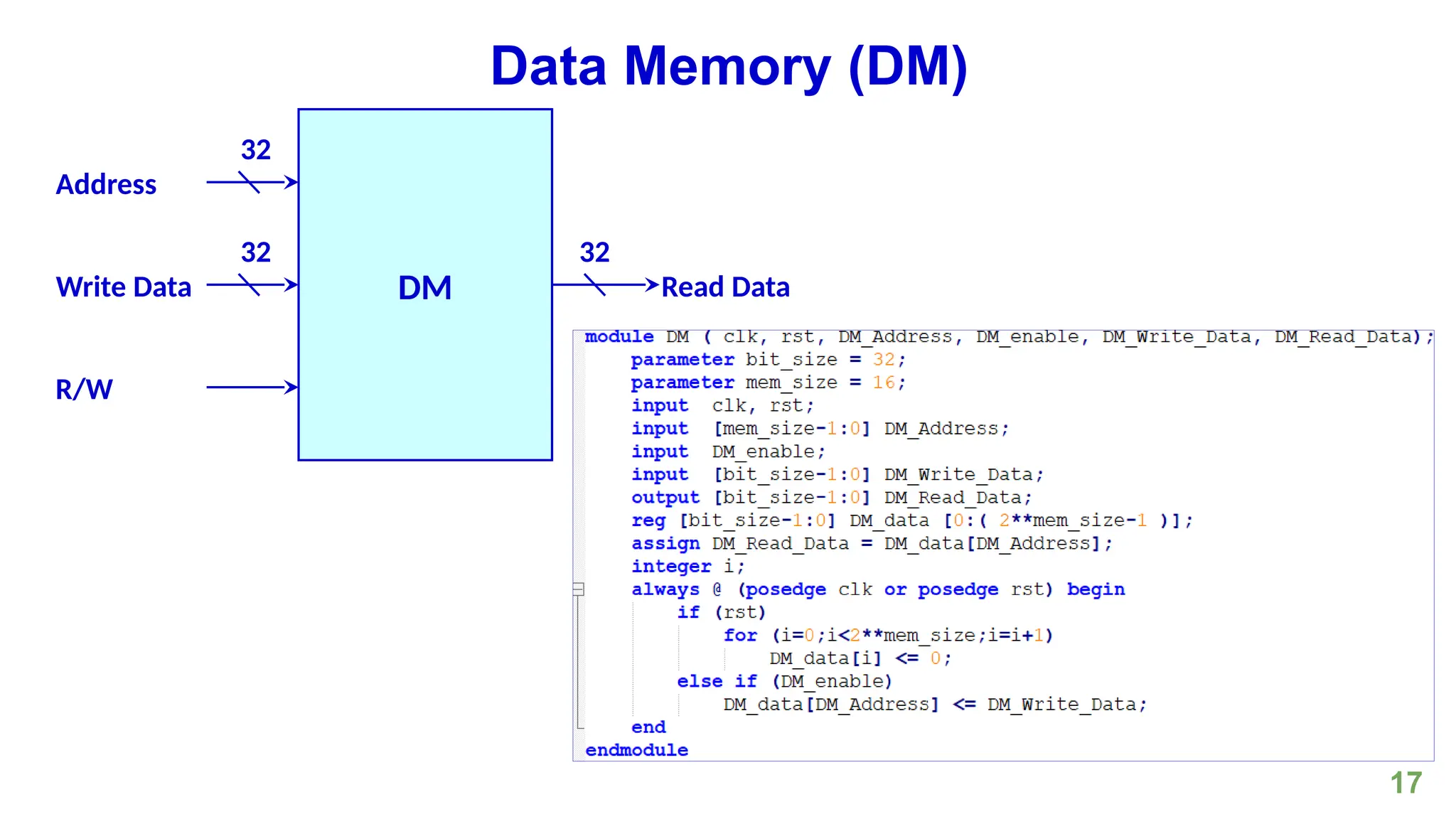
Data Memory (DM)
DM
Write Data Read Data
32
32
Address
32
R/W
18
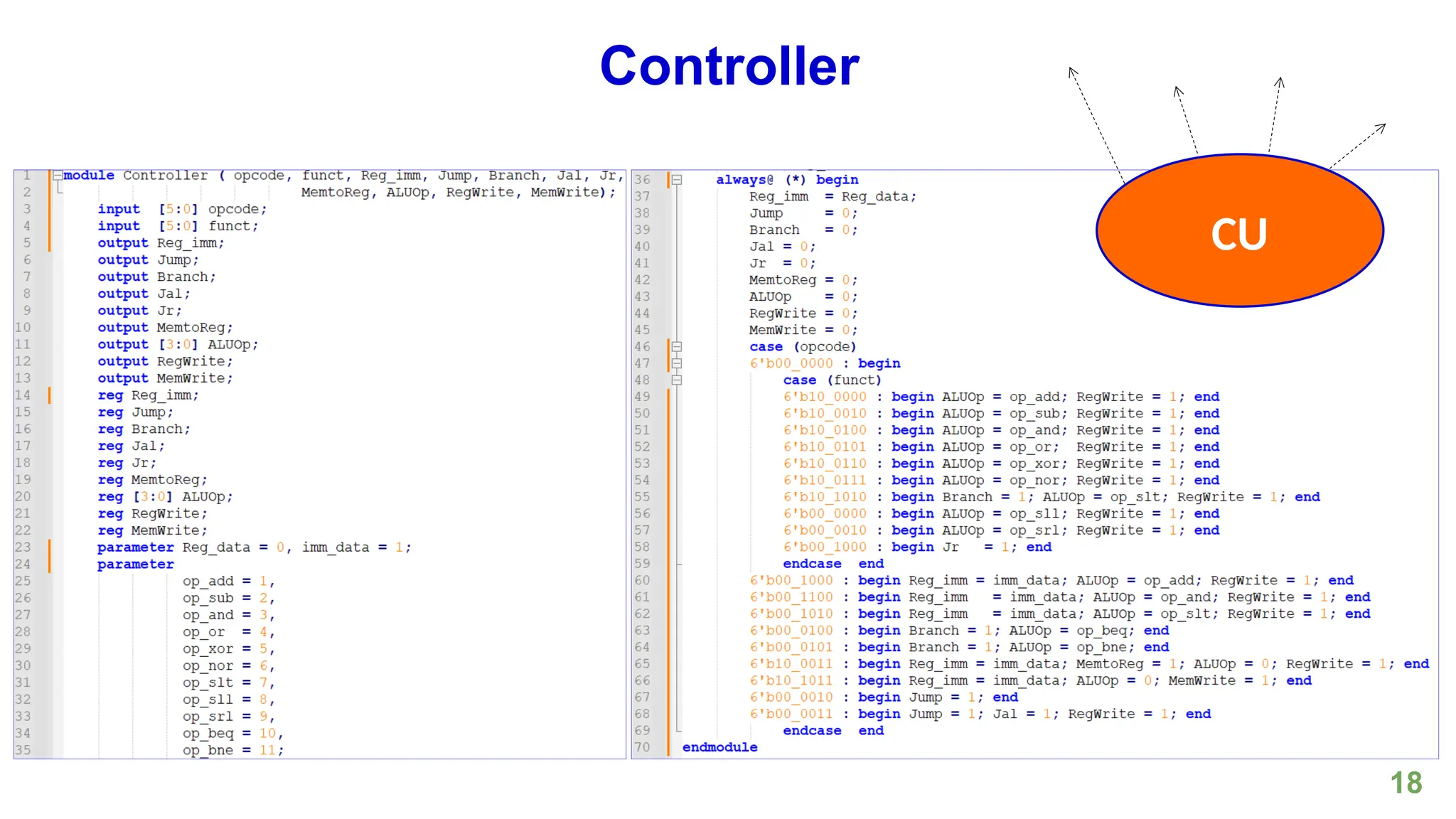
Controller
CU
19
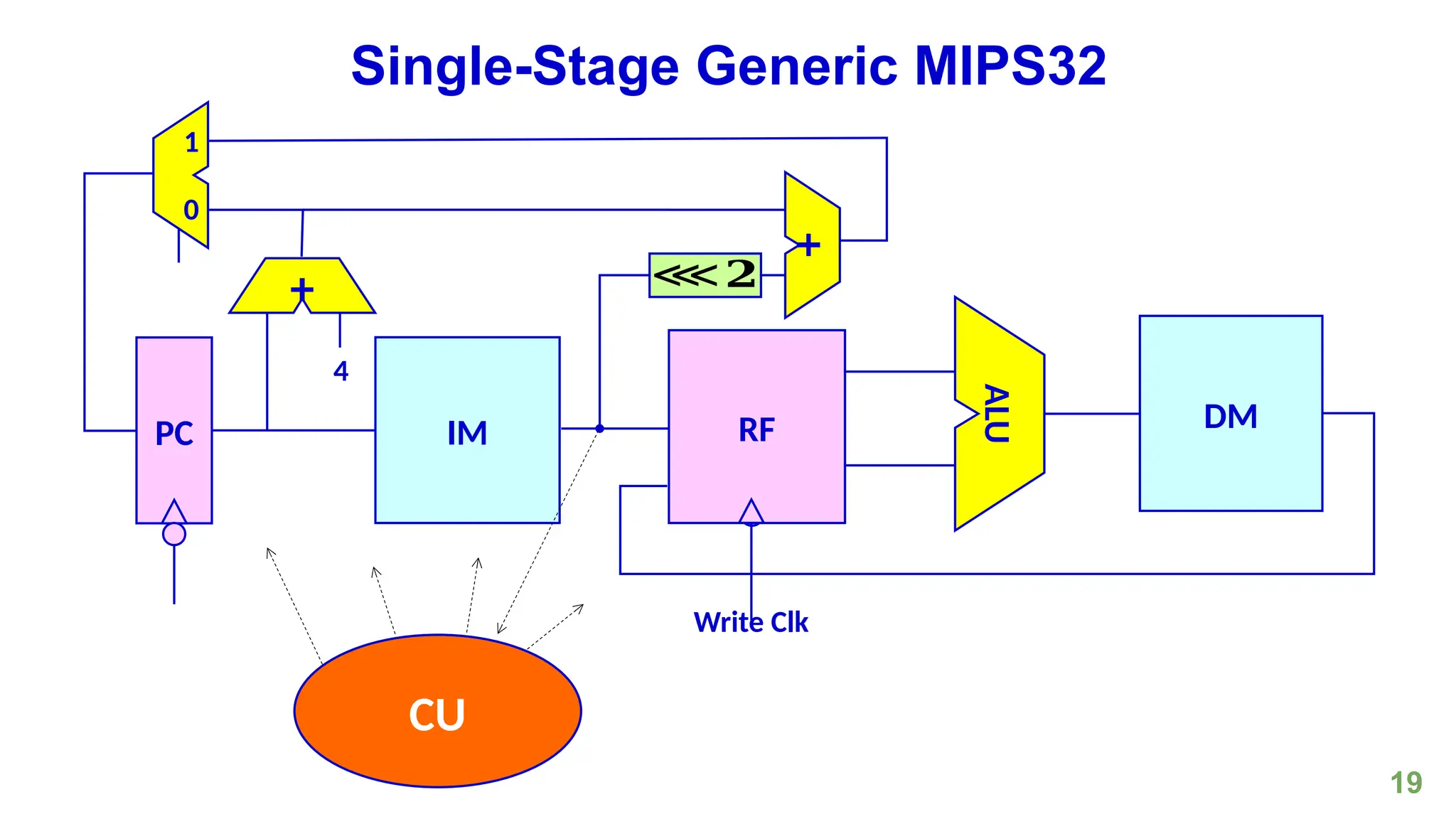
Single-Stage Generic MIPS32
Write Clk
+
PC
4
+
0
1
IM RF
ALU
DM
⋘𝟐
CU
20
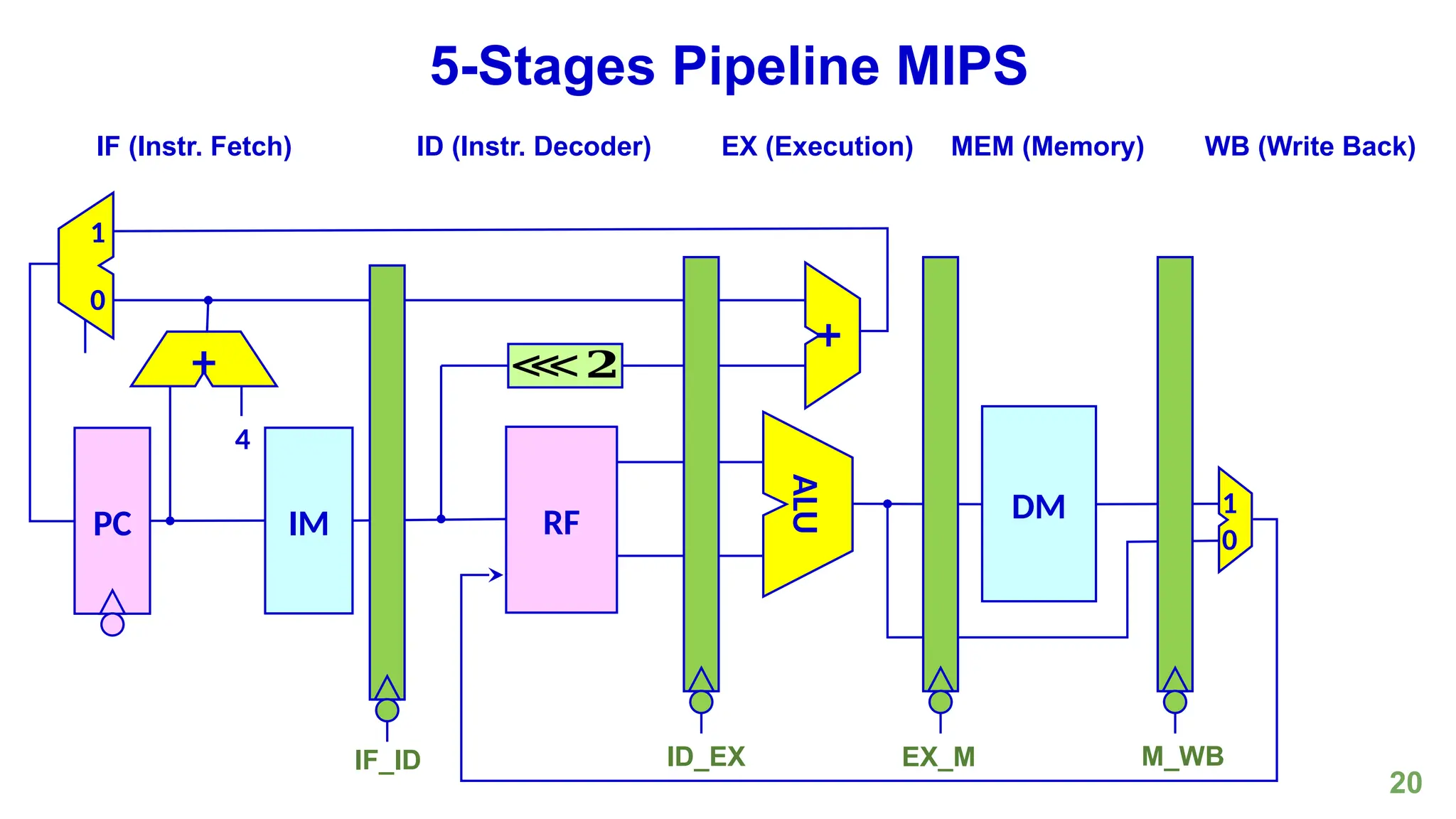
5-Stages Pipeline MIPS
PC
4
IM
⋘𝟐
RF
+
DM
ALU
0
1
0
1
+
IF (Instr. Fetch) ID (Instr. Decoder) EX (Execution) MEM (Memory) WB (Write Back)
IF_ID ID_EX EX_M M_WB
21
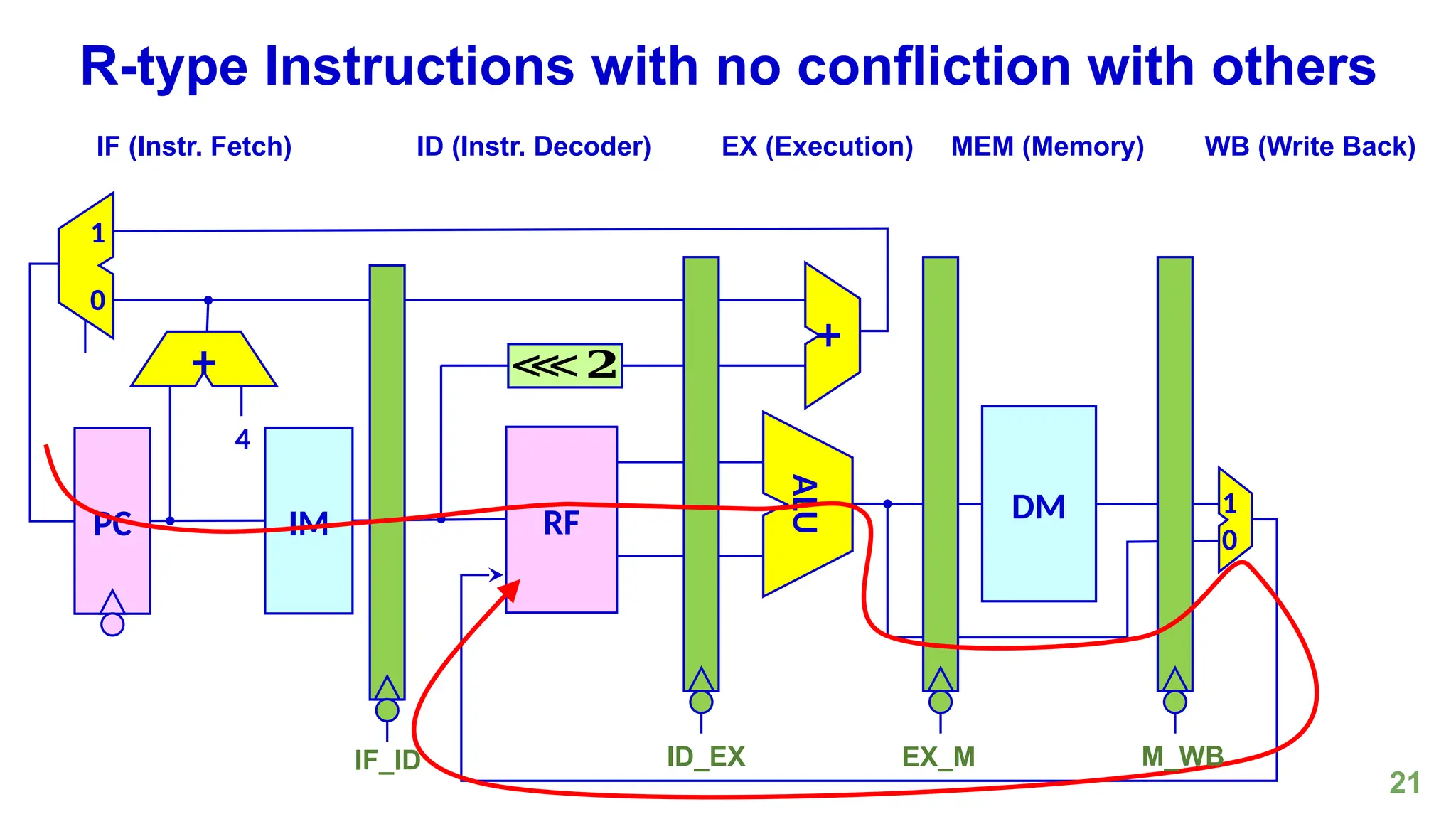
R-type Instructions with no confliction with others
PC
4
IM
⋘𝟐
RF
+
DM
ALU
0
1
0
1
+
IF (Instr. Fetch) ID (Instr. Decoder) EX (Execution) MEM (Memory) WB (Write Back)
IF_ID ID_EX EX_M M_WB
22
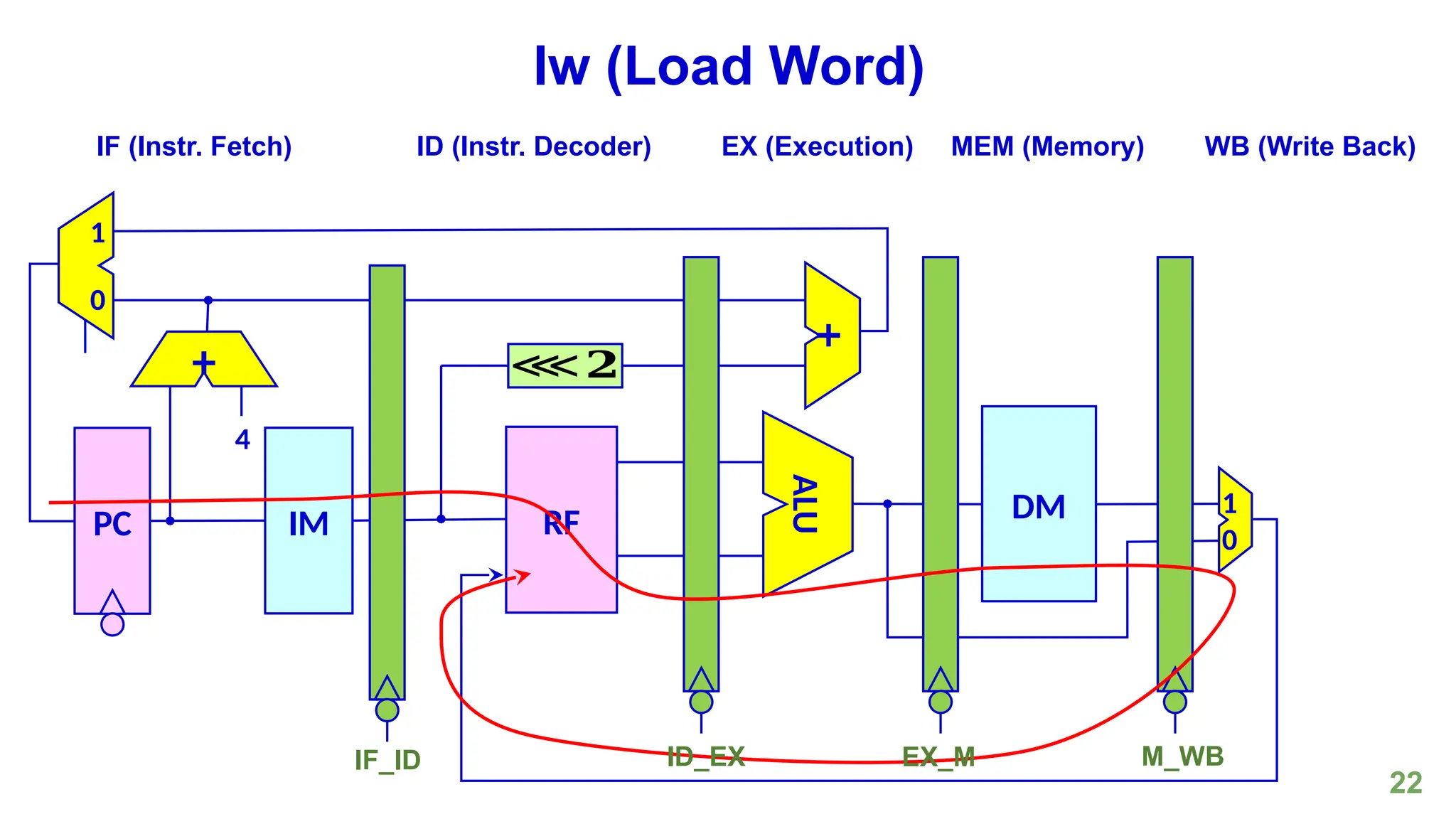
lw (Load Word)
PC
4
IM
⋘𝟐
RF
+
DM
ALU
0
1
0
1
+
IF (Instr. Fetch) ID (Instr. Decoder) EX (Execution) MEM (Memory) WB (Write Back)
IF_ID ID_EX EX_M M_WB
23
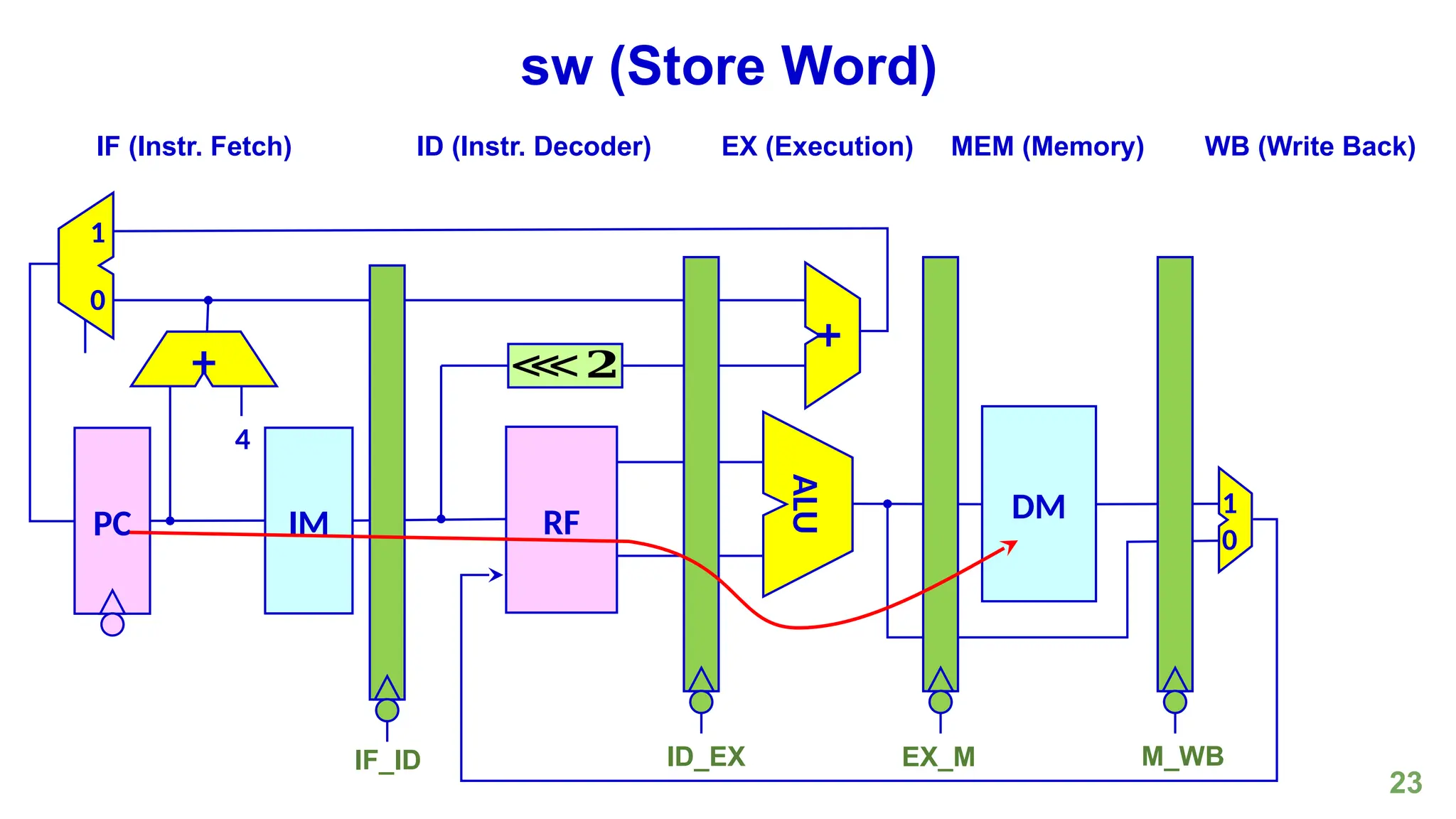
sw (Store Word)
PC
4
IM
⋘𝟐
RF
+
DM
ALU
0
1
0
1
+
IF (Instr. Fetch) ID (Instr. Decoder) EX (Execution) MEM (Memory) WB (Write Back)
IF_ID ID_EX EX_M M_WB
24
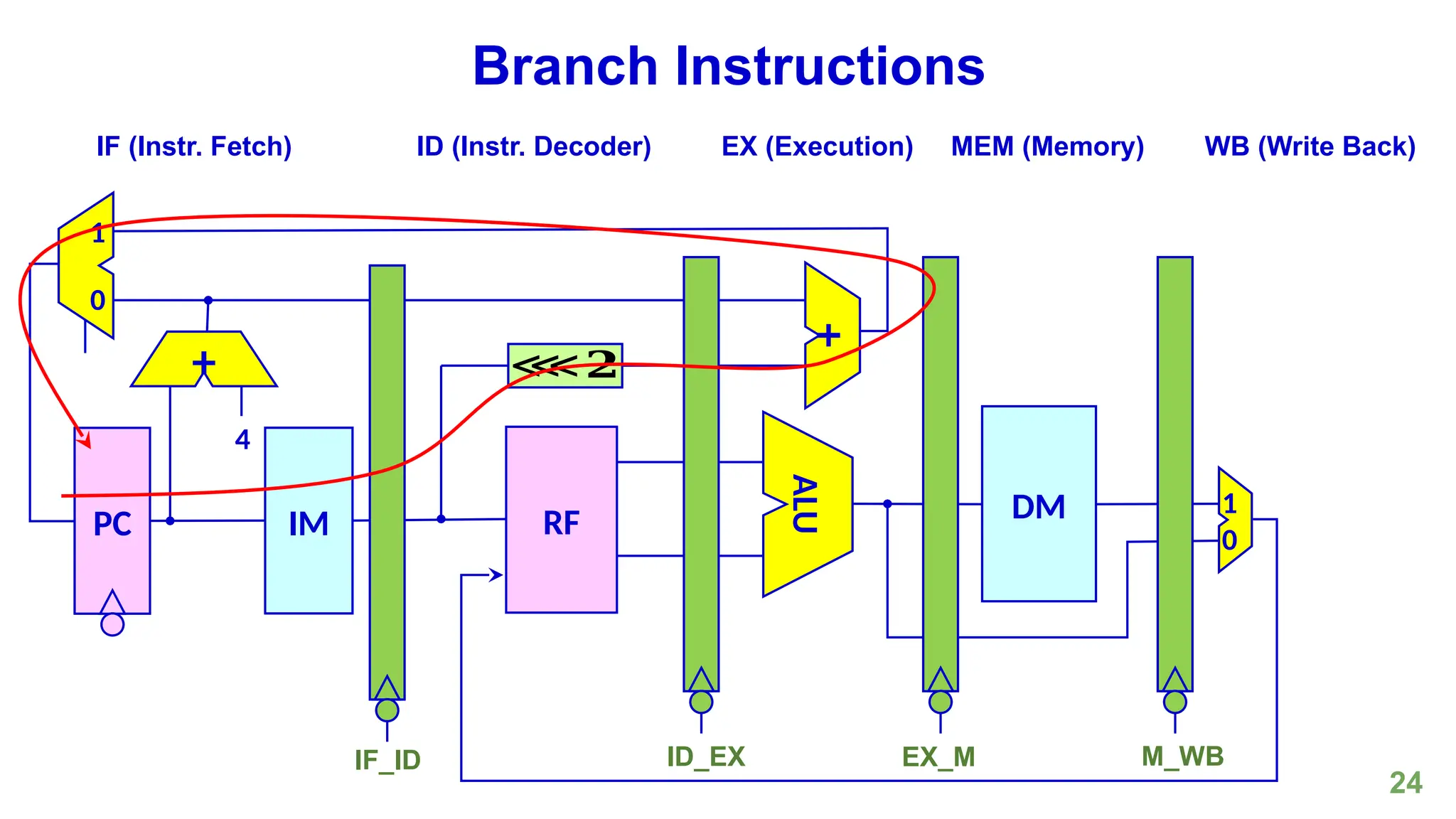
Branch Instructions
PC
4
IM
⋘𝟐
RF
+
DM
ALU
0
1
0
1
+
IF (Instr. Fetch) ID (Instr. Decoder) EX (Execution) MEM (Memory) WB (Write Back)
IF_ID ID_EX EX_M M_WB
25
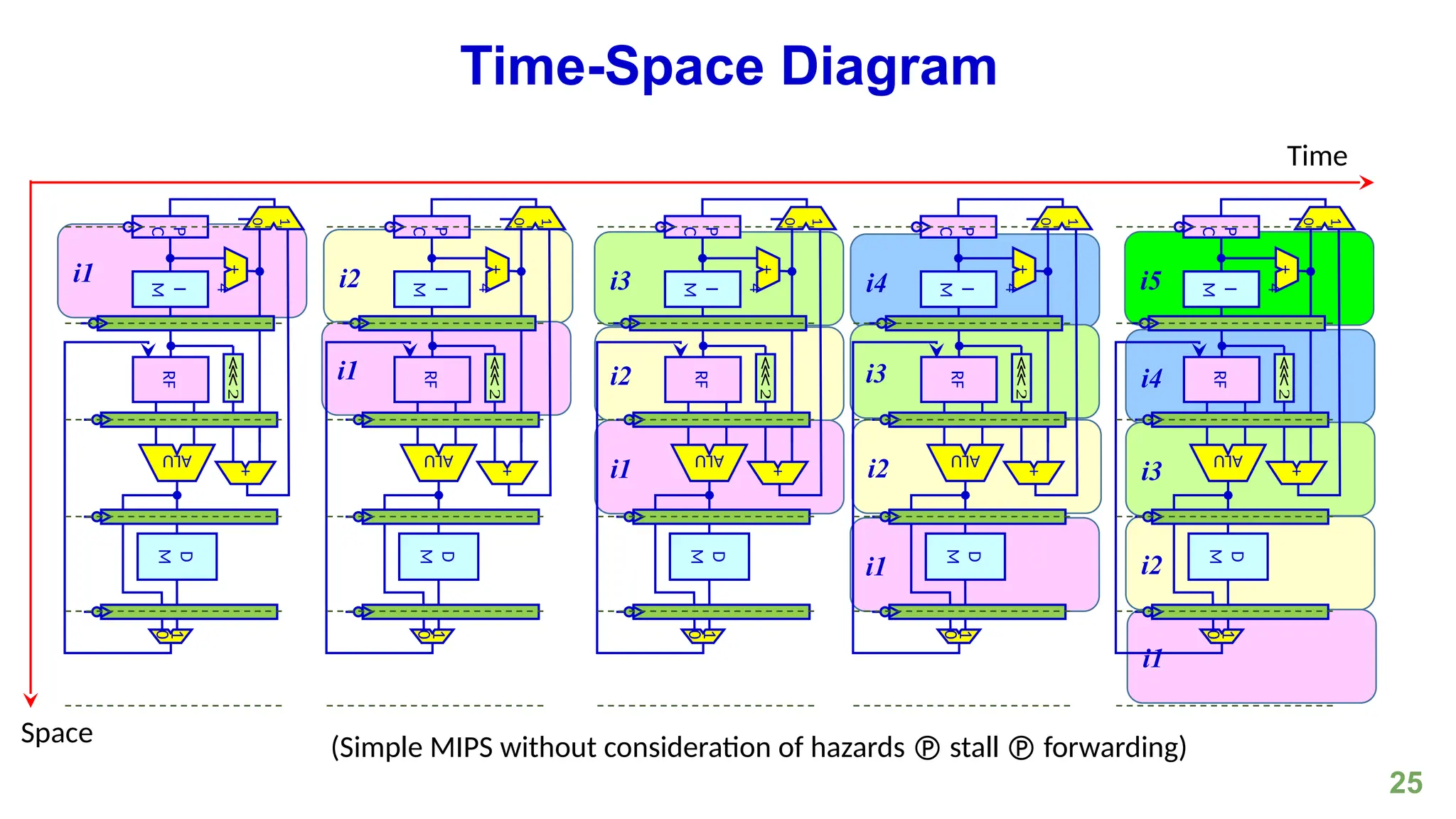
Time-Space Diagram
i1 i2 i3 i4 i5
i4
i3
i3
i2
i2
i2
i1
i1
i1
i1
P
C
I
M
⋘
2
RF
+
D
M
ALU
0
1
0
1
+
4
P
C
I
M
⋘
2
RF
+
D
M
ALU
0
1
0
1
+
4
P
C
I
M
⋘
2
RF
+
D
M
ALU
0
1
0
1
+
4
P
C
I
M
⋘
2
RF
+
D
M
ALU
0
1
0
1
+
4
P
C
I
M
⋘
2
RF
+
D
M
ALU
0
1
0
1
+
4
Time
Space (Simple MIPS without consideration of hazards  stall  forwarding)
26
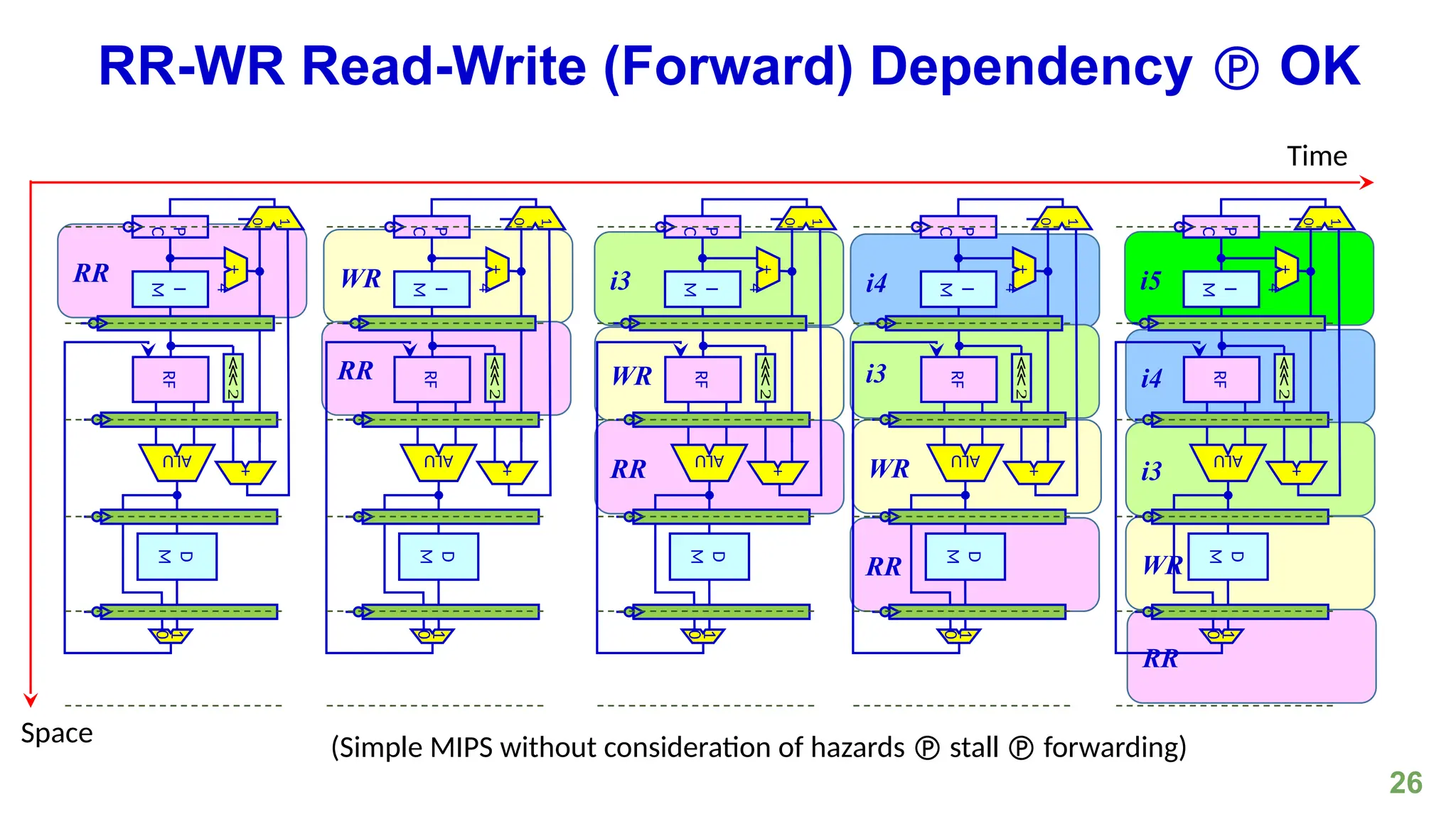
RR-WR Read-Write (Forward) Dependency  OK
RR WR i3 i4 i5
i4
i3
i3
WR
WR
WR
RR
RR
RR
RR
P
C
I
M
⋘
2
RF
+
D
M
ALU
0
1
0
1
+
4
P
C
I
M
⋘
2
RF
+
D
M
ALU
0
1
0
1
+
4
P
C
I
M
⋘
2
RF
+
D
M
ALU
0
1
0
1
+
4
P
C
I
M
⋘
2
RF
+
D
M
ALU
0
1
0
1
+
4
P
C
I
M
⋘
2
RF
+
D
M
ALU
0
1
0
1
+
4
Time
Space (Simple MIPS without consideration of hazards  stall  forwarding)
27
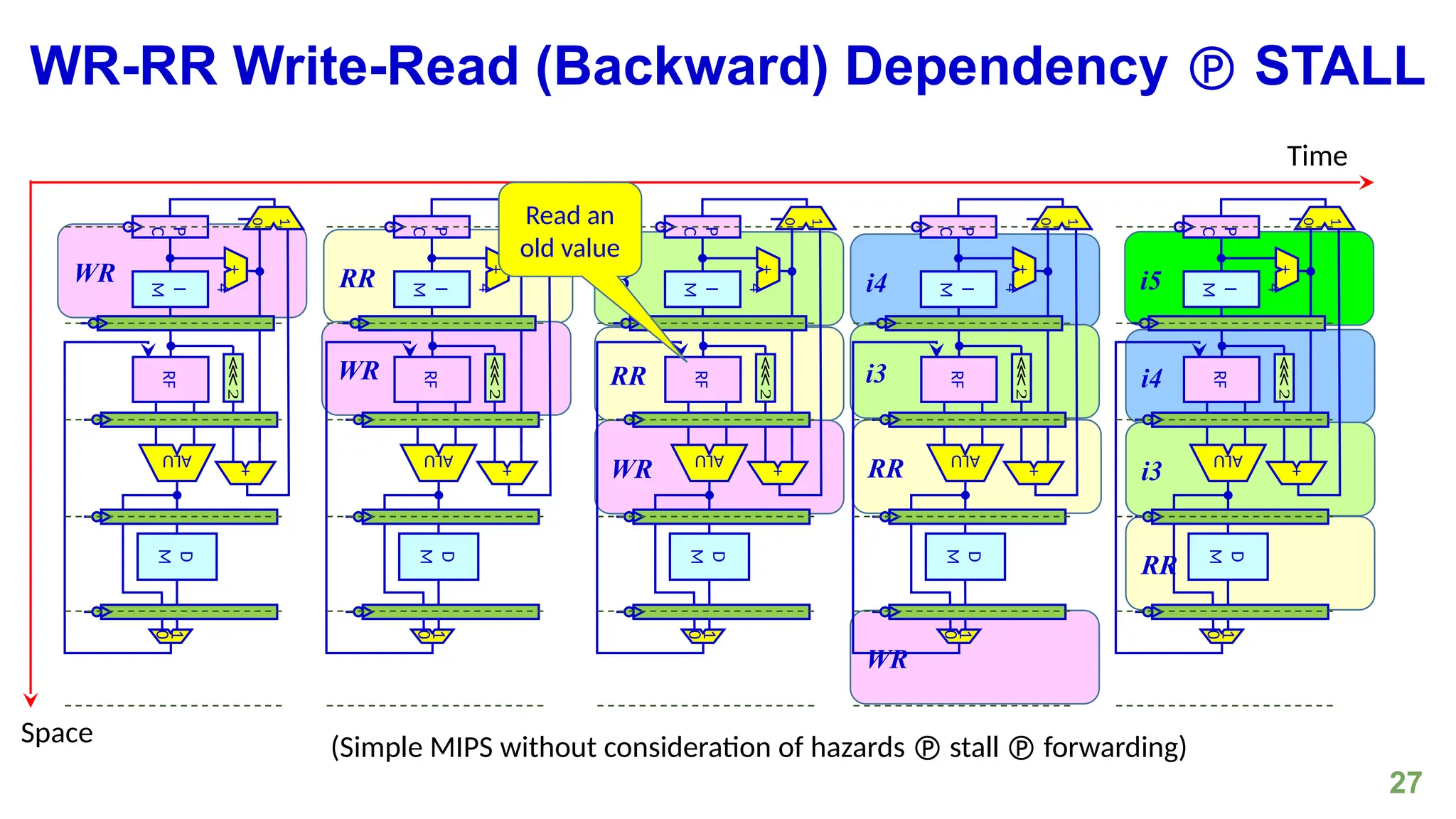
WR-RR Write-Read (Backward) Dependency  STALL
WR RR i3 i4 i5
i4
i3
i3
RR
RR
RR
WR
WR
WR
P
C
I
M
⋘
2
RF
+
D
M
ALU
0
1
0
1
+
4
P
C
I
M
⋘
2
RF
+
D
M
ALU
0
1
0
1
+
4
P
C
I
M
⋘
2
RF
+
D
M
ALU
0
1
0
1
+
4
P
C
I
M
⋘
2
RF
+
D
M
ALU
0
1
0
1
+
4
P
C
I
M
⋘
2
RF
+
D
M
ALU
0
1
0
1
+
4
Time
Space (Simple MIPS without consideration of hazards  stall  forwarding)
Read an
old value
28
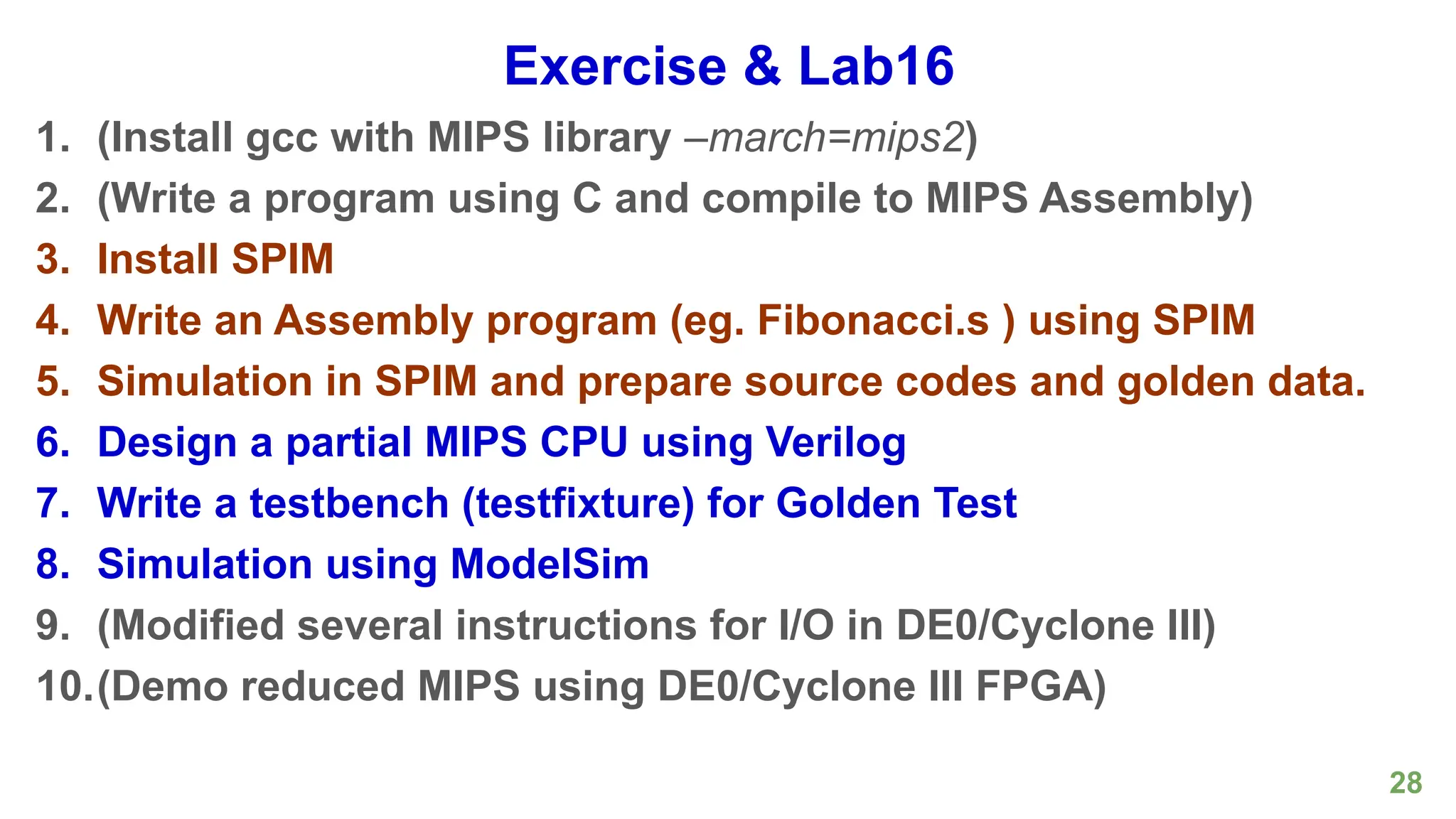
Exercise & Lab16
1. (Install gcc with MIPS library –march=mips2)
2. (Write a program using C and compile to MIPS Assembly)
3. Install SPIM
4. Write an Assembly program (eg. Fibonacci.s ) using SPIM
5. Simulation in SPIM and prepare source codes and golden data.
6. Design a partial MIPS CPU using Verilog
7. Write a testbench (testfixture) for Golden Test
8. Simulation using ModelSim
9. (Modified several instructions for I/O in DE0/Cyclone III)
10.(Demo reduced MIPS using DE0/Cyclone III FPGA)
29
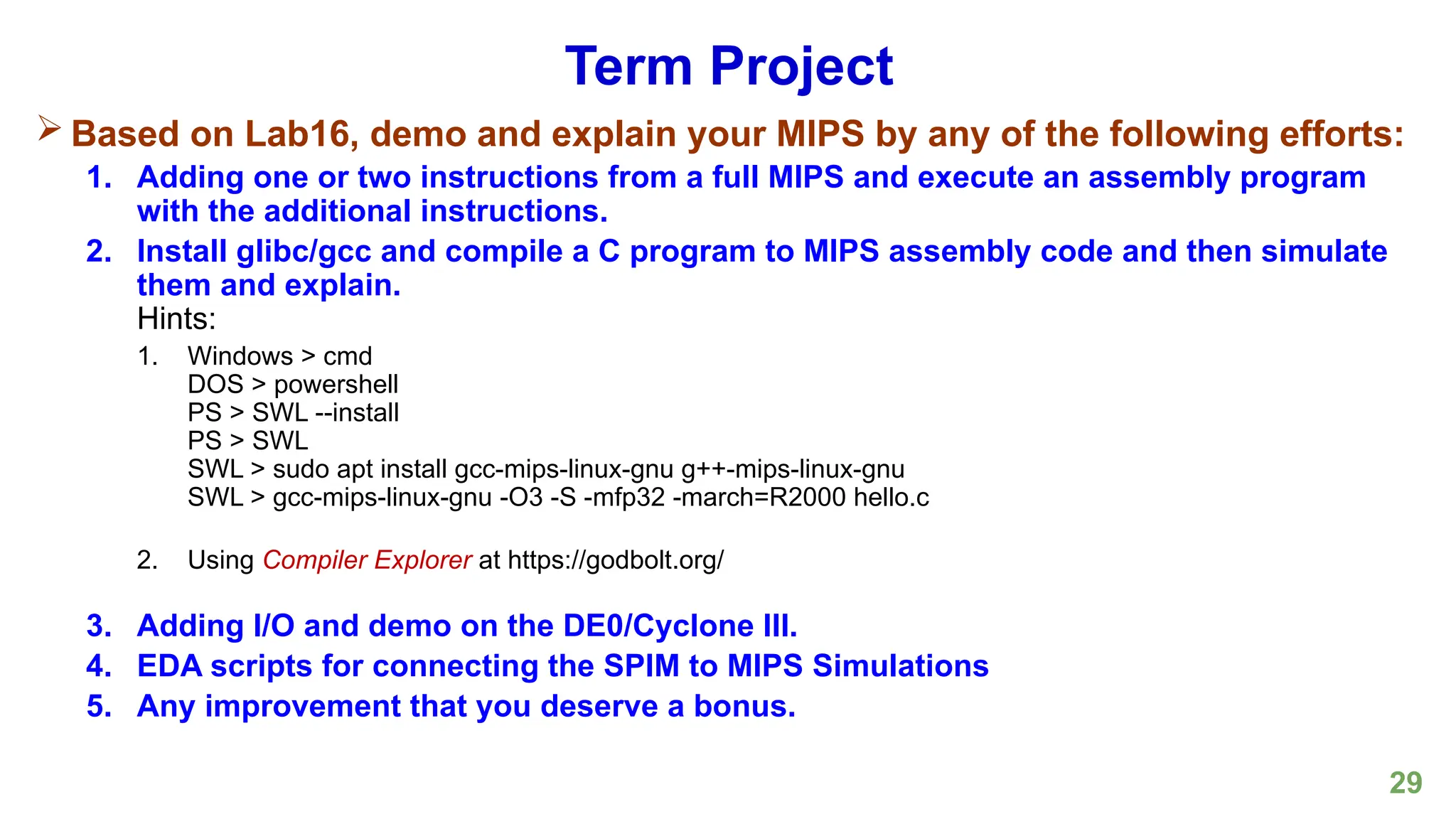
Term Project
 Based on Lab16, demo and explain your MIPS by any of the following efforts:
1. Adding one or two instructions from a full MIPS and execute an assembly program
with the additional instructions.
2. Install glibc/gcc and compile a C program to MIPS assembly code and then simulate
them and explain.
Hints:
1. Windows > cmd
DOS > powershell
PS > SWL --install
PS > SWL
SWL > sudo apt install gcc-mips-linux-gnu g++-mips-linux-gnu
SWL > gcc-mips-linux-gnu -O3 -S -mfp32 -march=R2000 hello.c
2. Using Compiler Explorer at https://godbolt.org/
3. Adding I/O and demo on the DE0/Cyclone III.
4. EDA scripts for connecting the SPIM to MIPS Simulations
5. Any improvement that you deserve a bonus.

HDL17_MIPS CPU Design using Verilog.pptx

  • 1.
    MIPS CPU Designusing Verilog Tsung-Chu Huang Dept. of Electronics Eng., National Changhua University of Education, Taiwan 2023/1/5
  • 2.
    2 Outline  Introduction toMIPS32: ISA & SPIM  Instruction Formats  Addressing Modes  Instruction Set Architecture and Assembly Language Compiled by SPIM  Single-Stage MIPS Design  Program Counter (PC)  Instruction Memory (IM)  Register Files (RF)  Arithmetic Logic Unit (ALU)  Data Memory (DM)  5-Stage Pipeline MIPS Design  Basic Pipeline Design by Spatial Gate-Level Design  Explanation for Term Project
  • 3.
    3 Introduction to MIPS Famous Microprocessors  CISC: • 4004: ’71 Intel. First CPU  8008  8080  80x86 (applied in PC) • 6502 (#T) : Motorola (applied in Apple II)  68000  68030 (applied in Sun Workstations) RISC: • MIPS (Mega Inst. per Sec): ’81, Prof. Hennessy, Stanford U.  ’92 MIPS Co.  ’18 Wave Comp. • ARM (Advanced RISC Machine): ’83 Acorn Co.  ’90 ARM Co.  ’16 SoftBank • RISC-V: ’10 UCB Open Project  ’15 Foundation  MIPS MIPS Co. converted to develop RISC-V, but MIPS is still popular in CPU Design course/lecture due to its concise pipeline stages. 32 32-bit Registers: • argument: $a0~$a7 = $0~$7 • save: $s0~$s7 = $8~$15 • temp: $t0~$t9 = $16~$23 • value: $v0~$v7 = $24~$31 (returned value) • $28=$gp (global pointer), $29=$sp (stack pointer), $30=$fp (frame pointer), $31=$ra (return address) 4GB Mem, 32-bit Word, 30-bit absolute address (therefore, only 2-bit J), State Control
  • 4.
  • 5.
    5 MIPS Register Files(RF)  32 Registers Pseudo Instructions in Assemblers Register Number Register Name Description 0 $zero The value 0 2-3 $v0 - $v1 (values) from expression evaluation and function results 4-7 $a0 - $a3 (arguments) First four parameters for subroutine 8-15, 24-25 $t0 - $t9 Temporary variables 16-23 $s0 - $s7 Saved values representing final computed results 31 $ra Return address Directive Result .word w1, ..., wn Store n 32-bit values in successive memory words .half h1, ..., hn Store n 16-bit values in successive memory words .byte b1, ..., bn Store n 8-bit values in successive memory words .ascii str Store the ASCII string str in memory. Strings are in double-quotes, i.e. "Computer Science" .asciiz str Store the ASCII string str in memory and null-terminate it Strings are in double-quotes, i.e. "Computer Science" .space n Leave an empty n-byte region of memory for later use .align n Align the next datum on a 2^n byte boundary. For example, .align 2 aligns the next value on a word boundary
  • 6.
    6 MIPS Instruction Set Arithmetic  Logical Instruction Example Meaning add add $1,$2,$3 $1=$2+$3 subtract sub $1,$2,$3 $1=$2-$3 add immediate addi $1,$2,100 $1=$2+100 add unsigned addu $1,$2,$3 $1=$2+$3 subtract unsigned subu $1,$2,$3 $1=$2-$3 add immediate unsigned addiu $1,$2,100 $1=$2+100 Multiply (without overflow) mul $1,$2,$3 $1=$2*$3 Multiply mult $2,$3 $hi,$low=$2*$3 Divide div $2,$3 $hi,$low=$2/$3 Instruction Example Meaning and and $1,$2,$3 $1=$2&$3 or or $1,$2,$3 $1=$2|$3 and immediate andi $1,$2,100 $1=$2&100 or immediate or $1,$2,100 $1=$2|100 shift left logical sll $1,$2,10 $1=$2<<10 shift right logical srl $1,$2,10 $1=$2>>10
  • 7.
    7 MIPS Instruction Set Data Transfer  Conditional Branch Instruction Example Meaning load word lw $1,100($2) $1=Memory[$2+100] store word sw $1,100($2) Memory[$2+100]=$1 load upper immediate lui $1,100 $1=100x2^16 load address la $1,label $1=Address of label load immediate li $1,100 $1=100 move from hi mfhi $2 $2=hi move from lo mflo $2 $2=lo move move $1, $2 $1=$2 Instruction Example Meaning branch on equal beq $1,$2,100 if($1==$2) go to PC+4+100 branch on not equal bne $1,$2,100 if($1!=$2) go to PC+4+100 branch on greater than bgt $1,$2,100 if($1>$2) go to PC+4+100 branch on greater than or equal bge $1,$2,100 if($1>=$2) go to PC+4+100 branch on less than blt $1,$2,100 if($1<$2) go to PC+4+100 branch on less than or equal ble $1,$2,100 if($1<=$2) go to PC+4+100
  • 8.
    8 MIPS Instruction Set Comparison  Jump Instruction Example Meaning set on less than slt $1,$2,$3 if($2<$3)$1=1; else $1=0 set on less than immediate slti $1,$2,100 if($2<100)$1=1; else $1=0 Instruction Example Meaning jump j 1000 go to address 1000 jump register jr $1 go to address stored in $1 jump and link jal 1000 $ra=PC+4; go to address 1000
  • 9.
    9 System Calls inSPIM Service Operation Code (in $v0) Arguments Results print_int Print integer number (32 bit) 1 $a0 = integer to be printed None print_float Print floating-point number (32 bit) 2 $f12 = float to be printed None print_double Print floating-point number (64 bit) 3 $f12 = double to be printed None print_string Print null-terminated character string 4 $a0 = address of string in memory None read_int Read integer number from user 5 None Integer returned in $v0 read_float Read floating-point number from user 6 None Float returned in $f0 read_double Read double floating-point number from user 7 None Double returned in $f0 read_string Works the same as Standard C Library fgets() function. 8 $a0 = memory address of string input buffer $a1 = length of string buffer (n) None sbrk Returns the address to a block of memory containing n additional bytes. (Useful for dynamic memory allocation) 9 $a0 = amount address in $v0 exit Stop program from running 10 None None print_char Print character 11 $a0 = character to be printed None read_char Read character from user 12 None Char returned in $v0 exit2 Stops program from running and returns an integer 17 $a0 = result (integer number) None
  • 10.
    10 SPIM – Assemblerof MIPS  Install QtSPIM from Cloud/Lab16, or + glibc for MIPS > File > Load > Hello.asm
  • 11.
    11 Modular (Gate-Level) Design Program Counter (PC)  Instruction Memory (IM)  Register Files (RF)  Sign Extension Unit (SE)  Arithmetic Logical Unit (ALU)  Data Memory (DM)
  • 12.
  • 13.
  • 14.
    14 Register Files (RF) RF ReadData2 32 Read Reg1 5 5 32 Read Data1 32 Read Reg2 Write Reg Write Data 5
  • 15.
    15 Sign Extension 0 0 16-bitbranch x 4 = 32-bit offset address ⋘𝟐
  • 16.
  • 17.
    17 Data Memory (DM) DM WriteData Read Data 32 32 Address 32 R/W
  • 18.
  • 19.
    19 Single-Stage Generic MIPS32 WriteClk + PC 4 + 0 1 IM RF ALU DM ⋘𝟐 CU
  • 20.
    20 5-Stages Pipeline MIPS PC 4 IM ⋘𝟐 RF + DM ALU 0 1 0 1 + IF(Instr. Fetch) ID (Instr. Decoder) EX (Execution) MEM (Memory) WB (Write Back) IF_ID ID_EX EX_M M_WB
  • 21.
    21 R-type Instructions withno confliction with others PC 4 IM ⋘𝟐 RF + DM ALU 0 1 0 1 + IF (Instr. Fetch) ID (Instr. Decoder) EX (Execution) MEM (Memory) WB (Write Back) IF_ID ID_EX EX_M M_WB
  • 22.
    22 lw (Load Word) PC 4 IM ⋘𝟐 RF + DM ALU 0 1 0 1 + IF(Instr. Fetch) ID (Instr. Decoder) EX (Execution) MEM (Memory) WB (Write Back) IF_ID ID_EX EX_M M_WB
  • 23.
    23 sw (Store Word) PC 4 IM ⋘𝟐 RF + DM ALU 0 1 0 1 + IF(Instr. Fetch) ID (Instr. Decoder) EX (Execution) MEM (Memory) WB (Write Back) IF_ID ID_EX EX_M M_WB
  • 24.
    24 Branch Instructions PC 4 IM ⋘𝟐 RF + DM ALU 0 1 0 1 + IF (Instr.Fetch) ID (Instr. Decoder) EX (Execution) MEM (Memory) WB (Write Back) IF_ID ID_EX EX_M M_WB
  • 25.
    25 Time-Space Diagram i1 i2i3 i4 i5 i4 i3 i3 i2 i2 i2 i1 i1 i1 i1 P C I M ⋘ 2 RF + D M ALU 0 1 0 1 + 4 P C I M ⋘ 2 RF + D M ALU 0 1 0 1 + 4 P C I M ⋘ 2 RF + D M ALU 0 1 0 1 + 4 P C I M ⋘ 2 RF + D M ALU 0 1 0 1 + 4 P C I M ⋘ 2 RF + D M ALU 0 1 0 1 + 4 Time Space (Simple MIPS without consideration of hazards  stall  forwarding)
  • 26.
    26 RR-WR Read-Write (Forward)Dependency  OK RR WR i3 i4 i5 i4 i3 i3 WR WR WR RR RR RR RR P C I M ⋘ 2 RF + D M ALU 0 1 0 1 + 4 P C I M ⋘ 2 RF + D M ALU 0 1 0 1 + 4 P C I M ⋘ 2 RF + D M ALU 0 1 0 1 + 4 P C I M ⋘ 2 RF + D M ALU 0 1 0 1 + 4 P C I M ⋘ 2 RF + D M ALU 0 1 0 1 + 4 Time Space (Simple MIPS without consideration of hazards  stall  forwarding)
  • 27.
    27 WR-RR Write-Read (Backward)Dependency  STALL WR RR i3 i4 i5 i4 i3 i3 RR RR RR WR WR WR P C I M ⋘ 2 RF + D M ALU 0 1 0 1 + 4 P C I M ⋘ 2 RF + D M ALU 0 1 0 1 + 4 P C I M ⋘ 2 RF + D M ALU 0 1 0 1 + 4 P C I M ⋘ 2 RF + D M ALU 0 1 0 1 + 4 P C I M ⋘ 2 RF + D M ALU 0 1 0 1 + 4 Time Space (Simple MIPS without consideration of hazards  stall  forwarding) Read an old value
  • 28.
    28 Exercise & Lab16 1.(Install gcc with MIPS library –march=mips2) 2. (Write a program using C and compile to MIPS Assembly) 3. Install SPIM 4. Write an Assembly program (eg. Fibonacci.s ) using SPIM 5. Simulation in SPIM and prepare source codes and golden data. 6. Design a partial MIPS CPU using Verilog 7. Write a testbench (testfixture) for Golden Test 8. Simulation using ModelSim 9. (Modified several instructions for I/O in DE0/Cyclone III) 10.(Demo reduced MIPS using DE0/Cyclone III FPGA)
  • 29.
    29 Term Project  Basedon Lab16, demo and explain your MIPS by any of the following efforts: 1. Adding one or two instructions from a full MIPS and execute an assembly program with the additional instructions. 2. Install glibc/gcc and compile a C program to MIPS assembly code and then simulate them and explain. Hints: 1. Windows > cmd DOS > powershell PS > SWL --install PS > SWL SWL > sudo apt install gcc-mips-linux-gnu g++-mips-linux-gnu SWL > gcc-mips-linux-gnu -O3 -S -mfp32 -march=R2000 hello.c 2. Using Compiler Explorer at https://godbolt.org/ 3. Adding I/O and demo on the DE0/Cyclone III. 4. EDA scripts for connecting the SPIM to MIPS Simulations 5. Any improvement that you deserve a bonus.