1© 2020 The MathWorks, Inc.
Predictive Maintenance with MATLAB: Case in Point
from Industry
Dr Bulat Khusainov
Education Technical Specialist
2
Agenda:
1. What is Predictive Maintenance? Who is benefiting by doing it?
2. How can you develop a predictive maintenance algorithm using MATLAB?
3. How can you get started quickly?
3
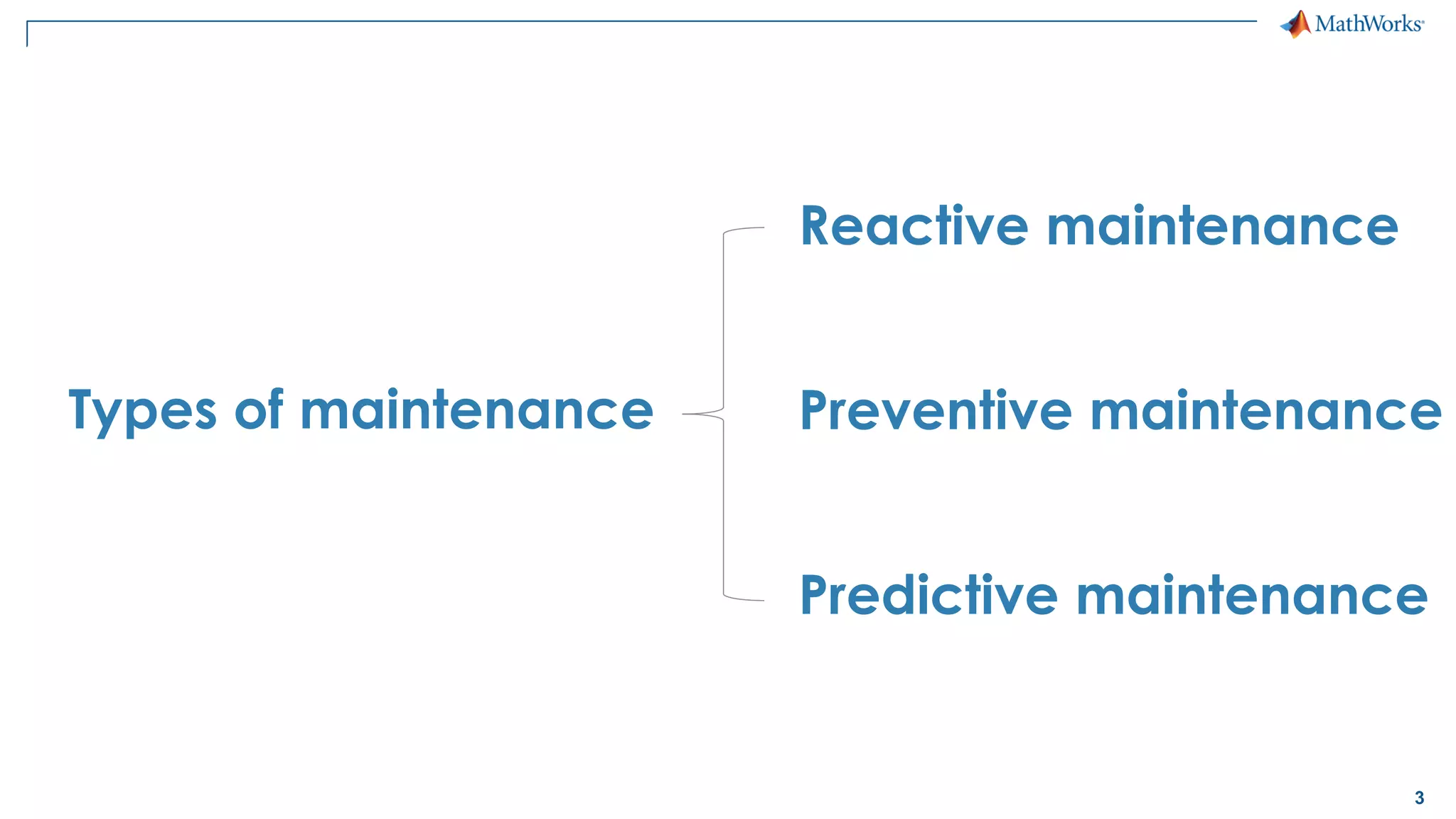
Predictive maintenance
Preventive maintenance
Reactive maintenance
Types of maintenance
4
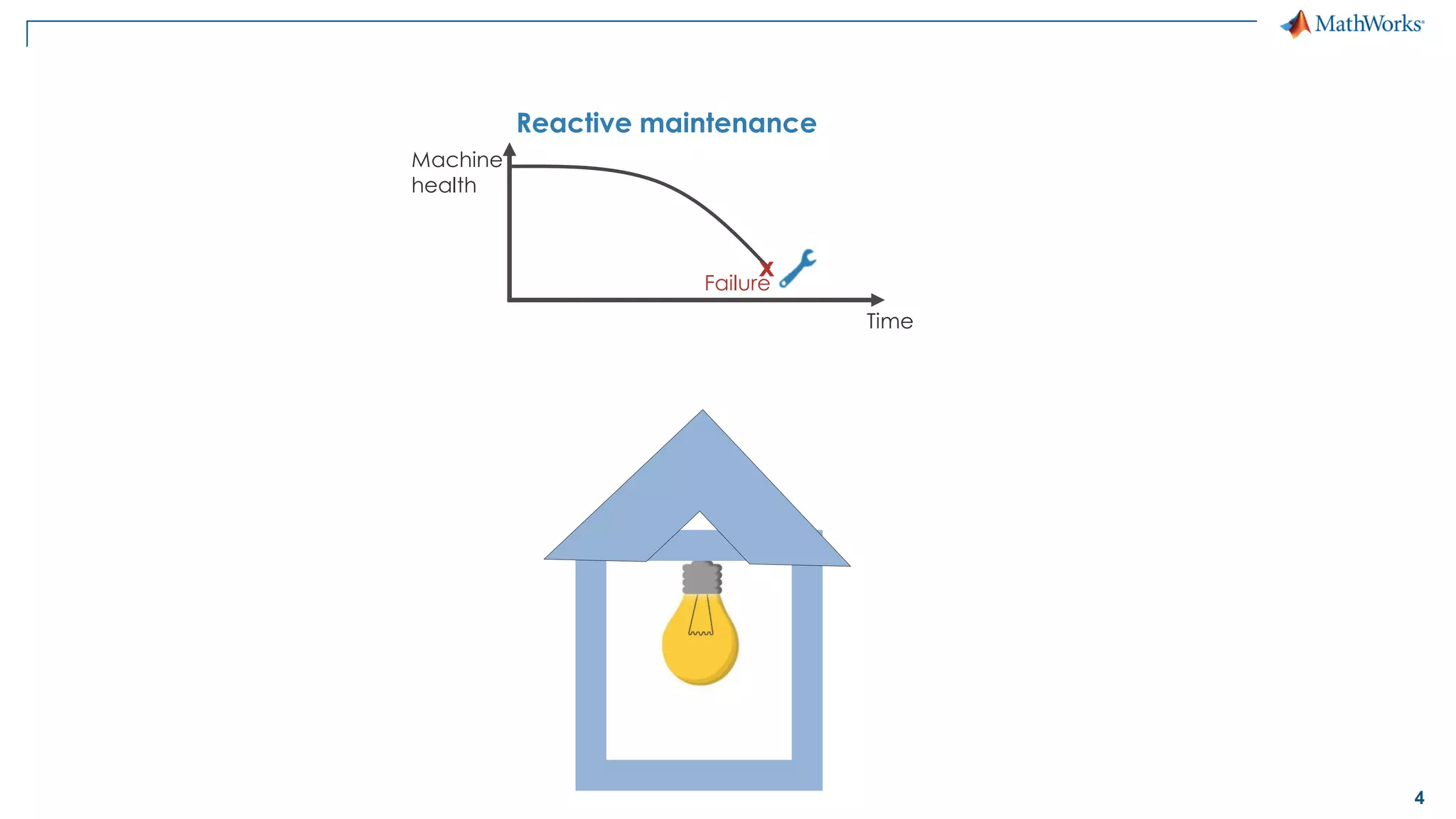
Time
Machine
health
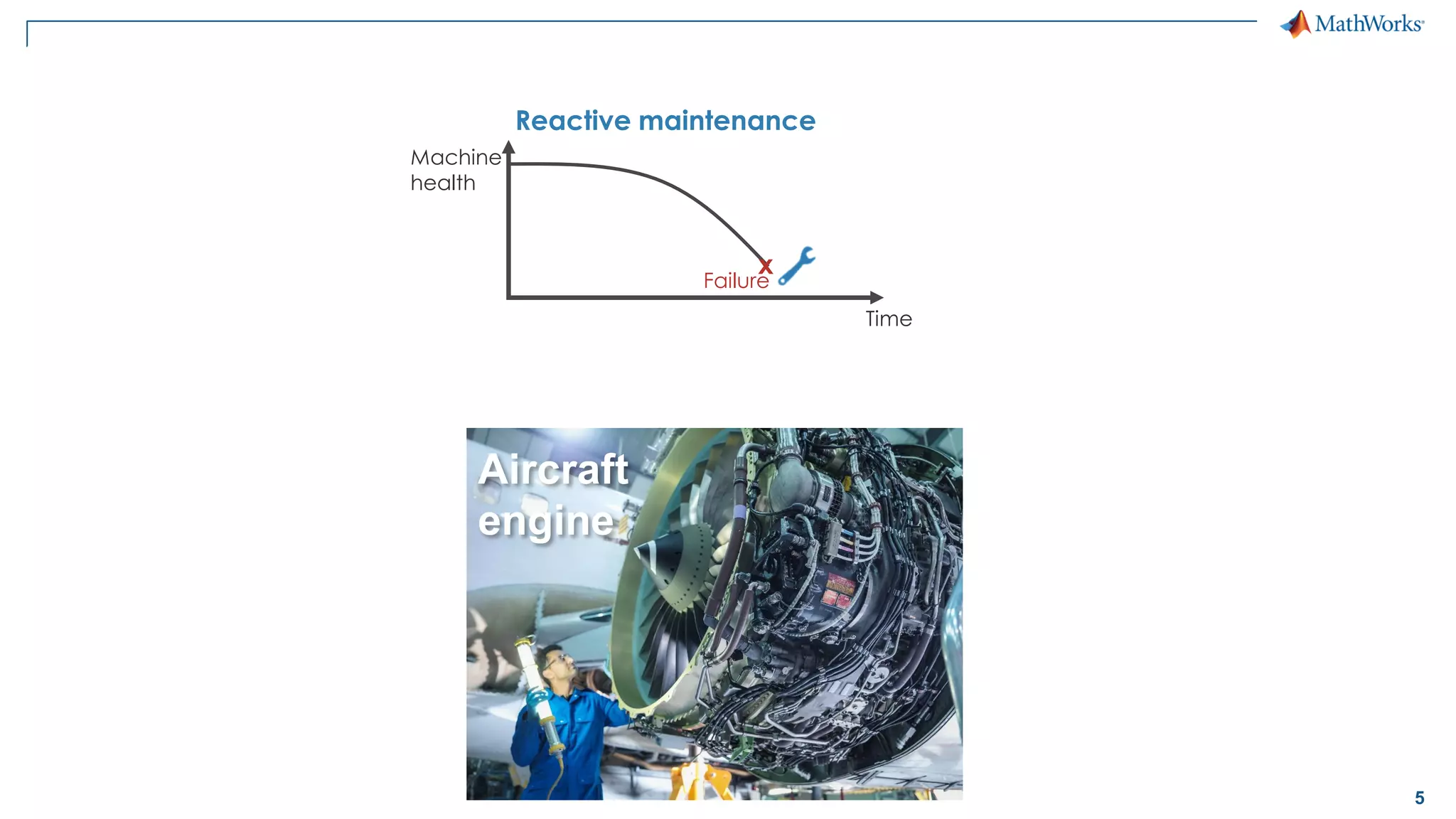
Reactive maintenance
x
Failure
5
Time
Machine
health
Reactive maintenance
x
Failure
Aircraft
engine
6
Time
Machine
health
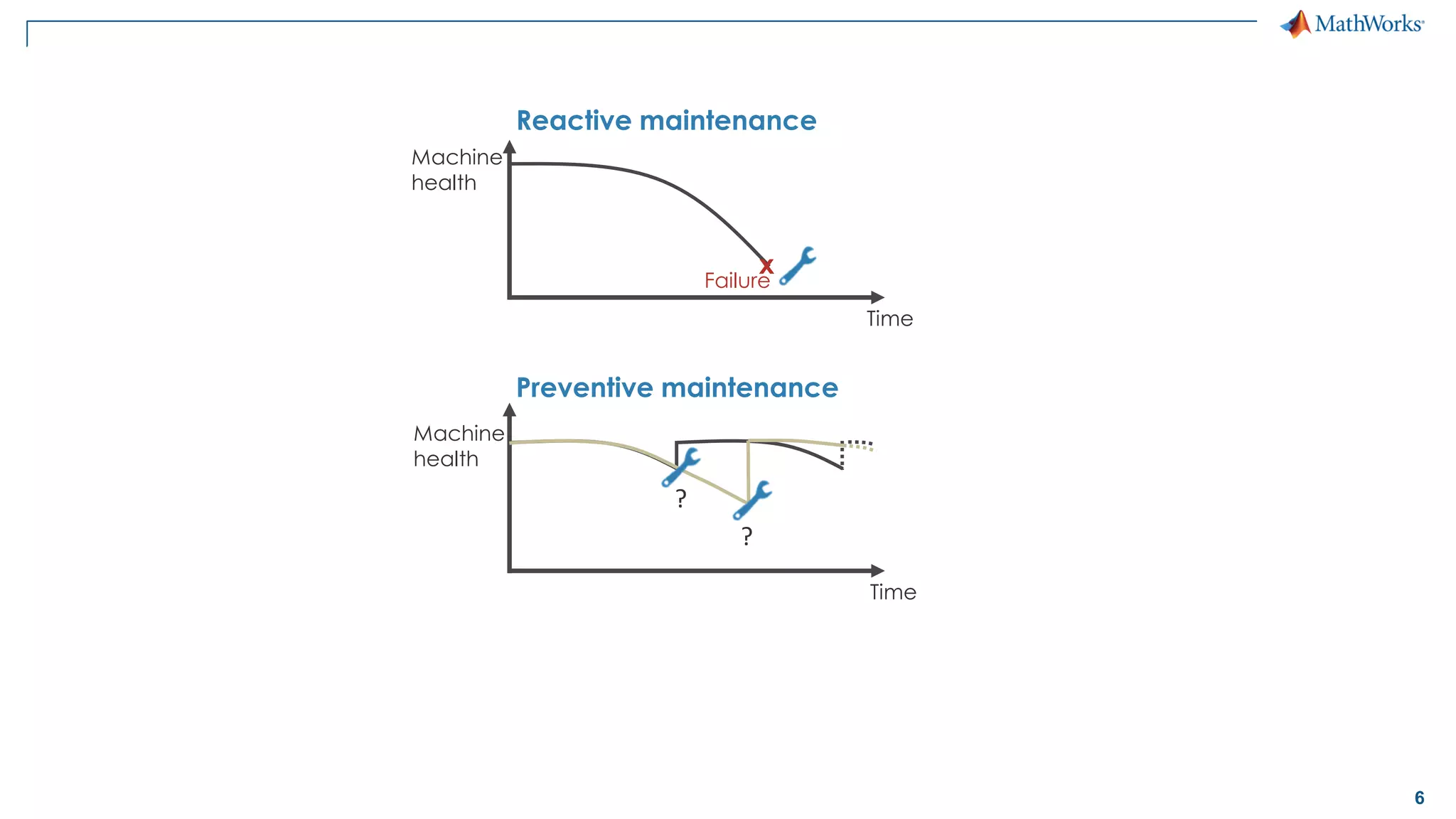
Reactive maintenance
Preventive maintenance
Time
Machine
health
x
Failure
?
?
7
Time
Machine
health
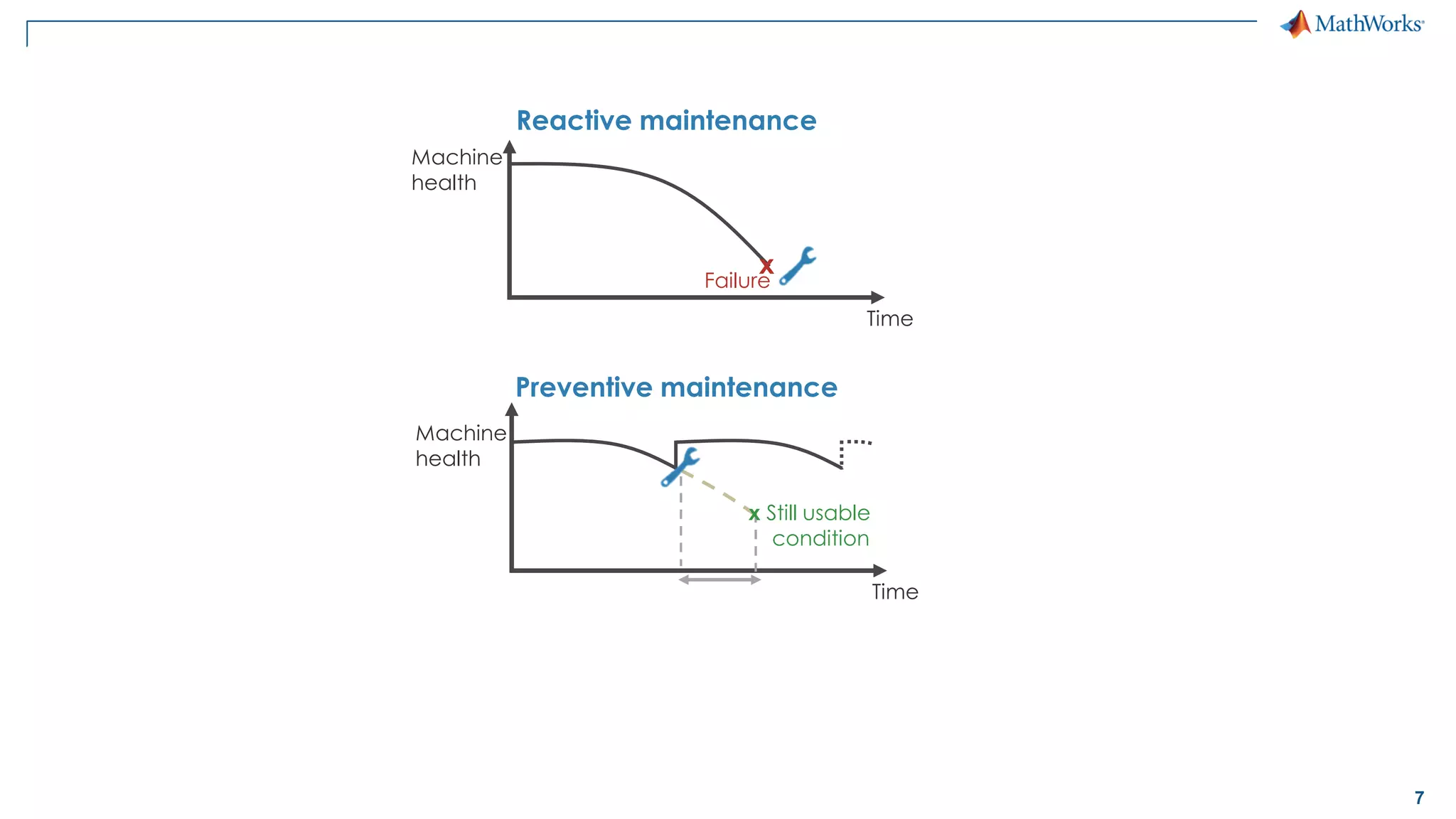
Reactive maintenance
x
Failure
Preventive maintenance
Time
Machine
health
x Still usable
condition
8
Time
Machine
health
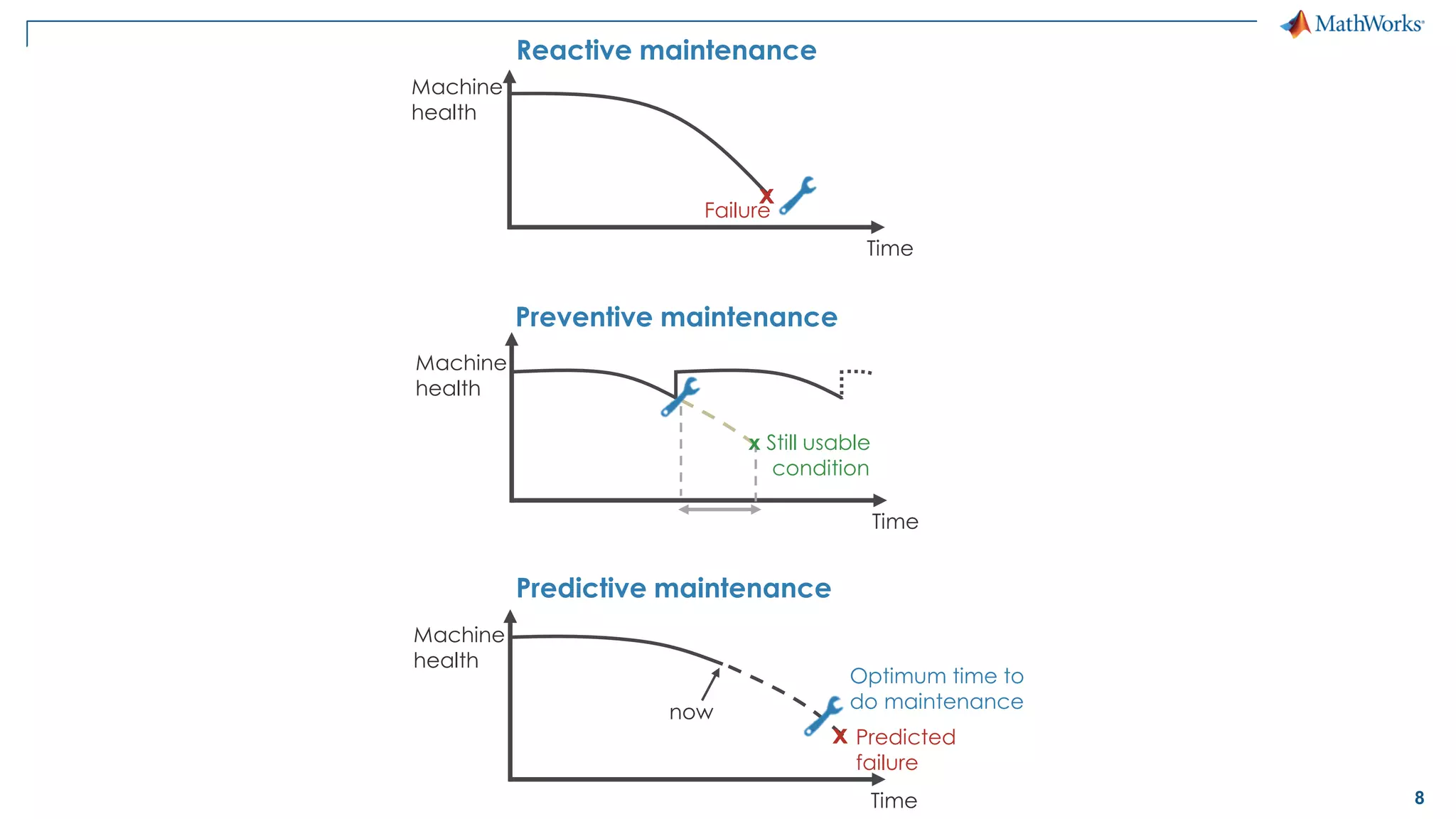
Reactive maintenance
x
Failure
Preventive maintenance
Time
Machine
health
x Still usable
condition
Predictive maintenance
Time
Machine
health
x
now
Predicted
failure
Optimum time to
do maintenance
9
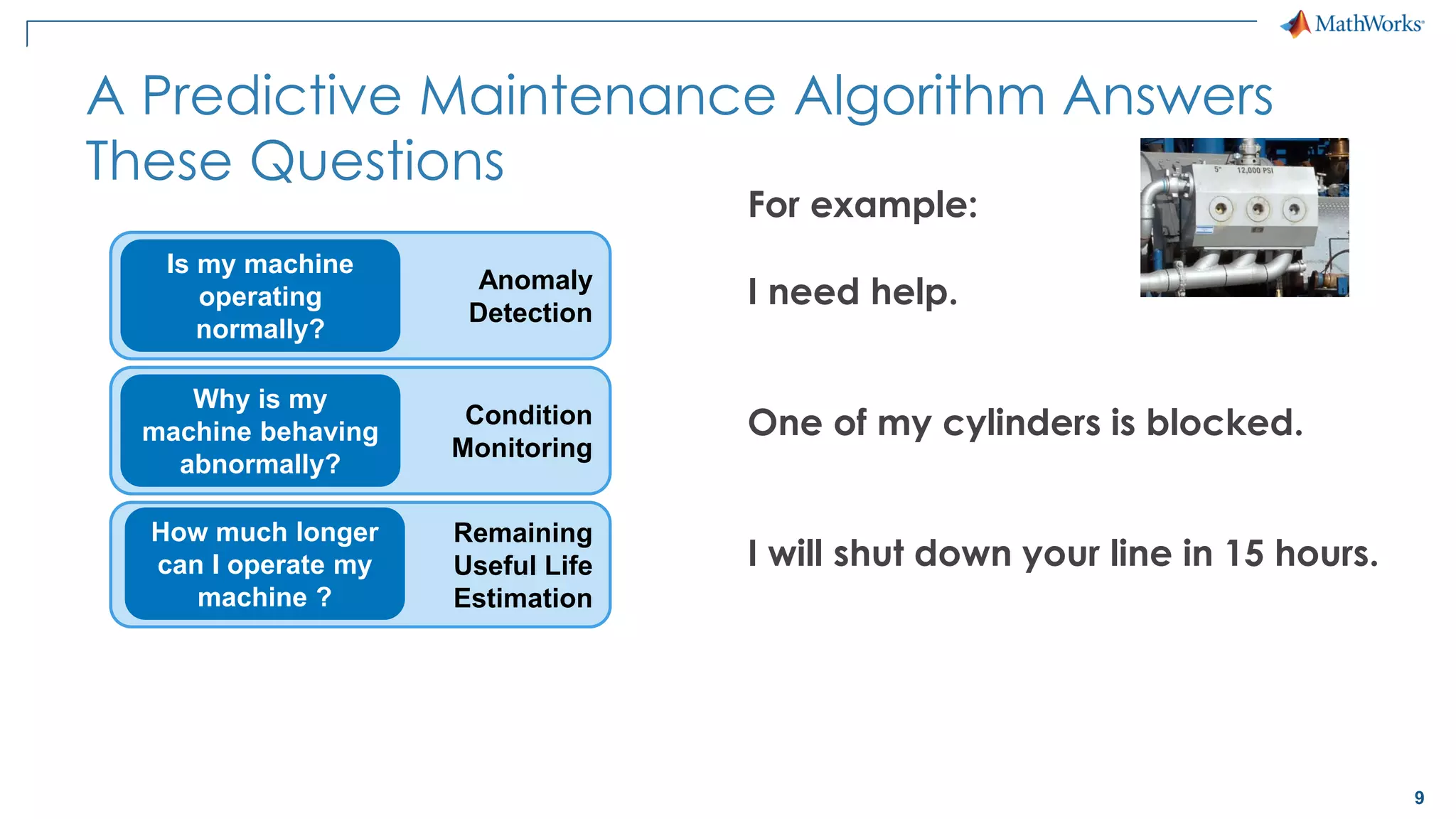
Condition
Monitoring
Remaining
Useful Life
Estimation
A Predictive Maintenance Algorithm Answers
These Questions
Why is my
machine behaving
abnormally?
How much longer
can I operate my
machine ?
Anomaly
Detection
Is my machine
operating
normally?
For example:
I need help.
One of my cylinders is blocked.
I will shut down your line in 15 hours.
10
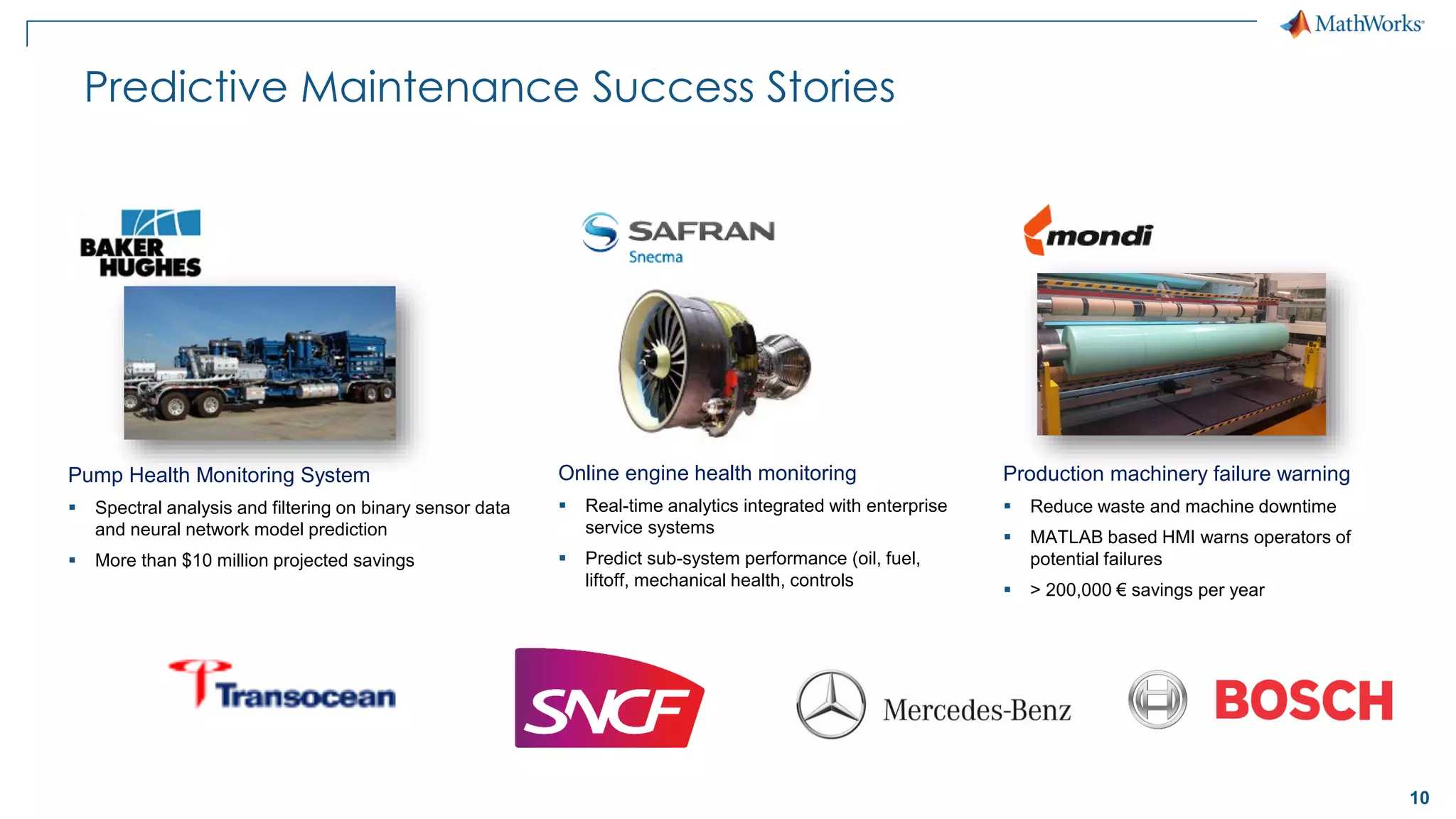
Predictive Maintenance Success Stories
Online engine health monitoring
▪ Real-time analytics integrated with enterprise
service systems
▪ Predict sub-system performance (oil, fuel,
liftoff, mechanical health, controls
Pump Health Monitoring System
▪ Spectral analysis and filtering on binary sensor data
and neural network model prediction
▪ More than $10 million projected savings
Production machinery failure warning
▪ Reduce waste and machine downtime
▪ MATLAB based HMI warns operators of
potential failures
▪ > 200,000 € savings per year
11
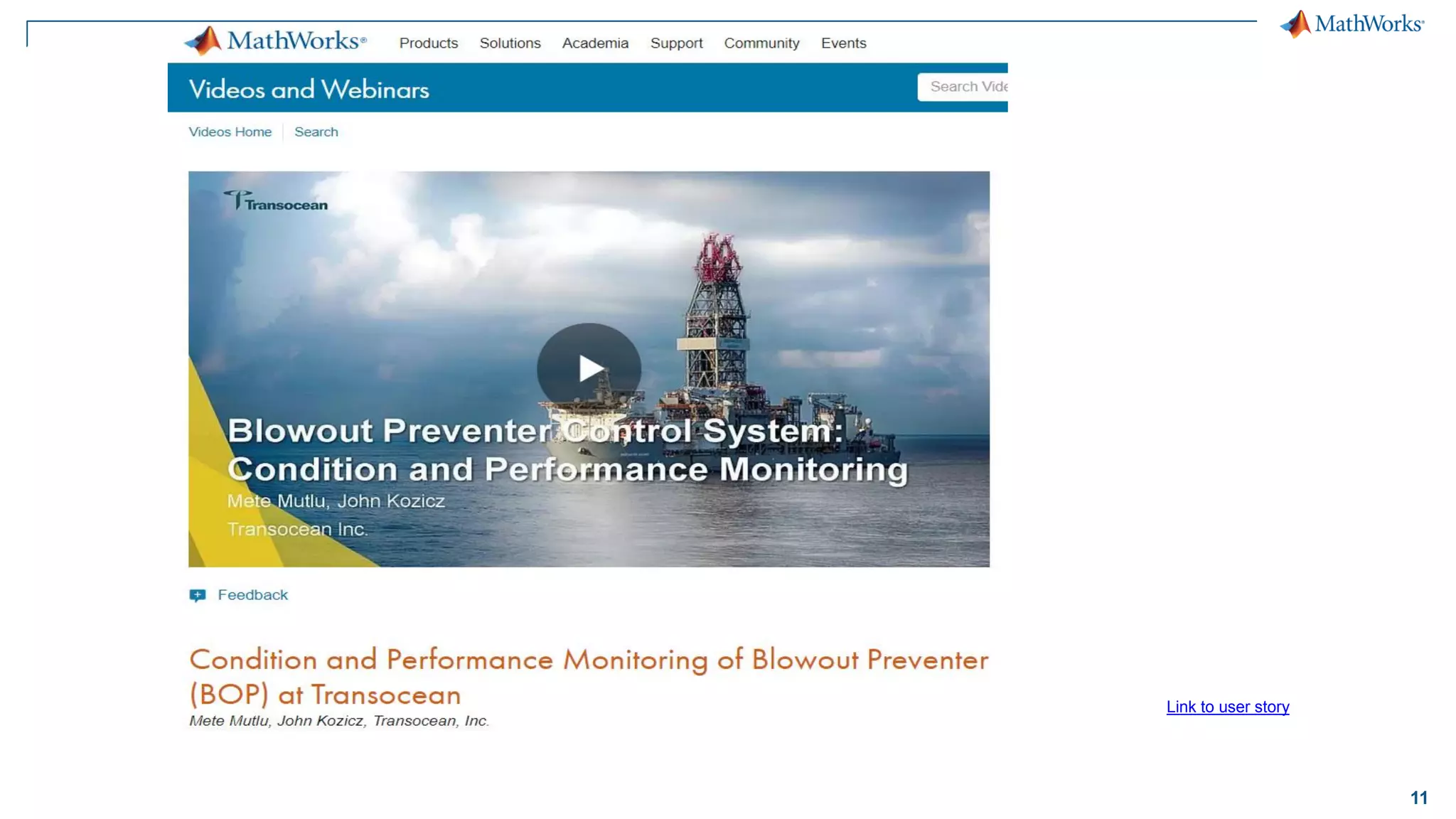
Link to user story
12
Transocean uses MATLAB tools to transition from preventative
maintenance to CPM* for a critical deep sea drilling component
*Condition and Performance Monitoring
Challenges
• Minimize unplanned downtime of the component
• Use as-close-to-real-time data for CPM
• Deploy CPM solution to components in other locations
Solution
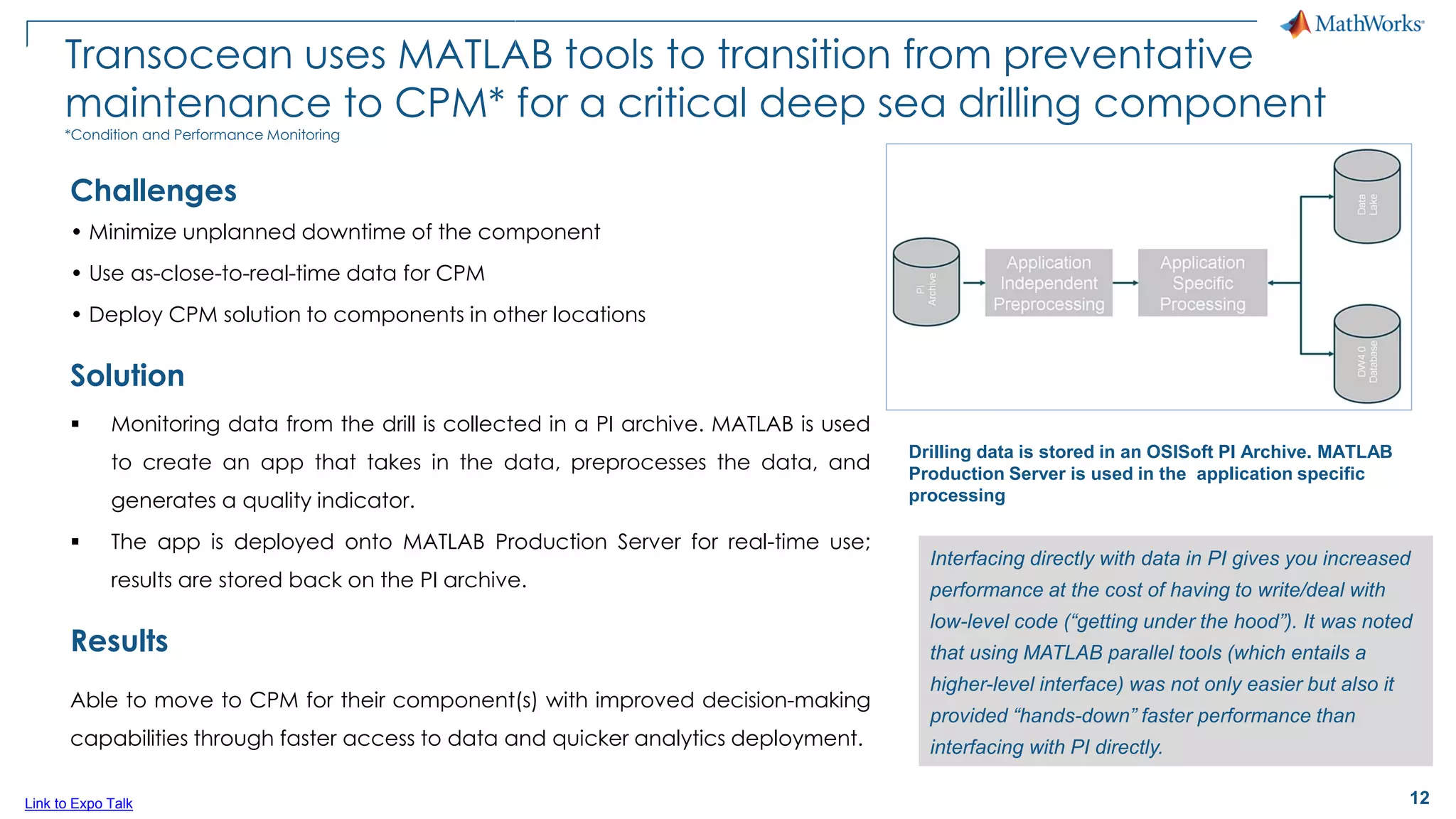
▪ Monitoring data from the drill is collected in a PI archive. MATLAB is used
to create an app that takes in the data, preprocesses the data, and
generates a quality indicator.
▪ The app is deployed onto MATLAB Production Server for real-time use;
results are stored back on the PI archive.
Results
Able to move to CPM for their component(s) with improved decision-making
capabilities through faster access to data and quicker analytics deployment.
Interfacing directly with data in PI gives you increased
performance at the cost of having to write/deal with
low-level code (“getting under the hood”). It was noted
that using MATLAB parallel tools (which entails a
higher-level interface) was not only easier but also it
provided “hands-down” faster performance than
interfacing with PI directly.
Link to Expo Talk
Drilling data is stored in an OSISoft PI Archive. MATLAB
Production Server is used in the application specific
processing
13
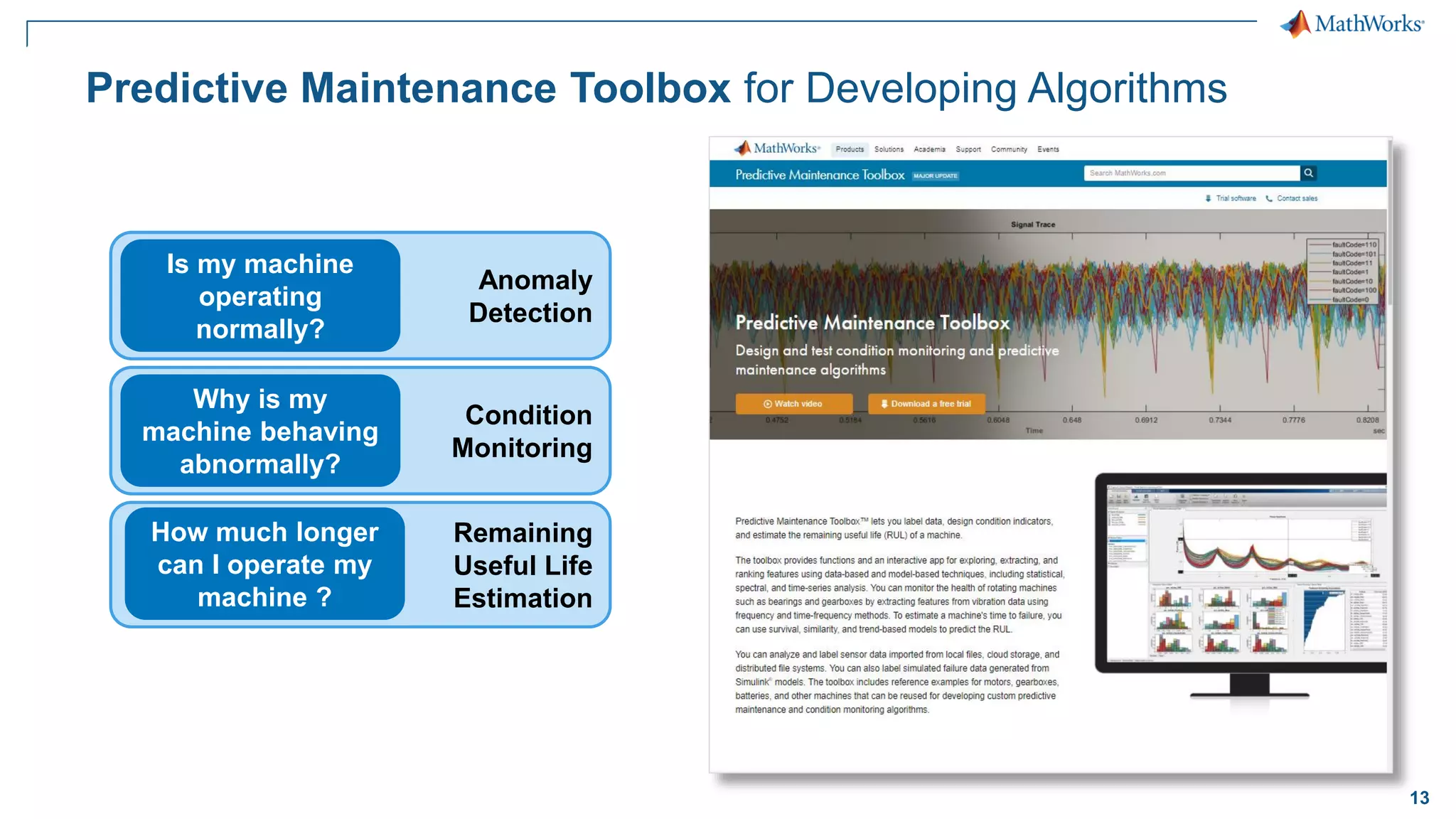
Condition
Monitoring
Remaining
Useful Life
Estimation
Predictive Maintenance Toolbox for Developing Algorithms
Why is my
machine behaving
abnormally?
How much longer
can I operate my
machine ?
Anomaly
Detection
Is my machine
operating
normally?
14
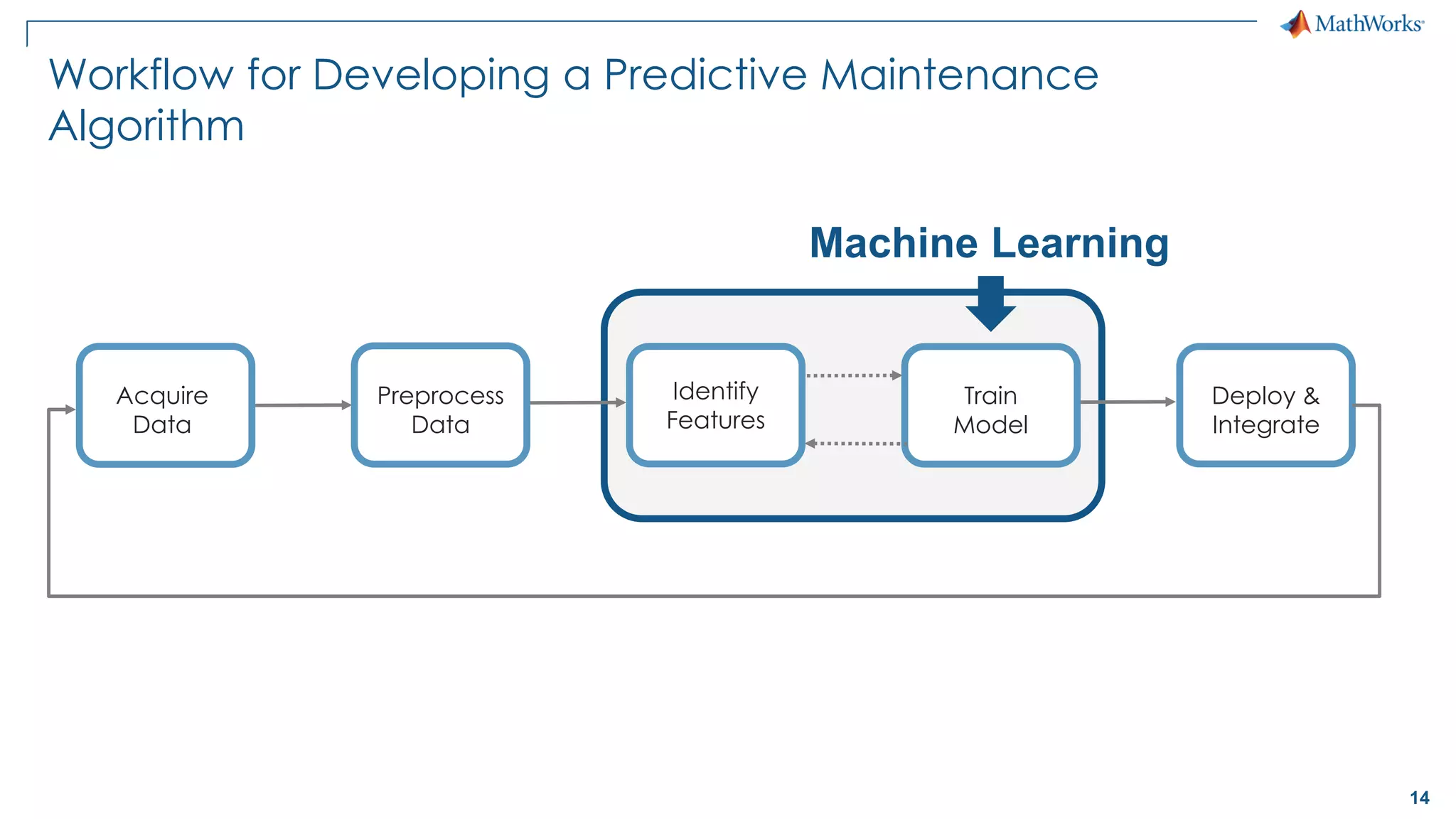
Workflow for Developing a Predictive Maintenance
Algorithm
Acquire
Data
Preprocess
Data
Identify
Features
Train
Model
Deploy &
Integrate
Machine Learning
15
Agenda:
1. What is Predictive Maintenance? Who is benefiting by doing it?
2. How can you develop a predictive maintenance algorithm using MATLAB?
3. How can you get started quickly?
16
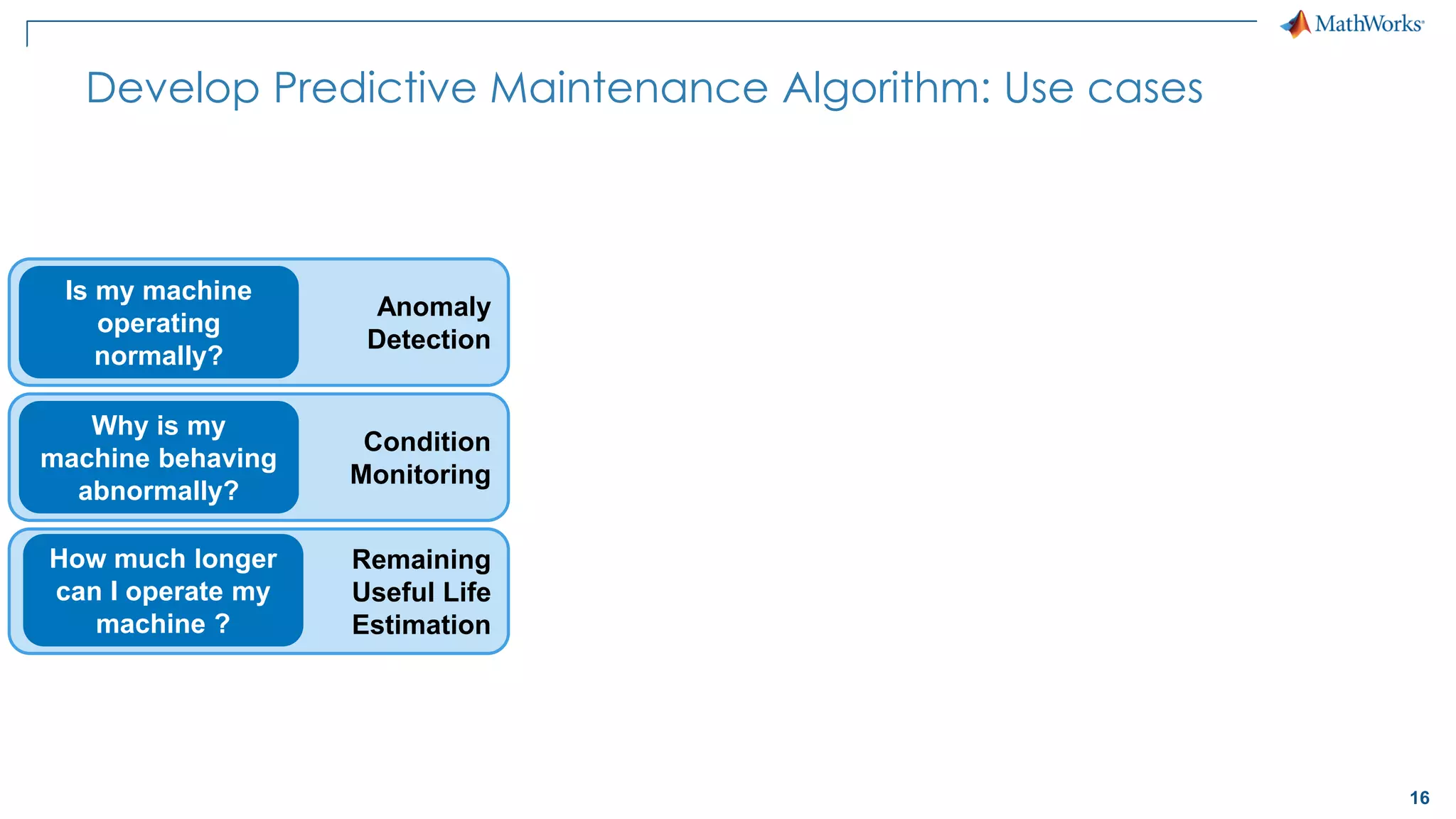
Condition
Monitoring
Remaining
Useful Life
Estimation
Develop Predictive Maintenance Algorithm: Use cases
Why is my
machine behaving
abnormally?
How much longer
can I operate my
machine ?
Anomaly
Detection
Is my machine
operating
normally?
17
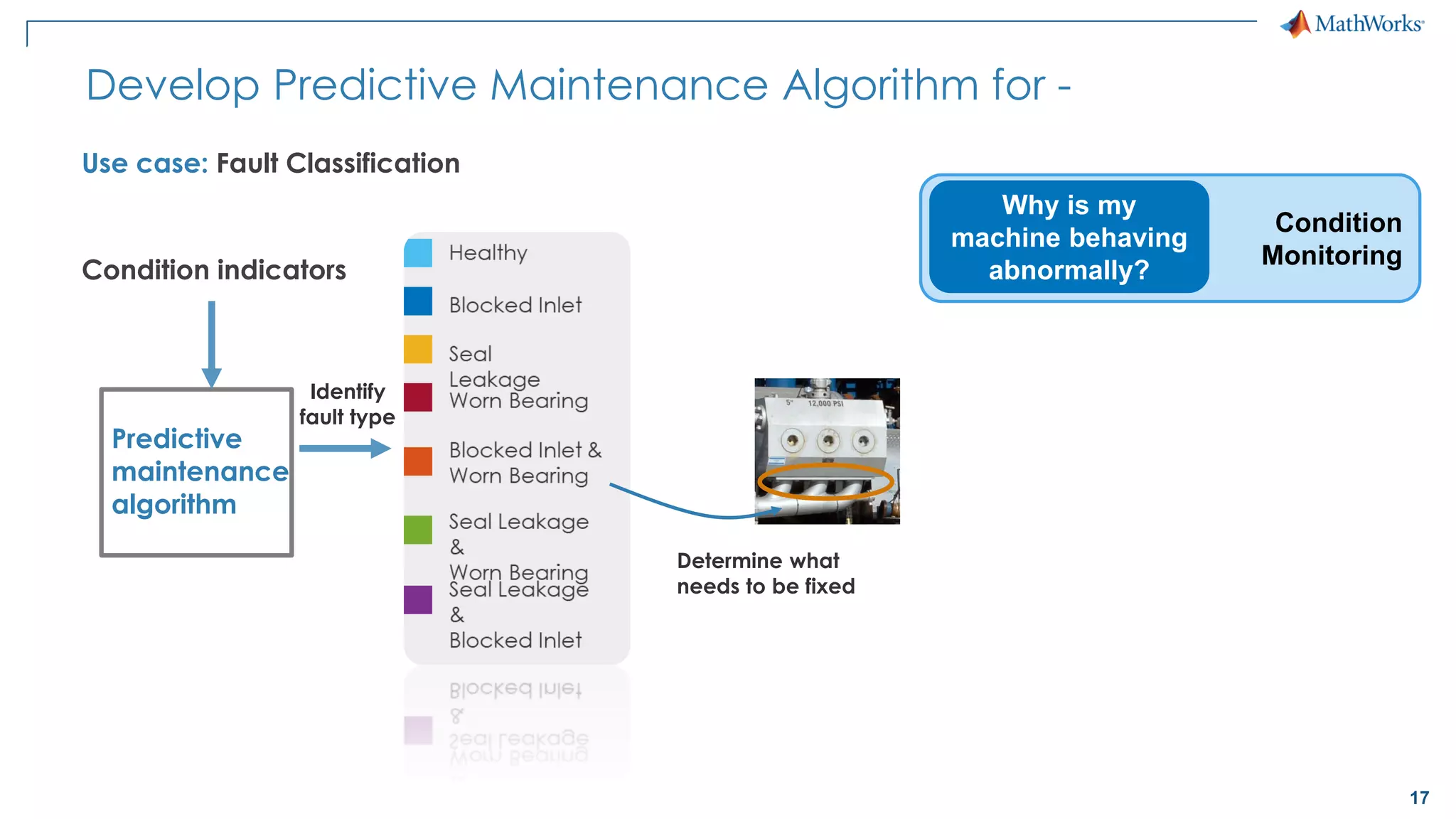
Condition
Monitoring
Develop Predictive Maintenance Algorithm for -
Why is my
machine behaving
abnormally?
Predictive
maintenance
algorithm
Identify
fault type
Determine what
needs to be fixed
Condition indicators
Use case: Fault Classification
19
20
Time
Sensor
data
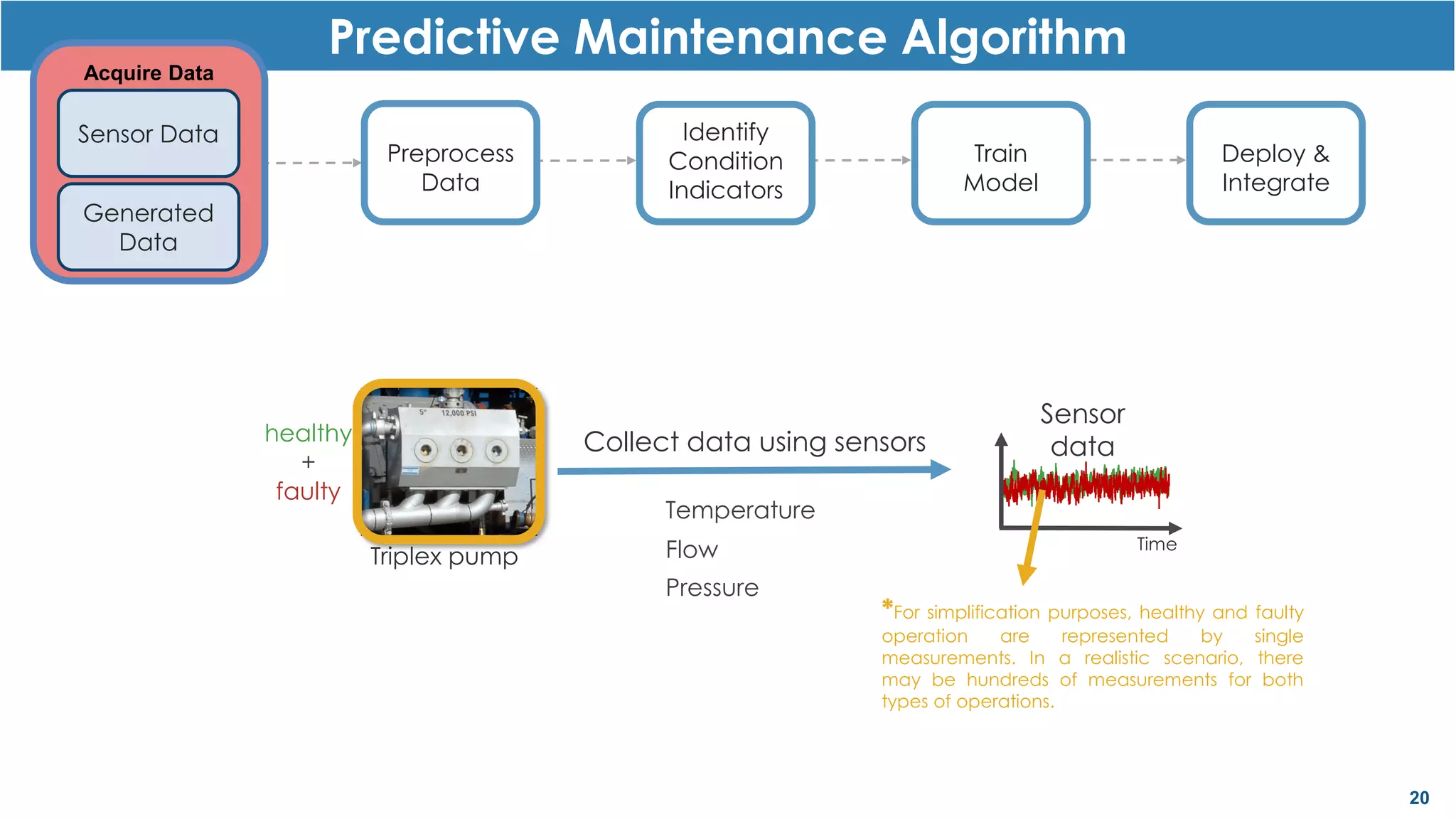
Predictive Maintenance Algorithm
Preprocess
Data
Identify
Condition
Indicators
Train
Model
Deploy &
Integrate
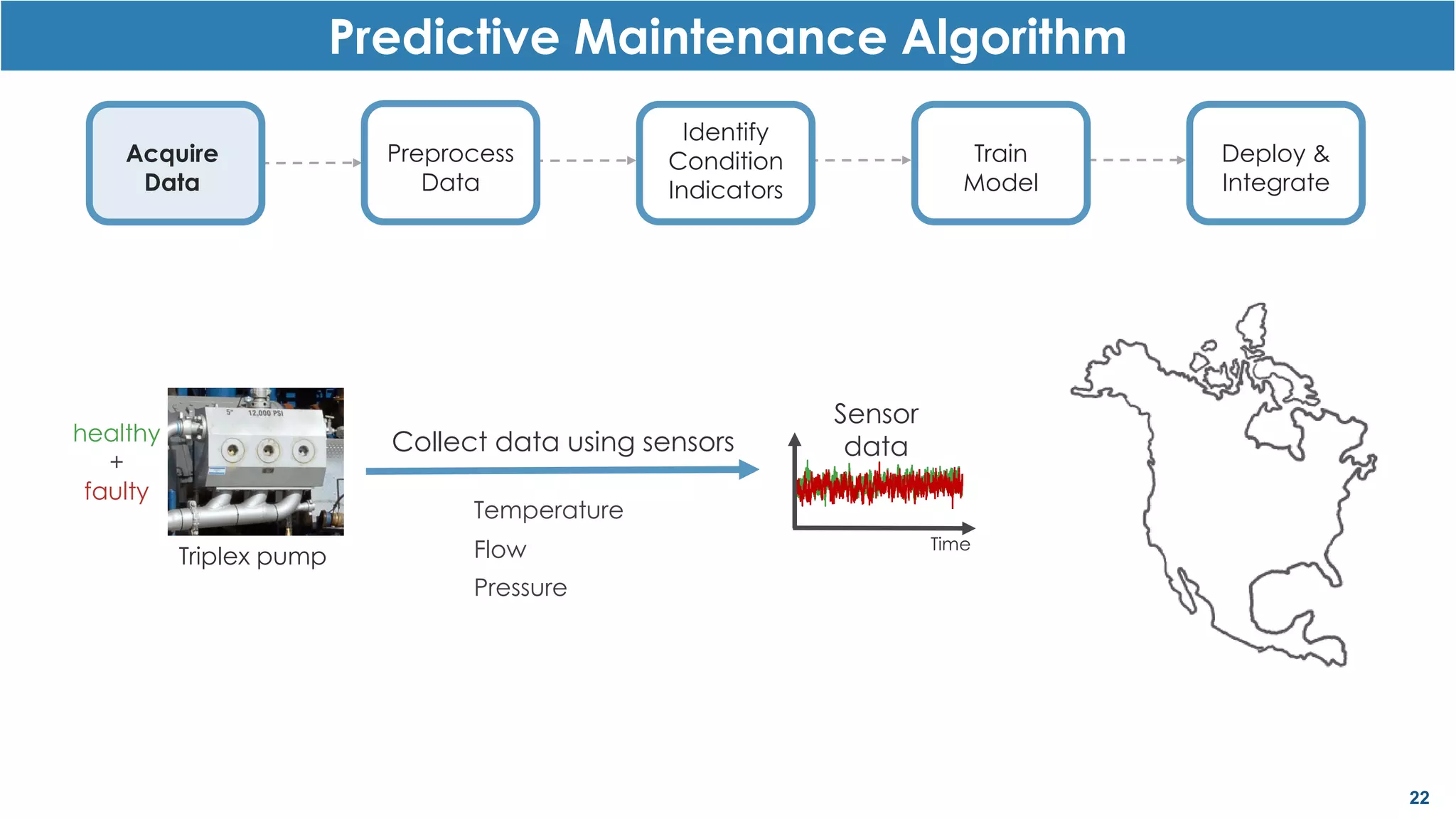
Triplex pump
Temperature
Pressure
Flow
Collect data using sensorshealthy
+
faulty
*For simplification purposes, healthy and faulty
operation are represented by single
measurements. In a realistic scenario, there
may be hundreds of measurements for both
types of operations.
Acquire Data
Sensor Data
Generated
Data
21
Acquire
Data
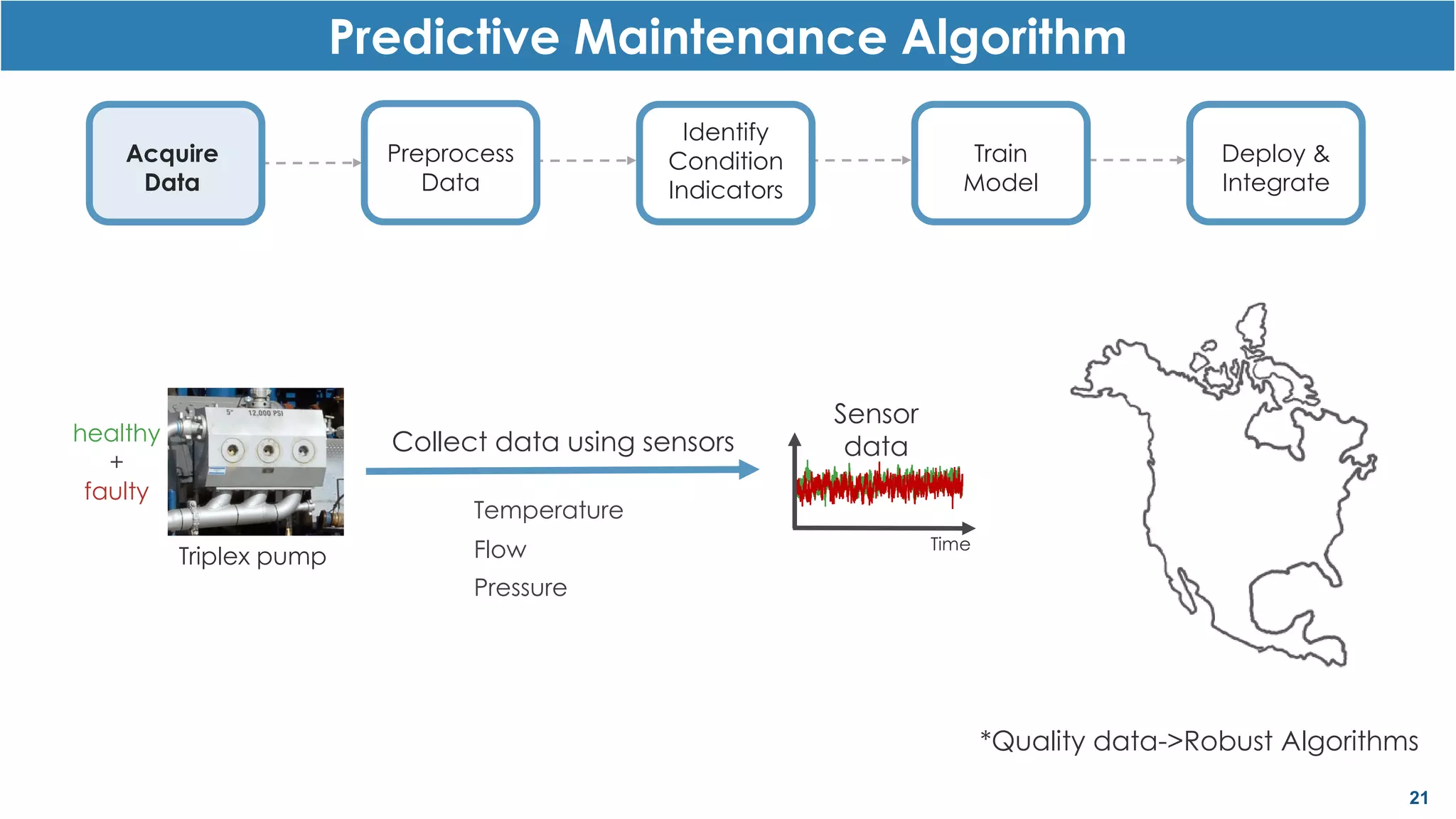
Predictive Maintenance Algorithm
Preprocess
Data
Identify
Condition
Indicators
Train
Model
Deploy &
Integrate
Triplex pump
Temperature
Pressure
Flow
Collect data using sensorshealthy
+
faulty
Time
Sensor
data
*Quality data->Robust Algorithms
22
Acquire
Data
Predictive Maintenance Algorithm
Preprocess
Data
Identify
Condition
Indicators
Train
Model
Deploy &
Integrate
Triplex pump
Temperature
Pressure
Flow
Collect data using sensorshealthy
+
faulty
Time
Sensor
data
23
Time
Sensor
data
Acquire
Data
Predictive Maintenance Algorithm
Preprocess
Data
Identify
Condition
Indicators
Train
Model
Deploy &
Integrate
Triplex pump
Temperature
Pressure
Flow
Collect data using sensorshealthy
+
faulty
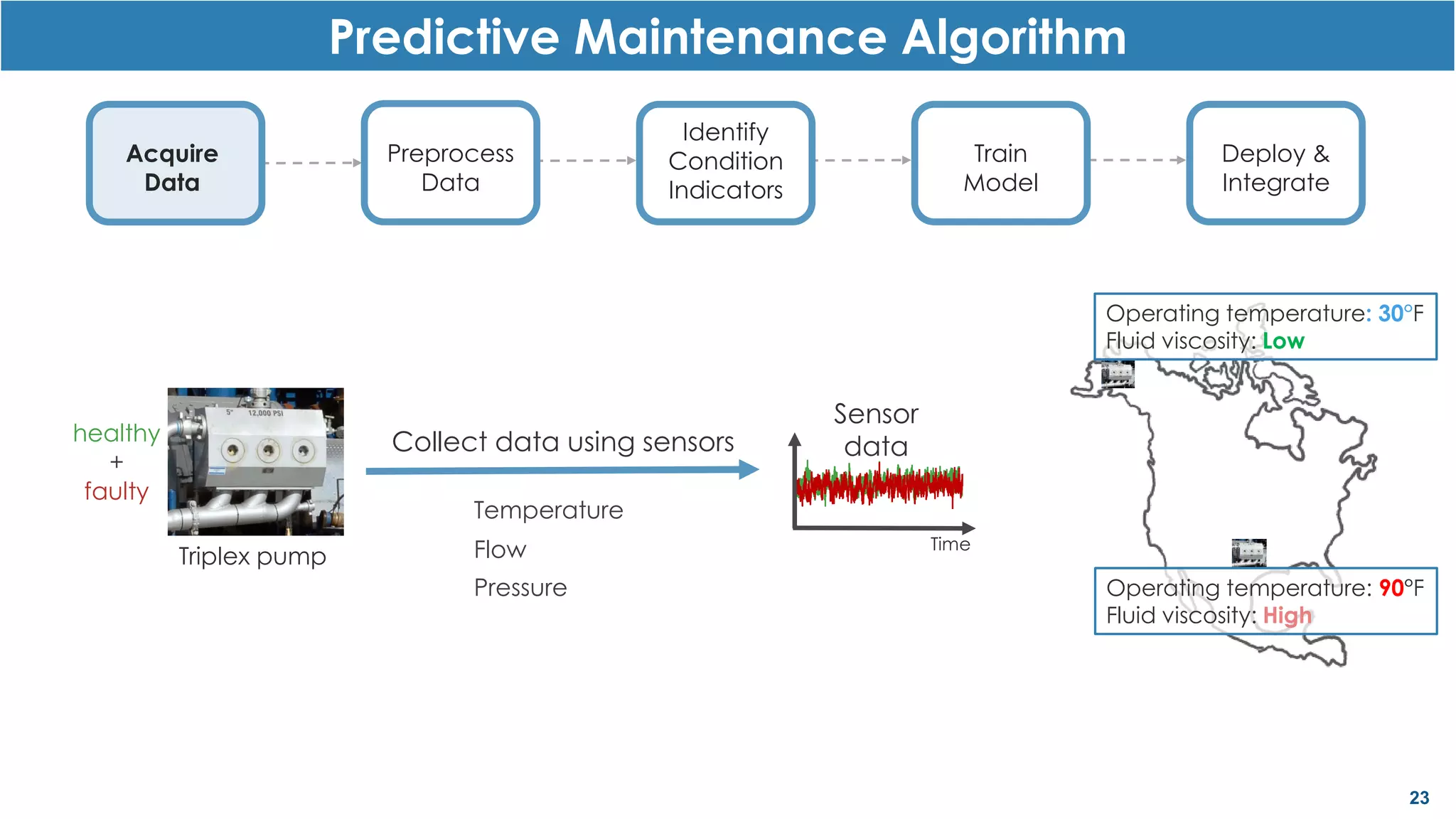
Operating temperature: 30°F
Fluid viscosity: Low
Operating temperature: 90°F
Fluid viscosity: High
24
Acquire
Data
Predictive Maintenance Algorithm
Preprocess
Data
Identify
Condition
Indicators
Train
Model
Deploy &
Integrate
Triplex pump
Time
Sensor
data
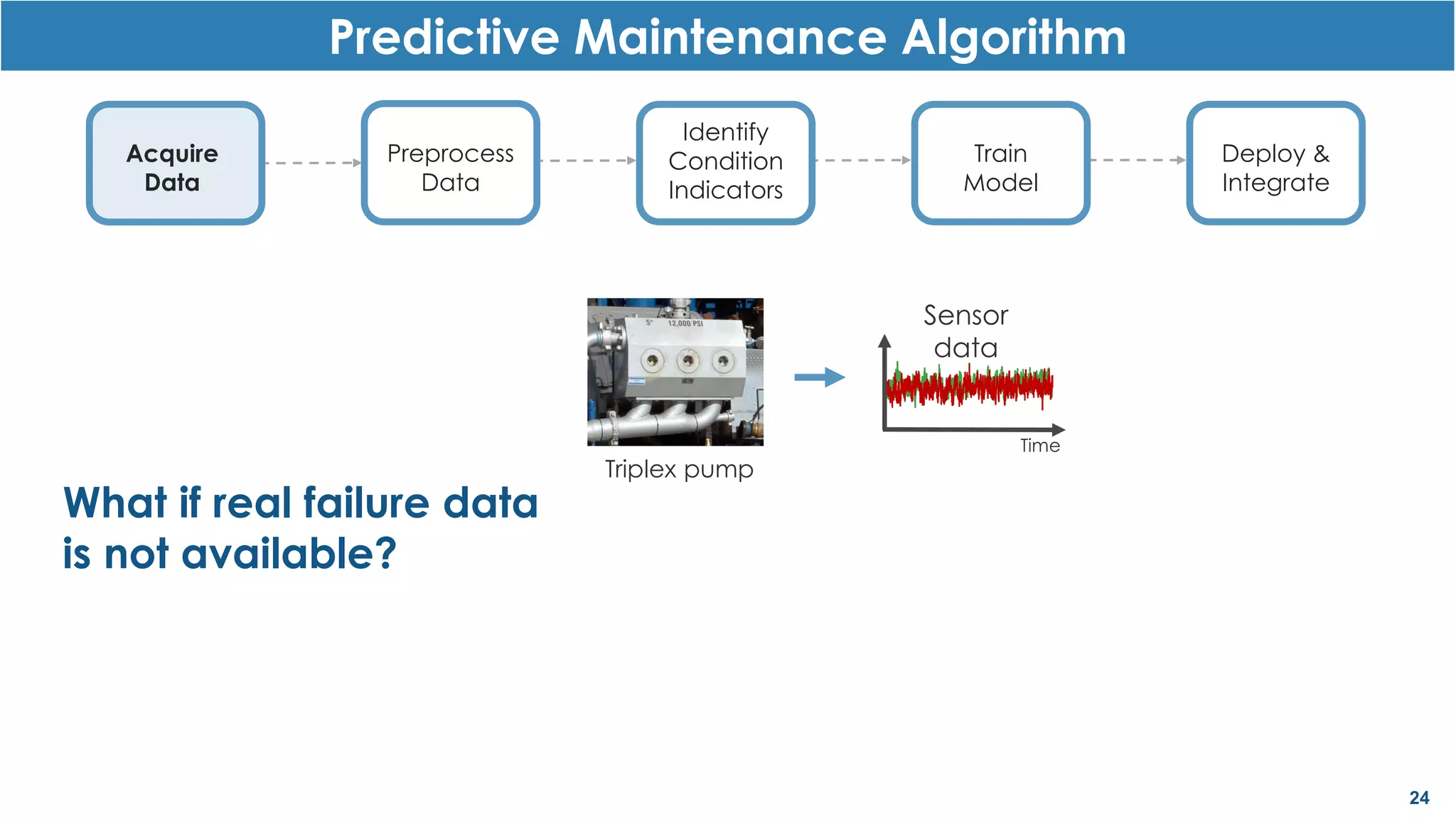
What if real failure data
is not available?
25
Time
Sensor data
Acquire
Data
Predictive Maintenance Algorithm
Preprocess
Data
Identify
Condition
Indicators
Train
Model
Deploy &
Integrate
Triplex pump
Time
Sensor
data
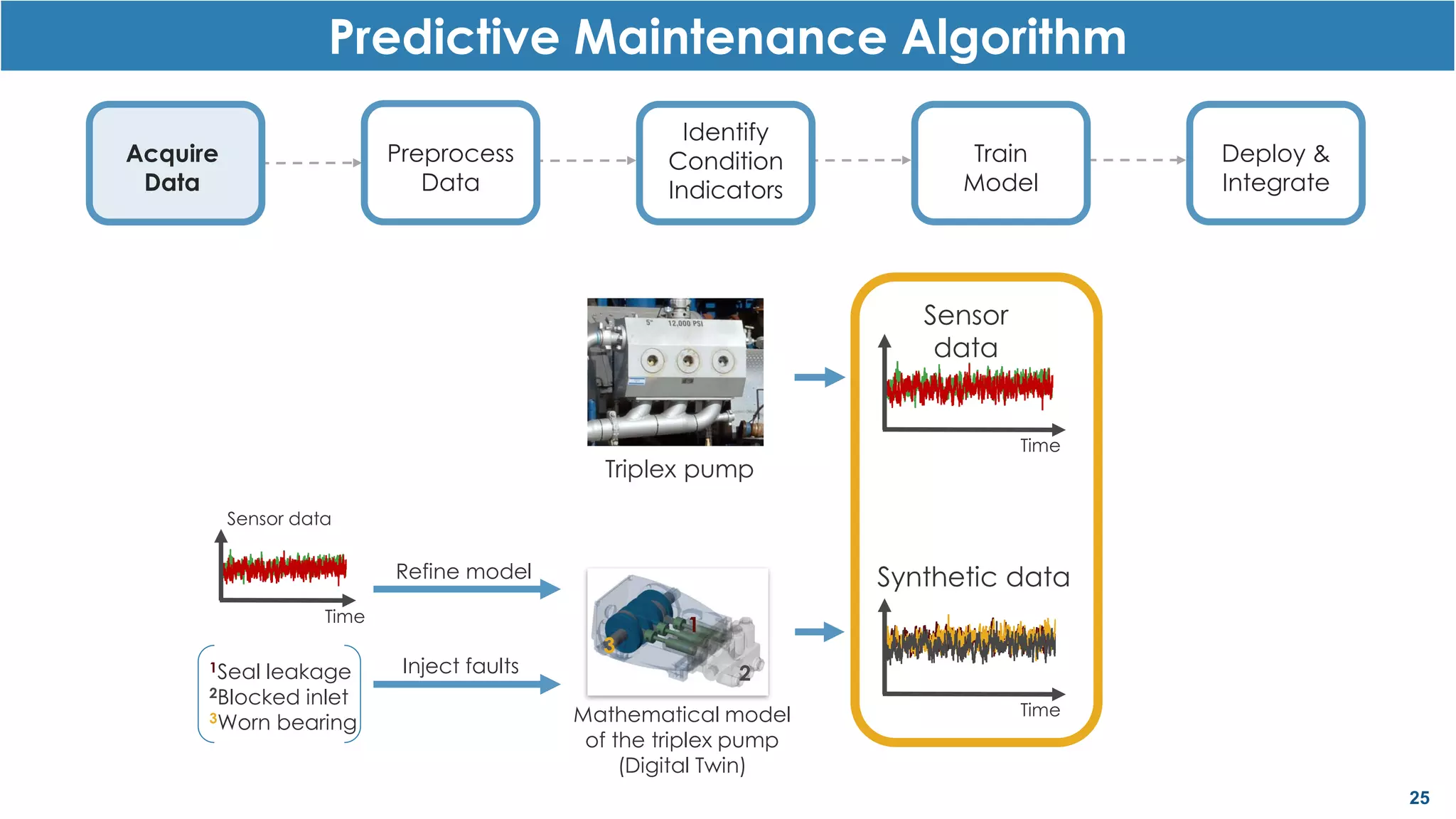
Inject faults1Seal leakage
2Blocked inlet
3Worn bearing Mathematical model
of the triplex pump
(Digital Twin)
Refine model
1
2
3
Time
Synthetic data
26
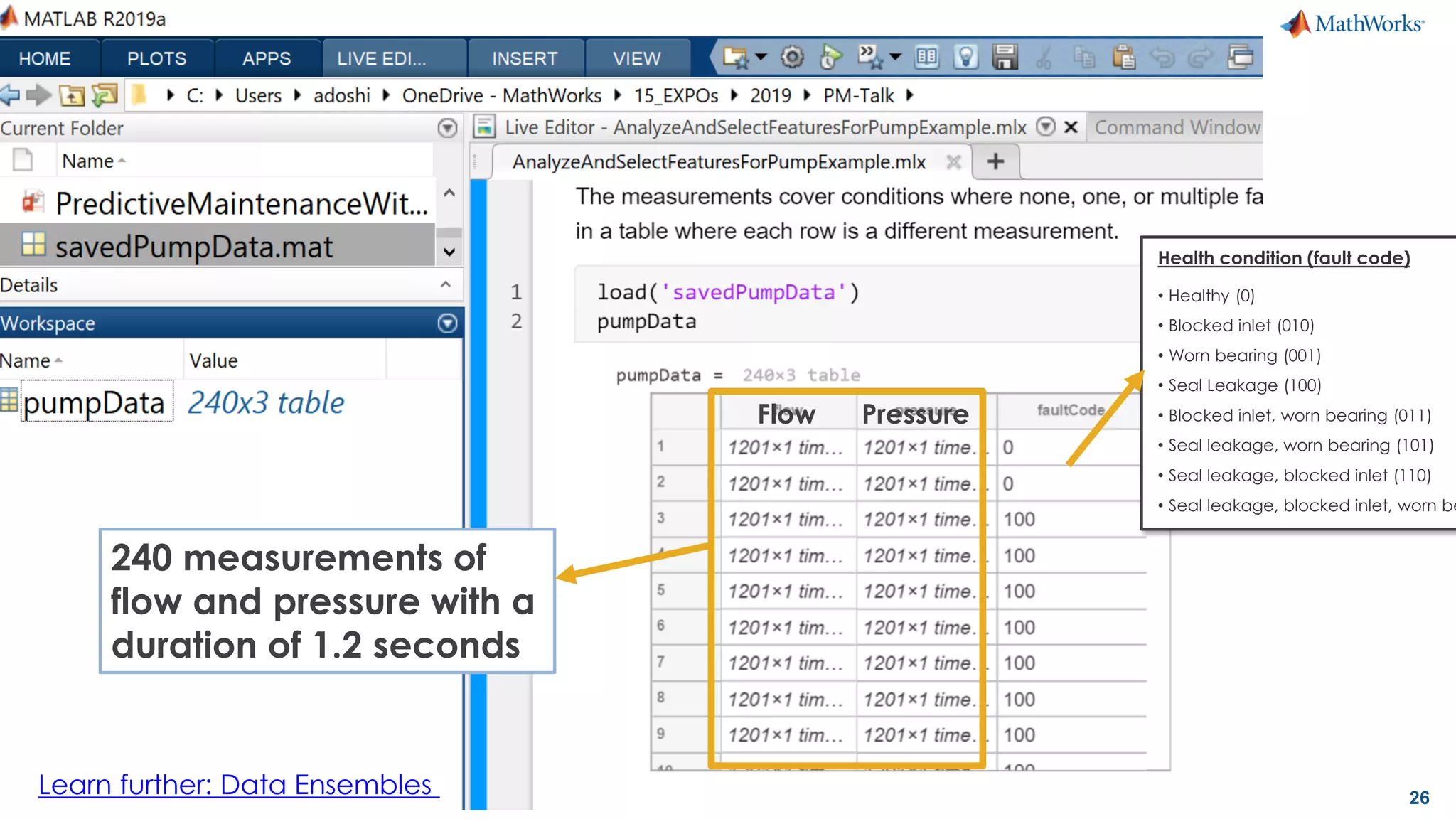
240 measurements of
flow and pressure with a
duration of 1.2 seconds
Flow Pressure
Health condition (fault code)
• Healthy (0)
• Blocked inlet (010)
• Worn bearing (001)
• Seal Leakage (100)
• Blocked inlet, worn bearing (011)
• Seal leakage, worn bearing (101)
• Seal leakage, blocked inlet (110)
• Seal leakage, blocked inlet, worn be
Learn further: Data Ensembles
27
Predictive Maintenance Algorithm
Preprocess
Data
Identify
Condition
Indicators
Train
Model
Deploy &
Integrate
Acquire Data
Sensor Data
Generated
Data
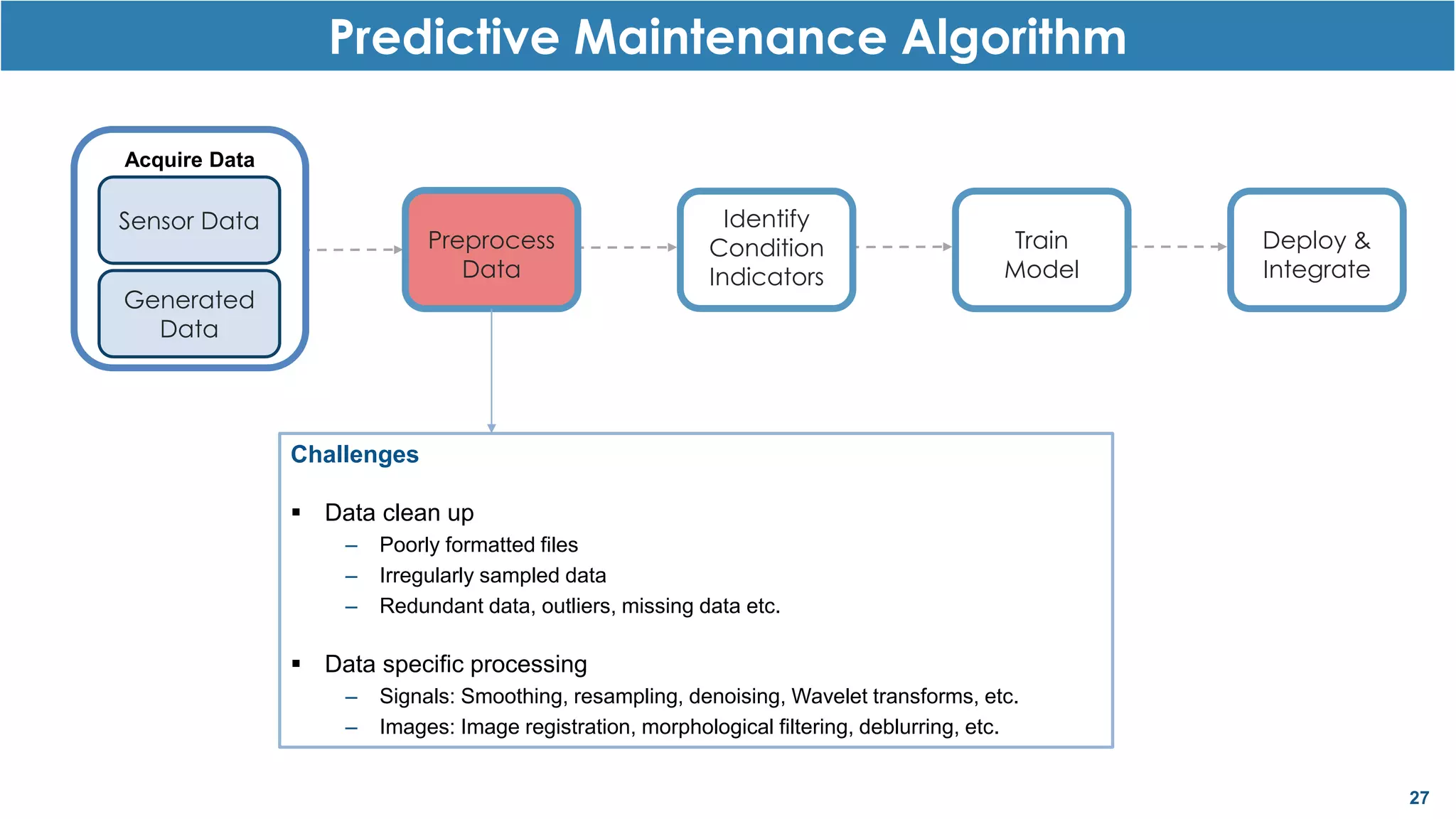
Challenges
▪ Data clean up
– Poorly formatted files
– Irregularly sampled data
– Redundant data, outliers, missing data etc.
▪ Data specific processing
– Signals: Smoothing, resampling, denoising, Wavelet transforms, etc.
– Images: Image registration, morphological filtering, deblurring, etc.
28
0.5 1 1.5 2 2.5 3 3.5 4
Time (s)
6.5
7
7.5
8
8.5
9
9.5
10
Raw data
Pressure(bar)
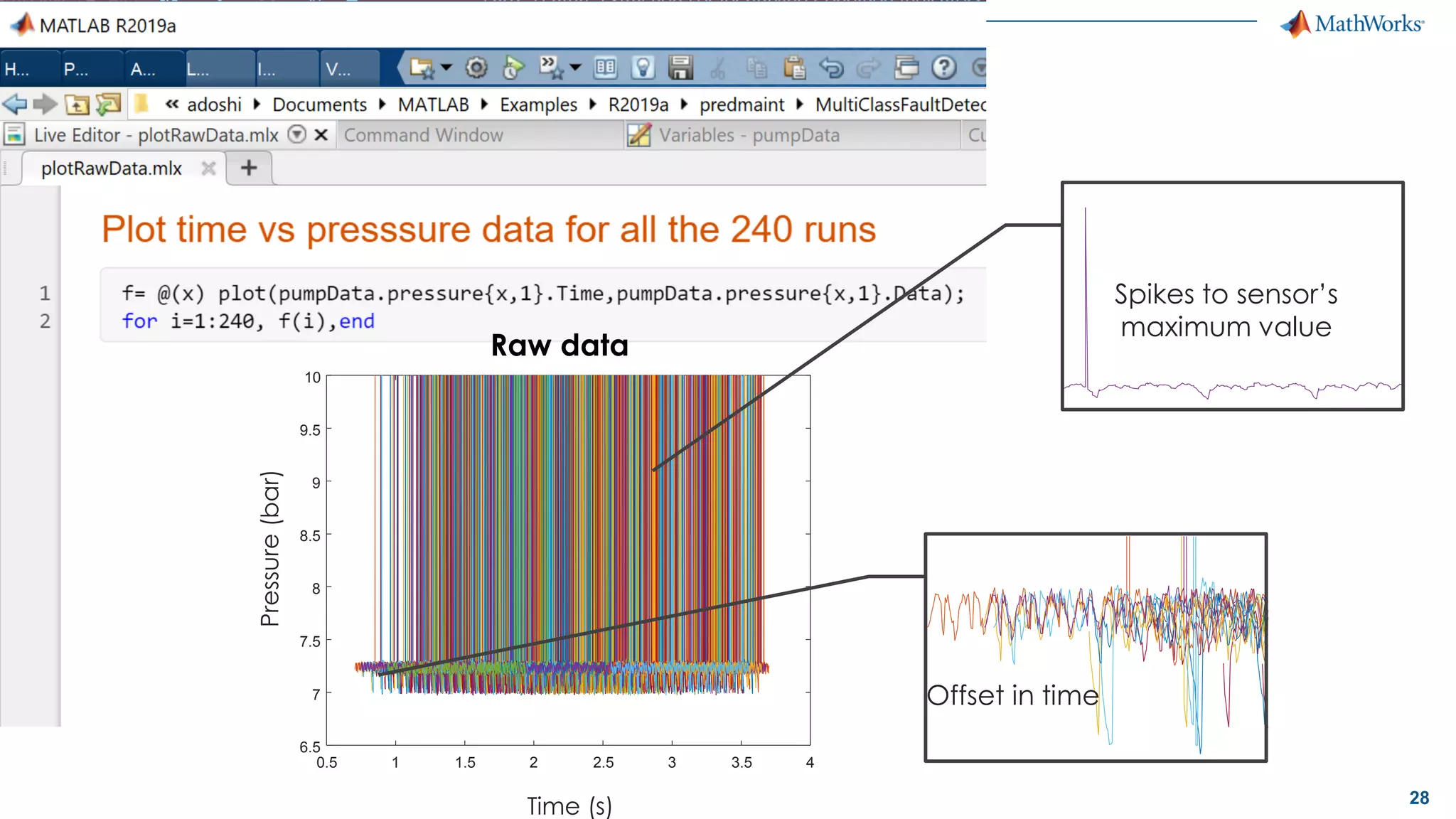
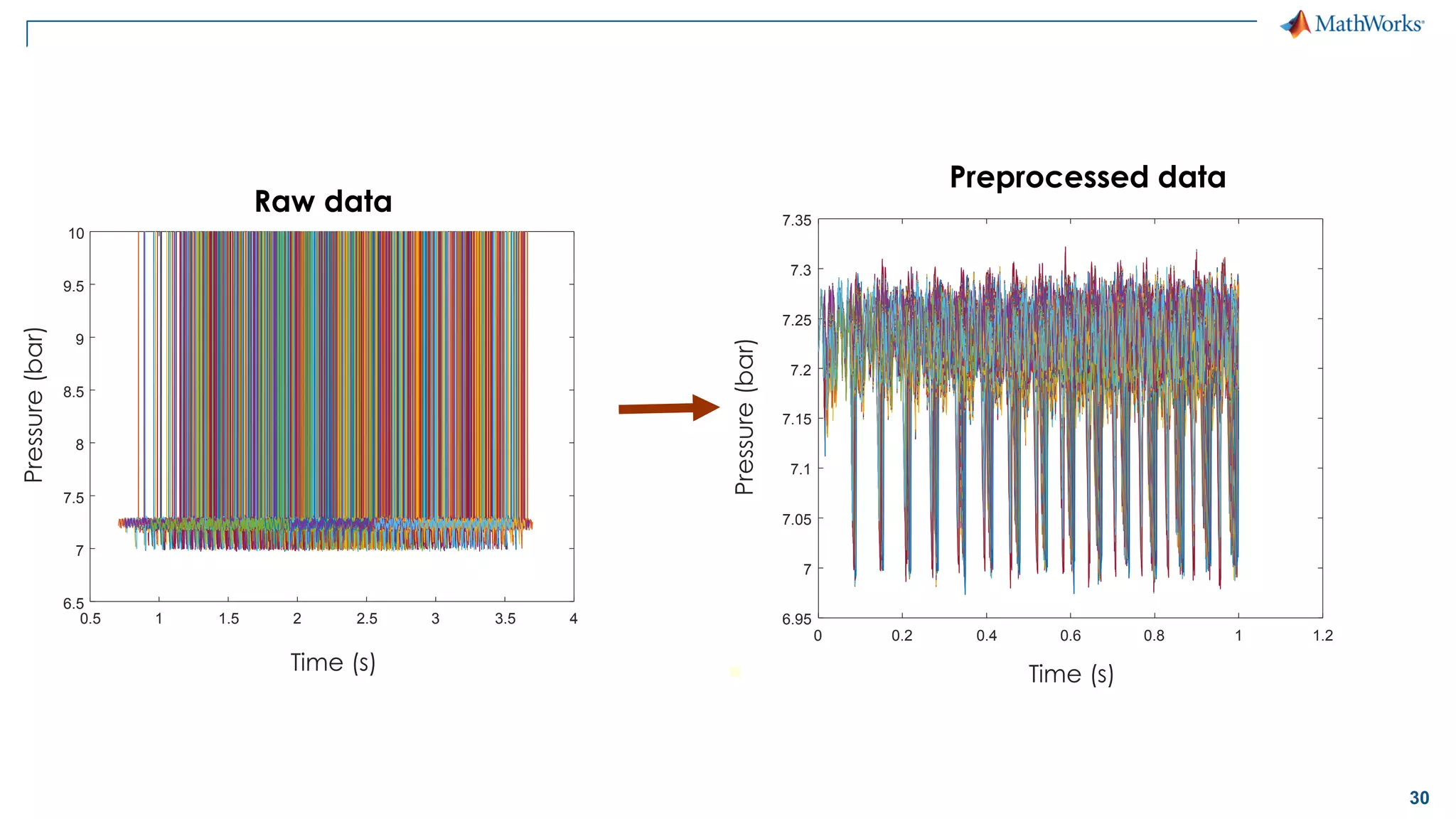
Spikes to sensor’s
maximum value
Offset in time
29
30
0.5 1 1.5 2 2.5 3 3.5 4
Time (s)
6.5
7
7.5
8
8.5
9
9.5
10
Raw data
Pressure(bar)
Time (s)
Preprocessed data
Pressure(bar)
0 0.2 0.4 0.6 0.8 1 1.2
6.95
7
7.05
7.1
7.15
7.2
7.25
7.3
7.35
31
Predictive Maintenance Algorithm
Preprocess
Data
Identify
Condition
Indicators
Train
Model
Deploy &
Integrate
Acquire Data
Sensor Data
Generated
Data
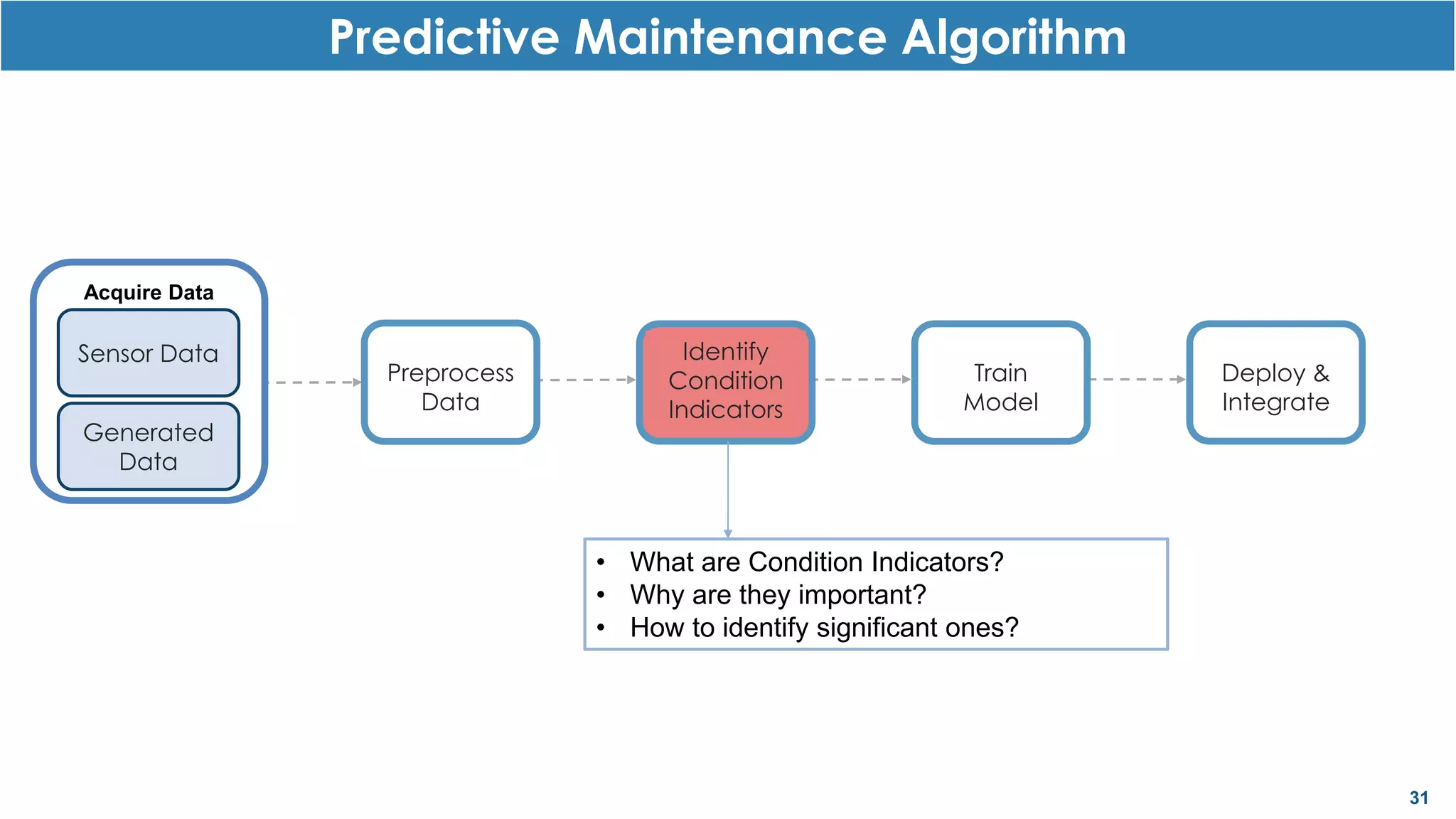
• What are Condition Indicators?
• Why are they important?
• How to identify significant ones?
32
Identify condition indicators
Time
Condition indicator
Time
Raw data
Healthy
operation
Faulty operation
Healthy
operation
Faulty operation
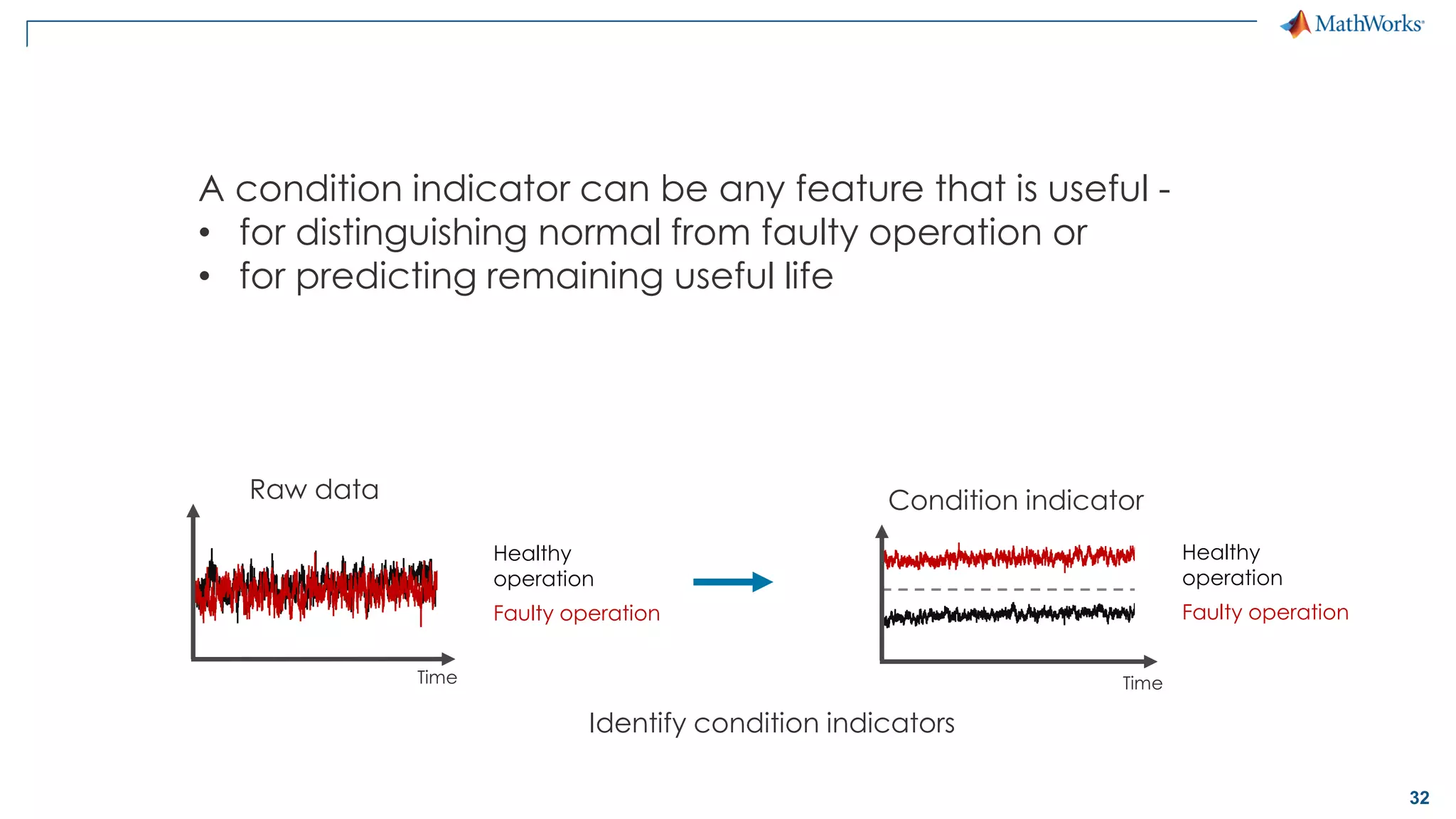
A condition indicator can be any feature that is useful -
• for distinguishing normal from faulty operation or
• for predicting remaining useful life
33
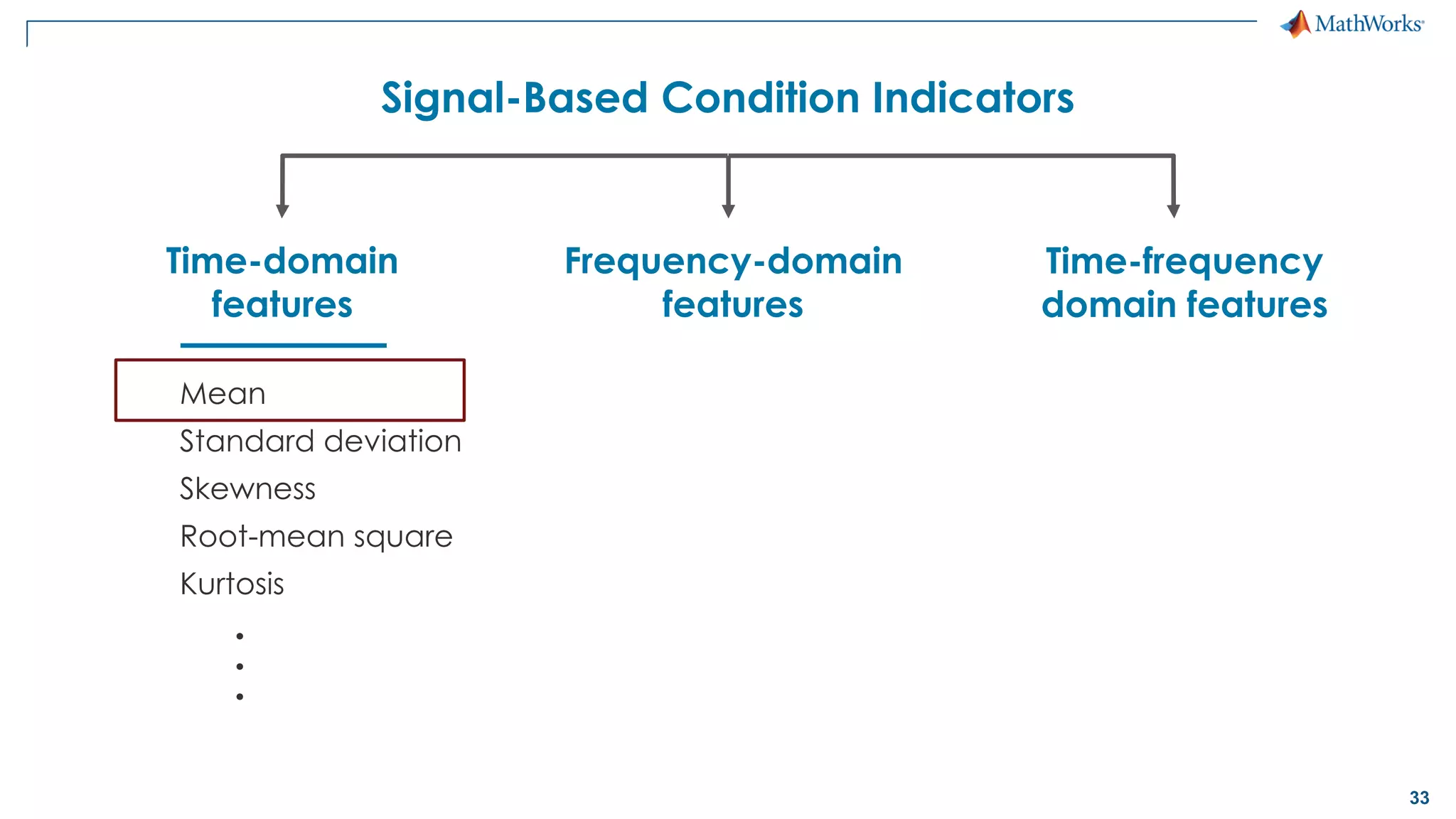
Signal-Based Condition Indicators
Time-domain
features
Frequency-domain
features
Time-frequency
domain features
Mean
Standard deviation
Skewness
Root-mean square
...
Kurtosis
34
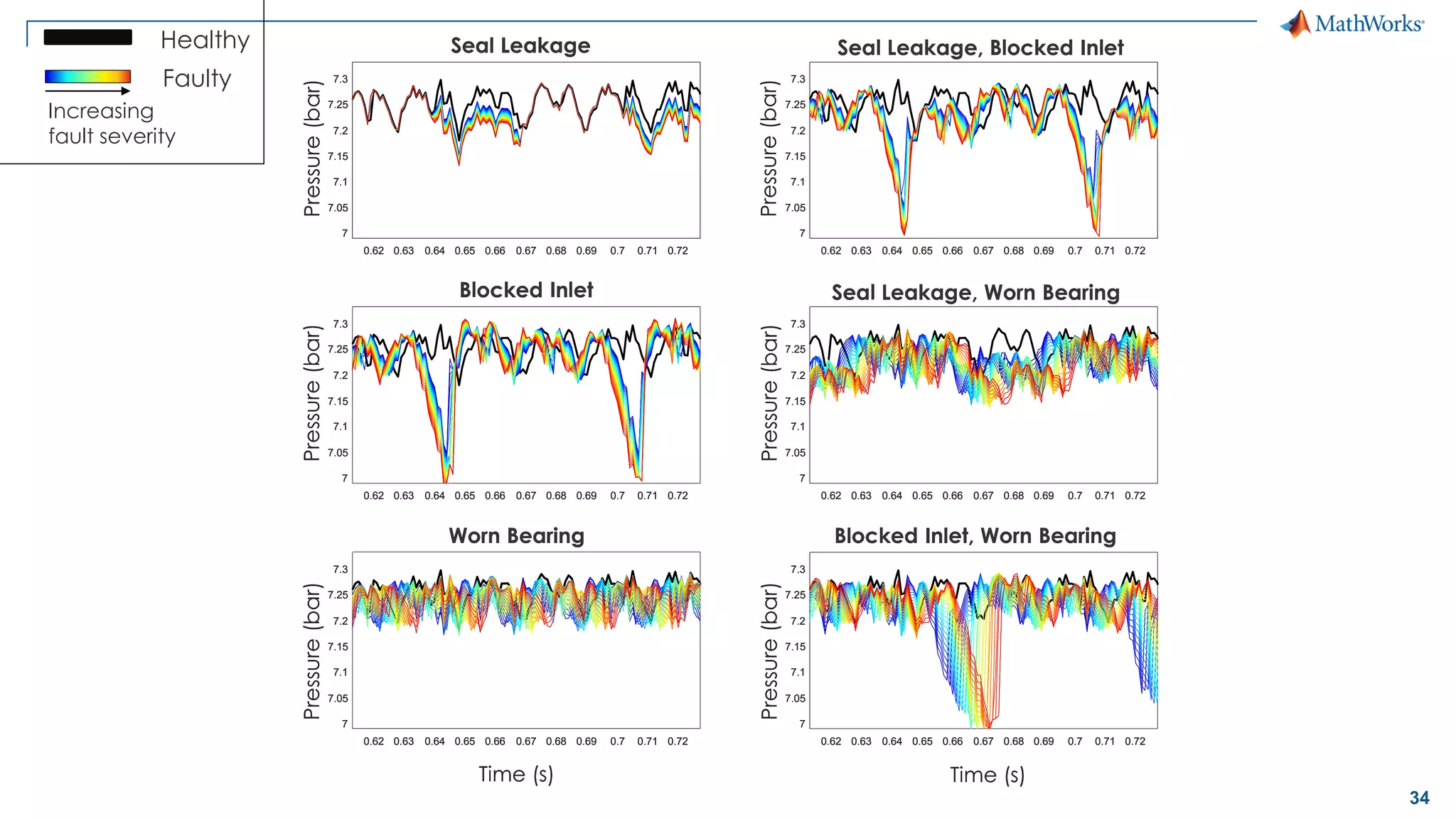
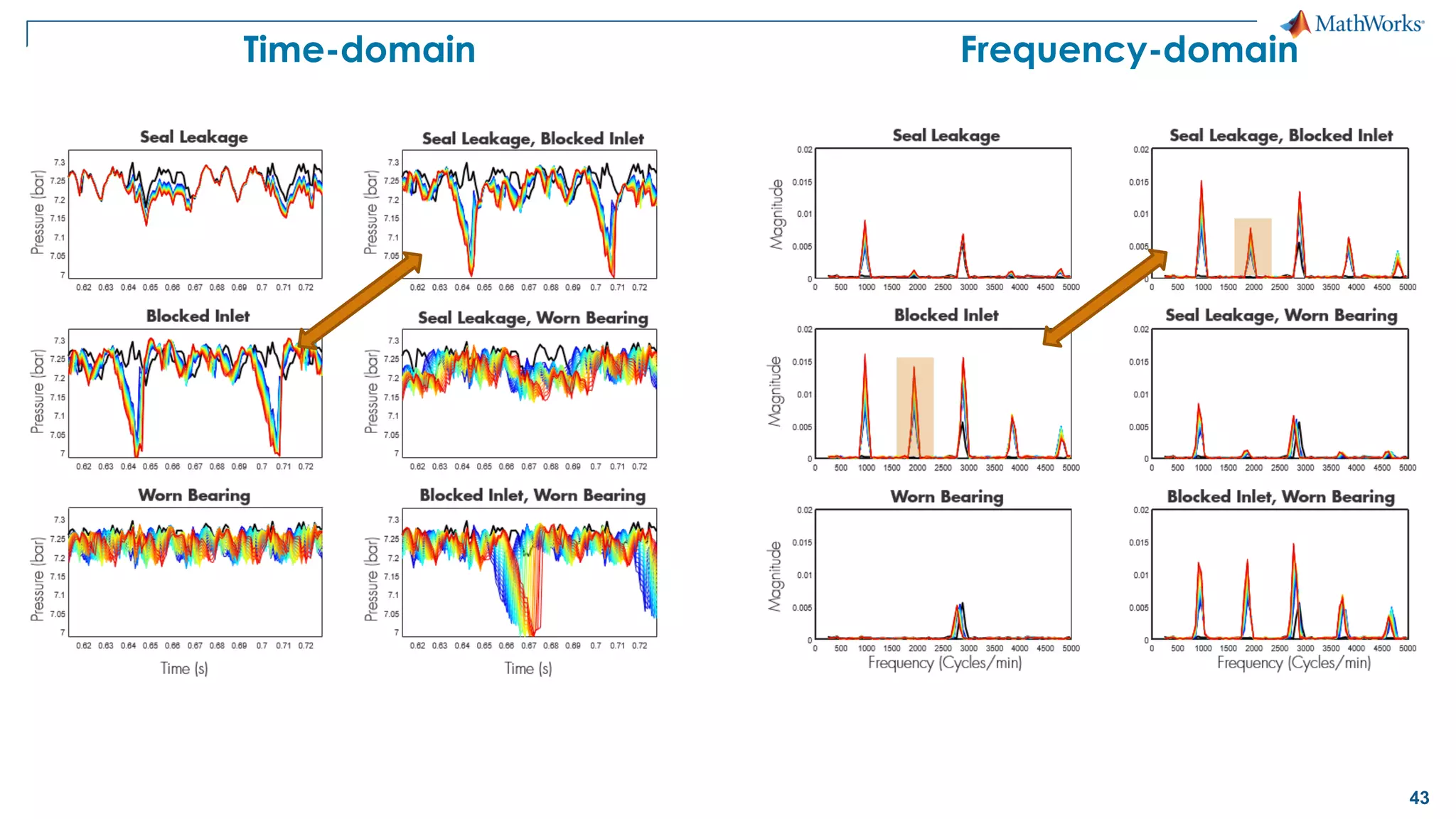
0.62 0.63 0.64 0.65 0.66 0.67 0.68 0.69 0.7 0.71 0.72
7
7.05
7.1
7.15
7.2
7.25
7.3
0.62 0.63 0.64 0.65 0.66 0.67 0.68 0.69 0.7 0.71 0.72
7
7.05
7.1
7.15
7.2
7.25
7.3
0.62 0.63 0.64 0.65 0.66 0.67 0.68 0.69 0.7 0.71 0.72
7
7.05
7.1
7.15
7.2
7.25
7.3
0.62 0.63 0.64 0.65 0.66 0.67 0.68 0.69 0.7 0.71 0.72
7
7.05
7.1
7.15
7.2
7.25
7.3
0.62 0.63 0.64 0.65 0.66 0.67 0.68 0.69 0.7 0.71 0.72
7
7.05
7.1
7.15
7.2
7.25
7.3
0.62 0.63 0.64 0.65 0.66 0.67 0.68 0.69 0.7 0.71 0.72
7
7.05
7.1
7.15
7.2
7.25
7.3
Blocked Inlet
Blocked Inlet, Worn Bearing
Seal Leakage Seal Leakage, Blocked Inlet
Seal Leakage, Worn Bearing
Worn Bearing
Pressure(bar)Pressure(bar)Pressure(bar)
Pressure(bar)Pressure(bar)Pressure(bar)Time (s) Time (s)
0.62 0.63 0.64 0.65 0.66 0.67 0.68 0.69 0.7 0.71 0.72
7
7.05
7.1
7.15
7.2
7.25
7.3
0.62 0.63 0.64 0.65 0.66 0.67 0.68 0.69 0.7 0.71 0.72
7
7.05
7.1
7.15
7.2
7.25
7.3
0.62 0.63 0.64 0.65 0.66 0.67 0.68 0.69 0.7 0.71 0.72
7
7.05
7.1
7.15
7.2
7.25
7.3
0.62 0.63 0.64 0.65 0.66 0.67 0.68 0.69 0.7 0.71 0.72
7
7.05
7.1
7.15
7.2
7.25
7.3
0.62 0.63 0.64 0.65 0.66 0.67 0.68 0.69 0.7 0.71 0.72
7
7.05
7.1
7.15
7.2
7.25
7.3
0.62 0.63 0.64 0.65 0.66 0.67 0.68 0.69 0.7 0.71 0.72
7
7.05
7.1
7.15
7.2
7.25
7.3
Blocked Inlet
Blocked Inlet, Worn Bearing
Seal Leakage Seal Leakage, Blocked Inlet
Seal Leakage, Worn Bearing
Worn Bearing
Pressure(bar)Pressure(bar)Pressure(bar)
Pressure(bar)Pressure(bar)Pressure(bar)Time (s) Time (s)
Healthy
Faulty
Increasing
fault severity
35
0.62 0.63 0.64 0.65 0.66 0.67 0.68 0.69 0.7 0.71 0.72
7
7.05
7.1
7.15
7.2
7.25
7.3
Blocked Inlet
Pressure(bar)
0.62 0.63 0.64 0.65 0.66 0.67 0.68 0.69 0.7 0.71 0.72
7
7.05
7.1
7.15
7.2
7.25
7.3
Blocked Inlet
Pressure(bar)
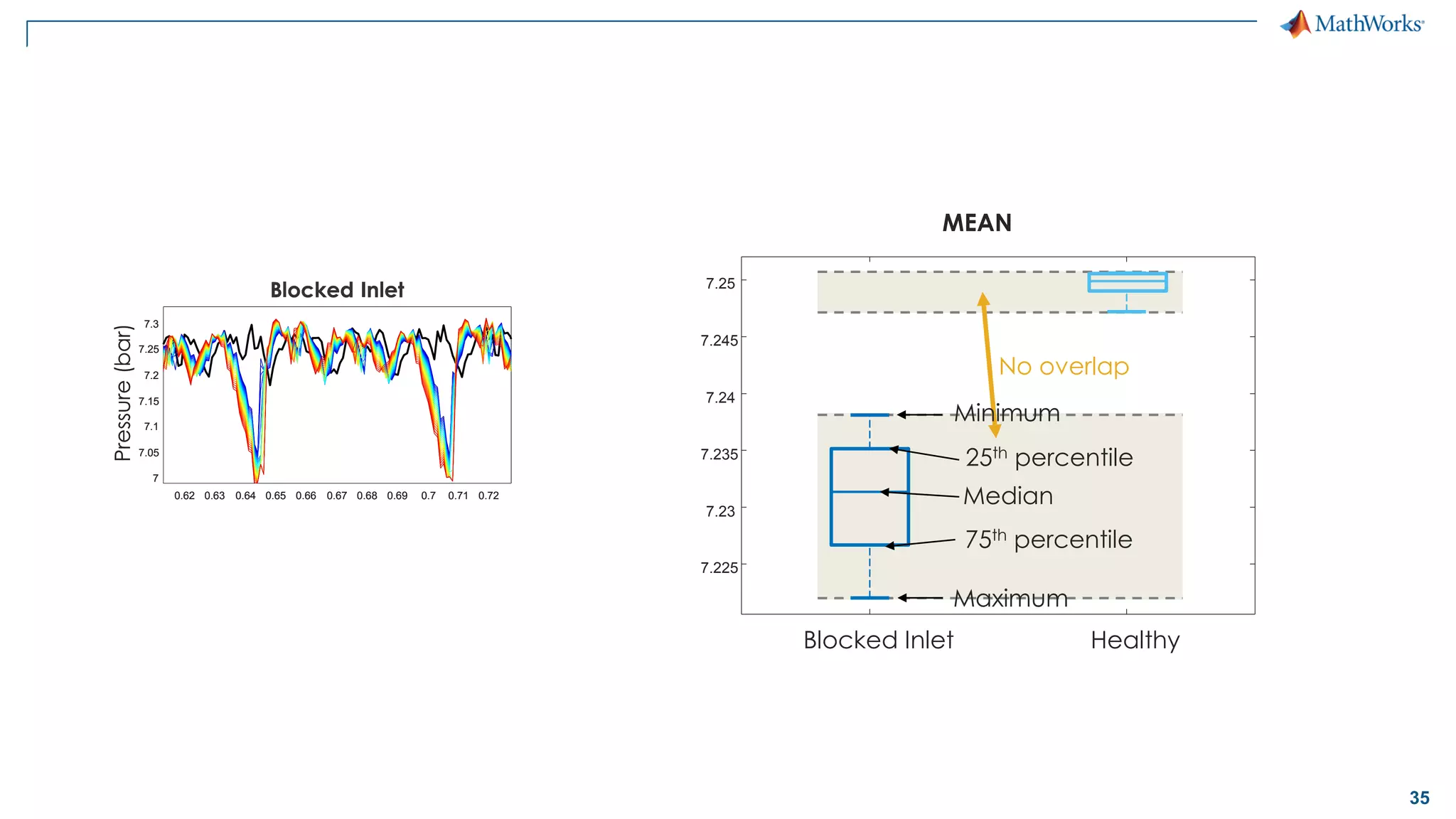
Blocked Inlet Healthy
7.225
7.23
7.235
7.24
7.245
7.25
MEAN
No overlap
Median
25th percentile
75th percentile
Minimum
Maximum
36
7.21
7.215
7.22
7.225
7.23
7.235
7.24
7.245
7.25
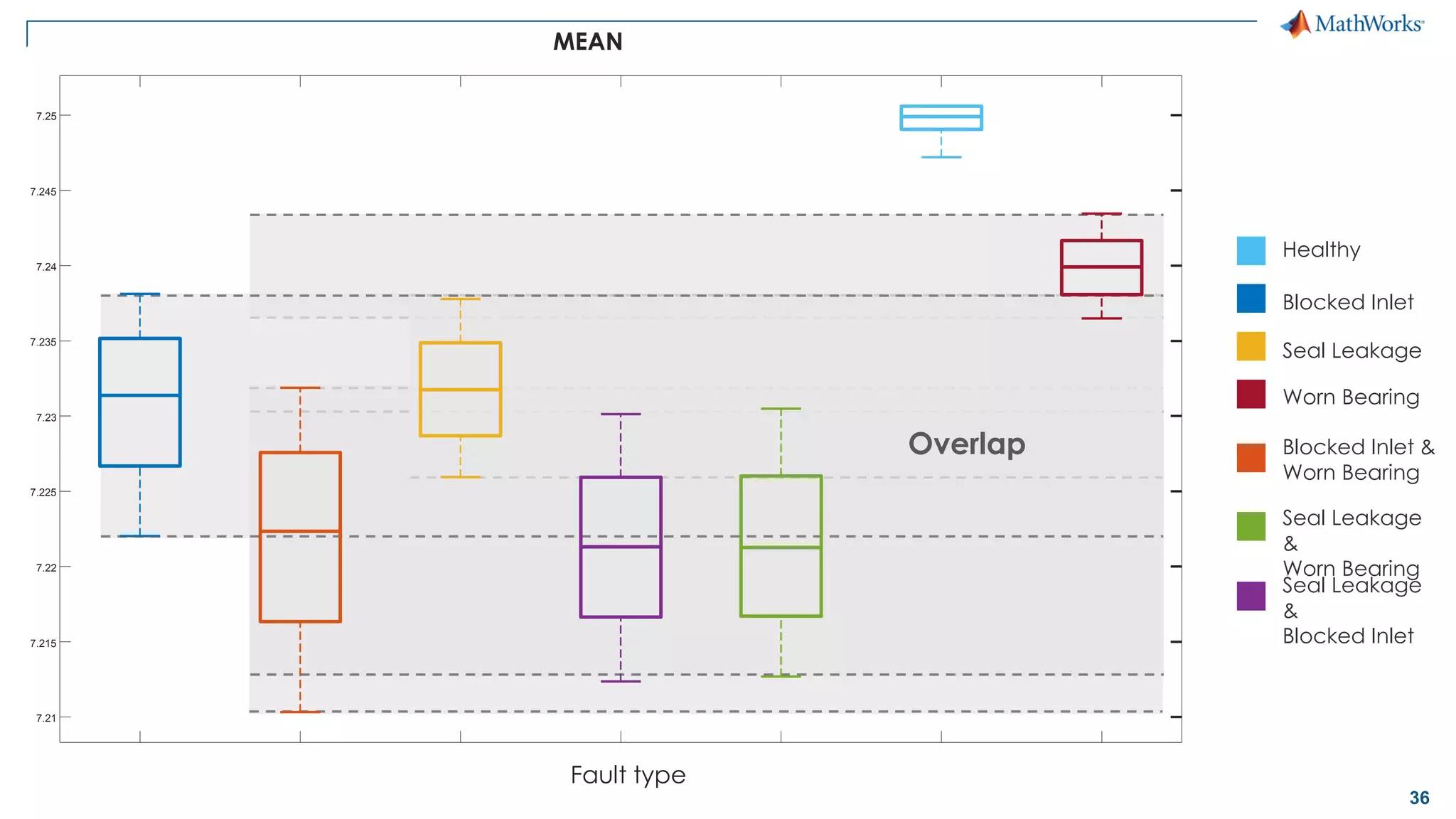
MEAN
Healthy
Blocked Inlet
Seal Leakage
Worn Bearing
Blocked Inlet &
Worn Bearing
Seal Leakage
&
Worn Bearing
Seal Leakage
&
Blocked Inlet
Fault type
Overlap
37
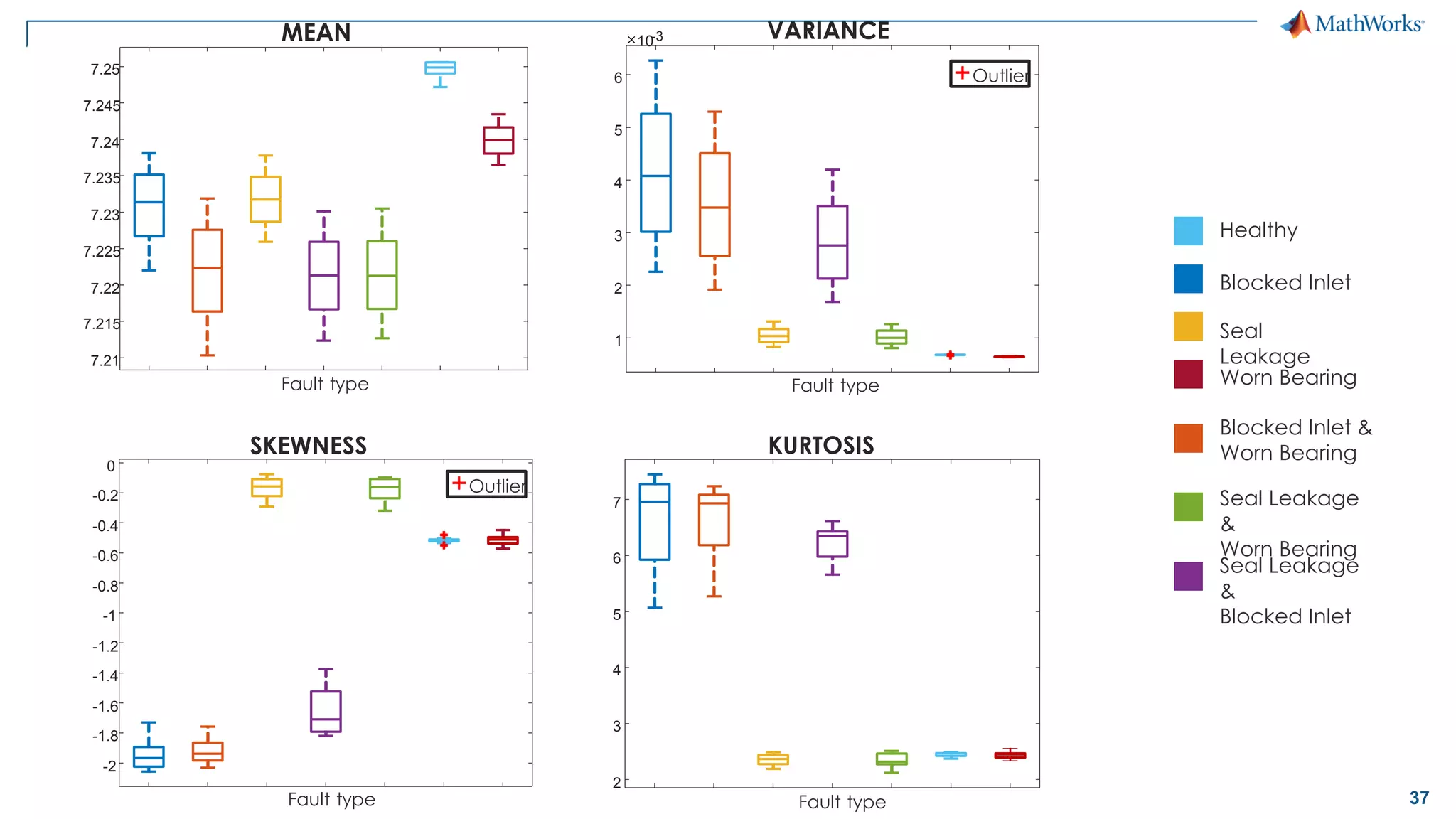
MEAN VARIANCE
KURTOSIS
Healthy
Blocked Inlet
Seal
Leakage
Worn Bearing
Blocked Inlet &
Worn Bearing
Seal Leakage
&
Worn Bearing
Seal Leakage
&
Blocked Inlet
7.21
7.215
7.22
7.225
7.23
7.235
7.24
7.245
7.25
SKEWNESS
-2
-1.8
-1.6
-1.4
-1.2
-1
-0.8
-0.6
-0.4
-0.2
0
1
2
3
4
5
6
10-3
2
3
4
5
6
7
Fault type Fault type
Outlier
Outlier
38
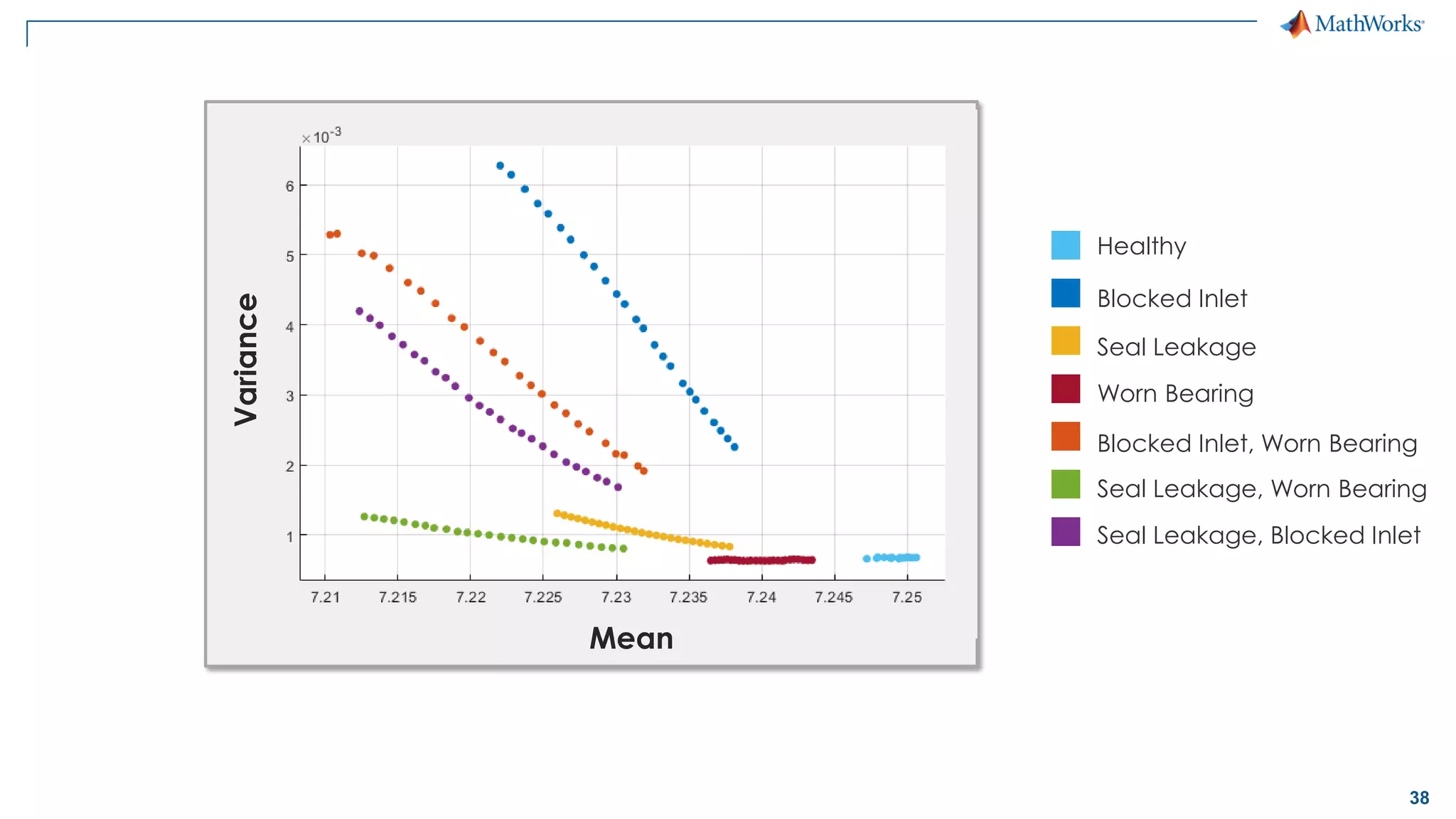
Healthy
Blocked Inlet
Seal Leakage
Worn Bearing
Blocked Inlet, Worn Bearing
Seal Leakage, Worn Bearing
Seal Leakage, Blocked Inlet
Mean
Variance
40
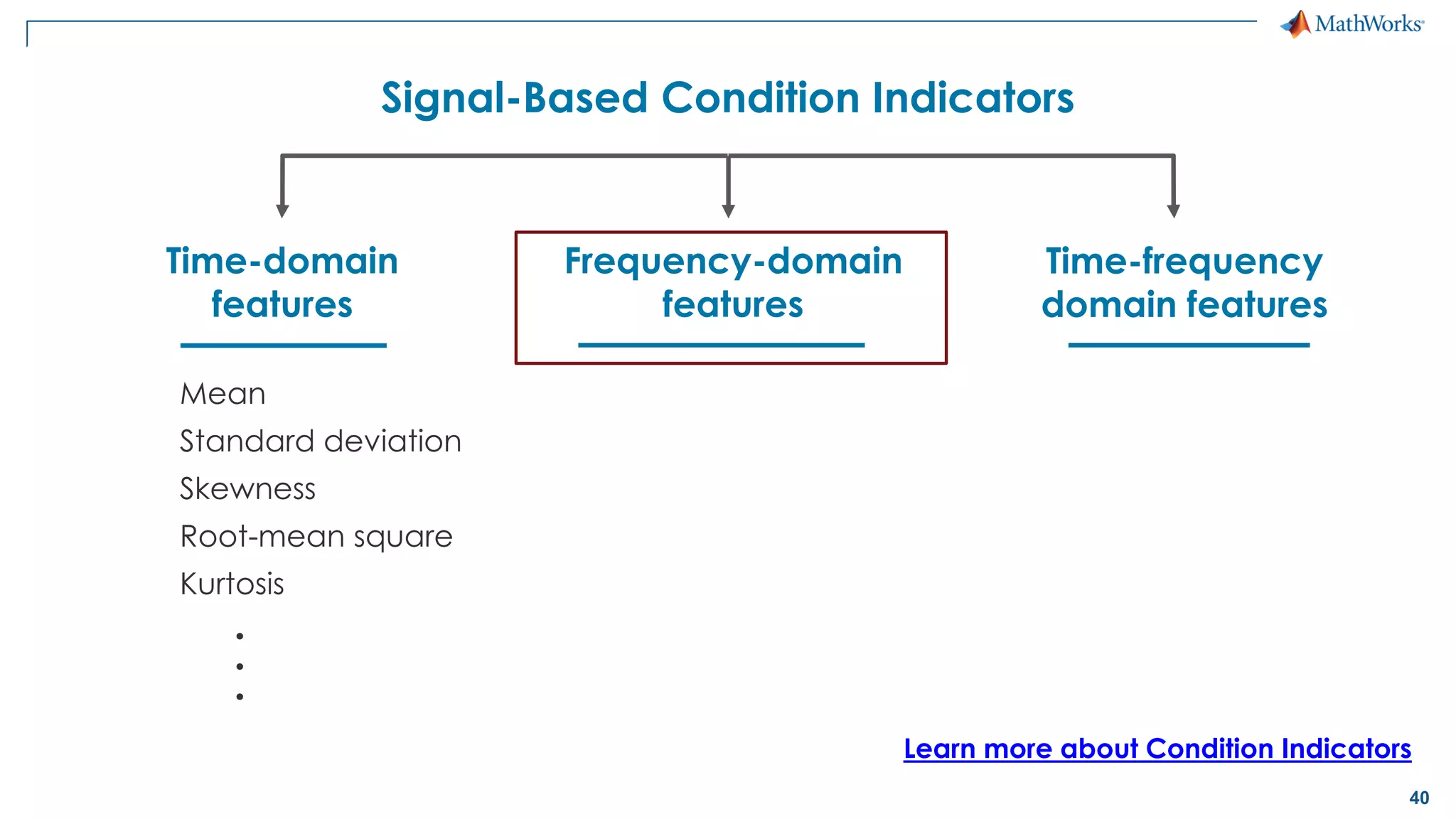
Signal-Based Condition Indicators
Time-domain
features
Frequency-domain
features
Time-frequency
domain features
Mean
Standard deviation
Skewness
Root-mean square
...
Kurtosis
Learn more about Condition Indicators
41
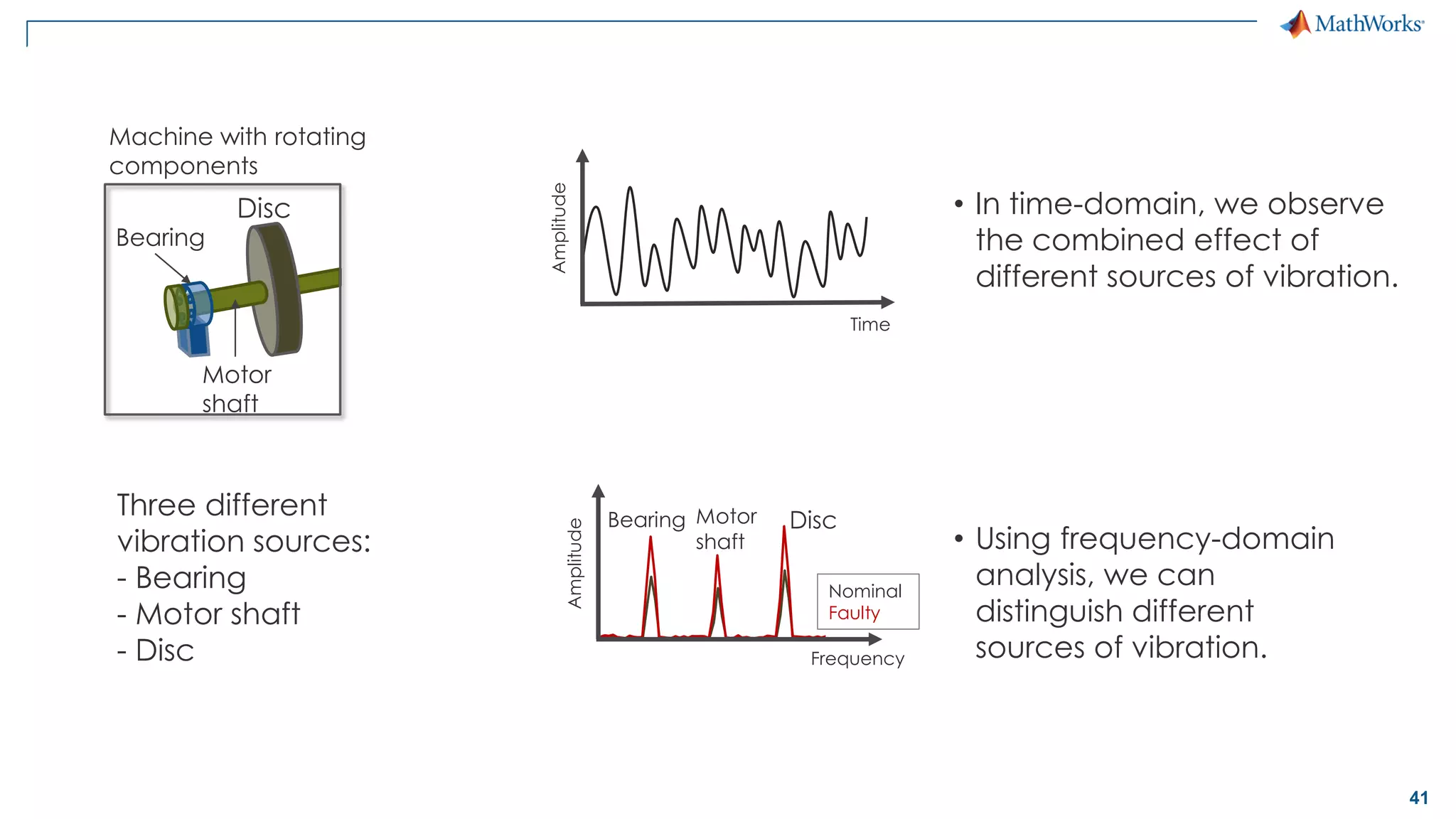
Three different
vibration sources:
- Bearing
- Motor shaft
- Disc
• In time-domain, we observe
the combined effect of
different sources of vibration.
DiscBearing Motor
shaft
Disc
Bearing
Motor
shaft
Machine with rotating
components
Time
Amplitude
Amplitude
Frequency
• Using frequency-domain
analysis, we can
distinguish different
sources of vibration.
Nominal
Faulty
42
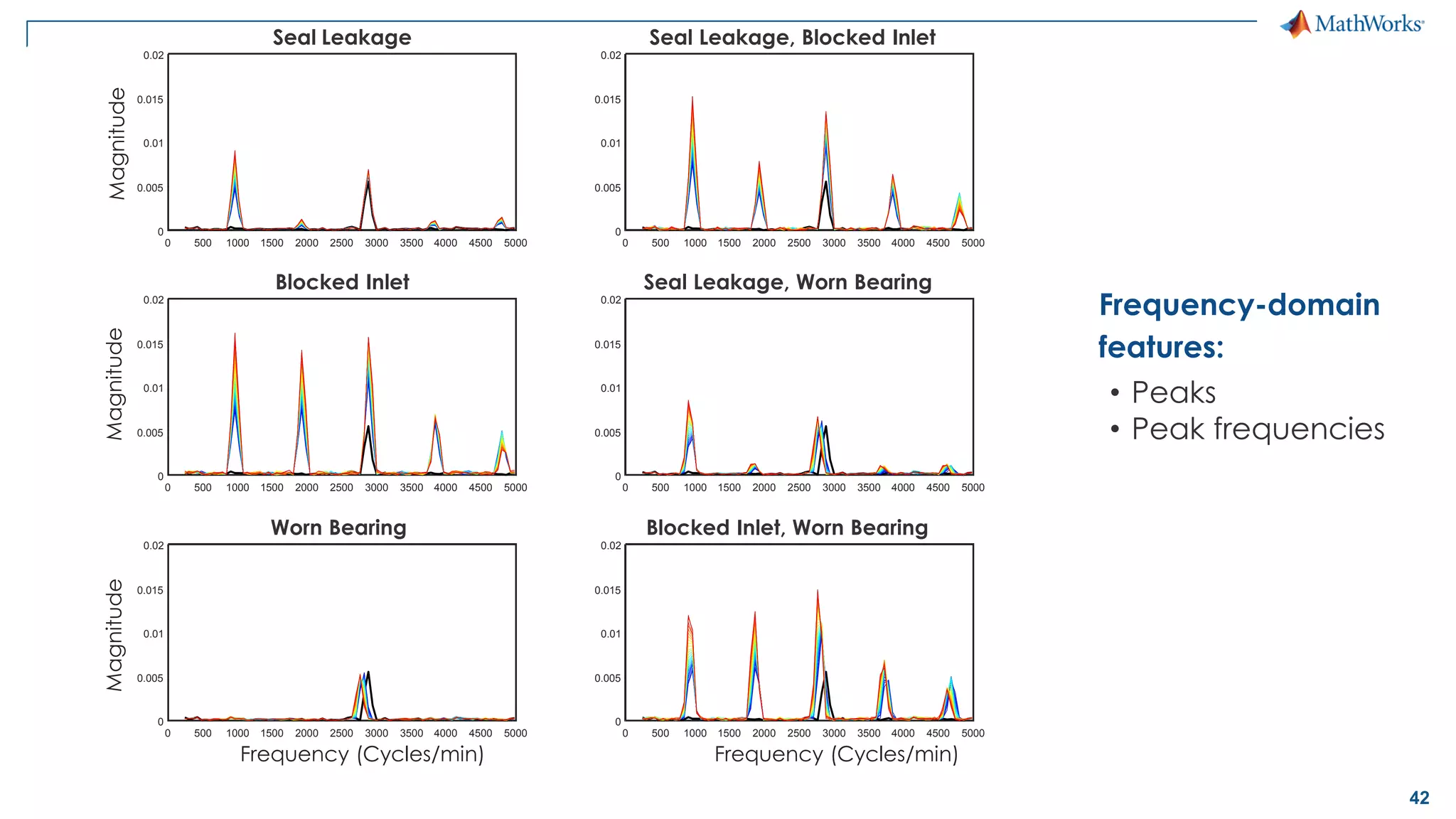
Frequency-domain
features:
• Peaks
• Peak frequencies
0 500 1000 1500 2000 2500 3000 3500 4000 4500 5000
0
0.005
0.01
0.015
0.02
Blocked Inlet
0 500 1000 1500 2000 2500 3000 3500 4000 4500 5000
Frequency (Cycles/min)
0
0.005
0.01
0.015
0.02
Blocked Inlet, Worn Bearing
0 500 1000 1500 2000 2500 3000 3500 4000 4500 5000
0
0.005
0.01
0.015
0.02
Seal Leakage
0 500 1000 1500 2000 2500 3000 3500 4000 4500 5000
0
0.005
0.01
0.015
0.02
Seal Leakage, Blocked Inlet
0 500 1000 1500 2000 2500 3000 3500 4000 4500 5000
0
0.005
0.01
0.015
0.02
Seal Leakage, Worn Bearing
0 500 1000 1500 2000 2500 3000 3500 4000 4500 5000
Frequency (Cycles/min)
0
0.005
0.01
0.015
0.02
Worn Bearing
MagnitudeMagnitudeMagnitude
43
Time-domain Frequency-domain
45
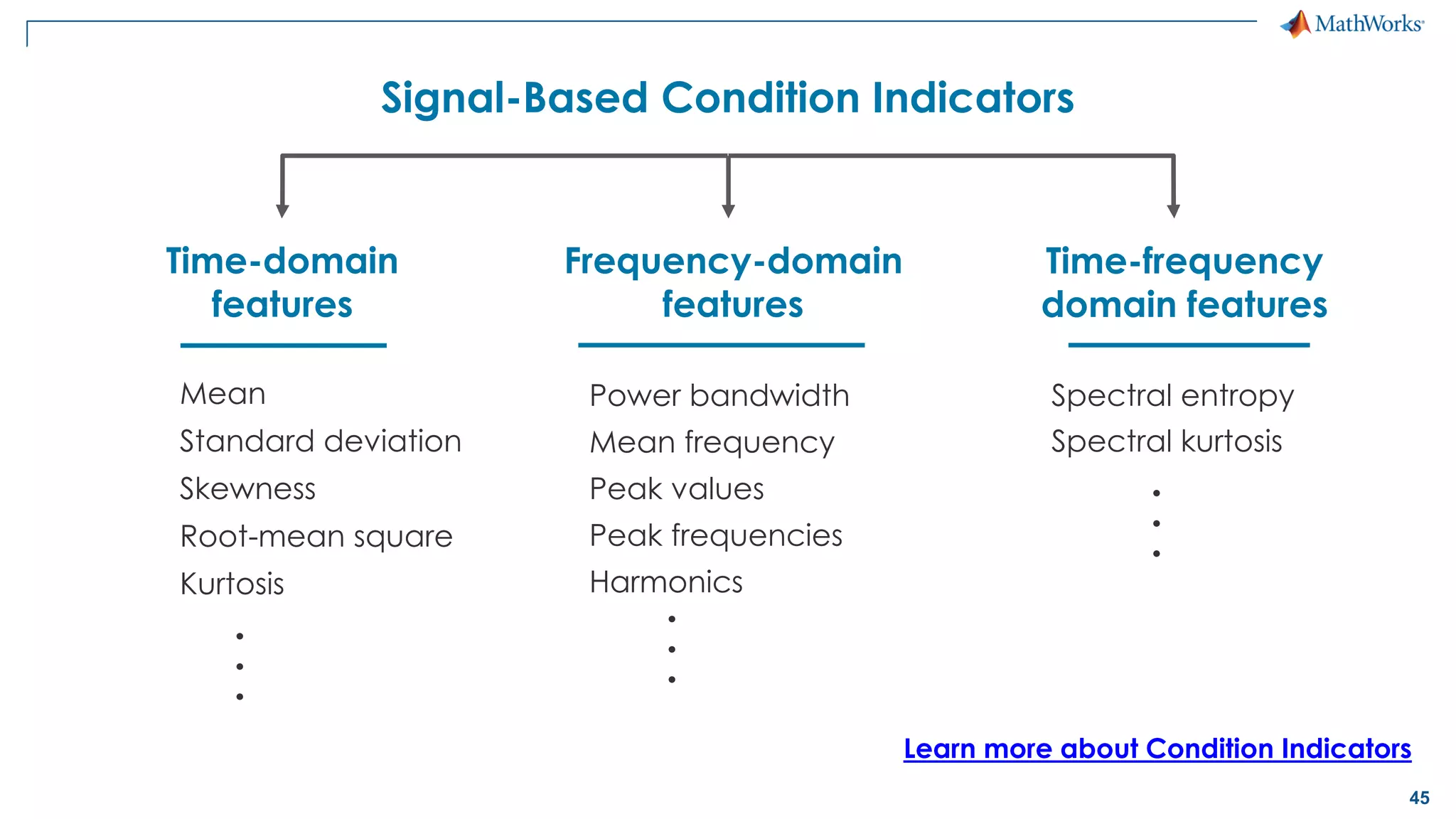
Signal-Based Condition Indicators
Time-domain
features
Frequency-domain
features
Time-frequency
domain features
Power bandwidth
Peak values
Peak frequencies
Mean frequency
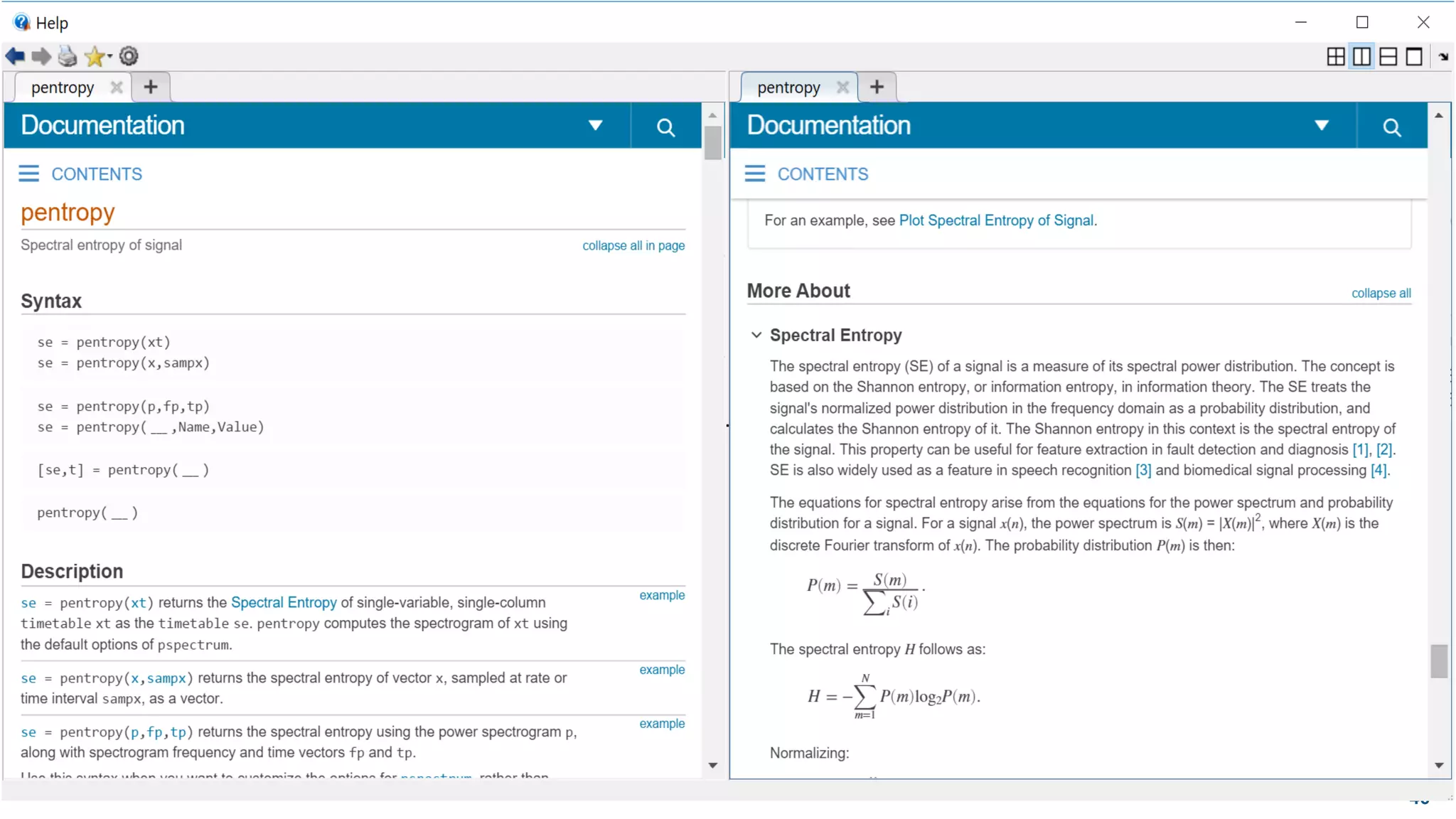
Spectral entropy
Spectral kurtosis
Harmonics
...
...
Mean
Standard deviation
Skewness
Root-mean square
...
Kurtosis
Learn more about Condition Indicators
46
47
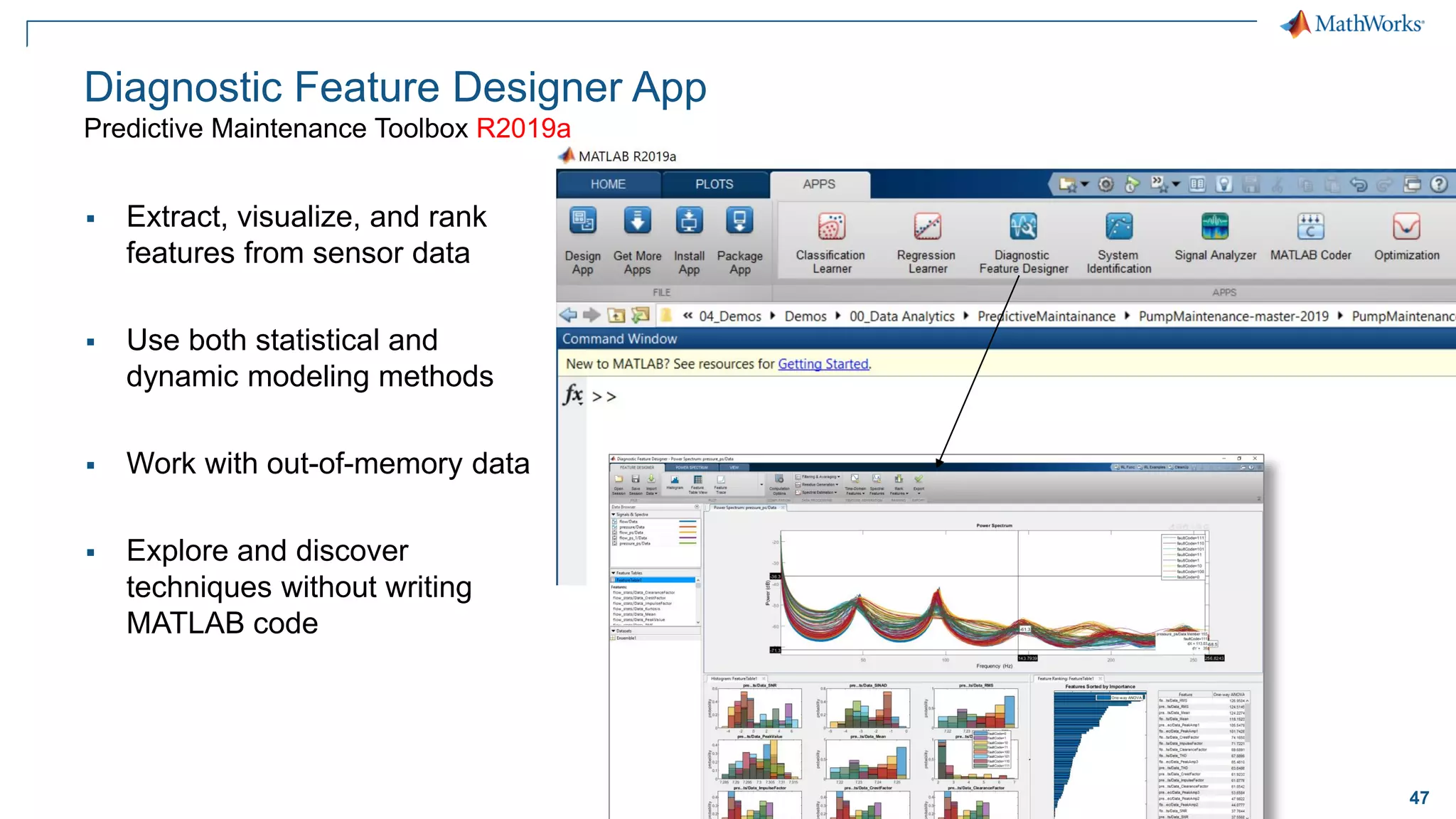
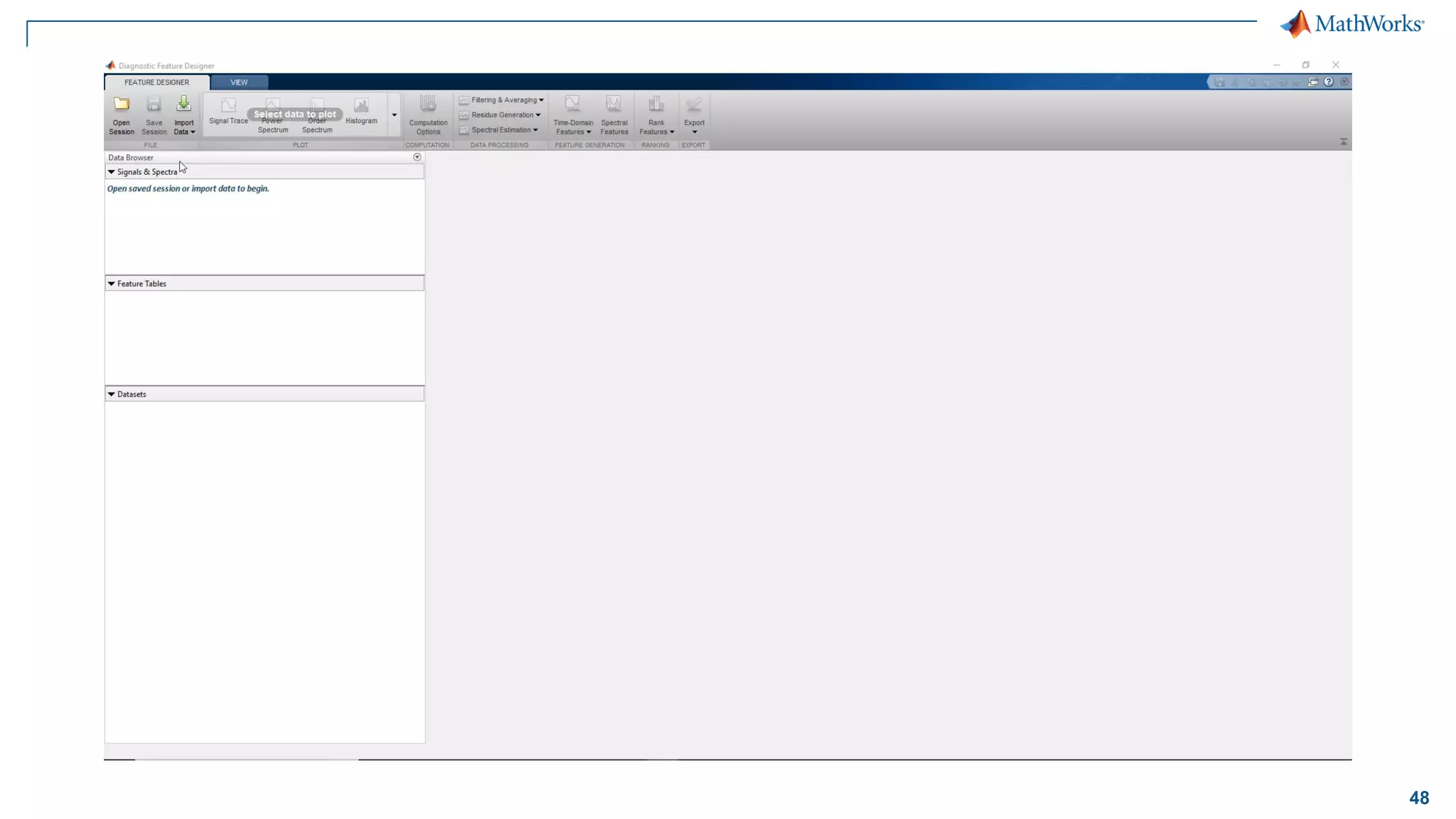
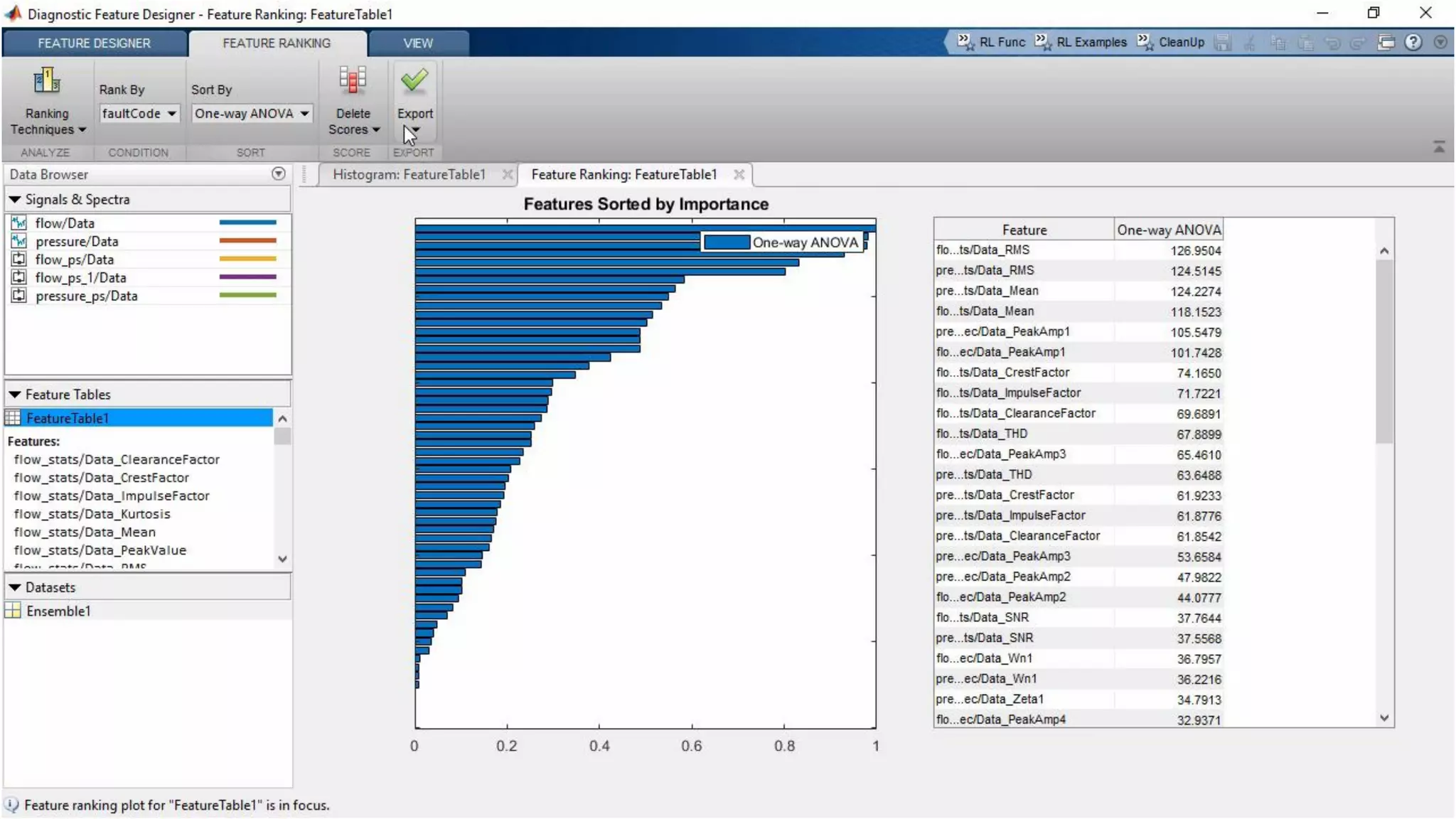
Diagnostic Feature Designer App
Predictive Maintenance Toolbox R2019a
▪ Extract, visualize, and rank
features from sensor data
▪ Use both statistical and
dynamic modeling methods
▪ Work with out-of-memory data
▪ Explore and discover
techniques without writing
MATLAB code
48
49
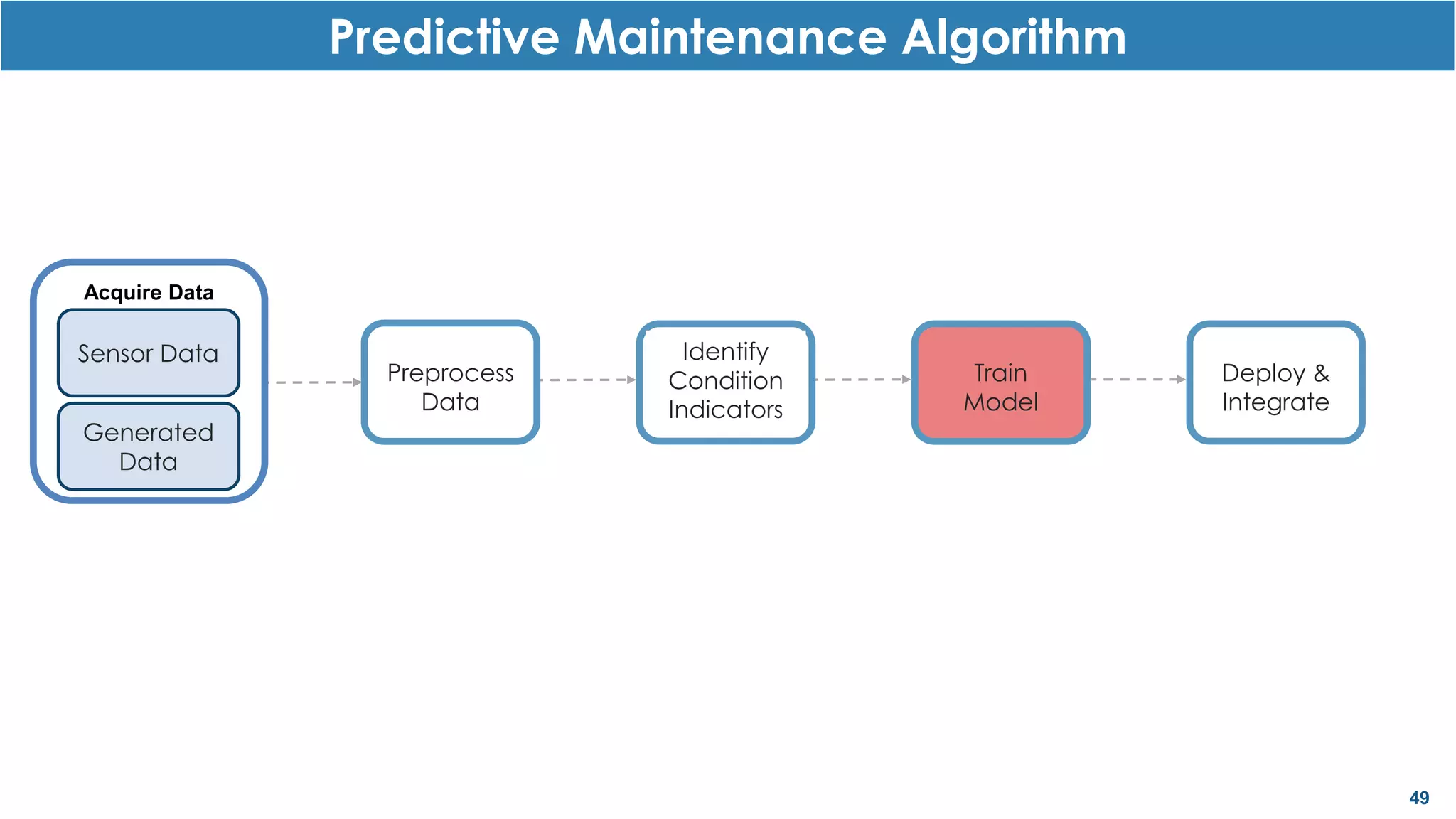
Predictive Maintenance Algorithm
Preprocess
Data
Identify
Condition
Indicators
Train
Model
Deploy &
Integrate
Acquire Data
Sensor Data
Generated
Data
50
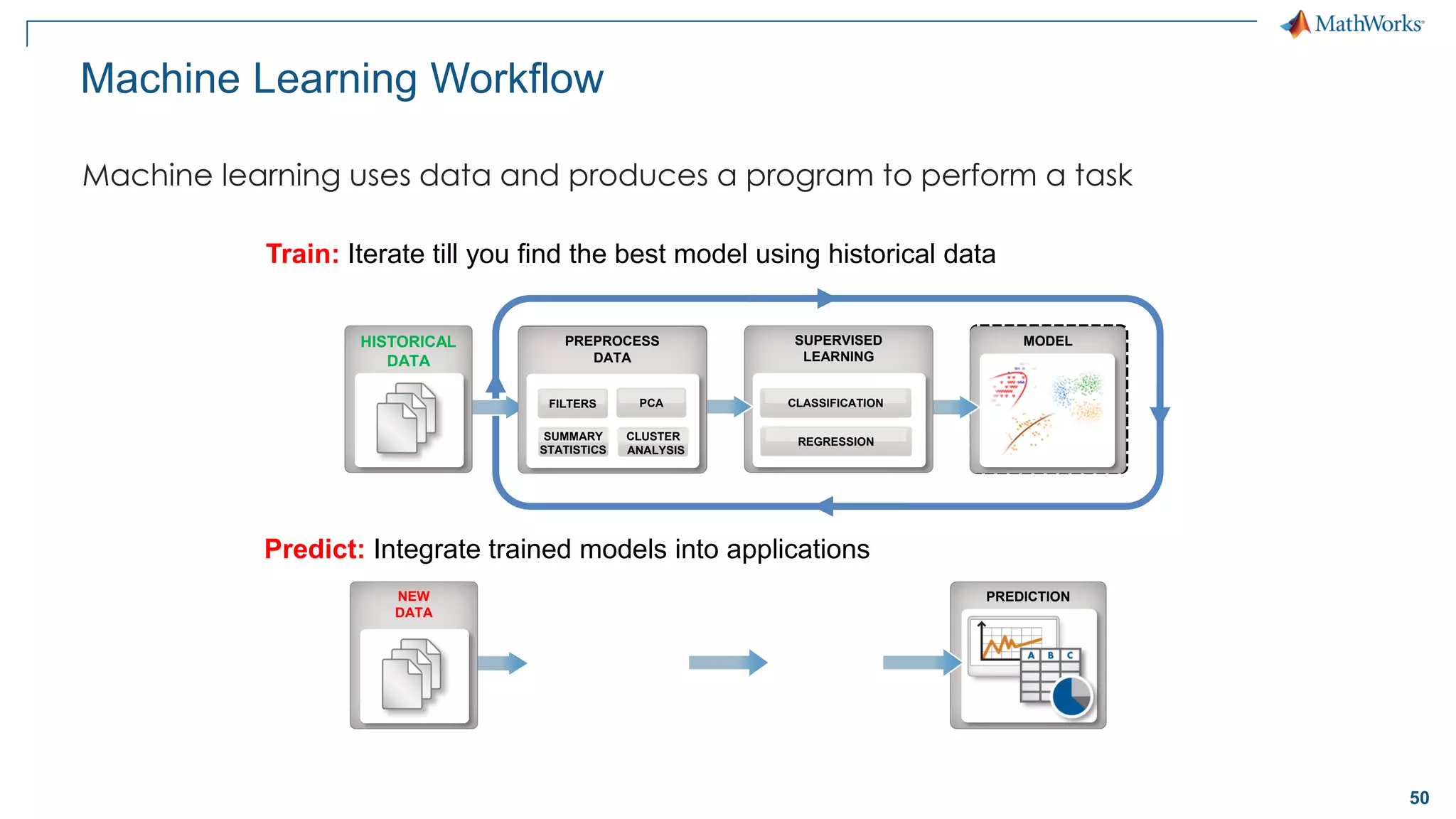
MODEL
PREDICTION
Machine Learning Workflow
Train: Iterate till you find the best model using historical data
Predict: Integrate trained models into applications
MODELSUPERVISED
LEARNING
CLASSIFICATION
REGRESSION
PREPROCESS
DATA
SUMMARY
STATISTICS
PCAFILTERS
CLUSTER
ANALYSIS
HISTORICAL
DATA
PREPROCESS
DATA
SUMMARY
STATISTICS
PCAFILTERS
CLUSTER
ANALYSIS
NEW
DATA
Machine learning uses data and produces a program to perform a task
51
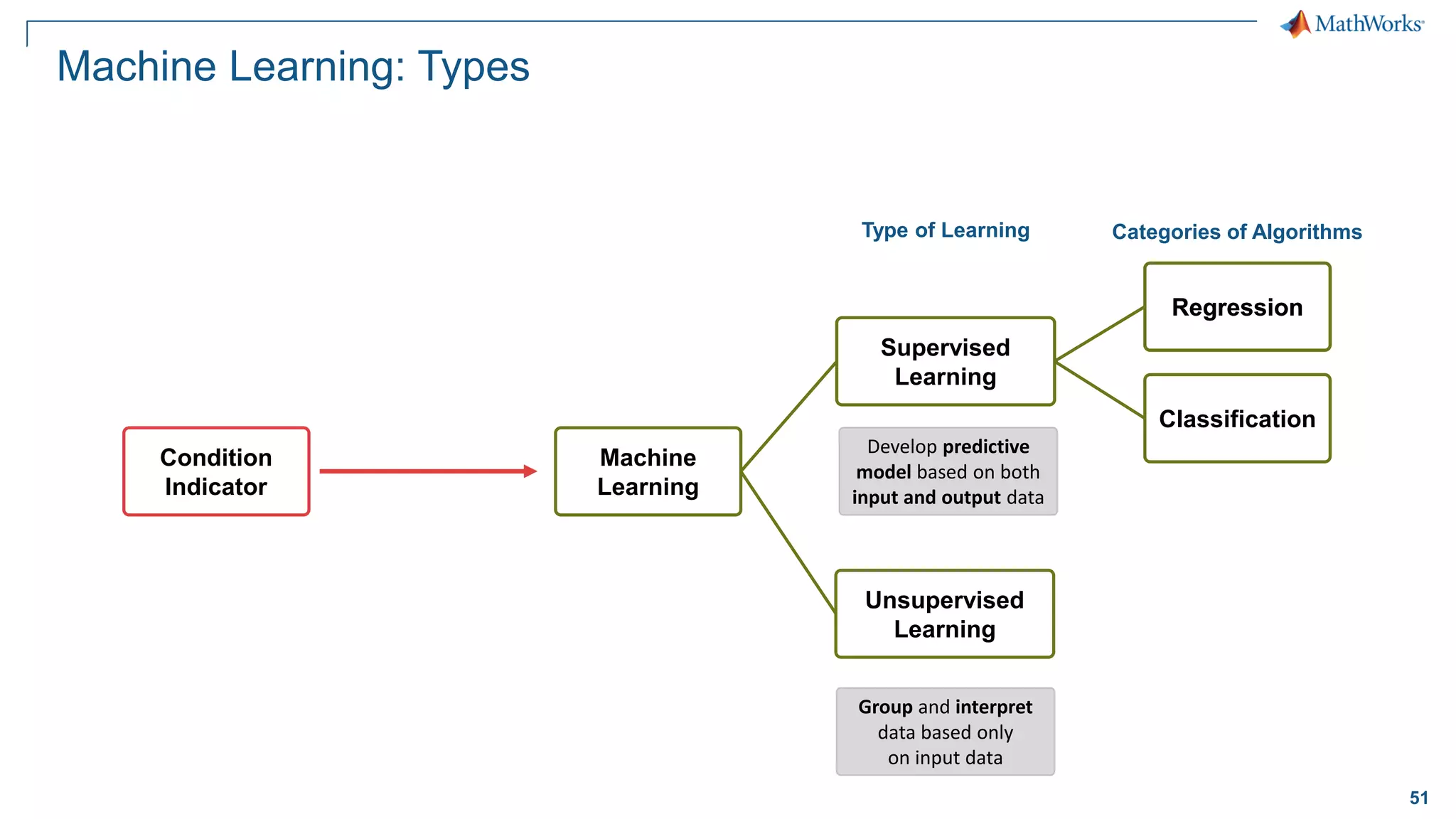
Machine
Learning
Supervised
Learning
Classification
Regression
Unsupervised
Learning
Group and interpret
data based only
on input data
Develop predictive
model based on both
input and output data
Type of Learning Categories of Algorithms
Condition
Indicator
Machine Learning: Types
Regression
52
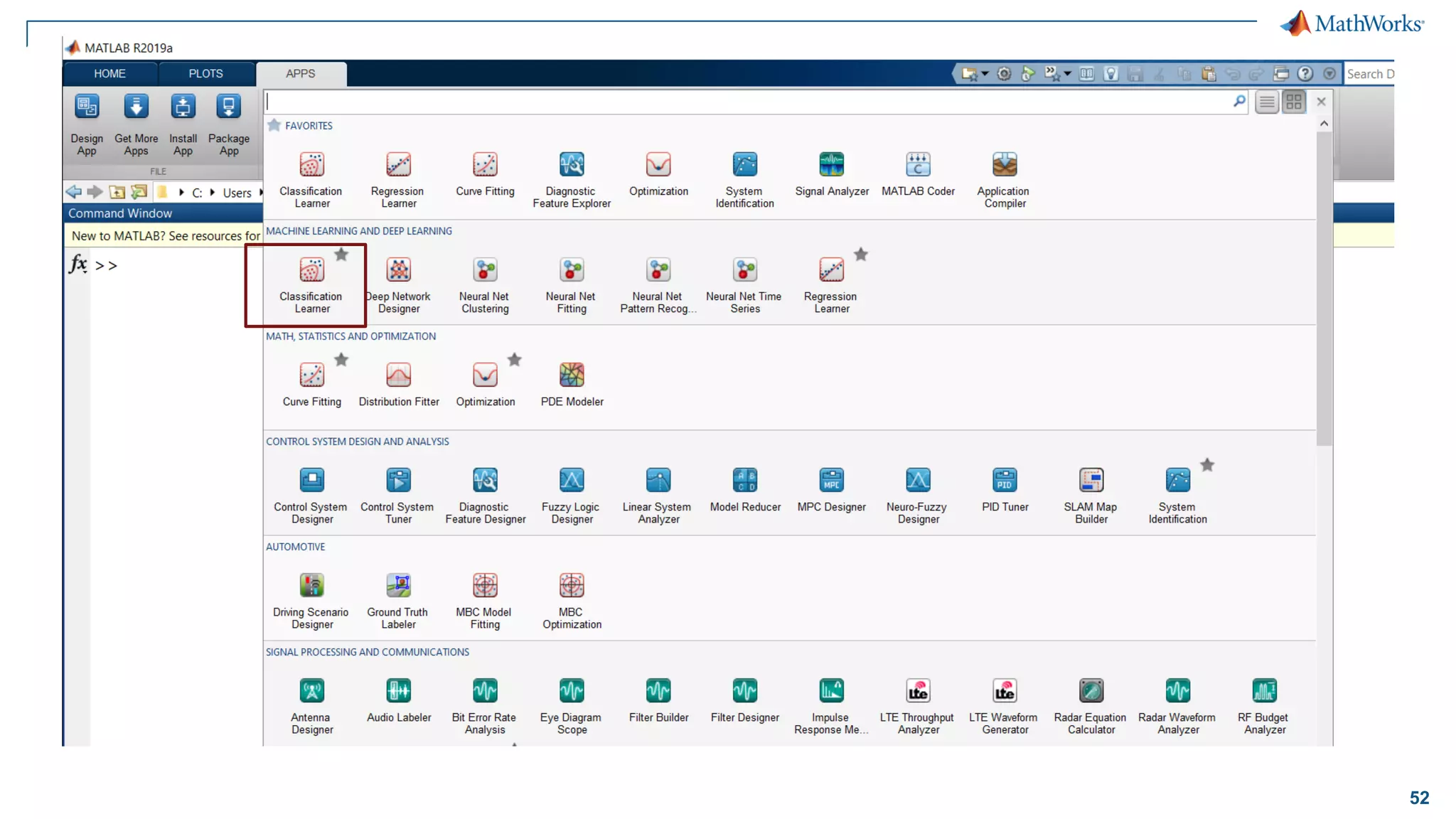
53
Video showing App in action
54
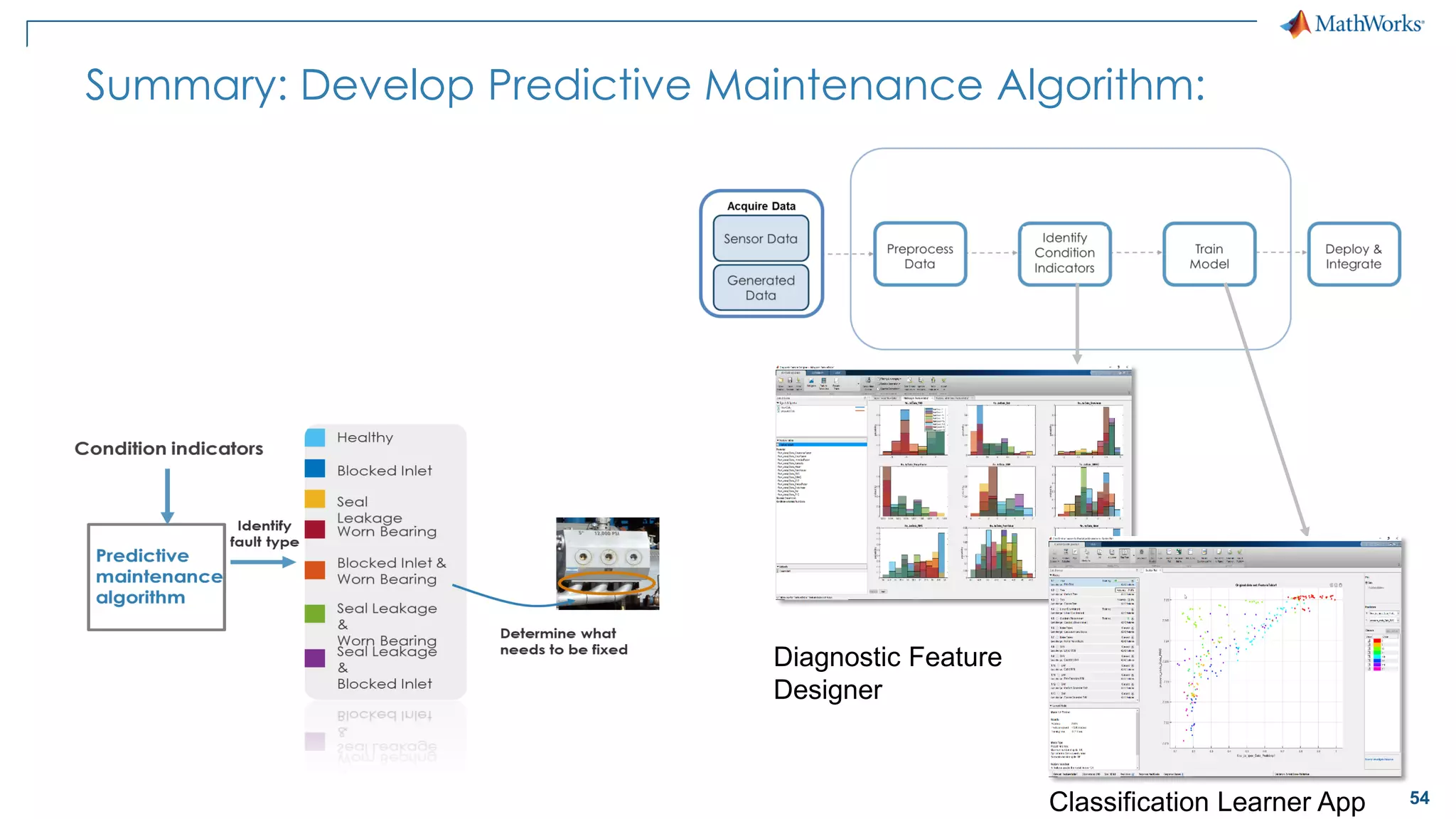
Summary: Develop Predictive Maintenance Algorithm:
Classification Learner App
Diagnostic Feature
Designer
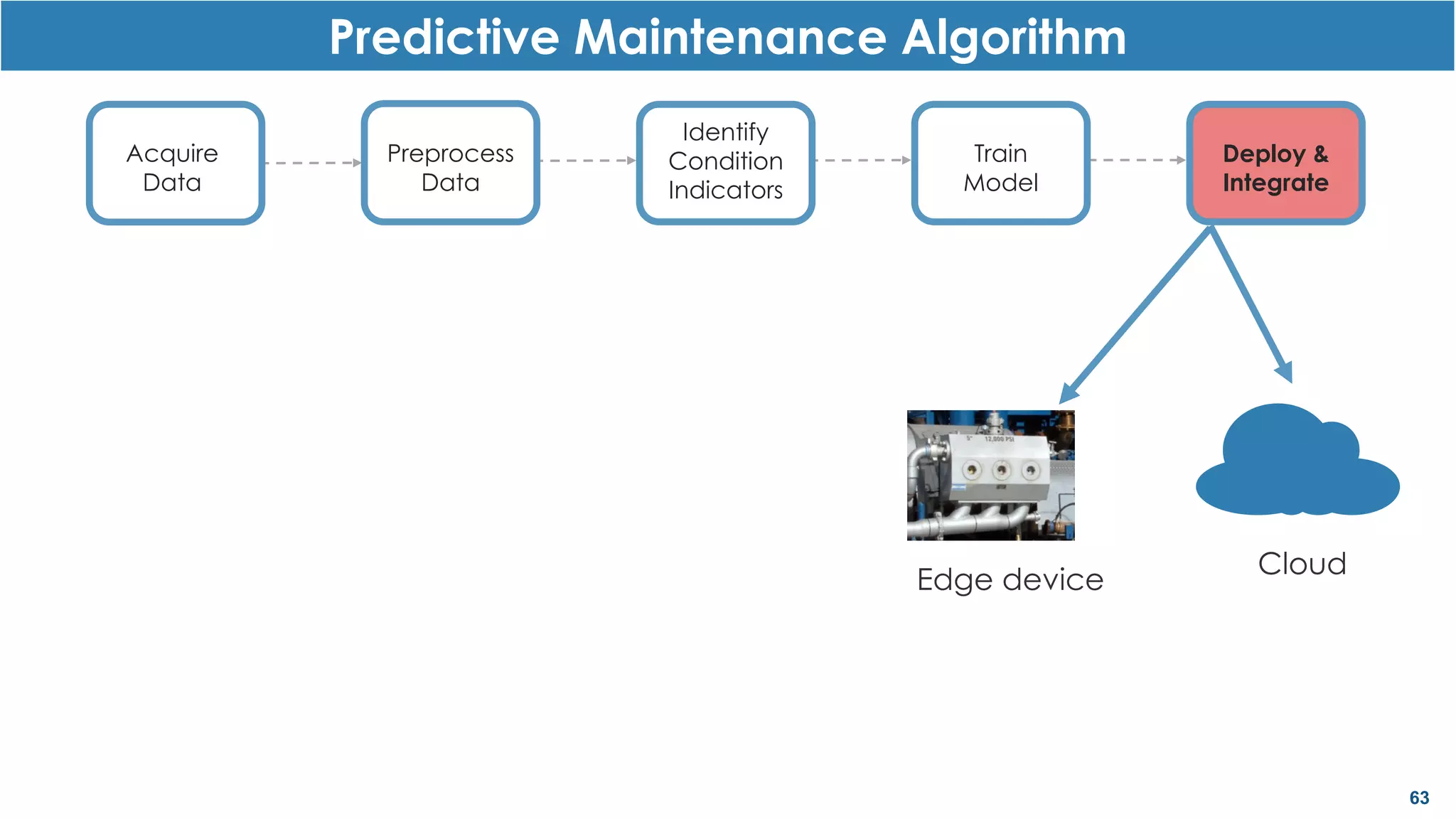
63
Acquire
Data
Predictive Maintenance Algorithm
Preprocess
Data
Identify
Condition
Indicators
Train
Model
Deploy &
Integrate
Edge device
Cloud
64
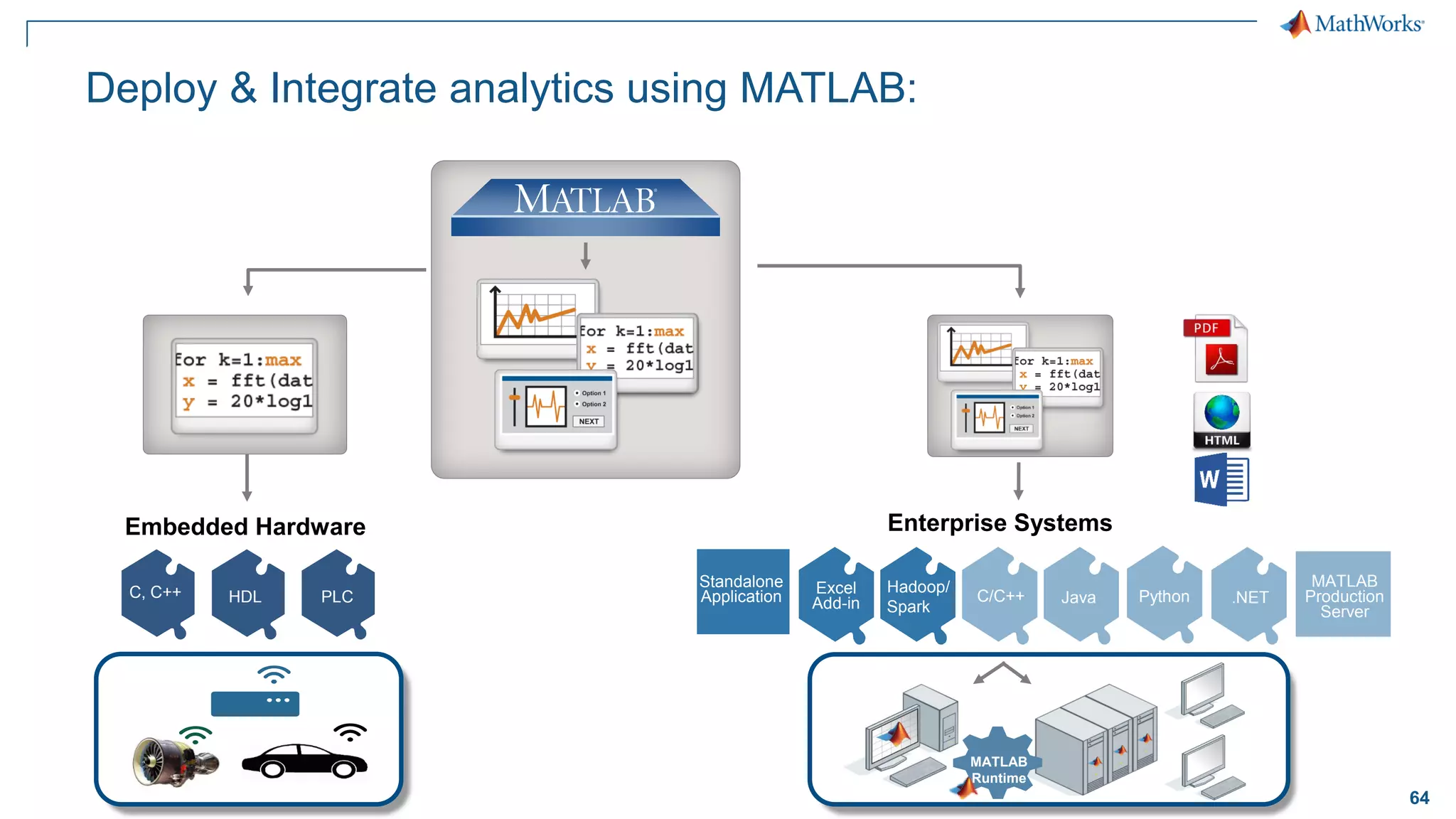
Deploy & Integrate analytics using MATLAB:
MATLAB
Runtime
C, C++ HDL PLC
Embedded Hardware
C/C++ ++
Excel
Add-in Java
Hadoop/
Spark
.NET
MATLAB
Production
Server
Standalone
Application
Enterprise Systems
Python
65
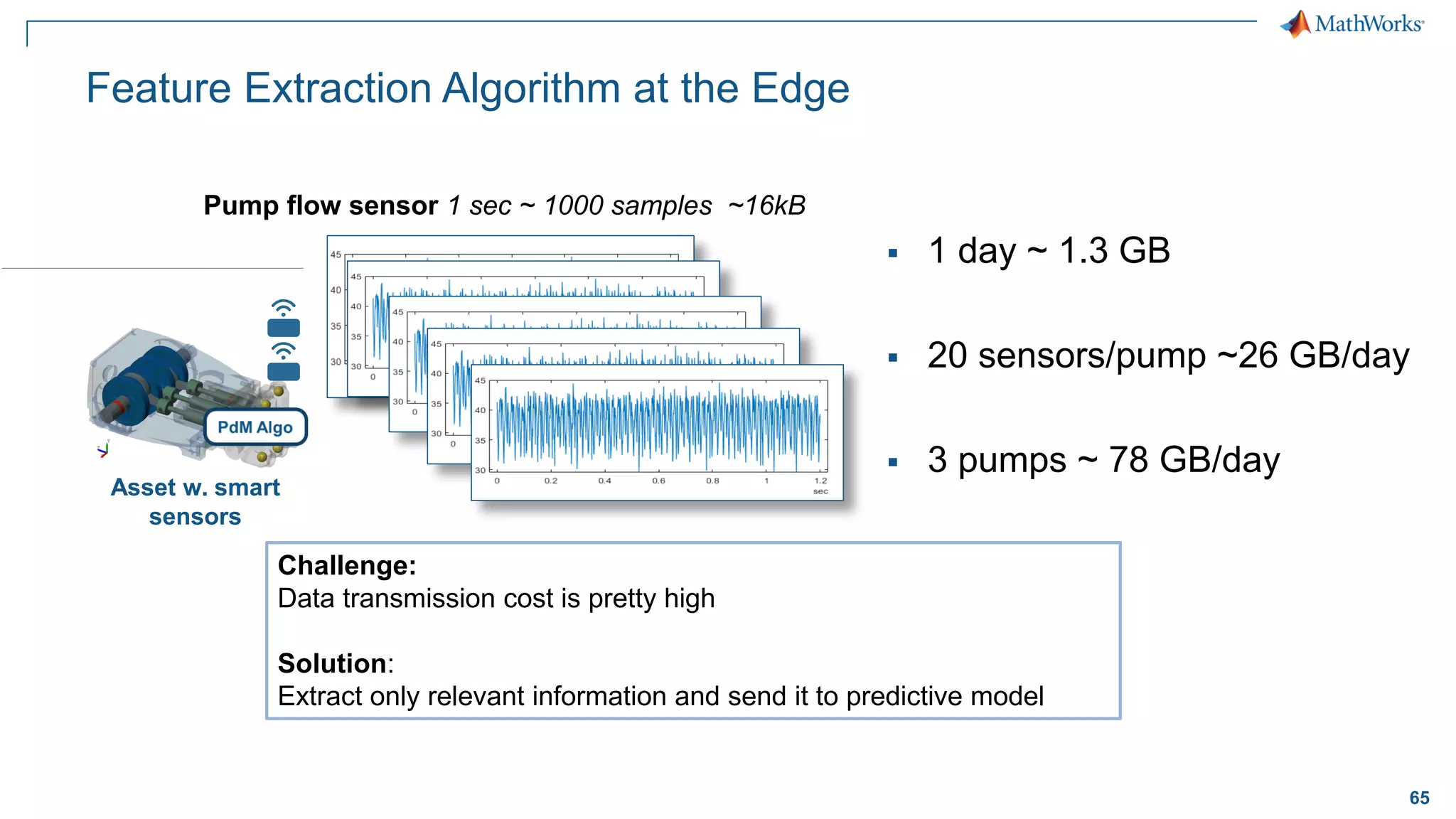
Feature Extraction Algorithm at the Edge
Asset w. smart
sensors
▪ 1 day ~ 1.3 GB
▪ 20 sensors/pump ~26 GB/day
▪ 3 pumps ~ 78 GB/day
Pump flow sensor 1 sec ~ 1000 samples ~16kB
Challenge:
Data transmission cost is pretty high
Solution:
Extract only relevant information and send it to predictive model
66
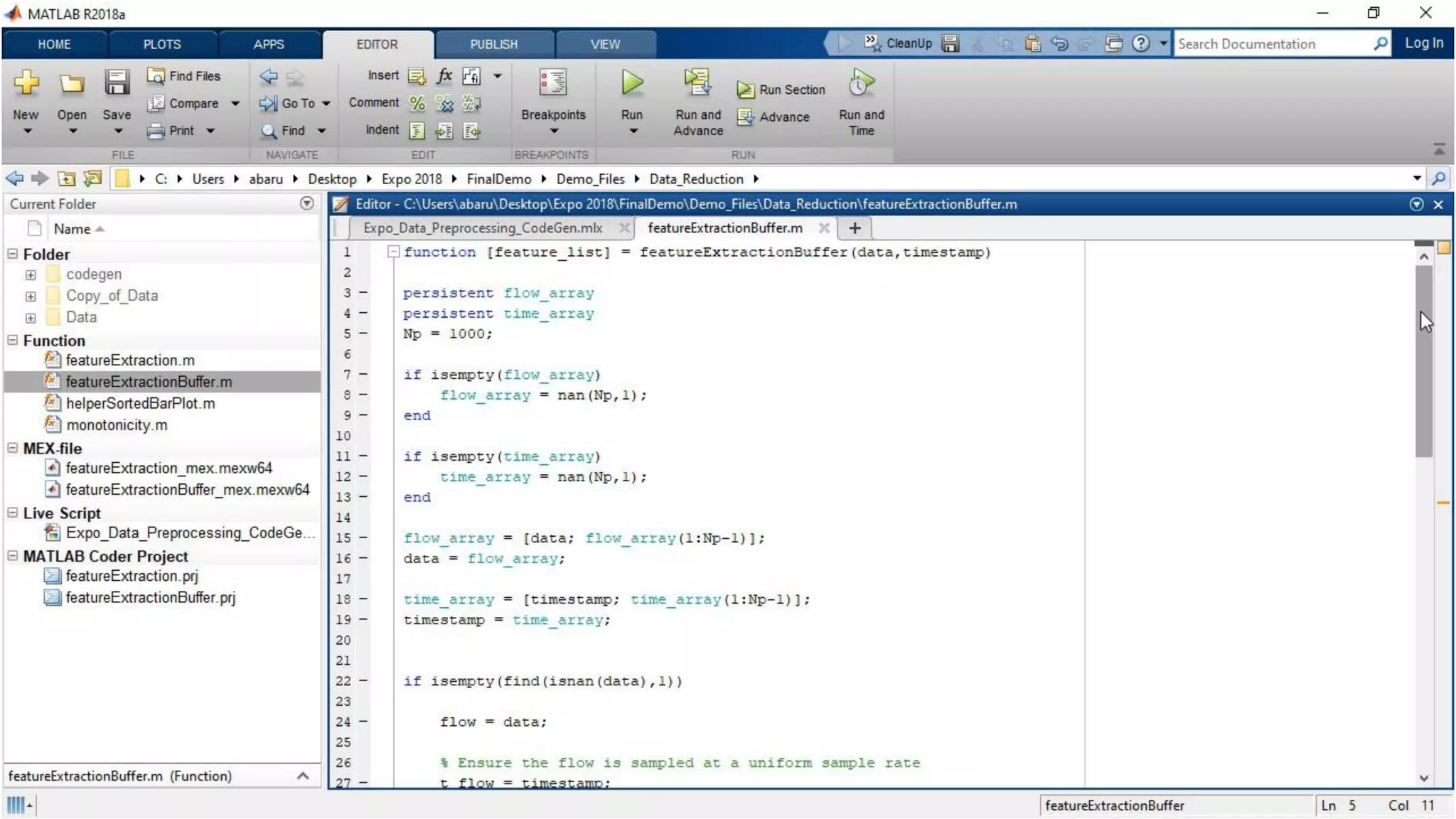
Video showing Codegen with MATLAB Coder
67
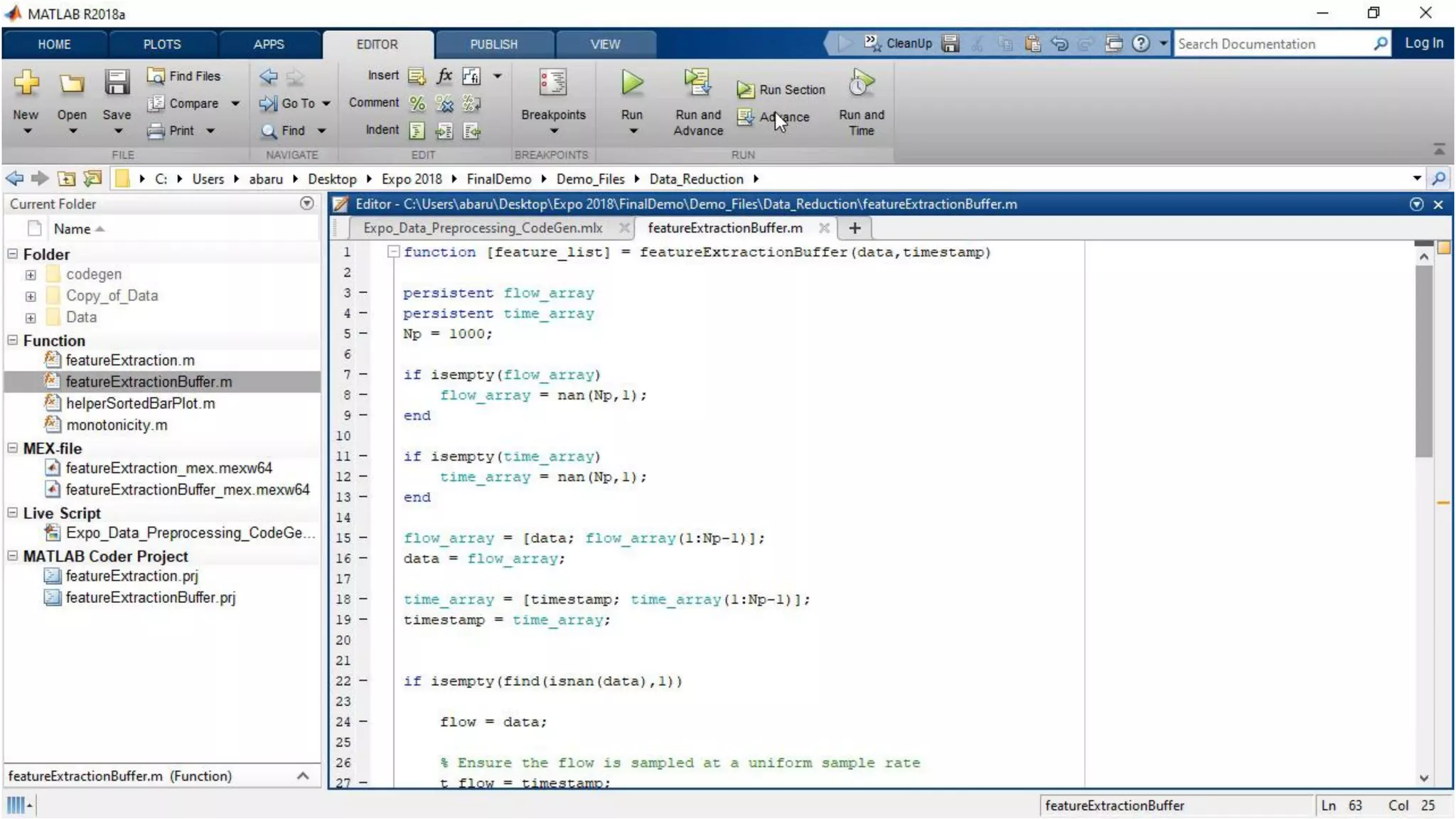
Video showing Codegen with MATLAB Coder
68
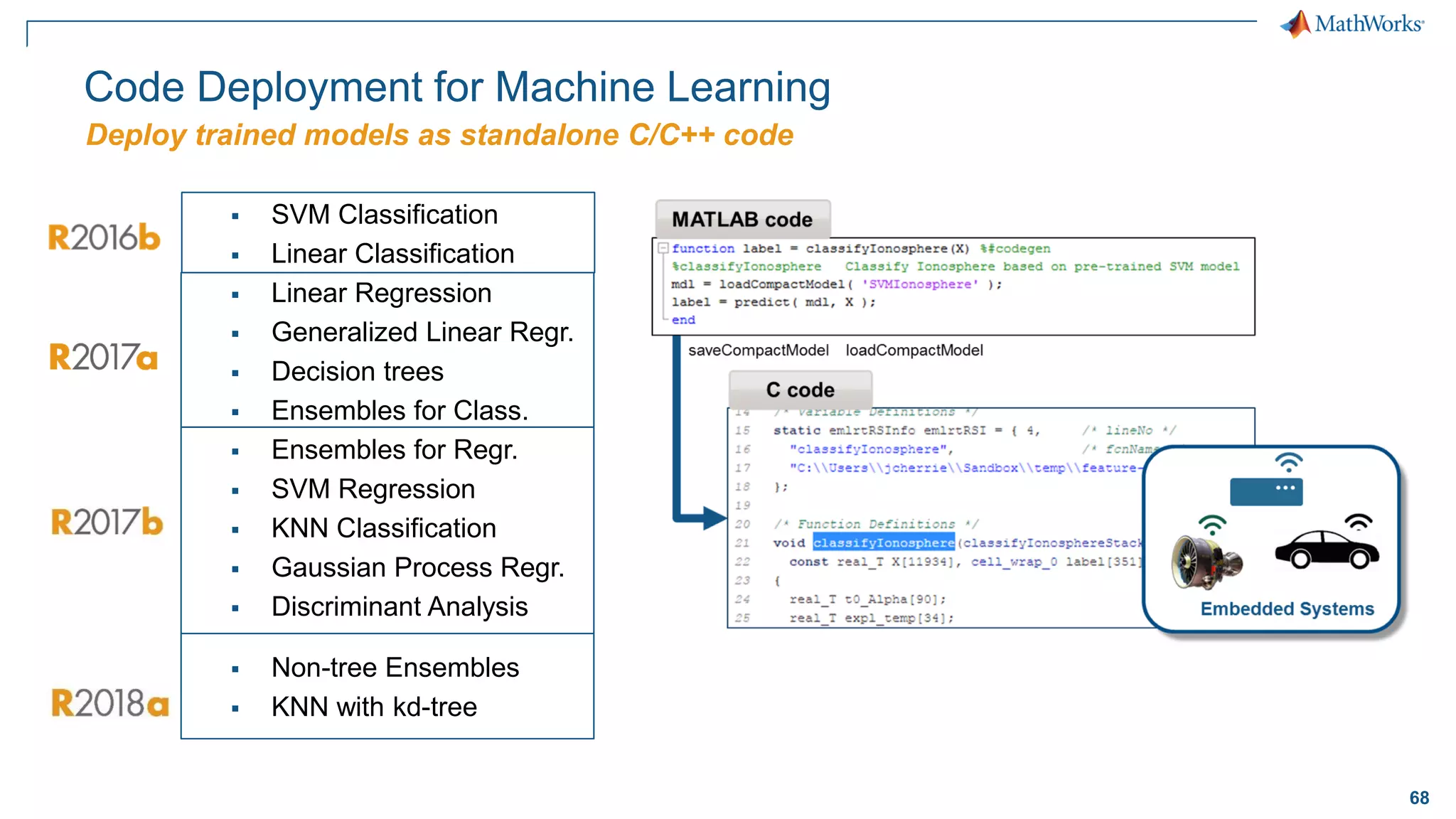
Code Deployment for Machine Learning
▪ SVM Classification
▪ Linear Classification
▪ Linear Regression
▪ Generalized Linear Regr.
▪ Decision trees
▪ Ensembles for Class.
▪ Ensembles for Regr.
▪ SVM Regression
▪ KNN Classification
▪ Gaussian Process Regr.
▪ Discriminant Analysis
▪ Non-tree Ensembles
▪ KNN with kd-tree
Deploy trained models as standalone C/C++ code
69
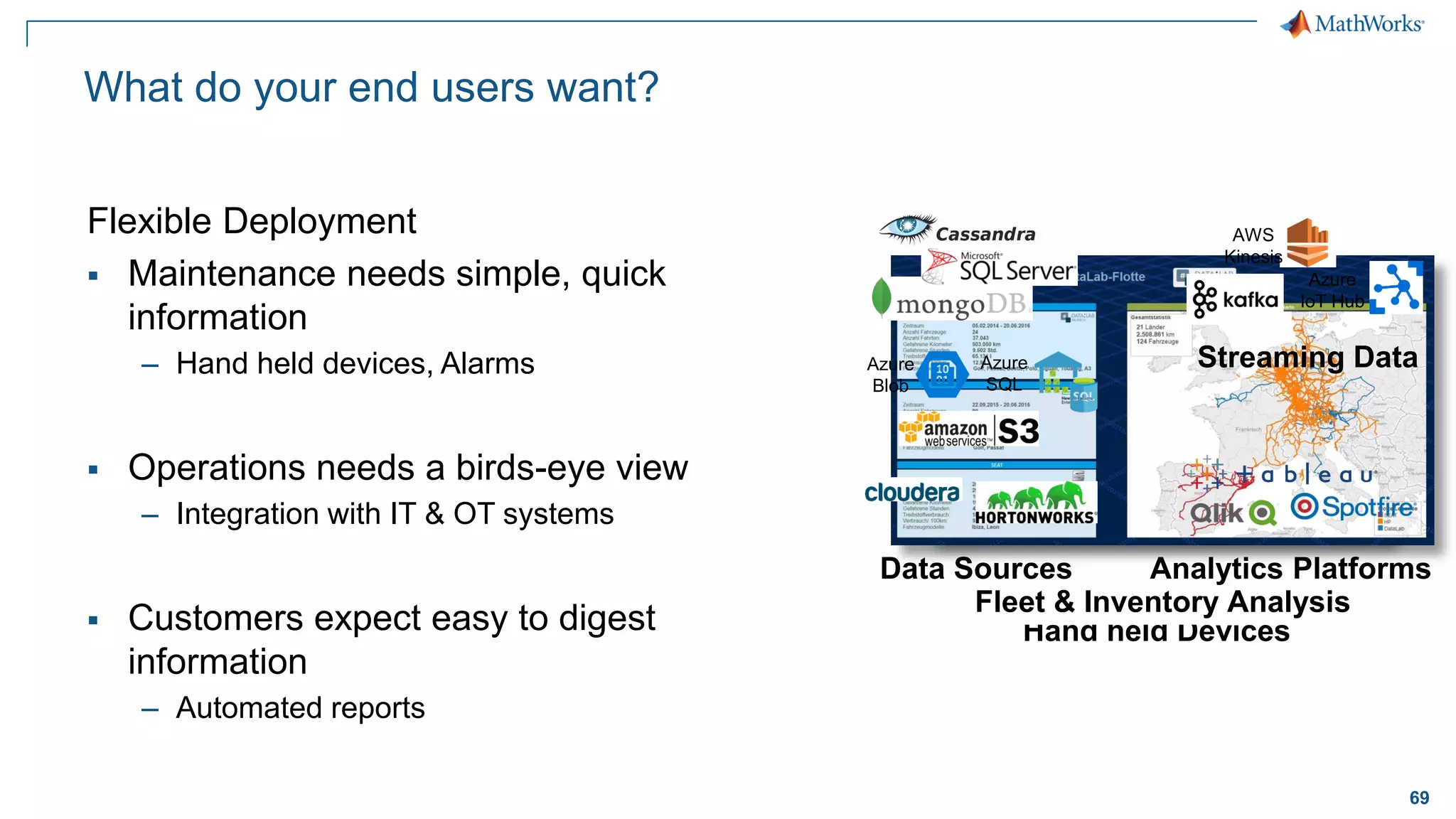
What do your end users want?
Flexible Deployment
▪ Maintenance needs simple, quick
information
– Hand held devices, Alarms
▪ Operations needs a birds-eye view
– Integration with IT & OT systems
▪ Customers expect easy to digest
information
– Automated reports
Dashboards &
Hand held Devices
Fleet & Inventory Analysis
Azure
Blob
Azure
SQL
Data Sources Analytics Platforms
Azure
IoT Hub
AWS
Kinesis
Streaming Data
70
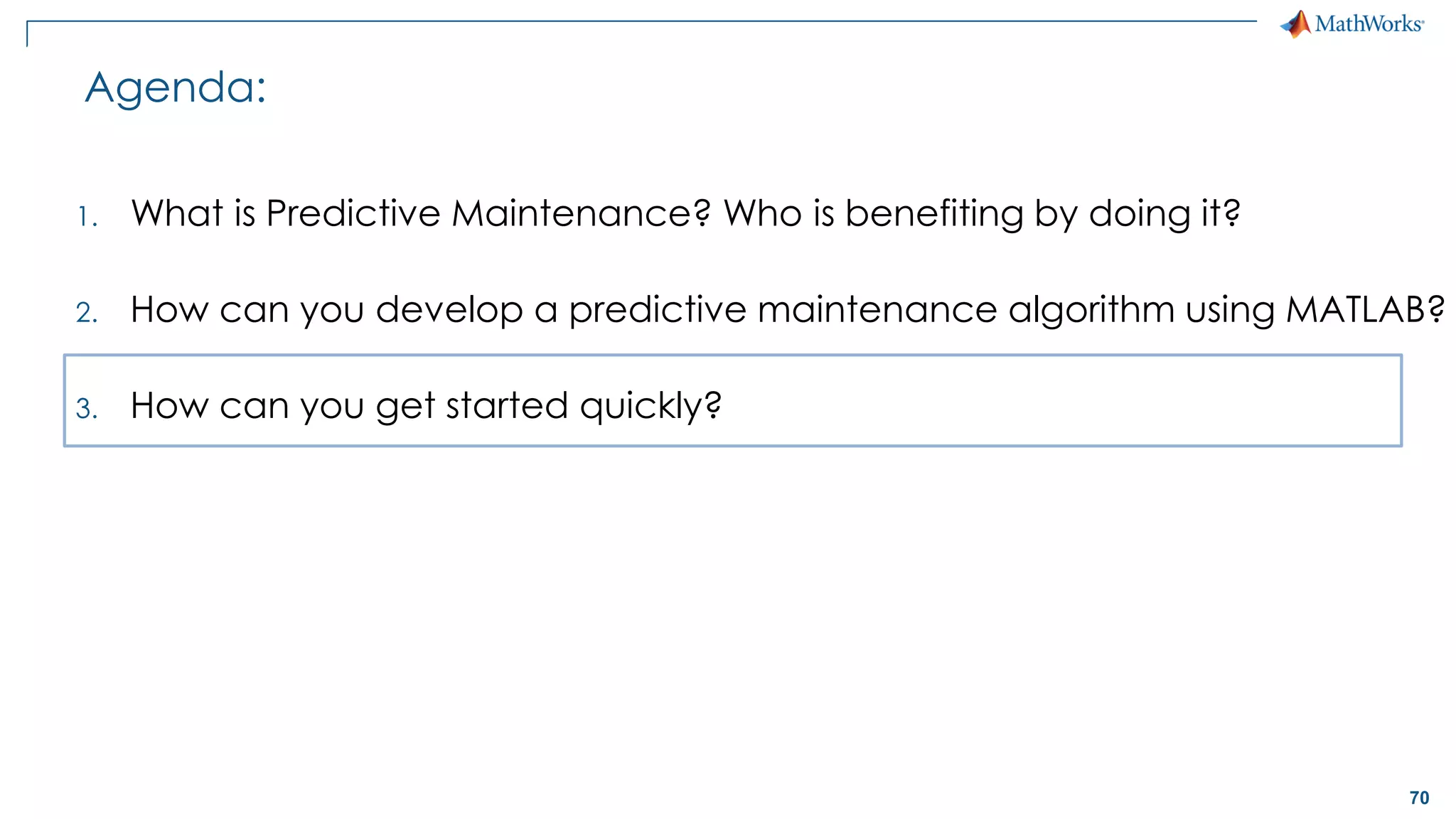
Agenda:
1. What is Predictive Maintenance? Who is benefiting by doing it?
2. How can you develop a predictive maintenance algorithm using MATLAB?
3. How can you get started quickly?
71
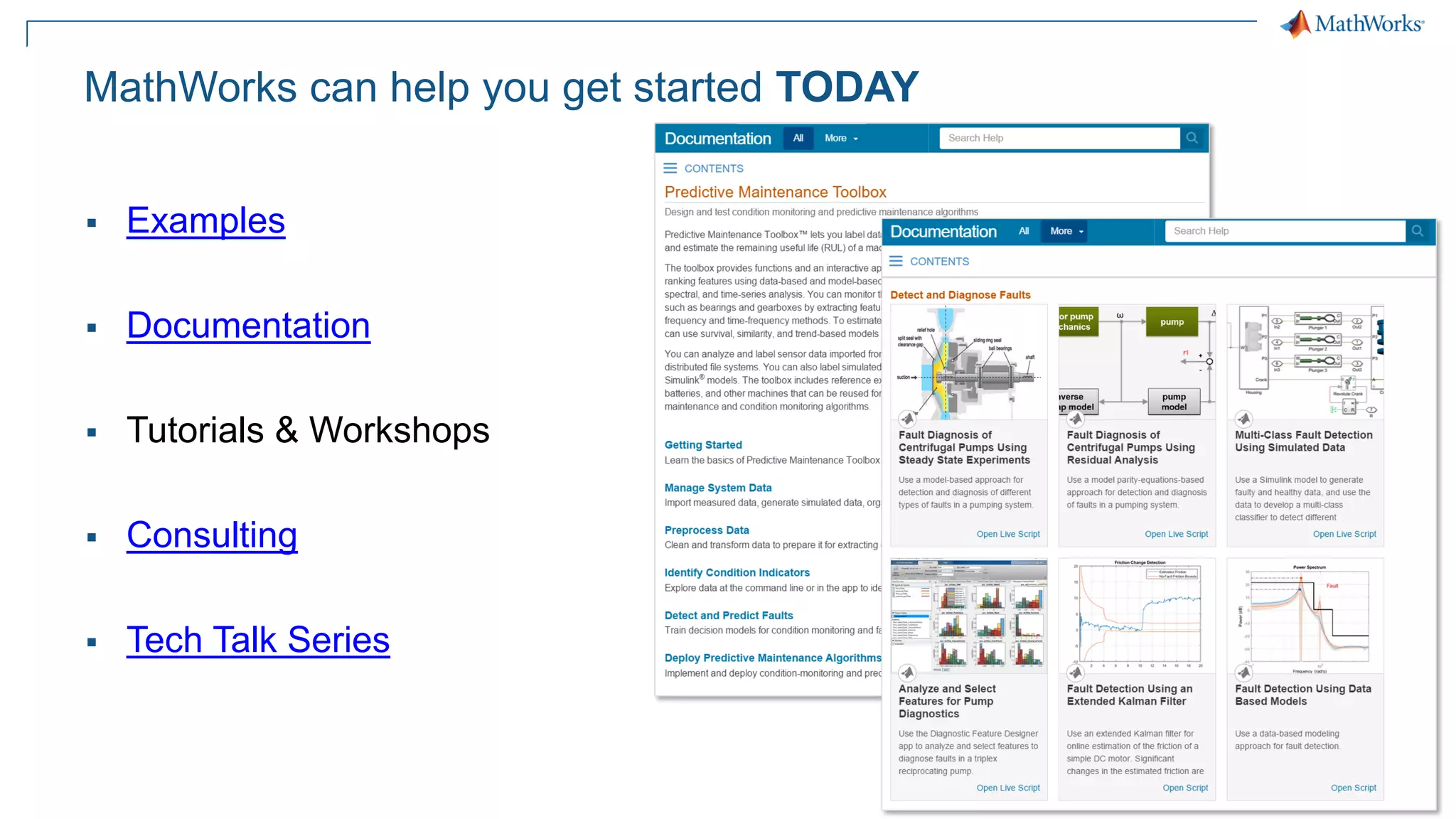
MathWorks can help you get started TODAY
▪ Examples
▪ Documentation
▪ Tutorials & Workshops
▪ Consulting
▪ Tech Talk Series
72
73
Thank you!
bkhusain@mathworks.com

Mathworks CAE simulation suite – case in point from automotive and aerospace.