VISVESVARAYA TECHNOLOGICAL UNIVERSITY JNANA SANGAMMA,
BELGAVI-590018
GOVERNMENT ENGINEERING COLLEGE TALAKAL-583238, KOPPAL
DEPARTMENT OF ELECTRICALAND ELECTRONICS ENGINEERING
MINI PROJECT PRESENTATION ON
“AUTOMATIC POWER FACTOR CORRECTION SYSTEM USING ARDUINO”
PRESENTED BY
SHALINI HALLI 2LG21EE025
ARUN M C 2LG23EE402
THANAJI RAO 2LG23EE424
SUDEEP 2LG23EE421
UNDER THE GUIDANCE OF
Prof.Jamalunissa Begum
CONTENTS
1.INTRODUCTION
2.LITERATURE SURVEY
3.PROBLEM STATEMENT
4.OBJECTIVE
5.METHODOLOGY
6.COMPONENTS REQUIRED
7.RESULT AND DISCUSSION
8.ADVANTAGES AND DISADVANTAGES WITH APPLICATIONS
9.CONCLUSION
INTRODUCTION

This project is one of the most effective for automatic power
factor improvement.
 Static capacitor will be controlled by an microcontroller with
very low cost.
 Power factor is set as standard value into the microcontroller.
 ACS712 current sensor acts as a current limiting device by
monitoring the current flowing through the system.
 Here one of the most popular microcontroller is used i.e the
Arduino uno at Mega 328 IC
LITERATURE SURVEY
SL,
NO
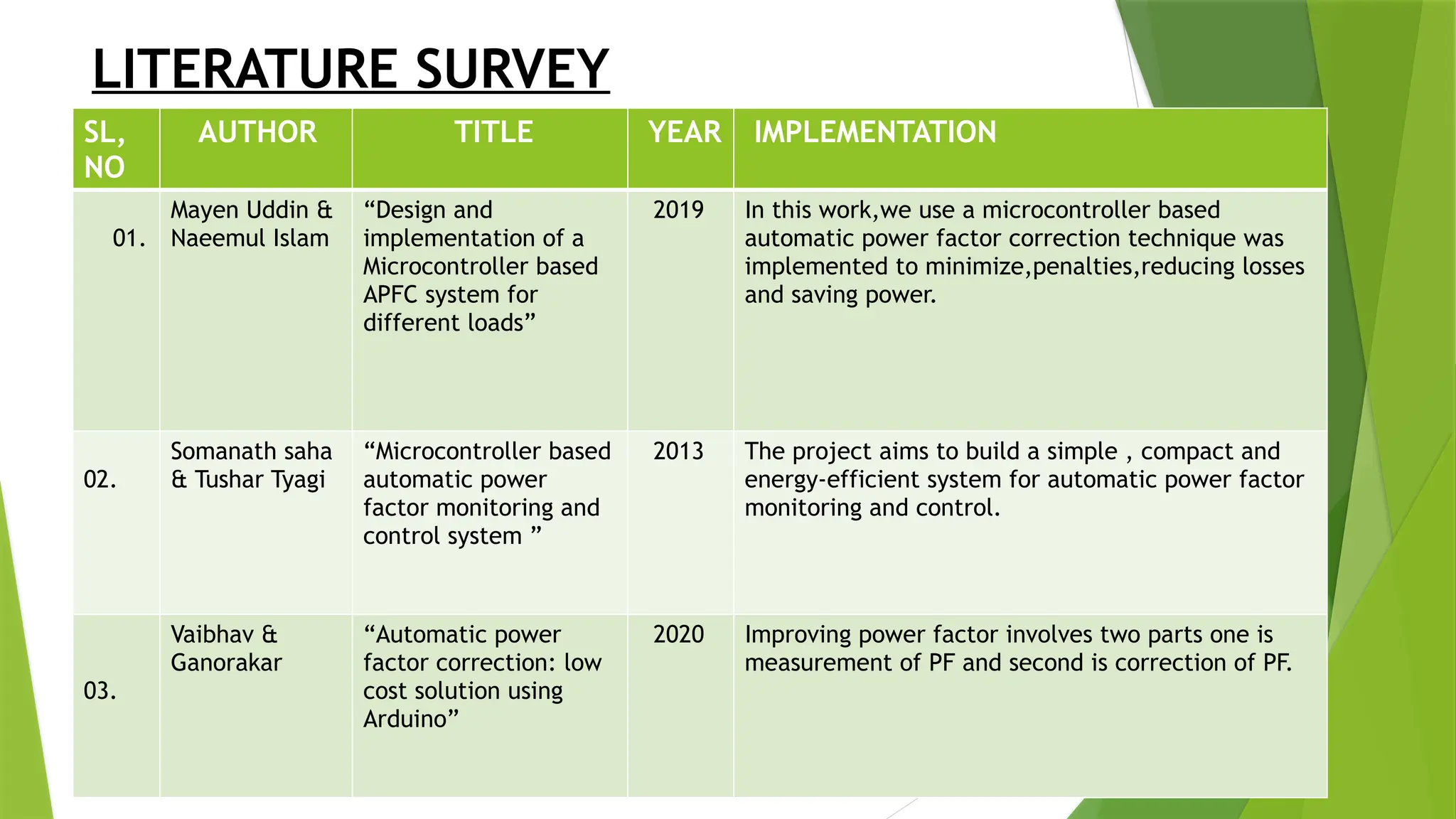
AUTHOR TITLE YEAR IMPLEMENTATION
01.
Mayen Uddin &
Naeemul Islam
“Design and
implementation of a
Microcontroller based
APFC system for
different loads”
2019 In this work,we use a microcontroller based
automatic power factor correction technique was
implemented to minimize,penalties,reducing losses
and saving power.
02.
Somanath saha
& Tushar Tyagi
“Microcontroller based
automatic power
factor monitoring and
control system ”
2013 The project aims to build a simple , compact and
energy-efficient system for automatic power factor
monitoring and control.
03.
Vaibhav &
Ganorakar
“Automatic power
factor correction: low
cost solution using
Arduino”
2020 Improving power factor involves two parts one is
measurement of PF and second is correction of PF.
PROBLEM STATEMENT:-
This project aims to develop an Arduino-based APFC
panel that automates power factor correction by
dynamically switching capacitor banks based on real-
time load conditions.
This project will serve as a model for integrating
Arduino technology with traditional electrical systems,
paving the way for smarter energy management
solutions.
OBJECTIVE:-
 Automatic power factor correction panel using Arduino,
capable of improving power factor while ensuring
system reliability, efficiency and safety
METHODOLOGY :-
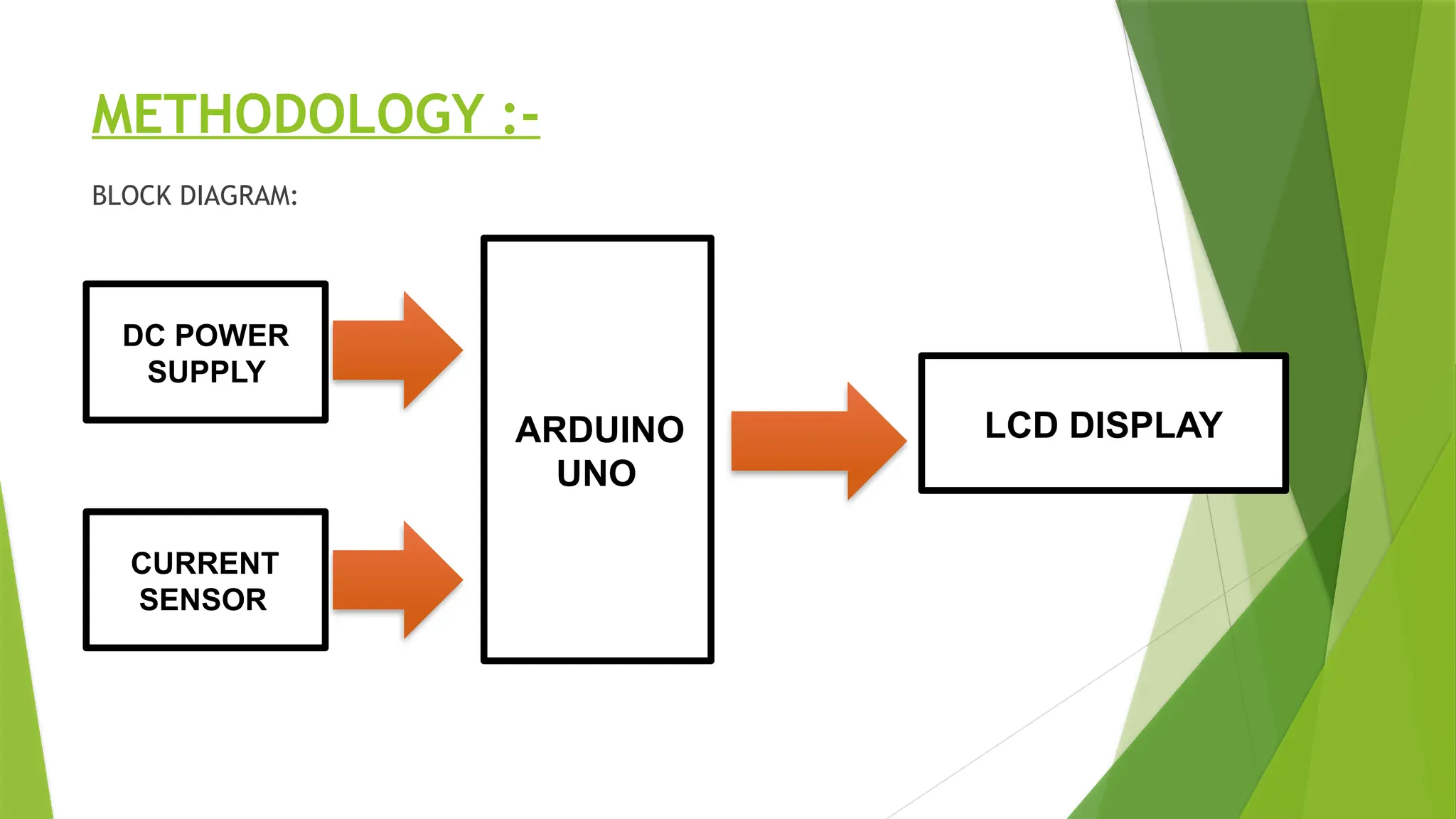
BLOCK DIAGRAM:
DC POWER
SUPPLY
CURRENT
SENSOR
ARDUINO
UNO
LCD DISPLAY
COMPONENTS REQUIRED:-
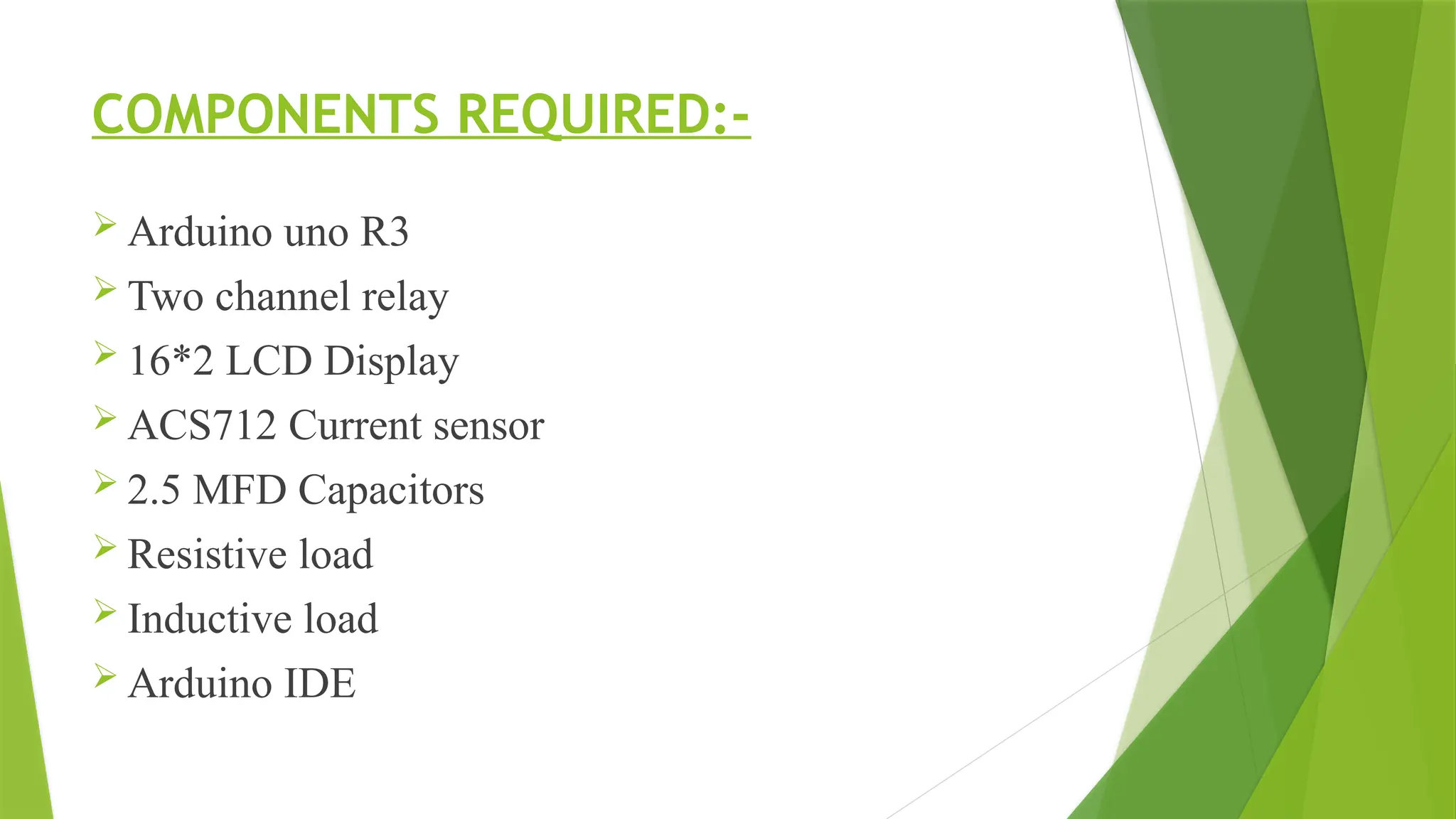
 Arduino uno R3
 Two channel relay
 16*2 LCD Display
 ACS712 Current sensor
 2.5 MFD Capacitors
 Resistive load
 Inductive load
 Arduino IDE
ARDUINO UNO R3 :-
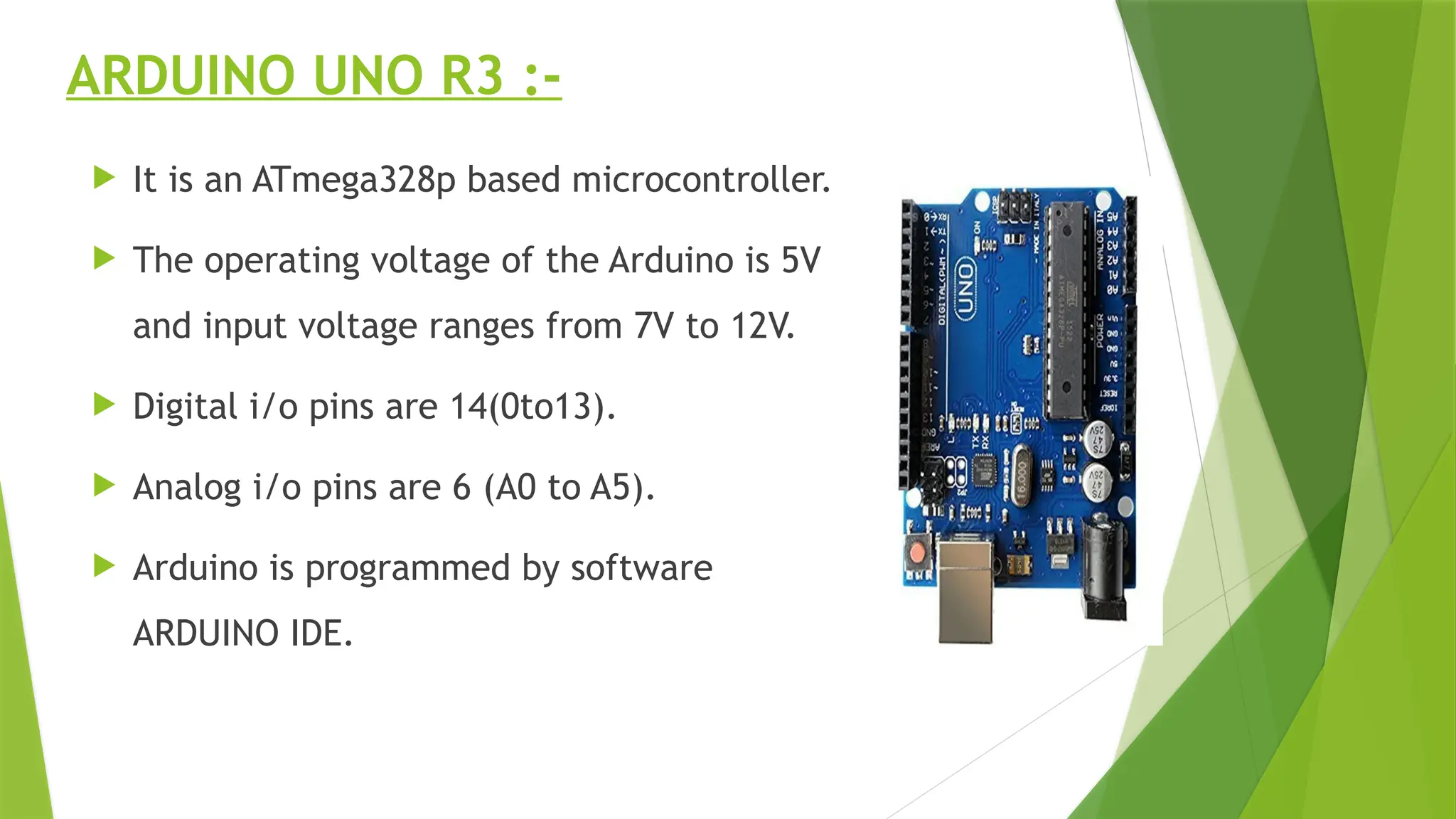
 It is an ATmega328p based microcontroller.
 The operating voltage of the Arduino is 5V
and input voltage ranges from 7V to 12V.
 Digital i/o pins are 14(0to13).
 Analog i/o pins are 6 (A0 to A5).
 Arduino is programmed by software
ARDUINO IDE.
TWO CHANNEL RELAY:-
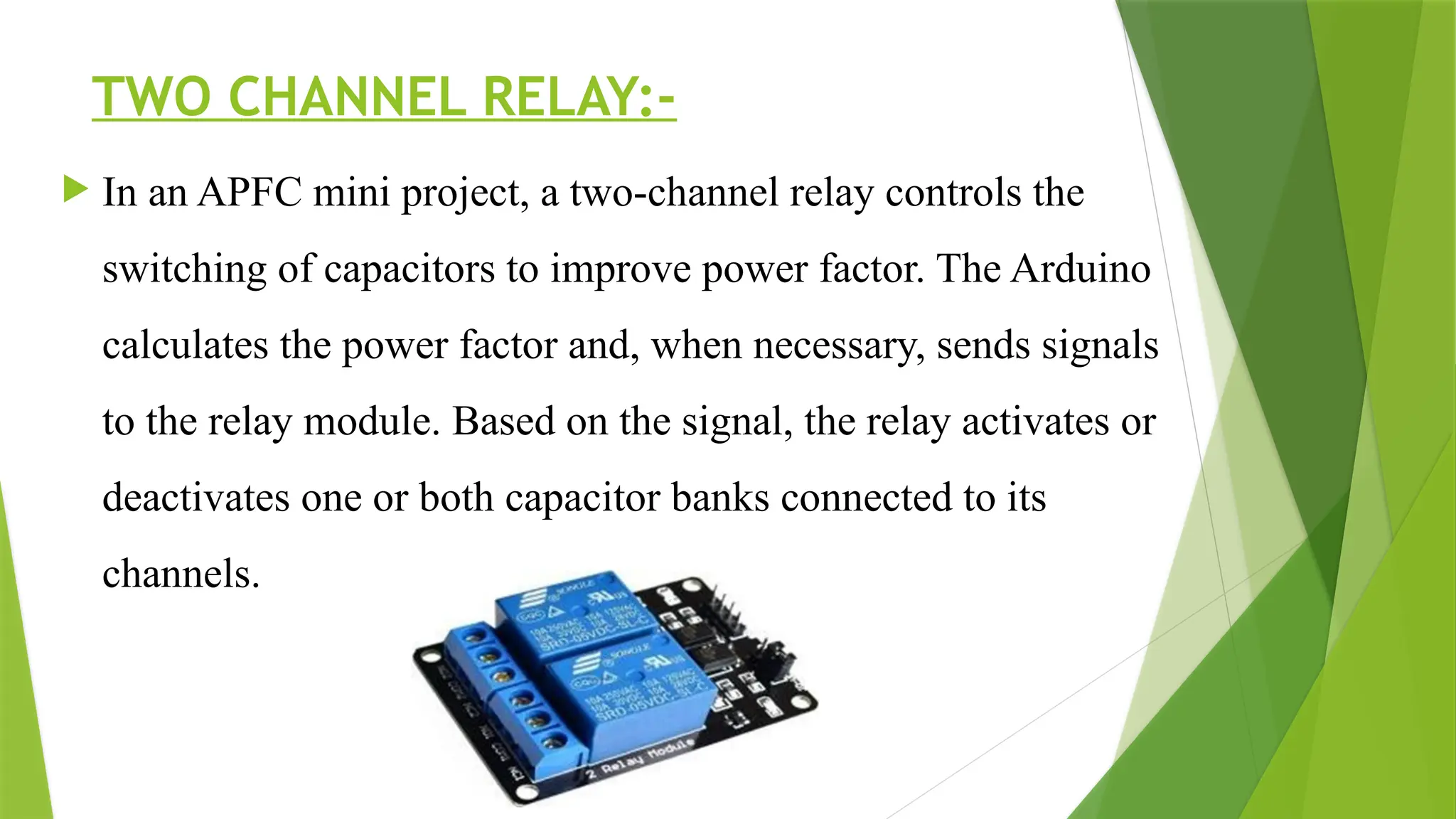
 In an APFC mini project, a two-channel relay controls the
switching of capacitors to improve power factor. The Arduino
calculates the power factor and, when necessary, sends signals
to the relay module. Based on the signal, the relay activates or
deactivates one or both capacitor banks connected to its
channels.
16*2 LCD DISPLAY:-
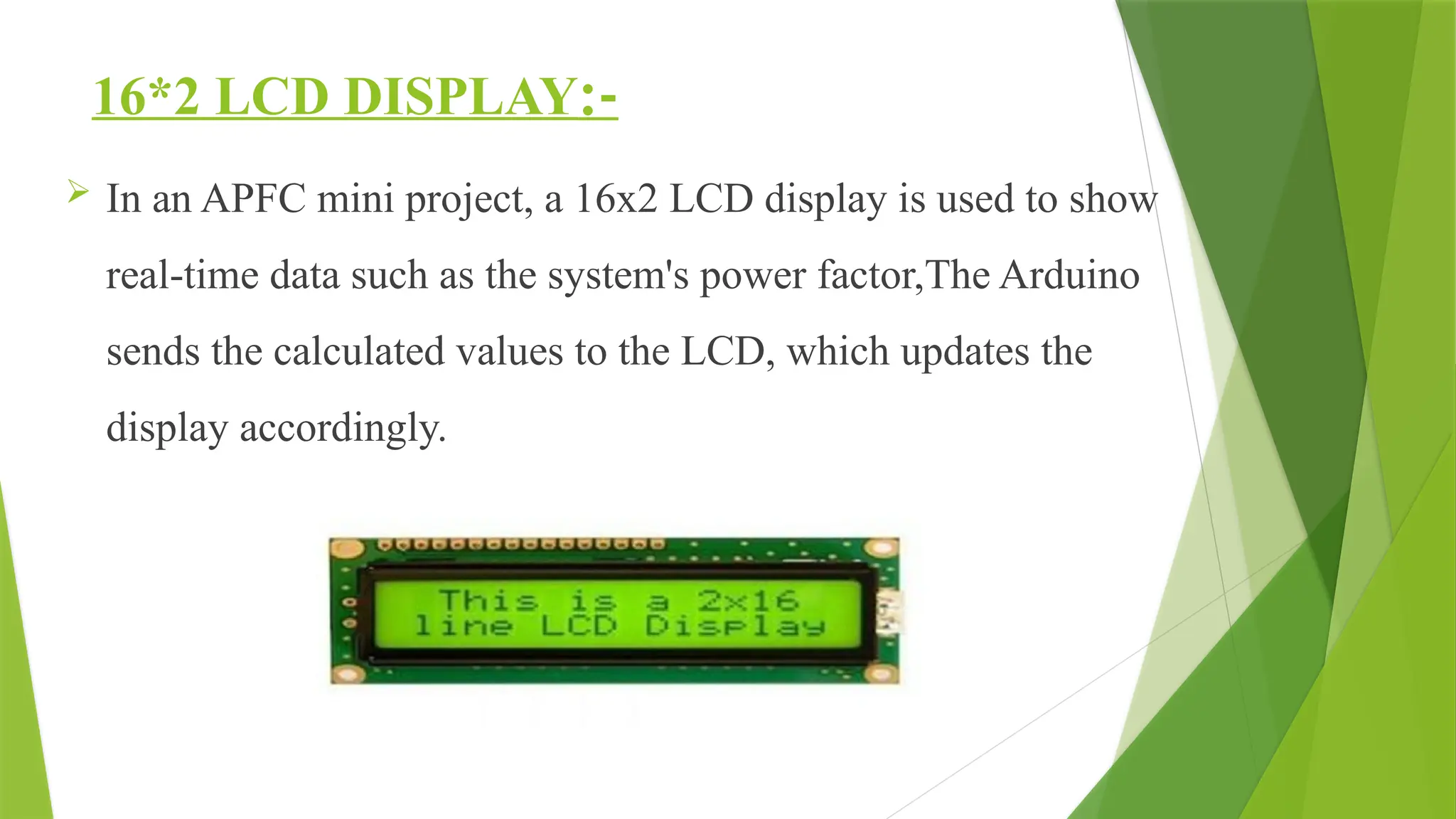
 In an APFC mini project, a 16x2 LCD display is used to show
real-time data such as the system's power factor,The Arduino
sends the calculated values to the LCD, which updates the
display accordingly.
ACS712 Current sensor:-
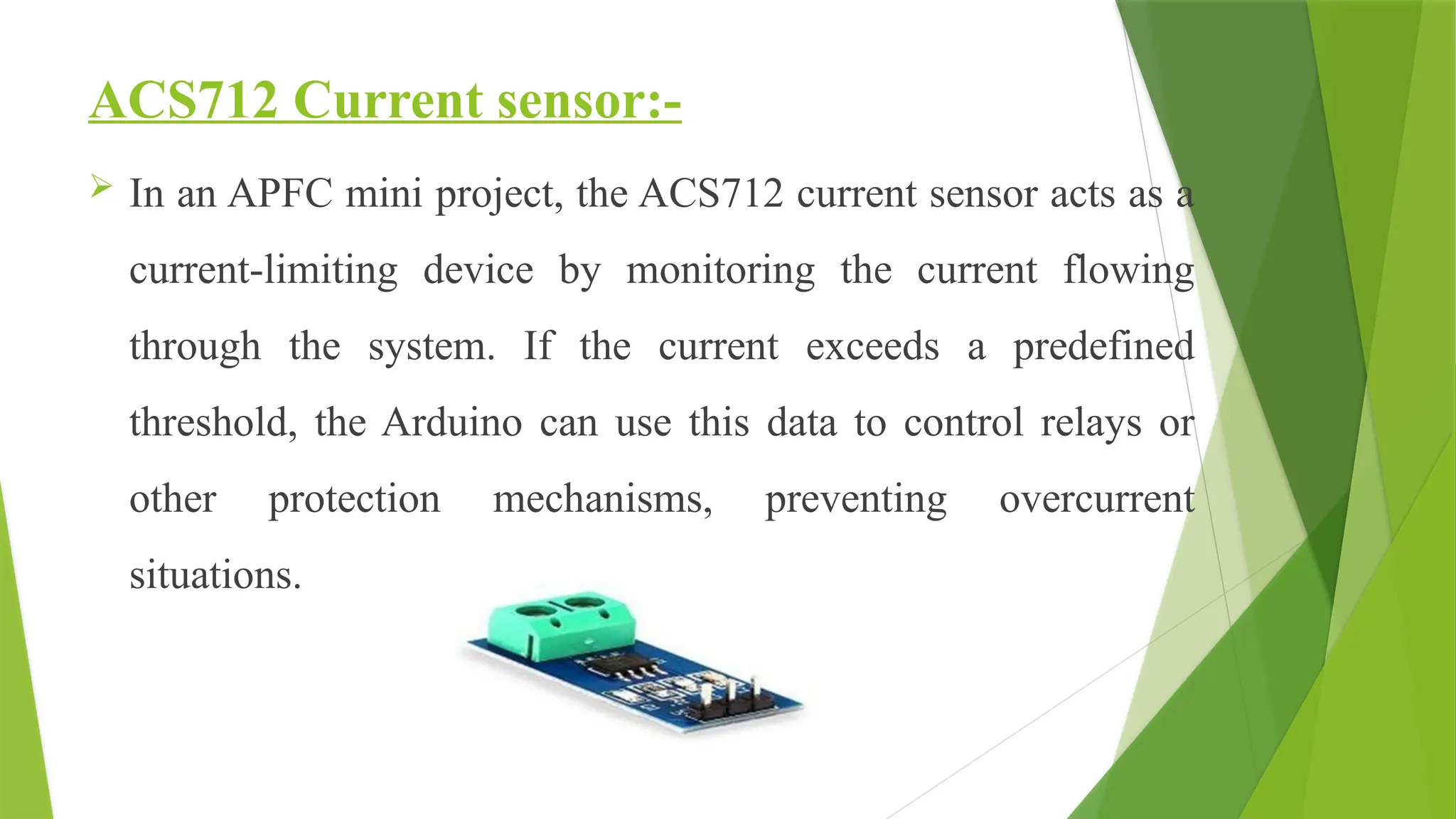
 In an APFC mini project, the ACS712 current sensor acts as a
current-limiting device by monitoring the current flowing
through the system. If the current exceeds a predefined
threshold, the Arduino can use this data to control relays or
other protection mechanisms, preventing overcurrent
situations.
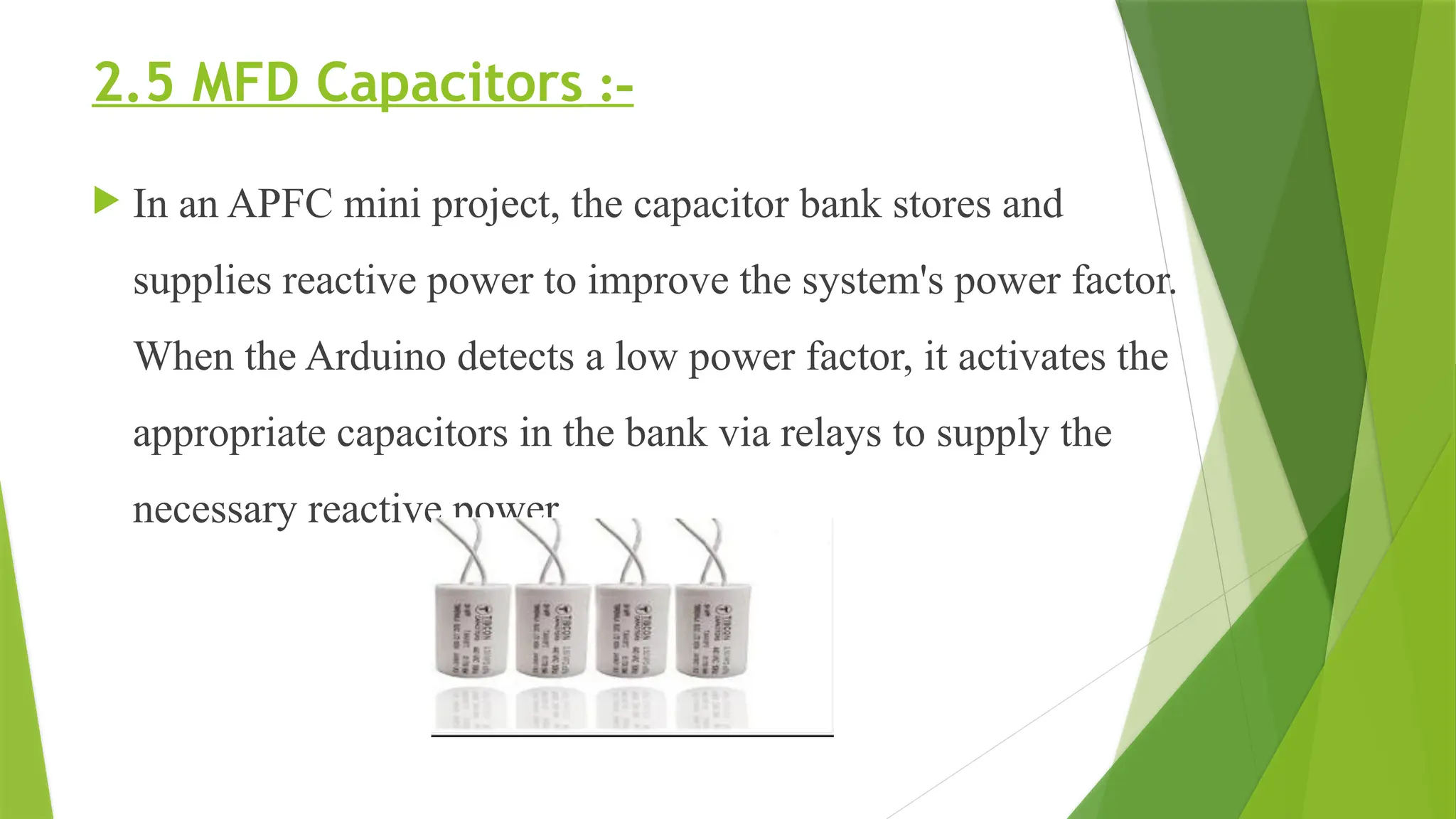
2.5 MFD Capacitors :-
 In an APFC mini project, the capacitor bank stores and
supplies reactive power to improve the system's power factor.
When the Arduino detects a low power factor, it activates the
appropriate capacitors in the bank via relays to supply the
necessary reactive power.
Resistive & Inductive load :-
 In an Automatic Power Factor Correction (APFC) panel, a
resistive load & Inductive load is used to simulate the desired
load conditions. The Arduino controls the switching of
capacitors to improve the power factor.
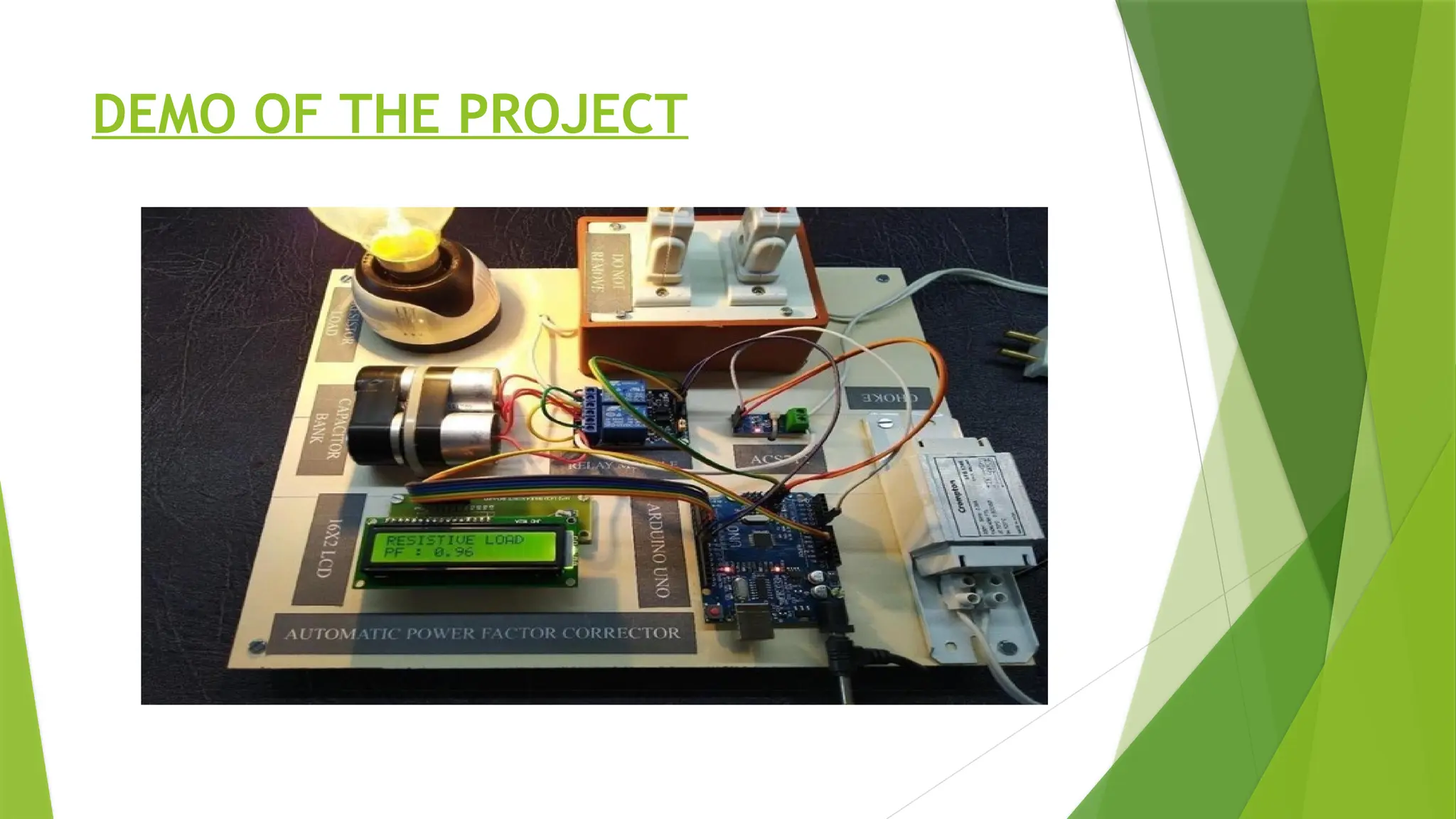
DEMO OF THE PROJECT
RESULT AND DISCUSSION
 The power factor correction method and device is useful in
improvement of the efficient transmission of active power.
 Power factor correction using capacitor banks reduces reactive
power consumption which will lead to minimization of losses
and at the same time increases the electrical system's efficiency.
 System continously monitoring the load power factor the
power quality can be improved.
ADVANTAGES:-
 Avoid power factor penalties.
 Reduced demand charges.
 Increased load carrying capabilities in existing circuits in existing
circuits.
 Improved voltages.
 Reduced power system losses.
 Increase in efficiency of system and devices.
DISADVANTAGES:-
 The short service life of capacitors.
 Repairing damaged capacitors can be uneconomical.
 If the voltage exceeds the rated value,the system can be
easily damaged.
APPLICATIONS:-
 Industrial motors, transformers and other equipment.
 Commercial buildings to maintain efficient energy usage, leading to
lower electrical bills.
 Renewable energy systems in solar and wind energy systems.
 In data centers to managing the power factor of servers and cooling
system effectively.
 In HVAC systems to optimize power usage in heating, ventilation and air
conditioning.
CONCLUSION:-
The Automatic Power Factor Correction (APFC) system
using Arduino has been successfully designed, developed, and
tested. The system accurately measures the power factor and
automatically adjusts it to maintain a value close to unity (1). The
project demonstrates the feasibility of using Arduino in power
quality improvement applications.
REFERENCE:-
 M.B.Khan,M.Owais, “Automatic power factor correction unit”,2016
international conference on computing , electronic and electrical
engineering (ICE Cube).IEEE,2016.
 Nader Barsoum “Programming of Pic Microcontroller for Power Factor
Correction” Proceedings of the first asia international conference on
modelling and simulation (IEEE),2017.
 Richard Tingee “Power factor controller- An Integrated Power factor and
autoparts” (IEEE),2019

THANK YOU

Power factor correction using harmonic filters

  • 1.
    VISVESVARAYA TECHNOLOGICAL UNIVERSITYJNANA SANGAMMA, BELGAVI-590018 GOVERNMENT ENGINEERING COLLEGE TALAKAL-583238, KOPPAL DEPARTMENT OF ELECTRICALAND ELECTRONICS ENGINEERING MINI PROJECT PRESENTATION ON “AUTOMATIC POWER FACTOR CORRECTION SYSTEM USING ARDUINO” PRESENTED BY SHALINI HALLI 2LG21EE025 ARUN M C 2LG23EE402 THANAJI RAO 2LG23EE424 SUDEEP 2LG23EE421 UNDER THE GUIDANCE OF Prof.Jamalunissa Begum
  • 2.
    CONTENTS 1.INTRODUCTION 2.LITERATURE SURVEY 3.PROBLEM STATEMENT 4.OBJECTIVE 5.METHODOLOGY 6.COMPONENTSREQUIRED 7.RESULT AND DISCUSSION 8.ADVANTAGES AND DISADVANTAGES WITH APPLICATIONS 9.CONCLUSION
  • 3.
    INTRODUCTION  This project isone of the most effective for automatic power factor improvement.  Static capacitor will be controlled by an microcontroller with very low cost.  Power factor is set as standard value into the microcontroller.  ACS712 current sensor acts as a current limiting device by monitoring the current flowing through the system.  Here one of the most popular microcontroller is used i.e the Arduino uno at Mega 328 IC
  • 4.
    LITERATURE SURVEY SL, NO AUTHOR TITLEYEAR IMPLEMENTATION 01. Mayen Uddin & Naeemul Islam “Design and implementation of a Microcontroller based APFC system for different loads” 2019 In this work,we use a microcontroller based automatic power factor correction technique was implemented to minimize,penalties,reducing losses and saving power. 02. Somanath saha & Tushar Tyagi “Microcontroller based automatic power factor monitoring and control system ” 2013 The project aims to build a simple , compact and energy-efficient system for automatic power factor monitoring and control. 03. Vaibhav & Ganorakar “Automatic power factor correction: low cost solution using Arduino” 2020 Improving power factor involves two parts one is measurement of PF and second is correction of PF.
  • 5.
    PROBLEM STATEMENT:- This projectaims to develop an Arduino-based APFC panel that automates power factor correction by dynamically switching capacitor banks based on real- time load conditions. This project will serve as a model for integrating Arduino technology with traditional electrical systems, paving the way for smarter energy management solutions.
  • 6.
    OBJECTIVE:-  Automatic powerfactor correction panel using Arduino, capable of improving power factor while ensuring system reliability, efficiency and safety
  • 7.
    METHODOLOGY :- BLOCK DIAGRAM: DCPOWER SUPPLY CURRENT SENSOR ARDUINO UNO LCD DISPLAY
  • 8.
    COMPONENTS REQUIRED:-  Arduinouno R3  Two channel relay  16*2 LCD Display  ACS712 Current sensor  2.5 MFD Capacitors  Resistive load  Inductive load  Arduino IDE
  • 9.
    ARDUINO UNO R3:-  It is an ATmega328p based microcontroller.  The operating voltage of the Arduino is 5V and input voltage ranges from 7V to 12V.  Digital i/o pins are 14(0to13).  Analog i/o pins are 6 (A0 to A5).  Arduino is programmed by software ARDUINO IDE.
  • 10.
    TWO CHANNEL RELAY:- In an APFC mini project, a two-channel relay controls the switching of capacitors to improve power factor. The Arduino calculates the power factor and, when necessary, sends signals to the relay module. Based on the signal, the relay activates or deactivates one or both capacitor banks connected to its channels.
  • 11.
    16*2 LCD DISPLAY:- In an APFC mini project, a 16x2 LCD display is used to show real-time data such as the system's power factor,The Arduino sends the calculated values to the LCD, which updates the display accordingly.
  • 12.
    ACS712 Current sensor:- In an APFC mini project, the ACS712 current sensor acts as a current-limiting device by monitoring the current flowing through the system. If the current exceeds a predefined threshold, the Arduino can use this data to control relays or other protection mechanisms, preventing overcurrent situations.
  • 13.
    2.5 MFD Capacitors:-  In an APFC mini project, the capacitor bank stores and supplies reactive power to improve the system's power factor. When the Arduino detects a low power factor, it activates the appropriate capacitors in the bank via relays to supply the necessary reactive power.
  • 14.
    Resistive & Inductiveload :-  In an Automatic Power Factor Correction (APFC) panel, a resistive load & Inductive load is used to simulate the desired load conditions. The Arduino controls the switching of capacitors to improve the power factor.
  • 15.
    DEMO OF THEPROJECT
  • 16.
    RESULT AND DISCUSSION The power factor correction method and device is useful in improvement of the efficient transmission of active power.  Power factor correction using capacitor banks reduces reactive power consumption which will lead to minimization of losses and at the same time increases the electrical system's efficiency.  System continously monitoring the load power factor the power quality can be improved.
  • 17.
    ADVANTAGES:-  Avoid powerfactor penalties.  Reduced demand charges.  Increased load carrying capabilities in existing circuits in existing circuits.  Improved voltages.  Reduced power system losses.  Increase in efficiency of system and devices.
  • 18.
    DISADVANTAGES:-  The shortservice life of capacitors.  Repairing damaged capacitors can be uneconomical.  If the voltage exceeds the rated value,the system can be easily damaged.
  • 19.
    APPLICATIONS:-  Industrial motors,transformers and other equipment.  Commercial buildings to maintain efficient energy usage, leading to lower electrical bills.  Renewable energy systems in solar and wind energy systems.  In data centers to managing the power factor of servers and cooling system effectively.  In HVAC systems to optimize power usage in heating, ventilation and air conditioning.
  • 20.
    CONCLUSION:- The Automatic PowerFactor Correction (APFC) system using Arduino has been successfully designed, developed, and tested. The system accurately measures the power factor and automatically adjusts it to maintain a value close to unity (1). The project demonstrates the feasibility of using Arduino in power quality improvement applications.
  • 21.
    REFERENCE:-  M.B.Khan,M.Owais, “Automaticpower factor correction unit”,2016 international conference on computing , electronic and electrical engineering (ICE Cube).IEEE,2016.  Nader Barsoum “Programming of Pic Microcontroller for Power Factor Correction” Proceedings of the first asia international conference on modelling and simulation (IEEE),2017.  Richard Tingee “Power factor controller- An Integrated Power factor and autoparts” (IEEE),2019

  • 22.