International Research Journal of Engineering and Technology (IRJET) e-ISSN: 2395 -0056
Volume: 04 Issue: 03 | Mar -2017 www.irjet.net p-ISSN: 2395-0072
© 2017, IRJET | Impact Factor value: 5.181 | ISO 9001:2008 Certified Journal | Page 1809
DESIGN OF SINGLE PHASE AUTOMATIC POWER FACTOR CONTROLLER
USING MICROCONTROLLER
Vaibhav Yeole1, Shubham Dhurve2, Sanket Sure3, Ashvini Meshram4,
Tushar Nawale5,Mr. Mohammad Ashar6
1Vaibhav Yeole, Electrical Engineering, S.B.J.I.T.M.R., Maharashtra, India
2Shubham Dhurve, Electrical Engineering, S.B.J.I.T.M.R., Maharashtra, India
3Sanket Sure, Electrical Engineering, S.B.J.I.T.M.R., Maharashtra, India
4Tushar Nawale, Electrical Engineering, S.B.J.I.T.M.R., Maharashtra, India
5Ashvini Meshram, Electrical Engineering, S.B.J.I.T.M.R., Maharashtra, India
6Prof. Mohammad Ashar, Dept. of Electrical Engineering, S.B.J.I.T.M.R., Maharashtra, India
---------------------------------------------------------------------***---------------------------------------------------------------------
Abstract - In the present scientific revolution, power isvery
valuable. So we need to find out the cause of power loss and
develop the system. Due to increase in use of inductive load,
power system losses its efficiency. So we need to improve the
power factor with a suitable method. Automatic power factor
improvement device reads power factor from line voltage and
line current by defining the delay in the arrival of the current
signal with respect to voltage signal from the zero cross
detector with high correctness by an internal timer. This time
values are then calibrated as phase angle and consequential
power factor. Then the microcontroller calculates the
compensation necessity and consequently switches on to
different capacitor banks. Automatic power factor
improvement methods can be applied to the industries, power
systems and also household to create them stable and due to
that the system becomes steady and hence increases efficiency
of the system.
Key Words: Inductive Load, Power Factor, Zero Cross
Detector, Microcontroller, Capacitor Bank.
1.INTRODUCTION
“POWER FACTOR is the ratio of useful (true) power whose
unit is KW to the total (apparent) power whose unit is KVA”.
Automatic power factor controller project is planned to
improve power factor automatically,wheneverpowerfactor
falls below convinced level [4]. As we know that the
requirement of electrical energy is increasing day by day,
more and more inductive loads are increasing in industries
as well as for household purpose [3]. Inductive loads are the
main reason for low power factor in power system. There
are more other problems occur if power factor is low [5].
They are
A) Additional losses in feeder cables
B) Important voltage drop
C) Reduction of effective capacity of cables
D)Voltage fall at the secondary of the transformer
E) Losses in transformer
The Automatic Power factor improvement device is a very
helpful device for improving efficient transmission of active
power. If the consumer connect inductive load, then the
power factor lags, when the power factor goes below
0.95(lag) then the Electricsupplycompanycharge penaltyto
the consumer. So it is important to sustain the Power factor
below with in a limit. Automatic Power factor improvement
device reads the power factor from line voltage and line
current,calculatingthecompensationrequirementswitchon
different capacitor banks.
This paper focuses on the implementation of power factor
correction using microcontroller. LowpowerfactorIncludes
needless burden on power system and transmission line. By
improving power factor of power system automatically,
power system efficiency can be better [1].
2. BLOCK DIAGRAM WITH DESCRIPTION
Microcontroller base block diagram of automatic power
factor improvement system shown in below figure 1. The
input to the circuit is applied from the power supply. The AC
input supply is step down by the transformer to 12V and is
fed to a rectifier. The output obtained from the rectifier is a
energetic pure DC voltage. The two sinusoidal waveforms
are being transformed to pulses through two zero crossing
detectors. These digital pulsesareusedbymicrocontrollerto
calculate phase differenceandpowerfactor.Acapacitiveload
bank is used which develops an electric load, in this
technique to improve power factor.
International Research Journal of Engineering and Technology (IRJET) e-ISSN: 2395 -0056
Volume: 04 Issue: 03 | Mar -2017 www.irjet.net p-ISSN: 2395-0072
© 2017, IRJET | Impact Factor value: 5.181 | ISO 9001:2008 Certified Journal | Page 1810
Microcontroller
ATmega 16
Drives
&
Relay
Capacitive
Bank
LCD
ZCD (V)
ZCD (I)
Load
Figure 1. Block diagram of APFC
3. METHODOLOGY
3.1 Simulink Model
In this simulation we have used the AC voltage source of
230V and 50 Hz frequency and current block is connected in
series with AC voltage source and voltage is connected in
parallel. In this we have designed a power factor meter as
shown in figure 3 to show the value of power factor via
display. This power factor meter consists of two integrator.
Then we have taken the difference of two integrator i.e.
voltage and current. The difference come out to be in (msec.)
but our actual concern is to find power factor. So wewantthe
difference in degree therefore we have multiply the
difference (msec.) into gain (2πf). Then the difference comes
out to be in degree from this we found power factor i.e.
0.3037. For improving the power factor we have added the
three capacitorbank acrossloadthenthepowerfactorcomes
out to be 0.4034. Then we have added two capacitor parallel
from this we get desired power factor i.e. 0.92 is as shown in
figure 2. Then we have added relay in series with capacitor
across the load. When the inductive load is ON the power
factor decrease now the microcontroller energize the relay
coil in order to compensate the unnecessary reactive power
hence we get improve power factor automatically i.e. is as
shown in figure 4.
Figure 2. Simulink Model with Capacitor Bank
Figure 3. Simulink Model of Power Factor Meter
Figure 4. Simulink Model using Capacitor and Relay
The methodology on which the paperidbasedconsistsof the
following main parts.
A. Power Supply: A bridge rectifierconnectedacrossmain
line which converts AC signal to DC. A capacitorisconnected
at output of rectifier to get pure DC voltage. The output of
bridge rectifier is +12V but as microcontroller workson+5V
hence output of this bridge rectifier is additional given to IC
7805(Voltage regulator IC) which gives fixed output voltage
+5V. A capacitor is connected at output ofIC7805inorder to
get pure DC voltage.
International Research Journal of Engineering and Technology (IRJET) e-ISSN: 2395 -0056
Volume: 04 Issue: 03 | Mar -2017 www.irjet.net p-ISSN: 2395-0072
© 2017, IRJET | Impact Factor value: 5.181 | ISO 9001:2008 Certified Journal | Page 1811
Figure 5. Power Supply
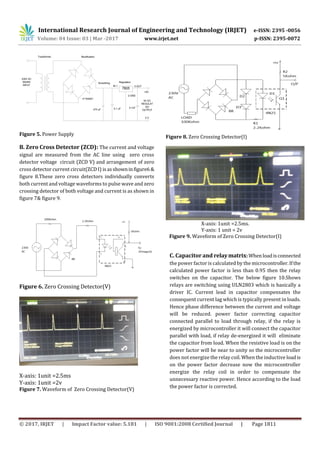
B. Zero Cross Detector (ZCD): The current and voltage
signal are measured from the AC line using zero cross
detector voltage circuit (ZCD V) and arrangement of zero
cross detector current circuit(ZCD I) isasshowninfigure6 &
figure 8.These zero cross detectors individually converts
both current and voltage waveforms to pulse wave and zero
crossing detector of both voltage and current is as shown in
figure 7& figure 9.
Figure 6. Zero Crossing Detector(V)
X-axis: 1unit =2.5ms
Y-axis: 1unit =2v
Figure 7. Waveform of Zero Crossing Detector(V)
Figure 8. Zero Crossing Detector(I)
X-axis: 1unit =2.5ms.
Y-axis: 1 unit = 2v
Figure 9. Waveform of Zero Crossing Detector(I)
C. Capacitor and relaymatrix:Whenloadisconnected
the power factor is calculated by the microcontroller.Ifthe
calculated power factor is less than 0.95 then the relay
switches on the capacitor. The below figure 10.Shows
relays are switching using ULN2803 which is basically a
driver IC. Current lead in capacitor compensates the
consequent current lag which is typically present in loads.
Hence phase difference between the current and voltage
will be reduced. power factor correcting capacitor
connected parallel to load through relay, if the relay is
energized by microcontroller it will connect the capacitor
parallel with load, if relay de-energized it will eliminate
the capacitor from load. When the resistive load is on the
power factor will be near to unity so the microcontroller
does not energize the relay coil. When the inductive loadis
on the power factor decrease now the microcontroller
energize the relay coil in order to compensate the
unnecessary reactive power. Hence according to the load
the power factor is corrected.
7805
230V AC
MAINS
INPUT
4*1N4001
470 uF
RegulationSmoothing
RectificationTransformer
IN 1 3 OUT
2 GND
+5V
5V DC
REGULAT
ED
OUTPUT
0.1uF0.1 uF
0 V
International Research Journal of Engineering and Technology (IRJET) e-ISSN: 2395 -0056
Volume: 04 Issue: 03 | Mar -2017 www.irjet.net p-ISSN: 2395-0072
© 2017, IRJET | Impact Factor value: 5.181 | ISO 9001:2008 Certified Journal | Page 1812
12V
12V
P
N
P
P
P
A0
A1
A2
A3
i/p
U
L
N
2
8
0
3
RELAY 1
RELAY3
RELAY4
RELAY2
GND
C1
C2 C3 C4
NO
NO
N
O
NO
Figure 10. Connection of Capacitor& Relay matrix
D. Pin Configuration:
Figure 11. Pin configuration of Atmega16microcontroller
interface with LCD
ATmega16 Microcontroller Features:
 The AVR ATmega16 provides the following
features: It has low power CMOS 8-bit controller
with AVR RISC
 Its throughput is up to 16MIPS per
 It has 32 General purpose registers directly
connected to 16 Kbytes In-System programmable
flash
 512 bytes of EEPROM, 1k byte SRAM, JTAG
 Three timer/counter for comparison
 Internal and external interrupts
 Serial programmable USART+I2C protocol
3.RESULTS
Load P.F (Before
APFC Circuit)
P.F (After APFC
Circuit)
LOAD 0.66 0.97
Sr. No. APFC LOAD CAPACITOR P.F
1. Without R-L None 0.67
2. With R-L 1 0.78
3. With R-L 1&2 0.87
4. With R-L 1,2&3 0.97
Before insertion of APFC circuit Power factor of at load
condition is observed as 0.66, while after insertion of APFC
circuit power factor gets improve to 0.97.
4.CONCLUSIONS
This paper deals with advancement method of power factor
improvement by using microcontroller. As Switching of
capacitors are done automatically, more correct results are
obtained. Power factor correction technique makes system
steady and due to improvement in power factor, its
efficiency also increases. The automatic power factor
improvement using capacitive load banks is very efficient as
it reduces the cost by decreasing the power drawn from the
supply. As it operates automatically, manpower is not
required and this Automatic Power factor improvement
using capacitive load banks can be used for the industries
purpose in the future.
5.REFERENCES
[1] “The 8051 Microcontroller and Embedded Systems” by
Muhammad Ali Mazidi and Janice Gillis pie Mazidi.
[2] Institute of Electrical and Electronics Engineers. The
authoritative dictionary of IEEE standards terms. Standards
Information Network, Std. 100, IEEE Press, 2000.
[3] Jones, L. D.; Blackwell, D. (1983) “Energy Saver Power
Factor Controller for Synchronous Motors”, IEEE
Transactions on Power Apparatus and Systems, Volume: 5,
Issue: 5, Pages: 1391-1394.
International Research Journal of Engineering and Technology (IRJET) e-ISSN: 2395 -0056
Volume: 04 Issue: 03 | Mar -2017 www.irjet.net p-ISSN: 2395-0072
© 2017, IRJET | Impact Factor value: 5.181 | ISO 9001:2008 Certified Journal | Page 1813
[4] J.G. Cho, J.W. Won, H.S. Lee , “Reduced conduction loss
zero-voltage-transition power factor correction converter
with low cost, ”IEEE Trans. Industrial
Electron.vol.45,no3,Jun. 2000,pp395-400.
[5] Jiang, Y. et al, A Novel Single-phase Power Factor
Correction Scheme, Applied Power Electronics Conference
and Exposition, 1993, pp. 287-292.
[6] Zero Crossing Detector, Available at:
http://www.ustudy.in/node/4699, Accessed on: February 4,
2015.
[7] Gupta, J.B., Theory & Performance of Electrical Machines,
14th edition, S K Kataria & Sons, 2010.

Design of Single Phase Automatic Power Factor Controller using Microcontroller

  • 1.
    International Research Journalof Engineering and Technology (IRJET) e-ISSN: 2395 -0056 Volume: 04 Issue: 03 | Mar -2017 www.irjet.net p-ISSN: 2395-0072 © 2017, IRJET | Impact Factor value: 5.181 | ISO 9001:2008 Certified Journal | Page 1809 DESIGN OF SINGLE PHASE AUTOMATIC POWER FACTOR CONTROLLER USING MICROCONTROLLER Vaibhav Yeole1, Shubham Dhurve2, Sanket Sure3, Ashvini Meshram4, Tushar Nawale5,Mr. Mohammad Ashar6 1Vaibhav Yeole, Electrical Engineering, S.B.J.I.T.M.R., Maharashtra, India 2Shubham Dhurve, Electrical Engineering, S.B.J.I.T.M.R., Maharashtra, India 3Sanket Sure, Electrical Engineering, S.B.J.I.T.M.R., Maharashtra, India 4Tushar Nawale, Electrical Engineering, S.B.J.I.T.M.R., Maharashtra, India 5Ashvini Meshram, Electrical Engineering, S.B.J.I.T.M.R., Maharashtra, India 6Prof. Mohammad Ashar, Dept. of Electrical Engineering, S.B.J.I.T.M.R., Maharashtra, India ---------------------------------------------------------------------***--------------------------------------------------------------------- Abstract - In the present scientific revolution, power isvery valuable. So we need to find out the cause of power loss and develop the system. Due to increase in use of inductive load, power system losses its efficiency. So we need to improve the power factor with a suitable method. Automatic power factor improvement device reads power factor from line voltage and line current by defining the delay in the arrival of the current signal with respect to voltage signal from the zero cross detector with high correctness by an internal timer. This time values are then calibrated as phase angle and consequential power factor. Then the microcontroller calculates the compensation necessity and consequently switches on to different capacitor banks. Automatic power factor improvement methods can be applied to the industries, power systems and also household to create them stable and due to that the system becomes steady and hence increases efficiency of the system. Key Words: Inductive Load, Power Factor, Zero Cross Detector, Microcontroller, Capacitor Bank. 1.INTRODUCTION “POWER FACTOR is the ratio of useful (true) power whose unit is KW to the total (apparent) power whose unit is KVA”. Automatic power factor controller project is planned to improve power factor automatically,wheneverpowerfactor falls below convinced level [4]. As we know that the requirement of electrical energy is increasing day by day, more and more inductive loads are increasing in industries as well as for household purpose [3]. Inductive loads are the main reason for low power factor in power system. There are more other problems occur if power factor is low [5]. They are A) Additional losses in feeder cables B) Important voltage drop C) Reduction of effective capacity of cables D)Voltage fall at the secondary of the transformer E) Losses in transformer The Automatic Power factor improvement device is a very helpful device for improving efficient transmission of active power. If the consumer connect inductive load, then the power factor lags, when the power factor goes below 0.95(lag) then the Electricsupplycompanycharge penaltyto the consumer. So it is important to sustain the Power factor below with in a limit. Automatic Power factor improvement device reads the power factor from line voltage and line current,calculatingthecompensationrequirementswitchon different capacitor banks. This paper focuses on the implementation of power factor correction using microcontroller. LowpowerfactorIncludes needless burden on power system and transmission line. By improving power factor of power system automatically, power system efficiency can be better [1]. 2. BLOCK DIAGRAM WITH DESCRIPTION Microcontroller base block diagram of automatic power factor improvement system shown in below figure 1. The input to the circuit is applied from the power supply. The AC input supply is step down by the transformer to 12V and is fed to a rectifier. The output obtained from the rectifier is a energetic pure DC voltage. The two sinusoidal waveforms are being transformed to pulses through two zero crossing detectors. These digital pulsesareusedbymicrocontrollerto calculate phase differenceandpowerfactor.Acapacitiveload bank is used which develops an electric load, in this technique to improve power factor.
  • 2.
    International Research Journalof Engineering and Technology (IRJET) e-ISSN: 2395 -0056 Volume: 04 Issue: 03 | Mar -2017 www.irjet.net p-ISSN: 2395-0072 © 2017, IRJET | Impact Factor value: 5.181 | ISO 9001:2008 Certified Journal | Page 1810 Microcontroller ATmega 16 Drives & Relay Capacitive Bank LCD ZCD (V) ZCD (I) Load Figure 1. Block diagram of APFC 3. METHODOLOGY 3.1 Simulink Model In this simulation we have used the AC voltage source of 230V and 50 Hz frequency and current block is connected in series with AC voltage source and voltage is connected in parallel. In this we have designed a power factor meter as shown in figure 3 to show the value of power factor via display. This power factor meter consists of two integrator. Then we have taken the difference of two integrator i.e. voltage and current. The difference come out to be in (msec.) but our actual concern is to find power factor. So wewantthe difference in degree therefore we have multiply the difference (msec.) into gain (2πf). Then the difference comes out to be in degree from this we found power factor i.e. 0.3037. For improving the power factor we have added the three capacitorbank acrossloadthenthepowerfactorcomes out to be 0.4034. Then we have added two capacitor parallel from this we get desired power factor i.e. 0.92 is as shown in figure 2. Then we have added relay in series with capacitor across the load. When the inductive load is ON the power factor decrease now the microcontroller energize the relay coil in order to compensate the unnecessary reactive power hence we get improve power factor automatically i.e. is as shown in figure 4. Figure 2. Simulink Model with Capacitor Bank Figure 3. Simulink Model of Power Factor Meter Figure 4. Simulink Model using Capacitor and Relay The methodology on which the paperidbasedconsistsof the following main parts. A. Power Supply: A bridge rectifierconnectedacrossmain line which converts AC signal to DC. A capacitorisconnected at output of rectifier to get pure DC voltage. The output of bridge rectifier is +12V but as microcontroller workson+5V hence output of this bridge rectifier is additional given to IC 7805(Voltage regulator IC) which gives fixed output voltage +5V. A capacitor is connected at output ofIC7805inorder to get pure DC voltage.
  • 3.
    International Research Journalof Engineering and Technology (IRJET) e-ISSN: 2395 -0056 Volume: 04 Issue: 03 | Mar -2017 www.irjet.net p-ISSN: 2395-0072 © 2017, IRJET | Impact Factor value: 5.181 | ISO 9001:2008 Certified Journal | Page 1811 Figure 5. Power Supply B. Zero Cross Detector (ZCD): The current and voltage signal are measured from the AC line using zero cross detector voltage circuit (ZCD V) and arrangement of zero cross detector current circuit(ZCD I) isasshowninfigure6 & figure 8.These zero cross detectors individually converts both current and voltage waveforms to pulse wave and zero crossing detector of both voltage and current is as shown in figure 7& figure 9. Figure 6. Zero Crossing Detector(V) X-axis: 1unit =2.5ms Y-axis: 1unit =2v Figure 7. Waveform of Zero Crossing Detector(V) Figure 8. Zero Crossing Detector(I) X-axis: 1unit =2.5ms. Y-axis: 1 unit = 2v Figure 9. Waveform of Zero Crossing Detector(I) C. Capacitor and relaymatrix:Whenloadisconnected the power factor is calculated by the microcontroller.Ifthe calculated power factor is less than 0.95 then the relay switches on the capacitor. The below figure 10.Shows relays are switching using ULN2803 which is basically a driver IC. Current lead in capacitor compensates the consequent current lag which is typically present in loads. Hence phase difference between the current and voltage will be reduced. power factor correcting capacitor connected parallel to load through relay, if the relay is energized by microcontroller it will connect the capacitor parallel with load, if relay de-energized it will eliminate the capacitor from load. When the resistive load is on the power factor will be near to unity so the microcontroller does not energize the relay coil. When the inductive loadis on the power factor decrease now the microcontroller energize the relay coil in order to compensate the unnecessary reactive power. Hence according to the load the power factor is corrected. 7805 230V AC MAINS INPUT 4*1N4001 470 uF RegulationSmoothing RectificationTransformer IN 1 3 OUT 2 GND +5V 5V DC REGULAT ED OUTPUT 0.1uF0.1 uF 0 V
  • 4.
    International Research Journalof Engineering and Technology (IRJET) e-ISSN: 2395 -0056 Volume: 04 Issue: 03 | Mar -2017 www.irjet.net p-ISSN: 2395-0072 © 2017, IRJET | Impact Factor value: 5.181 | ISO 9001:2008 Certified Journal | Page 1812 12V 12V P N P P P A0 A1 A2 A3 i/p U L N 2 8 0 3 RELAY 1 RELAY3 RELAY4 RELAY2 GND C1 C2 C3 C4 NO NO N O NO Figure 10. Connection of Capacitor& Relay matrix D. Pin Configuration: Figure 11. Pin configuration of Atmega16microcontroller interface with LCD ATmega16 Microcontroller Features:  The AVR ATmega16 provides the following features: It has low power CMOS 8-bit controller with AVR RISC  Its throughput is up to 16MIPS per  It has 32 General purpose registers directly connected to 16 Kbytes In-System programmable flash  512 bytes of EEPROM, 1k byte SRAM, JTAG  Three timer/counter for comparison  Internal and external interrupts  Serial programmable USART+I2C protocol 3.RESULTS Load P.F (Before APFC Circuit) P.F (After APFC Circuit) LOAD 0.66 0.97 Sr. No. APFC LOAD CAPACITOR P.F 1. Without R-L None 0.67 2. With R-L 1 0.78 3. With R-L 1&2 0.87 4. With R-L 1,2&3 0.97 Before insertion of APFC circuit Power factor of at load condition is observed as 0.66, while after insertion of APFC circuit power factor gets improve to 0.97. 4.CONCLUSIONS This paper deals with advancement method of power factor improvement by using microcontroller. As Switching of capacitors are done automatically, more correct results are obtained. Power factor correction technique makes system steady and due to improvement in power factor, its efficiency also increases. The automatic power factor improvement using capacitive load banks is very efficient as it reduces the cost by decreasing the power drawn from the supply. As it operates automatically, manpower is not required and this Automatic Power factor improvement using capacitive load banks can be used for the industries purpose in the future. 5.REFERENCES [1] “The 8051 Microcontroller and Embedded Systems” by Muhammad Ali Mazidi and Janice Gillis pie Mazidi. [2] Institute of Electrical and Electronics Engineers. The authoritative dictionary of IEEE standards terms. Standards Information Network, Std. 100, IEEE Press, 2000. [3] Jones, L. D.; Blackwell, D. (1983) “Energy Saver Power Factor Controller for Synchronous Motors”, IEEE Transactions on Power Apparatus and Systems, Volume: 5, Issue: 5, Pages: 1391-1394.
  • 5.
    International Research Journalof Engineering and Technology (IRJET) e-ISSN: 2395 -0056 Volume: 04 Issue: 03 | Mar -2017 www.irjet.net p-ISSN: 2395-0072 © 2017, IRJET | Impact Factor value: 5.181 | ISO 9001:2008 Certified Journal | Page 1813 [4] J.G. Cho, J.W. Won, H.S. Lee , “Reduced conduction loss zero-voltage-transition power factor correction converter with low cost, ”IEEE Trans. Industrial Electron.vol.45,no3,Jun. 2000,pp395-400. [5] Jiang, Y. et al, A Novel Single-phase Power Factor Correction Scheme, Applied Power Electronics Conference and Exposition, 1993, pp. 287-292. [6] Zero Crossing Detector, Available at: http://www.ustudy.in/node/4699, Accessed on: February 4, 2015. [7] Gupta, J.B., Theory & Performance of Electrical Machines, 14th edition, S K Kataria & Sons, 2010.