Installation ArtContemporary Artists
Installation ArtArt that is created for a specific site, often incorporating materials or physical features of the site.
Contemporary ArtistsArtists of the present age; belonging to the same period of time; modern, current.Maya Lin
 Janine  Antoni
 Judy Pfaff
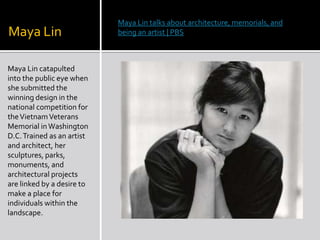
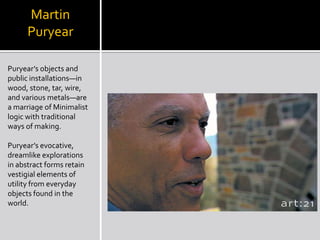
Martin PuryearMaya LinMaya Lin catapulted into the public eye when she submitted the winning design in the national competition for the Vietnam Veterans Memorial in Washington D.C. Trained as an artist and architect, her sculptures, parks, monuments, and architectural projects are linked by a desire to make a place for individuals within the landscape.Maya Lin talks about architecture, memorials, and being an artist | PBS
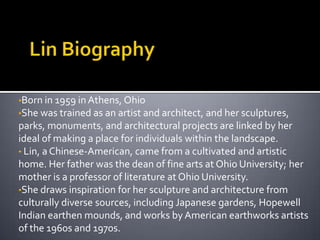
Lin BiographyBorn in 1959 in Athens, Ohio
She was trained as an artist and architect, and her sculptures, parks, monuments, and architectural projects are linked by her ideal of making a place for individuals within the landscape.
 Lin, a Chinese-American, came from a cultivated and artistic home. Her father was the dean of fine arts at Ohio University; her mother is a professor of literature at Ohio University.
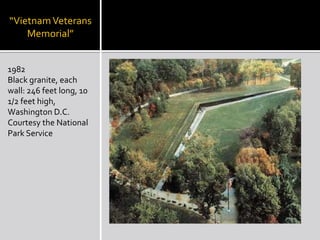
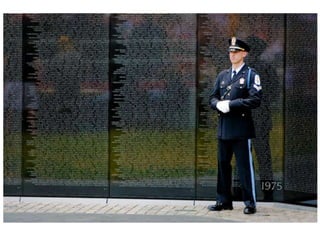
She draws inspiration for her sculpture and architecture from culturally diverse sources, including Japanese gardens, Hopewell Indian earthen mounds, and works by American earthworks artists of the 1960s and 1970s. “Vietnam Veterans Memorial”1982Black granite, each wall: 246 feet long, 10 1/2 feet high, Washington D.C.Courtesy the National Park Service
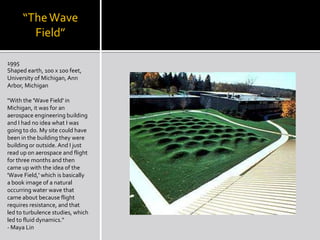
“The Wave Field”1995Shaped earth, 100 x 100 feet, University of Michigan, Ann Arbor, Michigan"With the 'Wave Field' in Michigan, it was for an aerospace engineering building and I had no idea what I was going to do. My site could have been in the building they were building or outside. And I just read up on aerospace and flight for three months and then came up with the idea of the 'Wave Field,' which is basically a book image of a natural occurring water wave that came about because flight requires resistance, and that led to turbulence studies, which led to fluid dynamics."- Maya Lin
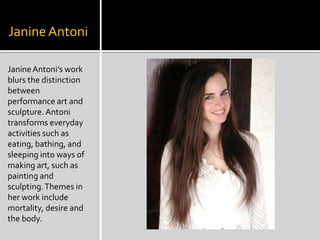
Janine AntoniJanine Antoni’s work blurs the distinction between performance art and sculpture. Antoni transforms everyday activities such as eating, bathing, and sleeping into ways of making art, such as painting and sculpting. Themes in her work include mortality, desire and the body.
Antoni BiographyJanine Antoni was born in Freeport, Bahamas in 1964.
She received her BA from Sarah Lawrence College in New York, and earned her MFA from the Rhode Island School of Design in 1989.
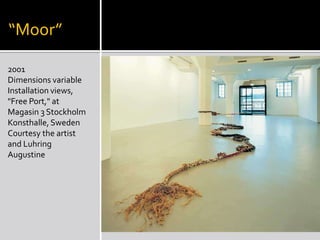
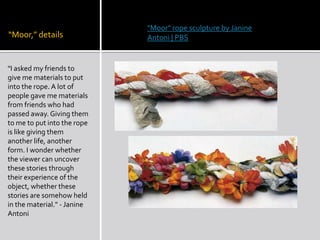
Antoni’s primary tool for making sculpture has always been her own body. She has chiseled cubes of lard and chocolate with her teeth, washed away the faces of soap busts made in her own likeness, and used the brainwave signals recorded while she dreamed at night as a pattern for weaving a blanket the following morning. “Moor”2001Dimensions variableInstallation views, "Free Port," at Magasin 3 Stockholm Konsthalle, SwedenCourtesy the artist and Luhring Augustine
“Moor,” details"I asked my friends to give me materials to put into the rope. A lot of people gave me materials from friends who had passed away. Giving them to me to put into the rope is like giving them another life, another form. I wonder whether the viewer can uncover these stories through their experience of the object, whether these stories are somehow held in the material." - Janine Antoni"Moor" rope sculpture by Janine Antoni | PBSrope sculpture
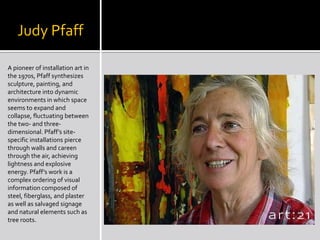
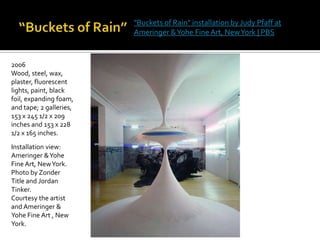
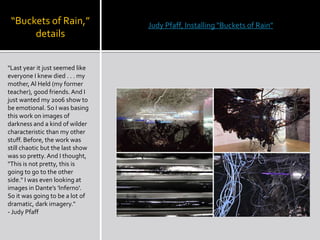
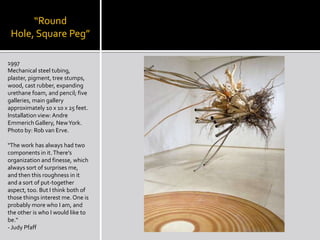
Judy PfaffA pioneer of installation art in the 1970s, Pfaff synthesizes sculpture, painting, and architecture into dynamic environments in which space seems to expand and collapse, fluctuating between the two- and three-dimensional. Pfaff’s site-specific installations pierce through walls and careen through the air, achieving lightness and explosive energy. Pfaff’s work is a complex ordering of visual information composed of steel, fiberglass, and plaster as well as salvaged signage and natural elements such as tree roots.
Pfaff BiographyJudy Pfaff was born in London, England in 1946.
She received a BFA from Washington University, Saint Louis (1971) and an MFA from Yale University (1973).
Balancing intense planning with improvisational decision-making, Pfaff creates exuberant, sprawling sculptures and installations that weave landscape, architecture, and color into a tense yet organic whole.

Installation Art

  • 1.
  • 2.
    Installation ArtArt thatis created for a specific site, often incorporating materials or physical features of the site.
  • 3.
    Contemporary ArtistsArtists ofthe present age; belonging to the same period of time; modern, current.Maya Lin
  • 4.
    Janine Antoni
  • 5.
  • 6.
    Martin PuryearMaya LinMayaLin catapulted into the public eye when she submitted the winning design in the national competition for the Vietnam Veterans Memorial in Washington D.C. Trained as an artist and architect, her sculptures, parks, monuments, and architectural projects are linked by a desire to make a place for individuals within the landscape.Maya Lin talks about architecture, memorials, and being an artist | PBS
  • 7.
    Lin BiographyBorn in1959 in Athens, Ohio
  • 8.
    She was trainedas an artist and architect, and her sculptures, parks, monuments, and architectural projects are linked by her ideal of making a place for individuals within the landscape.
  • 9.
    Lin, aChinese-American, came from a cultivated and artistic home. Her father was the dean of fine arts at Ohio University; her mother is a professor of literature at Ohio University.
  • 10.
    She draws inspirationfor her sculpture and architecture from culturally diverse sources, including Japanese gardens, Hopewell Indian earthen mounds, and works by American earthworks artists of the 1960s and 1970s. “Vietnam Veterans Memorial”1982Black granite, each wall: 246 feet long, 10 1/2 feet high, Washington D.C.Courtesy the National Park Service
  • 12.
    “The Wave Field”1995Shapedearth, 100 x 100 feet, University of Michigan, Ann Arbor, Michigan"With the 'Wave Field' in Michigan, it was for an aerospace engineering building and I had no idea what I was going to do. My site could have been in the building they were building or outside. And I just read up on aerospace and flight for three months and then came up with the idea of the 'Wave Field,' which is basically a book image of a natural occurring water wave that came about because flight requires resistance, and that led to turbulence studies, which led to fluid dynamics."- Maya Lin
  • 13.
    Janine AntoniJanine Antoni’swork blurs the distinction between performance art and sculpture. Antoni transforms everyday activities such as eating, bathing, and sleeping into ways of making art, such as painting and sculpting. Themes in her work include mortality, desire and the body.
  • 14.
    Antoni BiographyJanine Antoniwas born in Freeport, Bahamas in 1964.
  • 15.
    She received herBA from Sarah Lawrence College in New York, and earned her MFA from the Rhode Island School of Design in 1989.
  • 16.
    Antoni’s primary toolfor making sculpture has always been her own body. She has chiseled cubes of lard and chocolate with her teeth, washed away the faces of soap busts made in her own likeness, and used the brainwave signals recorded while she dreamed at night as a pattern for weaving a blanket the following morning. “Moor”2001Dimensions variableInstallation views, "Free Port," at Magasin 3 Stockholm Konsthalle, SwedenCourtesy the artist and Luhring Augustine
  • 17.
    “Moor,” details"I askedmy friends to give me materials to put into the rope. A lot of people gave me materials from friends who had passed away. Giving them to me to put into the rope is like giving them another life, another form. I wonder whether the viewer can uncover these stories through their experience of the object, whether these stories are somehow held in the material." - Janine Antoni"Moor" rope sculpture by Janine Antoni | PBSrope sculpture
  • 18.
    Judy PfaffA pioneerof installation art in the 1970s, Pfaff synthesizes sculpture, painting, and architecture into dynamic environments in which space seems to expand and collapse, fluctuating between the two- and three-dimensional. Pfaff’s site-specific installations pierce through walls and careen through the air, achieving lightness and explosive energy. Pfaff’s work is a complex ordering of visual information composed of steel, fiberglass, and plaster as well as salvaged signage and natural elements such as tree roots.
  • 19.
    Pfaff BiographyJudy Pfaffwas born in London, England in 1946.
  • 20.
    She received aBFA from Washington University, Saint Louis (1971) and an MFA from Yale University (1973).
  • 21.
    Balancing intense planningwith improvisational decision-making, Pfaff creates exuberant, sprawling sculptures and installations that weave landscape, architecture, and color into a tense yet organic whole.