Introduction to Style: Exploring Key
Differences in How People Learn.
We Bring Learning to Life
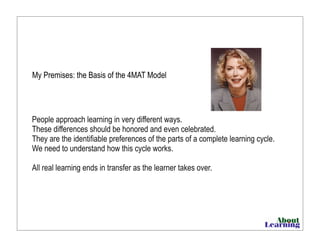
People approach learning in very different ways.
These differences should be honored and even celebrated.
They are the identifiable preferences of the parts of a complete learning cycle.
We need to understand how this cycle works.
All real learning ends in transfer as the learner takes over.
My Premises: the Basis of the 4MAT Model
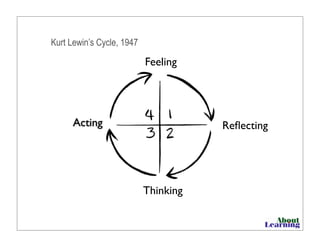
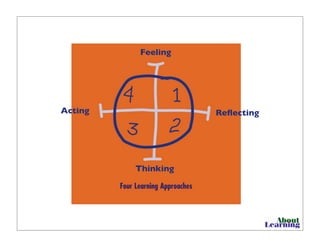
Feeling
Thinking
ReflectingActing
Kurt Lewin’s Cycle, 1947
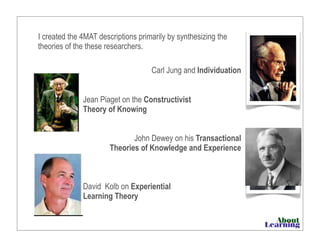
Carl Jung and Individuation
Jean Piaget on the Constructivist
Theory of Knowing
John Dewey on his Transactional
Theories of Knowledge and Experience
David Kolb on Experiential
Learning Theory
I created the 4MAT descriptions primarily by synthesizing the
theories of the these researchers.
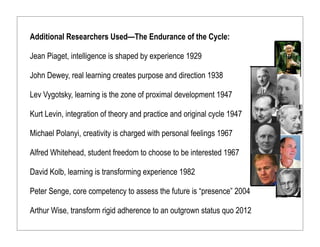
Additional Researchers Used—The Endurance of the Cycle:
Jean Piaget, intelligence is shaped by experience 1929
John Dewey, real learning creates purpose and direction 1938
Lev Vygotsky, learning is the zone of proximal development 1947
Kurt Levin, integration of theory and practice and original cycle 1947
Michael Polanyi, creativity is charged with personal feelings 1967
Alfred Whitehead, student freedom to choose to be interested 1967
David Kolb, learning is transforming experience 1982
Peter Senge, core competency to assess the future is “presence” 2004
Arthur Wise, transform rigid adherence to an outgrown status quo 2012
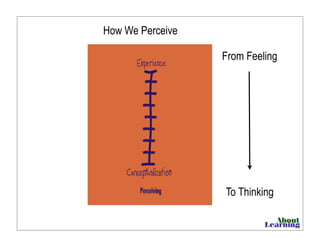
How We Perceive
From Feeling
To Thinking
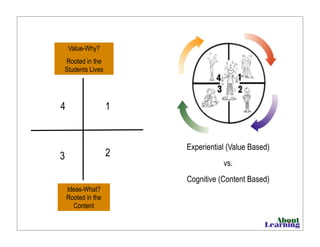
Experiential (Value Based)
vs.
Cognitive (Content Based)
2
1
3
4
Value-Why?
Rooted in the
Students Lives
Ideas-What?
Rooted in the
Content
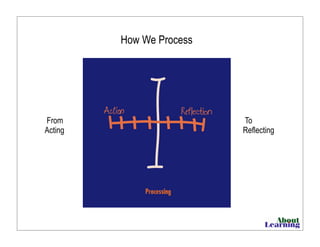
To
Reflecting
From
Acting
How We Process
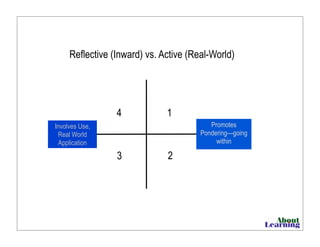
Reflective (Inward) vs. Active (Real-World)
1
23
4
Promotes
Pondering—going
within
Involves Use,
Real World
Application
Feeling
Reflecting
Thinking
Acting
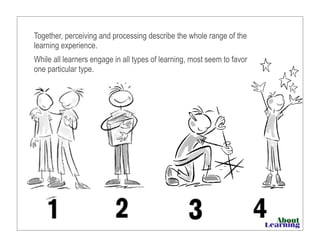
Together, perceiving and processing describe the whole range of the
learning experience.
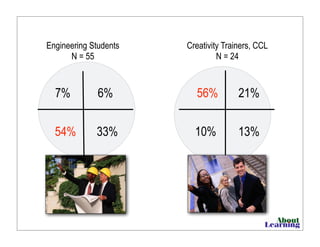
While all learners engage in all types of learning, most seem to favor
one particular type.
Engineering Students
N = 55
Creativity Trainers, CCL
N = 24
6%
33%54%
7% 56% 21%
10% 13%
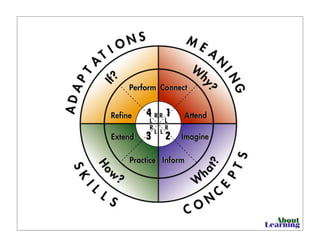
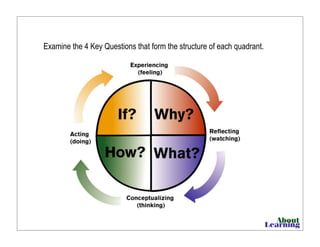
Examine the 4 Key Questions that form the structure of each quadrant.
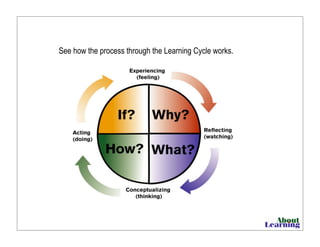
See how the process through the Learning Cycle works.
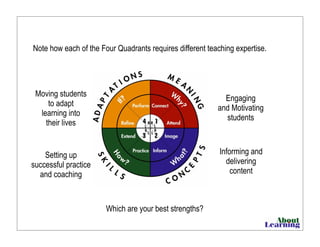
Note how each of the Four Quadrants requires different teaching expertise.
Informing and
delivering
content
Setting up
successful practice
and coaching
Moving students
to adapt
learning into
their lives
Engaging
and Motivating
students
Which are your best strengths?
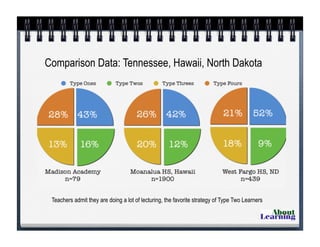
Comparison Data: Tennessee, Hawaii, North Dakota
Teachers admit they are doing a lot of lecturing, the favorite strategy of Type Two Learners
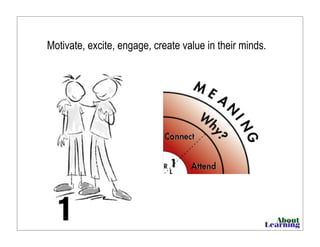
Motivate, excite, engage, create value in their minds.
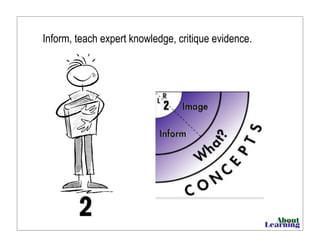
Inform, teach expert knowledge, critique evidence.
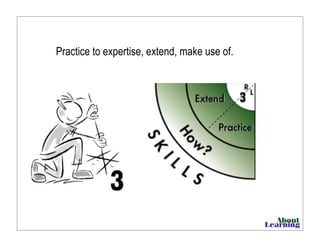
Practice to expertise, extend, make use of.
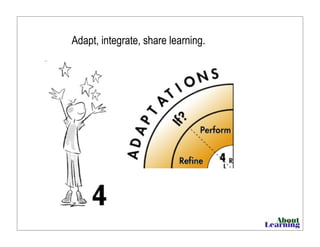
Adapt, integrate, share learning.
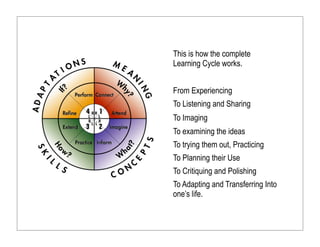
This is how the complete
Learning Cycle works.
From Experiencing
To Listening and Sharing
To Imaging
To examining the ideas
To trying them out, Practicing
To Planning their Use
To Critiquing and Polishing
To Adapting and Transferring Into
one’s life.
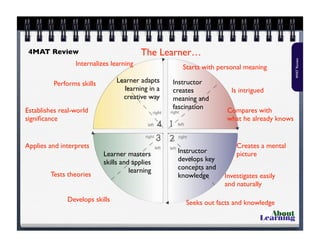
4MATReview
4MAT Review The Learner…
Instructor
creates
meaning and
fascination
Instructor
develops key
concepts and
knowledge
Learner masters
skills and applies
learning
Learner adapts
learning in a
creative way
Starts with personal meaning
Is intrigued
Compares with
what he already knows
Creates a mental
picture
Investigates easily
and naturally
Seeks out facts and knowledgeDevelops skills
Tests theories
Applies and interprets
Establishes real-world
significance
Performs skills
Internalizes learning
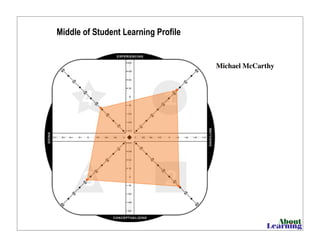
Middle of Student Learning Profile
Michael McCarthy
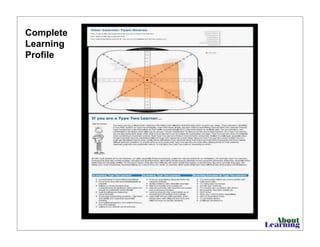
Complete
Learning
Profile
ABOUT LEARNING CONTACT INFORMATION
About Learning Corporate Office:
(800) 822-4MAT (4628)
Michael McCarthy (800) 822-4MAT, xt 234
michael@aboutlearning.com
Dr. Bernice McCarthy (847) 382-2915
bernice@aboutlearning.com
Fran Zidron, 4MAT Master Teacher and Trainer
fran@aboutlearning.com
Mary Piekarski, Training Coordinator and Customer Service
mary@aboutlearning.com
4MAT Web Sites
www.aboutlearning.com
www.4mationweb.com
www.teaching-algebra.com

Mini4mat overview

  • 1.
    Introduction to Style:Exploring Key Differences in How People Learn. We Bring Learning to Life
  • 3.
    People approach learningin very different ways. These differences should be honored and even celebrated. They are the identifiable preferences of the parts of a complete learning cycle. We need to understand how this cycle works. All real learning ends in transfer as the learner takes over. My Premises: the Basis of the 4MAT Model
  • 4.
  • 5.
    Carl Jung andIndividuation Jean Piaget on the Constructivist Theory of Knowing John Dewey on his Transactional Theories of Knowledge and Experience David Kolb on Experiential Learning Theory I created the 4MAT descriptions primarily by synthesizing the theories of the these researchers.
  • 6.
    Additional Researchers Used—TheEndurance of the Cycle: Jean Piaget, intelligence is shaped by experience 1929 John Dewey, real learning creates purpose and direction 1938 Lev Vygotsky, learning is the zone of proximal development 1947 Kurt Levin, integration of theory and practice and original cycle 1947 Michael Polanyi, creativity is charged with personal feelings 1967 Alfred Whitehead, student freedom to choose to be interested 1967 David Kolb, learning is transforming experience 1982 Peter Senge, core competency to assess the future is “presence” 2004 Arthur Wise, transform rigid adherence to an outgrown status quo 2012
  • 7.
    How We Perceive FromFeeling To Thinking
  • 8.
    Experiential (Value Based) vs. Cognitive(Content Based) 2 1 3 4 Value-Why? Rooted in the Students Lives Ideas-What? Rooted in the Content
  • 9.
  • 10.
    Reflective (Inward) vs.Active (Real-World) 1 23 4 Promotes Pondering—going within Involves Use, Real World Application
  • 11.
  • 12.
    Together, perceiving andprocessing describe the whole range of the learning experience. While all learners engage in all types of learning, most seem to favor one particular type.
  • 13.
    Engineering Students N =55 Creativity Trainers, CCL N = 24 6% 33%54% 7% 56% 21% 10% 13%
  • 14.
    Examine the 4Key Questions that form the structure of each quadrant.
  • 15.
    See how theprocess through the Learning Cycle works.
  • 16.
    Note how eachof the Four Quadrants requires different teaching expertise. Informing and delivering content Setting up successful practice and coaching Moving students to adapt learning into their lives Engaging and Motivating students Which are your best strengths?
  • 17.
    Comparison Data: Tennessee,Hawaii, North Dakota Teachers admit they are doing a lot of lecturing, the favorite strategy of Type Two Learners
  • 18.
    Motivate, excite, engage,create value in their minds.
  • 19.
    Inform, teach expertknowledge, critique evidence.
  • 20.
    Practice to expertise,extend, make use of.
  • 21.
  • 22.
    This is howthe complete Learning Cycle works. From Experiencing To Listening and Sharing To Imaging To examining the ideas To trying them out, Practicing To Planning their Use To Critiquing and Polishing To Adapting and Transferring Into one’s life.
  • 23.
    4MATReview 4MAT Review TheLearner… Instructor creates meaning and fascination Instructor develops key concepts and knowledge Learner masters skills and applies learning Learner adapts learning in a creative way Starts with personal meaning Is intrigued Compares with what he already knows Creates a mental picture Investigates easily and naturally Seeks out facts and knowledgeDevelops skills Tests theories Applies and interprets Establishes real-world significance Performs skills Internalizes learning
  • 24.
    Middle of StudentLearning Profile Michael McCarthy
  • 25.
  • 26.
    ABOUT LEARNING CONTACTINFORMATION About Learning Corporate Office: (800) 822-4MAT (4628) Michael McCarthy (800) 822-4MAT, xt 234 michael@aboutlearning.com Dr. Bernice McCarthy (847) 382-2915 bernice@aboutlearning.com Fran Zidron, 4MAT Master Teacher and Trainer fran@aboutlearning.com Mary Piekarski, Training Coordinator and Customer Service mary@aboutlearning.com 4MAT Web Sites www.aboutlearning.com www.4mationweb.com www.teaching-algebra.com