NED with two-stage
coherence optimization
or
How I taught my bottle of Jack Daniel’s not to turn into a 168-years-old
person with a net income of $120.000.000
Filip Ilievski
Supervisors:
Marieke van Erp Piek Vossen
Stefan Schlobach Wouter Beek
Kick-off
● Combinatorial explosion
● FrameNet
● NWR’s Events and Situations Ontology (ESO)
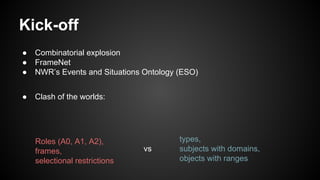
● Clash of the worlds:
Roles (A0, A1, A2),
frames,
selectional restrictions
types,
subjects with domains,
objects with ranges
vs
Outline
1. Background
a. Language processing
b. Identity
2. Problem statement
3. Research scope
4. Contemporary approaches
5. Solution design
6. Tools and examples
7. Experimental Setup
8. Remarks
Language processing: Motivation
● “Ninety percent of all the data in the world was
produced in the last two years.
○ This trend is expected to grow.”
● “80 percent of all the information in the world is
unstructured information.”
● We need computers that can understand this
flood of information.
○ i.e. we need tools to automatically process
language
(IBM on Watson, 2012)
● Language is at the base of our cognition, our ability to understand the
world
● The language is subjective and relates to a discourse world
● Language is incredibly imprecise: we luv reusing and messing up
○ How can a slim chance and a fat chance be the same, but a wise man
and a wise guy are opposites?
○ How can a house burn up as it burns down?
○ Why do we fill in a form by filling it out?
● And language is amazingly accurate
○ despite all its inconsistencies, irregularities and contradictions, we
convey so much meaning and accomplish so much collaboration.
On the Ambiguity of language
● Language is at the base of our cognition, our ability to understand the
world
● The language is subjective and relates to a discourse world
● Language is incredibly imprecise: we luv reusing and messing up
○ How can a slim chance and a fat chance be the same, but a wise man
and a wise guy are opposites?
○ How can a house burn up as it burns down?
○ Why do we fill in a form by filling it out?
● And language is amazingly accurate
○ despite all its inconsistencies, irregularities and contradictions, we
convey so much meaning and accomplish so much collaboration
On the Ambiguity of language
● Language is at the base of our cognition, our ability to understand the
world
● The language is subjective and relates to a discourse world
● Language is incredibly imprecise: we luv reusing and messing up
○ How can a slim chance and a fat chance be the same, but a wise man
and a wise guy are opposites?
○ How can a house burn up as it burns down?
○ Why do we fill in a form by filling it out?
● And language is amazingly accurate
○ despite all its inconsistencies, irregularities and contradictions, we
convey so much meaning and accomplish so much collaboration
(IBM on Watson, 2012)
The burden of context in language
● The language is context-dependent
● Verbal context
○ Ford fell from a tree.
■ What is “Ford” ?
● Social context
○ What is “2+2” ?
■ In mathematics it is 4
■ In the car domain it is a car configuration: 2 front + 2 back seats
■ In psychology it is a family with 2 parents and 2 children
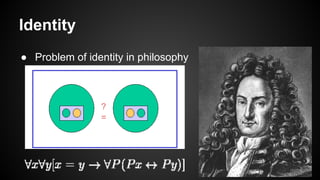
Identity
● Problem of identity in philosophy
?
=
Identity in language
“Any two entities are both similar and dissimilar with respect to an infinite
number of properties.” (Murphy & Medin, 1985)
● Entity linking becomes tricky
○ eg. Temporality: Is Old Amsterdam identical to New Amsterdam ?
● Continuum of identity
● Metonymy
○ “Plato is on the top shelf” - Who or what is Plato?
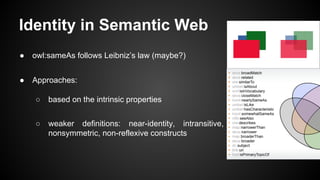
Identity in Semantic Web
● owl:sameAs follows Leibniz’s law (maybe?)
● Approaches:
○ based on the intrinsic properties
○ weaker definitions: near-identity, intransitive,
nonsymmetric, non-reflexive constructs
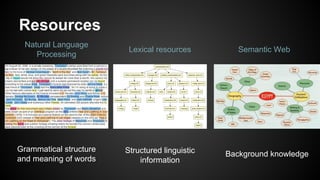
Resources
Grammatical structure
and meaning of words
Background knowledgeStructured linguistic
information
Semantic Web
Natural Language
Processing
Lexical resources
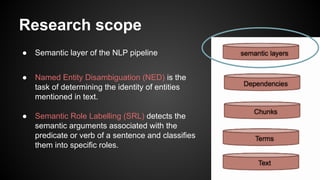
Research scope
● Semantic layer of the NLP pipeline
● Named Entity Disambiguation (NED) is the
task of determining the identity of entities
mentioned in text.
● Semantic Role Labelling (SRL) detects the
semantic arguments associated with the
predicate or verb of a sentence and classifies
them into specific roles.
Research question
● Can the NED accuracy be improved by optimizing the coherence of the
entities based on binary logic and probabilistic models?
○ What is the accuracy of each of the phases of the solution ?
1. the binary filtering phase
2. the probabilistic phase
○ Which components of the system are useful/useless?
○ How does this solution compare to the existing approaches (FRED,
NewsReader or DBPedia Spotlight) ?
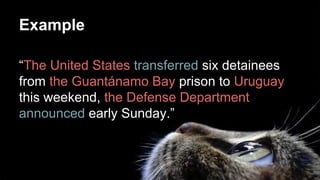
Example
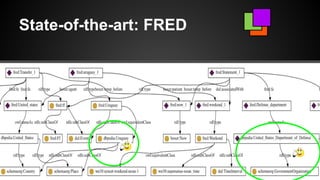
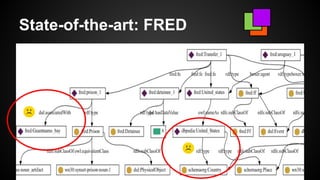
“The United States transferred six detainees
from the Guantánamo Bay prison to Uruguay
this weekend, the Defense Department
announced early Sunday.”
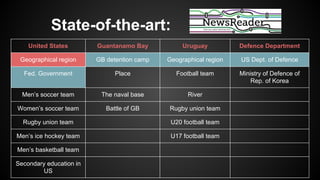
State-of-the-art:
United States Guantanamo Bay Uruguay Defence Department
Geographical region GB detention camp Geographical region US Dept. of Defence
Fed. Government Place Football team Ministry of Defence of
Rep. of Korea
Men’s soccer team The naval base River
Women’s soccer team Battle of GB Rugby union team
Rugby union team U20 football team
Men’s ice hockey team U17 football team
Men’s basketball team
Secondary education in
US
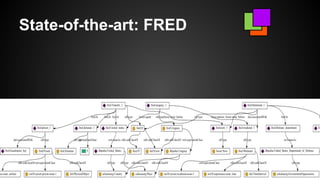
State-of-the-art:
State-of-the-art: FRED
Shall we go a step further?
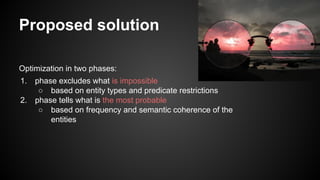
Proposed solution
Optimization in two phases:
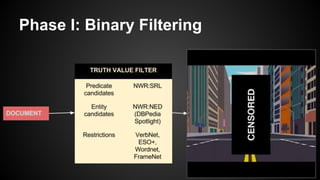
1. phase excludes what is impossible
○ based on entity types and predicate restrictions
2. phase tells what is the most probable
○ based on frequency and semantic coherence of the
entities
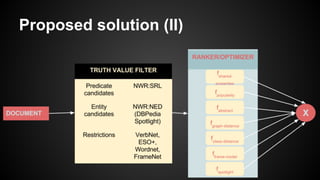
Proposed solution (II)
Phase I: Binary Filtering
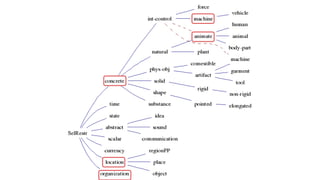
Tools: VerbNet
● largest online verb lexicon currently
available for English
● hierarchical (not ontological though)
● domain-independent
+ good coverage of predicates
+ defines syntactic-semantic relations
- thematic roles are too generic
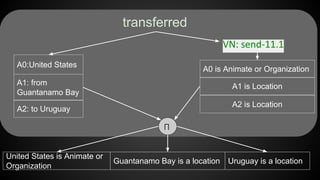
VN: send-11.1
transferred
A0 is Animate or Organization
A0:United States
United States is Animate or
Organization
∏
A1: from
Guantanamo Bay
A2: to Uruguay
A1 is Location
A2 is Location
Guantanamo Bay is a location Uruguay is a location
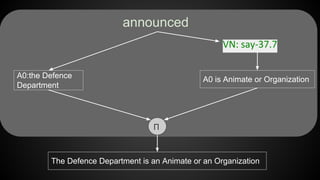
VN: say-37.7
announced
A0 is Animate or OrganizationA0:the Defence
Department
∏
The Defence Department is an Animate or an Organization
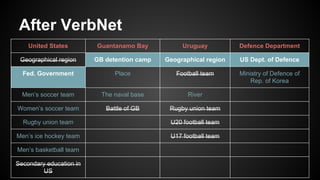
After VerbNet
United States Guantanamo Bay Uruguay Defence Department
Geographical region GB detention camp Geographical region US Dept. of Defence
Fed. Government Place Football team Ministry of Defence of
Rep. of Korea
Men’s soccer team The naval base River
Women’s soccer team Battle of GB Rugby union team
Rugby union team U20 football team
Men’s ice hockey team U17 football team
Men’s basketball team
Secondary education in
US
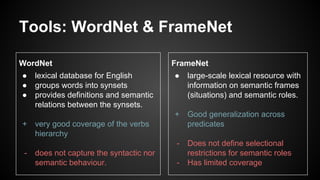
Tools: WordNet & FrameNet
WordNet
● lexical database for English
● groups words into synsets
● provides definitions and semantic
relations between the synsets.
+ very good coverage of the verbs
hierarchy
- does not capture the syntactic nor
semantic behaviour.
FrameNet
● large-scale lexical resource with
information on semantic frames
(situations) and semantic roles.
+ Good generalization across
predicates
- Does not define selectional
restrictions for semantic roles
- Has limited coverage
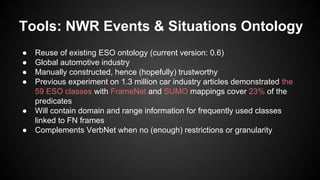
Tools: NWR Events & Situations Ontology
● Reuse of existing ESO ontology (current version: 0.6)
● Global automotive industry
● Manually constructed, hence (hopefully) trustworthy
● Previous experiment on 1.3 million car industry articles demonstrated the
59 ESO classes with FrameNet and SUMO mappings cover 23% of the
predicates
● Will contain domain and range information for frequently used classes
linked to FN frames
● Complements VerbNet when no (enough) restrictions or granularity
ESO+ example
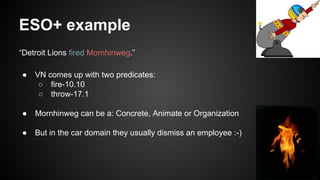
“Detroit Lions fired Mornhinweg.”
● VN comes up with two predicates:
○ fire-10.10
○ throw-17.1
● Mornhinweg can be a: Concrete, Animate or Organization
● But in the car domain they usually dismiss an employee :-)
ESO+ example
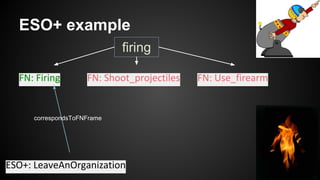
firing
FN: Shoot_projectiles FN: Use_firearmFN: Firing
ESO+: LeaveAnOrganization
correspondsToFNFrame
Tools: DBpedia/Schema.org
● Semantic web resources with domain-independent factual information
○ DBpedia has 685 classes, over 4 million instances
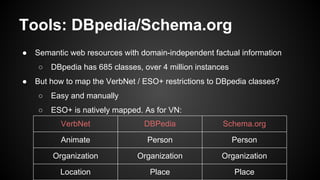
● But how to map the VerbNet / ESO+ restrictions to DBpedia classes?
○ Easy and manually
○ ESO+ is natively mapped. As for VN:
VerbNet DBPedia Schema.org
Animate Person Person
Organization Organization Organization
Location Place Place
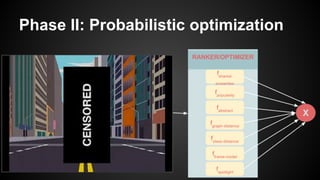
Phase II: Probabilistic optimization
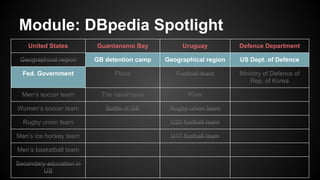
Module: DBpedia Spotlight
United States Guantanamo Bay Uruguay Defence Department
Geographical region GB detention camp Geographical region US Dept. of Defence
Fed. Government Place Football team Ministry of Defence of
Rep. of Korea
Men’s soccer team The naval base River
Women’s soccer team Battle of GB Rugby union team
Rugby union team U20 football team
Men’s ice hockey team U17 football team
Men’s basketball team
Secondary education in
US
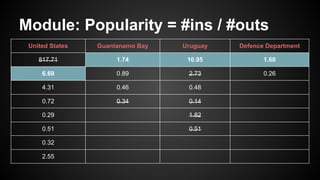
United States Guantanamo Bay Uruguay Defence Department
817.71 1.74 10.95 1.60
6.69 0.89 2.73 0.26
4.31 0.46 0.48
0.72 0.34 0.14
0.29 1.82
0.51 0.51
0.32
2.55
Module: Popularity = #ins / #outs
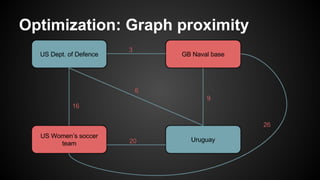
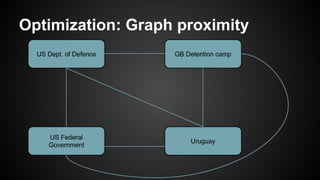
Optimization: Graph proximity
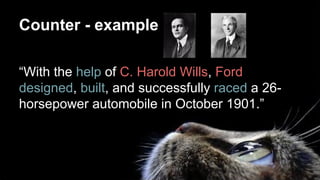
Counter - example
“With the help of C. Harold Wills, Ford
designed, built, and successfully raced a 26-
horsepower automobile in October 1901.”
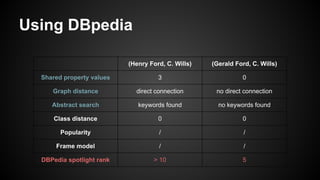
Using DBpedia
(Henry Ford, C. Wills) (Gerald Ford, C. Wills)
Shared property values 3 0
Graph distance direct connection no direct connection
Abstract search keywords found no keywords found
Class distance 0 0
Popularity / /
Frame model / /
DBPedia spotlight rank > 10 5
Points to make
● No module is perfect
○ but >1 module will be helpful
● Popularity Bias
● Topic Bias
○ old movies, the western
culture, entertainment, etc.
● Computational complexity
(reduced implicitly)
● Incompleteness and maintenance
of datasets
● The lexical resources are not
ontological
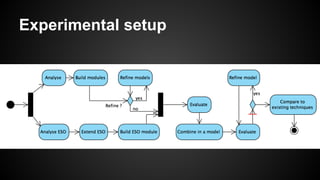
Experimental setup
Data
● 120 news articles
○ 30 GM, Ford, Chrysler car data
○ 30 Apple corpus articles
○ 30 Boeing Airbus
○ 30 stock market
● Training data
○ 1.3 M car articles
++Awesome things I won’t do
Cross-sentence check
Build a model over more ontologies
FrameNet situations reasoning
Questions?
Appendices
Identity in language
“Any two entities are both similar and dissimilar with respect to an infinite
number of properties.” (Murphy & Medin, 1985)
● Entity coreference becomes tricky
○ Temporality: Is Old Amsterdam identical to New Amsterdam ?
○ Pragmatism: Is Lord Lipton identical to the wealthiest tea importer ?
○ Granularization: Is passengers and people identical?
● Continuum of identity
Identity in NLP
● Traditional techniques interpret identify in a shallow way, based on:
○ popularity
○ TF-IDF score
○ bag-of-words similarity
● Contemporary techniques start looking into semantic coherence
○ pair-wise interpretation
○ collective interpretation
Problem statement
● Entity linking ambiguity in the NLP world
● Also present within the Semantic Web
● Lexical resources are not exploited enough
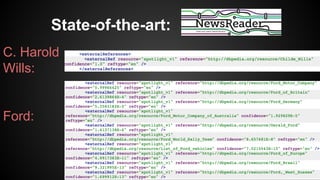
State-of-the-art:
C. Harold
Wills:
Ford:
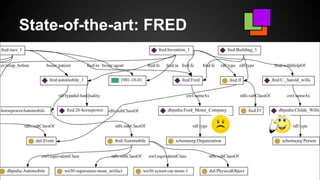
State-of-the-art: FRED
Tools: ConceptNet 5
● because common sense knowledge is lacking often in DBpedia (and alike)
resources

Mini seminar presentation on context-based NED optimization

  • 1.
    NED with two-stage coherenceoptimization or How I taught my bottle of Jack Daniel’s not to turn into a 168-years-old person with a net income of $120.000.000 Filip Ilievski Supervisors: Marieke van Erp Piek Vossen Stefan Schlobach Wouter Beek
  • 2.
    Kick-off ● Combinatorial explosion ●FrameNet ● NWR’s Events and Situations Ontology (ESO) ● Clash of the worlds: Roles (A0, A1, A2), frames, selectional restrictions types, subjects with domains, objects with ranges vs
  • 3.
    Outline 1. Background a. Languageprocessing b. Identity 2. Problem statement 3. Research scope 4. Contemporary approaches 5. Solution design 6. Tools and examples 7. Experimental Setup 8. Remarks
  • 4.
    Language processing: Motivation ●“Ninety percent of all the data in the world was produced in the last two years. ○ This trend is expected to grow.” ● “80 percent of all the information in the world is unstructured information.” ● We need computers that can understand this flood of information. ○ i.e. we need tools to automatically process language (IBM on Watson, 2012)
  • 5.
    ● Language isat the base of our cognition, our ability to understand the world ● The language is subjective and relates to a discourse world ● Language is incredibly imprecise: we luv reusing and messing up ○ How can a slim chance and a fat chance be the same, but a wise man and a wise guy are opposites? ○ How can a house burn up as it burns down? ○ Why do we fill in a form by filling it out? ● And language is amazingly accurate ○ despite all its inconsistencies, irregularities and contradictions, we convey so much meaning and accomplish so much collaboration. On the Ambiguity of language
  • 6.
    ● Language isat the base of our cognition, our ability to understand the world ● The language is subjective and relates to a discourse world ● Language is incredibly imprecise: we luv reusing and messing up ○ How can a slim chance and a fat chance be the same, but a wise man and a wise guy are opposites? ○ How can a house burn up as it burns down? ○ Why do we fill in a form by filling it out? ● And language is amazingly accurate ○ despite all its inconsistencies, irregularities and contradictions, we convey so much meaning and accomplish so much collaboration On the Ambiguity of language
  • 7.
    On the Ambiguityof language ● Language is at the base of our cognition, our ability to understand the world ● The language is subjective and relates to a discourse world ● Language is incredibly imprecise: we luv reusing and messing up ○ How can a slim chance and a fat chance be the same, but a wise man and a wise guy are opposites? ○ How can a house burn up as it burns down? ○ Why do we fill in a form by filling it out? ● And language is amazingly accurate ○ despite all its inconsistencies, irregularities and contradictions, we convey so much meaning and accomplish so much collaboration (IBM on Watson, 2012)
  • 8.
    The burden ofcontext in language ● The language is context-dependent ● Verbal context ○ Ford fell from a tree. ■ What is “Ford” ? ● Social context ○ What is “2+2” ? ■ In mathematics it is 4 ■ In the car domain it is a car configuration: 2 front + 2 back seats ■ In psychology it is a family with 2 parents and 2 children
  • 9.
    Identity ● Problem ofidentity in philosophy ? =
  • 10.
    Identity in language “Anytwo entities are both similar and dissimilar with respect to an infinite number of properties.” (Murphy & Medin, 1985) ● Entity linking becomes tricky ○ eg. Temporality: Is Old Amsterdam identical to New Amsterdam ? ● Continuum of identity ● Metonymy ○ “Plato is on the top shelf” - Who or what is Plato?
  • 11.
    Identity in SemanticWeb ● owl:sameAs follows Leibniz’s law (maybe?) ● Approaches: ○ based on the intrinsic properties ○ weaker definitions: near-identity, intransitive, nonsymmetric, non-reflexive constructs
  • 12.
    Resources Grammatical structure and meaningof words Background knowledgeStructured linguistic information Semantic Web Natural Language Processing Lexical resources
  • 13.
    Research scope ● Semanticlayer of the NLP pipeline ● Named Entity Disambiguation (NED) is the task of determining the identity of entities mentioned in text. ● Semantic Role Labelling (SRL) detects the semantic arguments associated with the predicate or verb of a sentence and classifies them into specific roles.
  • 14.
    Research question ● Canthe NED accuracy be improved by optimizing the coherence of the entities based on binary logic and probabilistic models? ○ What is the accuracy of each of the phases of the solution ? 1. the binary filtering phase 2. the probabilistic phase ○ Which components of the system are useful/useless? ○ How does this solution compare to the existing approaches (FRED, NewsReader or DBPedia Spotlight) ?
  • 15.
    Example “The United Statestransferred six detainees from the Guantánamo Bay prison to Uruguay this weekend, the Defense Department announced early Sunday.”
  • 16.
    State-of-the-art: United States GuantanamoBay Uruguay Defence Department Geographical region GB detention camp Geographical region US Dept. of Defence Fed. Government Place Football team Ministry of Defence of Rep. of Korea Men’s soccer team The naval base River Women’s soccer team Battle of GB Rugby union team Rugby union team U20 football team Men’s ice hockey team U17 football team Men’s basketball team Secondary education in US
  • 17.
  • 18.
  • 19.
  • 20.
  • 21.
    Shall we goa step further?
  • 22.
    Proposed solution Optimization intwo phases: 1. phase excludes what is impossible ○ based on entity types and predicate restrictions 2. phase tells what is the most probable ○ based on frequency and semantic coherence of the entities
  • 23.
  • 24.
    Phase I: BinaryFiltering
  • 25.
    Tools: VerbNet ● largestonline verb lexicon currently available for English ● hierarchical (not ontological though) ● domain-independent + good coverage of predicates + defines syntactic-semantic relations - thematic roles are too generic
  • 27.
    VN: send-11.1 transferred A0 isAnimate or Organization A0:United States United States is Animate or Organization ∏ A1: from Guantanamo Bay A2: to Uruguay A1 is Location A2 is Location Guantanamo Bay is a location Uruguay is a location
  • 28.
    VN: say-37.7 announced A0 isAnimate or OrganizationA0:the Defence Department ∏ The Defence Department is an Animate or an Organization
  • 29.
    After VerbNet United StatesGuantanamo Bay Uruguay Defence Department Geographical region GB detention camp Geographical region US Dept. of Defence Fed. Government Place Football team Ministry of Defence of Rep. of Korea Men’s soccer team The naval base River Women’s soccer team Battle of GB Rugby union team Rugby union team U20 football team Men’s ice hockey team U17 football team Men’s basketball team Secondary education in US
  • 30.
    Tools: WordNet &FrameNet WordNet ● lexical database for English ● groups words into synsets ● provides definitions and semantic relations between the synsets. + very good coverage of the verbs hierarchy - does not capture the syntactic nor semantic behaviour. FrameNet ● large-scale lexical resource with information on semantic frames (situations) and semantic roles. + Good generalization across predicates - Does not define selectional restrictions for semantic roles - Has limited coverage
  • 31.
    Tools: NWR Events& Situations Ontology ● Reuse of existing ESO ontology (current version: 0.6) ● Global automotive industry ● Manually constructed, hence (hopefully) trustworthy ● Previous experiment on 1.3 million car industry articles demonstrated the 59 ESO classes with FrameNet and SUMO mappings cover 23% of the predicates ● Will contain domain and range information for frequently used classes linked to FN frames ● Complements VerbNet when no (enough) restrictions or granularity
  • 32.
    ESO+ example “Detroit Lionsfired Mornhinweg.” ● VN comes up with two predicates: ○ fire-10.10 ○ throw-17.1 ● Mornhinweg can be a: Concrete, Animate or Organization ● But in the car domain they usually dismiss an employee :-)
  • 33.
    ESO+ example firing FN: Shoot_projectilesFN: Use_firearmFN: Firing ESO+: LeaveAnOrganization correspondsToFNFrame
  • 34.
    Tools: DBpedia/Schema.org ● Semanticweb resources with domain-independent factual information ○ DBpedia has 685 classes, over 4 million instances ● But how to map the VerbNet / ESO+ restrictions to DBpedia classes? ○ Easy and manually ○ ESO+ is natively mapped. As for VN: VerbNet DBPedia Schema.org Animate Person Person Organization Organization Organization Location Place Place
  • 35.
  • 36.
    Module: DBpedia Spotlight UnitedStates Guantanamo Bay Uruguay Defence Department Geographical region GB detention camp Geographical region US Dept. of Defence Fed. Government Place Football team Ministry of Defence of Rep. of Korea Men’s soccer team The naval base River Women’s soccer team Battle of GB Rugby union team Rugby union team U20 football team Men’s ice hockey team U17 football team Men’s basketball team Secondary education in US
  • 37.
    United States GuantanamoBay Uruguay Defence Department 817.71 1.74 10.95 1.60 6.69 0.89 2.73 0.26 4.31 0.46 0.48 0.72 0.34 0.14 0.29 1.82 0.51 0.51 0.32 2.55 Module: Popularity = #ins / #outs
  • 38.
  • 39.
  • 40.
    Counter - example “Withthe help of C. Harold Wills, Ford designed, built, and successfully raced a 26- horsepower automobile in October 1901.”
  • 41.
    Using DBpedia (Henry Ford,C. Wills) (Gerald Ford, C. Wills) Shared property values 3 0 Graph distance direct connection no direct connection Abstract search keywords found no keywords found Class distance 0 0 Popularity / / Frame model / / DBPedia spotlight rank > 10 5
  • 42.
    Points to make ●No module is perfect ○ but >1 module will be helpful ● Popularity Bias ● Topic Bias ○ old movies, the western culture, entertainment, etc. ● Computational complexity (reduced implicitly) ● Incompleteness and maintenance of datasets ● The lexical resources are not ontological
  • 43.
  • 44.
    Data ● 120 newsarticles ○ 30 GM, Ford, Chrysler car data ○ 30 Apple corpus articles ○ 30 Boeing Airbus ○ 30 stock market ● Training data ○ 1.3 M car articles
  • 45.
    ++Awesome things Iwon’t do Cross-sentence check Build a model over more ontologies FrameNet situations reasoning
  • 46.
  • 47.
  • 48.
    Identity in language “Anytwo entities are both similar and dissimilar with respect to an infinite number of properties.” (Murphy & Medin, 1985) ● Entity coreference becomes tricky ○ Temporality: Is Old Amsterdam identical to New Amsterdam ? ○ Pragmatism: Is Lord Lipton identical to the wealthiest tea importer ? ○ Granularization: Is passengers and people identical? ● Continuum of identity
  • 49.
    Identity in NLP ●Traditional techniques interpret identify in a shallow way, based on: ○ popularity ○ TF-IDF score ○ bag-of-words similarity ● Contemporary techniques start looking into semantic coherence ○ pair-wise interpretation ○ collective interpretation
  • 50.
    Problem statement ● Entitylinking ambiguity in the NLP world ● Also present within the Semantic Web ● Lexical resources are not exploited enough
  • 51.
  • 52.
  • 53.
    Tools: ConceptNet 5 ●because common sense knowledge is lacking often in DBpedia (and alike) resources