Anissa Lokey-Vega, Ph.D.
Kennesaw State University
Doug Hearrington, Ed.D.
Georgia Regents University
Its no secret…our world has
changed
• Scott McLeod
• Andy Hargreaves
• Michael Fullan
• Yong Zhao
• Sir Ken Robinson
Scott McLeod at TEDxASB
http://youtu.be/-yA6oTU1emM
Key points
• Schooling was designed for a different kind of
world in regards to work and information access.
• To redesign schools, we have to start with what
we want students to be able to do and then write
the curriculum.
• He doesn’t sound like a fan of standards…but
they aren’t going anywhere anytime soon.
Pragmatically speaking, how can we move in a
direction of improvement?
Steps for Change
(We are optimists!)
1. Articulate what we want students to be able to do.
What’s the point?!?
2. Assess how well/poorly our standards are preparing
students for the new information and work context.
Evaluate what we’ve got.
3. Identify what is irrelevant. Throw those standards out
or look for successful models to help in revision.
Learn from others.
4. Re-align instruction, assessments, teacher training,
policies, and other structures.
Make targeted changes.
How would we pick a model?
• Programme for International Student
Assessment (PISA): USA ranks 14th
• Gross Domestic Product per Capita: USA ranks
6th
• Countries consistently out-performing the
USA in these measures include:
– Norway
– Switzerland
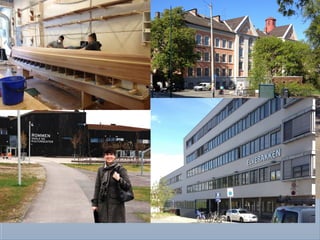
Norwegian Schools Overview
• Significant improvements in PISA 2009 scores
• Mandatory education up to completion of year 10 (typically
16 year olds) curriculum.
• Upper secondary education is an additional 3 years.
• Very very few privately funded schools
• Schools are selective and offer specialties
• Annual standardized tests are both written and oral.
Individual teachers and teacher panels are trusted to
grade.
• Purpose “Every student should be able to think for
themselves.”
• Staunch cultural value of social justice and equity that
drives the design and practice of mandatory education.
Step 1: What do we want US students to be able
to do?
• Goal of the Common Core: “college and career readiness”
(Common Core State Standards Initiative, 2010)
• Goal of Georgia Schools: preparation for employment
(Georgia Department of Education, 2009)
• Less than 6% of jobs in the United States are low-skill jobs
of the Agricultural and Industrial eras, and most employers
of today’s Knowledge Economy are looking for high-skilled
creative workers. (Kopczuk and Saez, 2004)
Why am I not focusing on “college readiness”? (Bui, 2013)
Work in the Knowledge Economy
(see YELLOW codebook/rubric)
• Creativity
• Digital Literacy
• English Language Literacy
• Information Literacy
• Interpersonal Participation in Learning Society
• Intrapersonal Skills of Life-Long Learning
• Media Literacy
• Numeracy
• Problem-Solving
• Systems Thinking
The Curricula
• GPS (Georgia Performance Standards)
– English Language Arts, Math, Science, and Social Studies
– 8th
grade
• CC (Common Core)
– English Language Arts and Math
– 8th
grade
• CCGPS
– English Language Arts, Math, Science, and Social Studies
– 8th
grade
• NOR (Norwegian National Curriculum)
– Norwegian, English Language Arts, Math, Science, and Social Studies
– 10th
grade
• NOR-E/M
– English Language Arts and Math
– 10th
grade
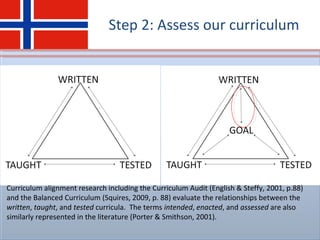
Step 2: Assess our curriculum
Curriculum alignment research including the Curriculum Audit (English & Steffy, 2001, p.88)
and the Balanced Curriculum (Squires, 2009, p. 88) evaluate the relationships between the
written, taught, and tested curricula. The terms intended, enacted, and assessed are also
similarly represented in the literature (Porter & Smithson, 2001).
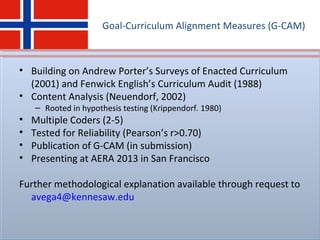
Goal-Curriculum Alignment Measures (G-CAM)
• Building on Andrew Porter’s Surveys of Enacted Curriculum
(2001) and Fenwick English’s Curriculum Audit (1988)
• Content Analysis (Neuendorf, 2002)
– Rooted in hypothesis testing (Krippendorf. 1980)
• Multiple Coders (2-5)
• Tested for Reliability (Pearson’s r>0.70)
• Publication of G-CAM (in submission)
• Presenting at AERA 2013 in San Francisco
Further methodological explanation available through request to
avega4@kennesaw.edu
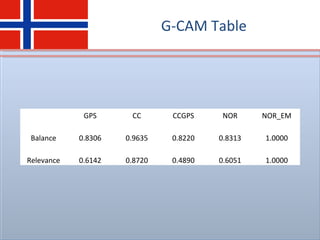
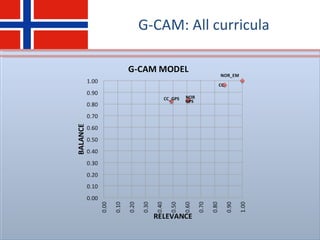
G-CAM Table
GPS CC CCGPS NOR NOR_EM
Balance 0.8306 0.9635 0.8220 0.8313 1.0000
Relevance 0.6142 0.8720 0.4890 0.6051 1.0000
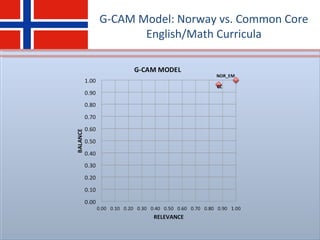
G-CAM Model: Norway vs. Common Core
English/Math Curricula
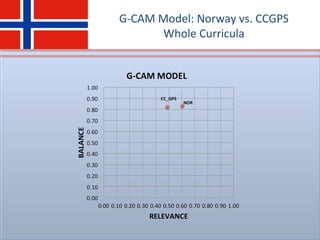
G-CAM Model: Norway vs. CCGPS
Whole Curricula
G-CAM: All curricula
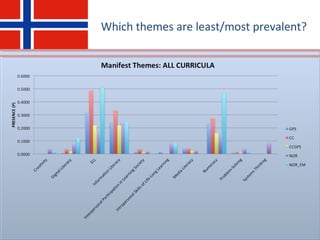
Which themes are least/most prevalent?
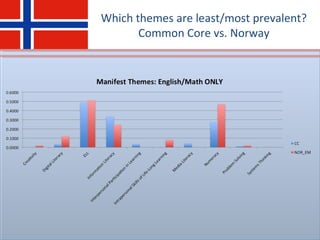
Common Core vs. Norway
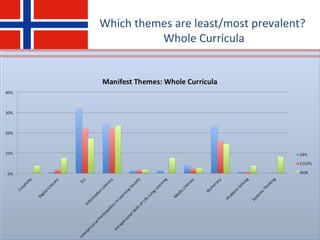
Which themes are least/most prevalent?
Whole Curricula
How are we doing?
“The Common Core State Standards provide a consistent, clear
understanding of what students are expected to learn, so
teachers and parents know what they need to do to help them.
The standards are designed to be robust and relevant to the real
world, reflecting the knowledge and skills that our young people
need for success in college and careers. With American students
fully prepared for the future, our communities will be best
positioned to compete successfully in the global economy.” –
CCSS mission statement
First, Let’s Celebrate!
• We are doing pretty good with information
literacy!
• Our English and Math Curricula could be
stronger, but they are NOT full of irrelevant
material like other subjects.
Why does it matter how standards are
written?
• Look at your latest CC text titles.
• If its not explicitly in the standards, is on the
tests? Is it taught?
• How do teachers interpret curriculum
standards in order to plan instruction?
– Sample (green handout)
– Audience (assumed), Behavior, Condition, Degree
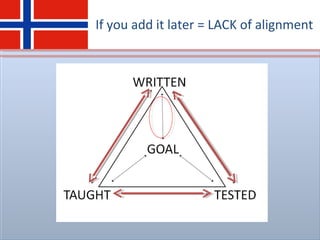
If you add it later = LACK of alignment
Step 3: Now, Let’s Get Better!
• Reduce the amount of irrelevant content found
in other subject areas.
• We need all curricular subjects to address more
of the skills/themes necessary to prepare student
for careers in today’s economy. We have big
gaps!
• We have far more curriculum standards for the
whole curriculum than Norway. Why is this so?
They are addressing more skills than we are in
fewer standards. CCGPS (n=364) NOR (n=157)
Creativity (see YELLOW codebook/rubric)
• CC: Develop the topic with relevant, well-chosen
facts, definitions, concrete details, quotations, or
other information and examples. (68WSHT2.b)
• NOR: use various media, sources and aesthetic
expressions in personal texts relating to the
Norwegian subject curriculum and
interdisciplinary texts (NN10.C02)
Continuous Improvement of the CC
Intrapersonal Skills of Life-Long Learning
• CC: Spell correctly (8.L2.c).
• NOR: describe and assess his/her own work in
learning English NE10.L05); identify important
linguistic similarities and differences between
English and the native language and use this
knowledge in his or her own language learning
(NE10.L02); give grounds for personal choices of
literature and reading material based on
knowledge of reading strategies (N10.W06)
Some informed revisions of
L2.c might include:
Option 1: Describe and assess his/her own work
in learning to spell words correctly.
Option 2: Identify important spelling similarities
and differences between related words and use
this knowledge in his/her own learning of how to
spell correctly.
Media Literacy
• CC: Cite specific textual evidence to support
analysis of science and technical texts. (68.RST1)
• NOR: search for and select sources, assess them
critically and show how different sources might
present history differently (NSS10.H04); use texts
taken from libraries, the internet and mass media
in a critical manner, discuss and elaborate on the
texts and acknowledge the sources used
(NN10.W14)
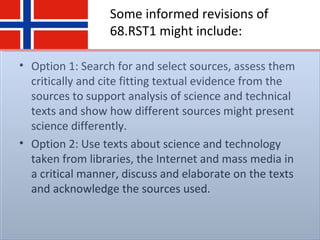
Some informed revisions of
68.RST1 might include:
• Option 1: Search for and select sources, assess them
critically and cite fitting textual evidence from the
sources to support analysis of science and technical
texts and show how different sources might present
science differently.
• Option 2: Use texts about science and technology
taken from libraries, the Internet and mass media in
a critical manner, discuss and elaborate on the texts
and acknowledge the sources used.
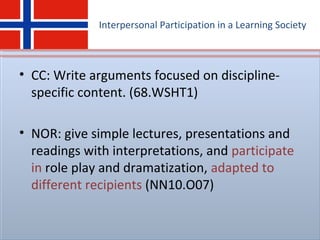
Interpersonal Participation in a Learning Society
• CC: Write arguments focused on discipline-
specific content. (68.WSHT1)
• NOR: give simple lectures, presentations and
readings with interpretations, and participate
in role play and dramatization, adapted to
different recipients (NN10.O07)
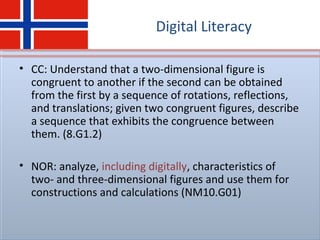
Digital Literacy
• CC: Understand that a two-dimensional figure is
congruent to another if the second can be obtained
from the first by a sequence of rotations, reflections,
and translations; given two congruent figures, describe
a sequence that exhibits the congruence between
them. (8.G1.2)
• NOR: analyze, including digitally, characteristics of
two- and three-dimensional figures and use them for
constructions and calculations (NM10.G01)
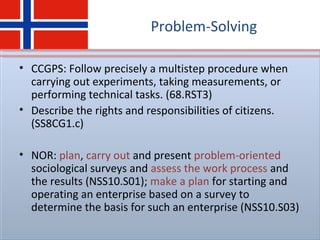
Problem-Solving
• CCGPS: Follow precisely a multistep procedure when
carrying out experiments, taking measurements, or
performing technical tasks. (68.RST3)
• Describe the rights and responsibilities of citizens.
(SS8CG1.c)
• NOR: plan, carry out and present problem-oriented
sociological surveys and assess the work process and
the results (NSS10.S01); make a plan for starting and
operating an enterprise based on a survey to
determine the basis for such an enterprise (NSS10.S03)
Systems Thinking
• CCGPS: The student will explain the benefits
of free trade (SS8E2)
• NOR: describe the universe and different
theories of how it has developed (NS10.U01);
describe the main characteristics of the
Norwegian economy and how our economy is
connected to the global economy (NSS10.S13)
Let’s raise the bar:
Digital Literacy, Information Literacy, & Numeracy
• CC: Know that straight lines are widely used to
model relationships between two quantitative
variables. For scatter plots that suggest a linear
association, informally fit a straight line, and
informally assess the model fit by judging the
closeness of the data points to the line. (8.SP1.2)
• NOR: carry out investigations and use databases
to search for and analyze statistical data and
demonstrate source criticism (NM10.SP01)
Let’s try 3rd
grade CC Math…
CC: Tell and write time to the nearest minute and
measure time intervals in minutes. Solve word
problems involving addition and subtraction of time
intervals in minutes, e.g., by representing the
problem on a number line diagram (3MD.A.1)
Interpersonal Skills of
Participating in a Knowledge Society (?)
Problem-Solving (?)
Systems Thinking (?)
Curricular Supplements
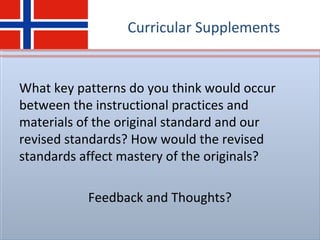
What key patterns do you think would occur
between the instructional practices and
materials of the original standard and our
revised standards? How would the revised
standards affect mastery of the originals?
Feedback and Thoughts?
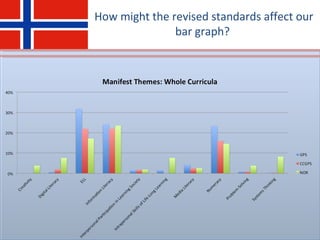
How might the revised standards affect our
bar graph?
Would the revised standards better support
the CCSS mission?
“The Common Core State Standards provide a consistent, clear
understanding of what students are expected to learn, so
teachers and parents know what they need to do to help them.
The standards are designed to be robust and relevant to the real
world, reflecting the knowledge and skills that our young people
need for success in college and careers. With American students
fully prepared for the future, our communities will be best
positioned to compete successfully in the global economy.” –
CCSS mission statement
Step 4?
Re-align instruction, assessments, teacher
training, policies, and other structures.
I Propose REVISION of the CC for Continuous
Improvement of College and Career Readiness
“‘Rapid iteration,’ ‘living in perpetual beta,’ and
other ideas related to quickly trying things,
getting feedback to see if they worked, and
adjusting course accordingly are all extremely
important, particularly in a rapidly-changing
world.” –Scott McLeod, 2013
Future Work: Continuous Improvement
Curriculum Revision Process
1. Articulate goal of schooling/subject/program
2. Conduct initial G-CAM analysis to identify
irrelevant content for revision
3. Use other curricula as models for targeted
revisions
4. Conduct follow-up G-CAM analysis to
determine quality improvement
Detailed Reference List Available
• Common Core State Standards Initiative, 2010
• Georgia Department of Education, 2009
• Kopczuk and Saez, 2004
• Bui, 2013
• Schweizer Medieninstitut furBildung und Kultur, 2011; Ministry of
Education and Research, 2011
• English & Steffy, 2001
• Squires, 2009
• Porter & Smithson, 2001
• Neuendorf, 2002
• Krippendorf. 1980
• Scott McLeod, 2013
Special Thanks
BCOE Global Engagement Award Committee
and
Dr. Geir Moen
Toyen Skole
of Oslo, Norway
And the many teachers and administrators of Oslo’s public
schools for welcoming me to Oslo and for their contributions
in assisting in the data collection process to ensure accurate
representation of Norway’s curriculum.
Contact Information
Anissa Lokey-Vega
Assistant Professor of Instructional Technology
Kennesaw State University
AVega4@kennesaw.edu
Doug Hearrington
Associate Professor
Georgia Regents University
Dhearrin@gru.edu

Aera 2013a

  • 1.
    Anissa Lokey-Vega, Ph.D. KennesawState University Doug Hearrington, Ed.D. Georgia Regents University
  • 2.
    Its no secret…ourworld has changed • Scott McLeod • Andy Hargreaves • Michael Fullan • Yong Zhao • Sir Ken Robinson
  • 3.
    Scott McLeod atTEDxASB http://youtu.be/-yA6oTU1emM
  • 4.
    Key points • Schoolingwas designed for a different kind of world in regards to work and information access. • To redesign schools, we have to start with what we want students to be able to do and then write the curriculum. • He doesn’t sound like a fan of standards…but they aren’t going anywhere anytime soon. Pragmatically speaking, how can we move in a direction of improvement?
  • 5.
    Steps for Change (Weare optimists!) 1. Articulate what we want students to be able to do. What’s the point?!? 2. Assess how well/poorly our standards are preparing students for the new information and work context. Evaluate what we’ve got. 3. Identify what is irrelevant. Throw those standards out or look for successful models to help in revision. Learn from others. 4. Re-align instruction, assessments, teacher training, policies, and other structures. Make targeted changes.
  • 6.
    How would wepick a model? • Programme for International Student Assessment (PISA): USA ranks 14th • Gross Domestic Product per Capita: USA ranks 6th • Countries consistently out-performing the USA in these measures include: – Norway – Switzerland
  • 7.
    Norwegian Schools Overview •Significant improvements in PISA 2009 scores • Mandatory education up to completion of year 10 (typically 16 year olds) curriculum. • Upper secondary education is an additional 3 years. • Very very few privately funded schools • Schools are selective and offer specialties • Annual standardized tests are both written and oral. Individual teachers and teacher panels are trusted to grade. • Purpose “Every student should be able to think for themselves.” • Staunch cultural value of social justice and equity that drives the design and practice of mandatory education.
  • 9.
    Step 1: Whatdo we want US students to be able to do? • Goal of the Common Core: “college and career readiness” (Common Core State Standards Initiative, 2010) • Goal of Georgia Schools: preparation for employment (Georgia Department of Education, 2009) • Less than 6% of jobs in the United States are low-skill jobs of the Agricultural and Industrial eras, and most employers of today’s Knowledge Economy are looking for high-skilled creative workers. (Kopczuk and Saez, 2004) Why am I not focusing on “college readiness”? (Bui, 2013)
  • 10.
    Work in theKnowledge Economy (see YELLOW codebook/rubric) • Creativity • Digital Literacy • English Language Literacy • Information Literacy • Interpersonal Participation in Learning Society • Intrapersonal Skills of Life-Long Learning • Media Literacy • Numeracy • Problem-Solving • Systems Thinking
  • 11.
    The Curricula • GPS(Georgia Performance Standards) – English Language Arts, Math, Science, and Social Studies – 8th grade • CC (Common Core) – English Language Arts and Math – 8th grade • CCGPS – English Language Arts, Math, Science, and Social Studies – 8th grade • NOR (Norwegian National Curriculum) – Norwegian, English Language Arts, Math, Science, and Social Studies – 10th grade • NOR-E/M – English Language Arts and Math – 10th grade
  • 12.
    Step 2: Assessour curriculum Curriculum alignment research including the Curriculum Audit (English & Steffy, 2001, p.88) and the Balanced Curriculum (Squires, 2009, p. 88) evaluate the relationships between the written, taught, and tested curricula. The terms intended, enacted, and assessed are also similarly represented in the literature (Porter & Smithson, 2001).
  • 13.
    Goal-Curriculum Alignment Measures(G-CAM) • Building on Andrew Porter’s Surveys of Enacted Curriculum (2001) and Fenwick English’s Curriculum Audit (1988) • Content Analysis (Neuendorf, 2002) – Rooted in hypothesis testing (Krippendorf. 1980) • Multiple Coders (2-5) • Tested for Reliability (Pearson’s r>0.70) • Publication of G-CAM (in submission) • Presenting at AERA 2013 in San Francisco Further methodological explanation available through request to avega4@kennesaw.edu
  • 14.
    G-CAM Table GPS CCCCGPS NOR NOR_EM Balance 0.8306 0.9635 0.8220 0.8313 1.0000 Relevance 0.6142 0.8720 0.4890 0.6051 1.0000
  • 15.
    G-CAM Model: Norwayvs. Common Core English/Math Curricula
  • 16.
    G-CAM Model: Norwayvs. CCGPS Whole Curricula
  • 17.
  • 18.
    Which themes areleast/most prevalent?
  • 19.
    Which themes areleast/most prevalent? Common Core vs. Norway
  • 20.
    Which themes areleast/most prevalent? Whole Curricula
  • 21.
    How are wedoing? “The Common Core State Standards provide a consistent, clear understanding of what students are expected to learn, so teachers and parents know what they need to do to help them. The standards are designed to be robust and relevant to the real world, reflecting the knowledge and skills that our young people need for success in college and careers. With American students fully prepared for the future, our communities will be best positioned to compete successfully in the global economy.” – CCSS mission statement
  • 22.
    First, Let’s Celebrate! •We are doing pretty good with information literacy! • Our English and Math Curricula could be stronger, but they are NOT full of irrelevant material like other subjects.
  • 23.
    Why does itmatter how standards are written? • Look at your latest CC text titles. • If its not explicitly in the standards, is on the tests? Is it taught? • How do teachers interpret curriculum standards in order to plan instruction? – Sample (green handout) – Audience (assumed), Behavior, Condition, Degree
  • 24.
    If you addit later = LACK of alignment
  • 25.
    Step 3: Now,Let’s Get Better! • Reduce the amount of irrelevant content found in other subject areas. • We need all curricular subjects to address more of the skills/themes necessary to prepare student for careers in today’s economy. We have big gaps! • We have far more curriculum standards for the whole curriculum than Norway. Why is this so? They are addressing more skills than we are in fewer standards. CCGPS (n=364) NOR (n=157)
  • 26.
    Creativity (see YELLOWcodebook/rubric) • CC: Develop the topic with relevant, well-chosen facts, definitions, concrete details, quotations, or other information and examples. (68WSHT2.b) • NOR: use various media, sources and aesthetic expressions in personal texts relating to the Norwegian subject curriculum and interdisciplinary texts (NN10.C02)
  • 27.
  • 28.
    Intrapersonal Skills ofLife-Long Learning • CC: Spell correctly (8.L2.c). • NOR: describe and assess his/her own work in learning English NE10.L05); identify important linguistic similarities and differences between English and the native language and use this knowledge in his or her own language learning (NE10.L02); give grounds for personal choices of literature and reading material based on knowledge of reading strategies (N10.W06)
  • 29.
    Some informed revisionsof L2.c might include: Option 1: Describe and assess his/her own work in learning to spell words correctly. Option 2: Identify important spelling similarities and differences between related words and use this knowledge in his/her own learning of how to spell correctly.
  • 30.
    Media Literacy • CC:Cite specific textual evidence to support analysis of science and technical texts. (68.RST1) • NOR: search for and select sources, assess them critically and show how different sources might present history differently (NSS10.H04); use texts taken from libraries, the internet and mass media in a critical manner, discuss and elaborate on the texts and acknowledge the sources used (NN10.W14)
  • 31.
    Some informed revisionsof 68.RST1 might include: • Option 1: Search for and select sources, assess them critically and cite fitting textual evidence from the sources to support analysis of science and technical texts and show how different sources might present science differently. • Option 2: Use texts about science and technology taken from libraries, the Internet and mass media in a critical manner, discuss and elaborate on the texts and acknowledge the sources used.
  • 32.
    Interpersonal Participation ina Learning Society • CC: Write arguments focused on discipline- specific content. (68.WSHT1) • NOR: give simple lectures, presentations and readings with interpretations, and participate in role play and dramatization, adapted to different recipients (NN10.O07)
  • 33.
    Digital Literacy • CC:Understand that a two-dimensional figure is congruent to another if the second can be obtained from the first by a sequence of rotations, reflections, and translations; given two congruent figures, describe a sequence that exhibits the congruence between them. (8.G1.2) • NOR: analyze, including digitally, characteristics of two- and three-dimensional figures and use them for constructions and calculations (NM10.G01)
  • 34.
    Problem-Solving • CCGPS: Followprecisely a multistep procedure when carrying out experiments, taking measurements, or performing technical tasks. (68.RST3) • Describe the rights and responsibilities of citizens. (SS8CG1.c) • NOR: plan, carry out and present problem-oriented sociological surveys and assess the work process and the results (NSS10.S01); make a plan for starting and operating an enterprise based on a survey to determine the basis for such an enterprise (NSS10.S03)
  • 35.
    Systems Thinking • CCGPS:The student will explain the benefits of free trade (SS8E2) • NOR: describe the universe and different theories of how it has developed (NS10.U01); describe the main characteristics of the Norwegian economy and how our economy is connected to the global economy (NSS10.S13)
  • 36.
    Let’s raise thebar: Digital Literacy, Information Literacy, & Numeracy • CC: Know that straight lines are widely used to model relationships between two quantitative variables. For scatter plots that suggest a linear association, informally fit a straight line, and informally assess the model fit by judging the closeness of the data points to the line. (8.SP1.2) • NOR: carry out investigations and use databases to search for and analyze statistical data and demonstrate source criticism (NM10.SP01)
  • 37.
    Let’s try 3rd gradeCC Math… CC: Tell and write time to the nearest minute and measure time intervals in minutes. Solve word problems involving addition and subtraction of time intervals in minutes, e.g., by representing the problem on a number line diagram (3MD.A.1) Interpersonal Skills of Participating in a Knowledge Society (?) Problem-Solving (?) Systems Thinking (?)
  • 38.
    Curricular Supplements What keypatterns do you think would occur between the instructional practices and materials of the original standard and our revised standards? How would the revised standards affect mastery of the originals? Feedback and Thoughts?
  • 39.
    How might therevised standards affect our bar graph?
  • 40.
    Would the revisedstandards better support the CCSS mission? “The Common Core State Standards provide a consistent, clear understanding of what students are expected to learn, so teachers and parents know what they need to do to help them. The standards are designed to be robust and relevant to the real world, reflecting the knowledge and skills that our young people need for success in college and careers. With American students fully prepared for the future, our communities will be best positioned to compete successfully in the global economy.” – CCSS mission statement
  • 41.
    Step 4? Re-align instruction,assessments, teacher training, policies, and other structures.
  • 42.
    I Propose REVISIONof the CC for Continuous Improvement of College and Career Readiness “‘Rapid iteration,’ ‘living in perpetual beta,’ and other ideas related to quickly trying things, getting feedback to see if they worked, and adjusting course accordingly are all extremely important, particularly in a rapidly-changing world.” –Scott McLeod, 2013
  • 43.
    Future Work: ContinuousImprovement Curriculum Revision Process 1. Articulate goal of schooling/subject/program 2. Conduct initial G-CAM analysis to identify irrelevant content for revision 3. Use other curricula as models for targeted revisions 4. Conduct follow-up G-CAM analysis to determine quality improvement
  • 44.
    Detailed Reference ListAvailable • Common Core State Standards Initiative, 2010 • Georgia Department of Education, 2009 • Kopczuk and Saez, 2004 • Bui, 2013 • Schweizer Medieninstitut furBildung und Kultur, 2011; Ministry of Education and Research, 2011 • English & Steffy, 2001 • Squires, 2009 • Porter & Smithson, 2001 • Neuendorf, 2002 • Krippendorf. 1980 • Scott McLeod, 2013
  • 45.
    Special Thanks BCOE GlobalEngagement Award Committee and Dr. Geir Moen Toyen Skole of Oslo, Norway And the many teachers and administrators of Oslo’s public schools for welcoming me to Oslo and for their contributions in assisting in the data collection process to ensure accurate representation of Norway’s curriculum.
  • 46.
    Contact Information Anissa Lokey-Vega AssistantProfessor of Instructional Technology Kennesaw State University AVega4@kennesaw.edu Doug Hearrington Associate Professor Georgia Regents University Dhearrin@gru.edu

Editor's Notes

  • #2 Assuming that a nation ’s education success is based on a combination of economics and Program for International Student Assessment scores, then Norway outperforms Finland, Singapore, and the United States. U.S. and Norway curricula were analyzed using an innovative method that exposes the strengths and weaknesses of each. In this session, participants will leave with specific examples of curriculum standards and language based on the data from Norway’s curriculum. Participants may use the data to improve or supplement the Common Core State Standards to better prepare U.S. students to compete in global markets. Lokey-Vega (2013) ASCD @ Chicago, IL 3/18/13
  • #4 Economic Shifts: 1. Manufacturing and service jobs have been broken into smaller chunks and out-sourced to locations where wages and cost of living are significantly cheaper. Machines have taken over manufacturing jobs, software is taking over service jobs, and Lokey-Vega (2013) ASCD @ Chicago, IL 3/18/13
  • #5 Lokey-Vega (2013) ASCD @ Chicago, IL 3/18/13
  • #7 Since Switzerland's education system leaves curriculum policies up to each of the 26 cantans, or districts, Norway's single National Curriculum is ideal to investigate for this study (Schweizer Medieninstitut fUrBildung und Kultur, 2011; Ministry of Education and Research, 2011). Lokey-Vega (2013) ASCD @ Chicago, IL 3/18/13
  • #10 http://www.washingtonpost.com/local/education/montgomery-countys-seven-keys-to-college-readiness-will-get-a-makeover/2013/01/10/a53f3848-568d-11e2-8b9e-dd8773594efc_story.html Lokey-Vega (2013) ASCD @ Chicago, IL 3/18/13
  • #26 All of the Finnish National Standards for Math, grades 1-9, fit on just 9 pages. In contrast, our K-8 Math Common Core Standards fit on 70 pages along with another 145-page appendix of requirements for grades 8-12. http://dangerouslyirrelevant.org/tag/common-core Lokey-Vega (2013) ASCD @ Chicago, IL 3/18/13
  • #27 Lokey-Vega (2013) ASCD @ Chicago, IL 3/18/13
  • #33 Lokey-Vega (2013) ASCD @ Chicago, IL 3/18/13
  • #38 Working with peers to create and rationalize a schedule. Lokey-Vega (2013) ASCD @ Chicago, IL 3/18/13
  • #39 Participants may use the data to improve or supplement the Common Core State Standards to better prepare U.S. students to compete in global markets. Lokey-Vega (2013) ASCD @ Chicago, IL 3/18/13
  • #45 Bui (2013) http://www.washingtonpost.com/local/education/montgomery-countys-seven-keys-to-college-readiness-will-get-a-makeover/2013/01/10/a53f3848-568d-11e2-8b9e-dd8773594efc_story.html Lokey-Vega (2013) ASCD @ Chicago, IL 3/18/13
  • #46 Lokey-Vega (2013) ASCD @ Chicago, IL 3/18/13