Systematic Study of
Long Tail Phenomena in
Entity Linking
Filip Ilievski, Piek Vossen, Stefan Schlobach
Entity Linking (EL)
“Washington announces Alex Smith trade
It seems like months ago that the Chiefs traded Alex Smith to Washington...
Smith, 33, originally entered ...”
(https://profootballtalk.nbcsports.com/2018/03/14/washington-announces-alex-smith-trade/)
surface form
instance
interpretation
State-of-the-art Entity Linking
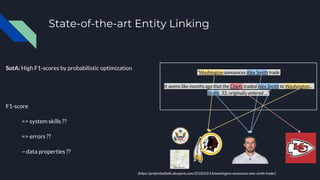
SotA: High F1-scores by probabilistic optimization
F1-score
=> system skills ??
=> errors ??
~ data properties ??
“Washington announces Alex Smith trade
It seems like months ago that the Chiefs traded Alex Smith to Washington...
Smith, 33, originally entered ...”
(https://profootballtalk.nbcsports.com/2018/03/14/washington-announces-alex-smith-trade/)
Head and tail of Entity Linking
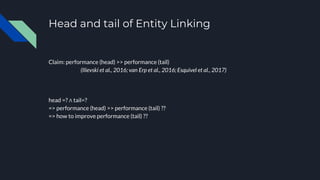
Claim: performance (head) >> performance (tail)
(Ilievski et al., 2016; van Erp et al., 2016; Esquivel et al., 2017)
head =? ∧ tail=?
=> performance (head) >> performance (tail) ??
=> how to improve performance (tail) ??
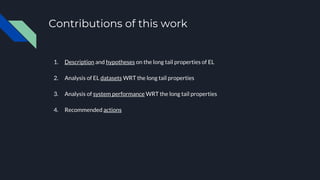
Contributions of this work
1. Description and hypotheses on the long tail properties of EL
2. Analysis of EL datasets WRT the long tail properties
3. Analysis of system performance WRT the long tail properties
4. Recommended actions
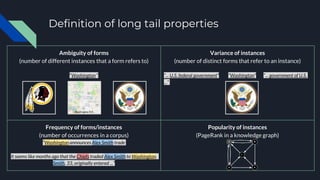
Ambiguity of forms
(number of different instances that a form refers to)
“Washington “
Variance of instances
(number of distinct forms that refer to an instance)
“... U.S. federal government” “Washington” “... government of U.S.
...”
Frequency of forms/instances
(number of occurrences in a corpus)
“Washington announces Alex Smith trade
It seems like months ago that the Chiefs traded Alex Smith to Washington.
Smith, 33, originally entered ...”
Popularity of instances
(PageRank in a knowledge graph)
Definition of long tail properties
Hypotheses and setup
16 hypotheses
2 data collections (CoNLL-AIDA and N3), 5 corpora in total
3 SotA systems: AGDISTIS MAG, DBpedia Spotlight, and WAT
Precision, recall and F1-score
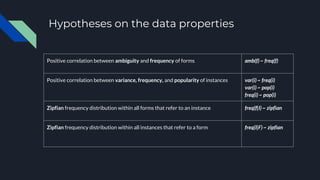
Hypotheses on the data properties
Positive correlation between ambiguity and frequency of forms amb(f) ~ freq(f)
Positive correlation between variance, frequency, and popularity of instances var(i) ~ freq(i)
var(i) ~ pop(i)
freq(i) ~ pop(i)
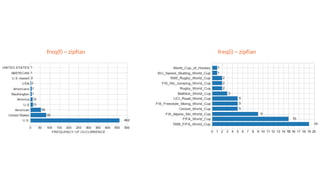
Zipfian frequency distribution within all forms that refer to an instance freq(f|I) ~ zipfian
Zipfian frequency distribution within all instances that refer to a form freq(i|F) ~ zipfian
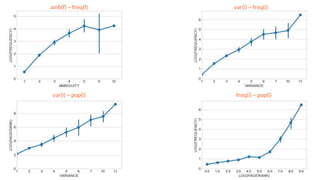
amb(f) ~ freq(f) var(i) ~ freq(i)
freq(i) ~ pop(i)var(i) ~ pop(i)
freq(f) ~ zipfian freq(i) ~ zipfian
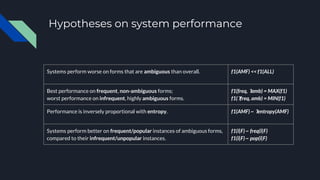
Hypotheses on system performance
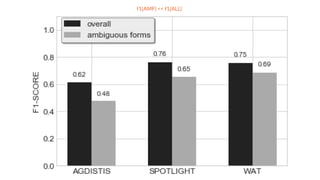
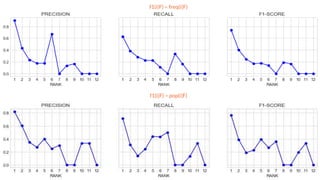
Systems perform worse on forms that are ambiguous than overall. f1(AMF) << f1(ALL)
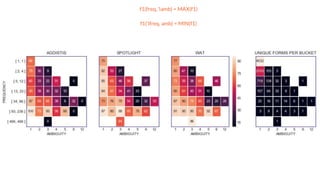
Best performance on frequent, non-ambiguous forms;
worst performance on infrequent, highly ambiguous forms.
f1(freq, ⅂amb) = MAX(f1)
f1(⅂freq, amb) = MIN(f1)
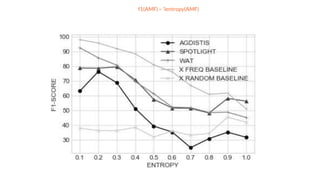
Performance is inversely proportional with entropy. f1(AMF) ~ ⅂entropy(AMF)
Systems perform better on frequent/popular instances of ambiguous forms,
compared to their infrequent/unpopular instances.
f1(i|F) ~ freq(i|F)
f1(i|F) ~ pop(i|F)
f1(AMF) << f1(ALL)
f1(freq, ⅂amb) = MAX(f1)
f1(⅂freq, amb) = MIN(f1)
S4: Systems perform better on ambiguous forms with imbalanced,
compared to balanced, instance distribution
f1(AMF) ~ ⅂entropy(AMF)
f1(amb)<< f1(all)
f1(i|F) ~ freq(i|F)
f1(i|F) ~ pop(i|F)
Recommendations
[Dataset creation]
● statistics on the head and the tail
● most-frequent-value baseline
[Evaluation]
● evaluate on the head and the tail
● use macro F1-score
[System development]
● which heuristics target which cases
● which resources optimize for the head/tail
Conclusions
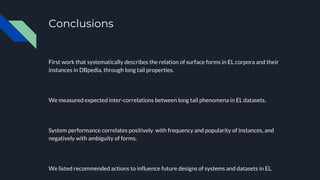
First work that systematically describes the relation of surface forms in EL corpora and their
instances in DBpedia, through long tail properties.
We measured expected inter-correlations between long tail phenomena in EL datasets.
System performance correlates positively with frequency and popularity of instances, and
negatively with ambiguity of forms.
We listed recommended actions to influence future designs of systems and datasets in EL.
Thanks for your attention!
Questions?
Github: cltl/EL-long-tail-phenomena
Twitter: @earthling91

Systematic Study of Long Tail Phenomena in Entity Linking

  • 1.
    Systematic Study of LongTail Phenomena in Entity Linking Filip Ilievski, Piek Vossen, Stefan Schlobach
  • 2.
    Entity Linking (EL) “Washingtonannounces Alex Smith trade It seems like months ago that the Chiefs traded Alex Smith to Washington... Smith, 33, originally entered ...” (https://profootballtalk.nbcsports.com/2018/03/14/washington-announces-alex-smith-trade/) surface form instance interpretation
  • 3.
    State-of-the-art Entity Linking SotA:High F1-scores by probabilistic optimization F1-score => system skills ?? => errors ?? ~ data properties ?? “Washington announces Alex Smith trade It seems like months ago that the Chiefs traded Alex Smith to Washington... Smith, 33, originally entered ...” (https://profootballtalk.nbcsports.com/2018/03/14/washington-announces-alex-smith-trade/)
  • 4.
    Head and tailof Entity Linking Claim: performance (head) >> performance (tail) (Ilievski et al., 2016; van Erp et al., 2016; Esquivel et al., 2017) head =? ∧ tail=? => performance (head) >> performance (tail) ?? => how to improve performance (tail) ??
  • 5.
    Contributions of thiswork 1. Description and hypotheses on the long tail properties of EL 2. Analysis of EL datasets WRT the long tail properties 3. Analysis of system performance WRT the long tail properties 4. Recommended actions
  • 6.
    Ambiguity of forms (numberof different instances that a form refers to) “Washington “ Variance of instances (number of distinct forms that refer to an instance) “... U.S. federal government” “Washington” “... government of U.S. ...” Frequency of forms/instances (number of occurrences in a corpus) “Washington announces Alex Smith trade It seems like months ago that the Chiefs traded Alex Smith to Washington. Smith, 33, originally entered ...” Popularity of instances (PageRank in a knowledge graph) Definition of long tail properties
  • 7.
    Hypotheses and setup 16hypotheses 2 data collections (CoNLL-AIDA and N3), 5 corpora in total 3 SotA systems: AGDISTIS MAG, DBpedia Spotlight, and WAT Precision, recall and F1-score
  • 8.
    Hypotheses on thedata properties Positive correlation between ambiguity and frequency of forms amb(f) ~ freq(f) Positive correlation between variance, frequency, and popularity of instances var(i) ~ freq(i) var(i) ~ pop(i) freq(i) ~ pop(i) Zipfian frequency distribution within all forms that refer to an instance freq(f|I) ~ zipfian Zipfian frequency distribution within all instances that refer to a form freq(i|F) ~ zipfian
  • 9.
    amb(f) ~ freq(f)var(i) ~ freq(i) freq(i) ~ pop(i)var(i) ~ pop(i)
  • 10.
    freq(f) ~ zipfianfreq(i) ~ zipfian
  • 11.
    Hypotheses on systemperformance Systems perform worse on forms that are ambiguous than overall. f1(AMF) << f1(ALL) Best performance on frequent, non-ambiguous forms; worst performance on infrequent, highly ambiguous forms. f1(freq, ⅂amb) = MAX(f1) f1(⅂freq, amb) = MIN(f1) Performance is inversely proportional with entropy. f1(AMF) ~ ⅂entropy(AMF) Systems perform better on frequent/popular instances of ambiguous forms, compared to their infrequent/unpopular instances. f1(i|F) ~ freq(i|F) f1(i|F) ~ pop(i|F)
  • 12.
  • 13.
    f1(freq, ⅂amb) =MAX(f1) f1(⅂freq, amb) = MIN(f1)
  • 14.
    S4: Systems performbetter on ambiguous forms with imbalanced, compared to balanced, instance distribution f1(AMF) ~ ⅂entropy(AMF)
  • 15.
    f1(amb)<< f1(all) f1(i|F) ~freq(i|F) f1(i|F) ~ pop(i|F)
  • 16.
    Recommendations [Dataset creation] ● statisticson the head and the tail ● most-frequent-value baseline [Evaluation] ● evaluate on the head and the tail ● use macro F1-score [System development] ● which heuristics target which cases ● which resources optimize for the head/tail
  • 17.
    Conclusions First work thatsystematically describes the relation of surface forms in EL corpora and their instances in DBpedia, through long tail properties. We measured expected inter-correlations between long tail phenomena in EL datasets. System performance correlates positively with frequency and popularity of instances, and negatively with ambiguity of forms. We listed recommended actions to influence future designs of systems and datasets in EL.
  • 18.
    Thanks for yourattention! Questions? Github: cltl/EL-long-tail-phenomena Twitter: @earthling91