Knowledge
Representation,
Reasoning and
Acquisition
Guest Lecture for CCS515
by Gan Keng Hoon
Nov 2016
GKH USM 1
Intelligence
Intelligent behavior is conditioned by knowledge.
Knowledge helps us to make decision.
Unintelligent act.
Describe an unintelligent act.
2
GKH USM
Artificial Intelligence
Artificial Intelligence (AI) is that it is the study of intelligent behavior
achieved through computational means.
3
GKH USM
Knowledge
Knowledge representation and reasoning, is part of AI.
How an agent uses what it knows in deciding what to do.
Also,
The study of thinking as a computational process.
4
GKH USM
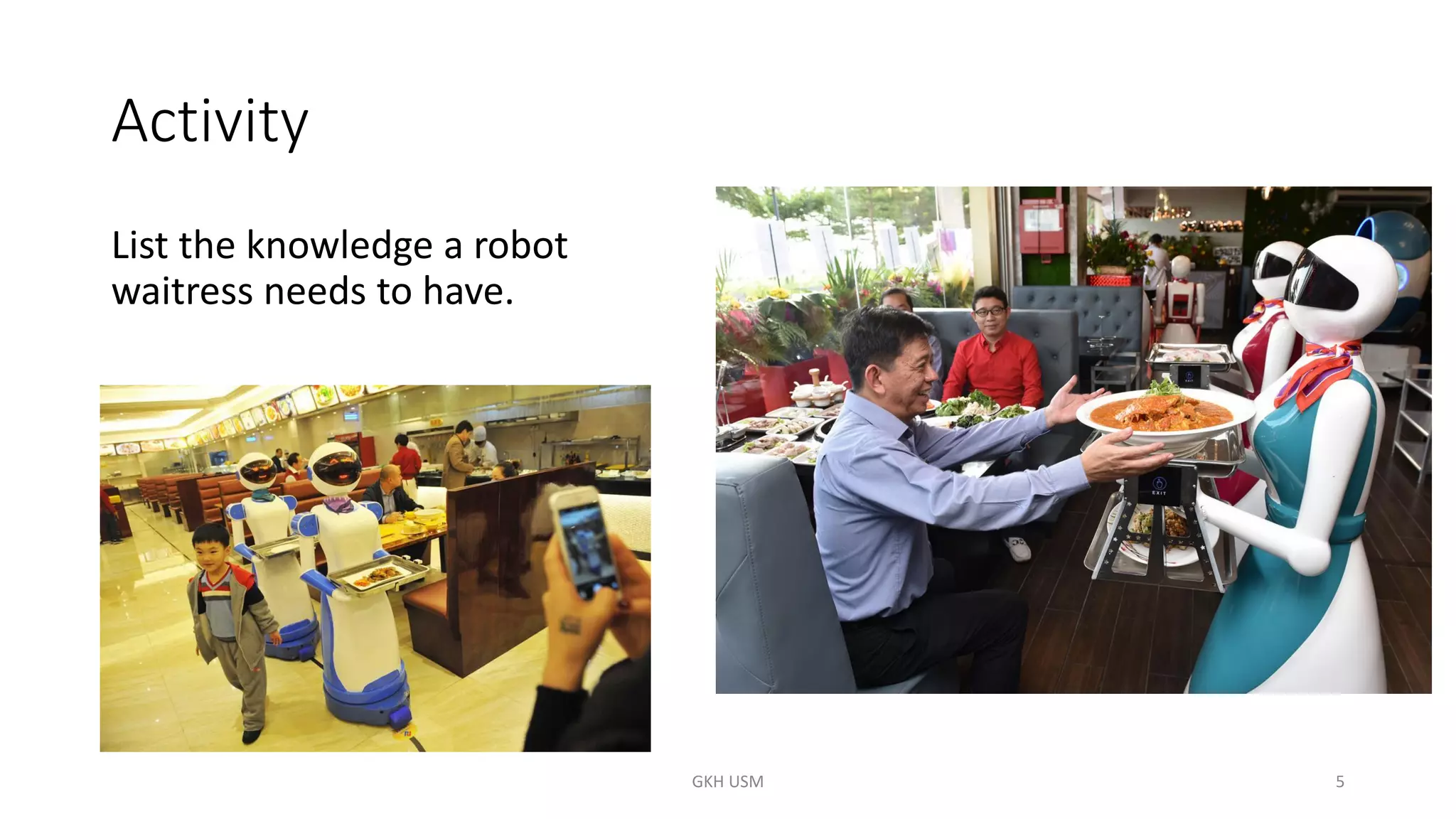
Activity
List the knowledge a robot
waitress needs to have.
5
GKH USM
Knowledge Representation
The field of study concerned with using formal symbols to represent a
collection of propositions.
Proposition – A statement that has a truth value, either true or false.
Can you represent
• The sushi is yummy.
• She hates sushi.
• Put some wasabi on the sushi…
6
GKH USM
Knowledge Reasoning
Formal manipulation of the symbols representing a collection of
believed propositions to produce representations of new ones.
• John loves sushi.
• Every sushi lover goes to Sushi Queen everyday.
-> Hence, John goes to Sushi Queen everyday.
Logical inference because the final sentence represents a logical
conclusion of the propositions represented by the initial ones.
7
GKH USM
Knowledge-based System
A system that reasons over explicitly represented knowledge.
Attempting to duplicate human-level intelligent behavior.
It has the ability to be told facts about its world and adjust its behavior
correspondingly.
8
GKH USM
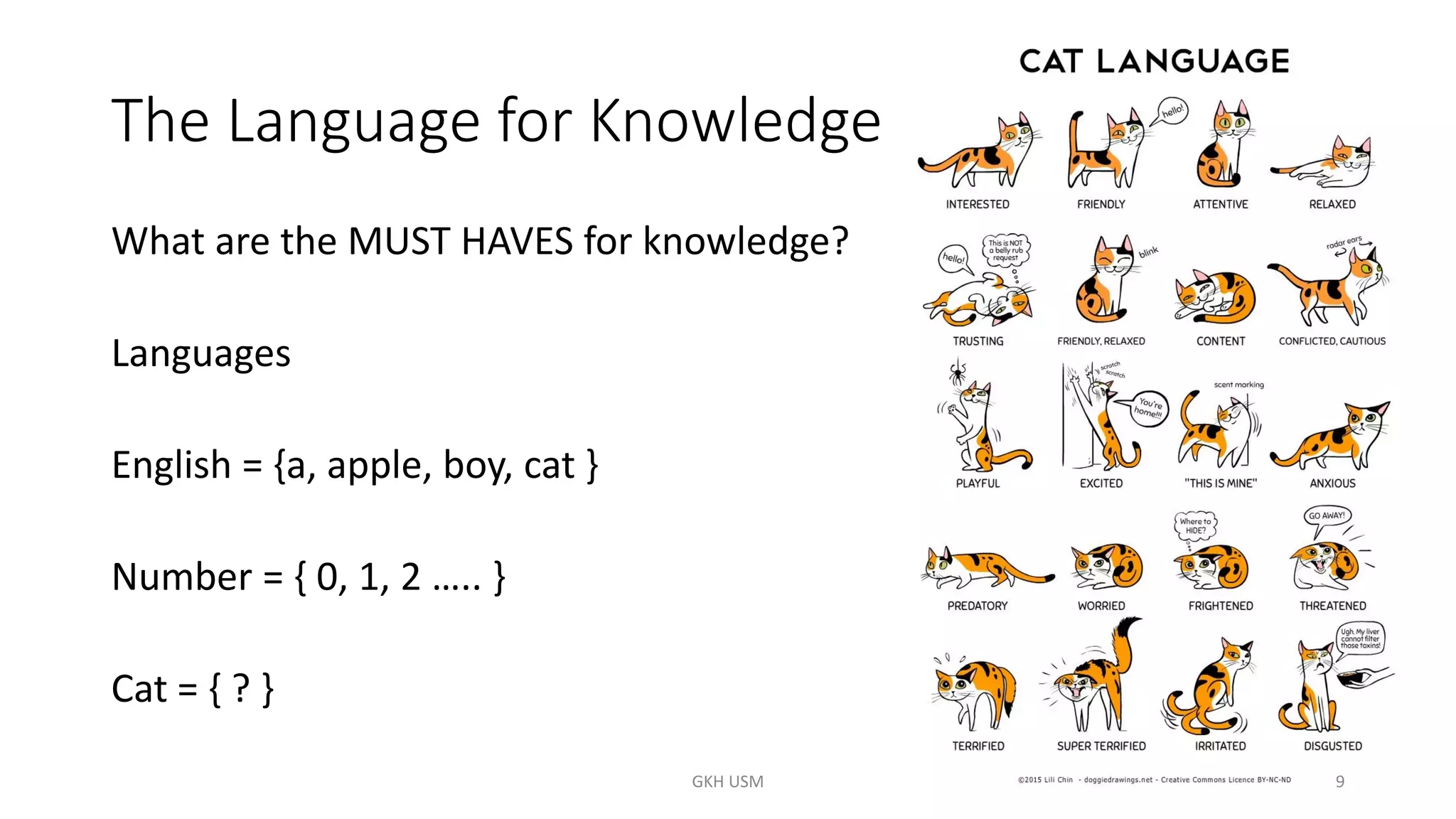
The Language for Knowledge
What are the MUST HAVES for knowledge?
Languages
English = {a, apple, boy, cat }
Number = { 0, 1, 2 ….. }
Cat = { ? }
9
GKH USM
Basic Structure of Language
Syntax
• specify which groups of symbols, arranged in what way, are to be
considered properly formed.
• “the cat my mother loves” vs. “the my loves mother cat”
10
GKH USM
Basic Structure of Language
Semantic
• specify what the well-formed expressions are supposed to mean.
• “the hardworking decimal point” ??
11
GKH USM
Basic Structure of Language
Pragmatic
• specify how the meaningful expressions in the language are to be
used.
• “There is someone right behind you”
could be used as a warning to be careful in some contexts and a
request to move in others.
12
GKH USM
Expressing Knowledge
Are you tempted to dive right in
and begin the implementation of a set of programs
that could reason over a specific KB of interest?
13
GKH USM
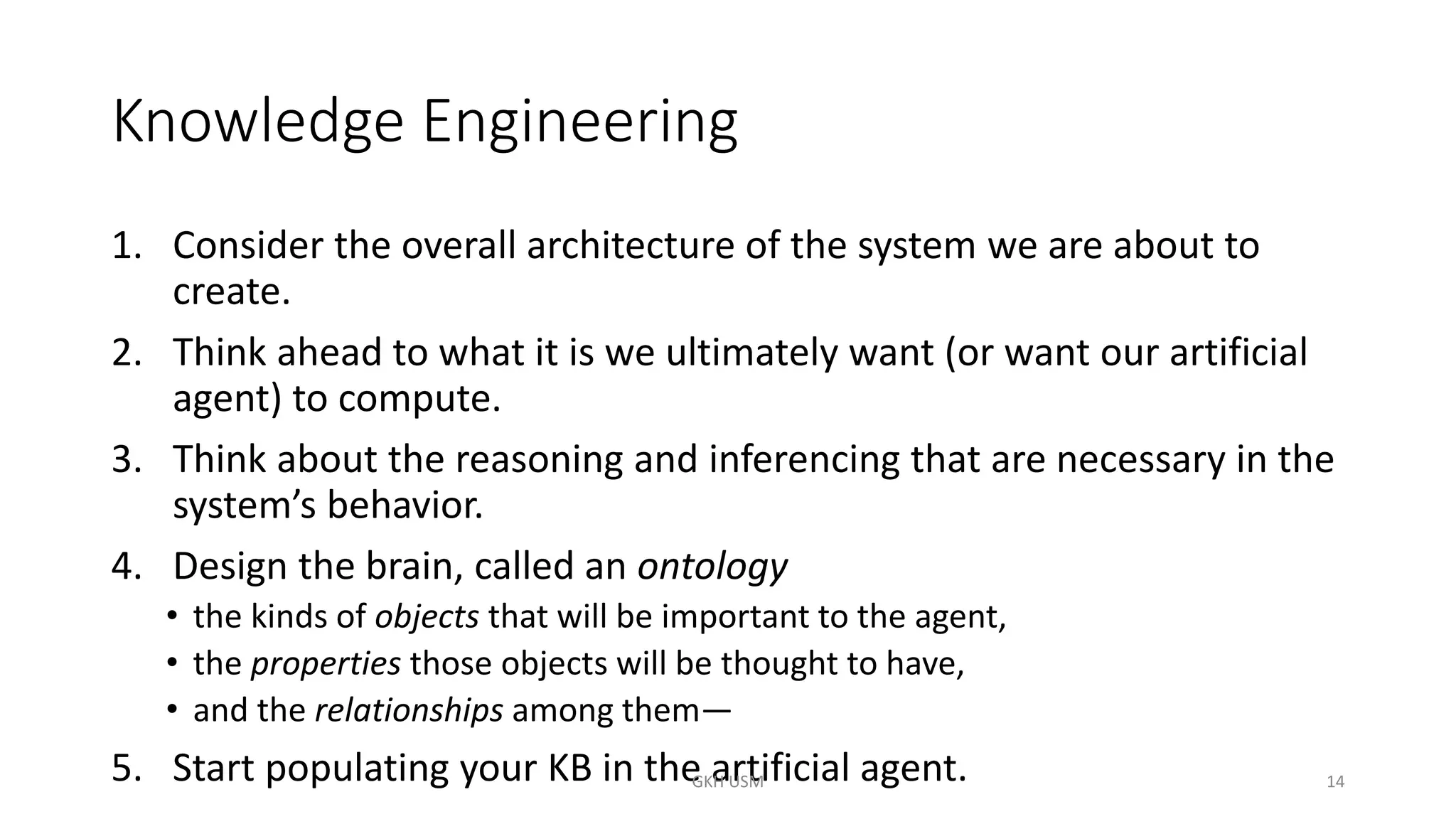
Knowledge Engineering
1. Consider the overall architecture of the system we are about to
create.
2. Think ahead to what it is we ultimately want (or want our artificial
agent) to compute.
3. Think about the reasoning and inferencing that are necessary in the
system’s behavior.
4. Design the brain, called an ontology
• the kinds of objects that will be important to the agent,
• the properties those objects will be thought to have,
• and the relationships among them—
5. Start populating your KB in the artificial agent. 14
GKH USM
Knowledge Engineering
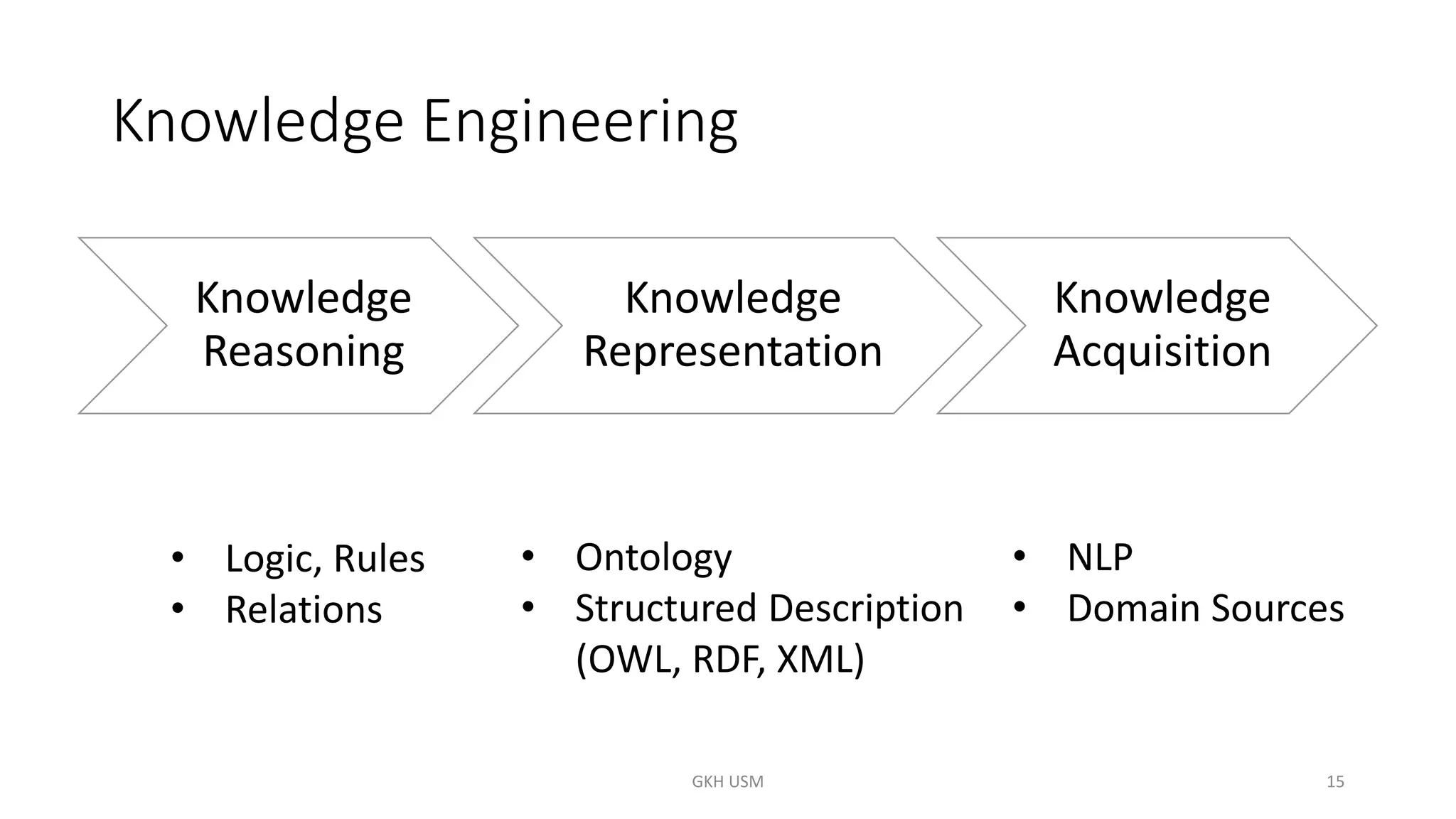
15
Knowledge
Reasoning
Knowledge
Representation
Knowledge
Acquisition
• Logic, Rules
• Relations
• Ontology
• Structured Description
(OWL, RDF, XML)
• NLP
• Domain Sources
GKH USM
Knowledge Reasoning
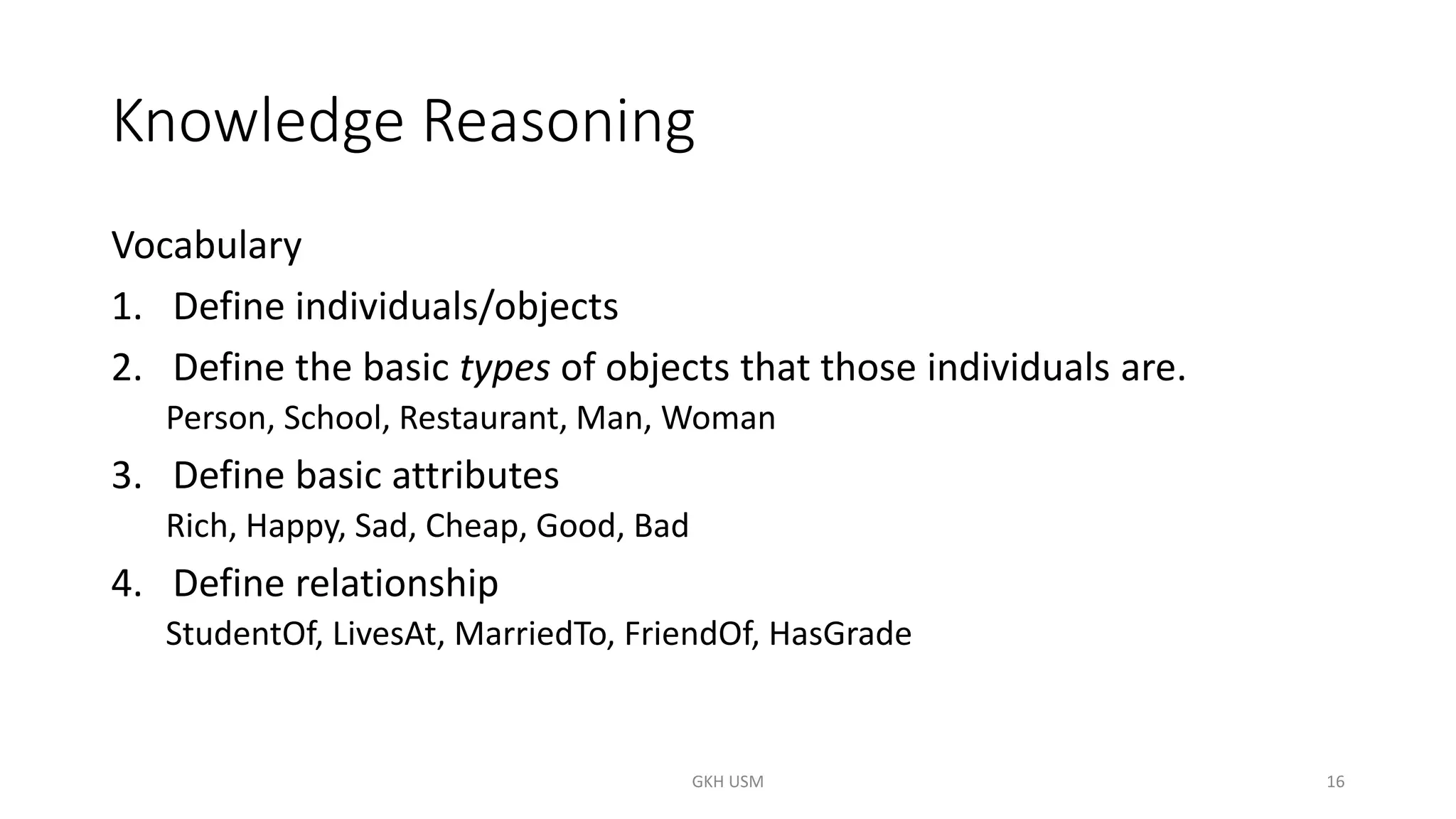
Vocabulary
1. Define individuals/objects
2. Define the basic types of objects that those individuals are.
Person, School, Restaurant, Man, Woman
3. Define basic attributes
Rich, Happy, Sad, Cheap, Good, Bad
4. Define relationship
StudentOf, LivesAt, MarriedTo, FriendOf, HasGrade
16
GKH USM
Knowledge Reasoning
Basic Facts
• Represent some basic truths with Object Type:
Man( john), Woman(jane)
• Represent some useful Property Assertions:
Rich( jim), ¬HappilyWorking(jim), WorksFor(jim, telco5)
Complex Facts
∀y[Rich( y) ∧ Man( y) ⊃ Loves( y, jane)]
What does this fact expresses?
All the rich men in our world love Jane
17
GKH USM
Knowledge Reasoning
If it were asserted that john were a Man, then we should answer “no”
to the query Woman( john).
For better inferences, we can include facts like the following:
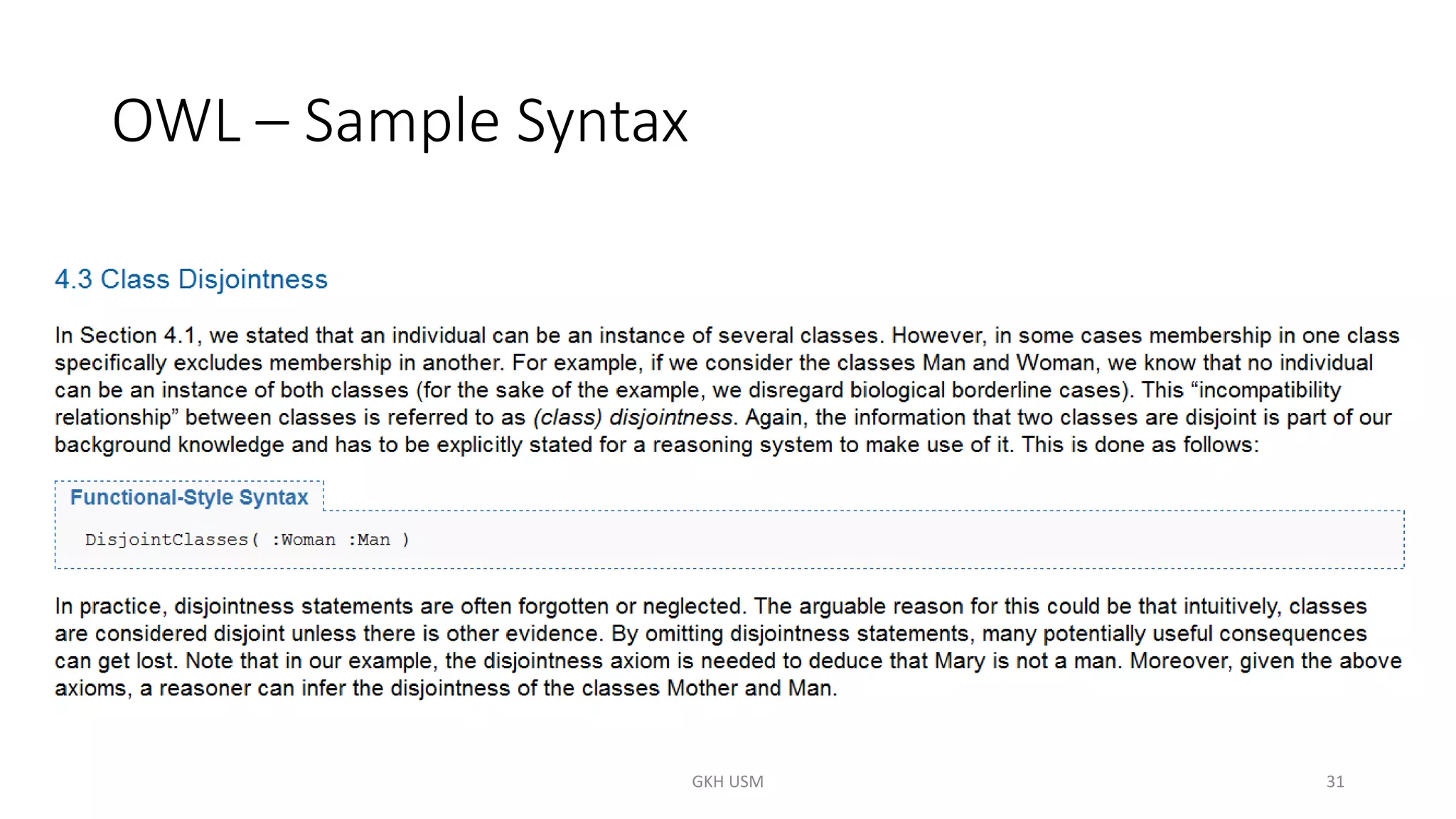
• Disjointness: Often two predicates are disjoint, and the assertion of
one implies the negation of the other, as in
∀x[Man(x) ⊃ ¬Woman(x)]
• Subtypes: There are many predicates that imply a form of
specialization, wherein one type is subsumed by another.
∀x[Surgeon(x) ⊃ Doctor(x)]
18
*Check out more in study of logics GKH USM
Knowledge Representation
The catalogue of concepts (constants, relations, functions, etc.)
used to represent knowledge about a problem domain
is known as an ontology.
Example
• Universal ontology for common sense reasoning
• Collaborative ontology project for the definition of sequence features
used in biological sequence annotation
19
GKH USM
Meaning Agreement
Ontology handles
Disambiguation of terms
Shared agreement on meanings
Description of the domain, with concepts and relations among
concepts
20
GKH USM
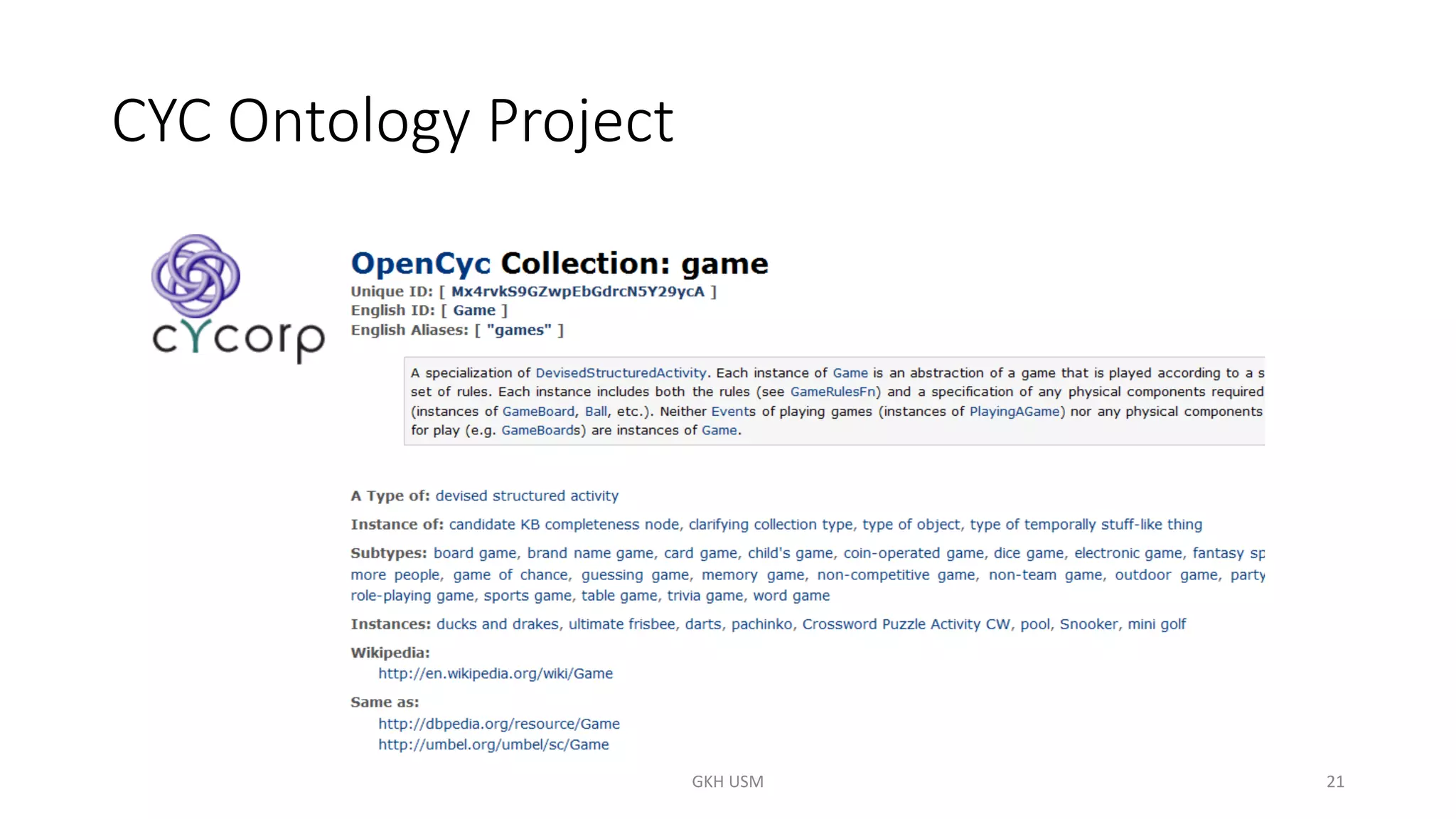
CYC Ontology Project
21
GKH USM
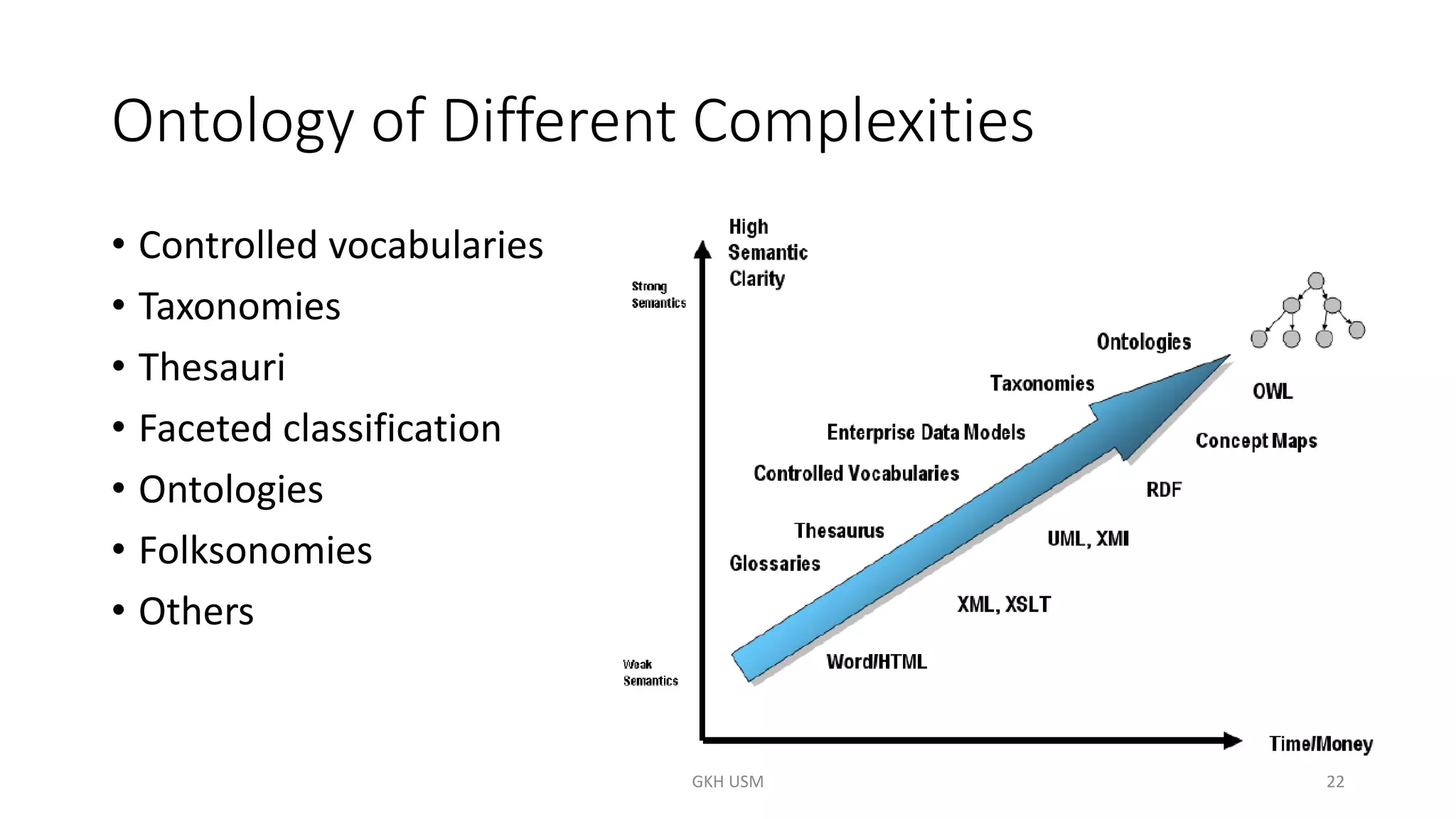
Ontology of Different Complexities
• Controlled vocabularies
• Taxonomies
• Thesauri
• Faceted classification
• Ontologies
• Folksonomies
• Others
22
GKH USM
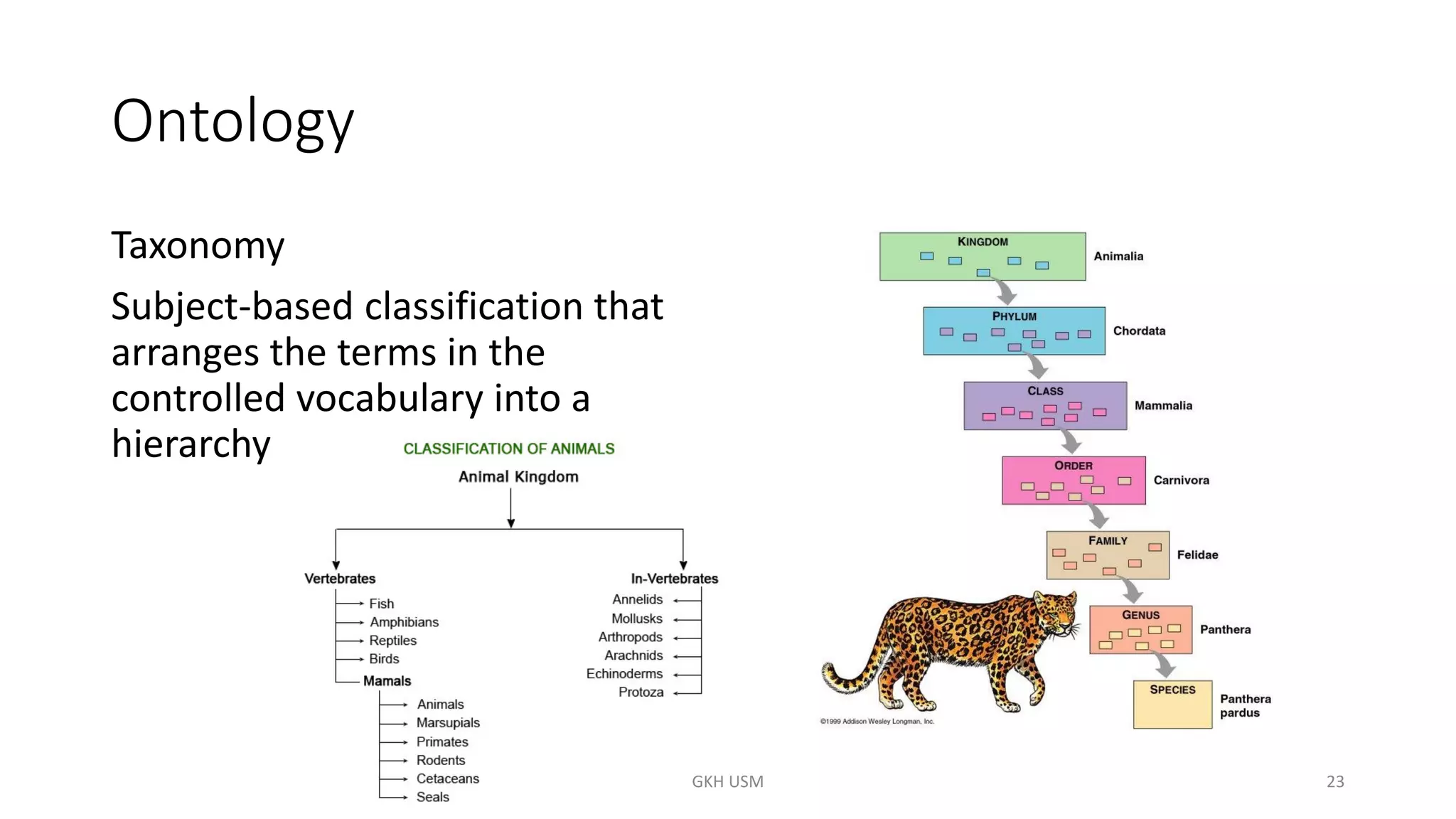
Ontology
Taxonomy
Subject-based classification that
arranges the terms in the
controlled vocabulary into a
hierarchy
23
GKH USM
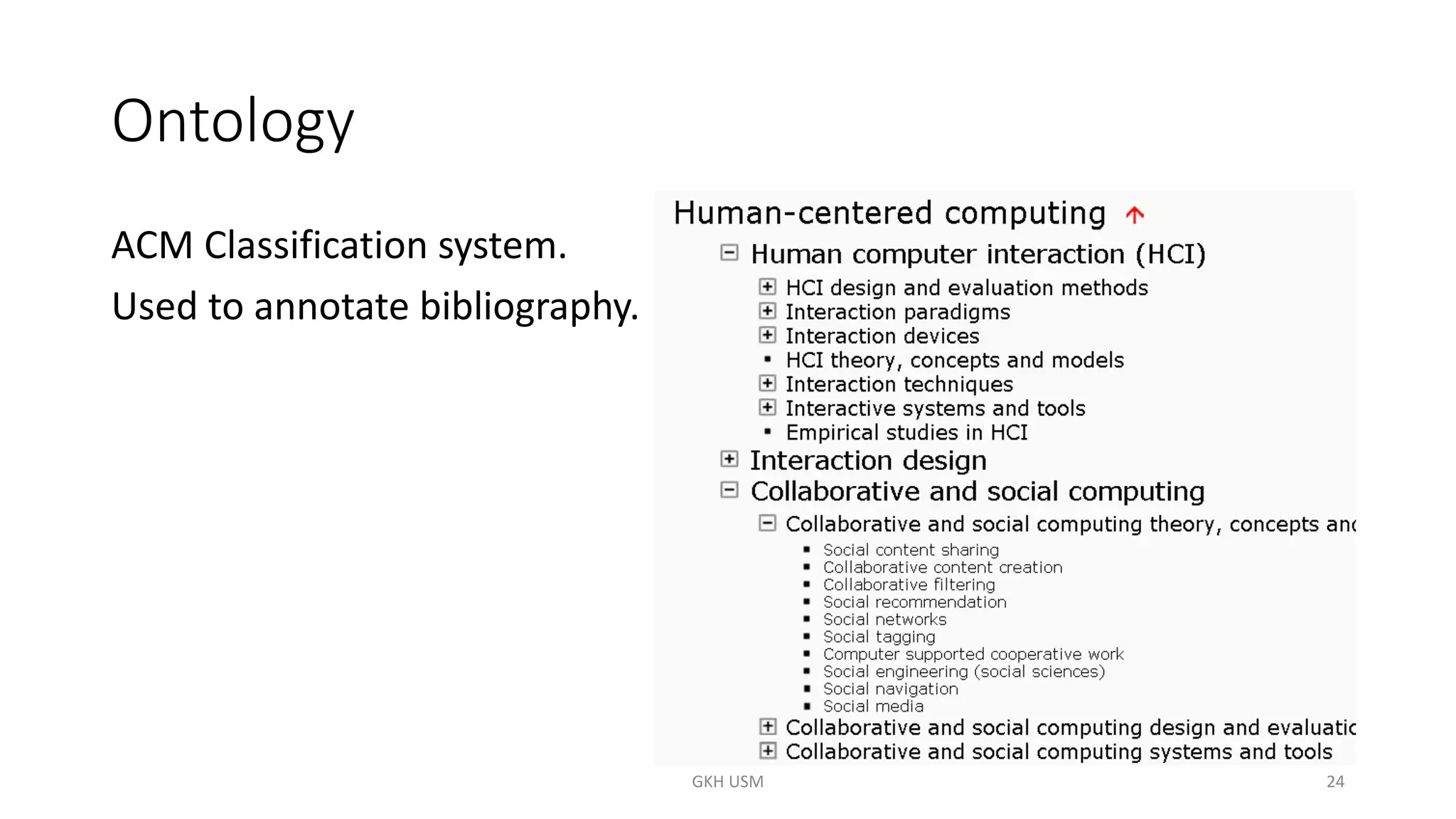
Ontology
ACM Classification system.
Used to annotate bibliography.
24
GKH USM
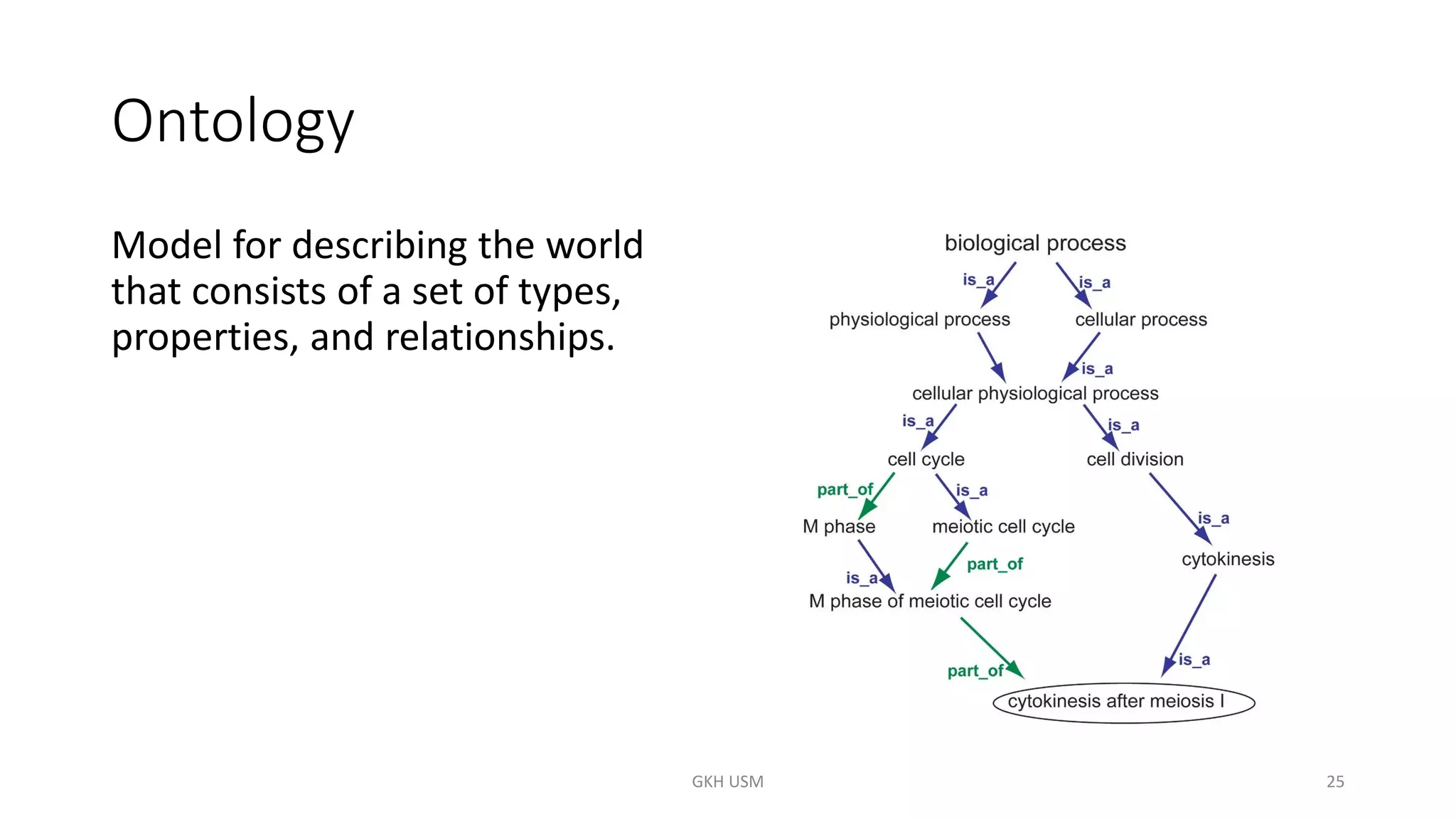
Ontology
Model for describing the world
that consists of a set of types,
properties, and relationships.
25
GKH USM
Knowledge Representation using Ontology
Ontologies generally describe:
Individuals
• the basic or “ground level” objects
Classes
• sets, collections, or types of objects
Attributes
• properties, features, characteristics, or parameters that objects can
have and share
Relationships
• ways that objects can be related to one another
26
GKH USM
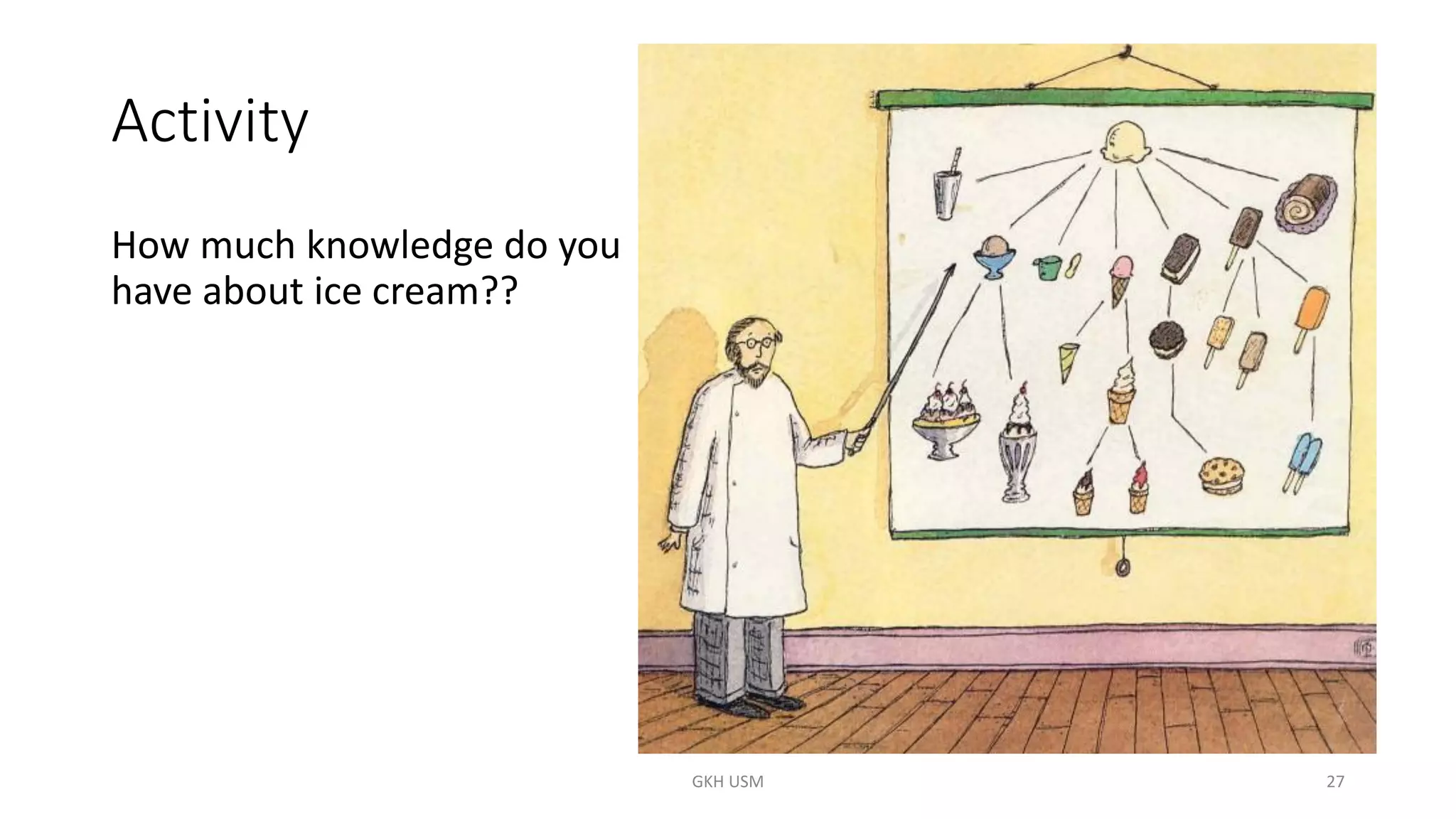
Activity
How much knowledge do you
have about ice cream??
27
GKH USM
Standard for Knowledge Representation
A number of standards have been proposed
for communicating knowledge between knowledge-based systems
and for representing knowledge in a standard format.
28
GKH USM
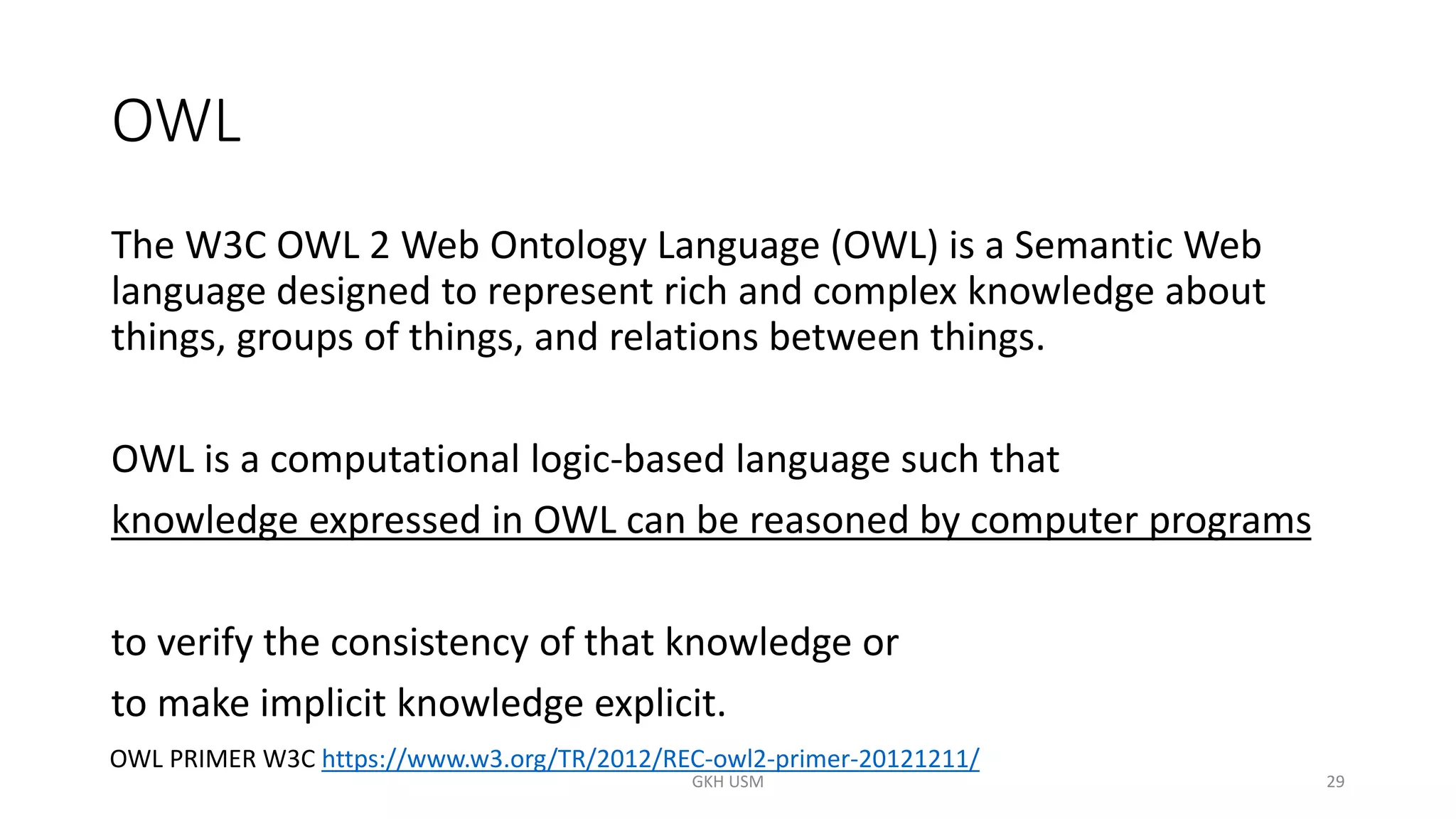
OWL
The W3C OWL 2 Web Ontology Language (OWL) is a Semantic Web
language designed to represent rich and complex knowledge about
things, groups of things, and relations between things.
OWL is a computational logic-based language such that
knowledge expressed in OWL can be reasoned by computer programs
to verify the consistency of that knowledge or
to make implicit knowledge explicit.
29
OWL PRIMER W3C https://www.w3.org/TR/2012/REC-owl2-primer-20121211/
GKH USM
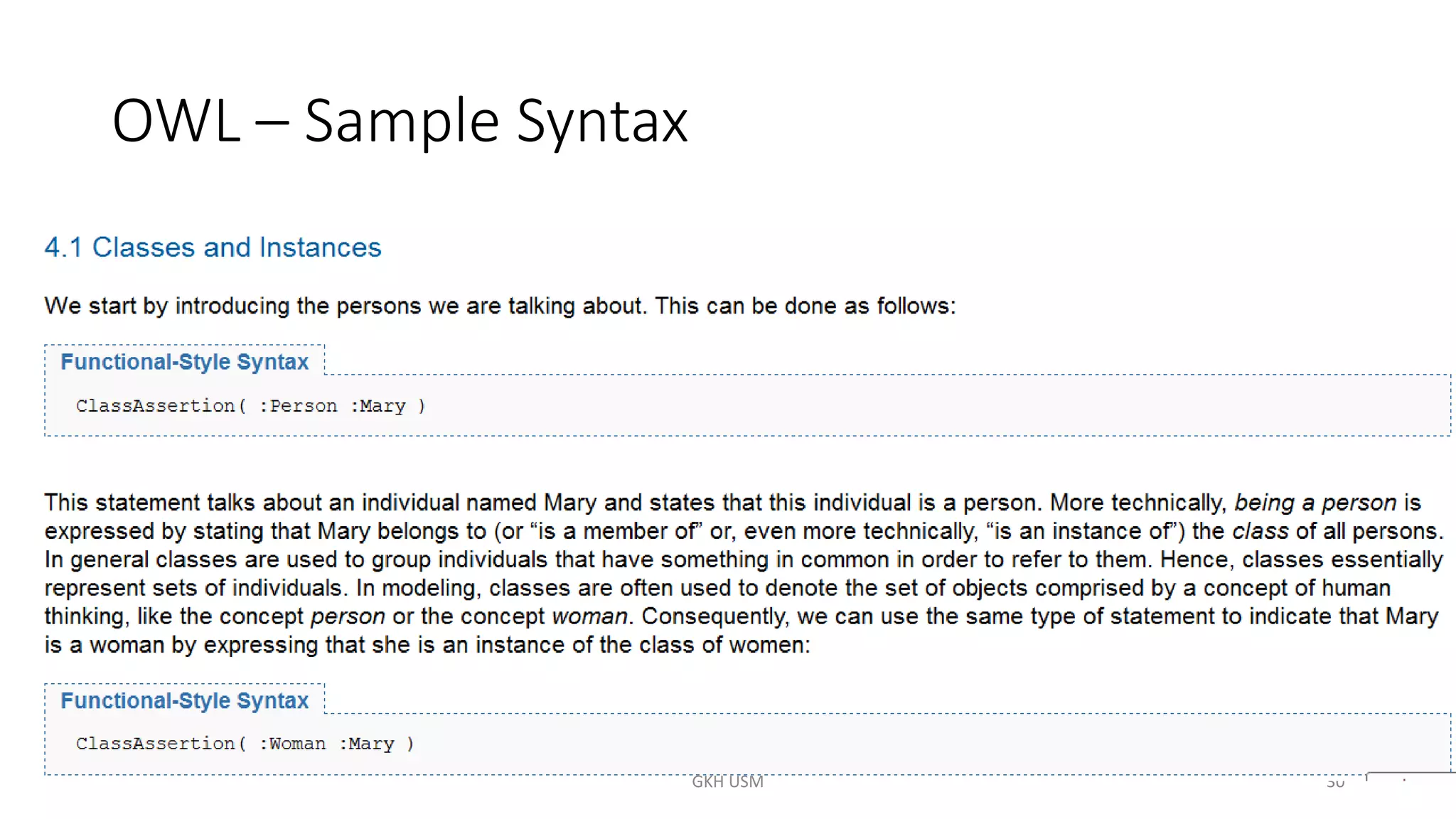
OWL – Sample Syntax
30
GKH USM
OWL – Sample Syntax
31
GKH USM
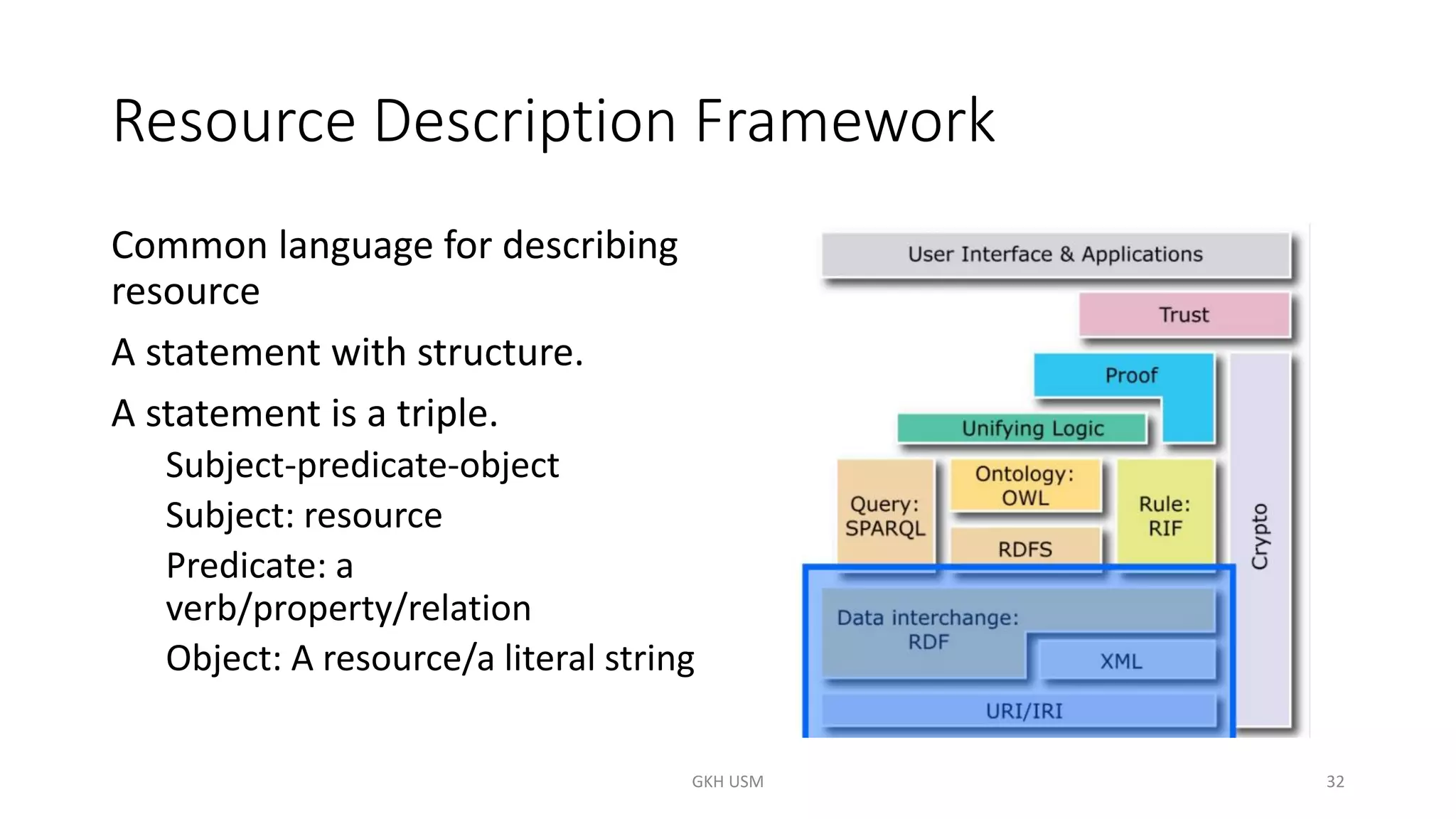
Resource Description Framework
Common language for describing
resource
A statement with structure.
A statement is a triple.
Subject-predicate-object
Subject: resource
Predicate: a
verb/property/relation
Object: A resource/a literal string
32
GKH USM
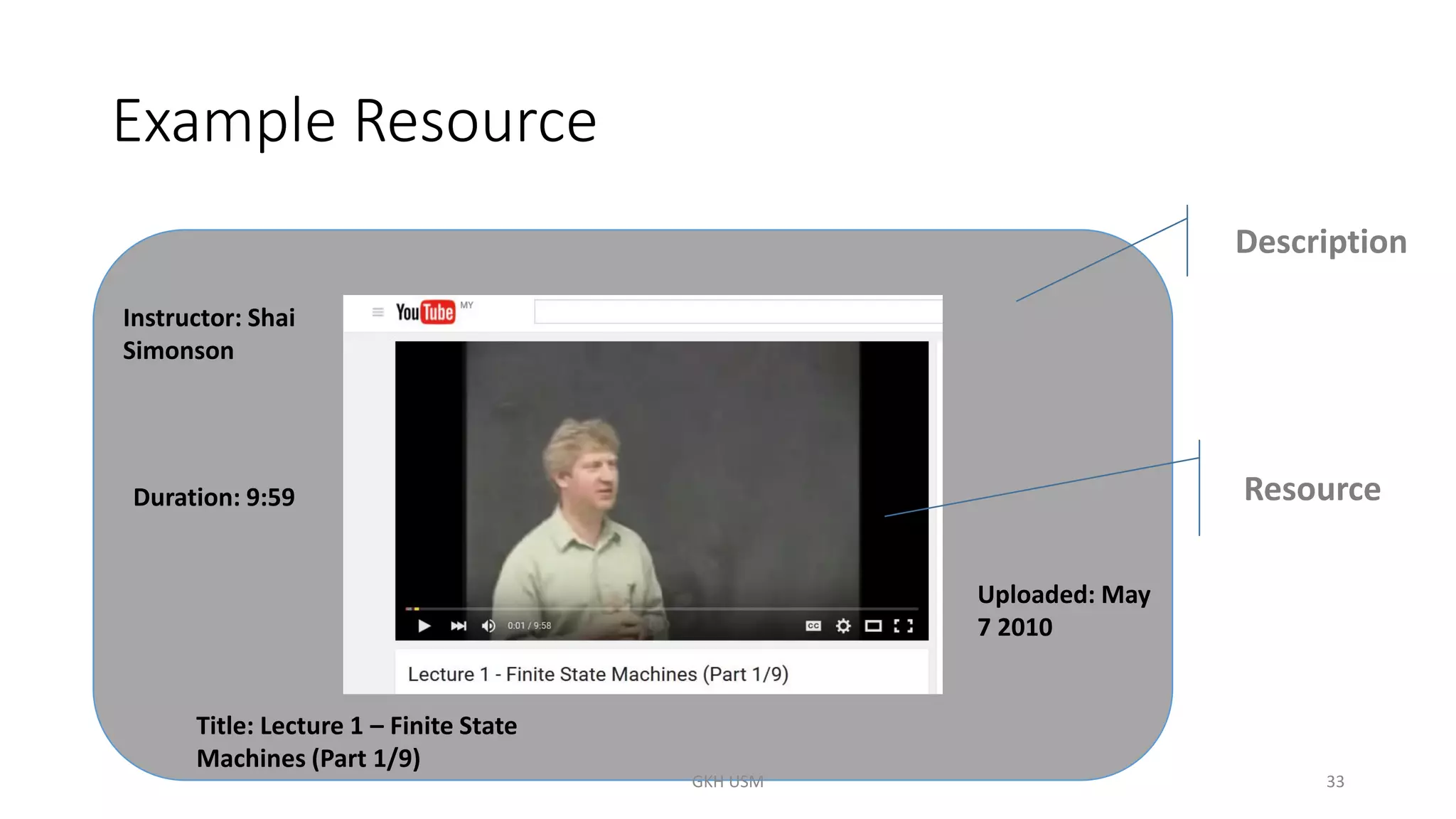
Example Resource
Resource
Description
Instructor: Shai
Simonson
Title: Lecture 1 – Finite State
Machines (Part 1/9)
Duration: 9:59
Uploaded: May
7 2010
33
GKH USM
Resource Description Framework
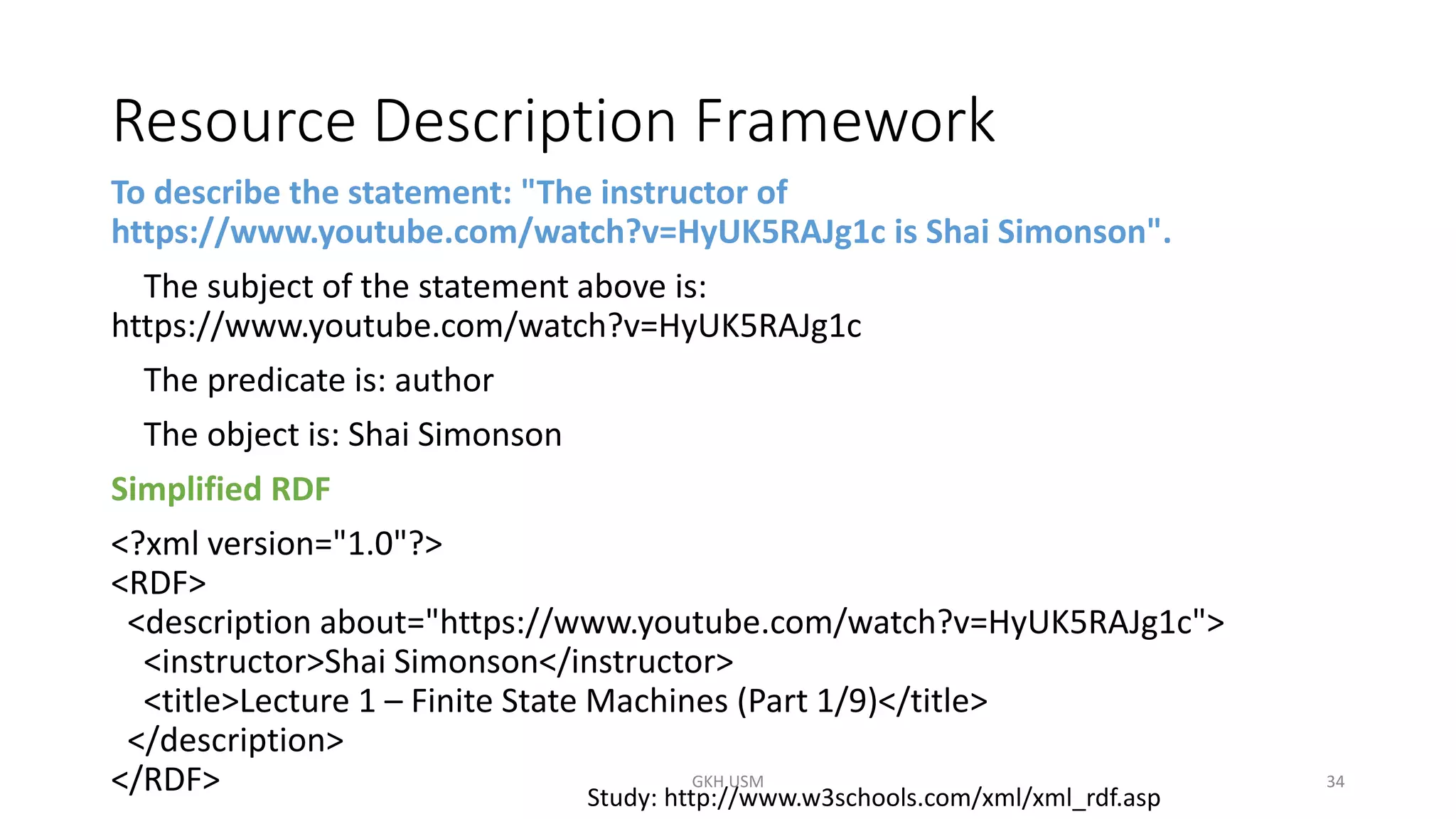
To describe the statement: "The instructor of
https://www.youtube.com/watch?v=HyUK5RAJg1c is Shai Simonson".
The subject of the statement above is:
https://www.youtube.com/watch?v=HyUK5RAJg1c
The predicate is: author
The object is: Shai Simonson
Simplified RDF
<?xml version="1.0"?>
<RDF>
<description about="https://www.youtube.com/watch?v=HyUK5RAJg1c">
<instructor>Shai Simonson</instructor>
<title>Lecture 1 – Finite State Machines (Part 1/9)</title>
</description>
</RDF> Study: http://www.w3schools.com/xml/xml_rdf.asp
34
GKH USM
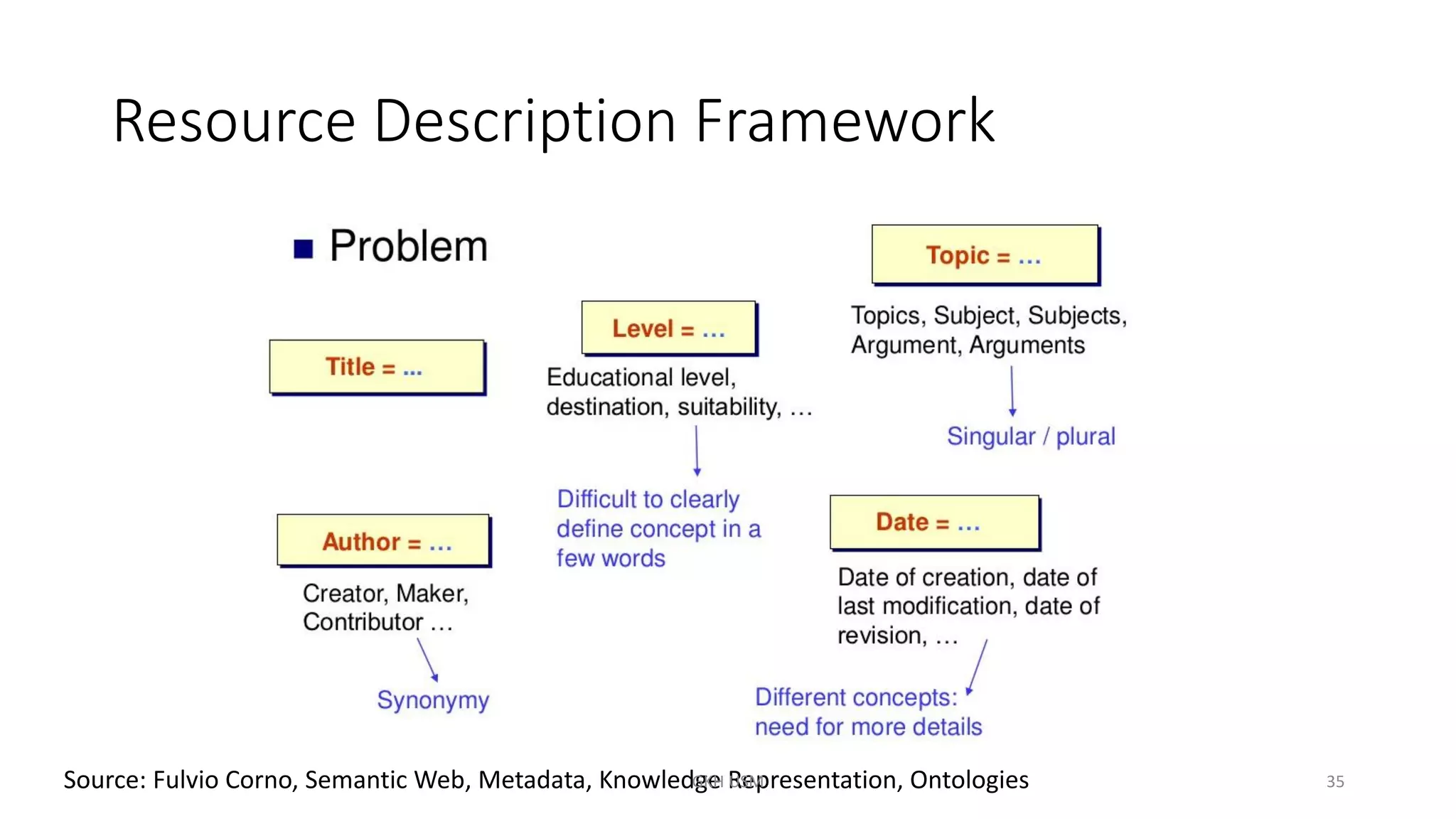
Resource Description Framework
Source: Fulvio Corno, Semantic Web, Metadata, Knowledge Representation, Ontologies 35
GKH USM
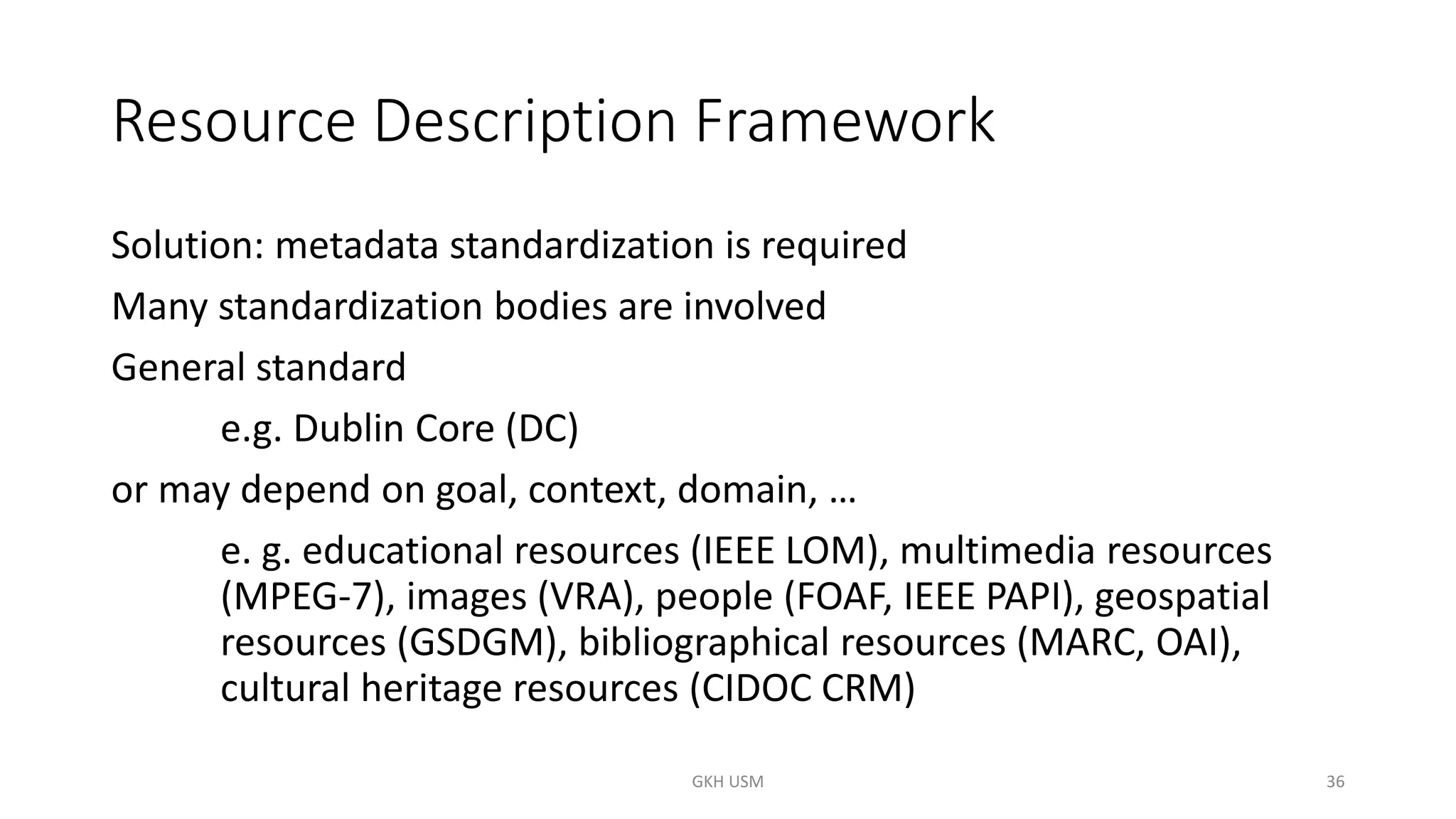
Resource Description Framework
Solution: metadata standardization is required
Many standardization bodies are involved
General standard
e.g. Dublin Core (DC)
or may depend on goal, context, domain, …
e. g. educational resources (IEEE LOM), multimedia resources
(MPEG-7), images (VRA), people (FOAF, IEEE PAPI), geospatial
resources (GSDGM), bibliographical resources (MARC, OAI),
cultural heritage resources (CIDOC CRM)
36
GKH USM
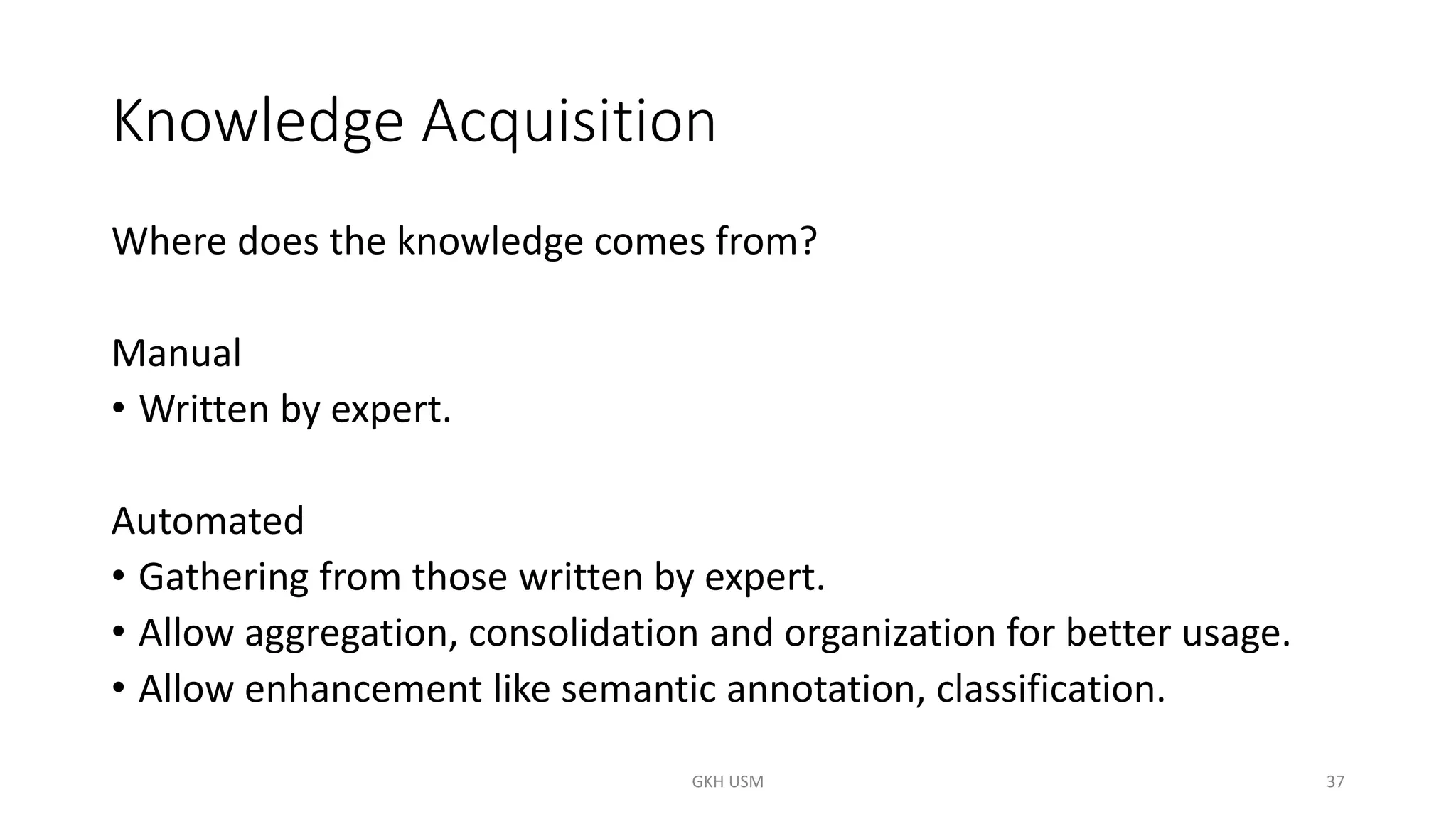
Knowledge Acquisition
Where does the knowledge comes from?
Manual
• Written by expert.
Automated
• Gathering from those written by expert.
• Allow aggregation, consolidation and organization for better usage.
• Allow enhancement like semantic annotation, classification.
37
GKH USM
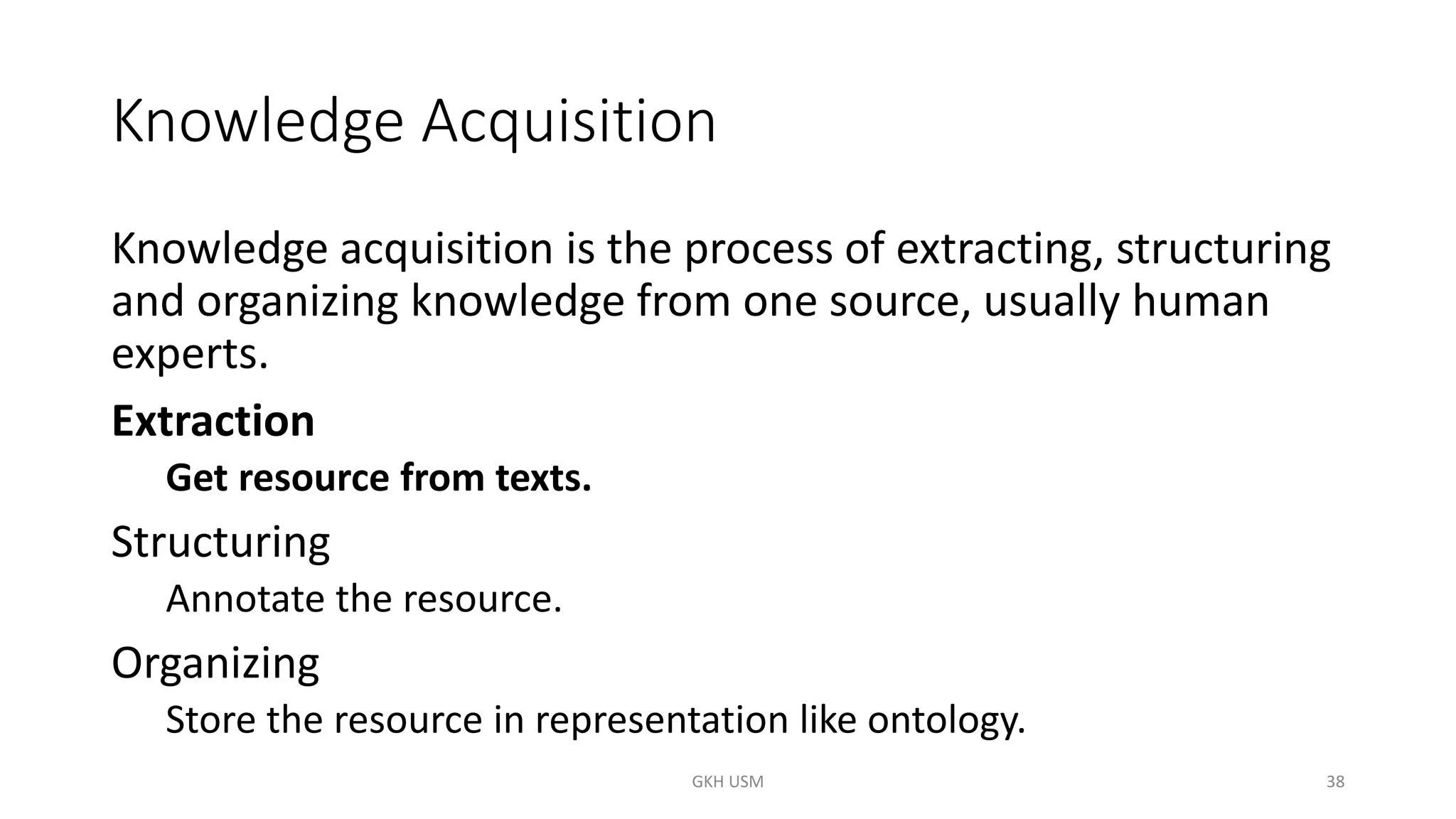
Knowledge Acquisition
Knowledge acquisition is the process of extracting, structuring
and organizing knowledge from one source, usually human
experts.
Extraction
Get resource from texts.
Structuring
Annotate the resource.
Organizing
Store the resource in representation like ontology.
38
GKH USM
Knowledge Acquisition
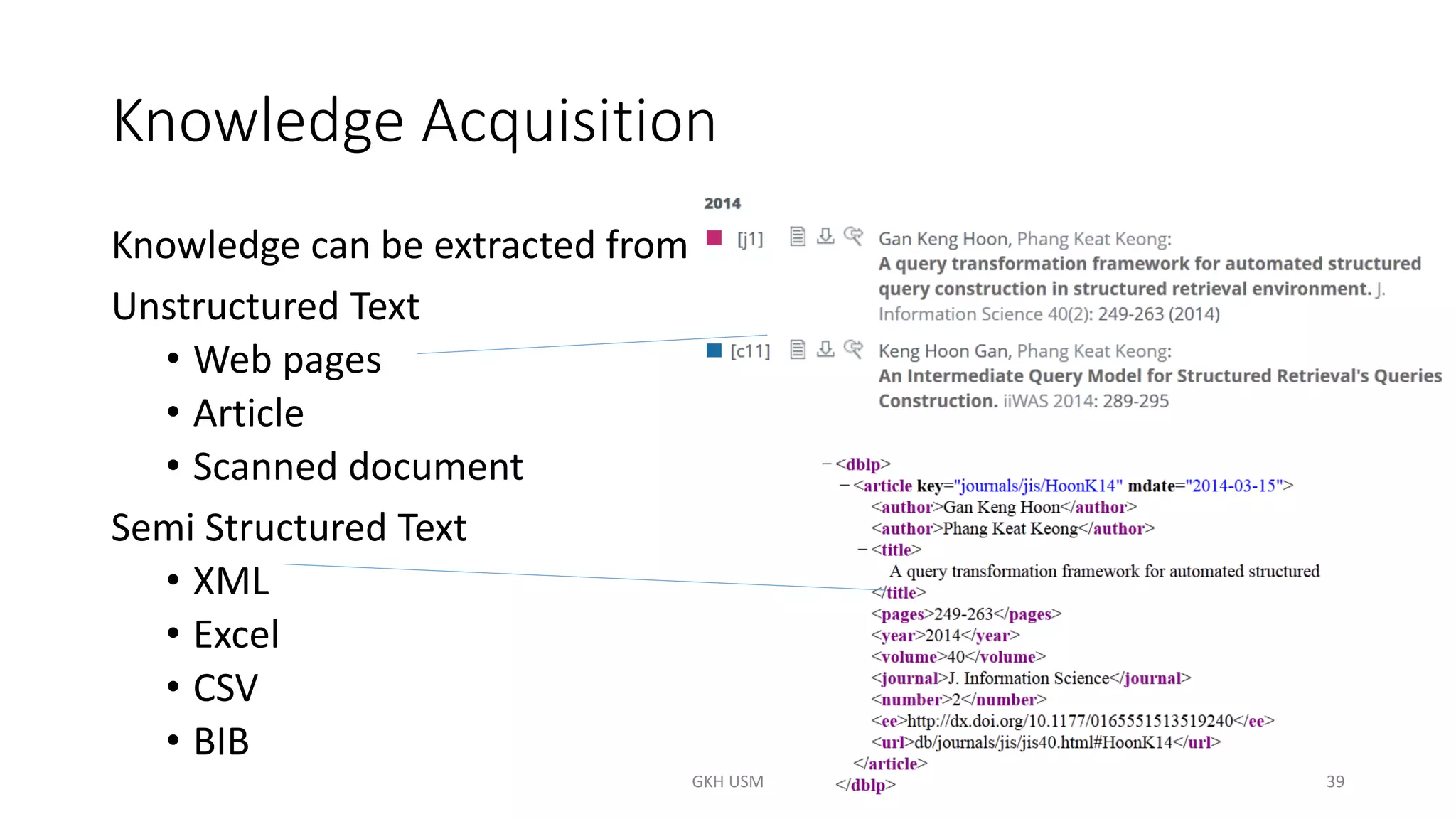
Knowledge can be extracted from
Unstructured Text
• Web pages
• Article
• Scanned document
Semi Structured Text
• XML
• Excel
• CSV
• BIB
39
GKH USM
Knowledge Acquisition
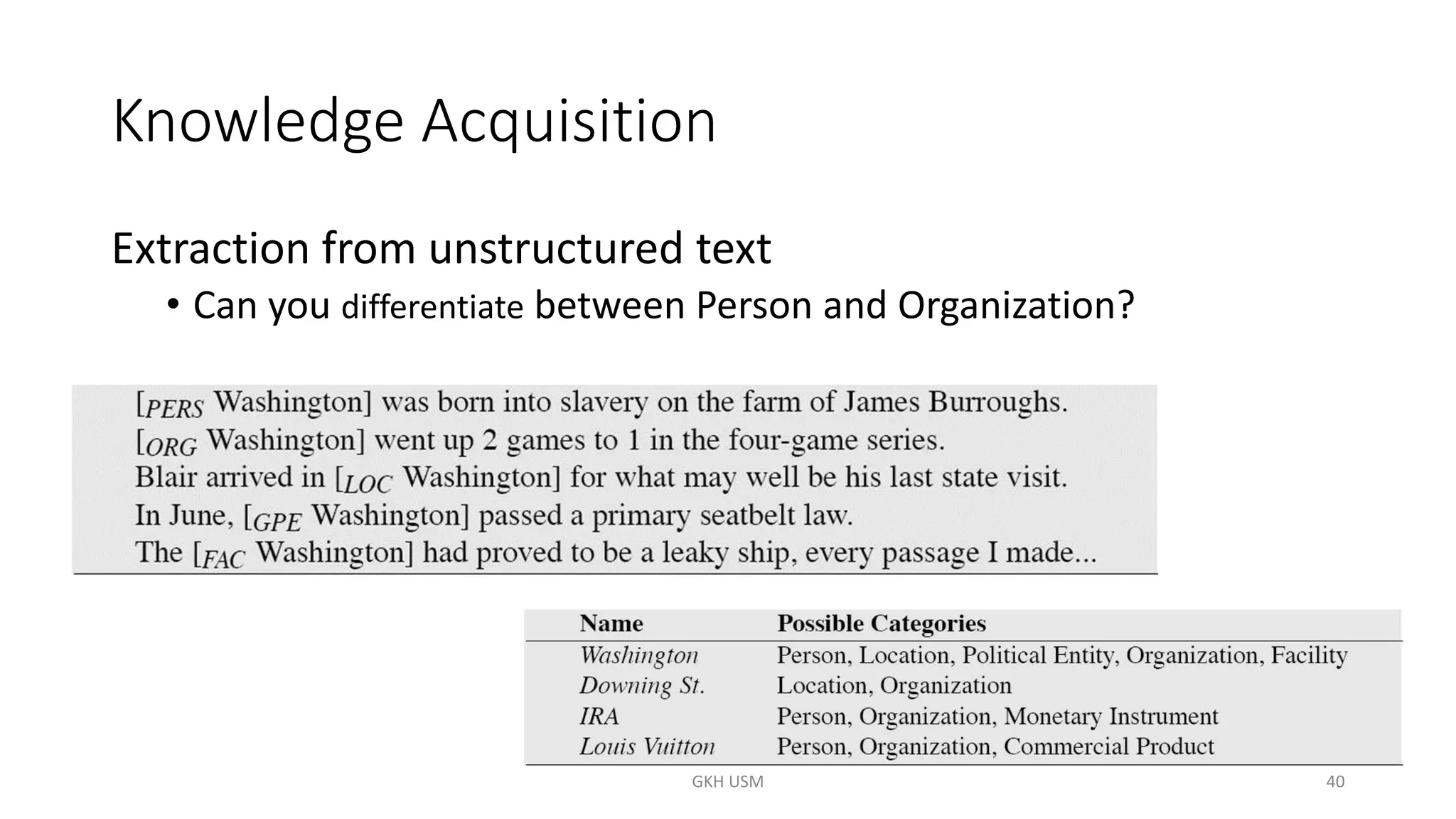
Extraction from unstructured text
• Can you differentiate between Person and Organization?
40
GKH USM
Knowledge Acquisition
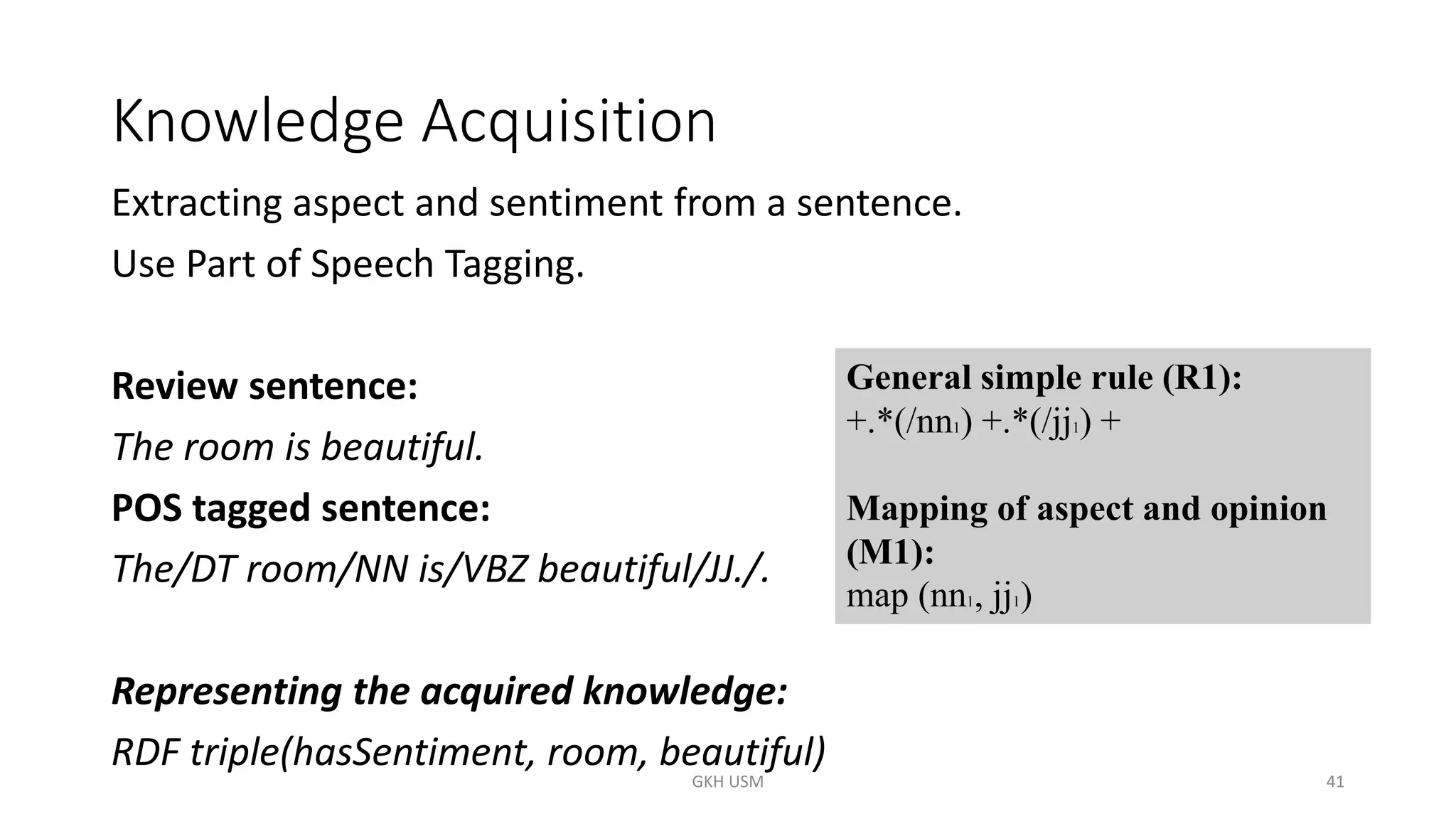
Extracting aspect and sentiment from a sentence.
Use Part of Speech Tagging.
Review sentence:
The room is beautiful.
POS tagged sentence:
The/DT room/NN is/VBZ beautiful/JJ./.
Representing the acquired knowledge:
RDF triple(hasSentiment, room, beautiful)
General simple rule (R1):
+.*(/nn1) +.*(/jj1) +
Mapping of aspect and opinion
(M1):
map (nn1, jj1)
41
GKH USM
Knowledge Acquisition – Road Ahead
Too much knowledge out there to be acquired.
Lots of research opportunities, especially,
unstructured resource to structured resource
Identify relation between entities in a resource
Identify implicit meaning of entities in a resource
42
GKH USM
Contact
Picture Source: http://www.mindonsolutions.com
Gan Keng Hoon
khganATusm.my
Visit our works at ir.cs.usm.my
43
GKH USM

Knowledge Representation Reasoning and Acquisition.pdf

  • 1.
    Knowledge Representation, Reasoning and Acquisition Guest Lecturefor CCS515 by Gan Keng Hoon Nov 2016 GKH USM 1
  • 2.
    Intelligence Intelligent behavior isconditioned by knowledge. Knowledge helps us to make decision. Unintelligent act. Describe an unintelligent act. 2 GKH USM
  • 3.
    Artificial Intelligence Artificial Intelligence(AI) is that it is the study of intelligent behavior achieved through computational means. 3 GKH USM
  • 4.
    Knowledge Knowledge representation andreasoning, is part of AI. How an agent uses what it knows in deciding what to do. Also, The study of thinking as a computational process. 4 GKH USM
  • 5.
    Activity List the knowledgea robot waitress needs to have. 5 GKH USM
  • 6.
    Knowledge Representation The fieldof study concerned with using formal symbols to represent a collection of propositions. Proposition – A statement that has a truth value, either true or false. Can you represent • The sushi is yummy. • She hates sushi. • Put some wasabi on the sushi… 6 GKH USM
  • 7.
    Knowledge Reasoning Formal manipulationof the symbols representing a collection of believed propositions to produce representations of new ones. • John loves sushi. • Every sushi lover goes to Sushi Queen everyday. -> Hence, John goes to Sushi Queen everyday. Logical inference because the final sentence represents a logical conclusion of the propositions represented by the initial ones. 7 GKH USM
  • 8.
    Knowledge-based System A systemthat reasons over explicitly represented knowledge. Attempting to duplicate human-level intelligent behavior. It has the ability to be told facts about its world and adjust its behavior correspondingly. 8 GKH USM
  • 9.
    The Language forKnowledge What are the MUST HAVES for knowledge? Languages English = {a, apple, boy, cat } Number = { 0, 1, 2 ….. } Cat = { ? } 9 GKH USM
  • 10.
    Basic Structure ofLanguage Syntax • specify which groups of symbols, arranged in what way, are to be considered properly formed. • “the cat my mother loves” vs. “the my loves mother cat” 10 GKH USM
  • 11.
    Basic Structure ofLanguage Semantic • specify what the well-formed expressions are supposed to mean. • “the hardworking decimal point” ?? 11 GKH USM
  • 12.
    Basic Structure ofLanguage Pragmatic • specify how the meaningful expressions in the language are to be used. • “There is someone right behind you” could be used as a warning to be careful in some contexts and a request to move in others. 12 GKH USM
  • 13.
    Expressing Knowledge Are youtempted to dive right in and begin the implementation of a set of programs that could reason over a specific KB of interest? 13 GKH USM
  • 14.
    Knowledge Engineering 1. Considerthe overall architecture of the system we are about to create. 2. Think ahead to what it is we ultimately want (or want our artificial agent) to compute. 3. Think about the reasoning and inferencing that are necessary in the system’s behavior. 4. Design the brain, called an ontology • the kinds of objects that will be important to the agent, • the properties those objects will be thought to have, • and the relationships among them— 5. Start populating your KB in the artificial agent. 14 GKH USM
  • 15.
    Knowledge Engineering 15 Knowledge Reasoning Knowledge Representation Knowledge Acquisition • Logic,Rules • Relations • Ontology • Structured Description (OWL, RDF, XML) • NLP • Domain Sources GKH USM
  • 16.
    Knowledge Reasoning Vocabulary 1. Defineindividuals/objects 2. Define the basic types of objects that those individuals are. Person, School, Restaurant, Man, Woman 3. Define basic attributes Rich, Happy, Sad, Cheap, Good, Bad 4. Define relationship StudentOf, LivesAt, MarriedTo, FriendOf, HasGrade 16 GKH USM
  • 17.
    Knowledge Reasoning Basic Facts •Represent some basic truths with Object Type: Man( john), Woman(jane) • Represent some useful Property Assertions: Rich( jim), ¬HappilyWorking(jim), WorksFor(jim, telco5) Complex Facts ∀y[Rich( y) ∧ Man( y) ⊃ Loves( y, jane)] What does this fact expresses? All the rich men in our world love Jane 17 GKH USM
  • 18.
    Knowledge Reasoning If itwere asserted that john were a Man, then we should answer “no” to the query Woman( john). For better inferences, we can include facts like the following: • Disjointness: Often two predicates are disjoint, and the assertion of one implies the negation of the other, as in ∀x[Man(x) ⊃ ¬Woman(x)] • Subtypes: There are many predicates that imply a form of specialization, wherein one type is subsumed by another. ∀x[Surgeon(x) ⊃ Doctor(x)] 18 *Check out more in study of logics GKH USM
  • 19.
    Knowledge Representation The catalogueof concepts (constants, relations, functions, etc.) used to represent knowledge about a problem domain is known as an ontology. Example • Universal ontology for common sense reasoning • Collaborative ontology project for the definition of sequence features used in biological sequence annotation 19 GKH USM
  • 20.
    Meaning Agreement Ontology handles Disambiguationof terms Shared agreement on meanings Description of the domain, with concepts and relations among concepts 20 GKH USM
  • 21.
  • 22.
    Ontology of DifferentComplexities • Controlled vocabularies • Taxonomies • Thesauri • Faceted classification • Ontologies • Folksonomies • Others 22 GKH USM
  • 23.
    Ontology Taxonomy Subject-based classification that arrangesthe terms in the controlled vocabulary into a hierarchy 23 GKH USM
  • 24.
    Ontology ACM Classification system. Usedto annotate bibliography. 24 GKH USM
  • 25.
    Ontology Model for describingthe world that consists of a set of types, properties, and relationships. 25 GKH USM
  • 26.
    Knowledge Representation usingOntology Ontologies generally describe: Individuals • the basic or “ground level” objects Classes • sets, collections, or types of objects Attributes • properties, features, characteristics, or parameters that objects can have and share Relationships • ways that objects can be related to one another 26 GKH USM
  • 27.
    Activity How much knowledgedo you have about ice cream?? 27 GKH USM
  • 28.
    Standard for KnowledgeRepresentation A number of standards have been proposed for communicating knowledge between knowledge-based systems and for representing knowledge in a standard format. 28 GKH USM
  • 29.
    OWL The W3C OWL2 Web Ontology Language (OWL) is a Semantic Web language designed to represent rich and complex knowledge about things, groups of things, and relations between things. OWL is a computational logic-based language such that knowledge expressed in OWL can be reasoned by computer programs to verify the consistency of that knowledge or to make implicit knowledge explicit. 29 OWL PRIMER W3C https://www.w3.org/TR/2012/REC-owl2-primer-20121211/ GKH USM
  • 30.
    OWL – SampleSyntax 30 GKH USM
  • 31.
    OWL – SampleSyntax 31 GKH USM
  • 32.
    Resource Description Framework Commonlanguage for describing resource A statement with structure. A statement is a triple. Subject-predicate-object Subject: resource Predicate: a verb/property/relation Object: A resource/a literal string 32 GKH USM
  • 33.
    Example Resource Resource Description Instructor: Shai Simonson Title:Lecture 1 – Finite State Machines (Part 1/9) Duration: 9:59 Uploaded: May 7 2010 33 GKH USM
  • 34.
    Resource Description Framework Todescribe the statement: "The instructor of https://www.youtube.com/watch?v=HyUK5RAJg1c is Shai Simonson". The subject of the statement above is: https://www.youtube.com/watch?v=HyUK5RAJg1c The predicate is: author The object is: Shai Simonson Simplified RDF <?xml version="1.0"?> <RDF> <description about="https://www.youtube.com/watch?v=HyUK5RAJg1c"> <instructor>Shai Simonson</instructor> <title>Lecture 1 – Finite State Machines (Part 1/9)</title> </description> </RDF> Study: http://www.w3schools.com/xml/xml_rdf.asp 34 GKH USM
  • 35.
    Resource Description Framework Source:Fulvio Corno, Semantic Web, Metadata, Knowledge Representation, Ontologies 35 GKH USM
  • 36.
    Resource Description Framework Solution:metadata standardization is required Many standardization bodies are involved General standard e.g. Dublin Core (DC) or may depend on goal, context, domain, … e. g. educational resources (IEEE LOM), multimedia resources (MPEG-7), images (VRA), people (FOAF, IEEE PAPI), geospatial resources (GSDGM), bibliographical resources (MARC, OAI), cultural heritage resources (CIDOC CRM) 36 GKH USM
  • 37.
    Knowledge Acquisition Where doesthe knowledge comes from? Manual • Written by expert. Automated • Gathering from those written by expert. • Allow aggregation, consolidation and organization for better usage. • Allow enhancement like semantic annotation, classification. 37 GKH USM
  • 38.
    Knowledge Acquisition Knowledge acquisitionis the process of extracting, structuring and organizing knowledge from one source, usually human experts. Extraction Get resource from texts. Structuring Annotate the resource. Organizing Store the resource in representation like ontology. 38 GKH USM
  • 39.
    Knowledge Acquisition Knowledge canbe extracted from Unstructured Text • Web pages • Article • Scanned document Semi Structured Text • XML • Excel • CSV • BIB 39 GKH USM
  • 40.
    Knowledge Acquisition Extraction fromunstructured text • Can you differentiate between Person and Organization? 40 GKH USM
  • 41.
    Knowledge Acquisition Extracting aspectand sentiment from a sentence. Use Part of Speech Tagging. Review sentence: The room is beautiful. POS tagged sentence: The/DT room/NN is/VBZ beautiful/JJ./. Representing the acquired knowledge: RDF triple(hasSentiment, room, beautiful) General simple rule (R1): +.*(/nn1) +.*(/jj1) + Mapping of aspect and opinion (M1): map (nn1, jj1) 41 GKH USM
  • 42.
    Knowledge Acquisition –Road Ahead Too much knowledge out there to be acquired. Lots of research opportunities, especially, unstructured resource to structured resource Identify relation between entities in a resource Identify implicit meaning of entities in a resource 42 GKH USM
  • 43.
    Contact Picture Source: http://www.mindonsolutions.com GanKeng Hoon khganATusm.my Visit our works at ir.cs.usm.my 43 GKH USM