C L A S S 6
MINERALS
Presented by: Akanksha
MINERALS
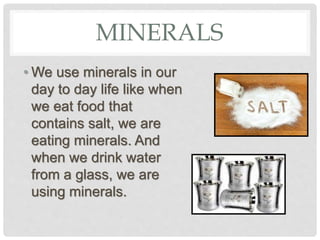
• We use minerals in our
day to day life like when
we eat food that
contains salt, we are
eating minerals. And
when we drink water
from a glass, we are
using minerals.
WHAT IS A MINERAL?
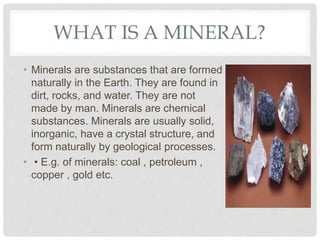
• Minerals are substances that are formed
naturally in the Earth. They are found in
dirt, rocks, and water. They are not
made by man. Minerals are chemical
substances. Minerals are usually solid,
inorganic, have a crystal structure, and
form naturally by geological processes.
• • E.g. of minerals: coal , petroleum ,
copper , gold etc.
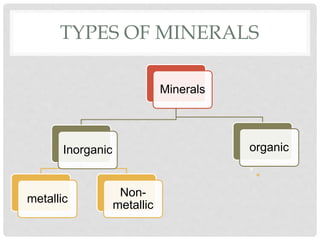
TYPES OF MINERALS
Minerals
Inorganic
metallic
Non-
metallic
organic
Organic
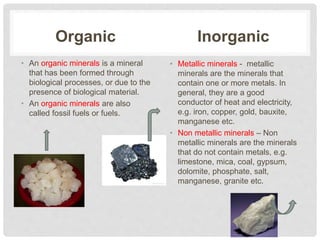
• An organic minerals is a mineral
that has been formed through
biological processes, or due to the
presence of biological material.
• An organic minerals are also
called fossil fuels or fuels.
Inorganic
• Metallic minerals - metallic
minerals are the minerals that
contain one or more metals. In
general, they are a good
conductor of heat and electricity,
e.g. iron, copper, gold, bauxite,
manganese etc.
• Non metallic minerals – Non
metallic minerals are the minerals
that do not contain metals, e.g.
limestone, mica, coal, gypsum,
dolomite, phosphate, salt,
manganese, granite etc.
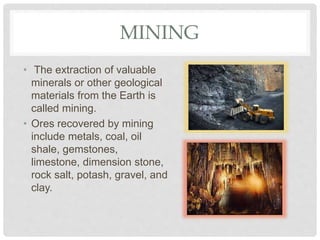
MINING
• The extraction of valuable
minerals or other geological
materials from the Earth is
called mining.
• Ores recovered by mining
include metals, coal, oil
shale, gemstones,
limestone, dimension stone,
rock salt, potash, gravel, and
clay.
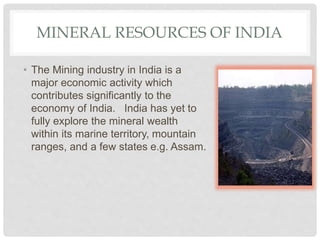
MINERAL RESOURCES OF INDIA
• The Mining industry in India is a
major economic activity which
contributes significantly to the
economy of India. India has yet to
fully explore the mineral wealth
within its marine territory, mountain
ranges, and a few states e.g. Assam.
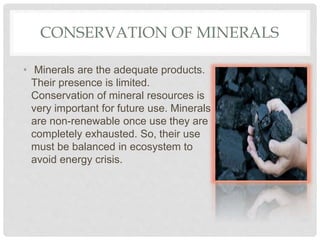
CONSERVATION OF MINERALS
• Minerals are the adequate products.
Their presence is limited.
Conservation of mineral resources is
very important for future use. Minerals
are non-renewable once use they are
completely exhausted. So, their use
must be balanced in ecosystem to
avoid energy crisis.
WAYS IN WHICH MINERALS CAN BE
PRESERVED
• Use of alternate sources of energy like solar energy,
hydroelectric energy, wind energy etc.
• Walking on a path that leads to sustainable development.
• Using the mineral resources with a greater efficiency.
• Use of renewable sources of energy.
• Avoid over-exploitation of the mineral resources.
• Use of biogas as a fuel for cooking instead of the non-
renewable sources of energy.
• Re-use and recycle of the minerals and their products
• By using Minerals in a planned way.
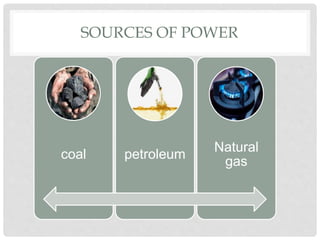
SOURCES OF POWER
coal petroleum
Natural
gas
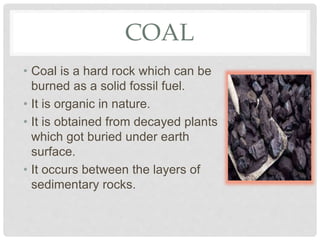
COAL
• Coal is a hard rock which can be
burned as a solid fossil fuel.
• It is organic in nature.
• It is obtained from decayed plants
which got buried under earth
surface.
• It occurs between the layers of
sedimentary rocks.
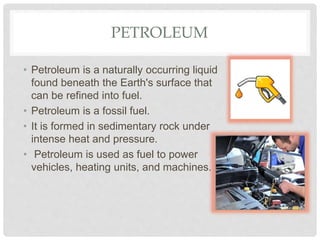
PETROLEUM
• Petroleum is a naturally occurring liquid
found beneath the Earth's surface that
can be refined into fuel.
• Petroleum is a fossil fuel.
• It is formed in sedimentary rock under
intense heat and pressure.
• Petroleum is used as fuel to power
vehicles, heating units, and machines.
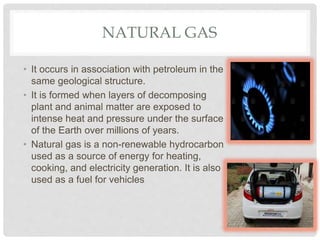
NATURAL GAS
• It occurs in association with petroleum in the
same geological structure.
• It is formed when layers of decomposing
plant and animal matter are exposed to
intense heat and pressure under the surface
of the Earth over millions of years.
• Natural gas is a non-renewable hydrocarbon
used as a source of energy for heating,
cooking, and electricity generation. It is also
used as a fuel for vehicles
Minerals for class 6

Minerals for class 6

  • 1.
    C L AS S 6 MINERALS Presented by: Akanksha
  • 3.
    MINERALS • We useminerals in our day to day life like when we eat food that contains salt, we are eating minerals. And when we drink water from a glass, we are using minerals.
  • 4.
    WHAT IS AMINERAL? • Minerals are substances that are formed naturally in the Earth. They are found in dirt, rocks, and water. They are not made by man. Minerals are chemical substances. Minerals are usually solid, inorganic, have a crystal structure, and form naturally by geological processes. • • E.g. of minerals: coal , petroleum , copper , gold etc.
  • 5.
  • 6.
    Organic • An organicminerals is a mineral that has been formed through biological processes, or due to the presence of biological material. • An organic minerals are also called fossil fuels or fuels. Inorganic • Metallic minerals - metallic minerals are the minerals that contain one or more metals. In general, they are a good conductor of heat and electricity, e.g. iron, copper, gold, bauxite, manganese etc. • Non metallic minerals – Non metallic minerals are the minerals that do not contain metals, e.g. limestone, mica, coal, gypsum, dolomite, phosphate, salt, manganese, granite etc.
  • 7.
    MINING • The extractionof valuable minerals or other geological materials from the Earth is called mining. • Ores recovered by mining include metals, coal, oil shale, gemstones, limestone, dimension stone, rock salt, potash, gravel, and clay.
  • 8.
    MINERAL RESOURCES OFINDIA • The Mining industry in India is a major economic activity which contributes significantly to the economy of India. India has yet to fully explore the mineral wealth within its marine territory, mountain ranges, and a few states e.g. Assam.
  • 9.
    CONSERVATION OF MINERALS •Minerals are the adequate products. Their presence is limited. Conservation of mineral resources is very important for future use. Minerals are non-renewable once use they are completely exhausted. So, their use must be balanced in ecosystem to avoid energy crisis.
  • 10.
    WAYS IN WHICHMINERALS CAN BE PRESERVED • Use of alternate sources of energy like solar energy, hydroelectric energy, wind energy etc. • Walking on a path that leads to sustainable development. • Using the mineral resources with a greater efficiency. • Use of renewable sources of energy. • Avoid over-exploitation of the mineral resources. • Use of biogas as a fuel for cooking instead of the non- renewable sources of energy. • Re-use and recycle of the minerals and their products • By using Minerals in a planned way.
  • 11.
    SOURCES OF POWER coalpetroleum Natural gas
  • 12.
    COAL • Coal isa hard rock which can be burned as a solid fossil fuel. • It is organic in nature. • It is obtained from decayed plants which got buried under earth surface. • It occurs between the layers of sedimentary rocks.
  • 13.
    PETROLEUM • Petroleum isa naturally occurring liquid found beneath the Earth's surface that can be refined into fuel. • Petroleum is a fossil fuel. • It is formed in sedimentary rock under intense heat and pressure. • Petroleum is used as fuel to power vehicles, heating units, and machines.
  • 14.
    NATURAL GAS • Itoccurs in association with petroleum in the same geological structure. • It is formed when layers of decomposing plant and animal matter are exposed to intense heat and pressure under the surface of the Earth over millions of years. • Natural gas is a non-renewable hydrocarbon used as a source of energy for heating, cooking, and electricity generation. It is also used as a fuel for vehicles